Ruth 3

3:1 One day Naomi her mother-in-law said to her, “My daughter, should I not try to find a home for you [an unselfish expression of Naomi’s concern for Ruth and a persistent concern], where you will be provided for [with the security and benefits of marriage]?

3:2 Is not Boaz, with whose servant girls you have been [interpreted by Naomi as an indication of Boaz’s interest in Ruth], a kinsman of ours? Tonight he will be winnowing barley on the threshing floor [an opportunity for Ruth to show Boaz her willingness to marry him].

3:3 Wash and perfume yourself, and put on your best clothes. Then go down to the threshing floor, but don’t let him know you are there until he has finished eating and drinking.

3:4 When he lies down [on the threshing floor to protect the grain], note the place where he is lying. Then go and uncover his feet and lie down [a symbolic gesture whereby Ruth indicated she wanted to be Boaz’s wife but, as symbolized by lying at his feet, did not yet have that status]. He will tell you what to do.”

3:5 “I will do whatever you say,” Ruth answered.

3:6 So she went down to the threshing floor and did everything her mother-in-law told her to do.

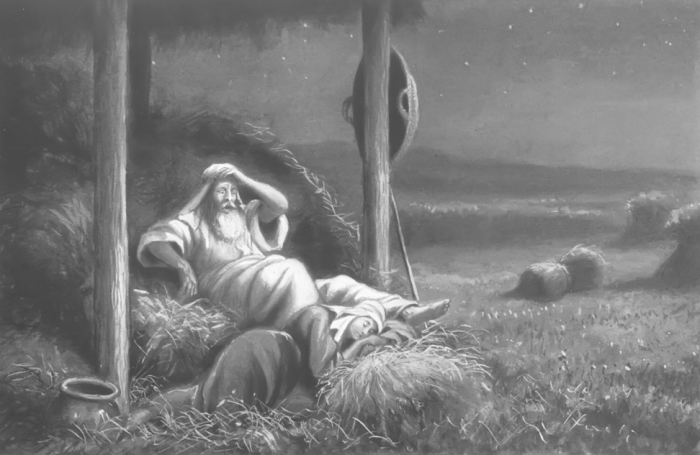
3:7 When Boaz had finished eating and drinking and was in good spirits [does not necessarily mean that he was drunk], he went over to lie down at the far end of the grain pile. Ruth approached quietly, uncovered his feet and lay down [Ruth showed no impropriety. She merely exercised her right under Jewish law to approach a kinsman-redeemer.].

3:8 In the middle of the night something startled the man, and he turned and discovered a woman lying at his feet.

3:9 “Who are you?” he asked. “I am your servant [shows humility and respect] Ruth,” she said. “Spread the corner of your garment over me [some interpret this as a marriage proposal], since you are a kinsman-redeemer.”

3:10 “The Lord bless you, my daughter,” he replied [a joyful response]. “This kindness is greater than that which you showed earlier [see 2:11]: You have not run after the younger men, whether rich or poor.

3:11 And now, my daughter, don’t be afraid. I will do for you all you ask. All my fellow townsmen know that you are a woman of noble character [Boaz was also of noble character (see 2:1)].

3:12 Although it is true that I am near of kin, there is a kinsman-redeemer nearer than I [and therefore the law required that he be given first choice].

3:13 Stay here for the night, and in the morning if he wants to redeem, good; let him redeem. But if he is not willing, as surely as the Lord lives [a solemn and binding oath] I will do it. Lie here until morning [an indication of Boaz’s trust in God and his willingness to go about the matter in the right way … according to the laws of his people.].”

3:14 So she lay at his feet until morning, but got up before anyone could be recognized; and he said, “Don’t let it be known that a woman came to the threshing floor [which could have become fodder for the town gossips].”

3:15 He also said, “Bring me the shawl you are wearing and hold it out.” When she did so, he poured into it six measures of barley and put it on her. Then he went back to town.

3:16 When Ruth came to her mother-in-law, Naomi asked, “How did it go, my daughter?” Then she told her everything Boaz had done for her

3:17 and added, “He gave me these six measures of barley, saying, “Don’t go back to your mother-in-law empty-handed [the same word used by Naomi in 1:21; last recorded words of Ruth in the book].’”

3:18 Then Naomi said, “Wait [an indication that Naomi trusted God to work things out], my daughter, until you find out what happens. For the man will not rest until the matter is settled today.”

Ruth 2

2:1 Now Naomi had a relative on her husband’s side, from the clan of Elimelech, a man of standing [a distinguished person or property holder], whose name was Boaz.

2:2 And Ruth the Moabitess [this term serves as a reminder that Ruth was a foreigner] said to Naomi, “Let me go to the fields and pick up [glean] the leftover grain [see Deut. 24:19 and Lev 19:9-10; 23:22] behind anyone in whose eyes I find favor [an indication that the poor were not always treated well by landowners].” Naomi said to her, “Go ahead my daughter [an affectionate reference].”

2:3 So she went out and began to glean in the fields behind the harvesters. As it turned out [a reference to God’s providential guidance], she found herself working in a field belonging to Boaz, who was from the clan of Elimelech.

2:4 Just then Boaz arrived from Bethlehem and greeted the harvesters, “The Lord be with you! [a typical Israelite greeting … see Psalm 129:8]” “The Lord bless you!” they called back.

2:5 Boaz asked the foreman of his harvesters, “Whose young woman is that? [suggests an attraction to Ruth]

2:6 The foreman replied, “She is the Moabitess who came back from Moab with Naomi [Boaz probably had heard about Ruth and Naomi (see 1:19) but had not yet had an opportunity to meet either of these women].

2:7 She said, ‘Please [Ruth courteously asked permission to glean] let me glean and gather among the sheaves behind the harvesters.’ She went into the field and has worked steadily from morning until now, except for a short rest in the shelter [perhaps a reference to a temporary shelter where workers could rest].”

2:8 So Boaz said to Ruth, “My daughter [may indicate a disparity in their ages … see also Ruth 3:10], listen to me. Don’t go and glean in another field and don’t go away from here. Stay here with my servant girls [an indication of Boaz’s concern for Ruth].

2:9 Watch the field where the men are harvesting, and follow along after the girls. I have told the men not to touch you [further indication of Boaz’s concern for Ruth]. And whenever you are thirsty, go and get a drink from the water jars the men have filled [a privilege not extended to other gleaners].”

2:10 At this, she bowed down with her face to the ground. She exclaimed, “Why have I found such favor in your eyes that you notice me — a foreigner?”

2:11 Boaz replied, “I’ve been told all about what you have done for your mother-in-law since the death of your husband — how you left your father and mother and your homeland and came to live with a people you did not know before [Boaz had heard about Ruth’s devotion and sacrifice.].

2:12 [Boaz pronounced a blessing on Ruth.] May the Lord repay you for what you have done. May you be richly rewarded by the Lord, the God of Israel, under whose wings you have come to take refuge [Boaz certainly became an answer to his own prayers.].”

2:13 “May I continue to find favor in your eyes [an expression of gratitude], my lord [a common way of expressing respect],” she said. “You have given me comfort and have spoken kindly to your servant — though I do not have the standing of one of your servant girls [a woman at the lowest social level].”

2:14 At mealtime Boaz [continued to express an interest in Ruth] said to her, “Come over here. Have some bread and dip it in the wine vinegar.” When she sat down with the harvesters, he offered her some roasted grain. She ate all she wanted and had some left over.

2:15 As she got up to glean, Boaz gave orders to his men [Boaz’s orders show his special interest in Ruth], “Even if she gathers among the sheaves, don’t embarrass her.

2:16 Rather, [deliberately] pull out some stalks for her from the bundles and leave them for her to pick up, and don’t rebuke her.”

2:17 So Ruth gleaned in the field until evening. Then she threshed [separated the grain from the chaff] the barley she had gathered, and it amounted to about an ephah [possibly up to fifty pounds of grain which was far more than a gleaner could acquire in an ordinary day of work and an amount that would last Ruth and Naomi for several weeks].

2:18 She carried it back to town, and her mother-in-law saw how much she had gathered. Ruth also brought out and gave her what she had left over after she had eaten enough [an indication of Ruth’s thoughtfulness].

2:19 Her mother-in-law asked her, “Where did you glean today? Where did you work? Blessed be the man who took notice of you! [Naomi pronounced a blessing on the benefactor.]” Then Ruth told her mother in law about the one at whose place she had been working. “The name of the man I worked with today is Boaz,” she said.

2:20 “The Lord bless him! [Naomi pronounced a second blessing on Boaz.]” Naomi said to her daughter-in-law. “He has not stopped showing his kindness to the living and the dead [Boaz would eventually show kindness to Mahlon by giving him an heir through levirate marriage.].” She added, “That man is our close relative; he is one of our kinsman redeemers [Hebrew = goel, meaning “to redeem, buy back.” A kinsman redeemer “was responsible for protecting the interests of needy members of the extended family — e.g., to provide an heir for a brother who had died (Deut. 25:5-10), to redeem land that a poor relative had sold outside the family (Lev. 25:25-28), to redeem a relative who had been sold into slavery (Lev. 25:47-49) and to avenge the killing of a relative (Num. 35:19-21). —from NIV Study Bible].”

2:21 The Ruth the Moabitess said, “He even said to me, ‘Stay with my workers until they finish harvesting all my grain [this arrangement offered protection for Ruth].’”

2:22 Naomi said to Ruth her daughter-in-law, “It will be good for you, my daughter, to go with his girls, because in someone else’s field you might be [violently] harmed.”

2:23 So Ruth stayed close to the servant girls of Boaz to glean until the barley and wheat harvests were finished [the two harvests lasted for about seven weeks]. And she lived with her mother-in-law.

Ruth 1

1:1 In the days when the judges ruled, [a turbulent period characterized by lawlessness, immorality, idolatry, war, and chaos in Israel according to Judges 21:25] there was a famine in the land [a natural catastrophe], and a man from Bethlehem in Judah, together with his wife and two sons, went to live for a while [as resident aliens] in the country of Moab [in expectation of a fuller life. Moab was located thirty-five miles southeast of Bethlehem, on the east side of the Dead Sea.].

1:2 The man’s name was Elimelech [name meaning, “My God is King”], his wife’s name Naomi [name meaning “pleasant” or “lovely”], and the names of his two sons were Mahlon and Kilion. They were Ephrathites from Bethlehem [Bethlehem was also known as Ephrath according to Genesis 35:19], Judah. And they went [eastward across the Jordan River] to Moab and lived there.

1:3 Now Elimelech, Naomi’s husband, died [after an undetermined period of time], and she was left with her two sons.

1:4 They married Moabite women [the law did not expressly forbid Israelites to marry Moabites according to Deuteronomy 7:1-3], one named Orpah [married Kilion] and the other Ruth [Hebrew name meaning “friendship” or “association.” Ruth married Mahlon according to Ruth 4:10.]. After they had lived there about ten years,

1:5 both Mahlon and Kilion also died, and Naomi was left without her two sons and her husband [a desperate situation for a woman, especially in a foreign country].

1:6 When she heard in Moab that the Lord had come to the aid of His people by providing food for them, Naomi and her daughters-in-law [Orpah and Ruth were prepared to leave their own land and accompany Naomi] prepared to return home [a journey of about 50 or 60 miles] from there.

1:7 With her two daughters-in-law she left the place where she had been living and set out on the road that would take them back to the land of Judah [perhaps they had only traveled a short distance when Naomi urged her daughters-in-law to return to their mother’s home].

1:8 Then Naomi said to her daughters-in-law, “Go back, each of you, to your mother’s home. May the Lord show kindness [Hebrew — “chesed” which refers to “deeds of mercy performed by a more powerful party for the benefit of a weaker one”] to you, as you have shown to your dead and to me.

1:9 May the Lord grant that each of you will find rest [security, not necessarily freedom from work] in the home of another husband.” Then she kissed them and they wept aloud

1:10 and said to her, “We [Both Orpah and Ruth pledged to stay with Naomi. This speaks highly of both Naomi and her daughters-in-law.] will go back with you to your people.”

1:11 But Naomi said, “Return home [Naomi unselfishly considered the welfare of her daughters-in-law above her own.], my daughters. Why would you come with me? Am I going to have any more sons [Assumes the law of levirate marriage in which these sons would be obligated to marry the childless widows of their older brothers and, by so doing, provide an heir to their brother’s name and heritage. See Deuteronomy 25:5-10.], who could become your husbands?

1:12 Return home, my daughters; I am too old to have another husband. Even if I thought there was still hope for me — even if I had a husband tonight and then gave birth to two sons —

1:13 would you wait until they grow up? Would you remain unmarried for them? No, my daughters. It is more bitter for me than for you [because Naomi’s daughters-in-law were still young enough to remarry and find happiness and security], because the Lord’s hand has gone out against me! [Naomi believed that nothing happened by chance. The prevailing thought of the day was that life’s difficulties were punitive acts of God.]

1:14 At this they wept again [because of the apparent hopelessness of their situation]. Then Orpah [reluctantly obeyed Naomi’s wishes] kissed her mother-in-law good-by, but Ruth clung to her.

1:15 “Look,” said Naomi, “your sister-in-law is going back to her people and her gods [By returning to her people Orpah also returned to the gods worshiped by her people. Chemosh was the god of the Moabites. A common belief was that deities were restricted by geographical boundaries.]. Go back with her.”

1:16 But Ruth [in contrast to Orpah] replied, “Don’t urge me to leave you or to turn back from you [Ruth made a commitment to go with Naomi and share both her home and whatever circumstances they might encounter.]. Where you go I will go, and where you stay I will stay. Your people will be my people and your God my God [Ruth renounced both her people and gods. Ruth’s decision to stay with Naomi and to embrace Naomi’s people and God reveals her noble character.].

1:17 Where you die I will die [death would be the only thing to separate Ruth from Naomi], and there I will be buried. May the Lord deal with me, be it ever so severely, if anything but death separates you and me [Ruth swore a curse on herself if she did not keep her promise to Naomi.].”

1:18 When Naomi [It is noteworthy that Naomi’s life and example so impressed Ruth that Ruth was willing to abandon her homeland and her gods.] realized that Ruth was determined to go with her, she stopped urging her.

1:19 So the two women went on [the journey was likely very dangerous for these two unaccompanied women] until they came to Bethlehem [located about five miles south of Jerusalem]. When they arrived in Bethlehem, the whole town was stirred [buzzed with commotion] because of them, and the women exclaimed, “Can this be Naomi? [this is exclamatory rather than interrogative]

1:20 “Don’t call me Naomi,” she told them. “Call me Mara [meaning “bitter,” as in Exodus 15:23], because the Almighty [Shaddai] has made my life very bitter [This was not a complaint but an acknowledgment of God’s sovereign control of all things. Naomi did not yet realize how God would work all of the experiences she said made her life bitter into something better.].

1:21 I went away full [not a reference to possessions but to family], but the Lord has brought me back empty [widowed and childless]. Why call me Naomi? The Lord has afflicted [caused evil or testified against] me; the Almighty has brought misfortune upon me [reflects a common Israelite belief that God blessed the righteous and brought calamity on the unrighteous].”

1:22 So Naomi returned from Moab accompanied by Ruth the Moabitess, her daughter-in-law, arriving in Bethlehem as the barley harvest [prepares us for the events of chapter 2] was beginning [near the end of April. The two widows arrived in Bethlehem at an opportune time. Their need for food would be satisfied by gleaning in harvest fields.].

Judges 7

7:1 Early in the morning, Jerub-Baal (that is Gideon) and all his men camped at the spring of Harod. The camp of Midian was north of them in the valley near the hill of Moreh.

The time for battle finally arrived. Gideon’s hastily assembled volunteer army of 32,000 (v. 3) was camped and waiting to do battle with the Midianite coalition of more than 135,000 (see 8:10). Perhaps Gideon thought that he had too few with which to face so many.

7:2 The Lord said to Gideon, “You have too many men for Me to deliver Midian into their hands. In order that Israel may not boast against Me that her own strength has saved her,

God did not want for Gideon to place his faith in the size of his army. Nor did God want for the army to boast that they had won the victory over the Midianites. This word from the Lord must have come as a surprise to Gideon. God however, did not need a large army to defeat Midian — “Nothing can hinder the Lord from saving, whether by many or by few” (1 Sam. 14:6).

7:3 announce now to the people, “Anyone who trembles with fear may turn back and leave Mount Gilead.’” So twenty-two thousand men left, while ten thousand remained.

The Lord began the process of sifting and reducing the size of Gideon’s army. The first to be released from service were the fearful. The presence of fearful men could have had a negative impact on the rest of the army (see Deut. 20:8). Twenty-two thousand men returned to their homes after Gideon’s announcement, leaving him with an army of only ten thousand.

7:4 But the Lord said to Gideon, “There are still too many men. Take them down to the water, and I will sift them for you there. If I say, ‘This one shall go with you,’ he shall go; but if I say, ‘This one shall not go with you,’ he shall not go.”

God instructed Gideon to take his men “to the water” to sift and further reduce the size of his army.

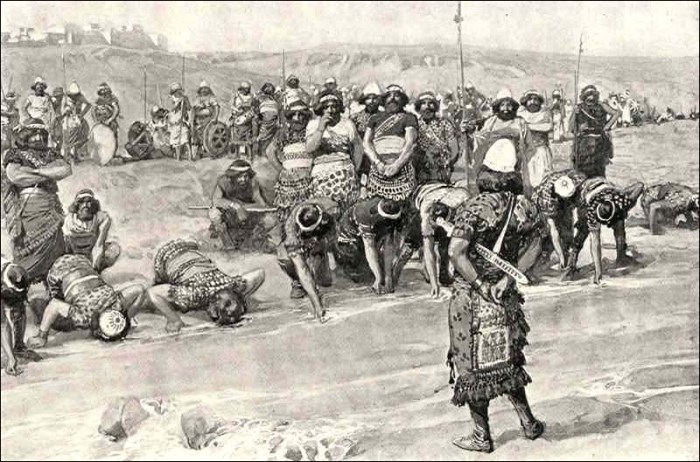
7:5 So Gideon took the men down to the water. There the Lord told him, “Separate those who lap the water with their tongues like a dog from those who kneel down to drink.”

The men who drank water did not know they were being tested. The Scripture does not tell us the significance of the test of drinking water. Some have conjectured that those who knelt to drink and brought the water to their mouths were more alert and kept their eyes on Gideon and their surroundings. Perhaps. The important thing to keep in mind is that this was a simple way to reduce the size of Gideon’s army without raising suspicion. On a practical note, this occasion reminds us to always be alert because we may not know when we are being tested. Marsden said, “Make every occasion a great occasion, for you can never tell when somebody may be taking your measure for a larger place.”

7:6 Three hundred men lapped with their hands to their mouths. All the rest got down on their knees to drink.

Gideon’s army was now reduced from 32,000 to only 300 men.

7:7 The Lord said to Gideon, “With the three hundred men that lapped I will save you and give the Midianites into your hands. Let all the other men go, each to his own place.”

God gave Gideon yet another promise of victory.

7:8 So Gideon sent the rest of the Israelites to their tents but kept the three hundred, who took over the provisions and trumpets of the others. Now the camp of Midian lay below him in the valley.

Gideon claimed God’s promise by releasing all but the 300 men that lapped water with their hands. The other men were released but left their equipment for use by the 300 men — torches, trumpets, and jars. The word “kept” implies that the 300 also had an urge to leave with the others.

7:9 During that night the Lord said to Gideon, “Get up, go down against the camp, because I am going to give it into your hands.

God instructed Gideon to “go down against the camp” and again assured him of victory.

7:10 If you are afraid to attack, go down to the camp with your servant Purah

God however, still had to deal with the fear in Gideon’s heart. As a final means of assurance (see 6:14,16; 7:7 for three previous assurances), God instructed Gideon to go down to the Midianite camp with his servant Purah.

7:11 and listen to what they are saying. Afterward, you will be encouraged to attack the camp.” So he and Purah his servant went down to the outposts of the camp.

Gideon was to eavesdrop on a conversation between two soldiers (v. 13).

7:12 The Midianites, the Amalekites and all the other eastern peoples had settled in the valley, thick as locusts. Their camels could no more be counted than the sand on the seashore.

It took courage for Gideon and Purah to go to the Midianite camp, especially because the Midianite coalition seemed innumerable.

7:13 Gideon arrived just as a man was telling a friend his dream. “I had a dream,” he was saying. “A round loaf of barley bread came tumbling into the Midianite camp. It struck the tent with such force that the tent overturned and collapsed.”

As Gideon and Purah listened from the shadows, a man related his dream to a friend. Barley was a grain used by poor people and here indicates weakness — a stale barley-cake that rolled into the Midianite camp like a wheel overturning the “tent“ (symbol of the nomadic forces).

7:14 His friend responded, “This can be nothing other than the sword of Gideon son of Joash, the Israelite. God has given the Midianites and the whole camp into his hands.”

Gideon heard from the lips of his enemy the very thing God had repeatedly told him. The man’s friend interpreted the dream as an indication that God would deliver Midian into the hands of the Israelites.

7:15 When Gideon heard the dream and its interpretation, he worshiped God. He returned to the camp of Israel and called out, “Get up! The Lord has given the Midianite camp into your hands.”

Gideon’s immediate response was to worship God. He then returned to his camp to muster his forces. We can only wonder if Gideon shared with his soldiers about the dream and its interpretation.

7:16 Dividing the three hundred men into three companies, he placed trumpets and empty jars in the hands of all of them, with torches inside.

Gideon armed his small army with peculiar weapons. By dividing his army into three companies, Gideon would give the enemy the impression that his army was much larger. The trumpets also helped create the impression of a large army. Only the leaders blew the trumpet in battle to give signals to their troops. Therefore, three hundred trumpets would give the enemy the impression that they were under attack by a very large army.

7:17 “Watch me,” he told them. “Follow my lead. When I go to the edge of the camp, do exactly as I do.

Gideon instructed his men to follow his example. Gideon is a new man. His words reflect great confidence.

7:18 When I and all who are with me blow our trumpets, then from all around the camp blow yours and shout, ‘For the Lord and for Gideon.’”

Gideon’s strategy was simple. Surround the camp. At Gideon’s signal, blow the trumpets (ram’s horn or shofar), break the jars, reveal the lights, and shout, “For the Lord and for Gideon.”

7:19 Gideon and the hundred men with him reached the edge of the camp at the beginning of the middle watch, just after they had changed the guard. They blew their trumpets and broke the jars that were in their hands.

Gideon courageously led his men from the Spring of Harod (“trembling”) to the edge of the Midianite camp in the Valley of Jezreel. With each company in place, they waited for Gideon’s signal and then blew their trumpets and broke their jars.

7:20 The three companies blew the trumpets and smashed the jars. Grasping the torches in their left hands and holding in their right hands the trumpets they were to blow, they shouted, “A sword for the Lord and for Gideon!”

What a surprise this sight and the sound of the battle cry must have been to the slumbering enemy. The Midianite coalition must have thought a large army was attacking them.

7:21 While each man held his position around the camp, all the Midianites ran, crying out as they fled.

Panic ensued.

7:22 When the three hundred trumpets sounded, the Lord caused the men throughout the camp to turn on each other with their swords. The army fled to Beth Shittah toward Zererah as far as the border of Abel Meholah near Tabbath.

A spirit of confusion caused the enemy soldiers to turn on one another and then flee.

7:23 Israelites from Naphtali, Asher and all Manasseh were called out, and they pursued the Midianites.

The Israelite army pursued their confused enemy.

7:24 Gideon sent messengers throughout the hill country of Ephraim, saying, “Come down against the Midianites and seize the waters of the Jordan ahead of them as far as Beth Barah.” So all the men of Ephraim were called out and they took the waters of the Jordan as far as Beth Barah.

Gideon sent messengers to call for reinforcements to assist in pursuing the Midianites. Perhaps many of the original 32,000 returned to pursue the Midianite army. This time the powerful tribe of Ephraim joined in to assist Gideon.

7:25 They also captured two of the Midianite leaders, Oreb and Zeeb. They killed Oreb at the rock of Oreb, and Zeeb at the winepress of Zeeb. They pursued the Midianites and brought the heads of Oreb and Zeeb to Gideon, who was by the Jordan.

Oreb (“raven”) and Zeeb (“wolf”), two generals (princes) of Midian, were captured and slain. The story of Gideon began with Gideon hiding in a winepress (6:11) and ended with the enemy prince being slain at a winepress.

Judges 6

6:1 [Judges records the repeated cycles of apostasy, judgment, and deliverance of the Israelites] Again [for the fourth time in Judges, the Israelites fell into sin; someone defined insanity as repeatedly doing the same thing but expecting different results] the Israelites [refers to all the tribes of Israel; failed to learn the importance of faithfulness to the Lord from the previous and recent periods of apostasy in their history] did evil in the eyes of the Lord [ God is familiar with all our ways (cf. Ps. 139:3); we never do anything “behind the Lord’s back”], and for seven years He gave them into the hands [cf. Ps. 119:67a] of the Midianites [nomads from the region east and southeast of the Dead Sea].

6:2 Because the power of Midian was so oppressive, the Israelites prepared shelters for themselves in mountain clefts, caves, and strongholds.

6:3 Whenever the Israelites planted their crops, the Midianites, Amalekites and other eastern peoples invaded the country.

6:4 They [“Midianites, Amalekites and other eastern peoples” (cf. 6:3)] camped on the land and ruined the crops all the way to Gaza and did not spare a living thing for Israel, neither sheep nor cattle nor donkeys.

6:5 They came up with their livestock and the tents like swarms of locusts. It was impossible to count the men and their camels; they invaded [this annual destruction should have served as a wake-up call concerning the need for repentance] the land to ravage it.

6:6 Midian so impoverished [left them without adequate food for another year] the Israelites that they cried out to the Lord for help [distress and difficulty have a way of eventually turning our focus heavenward].

6:7 When the Israelites cried to the Lord because of Midian [how often we cry to the Lord for understanding concerning our difficulties without realizing our role in inviting such difficulties to visit us],

6:8 He [indicates that God heard the cries of the Israelites] sent them a prophet [unnamed], who said [the prophet pinpointed the cause of the oppression], “This is what the Lord, the God of Israel, says: I brought you up out of Egypt, out of the land of slavery.

6:9 I [God had released them from Egypt’s slavery] snatched you from the power of Egypt and from the hand of all your oppressors. I drove them from before you and gave you their land.

6:10 I said to you, ‘I am the Lord your God; do not worship the god of the Amorites [used generally to refer to all the inhabitants of Palestine], in whose land you live.’ But you have not listened to Me [they disobeyed God].”

6:11 The angel of the Lord came and sat down under the oak in Ophrah [a town located west of the Jordan River (exact location uncertain)] that belonged to Joash the Abiezrite, where his son Gideon was threshing wheat in a winepress [a pit carved out of rocky ground; ordinarily, the threshing of wheat was done in exposed areas where the wind could blow away the chaff] to keep it [to hide the wheat and himself] from the Midianites.

6:12 When the angel of the Lord appeared to Gideon [someone wisely noted that God does not always call the qualified, but He always qualifies the called], he said, “The Lord is with you, mighty [means “prevail,” “have strength,” or “be great”] warrior [Gideon had no record of distinguished military service; a prophetic statement of what God would make out of this fearful man secretly threshing wheat in a pit; God often uses fearful and unlikely people to do His work — people who would not qualify for service by the world’s standards (see 1 Cor. 1:26-27)].”

6:13 “But sir [a term of respect; suggests he did not know his visitor was the angel of the Lord],” Gideon replied, “if the Lord is with us, why has all this happened to us? Where are all His wonders that our fathers told us about when they said [Gideon had heard wonderful stories about the Lord’s deliverance of Israel from Egypt], ‘Did not the Lord bring us up out of Egypt?’ But now the Lord has abandoned us [the truth of the matter was not that the Lord had forsaken Israel but that Israel had forsaken the Lord] and put us into the hand of Midian.”

6:14 The Lord [the angel is here identified as “the Lord”] turned to him and said, “Go [the Lord called and commissioned Gideon for an important task, just as He had called and commissioned Moses before him (Ex. 3:12)] in the strength you have and save Israel out of Midian’s hand. Am I not sending you?”

6:15 “But Lord,” Gideon asked [Moses too, was reluctant (Ex. 3:11)], “how can I save Israel? My clan is the weakest [God often uses the weak and most unlikely candidates to do His work (cf. 1 Cor. 1:26-27)] in Manasseh, and I am the least [youngest] in my family.”

6:16 The Lord answered, “I will be with you [if God is with us, who can resist us (cf. Rom. 8:31)], and you will strike down all the Midianites together.”

6:17 Gideon replied, “If now I have found favor in your eyes, give me a sign [the first of three signs he asked for] that it is really you talking to me.

6:18 Please do not go away until I come back and bring my offering and set it before you.” And the Lord said, “I will wait until you return.”

6:19 Gideon went in, [note that Gideon prepared a substantial meal for his heavenly guest, especially in light of the scarcity of food] prepared a young goat, and from an ephah of flour he made bread without yeast. Putting the meat in a basket and its broth in a pot, he brought them out and offered them to him under the oak.

6:20 Then the angel of the Lord said to him, “Take the meat and the unleavened bread, place them on this rock [perhaps part of the winepress.], and pour out the broth.” And Gideon did so.

6:21 With the top of the staff that was in his hand, the angel of the Lord touched the meat and the unleavened bread. Fire flared from the rock, consuming [an indication that Gideon’s offering was accepted] the meat and the bread. And the angel of the Lord disappeared.

6:22 When Gideon realized that it was the angel of the Lord, he exclaimed, “Ah, Sovereign Lord! I have seen the angel of the Lord face to face!”

6:23 But the Lord said to him, “Peace [an indication that the Lord had the welfare of Gideon and Israel uppermost in His heart]! Do not be afraid. You are not going to die.”

6:24 So Gideon built an altar [to commemorate the Lord’s promise] to the Lord there and called it The Lord is Peace. To this day it stands in Ophrah of the Abiezrites.

6:25 That same night the Lord said to him, “Take the second bull from your father’s herd, the one seven years old. Tear down [since Baal worship was popular, this act would require that Gideon exercise courage (cf. 6:27); Gideon had to practice his faith at home before practicing it away from home; he had to face opposition at home before facing opposition on the battlefield] your father’s altar to Baal [worship of Baal was prohibited by God in His Law (see Ex. 34:12-13; Deut. 7:5) and allowed for the stoning of those who worshiped Baal (cf. Deut. 13)] and cut down the Asherah pole [dedicated to the worship of the goddess Asherah] beside it.

6:26 Then build [must tear down altar to false gods before we build altar to God] a proper kind of altar to the Lord your God on the top of this height [perhaps a bluff or stronghold]. Using the wood of the Asherah pole that you cut down, offer the second bull as a burnt offering.”

6:27 So Gideon took ten of his servants and did as the Lord told him. But because he was afraid of his family and the men of the town, he did it at night rather than in the daytime [an indication of his fear].

6:28 In the morning when the men of the town got up, there was Baal’s altar, demolished, with the Asherah pole beside it cut down and the second bull sacrificed on the newly built altar!

6:29 They asked each other, “Who did this [Gideon’s actions aroused the anger of the community]?” When they carefully investigated, they were told, “Gideon son of Joash did it.”

6:30 The men of the town [ironically, according to God’s Law, the “men of the town” should have been slain (cf. Deut. 13:6-9)] demanded of Joash, “Bring out your son. He must die, because he has broken down Baal’s altar and cut down the Asherah pole beside it.”

6:31 But Joash replied to the hostile crowd around him, “Are you going to plead Baal’s cause? Are you trying to save him? Whoever fights for him shall be put to death by morning! If Baal really is a god, he can defend himself when someone breaks down his altar [if Baal was indeed a god, he was capable of defending himself].”

6:32 So that day they called Gideon “Jerub-Baal [“Baal’s antagonist” (a derogatory name)], saying, “Let Baal contend with him,” because he broke down Baal’s altar.

6:33 Now all the Midianites, Amalekites and other eastern peoples joined forces [according to Jud. 8:10, the Midianite coalition numbered more than 135,000] and crossed over [for their annual invasion] the Jordan and camped in the Valley of Jezreel.

6:34 Then the Spirit of the Lord came upon [clothed; to strengthen him for the task (cf. Zech. 4:6)] Gideon, and he blew a trumpet, summoning the Abiezrites [the men of his hometown] to follow him.

6:35 He sent messengers throughout Manasseh, calling them to arms, and also into Asher, Zebulun and Naphtali [the four tribes who lived nearest the Valley of Jezreel and who would be affected the most by the invading Midianites; 32,000 men responded to Gideon’s call (cf. Jud. 7:3)], so that they too went up to meet them.

6:36 Gideon [got cold feet before leading the people into battle] said to God, “If you will save Israel by my hand as you have promised —[Gideon asked God for two more signs before going into battle; he requested a sign from God that would reaffirm God’s promise to him…]

6:37 look, I will place a wool fleece on the threshing floor. If there is dew on the fleece and all the ground is dry, then I will know that you will save Israel by my hand, as you said.

6:38 And that is what happened. [God stooped to Gideon’s weakness and reaffirmed His promise…] Gideon rose early the next day; he squeezed the fleece and wrung out the dew — a bowlful of water.

6:39 Then Gideon said to God, “Do not be angry with me. Let me make just one more request. Allow me one more test with the fleece. This time make the fleece dry and the ground covered with dew.”

6:40 That night God did so. Only the fleece was dry; all the ground was covered with dew.
Judges 5

Judges 5:1-11
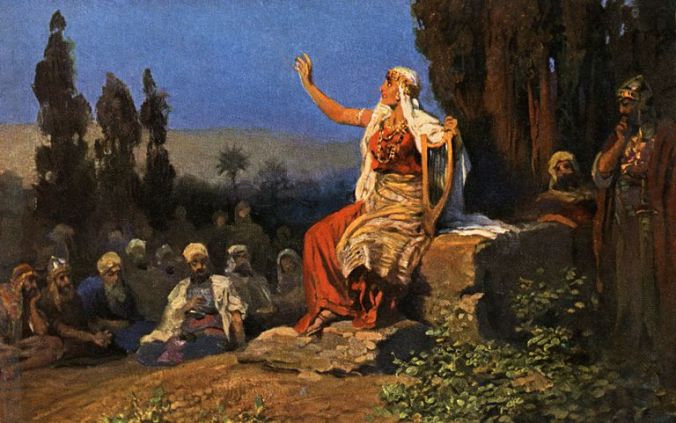
5:1 [a poetic description of the events in chapter 4; cf. song of Moses in Ex. 15] On that day Deborah and Barak son of Abinoam sang [Heb. word means “to sing with a stringed instrument”] this song:

5:2 “When the princes in Israel take the lead [military leaders willing to fight against Sisera], when the people [10,000 soldiers] willingly offer [volunteer] themselves—praise the LORD [the theme of this chapter]!

5:3 “Hear this, you kings! Listen, you rulers! I will sing to the LORD, I will sing; I will make music to the LORD, the God of Israel.

5:4 “O LORD, when you went out from Seir, when you marched from the land of Edom, the earth shook, the heavens poured, the clouds poured down water.

5:5 The mountains quaked before the LORD, the One of Sinai, before the LORD, the God of Israel.

5:6 [a description of the conditions that existed under Canaanite oppression] “In the days of Shamgar [a judge] son of Anath, in the days of Jael [the woman who killed Sisera (cf. 5:24-27)], the roads [the highways were controlled by the Canaanites who exploited travelers] were abandoned; travelers [caravans and individual travelers] took to winding paths [the back roads].

5:7 Village [small settlement that had no defensive wall] life in Israel ceased [people did not work in their fields for fear of the Canaanites], ceased until I, Deborah, arose [in the midst of Israel’s plight], arose a mother [a title of honor; evident in her concern and courage] in Israel.

5:8 When they [the Israelites] chose new gods [Canaanite idols such as Baal and Asherah], war [the judgement and discipline of the Lord] came to the city gates, and [note that Israel was powerless before attacking enemies] not a shield or spear was seen among forty thousand in Israel.

5:9 My heart is with Israel’s princes [governors; military leaders], with the willing volunteers among the people. Praise the LORD [this is the theme of this chapter]!

5:10 “You who ride on white donkeys, sitting on your saddle blankets, and you who walk along the road, consider

5:11 the voice of the singers at the watering places. They recite the righteous acts of the LORD, the righteous acts of his warriors in Israel. “Then the people of the LORD went down to the city gates.

Judges 4

Judges 4:4-16
4:1 After Ehud died, the Israelites once again did evil in the eyes of the LORD.

4:2 So the LORD sold them into the hands of Jabin, a king of Canaan, who reigned in Hazor. The commander of his army was Sisera, who lived in Harosheth Haggoyim.

4:3 Because he had nine hundred iron chariots and had cruelly oppressed the Israelites for twenty years, they cried to the LORD for help.

4:4 [note four things about Deborah] [1] Deborah [woman], [2] a prophetess [delivered God’s messages to Israelites], the [3] wife of Lappidoth, was [4] leading [judging or governing; judges served as judicial, religious, military leaders; only woman to serve as a judge (leader)] Israel at that time.

4:5 She held court under the Palm of Deborah [the place to which people brought their disputes] between Ramah and Bethel in the hill country of Ephraim, and the Israelites came to her to have their disputes decided.

4:6 She [acting on divine instructions] sent for [summoned] Barak [Israel’s military leader] son of Abinoam from Kedesh in Naphtali and said to him, “The LORD, the God of Israel, commands you [Deborah delivered God’s message]: ‘Go, take with you ten thousand men of Naphtali and Zebulun [from the northern part of Israel] and lead the way to Mount Tabor.

4:7 I will lure [Heb. word means “drag” or “seize”] Sisera, the commander of Jabin’s [king of Canaan] army, with his chariots [the latest of military weapons at that time] and his troops [supporting infantry] to the Kishon River [or “wadi”—a stream or river that contains water only in the rainy season] and give him into your hands.’”

4:8 Barak said to her, “If you go with me [Barak wanted to be accompanied by God’s prophetess because he believed God’s presence was ensured by her presence], I will go; but if you don’t go with me, I won’t go.”

4:9 “Very well,” Deborah said, “I will go with you. But because of the way you are going about this [needing the reassurance of 4:8], the honor will not be yours, for the LORD will hand Sisera over to a woman [not Deborah but Jael (cf. 4:17-24)].” So Deborah went with Barak to Kedesh [located in Naphtali (north of Sea of Galilee)],

4:10 where he summoned [means “cry out” or “call” or “to cry for help in a time of distress”] Zebulun and Naphtali. Ten thousand men followed him, and Deborah also went with him.

4:11 Now Heber the Kenite had left the other Kenites, the descendants of Hobab, Moses’ brother-in-law, and pitched his tent by the great tree in Zaanannim near Kedesh.

4:12 When they told Sisera that Barak son of Abinoam had gone up to Mount Tabor,

4:13 Sisera gathered together his nine hundred iron chariots and all the men with him, from Harosheth Haggoyim to the Kishon River.

4:14 Then Deborah said to Barak, “Go! This is the day the LORD has given Sisera into your hands. Has not the LORD gone ahead of you?” So Barak went down [this took faith and courage] Mount Tabor, followed by ten thousand men [encouraged by Barak’s example].

4:15 At Barak’s advance, the LORD routed [through human instruments (Barak and his men)] Sisera and all his chariots [Jud. 5:4,20 imply rain which may have caused chariots to get bogged down in the mud thus levelling the playing field] and army by the sword, and Sisera abandoned his chariot and fled on foot.

4:16 But Barak pursued the chariots and army as far as Harosheth Haggoyim. All the troops of Sisera fell by the sword; not a man was left.

Joshua 3

3:1 Early in the morning Joshua and all the Israelites set out from Shittim and went to [a journey of about ten miles] the Jordan where they camped before crossing over.

3:2 After three days [on the third day] the officers went throughout the camp,

3:3 giving orders to the people: “When you see the ark of the covenant [symbolized God’s presence among His people; contained the stone tablets on which the Ten Commandments had been written, a jar of manna, and Aaron’s staff (symbol of the high priest’s authority)] of the LORD your God, and the priests [only the priests were permitted to carry the ark], who are Levites, carrying it, you are to move out from your positions [specific locations in the camp and an assigned order in the march] and follow [better to follow God than to try to get ahead of Him] it.

3:4 Then you will know which way to go, since you have never been this way before [important to follow God, especially when you are venturing to places where you have never been before]. But keep a distance [because the ark was very holy] of about a thousand yards between you and the ark; do not go near it.”

3:5 Joshua told the people, “Consecrate yourselves [involved bathing, washing one’s clothing, abstinence from sexual activity (Ex. 19:14-15)], for tomorrow the LORD will do amazing [miraculous] things among you.”

3:6 Joshua said to the priests, “Take up the ark of the covenant and pass on ahead of the people.” So they took it up and went ahead of them.

3:7 And the LORD said to Joshua, “Today I will begin to exalt you [this miracle would help confirm Joshua’s leadership] in the eyes of all Israel, so they may know that I am with you as I was with Moses.

3:8 Tell the priests who carry the ark of the covenant: ‘When you reach the edge of the Jordan’s waters, go and stand in the river [the river at this time was overflowing its banks].’”

3:9 Joshua said to the Israelites, “Come here and listen [a call to listen and obey] to the words of [points to the source of Joshua’s message] the LORD your God [Joshua pointed the people to the Lord and His greatness].

3:10 This [their obedience to God] is how you will know that the living [as opposed to the dead idols of the heathen nations that inhabited the promised land (cf. Ps. 115:3-7)] God is among you and that he will certainly drive out before you the Canaanites [lived in the lowlands of the seacoast and the Jordan valley (Num. 13:29)], Hittites, Hivites [cf. Josh. 11:3], Perizzites [lived in the central highlands (Gen. 13:7; 34:30)], Girgashites, Amorites [lived in the mountainous areas (Num. 13:29) and Jebusites [inhabited Jerusalem (Josh. 15:63)].

3:11 See, the ark of the covenant of the Lord of all the earth will go into the Jordan ahead of you.

3:12 Now then, choose twelve men from the tribes of Israel, one from each tribe.

3:13 And as soon as the priests who carry the ark of the LORD—the Lord [ruler, owner] of all the earth—set foot in the Jordan, its waters flowing downstream will be cut off and stand up in a heap.”

3:14 So when the people broke camp to cross the Jordan, the priests carrying the ark of the covenant went ahead [cf. Josh. 3:3-4] of them.

3:15 Now the Jordan is at flood stage [Jordan normally about a hundred feet wide but as much as a mile wide in flood season (Wiersbe); making a crossing a dangerous, if not an impossible, venture] all during harvest. Yet as soon as [faith must come first] the priests who carried the ark reached the Jordan and their feet touched [faith in action] the water’s edge,

Note: “Unless we step out by faith (1:3) and ‘get our feet wet,’ we’re not likely to make much progress in living for Christ and serving Him. … Unless we are willing to step out by faith and obey His Word, God can never open the way for us.” (Wiersbe • Be Strong • p. 51)

3:16 the water from upstream stopped flowing. It piled up in a heap a great distance [about twenty miles] away, at a town called Adam in the vicinity of Zarethan, while the water flowing down to the Sea of the Arabah (the Salt Sea) [the Dead Sea] was completely cut off. So the people crossed over opposite Jericho.

3:17 The priests who carried the ark of the covenant of the LORD stood firm on dry ground [no longer covered with water] in the middle of the Jordan, while all Israel passed by until the whole nation had completed the crossing on dry ground.

Joshua 6

Joshua 6:1-5
6:1 Now Jericho [the first walled city the Israelites had ever encountered] was tightly shut up [and fortified] because of the Israelites [news of Israel’s victories east of the Jordan had already reached Jericho; cf. Ex. 23:27]. No one went out and no one came in [indicates how desperate the situation was].

6:2 Then the LORD said to Joshua [important that leaders receive their orders from the Lord], “See, I have delivered [indicated Jericho already belonged to Israelites; guaranteed victory; “Remember that you fight from victory, not just for victory.” (Wiersbe)] Jericho into your hands, along with its king and its fighting men.

Note: You are a poor soldier of Christ if you think you can overcome without fighting, and suppose you can have the crown without the conflict.” (John Chrysostom (347-407) Syrian preacher and martyr)

6:3 March [this was not a military strategy but rather one that would call for people to act in faith; a seemingly foolish plan; God’s wisdom is far above ours (cf. Isa. 55:8-9)] around the city once with all the armed men. Do this for six days.

Note: Three ways to do God’s work: “One is to make the best plans we can, and carry them out to the best of our ability … or, having carefully laid our plans and determined to carry them through, we may ask God to help us, and to prosper us in connection with them. Yet another way of working is to begin with God; to ask His plans, and to offer ourselves to Him to carry out His purposes.” (Hudson Taylor • China Inland Mission)

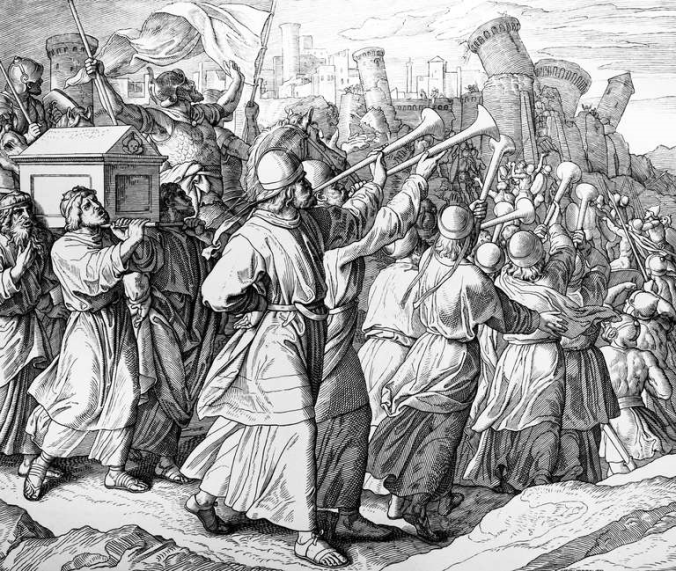
6:4 Have seven [“seven” (Heb. shevah) is the number of divine perfection or completion] priests carry trumpets [typically used to call an assembly, to sound battle signal, and also used in religious observances] of rams’ horns [Heb. jobel (root of the word jubilee)] in front of the ark [represented God’s presence with His people]. On the seventh day, march around the city seven [not “once” as in previous six days] times, with the priests blowing the trumpets.

6:5 When you hear them sound a long blast on the trumpets, have all the people [the whole army] give a loud shout [a battle cry to encourage one another and to intimidate enemy]; then [after God’s instructions followed totally] the wall of the city will [certainty] collapse [thus removing barrier and making city vulnerable to attack] and the people will go up, every man straight in.”

Joshua 6:14-27
6:14 So on the second day they marched around the city once and returned to the camp. They did this for six days [indicates they persisted in obedience; helped people learn patience].

6:15 On the seventh day, they got up at daybreak [early, because there was much to accomplish that day] and marched around the city seven times [as per instructions in v. 4] in the same manner, except that on that day they circled the city seven times.

6:16 The seventh time around, when the priests sounded the trumpet blast, Joshua commanded the people, “Shout! For the LORD has [indicates victory already won] given [victory was a gift from God] you the city!

6:17 The city and all that is in it are to be devoted [under the ban; refers to excluding something from people’s use or abuse and completely surrendering it to God; cf. Deut. 20:16-18; God is concerned about the holiness of His people] to the LORD. Only Rahab [cf. Matt. 1:5; Heb. 11:31; Jas. 2:25] the prostitute and all who are with her in her house shall be spared, because she hid the spies we sent [cf. Josh. 2:1-21].

6:18 But keep away from the devoted things [a specific command], so that you [a reminder that the sin of an individual has consequences for others] will not bring about your own destruction by taking any of them [only Achan violated this command (Josh. 7)]. Otherwise you will make the camp of Israel liable to destruction and bring trouble on it.

Note: “Let us be as watchful after the victory as before the battle.” (Andrew Bonar)

6:19 All [without exception] the silver and gold and the articles of bronze and iron are sacred to the LORD and must go into his treasury.”

6:20 When the trumpets sounded, the people shouted, and at the sound of the trumpet, when the people gave a loud shout, [after God’s instructions had been carefully followed, then…] the wall collapsed; so every man charged straight in, and they took the city.

Note: “The only way to grow in faith is to accept new challenges and trust God to give you victory.” (Wiersbe • Be Strong • p. 78)

Note: “Do not pray for easy lives, pray to be better men and women. Do not pray for tasks equal to your powers; pray for power equal to your tasks.” (Phillips Brooks)

6:21 They devoted the city to the LORD and destroyed with the sword every [emphasizes totality of the destruction] living thing in it—men and women, young and old, cattle, sheep and donkeys.

6:22 Joshua said to the two men who had spied out the land,”Go into the prostitute’s house and bring her out and all who belong to her, in accordance with your oath to her.”

6:23 So the young men who had done the spying went in and brought out Rahab, her father and mother and brothers and all who belonged to her. They brought out her entire family and put them in a place outside the camp of Israel.

Then they burned the whole city and everything in it, but they put the silver and gold and the articles of bronze and iron into the treasury of the LORD’S house [the tabernacle].

6:25 But Joshua spared Rahab the prostitute, with her family and all who belonged to her, because she hid the men Joshua had sent as spies to Jericho—and she lives among the Israelites to this day [either means this account was written while Rahab was still living or that Rahab lived on in her posterity].

6:26 At that time Joshua pronounced this solemn oath [cf. 1 Kings 16:34]: Cursed before the Lord ids the man who undertakes to rebuild this city, Jericho:

“At the cost of his firstborn son
will he lay its foundations;
at the cost of his youngest
will he set up its gates.”

6:27 So the LORD was with Joshua, and his fame spread throughout the land.

Joshua 24

Joshua 24:14-27
24:14 “Now fear [reverently worship] the LORD and serve [with complete devotion] him with all [not halfhearted loyalty and service] faithfulness [with integrity and truth]. Throw away [essential outward expression of their commitment to the Lord; cf. Josh. 24:23] the gods your forefathers worshiped beyond [area where Abram and his father Terah had lived] the River [the Euphrates River in Mesopotamia] and in Egypt, and serve the LORD.

24:15 But if serving the LORD seems undesirable to you, then choose [no neutrality] for yourselves this day [do not delay] whom you will serve [every body must worship and serve something or someone], whether [1] the gods [included the moon god and numerous idols] your forefathers served beyond the River [Mesopotamia], [2] or the gods of the Amorites [people group living in Canaan; sometimes a general designation for all Canaan’s inhabitants], in whose land you are living. But as for me [Joshua set an example by his own choice] and my household, we will serve [3] the LORD.”

24:16 Then the people answered [easy to say, hard to follow-through], “Far be it from us to forsake the LORD to serve other gods!

24:17 [the people recalled God’s mighty acts on their behalf] It was the LORD our God himself who brought us and our fathers up out of Egypt, from that land of slavery, and performed those great signs before our eyes. He protected us on our entire journey and among all the nations through which we traveled.

24:18 And the LORD drove out before us all the nations, including the Amorites, who lived in the land. We too will serve the LORD, because he is our God.”

24:19 Joshua said [words not meant to discourage but rather to cause the people to realize the cost of serving the Lord (cf. Lk. 14:25-35); “a kind of holy provoking” (Bisagno)] to the people, “You are not able to serve the LORD. He is a holy [separate or set apart] God; he is a jealous [God demands and deserves our undivided loyalty and love] God. He will not forgive your rebellion [conveys deliberate revolt against God] and your sins.

24:20 If you forsake the LORD and serve foreign gods, he will turn and bring disaster [cf. Deut. 28:15-68] on you and make an end of you, after he has been good to you.”

24:21 But the people said to Joshua, “No! We will serve the LORD.”

24:22 Then Joshua said, “You are witnesses against yourselves [in other words, their own words would condemn them if they failed to follow-through on their commitment] that you have chosen to serve the LORD.” “Yes, we are witnesses,” they replied.

24:23 “Now then,” said Joshua, “throw away [essential outward expression of their commitment to the Lord; cf. Josh. 24:14] the foreign gods that are among you and yield your hearts [inward loyalty] to the LORD, the God of Israel.”

24:24 And the people said to Joshua, “We will serve the LORD our God and obey him.”

24:25 On that day Joshua made a covenant [a renewal of the covenant God had made with them through Moses (cf. Ex. 19:1-6)] for the people, and there at Shechem he drew up for them decrees and laws [basic stipulation was that they follow God in complete loyalty and obedience].

24:26 And Joshua recorded [so that they wouldn’t forget] these things in the Book of the Law of God. Then he took a large stone and set it up [to serve as a perpetual witness to their agreement; a tangible outward expression of their inner commitment] there under the oak near the holy place of the LORD.

24:27 “See!” he said to all the people. “This stone will be a witness against us. It has heard all the words the LORD has said to us. It will be a witness against you if you are untrue to your God.”

Note: Why is accountability essential to the process of keeping a commitment?