Mark 13

Mark 13:3-14

13:1 One of the disciples called attention to the magnificence of the temple area.

13:2 Jesus foretold destruction of the temple (which occurred in A.D. 70).

13:3 As Jesus was sitting on the Mount of Olives [this high place allowed a good view of the temple mount and of the city of Jerusalem] opposite the temple, Peter, James, John and Andrew [the first disciples Jesus chose (Mk. 1:16-20)] asked him privately [about temple’s future destruction],

13:4 “Tell us [note two concerns], [1] when will these things [destruction of the temple] happen? And [2] what will be the sign [indicator; visible revelation of something to follow] that they [cf. Matt. 24:3] are all about to be fulfilled?”

13:5 Jesus said to them [how to be ready; personal preparation]: “[this warning issued in vv. 5,9,23,33,37] Watch out [Greek = blepo which means beware] that no one [false prophets; imposters] deceives [sound doctrine is the best antidote for false doctrine] you.

Note: What actions should you take to avoid being deceived?

13:6 [First] Many [false prophets and teachers] will [speaks of certainty] come in my name [claiming His authority], claiming, ‘I am he [a messiah or his representative; see Acts 5:36],’ and will deceive [claim to represent God but not live according to His Word] many.

Note: Can you think of recent examples of false teachers or prophets? Have their movements continued after their deaths?

13:7 [Second] When you hear of [political developments and unrest] wars and rumors of war, do not be alarmed [do not allow these events/rumors to divert you from your task of following Jesus and spreading the gospel]. Such things [which are part of natural human existence or normal aspects of history in an unsettled world] must happen, but the end is still to come [do not confuse historical events of your day with eschatological events].

Note: What events today can cause believers today to lose their focus on following Jesus and spreading the gospel?

13:8 [causes of war] Nation will rise against nation, and kingdom against kingdom. [Third] There will be [natural disasters] earthquakes in various places, and famines. These are the beginning [with more to follow] of birth pains.”

Note: In what ways do believers today allow unsettling world events to deter them from their commitment? Do any of these events take God by surprise?

13:9 “You must be on your guard [see v. 5]. You will [speaks of certainty] be handed over [expect official persecution] to the local councils [city and area governments] and flogged in the synagogues [see Acts 6:9; 26:11]. On account of me [religious persecution; see Acts 8:1-3] you will stand before governors and kings as witnesses [turn sufferings into opportunities to witness] to them [magistrates and kings].

Note: Do the events described in these verses relate only to first-century believers? Why or why not?

13:10 And the gospel must first be preached [priority while awaiting Christ’s return] to all nations [word “ethnic” related to word “nation” — refers to people groups; see Isa. 42:6].

Note: There are still over 2,000 unreached people groups who have little or no access to the gospel.

13:11 Whenever you are [unexpectedly] arrested and brought to trial [see Acts 4:1-13], do not worry beforehand [not an excuse for poor preparation] about what to say. Just [turn situation into an opportunity to witness for Christ] say whatever is given you at the time, for it is not you speaking, but the Holy Spirit [see Acts 6:8 — 7:60 re: Stephen].”

Note: What can believers do to prepare to share a witness in difficult situations?

13:12 “[unbelieving] Brother will betray [as Judas betrayed Christ; personal persecution] brother [who is a believer] to death, and a father his child [family difficulties]. Children will rebel against their parents and have them put to death [not just flogged as indicated in verse 9].

Note: Can you think of cases today when believers have been betrayed or killed by family members because of their faith in Christ?

13:13 All [refers to universal scope of opposition] men will hate you because of me [indication of the world’s attitude toward Jesus and His followers], but he who stands firm [bear up under difficulties; endure in commitment to Jesus without wavering; demonstrate the reality of their conversion; the result of a right relationship with God] in the end [the time of the second coming] will be [spiritually] saved.”

Note: How can believers today stand firm in the midst of opposition?

13:14 “When you see ‘the abomination that causes desolation [Dan. 9:27; 11:31; wicked defilement of a holy place]’ standing where it does not belong [some believe this was fulfilled when the Roman army stood in the temple where it did not belong and destroyed it]—let the reader understand—then let those who are in Judea flee to the mountains.

Note: The “abomination that causes desolation” may refer to an end-time antichrist or to Titus and his Roman armies who destroyed the Temple in AD 70.

Mark 13:21-22

13:21 At that time if anyone says to you, ‘Look, here is the Christ!’ or, ‘Look, there he is!’ do not believe it.

13:22 For false Christs and false prophets will appear and [energized by Satan] perform signs and miracles to deceive the elect—if that were possible.

Mark 13:26-27

13:26 “At that time [cf. 13:24-25] men will see [the second coming of Christ will be a visible experience for all to see; cf. 1 Thess. 4:16] the Son of Man coming in clouds [a sign of His deity] with great power and glory.

13:27 And he will send his angels and gather [not a single follower of Jesus will be left behind] his elect [those who have become a part of God’s family through faith in Jesus] from the four winds, from the ends of the earth [from throughout the earth; wherever they may be] to the ends of the heavens.

Mark 13:35-37

13:35 “Therefore keep watch [live in a state of perpetual readiness; Greek = gregoreo which means keep awake, be on the alert, stay focused on your task] because you do not know when the owner [Jesus] of the house [a metaphor for this world and all that is in it] will [the fact is certain] come back — whether in [the four night watches observed by the Romans from six to six] the evening, or at midnight, or when the rooster crows [the name of the third watch of the night — 12:00 AM to 3:00 AM], or at dawn.

Note: List some practical ways in which believers can stay alert in their anticipation of Christ’s coming?

13:36 If he comes suddenly, do not let him find you sleeping [but rather fulfilling your task].

13:37 What I say to you, I say to everyone: ‘Watch [stay awake until the Lord comes]!’”

Note: List some ways in which believers today are sleeping or demonstrating they are not living in readiness or in anticipation of Christ’s return.

Mark 14

14:1 Now the Passover [see Ex. 12; celebrated on 14th day of Nisan (corresponds to last of March and first of April)] and the Festival of Unleavened Bread [festival lasted seven days; all Jewish males over age 12 required to to to Jerusalem for Passover Feast (included Festival of Unleavened Bread) as per Deut. 16:5-6] were only two days away, and the chief priests and the teachers of the law were scheming to arrest Jesus secretly [because of Jesus’ popularity] and kill him [cf. Jn. 11:47-53].

14:2 “But not during the festival,” they said, “or the people may riot.”

14:3 While he was in Bethany [located on eastern slope of Mount of Olives; hometown of Mary, Martha, Lazarus], reclining at the table in the home of Simon the Leper [not a leper at this time; perhaps he was one who Jesus had healed; this was not a good nickname], a woman came with an alabaster jar [the jar itself was expensive] of very expensive perfume, made of pure nard [nard came from India]. She broke the jar and poured the perfume on his head [cf. Lk. 7:44-46; according to Jn. 12:3-5 a pint of pure nard was worth 300 denaii or a year’s wages for an average laborer].

14:4 Some [specifically Judas as per Jn. 12:4-5] of those present were saying indignantly to one another, “Why this waste of perfume?

14:5 It could have been sold for more than a year’s wages and the money given to the poor [Passover a time of giving to poor as per Jn. 13:27-29].” And they rebuked her harshly.

14:6 “Leave her alone,” said Jesus. “Why are you bothering her [Judas and others failed t grasp the significance of May’s actions]? She has done a beautiful thing to me [she had taken the initiative to do something costly for Jesus rather than just wishing or talking as some are prone to do].

14:7 The poor you will always have with you [Deut. 15:11], and you can help them any time you want. But you will not always have me [Jesus would soon be physically gone from them].

14:8 She did what she could. She poured perfume [the dead anointed with fragrant perfume] on my body beforehand to prepare for my burial.

14:9 Truly I tell you, wherever the gospel is preached throughout the world, what she has done [an unselfish and heartfelt act of devotion] will also be told, in memory of her.”

14:10 Then Judas Iscariot [name means “the man from Kerioth,” a town in southerJudea (see Jos. 15:25); he was the only disciple who was not from Galilee], one of the Twelve, went to the chief priests to betray Jesus to them [he finally realized that Jesus was not going to establish a political kingdom].

14:11 They [the religious leaders] were delighted to hear this and promised to give him money [cf. Matt. 26:15; h received thirty silver coins which was the price of a slave (Ex. 21:32)]. So he watched for an opportunity to hand him over [a time when Jesus would be away from the crowds (cf. Mk. 14:2 re: crowds)].

14:12 On the first day of the Festival of Unleavened Bread [a week long celebration that technically started the day after Passover], when it was customary to sacrifice the Passover lamb [to commemorate escape from Egypt], Jesus’ disciples asked him, “Where do you want us to go and make preparations [required preparation of unleavened bread, herbs, wine, and other foods] for you to eat the Passover?”

14:13 So he sent two of his disciples [Peter and John as per Lk. 22:8], telling them, “Go [from Bethany] into the city [Jerusalem], and a man carrying a jar of water [unusual because women generally fetched and carried water] will meet you. Follow him.

14:14 Say to the owner of the house he enters, ‘The Teacher asks: Where is my [personal pronoun suggests that Jesus may have previously made arrangements to use room] guest room, where I may eat the Passover with my disciples?’

14:15 He will show you [fact that Jesus knew exactly what the room looked like suggest He mad have prearranged its use] a large room upstairs, furnished and ready. Make preparations for us there.”

14:16 The disciples left, went into the city and found things just as Jesus had told them. So they prepared the Passover.

14:17 When evening [after sunset on Wednesday or Thursday] came, Jesus arrived with the Twelve.

14:18 While they were reclining at the table eating [meal started after sunset and had to conclude before midnight], he said, “Truly I tell you, one of you will betray me—one who is eating with me [cf. Ps. 41:9].”

14:19 They were saddened, and one by one they said to him, “Surely you don’t mean me [indicates that they did not know who the betrayer was]?”

14:20 “It is one of the Twelve,” he replied, “one who dips bread into the bowl with me [indication that it was someone close to Jesus].

14:21 The Son of Man will go just as it is written about him [see Ps. 41:9-13; Isa. 53:1-6]. But [this conjunction introduces what would happen to the betrayer] woe to that man [according to Lk. 22:3 Satan entered Judas prior to betrayal] who betrays the Son of Man! It would be better for him if he had not been born [read Jn. 13:27 re: instructions of Jesus to Judas].”

14:22 [cf. 1 Cor. 1:23-29 re: significance of the Lord’s Supper] While they were eating, Jesus took bread [unleavened], and when he had given thanks [“daily bread” (Matt. 6:11) considered a gift from God], he broke [bread torn and not cut with a knife] it and gave it to his disciples, saying, “Take it; this is [represents] my body [figurative language].”

Note: Three Views of the Lord’s Supper (also called Communion and Eucharist)
A. Transubstantiation | The bread actually becomes Christ’s body and the wine actually becomes His blood.
B. Consubstantiation | Christ is spiritually present alongside the bread and the wine.
C. Symbols | Bread and wine are symbols of Christ’s sacrifice.

14:23 Then he took a cup [wine served four times during traditional Passover meal; Christ drank all but the final cup], and when he had given thanks [from Greek word “eucharisteo”], he gave it to them, and they all drank from it.

14:24 “This is [represents] my blood of the covenant [God established this new covenant; we can only accept or reject covenant but never alter it], which is poured out for many,” he said to them.

14:25 “Truly [“Assuredly” as in NKJV] I tell you, I will not drink again [Jesus made this statement after drinking the third cup of wine; He would not drink the fourth and final cup at this time] from the fruit of the vine until that day when I drink it new in the kingdom of God [this celebration would be concluded in heaven (see Lk. 14:5; Rev. 3:20; 19:6-9); Matt. 26:29 adds the words “with you”].”

14:26 When they had sung a hymn [very likely Psalm 116-118 which was sung after the Passover meal], [John 13:31–17:26 records discourse before leaving the upper room] they went out to the Mount of Olives [located east of Jerusalem; Jesus went to Gethsemane, an olive grove on the southwestern slope].

14:27 “You will all fall away [desert, turn away, distance themselves from Him],” Jesus told them, “for it is written [Zech. 13:7]: “‘I will strike the shepherd, and the sheep will be scattered.’

14:28 But after I have risen, I will go ahead of you into Galilee [cf. Lk. 16:6-7; post-resurrection appearances recorded in Matt. 28:16; Jn. 21:1-23; Lk. 24:13-52; Jn. 20-11-29; 1 Cor. 15:5-8].”

14:29 Peter declared, “Even if all fall away [become deserters], I will not.”

14:30 “Truly I tell you,” Jesus answered, “today—yes, tonight—before the rooster crows twice [only Mark records this detail of the rooster crowing twice] you yourself will disown me three times.”

14:31 But Peter insisted emphatically, “Even if I have to die with you, I will never disown you.” And all the others said the same.

14:32 They went to a place called Gethsemane [located in the Kidron Valley; names means “olive press”], and Jesus said to his disciples, “Sit here while I pray.”

14:33 He took Peter, James and John [Jesus’ inner circle] along with him, and he began to be deeply distressed and troubled [Jesus knew what awaited Him; 2 Cor. 5:21; He would become “a curse for us” (Gal. 5:21)].

14:34 “My soul is overwhelmed with sorrow to the point of death,” he said to them [Jesus shared His deepest struggle with His inner circle of friends]. “Stay here and keep watch.”

14:35 Going a little farther [a beautiful phrase; Jesus was always “going a little farther” in everything He did], he fell to the ground and prayed that if possible the hour might pass from him [or that His redemptive mission might be accomplished some other way].

14:36 “Abba [a tender and loving Aramaic word for “Father”; cf. Rom. 8:15 and Gal. 4:6 re: how the early church used this term], Father,” he said, “everything is possible for you [God is indeed omnipotent]. Take this cup [all that Jesus would endure in the coming hours in order to atone for our sins, including isolation from God (Heb. 5:7-9)] from me. Yet [this is an indication that Jesus was not trying to get out of His mission of dying for the sins of the world; He was indeed willing to fulfill His mission] not what I will, but what you will.”

14:37 Then he returned to his disciples [His inner circle of Peter, James, and John] and found them sleeping [“exhausted from sorrow” as per Lk. 22:45]. “Simon [perhaps Jesus used this old name because Peter, who had boasted of his loyalty to Jesus, now demonstrated that he was behaving as less-than a rock-like man],” he said to Peter, “are you asleep? Couldn’t you keep watch for one hour?

14:38 Watch and pray [for themselves] so that you [the three disciples] will not fall into temptation [to forsake or deny Him, especially during the coming hours]. The spirit [human spirit] is willing [to stand strong or to not deny him as they had boasted earlier], but the flesh is weak.”

14:39 Once more he went away and prayed the same thing [cf. Mk. 14:35-36].

14:40 When he came back, he again found them [the three disciples] sleeping, because their eyes were heavy. They did not know what to say to him.

14:41 Returning the third time, he said to them, “Are you still sleeping and resting? Enough! The hour has come [the time for prayer was now past]. Look, the Son of Man is delivered into [see Mk. 8:31; 9:31; 10:33-34 re: predictions of Jesus’ death] the hands of sinners [refers to the Jewish religious leaders and the Gentiles who were cooperating with them to arrest Jesus].

14:42 Rise! Let us go [Jesus walked toward His betrayer and the crowd that was there to arrest Him]! Here comes my betrayer [Judas knew where to find Jesus; the Garden of Gethsemane was a favorite place of Jesus and the disciples (see Jn. 18:1-2)]!”

14:43 Just as he was speaking [to His half-asleep disciples], Judas [had left the Last Supper at the request of Jesus (Jn. 13:27)], one of the Twelve, appeared. With him was a crowd armed with swords and clubs, sent from [note the three groups that made up the Sanhedrin…] the chief priests, the teachers of the law, and the elders.

14:44 Now the betrayer had arranged a signal with them: “The one I kiss [a common way to greet others in the Middle East] is the man; arrest him and lead him away under guard.”

14:45 Going at once to Jesus, Judas said, “Rabbi [a sign of respect]!” and kissed him [either on the cheek or on the hand].

14:46 The men seized Jesus [who offered no resistence] and arrested him.

14:47 Then one of those [Peter as per Jn. 18:10] standing near drew his sword and struck the servant [named Malchus (Jn. 18:10)] of the high priest, cutting off his ear [according to Lk. 22:51, Jesus healed Malchus’ ear].

14:48 “Am I leading a rebellion,” said Jesus [addressed the manner in which they had come to arrest Him], “that you have come out with swords and clubs to capture me?

14:49 Every day I was with you, teaching in the temple courts [where they could have arrested Him but did not do so for fear of the crowds], and you did not arrest me. But the Scriptures must be fulfilled [cf. Ps. 22:7-8,14,16-17; 41:9; Isa. 50:6; 53:7-8].”

14:50 Then everyone [those who had boasted that they would never desert Jesus (Mk. 14:31)] deserted [just as Jesus had predicted in Mk. 14:27] him and fled.

14:51 A young man [traditionally believed to be John Mark, the writer of this Gospel], wearing nothing but a linen garment, was following Jesus. When they seized him,

14:52 he fled naked, leaving his garment behind.

14:53 They took Jesus to the high priest [Caiaphas served as high priest from AD18 to 36/37; Jesus questioned by Annas, the father-in-law of Caiaphas and former high priest (see Jn. 18:12-24)], and [note that the members of the Sanhedrin assembled that night; another meeting was held in the morning (Mk. 15:1)] all the chief priests, the elders and the teachers of the law came together [they were motivated to meet and to act quickly because they finally had Jesus where they wanted Him; they needed to act quickly in order to execute Jesus before the Sabbath].

Note: Sequence of Events
• Jesus taken from Gethsemane to the home of Caiaphas, the high priest.
• Jesus taken from Caiaphas‘ home to Pilate, the Roman governor.
• Pilate sent Jesus to Herod who was in Jerusalem (see Lk. 23:5-12).
• Herod sent Jesus back to Pilate.
• Pilate handed Jesus over to be crucified.

14:54 Peter [and “another disciple” (perhaps John) as per Jn. 18:15] followed him at a distance, right into the courtyard of the high priest. There he sat with the guards and warmed himself at the fire.

14:55 The chief priests and the whole Sanhedrin [seventy-one leaders] were looking for evidence against Jesus so that they could put him to death, but they did not find any [the fact that Jesus was innocent did not stop these religious leaders from finding a reason or a way to put Jesus to death; this trial was not about justice but instead about looking for a way to conceal an evil plan under the guise of justice].

14:56 Many testified falsely against him, but their statements did not agree [two or more witnesses whose testimonies were in agreement were required in order to put someone to death; Num. 35:30; Deut. 19:15].

14:57 Then some [possibly hired by the Sanhedrin] stood up and gave this false testimony [a violation of one of the Ten Commandments: “You shall not give false testimony.” (Ex. 20:16)] against him:

14:58 “We heard him say [statement twisted Jesus’ words; compare to Jesus’ words in Jn. 2:19], ‘I will destroy this temple [considered a blasphemous statement] made with human hands and in three days will build another, not made with hands.’”

14:59 Yet even then their testimony did not agree [there were discrepancies in their statements].

14:60 Then the high priest [Caiaphas] stood up before them and asked Jesus, “Are you not going to answer [Jesus wisely did not try to answer the fabricated lies of the false witnesses]? What is this testimony that these men [the false witnesses] are bringing against you?”

14:61 But Jesus remained silent and gave no answer [as per prophecy in Isa. 53:7]. Again the high priest asked him [he put Jesus under oath as per Matt . 26:63, thus Jesus was obligated to answer this question as per Lev. 5:1], “Are you the Messiah, the Son of the Blessed One?”

14:62 “I am [the first time in Mark’s Gospel that Jesus openly claimed to be the Messiah; cf. Ex. 3:14 and Matt. 26:64 and Lk. 22:67-70],” said Jesus. “And you will see the Son of Man sitting at the right hand [the position of honor; referred to ability to act on behalf of God] of the Mighty One [cf. Ps. 110:1] and coming on the clouds of heaven [cf. Dan. 7:13-14].

14:63 The high priest tore his clothes [ancient expression of sorrow (see Gen. 44:13); read Lev. 10:6; 21:10 re: what he law had to say about a high priest tearing his robes]. “Why do we need any more witnesses [a rhetorical question]?” he asked.

14:64 “You [the Sanhedrin] have heard the blasphemy [the claim to be God or of attacking God’s authority; a serious charge punishable by death as per Lev. 24:15-16]. What do you think?” They all [those present; likely a majority were present; neither Nicodemus (Jn. 3:1-21; 19:38-40) nor Joseph of Arimathea (Lk. 23:50-51) would have agreed to this action] condemned him as worthy of death.

14:65 Then some began to spit at him [a terrible insult (see Num. 12:14)]; they blindfolded him, struck him with their fists, and said, “Prophesy!” [cf. Isa. 11:2-4] And the guards took him and beat him [see prophecy in Isa. 52:14].

14:66 While Peter was below in the courtyard, one of the servant girls [Jn. 18:16] of the high priest came by.

14:67 When she saw Peter warming himself, she looked closely at him [perhaps saw him more clearly by the light of the fire]. “You also were with that Nazarene, Jesus,” she said.

14:68 But he denied it [Peter lied about his association with Jesus, just as Jesus had predicted]. “I don’t know or understand what you’re talking about,” he said, and went out into the entryway.

14:69 When the [“another” as per Matt. 26:71] servant girl saw him there, she said again to those standing around, “This fellow is one of them.”

14:70 Again he denied it [Peter lied about knowing Jesus a second time]. After a little while [after about an hour as per Lk. 22:59], those [including a relative of Malchus as per Jn. 18:26] standing near said to Peter, “Surely you are one of them, for you are a Galilean [Peter’s accent gave him away (see Matt. 26:73)].”

14:71 He began to call down curses [the strongest form of denial, akin to saying: “May God kill me if I am not telling you the truth.”], and he swore to them, “I don’t know this man you’re talking about.”

Note: Progression of Peter’s Denials
1. Pretended not to understand the question (Mk. 14:66-68).
2. Denied being one of the disciples (Mk. 14:69-70).
3. Sealed his denial with a strong oath (Mk. 14:70-71).

14:72 Immediately the rooster crowed the second time. Then Peter remembered the word Jesus had spoken to him: “Before the rooster crows twice you will disown me three times.” And he broke down and wept [tears of sorrow and repentance; Peter later reaffirmed his love for Jesus and was forgiven (Mk. 16:7; Jn. 21:15-19)].

Mark 15

Mark 15:22-32

• Jesus was mocked by Herod’s soldiers (Mark 15:16-20).
• Simon of Cyrene was forced to carry Jesus’ cross (Mark 15:21).

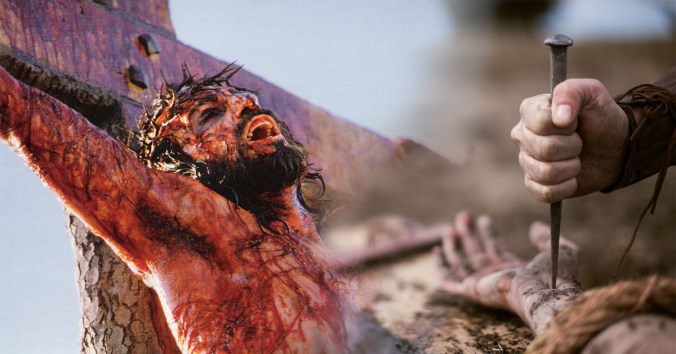
15:22 They [Roman soldiers] brought [possibly led or carried] Jesus to the place called Golgotha [Greek word for a place located outside the city’s walls — see Heb. 13:12] (which means [in Aramaic] The Place of the Skull [Latin word is translated Calvary]).

15:23 Then [before He was nailed to the cross] they [perhaps friends since the soldiers would want to inflict maximum pain] offered him wine mixed with myrrh [an anesthetic or sedative to induce sleep and deaden pain], but he did not [see Matt. 27:34] take it [He accepted His sentence and the suffering it involved / He was willing to feel the full impact of the crucifixion].

15:24 And they crucified [the most horrible way to die at the time / Mark did not have to elaborate because his Roman audience would have understood] him [Jesus was not a victim but a volunteer]. Dividing up his clothes, they [soldiers] cast lots [fulfilled prophecy of Ps. 22:18] to see what each would get [ironically they could have received something far greater than Jesus’ clothing].

Note: “The pain was absolutely unbearable … In fact, it was literally beyond words to describe; they had to invent a new word: excruciating. Literally, ‘excruciating’ means ‘out of the cross.’ Think of that: they needed to create a new word, because there was nothing in the language that could describe the intense anguish caused during the crucifixion.” (“The Case for Christ” • Lee Strobel • pp. 197-198)

15:25 It was the third hour [9:00 AM] when they crucified [a painful and humiliating form of execution] him.

15:26 The written notice of the charge [Roman custom was to indicate charges on a sign hung around the accused person’s neck] against him read: THE KING OF THE JEWS [Jewish leaders protested wording of sign (John 19:21-22); see also Luke 23:2].

Note: Pilate displayed the sign out of contempt for the Jewish leaders, but it was also the truth.

15:27 They crucified two robbers [Greek word: lestes, refers to political insurrectionists or terrorists who may have robbed to obtain support for their cause: see Mark 15:7 regarding Barabbas; perhaps they had participated in the treason of Barabbas] with him [see prophecy in Isaiah 53:12], one on his right and one on his left [see Luke 23:39-43].

15:29 Those who passed by hurled insults at him, shaking their heads [a gesture of contempt] and saying [fulfilled Ps. 22:7], “So! You who are going to destroy the temple and build it in three days [see John 2:19],

15:30 come down from the cross [not a physical impossibility, but a moral and spiritual impossibility] and save yourself!”

15:31 In the same way the chief priests [probably Sadducees: failed to recognize the Great High Priest] and the teachers of the law [Pharisees] mocked [Greek: empaizo, “to ridicule” or “to make fun of”] him among themselves [rather than to His face]. “He saved others [interestingly, they acknowledged His saving work],” they said, “but he can’t save himself [had Jesus chosen to save Himself He could not have saved others]!

Note: How do you react when people insult you because of your following Jesus?

15:32 Let this [not “the”] Christ, this [not “our”] King of Israel [they did not believe these things about Jesus but spoke these words in derision], come down now from the cross, that we may see and believe [see John 11:46-53].” Those crucified with him [two thieves] also heaped insults on him [total rejection from everyone present].

15:33 At the sixth hour [12:00 PM] darkness [indicative of God’s judgment on human sin] came over the whole land until the ninth hour [3:00 PM].

15:34 And at the ninth hour Jesus cried out [Mark recorded only one of Jesus’ seven sayings from the cross] in a loud voice, “Eloi, Eloi, lama sabachtani? [an Aramaic version of Ps. 22:1]” — which means, “My God, my God [one of Jesus’ five double expressions], why have you forsaken [term means: “to be left behind”] me? [for the first time in eternity Jesus experienced the pain of feeling absolutely alone]

Note: Jesus understands what it is like to be lonely. Suggest people in society today who may be forsaken or feel lonely. How can we minister to them and help them understand that God will never forsake them?

15:35 When some of those standing near heard this, they said, “Listen, he’s calling Elijah.”

15:36 One man ran, filled a sponge with wine vinegar, put it on a stick, and offered it to Jesus to drink. “Now leave him alone. Let’s see if Elijah comes to take him down,” he said.

15:37 With a loud cry [perhaps the cry of victory in John 19:30 or Luke 23:46], Jesus breathed his last [after six excruciatingly painful hours: see Phil. 2:8].

15:38 The curtain of the temple [which separated the holy place from the holy of holies: only one priest entered the holy of holies on the Day of Atonement — once a year] was torn in two [indicating it was no longer needed: no more need for OT rituals; Jesus was the ultimate and final sacrifice] from top to bottom [indicative of God’s action and symbolizing the removal of the barrier between God and man: see Heb. 10:19-22].

15:39 And when the centurion [a Roman army officer responsible for 100 men: an unlikely convert and evangelist], who stood there in front of [in a position to witness all the events at the crucifixion] Jesus, heard his cry and saw how he died [overwhelming evidence of Jesus’ identity], he said, “Surely this man was the Son of God!”

Mark 16

16:1 When the Sabbath was over, [cf. Matt. 27:56] Mary Magdalene, Mary the mother of James [“son of Alphaeus” or “James the younger” ], and Salome [probably the mother of James and John] bought spices so that they might go to anoint [no opportunity to anoint Jesus’ body because He died and was buried shortly before the start of the Sabbath] Jesus’ body.

16:2 Very early [“while it was still dark” (Jn. 20:1)] on the first day [Sunday] of the week, just after sunrise, they were on their way to the tomb [the tomb had been sealed and was guarded by Roman soldiers (cf. Matt. 27:66)]

16:3 and they asked each other [note the main concern of the women…], “Who will roll the stone [described as “very large” in 16:4] away from the entrance of the tomb [Mary Magdalene and Jesus’ mother had watched as the tomb was sealed (Mk. 15:46)]?”

16:4 But when they looked up, they saw that the stone, which was very large, had been rolled away [Gr. anakulio means “to roll up / upward”; the stone was moved not to let Jesus out but instead to let the world in].

Note: Regarding position of stone:
• Matt. 27:60 — kulio: “to roll”
• Mark 16:3,4 — anakulio: “to roll up / upward”
• Luke 24:2 — apokulio: “separation in sense of distance, thus rolled away”

16:5 As they entered the tomb, they saw a young man [identified as an angel in Matt. 28:2] dressed in a white robe sitting on the right side, and they were alarmed [frightened or dumfounded, a natural reaction to what the women encountered].

16:6 “Don’t be alarmed,” he said. “You are looking for Jesus the Nazarene, who was crucified. He has risen! He is not here [the women were the first to hear this good news]. See the place where they laid him [cf. Jn. 20:6-7].

16:7 But [the women were given a new assignment] go, tell his disciples and [as if to emphasize that Peter had not been disowned…] Peter, ‘He is going ahead of you into Galilee [Jesus had called most of the disciples there]. There you will see him, just as he told you [cf. Mk. 14:28].’”

16:8 Trembling and bewildered, the women went out and fled from the tomb. They said nothing to anyone, because they were afraid.

Note: The earliest manuscripts and some other ancient witnesses do not have verses 9–20.

16:9 When Jesus rose early on the first day of the week, he appeared first to Mary Magdalene, out of whom he had driven seven demons.

16:10 She went and told those who had been with him and who were mourning and weeping.

16:11 When they heard that Jesus was alive and that she had seen him, they did not believe it.

16:12 Afterward Jesus appeared in a different form to two of them while they were walking in the country.

16:13 These returned and reported it to the rest; but they did not believe them either.

16:14 Later Jesus appeared to the Eleven as they were eating; he rebuked them for their lack of faith and their stubborn refusal to believe those who had seen him after he had risen.

16:15 He said to them, “Go into all the world and preach the gospel to all creation.

Imagine being among the first to hear Jesus say, “Go into all the world and preach the good news to all creation” (Mark 16:15). How would you have felt? What would you have thought about such an enormous assignment? Perhaps you would have felt overwhelmed. Perhaps you would have thought, “I am inadequate for such a task.” How then, did Jesus prepare a group of ordinary human beings for the enormous task of sharing the good news with the world?

16:16 Whoever believes and is baptized will be saved, but whoever does not believe will be condemned.

16:17 And these signs will accompany those who believe: In my name they will drive out demons; they will speak in new tongues;

16:18 they will pick up snakes with their hands; and when they drink deadly poison, it will not hurt them at all; they will place their hands on sick people, and they will get well.”

16:19 After the Lord Jesus had spoken to them, he was taken up into heaven and he sat at the right hand of God.

16:20 Then the disciples went out and preached everywhere, and the Lord worked with them and confirmed his word by the signs that accompanied it.

The Cork and the Whale

A little brown cork
Fell in the path of a whale
Who lashed it down
With his angry tail.
But, in spite of the blows,
It quickly arose,
And floated serenely
Before his nose.
Said the cork to the whale,
“You may flap and sputter and frown,
But you never, never can keep me down:
For I’m made of the stuff
That is buoyant enough
To float instead of to drown.”

Author Unknown

Matthew 13

Matthew 13:1-9

13:1 That same day [presumably same day in which the severe confrontation with the scribes and Pharisees took place (12:24-45)] Jesus went out of the house [to be more accessible to people] and sat by the lake [Sea of Galilee].

13:2 Such large crowds gathered around Him [Jesus still very popular; crowds still eager to hear Him] that he got into a boat [easier to face and address the crowd from this place] and sat [customary position for Jewish teachers] in it, while all the people stood on the shore.

One day, after a confrontation with religious leaders (Matt. 12:22-45), Jesus spoke to a large crowd by the Sea of Galilee (Matt. 13:1). He had to get into a boat and use it as a platform from which to speak to the people (Matt. 13:2). Jesus told those assembled along the shore many things in parables (Matt. 13:3). A parable is best defined as an earthly story with a heavenly meaning.

13:3 Then he told them many things in parables [to reveal truth (make it clearer) to those who wanted to understand and conceal it from those who only wanted to criticize/reject it], saying: “A farmer [focus of parable is not the sower (farmer)] went out to sow [customary to sow wheat or barley by hand] his seed.

13:4 As he [same sower] was scattering [perhaps flinging by hand] the seed [same seed], some [unavoidably] fell [focus of parable is the soils] along the path [too hard to receive seed; hardened by much foot traffic], and [it was walked on (Lk. 8:5)] the birds came and ate it up [quickly and completely].

13:5 Some fell on rocky places [limestone bedrock close to surface], where it did not have much soil. It sprang [germinated and grew] up quickly, because the soil was shallow [little depth of soil preventing the possibility of establishing deep roots; little retention of moisture in thin soil].

13:6 But when the sun came up, the plants were scorched, and they withered because they had no root [thus not able to reach moisture].

13:7 Other seed fell among thorns [deprive plants of sun and nourishment], which grew up [usually quickly] and choked the plants.

13:8 Still other [of the same kind] seed fell on good soil, where it produced a crop [design and intent of the sower] — a hundred, sixty or thirty times what was sown.

13:9 He who has ears [spiritual capacity], let him [personal responsibility] hear [ponder the parable and make appropriate application].”

Matthew 13:18-23

13:18 [originally, Jesus shared parable with the multitude and later revealed its meaning to His disciples (vv. 10-18)] “Listen [pay close attention] then to what the parable of the sower [minister, missionary, evangelist, any believer: responsible to declare the message but hearer is responsible for personal response to the message] means:

13:19 When anyone hears [depends on condition of the heart] the message about the kingdom [cf. Lk. 8:11] and does not understand it [does not let the truth penetrate], the evil one [Satan] comes and snatches [to rob/plunder] away [before person really understands it and has an opportunity to believe (Lk. 8:12)] what was sown in his heart [heart represents soil; the place of decision]. This is the seed sown along the path [hard, packed path; heart made hard by the traffic of the world].

13:20 The one who received the seed that fell on rocky places [thin layer of dirt on top of solid rock, allowing no chance for deep roots that would enable plants to survive] is the man who hears the word and at once [immediately and impulsively] receives it [profess to follow Christ] with joy [gladly].

13:21 But since he has no root [superficial response to the gospel with temporary results; no inner conviction; no root means no fruit], he lasts only a short time [temporary]. When [the intense heat of…] trouble [pressure] or persecution [affliction associated with accepting and following Christ] comes because of the word, he quickly falls [Gr. skandalizo: to stumble over] away [cf. John 6:66 re: crowds in Galilee who ceased to follow Jesus when He made demands on them].

13:22 The one who received the seed [nothing wrong with either seed or sower] that fell among the thorns [grow quickly, absorb nutrients, and choke out life] is the man who hears the word, but [note the competing thorns as: 1] the worries [undue cares/concerns; preoccupations/distractions] of this life [world] and [2] the deceitfulness [pleasure or delight in] of wealth [cf. 1 Tim. 6:9 and Matt. 6:24; the good life; see 2 Tim. 4:10 re: Demas and his love for the world] choke it, making it unfruitful.

13:23 But the one who received the seed [same as the seed that fell on other soils] that fell on good soil [“those with a noble and good heart” (Lk. 8:15)] is the man who hears the word and understands [refers more to spiritual receptivity than to mental ability] it. He produces a crop [because of obedience to what he has heard], yielding a hundred, sixty or thirty times what was sown.”

Matthew 13:31-52

Jesus told a series of parables to describe “the kingdom of heaven” (Matt. 13:31), that is, the sovereign reign of God. The kingdom of heaven is not geographical or political. The kingdom of heaven is first and foremost relational — it is the rule of God in the hearts of believers.

Each parable Jesus told (Matt. 13:34) cast light on some aspect of the kingdom (Matt. 13:35). These parables are introduced by the phrase “the kingdom of heaven is like.” Two of the parables he shared illustrate how something small eventually grows into something great.

13:31 He told them another parable: “The kingdom of heaven [initially manifested in a small way in a small place] is like [similar] a [single] mustard seed [proverbial for its smallness], which a man took and planted in his field.

13:32 Though it is the smallest [easy to overlook its potential] of all your seeds, yet when it grows, it is the largest [grew to eight to ten feet high] of garden plants and becomes a tree [in same way the small beginnings of the kingdom would eventually result in the triumph of God’s rule], so that the birds of the air come and perch [indication of the size of the tree] in its branches.”

Jesus compared the kingdom of heaven to a single mustard seed (Matthew 13:31-32) — believed to be the smallest of all seeds (Matt. 13:32). A single mustard seed was so small as to seem insignificant. But, once planted, the tiny mustard seed eventually breaks through the surface of the ground and grows to become the largest of garden plants (Matt. 13:32) — growing to a height of ten or more feet.

Jesus inaugurated the kingdom of heaven among humanity when He began His earthly ministry. At that time, the kingdom seemed as small and insignificant as a single tiny mustard seed. At other times it seemed the tender shoot would not survive in the harsh environment of religious, philosophical, and political opposition and persecution. However, like the mustard seed, the kingdom of heaven has steadily grown into something immeasurably larger. Today, God’s kingdom rule continues to expand across ethnic and geographical lines as people submit to Him all across the planet.

13:33 He told them still another parable [to illustrate another aspect of the kingdom]: “The kingdom of heaven is like yeast [usually symbol of that which was evil or unclean, except in this case; “normally a small piece of dough kept from a previous baking and allowed to ferment” (Mounce); pervasive power] that a woman took and mixed into a large amount of flour until it worked [quietly and mysteriously] all through the dough.”

Jesus also likened the kingdom of heaven to yeast (Matt. 13:33) — a small piece of fermented dough kept from a previous baking. A small piece of yeast is capable of permeating a large amount of flour. Yeast was usually a symbol of that which was evil or unclean (see Matt. 16:6; 1 Cor. 5:6). However, Jesus likened the kingdom of heaven to the pervasive power of yeast.

Like yeast, the kingdom of heaven quietly spreads from one life to another — transforming individuals one by one. This leavening activity happens as citizens of the kingdom understand and fulfill their responsibility to “preach the kingdom of God” (Luke 9:2).

Every Christ-follower has a responsibility to know the message, to live the message, and to share the message. As we do so, the kingdom of God quietly spreads from one transformed life to another — from home all the way to the ends of the earth.

13:34 Jesus spoke all these things to the crowd in parables; he did not say anything to them without [refers to a regular practice, not merely to a single occasion] using a parable.

13:35 So was fulfilled what was spoken through the prophet: “I will open my mouth in parables, I will utter [and by so doing cast light on the purposes of God long kept hidden] things hidden since the creation of the world.”

13:36 Then he left the crowd and went into the house [cf. Matt. 13:1; probably in Capernaum]. His disciples [needed explanation] came [took the initiative] to him [we should seek answers from Him] and said, “Explain [“make thoroughly clear right now”] to us the parable of the weeds in the field.”

13:37 He answered, “The one who sowed the good seed [the good seed is not the Word of God, but rather represents people converted through trusting the Word] is the Son of Man [Jesus].

13:38 The field is the world [field is not the church or the human heart but rather the world; Christ sows true believers throughout the world that they might bear fruit; cf. Matt. 28:19-20], and the good seed stands for the sons of the kingdom. The weeds are the sons of the evil one [“those whose character is evil”],

13:39 and the enemy who sows them [Satan sows counterfeit Christians (cf. 2 Cor. 11:26 re: “false brothers”) who believe a counterfeit Gospel (cf. Gal. 1:6-9), are trusting in a counterfeit righteousness (cf. Rom. 10:1-3), have a counterfeit church (cf. Rev. 2:9), and will ultimately produce a counterfeit Christ at the end of the age (cf. 2 Thes. 2:1-12)] is the devil [slanderer]. The harvest is the end of the age, and the harvesters are angels.

13:40 “As the weeds are pulled up and burned in the fire, so it will be at the end of the age.

13:41 The Son of Man will send out his angels, and they will weed out of his kingdom everything that causes [those who work against God and try to cause as many as possible to fall] sin and all who do evil.

13:42 They will throw [cast] them into the fiery furnace, where there will be weeping [loud crying] and gnashing [grinding] of teeth [phrase used as an expression of anger and frustration of the damned].

13:43 Then the righteous will shine [to shine out, to shine forth] like the sun in the kingdom of their Father. He who has ears, let him hear.

13:44 “The kingdom of heaven is like treasure [emphasizes the surpassing worth of the kingdom] hidden in a field. When a man found it, he hid it again, and then in his joy went and sold all [not too great a price to pay] he had [worth every sacrifice] and bought that field [could not live without it, willingly and gladly sold all he had to possess it].

Jesus said “the kingdom of heaven is like treasure hidden in a field” (v. 44).

People sometimes resorted to burying their valuables in the ground in order to hide them from burglars or raiders.

Jesus told of a man digging in a field and unexpectedly found such a treasure — perhaps buried in a chest. Overjoyed by his discovery, the man covered up his find. Realizing he could not live without the treasure, the man then willingly and gladly sold everything he had and legally purchased the field.

Like the man digging in the field, the Apostle Paul unexpectedly came upon the treasure of a lifetime on the road to Damascus (Acts. 9:1-19).

Paul later commented, “What is more, I consider everything a loss compared to the surpassing greatness of knowing Christ Jesus my Lord, for whose sake I have lost all things. I consider them rubbish, that I may gain Christ” (Phil. 3:8).

Paul considered the loss of everything in order to gain Christ the greatest bargain of his life — a very profitable exchange. Sadly, many people fail to recognize the surpassing worth of the kingdom and prefer instead to hold on to what they have (see Matt. 16:25).

13:45 “Again, the kingdom of heaven is like a merchant looking for fine pearls [emphasizes the surpassing worth of the kingdom].

Jesus also likened the kingdom of heaven to “a merchant looking for fine pearls” (v. 45).

Pearls were expensive and generally beyond the purchasing power of the average person.

In his search for fine pearls, the merchant found the pearl of his dreams. The merchant immediately recognized the surpassing value of that pearl. Perhaps his eyes widened and his jaw dropped at the first sight of the pearl. All other pearls he had ever seen paled by comparison. Without hesitation, the merchant eagerly sold all that he had and purchased the pearl.

Like the man who found the treasure and the merchant who found the pearl, people should willingly and joyfully surrender whatever they must in order to gain the kingdom. Nothing we possess or pursue can surpass the value of being a child of God and living under His rule.

I met a young missionary from eastern Europe while I was returning home from Mongolia. She shared with me how she eagerly embraced the gospel when she first heard it preached. Soon afterward she felt God leading her to take the gospel of the kingdom to the people of Mongolia. She joyfully exchanged the comforts and security of her home in order to advance the work of the kingdom in Mongolia. She expressed to me that she felt there was nothing greater in life than the privilege of knowing God and serving the interests of His kingdom. This young woman understood the surpassing worth of the kingdom.

13:46 When he found one of great value [costly], he went away and sold [rather eagerly] everything [demonstrates willingness and determination to surrender everything to gain the kingdom] he had and bought it [did not feel it was a sacrifice to do so].

13:47 “Once again, the kingdom of heaven is like a net [dragnet; large rectangular seine; net pulled through water by two boats or net anchored to shored while boat pulled other end through the sea; seining process caught all kinds of fish] that was let down into the lake and caught all kinds of fish.

After sharing parables about kingdom growth and kingdom worth, Jesus shared a final parable about the kingdom of heaven with His disciples. In Matthew 13:47, Jesus said “the kingdom of heaven is like a net.”

The mention of a net would have immediately caught the attention of the fishermen in the room — Peter, Andrew, James, and John. These men had been working with nets beside the Sea of Galilee on the day Jesus had called them to follow Him (Matt. 4:18-22). Their nets represented their previous profession. However, these men chose to follow Jesus, left their fishing nets behind, and instead became “fishers of men” (Matt. 4:19).

Jesus told a parable about a net that was let down into the lake. The net was probably a large and rectangular dragnet. This type of net was generally used in one of two ways. The net was either secured to two boats and pulled through the water or anchored to the shore on one end while a boat pulled the other end through the sea. Either way, this seining process effectively resulted in a catch of “all kinds of fish.”

13:48 When it was full, the fishermen pulled it up on the shore. Then they sat down and collected the good [edible] fish in baskets, but threw the bad [worthless, unsuitable for eating] away.

While visiting the Reindeer People in northern Mongolia, I had the opportunity to observe how men there fish with nets on frozen lakes. The fishermen cut a series of holes in the ice and then lower a net through one hole and stretch it under the ice to the farthest hole. Then, they leave the net and return to pull it out of the frigid water the following day. Amazingly, this process results in a catch of all kinds of fish. I observed as these Mongolian fishermen, like those in the parable, sorted their catch, tossing the good fish in one pile and the bad fish in another pile (Matt. 13:48).

13:49 This is how it will be at the end of the age. The angels will come and separate [on the basis of how people have responded to Jesus] the wicked [those who have rejected Christ] from the righteous [those who have placed their faith in Christ]

All kinds of people get caught in the kingdom net — those who have been truly converted and those who have never actually trusted Christ for salvation. However, Jesus explained that at the end of the age people will be separated on the basis of how they responded to Him (Matt. 13:49).

13:50 and throw them into the fiery furnace, where there will be weeping and gnashing of teeth.

The wicked — those who rejected Christ or feigned citizenship in His kingdom — will be separated from the righteous and consigned to a place where there will be weeping and gnashing of teeth (Matt. 13:50).

In light of this, we must not remain silent knowing that one day all people will be subject to judgment. Every person who has a saving knowledge of Christ has a personal responsibility to share that knowledge with others. We owe Christ to all people (Rom. 1:14).

13:51 “Have you understood all these things?” Jesus asked. “Yes,” they replied.

13:52 He said to them, “Therefore every teacher of the law who has been instructed [reference to disciple] about the kingdom of heaven is like the owner of a house who brings out of his storeroom new treasures as well as old.”

The disciples had listened patiently as Jesus taught them about the kingdom of heaven. Jesus asked them, “Have you understood all these things?” (Matt. 13:51). The disciples replied affirmatively. Jesus continued by explaining that they were responsible for the knowledge they had received about the kingdom (Matt. 13:52).

The disciples were like scribes or teachers of the law who had received special instruction in matters concerning the kingdom of heaven. This knowledge was like a wonderful treasure deposited in the storeroom of their hearts. They were not to hide and hoard that treasure. Instead they were obligated to share that treasure with the world.

We too, are obligated to share what we know about the kingdom. John R. Mott once said that the greatest crime we can commit is to withhold what we know about Jesus from the world. Unless we are willing to open the storeroom and bring out the treasures, many people in the world today will remain spiritually impoverished. So, how should we respond to what Jesus taught about the kingdom of heaven?

Matthew 6

6:1 “Be careful [caution to not do the right thing in the wrong way and for the wrong purpose] not to do your ‘acts of righteousness’ [righteous deeds] before men [to impress others], to [for the purpose of] be seen by them [and receive their praise]. If you do, you will have no [Gr. ouk is a strong negative] reward from your Father in heaven.

6:2 “So when you give [charitable deeds as well as gifts] to the needy, do not announce it with trumpets [some see this as metaphorical statement, “Don’t blow your own horn!”], as the hypocrites [Gr. hupokrites literally means a play actor or pretender] do in the synagogues and on the streets, to [for the purpose of] be honored by men. I tell you the truth, they have received their reward in full [Gr. apecho means paid in full].

6:3 But when you give to the needy, [Jesus used hyperbole to emphasize His point…] do not let your left hand know what your right hand is doing,

6:4 so that your giving may be in secret. Then your Father, who sees what is done in secret, will reward you.

6:5 “And when you pray [Jews had three appointed prayer times: 9 AM, Noon, 3 PM], do not [translates the strong negative ouk] be like the hypocrites, for they love [Gr. phileo] to pray standing in the synagogues and on the street corners to [for the purpose of] be seen by men. I tell you the truth, they have received their reward in full [Gr. apecho means paid in full].

6:6 But when you pray, go into your room [away from distractions; place where you do not have to be concerned with the correctness of your words], close the door and pray to your Father, who is unseen. Then your Father, who sees what is done in secret, will reward you.

6:7 And when you pray, do not keep on babbling [empty repetitions; cf. Acts 19:34] like pagans, for they think they will be heard because of their many words [repeating or muttering the same words over and over again].

6:8 Do not be like them, for your Father knows what you need before you ask him.

6:9 “This, then, is how you should pray: [1: pray for God’s glory] “‘Our Father [assumes a personal relationship (only possible through faith in Christ); denotes authority and intimacy; God is not an impersonal deity] in heaven [literally the one in the heavens; cf. Isa. 6:1], hallowed [declare, acknowledge, treat as holy; to set apart; to hold in reverence] be your name [represented the person and his character; exalt God in prayer],

6:10 your kingdom [the reign and rule of God in the hearts of people] come [attitude is that of submission to the reign of God], your will be done on earth as it is in heaven.

Note: H.H. Hobbs points out that God’s kingdom may be thought of in several ways:
• God’s kingdom is God’s reign over the entire universe.
• God’s kingdom is the reign of God in people’s hearts (cf. Lk. 17:21).
• God’s kingdom is the reign of Christ now in His mediatorial kingdom (cf. 1 Cor. 15:25).
• God’s kingdom is the reign of God over His eternal kingdom (cf. 1 Cor. 15:28).
The Herschel Hobbs Commentary, Jan. – Mar. 1996 Life & Work Lessons

Note: “To know the will of God is the greatest knowledge. To do the will of God is the greatest achievement. The will of God is not always easy, but it is always right.” (Dr. George W. Truett as quoted by Hobbs)

6:11 [2: pray for our good] [prayer for physical provisions] Give [attitude of dependence on God to give what is needed; keep on giving; a request for ongoing provision] us today our daily [for the coming day; cf. Ex. 16:18-19 re: manna] bread [basic human needs].

6:12 [prayer for spiritual provisions] Forgive [to dismiss, release, send away] us our debts [refers to sins rather than financial obligations], as we also [we must treat others as we are treated by God; forgiveness is a two-way street (cf. Mk. 11:25)] have forgiven our debtors.

6:13 And lead us not [keep us from yielding to; do not allow us to be led into; expresses a desire to avoid sin; acknowledgment of our weakness and vulnerability] into temptation [cf. Jas. 1:13], but deliver us from the evil one [Satan].’

6:14 For if you forgive men when they sin against you, your [indicates that Jesus was talking to believers] heavenly Father will also forgive you.

6:15 But if you do not forgive men their sins, your Father will not forgive your sins.

6:16 “When you fast [mandatory fast on Day of Atonement (Lev. 23:32); Pharisees fasted twice a week (Lk. 18:12); personal fast], do not look somber as the hypocrites do, for they disfigure their faces to show men they are fasting. I tell you the truth, they have received their reward in full.

6:17 But when you fast, put oil on your head and wash your face [normal acts of daily hygiene],

6:18 so [purpose of instructions in previous verse: to not draw attention to oneself] that it will not be obvious to men that you are fasting, but only to your Father, who is unseen; and your Father, who sees what is done in secret, will reward you.

6:19 “Do not [do not get in the habit of] store up for yourselves treasures on earth, where moth [a threat to clothing, rugs, tapestries] and rust [something which ate away (could refer to mice which ate and destroyed grain, etc.)] destroy, and where [indicates treasures kept in the home] thieves break in and steal.

6:20 But store up for yourselves treasures in heaven, where moth and rust do not destroy, and where thieves do not break in [means dig through (homes in Jesus’ day made of clay making it easy for thieves to gain entry by digging through)] and steal.

6:21 For where your treasure is, there your heart will be also.

6:22 “The eye is the lamp of the body. If your eyes are good [“single” (KJV); “without folds” like a piece of unfolded cloth (Robertson); having a single focus], your whole body will be full of light.

6:23 But if your eyes are bad [or sick; one who is blind to God and His will], your whole body will be full of darkness. If then the light within you is darkness, how great is that darkness!

6:24 “No one can serve [Gr. douleuein means to serve as a slave (Gr. doulos)] two masters [Gr. kurios]. Either he [a slave in the ancient world belonged to his owner absolutely and had no personal rights] will hate the one and love the other [attitude toward one master determined attitude toward the other], or he will be devoted to the one and despise the other. You cannot serve both God and Money [mammon: Aramaic, Syriac, and Punic word for the money-god or the devil (Robertson); denotes material possessions; refers to that which a person trusted].

6:25 “Therefore [links what follows with previous verses] I tell you, do not [an imperative or command] worry [to be anxious or to fret] about your life [the physical necessities of life…], what you will eat or drink; or about your body, what you will wear. Is not life more important than food, and the body more important than clothes [trust God with the details of your life]?

6:26 Look [observe for the purpose of learning] at the birds [they are dependent on God’s daily provision; birds are not idle, but neither are they anxious] of the air; they do not [illustration of normal activities in an agricultural society…] sow or reap or store away in barns [this is not an excuse for laziness (cf. 2 Thess. 3:10)], and yet your heavenly Father [Jesus identified God as the sole basis of provision] feeds them [this is not teaching that every hungry person in the world will be fed]. Are you not much more valuable than they?

6:27 Who of you by worrying can add [prolong or lengthen] a single hour to his life?

Note: What do you worry about most? How can worrying affect your health, thoughts, emotions, relationships with others and your relationship with God?

Reflect: If Jesus spoke directly to you, what would He tell you not to worry about?

6:28 “And why do you worry about clothes? See how the lilies of the field grow. They do not labor [refers to hard work that leads to fatigue] or spin.

6:29 Yet I tell you that not even Solomon [Israel’s richest king] in all his splendor was dressed like one of these.

6:30 If that is how God clothes the grass of the field, which is here today and tomorrow is thrown into the fire [fuel for clay ovens], will he not much more clothe you, O you of little faith [anxiety is one of the results of unbelief; faith is the antidote to worry]?

Note: What actions in your life reveal “little faith” in the Lord?

6:31 So [because God provides] do not worry [worry shows a lack of faith in God], saying, ‘What shall we eat?’ or ‘What shall we drink?’ or ‘What shall we wear?’

6:32 For the pagans [unbelievers; those who have no sense of God’s care for them; worry puts believers on the same level with unbelievers] run after all these things, and your heavenly Father knows that you need them.

6:33 But seek [continuous action] first [priority] his kingdom [submit to God’s sovereignty; work to advance His kingdom] and his righteousness [live according to God’s will], and [when your priorities are right] all these things [needs; the things that people worry about] will be given to you as well.

Note: What do you seek first? What competes for first place in your list of priorities? How can misplaced priorities produce worry?

6:34 Therefore [because of God’s ability and faithfulness to provide for your needs] do not worry about tomorrow [do not invest energy worrying about what may not happen], for tomorrow will worry about itself. Each day has enough trouble [any kind of material evil or calamity; indication that believers are not exempt from trouble or problems] of its own [a reminder to live one day at a time].

Note: How does worrying about tomorrow add to today’s burdens? Can worry change the outcome of what may happen tomorrow? What is the difference between planning for tomorrow and worrying about tomorrow? How can planning help alleviate worry?

Read: For more on anxiety and faith, read the following verses:
• Psalm 56:3
• Isaiah 41:10
• Philippians 4:6
• 1 Peter 5:7

Matthew 7

Matthew 7:1-5

7:1 “Do not judge [the kind of judgmental attitude that destroys others in order to build up oneself; self-righteous, unjust criticism; this is not a prohibition against critical thinking], or you too will be judged.

7:2 For in the same way you judge others, you will be judged, and with the measure you use, it will be measured to you [a negative application of the Golden Rule—“Do not do to others (in this case, judge harshly) what you would not have them do to you.”].

7:3 [example of hypocritical judging…] “Why do you look [to stare or gaze] at the speck [splinter; represents the lesser] of sawdust in your brother’s eye [it is easy to spot sin in others, however small] and pay no attention to the plank [log or beam; represents the greater] in your own eye?

7:4 How can you say to your brother, ‘Let me take the speck [represents minor fault] out of your eye,’ when all the time there is a plank [represents major fault] in your own eye?

7:5 You hypocrite [actors who pretend to be holier than they actually are and holier than those they condemn], first take the plank out of your own eye, and then you will see clearly to remove the speck from your brother’s eye.

Matthew 7:13-29

7:13 “Enter through the narrow [“strait” (KJV)] gate [a way to enter into a place]. For wide is the gate and broad is the road that leads to destruction [Gr. apoleian; spiritual death; to hell itself; cf. Rev. 9:11 re: Apollyon which means Destroyer and is another name for Satan], and many enter through it [because it is easy to find and easy to follow].

7:14 But small is the gate and narrow [from Gr. verb thlibo which means to experience trouble or difficulty; road of discipleship is often difficult road to travel] the road that [the narrow way alone] leads to life [salvation; eternal life], and only a few [a small number] find it [cf. Lk. 13:24].

Note: Read the following verses for more on two paths: Deuteronomy 30:19; Psalm 1:1-2; Jeremiah 21:8.

7:15 “Watch out for false prophets [Gr. pseudopropheton or pseudo prophets who claimed to have a word from God but taught error and were motivated by self-interests (such as wealth, power, recognition); posed as members of the Christian community; cf. Matt. 24:24; their teaching did not include teaching of Matt. 7:13-14]. They come to you in sheep’s clothing [try to pass for true prophets by looking and talking like sheep], but inwardly they are ferocious wolves [cf. Acts 20:29-30].

Note: Do the math.
False prophets always…
• Subtract from Christ
• Add to salvation
• Divide the church

7:16 [instructions on how to be discerning…] By their fruit [metaphor for character and conduct; what they produce] you will recognize them. Do people pick grapes from thornbushes, or figs from thistles?

7:17 Likewise every good [healthy] tree bears good fruit, but a bad [unhealthy] tree bears bad fruit [one way to recognize false prophets is by what they produce].

7:18 A good tree cannot bear bad fruit, and a bad tree cannot bear good fruit.

7:19 Every tree [read Deut. 13:1-5; 18:14-22 re: fate of false prophets] that does not bear good fruit is cut down and thrown into the fire [final judgment of false prophets].

7:20 Thus, by their fruit [claims must be backed up by results] you will recognize them.

7:21 “Not everyone who says to me, ‘Lord, Lord,’ will enter the kingdom of heaven, but only he who does the will of my Father [these words imply a relationship with God] who is in heaven.

7:22 Many [those who were religious but had no relationship with Jesus] will say to me [note role of Jesus in the judgment] on that day [judgment day at the end of the age], ‘Lord, Lord, [notice what false prophets are able to do…] did we not prophesy in your name, and in your name drive out demons and perform many miracles [cf. Mk. 13:22; 2 Thess. 2:9]?’

7:23 Then I will tell them plainly, ‘I never knew you [those who had no personal relationship with Christ]. Away from me, you evildoers!’

7:24 “Therefore [conclusion of the Sermon on the Mount] everyone who hears these words of mine and puts them into practice is like a wise [refers to practical rather than philosophical wisdom; common sense] man who built his house on the rock [legitimate commitment].

7:25 The rain came [not a matter of if but when] down, the streams rose, and the winds blew and beat against that house; yet it did not fall, because it had its foundation on the rock.

7:26 But everyone who hears these words of mine and does not put them into practice is like a foolish [stupid; moron; unreflecting] man who built his house on sand [provided good shelter in good weather].

7:27 The rain [often a crisis makes evident the difference in how something is built] came down, the streams rose, and the winds blew and beat against that house, and it fell with a great crash.”

7:28 When Jesus had finished saying these things [His teaching on discipleship], the crowds were amazed [astonished or astounded] at his teaching,

7:29 because he taught as one who had authority, and not as their teachers of the law [the scribes; called “lawyers” in some translations].

Matthew 8

Matthew 8:1-13

8:1 When he came down from the mountainside [after the Sermon on the Mount (Matt. 5:1–7:29)], large crowds followed him.

8:2 A man with leprosy [cf. Lev. 13-14 re: instructions about skin diseases; lepers were required to keep a certain distance from others (they had to call out “unclean” to warn others of their approach as per Lev. 13:45) and prohibited from participation in social and religious activities] came and knelt before him and said, “Lord, if you are willing [the leper believed that Jesus could heal him], you can make me clean [cleansing meant that this man would be restored to his family and could again participate in the social and religious life of his town].”

8:3 Jesus reached out his hand and touched [Jewish law prohibited touching lepers (Lev. 5:3; 13:1-46; Num. 5:2); possible that no one had touched this man in years; Jesus moved in the direction of people in need] the man. “I am willing,” he said. “Be clean!” Immediately he was cured of his leprosy [indicates complete restoration of health rather than just a remission; healing lepers a sign of Messiah’s arrival (Matt. 11:5)].

8:4 Then Jesus said to him, “See that you don’t tell anyone [lest doing so create a hindrance to Jesus’ ministry and cause others to seek Jesus for the wrong reasons]. But go, show yourself to the priest [as per instructions in Lev. 14] and offer the gift [Lev. 14:2-32] Moses commanded, as a testimony to them [to those who witnessed the healing and to the priest].”

8:5 When Jesus had entered Capernaum [large city located on northwestern shore of Sea of Galilee], a centurion [Roman military office in charge of 100 men] came to him, asking for help.

8:6 “Lord,” he said, “my servant [“whom his master valued highly” (Lk. 7:2)] lies at home paralyzed and in terrible suffering.”

8:7 Jesus said to him [Jesus affirmed His willingness to help…], “I will go and heal him.”

8:8 The centurion replied, “Lord [shows centurion’s respect for Jesus], I do not deserve to have you come under my roof. But just say the word [shows centurion’s unconditional trust in Jesus; Jesus did not need medicines or rituals or even to be present in order to heal], and my servant will be healed.

8:9 For I myself am a man under authority [centurion understood what it meant to obey others as well as to be obeyed by those under his command], with soldiers under me. I tell this one [Roman soldiers were trained to obey orders unquestioningly], ‘Go,’ and he goes; and that one, ‘Come,’ and he comes. I say to my servant, ‘Do this,’ and he does it.”

8:10 When Jesus heard this, he was astonished [cf. Mk. 6:6 where Jesus was “amazed” at the lack of faith of the Jews] and said to those following him, “I tell you the truth, I have not found anyone in Israel with such great faith [cf. the “great faith” of the Canaanite woman whose daughter Jesus delivered from demon-possession (at a distance as in the case of the centurion’s servant); cf. Jn. 4:46-54 re: Jesus healing the son of a royal official at a distance].

8:11 I say to you that many [not limited by geographic, ethnic, cultural, racial, or national considerations; Jews and Gentiles] will come from the east and the west [beyond the borders of Israel], and will take their places at the feast [banquet table of God’s Messiah (cf. Isa. 25:6-9 re: imagery of such a celebration)] with [note patriarchs of the Hebrew people…] Abraham, Isaac and Jacob in the kingdom of heaven.

8:12 But the subjects [or sons] of the kingdom [a common self-identifying idiom for the Jews’ belief that they were part of God’s covenant by birth] will be thrown outside [Jesus emphasized that salvation was not a matter of birthright but a right-birth—being born-again (Jn. 3:7)], into [note description of hell…] the darkness, where there will be weeping and gnashing of teeth [this phrase occurs six times in Matthew’s gospel (cf. 13:42,50; 22:13; 24:51; 25:30)].”

8:13 Then Jesus said to the centurion, “Go! It will be done just as you believed it would.” And his servant was healed [Jesus exercised authority over disease] at that very hour [at the precise moment Jesus spoke these words].

Matthew 5

Matthew 5:1-16

5:1 Now when he saw the crowds, he went up on a mountainside [allowed Him to speak to many people without a public address system] and sat down [rabbis typically sat down to teach]. His disciples [the Twelve; Gr. mathetai means pupil or learner, thus also suggesting all believers present on that day] came to him,

5:2 and he began to teach them, saying [the following beatitudes (Latin word beatitudo means “a state of blessedness”) describe how Christ’s followers should live]:

5:3 “Blessed [Gr. makarioi means more than happiness; word refers to inner peace and security regardless of external circumstances] are the poor [Gr. ptochoi means absolute or abject poverty as opposed to Gr. word penes which refers to someone who works to provide for his needs but has nothing left over] in spirit [indicates that Jesus was not talking about those who lack material possessions but rather those aware of their own spiritual poverty and who trust entirely in God’s mercy and help; cf. Lk. 18:11-13], for theirs is the kingdom of heaven [the poor in spirit allow Jesus to be their King].

5:4 Blessed are those who mourn [Gr. penthountes is strongest word for mourning; those who mourn for their own sins (what their sins have done to them and to God); those who mourn as a result of suffering], for they will be comforted [cf. Isa. 61:2; Latin cum fortis means to give strength or power to someone; cf. Rev. 21:4; Gr. paraklethesontai].

5:5 Blessed are the meek [or gentle; this word occurs three other times in NT (cf. Matt. 11:29; 21:5; 1 Pet. 3:4); do not think too little or too highly of themselves; those who are self-controlled and disciplined; power under control], for they will inherit the earth [cf. Rev. 21–22 re: new heaven and new earth].

Note: Someone wisely said, “If you think it is weak to be meek, then try being meek for a week.”

5:6 Blessed are those who hunger and thirst [these are our most demanding appetites; to have an intense longing] for righteousness [personal righteousness (pleasing God by living a life of obedience; the defeat of sin in their own lives); righteousness for the world (the defeat of sin in the world); to be righteous, do what is right, and see right done], for they will be filled [spiritually satisfied].

5:7 Blessed are the merciful [Gr. eleemon means active pity; those who are kind, sympathetic, understanding, and who are grieved by the pain of others; do what they can to help others who are in pain], for they will be shown mercy.

5:8 Blessed are the pure [means unmixed, unadulterated, without alloy] in heart [integrity and sincerity of heart; a heart with unmixed motives], for they will see God [spiritually in this world (cf. 1 Cor. 2:12-14) and face-to-face in eternity (cf. Rev. 22:4)].

5:9 Blessed are the peacemakers [those who promote peace and help to quiet strife; bridge builders], for they will be called sons of God.

5:10 Blessed are those who are persecuted because of righteousness [cf. 1 Pet. 2:20; 3:13-14; 4:12-19], for theirs is the kingdom of heaven.

5:11 “Blessed are you when people insult you, persecute you and falsely say all kinds of evil [false reports] against you because of me [cf. Matt. 10:18; 24:9; Jn. 15:20; 16:2].

5:12 Rejoice and be glad [or exult], because great is your reward in heaven, for in the same way they persecuted the prophets [e.g., Elijah (1 Kings 19:2,13-14); Micaiah (1 Kings 22:26-27); Jeremiah (Jer. 37:17; 38:6)] who were before you [cf. Parable of the Tenants in Matt. 21:33-46].

5:13 “You are the salt [a seasoning; preservative: prevents and retards decay, combats deterioration; believers are to combat moral and spiritual decay, but can only do so if they retain their virtue] of the earth. But if the salt loses its saltiness [tasteless, insipid, inability to fulfill its purpose], how can it be made salty again? It is no longer good for anything, except to be thrown out and trampled [to tread down] by men.

5:14 “You are the light [dispels darkness; light enables others to see what they otherwise would be unable to see; those who possess the light are to transmit the light; Christ is the true “light of the world” (Jn. 8:12); believers cannot shine apart from Christ] of the world. A city on a hill [visible location] cannot be hidden.

5:15 Neither do people light a lamp [small oil-filled lamps used to illuminate home] and put it under a bowl. Instead they put it on its stand, and it gives light to everyone in the house.

5:16 In the same way, let your light [good deeds; cf. Prov. 3:3-4] shine before men, that they may see your good deeds [conduct; everything we are/do should reflect the mind and will of God] and [to the end that] praise your Father in heaven.

Matthew 5:21-22

5:21 “You have heard that it was said [by interpreters of the law] to the people long ago [earlier generations], ‘Do not murder [Ex. 20:13], and anyone who murders will be subject to [to be liable] judgment.’

5:22 But I tell you [this phrase underscored the authority of Jesus over the interpretation of the law; Jesus expanded limited interpretation; Jesus traced the deed to the underlying evil disposition of the heart] that anyone who is angry [kind of anger that devalues human worth; anger is the seed of murder] with his brother [cf. 1 Jn. 3:15; Matt. 5:23-24; Eph. 4:26-27] will be subject to judgment. Again, anyone who says [illustration of name calling that belittles others] to his brother [not to be seen as limited to male siblings], ‘Raca [Aramaic derogatory expression; term of extreme contempt for a person’s head (“you idiot / moron / empty head / blockhead”)],’ is answerable to the Sanhedrin. But anyone who says, ‘You fool [Gr. moreh: English term “moron” derived from this word; expresses contempt for a person’s heart/character (“you scoundrel”)]!’ will be in danger of the fire of hell [eternal judgment; Gr. gehenna: the city dump of Jerusalem, a picture of the final place of judgment for the wicked].

Matthew 5:27-28

5:27 “You have heard that it was said, ‘Do not commit adultery [Ex. 20:14; sex outside of marriage].’

5:28 But I tell you that anyone who looks [to gaze, to stare] at a woman lustfully [desire to have illicit sexual relations with another; attitude leads to action; this commandment (7th) must be interpreted in light of the 10th commandment, “You shall not covet your neighbor’s wife.” (Ex. 20:17)] has already committed adultery with her in his heart.

Matthew 5:43-45

5:43 “You have heard that it was said, ‘Love your neighbor [Lev. 19:18] and [what follows is not included in OT reference] hate your enemy.’

5:44 But I tell you: Love your enemies [this statement must have startled Jesus’ audience; cf. Lk. 10:25-17] and pray [tap into source of strength that can help you love difficult people] for those who persecute you,

5:45 that [in order that] you may be sons of your Father in heaven. He causes his sun to rise on the evil and the good, and sends rain on the righteous and the unrighteous.