Mark 12

12:1 He then began to speak to them in parables: “A man planted a vineyard. He put a wall around it, dug a pit for the winepress and built a watchtower. Then he rented the vineyard to some farmers and went away on a journey.

12:2 At harvest time he sent a servant to the tenants to collect from them some of the fruit of the vineyard.

12:3 But they seized him, beat him and sent him away empty-handed.

12:4 Then he sent another servant to them; they struck this man on the head and treated him shamefully.

12:5 He sent still another, and that one they killed. He sent many others; some of them they beat, others they killed.

12:6 “He had one left to send, a son, whom he loved. He sent him last of all, saying, ‘They will respect my son.’

12:7 “But the tenants said to one another, ‘This is the heir. Come, let’s kill him, and the inheritance will be ours.’

12:8 So they took him and killed him, and threw him out of the vineyard.

12:9 “What then will the owner of the vineyard do? He will come and kill those tenants and give the vineyard to others.

12:10 Haven’t you read this scripture: “‘The stone the builders rejected has become the capstone;
12:11 the Lord has done this, and it is marvelous in our eyes’?”

12:12 Then they looked for a way to arrest him because they knew he had spoken the parable against them. But they were afraid of the crowd; so they left him and went away.

12:13 Later they sent some of the Pharisees and Herodians to Jesus to catch him in his words.

12:14 They came to him and said, “Teacher, we know you are a man of integrity. You aren’t swayed by men, because you pay no attention to who they are; but you teach the way of God in accordance with the truth. Is it right to pay taxes to Caesar or not?

12:15 Should we pay or shouldn’t we?” But Jesus knew their hypocrisy. “Why are you trying to trap me?” he asked. “Bring me a denarius and let me look at it.”

12:16 They brought the coin, and he asked them, “Whose portrait is this? And whose inscription?” “Caesar’s,” they replied.

12:17 Then Jesus said to them, “Give to Caesar what is Caesar’s and to God what is God’s.” And they were amazed at him.

12:18 Then the Sadducees, who say there is no resurrection, came to him with a question.

12:19 “Teacher,” they said, “Moses wrote for us that if a man’s brother dies and leaves a wife but no children, the man must marry the widow and have children for his brother.

12:20 Now there were seven brothers. The first one married and died without leaving any children.

12:21 The second one married the widow, but he also died, leaving no child. It was the same with the third.

12:22 In fact, none of the seven left any children. Last of all, the woman died too.

12:23 At the resurrection whose wife will she be, since the seven were married to her?”

12:24 Jesus replied, “Are you not in error because you do not know the Scriptures or the power of God?

12:25 When the dead rise, they will neither marry nor be given in marriage; they will be like the angels in heaven.

12:26 Now about the dead rising—have you not read in the book of Moses, in the account of the bush, how God said to him, ‘I am the God of Abraham, the God of Isaac, and the God of Jacob’?

12:27 He is not the God of the dead, but of the living. You are badly mistaken!”

12:28 One of the teachers of the law [a scribe: one who copied the laws given by Moses and interpreted them] came and heard them debating. Noticing that Jesus had given them a good answer, he asked him, “Of all the commandments [rabbis had a list of over 600 laws and often disagreed over which ones were the most important], which is the most important?”

12:29 “The most important one,” answered Jesus, “is this [Deut. 6:4-5, known as the Shema from the Heb. word meaning “to listen”]: ‘Hear, O Israel, the Lord our God, the Lord is one.

12:30 Love the Lord your God with all [complete devotion] your heart [emotions] and with all your soul [personhood] and with all your mind [thoughts and intellect] and with all your strength [physical strength].’

12:31 The second [no other teacher before Jesus had ever ranked these two commandments as first and second in importance; loving God and loving others are two sides of the same coin] is this [Lev. 19:18]: ‘Love your neighbor [to Jews this meant “members of your community” but Jesus expanded definition to include Gentiles as well] as yourself. ‘There is no commandment greater than these.”

12:32 “Well said, teacher,” the man replied. “You are right in saying that God is one and there is no other but him.

12:33 To love him with all your heart, with all your understanding [loving God with all one’s mental capacities] and with all your strength, and to love your neighbor as yourself is more important [this scribe had a deeper understanding than many of his contemporaries about what pleased God (perhaps he was thinking of 1 Sam. 15:22)] than all burnt offerings and sacrifices.”

12:34 When Jesus saw that he had answered wisely [intelligently; with understanding], he said to him, “You are not far from the kingdom of God [the scribe was “on the right track”].” And from then on no one dared ask him any more questions.

12:35 While Jesus was teaching in the temple courts, he asked, “How is it that the teachers of the law say that the Christ is the son of David?

12:36 David himself, speaking by the Holy Spirit, declared: “‘The Lord said to my Lord: “Sit at my right hand until I put your enemies under your feet.”‘

12:37 David himself calls him ‘Lord.’ How then can he be his son?” The large crowd listened to him with delight.

12:38 As he taught, Jesus said, “Watch out for the teachers of the law. They like to walk around in flowing robes and be greeted in the marketplaces,

12:39 and have the most important seats in the synagogues and the places of honor at banquets.

12:40 They devour widows’ houses and for a show make lengthy prayers. Such men will be punished most severely.”

12:41 Jesus sat down opposite the place where the offerings were put and watched the crowd putting their money into the temple treasury. Many rich people threw in large amounts.

12:42 But a poor widow came and put in two very small copper coins, worth only a fraction of a penny.

12:43 Calling his disciples to him, Jesus said, “I tell you the truth, this poor widow has put more into the treasury than all the others.

12:44 They all gave out of their wealth; but she, out of her poverty, put in everything—all she had to live on.”

Mark 13

Mark 13:3-14

13:1 One of the disciples called attention to the magnificence of the temple area.

13:2 Jesus foretold destruction of the temple (which occurred in A.D. 70).

13:3 As Jesus was sitting on the Mount of Olives [this high place allowed a good view of the temple mount and of the city of Jerusalem] opposite the temple, Peter, James, John and Andrew [the first disciples Jesus chose (Mk. 1:16-20)] asked him privately [about temple’s future destruction],

13:4 “Tell us [note two concerns], [1] when will these things [destruction of the temple] happen? And [2] what will be the sign [indicator; visible revelation of something to follow] that they [cf. Matt. 24:3] are all about to be fulfilled?”

13:5 Jesus said to them [how to be ready; personal preparation]: “[this warning issued in vv. 5,9,23,33,37] Watch out [Greek = blepo which means beware] that no one [false prophets; imposters] deceives [sound doctrine is the best antidote for false doctrine] you.

Note: What actions should you take to avoid being deceived?

13:6 [First] Many [false prophets and teachers] will [speaks of certainty] come in my name [claiming His authority], claiming, ‘I am he [a messiah or his representative; see Acts 5:36],’ and will deceive [claim to represent God but not live according to His Word] many.

Note: Can you think of recent examples of false teachers or prophets? Have their movements continued after their deaths?

13:7 [Second] When you hear of [political developments and unrest] wars and rumors of war, do not be alarmed [do not allow these events/rumors to divert you from your task of following Jesus and spreading the gospel]. Such things [which are part of natural human existence or normal aspects of history in an unsettled world] must happen, but the end is still to come [do not confuse historical events of your day with eschatological events].

Note: What events today can cause believers today to lose their focus on following Jesus and spreading the gospel?

13:8 [causes of war] Nation will rise against nation, and kingdom against kingdom. [Third] There will be [natural disasters] earthquakes in various places, and famines. These are the beginning [with more to follow] of birth pains.”

Note: In what ways do believers today allow unsettling world events to deter them from their commitment? Do any of these events take God by surprise?

13:9 “You must be on your guard [see v. 5]. You will [speaks of certainty] be handed over [expect official persecution] to the local councils [city and area governments] and flogged in the synagogues [see Acts 6:9; 26:11]. On account of me [religious persecution; see Acts 8:1-3] you will stand before governors and kings as witnesses [turn sufferings into opportunities to witness] to them [magistrates and kings].

Note: Do the events described in these verses relate only to first-century believers? Why or why not?

13:10 And the gospel must first be preached [priority while awaiting Christ’s return] to all nations [word “ethnic” related to word “nation” — refers to people groups; see Isa. 42:6].

Note: There are still over 2,000 unreached people groups who have little or no access to the gospel.

13:11 Whenever you are [unexpectedly] arrested and brought to trial [see Acts 4:1-13], do not worry beforehand [not an excuse for poor preparation] about what to say. Just [turn situation into an opportunity to witness for Christ] say whatever is given you at the time, for it is not you speaking, but the Holy Spirit [see Acts 6:8 — 7:60 re: Stephen].”

Note: What can believers do to prepare to share a witness in difficult situations?

13:12 “[unbelieving] Brother will betray [as Judas betrayed Christ; personal persecution] brother [who is a believer] to death, and a father his child [family difficulties]. Children will rebel against their parents and have them put to death [not just flogged as indicated in verse 9].

Note: Can you think of cases today when believers have been betrayed or killed by family members because of their faith in Christ?

13:13 All [refers to universal scope of opposition] men will hate you because of me [indication of the world’s attitude toward Jesus and His followers], but he who stands firm [bear up under difficulties; endure in commitment to Jesus without wavering; demonstrate the reality of their conversion; the result of a right relationship with God] in the end [the time of the second coming] will be [spiritually] saved.”

Note: How can believers today stand firm in the midst of opposition?

13:14 “When you see ‘the abomination that causes desolation [Dan. 9:27; 11:31; wicked defilement of a holy place]’ standing where it does not belong [some believe this was fulfilled when the Roman army stood in the temple where it did not belong and destroyed it]—let the reader understand—then let those who are in Judea flee to the mountains.

Note: The “abomination that causes desolation” may refer to an end-time antichrist or to Titus and his Roman armies who destroyed the Temple in AD 70.

Mark 13:21-22

13:21 At that time if anyone says to you, ‘Look, here is the Christ!’ or, ‘Look, there he is!’ do not believe it.

13:22 For false Christs and false prophets will appear and [energized by Satan] perform signs and miracles to deceive the elect—if that were possible.

Mark 13:26-27

13:26 “At that time [cf. 13:24-25] men will see [the second coming of Christ will be a visible experience for all to see; cf. 1 Thess. 4:16] the Son of Man coming in clouds [a sign of His deity] with great power and glory.

13:27 And he will send his angels and gather [not a single follower of Jesus will be left behind] his elect [those who have become a part of God’s family through faith in Jesus] from the four winds, from the ends of the earth [from throughout the earth; wherever they may be] to the ends of the heavens.

Mark 13:35-37

13:35 “Therefore keep watch [live in a state of perpetual readiness; Greek = gregoreo which means keep awake, be on the alert, stay focused on your task] because you do not know when the owner [Jesus] of the house [a metaphor for this world and all that is in it] will [the fact is certain] come back — whether in [the four night watches observed by the Romans from six to six] the evening, or at midnight, or when the rooster crows [the name of the third watch of the night — 12:00 AM to 3:00 AM], or at dawn.

Note: List some practical ways in which believers can stay alert in their anticipation of Christ’s coming?

13:36 If he comes suddenly, do not let him find you sleeping [but rather fulfilling your task].

13:37 What I say to you, I say to everyone: ‘Watch [stay awake until the Lord comes]!’”

Note: List some ways in which believers today are sleeping or demonstrating they are not living in readiness or in anticipation of Christ’s return.

Mark 14

14:1 Now the Passover [see Ex. 12; celebrated on 14th day of Nisan (corresponds to last of March and first of April)] and the Festival of Unleavened Bread [festival lasted seven days; all Jewish males over age 12 required to to to Jerusalem for Passover Feast (included Festival of Unleavened Bread) as per Deut. 16:5-6] were only two days away, and the chief priests and the teachers of the law were scheming to arrest Jesus secretly [because of Jesus’ popularity] and kill him [cf. Jn. 11:47-53].

14:2 “But not during the festival,” they said, “or the people may riot.”

14:3 While he was in Bethany [located on eastern slope of Mount of Olives; hometown of Mary, Martha, Lazarus], reclining at the table in the home of Simon the Leper [not a leper at this time; perhaps he was one who Jesus had healed; this was not a good nickname], a woman came with an alabaster jar [the jar itself was expensive] of very expensive perfume, made of pure nard [nard came from India]. She broke the jar and poured the perfume on his head [cf. Lk. 7:44-46; according to Jn. 12:3-5 a pint of pure nard was worth 300 denaii or a year’s wages for an average laborer].

14:4 Some [specifically Judas as per Jn. 12:4-5] of those present were saying indignantly to one another, “Why this waste of perfume?

14:5 It could have been sold for more than a year’s wages and the money given to the poor [Passover a time of giving to poor as per Jn. 13:27-29].” And they rebuked her harshly.

14:6 “Leave her alone,” said Jesus. “Why are you bothering her [Judas and others failed t grasp the significance of May’s actions]? She has done a beautiful thing to me [she had taken the initiative to do something costly for Jesus rather than just wishing or talking as some are prone to do].

14:7 The poor you will always have with you [Deut. 15:11], and you can help them any time you want. But you will not always have me [Jesus would soon be physically gone from them].

14:8 She did what she could. She poured perfume [the dead anointed with fragrant perfume] on my body beforehand to prepare for my burial.

14:9 Truly I tell you, wherever the gospel is preached throughout the world, what she has done [an unselfish and heartfelt act of devotion] will also be told, in memory of her.”

14:10 Then Judas Iscariot [name means “the man from Kerioth,” a town in southerJudea (see Jos. 15:25); he was the only disciple who was not from Galilee], one of the Twelve, went to the chief priests to betray Jesus to them [he finally realized that Jesus was not going to establish a political kingdom].

14:11 They [the religious leaders] were delighted to hear this and promised to give him money [cf. Matt. 26:15; h received thirty silver coins which was the price of a slave (Ex. 21:32)]. So he watched for an opportunity to hand him over [a time when Jesus would be away from the crowds (cf. Mk. 14:2 re: crowds)].

14:12 On the first day of the Festival of Unleavened Bread [a week long celebration that technically started the day after Passover], when it was customary to sacrifice the Passover lamb [to commemorate escape from Egypt], Jesus’ disciples asked him, “Where do you want us to go and make preparations [required preparation of unleavened bread, herbs, wine, and other foods] for you to eat the Passover?”

14:13 So he sent two of his disciples [Peter and John as per Lk. 22:8], telling them, “Go [from Bethany] into the city [Jerusalem], and a man carrying a jar of water [unusual because women generally fetched and carried water] will meet you. Follow him.

14:14 Say to the owner of the house he enters, ‘The Teacher asks: Where is my [personal pronoun suggests that Jesus may have previously made arrangements to use room] guest room, where I may eat the Passover with my disciples?’

14:15 He will show you [fact that Jesus knew exactly what the room looked like suggest He mad have prearranged its use] a large room upstairs, furnished and ready. Make preparations for us there.”

14:16 The disciples left, went into the city and found things just as Jesus had told them. So they prepared the Passover.

14:17 When evening [after sunset on Wednesday or Thursday] came, Jesus arrived with the Twelve.

14:18 While they were reclining at the table eating [meal started after sunset and had to conclude before midnight], he said, “Truly I tell you, one of you will betray me—one who is eating with me [cf. Ps. 41:9].”

14:19 They were saddened, and one by one they said to him, “Surely you don’t mean me [indicates that they did not know who the betrayer was]?”

14:20 “It is one of the Twelve,” he replied, “one who dips bread into the bowl with me [indication that it was someone close to Jesus].

14:21 The Son of Man will go just as it is written about him [see Ps. 41:9-13; Isa. 53:1-6]. But [this conjunction introduces what would happen to the betrayer] woe to that man [according to Lk. 22:3 Satan entered Judas prior to betrayal] who betrays the Son of Man! It would be better for him if he had not been born [read Jn. 13:27 re: instructions of Jesus to Judas].”

14:22 [cf. 1 Cor. 1:23-29 re: significance of the Lord’s Supper] While they were eating, Jesus took bread [unleavened], and when he had given thanks [“daily bread” (Matt. 6:11) considered a gift from God], he broke [bread torn and not cut with a knife] it and gave it to his disciples, saying, “Take it; this is [represents] my body [figurative language].”

Note: Three Views of the Lord’s Supper (also called Communion and Eucharist)
A. Transubstantiation | The bread actually becomes Christ’s body and the wine actually becomes His blood.
B. Consubstantiation | Christ is spiritually present alongside the bread and the wine.
C. Symbols | Bread and wine are symbols of Christ’s sacrifice.

14:23 Then he took a cup [wine served four times during traditional Passover meal; Christ drank all but the final cup], and when he had given thanks [from Greek word “eucharisteo”], he gave it to them, and they all drank from it.

14:24 “This is [represents] my blood of the covenant [God established this new covenant; we can only accept or reject covenant but never alter it], which is poured out for many,” he said to them.

14:25 “Truly [“Assuredly” as in NKJV] I tell you, I will not drink again [Jesus made this statement after drinking the third cup of wine; He would not drink the fourth and final cup at this time] from the fruit of the vine until that day when I drink it new in the kingdom of God [this celebration would be concluded in heaven (see Lk. 14:5; Rev. 3:20; 19:6-9); Matt. 26:29 adds the words “with you”].”

14:26 When they had sung a hymn [very likely Psalm 116-118 which was sung after the Passover meal], [John 13:31–17:26 records discourse before leaving the upper room] they went out to the Mount of Olives [located east of Jerusalem; Jesus went to Gethsemane, an olive grove on the southwestern slope].

14:27 “You will all fall away [desert, turn away, distance themselves from Him],” Jesus told them, “for it is written [Zech. 13:7]: “‘I will strike the shepherd, and the sheep will be scattered.’

14:28 But after I have risen, I will go ahead of you into Galilee [cf. Lk. 16:6-7; post-resurrection appearances recorded in Matt. 28:16; Jn. 21:1-23; Lk. 24:13-52; Jn. 20-11-29; 1 Cor. 15:5-8].”

14:29 Peter declared, “Even if all fall away [become deserters], I will not.”

14:30 “Truly I tell you,” Jesus answered, “today—yes, tonight—before the rooster crows twice [only Mark records this detail of the rooster crowing twice] you yourself will disown me three times.”

14:31 But Peter insisted emphatically, “Even if I have to die with you, I will never disown you.” And all the others said the same.

14:32 They went to a place called Gethsemane [located in the Kidron Valley; names means “olive press”], and Jesus said to his disciples, “Sit here while I pray.”

14:33 He took Peter, James and John [Jesus’ inner circle] along with him, and he began to be deeply distressed and troubled [Jesus knew what awaited Him; 2 Cor. 5:21; He would become “a curse for us” (Gal. 5:21)].

14:34 “My soul is overwhelmed with sorrow to the point of death,” he said to them [Jesus shared His deepest struggle with His inner circle of friends]. “Stay here and keep watch.”

14:35 Going a little farther [a beautiful phrase; Jesus was always “going a little farther” in everything He did], he fell to the ground and prayed that if possible the hour might pass from him [or that His redemptive mission might be accomplished some other way].

14:36 “Abba [a tender and loving Aramaic word for “Father”; cf. Rom. 8:15 and Gal. 4:6 re: how the early church used this term], Father,” he said, “everything is possible for you [God is indeed omnipotent]. Take this cup [all that Jesus would endure in the coming hours in order to atone for our sins, including isolation from God (Heb. 5:7-9)] from me. Yet [this is an indication that Jesus was not trying to get out of His mission of dying for the sins of the world; He was indeed willing to fulfill His mission] not what I will, but what you will.”

14:37 Then he returned to his disciples [His inner circle of Peter, James, and John] and found them sleeping [“exhausted from sorrow” as per Lk. 22:45]. “Simon [perhaps Jesus used this old name because Peter, who had boasted of his loyalty to Jesus, now demonstrated that he was behaving as less-than a rock-like man],” he said to Peter, “are you asleep? Couldn’t you keep watch for one hour?

14:38 Watch and pray [for themselves] so that you [the three disciples] will not fall into temptation [to forsake or deny Him, especially during the coming hours]. The spirit [human spirit] is willing [to stand strong or to not deny him as they had boasted earlier], but the flesh is weak.”

14:39 Once more he went away and prayed the same thing [cf. Mk. 14:35-36].

14:40 When he came back, he again found them [the three disciples] sleeping, because their eyes were heavy. They did not know what to say to him.

14:41 Returning the third time, he said to them, “Are you still sleeping and resting? Enough! The hour has come [the time for prayer was now past]. Look, the Son of Man is delivered into [see Mk. 8:31; 9:31; 10:33-34 re: predictions of Jesus’ death] the hands of sinners [refers to the Jewish religious leaders and the Gentiles who were cooperating with them to arrest Jesus].

14:42 Rise! Let us go [Jesus walked toward His betrayer and the crowd that was there to arrest Him]! Here comes my betrayer [Judas knew where to find Jesus; the Garden of Gethsemane was a favorite place of Jesus and the disciples (see Jn. 18:1-2)]!”

14:43 Just as he was speaking [to His half-asleep disciples], Judas [had left the Last Supper at the request of Jesus (Jn. 13:27)], one of the Twelve, appeared. With him was a crowd armed with swords and clubs, sent from [note the three groups that made up the Sanhedrin…] the chief priests, the teachers of the law, and the elders.

14:44 Now the betrayer had arranged a signal with them: “The one I kiss [a common way to greet others in the Middle East] is the man; arrest him and lead him away under guard.”

14:45 Going at once to Jesus, Judas said, “Rabbi [a sign of respect]!” and kissed him [either on the cheek or on the hand].

14:46 The men seized Jesus [who offered no resistence] and arrested him.

14:47 Then one of those [Peter as per Jn. 18:10] standing near drew his sword and struck the servant [named Malchus (Jn. 18:10)] of the high priest, cutting off his ear [according to Lk. 22:51, Jesus healed Malchus’ ear].

14:48 “Am I leading a rebellion,” said Jesus [addressed the manner in which they had come to arrest Him], “that you have come out with swords and clubs to capture me?

14:49 Every day I was with you, teaching in the temple courts [where they could have arrested Him but did not do so for fear of the crowds], and you did not arrest me. But the Scriptures must be fulfilled [cf. Ps. 22:7-8,14,16-17; 41:9; Isa. 50:6; 53:7-8].”

14:50 Then everyone [those who had boasted that they would never desert Jesus (Mk. 14:31)] deserted [just as Jesus had predicted in Mk. 14:27] him and fled.

14:51 A young man [traditionally believed to be John Mark, the writer of this Gospel], wearing nothing but a linen garment, was following Jesus. When they seized him,

14:52 he fled naked, leaving his garment behind.

14:53 They took Jesus to the high priest [Caiaphas served as high priest from AD18 to 36/37; Jesus questioned by Annas, the father-in-law of Caiaphas and former high priest (see Jn. 18:12-24)], and [note that the members of the Sanhedrin assembled that night; another meeting was held in the morning (Mk. 15:1)] all the chief priests, the elders and the teachers of the law came together [they were motivated to meet and to act quickly because they finally had Jesus where they wanted Him; they needed to act quickly in order to execute Jesus before the Sabbath].

Note: Sequence of Events
• Jesus taken from Gethsemane to the home of Caiaphas, the high priest.
• Jesus taken from Caiaphas‘ home to Pilate, the Roman governor.
• Pilate sent Jesus to Herod who was in Jerusalem (see Lk. 23:5-12).
• Herod sent Jesus back to Pilate.
• Pilate handed Jesus over to be crucified.

14:54 Peter [and “another disciple” (perhaps John) as per Jn. 18:15] followed him at a distance, right into the courtyard of the high priest. There he sat with the guards and warmed himself at the fire.

14:55 The chief priests and the whole Sanhedrin [seventy-one leaders] were looking for evidence against Jesus so that they could put him to death, but they did not find any [the fact that Jesus was innocent did not stop these religious leaders from finding a reason or a way to put Jesus to death; this trial was not about justice but instead about looking for a way to conceal an evil plan under the guise of justice].

14:56 Many testified falsely against him, but their statements did not agree [two or more witnesses whose testimonies were in agreement were required in order to put someone to death; Num. 35:30; Deut. 19:15].

14:57 Then some [possibly hired by the Sanhedrin] stood up and gave this false testimony [a violation of one of the Ten Commandments: “You shall not give false testimony.” (Ex. 20:16)] against him:

14:58 “We heard him say [statement twisted Jesus’ words; compare to Jesus’ words in Jn. 2:19], ‘I will destroy this temple [considered a blasphemous statement] made with human hands and in three days will build another, not made with hands.’”

14:59 Yet even then their testimony did not agree [there were discrepancies in their statements].

14:60 Then the high priest [Caiaphas] stood up before them and asked Jesus, “Are you not going to answer [Jesus wisely did not try to answer the fabricated lies of the false witnesses]? What is this testimony that these men [the false witnesses] are bringing against you?”

14:61 But Jesus remained silent and gave no answer [as per prophecy in Isa. 53:7]. Again the high priest asked him [he put Jesus under oath as per Matt . 26:63, thus Jesus was obligated to answer this question as per Lev. 5:1], “Are you the Messiah, the Son of the Blessed One?”

14:62 “I am [the first time in Mark’s Gospel that Jesus openly claimed to be the Messiah; cf. Ex. 3:14 and Matt. 26:64 and Lk. 22:67-70],” said Jesus. “And you will see the Son of Man sitting at the right hand [the position of honor; referred to ability to act on behalf of God] of the Mighty One [cf. Ps. 110:1] and coming on the clouds of heaven [cf. Dan. 7:13-14].

14:63 The high priest tore his clothes [ancient expression of sorrow (see Gen. 44:13); read Lev. 10:6; 21:10 re: what he law had to say about a high priest tearing his robes]. “Why do we need any more witnesses [a rhetorical question]?” he asked.

14:64 “You [the Sanhedrin] have heard the blasphemy [the claim to be God or of attacking God’s authority; a serious charge punishable by death as per Lev. 24:15-16]. What do you think?” They all [those present; likely a majority were present; neither Nicodemus (Jn. 3:1-21; 19:38-40) nor Joseph of Arimathea (Lk. 23:50-51) would have agreed to this action] condemned him as worthy of death.

14:65 Then some began to spit at him [a terrible insult (see Num. 12:14)]; they blindfolded him, struck him with their fists, and said, “Prophesy!” [cf. Isa. 11:2-4] And the guards took him and beat him [see prophecy in Isa. 52:14].

14:66 While Peter was below in the courtyard, one of the servant girls [Jn. 18:16] of the high priest came by.

14:67 When she saw Peter warming himself, she looked closely at him [perhaps saw him more clearly by the light of the fire]. “You also were with that Nazarene, Jesus,” she said.

14:68 But he denied it [Peter lied about his association with Jesus, just as Jesus had predicted]. “I don’t know or understand what you’re talking about,” he said, and went out into the entryway.

14:69 When the [“another” as per Matt. 26:71] servant girl saw him there, she said again to those standing around, “This fellow is one of them.”

14:70 Again he denied it [Peter lied about knowing Jesus a second time]. After a little while [after about an hour as per Lk. 22:59], those [including a relative of Malchus as per Jn. 18:26] standing near said to Peter, “Surely you are one of them, for you are a Galilean [Peter’s accent gave him away (see Matt. 26:73)].”

14:71 He began to call down curses [the strongest form of denial, akin to saying: “May God kill me if I am not telling you the truth.”], and he swore to them, “I don’t know this man you’re talking about.”

Note: Progression of Peter’s Denials
1. Pretended not to understand the question (Mk. 14:66-68).
2. Denied being one of the disciples (Mk. 14:69-70).
3. Sealed his denial with a strong oath (Mk. 14:70-71).

14:72 Immediately the rooster crowed the second time. Then Peter remembered the word Jesus had spoken to him: “Before the rooster crows twice you will disown me three times.” And he broke down and wept [tears of sorrow and repentance; Peter later reaffirmed his love for Jesus and was forgiven (Mk. 16:7; Jn. 21:15-19)].


Mark 15

Mark 15:22-32

• Jesus was mocked by Herod’s soldiers (Mark 15:16-20).
• Simon of Cyrene was forced to carry Jesus’ cross (Mark 15:21).

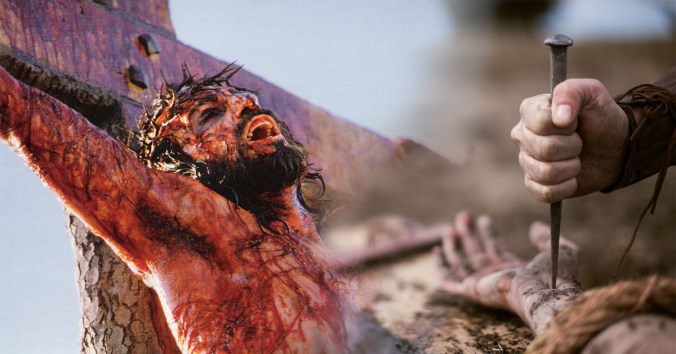
15:22 They [Roman soldiers] brought [possibly led or carried] Jesus to the place called Golgotha [Greek word for a place located outside the city’s walls — see Heb. 13:12] (which means [in Aramaic] The Place of the Skull [Latin word is translated Calvary]).

15:23 Then [before He was nailed to the cross] they [perhaps friends since the soldiers would want to inflict maximum pain] offered him wine mixed with myrrh [an anesthetic or sedative to induce sleep and deaden pain], but he did not [see Matt. 27:34] take it [He accepted His sentence and the suffering it involved / He was willing to feel the full impact of the crucifixion].

15:24 And they crucified [the most horrible way to die at the time / Mark did not have to elaborate because his Roman audience would have understood] him [Jesus was not a victim but a volunteer]. Dividing up his clothes, they [soldiers] cast lots [fulfilled prophecy of Ps. 22:18] to see what each would get [ironically they could have received something far greater than Jesus’ clothing].

Note: “The pain was absolutely unbearable … In fact, it was literally beyond words to describe; they had to invent a new word: excruciating. Literally, ‘excruciating’ means ‘out of the cross.’ Think of that: they needed to create a new word, because there was nothing in the language that could describe the intense anguish caused during the crucifixion.” (“The Case for Christ” • Lee Strobel • pp. 197-198)

15:25 It was the third hour [9:00 AM] when they crucified [a painful and humiliating form of execution] him.

15:26 The written notice of the charge [Roman custom was to indicate charges on a sign hung around the accused person’s neck] against him read: THE KING OF THE JEWS [Jewish leaders protested wording of sign (John 19:21-22); see also Luke 23:2].

Note: Pilate displayed the sign out of contempt for the Jewish leaders, but it was also the truth.

15:27 They crucified two robbers [Greek word: lestes, refers to political insurrectionists or terrorists who may have robbed to obtain support for their cause: see Mark 15:7 regarding Barabbas; perhaps they had participated in the treason of Barabbas] with him [see prophecy in Isaiah 53:12], one on his right and one on his left [see Luke 23:39-43].

15:29 Those who passed by hurled insults at him, shaking their heads [a gesture of contempt] and saying [fulfilled Ps. 22:7], “So! You who are going to destroy the temple and build it in three days [see John 2:19],

15:30 come down from the cross [not a physical impossibility, but a moral and spiritual impossibility] and save yourself!”

15:31 In the same way the chief priests [probably Sadducees: failed to recognize the Great High Priest] and the teachers of the law [Pharisees] mocked [Greek: empaizo, “to ridicule” or “to make fun of”] him among themselves [rather than to His face]. “He saved others [interestingly, they acknowledged His saving work],” they said, “but he can’t save himself [had Jesus chosen to save Himself He could not have saved others]!

Note: How do you react when people insult you because of your following Jesus?

15:32 Let this [not “the”] Christ, this [not “our”] King of Israel [they did not believe these things about Jesus but spoke these words in derision], come down now from the cross, that we may see and believe [see John 11:46-53].” Those crucified with him [two thieves] also heaped insults on him [total rejection from everyone present].

15:33 At the sixth hour [12:00 PM] darkness [indicative of God’s judgment on human sin] came over the whole land until the ninth hour [3:00 PM].

15:34 And at the ninth hour Jesus cried out [Mark recorded only one of Jesus’ seven sayings from the cross] in a loud voice, “Eloi, Eloi, lama sabachtani? [an Aramaic version of Ps. 22:1]” — which means, “My God, my God [one of Jesus’ five double expressions], why have you forsaken [term means: “to be left behind”] me? [for the first time in eternity Jesus experienced the pain of feeling absolutely alone]

Note: Jesus understands what it is like to be lonely. Suggest people in society today who may be forsaken or feel lonely. How can we minister to them and help them understand that God will never forsake them?

15:35 When some of those standing near heard this, they said, “Listen, he’s calling Elijah.”

15:36 One man ran, filled a sponge with wine vinegar, put it on a stick, and offered it to Jesus to drink. “Now leave him alone. Let’s see if Elijah comes to take him down,” he said.

15:37 With a loud cry [perhaps the cry of victory in John 19:30 or Luke 23:46], Jesus breathed his last [after six excruciatingly painful hours: see Phil. 2:8].

15:38 The curtain of the temple [which separated the holy place from the holy of holies: only one priest entered the holy of holies on the Day of Atonement — once a year] was torn in two [indicating it was no longer needed: no more need for OT rituals; Jesus was the ultimate and final sacrifice] from top to bottom [indicative of God’s action and symbolizing the removal of the barrier between God and man: see Heb. 10:19-22].

15:39 And when the centurion [a Roman army officer responsible for 100 men: an unlikely convert and evangelist], who stood there in front of [in a position to witness all the events at the crucifixion] Jesus, heard his cry and saw how he died [overwhelming evidence of Jesus’ identity], he said, “Surely this man was the Son of God!”

Themes of New Testament Books

Matthew

• The words and deeds of Jesus
• Keyword: King

Mark
• Jesus’ mission
• Keyword: Servant

Luke
• The life and ministry of Jesus
• Keyword: Son of Man

John
• Believe in Jesus
• Keyword: Son of God

Acts
• The life and expansion of the early church
• Keyword:The Holy Spirit

Romans
• God’s gift of righteousness
• Keyword: The righteous

1 Corinthians
• Spiritual development
• Keyword: Sanctification

2 Corinthians
• Jesus’ death on the cross
• Keyword: Reconciliation

Galatians
• No other gospel
• Keyword: Freedom

Ephesians
• Living in unity
• Keyword: Grace

Philippians
• To live is Christ
• Keyword: Joy

Colossians
• The supremacy of Christ
• Keyword:Christ

1 Thessalonians
• The return of Jesus
• Keyword: Imitate

2 Thessalonians
• Expecting Jesus’ return
• Keyword: Day of the Lord

1 Timothy
• Advice for Christian leaders
• Keyword: Instruction

2 Timothy
• Instructions to Timothy
• Keyword:Endure

Titus
• Advice to young minister
• Keyword: Teach

Philemon
• Have your slave back
• Keyword: Forgiveness

Hebrews
• The superiority of Christ
• Keyword: Better

James
• The importance of faith and action
• Keyword: Active faith

1 Peter
• When you are persecuted
• Keyword: Endurance

2 Peter
• Enemies from within
• Keyword: Be alert

1 John
• Live in fellowship with God
• Keyword: Fellowship

2 John
• Beware of false teachers
• Keyword: Watch out

3 John
• Live in fellowship with Christians
• Keyword:Faithful

Jude
• Beware of false teaching
• Keyword: Contend

Revelation
• Things that will take place
• Keyword: Revelation

Themes of Old Testament Books

Genesis
• God chooses one nation to bless all nations
• Keyword: Beginnings

Exodus
• Deliverance from Egypt
• Keyword: Redemption

Leviticus
• Approaching a holy God
• Keyword: Holiness

Numbers
• Disbelief and disobedience
• Keyword: Wanderings

Deuteronomy
• Beware that you do not forget
• Keyword: Covenant

Joshua
• Entering the Promised Land
• Keyword: Conquest

Judges
•Leaders from Joshua to Samuel
• Keyword: Forgot

Ruth
Godliness illustrated
• Keyword: Kinsman-redeemer

1 Samuel
•Israel’s early kings
• Keyword: Rejection

2 Samuel
• Israel’s early kings
• Keyword: David

1 Kings
• Story of two kingdoms
• Keyword: Division

2 Kings
• Story of two kingdoms
• Keyword: Captives

1 Chronicles
• A spiritual perspective
• Keyword: Covenant

2 Chronicles
• Solomon and the kings of Judah
• Keyword: The Temple

Ezra
• Exiles returning to Jerusalem
• Keyword: The Temple

Nehemiah
• Rebuilding the walls of Jerusalem
• Keyword: Jerusalem walls

Esther
Jews under threat
• Keyword: Providence

Job
The suffering of man / a loving God
• Keyword: Sovereignty

Psalms
• Hymn book of the Jews
• Keyword: Worship

Proverbs
• Practical moral instruction
• Keyword: Wisdom

Ecclesiastes
• The search for meaning in life
• Keyword: Vanity

Song of Songs
• A love song
• Keyword: Love

Isaiah
• Salvation comes from God
• Keyword: Salvation

Jeremiah
• God’s patience and holiness
• Keyword: Obey

Lamentations
• Mourning the destruction of Jerusalem
• Keyword: Weep

Ezekiel
• Condemnation and consolation
• Keyword: Restoration

Daniel
• Encouragement for exiled Jews
• Keyword: God’s plan

Hosea
• God’s love for Israel
• Keyword: Return

Joel
• God’s judgment
• Keyword: The day of the Lord

Amos
• Social justice
• Keyword: Judgment

Obadiah
• Judgment on Edom
• Keyword: Judgment

Jonah
• Salvation for non-Jews
• Keyword: God’s love

Micah
• Injustice exposed
• Keyword: Mercy

Nahum
• The fall of Nineveh
• Keyword: Judgment

Habakkuk
• Sin in God’s world
• Keyword: Faith

Zephaniah
• The coming day of judgment
• Keyword: Restoration

Haggai
• Rebuild the temple
• Keyword: The temple

Zechariah
• Future blessings for Israel
• Keyword: Vision

Malachi
• An appeal to backsliders
• Keyword: Return

Mark 16

16:1 When the Sabbath was over, [cf. Matt. 27:56] Mary Magdalene, Mary the mother of James [“son of Alphaeus” or “James the younger” ], and Salome [probably the mother of James and John] bought spices so that they might go to anoint [no opportunity to anoint Jesus’ body because He died and was buried shortly before the start of the Sabbath] Jesus’ body.

16:2 Very early [“while it was still dark” (Jn. 20:1)] on the first day [Sunday] of the week, just after sunrise, they were on their way to the tomb [the tomb had been sealed and was guarded by Roman soldiers (cf. Matt. 27:66)]

16:3 and they asked each other [note the main concern of the women…], “Who will roll the stone [described as “very large” in 16:4] away from the entrance of the tomb [Mary Magdalene and Jesus’ mother had watched as the tomb was sealed (Mk. 15:46)]?”

16:4 But when they looked up, they saw that the stone, which was very large, had been rolled away [Gr. anakulio means “to roll up / upward”; the stone was moved not to let Jesus out but instead to let the world in].

Note: Regarding position of stone:
• Matt. 27:60 — kulio: “to roll”
• Mark 16:3,4 — anakulio: “to roll up / upward”
• Luke 24:2 — apokulio: “separation in sense of distance, thus rolled away”

16:5 As they entered the tomb, they saw a young man [identified as an angel in Matt. 28:2] dressed in a white robe sitting on the right side, and they were alarmed [frightened or dumfounded, a natural reaction to what the women encountered].

16:6 “Don’t be alarmed,” he said. “You are looking for Jesus the Nazarene, who was crucified. He has risen! He is not here [the women were the first to hear this good news]. See the place where they laid him [cf. Jn. 20:6-7].

16:7 But [the women were given a new assignment] go, tell his disciples and [as if to emphasize that Peter had not been disowned…] Peter, ‘He is going ahead of you into Galilee [Jesus had called most of the disciples there]. There you will see him, just as he told you [cf. Mk. 14:28].’”

16:8 Trembling and bewildered, the women went out and fled from the tomb. They said nothing to anyone, because they were afraid.

Note: The earliest manuscripts and some other ancient witnesses do not have verses 9–20.

16:9 When Jesus rose early on the first day of the week, he appeared first to Mary Magdalene, out of whom he had driven seven demons.

16:10 She went and told those who had been with him and who were mourning and weeping.

16:11 When they heard that Jesus was alive and that she had seen him, they did not believe it.

16:12 Afterward Jesus appeared in a different form to two of them while they were walking in the country.

16:13 These returned and reported it to the rest; but they did not believe them either.

16:14 Later Jesus appeared to the Eleven as they were eating; he rebuked them for their lack of faith and their stubborn refusal to believe those who had seen him after he had risen.

16:15 He said to them, “Go into all the world and preach the gospel to all creation.

Imagine being among the first to hear Jesus say, “Go into all the world and preach the good news to all creation” (Mark 16:15). How would you have felt? What would you have thought about such an enormous assignment? Perhaps you would have felt overwhelmed. Perhaps you would have thought, “I am inadequate for such a task.” How then, did Jesus prepare a group of ordinary human beings for the enormous task of sharing the good news with the world?

16:16 Whoever believes and is baptized will be saved, but whoever does not believe will be condemned.

16:17 And these signs will accompany those who believe: In my name they will drive out demons; they will speak in new tongues;

16:18 they will pick up snakes with their hands; and when they drink deadly poison, it will not hurt them at all; they will place their hands on sick people, and they will get well.”

16:19 After the Lord Jesus had spoken to them, he was taken up into heaven and he sat at the right hand of God.

16:20 Then the disciples went out and preached everywhere, and the Lord worked with them and confirmed his word by the signs that accompanied it.

The Place for the Bible


The HOME is a Place for the Bible

The home is a place for the Bible. The Bible belongs in the home because it contains God’s blueprint for building and maintaining a stable home. God cares about the home. Psalm 127:1 states, “Unless the Lord builds the house, they labor in vain who build it.” This verse assures us that God is willing to roll up His divine sleeves and help us build homes that are strong.

The home is important to God for several reasons.

First, the home is important to God because it’s the setting where children learn their value as human beings. As children interact with others in the home they develop either a positive or negative view of themselves. The Bible gives family members important guidelines concerning how they should relate to one another.

Second, the home is important to God because it’s the setting in which children learn to relate to those in authority. Their experiences at home usually determine the manner in which they relate to those in authority outside the home and ultimately to God.

Finally, the home is important to God because it’s the place where children develop their values. As children observe what their parents hold important they too make determinations about what is important. In particular, if your children do not see the importance of the Bible in your life, they will likely not place much importance on the Bible.

The home was very important in ancient Israel. That is why in Deuteronomy 6:4-9 God charged parents with the responsibility of providing spiritual instruction in the home. Parents were to teach their children how to put their confidence in God, to not forget the works of God, and to live in obedience to God (Ps. 78:5-8). The children, in turn, were to teach these same lessons to their children.

The home is the basis of a strong nation. When homes are strong the nation is strong. And, when homes are weak the nation is correspondingly weak. According to Ezekiel 22:7, the breakdown of the home contributed to the spiritual and moral decline and eventual captivity of Israel. Many other ancient civilizations also fell because of the disintegration of the home.

We can not expect to provide spiritual instruction in the home apart from God’s Word. And, if we fail to teach our children how to put their confidence in God, to not forget the works of God, and to live in obedience to God, we will raise a spiritually and morally confused generation that will further weaken the moral fiber of our nation. The Bible must have a central place in our homes.

The HAND is a Good Place for the Bible

The Bible must also have a place in our hands.

I met Dr. David Fite during my seminary years. Dr. Fite was imprisoned by Castro for a number of years. He was not allowed to have a Bible while he was in prison. Dr. Fite could not bear the thought of being without a Bible, so he asked a friend to get him a copy of the Greek New Testament. When the guards examined the book, they were told it was a book of great literature and history written in Greek. That New Testament became a great source of strength and comfort to him during those difficult years.

Years ago I visited the home of Corrie ten Boom in Haarlem, Holland — just outside the city of Amsterdam. Her family’s story is recorded in the book entitled, “The Hiding Place.” Corrie and her family were Christians who helped hide Jews from the Nazis during the dark days of World War 2. Her family was betrayed and consequently arrested and sent to concentration camps. Corrie ten Boom kept a Bible hidden on her person during her imprisonment. It was a constant source of strength to her.

A Bible in our hands is available for reading. It is important for us to spend quiet moments with God when He can specifically speak to us about our lives. We should have a Bible in our hands for the purpose of reading at least once a day. Doing so will make a great difference in our lives.

A Bible in our hands is also available for reference. The Bible addresses all the issues that touch our lives and can give us the counsel to make right decisions.

A Bible is our hands is also available as a resource in times of confusion, danger, difficulties, distress, doubt, fear, loneliness, pain, pressures, and trials. Whenever I find myself in one of those difficult seasons in life, I do not hesitate to look to the Bible in my hand as a resource that will comfort and guide me.

What about you? Does the Bible in your home find its way to your hand at least once a day? The Bible in your home will not make a difference in your life if it never ends up in your hand.

The HEAD is a Better Place for the Bible

The home is a place for the Bible and the hand is a good place for the Bible. But the head is a better place for the Bible.

To have the Bible in our head means that we should strive to master the Word of God. In other words, we should seek to increase our knowledge and understanding of the Word of God — a task that will take a lifetime.

Someone wisely stated that no one ever graduates from Bible Study until he meets the Author face to face. Paul told his young friend Timothy, “Be diligent to present yourself approved to God as a workman who does not need to be ashamed, handling accurately the word of truth” (2 Tim. 2:15).

A friend in high school gave me a copy of the New Testament. That New Testament did not have a concordance. I did not know that there was such a thing as a concordance at the back of most Bibles. A concordance is a handy tool for finding verses in the Bible. But, as I read and studied this little New Testament every day, I began to put together my own concordance. All of the pages at the front and back of this New Testament are filled with my notes about where to find verses on certain topics. That was only the beginning of a Bible Study journey that continues through this day and will continue until the day I meet the Author face to face.

To have the Bible in our head also means that we should meditate on the Word of God. To meditate means to reflect on God’s Word … to turn it over in our minds … to think it through. The Psalmist said (quote Ps. 1:1-3).

Ezra is one of my favorite Bible characters. Ezra 7:10 states, “For Ezra had set his heart to study the law of the Lord, and to practice it, and to teach His statutes in Israel.”

Many scholars believe that Ezra is the author of Psalm 119 — the most magnificent Psalm on the beauty of the Word of God. Psalm 119:97 states, “O how I love Thy law! It is my meditation all the day.”

Like the righteous man of Psalm 1 and Ezra, we too should meditate on God’s Word throughout the day.

To have the Bible in our head also means that we should memorize the Word of God. Every believer should make it a point to memorize Scripture. Begin by memorizing familiar and favorite verses.

I enjoy memorizing Scripture. By memorizing Scripture I am able to meditate on it throughout the day. My favorite book of the Bible is Psalms. The Psalms not only speak to me, they also speak for me. They are a daily source of comfort and inspiration to me. I enjoy reflecting on their meaning as I go about my day. These are among my favorites.

The Bible in your home must find a place in your hands if it is ever going to end up in your head.

The HEART is the Best Place for the Bible

The home is a place for the Bible. The hand is a good place for the Bible. The head is a better place for the Bible. But the heart is the best place for the Bible.

The Psalmist declared, “Thy word I have treasured in my heart, That I may not sin against Thee” (Ps. 119:11). The Apostle Paul said, “Let the word of Christ richly dwell within you…” (Col. 3:16).

We memorize God’s Word in our heads but we treasure it in our hearts.

In other words, the truths, principles, and precepts of God’s Word are what we treasure in our hearts. When God’s truths richly dwell in our hearts they can help govern our decisions, our actions, and help us live our lives in a way that pleases God.

Someone wisely said about the Bible: “This book will keep you from sin or sin will keep you from this book.”

Let me illustrate what I mean. Psalm 139 is in my head. It is recorded on the pages of my memory. That has allowed to meditate on its truths as I go about my day.

Psalm 139:1-6 states “O Lord, Thou hast searched me…”
The truth that is treasured in my heart is this: The fact that God watches everything I do should be an incentive to holy living. I can never do anything behind God’s back.

Psalm 139:7-12 states “Where can I go from Thy Spirit…”
The truth that is treasured in my heart is this: I can never escape the presence of God. I am never alone no matter where I go or how fast I try to go. I can count on God’s presence all the time. I am never alone.

Psalm 139:13-16 states “For Thou didst form my inward parts…”
The truth that is treasured in my heart is this: I am special to God. He has known me since I was in my mother’s womb. I am a person of value and significance.

Psalm 139:17-18 states “How precious also are Thy thoughts…”
The truth that is treasured in my heart is this: God thinks about me all the time. Even when I am asleep, God is thinking about me. And when I wake up in the morning He is still thinking about me. Nobody thinks about me as much as God.

Psalm 139:19-22 states “O that Thou wouldst slay…”
The truth that is treasured in my heart is this: I should hate the things God hates. I should avoid the things that would cause my love for Him to grow cold.

Psalm 139:23-24 states “Search me, O God…”
The truth that is treasured in my heart is this: God can make my heart clean. He can calm anxious thoughts and correct hurtful ways.

And so, the Bible in your home must find its way in to your hands in order to find a place in your head and ultimately end up in your heart.

Conclusion

I want to challenge you to think seriously about what you believe concerning God’s Word, the implications of that belief, and the place that God’s Word actually holds in your life.

How frequently does the Bible in your home find its way into your hand?

How much time do you actually spend engaging your head with the Bible in your hand?

How much of what you learn in your head actually ends up finding a place in your heart?

We cannot expect to intelligently speak to the various competing ideologies and worldviews in our post-modern culture apart from a strong Biblical worldview?

I hope you will allow God’s Word to richly dwell within you.

Please spend time in God’s Word every day.

Proverbs 13:13 is a one-verse commentary on why God’s Word deserves a special place in each of our lives: “Despise God’s Word and find yourself in trouble. Obey it and succeed.”

Ten Little Christians

10 Little Christians standing in line
1 disliked the preacher, then there were 9

9 little Christians stayed up very late
1 overslept Sunday, then there were 8

8 little Christians on their way to Heaven
1 took the low road and then there were 7

7 little Christians chirping like chicks
1 disliked music, then there were 6

6 little Christians seemed very much alive
but one lost his interest then there was 5

5 little Christians pulling for Heaven’s Shore
but one stopped to rest, then there were 4

4 little Christians each busy as a bee
1 got his feelings hurt, then there were 3

3 little Christians knew not what to do
1 joined the sporty crowd, then there were 2

2 little Christians, our rhyme is nearly done
differed with each other, then there was 1

1 little Christian can’t do much ’tis true
brought his friend to Bible study, then there were 2

2 earnest Christians, each won one more
that doubled the number, then there were 4

4 sincere Christians worked early and late
Each won another then there were 8

8 splendid Christians if they doubled as before
In just so many Sundays, we’d have 1,024

In this little jingle, there is a lesson true,
You belong either to the building or to the wrecking crew!


Author Unknown

Kiss My Foot

What if my foot felt lowly and blue,
Looking up at a knee or a wrist.
And began turning green, as we’re prone to do
When we fancy the glory we’ve missed.

Can’t you just hear my toes up in arms,
Crying out from the depth of my sole?
Wriggling that I might notice their charms—
They might topple me off in a hole!

And where would I be without my best foot
To step forth and traverse terrain?
If my heart said to dance, would I just stay put?
The thought of it boggles my brain!

If we are attached, whose itch have I scratched?
Whose misery or glory dismissed?
Though my tongue’s in my cheek, heed the wisdom I speak—
Pucker up! There’s a foot to be kissed!


Margie Mayfield
August 29, 1996
Houston, Texas