1 Kings 14

Why do you think Jeroboam asked his wife to put on a disguise and travel to Shiloh to see the prophet Ahijah?
A. Perhaps he felt that the prophet would not help him in light of his unresponsiveness to the message of the “man of God.”

B. Perhaps he felt that he might discredit his sinfully contrived religious system if the people knew he was consulting a true prophet rather than his carelessly appointed false priests and hirelings in a time of personal distress. Jeroboam’s actions indicate that he had no confidence in either his golden calves of his false priests. It is interesting to note that people often have no need for God’s man until they are in distress.

C. Perhaps he felt that since Ahijah had rightly prophesied his ascent to the throne he could rightly reveal the outcome of his son’s illness.

D. Perhaps he sent his wife because he did not have the courage to face the prophet himself, knowing that Ahijah would probably condemn him for his sinful leadership.

Note that Jeroboam said to his wife, “He will tell you what will happen to the boy” (verse 2). He did not ask his wife to ask the prophet how his son’s health might be restored.

Note also that the disguise did not work. God revealed to the blind old prophet that Jeroboam’s wife was coming to see him. God also instructed Ahijah regarding what to tell Jeroboam’s wife (see 1 Kings 14:5). This accentuates the fact that a prophet is a servant of God and is to be obedient to fulfill the instructions he receives from God. A prophet must tell God’s message faithfully without respect of persons, even as Ahijah delivered God’s message to Jeroboam’s wife.

What news did Jeroboam’s wife receive from Ahijah?
Ahijah reviewed God’s goodness to Jeroboam (verses 7-8), Jeroboam’s sin (verses 8-9), and prophesied the complete destruction of the house of Jeroboam (verses 10-16) and the scattering of the Northern Kingdom of Israel (see 2 Kings 17:6-23). Ahijah was the first of a long line of prophets to speak of exile beyond the Euphrates River.

God’s judgment is always just and always justified. So that Jeroboam and the people and the generations to come might know the reason for such severe judgment, Ahijah stated the reason in verse 16. We see in this verse the severe consequences (God “will give up Israel”) and contagious nature (Jeroboam “made Israel to sin”) of sin. See Psalm 103:8-9. God will not tolerate evil forever.

Note that only one member of Jeroboam’s family, Abijah, was to receive a proper burial (see verses 13 and 17-18). The descendants of Jeroboam would be denied a proper burial (verse 11). As prophesied in verse 14, Jeroboam’s house was destroyed (see 1 Kings 15:25-30).

What confirmation do we have in 1 Kings 14:17-18 that what Ahijah spoke would come to pass?
A. The child died as soon as Jeroboam’s wife stepped over the threshold of her home, just as Ahijah had said (verse 12). This was the beginning of judgment.

B. The nation mourned the child’s death (verse 13) as Ahijah had said.

1 Kings 15

What does the Scripture tell us about Nadab?
A. He was the son of Jeroboam (15:25).

B. He became king of Israel during the second year of Asa’s reign in Judah (15:25).

C. He reigned over Israel only two years (15:25), a short and unproductive reign.

D. Like his father before him, he did evil in the sight of the Lord (15:26). Refer to 1 Kings 12:28-31 for a record of the evil which Nadab’s father Jeroboam did in the sight of the Lord. Proverbs 16:12 states, “It is an abomination for kings to commit wickedness, For a throne is established on righteousness.” But where sin rules and righteousness is disregarded there can be no stable throne.

E. He was assassinated by Baasha who plotted against him and usurped the throne (15:27-28). This was the first “regicide” in the history of the kingdom.

What was Baasha’s first act once he usurped the throne?
Baasha “struck down all the household of Jeroboam” and thus fulfilled the word of Ahijah the prophet to Jeroboam (see 1 Kings 14:10-11). Baasha was the “broom” God used to “make a clean sweep of the house of Jeroboam” (1 Kings 14:10).

Why did Baasha completely destroy the house of Jeroboam?
A. From Baasha’s view: Because it was politically expedient. Such action would ensure that any surviving member of Jeroboam’s household would not threaten his reign.

B. From the writer’s view: To fulfill the word of The Lord through Ahijah the prophet. Psalm 119:91b states, “For all things are Thy servants.” God, in this case, used the wicked to punish the wicked.

What does the Scripture tell us about Baasha?
A. He was the son of Ahijah (not the same person as the prophet) of the house of Issachar (an undistinguished tribe named after the ninth son of Jacob). See 1 Kings 15:27.

B. He was the first person to assassinate a king of Israel, namely Nadab the son of Jeroboam (15:27-28).

C. He utterly destroyed the house of Jeroboam. He not only destroyed the male members of the household as per the prophesy of Ahijah in 1 Kings 14:10, but also “did not leave to Jeroboam any persons alive” (15:29).

D. He usurped the throne of Israel and reigned a total of twenty-four years (15:33).

E. His capital city was Tirzah, a few miles north of Shechem (the capital city of Jeroboam). Some believe that Jeroboam moved his capital from Shechem to Tirzah (see 1 Kings 14:17) while others hold that Baasha made Tirzah the capital city of the northern kingdom.

F. Like Jeroboam, “he did evil in the sight of the Lord” (15:34). His reign was not distinguished from the wicked and evil reigns of Jeroboam and Nadab. 1 Kings 16:7 states that his house was “like the house of Jeroboam.” He was a wicked man who killed a wicked king and continued a wicked reign. He usurped the throne because he wanted power and dominion, not because he was interested in introducing religious reforms. This is seen in that he embraced the sins of Jeroboam.

G. He failed to recognize that God had exalted him (that is, allowed him to attain the throne) and made him leader over Israel (16:2) and consequently lived his life in a manner displeasing to God.

Practical Consideration

A life of sin leads to misery and death.
Nadab continued to try God’s patience (Psalm 103:9) by following the wicked example of his father. He suffered the consequences of not honoring God with his life. As long as men think they can live their lives without regard to God or His Word, they will suffer the consequences of their foolishness. Sin rewards men in the currency of misery, frustration, and death.

1 Kings 15:9-21 NIV

15:9 In the twentieth year of Jeroboam king of Israel [the Northern Kingdom], Asa [names means “doctor” or “healing”] became king of Judah [Asa was the third king of the Southern Kingdom of Judah],

15:10 and he reigned in Jerusalem forty-one years [length of his reign surpassed the reigns of David (1 Kings 2:11) and Solomon (1 Kings 11:42)]. His grandmother’s name was Maacah [mother of Abijah] daughter of Abishalom [Absalom].

15:11 Asa did what was right in the eyes of the LORD [Asa sought to keep the Lord’s commands and to carry out his covenant responsibilities as Judah’s king], as his father [used here in the sense of forefather or ancestor] David had done.

15:12 He expelled the male shrine prostitutes [part of Canaanite religious practice: men and women cult prostitutes engaged in sexual relations in hope of bringing fertility to the land; included the practice of sodomy and other sexual acts] from the land [these practices had been tolerated in the land since reign of Rehoboam (1 Kings 14:24)] and got rid of all the idols [worshiping idols a violation of the First and Second Commandments (Ex. 20:4-6)] his fathers [Solomon, Rehoboam, and Abijah] had made.

15:13 He even deposed [an indication of Asa’s commitment to spiritual reformation] his grandmother Maacah from her position as queen mother [she wielded influence from this position], because she had made [possibly did so after Asa began instituting his reforms (cf. 2 Chron. 15:10-16)] a repulsive [frightening, horrible, abominable] Asherah [a Canaanite fertility goddess and mother of 70 sons, of whom Baal was the most famous; worshiped by Canaanites and Phoenicians] pole [used as an image in worship of Asherah; some believe the pole was a phallic symbol that was part of worship practices of fertility cult]. Asa cut the pole down and burned it in the Kidron Valley [cf. 2 Chron. 15:16; Kidron Valley separated the city of David and the temple from the Mount of Olives].

15:14 Although he did not remove the high places [worship sites throughout the countryside where people worshiped pagan gods], Asa’s heart was fully committed to the LORD all his life.

15:15 He brought into the temple of the LORD the silver and gold and the articles [these items (probably the plunder of military victories) would ensure adequate financial support to maintain formal worship of God] that he and his father had dedicated.

15:16 There was war [being committed to God does not mean an absence of difficult or threatening problems] between Asa and Baasha king of Israel throughout their reigns.

15:17 Baasha king of Israel went up against Judah and fortified Ramah [located five miles north of Jerusalem on main north-south road running through Israel and Judah; this was a strategic location from which to launch a further invasion of Judah] to prevent anyone from leaving or entering the territory of Asa king of Judah.

15:18 Asa [resorted to bribery and political intrigue to deal with Baasha rather than trusting God as he did when threatened by Zerah the Cushite (2 Chron. 14:9-15)] then took all the silver and gold that was left in the treasuries of the LORD’S temple [Asa used the funds he had set aside in the temple treasury (cf. 1 Kings 15:15) to hire a pagan king to attack the Northern Kingdom; Asa started his reign well (called Judah back to God) but did not finish well (depended on money and military power to deal with Baasha)] and of his own palace. He entrusted it to his officials and sent them to Ben-Hadad [name “Hadad” referred to Arameans’ storm god] son of Tabrimmon, the son of Hezion, the king of Aram [geographical region located northeast of holy land and west of Mesopotamia; also known as Syria], who was ruling in Damascus [located northwest of the Northern Kingdom of Israel].

15:19 [1] “Let there be a treaty between me and you,” he said, “as there was between my [Asa’s] father [King Abijah] and your [Ben-hadad’s] father.  [2] See, I am sending you a gift of silver and gold [an extra incentive for Ben-hadad to restore earlier treaty with Judah].  [3] Now [accept the bride and…] break your treaty with Baasha king of Israel so he [Baasha and the armies of the Northern Kingdom Israel] will withdraw from me.”

Note: Have you ever been tempted to compromise your faith in an effort to overcome some obstacle? What factors cause you to shift your focus from God? What definite actions can help you stay focused on the Lord as you seek solutions to your problems?

15:20 Ben-Hadad agreed with King Asa and sent the commanders of his forces against the towns of Israel. He conquered Ijon, Dan, Abel Beth Maacah [these three towns lay in the northern part of Israel close to border with Aram] and all Kinnereth [referred to area around Sea of Galilee] in addition to Naphtali [referred to area north and west of Sea off Galilee].

15:21 When Baasha heard this [the attacks against Israel in the north], he stopped building Ramah [in the south] and withdrew [Baasha not able to fight a war on two fronts] to Tirzah [current capital of Northern Kingdom; located a few miles north of Shechem].

1 Kings 16

What word from the Lord did Jehu the son of Hanani have for Baasha?
Essentially the same message that Ahijah delivered to Jeroboam. Because Baasha had provoked God to anger by walking in the sinful ways of Jeroboam, his household would suffer the same fate as Jeroboam’s. The words of Jehu must have weighed heavily on Baasha in light of the fact that he had been God’s instrument to make a clean-sweep of the house of Jeroboam. See Proverbs 16:12.

What does the Scripture tell us about Elah?
A. He was the son of Baasha (16:8) who became king after his father’s death (in the twenty-sixth year of Asa’a reign in Judah).

B. Like the man his father killed (Nadab), he reigned two years at Tirzah (16:8).

C. Just as his father had conspired against Nadab (15:27) and killed him, Elah’s servant Zimri (one of his chariot commanders) conspired against him and killed him (16:9-10).

D. Just as his father had usurped the throne from Nadab, Zimri usurped the throne from Elah (16:10).

E. Elah was no different than his father Baasha or Nadab or Jeroboam. He too, provoked God to anger with his sin (16:13). His life and reign was characterized by wickedness and evil. See Proverbs 16:12.

What was Zimri’s first act once he usurped the throne?
Zimri “killed all the household of Baasha” (16:11-12) and thus fulfilled the word of the prophet Jehu to Baasha. Zimri was as thorough in his annihilation of Baasha’s household as Baasha was in the annihilation of Jeroboam’s household. Like Baasha, Zimri eliminated every possible threat to his reign from the house of Jeroboam.

What does the Scripture tell us about Zimri?
A. He was a military man. He was the “commander of half [Elah’s] chariots” (16:9). It is possible that he was not even an Israelite since no father or tribe is listed for him.

B. He was an opportunist. He took advantage of the opportunity to assassinate Elah while Elah was in a drunken stupor (16:9) and thus usurped the throne of Israel. It is possible that Arza (16:9) was a part of Zimri’s conspiracy to kill Elah.

C. He destroyed the household of Baasha (16:11-12).

D. He reigned a total of seven days (16:15).

E. He committed suicide when Omri, the commander of the army, was declared king and besieged the city of Tirzah (16:18). Someone has said, “The usurper is often the dupe of his own wickedness.”

F. He was an evil man. Even though he reigned seven days, the writer declared that he did evil in the sight of the Lord as the rulers before him. See Proverbs 16:12.

How are we introduced to Omri?
He was a military man (16:16). He was the commander of the army of the Israel. He was involved in a military campaign against the Philistine city of Gibbethon (see also 1 Kings 15:27) when Zimri killed Elah and usurped the throne. When the people who were with Omri heard of the coup d’ état led by Zimri, they made Omri king over Israel. Omri then went from Gibbethon to Tirzah and besieged the city (16:17). This event led Zimri to commit suicide (16:18).

What opposition did Omri encounter after the death of Zimri?
He encountered strong opposition from Tibni the son of Ginath. The northern kingdom was divided in its choice for a king. Half the people followed Omri and half followed Tibni. Omri eventually prevailed after a four-year struggle (16:15, 23) and officially began his reign in the thirty-first year of Asa’s reign in Judah (16:23).

Where did Omri move the capital of the Northern Kingdom of Israel?
Omri moved the capital from Tirzah to Samaria, which remained the capital city until it fell to the Assyrians in 722 B.C. (16:24). This was the third capital city of Israel (Shechem, Tirzah, Samaria). It was strategically located on a high hill.

What kept Omri from being a great man in the eyes of the writer?
The fact the Omri “did evil in the sight of the Lord, and acted more wickedly than all who were before him” (16:25). Micah 6:16 refers to “the statutes of Omri.” Those who were before Omri led Israel astray by example and temptation, but Omri went further and led them astray by compulsion. Like his predecessors, he “walked in all the way of Jeroboam” (16:26), who by now has been established as the king by which evil is measured.

The writer was not as impressed by Omri’s political and military accomplishments as the Assyrians who referred to Israel in their records as “the land of Omri.” He was interested in Omri’s moral and spiritual condition and contributions. The sum of these is recorded in 1 Kings 16:25, “He acted more wickedly than all who were before him.” Up to this point in the narrative, Omri has the distinction of being the most evil and wicked king in Israel’s brief history. No accomplishments in the eyes and estimation of the world can make up for such failure in the eyes of God.

Who succeeded Omri as king of Israel?
His son Ahab, another godless ruler who plunged Israel deeper into idolatry, succeeded Omri. His twenty-two year reign is littered with evil. As with the other kings in the narrative, the historian summed up Ahab’s reign in 1 Kings 16:30, “And Ahab the son of Omri did evil in the sight of the Lord more than all who were before him.” Ahab went beyond the “more” wicked behavior of his father (16:25). Ahab led Israel to the summit of wickedness.

In what way did Ahab go beyond the wickedness of those before him?
A. By marrying Jezebel the daughter of Ethbaal king of the Sidonians [Phoenicians] (16:31). This was a politically expedient marriage. Jezebel was a devoted worshipper of Baal [the chief male god of the Phoenicians…Ashtoreth was their female deity] and had a missionary zeal for spreading the worship of Baal. She was a strong-willed woman who held sway over Ahab.

B. Ahab “went to serve Baal and worship him” (16:31). This attests to the influence Jezebel had over Ahab.

C. Ahab “erected an altar for Baal in the house of Baal, which he built in Samaria” (16:32). Ahab allowed the idolatrous worship of Baal to become better organized in Israel. By building a temple for Baal and erecting an altar he fanned the flames of idolatry into a raging fire.

D. Ahab also “made the Asherah” (16:33).

All of this led the historian to conclude, “Ahab did more to provoke the Lord God of Israel than all who were before him” (16:33).

Practical Considerations

We should learn good lessons from bad examples.
Baasha failed to learn good lessons from Nadab’s and Jeroboam’s bad examples. Instead, he entered into and embraced the same sins that had destroyed Jeroboam and Nadab. As a result, his household experienced the same awful punishment as the house of Jeroboam. We err when we think that we can commit the same sins as others and escape judgment. See Galatians 6:7 and Colossians 3:25.

Those who despise God’s Word will be in debt to it.
Proverbs 13:13 states, “The one who despises the word will be in debt to it, But the one who fears the commandment will be rewarded.” The Living Bible paraphrases this verse: “Despise God’s Word and find yourself in trouble. Obey it and succeed.” One scholar has written. “The whole Bible is an exposition of this text.” The Amplified Bible translates this verse, “Whoever despises the Word [of God] brings destruction upon himself, but he who (reverently) fears and respects the commandment [of God] shall be rewarded.” This truth from the book of Proverbs is repeatedly illustrated in the history of Israel’s kings. This truth is also illustrated in our lives every time we think that we are smarter than God and choose to ignore his Word.

God is more interested in our character than in our career.
Omri was a powerful military leader who earned the respect of the neighboring nations, but he was a moral and spiritual failure. All of his political and military accomplishments could not make up for his spiritual deficit. The historian summed up Omri’s life with the words, “Omri did evil in the sight of the Lord” (16:25). It is what we are in the sight of the Lord that matters most rather than what we do in the sight of man. God measures our success in terms of our character rather than our career. No measure of vocational success can make up for spiritual failure.

The behavior of parents has an immeasurable impact on their children.
Omri may have been a politically and militarily successful man, but he was a failure as a parent. He failed to provide godly spiritual leadership to the people closest to him and to the people of the kingdom. Omri’s children learned to disregard God through his example. As a result they were even more godless than their father.

1 Kings 17

Who was Elijah the Tishbite?
A. He was one of the greatest prophets of the Old Testament. He was “the most important leader of the true worship of Yahweh since Moses and Samuel.” (Broadman Bible Commentary, Volume 3)

B. He is referred to as “the Tishbite.” It is believed that Tishbe was a place in Gilead (“of the settlers of Gilead”) east of the Jordan River. Some believe that Elijah was a Gentile thus further accentuating that there was none in Israel to speak for God.

C. He is described in 2 Kings 1:8 – “He was a hairy man with a leather girdle bound about his loins.”

D. His name means “God-Jehovah” or “Jehovah is my God.”

Why did he appear on the scene so suddenly?
A. This is the first mention of Elijah in the Bible.

B. He is introduced as though he were already a well-known prophet.

C. His abrupt entrance into the scene was most likely due to the increasing national apostasy under Ahab. The worship of God was in danger of being completely supplanted by the worship of Baal. Elijah appears on the scene as a new Moses to deliver Israel out of the bondage of idolatry.

What message did Elijah deliver to Ahab?
“As the Lord, the God of Israel lives, before whom I stand, surely there shall be neither dew nor rain these years, except by my word” (1 Kings 17:1).

Note: The use of the phrase “As the Lord, the God of Israel lives” must have reminded Ahab that the dead and dumb idols which he served were not living and of no comparison to the living God.

What is the significance of this prediction of drought?
It is a direct challenge to Baal who was the Canaanite god in charge of storms and rain. Elijah’s prediction was meant to accentuate Baal’s impotence as a god. The drought was also to become an instrument in God’s hands to punish Israel for turning to other gods (see Deuteronomy 11:16-17).

What did Elijah do after announcing the drought?
God instructed Elijah to hide himself by the brook Cherith, which is east of the Jordan (17:2-3). The fact that Elijah was told to “hide” himself implies that it may have been necessary in order to escape any retaliatory action on the part of the Ahab. God protected and provided (“I have commanded the ravens to provide for you there.” [17:4]) for Elijah by the brook Cherith. He had water to drink and the ravens brought him bread and meat in the morning and evening (17:6). This retreat to the brook Cherith would also give Elijah’s prediction time to come to pass.

What did Elijah do when the brook dried up because of the drought?
God instructed Elijah to go to the Phoenician coastal city of Zarephath (located between the coastal cities of Tyre and Sidon) in the homeland of Jezebel. God told Elijah, “I have commanded a widow there to provide for you” (17:9). Notice that God made provision for Elijah in Zarephath before he commanded him to leave the brook Cherith.

Elijah did as God instructed and met the (Gentile) widow gathering sticks for a cooking fire on which to prepare a final meal for herself and her son (17:10-12). Elijah asked the woman for water and then for bread. The woman told the prophet that she had “only a handful of flour in the bowl and a little oil in the jar” (17:12). Certainly not enough for an extra guest.

Elijah instructed the woman to prepare a cake of bread for him “first” and then afterwards to prepare one for herself and her son (17:13). Elijah then promised the woman that God would bless her kindness and obedience. God would not allow her bowl of flour and jar of oil to be exhausted until after the drought. God would sustain them through the difficult days of the drought.

Why do you think God sent Elijah to a Phoenician city for assistance rather than to a city in Israel?
Luke 4:25-26 records the words of Jesus in reference to this incident in the life of Elijah: “But I say to you in truth, there were many widows in Israel in the days of Elijah, when the sky was shut up for three years and six months, when a great famine came over the land; and yet Elijah was sent to none of them, but only to Zarephath, in the land of Sidon, to a woman who was a widow.” Jesus uttered these words when telling the people of Nazareth that a prophet is not welcome in his hometown.

Some feel that Elijah was sent to Zarephath because that would be the last place anyone would suspect him of hiding because it was in the homeland of Jezebel, a hotbed of Baal worship.

What happened to the widow’s son?
He became ill and died (17:17).

How did the widow respond to this event?
As a mother overwhelmed with grief, she blamed Elijah for the boy’s death (17:18).

What then, did Elijah do?
He took the boy from his mother’s bosom to the upper room where he was living and laid the boy on his own bed (17:19). Elijah then earnestly cried out to the Lord in prayer asking God to “let this child’s life return to him” (17:21). The Lord answered Elijah’s prayer by reviving the boy (17:22). Nothing is too difficult for the Lord! This is the first recorded instance of an individual being revived from the dead. This convinced the widow that Elijah was truly a man of God (17:24).

One scholar stated, “The design of miracles is not for display, or to excite wonder, but for the confirmation of truth.” What truths about God are stressed by the miracles in 1 Kings 17?

A. God is in control of nature. He caused the heavens to be shut up, for birds to provide food for his prophet, and for a widow’s pantry to remain inexhaustible through a drought.

B. God is in control of life and death. He caused the widow’s son to be revived after he had died of a severe illness.

What instruction did Elijah receive from the Lord after three and one-half years?
God instructed Elijah to go “show” himself to Ahab because He was going to end the drought (18:1). Elijah promptly obeyed (18:2). This was a courageous thing to do in light of the severity of the drought that Elijah had proclaimed (17:1). The severe physical drought was also paralleled by a great spiritual drought. There was a famine of spiritual values and a drought for God’s Word.

Practical Considerations

Faithful men are needed in the worst of times.
God can raise up faithful men to do the most difficult tasks during the darkest days. God had been preparing Elijah in the rough region of Gilead for the task of confronting Ahab and Jezebel. When the time came for the evil rule of Ahab to be challenged, he sent Elijah to trouble (see 1 Kings 18:17) Ahab and the northern kingdom of Israel.

God will not allow sin to go unchallenged or unpunished.
God sent Elijah to Ahab to hold him accountable for his sin. The sin of Ahab and the nation was punished by a severe drought (see Deuteronomy 11:16-17). If we persist in our sin God will hold us accountable. He will send a Nathan or an Elijah into our lives to get us to face our sin. God will also punish us if we persist in our sin. God’s efforts are redemptive in purpose.

God is interested in meeting our needs.
God was interested in protecting Elijah and providing for his needs. God was also interested in providing for the needs of the widow and her son. God is interested in meeting our needs as well. He invites us to cast our burdens upon Him (Psalm 55:22 and 1 Peter 5:7) and to find rest in Him when we are weary and heavy-laden (Matthew 11:28-30).

Verse by Verse NIV

1 Kings 17:1-18
17:1 Now Elijah [this is the first mention of Elijah in the Bible; name means “God-Jehovah” or “Jehovah is my God”; the dominant religious figure in first half of 9th century BC; he is described in 2 Kings 1:8] the Tishbite, from Tishbe in Gilead [it is believed that Tishbe was a place in Gilead (“of the settlers of Gilead”) east of the Jordan River], said to Ahab [(874-853 BC) king of Northern Kingdom of Israel whose reign was marred by religious failure; married Jezebel, a devout worshiper of Baal; cult of Baal became most popular religion in Northern Kingdom], “As the LORD, the God of Israel, lives [in contrast to the dead and dumb idols which Ahab and the people served], whom I serve [Elijah publically and courageously declared his allegiance to God], there will be neither dew nor rain [a direct challenge to Baal who was the Canaanite god in charge of storms and rain; drought was also an instrument in God’s hands to punish Israel for turning to other gods (see Deut. 11:16-17)] in the next few years [three and a half years (cf. 1 Kings 18:45; Jas. 5:17-18)] except at my word.”

17:2 Then [after he had delivered God’s message to Ahab] the word of the LORD came to Elijah:

17:3 “Leave here, turn eastward and hide [it may have been necessary to hide in order to escape any retaliatory action on the part of the Ahab and Jezebel; this retreat to the Kerith Ravine would also give Elijah’s prophecy time to come to pass] in the Kerith Ravine, east of the Jordan.

17:4 You will drink from the brook, and I have ordered [expresses God’s authority] the ravens [cf. Ps. 119:91b] to feed you there [a very important word; where God guides He provides].”

17:5 So he did what the LORD had told him [Elijah was obedient to God’s instructions]. He went to the Kerith Ravine, east of the Jordan, and stayed there.

17:6 The ravens brought him bread and meat in the morning and bread and meat in the evening, and he drank from the brook.

17:7 Some time later the brook dried up because there had been no rain in the land.

17:8 Then the word of the LORD came to him:

17:9 “Go at once to Zarephath [coastal city located between the coastal cities of Tyre and Sidon in the homeland of Jezebel] of Sidon and stay there. I have commanded a widow in that place to supply you with food [notice that God made provision for Elijah in Zarephath before he commanded him to leave the Kerith Ravine].”

17:10 So he went to Zarephath [perhaps God sent Elijah to Zarephath because that would be the last place anyone would suspect him of hiding and because it was in the homeland of Jezebel, a hotbed of Baal worship]. When he came to the town gate, a widow [a Gentile woman; read Lk. 4:25-26 re: what Jesus said about this woman when telling the people of Nazareth that a prophet is not welcome in his hometown] was there gathering sticks. He called to her and asked, “Would you bring me a little water in a jar so I may have a drink?”

17:11 As she was going to get it, he called, “And bring me, please, a piece of bread.”

17:12 “As surely as the LORD your God lives [the widow acknowledged that the Lord lives even as she was preparing to die],” she replied, [note the hopelessness of the widow’s situation…] “I don’t have any bread—only a handful of flour in a jar and a little oil in a jug. I am gathering a few sticks to take home and make a meal for myself and my son, that we may eat it—and die.”

17:13 Elijah said [Elijah told woman to take a big step of faith] to her, “Don’t be afraid. Go home and do as you have said. But first make a small cake of bread for me from what you have and [Elijah’s instructed the woman to feed him first and then her son (these instructions were contrary to her parental instinct)] bring it to me, and then make something for yourself and your son.

17:14 For this is what the LORD, the God of Israel, says: ‘The jar of flour will not be used up and the jug of oil will not run dry until the day the LORD gives rain on the land.’”

17:15 She went away and did as Elijah had told her [the widow exercised faith]. So [as a result of her obedience the woman experienced the truth of Elijah’s assurance of provision from God] there was food every day for Elijah and for the woman and her family.

17:16 For the jar of flour was not used up and the jug of oil did not run dry, in keeping with the word of the LORD spoken by Elijah.

1 Kings 18

Who was Obadiah?
A. He was a man (not to be confused with Obadiah the prophet whose book is a part of the Old Testament) “who was over the household” of Ahab (18:3).

B. He “feared the Lord greatly” (18:4) from the time he was a young person (18:12). One scholar noted, “To be pious with the pious, to maintain one’s faith in the midst of the faithful, is not difficult; but in the midst of the world, to preserve one’s self unspotted from it, to keep a pure heart, and have God before our eyes and in our hearts, wherever the Lord places us, this is, indeed, greatly to fear the Lord.”

C. He was instrumental in saving the lives of a hundred prophets of the Lord in a cave when Jezebel went on a persecuting rampage (18:4). He “provided them with bread and water” (18:4) at considerable risk to his own life. [Compare Obadiah to Queen Esther and recall Mordecai’s words to Esther (4:14), “And who knows whether you have not attained royalty for such a time as this?”]

What task did Ahab assign to Obadiah?
Ahab recruited Obadiah to help him search the land for water and pasture to keep the horses, mules, and cattle alive (18:5). It is interesting to note that Ahab was more concerned about his cattle than his people. We read of no efforts on the part of this monarch to alleviate the sufferings of his people. Apparently the drought had done nothing to soften the hard heart of this evil monarch. Ahab and Obadiah divided the land between them and went in search of water and pasture.

Who did Obadiah encounter on the way?
He encountered none other than Elijah himself (18:7). He fell on his face and asked Elijah to confirm his identity. Elijah responded by saying “It is I” (18:8).

What did Elijah instruct Obadiah to do?
Elijah instructed Obadiah to go and tell Ahab that he was here (18:8).

What was Obadiah’s response?
He was afraid to follow-through. He knew how fervently Ahab had searched for Elijah. Ahab had conducted an international search for Elijah and went so far as to make kingdoms and nations swear that they were not harboring the fugitive (18:10). Obadiah feared that if he announced to Ahab that Elijah had been found, God’s Spirit might carry Elijah to parts unknown thus leaving Ahab to vent his anger on Obadiah (18:12). Understanding his concern, Elijah promised Obadiah that he would show himself to Ahab that very day (18:15). Obadiah then went and told Ahab that Elijah had been found and Ahab went to meet Elijah (18:16).

What accusation did Ahab hurl at Elijah?
He accused him of being the “troubler of Israel” (18:17). Ahab attributed the national distress to the man who had announced its coming. Ahab was blind to his own sin.

What was Elijah’s response to Ahab?
Elijah calmly and authoritatively told Ahab that Israel was in trouble and troubled because he had forsaken God’s commandments and followed the Baals (18:18). Elijah then instructed Ahab to gather all Israel at Mount Carmel along with the “450 prophets of Baal and 400 prophets of the Asherah, who eat at Jezebel’s table” (18:19). Ahab did as Elijah instructed (18:20) and thus the stage was set for one of the most dramatic confrontations of all time.

What did Elijah ask the people?
He asked them to make up their minds regarding who they were going to follow (18:21). The people were trying to serve both God and Baal (as if hopping from one leg to another). This was an impossibility. Jesus said, “No one can serve two masters; for either he will hate the one and love the other, or he will hold to one and despise the other…” (Matthew 6:24). Our love for one master will always determine our attitude toward the other. God is a jealous God (Exodus 20:3-5) who will not tolerate a divided loyalty.

How did the people respond to Elijah’s question?
“But the people did not answer him a word” (18:21). Perhaps because:

A. They felt that it was possible to serve two masters.

B. They were afraid to take a public stand lest they incite the wrath of Jezebel.

C. They wanted to “play it safe” by waiting to see the outcome of the events on Mount Carmel.

D. They were comfortable with things as they were.

E. They had never been confronted so boldly and directly regarding their tolerance of idolatry and were afraid to respond.

In spite of the silence of the people, Elijah made his stand clear (18:22): “I alone am left a prophet of the Lord, but Baal’s prophets are 450 men.” (See Joshua 24:14-15). This is a picture of great bravery in the midst of overwhelming numbers and opposition.

What rules did Elijah set down for the contest?
Two oxen would be prepared and placed upon wood (18:23), one by the prophets of Baal and one by Elijah. No fire was to be ignited by either the Baal prophets or by Elijah. Each side would call upon their deity to set fire to the wood and consume the sacrifice. “The God who answers by fire, He is God” (18:24). This contest seemed fair to all parties concerned. Surely such a contest would settle the matter and force the people out of their complacency and tolerance of idolatry.

What advantage did Elijah give the prophets of Baal?
He allowed them to go first (18:25). The prophets prepared their ox and then proceeded to call upon Baal to consume it with fire. They called upon Baal from morning until noon, leaping about the altar (18:26). “But there was no voice and no one answered” (18:26).

What did Elijah say to the prophets of Baal at noon-time?
Elijah mocked them and suggested they call out with a loud voice because (18:27):

A. Baal might be occupied! (“either he is occupied”)

B. Baal might be in the outhouse! (“or gone aside”)

C. Baal might be on vacation! (“or is on a journey”)

D. Baal might be sound asleep! (“or perhaps he is asleep”)

What effect did Elijah’s words have on the prophets of Baal?
Their efforts intensified as they continued in pathetic desperation to cry out and “cut themselves according to their custom with swords and lances until the blood gushed out on them” (18:28). This continued until the evening “but there was no voice, no one answered, and no one paid attention” (18:29).

What steps did Elijah take to prepare his sacrifice?
A. He repaired the altar of the Lord, rebuilding it with twelve stones according to the number of tribes (18:30-31).

B. He dug a trench around the altar capable of holding about 22 quarts of water (18:32).

C. He placed wood on the altar and the ox (cut in pieces) on the wood (18:33).

D. He instructed some attendants to fill four pitchers of water and pour it on the wood and the offering (18:33). He instructed that this procedure be done three times (18:34) until the water flowed around the altar. The four pitchers filled three times may bear the same symbolism as the twelve stones. He went a step further and filled the trench around the altar with water (18:35).

Why do you think Elijah went to such extreme measures?
Perhaps to assure everyone present that no tricks would be used and to make the miracle seem even more miraculous.

What are the most notable differences between the prayer of Elijah and the prayers of the prophets of Baal?
A. Elijah’s prayer was brief. The prophets of Baal prayed all day.

B. Elijah’s prayer was calm. The prophets of Baal shouted and danced and raved and cut themselves with swords and lances.

What was the content of Elijah’s prayer (18:36)?
A. “O Lord, the God of Abraham, Isaac, and Israel…” Elijah wanted the people to remember their past.

B. “today let it be known that Thou art God in Israel…” Elijah wanted for the people to remember what they should have never forgotten: “Hear, O Israel! The Lord is our God, the Lord is one!” (Deuteronomy 6:4).

C. “and that I am Thy servant…” Elijah wanted for the people to know that he was God’s servant.

D. “and that I have done all these things at Thy word.” Elijah wanted for the people to know that he was acting upon divine instruction and not his own agenda. The “these things” of the prayer would include the drought and the contest on Mount Carmel.

E. “that this people may know…” Elijah wanted for the people who were trying to serve two masters that only one master was worthy of their devotion, the Lord, the God of Abraham, Isaac, and Israel.

What happened next?
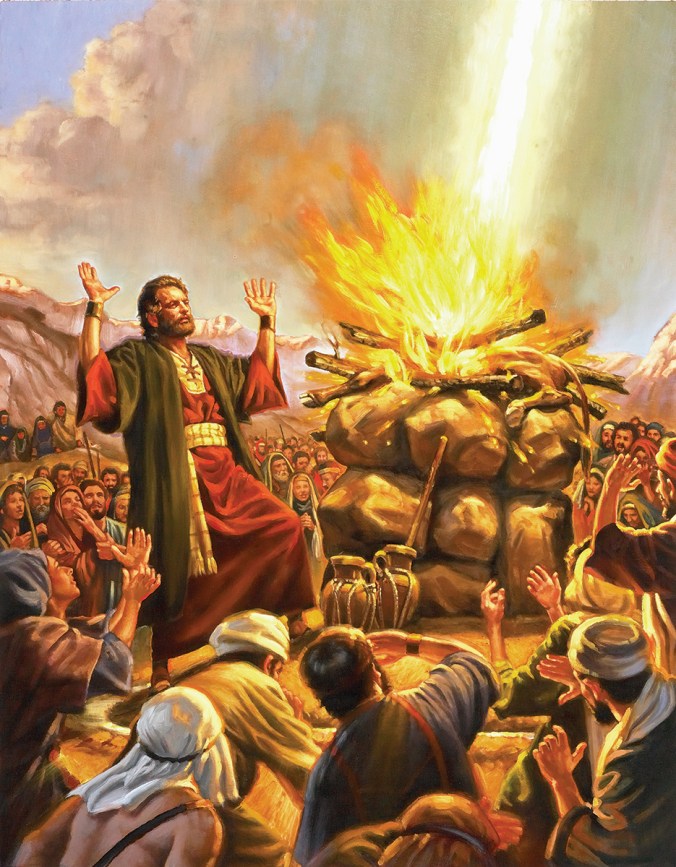
A. God sent fire to consume the sacrifice (18:38).

B. The people who witnessed the miraculous event fell on their faces and acknowledged that “The Lord, He is God; the Lord, He is God” (18:39).

C. Elijah had the prophets of Baal seized and put to death by the brook Kishon (18:40).

D. The drought was broken (18:41-46). Elijah told Ahab that rain was coming (18:41). Elijah then prayed for the rain to come (18:42-43) as he crouched down on top of Mount Carmel (see also James 5:17-18). As Elijah prayed his servant announced the coming of a cloud from the sea (18:44) after which came a heavy shower (18:45).

Practical Considerations

We should remain faithful to the Lord even in the midst of a difficult working environment.
Obadiah remained faithful to God even in the midst of a terrible and evil working environment. We have a responsibility to “live above reproach in the midst of a crooked and perverse generation” (Philippians 2:15). Obadiah’s faithfulness made a difference in the lives of a hundred of God’s prophets who were in danger of being executed by Jezebel. Our faithfulness in the work-place can also make a difference in the lives of those around us.

We must not tolerate mediocre Christianity.
Elijah asked the people to make up their minds regarding who they were going to follow, either God or Baal (1 Kings 18:21). Jesus said you cannot serve two masters (Matthew 6:24). John said God cannot stand lukewarm Christianity (Revelation 3:15-16). God always calls His people to a devoted and loyal commitment to Himself.

We must not be fearful of making our devotion to God known in public.
Elijah made his stand clear on Mount Carmel. The people, however, would not publicly acknowledge their devotion to God. They were fearful of reprisal from those in authority. We must not be fearful of making our commitment to God known in public.

One person can make a difference.
The widow of Zarephath was only one, but she made a difference. Obadiah was only one man in the court of a wicked king, but he made a difference. Elijah was only one prophet of God facing a king, 450 false prophets, and a complacent people, but he made a difference. God can use one person to make a difference in the world!

1 Kings 18 NIV

1 Kings 18:17-18
18:17 When he [Ahab: king of Israel (Northern Kingdom); cf. 16:29-33] saw Elijah [name means “my God is the Lord”], he said to him, “Is that you, you troubler [from the Heb. aker which describes the harmful effects one’s bad behavior has on others; cf. 1 Kings 17:1] of Israel [Ahab attributed the national distress (turmoil, problems, famine caused by the prolonged drought) to the man who had announced its coming; Ahab was blind to his own sin; Ahab unwittingly admitted Elijah held more power with God than he did]?”

18:18 “I have not made trouble for Israel [real problem was a spiritual problem],” Elijah replied. “But you and your father’s family have. You have abandoned [no longer loyal; forsaken God, the only true source of power] the LORD’s commands and have followed the Baals [Israel was in trouble and troubled because Ahab had forsaken God’s commandments and followed the Baals (2 Kings 10:18); Ahab’s wife Jezebel had prophets of the Lord killed (18:4)].

1 Kings 18:20-26
18:20 So Ahab [in response to Elijah’s challenge in 18:19] sent word throughout all Israel and assembled the prophets [cf. 18:19] on Mount Carmel [in northwest Israel; regarded as the sacred home of Baal (which would give a strategic/home court advantage to the prophets of Baal)].

18:21 Elijah went before the people and said, “How long will you waver [to be lame, to limp; to hesitate] between two opinions [cf. Matt. 6:24; Josh. 24:14-15; Ex. 32:26; our love for one master will always determine our attitude toward the other; God is a jealous God (Ex. 20:3-5) who will not tolerate a divided loyalty]? If the LORD is God, follow him; but if Baal is God, follow him.” But the people said nothing.

18:22 Then Elijah said to them, “I am the only one of the LORD’s prophets left [even though he knew there were other prophets hiding in caves (18:4,13); only one willing to take a stand for his convictions], but Baal has four hundred and fifty prophets.

18:23 Get two bulls for us. Let them choose one for themselves, and let them cut it into pieces and put it on the wood but not set fire to it. I will prepare the other bull and put it on the wood but not set fire to it.

18:24 [Elijah set the contest rules: 18:22-23] Then you call on the name [represented one’s character, nature, essence] of your god, and I will call on the name of the LORD. The god who answers by fire — he is God.” Then all the people said [broke their silence], “What you say is good [fair and right].”

18:25 Elijah said to the prophets of Baal, “Choose one [the one they believed Baal would accept] of the bulls and prepare it first [Elijah invited the opposition to go first], since there are so many [450 prophets (1 Kings 18:22)] of you. Call [a synonym for “pray”] on the name [an indication that worshiper had a relationship with the deity and believed in the deity’s nature and power] of your god, but do not light the fire.”

18:26 So they took the bull given them and prepared it. Then they called on the name of Baal from morning till noon [suggests that Elijah gave them ample time to get a reply from Baal]. “O Baal, answer us!” they shouted. But there was no response [translates the Heb. word meaning “voice”]; no one answered [people heard only silence; prayers and worship directed at a god that does not exist produce no results]. And they danced around the altar they had made.

1 Kings 18:30-39
18:30 Then [after Baal’s prophets had prayed to no avail (18:25-29); read Ps. 135:15-18] Elijah said to all the people, “Come here to me.” They came to him, and he repaired the altar of the LORD, which was in ruins [because the people had not been using it].

18:31 Elijah took twelve stones [reminder of the twelve tribes and of God’s original covenant with Israel], one for each of the tribes [divided into two nations in Elijah’s time] descended from Jacob [name meaning “deceiver”], to whom the word of the LORD had come, saying, “Your name shall be Israel [name meaning one who “struggles with God”].”

18:32 With the stones he built an altar in the name of the LORD, and he [made task difficult] dug a trench around it large enough to hold two seahs of seed.

18:33 He arranged the wood, cut the bull into pieces and laid it on the wood. Then he said to them, “Fill four large jars [used by women to carry a day’s supply of water for the family] with water and pour it on the offering and on the wood.”

18:34 “Do it again,” he said, and they did it again. “Do it a third time [four pitchers filled three times may bear the same symbolism as the twelve stones],” he ordered, and they did it the third time [thoroughly soaking the offering, the wood, the altar].

18:35 The water ran down around the altar and even filled the trench [an effective guarantee against fraud].

18:36 At the time of sacrifice, the prophet Elijah stepped forward and prayed [compare length of Elijah’s prayer with that of Baal’s prophets (18:26-29)]: “O LORD, God of Abraham, Isaac and Israel [a reminder that the true God had made a covenant with their ancestors, the patriarchs; Elijah asked for three things in his prayer], [1] let it be known today that you are God in Israel [2] and that I am your servant [3] and have done all these things [drought and the contest on Mount Carmel] at your command [Elijah was acting upon divine instruction and not his own agenda].

18:37 Answer me, O LORD, answer me, so these people will know that you, O LORD, are God, and that you are turning their hearts back again.”

18:38 Then [the answer came quickly; the difference between Elijah’s prayer and that of the prophets of Baal lay in the One addressed] the fire of the LORD fell and burned up the sacrifice, the wood, the stones and the soil, and also licked up the water in the trench.

18:39 When all the people saw this, they fell prostrate [in humility and repentance] and cried, “The LORD — he is God! The LORD — he is God!”

1 Kings 19

What did Elijah do after the experience on Mount Carmel?
“Then the hand of the Lord was on Elijah, and he girded up his loins and outran Ahab to Jezreel” (1 Kings 18:46). Ahab had a summer palace at Jezreel, which was located 17 miles from Mount Carmel.

Why did Elijah go to Jezreel?
Perhaps he hoped that the events of Mount Carmel would serve to lead Ahab and Jezebel to repentance and the initiation of religious reform.

What did Ahab do once he returned home?
He gave Jezebel a blow-by-blow account of the events on Mount Carmel (19:1).

What was Jezebel’s response to the news?
She was furious and sent a messenger to Elijah to warn him that she would have him killed within 24 hours (19:2). Jezebel’s message was in the form of a binding, unbreakable oath. Rather than leading Jezebel to repentance, the Mount Carmel events aroused her anger and hostility and a desire for revenge. She was an obstinately wicked woman.

How did Elijah respond to the message from Jezebel?
A. He was afraid (19:3). He knew that this was no idle threat (see 1 Kings 18:4 and 13). Here we see the humanity of Elijah. The day before he had stood fearless on Mount Carmel and now he trembled at the threat of Jezebel. Perhaps this can be attributed in part, to his physical exhaustion. James 5:17 states, “Elijah was a man with a nature like ours…”

B. He ran for his life (19:3). Elijah ran from Jezreel to Beersheba, a distance in excess of 100 miles. Beersheba was in the southern part of the kingdom of Judah, out of Ahab and Jezebel’s jurisdiction.

C. He left his servant in Beersheba (19:3). This was the same servant mentioned in 1 Kings 18:43 who kept watch for the rain cloud while Elijah prayed.

D. He went a day’s journey into the wilderness and sat under a juniper tree (19:4). This was an opportunity for Elijah to spend some time alone with God.

E. He asked God to let him die (19:4). The Living Bible paraphrases this verse, “I’ve had enough…Take away my life. I’ve got to die sometime, and it might as well be now.”

F. He fell asleep (19:5). He was utterly exhausted.

Why do you think Elijah wanted to die?
He probably felt like a failure since the dramatic events of Mount Carmel did nothing to turn the king or the kingdom from idolatry. Elijah was discouraged by the thought that everything that had happened was in vain and fruitless and that nothing more could possibly be done by him for God’s cause.

What provision did God make for the weary prophet?
God miraculously provided bread and water for him (19:5-8) through an angel. Regarding angels, Psalm 103:20-21 states, “Bless the Lord, you His angels, Mighty in strength, who perform His word, Obeying the voice of His word! Bless the Lord, all you His hosts, You who serve Him doing His will.” Elijah ate two meals, which was sufficient to sustain him for forty days and nights at Horeb (Mt. Sinai). Someone has written, “God is a wise physician – food first, instruction, rebuke, after. He comes to man in the moment of his greatest helplessness, restores and strengthens him, and then prepares him for future usefulness and more splendid triumphs.”

Where did Elijah travel to from Beersheba?
Elijah traveled almost 200 miles south of Beersheba to Horeb (Mt. Sinai) where he found refuge in a cave (19:8-9). Elijah had traveled all the way back to where the nation began. Perhaps to regain perspective on his own life and the need to remain faithful in his efforts to call the people back to God.

What did God ask Elijah?
Now that he was physically stronger, God asked, “What are you doing here, Elijah?” (19:9). Notice two things in this question.

A. First, notice the use of the word “here.” Its use is as significant as the use of the word “there” in 1 Kings 17:4 and 9. On the occasions in 1 Kings 17, God instructed Elijah regarding where to go and when to go, but such was not the case when he ran from Jezebel. The word “here” accentuated the fact that he was far away from the place where God intended for him to be, namely in Israel. It is as if God were asking, “Who is to do the work there when you are here?” This was a rebuke.

B. Second, notice the use of the personal pronoun “you.” Elijah, above all men, should have remained at his post and faithful to his assignment. Fred M. Wood writes, “Life is for living, not for fleeing and hiding out when opposition arises and danger approaches.” Elijah, who had witnessed God’s great power on Mount Carmel, should have stood firm in the face of Jezebel’s threats. This too, was a rebuke.

What was Elijah’s answer to God’s question?
A. “I have been very zealous for the Lord, the God of hosts” (19:10). This was certainly true in every sense. Elijah had demonstrated an intense fervor for God in the face of a wicked king and a backslidden nation. Elijah’s devotion to God is accentuated when seen against the backdrop of the national apostasy.

B. “For the sons of Israel have forsaken Thy covenant, torn down Thine altars and killed Thy prophets with the sword” (19:10). Once again Elijah uttered truth. The northern kingdom had forsaken God’s word, will, and way (12:28-30). Israel’s apostasy was evident in destroyed altars (18:30) and murdered prophets (18:13).

C. “And I alone am left” (19:10). As God would later reveal to Elijah (19:18), he was not the only one left. But at this point in the story, Elijah was the only prophet to publicly confront and challenge the king and queen regarding their idolatry and wickedness. Elijah sincerely thought he was the only loyal prophet left.

D. “And they seek my life, to take it away” (19:10). This too, was a true statement. It seems however, that Elijah forgot that his life was in as much danger when Ahab conducted an international search for him. He was also in as much danger on Mount Carmel in the presence of 450 prophets of Baal and a backslidden people. God had protected him on those occasions and was certainly capable of protecting him from his present danger. Elijah seems to have temporarily lost sight of God’s strong arm.

How did God respond to Elijah’s complaint?
A. God told him to get out of the cave and “Go forth, and stand on the mountain before the Lord” (19:11).

B. The Lord gave Elijah a new revelation of Himself (19:11-12). Elijah witnessed the unlimited and tremendous power of God in [1] a wind so powerful that it broke apart rocks and mountains, [2] an earthquake that shook the very foundations of the mountains, and [3] a fire (perhaps lightning). But God was not in the wind, earthquake, or fire. These were merely manifestations of God’s power.

C. Finally, after the three tremendous displays of God’s power, there came “a sound of gentle blowing” (19:12) or “a still small voice.” Elijah was so convicted by the “sound of gentle blowing” that “he wrapped his face in his mantle, and went out and stood in the entrance of the cave” (19:13). Bill Chitwood comments, “This revelation seemed designed to show the fiery prophet who wanted to reform everything by means of tempest that God often pursues gentler, quiet means to accomplish His will” (page 158 of the Adult Teachers book). D.C. Martin notes, “Elijah needed the lesson that God was going to overthrow Baalism, but not as he expected” (page 119 of the Bible Book Study Commentary).

D. Elijah hears God’s convicting question once again, “What are you doing here, Elijah?” (19:13). Elijah gave God the same answer as before (compare 19:10 and 14). These were indeed the reasons why Elijah was not where he was supposed to be, but may indicate that Elijah was still despondent.

What new assignment did God give to Elijah?
It was time for Elijah to return to active duty! Work and service is often the best cure for despondency. Elijah needed “the tonic of a great task.” He needed to get back to work! God still had a job for Elijah to do.

A. God told Elijah to go to Damascus and anoint (designate) Hazael king over Aram (Syria). Hazael would become an instrument of God’s judgment upon Israel. Elijah did not fulfill this assignment (19:17). Elisha however, fulfilled this assignment (see 2 Kings 8:7-15).

B. God told Elijah to anoint Jehu the son of Nimshi king over Israel. Jehu was a son of Jehoshaphat and the grandson of Nimshi. Jehu would become an instrument of God’s judgment upon the house of Ahab (see 1 Kings 19:17 and 2 Kings 9:7). Elisha also fulfilled this assignment (see 2 Kings 9:1-13).

C. God told Elijah to anoint (designate) Elisha as prophet in his place. Elijah did fulfill this task (19:19). This must have indicated to Elijah that his ministry was drawing to a close.

What encouraging word did God share with Elijah regarding a faithful remnant?
God told Elijah that he was not the only loyal one left, but that there were 7,000 in Israel who had not bowed to Baal or kissed him in the ceremonies of idol worship. Even in the worst of times, God has a remnant of believers who remain faithful. Elijah must have been encouraged by the news that he was not alone.

What did Elijah do once he left Horeb?
He went and found Elisha plowing in a field and threw his mantle upon him to designate him as his successor. Elisha asked for permission to bid his family good-bye, sacrificed the oxen with which he was plowing, and then followed Elijah (19:19-21).

Practical Considerations

Disappointment often comes when our expectations are not met.
Elijah fully expected that the dramatic events on Mount Carmel would have a greater impact upon the king and the kingdom than they did. The events however, did not lead the king and queen to repentance and to the initiation of religious reform. They only served to intensify the hatred of Jezebel for the things of God. This response came as a hard blow to Elijah who retreated in fear and frustration.

It is easy to lose perspective when we are physically exhausted.
After the Mount Carmel experience and the marathon from Mount Carmel to Jezreel and from Jezreel to Beersheba, Elijah was physically exhausted. He sat under a tree and asked God to let him die. We should guard against making major decisions when we are physically exhausted or at a low point in our lives.

We should not lose heart in doing good.
It is easy to grow discouraged when our expectations are not met or when we see the faithlessness of those around us. It is easy to grow discouraged to the point of giving up when we feel that our efforts have gone unrecognized or seem fruitless. The Apostle Paul offers some words of encouragement. “And let us not lose heart in doing good, for in due time we shall reap if we do not grow weary” (Galatians 6:9). “Therefore, my beloved brethren, be steadfast, immovable, always abounding in the work of the Lord, knowing that your toil is not in vain in the Lord” (1 Corinthians 15:58).

Service is often the best cure for despondency.
God gave Elijah a new assignment and told him to get to work. Service to others or to a cause bigger than ourselves is often the best medicine for the despondent. We can derive great strength from bearing one another’s burdens (Galatians 6:2) and from looking out for the interests of others (Philippians 2:3-4).

God will accomplish His work in His time and in accordance with His plan.
God sent judgment upon the house of Ahab and the nation of Israel through Jehu, Hazael, and Elisha. God will accomplish His purpose.

Don’t let go.
I Won’t Let Go…
I want to let go, but I won’t let go.
There are battles to fight,
By day and night,
For God and the right–
And I’ll never let go.

I want to let go, but I won’t let go.
I’m sick, tis true,
Worried and blue,
And worn through and through,
But I won’t let go.

I want to let go, but I won’t let go.
I will never yield!
What! lie down on the field
And surrender my shield?
No, I’ll never let go!

I want to let go, but I won’t let go.
May this be my song
“Mid legions of wrong–
Oh, God, keep me strong
That I may never let go!”

(Author Unknown)

Verse by Verse (NIV)

19:1 Now Ahab told [a detailed report] Jezebel everything Elijah had done [the events on Mount Carmel] and how he had killed all the prophets with the sword.

Ahab gave Jezebel a detailed report of the events on Mount Carmel.

19:2 So [unrepentant] Jezebel [filled with anger and hostility and desire for revenge] sent a messenger to Elijah to say [in the form of a binding, unbreakable oath], “May the gods deal with me, be it ever so severely, if by this time tomorrow [twenty-four hour deadline] I [Jezebel’s message was no idle death threat (see 1 Kings 18:4 and 13)] do not make your life [kill you] like one of them [prophets of Baal].”

Jezebel was furious when she heard about the events that had occurred on Mount Carmel. She sent a messenger to tell Elijah that she would have him killed with twenty-four hours. Jezebel’s message was in the form of a binding, unbreakable oath. The events that occurred on Mount Carmel should have led Jezebel to repentance. Instead, they aroused her anger and hostility and desire for revenge.

19:3 Elijah was afraid and ran for his life [Elijah was human! The day before he had stood fearless on Mount Carmel and now he trembled at the threat of Jezebel. Perhaps this can be attributed in part, to his physical exhaustion (see James 5:17).]. When he came to Beersheba in Judah [from Jezreel to Beersheba (over 100 miles)…Beersheba in the southern part of the kingdom of Judah, out of Ahab and Jezebel’s jurisdiction], he left his servant [see 1 Kings 18:43] there [in Beersheba],

Elijah was afraid. He knew that this was no idle threat (see 1 Kings 18:4 and 13). Here we see the humanity of Elijah. The day before he had stood fearless on Mount Carmel and now he trembled at the threat of Jezebel. Perhaps this can be attributed in part, to his physical exhaustion. James 5:17 states, “Elijah was a man with a nature like ours…”

Elijah ran for his life. He ran from Jezreel to Beersheba, a distance in excess of 100 miles. Beersheba was in the southern part of the kingdom of Judah, out of Ahab and Jezebel’s jurisdiction.

Elijah left his servant in Beersheba. This was the same servant mentioned in 1 Kings 18:43 who kept watch for the rain cloud while Elijah prayed.

19:4 while he himself went a day’s journey into the desert. He came to a broom tree, sat down under it [scant shade in the desert] and prayed that he might die [Elijah: [1] probably felt like a failure since the dramatic events of Mount Carmel did not turn the king or kingdom from idolatry; [2] discouraged that his efforts for God’s cause apparently were in vain.]. “I have had enough, Lord,” he said. “Take my life; I am no better than my ancestors [“I’ve had enough…Take away my life. I’ve got to die sometime, and it might as well be now.” (Living Bible)].”

Elijah went a day’s journey into the wilderness and sat under a broom tree. This was an opportunity for Elijah to spend some time alone with God. He asked God to take his life. The Living Bible paraphrases this verse, “I’ve had enough…Take away my life. I’ve got to die sometime, and it might as well be now.”

Elijah probably felt like a failure since the dramatic events of Mount Carmel did nothing to turn the king or the kingdom from idolatry. Elijah was discouraged by the thought that everything that had happened was in vain and fruitless and that nothing more could possibly be done by him for God’s cause.

19:5 Then he lay down [utterly exhausted] under the tree and fell asleep. All at once an angel of the Lord [see Psalm 103:20-21] touched him and said, “Get up and eat.”

Elijah fell asleep. He was utterly exhausted. God miraculously provided bread and water for him (19:5-8) through an angel. Regarding angels, Psalm 103:20-21 states, “Bless the Lord, you His angels, Mighty in strength, who perform His word, Obeying the voice of His word! Bless the Lord, all you His hosts, You who serve Him doing His will.”

19:6 He looked around, and there by his head was a cake of bread baked over hot coals, and a jar of water [God miraculously provided bread and water for him.]. He ate and drank and then lay down again.

19:7 The angel of the Lord came back a second time and touched him and said, “Get up and eat, for the journey is too much for you.”

19:8 So he got up and ate and drank [Elijah ate two meals which was sufficient to sustain him for forty days and nights of travel to Horeb (Mt. Sinai)]. Strengthened by that food [“God is a wise physician – food first, instruction, rebuke, after. He comes to man in the moment of his greatest helplessness, restores and strengthens him, and then prepares him for future usefulness and more splendid triumphs.”], he traveled forty days and forty nights until he reached Horeb [the place where God had disclosed Himself to Moses — perhaps to regain perspective on his own life and the need to remain faithful in his efforts to call the people back to God.], the mountain of God.

Elijah ate two meals, which was sufficient to sustain him for forty days and nights of travel to Horeb (Mt. Sinai). Someone has written, “God is a wise physician – food first, instruction, rebuke, after. He comes to man in the moment of his greatest helplessness, restores and strengthens him, and then prepares him for future usefulness and more splendid triumphs.”

19:9 There he went into a cave [Elijah traveled almost 200 miles south of Beersheba to Horeb (Mt. Sinai) where he found refuge in a cave — perhaps the very “cleft in the rock” where Moses had stood when God’s glory passed by (Ex. 33:21-23)] and spent the night. And [now that he was physically stronger] the word of the Lord came to him: “What are you [personal pronoun “you” suggests that Elijah, above all men, should have remained at his post and faithful to his assignment…Elijah, who had witnessed God’s great power on Mount Carmel, should have stood firm in the face of Jezebel’s threats. This was a rebuke.] doing here [word “here” accentuated the fact that he was far away from the place where God intended for him to be, namely in Israel. It is as if God were asking, “Who is to do the work there when you are here?” This was a rebuke.], Elijah?”

Elijah traveled almost 200 miles south of Beersheba to Horeb (Mt. Sinai) where he found refuge in a cave. Perhaps this cave was the very “cleft in the rock” where Moses had stood when God’s glory passed by (see Ex. 33:21-23).

Elijah traveled all the way back to where God had disclosed Himself to Moses. Perhaps to regain perspective on his own life and the need to remain faithful in his efforts to call the people back to God.

Now that he was physically stronger, God asked, “What are you doing here, Elijah?” (19:9). Notice two things in this question.

First, notice the use of the word “here.” Its use is as significant as the use of the word “there” in 1 Kings 17:4 and 9. On the occasions in 1 Kings 17, God instructed Elijah regarding where to go and when to go, but such was not the case when he ran from Jezebel. The word “here” accentuated the fact that he was far away from the place where God intended for him to be, namely in Israel. It is as if God were asking, “Who is to do the work there when you are here?” This was a rebuke.

Second, notice the use of the personal pronoun “you.” Elijah, above all men, should have remained at his post and faithful to his assignment. Fred M. Wood writes, “Life is for living, not for fleeing and hiding out when opposition arises and danger approaches.” Elijah, who had witnessed God’s great power on Mount Carmel, should have stood firm in the face of Jezebel’s threats. This too, was a rebuke.

19:10 He replied, “I have been very zealous for the Lord God Almighty [Elijah’s had demonstrated faithfulness to God in the face of a wicked king and a backslidden nation]. The Israelites have rejected your covenant, broken down your altars, and out your prophets to death with the sword [northern kingdom had forsaken God’s word, will, and way (12:28-30); Israel’s apostasy evident in destroyed altars (18:30) and murdered prophets (18:13).]. I am the only one left [God would later reveal to Elijah that he was not the only one left; at this point in the story, Elijah was the only prophet to publicly confront and challenge the king and queen regarding their idolatry and wickedness; Elijah sincerely thought he was the only loyal prophet left], and now they are trying to kill me too [Elijah forgot that his life was in danger [1] when Ahab conducted an international search for him, and [2] on Mount Carmel in the presence of 450 prophets of Baal. God had protected him in the past and would do so in the present; Elijah temporarily lost sight of God’s strong arm].”

“I have been very zealous for the Lord God Almighty. This was certainly true in every sense. Elijah had demonstrated an intense fervor for God in the face of a wicked king and a backslidden nation. Elijah’s devotion to God is accentuated when seen against the backdrop of the national apostasy.

“The Israelites have rejected your covenant, broken down your altars, and out your prophets to death with the sword.” Once again Elijah uttered truth. The northern kingdom had forsaken God’s word, will, and way (12:28-30). Israel’s apostasy was evident in destroyed altars (18:30) and murdered prophets (18:13).

“I am the only one left.” As God would later reveal to Elijah, he was not the only one left. But at this point in the story, Elijah was the only prophet to publicly confront and challenge the king and queen regarding their idolatry and wickedness. Elijah sincerely thought he was the only loyal prophet left.

“And now they are trying to kill me too.” This too, was a true statement. It seems however, that Elijah forgot that his life was in as much danger when Ahab conducted an international search for him. He was also in as much danger on Mount Carmel in the presence of 450 prophets of Baal and a backslidden people. God had protected him on those occasions and was certainly capable of protecting him from his present danger. Elijah seems to have temporarily lost sight of God’s strong arm.

19:11 The Lord said, “Go out and stand on the mountain in the presence of the Lord, for the Lord is about to pass by [God gave Elijah a new revelation of Himself].” Then [Elijah witnessed the unlimited and tremendous power of God in…] a [1] great and powerful wind tore the mountains apart and shattered the rocks before the Lord, but the Lord was not in the wind. After the wind there was [2] an earthquake, but the Lord was not in the earthquake.

God told him to get out of the cave and “Go forth, and stand on the mountain before the Lord” (19:11).

19:12 After the earthquake came [3] a fire [perhaps lightning], but the Lord was not in the fire. And after the fire came a gentle whisper [God was not in the wind, earthquake, or fire, mere manifestations of God’s power; after the tremendous displays of God’s power, there came “a gentle whisper” or “a still small voice.”].

The Lord gave Elijah a new revelation of Himself (19:11-12). Elijah witnessed the unlimited and tremendous power of God in [1] a wind so powerful that it broke apart rocks and mountains, [2] an earthquake that shook the very foundations of the mountains, and [3] a fire (perhaps lightning). But God was not in the wind, earthquake, or fire. These were merely manifestations of God’s power.

Finally, after the three tremendous displays of God’s power, there came “a gentle whisper” or “a still small voice.”

19:13 When Elijah heard it, he pulled his cloak over his face [a demonstration of reverence and fear] and went out and stood at the mouth of the cave. Then a voice said to him, “What are you doing here, Elijah?”

Elijah was so convicted by the “gentle whisper” that “he pulled his cloak over his face and went out and stood at the mouth of the cave.” Bill Chitwood comments, “This revelation seemed designed to show the fiery prophet who wanted to reform everything by means of tempest that God often pursues gentler, quiet means to accomplish His will” (page 158 of the Adult Teachers book). D.C. Martin notes, “Elijah needed the lesson that God was going to overthrow Baalism, but not as he expected” (page 119 of the Bible Book Study Commentary).

Elijah heard God’s convicting question once again, “What are you doing here, Elijah?” Elijah gave God the same answer as before (compare 19:10 and 14). These were indeed the reasons why Elijah was not where he was supposed to be, but may indicate that Elijah was still depressed.

Note: What are some ways that God has spoken to you?

19:14 He replied, “I have been very zealous for the Lord God Almighty. The Israelites have rejected your covenant, broken down your altars, and put your prophets to death with the sword. I am the only one left, and now they are trying to kill me too.”

19:15 The Lord said to Him, “Go back [work and service is often the best cure for despondency; Elijah needed “the tonic of a great task;” God still had a job for Elijah to do] the way you came, and go to the Desert of Damascus. When you get there, anoint Hazael king over Aram [God told him to go to Damascus and anoint (designate) Hazael king over Aram (Syria). Hazael would become an instrument of God’s judgment upon Israel. This assignment fulfilled by Elisha (2 Kings 8:7-15) rather than Elijah.].

It was time for Elijah to return to active duty! Work and service is often the best cure for despondency. Elijah needed “the tonic of a great task.” He needed to get back to work! God still had a job for Elijah to do.

God told Elijah to go to Damascus and anoint (designate) Hazael king over Aram (Syria). Hazael would become an instrument of God’s judgment upon Israel. Elijah did not fulfill this assignment (19:17). Elisha however, fulfilled this assignment (see 2 Kings 8:7-15).

19:16 Also, anoint Jehu son of Nimshi king over Israel [Jehu was a son of Jehoshaphat and the grandson of Nimshi. Jehu would become an instrument of God’s judgment upon the house of Ahab (see 1 Kings 19:17 and 2 Kings 9:7); This assignment fulfilled by Elisha (2 Kings 9:1-13)], and anoint Elisha son of Shaphat from Abel Meholah to succeed you [indicated Elijah’s ministry was drawing to a close] as prophet [in his place].

God told Elijah to anoint Jehu the son of Nimshi king over Israel. Jehu was a son of Jehoshaphat and the grandson of Nimshi. Jehu would become an instrument of God’s judgment upon the house of Ahab (see 1 Kings 19:17 and 2 Kings 9:7). Elisha also fulfilled this assignment (see 2 Kings 9:1-13). God told Elijah to anoint (designate) Elisha as prophet in his place. Elijah did fulfill this task (19:19). This must have indicated to Elijah that his ministry was drawing to a close.

19:17 Jehu will put to death any who escape the sword of Hazael, and Elisha will put to death any who escape the sword of Jehu.

19:18 Yet I reserve [technical term for people who survived elimination or catastrophe] seven thousand [Elijah was not the only faithful individual left as he had mistakenly thought (18:10)] in Israel–all whose knees have not bowed down [your convictions are in your knees] to Baal and all whose mouths have not kissed him.”

God told Elijah that he was not the only loyal one left, but that there were 7,000 in Israel who had not bowed to Baal or kissed him in the ceremonies of idol worship. Even in the worst of times, God has a remnant of believers who remain faithful. Elijah must have been encouraged by the news that he was not alone.

19:19 So Elijah went from there and found Elisha son of Shaphat. He was plowing with twelve yoke of oxen, and he himself was driving the twelfth pair. Elijah went up to him and threw his cloak around him.

He went and found Elisha plowing in a field and threw his mantle upon him to designate him as his successor.

19:20 Elisha then left his oxen and ran after Elijah. “Let me kiss my father and mother good-bye,” he said, “and then I will come with you.” “Go back,” Elijah replied. “What have I done to you?”

Elisha asked for permission to bid his family good-bye, sacrificed the oxen with which he was plowing, and then followed Elijah

19:21 So Elisha left him and went back. He took his yoke of oxen and slaughtered them. He burned the plowing equipment to cook meat and gave it to the people, and they ate. Then he set out to follow Elijah and to be his attendant.

1 Kings 20

Who was Ben-hadad [Ben-hadad II]?
A. He was King of Aram [Syria]. (20:1) This was not the same Ben-hadad who was a contemporary of Baasha, king of Israel (see 1 Kings 15:16-22).

B. He led an unsuccessful siege against Samaria, the city built by Omri (20:1-12). He besieged the stronghold of Samaria with the aid of thirty-two kings. These were vassals (or viceroys who ruled single cities or districts) who were later replaced by competent military commanders (see 1 Kings 20:24).

What message did Ben-hadad deliver to Ahab?
He sent a messenger to Ahab with insulting and humiliating terms of surrender. “Your silver and your gold are mine; your most beautiful wives and children are also mine” (20:2,3).

What was Ahab’s reply?
Ahab was in agreement with these initial terms (20:4,7), indicating that Israel may have already been a vassal of Samaria (see 1 Kings 20:34).

What follow-up message did Ben-hadad deliver to Ahab?
The terms of surrender became even more humiliating as Ben-hadad demanded unlimited search and seizure rights “in [Ahab’s] house and the house of [his] servants” (20:5-6).

What did Ahab do when he received the second message?
He consulted “all the elders of the land” (20:7) who advised him to not listen or consent to the demands of Ben-hadad (20:8). He sent Ben-hadad’s messengers back with word that while he would agree to the initial demands, he would not give in to the second demands.

Notice that Ahab did not cry out to Baal for help or to God. Perhaps he had forgotten how to pray. Instead he looked to men for counsel and help.

What did Ben-hadad threaten to do when he received Ahab’s message?
He threatened to crush Samaria using the same formula that Jezebel had used in her message to Elijah (compare 1 Kings 20:10 to 19:2). In fact, his remark in 1 Kings 20:10 is a bragging remark regarding the size of his army. Ben-hadad, in essence, told Ahab that his army was so immense that if every one of his soldiers were to carry away a handful of dust from Samaria some of his soldiers would go away empty handed!

What message did Ahab send back to Ben-hadad?
“Let not him who girds on his armor boast like him who takes it off” (20:11). Paraphrased: “Don’t count your chickens before they hatch.” Or (Latin), Ne triumphum canas ante victoriam (the victory must be won before it is celebrated). Ben-hadad received Ahab’s message “as he was drinking with the kings” (20:12). This reply motivated the drunken (see also 20:16) Ben-hadad to move his army against Samaria (20:12).

What message did “a prophet” deliver to Ahab?
A prophet approached Ahab and assured him of victory over Ben-hadad’s great army. The purpose of the victory was to teach Ahab an important lesson, “and you shall know that I am the Lord” (20:13).

How did Ahab conduct the military campaign against Ben-hadad?
A. He mustered 232 “young men of the rulers of the provinces” (20:15). These were “young professional soldiers in the service of the district commanders” (Broadman Bible Commentary, Volume 3).

B. He mustered all the people and formed an army of 7000.

C. They began their attack at noon while Ben-hadad was still drinking (20:17). The fact that Ben-hadad was drinking may indicate how overconfident he was. He was not alarmed by the news that “Men [not an army] have come out from Samaria” (20:17). The “young men of the rulers of the provinces” led the attack that resulted in a great loss of Syrian men, horses and chariots. The drunken and boasting Ben-hadad fled the battle!

What word did the prophet have for Ahab following the battle?
The prophet informed Ahab that Ben-hadad would come against him once again in the spring (see 2 Samuel 11:1). He instructed Ahab to make preparations for that occasion (20:22).

Note: This is a reminder that the enemies of God are never idle and that God’s people should remain vigilant lest the enemy overtake them.

What advise did Ben-hadad’s servants give him?
A. They told him that the reason Israel had been victorious in battle was because they had fought in the mountains. They said this was advantageous to Israel because “their gods are gods of the mountains” (20:23). This gives us some insight into pagan theology. They felt that boundaries and regions limited gods. This was a slander against God’s sovereignty.

B. They advised the king to engage Israel in battle on the plain where their mountain gods would be of no help to them (20:23,25).

C. They advised the king to replace the kings (see 20:1) with competent military commanders and muster an army equal in size and strength to the army that Ahab had defeated in the previous battle.

D. Ben-hadad “listened to their voice and did so” (20:25). In the spring of the year he marched his army to Aphek to fight against Israel (20:26). Aphek is located “on the main road east of Lake Galilee between Israel and Damascus” (Broadman Bible Commentary, Volume 3). The Syrian army was so immense that “the sons of Israel camped before them [were] like two little flocks of goats” (20:27), by comparison.

What important message did “a man of God” deliver to Ahab?
A man of God appeared on the scene and told the king that God would vindicate his name and prove to both Israel and Syria that He was not just some impotent local deity (20:23), but the God of the universe. God would allow Ahab another victory to demonstrate that He alone was God. This second victory in the face of tremendous odds was also meant to remind Ahab and Israel that “I am the Lord” (see 1 Kings 20:13,28). As foretold by the man of God, Israel was victorious once again (20:29-30).

What did Ben-hadad do to insure his own safety?
Some of his men appealed to the mercy of Ahab by dressing themselves in sackcloth with ropes around their necks (after the fashion of captives). They pled with Ahab to spare their lives and the life of their king. Ahab gave them a favorable response (20:32), met with Ben-hadad, made a covenant with him, and let him go (20:33-34). This action was contrary to the will of God (20:42). Ahab acted without the counsel of God or anyone else regarding the disposition of Ben-hadad. (Compare 1 Samuel 15:3,9 regarding Saul’s treatment of Agag the Amalekite king.)

How did God feel about Ahab letting Ben-hadad go free?
God was displeased (20:35-43). He let Ahab know of his displeasure through “a certain man of the sons of the prophets” (20:35). This “certain man” disguised himself as a soldier who had carelessly allowed a prisoner of war to escape. Ahab pronounced judgment upon the soldier (prophet in disguise) not realizing that he had been induced to judge his own case (see also David and Nathan in 2 Samuel 12:1-15). The prophet removed the disguise “and the king of Israel recognized him as one of the prophets” (20:41). The prophet then pronounced God’s judgment upon Ahab for letting Ben-hadad, a man under God’s ban, go (20:42). Ahab would forfeit his life for this foolish and careless action (20:42). Ahab then “went to his house sullen and vexed” (20:43). The sequel to this chapter on international military affairs is in 1 Kings 22.

Practical Considerations

God’s enemies are never idle.
After defeating Ben-hadad in battle, a prophet informed Ahab that Ben-hadad would come against him once again in the spring. God’s enemies are never idle. Someone has said that the devil never takes a vacation. God’s people should remain sober and on the alert because their “adversary, the devil, prowls about like a roaring lion, seeking someone to devour” (1 Peter 5:8).

God is concerned about His name and reputation.
God overheard the conversation of Ben-hadad’s servants regarding why Israel had been successful in battle. The Syrians slandered God’s sovereignty by stating that he was an impotent god limited by regions and territories. God vindicated his name by allowing Ahab to be victorious in battle against the Syrians on the plain. We too, should be concerned about God’s name and reputation. We should be careful lest we give others occasion for misunderstanding God.

1 Kings 21

Who was Naboth?
A. He was an inhabitant of Jezreel (21:1).

B. He owned a vineyard that was located “beside the palace of Ahab king of Samaria” (21:1). The vineyard was in Jezreel, the site of one of Ahab’s palaces.

C. Naboth invoked the Lord’s name in 1 Kings 21:3 which may be an indication that he was a true worshipper of God and numbered among those who had not bowed the knee to Baal nor kissed the idol (see 1 Kings 19:18).

What request did Ahab make of Naboth?
The king asked Naboth for his vineyard because it was adjacent to his palace. Ahab wanted it for a vegetable garden. After his victory over Ben-hadad, Ahab seems to concern himself with the matter of expanding his personal estate. He offered Naboth a “better” garden in exchange or to buy it with money (21:2).

Why did Naboth refuse to give up or sell his vineyard?
The property was Naboth’s family inheritance. It was his ancestral property. According to the law (Leviticus 25:23-28 and Numbers 36:7-9) Naboth had to keep the land He could not sell it. Naboth’s reply is courageous because [1] he invoked the name of the Lord in the face of a monarch who worshipped Baal, and [2] because he refused Ahab’s request on the grounds that it was wrong because the law of God said it was wrong.

From a practical standpoint, it might have been expedient for Naboth to sell his property to the king. It might have gained him favor in the king’s eyes. It might have secured him a better parcel of land or perhaps wealth enough to retire comfortably. But Naboth did not yield to any temptation. He remained firm in his obedience to God’s law.

How did Ahab respond to Naboth’s refusal?
He went home and pouted. He “lay down on his bed and turned away his face and ate no food” (21:4). Ahab behaved like a spoiled child. Ahab was king over all Israel while Naboth was the owner of one small parcel of land. Proverbs 27;20 states, “Sheol and Abaddon are never satisfied, Nor are the eyes of man ever satisfied.” Someone stated, “Ahab cannot enjoy Israel if Naboth enjoy his vineyard.”

What did Jezebel do when Ahab reported the failed real estate deal to her?
She told Ahab to get up and start acting like a king and promised to secure the vineyard for her pouting husband (21:5-7). There is no record of Ahab trying to stop Jezebel from securing the vineyard. He knew that Naboth was the only obstacle to owning the vineyard. Ahab thus allowed Jezebel to exercise her wicked plan and secure the vineyard by whatever means possible. Jezebel contrived an evil plan to have Naboth killed (21:8-10). She set up a situation in which Naboth would be accused of having cursed both God and the king, an act punishable by death. Jezebel’s plot was carried out to the letter (21:11-13). Naboth was falsely accused and stoned to death. 2 Kings 9:26 indicates that Naboth’s sons were also put to death, thus leaving no one to lay legal claim to or inherit the property. (This is reminiscent of David’s plan to have Uriah killed in 2 Samuel 11:14-15.) Jezebel then told Ahab to go and claim his vineyard (21:15). Ahab, without remorse or thought that God had witnessed the crime, “arose to go down to the vineyard of Naboth the Jezreelite, to take possession of it” (21:16).

What did God, who took note of this heinous crime, instruct Elijah to do?
A. God instructed Elijah to go and meet Ahab in Naboth’s vineyard (21:18).

B. God instructed Elijah to pronounce severe judgment upon Ahab (21:19). This judgment included [1] Ahab (21:19), [2] Jezebel (21:23) and [3] the house of Ahab (21:21-22, 24). Notice that there is always a “because” in God’s judgment: “I have found you, because you have sold yourself to do evil in the sight of the Lord” (21:20). And again in 1 Kings 21:22, God told Ahab that he would experience severe judgment “because of the provocation with which you have provoked Me to anger, and because you have made Israel sin.”

Thus we see the reasons why Ahab would experience God’s judgment: [1] Because he sold himself to do evil (21:20,25). [2] Because he provoked the Lord to anger with his wicked conduct (21:22,26). [3] Because he led the nation astray (21:22).

What was Ahab’s response when he saw Elijah?
He said, “Have you found me, O my enemy?” (21:20). Prior to the Mount Carmel experience, Ahab referred to Elijah as “the troubler of Israel” (18:17). Now, some seven years later, Ahab refers to Elijah as his personal enemy.

“Have you found me?” is another of the interesting questions of the Bible. Numbers 32:23b states, “and be sure your sin will find you out.” Yes, Elijah found Ahab just as surely as Nathan found David. When we sin against the Lord and continue in an unrepentant state, be sure that Elijah and Nathan will find you. God will tell them where to look!

What was Ahab’s response when he heard Elijah?
“He tore his clothes and put on sackcloth and fasted, and he lay in sackcloth and went about despondently” (21:27). Ahab humbled himself before God. Although it was too little too late, it was enough to cause God to mercifully postpone judgment until Ahab’s sons succeeded him to the throne (21:29). We have no record that Ahab’s repentance bore fruit. He still took possession of Naboth’s vineyard. He still allowed idol worship in Israel. He was still married to Jezebel.

Practical Considerations

Coveting can lead us into grievous sin.
God has given us clear instruction regarding the matter of coveting. Exodus 20:17 records His instruction, “You shall not covet your neighbor’s house; you shall not covet your neighbor’s wife or his male servant or his female servant or his ox or his donkey or anything that belongs to your neighbor.” Ahab ruled a kingdom and still coveted his neighbor’s small parcel of land. He had great possessions, but wanted just a little bit more. Proverbs 27:20 states, “Sheol and Abaddon are never satisfied, Nor are the eyes of man ever satisfied.” Covetousness led Ahab to allow Jezebel to implement her wicked plot to have Naboth and his sons killed. Covetousness can lead men into grievous sin.

There is no room for compromise when we have a clear word from God.
Naboth was unwilling to sell or trade his land because it was wrong according to God’s law. Naboth did not compromise what he knew God had instructed.

Be sure your sin will find you out.
The murderous crime of Ahab and Jezebel did not go unnoticed by God. God sent Elijah to find and confront Ahab about Naboth’s death. Elijah found Ahab just as surely as Nathan found David. When we sin against God and continue in an unrepentant state, God will send an Elijah or a Nathan to find us and confront us. We cannot hide from God.

1 Kings 22

Why did Ahab enter into a military alliance with Jehoshaphat?
Ahab entered into a military alliance with Jehoshaphat for the purpose of recovering the ancient Israelite city of Ramoth-gilead from the Syrians (22:1-4). This city “was strategic in controlling the eastern caravan route” (Layman’s Bible Book Commentary, Volume 6). This was a city which Ben-hadad should have given back to Israel according to the terms of 1 Kings 20:34.

What did Jehoshaphat ask Ahab to do before going into battle?
Jehoshaphat asked Ahab to “inquire first for the word of the Lord” (22:5).

Who did Ahab consult?
Ahab gathered 400 prophets to inquire of them regarding the outcome of the proposed military campaign (22:6). These court prophets told Ahab exactly what he wanted to hear (22:10-12). They told Ahab that the military campaign would be a success. These were not prophets of the Lord as is suggested by Jehoshaphat’s question in 1 Kings 22:7.

What did Jehoshaphat request?
Jehoshaphat requested that “a prophet of the Lord” (22:7) be consulted. The only man available was Micaiah son on Imlah. Ahab hated this particular prophet because “he does not prophesy good concerning me, but evil” (22:8). Ahab however, agreed to call and inquire of Micaiah (22:9).

What did Micaiah prophesy?
The messenger who went after Micaiah asked him to prophesy in agreement with the 400 prophets already consulted. The 400 were in unanimous agreement. Micaiah was being pressured to agree with them. Micaiah responded, “As the Lord lives, what the Lord says to me, that I will speak” (22:14). And indeed Micaiah was faithful to tell Ahab what the Lord had said to him (although he mocked Ahab with the words of his court prophets in 22:15). Micaiah prophesied the death of Ahab in battle and the defeat of Israel (22:15-23).

How did Ahab respond to this unfavorable word from Micaiah?
He had Micaiah imprisoned and put on a meager diet of bread and water until such time as he returned safely from battle (22:26-28).

What happened to Ahab in battle?
Ahab went into battle disguised as an ordinary soldier (22:30). Perhaps Ahab disguised himself [1] as a precaution in case Micaiah’s prophesy be true, or [2] because he had heard through spies that Ben-hadad had ordered his captains to go after the king of Israel. At any rate, Ahab did not escape death. “Now a certain man drew his bow at random and struck the king of Israel in a joint of the armor” (22:34). Ahab bled to death in his chariot (22:35). He was taken back to Samaria where he was buried (22:37). His chariot was washed by the pool of Samaria “and the dogs licked up his blood, according to the word of the Lord which He spoke” (22:38). His son Ahaziah became king in his place (22:40) and had an evil and unproductive two-year reign (22:51-53). He was no different than his parents.

What became of Jezebel?
Jezebel met a violent end eleven years after the death of Ahab (2 Kings 9:7, 30-37). Jehu ordered her thrown from a window (2 Kings 9:33). She landed on the ground and her blood was sprinkled on the wall and on Jehu’s horses. Jehu then “trampled her under foot” (2 Kings 9:33). Before she could be buried, dogs had eaten all but her skull, feet, and hands (2 Kings 9:35). Even the dogs did not want to eat a skull that had conceived evil, hands that had done evil, and feet that had walked an evil course!

Practical Considerations

We must speak the truth even in the face of opposition.
Micaiah was unwilling to tell the king only what he wanted to hear or what seemed expedient. He did not compromise the word he had received from God. As a result he was imprisoned. We must be willing to speak the truth even when it is unpopular to do so.

1 Kings 22 NIV

22:13 The messenger [Ahab’s messenger] who had gone to summon Micaiah [a true prophet of God] said [advised] to him, “Look, as one man [indicates Ahab’s prophets were unanimous] the other prophets [about 400 prophets (1 Kings 22:6); read Ezek. 13:3 re: prophets who “follow their own spirit and have seen nothing”] are predicting success [in the matter of liberating Ramoth Gilead from Aram] for the king. Let your word agree with theirs, and speak favorably.”

Note: How can pressure cause us to compromise Christian convictions and integrity? What kind of pressures have you experienced that tempted you to relax or soften your commitment to God?

22:14 But Micaiah said, “As surely as the LORD lives, I [even at the risk of personal death] can tell him only what the LORD tells me.”

22:15 When he [Micaiah] arrived, the king asked him, “Micaiah, shall we [King Ahab of Israel and King Jehoshaphat of Judah] go to war against Ramoth Gilead [Israelite city located east of the Jordan River; controlled by Aram for 70 years; a city of refuge (Deut. 4:41-43); a Levitical city (Josh. 21:8,38)], or shall I refrain?” “Attack and be victorious,” he answered [in a way that communicated obvious insincerity (perhaps sarcasm) and indicated he felt pressured to tell the king what he wanted to hear], “for the LORD will give it into the king’s hand.”

22:16 The king [perhaps detected a sarcastic, mocking, or insincere tone in Michaiah’s voice] said to him, “How many times must I make you swear to tell me nothing but the truth in the name of the LORD?”

22:17 Then Micaiah answered, “I saw all Israel scattered on the hills like sheep without a shepherd [a common metaphor for king], and the LORD said, `These people have no master. Let each one go home [thus breaking off the attack on Ramoth Gilead] in peace.'”

22:18 The king of Israel said to Jehoshaphat, “Didn’t I tell you that he [Micaiah’s integrity prevented him from being a “yes man” to the king] never prophesies anything good about me, but only bad [1 Kings 22:8]?”

22:19 Micaiah continued, “Therefore hear [and heed] the word of the LORD: I saw [vision emphasizes God’s power and sovereignty…] the LORD sitting on his throne [in control; cf. Ps. 103:19] with all the host of heaven [cf. Ps. 103:20-21] standing around him on his right and on his left.

22:20 And the LORD said, `Who will entice [to delude] Ahab into attacking Ramoth Gilead and going to his death [God already had decreed Ahab’s death as judgment for his sins (cf. 1 Kings 21:17-24)] there [God’s death sentence on Ahab would be carried out at the battle at Ramoth Gilead]?’ “One suggested this, and another that.

22:21 Finally, a spirit [represented God’s judgment on Ahab] came forward, stood before the LORD and said, `I will entice him.’

22:22 ” `By what means?’ the LORD asked. ” `I will go out and be a lying spirit [symbolized the judgment God already had passed on Ahab] in the mouths of all his prophets [telling Ahab what he wanted to hear; Ahab rejected God’s words through Micaiah],’ he said.” `You will succeed in enticing him,’ said the LORD. `Go and do it.’

22:23 “So now the LORD has put a lying spirit in the mouths of all these prophets [about 400 prophets (1 Kings 22:6)] of yours. The LORD has decreed disaster for you.”

22:24 Then Zedekiah [one of Ahab’s prophets] son of Kenaanah went up and slapped [a grave insult] Micaiah in the face. “Which way did the spirit from the LORD go when he went from me to speak to you [implies that Zedekiah believed he had prophesied under the Lord’s leadership and that Micaiah was the lying prophet]?” he asked.

22:25 Micaiah replied, “You will find out [which of them really had prophesied under the leadership of God’s Spirit] on the day you go to hide [after Aram defeated Israel at Ramoth Gilead] in an inner room.”

22:26 The king of Israel [Ahab continued to stubbornly refuse to heed God’s warning through Micaiah] then ordered, “Take Micaiah and send him back to Amon the ruler of the city and to Joash the king’s son

22:27 and say, `This is what the king says: Put this fellow in prison and give him nothing but bread and water until I return safely.'”

22:28 Micaiah declared [he appealed to the test of a true prophet (cf. Deut. 18:21-22)], “If you ever return safely, the LORD has not spoken through me.” Then he added, “Mark [literally “hear”] my words [his prophecy], all you people!”

1 Kings 3

1 Kings 3:5-14
3:5 At Gibeon
[located eight miles northwest of Jerusalem; tabernacle located there at that time (2 Chron. 1:3) though ark of covenant in Jerusalem (2 Sam. 6:1-17)] the LORD appeared to Solomon [second son born to David and Bathsheba (2 Sam. 12:14-24)] during the night in a dream [God occasionally revealed His will or word to people through dreams (cf. Gen. 40:5-19; Matt. 1:20-21; 2:12-13)], and God said [note that God voluntarily offered to bless Solomon], “Ask for whatever you want me to give you.”

Note: What would you have asked for if you were in Solomon’s shoes? At this point in your life, what is the blessing from God you desire most?

3:6 Solomon answered, “You have shown great kindness to your servant, my father David, because he was faithful to you and righteous and upright in heart. You have continued this great kindness to him and have given him a son to sit on his throne this very day.

3:7 “Now, O LORD my God, you [Solomon recognized that God was responsible for giving him the throne] have made your servant [Solomon recognized that he was a servant] king in place of my father David. But I am only a little child [indicates sense of subservience to a superior and an understanding of his lack of experience] and [note that Solomon knew he needed help] do not know how to carry out my duties [involved ruling “a great people” (3:8)].

3:8 Your servant is here among the people you have chosen, a great people, too numerous to count or number [in fulfillment of His promise to Abraham].

3:9 So give your servant a discerning heart [literally “a heart that listens”; an obedient heart; heart a metaphor for the mind and will] to govern [cf. Deut. 17:18-20 re: how kings were to govern] your people and to distinguish [required a sharp mind] between right and wrong. For who is able to govern this great people of yours? [reveals Solomon’s humility and desire to depend on God]

Note: What was Solomon’s request and why was God pleased with it? Who would benefit from Solomon’s prayer and why?

3:10 The Lord was pleased that Solomon had asked for this [instead of the kinds of things most people would have asked for, such as money, a long life, success, popularity, etc.].

3:11 So God said to him, “Since you have asked for this [wisdom (essential for a ruler); Solomon put first things first; Solomon had his priorities in order] and not [God was impressed by what Solomon did not ask for] for long life or wealth for yourself, nor have asked for the death of your enemies but for discernment in administering justice,

Note: God is as interested in what we do not ask for as in what we do ask for when we approach Him in prayer.

3:12 I will do what you have asked [God granted Solomon’s petition]. I will give you a wise and discerning heart [essential for judging and ruling well], so that there will never have been anyone like you [in wisdom and understanding, also in riches and honor], nor will there ever be.

3:13 Moreover, I will give [in addition to what Solomon asked for] you what you have not asked for—both riches and honor—so that in your lifetime you will have no equal among kings.

3:14 And if [note the condition] you walk in my ways [walk in accordance with God’s will] and obey my statutes and commands as David your father did, [this was dependent on whether Solomon walked in God’s ways and obeyed His Word] I will give you a long life.”