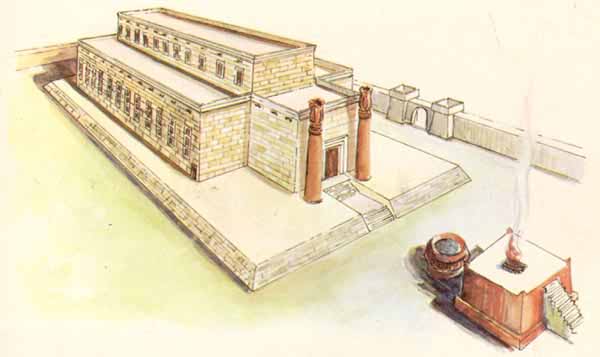
1 Kings 11

1 Kings 11:1-13
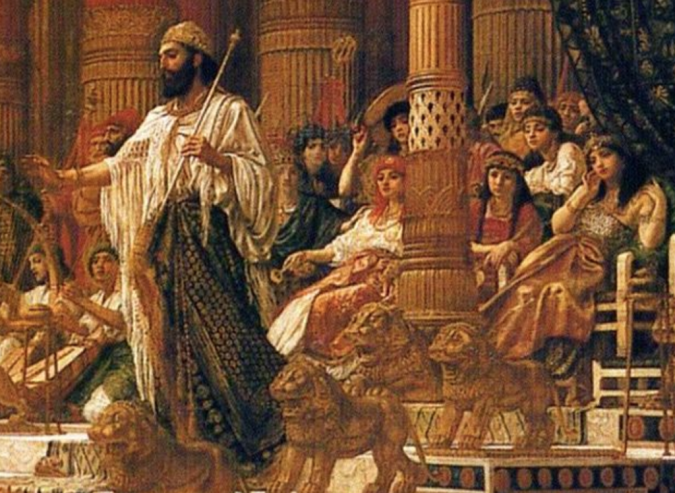
11:1 King Solomon, however, loved many foreign women besides Pharaoh’s daughter [cf. 1 Kings 3:1]—Moabites [Moab located east of the Dead Sea], Ammonites [Ammon located northeast of the Dead Sea], Edomites [Edom located southeast and southwest of the Dead Sea], Sidonians [from the area of the Phoenician city of Sidon] and Hittites [kingdom had existed north of Israel; had become integrated into Israel; Bathsheba’s first husband was a Hittite (2 Sam. 11:3); Hittites conscripted to serve as laborers (1 Kings 9:20-21)].
11:2 They were from nations about which the LORD had told the Israelites [cf. Ex. 34:15-16; Deut. 7:1-5 re: warnings about the dangers of intermarriage with other nations], “You must not [this prohibition based on spiritual reasons, not racial reasons] intermarry with them, because [note the reason behind the prohibition; behind every negative command stand the positive principles of protection from harm and provision of something better] they will surely turn your hearts after their gods.” Nevertheless, Solomon held fast to them in love [means “a strong emotional attachment” (implies a desire to be in the presence of the object of love); what or who we love can impact our allegiance to God].

Note: Ask these questions before entering into any association…
• What do they believe? — Are their beliefs consistent with the Word of God?
• How do they behave? — How will their behavior impact my life?
• What will I become? — Will I have to compromise my convictions in order to get along with them?

11:3 He had seven hundred wives of royal birth [indicates that marriages were primarily political (to maintain peace and mutual economic benefits); considered good politics from a worldly perspective] and three hundred concubines [sort of second-class wives], and his wives led him [Solomon placed greater value on the words of his wives than on the Word of God] astray [cf. Deut. 17:16-17; conscious disobedience can only lead to disaster (cf. Prov. 13:13); cf. Ps. 1:1].

Note: What worldly beliefs and lifestyles threaten to endanger your commitments to God and His purposes?

11:4 As Solomon grew old [through the years Solomon’s wives led him to become tolerant of the very things God had told him to reject (a reminder that deterioration is never sudden); old age does not exempt us from temptation], his wives turned his heart [indicates the inner being of a person, including mind, emotion, and will] after other gods, and his heart [Solomon’s actions followed the direction of his heart] was not fully devoted [Solomon quit worshiping the Lord exclusively] to the LORD his God, as the heart of David his father had been.

11:5 He followed [literally “walked after”; he no longer hated the things that God hated; he accepted the things that were detestable in God’s sight; violated the first commandment (Ex. 20:3)] Ashtoreth [also called Astarte (Gr. name); a fertility goddess and consort of Baal (a fertility god); associated with fertility, love, and war; worship practices included lewd sexual rites] the goddess of the Sidonians, and Molech [the worship of Molech involved passing children through fire (Lev. 18:21; 20:2-5; 2 Kings 23:10; Jer. 32:35) as either a burnt offering to Molech or as a rite dedicating children to service of Molech] the detestable god of the Ammonites.

11:6 So Solomon did evil [by facilitating and participating in the worship of idols] in the eyes [everything we do is in the sight of God; no one can do anything “behind God’s back”] of the LORD [cf. Deut. 4:25]; he did not follow the LORD completely [the Lord requires our total allegiance (cf. Matt. 6:24)], as David his father had done.

11:7 On a hill east of Jerusalem [identified as the Hill of Corruption at the time Josiah destroyed the shrines Solomon built to the idols (cf. 2 Kings 23:13); the Mount of Olives], Solomon built a high place [a place where pagan gods were worshiped (most of these places were located on mountains or hills); the high places that Solomon built survived for approximately three centuries until the time of Josiah (2 Kings 23:13)] for Chemosh the detestable god of Moab [cf. 2 Kings 3:26-27], and for Molech the detestable god of the Ammonites.

Note: Solomon’s decision to build high places of worship for Ashtoreth, Chemosh, and Molech served as a stumbling block for Israel for approximately three centuries. How will our choices impact future generations?

11:8 He did the same [provided places of worship in direct violation of God’s command (Ex. 20:1-6; 23:13; Deut. 5:6-10; 6:14); Solomon’s love for his wives (11:2) motivated him to provide shrines where they could worship their gods] for all his foreign wives, who burned incense and offered sacrifices to their gods.

Note: How could Solomon, who displayed such wisdom early in his reign, have acted so foolishly and sinfully toward the end of his life?

11:9 The LORD [does not tolerate idolatry; cf. Deut. 4:24] became angry [disobedience is costly] with Solomon because his heart had turned away from the LORD, the God of Israel, who had appeared to him twice [cf. 1 Kings 3:5 (beginning of his reign) and 1 Kings 9:2 (24 years later at dedication of temple); this wonderful privilege accentuated the grievous nature of Solomon’s sin; God had emphasized the importance of commitment to Him on the occasions He had appeared to Solomon (1 Kings 3:14; 9:4-9)].

11:10 Although he had forbidden Solomon to follow other gods, Solomon did not keep the LORD’S command [we must say “no” to God before we can say “yes” to sin].

11:11 So the LORD said to Solomon [no record that Solomon repented when confronted by the Lord], “Since this is your attitude and you have not kept my covenant and my decrees, which I commanded you, I will most certainly tear the kingdom away from you and give it to one of your subordinates [one who was serving Solomon; Jeroboam, head of the labor force of the tribes of Joseph (1 Kings 11:28), became king of the northern tribes after Solomon’s death (1 Kings 11:31,34-36; 12:20)].

Note: Does the severity of God’s judgment on Solomon for his disobedience challenge you to a higher level of commitment?

11:12 Nevertheless, for the sake of David your father, [note that God tempered His judgment on Solomon] I will not do it during your lifetime. I will tear it out of the hand of your son [Rehoboam (1 Kings 14:21)].

11:13 Yet I will not tear the whole kingdom from him, but will give him one tribe [Judah (the tribe of David); the Southern Kingdom] for the sake of David my servant and for the sake of Jerusalem, which I have chosen.”

1 Kings 12

1 Kings 12:6-16
12:6 Then King Rehoboam [Solomon’s son; did evil in the sight of the Lord during his 17 year reign] consulted [Rehoboam wisely sought advice to determine the best course of action] the elders [men who understood the complexities of ruling a kingdom; these men realized the people had a valid complaint] who had served his father Solomon during his lifetime. “How would you advise me to answer [read 12:3-4] these people?” he asked.

12:7 They replied [their advice reflected a wealth of experience and knowledge; the elders were aware of the growing resentment under Solomon’s reign], “If today you will be a servant to these people and serve them and give them a favorable answer, they will always be your servants.”

12:8 But Rehoboam rejected the advice the elders gave him and consulted the young men [as opposed to “the elders” in 12:6] who had grown up with him [indicates limited experience and knowledge] and were serving him [Rehoboam had quickly enlisted his friends to serve in his administration].

12:9 He asked them, “What is your advice? How should we answer these people who say to me, ‘Lighten the yoke [used figuratively to refer to hardship and burden] your father [Solomon] put on us’?”

12:10 The young men who had grown up with him replied [these young men urged Rehoboam to rule by fear and force rather than by concern and service; their advice expressed ambition, greed, and indifference for the well being of the people], “Tell these people who have said to you, ‘Your father put a heavy yoke on us, but make our yoke lighter’—tell them, ‘My little finger is thicker than my father’s waist [proverb emphasized that Rehoboam’s weakest measures would be stronger than his father’s sternest measures].

12:11 My father laid on you a heavy yoke; I will make it even heavier. My father scourged you with whips; I will scourge you with scorpions [a reference to metal-spiked leather lashes].’”

Note: What are ways we can weigh advice carefully? What principles guide you in evaluating advice? What factors influence you as you listen to advice and decide on a course of action?

12:12 Three days later Jeroboam and all the people returned to Rehoboam, as the king had said [cf. 12:5], “Come back to me in three days.”

12:13 The king answered the people harshly [refers to action that can be cruel or stubborn]. Rejecting the advice [to ease the people’s burden, even at the expense of revenues for the king and his court] given him by the elders,

Note: What makes advice godly? Godly advice…
• has a concern for people
• guides us in ethical and moral paths
• encourages us to lead through service
• focuses on bringing glory to God
(Source: ETB Adult Leader Guide, Spring 2003, p. 84)

12:14 he followed [the king chose to act on the bad advice] the advice [advice that was brash, selfish, and callous] of the young men and said, “My father made your yoke heavy; I will make it even heavier. My father scourged [the term used to beat a slave] you with whips; I will scourge [use of this word indicates that Rehoboam saw the people as slaves] you with scorpions.”

12:15 So the king did not listen to the people, for this turn of events was from the LORD, to fulfill the word the LORD had spoken to Jeroboam son of Nebat through Ahijah the Shilonite.

12:16 When all Israel [“all Israel” a reference to northern tribes] saw that the king refused to listen to them [Rehoboam destroyed in one moment what David and Solomon had built over a period of 80 years], they answered the king: “What share do we have in David, what part in Jesse’s son [rhetorical question that declares they were severing all ties with Judah (the tribe of David)]? To your tents, O Israel [a call for the leaders of the northern tribes to return home]! Look after your own house, O David [a way of telling Rehoboam he could reign over Judah, but not over them]!” So the Israelites went home.

1 Kings 12:26-28
12:26 Jeroboam [the Northern Kingdom’s first king; made Shechem his capital; read the words of Ahijah the prophet concerning Jeroboam in 11:29-31] thought to himself, “The kingdom will now likely revert to the house of David [David still recognized as a great national hero; Jeroboam feared that the people would change their minds and accept Rehoboam as king].

12:27 If [Jeroboam, unsure of how firmly he was in control, began to think of an unpleasant scenario] these people go up to offer sacrifices at the temple of the LORD in Jerusalem, they will again give their allegiance to their lord, Rehoboam king of Judah. They will kill me and return to King Rehoboam.”

12:28 After seeking advice [the source of the advice he sought is unspecified], the king [Jeroboam established a new place of worship and new symbols to use in worship] made [Jeroboam’s actions were politically motivated and designed to keep the people from going to Jerusalem to worship; Jeroboam interested in self-preservation] two golden calves [this was a violation of God’s commandments in Ex. 20:4-6; one calf was set up in Bethel in the south (located ten miles north of Jerusalem) and Dan in the north (north of the Sea of Galilee) as per 12:29; Jeroboam sowed the seeds of evil and idolatry that would eventually result in the fall of the Northern Kingdom (cf. 2 Kings 17:21-23)]. He said to the people, “It is too much for you to go up to Jerusalem. Here are your gods [a violation of the first and second commandments], O Israel, who brought you up out of Egypt. [cf. Aaron’s words in Ex. 32:4]

1 Kings 10

1 Kings 10:4-7
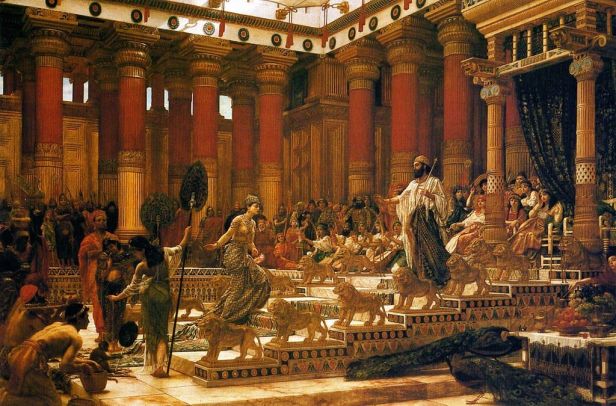
10:4 When the queen of Sheba saw [in Solomon’s answers to her questions and in his administration of the kingdom] all the wisdom of Solomon and the palace he had built [the palace was mute testimony to Solomon’s power and organizational genius],

10:5 [Solomon’s organizational genius was obvious in every detail the queen of Sheba observed] the food on his table, the seating of his officials, the attending servants in their robes, his cupbearers, and the burnt offerings he made at the temple of the LORD, she was overwhelmed [literally “there was no more spirit in her”; the grandeur of all she saw took her breath away; queen later acknowledged source of Solomon’s wisdom and honor (10:9)].

10:6 She said to the king, “The report I heard in my own country about your achievements and your wisdom is true.

10:7 But I did not believe [she had been skeptical about what she had heard about Solomon] these things until I came and saw with my own eyes [she took the time to personally investigate]. Indeed, not even half [the reports she had heard were clearly understated] was told me; in wisdom and wealth you have far exceeded the report I heard.

1 Kings 10:14-15
10:14 The weight of the gold that Solomon received yearly was 666 talents [almost 25 tons of gold; talent roughly equivalent to 75 pounds],

10:15 not including [Solomon had other sources of income] the revenues from merchants and traders [taxes levied on those who moved their merchandise through Solomon’s territory] and from all the Arabian kings [tribal chiefs in the desert to the south and east of Jerusalem; they paid tribute to Solomon] and the governors of the land.

1 Kings 10:22
10:22 The king had a fleet of trading ships [“trading ships” translates Heb. word “Tarshish” which was a trading center somewhere in the western Mediterranean Sea (some believed it was a port in southern Spain); ships that could travel as far as Tarshish came to be called “Tarshish” which means “large trading vessels”; Solomon constructed fleet of ships at Ezion Geber (cf. 1 Kings 9:26)] at sea along with the ships of Hiram[king of Tyre (1 Kings 5:1); both Solomon and Hiram benefited from this alliance]. Once every three years it returned, carrying gold, silver and ivory, and apes and baboons.

1 Kings 9

1 Kings 9:15-19
9:15 Here is the account of the forced labor [cf. 1 Sam. 8:11-18 re: Samuel’s warning that a king would use them and their resources for his own ends] King Solomon conscripted to build the LORD’S temple, his own palace, the supporting terraces [may refer to earthworks connecting David’s city of Jerusalem and newly constructed temple], the wall of Jerusalem [probably extended the wall to include the area of the new temple and palace complex; made the city more easily defended], and Hazor [located three miles north of the Sea of Galilee at junction of two major trade routes], Megiddo [a fortress northwest of Jerusalem] and Gezer [located west on the road from Joppa to Jerusalem; these three cities occupied strategic locations].

9:16 (Pharaoh king of Egypt had attacked and captured Gezer. He had set it on fire. He killed its Canaanite inhabitants and then gave it as a wedding gift to his daughter, Solomon’s wife.

9:17 And Solomon rebuilt Gezer.) He built up [strengthened] Lower Beth Horon [located northwest of Jerusalem; cf. 2 Chron. 8:5; along with its sister city, Upper Beth Horon, guarded an important travel route],

9:18 Baalath [precise location uncertain], and Tadmor [all of the places named were strategic places; Solomon strengthened these places to protect trade routes and to fortify Israel against attack] in the desert, within his land,

9:19 as well as all his store cities and the towns [Solomon used these cities and towns to stockpile provisions he and his army might need; these cities were strategically located, enabling the forces stationed there to move quickly to defend Israel; Solomon stored tax revenues in these cities] for his chariots and for his horses [archaeological excavations unearthed remains of stables in Megiddo (capable of housing from 300-500 horses)]—whatever he desired to build in Jerusalem, in Lebanon and throughout all the territory he ruled.

1 Kings 9:25
9:25 Three times a year [Feasts of Passover (or Unleavened Bread), Weeks (Pentecost), and Booths (Tabernacles); cf. Ex. 23:14-19; cf. parallel passage in 2 Chron. 8:12-13] Solomon sacrificed burnt offerings and fellowship offerings on the altar he had built for the LORD, burning incense before the LORD along with them, and so fulfilled the temple obligations [although he was busy, Solomon took time to focus on the Lord].

Note: King Solomon maintained his focus on God and His work even while completing many impressive building projects. What, if any, earthly concerns or responsibilities distract you from spiritual priorities?

1 Kings 8

1 Kings 8:22-30 | Prayer of Dedication


8:22 Then Solomon stood before the altar [the temple had two altars: the gold altar or altar of incense was inside the inner sanctuary in front of the wall of the Most Holy Place; the bronze altar of burnt offering (on which priests sacrificed animals) was placed in front of the temple (Solomon stood before this altar)] of the LORD in front of the whole assembly of Israel [indicates that Solomon’s prayer was part of a public worship service], spread out his hands toward heaven [our spiritual posture in prayer is more important than our physical posture]

Note: Prayer postures in the Bible…
• Solomon “spread out his hands toward heaven” 1 Kings 8:22
• Hezekiah prayed while lying ill in bed 2 Kings 20:1-2
• Daniel prayed while kneeling Daniel 6:10
• Peter prayed while kneeling Acts 9:40

8:23 and said: “O LORD [the personal name for God (the name He revealed to Moses)], God of Israel, there is no God like you [Solomon praised the Lord for His uniqueness] in heaven above or on earth below [people in surrounding nations commonly worshiped various gods/idols] [Solomon praised the Lord for His faithfulness; cf. Deut. 7:7-9] you who [God has covenant responsibilities] keep your covenant of love [Heb. “chesed” which has been translated “lovingkindness,” “covenant love,” “loyalty,” and “steadfast love”] with your servants [God’s people have covenant responsibilities] who continue wholeheartedly in your way.

Note: How can we affirm God’s faithfulness in our prayer life?

8:24 [illustration of God’s faithfulness…] You have kept your promise [that David’s son would build temple (2 Sam. 7:12-13)] to your servant David my father; with your mouth you have promised and with your hand you have fulfilled it—as it is today.

Note: What experiences in your life have affirmed God’s faithfulness?

8:25 “Now LORD, God of Israel, keep for your servant David my father the promises [other promises besides the one referred to in 8:24] you made to him when you said, ‘You shall never fail to have a man to sit before me on the throne of Israel [cf. 2 Sam. 7:12-16], if [a conditional promise] only your sons are careful in all they do to walk before me as you have done [cf. 1 Kings 2:2-4].’

Note: Promises in the Bible
• Some of God’s promises are to everyone Genesis 9:16
• Some of God’s promises are to believers John 14:2-3
• Some of God’s promises are made at a particular time to a particular person 1 Kings 17:14
• Satan temps us to misapply God’s promises Ps. 91:11-12 / Lk. 4:9-12

8:26 [Solomon was concerned that the Lord continue to bless Israel beyond his lifetime] And now, O God of Israel, let your word that you promised your servant David my father come true.

Note: Some tend to think only of their generation. In what ways do you demonstrate concern for future generations?

8:27 “But will God really dwell on earth [God is omnipresent]? The heavens, even the highest heaven [“heaven of heavens”], cannot contain you [cf. Isa. 66:1-2; Acts 7:48-50]. How much less this temple I have built [God’s greatness and magnitude cannot be contained in any earthly structure]!

8:28 Yet give attention to your servant’s prayer [refers generally to any prayer offered to God; can refer specifically to intercession or supplication] and his plea for mercy [denoted entreating a favor from God based on His grace; can also be translated “supplication” or “plea” (cf. 1 Kings 8:52; Ps. 55:1)], O LORD my God. Hear the cry [can indicate an expression of praise to God (Ps. 105:43) or a cry (“a wailing cry of petition”) for God’s help (Pss. 5:2; 61:1)] and the prayer that your servant is praying in your presence this day.

8:29 May your eyes be open toward this temple night and day [Solomon wanted God to keep His attention on the temple at all times], this place of which you said, ‘My Name [signified God’s self-revealed character] shall be there,’ so that you will hear [be attentive and responsive to] the prayer your servant prays toward [the temple provided a way for worshipers to focus on God’s reality and holiness] this place.

8:30 Hear [to hear and to act on what was heard; cf. 8:31-53 re: seven specific instances when a person might pray a prayer towards the temple (8:31-32; 8:33-34; 8:35-36; 8:37-40; 8:41-43; 8:44-45; 8:46-53] the supplication of your servant and of your people Israel when they pray toward this place. Hear from heaven, your dwelling place, and when you hear, forgive.

1 Kings 8:56
8:56“Praise be to the LORD, who has given rest [implied the end of war and the ensuing security; peaceful settlement in the promised land, freedom from enemies, the Lord’s presence in their midst; people of Israel able to build the temple because they were not preoccupied with war] to his people Israel just as he promised. Not one word has failed of all the good promises he gave through his servant Moses [cf. Deut. 12:1-14].

1 Kings 4

1 Kings 4:29-34
4:29 God [the source of Solomon’s wisdom] gave [cf. Jas. 1:5] Solomon wisdom [cf. 1 Kings 3:16-28 re: the application of wisdom in determining the mother of an infant; cf. 1 Kings 4:1-19 re: the use of wisdom to organize and govern Israel more effectively] and very great insight [cf. Ps. 119:99], and a breadth of understanding as measureless [impossible to measure] as the sand [imagery of each grain of sand representing a piece of understanding] on the seashore.

4:30 Solomon’s wisdom was greater than [surpassed] the wisdom of all [all who lived to that point] the men [cf. 4:31] of the East [included Mesopotamia and Arabia; cf. Matt. 2:1], and greater than all the wisdom of Egypt [cf. Gen. 41:8; Ex. 7:11].

4:31 He was wiser than any other man, including [noted wise men of Solomon’s day included…] Ethan the Ezrahite—wiser than Heman, Calcol and Darda, the sons of Mahol. And his fame spread to all the surrounding nations.

4:32 He spoke three thousand proverbs [a proverb is a comparison drawn from life; not all of these are included in the Book of Proverbs] and his songs [Pss. 72; 127 are credited to Solomon] numbered a thousand and five.

4:33 [Solomon’s interests and knowledge included botany and biology] He described plant life, from the cedar of Lebanon [used in royal building projects (2 Sam. 5:11; 1 Kings 6:9); ideal building material that resisted dry rot and insects, had a grain suitable for carving, and had a pleasant fragrance] to the hyssop [“cedar” and “hyssop” used in worship (cf. Lev. 14:4; Num. 19:6); hyssop used to place blood on doorframes at Passover (Ex. 12:22); Ps. 51:7] that grows out of walls. He also taught [described] about animals and birds, reptiles and fish [many of Solomon’s observations from nature are recorded in Proverbs (e.g. Prov. 6:5-6; 19:12)].

4:34 Men [also the queen of Sheba (1 Kings 10:1)] of all nations came to listen to Solomon’s wisdom, sent by all the kings of the world, who had heard of his wisdom.

1 Kings 5

1 Kings 5:1-7
5:1 When Hiram king [ruled for more than 30 years] of Tyre [the capital of Phoenicia; a major seaport] heard that Solomon had been anointed king to succeed his father David, he [Hiram wanted to maintain the mutually beneficial relationship between the two kingdoms] sent his envoys to Solomon, because he had always been on friendly terms with David [he had sent men and materials to help David construct his palace (2 Sam. 5:11)].

5:2 Solomon sent back this message [perhaps via sealed letter or oral message entrusted to responsible messenger] to Hiram:

5:3 “You know that because of the wars waged against my father David from all sides, he could not build [David had shed too much blood to build a temple (cf. 1 Chron. 22:8; 28:3)] a temple for [“in honor of” or “to honor the Lord”] the Name [stands for all that the Lord is (His character, His attributes, the essence of His being)] of the LORD [Heb. YHWH: the personal name of God reveled to Moses (Ex. 3:15; 6:3)] his God [Elohim: a plural form for deity (signifies the fullness of the majesty of God)] until the LORD put his enemies under his feet.

5:4 But now the LORD my God has given me [Solomon’s name is Heb. word “shalom” which means “peace” or “wholeness”] rest on every side [cf. 1 Chron. 22:9-10], and there is no adversary [from Heb. word for “satan”; here refers to anyone who might give him trouble] or disaster [Solomon not distracted by wars; did not have to spend resources on wars; could give priority to building project].

5:5 I intend [Solomon wanted to carry out his father’s wishes and God’s will], therefore, to build a temple for [“in honor of” or “to honor the Lord”] the Name of the LORD my God, as the LORD told my father David, when he said [cf. 1 Chron. 28:6], ‘Your son whom I will put on the throne in your place will build the temple for my Name.’

Note: What does it mean to honor the Lord? List practical ways in which you can honor the Lord.

5:6 “So give orders that cedars of Lebanon [used in royal building projects (2 Sam. 5:11; 1 Kings 6:9); ideal building material that resisted dry rot and insects, had a grain suitable for carving, and had a pleasant fragrance] be cut for me. My men will work with yours, and I will pay you for your men whatever wages you set. You know that [Solomon knew when to seek help from others] we have no one so skilled in felling timber as the Sidonians [from city of Sidon in Phoenicia].”

5:7 When Hiram heard Solomon’s message, he was greatly pleased and said, “Praise be to the LORD [Hiram probably worshiped Baal yet recognized the Lord as Israel’s God] today, for he has given David a wise son to rule over this great nation.”

1 Kings 6

1 Kings 6:11-14
6:11 The word of the LORD came [the precise method of speaking remains unspecified] to Solomon:

6:12 “As for this temple you are building, if [blessing conditional on obedience; presence of the temple would not guarantee God’s presence] you follow my decrees, carry out my regulations and keep all my commands and obey [the temple and all its ritual worship could not substitute for obedience] them, I will fulfill through you the promise I gave to David your father.

6:13 And I will live among the Israelites and will not abandon [used in OT to describe physical act of leaving (Ex. 2:20) and the spiritual act of forsaking God (Jer. 1:6); God refused to completely abandon His people (Isa. 54:7); cf. Amos 9:11-15 re: a remnant] my people Israel [Solomon’s obedience directly affected the people of Israel].”

6:14 So Solomon built the temple and completed [project took a little more than seven years (1 Kings 6:37-38)] it.

1 Kings 7

1 Kings 7:51
7:51 When all the work King Solomon had done for the temple of the LORD was finished [Solomon honored his father’s dream of building and furnishing a temple for the Lord], he brought in the things his father David had dedicated—the silver and gold and the furnishings—and he placed them in the treasuries [this wealth helped defray future temple expenses] of the LORD’S temple.

1 Kings 13

Summarize the events recorded in 1 Kings 12:25-33.
According to 1 Kings 12:25-33, Jeroboam built golden calf shrines (idols) at Dan and Bethel (rival worship centers) and recruited false priests. He did so because he feared that if the people of the ten Northern Tribes continued to return to Jerusalem to worship at the Temple, they might want to see the kingdom reunited under Rehoboam. He thus feigned altruism by telling the people that he had erected the worship centers in the north for their convenience. 1 Kings 12:30 tells us “this thing became a sin.” God was not pleased with what Jeroboam had done. He succeeded in keeping the northern tribes at home, but sowed the seeds that would yield a harvest of idolatry and ruin for the nation. The occasion for the events of 1 Kings 13 is the dedication festival of the Bethel altar.

What do we know about the “man of God” who mysteriously appears in 1 Kings 13:1?
A. He is referred to as a “man of God” rather than a prophet throughout the chapter.

B. He was from Judah, Israel’s rival kingdom.

C. He came “by the word of the Lord,” that is to say, “in” the power of God’s Word, obeying its impulsion.

D. He came to Bethel, the center of the problem. God sent this man to the heart of the matter.

Where was Jeroboam when the “man of God” arrived on the scene?
He “was standing by the altar to burn incense” (1 Kings 13:1). Jeroboam was playing a leading role in the national apostasy. According to 1 Kings 14:16, Jeroboam was held accountable for causing Israel to sin. Everything rises and falls on leadership.

Why did the “man of God” cry against the altar rather than against the king?
A. The altar was a symbol of the system of idolatry, which the king had imposed upon Israel.

B. The altar represented the system that would ultimately lead to the downfall of the Northern Kingdom. Recall that the Northern Kingdom of Israel fell to the Assyrians in 722 B.C. (see 2 Kings 17:6-23). 2 Kings 17:22 states, “And the sons of Israel walked in all the sins of Jeroboam which he did; they did not depart from them.”

C. A prediction regarding the destruction of the altar would carry with it and include the destruction of its architect.

What did the “man of God” prophesy in verse 2?
That a child born to the house of David would desecrate the altar erected by Jeroboam. The descendant’s name was Josiah (which means “whom Jehovah sustains”). King Josiah fulfilled this prophecy 360 years later (see 2 Kings 23:15-16). Note also that this is a very specific prophecy. There are only three other instances in the Bible where specific names were included in a prophecy: Israel (Genesis 17:19), Solomon (I Chronicles 22:9), and Cyrus (Isaiah 45:1).

How was the altar to be desecrated by Josiah?
By burning on the altar the bones of the priests who had used it. See 2 Kings 23:15-16.

What sign did the “man of God” give to show Jeroboam that this was no idle threat?
The altar would be split apart and the ashes upon it poured out in the very presence of Jeroboam. See verses 4 and 6.

What was Jeroboam’s response to the “man of God” and what happened to Jeroboam?
Jeroboam defiantly stretched out his hand and called for the arrest of the “man of God” (verse 4). Like all tyrants who feel they have been threatened or embarrassed, Jeroboam resorted to the use of force. But God protected his messenger by causing Jeroboam’s outstretched arm to become paralyzed “so that he could not draw it back to himself.” This served as a warning to Jeroboam not to harm God’s messenger and as advance notice of judgment to come.

What impact did the events have on Jeroboam according to verse 6?
Jeroboam asked the “man of God” to “entreat” God on his behalf “that my hand may be restored to me.” The word “entreats” means “to soften.” Jeroboam asked the “man of God” to soften the face of the Lord or to smooth the Lord’s angry countenance through prayer. Notice two things about Jeroboam’s request.

A. Jeroboam asked the “man of God” to “entreat the Lord your God” thus implying that he had no personal relationship with the God of Israel. Someone noted, “They who in prosperity reject the warnings of God’s messengers are ready enough in distress to have recourse to their prayers.”

B. Jeroboam betrayed his impenitent heart by expressing greater concern for his sufferings than for his sins. Yet God in his grace allowed the king’s hand to be restored to normal. Even this did not cause Jeroboam to repent of his evil ways according to 1 Kings 13:33-34.

What invitation did the king issue to the “man of God” according to verse 7? What do you think was Jeroboam’s motivation in issuing the invitation?
The king invited the “man of God” to his home for rest, refreshment, and a reward for restoring his arm. It was customary to offer a prophet a gift or reward if he performed something requested of him (see 1 Samuel 9:7-8, 1 Kings 14:3, 2 Kings 5:5 and 8:9). Regarding Jeroboam’s motivation, his offer could have been a step to try to “buy” the prophet.

Why did the “man of God” refuse Jeroboam’s invitation?
A. Because God said no (see verse 9).

B. Because accepting Jeroboam’s invitation could have been perceived as his approval of what was going on in Bethel. He did not want to imply any kind of friendly relationship with Jeroboam.

C. Rejecting Jeroboam’s invitation was a marked way of showing God’s abhorrence of Jeroboam’s actions.

Notice also that the “man of God” was instructed by God to take a different route home. Perhaps this was to insure his safety lest anyone be lying in wait to harm him.

What do we know about the old prophet of Bethel mentioned in verse 11?
A. It is possible that he was a “false” prophet.

B. He was living in Bethel, a center of idolatry.

C. He had sons who witnessed the events of 1 Kings 13:1-10.

What did the old prophet of Bethel do when he heard the report from his sons? What do you think motivated his actions?
He got on his donkey and pursued the “man of God” to persuade him to come to his home for rest and refreshment. He could have been motivated to pursue the “man of God” for several reasons:

A. Perhaps he was filled with shame for being a faithless prophet in the midst of faithlessness.

B. Perhaps he felt that he would somehow benefit from an association with the courageous “man of God.”

C. Perhaps he saw an opportunity to gain the king’s favor by getting the “man of God” to contradict himself and thus impair the weight of his message.

What should have “tipped off” the “man of God” regarding what kind of prophet the old man was?
A. He was living in Bethel but apparently had not spoken out against the sins of Jeroboam. It is possible that the old prophet did not agree with the king, but he lacked the courage to speak out and the sense to protect his family from such sin. If the old prophet had spoken out against the corruption in Bethel there would have been no need for God to send the “man of God.”

B. “‘An angel spoke to me’ is regarded by the story as an inferior medium of revelation to the direct command by the Lord already quoted.” (Broadman Bible Commentary, Volume 3)

How did the “man of God” disobey God?
Note that verse 14 states the “man of God” was sitting under an oak tree when the old prophet found him. Delay sometimes gives opportunity for the tempter to overtake us.

The “man of God” disobeyed God by violating the command of God, which he defined in verses 9 and 10 and verses 16 and 17. It is interesting to note that the “man of God” nobly resisted greater temptation when invited by the king and yet yielded to a lesser temptation when he accepted the invitation of the old prophet. 1 Corinthians 10:12 states, “Therefore let him who thinks he stands take heed lest he fall.”

D.C. Martin comments (Bible Book Study Commentary, page 80), “One main lesson in this baffling story is probably this. When we have a strong conviction of the Lord’s expressed will, one from Him alone, then we must be extremely cautious when considering doing something different, even if the new thought seems to come from a messenger of the Lord.”

How was the “man of God” punished?
A lion killed him and remained with the body until the old prophet of Bethel arrived on the scene (see verse 28). Note the behavior of the lion and the donkey in verse 24. This was regarded as a sign that these animals were under the Lord’s control.

What did the old prophet do when he learned of the death of the “man of God”?
He took the body back to Bethel and buried the “man of God” in his own grave. He then spoke to his sons and asked them to bury him in the same grave (see verses 29-31).

Why do you think the old prophet asked his sons to bury him in the same grave as the “man of God”?
The old prophet was now convinced that what the “man of God” had spoken would come true. Perhaps he hoped to escape having his bones burned on the altar as the “man of God” had prophesied. According to 2 Kings 23:16-18 the bones of the old prophet were not burned on the altar because he was buried in the same grave as the “man of God.”

What impact did the events of 1 Kings 13:1-32 have on Jeroboam?
Absolutely none, according to 1 Kings 13:33-34. He continued to blatantly sin against God. Such behavior would have disastrous results in the life of Jeroboam, his family, and the nation. We are reminded in verse 34 that sin will not triumph. See Galatians 6:7 and Colossians 3:25.

Do you think there is any connection between Jeroboam’s sin and his son’s illness?
Yes. See 1 Kings 13:34. The child’s illness was yet another warning from God to the impenitent Jeroboam.

Practical Considerations

God will hold us accountable for how we live our lives.
God held Jeroboam accountable for the sinful leadership he offered the nation of Israel. Jeroboam continued in his evil ways (1 Kings 13:33) even after repeated warnings from God. See Proverbs 29:1. The “man of God” was held accountable for disobeying God’s instructions. He had a clear word from God and compromised it by listening to the lie of the old prophet of Bethel.

We should speak out against the evil in our day.
The “man of God” spoke out against Jeroboam’s evil. The old prophet of Bethel remained silent in the midst of evil. When God’s people are silent, evil grows.

The consequences of sin are always severe.
The consequences of sin were severe for Jeroboam, his family, and for the nation. Jeroboam sowed seeds of sin that yielded a terrible harvest at the hands of the Assyrians in 722 B.C. The Bible teaches us that we cannot break the law of the harvest (see Galatians 6:7).

Delay sometimes gives opportunity for the tempter to overtake us.
The “man of God” was “sitting under an oak” when the old prophet of Bethel found him and enticed him to return to his home.

We must listen to God if we expect Him to listen to us.
Jeroboam was not interested in what God had to say until his son Abijah became sick. Only then did he seek to get a word from God. We cannot ignore God and spurn His laws and then expect Him to listen to us. Proverbs 28:9 states, “He who turns away his ear from listening to the law, even his prayer is an abomination.”

Children suffer when their parents refuse to follow God.
Abijah suffered because his father was unrepentant and persisted in his evil ways. This impenitent attitude (1 Kings 13:33-34) resulted in the prophesy of severe judgment upon Jeroboam’s house (1 Kings 14:10-11). Abijah was the first male to be cut off from Jeroboam’s house.