Isaiah 63

Judgment on the Nations

63:1-6
What fate came upon those hostile to God and His people?
These verses contain a dialogue between God and the prophet. Seeing a figure wearing blood-stained garments approaching Jerusalem from the direction of Edom, the prophet asks, “Who is this who comes from Edom, with garments of glowing colors from Bozrah, this One who is majestic in His apparel, marching in the greatness of His strength?” (63:1).

The figure replies, “It is I who speak in righteousness, mighty to save” (or as the NEB translates the verse, “It is I, who announce that right has won the day, I, who am strong to save.”).

The prophet again inquires, “Why is Your apparel red, and Your garments like the one who treads in the wine press?” (63:2). The Lord explains to the prophet that His garments are stained with blood because He has acted on behalf of His people (63:3-6) by dealing with those hostile to them (as represented by Edom) and intent on trying to frustrate His purpose for them.

Practical Consideration: Unbelievers will never prevail against God.
No person or nation intent on frustrating the purposes of God will ever succeed. It is foolish for any man or nation to think that God can be defeated or that His purposes can be frustrated. God will prevail.

A Recap of Israel‘s History

63:7-14
Why did the prophet review Israel‘s history?
These verses form a psalm of remembrance in which the prophet recalls the past mercies of God on behalf of His people. God’s great acts on behalf of His people were grounded in His steadfast love for them (63:7). The prophet reminded the people that they had been chosen by God (63:8) and delivered by God (a reference to the Exodus: 63:9). He also reminded them of their stubborn rebellion against God (63:10) and the consequent problems (63:11-14). The prophet reviewed the history of God’s people to set the stage for the prayer to follow in which he asked God to work on behalf of His people once again.

The Prophet’s Intercessory Prayer

63:15-64:12
What did the prophet ask God to do?
The prophet asked God to “Look down from heaven” (63:15) and to “come down” from heaven (64:1). The prophet asked God to look down from heaven to behold the condition of His people and the temple, both of which were in a ruined condition (63:15-19 and 64:10-11). The prophet confessed the sins of the people (64:5) and asked God to come down in a mighty display of power as in the days of old (recalled in 63:7-14) to rescue His people from their present distress (64:1-12).


Isaiah 62

Zion to Be Honored as God’s Bride

62:1-5
What honor is in store for Zion?
These verses accentuate the difference that God makes. They look to the day when Israel will be vindicated before the world. They look to the day when Zion’s name will be changed from “Forsaken” to “My delight is in her,” and the name of her land from “Desolate” to “Married” (6:4).

God’s Watchmen to Guard Jerusalem

62:6-9
What responsibility was assigned to the watchmen?
These verses announce the placement of watchmen on the wall. The primary responsibility of these watchmen is to pray incessantly (62:6) for Jerusalem until God blesses her with peace and prosperity (62:7-9). No longer will foreigners confiscate the harvests and products of God’s people (62:8). God’s people will be privileged to enjoy the labor of their hands and to give praise to the Lord (62:9).

Practical Consideration: Believers should pray for their nation.
Isaiah spoke of watchmen on the wall who were responsible for praying for the peace of Jerusalem. These watchmen prayed incessantly for their beloved city. Believers today have a responsibility to pray for their nation. Many are guilty of incessant criticism, few of incessant prayer.

Jerusalem‘s Inhabitants Invite the Exiles Back

62:10-12
What did God urge the inhabitants of Jerusalem to do?
God charged the inhabitants of Jerusalem to prepare a highway for the return of exiles still scattered among the nations and to call those exiles home. On that day the city will be called “Sought out, a city not forsaken,” and God’s people will be called “The holy people, the redeemed of the Lord.”

Isaiah 61

Praise for Israel‘s Great Ministry

61:1-11
What is Israel‘s great ministry?


Isaiah 61:1-4 describes the prophet’s mission to the postexilic community (the suggested date for this passage is 538 B.C. after the return of the first band of exiles to Jerusalem). Their captivity had not yet ended (61:1). They were afflicted, brokenhearted, imprisoned, mournful, and faint-hearted (61:1-3).

In addition, their land was in ruins (61:4). The prophet declared that he had been empowered by God for his specific mission. (61:1). According to Luke 4:16-21, Jesus saw in the description of the prophet’s mission a portrayal of His own. This Scripture was ultimately fulfilled in Jesus.

Practical Consideration: Believers have a responsibility to minister to desperate people.
God commissioned and empowered His servant to minister to people in difficult and desperate circumstances. Jesus set the best example of ministry to others. Believers today are to follow the example of Jesus in ministering to others who are experiencing difficulties. We have a responsibility to minister to others in Jesus’ name, in Jesus’ strength, and with Jesus’ love.

Isaiah 61:5-9 describes the mission of God’s people in a restored Zion. They are to be priests and ministers of the Lord (61:6). They will be able to fully devote themselves to this role because foreigners will tend to their (God’s people) fields and flocks (61:5) and sustain them (God’s people) with their wealth (61:6). Israel, like a first-born son (Deuteronomy 21:17), will enjoy a double portion of the Lord’s inheritance (61:7). Both they and their descendants will be recognized by the nations as people whom God has blessed (61:8-9). These promises caused Zion to respond with a hymn of thanksgiving (61:10-11).

Isaiah 60

The Glory of the New Jerusalem

60:1-22
How did the prophet describe the new Jerusalem?


The double imperative, “Arise, shine” (60:1), was God’s “wake-up call” to Zion. The prophet painted a picture of Zion as an island of light reflecting the glory of God in the midst of a sea of sin (60:2). This light is a reference to Zion’s mission to the nations. Zion was to reflect the glory of God to the end that other nations would be drawn to her (60:3).

A second double imperative, “Lift up your eyes … and see” (60:4), was God’s call for Zion to behold the multitudes of people (60:4) converging upon her and to rejoice (60:5). The prophet envisioned camels bearing riches and people bearing sacrificial offerings to Zion (60:6-7).

In addition, the prophet envisioned the return of some of Zions sons and daughters on ships of Tarshish laden with silver and gold (60:8-9).

Practical Consideration: Believers have a responsibility to shine in a dark world.
Zion was to reflect God’s glory to the end that other nations would be drawn to her. Our lives should reflect to those around us the wonderful difference that makes in the lives of those committed to Him. Jesus said, “Let your light shine before men in such a way that they may see your good works, and glorify your Father who is in heaven” (Matthew 5:16).

In verses 10-14 the prophet spoke of Zion’s restoration to her former glory. Even foreigners and kings contribute to the rebuilding and restoration of Zion (60:10). The gates of the city remain open to facilitate the receiving of tribute from other nations (60:11-13). All people, including sons and former oppressors, call Zion by her new name, “the city of the Lord, the Zion of the Holy One of Israel” (60:14).

Verses 15-22 contrast Zion past and future. Zion was forsaken and hated in the past but would be a glorious place in the future (60:15). Zion was once like a motherless child but would be nourished by the milk of nations (60:16). She would experience the benefits of being governed by peace and righteousness and would be a place free of violence and destruction (60:17-18). The Lord Himself will be the source of light for the city (60:19-20 and see also Revelation 21:23-25), which will be inhabited by the righteous (60:21-22).

Isaiah 59

A Confession of Sin

59:9-15a
What did the prophet express in the confession of sin recorded in Isaiah 59?
These verses record Isaiah’s prayer of confession on behalf of the people. Notice the use of “us,” “we,” and “our.” Isaiah identified himself with the people. His prayer illustrates the results of disobedience to God: [1] they grope in darkness (59:9-10), [2] they groan like animals (59:11), [3] they are weighed down with guilt (59:12-13), [4] they are plagued by injustice (59:14-15a).

God Is A Warrior Against Sin

59:15b-21
How did God respond to the prayer of confession?
These verses constitute God’s response to the prayer of confession. Notice the following:

First, God expressed that He is both aware of and displeased with what He saw (59:15b).

Second, God intervened on behalf of the downtrodden (59:16).

Third, God clothed Himself like a warrior (59:17) and dealt personally with the wicked (59:19), coming as the Redeemer of His people (59:20).

The chapter closes with the assurance that God will maintain His covenant with His people (59:21).

Isaiah 58

Condemnation of Empty Fasting and Empty Sabbath Observance

58:1-14
What did God command His prophet to declare to His people?
God commanded the prophet to raise his voice like a trumpet to declare to the people their transgression (58:1). The people were outwardly very religious (58:2). They were fasting but felt that it was not doing them any good because God did not seem to take notice of or bless their fasting (58:3a).

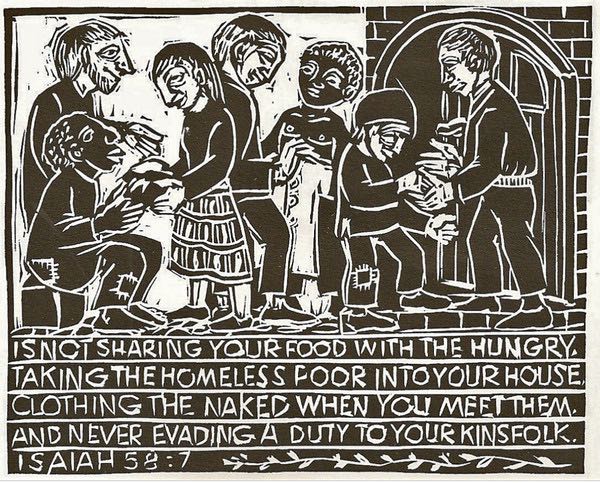
The prophet pointed out one of the unacceptable things about their fasting: employers delighted in fasting but were indifferent to the needs of their employees (58:3b). The prophet redefined fasting as an act that should have an impact on relationships with fellowmen, including: freeing the oppressed, feeding the hungry, giving shelter to the homeless, and clothing the naked (58:4-7 and see also Matthew 25:31-46).

Warren Wiersbe comments, “True fasting will lead to humility before God and ministry to others.” That kind of fasting will result in blessings from God (58:8-12). In addition to participating in fasting that helped alleviate human need, God wanted for His people to honor the Sabbath (58:13-14).

Practical Consideration: You can’t cover spiritual nakedness with the fig leaf of religion!
Many of the repatriates were very religious. They observed fasts and feasts. They followed the prescription for piety to the letter. Their piety however, lasted only as long as the worship service. It had no impact on their personal relationships with others in society. They were spiritually naked and impoverished. Their hearts were insensitive to the plight of others. They tried to cover their spiritual nakedness with the fig leaf of religious activity. They fooled their peers but not God.

Isaiah 57

Isaiah 57:1-2 express alarm at the fact that people were indifferent to the death of righteous and devout men. Verses 3-13 are addressed to those who kept clinging to idolatry, in spite of the experience of the exile. Much of the blame for this can be put on the religious and political leaders who failed to provide godly leadership (56:9-12).

God summoned the idolaters to draw near to hear the charges against them (57:3). Those charges included: blasphemous mockery (57:4), cultic prostitution (57:5a, 7-8), child sacrifice (57:5b), the offering of sacrifices (57:6), and the paying of homage to idols by trusting in the kings of other nations who worshiped them (57:9).

Verse 10 describes the state of those addicted to idolatry. They were tired of it but not enough to forsake it. Verses 11-13 stress the futility of trusting in anything or anyone other than God.

God’s Constant Effort to Restore Sinners

57:14-21
What did God do in an effort to restore sinners to Himself?


God commanded His prophet to prepare the way for His people to return to Him by removing any and all obstacles that would hinder their return (57:14).

God declared that He dwells with and has intimate fellowship with those who are humble and contrite (57:15) to the end that they will be revitalized (57:16).

Verse 17 declares that many people continued to backslide in spite of the severe judgment they had experienced in the exile.

Verse 18 accentuates the grace and mercy of God as He announces that He will heal, lead, and restore His erring people. They will know peace (57:19) as opposed to the wicked whose lives are as restless as the sea (57:20) and no know peace (57:21).

Practical Consideration: God takes the initiative in paving the way for sinners to come to Him.
Isaiah often spoke of a way, highway, or roadway (see, for example, Isaiah 11:16; 40:3-4; 43:16, 19; 49:11 and 57:14) which God would make in order to make it possible for people to come to Him. God has always taken the initiative in paving the way for people to come to Him. Jesus said, “I am the way … no one comes to the Father, but through Me” (John 14:6). Those wishing to come to God must travel over His highway. All other ways lead nowhere.

Isaiah 56

After their return from Babylon in 538 B.C., the people encountered many difficulties. They had a hard time reconciling their difficulties with the promises of the prophet regarding the restoration of the city and its temple (Isaiah 44:28), the population explosion (Isaiah 49:19-21; 54:1-3), the wealth that would become theirs (Isaiah 45:14), and the homage they would receive from other nations (Isaiah 49:22-23). Instead, they encountered delays in the rebuilding of their temple (Ezra 4:1-5), bad economic conditions as the result of natural catastrophes (Haggai 1:6, 9-11; 2:16-17), and the payment of tribute to Persia (Nehemiah 5:15). The transition period was difficult for the people. Many became disillusioned. It was against this background that the prophet proclaimed the messages recorded in these chapters.

Everyone Who Keeps God’s Law Welcomed in His Temple

56:1-8
Who was welcomed in God’s Temple?


Verses 1 and 2 stress the importance of obedience. The prophet exhorted the people to demonstrate their obedience to God in four areas: [1] “Preserve justice,” [2] “do righteousness,” [3] keep the sabbath, and [4] keep their “hand from doing any evil.” Those who abided by this standard were welcome in God’s Temple.

Verses 3-8 address the issue of whether or not foreigners and eunuchs would be allowed to participate in worship. The eunuchs were probably Jews who had been mutilated while in exile so that they could be trusted to work in royal palaces. Foreigners were non-Jews who became proselytes.

Isaiah declared that both eunuchs and foreigners were welcome to participate in worship as long as they met the requirements outlined in verses 4 and 6: [1] keep the Sabbath, [2] choose what pleases God, [3] keep His covenant, and [4] love the Lord. (Read Romans 2:29 and Galatians 3:28-29).

Condemnation of Those Who Learned Nothing from the Exile

56:9-57:13
Who in the postexilic community did the prophet condemn?
Isaiah condemned Judah’s religious and political leaders who had failed to learn anything from the exile (56:9-12). The “watchmen” were the nation’s prophets. Isaiah characterized them as being blind, knowing nothing, being like dumb (mute) dogs unable to bark, interested only in indulging their sinful appetites. The “shepherds” (political leaders) of the nation were no better. They too, were interested only in their own gain. Verse 12 records one of the comments (perhaps a drinking song) of the leaders.

Practical Consideration: What we keep will keep us in or out of trouble.
The prophet gave the people specific instructions regarding God’s expectations of them. God expected His people to keep justice, righteousness, the Sabbath, and their hand from doing any evil. Even eunuchs and foreigners who kept these things would be welcome in God’s Temple. Failure to keep these things however, would keep people in trouble with God.

Isaiah 57:1-2 express alarm at the fact that people were indifferent to the death of righteous and devout men. Verses 3-13 are addressed to those who kept clinging to idolatry, in spite of the experience of the exile. Much of the blame for this can be put on the religious and political leaders who failed to provide godly leadership (56:9-12).

God summoned the idolaters to draw near to hear the charges against them (57:3). Those charges included: blasphemous mockery (57:4), cultic prostitution (57:5a, 7-8), child sacrifice (57:5b), the offering of sacrifices (57:6), and the paying of homage to idols by trusting in the kings of other nations who worshiped them (57:9).

Verse 10 describes the state of those addicted to idolatry. They were tired of it but not enough to forsake it. Verses 11-13 stress the futility of trusting in anything or anyone other than God.

Isaiah 55

God’s Invitation to the Covenant Blessings

55:1-5
What invitation did God issue to the people?
Verses 1-5 accentuate the fact that only God can satisfy the spiritual needs of man. Isaiah pictured God calling out to the thirsty (both Jew and Gentile) to look to Him for water (symbol of salvation), wine (a symbol of the joy of salvation), and milk, (a symbol of nourishment). This life-giving sustenance was available to all (55:1). Those who do not look to God however, are spending their resources on things that do not satisfy (55:2a).

Many of the exiles were enjoying secure and prosperous lives in captivity. Their lives were however, spiritually empty. And spiritual voids cannot be filled with material things. One commentator paraphrased the question of verse 2 (addressed to the comfortable exiles): “Does all this really satisfy you? Is this what you are for?”

God pled with the people to listen to Him and partake of the spiritual food and drink that would satisfy their deepest spiritual needs (55:2b). God called on the exiles to listen to Him, come to Him, and respond to Him in faith that they might experience life at its fullest (55:3a).

God promised to make an everlasting covenant with them as He did with David. Such a covenant would make them the beneficiaries of God’s love and care. (55:3b). God expected His people to serve as a witness and spiritual leader to the world even as David served as a spiritual leader to the nation (55:4-5).

Practical Consideration: God always takes the initiative in salvation.
Isaiah 55 affirms the fact that it is God who takes the initiative in salvation. Other religions tell seekers to go and do something whereas God bids them to come. It is God who calls the thirsty to come and have their thirst quenched with the water He provides.

The New Testament similarly affirms that it is God who so loved that He gave (John 3:16) and who first loved us (1 John 4:19). God’s ultimate and undeniable demonstration of His initiative was at Calvary.

Practical Consideration: Spiritual needs cannot be satisfied with material things.
Many of the exiles had grown comfortable in captivity. They were content with the thought of staying in a foreign land with their hard-earned possessions rather than to return to rebuild their devastated homeland and be identified with God’s people.

In like manner, many people today are comfortable in captivity. They are in bondage to sin. They soothe the sores produced by the chains that bind them with the salve of materialism, but the sores will not heal. They seek to fill the aching void within their hearts with possessions, power, and prestige, but their hearts still ache. Only God can heal our hurts, forgive our sins, and fill the void in our hearts. Only God can satisfy the deep spiritual hunger of man.

God’s Call to Repent and Be Pardoned

55:6-13
What did God call upon the people to do?
God called upon individuals to seek Him and call upon Him (55:6). There is a sense of urgency conveyed in Isaiah’s message (see also 2 Corinthians 6:2). They were to seek the Lord “while He may be found” and call upon Him “while He is near” (55:6).

Those who had grown comfortable in captivity had to make up their minds. God offered salvation. God offered deliverance from exile. They had a window of opportunity to repent and return to the Lord and their land. In order to seek Him they needed to forsake their wicked ways (lifestyle) and thoughts (55:7a) and then “return to the Lord…And to our God” (55:7b).

Those repenting and returning to the Lord would experience His compassion and pardon. God reminded His people that His thoughts and ways are higher than theirs. There is a moral difference between God’s ways and thoughts and the ways and thoughts of the wicked man (55:7a).

God assured the people that His word was reliable. They could count on God fulfilling His word to deliver them from captivity as sure as the rain and snow water the earth and make it productive (55:10-11). On that day they would go forth rejoicing and in peace and the world of nature would rejoice with them as well (55:12-13). Their deliverance from exile would testify to the validity of God’s prophetic word.

Note: Biblical commentator Trent C. Butler writes: “Here then is the summary of the message of chapters 40-55. God had planned salvation for His people. He sent His prophet with the word of God to announce this salvation. The people must decide to climb out of the depth of despair to join the journey of joy along the wilderness way to be a witness for the world to the glory of God.”

Isaiah 54

Note: Isaiah 54:1-3 was the text of William Carey’s memorable sermon in Nottingham in June 1792. Concerned about the lost throughout the world, Carey exhorted his listeners to expect great things from God and attempt great things for God. Immediately afterwards, Carey met with his companions and said, “I will go down into the pit, if you will hold the ropes.” As a result, the Baptist Missionary Society was formed and William Carey unwittingly launched what became the modern missionary movement.

God as Husband Will Make Barren Israel Fruitful

54:1-8
What comforting words did God speak to Jerusalem?


The language of Isaiah 54 is beautiful and tender. God, the loving and powerful husband, addressed Jerusalem, the barren and abandoned wife. Jerusalem, the childless widow, is told by God to rejoice because she will soon have numerous children (54:1). In fact, she will have to enlarge her home to make room for them (54:2). Even then, they will spill over into the surrounding countryside and cities and populate those areas (54:3).

Verses 4-8 speak of the reconciliation of Israel, the prodigal wife (54:4), to God (54:5). Israel had justifiably suffered God’s wrath (in the exile) but would soon experience His great compassion (54:7-8). When reconciled to God, the people would soon forget the “reproach of [their] widowhood” (54:4) in the Babylonian Captivity. Israel had been unfaithful to God by chasing after false gods so God allowed the people to briefly experience life in a land filled with idolatry. God however, had not forgotten His unfaithful wife. He would restore her unto Himself.

God Will Establish Israel on a Strong, Rich Foundation

54:9-17
What lay in store for God’s people?
God made a “covenant of peace” (54:10) with His people. He likened it to the covenant He made with Noah after the flood (54:9). The rainbow served as a constant reminder that God would never again flood the earth to destroy all flesh (see Genesis 9:15). God’s new “covenant of peace” with the exiles was like a rainbow over the dark skies of their exile. He promised goodwill toward His people. God’s new covenant (characterized by lovingkindness, peace, and compassion) would be everlasting (54:10).

Verses 11-17 describe what it will be like to live under God’s “covenant of peace.” While the city, temple, and walls of Jerusalem were rebuilt, the language of these verses also looks to their ultimate fulfillment in the future. First, Jerusalem will be rebuilt with splendor (54:11-12). Second, there will be no need for a temple or priests because the Lord Himself will teach His people (54:13). Third, the inhabitants of the city will be prosperous and live free of the fear of oppression (54:14-15). Fourth, God will deal with the arms makers and dealers (54:16). Fifth, no weapon formed against them shall prosper (54:17).

Note: Biblical commentator Page H. Kelley writes, “Chapter 55 appears to have been written on the eve of the return of the exiles to Jerusalem under the leadership of Sheshbazzar in 538 B.C. (cf. Ezra 1:2-11).”