Luke 17

17:1 Jesus said to his disciples: “Things that cause people to sin are bound to come, but woe to that person through whom they come.

17:2 It would be better for him to be thrown into the sea with a millstone tied around his neck than for him to cause one of these little ones to sin.

17:3 So watch yourselves. “If your brother sins, rebuke him, and if he repents, forgive him.

17:4 If he sins against you seven times in a day, and seven times comes back to you and says, ‘I repent,’ forgive him.”

17:5 The apostles said to the Lord, “Increase our faith!”

17:6 He replied, “If you have faith as small as a mustard seed, you can say to this mulberry tree, ‘Be uprooted and planted in the sea,’ and it will obey you.

17:7 “Suppose one of you had a servant plowing or looking after the sheep. Would he say to the servant when he comes in from the field, ‘Come along now and sit down to eat’?

17:8 Would he not rather say, ‘Prepare my supper, get yourself ready and wait on me while I eat and drink; after that you may eat and drink’?

17:9 Would he thank the servant because he did what he was told to do?

17:10 So you also, when you have done everything you were told to do, should say, ‘We are unworthy servants; we have only done our duty.'”

17:11 Now on his way to Jerusalem, Jesus traveled along the border between Samaria and Galilee.

17:12 As he was going into a village, ten men who had leprosy met him. They stood at a distance

17:13 and called out in a loud voice, “Jesus, Master, have pity on us!”

17:14 When he saw them, he said, “Go, show yourselves to the priests.” And as they went, they were cleansed.

17:15 One of them, when he saw he was healed, came back, praising God in a loud voice.


17:16 He threw himself at Jesus’ feet and thanked him—and he was a Samaritan.

17:17 Jesus asked, “Were not all ten cleansed? Where are the other nine?

17:18 Was no one found to return and give praise to God except this foreigner?”

17:19 Then he said to him, “Rise and go; your faith has made you well.”

17:20 Once, having been asked by the Pharisees [largest and most influential religious/political party in Jesus’ day] when the kingdom of God would come [many believed the Messiah’s coming would usher in political kingdom that would restore Israel’s national prominence], Jesus replied [Jesus’ answer shows that He would not satisfy curiosity about the dating of future kingdom-related events (cf. Matt. 24:36)], “The kingdom of God does not come with your careful observation [Pharisees believed certain signs would accompany the kingdom’s arrival],

17:21 nor will people say, ‘Here it is,’ or ‘There it is,’ because the kingdom of God is within [or “among,” “in your midst,” or “within your reach”] you [wherever Jesus is present the kingdom is a reality].”

17:22 Then he said to his disciples, “The time is coming when you will long to see one of the days [probably refers to the period of time Christ’s return will inaugurate] of the Son of Man [used four times in Lk. 17:20-37 in reference to Jesus coming in judgment at the future fulfillment of God’s kingdom], but you will not see it [believers are to wait for the Lord’s return].

17:23 [Jesus warned the disciples about being misled concerning His return…] Men [false prophets and others who would declare the Lord had returned (cf. Lk. 21:8)] will tell you, ‘There he is!’ or ‘Here he is!’ Do not go running off after them.

17:24 For [the reason why the false prophets of 17:23 should be ignored…] the Son of Man in his day will be like the lightning [Jesus’ return will be visible and sudden], which flashes and lights up the sky from one end to the other [Jesus’ return will be evident to all].

17:25 But first he must [emphasizes God’s providential will; cf. Acts 2:23] suffer many things and be rejected by this generation [an “unbelieving and rebellious generation” (Lk. 9:41)].

17:26 “Just as it was in the days of Noah [who prepared for the coming flood], so also will it be in the days of the Son of Man.

17:27 People [continued their daily routines without regard to God…] were eating, drinking, marrying and being given in marriage up to the day Noah entered the ark. Then the flood came and destroyed them all [because they were unprepared].

17:28 “It was the same in the days of Lot. People [continued their daily routines without regard to God…] were eating and drinking, buying and selling, planting and building [earthly pursuits took precedence over spiritual preparation for judgment of sin].

17:29 But the day Lot left Sodom, fire and sulfur rained down [suddenly] from heaven and destroyed them all [because they were unprepared].

17:30 “It [the suddenness of Jesus’ return] will be just like this [what happened in the days of Noah and Lot] on the day the Son of Man is revealed.

17:31 On that day [cf. Lk. 17:31-37] no one who is on the roof of his house [homes in Israel had flat roofs with exterior stairs leading to the roofs], with his goods [material possessions] inside, should go down to get them. Likewise, no one in the field should go back for anything [material possessions are no longer needed and therefore should be left behind].

17:32 Remember [keep in mind] Lot’s wife [looked back (Gen. 19:26), indicating that she had material and temporal things on her mind]!

17:33 [cf. Matt. 16:25; Mk. 8:35; Lk. 9:24] Whoever tries to keep his life will lose it, and whoever loses his life will preserve it.

17:34 I tell you, on that night [does not designate a specific time of Jesus’ return] two people will be in one bed; one will be taken [saved from judgment] and the other left [Jesus’ return will separate people].

17:35 Two women will be grinding grain together; one will be taken and the other left.”

17:36 [note: this verse does not occur in the best Greek manuscripts (cf. Matt. 24:40)] Two will be in a field: one will be taken, and the other will be left.

17:37 “Where, Lord?” they asked. He replied [cf. Matt. 24:28], “Where there is a dead body, there the vultures will gather [this proverb serves as a parallel to the lightning flashes in 17:24; Jesus’ coming will be self-evident and unquestionable].”
Luke 18

18:1 Then Jesus told his disciples a parable to show them that they should always pray and not give up.

18:2 He said: “In a certain town there was a judge who neither feared God nor cared about men.

18:3 And there was a widow in that town who kept coming to him with the plea, ‘Grant me justice against my adversary.’

18:4 “For some time he refused. But finally he said to himself, ‘Even though I don’t fear God or care about men,

18:5 yet because this widow keeps bothering me, I will see that she gets justice, so that she won’t eventually wear me out with her coming!'”

18:6 And the Lord said, “Listen to what the unjust judge says.

18:7 And will not God bring about justice for his chosen ones, who cry out to him day and night? Will he keep putting them off?

18:8 I tell you, he will see that they get justice, and quickly. However, when the Son of Man comes, will he find faith on the earth?”

18:9 To some who were confident of their own righteousness [having too high an opinion of oneself is a prerequisite to looking down on others] and looked down on everybody else, Jesus told this parable [Gr: para + bole = “to throw alongside”—a story thrown alongside a truth to illustrate it]:

18:10 “Two men went up [temple built on a mount within Jerusalem; persons literally walked up a series of steps to temple] to the temple to pray [public prayer services held at the temple at 9:00 AM and 3:00 PM (see Acts 2:15; 3:1)], one a Pharisee [often did things to be observed by others as per Matt. 23:5] and the other a tax collector [generally despised by others].

18:11 The Pharisee stood up and prayed about himself: ‘God, I thank you [note that he did not praise God or thank Him for His goodness] that I am not like other men [the Pharisee pointed out the sins of others but confessed none of his own; he mistakenly compared himself to others rather than with God’s standard]—robbers [cf. Ex. 20:15,17], evildoers, adulterers [cf. Ex. 20:14; he did not claim to not have lusted (Matt. 5:27-28)]—or even like this [derogatory tone] tax collector.

18:12 I fast twice a week [the Mosaic law required fasting only on the Day of Atonement (Lev. 23:27)] and give a tenth of all I get [Lev. 27:30-32].’

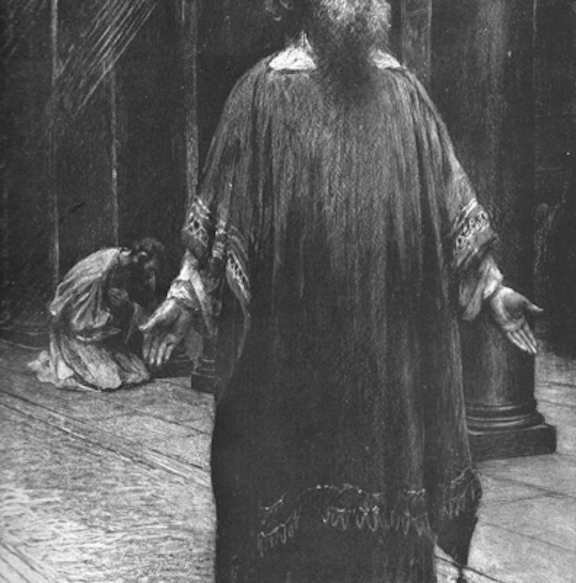
18:13 “But the tax collector stood at a distance [felt unworthy to be close]. He would not even look up to heaven [looking up in prayer was a typical Jewish posture when praying], but beat his breast [an indication of great sorrow or grief; cf. Jer. 31:19; Lk. 23:48] and said [the tax collector focused on God’s character as One who shows mercy], ‘God, have mercy on me [turn Your wrath from me], a sinner.’

18:14 “I tell you that this man [the tax collector], rather than the other [the self-righteous Pharisee], went home justified [declared right before God] before God. For everyone who exalts himself will be humbled, and he who humbles himself will be exalted.”

18:15 People [probably parents] were also bringing babies [Gr. “paidia” could mean any child from infancy (cf. Lk. 18:15) up to twelve years old; this word can also refer to an unborn child (Luke used this Gr. word to refer to John in Elizabeth’s womb in Lk. 1:41,44)] to Jesus [parents thought it important to have a distinguished rabbi to bless their children] to have him touch [perhaps because they believed Jesus’ touch would convey a special blessing from God; Matthew adds, “and pray for them” (19:13)] them. When the disciples saw this, they rebuked [scolded the parents for interrupting Jesus; sought to prevent the children from getting to Jesus] them.

18:16 [cf. Mk. 10:14] But Jesus [Jesus viewed children as significant persons (in the first-century, unwanted infants were killed or left alone to die and abortion was an accepted part of pagan society)] called the children to him and said [Jesus took advantage of this opportunity to teach a spiritual truth], “Let the little children come to me, and do not hinder them [“stop hindering them” or “never stop them”], for the kingdom of God belongs to such as these [does not mean that children are automatically in the kingdom of God; children are needy, helpless, and dependent on others; those seeking to enter God’s kingdom must have a childlike attitude (openness, humility, trust, acceptance)].

18:17 I tell you the truth [these words introduce a solemn statement], anyone who will not receive the kingdom of God [the rule and reign of God in the lives of people] like a little child [accept the message of salvation in an attitude of childlike humility; with simple trust, joyfully, thankfully] will never enter it.”

18:18 A certain ruler [rich (Mk. 10:22), young (Matt. 19:22)] asked [man believed Jesus could answer his question] him, “Good teacher, what must I do [man believed goodness defined by human achievement and that salvation must be earned] to inherit eternal life [life’s most important issue; cf. Jn. 17:3 re: Jesus’ definition of eternal life; man recognized that something was missing from his life – he did not have the assurance that he had eternal life]?”

18:19 “Why do you call me good [Jesus was not denying His own goodness and deity; wanted to know if the man was trying to flatter Him or really understood that God is the source of goodness]?” Jesus answered. “No one is good–except God alone.

18:20 You know the commandments [cf. Ex. 20; Deut. 5; Jesus cited five commandments]: ‘Do not commit adultery, do not murder, do not steal [to rob, to deprive, holding back wages of one hired], do not give false testimony, honor your father and mother. [Matt. 19:19 adds “and love your neighbor as yourself”]‘”

18:21 “All these I have kept [indication of spiritual pride or ignorance; man sincerely felt he had obeyed outward demands of the law but had obviously not heard Jesus’ inward interpretation of some of the commandments (Matt. 5:21-48); perhaps he thought so because he was comparing himself with others] since I was a boy,” he said.

18:22 When Jesus heard this, he said to him, “You still lack one thing. Sell everything you have and give to the poor [the man was trusting in his possessions as his basis for securing eternal life; the man’s riches were a barrier between himself and God; wealth occupied place in his life that belonged to God (violation of first commandment)], and you will have treasure in heaven. Then come, follow [follow as a disciple] me.”

18:23 When he heard this [the man faced the most important decision of his life], he became very sad [grieving and sorrowful], because he was a man of great wealth [his gold remained his god; his possessions possessed him].

18:24 Jesus looked at him and said [Matt. 19:23 records that Jesus spoke these words to His disciples; Jesus took advantage of this teachable moment], “How hard [because wealth breeds self-sufficiency] it is for the rich [word often means things or possessions: property, wealth, means] to enter the kingdom of God [the rule and reign of God in the heart of an individual]!

18:25 [exaggerated illustration to make a point (hyperbole)] Indeed, it is easier for a camel [the largest animal known to those who heard Jesus’ words] to go through the eye of a needle [Luke used word for surgical needle in Lk. 18:25] than for a rich [perhaps because material wealth can make people blind to their spiritual needs] man to enter the kingdom of God.”

18:26 Those [“the disciples” as per Matt. 19:25] who heard this asked [“were greatly astonished” (Matt. 19:25) perhaps because many viewed wealth as a sign of God’s favor], “Who then can be saved [to rescue from a deadly plight]?”

18:27 Jesus replied, “What is [refers to entering the kingdom] impossible [human achievement cannot qualify anyone for eternal life] with men is possible with God [salvation is a divine accomplishment].”

18:28 Peter said to him, “We have left all we had to follow you [implication is that they had done what the rich, young ruler had refused to do]!”

18:29 “I tell you the truth,” Jesus said to them, “no one who has left [note precious things listed, a reminder that it costs to follow Jesus…] home or wife or brothers or parents or children for the sake of the kingdom of God

18:30 will fail to receive many times as much [not a promise of material riches; some rewards may be material in nature, but greater rewards are spiritual] in this age and, in the age to come, eternal life.”

18:31 Jesus took the Twelve aside and told them, “We are going up to Jerusalem, and everything that is written by the prophets about the Son of Man will be fulfilled.

18:32 He will be handed over to the Gentiles. They will mock him, insult him, spit on him, flog him and kill him.

18:33 On the third day he will rise again.”

18:34 The disciples did not understand any of this. Its meaning was hidden from them, and they did not know what he was talking about.

18:35 As Jesus approached Jericho, a blind man was sitting by the roadside begging.

18:36 When he heard the crowd going by, he asked what was happening.

37 They told him, “Jesus of Nazareth is passing by.”

18:38 He called out, “Jesus, Son of David, have mercy on me!”

18:39 Those who led the way rebuked him and told him to be quiet, but he shouted all the more, “Son of David, have mercy on me!”

18:40 Jesus stopped and ordered the man to be brought to him. When he came near, Jesus asked him,

18:41 “What do you want me to do for you?” “Lord, I want to see,” he replied.

18:42 Jesus said to him, “Receive your sight; your faith has healed you.”

18:43 Immediately he received his sight and followed Jesus, praising God. When all the people saw it, they also praised God.

Luke 19

19:1 Jesus entered Jericho [situated in the lower Jordan Valley (about 800 feet below sea level); first city attacked when Joshua led Israel into promised land (Josh. 6); located approximately 12 miles northeast of Jerusalem] and was passing through [on His way to Jerusalem to celebrate the Passover Feast].

19:2 A man was there by the name of Zacchaeus [most likely a Jew; name is Greek form of Heb. name meaning “pure; innocent; righteous one”]; he was a chief tax collector [tax collectors considered traitors because they worked for the Romans (Israel’s oppressors); hated because the were known to overcharge taxes to line their own pockets] and was wealthy [his wealth came from ill-gotten gain (imposing exorbitant taxes) as per 19:8].

19:3 He wanted to see who Jesus [known as “a friend of tax collectors and sinners” (Lk. 7:34)] was, but being a short man he could not, because of the crowd.

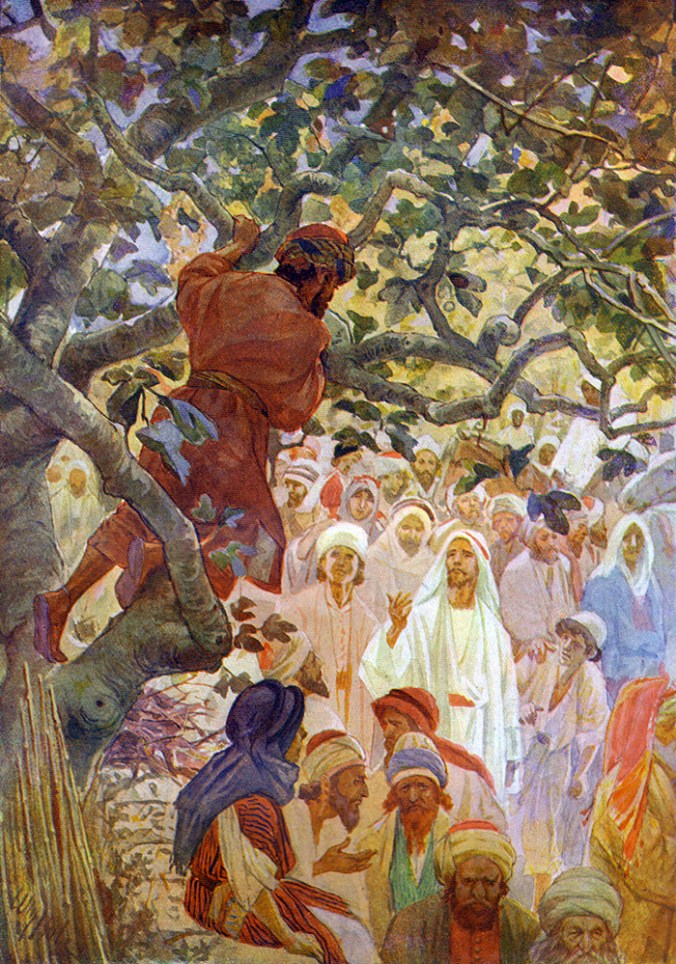
19:4 So [Zacchaeus did not give up] he ran ahead and climbed a sycamore-fig [a combination fig and mulberry tree with large, low-hanging branches; fruit eaten by the poor] tree to see him, since Jesus was coming that way.

19:5 When Jesus reached the spot, he looked up and said to him, “Zacchaeus [Jesus called him by name although there is no record that they had previously met], come down immediately. I must [denotes moral and spiritual necessity] stay at your house today [this is the only record of Jesus inviting Himself to be a guest in someone’s home].”

19:6 So he came down at once [an immediate response] and welcomed him gladly [joyfully].

19:7 All [shows how widespread was the disappointment in Jesus for accepting the hospitality of Zacchaeus] the people saw this and began to mutter [Gr. “diagonguzo”], “He has gone to be the guest of a ‘sinner.’ [the critics had obviously forgotten that they too were sinners]

19:8 But Zacchaeus [his actions illustrate that God’s love changes lives] stood up and said to the Lord [Zacchaeus made two important commitments…], “Look, Lord! [1] Here and now I give half of my possessions to the poor, [2] and if [or since] I have cheated [extorted more money from people than they should have paid] anybody out of anything, I will pay back four times [this was double the required restitution (Ex. 22:4,9)] the amount.”

19:9 Jesus said to him, “Today salvation has come to this house, because this man [a descendant of Abraham in the flesh], too, is a son of Abraham [now a son of Abraham by faith].

19:10 [statement of Jesus’ mission…] For the Son of Man [Jesus’ most commonly used title for Himself] came to seek and to save what was lost.”

19:11 While they were listening to this, he went on to tell them a parable, because he was near Jerusalem and the people thought that the kingdom of God was going to appear at once [the people thought that Jesus was the political leader who would set up an earthly kingdom and free them from Roman domination; Jesus told parable to correct this wrong notion].

19:12 He said: “A man of noble birth [a person born with high social status] went to a distant country [a Roman ruler had to travel to Rome to receive his appointment and then return to his respective land to rule] to have himself appointed king and then to return.

19:13 So he called ten of his servants [obviously people he trusted] and gave them ten minas [one mina was worth two hundred denarii (one denarius was a day’s wage for a common laborer)]. ‘Put this money to work,’ he said, ‘until I come back [Jesus will return one day to set up His kingdom].’

19:14 [Jesus’ listeners would have understood these words in light of their own recent history; Archelaus, a son of Herod the Great, was an evil man who had three thousand Jews murdered at Passover soon after he came into power; Jews sent delegation to Rome to ask that he not be made their ruler (king)] “But his subjects hated him and sent a delegation after him to say, ‘We don’t want this man to be our king.’

19:15 “He was made king, however, and returned home. Then he sent for the servants to whom he had given the money, in order to find out what they had gained with it [accountability].

19:16 “The first one came and said, ‘Sir, your [rather than “my,” an indication that he understood stewardship] mina has earned ten more.’

19:17 ” ‘Well done, my good [indicates the servant had met his master’s expectations in service] servant!’ his master replied. ‘Because you have been trustworthy in a very small matter, take charge of ten cities [the basis for the reward was the servant’s faithfulness as a steward; cf. Lk. 16:10].’

19:18 “The second came and said, ‘Sir, your [rather than “my,” an indication that he understood stewardship] mina has earned five more.’

19:19 “His master answered, ‘You take charge of five cities [this reward was in the same proportion as the reward for the first servant].’

19:20 “Then another servant came [to give his accounting] and said, ‘Sir, here is your mina; I have kept it laid away in a piece of cloth [although he had not stolen the money or done anything illegal with it, this servant had failed to use the resource entrusted to him in accordance with his master’s instructions].

19:21 [note the excuse of the final servant (“it’s not my fault’)…] I was afraid [his fear led him to play it safe] of you, because you are a hard [austere, strict, and exacting] man. [the servant accused his master of unfair banking practices…] You take out what you did not put in [the servant accused his master of dishonest farming…] and reap what you did not sow.’

19:22 “His master replied, ‘I will judge you by your own words, you wicked servant [this servant had acted in his own self-interest]! You knew, did you, that I am a hard man, taking out what I did not put in, and reaping what I did not sow?

19:23 [ironically, the final servant had failed to act according to his own presuppositions about his master] Why then didn’t you put my money on deposit, so that when I came back, I could have collected it with interest?’

19:24 “Then he said to those standing by, ‘Take his mina away from him and give it to the one who has ten minas [the servant who had acted responsibly].’

19:25 “‘Sir,’ they said, ‘he already has ten!’

19:26 “He replied, ‘I tell you that to everyone who has, more will be given [faithful servants receive both blessing and additional responsibility], but as for the one who has nothing, even what he has will be taken away [unfaithful servants receive punishment and loss of additional responsibility].

19:27 But those enemies of mine who did not want me to be king over them–bring them here and kill them in front of me [the kings of that time did such things (Matt. 2:16; 14:9-10)].’”

19:28 After Jesus had said this, he went on ahead, going up to Jerusalem [Jesus had earlier announced why He had to go to Jerusalem (cf. Matt. 16:21; 20:18); His final trip to Jerusalem].

19:29 As he approached Bethphage [means “House of Figs”] and Bethany at the hill called the Mount of Olives, he sent two of his disciples, saying to them,

19:30 “Go to the village ahead [Bethany: hometown of Mary, Martha, Lazarus] of you, and as you enter it, you will find a colt [not a warrior’s stallion, but an animal (“the donkey and the colt” as per Matt. 21:7) used by common people] tied there, which no one has ever ridden. Untie it and bring it here [perhaps Jesus prearranged use of the animals with their owner].

19:31 If anyone asks you [cf. Mk. 11:5; Lk. 19:33], ‘Why are you untying it?’ tell him, ‘The Lord [suggests that the owner was a disciple of Jesus] needs it.'”

19:32 Those who were sent ahead went and found it just as he had told them.

19:33 As they were untying the colt, its owners asked them, “Why are you untying the colt?”

19:34 They replied, “The Lord needs it.”

19:35 They brought it to Jesus, threw their cloaks on the colt [this colt had never been ridden (Mk. 11:2; Lk. 19:30)] and put Jesus on it [riding on a donkey indicated a mission of goodwill; Jesus entry into Jerusalem on a donkey (colt) fulfilled prophecy (Zech. 9:9)].

19:36 As he went along, people spread their cloaks on the road [“red carpet” treatment; sign of honor and submission].

19:37 When he came near the place where the road goes down the Mount of Olives, the whole crowd of disciples began joyfully to praise God in loud voices for all the miracles they had seen:

19:38 “Blessed is the king who comes in the name of [as a representative] the Lord!” “Peace in heaven and glory in the highest!”

19:39 Some of the Pharisees in the crowd said to Jesus, “Teacher, rebuke your disciples!”

19:40 “I tell you,” he replied, “if they keep quiet, the stones will cry out.”

19:41 As he approached Jerusalem and saw the city, he wept over it

19:42 and said, “If you, even you, had only known on this day what would bring you peace–but now it is hidden from your eyes.

19:43 The days will come upon you when your enemies will build an embankment against you and encircle you and hem you in on every side.

19:44 They will dash you to the ground, you and the children within your walls. They will not leave one stone on another, because you did not recognize the time of God’s coming to you.”

19:45 [Jesus began ministry with similar act (Jn. 2:13-25)] Then he entered the temple [Court of the Gentiles] area and began driving out [with force] those who were selling [originally started as a service and convenience for visitors to Jerusalem to provide unblemished sacrificial animals and exchange foreign currency for coins to pay the Temple tax (cf. Matt. 17:24); temple looked more like a marketplace than a holy place].

19:46 “It is written,” he said to them, “‘My house will be a house of prayer [cf. Isa. 56:7; legitimate use of temple space: prayer, meditation, fellowship, spiritual devotion to God]‘; but you have made it ‘a den of robbers [people were exploited by sellers who charged exorbitant prices; cf. Jer. 7:11].'”

19:47 Every day he was teaching at the temple. But the chief priests, the teachers of the law and the leaders among the people were trying to kill him.

19:48 Yet they could not find any way to do it, because all the people hung on his words.

Luke 20

20:1 One day as he was teaching the people in the temple courts and preaching the gospel, the chief priests and the teachers of the law, together with the elders, came up to him.

20:2 “Tell us by what authority you are doing these things,” they said. “Who gave you this authority?”

20:3 He replied, “I will also ask you a question. Tell me,

20:4 John’s baptism—was it from heaven, or from men?”

20:5 They discussed it among themselves and said, “If we say, ‘From heaven,’ he will ask, ‘Why didn’t you believe him?’

20:6 But if we say, ‘From men,’ all the people will stone us, because they are persuaded that John was a prophet.”

20:7 So they answered, “We don’t know where it was from.”

20:8 Jesus said [to a group of religious leaders (see 20:1)], “Neither will I tell you by what authority I am doing these things [the implication is clear that Jesus and John both received their authority from God].”


20:9 [cf. Isa. 5:1-7 re: the Song of the Vineyard] He went on to tell the people this parable [Greek: para + bole means “to throw alongside”—parable is a story thrown alongside a truth to illustrate it]: “A man planted a vineyard [a symbol of Israel’s privileged position as the covenant people and heirs of God’s kingdom], rented [rent would come due after the harvest and payable in the form of a predetermined amount of the produce] it to some farmers [either tenant farmers or vinedressers; represented Israel’s religious leaders] and went away for a long time.

20:10 At harvest time he sent a [a single person since the owner would not have expected any trouble from the tenants] servant [with the requisite authority to receive the owner’s share of the profits; just as God sent prophets to His people] to the tenants so they would give him some of the fruit of the vineyard. But the tenants beat him [just as the prophets were often beaten by the people] and sent him away empty-handed.

20:11 He sent another servant [on the same assignment], but that one also they beat and treated shamefully [means “to insult” or “to treat in a dishonored and despised manner”] and sent away empty-handed.

20:12 He sent still a third [just as God sent prophet after prophet in the OT], and they wounded him and threw him out.

20:13 “Then the owner of the vineyard said, ‘What shall I do? I will send my son [someone with greater authority than a servant], whom I love [cf. Lk. 3:22; 9:35]; perhaps [this adverb occurs only here in the NT] they will respect him.’

20:14 “But when the tenants saw him, they talked the matter over [perhaps they thought that the owner had died and the son had arrived to claim his inheritance]. ‘This is the heir,’ they said. ‘Let’s kill him, and the inheritance will be ours [based on Jewish custom at the time that said unclaimed property could be declared ownerless and therefore open to anyone’s claim; the tenants hoped to secure the property over others who might express interest in it on the basis of “squatter’s rights”].’

20:15 So they threw him out of [just as Jesus died outside of Jerusalem’s city limits; cf. Heb. 13:11-13] the vineyard and killed him. [Jesus then asked a question that was not part of the parable itself…] “What then will the owner of the vineyard do to them?

20:16 [Jesus proceeded to answer the question…] He will come and kill those tenants and give the vineyard to others [as in the case of Jerusalem’s destruction in AD 70 and the entry of the Gentiles into the church].” When the people heard this, they said, “May this never be [or “No—Never!”]!”

20:17 Jesus looked [fixed His gaze on] directly at them and asked, “Then what is the meaning of that which is written [cf. Ps. 118:22]: “‘The stone the builders rejected has become the capstone [or “cornerstone”]‘?

20:18 [first part of verse shows judgment in a passive sense] Everyone who falls on that stone will be broken to pieces, [second part of verse shows judgment in the active sense] but he on whom it falls will be crushed [to grind to powder; expresses the thoroughness of God’s judgment].”

20:19 The teachers of the law and the chief priests looked for a way to arrest him immediately, because they knew he had spoken this parable against them. But they were afraid of the people.


20:20 Keeping a close watch on him, they sent spies, who pretended to be honest. They hoped to catch Jesus in something he said so that they might hand him over to the power and authority of the governor.

20:21 So the spies questioned him: “Teacher, we know that you speak and teach what is right, and that you do not show partiality but teach the way of God in accordance with the truth.

20:22 Is it right for us to pay taxes to Caesar or not?”

20:23 He saw through their duplicity and said to them,

20:24 “Show me a denarius. Whose portrait and inscription are on it?”

20:25 “Caesar’s,” they replied. He said to them, “Then give to Caesar what is Caesar’s, and to God what is God’s.”

20:26 They were unable to trap him in what he had said there in public. And astonished by his answer, they became silent.


20:27 Some of the Sadducees, who say there is no resurrection, came to Jesus with a question.

20:28 “Teacher,” they said, “Moses wrote for us that if a man’s brother dies and leaves a wife but no children, the man must marry the widow and have children for his brother.

20:29 Now there were seven brothers. The first one married a woman and died childless.

20:30 The second

20:31 and then the third married her, and in the same way the seven died, leaving no children.

20:32 Finally, the woman died too.

20:33 Now then, at the resurrection whose wife will she be, since the seven were married to her?”

20:34 Jesus replied, “The people of this age marry and are given in marriage.

20:35 But those who are considered worthy of taking part in that age and in the resurrection from the dead will neither marry nor be given in marriage,

20:36 and they can no longer die; for they are like the angels. They are God’s children, since they are children of the resurrection.

20:37 But in the account of the bush, even Moses showed that the dead rise, for he calls the Lord ‘the God of Abraham, and the God of Isaac, and the God of Jacob.’

20:38 He is not the God of the dead, but of the living, for to him all are alive.”

20:39 Some of the teachers of the law responded, “Well said, teacher!”

20:40 And no one dared to ask him any more questions.


20:41 Then Jesus said to them, “How is it that they say the Christ is the Son of David?

20:42 David himself declares in the Book of Psalms: “‘The Lord said to my Lord: “Sit at my right hand

20:43 until I make your enemies a footstool for your feet.”‘

20:44 David calls him ‘Lord.’ How then can he be his son?”

20:45 While all the people were listening, Jesus said to his disciples,

20:46 “Beware of the teachers of the law. They like to walk around in flowing robes and love to be greeted in the marketplaces and have the most important seats in the synagogues and the places of honor at banquets.

20:47 They devour widows’ houses and for a show make lengthy prayers. Such men will be punished most severely.”

Luke 21

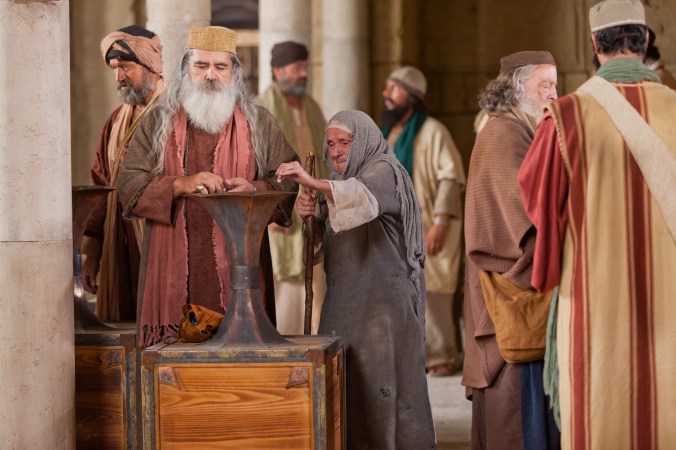
21:1 As he [Jesus was in area of temple called the Court of the Women] looked up, Jesus saw the rich [probably easy to spot because of what they wore] putting their gifts [“large amounts” according to Mk. 12:41] into the temple treasury [thirteen trumpet shaped receptacles in the Court of the Women in the temple].

Note: Have you ever given a gift just to impress others? How much satisfaction did it give you?

21:2 He also saw a poor [very poor; probably obvious by her apparel] widow [had few resources for generating income] put in two very small copper coins [mites: the coins of smallest value; probably amounted to one-eighth of a penny].

21:3 “I tell you the truth,” he said, “this poor widow has put in more than all the others [the others had plenty left over after they gave].

21:4 All these people gave their gifts out of their wealth [indicates they had plenty left over after they gave]; but she out of her poverty put in all [she did not hold back one coin; she had nothing left after she gave] she had [her means of living] to live on.”

Note: “God judges what we give by what we keep.” (George Mueller)

21:5 Some of his disciples were remarking about how the temple [covered one-sixth of land area of Jerusalem] was adorned with beautiful stones and with gifts dedicated to God. But Jesus said,

Note: About the Temple…
• Solomon’s temple destroyed by Babylonians in 7th century BC
• Ezra built temple after return from exile in 6th century BC
• Temple desecrated by the Seleucids in 2nd century BC
• Temple reconstructed by Maccabees
• Temple expanded by Herod the Great over 46 year period
• Temple destroyed by Titus in AD 70

21:6 “As for what you see here, the time will come when not one stone will be left on another; every one of them will be thrown down [this prophecy fulfilled in AD 70 when Emperor Titus destroyed temple].”

21:7 “Teacher,” they asked [note two concerns], [1] “when will these things [destruction of the temple] happen? [2] And what will be the sign [indicator; visible revelation of something to follow] that they [cf. Matt. 24:3] are about to take place?”

21:8 He replied: [First] “Watch out [Greek = blepo which means beware] that you are not deceived. For many [false prophets and teachers; imposters who claim to represent God but not live according to His Word] will [speaks of certainty] come in my name [claiming His authority], claiming, ‘I am he [a messiah or his representative; see Acts 5:36],’ and, ‘The time is near.’ Do not follow them [sound doctrine is the best antidote for false doctrine].

21:9 [Second] When you hear of [political developments and unrest] wars and revolutions, do not be frightened [do not allow these events/rumors to divert you from your task of following Jesus and spreading the gospel]. These things [which are part of natural human existence or normal aspects of history in an unsettled world] must happen first, but the end will not come right away [do not confuse historical events of your day with eschatological events].”

21:10 Then he said to them: [causes of war] “Nation will rise against nation, and kingdom against kingdom.

21:11 [Third] There will be [natural disasters…] great earthquakes, famines and pestilences in various places, and fearful events and great signs from heaven.

21:12 “But before all this, they will [speaks of certainty] lay hands on you and persecute you. They will deliver you to [expect official persecution] synagogues [see Acts 6:9; 26:11] and prisons, and you will be brought before kings and governors, and all on account of my name [religious persecution; see Acts 8:1-3].

21:13 This will result in your being witnesses [turn sufferings into opportunities to witness] to them [magistrates and kings].

21:14 But make up your mind not to worry beforehand how you will defend yourselves [see Acts 4:1-13].

21:15 For I will give you words and wisdom [to turn situation into an opportunity to witness for Christ] that none of your adversaries will be able to resist or contradict [see Acts 6:8 — 7:60 re: Stephen].

21:16 You will be betrayed [as Judas betrayed Christ; personal persecution] even by [unbelieving] parents, brothers, relatives and friends, and they will put some of you to death.

21:17 All [refers to universal scope of opposition] men will hate you because of me [indication of the world’s attitude toward Jesus and His followers].

21:18 But not a hair of your head will perish.

21:19 By standing firm [bear up under difficulties; endure in commitment to Jesus without wavering; demonstrate the reality of their conversion; the result of a right relationship with God] you will gain life.

21:20 “When you see Jerusalem being surrounded by armies, you will know that its desolation [“the abomination that causes desolation” (Mk. 13:14); Dan. 9:27; 11:31; wicked defilement of a holy place] is near [some believe this was fulfilled when the Roman army stood in the temple where it did not belong and destroyed it].

21:21 Then let those who are in Judea flee to the mountains [when Romans invaded in AD 66 many fled to the mountains], let those in the city get out, and let those in the country not enter the city [protection would not be found in the city].

21:22 For this is the time of punishment in fulfillment of all that has been written.

21:23 How dreadful it will be in those days for pregnant women and nursing mothers [running away to safety would be most difficult for these]! There will be great distress in the land and wrath against this people.

21:24 They will fall by the sword [Josephus recorded that over one million people were killed] and will be taken as prisoners [Josephus recorded that 97,000 taken prisoner] to all the nations. Jerusalem will be trampled on by the Gentiles [this happened in AD 70] until the times of the Gentiles are fulfilled.

21:25 “There will be signs in the sun [“will be darkened” (Matt. 24:29)], moon [“will not give its light” (Matt. 24:29)] and stars [“will fall from the sky” (Matt. 24:29)]. On the earth, nations will be in anguish and perplexity at the roaring and tossing of the sea [cf. Rev. 6:12-14].

21:26 Men will faint from terror, apprehensive of what is coming on the world, for the heavenly bodies will be shaken.

21:27 At that time [cf. Mk. 13:24-25] they will see [the second coming of Christ will be a visible experience for all to see; cf. 1 Thess. 4:16] the Son of Man coming in [or “on”] a cloud [a sign of His deity] with power and great glory.

21:28 When these things [persecutions; natural disasters; cf. Lk. 21:25-26] begin to take place, stand up and lift up your heads, because your redemption [deliverance] is drawing near [indication that the return of the Messiah is near].”

21:29 He told them this parable [re: when the events would occur (cf. 21:7)]: “Look at the fig tree and all the trees.

21:30 When they sprout leaves, you can see for yourselves and know that summer is near [people can know what season it is by looking at trees or signs in nature].

21:31 Even so, when you see these things [described in preceding verses] happening, you know that the kingdom of God is near [the second coming of Jesus].

21:32 “I tell you the truth, this generation [refers to those living as well as to race or lineage (in this case the Jewish race)] will certainly not pass away until all these things [the destruction of Jerusalem and the end times] have happened.

21:33 Heaven and earth will pass away, but my words will never pass away [what Jesus said will be fulfilled].

21:34 “Be careful [do not allow yourself to be distracted from watching and waiting for His return], or your hearts will be weighed down with dissipation, drunkenness and the anxieties of life, and that day will close on you unexpectedly like a trap.

21:35 For it will come upon all [no exceptions] those who live on the face of the whole earth.

21:36 Be always on the watch [shun evil; live holy], and pray that you may be able to escape all that is about to happen, and that you may be able to stand before the Son of Man.”

21:37 Each day [during His final week on earth] Jesus was teaching at the temple, and each evening he went out to spend the night on the hill called the Mount of Olives [probably in the city of Bethany (cf. Matt. 21:17)],

21:38 and all the people came early in the morning to hear him at the temple.

Luke 22

22:1 Now the Feast of Unleavened Bread, called the Passover, was approaching,

22:2 and the chief priests and the teachers of the law were looking for some way to get rid of Jesus, for they were afraid of the people.

22:3 Then Satan entered Judas, called Iscariot, one of the Twelve.

22:4 And Judas went to the chief priests and the officers of the temple guard and discussed with them how he might betray Jesus.

22:5 They were delighted and agreed to give him money.

22:6 He consented, and watched for an opportunity to hand Jesus over to them when no crowd was present.

22:7 Then came the day of Unleavened Bread on which the Passover lamb had to be sacrificed.

22:8 Jesus sent Peter and John, saying, “Go and make preparations for us to eat the Passover.”

22:9 “Where do you want us to prepare for it?” they asked.

22:10 He replied, “As you enter the city, a man carrying a jar of water will meet you. Follow him to the house that he enters,

22:11 and say to the owner of the house, ‘The Teacher asks: Where is the guest room, where I may eat the Passover with my disciples?’

22:12 He will show you a large upper room, all furnished. Make preparations there.”

22:13 They left and found things just as Jesus had told them. So they prepared the Passover.

22:14 When the hour [the time the group gathered to eat the Passover meal] came, Jesus and his apostles reclined [probably on low couches with their feet pointing away from the table] at the table [a low table].

22:15 And he said to them, “I have eagerly [or “fervently”] desired to eat this Passover with you [those whom He loved] before I suffer.

22:16 For I tell you, I will not eat it again [Jesus knew this would be the last time He would eat a Passover meal with His disciples] until it finds fulfillment in the kingdom of God [the Passover was a preview of the messianic banquet that will occur when God’s kingdom is consummated; cf. Lk. 14:15-24; 22:30; Rev. 19:9].”

22:17 After taking the cup, he gave thanks and said, “Take this [a single cup was passed for all to share] and divide it among you.

22:18 For I tell you I will not drink again of the fruit of the vine until the kingdom of God comes.”

22:19 [this verse marks the transition from the Passover observance to the Lord’s Supper] And he took bread [Jesus gave new meaning to the unleavened bread that was a standard part of the Passover meal], gave thanks [Gr. eucharisteo from which we get our term Eucharist, a designation some use to refer to the Lord’s Supper] and broke it, and gave it to them, saying, “This is [represents] my body given [sacrificed] for you; do this in remembrance of me [this is a command or ordinance for His followers to repeat this on a regular basis].”

22:20 In the same way, after the supper he took the cup [Jesus gave new meaning to the cup], saying, “This cup is the new covenant [a binding agreement between two parties; established by the shedding of Jesus’ blood; cf. Jer. 31:31-34; Heb. 9:15; 12:24] in my blood, which is poured out for you [he died to pay the penalty for sin that we owed; substitutionary atonement].

22:21 But the hand of him [Judas Iscariot] who is going to betray me is with mine on the table.

22:22 The Son of Man [one of Jesus’ favorite self-designations] will go as it has been decreed [or determined by God; cf. Acts 2:23], but woe to that man who betrays him.”

22:23 They began to question among themselves which of them it might be who would do this.

22:24 Also a dispute arose among them as to which of them was considered to be greatest.

22:25 Jesus said to them, “The kings of the Gentiles lord it over them; and those who exercise authority over them call themselves Benefactors.

22:26 But you are not to be like that. Instead, the greatest among you should be like the youngest, and the one who rules like the one who serves.

22:27 For who is greater, the one who is at the table or the one who serves? Is it not the one who is at the table? But I am among you as one who serves.

22:28 You are those who have stood by me in my trials.

22:29 And I confer on you a kingdom, just as my Father conferred one on me,

22:30 so that you may eat and drink at my table in my kingdom and sit on thrones, judging the twelve tribes of Israel.

22:31 “Simon, Simon, Satan has asked to sift you as wheat.

22:32 But I have prayed for you, Simon, that your faith may not fail. And when you have turned back, strengthen your brothers.”

22:33 But he replied, “Lord, I am ready to go with you to prison and to death.”

22:34 Jesus answered, “I tell you, Peter, before the rooster crows today, you will deny three times that you know me.”

22:35 Then Jesus asked them, “When I sent you without purse, bag or sandals, did you lack anything?” “Nothing,” they answered.

22:36 He said to them, “But now if you have a purse, take it, and also a bag; and if you don’t have a sword, sell your cloak and buy one.

22:37 It is written: ‘And he was numbered with the transgressors’; and I tell you that this must be fulfilled in me. Yes, what is written about me is reaching its fulfillment.”

22:38 The disciples said, “See, Lord, here are two swords.” “That is enough,” he replied.

22:39 Jesus went out as usual to the Mount of Olives, and his disciples followed him.

22:40 On reaching the place, he said to them, “Pray that you will not fall into temptation.”

22:41 He withdrew about a stone’s throw [not completely out of range of sight] beyond them, knelt down [shows utmost attitude of submission and humility; indicates the pressure Jesus felt] and prayed,

22:42 “Father [Abba in Mk. 14:36], if you are willing [if there is another way within God’s will; all prayer is subject to God’s will], take this cup [represented Jesus’ suffering and death; a metaphor for punishment and suffering (cf. Ps. 75:8; Isa. 51:17)] from me; yet not my will, but yours be done [Jesus affirmed His submission to His Father].”

22:43 [22:43-44 do not appear in some of the early Greek manuscripts of Luke’s Gospel] An angel [angels ministered to Jesus after He had fasted and was tempted in the wilderness (Matt. 4:11; Mk. 1:13)] from heaven appeared to him and strengthened him.

22:44 And being in anguish, he prayed more earnestly, and his sweat was like drops of blood [a medical condition called hematidrosis in which blood and sweat are actually mixed, a condition that can occur in instances of extreme anguish] falling to the ground.

22:45 When he rose from prayer and went back to the disciples, he found them asleep [cf. Matt. 26:40], exhausted from sorrow.

22:46 “Why are you sleeping?” he asked them. “Get up [be awake and prepared] and pray so that you will not fall into temptation [means test, try, prove, examine].”

22:47 While he was still speaking a crowd came up, and the man who was called Judas, one of the Twelve, was leading them. He approached Jesus to kiss him,

22:48 but Jesus asked him, “Judas, are you betraying the Son of Man with a kiss?”

22:49 When Jesus’ followers saw what was going to happen, they said, “Lord, should we strike with our swords?”

22:50 And one of them struck the servant of the high priest, cutting off his right ear.

22:51 But Jesus answered, “No more of this!” And he touched the man’s ear and healed him.

22:52 Then Jesus said to the chief priests, the officers of the temple guard, and the elders, who had come for him, “Am I leading a rebellion, that you have come with swords and clubs?

22:53 Every day I was with you in the temple courts, and you did not lay a hand on me. But this is your hour—when darkness reigns.”

22:54 Then seizing him, they led him away and took him into the house of the high priest. Peter followed at a distance.

22:55 But when they had kindled a fire in the middle of the courtyard and had sat down together, Peter sat down with them.

22:56 A servant girl saw him seated there in the firelight. She looked closely at him and said, “This man was with him.”

22:57 But he denied it. “Woman, I don’t know him,” he said.

22:58 A little later someone else saw him and said, “You also are one of them.” “Man, I am not!” Peter replied.

22:59 About an hour later another asserted, “Certainly this fellow was with him, for he is a Galilean.”

22:60 Peter replied, “Man, I don’t know what you’re talking about!” Just as he was speaking, the rooster crowed.

22:61 The Lord turned and looked straight at Peter. Then Peter remembered the word the Lord had spoken to him: “Before the rooster crows today, you will disown me three times.”

22:62 And he went outside and wept bitterly.

22:63 The men who were guarding Jesus began mocking and beating him.

22:64 They blindfolded him and demanded, “Prophesy! Who hit you?”

22:65 And they said many other insulting things to him.

22:66 At daybreak [they held a trial at daybreak in order for it to be legal] the council [the Sanhedrin; the council of Jewish leaders; Romans allowed the Sanhedrin to serve both as a legislature and as a judicial court for most Jewish internal matters] of the elders of the people, both the chief priests [of the Sadducees] and teachers of the law [scribes; mainly Pharisees], met together, and Jesus was led before them.

22:67 “If you are the Christ,” they said, “tell us.” Jesus [knew that the council was not interested in understanding but only in condemning] answered, “If I tell you, you will not believe me [they had no intention of believing Jesus to be their Messiah],

22:68 and if I asked you [as in Lk. 20:1-8], you would not answer.

22:69 [these words are a claim to deity and that He was the Messiah…] But from now on, the Son of Man will be seated at the right hand [the place of greatest honor and glory] of the mighty God.”

22:70 They all asked, “Are you then the Son of God?” He replied [cf. Mk. 14:62], “You are right in saying I am.”

22:71 Then they said, “Why do we need any more testimony? We have heard it [Jesus’ claim of equality with God (cf. Matt. 26:65; Mk. 14:64)] from his own lips.”

Luke 23

23:1 Then the whole assembly rose and led him off to Pilate.

23:2 And they began to accuse him, saying, “We have found this man subverting our nation. He opposes payment of taxes to Caesar and claims to be Christ, a king.”

23:3 So Pilate asked Jesus, “Are you the king of the Jews?” 
”Yes, it is as you say,” Jesus replied.

23:4 Then Pilate announced to the chief priests and the crowd, “I find no basis for a charge against this man.”

23:5 But they insisted, “He stirs up the people all over Judea by his teaching. He started in Galilee and has come all the way here.”

23:6 On hearing this, Pilate asked if the man was a Galilean.

23:7 When he learned that Jesus was under Herod’s jurisdiction, he sent him to Herod, who was also in Jerusalem at that time.

23:8 When Herod saw Jesus, he was greatly pleased, because for a long time he had been wanting to see him. From what he had heard about him, he hoped to see him perform some miracle.

23:9 He plied him with many questions, but Jesus gave him no answer.

23:10 The chief priests and the teachers of the law were standing there, vehemently accusing him.

23:11 Then Herod and his soldiers ridiculed and mocked him. Dressing him in an elegant robe, they sent him back to Pilate.

23:12 That day Herod and Pilate became friends–before this they had been enemies.

23:13 Pilate called together the chief priests, the rulers and the people,

23:14 and said to them, “You brought me this man as one who was inciting the people to rebellion. I have examined him in your presence and have found no basis for your charges against him.

23:15 Neither has Herod, for he sent him back to us; as you can see, he has done nothing to deserve death.

23:16 Therefore, I will punish him and then release him.”

23:17 [this verse omitted in some manuscripts] For according to the festival he had to release someone to them.

23:18 With one voice they cried out, “Away with this man! Release Barabbas to us!”

23:19 (Barabbas had been thrown into prison for an insurrection in the city, and for murder.)

23:20 Wanting to release Jesus, Pilate appealed to them again.

23:21 But they kept shouting, “Crucify him! Crucify him!”

23:22 For the third time he spoke to them: “Why? What crime has this man committed? I have found in him no grounds for the death penalty. Therefore I will have him punished and then release him.”

23:23 But with loud shouts they insistently demanded that he be crucified, and their shouts prevailed.

23:24 So Pilate decided to grant their demand.

23:25 He released the man who had been thrown into prison for insurrection and murder, the one they asked for, and surrendered Jesus to their will. 

23:26 As they led him away, they seized Simon from Cyrene, who was on his way in from the country, and put the cross on him and made him carry it behind Jesus.

23:27 A large number of people followed him, including women who mourned and wailed for him.

23:28 Jesus turned and said to them, “Daughters of Jerusalem, do not weep for me; weep for yourselves and for your children.

23:29 For the time will come when you will say, ‘Blessed are the barren women, the wombs that never bore and the breasts that never nursed!’

23:30 Then ” ‘they will say to the mountains, “Fall on us!” and to the hills, “Cover us!”‘

23:31 For if men do these things when the tree is green, what will happen when it is dry?”

23:32 [fulfillment of Isa. 53:12 re: Suffering Servant being counted with transgressors or outlaws] Two other men, both criminals [literally “evil workers”], were also led out with him to be executed.

23:33 When they came to the place called the Skull [some think the location looked like a skull; others suggest the place was littered with skulls and bones from previous executions], there they crucified him [the Gospel writers did not describe crucifixion in detail; the meaning of Jesus’ death was more important than the details of His execution; suggested reading: “Crucifixion” by Martin Hengel], along with the criminals–one on his right, the other on his left [this emphasized the fact that Jesus was viewed as a criminal].

Note
• Golgotha = Aramaic
• Kranion = Greek
• Calvariae = Latin

23:34 Jesus said, “Father, forgive them [everyone responsible for His death (Roman soldiers, Jews, Gentiles)], for they do not know what they are doing. [cf. Stephen in Acts 7:60]” And they divided up his clothes by casting lots [fulfillment of Ps. 22:18].

23:35 The people [including Jesus’ family and friends] stood watching [cf. Jn. 19:25-27], and the rulers even sneered at him [cf. Mk. 15:29]. They said, “He saved others; let him save himself if he is the Christ of God, the Chosen One [a title for the promised messianic servant of the Lord (Isa. 42:1)].”

23:36 The soldiers also came up and mocked him. They offered him wine vinegar [a cheap beverage used by the soldiers for their own refreshment; offered as part of the soldiers’ mocking; fulfillment of Ps. 69:20-21]

23:37 and said, “If you are the king of the Jews [mimicking what had been said at Jesus’ trial before Pilate (Lk. 23:3)], save yourself [parroting what the Jewish leaders had said (Lk. 23:35)].”

23:38 There was a written notice [cf. Matt. 27:37; Mk. 15:26; Jn. 19:19] above him, which read: THIS IS THE KING OF THE JEWS.

23:39 One of the criminals who hung there hurled insults [could be translated literally “blasphemed”] at him: “Aren’t you the Christ [perhaps asked contemptuously]? Save yourself [cf. Lk, 23:35,37] and us!”

23:40 But the other criminal rebuked him. “Don’t you fear God,” he said, “since you are under the same sentence?

23:41 We are punished justly, for we are getting what our deeds deserve [this criminal confessed that he was guilty and deserving of punishment]. But this man has done nothing wrong.”


23:42 Then he said, “Jesus, remember me when you come into your kingdom.”

23:43 Jesus answered him, “I tell you the truth, today you will be with me in paradise [a synonym for heaven; this word also used in 2 Cor. 12:4 and Rev. 2:7].” 

23:44 It was now about the sixth hour [noon; normally the lightest, brightest part of the day], and darkness came over the whole land until the ninth hour [3:00 PM],

23:45 for the sun stopped shining [a supernatural event because Passover occurs at the full moon and eclipses cannot occur when there is a full moon]. And the curtain [separated the Holy of Holies from the Holy Place] of the temple was torn [the curtain was torn from the top to the bottom (Matt. 27:51) suggesting this was an act of God, not of man] in two [perhaps announcing the end of animal sacrifices—the ceremonies of the old covenant (Heb. 10:19-22); perhaps a symbolic picture of the opening of salvation to all through the death of Christ (Heb. 9:1-8; 10:19-22)].

23:46 Jesus called out with a loud voice, “Father, into your hands I commit my spirit [cf. Ps. 31:5; Acts 7:59; 1 Pet. 4:19].” When he had said this, he [voluntarily] breathed his last [Jesus had completed the task for which He had been sent into the world (Jn. 19:30)].

23:47 The centurion [probably the man in charge at the crucifixion], seeing what had happened, praised God and said [the centurion confessed Jesus’ innocence; cf. Matt. 27:54; Mk. 15:39], “Surely this was a righteous man. [some think this was a confession of faith in Jesus; others think the centurion only concluded that Jesus had been wrongly executed]

23:48 When all the people who had gathered to witness this sight saw what took place, they beat their breasts and went away.

23:49 But all those who knew him, including the women who had followed him from Galilee, stood at a distance, watching these things. 


23:50 Now there was a man named Joseph, a member of the Council, a good and upright man,

23:51 who had not consented to their decision and action. He came from the Judean town of Arimathea and he was waiting for the kingdom of God.

23:52 Going to Pilate, he asked for Jesus’ body.

23:53 Then he took it down, wrapped it in linen cloth and placed it in a tomb cut in the rock, one in which no one had yet been laid.

23:54 It was Preparation Day, and the Sabbath was about to begin.

23:55 The women who had come with Jesus from Galilee followed Joseph and saw the tomb and how his body was laid in it.

23:56 Then they went home and prepared spices and perfumes. But they rested on the Sabbath in obedience to the commandment.

Luke 24

24:1 On the first day of the week [corresponds to our Sunday], very early in the morning [probably at first light], the women took the spices [probably myrrh and aloes] they had prepared and went [the women knew the location of the tomb (Lk. 23:55)] to the tomb [carved into the rock (Lk. 23:53); Jewish leaders requested Roman authorities to put a seal on the tomb and to post a guard (Matt. 27:62-66)].

Note: Regarding the women present at the tomb (each God-inspired writer included details appropriate to the purpose of his particular Gospel):
• Matt. 28:1 — Mary Magdalene and the other Mary
• Mark 16:1 — Mary Magdalene, Mary the mother of James, Salome
• Luke 24:10 — Mary Magdalene, Joanna, Mary the mother of James, and the others with them
• John 20:1 — Mary Magdalene, others implied by the use of “we” in verse 2

24:2 They [the women encountered an unexpected situation] found the stone [prevented animals and humans from entering the tomb and disturbing the body] rolled away [separation in sense of distance, thus rolled away] from the tomb,

Note: Regarding position of stone:
• Matt. 27:60 — kulio: “to roll”
• Mark 16:3,4 — anakulio: “to roll up / upward”
• Luke 24:2 — apokulio: “separation in sense of distance thus rolled away”
• John 20:1 — airo: to pick up and carry away

24:3 but when they entered, they did not find the body of the Lord Jesus.

24:4 While they were wondering [perplexed] about this, suddenly two men [cf. Jn. 20:12] in clothes that gleamed [shining, glistening] like lightning stood beside them.

24:5 In their fright the women bowed [to show respect and reverential fear] down with their faces to the ground, but the men said to them, “Why do you look for the living among the dead?

24:6 He is not here; he has risen! Remember how he told you [cf. Lk. 9:18-22; 18:31-33; the women knew of what Jesus had said concerning His own death], while he was still with you in Galilee:

24:7 ‘The Son of Man [a title applied to Jesus as God in the flesh and the agent of divine judgment (cf. Dan. 7:13-14)] must [stresses the necessity of His death in order for salvation to be provided for all who would believe and trust in Jesus] be delivered into the hands of sinful men, be crucified and on the third day be raised again.’”

24:8 Then they remembered his words [only then did things begin to make sense].

24:9 When they came back from the tomb, they told all these things to the Eleven [cf. Matt. 27:5 re: Judas’ suicide] and to all the others [perhaps the two men who later traveled to Emmaus (Lk. 24:13-35) and the approximately 120 others who followed Jesus (Acts 1:15)].

24:10 It was Mary Magdalene [Jesus had cast seven demons out of her (Lk: 8:2); she was at the cross and at the tomb as per all Gospel accounts], Joanna [also mentioned in Lk. 8:3; married to Cuza, the manager of Herod’s household], Mary the mother of James [also mentioned in Mk. 15:40; 16:1; may be “the other Mary” of Matt. 28:1], and the others [Salome (Mk. 16:1) and other unnamed women] with them who told this to the apostles.

24:11 But they did not believe [shows that the disciples were not anticipating the resurrection] the women, because their words seemed to them like nonsense.

24:12 Peter [and John (Jn. 20:3-4)], however, got up and ran to the tomb. Bending over, he saw the strips of linen lying by themselves [cf. Jn. 20:6-7], and he went away, wondering to himself what had happened.

24:13 Now that same day [resurrection Sunday; cf. Lk. 24:1-12; read Lk. 24:21b] two [number required to provide a valid witness] of them [Jesus’ followers from Jerusalem; part of “all the others” (Lk. 24:9) who thought the report of the women concerning the resurrected Christ seemed like nonsense (Lk. 24:11)] were going to a village called Emmaus [name means “hot baths”], about seven miles from Jerusalem.

24:14 They were talking with each other about everything that had happened [Jesus’ arrest, trial, crucifixion, report of the resurrection].

24:15 As they talked [conversing] and discussed [questioning] these things with each other, Jesus [the first appearance of the resurrected Lord in Luke’s Gospel] himself [emphatic] came up and walked along with them;

Note: Witness Like Jesus…
• Jesus “walked along with them” (24:15)

24:16 but they were kept from [suggests this happened by a special act of God] recognizing him.

24:17 He asked them, “What are you discussing [an exchange of ideas; “throwing back and forth”] together as you walk along?” They stood still [they stopped in their tracks], their faces downcast [long-faced; expression suggests they still did not understand significance of events in Jerusalem and were sad and filled with heartache].

Note: Witness Like Jesus…
• Jesus asked questions (24:17)

24:18 One of them [do not know whether the other was male or female; some have suggested that the other was the wife of Cleopas], named Cleopas [was likely known to Luke’s readers; tradition holds that he was an uncle of Jesus, a brother of Joseph], asked him, “Are you only a visitor [city was crowded with pilgrims during Passover week] to Jerusalem and do not know the things [suggests that the events of the previous days were known by all who were in Jerusalem] that have happened there in these days?”

24:19 “What things?” he asked. “About Jesus of Nazareth,” they replied [their answer reveals what they understood about Jesus before they recognized Him as the resurrected Lord]. “He was a prophet [a spokesman for God], powerful in word and deed before God and all the people [implication is that people saw, heard, and approved Jesus’ words and actions].

24:20 The chief priests and our rulers [they did not attribute Jesus’ death to the Romans; cf. 1 Thess. 2:14-15 re: Jews responsibility in Jesus’ death] handed him over [to Pilate] to be sentenced to death, and they [the Sanhedrin responsible for this, not Pilate and his soldiers] crucified him [for those unaware of Jesus’ resurrection, the cross looked like the end; seemed hope was gone];

24:21 but we had hoped [reflects disappointment] that he was [more than a prophet (24:19)] the one who was going to redeem [word occurs only three times in NT (Titus 2:14; 1 Pet. 1:18); people expected Jesus to politically redeem nation; read Lk. 2:28 re: “all who were looking forward to the redemption of Jerusalem;” they failed to realize that Jesus came to redeem people from sin and death] Israel. And what is more, it is the third day [cf. Lk. 24:13 re: “Now that same day…”] since all this took place.

24:22 In addition, some of our women [“Mary Magdalene, Joanna, Mary the mother of James, and the others with them” (Lk. 24:10)] amazed us. They went to the tomb early this morning [cf. Lk. 24:1]

24:23 but didn’t find his body [cf. Lk. 24:3]. They came and told us that they had seen a vision of angels, who said he was alive.

24:24 Then some of our companions [Peter and John (Jn. 20:2-10)] went to the tomb [because they did not believe the women (24:11)] and found it just as the women had said, but him they did not see.”

24:25 He said to them, “How foolish [dull; cf. Gal. 3:1,3] you are, and how slow of heart to believe all [they obviously believed a part of the prophetic message (concerning a coming Redeemer for Israel); Jesus would explain to them what they had missed or failed to believe] that the prophets have spoken!

24:26 Did not the Christ have to suffer these things and then enter his glory [kingly rule or authority]?”

24:27 And beginning with Moses [the Law: Genesis through Deuteronomy; Moses had promised that God would raise up from among the people “a prophet like me” (Deut. 18:15)] and all the Prophets [surely Jesus pointed to passages like Isa. 53], he [Jesus pointed them to the Scriptures] explained [or interpreted; our English word “hermeneutics” (the science of interpretation) is derived from this Greek word] to them what was said in all [entire OT] the Scriptures concerning himself.

Note: Witness Like Jesus…
• Jesus “explained [Scriptures] to them” (24:27)

24:28 As they approached the village to which they were going, Jesus acted as if he were going farther.

24:29 But they urged him strongly [to prevail upon], “Stay with us, for it is nearly evening; the day is almost over.” So he went in to stay with them.

24:30 When he was at the table with them [note four actions; cf. 24:35], [1] he took bread, [2] gave thanks, [3] broke it and [4] began to give it to them.

Note: Witness Like Jesus…
• Jesus shared a meal with them (24:30)

24:31 Then their eyes were opened [fully] and they recognized [fully; they knew without question that it was Jesus] him, and he disappeared from their sight.

24:32 They asked each other, “Were not our hearts burning [to glow with warmth; emotional response] within us while he talked with us on the road and opened [Jesus helped them understand the Scriptures] the Scriptures to us?”

Note: After we see Jesus…
• vision “their eyes were opened” (24:31)
• emotion “were not our hearts burning” (24:32)
• insight “opened the Scriptures to us” (24:32)
• action “returned at once to Jerusalem” (24:33)
• fellowship “assembled together” (24:33)
• evangelism “the two told what happened” (24:35)

24:33 They got up and returned at once [urgency; they could not wait] to Jerusalem. There they found the Eleven and those with them, assembled together

24:34 and saying, “It is true! The Lord has risen and has appeared to Simon [cf. 1 Cor. 15:5].”

24:35 Then the two told what had happened on the way, and how Jesus was recognized by them when he broke the bread.

24:36 While they were still talking about this, Jesus himself stood among them [they were behind locked doors (Jn. 20:19); read 1 Cor. 15:42-44 re: nature of a resurrection body; this is the third appearance of the risen Christ recorded by Luke] and said to them, “Peace be with you [common first century greeting].”

Note: Jesus’ death and resurrection has made possible:
• peace with God — Rom. 5:1
• peace within — Phil. 4:7
• peace with others — 2 Cor. 13:11

24:37 They were startled and frightened [comes from a word that is source of our word “phobia”], thinking they saw a ghost.

24:38 He said to them, “Why [after all, Jesus Himself had predicted these events (Mk. 8:31; 9:31; 10:34)] are you troubled [describes an agitated, stirred up, excited state of mind; they were troubled because they had not expected His resurrection], and why do doubts [concerned whether what they saw was real or a ghost] rise in your minds?

24:39 [Jesus graciously sought to reassure the disciples…] Look at my hands and my feet. It is I myself [the Jesus they knew]! Touch me [a way to reassure them that He was the same individual who had died on the cross] and see; a ghost does not have flesh and bones [cf. Matt. 28:9; Jn. 20:27], as you see I have.”

24:40 When he had said this, he showed them his hands and feet [the marks of crucifixion would have been evident; undeniable evidence that He Himself literally had risen from the dead; cf. 1 Jn. 1:1].

24:41 And while they still did not believe it because of joy and amazement, he asked them, “Do you have anything here to eat [a ghost would not be able to partake of food]?”

24:42 They gave him a piece of broiled fish,

24:43 and he took it and ate it [to show that he was not a “ghost” (24:37)] in their presence.

24:44 [Jesus talked of Scriptural support for His resurrection…] He said to them, “This is what I told you while I was still with you: Everything [the prophecies re: His birth, suffering, death, resurrection] must be fulfilled that is written about me in [note that the entire OT spoke of Jesus…] the Law of Moses [first five books of the OT], the Prophets [Joshua, Judges, Samuel, Kings, Isaiah, Jeremiah, Ezekiel, and the 12 Minor Prophets] and the Psalms [the largest book in the section of Writings (here represents the entire section)].”

24:45 Then he opened their minds so they could understand the Scriptures.

24:46 He told them, “This is what is written [Jesus’ death and resurrection were part of God’s plan]: The Christ will suffer [cf. Lk. 24:26; Acts 1:3; 17:3] and rise from the dead on the third day,

24:47 and repentance [turning away from sin and turning to Christ in faith] and forgiveness [to have sins put away and to be reconciled to God] of sins will be preached in his name to all nations, beginning at Jerusalem [cf. Acts 1:8].

24:48 You are witnesses [their eyewitness testimony would help convince others of Jesus’ identity and mission] of these things.

Note: What responsibility is given to believers? Is it an option? What makes it difficult for you to carry out this assignment?

24:49 I am going to send you what my Father has promised [reference to the Holy Spirit; cf. Jn. 14:16-17]; but stay in the city until [cf. Acts 2:1-47] you have been clothed with power [Jesus supplied the power necessary for His followers to do what He commanded them to do] from on high.”

24:50 When he had led them out [of Jerusalem] to the vicinity of Bethany [a village located about two miles from Jerusalem on the lower side of the Mount of Olives], he lifted up his hands and blessed them [Jewish high priests would dismiss the people in this fashion after offering sacrifices].

24:51 While he was blessing them, he left them and was taken up into heaven [cf. Acts 1:9].

24:52 Then they worshiped him and returned to Jerusalem with great joy.

24:53 And they stayed continually at the temple, praising God [cf. Simeon (Lk. 2:25-32) and Anna (Lk. 2:36-38)].

John 3

3:1 Now there was a man of the Pharisees [largest and most strict and conservative Jewish sect in Jesus’ day; literally means “separated ones”] named Nicodemus, a member [being a member of the council implies that Nicodemus was a man of wealth, prominence, and influence] of the Jewish ruling council [the Sanhedrin, a 71-member council consisting of Pharisees and Sadducees, presided over by the high priest; council handled civil and religious issues].

Note: Nicodemus defended Christ before his peers (Jn. 7:50-51) and helped to prepare Jesus’ body for burial (Jn. 19:38-42).

3:2 He came [an intentional act] to Jesus at night [perhaps to have a private and undisturbed conversation with Jesus; perhaps because of fear] and said, “Rabbi [Teacher or Master; Nicodemus himself was a teacher (see v. 10)], we [indicates he was not alone in his estimation of Jesus] know you are a teacher who has come from God [other Pharisees attributed Jesus’ power to demons (Matt. 9:34)]. For no one [no one relying on personal merits] could [conveys the idea of “ability”] perform the miraculous signs [plural indicates Jesus had done more signs than changing water into wine (Jn. 2:1-11)] you are doing if God were not with him.”

3:3 In reply Jesus declared [Jesus turned the conversation to more important matters], “I tell you the truth [phrase emphasized the importance of what Jesus was about to say], no one can see the kingdom of God [the rule of God in the lives of those who place their faith in Jesus for salvation; not a geographical or political kingdom] unless he is born again [“born from above” (a birth that is spiritual in nature)].”

Note: What religious truths do people hold that they believe gives them eternal life?

3:4 “How can a man be born when he is old?” Nicodemus asked [Nicodemus asked questions in effort to understand what Jesus was saying]. “Surely he cannot enter a second time into his mother’s womb to be born! [Nicodemus took Jesus’ words literally; he failed to understand the spiritual intent of Jesus’ words]

3:5 Jesus answered, “I tell you the truth, no one can enter the kingdom of God unless he is born of water [perhaps used as a symbol of cleansing (cf. Ezek. 36:25-27); likely refers to physical birth] and the Spirit.

3:6 Flesh gives birth to flesh [describes physical childbirth; human beings can only give birth to human beings], but the Spirit gives birth to spirit [refers to spiritual birth – the kind of birth necessary to be part of God’s kingdom; only the Holy Spirit can give spiritual life].

3:7 You should not be surprised at my saying, ‘You [plural: all people, not just Nicodemus] must [word expresses moral and spiritual necessity] be born again.’

Note: Someone has wisely noted that those who are born once will die twice and those who are born twice will die once.

3:8 The wind [Gr. word (pneuma) can mean “spirit,” “wind,” “breath”] blows wherever it pleases. You hear its sound, but you cannot tell where it comes from or where it is going. So it is with everyone born of the Spirit.”

3:9 [this question may reveal amazement or is a request for further clarification] “How can this be?” Nicodemus asked.

3:10 “You are Israel’s teacher [indicates Nicodemus was an accredited teacher among his people],” said Jesus, “and do you not understand [Nicodemus knew the OT and yet lacked spiritual insight] these things?

3:11 I tell you the truth, we [perhaps includes such reliable witnesses as the prophets of Israel’s past whose message was rejected, or John the Baptist, or the testimony of Scripture, or the disciples, or to Jesus and His Father] speak of what we know, and we testify to what we have seen, but still you people do not accept our testimony.

Note: Who has helped you in your effort to understand spiritual truths and apply them to your life?

3:12 I have spoken to you of earthly things [the easier teachings] and you do not believe; how then will you believe if I speak of heavenly things [the more difficult teachings]?

3:13 No one has ever gone into heaven except the one who came from heaven—the Son of Man [title stresses Jesus’ humanity, but does not diminish His divinity; because Jesus came from heaven he is the best witness regarding “heavenly things” (3:12)].

3:14 Just as Moses lifted up the snake in the desert [cf. Num. 21:6-9], so the Son of Man must be lifted up [signifies Jesus’ crucifixion (Jn. 8:28 and 12:32) and implies His exaltation (Acts 2:33; 5:31)],

3:15 that everyone who believes in him may have eternal life [expression used 17 times in John’s Gospel; emphasizes quality of life not just its duration].

3:16 For God so loved [no one can love to the degree to which God loves] the world [indicates the broad scope of God’s love; refers to all of us; humanity in rebellion against God] that he gave [the greatest act of love; God’s act of giving grew out of His attitude of loving] his one and only Son [the greatest gift (cf. 2 Cor. 9:15); loving humanity was the most expensive thing that God ever did because it cost Him His Son], that whoever [refers to each of us] believes [God has made the way of salvation simple] in him [Jesus Christ alone (cf. Acts 4:12)] shall not perish [the ultimate purpose of His love; the word “perish” indicates what will happen to those who do not believe in Him] but [conjunction introduces the difference believing in Him makes] have [certainty] eternal life.

3:17 For God did not send his Son into the world to condemn the world [the world is already condemned], but to save the world [cf. 2 Pet. 3:9] through him.

3:18 Whoever believes [includes believing, repenting, and committing] in him is not condemned [cf. Jn. 5:24; Rom. 8:1], but [note that there is no neutral position before God] whoever does not believe stands condemned already because he has not believed in the name of God’s one and only Son.

3:19 This is the verdict: Light has come into the world, but men loved darkness instead of light because their deeds were evil.

3:20 Everyone who does evil hates the light, and will not come into the light for fear that his deeds will be exposed.

3:21 But whoever lives by the truth comes into the light, so that it may be seen plainly that what he has done has been done through God.”

3:22 After this, Jesus and his disciples went out into the Judean countryside, where he spent some time with them, and baptized.

3:23 Now John also was baptizing at Aenon near Salim, because there was plenty of water, and people were constantly coming to be baptized.

3:24 (This was before John was put in prison.)

3:25 An argument developed between some of John’s disciples and a certain Jew over the matter of ceremonial washing.

3:26 They came to John and said to him, “Rabbi, that man who was with you on the other side of the Jordan—the one you testified about—well, he is baptizing, and everyone is going to him.”

3:27 To this John replied, “A man can receive only what is given him from heaven.

3:28 You yourselves can testify that I said, ‘I am not the Christ but am sent ahead of him.’

3:29 The bride belongs to the bridegroom. The friend who attends the bridegroom waits and listens for him, and is full of joy when he hears the bridegroom’s voice. That joy is mine, and it is now complete.

3:30 He must become greater; I must become less.

3:31 “The one who comes from above is above all; the one who is from the earth belongs to the earth, and speaks as one from the earth. The one who comes from heaven is above all.

3:32 He testifies to what he has seen and heard, but no one accepts his testimony.

3:33 The man who has accepted it has certified that God is truthful.

3:34 For the one whom God has sent speaks the words of God, for God gives the Spirit without limit.

3:35 The Father loves the Son and has placed everything in his hands.

3:36 Whoever believes in the Son has [as in present ownership; cf. 1 Jn. 5:11] eternal life, but [indicates that we have a choice] whoever rejects [this cuts us off from the benefits of salvation available only through Christ] the Son will not see life [will not experience God’s eternal life], for God’s wrath remains on him.”

John 4

John 4:7-42

4:7 When a Samaritan woman [from the region of Samaria] came [at about noontime as per v. 6; hottest part of the day; perhaps to avoid having to speak with other women at the well in cooler part of the day] to draw water [the woman had more than physical thirst], Jesus said [initiating a conversation with the Samaritan woman indicated Jesus viewed her as a person of worth and value; Jesus turned an awkward situation into an opportunity to witness] to her, “Will you give me a drink [a polite request; note: Jews did not share vessels with the Samaritans for fear of becoming unclean]?”

4:8 (His disciples had gone into the town to buy food.)

4:9 The Samaritan woman said [probably in a discourteous way] to him, “You are a Jew and I am a Samaritan woman. How can you [a Jewish man] ask [in public; crossed barrier of prejudice that involved social position and gender] me [a Samaritan woman] for a drink?” (For Jews do not [because of prejudice that involved race] associate [have any kind of social dealings with (although they did trade with the Samaritans as per v. 8); may refer to the fact that Jews and Samaritans did not share eating or drinking vessels] with Samaritans [racially mixed Jews].)

4:10 Jesus [not offended by the woman’s harsh tone] answered her, “If [indicates the woman lacked spiritual discernment] you [1] knew [knowledge with perception] the gift [emphasizes free nature] of God [refers to salvation, the new life Jesus could give her; cf. Rom. 6:23b] and [2] who it is that asks you for a drink, you would have asked him and he would have given you living [running water instead of standing water] water [water from an underground flowing stream or fountain; on the spiritual level refers to eternal life; kind of water that takes away spiritual defilement; cf. Jn. 7:38-39; Rev. 22:17].”

Note: When you are with others, how do you see past their physical needs and determine how you can help them spiritually?

4:11 “Sir,” the woman said, “you have nothing to draw with [no container] and the well is deep. Where can you get this living water?

4:12 Are you greater than our [Samaritans claimed to be descendants of Jacob through Joseph] father Jacob, who gave us the well [Samaritans claimed that Jacob had dug and used the well] and drank from it himself, as did also his sons and his flocks and herds?”

4:13 Jesus answered, “Everyone who drinks this water [literal or physical water from Jacob’s well as per v. 6] will be thirsty again,

4:14 but whoever drinks the water [Jesus used water as a figure of speech to talk about the gift of eternal life] I give him [the gift of eternal life] will never [never under any circumstances] thirst. Indeed, the water I give him will become in him a spring of water welling up [like a fountain bubbling or gushing out good water from a never-ending source; cf. Jn. 10:10] to eternal life [abundant (present reality) and eternal (future reality) life; begins when we accept Christ as Savior and continues forever into eternity].”

4:15 The woman said [her response indicates she was still comprehending Jesus’ words on a literal, physical level] to him, “Sir, give me this water so that I won’t get thirsty and have to keep coming here to draw water [woman excited about eliminating chore].”

4:16 He told her, “Go, call your husband and come back [Jesus’ words forced the woman to face her sin (which stood between her and the living water) and her need].”

4:17 “I have no husband,” she replied [abrupt response]. Jesus said to her, “You are right when you say you have no husband.

4:18 The fact is [Jesus knew all about her sinful life], you have had five husbands [according to rabbinical teaching, a woman was to be married only twice or at the most three times (Rienecker/Rogers)], and the man you now have is not your husband. What you have just said is quite true.”

4:19 “Sir,” the woman said, “I can see that you are a prophet.

4:20 Our fathers worshiped on this mountain, but you Jews claim that the place where we must [it is necessary] worship is in Jerusalem.”

4:21 Jesus declared, “Believe me, woman, a time is coming when you will worship the Father neither on [place of worship; geography not the issue of worship] this mountain [temple on Mt. Gerizim had already been destroyed] nor in Jerusalem [temple in Jerusalem would be destroyed in the future].

4:22 You Samaritans worship what you do not know; we worship what we do know, for salvation [deliverance] is from the Jews [directly related to God’s working in history through the Jews; cf. Ps. 147:19-20].

4:23 Yet a time is coming and has now come when the true [genuine] worshipers [born of the Spirit (cf. Jn. 3:6)] will [nature of worship] worship the Father in spirit and truth, for they are the kind of worshipers the Father seeks.

4:24 God is spirit [God’s essential nature; God not confined to any particular place of worship], and his worshipers must worship in spirit and in truth.”

4:25 The woman said, “I know that Messiah [Anointed One]” (called Christ [Greek equivalent of Hebrew term Messiah; Samaritans accepted only the Pentateuch as Scripture and thus had a limited knowledge about the Messiah; Samaritans believed in the coming of the prophet predicted by Moses (Deut. 18:15-18)]) “is coming. When he comes, he will explain everything to us.”

4:26 Then Jesus declared [Jesus’ claim demanded a response], “I who speak to you am he [literally, “I am, the one speaking to you.” (cf. Ex. 3:14)].”

4:27 Just then his disciples returned and were surprised to find him talking with a woman [violation of cultural taboos; Jews did not speak with Samaritans; Jewish males did not speak with female strangers]. But no one asked, “What do you want?” or “Why are you talking with her?”

4:28 Then, leaving her water jar [indication that she was in a hurry to return home with her exciting news; a full water jar would have slowed her down], the woman went back to the town and said to the people,

Note: What did you “leave behind” after encountering Jesus? Are you eager to tell others about Jesus? What will you do this week to help you be more alert to new opportunities to tell others about Jesus?

4:29 “Come, see a man who told me everything I ever did. Could this be the Christ?”

Quote: “The fact that I am a woman does not make me a different kind of Christian, but the fact that I am a Christian does make me a different kind of woman.” (Elisabeth Elliot)

4:30 [the woman’s report stirred the curiosity of the people of her town] They came out of the town and made their way toward him.

Quote: “The woman began her journey that day intending to bring water back to her home. In the end she brought the village to the Source of living water.” (ETB Adult Commentary, Fall 2002, p. 57)

4:31 Meanwhile his disciples urged him, “Rabbi, eat something.”

4:32 But he said to them, “I have food to eat that you know nothing about.”

4:33 Then his disciples said to each other, “Could someone have brought him food?”

4:34 “My food,” said Jesus, “is to do the will of him who sent me and to finish [complete the task; cf. Jn. 17:4] his work [Jesus found true satisfaction in satisfying the Father].

4:35 Do you not say, ‘Four months more and then the harvest’? I tell you, open your eyes and look at the fields [perhaps a reference to the approaching Samaritans, residents of Sychar]! They are ripe [“white” (NKJV) may refer to Samaritans who often dressed in white] for harvest.

4:36 Even now the reaper draws his wages, even now he harvests the crop for eternal life, so that the sower [Jesus sowed seed in life of a single Samaritan woman] and the reaper [Jesus reaped a harvest of many from the woman’s town] may be glad together.

4:37 Thus the saying [this is not a direct quotation of any known biblical passage] ‘One sows and another reaps’ is true.

4:38 I sent you to reap [harvest of Samaritan believers; post-Pentecost harvest (Acts 1:8; 2:41; 9:31; 15:3)] what you have not worked for. Others [probably includes OT prophets or John the Baptist] have done the hard work, and you have reaped the benefits of their labor.”

4:39 Many of the Samaritans from that town believed [trusted Him as a Person] in him because of the woman’s testimony, “He told me everything I ever did.”

Note: Have others believed in Christ because of your testimony?

4:40 So when the Samaritans came to him, they urged him to stay with them, and he stayed [Jesus ignored Jewish rules of ritual purity that forbade association with Samaritans] two days.

4:41 And because of his words [not because of His miracles] many more became believers.

4:42 They said to the woman, “We no longer believe just because of what you said; now we have heard for ourselves, and we know that this man really is the Savior of the world.”