Matthew 21

Matthew 21:1-17

21:1 As they approached [from Jericho (Matt. 20:29)] Jerusalem [Jesus had earlier announced why He had to go to Jerusalem (cf. Matt. 16:21; 20:18); His final trip to Jerusalem] and came to Bethphage [means “House of Figs”] on the Mount of Olives, Jesus sent two disciples,

21:2 saying to them, “Go to the village ahead [Bethany: hometown of Mary, Martha, Lazarus] of you, and at once you will find a donkey [not a warrior’s stallion, but an animal used by common people] tied there, with her colt by her. Untie them and bring them to me [perhaps Jesus prearranged use of the animals with their owner].

21:3 If anyone says anything to you [cf. Mk. 11:5], tell him that the Lord [suggests that the owner was a disciple of Jesus] needs them, and he will send them right away.”

21:4 This took place to fulfill what was spoken through the prophet:

21:5 “Say to the Daughter of Zion, ‘See, your king comes to you, gentle and riding on a donkey, on a colt, the foal of a donkey.’ [Jesus entry into Jerusalem on a donkey (colt) fulfilled prophecy (Zech. 9:9)]

21:6 The disciples went and did as Jesus had instructed them.

21:7 They brought the donkey and the colt [this colt had never been ridden (Mk. 11:2; Lk. 10:30)], placed their cloaks on them [presumably as saddles], and Jesus sat on them [cloaks; riding on a donkey indicated a mission of goodwill].

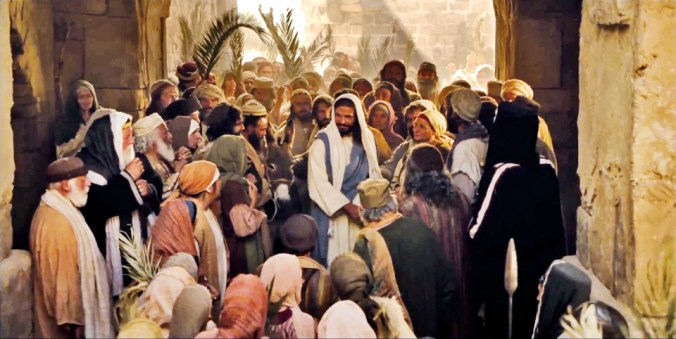
21:8 A very large crowd [some estimate as many as 2 million people were present in Jerusalem at Passover (cf. Jn. 12:12)] spread their cloaks on the road, while others cut branches from the trees [“palm branches” as per Jn. 12:13 (celebrated today as Palm Sunday)] and spread them on the road [“red carpet” treatment; sign of honor and submission].

21:9 The crowds [saw Jesus as the possible political or military Messiah] that went ahead of him and those that followed shouted [repeatedly], “[cf. Ps. 118:25-26] Hosanna [means “grant salvation” or “save now” / here used as a cry of greeting, a shout of joyous praise, an homage “glory, or hail, or welcome to David’s son”] to the Son of David [refers to the Messiah]!” “Blessed is he who comes in the name of [as a representative] the Lord [“he who comes in the name of the Lord” was a messianic title]!” “Hosanna in the highest [means “May God (in heaven) save now”]!”

21:10 When Jesus entered Jerusalem, the whole city was stirred [from Greek word seio, from which we get our word seismic] and asked, “Who is this?”

21:11 The crowds answered, “This is Jesus, the prophet [possibly the eschatological prophet foretold by Moses (Deut. 18:15)] from Nazareth in Galilee.”

21:12 Jesus entered the temple area [Court of the Gentiles] and drove out [with force] all who were buying and selling [originally started as a service and convenience for visitors to Jerusalem to provide unblemished sacrificial animals and exchange foreign currency for coins to pay the Temple tax (cf. Matt. 17:24)] there [temple looked more like a marketplace than a holy place]. He overturned the tables of the money changers and the benches of those selling doves [Jesus began ministry with similar act (Jn. 2:13-25)].

21:13 “It is written,” he said to them, “‘My house will be called a house of prayer [cf. Isa. 56:7; legitimate use of temple space: prayer, meditation, fellowship, spiritual devotion to God],’ but you are making it a ‘den of robbers [people were exploited by sellers who charged exorbitant prices; cf. Jer. 7:11].’”

21:14 The blind and the lame came to him at the temple, and he healed [Jesus’ public ministry (Matt. 4:23) and final week (Matt. 21:14) began with healing] them.

21:15 But when the chief priests and the teachers of the law saw the wonderful things he did and the children shouting [innocent children revealed God’s truth] in the temple area, “Hosanna to the Son of David,” they were indignant.

21:16 “Do you hear what these children are saying?” they [religious leaders rejected or ignored what God was doing] asked him. “Yes,” replied Jesus, “have you never read [Ps. 8:2], “‘From the lips of children and infants you have ordained praise’?”

21:17 And he left them [departed] and went out of [outside] the city to Bethany, where he spent the night [to find lodging].

Matthew 24

Matthew 24:42-44

24:42 “Therefore [word points to previous discussion or illustration (read 24:38-39)] keep watch [be prepared for the fulfillment of Jesus’ words; do not be caught off guard], because you do not know on what day [time] your Lord will come [His coming will be sudden].

24:43 But understand this: If the owner of the house had known at what time of night the thief was coming [Jesus’ coming is compared to that of a thief in the night (cf. 1 Thess. 5:2; Rev. 3:3; 16:15)], he would have kept watch and would not have let his house be broken into.

24:44 So [because Jesus had told His disciples in advance about His return His followers had no excuse for being unprepared] you also must be ready, because the Son of Man [this was Jesus’ favorite self description (cf. Dan. 7:13-14); a seldom used title for the Messiah; Jesus filled this title with meaning] will come [cf. Titus 2:13] at an hour when you do not expect him.

Matthew 26

Matthew 26:26-29

26:26 [Jesus and disciples gathered to celebrate the Passover, the annual springtime festival commemorating the Exodus (Ex. 12:1-11)] While they were eating [meal included roasted lamb, unleavened bread, wine, and other items], Jesus took bread [an unleavened loaf], gave thanks and broke it, and gave it to his disciples, saying, “Take and eat; this is my body [the bread represented His body which was about to be sacrificed on the cross].”

26:27 Then he took the cup, gave thanks [our term “Eucharist” comes from the Gr. “eukharistia” which means “thanksgiving” (some denominations use “Eucharist” as alternate term for the Lord’s Supper)] and offered it to them, saying, “Drink from it, all of you.

26:28 This [contents of the cup represented His blood which was about to be shed on the cross] is my blood of the covenant [cf. Jer. 31:31-34], which is poured out for many [Jesus died in the place of sinners (substitutionary atonement); cf. Matt. 20:28] for the forgiveness of sins [cf. Heb. 10:12].

26:29 I tell you, I will not drink of this fruit of the vine from now on [or in this life] until [anticipates His resurrection] that day when I drink it anew with you in my Father’s kingdom [cf. Lk. 22:30].”

Matthew 26:36-41

26:36 Then [following the Lord’s Supper in the upper room] Jesus went with his disciples [all but Judas] to a place called Gethsemane [means “oil press”], and he said to them, “Sit here while [as long as] I go over there and pray.”

26:37 He took [Jesus wanted the companionship and fellowship of others] Peter and the two sons [James and John (Mk. 1:19)] of Zebedee [Jesus’ inner circle; cf. Matt. 17:1-8; Mk. 5:37-42] along with him, and he began to be sorrowful and troubled [distressed].

26:38 Then he said to them, “My soul is overwhelmed [surrounded by] with sorrow [distress] to the point of death [a way of expressing the greatest amount of sorrow one can experience]. Stay here and keep watch [keep awake (and pray)] with me [implies association, intimacy, support].

26:39 Going a little farther [“about a stone’s throw beyond them” (Lk. 22:41)], he fell with his face to the ground [shows utmost attitude of submission and humility; indicates the pressure Jesus felt] and prayed [Luke (the physician) added that “his sweat was like drops of blood” (Lk. 22:44)], “My Father, if it is possible [if there is another way within God’s will], may this cup [metaphor for punishment and suffering (cf. Ps. 75:8; Isa. 51:17)] be taken from me. Yet not as I will, but as you will [Jesus affirmed His submission to His Father].”

26:40 Then he returned to his disciples and found them sleeping. “Could you men not keep watch with me for one hour [duration of Jesus’ intense prayer time]?” he asked Peter.

26:41 “Watch [be awake and prepared] and pray so that you will not fall into temptation [means test, try, prove, examine]. The spirit is willing, but the body [our weak human nature] is weak [disciples gave in to human exhaustion].”

Matthew 26:47-56

26:47 While he was still speaking, Judas, one of the Twelve, arrived [after arranging with the religious leaders to betray Jesus, Judas “watched for an opportunity to hand Jesus over to them when no crowd was present” (Lk. 22:6)]. With him was a large crowd armed with swords [carried primarily by temple police and Roman soldiers] and clubs [carried primarily by Jewish laymen; also carried torches and lanterns (Jn. 18:3)], sent from [but not accompanied by] the chief priests and the elders [the Sanhedrin] of the people.

26:48 Now the betrayer had arranged a signal with them: “The one I kiss [to love, to kiss; a mark of friendship] is the man; arrest him.”

26:49 Going at once to Jesus, Judas said, “Greetings, Rabbi [means “master” or “teacher;” Judas did not call Jesus “Lord” (cf. Matt. 26:22,25)]!” and kissed [strong, outward form of affection] him.

26:50 Jesus replied, “Friend [perhaps intended to remind Judas of the years they had spent together; “an open-hearted but not intimate greeting” (Expositor’s, Vol. 8, p. 547)], do what you came for [Jesus already knew why Judas had come (Matt. 26:21)].” Then the men [temple police, perhaps accompanied by some Roman soldiers] stepped forward, seized Jesus and arrested him.

26:51 With that, one of Jesus’ companions [Peter] reached for his sword, drew it out and struck the servant of the high priest [Malchus (Jn. 18:10)], cutting off his ear [Luke (the physician) added that Jesus “touched the man’s ear and healed him” (Lk. 22:51)].

26:52 “Put your sword back in its place, [Jesus did not want His cause to be advanced by physical violence]” Jesus said to him, “for all who draw the sword will die by the sword [violence begets violence].

26:53 Do you think I cannot call [to summon, to call to one’s side for help] on my Father, and he will at once put at my disposal more than twelve legions [a legion was about 6,000 men; twelve legions would be 72,000] of angels?

26:54 But how then would the Scriptures [OT messianic prophecies] be fulfilled that say it must happen in this way?”

26:55 At that time Jesus said to the crowd, “Am I leading a rebellion, that you have come out with swords and clubs to capture me? Every day I sat in the temple courts [a public place] teaching, and you did not arrest me [they could have easily identified Jesus in the daytime (no need for a signal as in 26:48)].

26:56 But this has all taken place that the writings of the prophets might be fulfilled [re: Jesus’ sufferings (Ps. 22; Isa. 53)].” Then all the disciples deserted him and fled [Zech. 13:7; Jesus traveled to the cross alone].

Matthew 27

Matthew 27:27-51

27:27 Then the governor’s [Pontius Pilate (appointed by the emperor as procurator of Judea)] soldiers [the soldiers had earlier flogged Jesus (Matt. 27:26)] took Jesus into the Praetorium [or headquarters; either a military headquarters or the governor’s palace; likely refers to tower or fortress of Antonia, near the temple] and gathered the whole company [Gr. “speira” or Latin “cohort” referred to a military unit of about 600, a tenth of a legion] of soldiers [also the Sanhedrin and the angry mob] around him.

27:28 [notice the shameful ways in which the soldiers mocked Jesus] [1] They stripped him and [2] put a scarlet [a royal color] robe [possibly one of the short red cloaks worn by the soldiers of that period] on him,

27:29 and [3] then twisted together a crown of thorns and set it on his head. [4] They put a staff in his right hand and [5] knelt [unknowingly they knelt before the King of kings; cf. Phil. 2:10-11] in front of him and mocked him. “Hail, king of the Jews!” they said.

27:30 [6] They spit [a great insult; the Jews also spit on Jesus (cf. Matt. 26:67)] on him, and took the staff and [7] struck him on the head again and again [these repeated blows drove the thorns deeper into Jesus’ head].

27:31 After they had mocked him, they took off the robe and put his own clothes on him. Then they led him away to crucify him [they took Jesus outside the city gates (cf. Heb. 13:12) to a place called Golgotha (cf. Matt. 27:33), a Heb. word meaning “skull” (Latin “calvaria”)].

27:32 As they were going out, they met a man from Cyrene, named Simon, and they forced him to carry the cross.

27:33 They came to a place called Golgotha (which means The Place of the Skull).

27:34 There they offered Jesus wine to drink, mixed with gall; but after tasting it, he refused to drink it.

27:35 When they had crucified him [the people of that day were familiar with the horror of crucifixion], they [four soldiers as per Jn. 19:23-24] divided up his clothes [the soft and seamless undergarment worn beneath the outer robe] by casting lots [similar to rolling dice; cf. prophecy recorded in Psalm 22:18].

27:36 And sitting down, they kept watch [to insure no one tried to rescue Him; to ensure that He died] over him there [at the place of crucifixion].

27:37 Above his head they placed the written charge against him [sign written in Hebrew, Latin, and Greek (cf. Jn. 19:19-20)]: THIS IS JESUS, THE KING OF THE JEWS [to the Jews this was a reference to their Messiah].

27:38 Two robbers were crucified with him, one on his right and one on his left.

27:39 Those who passed by hurled insults at him, shaking their heads

27:40 and saying, “You who are going to destroy the temple and build it in three days, save yourself! Come down from the cross, if you are the Son of God!”

27:41 In the same way the chief priests, the teachers of the law and the elders mocked him.

27:42 “He saved others,” they said, “but he can’t save himself! He’s the King of Israel! Let him come down now from the cross, and we will believe in him.

27:43 He trusts in God. Let God rescue him now if he wants him, for he said, ‘I am the Son of God.’”

27:44 In the same way the robbers who were crucified with him also heaped insults on him.

27:45 From the sixth hour until the ninth hour darkness came over all the land.

27:46 About the ninth hour Jesus cried out in a loud voice, “Eloi, Eloi, lama sabachthani?”—which means, “My God, my God, why have you forsaken me?”

27:47 When some of those standing there heard this, they said, “He’s calling Elijah.”

27:48 Immediately one of them ran and got a sponge. He filled it with wine vinegar, put it on a stick, and offered it to Jesus to drink.

27:49 The rest said, “Now leave him alone. Let’s see if Elijah comes to save him.”

27:50 And when Jesus had cried out again in a loud voice [the words He shouted were “It is finished” (Jn. 19:30), and then, “Father, into Your hands I entrust My spirit” (Lk. 23:46)], he gave up his spirit [an idiom for death].

27:51 At that moment [moment of death] the curtain [two curtains in the Jewish temple, one at the entrance to the holy place and the other separated the holy place from the holy of holies (only the high priest could enter holy of holies, the special room representing God’s presence)] of the temple was torn in two from top [indicating that God Himself tore the curtain thus signifying that the way to Him was now available on the basis of Jesus death (cf. Heb. 10:19-20)] to bottom. The earth shook [an earthquake] and the rocks split [allowing the release of the bodies of many saints who had died and who appeared in Jerusalem (cf. Matt. 27:52-53].

Matthew 28

28:1 After the Sabbath [24-hour period from sunset on Friday till sunset Saturday], at dawn on the first day of the week [Sunday], Mary Magdalene [from the village of Magdala on western shore of Sea of Galilee; cf. Lk. 8:2] and the other Mary [the mother of James and Joseph (Matt. 27:56)] went [came with spices in order to anoint body of Jesus for burial (Mk. 16:1)] to look at the tomb [they expected to find Jesus’ corpse there].

28:2 There was a violent earthquake [or “a great tempest or commotion”], for an angel of the Lord came down from heaven and, going to the tomb, rolled back the stone [cf. Mk. 16:3 re: concern of women re: how to move stone; the stone was moved not to let Jesus out but to let the world in] and sat [only Matt. notes that angel “sat” on the stone] on it.

28:3 His appearance [the angel’s entire form] was like lightning [brilliant], and his clothes were white [emblem of purity and righteousness] as snow.

28:4 The guards [Romans; cf. Matt. 27:65] were so afraid of him [the angel] that they shook [Gr. “seismos” (same word for “earthquake” in 28:2)] and became like dead men [they were paralyzed by fear].

28:5 The angel said to the women, “Do not be afraid, for I know that you are looking for Jesus, who was crucified [perfect tense of verb points to completed action with ongoing results].

28:6 He is not here; he has risen, just as he said [Jesus predicted His resurrection in Matt. 16:21; 17:23; 20:19; 26:32]. Come [invitation to enter the open tomb] and see the place where he lay [no body present].

28:7 Then go quickly and tell [the women who were expecting to anoint body of Jesus were given an important new task] his disciples: ‘He has risen from the dead and is going ahead of you into Galilee. There you will see him.’ Now I have told you.”

28:8 So the women hurried away from the tomb [as instructed by the angel], afraid yet filled with joy, and ran to tell his disciples.

28:9 Suddenly Jesus met them. “Greetings [Gr. “chairete”],” he said. They came to him, clasped his feet and worshiped [appropriate response to the risen Lord] him.

28:10 Then Jesus said to them, “Do not be afraid. Go and tell my brothers [His disciples] to go to Galilee [just as Jesus had told them during the Last Supper (cf. Matt. 26:32)]; there they will see me.”

28:11 While the women were on their way, some of the guards [cf. Matt. 27:62-66; Roman guards assigned to the service of the religious leaders] went into the city and reported to the chief priests [rather than to Pilate thus indicating these religious leaders were the driving force behind Jesus’ crucifixion] everything that had happened.

28:12 When the chief priests [controlled the temple] had met with the elders [influential leaders from key families; chief priests and elders represented the strongest leaders among the Jews] and devised a plan, they gave the soldiers a large sum of money [gave the soldiers a bribe to perpetuate a lie],

28:13 telling them, “You are to say, ‘His disciples [if the disciples were responsible the chief priests could easily have had them arrested and prosecuted] came during the night and stole him away while we were asleep [by admitting that they had fallen asleep the guards incriminated themselves in an offense that could have fatal results; however, if the guards were indeed asleep, they could not know what happened and had no basis to accuse the disciples of stealing the body].’

28:14 If this report gets to the governor [Pilate], we will satisfy him [possibly means they would also bribe Pilate to ignore the story] and keep you out of trouble.”

28:15 So the soldiers took the money and did as they were instructed. And this story has been widely circulated among the Jews to this very day [Matthew probably written between AD 60–65 before the fall of Jerusalem in AD 70].

28:16 Then the eleven disciples went to Galilee, to the mountain where Jesus had told them to go [cf. Matt. 28:10; the ascension took place at a later time, after Jesus had ministered to His disciples in Jerusalem (Lk. 24:44-53)].

28:17 When they saw him, they worshiped [to prostrate oneself (in homage)] him; but some [this possibly was occasion when over 500 followers of Jesus saw Him alive (cf. 1 Cor. 15:6)] doubted [either some among the 500 or people other than the disciples; this word can also mean “hesitated”].

28:18 [see also Mk. 16:15-16; Lk. 24:46-49; Jn. 20:21-23] Then Jesus came to them and said, “All authority [absolute power and the right to act, make choices, issue commands] in heaven and on earth [scope of Jesus’ authority] has been given to me.

Note: Charles Spurgeon, preaching from the text, “All power is given unto Me … lo I am with you always,” said the following: “You have a factor here that is absolutely infinite, and what does it matter as to what other factors may be. ‘I will do as much as I can,’ says one. Any fool can do that. He that believes in Christ does what he cannot do, attempts the impossible and performs it.”

28:19 Therefore [on the basis of Jesus’ authority and because He is worthy of our obedience] go [we must not just “come” to church, we must “go”] and make disciples [imperative; a command; a disciple is more than a convert] of all nations [people groups rather than political-geographical regions], baptizing them in the name of [“under the authority of” or “in allegiance to”] the Father and of the Son and of the Holy Spirit,

Note: Someone wisely said that the church must evangelize or it will fossilize.

28:20 and teaching [an imperative; essential to making disciples; a lifelong process that requires the study of God’s Word; “A disciple is not simply one who has been taught but one who continues to learn.” (Mounce)] them to obey [to heed; to keep] everything I have commanded you. And [what follows is more than an unconditional promise, it is a fact] surely I am with [Jesus is with His followers in the Person of the Holy Spirit] you [read Acts 18:9-10 re: words of Jesus to Paul at Corinth when things got tough: “For I am with you…”] always [cf. Matt. 1:23 re: Jesus as Immanuel (God with us)], to the very end of the age [if understood in the spatial sense: “to the end of the inhabited world;” if understood in the temporal sense: “throughout all time”].”

2 Corinthians 4

4:1 Therefore, since through God’s mercy [cf. Acts 9:1-19; Eph. 2:4; Titus 3:5] we have this ministry [God uses us because He is good, not because we are good], we do not lose heart [to not become discouraged or behave with cowardice].

4:2 Rather, we have renounced secret and shameful ways [unlike some of Paul’s critics whose methods and motives were suspect]; we do not use deception, nor do we distort [word commonly used in the marketplace to describe tactics of unscrupulous merchants who, for example, adjusted their scales to take advantage of customers] the word of God [as did Paul’s opponents]. On the contrary, by setting forth the truth plainly we commend ourselves to every man’s conscience in the sight of God.

4:3 And even if our gospel is veiled [obscure], it is veiled to those who are perishing [those who refuse to place their trust in Christ].

4:4 The god of this age [Satan, whose agenda is to steal, kill, and destroy (cf. Jn. 10:10)] has blinded [Satan uses the things of this world to blind people] the minds of unbelievers [cf. 2 Cor. 11:14-15], so that they cannot see the light of the gospel of the glory of Christ, who [Jesus who lived and walked among us] is the image [cf. Col. 1:15] of God [who is invisible (cf. 1 Tim. 6:16)].

Paul marveled that God had chosen him to tell others about Jesus. Before his conversion, he had been a sworn enemy of Jesus Christ and His followers. However, Christ Himself had stopped Paul on his way to persecute believers in Damascus and commissioned him to preach the gospel. Paul knew that it was only by the mercy of God that he had been called to preach the gospel of Jesus Christ. He was always careful to preach with right motives and never resorted to methods that distorted the message or jeopardized his integrity.

In his previous letter to the Corinthians, Paul said that the message of the cross is foolishness to those who are perishing (1 Cor. 1:18). Those who use human wisdom to try to understand the gospel often minimize both the effect and impact of the cross. For many unbelievers the cross is an insurmountable stumbling block and for others it is just plain foolishness.

Although Paul’s presentation of the gospel was clear and straightforward, it was veiled or obscure to those who refuse to believe in Christ. Paul used the imagery of blindness to describe the spiritual condition of unbelievers who are unable or unwilling to comprehend spiritual truth. Ultimately, Satan himself is responsible for obscuring the message of the cross and blinding the minds of the unbelievers.

Those whose minds are blinded by Satan cannot think straight, resist God’s truth, and are vulnerable to false information about God. While on an international flight, I met a young man who was reading Bertrand Russell’s essay entitled “Why I Am Not a Christian.” When I engaged him in conversation, he remarked that he agreed with Russell. He also admitted to me that he had never talked with a Christian nor read any Christian literature that might challenge Russell’s conclusions. We then spent the remainder of the flight talking about Christianity and why Jesus had come to earth. Like Russell, this young man’s mind had been blinded by Satan to the light of the gospel.

The Psalmist said that the entrance of God’s Word gives light (see Ps. 119:130). That is why Satan seeks to blind the minds of unbelievers to the light of the gospel. As the god of this age, or the god of those who live according to the fallen world order, Satan will stop at nothing to influence the human mind. He is a schemer (2 Cor. 2:11) who employs any and all measures to prevent the entrance of light into darkened minds and hearts. Light enables people to see what they otherwise would be unable to see. Satan does not want for people to see and understand their desperate spiritual condition and need for salvation through Jesus Christ.

Satan, the prince of darkness (Eph. 6:12), cleverly disguises himself as an angel of light and his servants can disguise themselves as servants of righteousness (2 Cor. 11:14-15). Paul cautioned against these deceivers who convincingly preached another Jesus and a different gospel (2 Cor. 11:4).

Unlike the smooth-talking false teachers of his day, Paul always kept Jesus as the focal point of his preaching (2 Cor. 4:5). Jesus, after all, is the light of the world and the only antidote to spiritual darkness. We must share the message about Jesus in dependence on the Holy Spirit, who counteracts the work of Satan by revealing the truth of the gospel. He can enable the spiritually blind to see!

4:5 For we do not preach ourselves, but Jesus Christ as Lord [cf. 1 Cor. 2:1-2], and ourselves as your servants [cf. Rom. 1:1; 1 Cor. 4:1; 2 Cor. 11:23; Gal. 1:10] for Jesus’ sake.

4:6 For God, who said, “Let light shine out of darkness [cf. Gen. 1:2-5],” made his light [which can illumine dark hearts and minds] shine in our hearts to give us the light of the knowledge of the glory of God in the face of Christ.

4:7 But we have this treasure in jars of clay to show that this all-surpassing power is from God and not from us.

4:8 We are hard pressed on every side, but not crushed; perplexed, but not in despair;

4:9 persecuted, but not abandoned; struck down, but not destroyed.

4:10 We always carry around in our body the death of Jesus, so that the life of Jesus may also be revealed in our body.

4:11 For we who are alive are always being given over to death for Jesus’ sake, so that his life may be revealed in our mortal body.

4:12 So then, death is at work in us, but life is at work in you.

4:13 It is written: “I believed; therefore I have spoken.” With that same spirit of faith we also believe and therefore speak,

4:14 because we know that the one who raised the Lord Jesus from the dead will also raise us with Jesus and present us with you in his presence.

4:15 All this is for your benefit, so that the grace that is reaching more and more people may cause thanksgiving to overflow to the glory of God.

4:16 Therefore we do not lose heart [Paul endured because he had an eternal perspective and knew there was more than just this life]. Though outwardly we are wasting away [our physical bodies are in the process of wasting away], yet inwardly [the part of us (soul) that will survive physical death] we are being renewed day by day.

4:17 For our light and momentary troubles [cf. 2 Cor. 11:23-29 re: the hardships Paul endured] are achieving [sufferings produced something that would last for all eternity…] for us an eternal glory that far outweighs them all [cf. Rom. 8:18].

4:18 So we fix our eyes not on what is seen [the decay of the outer person], but on what is unseen [the eternal glory believers will enjoy]. For what is seen is temporary, but what is unseen is eternal.

2 Corinthians 5

5:1 Now we know that if the earthly tent [a temporary shelter] we live in is destroyed [at death], we have a building [a resurrection body fit for heaven] from God, an eternal house in heaven, not built by human hands.

5:2 Meanwhile we groan [this verb used six times in NT (Mk. 7:34; Rom. 8:23; 2 Cor. 5:2,4; Heb. 13:17; Jas. 5:9); noun used in Acts 7:34 and Rom. 8:26; audible sighing because of a condition from which one longs to be free, in this case sighing due to limitations imposed by living in a mortal body], longing to be clothed with our heavenly dwelling [anticipation of receiving an immortal body],

5:3 because when we are clothed [with the resurrection body], we will not be found naked [death is like stripping off rotten and worn-out garments].

5:4 For while we are in this tent [our mortal bodies], we groan and are burdened, because we do not wish to be unclothed but to be clothed with our heavenly dwelling, so that what is mortal may be swallowed up by life [cf. 1 Cor. 15:54].

5:5 Now it is God who has made us for this very purpose and has given us the Spirit [received at the new birth (cf. Jn. 3:5-8)] as a deposit [down payment; cf. 2 Cor. 1:22; Eph. 1:14], guaranteeing [cf. Rom. 8:9] what is to come.

5:6 Therefore we are always confident and know that as long as we are at home in the body [physically alive] we are away from the Lord [in the sense that we do not perceive Him with our physical senses].

5:7 We live by faith [cf. Rom. 1:17 (Hab. 2:4)], not by sight.

5:8 We are confident, I say, and would prefer to be away from the body [after death] and at home with the Lord [cf. Phil. 1:23].

5:9 So we make it our goal to please him [this should be the central purpose of our lives], whether we are at home in the body [physically alive] or away from it [physically dead].

5:10 [cf. 1 Cor. 3:12-15] For we must all appear before the judgment seat [Gr. bema used originally of the place from which an earthly ruler gave legal decisions; cf. Rom. 14:10] of Christ [Paul did not indicate whether this judgment occurs immediately after a believer dies (as context suggests) or whether this will be a general judgment involving many persons at once], that each one may receive what is due him for the things done while in the body, whether good [actions that conform to God’s revealed word] or bad [actions contrary to God’s revealed word].

5:11 Since, then, we know what it is to fear the Lord, we try to persuade men. What we are is plain to God, and I hope it is also plain to your conscience.

5:12 We are not trying to commend ourselves to you again, but are giving you an opportunity to take pride in us, so that you can answer those who take pride in what is seen rather than in what is in the heart.

5:13 If we are out of our mind, it is for the sake of God; if we are in our right mind, it is for you.

5:14 For Christ’s love [are you motivated by love or fear?] compels [“controls” (NASB); “urges us on” (NRSV); “leaves us no choice” (NEB)] us [all believers, not just Paul], because we are convinced that one died [the highest expression of divine love for sinners] for all [Jesus’ death was sufficient for all people of every age], and therefore all died [Christ’s death was a substitutionary atonement].

Motivation matters, especially when it comes to serving God. Paul left no doubt about his motivation for ministry. It was Christ’s love that compelled him to serve. This may be understood to mean “Christ’s love for Paul” or “Paul’s love for Christ.” Although Greek grammar permits either interpretation, Christ loved Paul first — which explains why Paul loved Christ. The word compels means to constrain or to hold fast a person to a course of action.

Christ’s love was at the core of Paul’s motivation for ministry. Christ had demonstrated His love for Paul by dying for him. Paul demonstrated his love for Christ by living for Him. The magnitude of Christ’s love left Paul with no choice but to live for the One who died for him. In light of Christ’s death for all, we have no right to live selfishly. Every follower of Christ should abandon their old and selfish ways. We must no longer live for ourselves or to please ourselves. Instead we should die to ourselves and live for Christ.

Christ’s love also compelled Paul to share the love of Christ with lost people. Paul saw himself as someone under obligation or in debt to those who did not know Christ (Rom. 1:15). He felt that because he knew and had experienced the love of Christ, he owed Christ to everyone who did not know him. Christ’s love compelled him “to evangelize where Christ has not been named” (Rom. 15:20) and to “plead on Christ’s behalf” that others would “be reconciled to God” (2 Cor. 5:20).

Like Paul, every Christ follower is under obligation to share Christ’s love with those who do not know Him. We owe Christ to all people. The greatest crime we can commit against others is to withhold the message of Christ from them. Christ’s love is the greatest motivation for serving Christ and sharing His story with others.

Our motivation for service impacts how and what we share with others. Paul was not unfamiliar with those who proclaimed Christ out of selfish ambition and other impure motives (read Phil. 1:15-17). He did however distinguish between those who preached the right message with false motives from those who preached the wrong message. He rejoiced that Christ was being proclaimed “whether out of false motives or true” (Phil. 1:18) but was absolutely intolerant of heresy and those who spread it.

Christian history has no shortage of examples of charlatans who used the gospel as a means to line their own pockets at the expense of the truth and the welfare of others. However, serving with false motives is not something that can happen only to those in leadership. Serving with false motives can happen as easily to the person in the pew as to the person behind the pulpit. Each of us must make certain that we are compelled by love to serve God and His purposes and to share the gospel of Jesus Christ.

Note: What effect does Christ’s love have in your life?


Note: People want to be loved. Nobody likes being rejected, overlooked, or ignored. Every follower of Christ has a responsibility to love God and to love people. As the recipients and beneficiaries of Christ’s great love, we must do more than sit, soak, and sour in the pew. We must take His love to those who live beyond the walls of our churches and share that love with all whom we meet. His love can transform lives and fill them with meaning. Here are a few practical suggestions for how you can leave a legacy of love.


M = Magnitude | Live each day with awareness of the magnitude of God’s love for you and then look for ways to demonstrate and share His love with others.

O = Owe | Remember that we owe Christ to every person who does not know Christ. Look for opportunities to tell others how wonderful He is.

T = Trustees | Consider yourself a trustee of Christ’s love and not the sole proprietor. Be a good steward of the good news by sharing it freely with others.

I = Interest | Invest personal interest in others. Take the time to talk to others and to learn about them and then be prepared to offer them hope and encouragement from God’s Word.

V = Vision | Ask God to help you sharpen your peripheral vision so that you do not overlook the people around you who are in need of the gospel. Slow down, look carefully, and share intentionally.

E = Example | Guard your example. Remember that you are a letter of recommendation for Christ, known and read by all men (2 Cor. 3:2-3).

S = Speak | Do not remain silent when you have opportunities to share the good news with others. Keep in mind that our silence can have terrible consequences for those who have not heard the gospel.


5:15 And he died for all [even though not all will accept Him as Savior], that those who live should no longer live for themselves [those who believe in Jesus should abandon their old, selfish ways] but for him who died for them and was raised again.

5:16 So from now on [Christians have a new and different perspective on people] we regard no one from a worldly point of view [an inadequate standard by which to measure others]. Though we once regarded Christ in this way [Paul once judged Christ by earthly standards and looked at Him as a blasphemer and a fraud], we do so no longer [after conversion, Paul saw Jesus in a different light; cf. Acts 9:1-18].

Note: What is the difference between seeing people through a worldly point of view and seeing them through spiritual eyes?

5:17 Therefore, if anyone is in Christ, he is a new creation [a new kind of human being—one who is in Christ]; the old has gone, the new has come [those who place their faith in Christ have a new destiny, a new direction, and new desires in life]!

5:18 All this is from God, who [God took the initiative] reconciled [to restore to harmony after a break] us to himself through Christ and gave us the ministry of reconciliation [we are responsible for telling others what they need to do if they want to be reconciled to God]:

Note: Do you believe that every person deserves the opportunity to hear the good news? What responsibility are you willing to assume to ensure that others hear the message about Jesus?

5:19 that God was reconciling the world to himself in Christ [the incarnate Son], not counting [calculating people’s debt] men’s sins [the obstacle to our relationship with God] against them. And he has committed to us the message of reconciliation [the gospel].

5:20 We [all believers] are [being an ambassador for Christ is not optional for a believer] therefore Christ’s ambassadors [an official representative of one country to another; believers have the privilege of representing God on earth], as though God were making his appeal through us [note the content of God’s appeal through us…]. We implore [to beg; a reminder that we cannot remain passive about the lost condition of the world] you on Christ’s behalf: Be reconciled to God.

Note: Someone said that believers are the only Jesus some will ever see. Is there anything that keeps others from seeing Jesus in you? If so, what will you do to insure that others see Jesus clearly?

5:21 God made him who had no sin [Christ was sinless; cf. Heb. 4:15; 7:26] to be sin for us [means that Jesus died a sinner’s death; He took our sins upon Himself; refers to substitutionary atonement; Jesus took the place of sinners; cf. Isa. 53:5], so that in him we might become the righteousness of God.

2 Corinthians 6

Note: The church at Corinth failed to appreciate the work that Paul had done among them. Instead, they embraced the Judaizers who had infiltrated the church. Paul, therefore, was forced to defend himself and reminded the Corinthians of his personal ministry among them. After all, it was Paul who had founded the church at Corinth and not the Judaizers. Paul did not write these words to beg for praise from the Corinthians but to remind them that his ministry to them had cost him dearly. He had paid a price the Judaizers were unwilling to pay.

6:1 And working together with Him [“as God’s fellow workers” (NIV)], we also urge [Paul could have issued a command but instead asked diplomatically] you not to receive [by believing in Jesus] the grace [God’s undeserved favor] of God in vain [possibly an exhortation to the Corinthians to take God’s grace seriously by taking the demands of the gospel seriously, by living up to their profession of faith in Christ]

6:2 [it is likely that not all of those who professed to be Christians at Corinth were actually saved] for He says, “At the acceptable time I listened to you, And on the day of salvation I helped you [cf. Isaiah 49:8-12, 23-26 regarding prediction that God would one day bring His people out of their exile in Babylon].” Behold, now [today; cf. Isa. 55:6; no guarantee that we will have tomorrow; this word conveys a sense of urgency; someone said, “Today is a gift. That’s why they call it ‘the present.’”] is “the acceptable time,” behold, now is “the day of salvation” [because God had sent His Son to earth]

6:3 giving no cause for offense in anything [Paul was aware that others were watching his life; the inconsistent life of a professing Christian is a great hindrance to the gospel], so that the ministry will not be discredited [Paul did not want to do anything that might discredit or distract from the gospel message or cause others to ridicule God or His servants; “Lord. don’t let me be a stumbling block to those who trust in You. Don’t let me confuse those who are seeking after You.” (Ps. 69:6)],


Focus on Endurance and Stamina

6:4 but in everything [Paul listed some of the things he had endured in order to remain faithful to Christ] commending ourselves as servants of God, in much endurance, [note some of the involuntary hardships Paul endured for the sake of the gospel…] in afflictions [trials under pressure; a general term for a variety of difficulties (none of which could separate him from God’s love as per Rom. 8:37-39); cf. Acts 9:15-16 re Christ’s warning to Paul that he would suffer greatly], in hardships [necessities], in distresses [from a Greek word meaning “a narrow place”],

6:5 [Paul listed some of the specific difficulties he had endured for Jesus (see also 2 Cor. 11:22-33)] [notice three things Paul endured because of the opposition of people…] in beatings [see 2 Cor. 11:23-25], in imprisonments [see Acts 16:23-24; Paul always mace the most of whatever circumstances he was in (see Phil. 1:12-14)], in tumults [Paul; faced angry mobs more than once on his missionary journeys (see Acts 13:49-52; 14:5-6; 14:19; 16:19-24; 17:5; 19:23-41], [note some of the voluntary hardships Paul endured for the sake of the gospel… ] in labors [Paul worked hard and did not want to burden those he ministered to (2 Cor. 11:9)], in sleeplessness [see 1 Thess 2:9 re Paul working night and day in Thessalonica; perhaps Paul also lost sleep because of his concern for the churches as per 2 Cor. 11:28], in hunger [perhaps to not be a financial burden to those top whom was ministering],


Note: Paul did not allow his circumstances to discourage him. Instead, he saw every circumstance as an opportunity to advance the gospel. He always looked for ways to turn bad situations into good ones. Our response to circumstances reflects what we believe about God. We should always look for ways to demonstrate our faith even in the worst of circumstances.

Focus on Godly Personal Attributes

6:6 [Paul listed five character traits of an effective minister of the gospel] [1] in purity [in thought and deed; moral cleanliness; see Phil. 4:8; as opposed to false teachers who were motivated by greed and self-interest], [2] in knowledge [Paul understood the gospel message and how to communicate it clearly], [3] in patience [Paul had learned patience through the various trials he had endured], [4] in kindness [Paul was gracious and kind and learned to put the needs of others above his own; Phil. 2:3-4], in the Holy Spirit [the source of power for being an effective minister of the gospel], [5] in genuine love [Paul always tried to demonstrate the same kind of selfless and sacrificial love that Christ had sown],


Note: Our life should prove our message. We should always consider what our actions communicate to others about Jesus Christ (Illustration Poem: You Are Writing a Gospel). We should never allow our careless or undisciplined actions cause others to reject Christ.

Focus on Ministry Tools

6:7 in the word of truth [Paul faithfully preached the truth of the gospel in all circumstances], in the power of God [Paul demonstrated the power of God as he preached and lived out the message of the gospel]; by the weapons [a shield and a sword like a Roman soldier; see Eph. 6:10-18] of righteousness for the right hand [Roman soldiers wielded their sword with their right hand; sword used to attack] and the left [Roman soldiers carried shield in left hand; shield used to defend],

Focus on Maintaining a Kingdom Perspective

6:8 [Paul served God…] by glory [whether people honored or liked him] and dishonor [even if people dishonored and disliked him], by evil report [false teachers often said bad things about Paul, slandered him, and attacked his authority in order to gain advantage among the Corinthians (see 2 Cor. 10:10-11)] and good report [whether insulted or flattered, Paul was intent on preaching the gospel]; regarded as deceivers [by those who opposed Paul] and yet true [Paul always remained true to his calling and always preached the truth of the gospel in spite of opposition];

6:9 as unknown [those who opposed Paul treated him as an unknown and considered his message foolishness (see Acts 17:18-21; 32-33)] yet well-known, as dying yet behold, we live; as punished [see 2 Cor. 1:8 re Paul facing death for preaching the gospel] yet not put to death [see story pf Paul being stones in Acts 14:19-20 and yet living and moving on to continue preaching the gospel],

6:10 as sorrowful [Paul’s heart ached over the welfare of the churches] yet always rejoicing [Paul rejoiced because he knew God could use suffering to make churches and believers stronger], as poor [Paul had no earthly riches; Paul supported himself by making tents so that he could preach the gospel without being a financial burden on others (see Acts 18:1-5)] yet making many rich [by introducing them to the riches of the gospel], as having nothing yet possessing all things.

6:11 [in spite of how the Corinthians had treated Paul, he loved hem dearly and asked them to open their hearts to him] Our mouth has spoken freely [Paul had been straightforward and honest in his communication with the Corinthians; his critics were accusing him of having done otherwise] to you, O Corinthians, our heart is opened wide [Paul spoke very honestly about his failures and shortcomings].

6:12 You are not restrained by us [Paul, the founder of the Corinthian church, and his companions had not withheld their affections from the Corinthians], but [unlike Paul and his coworkers] you are restrained in your own affections [the Corinthians were withholding their affection from Paul; they had believed the worst about Paul; the Corinthians criticized Paul’s preaching (1 Cor 2:1-4; 2 Cor. 11:6), Paul’s writing (2 Cor. 1:13), and Paul’s behavior among them (2 Cor. 1:14).].

6:13 Now in a like exchange [with the same sincerity and openness with which Paul had opened up to the Corinthians]—I speak as to children [Paul had a right to speak to them in this way as the father of the church on Corinth]—open wide to us also [Paul urged the Corinthians to open their hearts to him].

6:14 Do not [this exhortation also applies to marriage] be bound together [yoked, as with animals harnessed together] with unbelievers [and especially any immoral and unethical practices; lest this kind of union weaken their commitment to Christ]; for what partnership [be careful lest partnership result in compromise of Christian morals] have righteousness and lawlessness, or what fellowship has light with darkness [this admonition was intended to guard the Corinthians from any situation that would compromise their beliefs]?

6:15 Or what harmony [there are ethical and moral differences between the two] has Christ with Belial [from Greek word derived from Hebrew word that means “worthless” or “lawless”; only place this word used in NT; Belial is the Devil], or what has a believer [who resides in the kingdom of His beloved Son (Col. 1:13); recognizes God’s authority] in common with an unbeliever [who resides in the kingdom of darkness (Col. 1:13); does not recognize God’s authority]?

6:16 Or what agreement has the temple of God [a reference to the community of faith] with idols [there were many temples to pagan deities in Corinth]? For we [not a building] are the temple of the living God; just as God said, “I will dwell in [specifies nearness] them and walk among [specifies nearness] them; And [as prophesied by Ezekiel (37:26-28) re the time when God would give among His people] I will be their God, and they shall be My people.

6:17 “Therefore, [note this positive command; cf. Isa. 52:11 where this was a command to the exiles to leave Babylon without anything associated with pagan worship] come out from their midst and be separate [separation in this case helps ensure safety],” says the Lord. “And do not touch what is unclean [sinful]; And I will welcome you [cf. Ezek. 20:34].

6:18 “And I will be a father to you, And you shall be sons and daughters [cf. Isa. 43:6; through Christ, we have become a part of God’s loving family] to Me,” Says the Lord Almighty.

2 Corinthians 8

8:1 And now [an attempt by Paul to rekindle the Corinthians’ initial commitment to give to the offering to assist the poor Jewish believers in Jerusalem (see 1 Cor. 16:1-4 and Rom. 15:25-33)], brothers [reminder that all believers are members of God’s family], we want you to know about the grace [God’s undeserved kindness and mercy; cause of their generosity; experiencing God’s grace opened their hearts] that God has given the Macedonian [a province in northern Greece; Paul preached there as a result of a vision (Acts 16:9)] churches [poor and persecuted (see 1 Thess. 1:6; 2:14) but nevertheless generous; included congregations in Philippi, Thessalonica, Berea (Acts 16:9—17:14)].

8:2 Out of the most severe trial [Gr. thlipseos: distress, pressure, affliction, tribulation], their overflowing joy [resulted in overflowing giving; giving a joy not a duty] and their extreme [deep] poverty welled up in rich [overwhelming] generosity [openhearted and openhanded; their poverty did not become an excuse for not giving to others].

Note: In 1 Corinthians 13:3, Paul said, “If I give all I possess to feed the poor and surrender my body to the flames, but have not love, I gain nothing.” It is possible to give without loving, but it is not possible to love without giving. It is possible to have compassion and express kindness without love, but it is not possible to have love without compassion and kindness.

8:3 For I testify that they gave [to help the poverty-stricken believers in Jerusalem] as much as they were able, and even beyond their ability [sacrificially; cf. the widow’s offering in Mk. 12:41-44]. Entirely on their own [voluntarily; took the initiative],

8:4 they urgently pleaded [begged] with us for the privilege [not burden or duty] of sharing [Gr. koinonia: fellowship or participation] in this service [Gr. diakonias; work that benefits another] to the saints [the poor in Jerusalem].

8:5 And they did not do as we expected [but rather went beyond what Paul hoped for], but they gave themselves first [priority] to the Lord [the first step in becoming a generous giver] and then to us [submissiveness] in keeping with God’s will.

8:6 So [because of the example of the Macedonians] we urged Titus, since he had earlier made a beginning [on the collection], to [Titus sent back to complete the task] bring also to completion [to help the Corinthians follow-through on their pledge to take part in the offering] this act of grace [Gr. charis: gracious giving] on your part.

Titus
Titus was a dear and trusted friend of the Apostle Paul. He was a Greek believer (Gal. 2:3) who was converted to faith in Christ by Paul (Titus 1:4). Although Titus is not mentioned by name in the book of Acts, he accompanied Paul and Barnabas (Gal. 2:1-10) to the Jerusalem Council (Acts 15) where he was Exhibit A that the Jewish rite of circumcision was not necessary for salvation.

Titus was a trustworthy individual who assisted Paul in dealing with the troubled church in Corinth (2 Corinthians 7:13-14; 8:6,16,23; 12:18). He was also an individual with administrative gifts (Titus 1:5). He was highly regarded by Paul who referred to him as “my partner and fellow worker” (2 Corinthians 8:23).

8:7 But just as you excel [go beyond the minimum; to go over and above] in everything — in faith, in speech, in knowledge, in complete earnestness and in your love for us [areas of which the Corinthians had boasted] — see that you also [add to these] excel [go beyond mere duty] in this grace of giving [cf. Rom. 12:8 re: gift of giving; giving focuses on needs of others].

8:8 I am not commanding you [to give; perhaps out of a feeling of obligation to Paul], but I want to test the sincerity [legitimacy or genuineness; a quality of being real and without pretense; Latin sin cera or “without wax”] of your love by comparing it with the earnestness of others [other contributors such as the Macedonian Christians].

8:9 For you know the grace of our Lord Jesus Christ [best example of giving], that though He was rich [Col. 1:16-18], yet for your sakes He became poor [cf. Phil. 2:5-8], so that you through His poverty [the cross] might become [spiritually] rich.

8:10 And here is my advice about what is best for you in this matter: Last year [period of time that had elapsed since they had first made a commitment to give] you were the first not only to give [even before the Macedonian churches; their example had stirred the Macedonian churches to action (see 2 Cor. 9:2)] but also to have the desire to do so [intention must lead to completion].

8:11 Now [an urgent reminder to complete their commitment] finish [imperative] the work, so that your eager willingness to do it may be matched by your completion of it, according to your means [recall that Macedonian Christians had contributed beyond their means].

8:12 For if the willingness is there, the gift is acceptable according to what one has, not according to what he does not have [gift must be seen in comparison with the total financial resources of the giver as in the case of the widow’s offering].

Note: God does not expect us to give according to what we do not have.

8:13 Our desire is not that others might be relieved while you are hard pressed [some feared that by giving they might end up in need like the poor believers in Jerusalem], but that there might be equality [in sharing the burden].

8:14 At the present time your plenty [by comparison to those in need, the Corinthians had plenty] will supply what they [Judean Christians] need, so that in turn their plenty will supply what you need [Corinthians could count on help from others if they encountered difficulties in the future]. Then there will be equality,

8:15 as it is written [Ex. 16:18]: “He who gathered much [manna] did not have too much, and he who gathered little [manna] did not have too little.”

2 Corinthians 8:24
8:24 Therefore show these men [Titus and the two representatives mentioned in 8:16-23] the proof of your love and the reason for our pride in you [see 2 Cor. 7:14; 9:1-4], so that the churches [the churches of Macedonia; the churches contributing to the offering] can see it [and therefore be encouraged and motivated by the example].

2 Corinthians 10

10:1 By the meekness and gentleness of Christ [Paul followed the example of Jesus], I appeal [Gr. parakalo means to politely ask someone to do something] to you—I, Paul [cf. Col. 1:23; Philemon 1:19 re: other places where Paul used his name in middle of letter; ironically, the name Paul means “little”], who am “timid” when face to face with you, but “bold” when away! [Paul’s enemies had accused him of being timid and weak in person but bold from a distance]

10:2 I beg you that when I come [Paul wanted for things at the church to be in order; cf. 2 Cor. 13:7] I may not have to be as bold [Paul did not want to spend his time dealing with problem members of the church] as I expect to be toward [note that some people questioned Paul’s motives and standard of living…] some people who think that we live by the standards of this world.

10:3 For though we live in the world, we do not wage war [against the forces aligned against Christ] as the world does.

Paul understood the nature of spiritual warfare. In the course of his ministry he crossed swords with critics, skeptics, philosophers, Judaizers, and political leaders. Some of Paul’s opponents sought to discredit him and others tried to kill him. Many of his opponents sought to dismiss, distort, and minimize the work of Christ.

Paul recognized that although we are human beings made of flesh and blood, our struggle “is not against flesh and blood” (Eph. 6:12). We cannot engage in spiritual warfare in a fleshly way or with the wrong weapons. To rely on human methods against the spiritual forces seeking to frustrate God’s purposes is foolish. Human strength, wisdom, and wealth are no match against the weapons arrayed against us in this struggle.

10:4 The weapons we fight with are not the weapons of the world [Paul did not depend on physical strength, worldly wisdom, or material wealth in the battle against the forces of evil]. On the contrary, they have divine power to demolish strongholds [the worldviews that seek to destroy Christianity].

God never intended for us to fight spiritual battles in our own strength or with weapons that are fleshly. Human strength may be used to knock out a human opponent and human wisdom can be used to manipulate or deceive other humans. However, these weapons are useless in the spiritual realm.

We must use the mighty weapons in God’s arsenal — truth, righteousness, the gospel of peace, faith, salvation, the word of God, and prayer (Eph. 6:14-18). These weapons are suited for storming and demolishing the Devil’s strongholds — the fortresses from which his snipers strategically target the destruction of God’s people and God’s purposes.

10:5 We demolish arguments [ideas that seek to deny God and keep people from the gospel] and every pretension [rebellious ideas and false philosophies that keep people from God, seek to rob Him of glory, and obscure the truth] that sets itself up against the knowledge of God, and we take captive every thought to make it obedient to Christ.

When our opponents strike with lies and distortions, we must counter with truth. When the mortars of immorality explode around us, we must stand firm in righteous living. When worldviews assault and challenge the validity of what we believe, we must intelligently articulate the gospel of peace. When the smoke and dust of battle obscure our sight, we must proceed in faith. When the exclusive claims of Christ are challenged, we must remember that there is salvation in no one else (Acts 4:12). And, above all, we must do more to prepare for battle than spend five minutes a day in prayer and in the study of God’s Word.

The world is not a friendly place. As in Paul’s day, the world still sees the gospel as foolishness. Comedians and philosophers alike take up arms against the knowledge of God. Their no-holds-barred attacks are public, shameless, and unrestrained. They fire each volley with the confidence that there is no God who will ever hold them accountable. Their objective is to blind the minds of unbelievers (2 Cor. 4:4) and to assault and hold hostage the minds of believers’. Unless we learn to think strategically, prepare intentionally, and fight purposefully, we will suffer many casualties.

Note: The battle for the mind is real.
The consequences of losing ground to the enemy are serious for yourself and others. Our victories and failures will be felt beyond our own generation. Too much is at stake to stay home from the fight. Make it your aim to drag into heaven with a dirty uniform. Here are a few of the rules of engagement.

D = Devil. Know the enemy. Do not be “ignorant of his intentions” (2 Cor. 2: 11) or his “tactics” (Eph. 6:11).
E = Equipment. Know how to use your weapons and always wear your armor.
F = Fight. Don’t just passively wait for the enemy to attack. Take the initiative to engage on strategic fronts.
E = Enlist. Do not go into battle alone. The “one another” passages in the New Testament remind us that we need one another. Remember that Satan is a pirate looking for a vessel without a fleet.
N = Neutrality. The failure to choose sides is unacceptable. The stakes are too high to remain unaligned, uninvolved, and uncommitted.
S = Stand. Hold your ground. Do not be intimidated. Do not walk away.
E = Endure. In the words of Winston Churchill: “Never give in. Never give in. Never, never, never, never—in nothing, great or small, large or petty—never give in, except to convictions of honor and good sense. Never yield to force. Never yield to the apparently overwhelming might of the enemy.”

10:6 And we will be ready to punish every act of disobedience, once your obedience is complete.

10:7 You are looking only on the surface of things. If anyone is confident that he belongs to Christ, he should consider again that we belong to Christ just as much as he.

10:8 For even if I boast somewhat freely about the authority the Lord gave us for building you up rather than pulling you down, I will not be ashamed of it.

10:9 I do not want to seem to be trying to frighten you with my letters.

10:10 For some say, “His letters are weighty and forceful, but in person he is unimpressive and his speaking amounts to nothing.”

10:11 Such people should realize that what we are in our letters when we are absent, we will be in our actions when we are present.

10:12 We do not dare to classify or compare ourselves with some who commend themselves. When they measure themselves by themselves and compare themselves with themselves, they are not wise.

10:13 We, however, will not boast beyond proper limits, but will confine our boasting to the field God has assigned to us, a field that reaches even to you.

10:14 We are not going too far in our boasting, as would be the case if we had not come to you, for we did get as far as you with the gospel of Christ.

10:15 Neither do we go beyond our limits by boasting of work done by others. Our hope is that, as your faith continues to grow, our area of activity among you will greatly expand,

10:16 so that we can preach the gospel in the regions beyond you. For we do not want to boast about work already done in another man’s territory.

10:17 But, “Let him who boasts boast in the Lord.”

10:18 For it is not the one who commends himself who is approved, but the one whom the Lord commends.