Matthew 16

Matthew 16:13-28

16:13 When Jesus came to the region of Caesarea Philippi [a Gentile region located about 25 miles northeast of the Sea of Galilee], he asked [began to question] his disciples, “Who do people say the Son of Man [this was Jesus’ favorite self description (cf. Dan. 7:13-14); a seldom used title for the Messiah; Jesus filled this title with meaning] is?”

16:14 They replied, “Some say John the Baptist [executed by Herod Antipas who later thought Jesus was John raised from the dead (Matt. 14:1-2)]; others say Elijah; and still others, Jeremiah or one of the prophets [term falls short of who Jesus is].

16:15 “But what about you?” he asked. “Who do you say I am?”

16:16 Simon Peter answered [first clear confession of faith by disciples in Matthew’s Gospel], “You are the [use of the article defines Christ as the one promised in the OT] Christ [the Messiah, the anointed one], the Son of [Jesus had a unique relationship with the Father] the living God.”

16:17 Jesus replied, “Blessed [one to whom the Lord has shown favor] are you, Simon son of Jonah [like Peter, our origins are of the earth (“son of Jonah”) while Christ’s is of heaven (“Son of the living God,” v. 16)], for this was not revealed [to unveil] to you by man [result of human insight], but by my Father [indicates divine revelation] in heaven.

16:18 And I tell you that you are Peter [a small piece of rock], and on this rock I will build my [indicates that the church belongs to Jesus] church [first use of the word “church” in the Gospels; usage here refers to all God’s people rather than a local congregation of believers; a spiritual building made up of people of faith (1 Pet. 2:1-9)], and the gates of Hades [the underworld] will not overcome [to overpower, to gain mastery over] it.

16:19 I will give you the keys [“represent the responsibility of the church to provide opportunities for people to hear and respond to the good news” (R.J. Dean); the knowledge of the gospel] of the kingdom of heaven [the rule and reign of God]; whatever you bind on earth will be [“shall have been”] bound in heaven, and whatever you loose on earth will be loosed in heaven.”

16:20 Then he warned [to order, to instruct, to seriously warn] his disciples not [until they fully comprehended His mission] to tell anyone that he was the Christ [many Jews expecting an earthly Messiah different than the kind of Messiah Jesus was (v. 21)].

16:21 From that time on [indicates a new stage in the self-revelation of Jesus had now been reached (Tasker)] Jesus began to explain [Jesus explained what kind of Messiah He was] to his disciples that he must [refers to a moral necessity] go to Jerusalem and suffer many things at the hands of [the following groups made up the Sanhedrin which later condemned and sent Jesus to Pilate to be crucified] the elders, chief priests and teachers of the law, and that he must be killed and on the third day be raised to life [cf. 1 Cor. 15:3-4].

16:22 Peter [still shared the false notion about an earthly Messiah; indicates disciples did not fully comprehend nature of Jesus’ mission as the Messiah] took him aside and began to rebuke him. “Never, Lord! [or “God forbid it, Lord!”]” he said [an emotional response]. “This shall never happen to you!”

16:23 Jesus turned and said to Peter, “Get [get away from] behind me, Satan! You are a stumbling block [Gr. skandalon] to me; you do not have in mind [to be intent on] the things of God, but the things of men [Peter guilty of thinking like people of the world; any attempt to dissuade Jesus from His mission meant cooperation with Satan].”

16:24 Then Jesus said to his disciples, “If anyone would come after [follow] me, he must deny [in wholly unselfish manner; put God’s will before our own desires and wishes; means more than denying something for yourself] himself and take up his cross [means death to self and submission to God’s will; disciples familiar with this Roman practice of execution; Luke 9:23 adds “daily”] and follow [to follow like a disciple] me.

16:25 [a paradox] For whoever wants to save his life will lose it, but whoever loses his life for me [key words (“for me”) challenge us to consider to what or to whom we are giving our lives; for Christ’s sake] will find it.

16:26 What good [profit] will it be for a man if he gains [to win, to make a profit] the whole world, yet forfeits [to suffer loss, to suffer confiscation] his soul? Or what can a man give in exchange for his soul?

16:27 For the Son of Man is going to come [“with rewards for those who gave their lives to and for Him and with judgment on those who refused to surrender their lives to Him” (Advanced Bible Study)] in his Father’s glory with his angels, and then he will reward [to give back, to repay] each person according to what he has done [deed, conduct, the sum of one’s doings including that self-denial, adherence to their faith and confession (Meyer)].

16:28 I tell you the truth, some who are standing here will not taste death before they see the Son of Man coming [possible meanings: the transfiguration (see Matt. 17:1-13), the resurrection, coming of the Spirit at Pentecost, the fall of Jerusalem] in his kingdom.”

Matthew 17

Matthew 17:1-13

17:1 After six days [after Peter’s confession at Caesarea Philippi (Matt. 16:13-20); synoptic gospel writers do not tell us what happened during those six days] Jesus took with him [Jesus’ inner circle of disciples] Peter, James and John [nicknamed “Sons of Thunder” (Mk. 3:17)] the brother of James [first disciple to be martyred (Acts 12:2)], and led them up a high mountain [exact site not identified; possibilities include Mount Tabor, Mount Hermon, and Mount Meron] by themselves [privately].

17:2 There he [Luke 9:29 says Jesus was praying] was transfigured [Gr. metamorphoomai: to transform or to change in form, in this case an instant metamorphosis; allowed Peter, James, and John to glimpse His eternal glory] before them [this experience reinforced the truth Jesus had revealed at Caesarea Philippi (Matt. 16:21-28); Luke 9:32 says the disciples were sleepy and then became fully awake]. His face shone [to gleam] like the sun, and his clothes became as white [symbol of purity] as the light.

17:3 Just then there appeared before them Moses [represented the Law] and Elijah [represented the prophets; cf. Matt. 5:17; Heb. 1:2], talking [according to Luke 9:31, “They spoke about His departure (term means “exodus”), which He was about to bring to fulfillment at Jerusalem.”] with Jesus.

17:4 Peter [emotional; could not restrain feelings] said [read Mk. 9:6 and Lk. 9:33] to Jesus, “Lord, it is good for us to be here [Peter wanted to prolong the experience on the mountain (but they were needed in the valley: cf. Matt. 17:14-16)]. If you wish, I will put up three shelters [temporary shelters made of branches such as the ones erected during the Feast of Tabernacles (cf. Lev. 23:42-43)] — one for you, one for Moses and one for Elijah.”

17:5 While he [Peter] was still speaking, a bright cloud [in OT often represented/signified God’s presence among His people (cf. Ex. 13:21-22; 24:15-18; 1 Kings 8:10)] enveloped them [Jesus, Moses, and Elijah], and a voice from the cloud said [God interrupted Peter; words spoken for benefit of Peter, James, and John], “This is my Son, whom I love; with him I am well pleased [same message spoken at Jesus’ baptism (Matt. 3:17); cf. Ps. 2:7 and Isa. 42:1]. Listen [command; implies obedience; must stop talking in order to listen] to him!”

17:6 When the disciples heard this, they fell facedown [probably more because of fear than reverence] to the ground, terrified [literally “very much afraid”].

17:7 But Jesus came and touched [reassurance] them. “Get up,” he said. “Don’t [stop action in progress] be afraid. [Jesus reassured His disciples through His touch and His words]

17:8 When they looked up, they saw no one except Jesus [Gr: “they saw no one except Jesus alone”].

17:9 As they were coming down the mountain, Jesus instructed them, “Don’t tell anyone what you have seen [the last of these prohibitions in Matthew (cf. 8:4; 9:30; 12:16; 16:20)], until the Son of Man has been raised from the dead [at that time the prohibition would be lifted and the disciples would be able to speak from the perspective of Jesus’ death, burial, and resurrection].” [Peter later wrote of what he had witnessed: 2 Pet. 1:16-18]

17:10 The disciples asked [firmly believed Jesus was the Messiah] him, “Why then do the teachers of the law say that Elijah must come first? [cf. Mal. 4:5-6]

17:11 Jesus replied, “To be sure, Elijah comes and will restore all things.

17:12 But I tell you, Elijah has already come [prophecy about Elijah fulfilled in ministry of John the Baptist, an Elijah-type figure (cf. Matt. 11:7-14; Lk. 1:17)], and they did not recognize him, but have done to him everything they wished [cf. Matt. 14:1-12 re: death of John the Baptist]. In the same way [like the forerunner who was rejected and executed] the Son of Man is going to suffer at their [religious and political leaders] hands.”

17:13 Then the disciples understood [to comprehend] that he was talking to them about John the Baptist.

Matthew 19

Matthew 19:3-9

19:3 Some Pharisees [an influential religious sect among Judaism; means “separated ones”] came [with an ulterior motive] to Him to test [tempt or trap rather than to seek spiritual guidance; wanted Jesus to take a side (Hillel or Shammai) on a controversial topic; Pharisees regarded marriage as a transaction rather than a covenant and viewed divorce as a legal rather than a spiritual issue] Him. They asked, “Is it lawful [allowed] for a man to divorce [release] his wife for any and every reason [read Deuteronomy 24:1-4 re “something indecent” as a cause for divorce; followers of Rabbi Hillel interpreted this to mean anything that displeased the husband; followers of Rabbi Shammai interpreted this to refer only to adultery]?”

Note: Verses 4-6 record Jesus response concerning God’s design for marriage.

19:4 “Haven’t you read [see Gen. 1:27; 2:24],” He replied, “that at the beginning [before the Deuteronomy 24:1 account] the Creator ‘made [to complement and complete one another] them [God made men and women in His image; the wife is not property but a partner] male and female [only two genders; no room for same-sex marriage interpretation],’

19:5 and said [see Gen. 2:24], `For this reason a man [and woman] will leave [in order to give priority to his wife] his father and mother and be united [permanently glued or adhered] to his wife [spiritually, emotionally, bodily], and the two will become one flesh [an indissoluble union; physical intimacy and more]‘?

19:6 So [therefore: draws a conclusion from the preceding] they are no longer two, but one. Therefore [because God has not changed His intention for marriage] what God has joined [yoked] together [for a lifetime], let man [a third party] not separate [affirms God’s intention that marriage be a permanent union between one man and one woman for life].”

19:7 “Why then [if God’s intention is for marriage to be permanent as per vv. 4-6],” they asked, “did Moses command [see Deut. 24:1; not actually a command but an attempt to regulate what was occurring] that a man give his wife a certificate of divorce [see Matt. 5:31; enabled woman to seek another marriage] and send her away?”

Note: Jews debated meaning of “something indecent” in Deuteronomy 24:1. Rabbinical school of Shammai interpreted phrase to mean “sexual unfaithfulness.” School of Hillel said that a wife burning her husband’s food was “something indecent.” Hillel’s interpretation was popular in Jesus’ day.

19:8 Jesus replied, “Moses permitted [not required] you to divorce your wives because your hearts were hard [unwilling to repent, forgive, and reconcile]. But it was not this way from the beginning [God’s original intention was for marriage to be permanent; see also Malachi 2:16 concerning divorce].

19:9 I tell you that anyone who divorces [unjustifiably] his wife [including out of lust for another woman], except for [on the basis of] marital unfaithfulness [Gr. porneia: any form of sexual immorality; every kind of unlawful sexual intercourse; adultery puts personal pleasure above commitment and integrity; see also Matt. 5:32 and 19:9; 1 Cor. 7:15], and marries another woman commits adultery [against the first spouse].”

Matthew 19:16-30

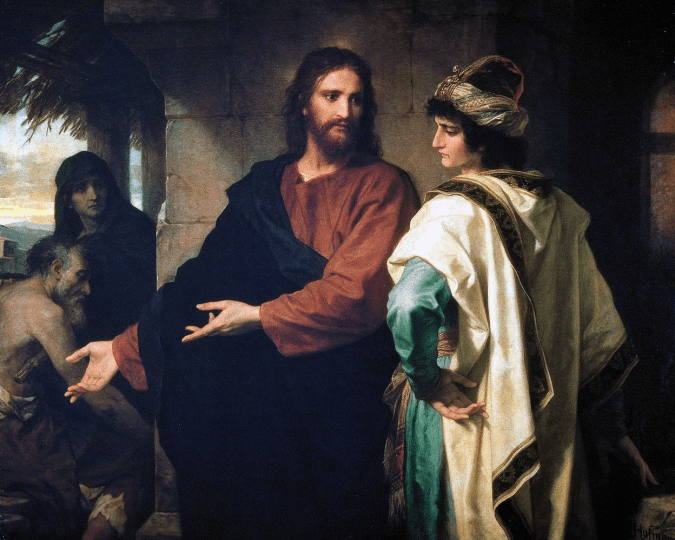
19:16 Now a man [rich (Mk. 10:22), young (Matt. 19:22), ruler (Lk. 18:18)] came up [eagerness, earnestness] to Jesus and asked [man believed Jesus could answer his question], “Teacher, what good thing must I do [man believed goodness defined by human achievement and that salvation must be earned] to get eternal life [life’s most important issue; cf. Jn. 17:3 re: Jesus’ definition of eternal life; man recognized that something was missing from his life – he did not have the assurance that he had eternal life]?”

19:17 “Why do you ask me about what is good [Jesus was not denying His own goodness and deity; wanted to know if the man was trying to flatter Him or really understood that God is the source of goodness]?” Jesus replied. “There is only One who is good. If you want to enter life, obey the commandments.”

19:18 “Which ones?” the man inquired.

19:19 Jesus replied [cf. Ex. 20; Deut. 5; Jesus cited the last six commandments], ” ‘Do not murder, do not commit adultery, do not steal [to rob, to deprive, holding back wages of one hired], do not give false testimony, honor your father and mother,’ and ‘love your neighbor as yourself.'”

19:20 “All these I have kept [indication of spiritual pride or ignorance; man sincerely felt he had obeyed outward demands of the law but had obviously not heard Jesus’ inward interpretation of some of the commandments (Matt. 5:21-48); perhaps he thought so because he was comparing himself with others],” the young man said. “What do I still lack?”

19:21 Jesus answered, “If you want to be perfect, go, sell your possessions and give to the poor [the man was trusting in his possessions as his basis for securing eternal life; the man’s riches were a barrier between himself and God; wealth occupied place in his life that belonged to God (violation of first commandment)], and you will have treasure in heaven. Then come, follow [follow as a disciple] me.”

19:22 When the young man heard this [the man faced the most important decision of his life], he went away sad [grieving and sorrowful], because he had great wealth [his gold remained his god; his possessions possessed him].

19:23 Then Jesus said [Jesus took advantage of this teachable moment] to his disciples, “I tell you the truth, it is hard [because wealth breeds self-sufficiency] for a rich [word often means things or possessions: property, wealth, means] man to enter the kingdom of heaven [the rule and reign of God in the heart of an individual].

Note: Other rich men who missed eternal life…
• man preoccupied with wealth Lk. 12:16-21
• man indifferent to God & needy Lk. 16:19-31

19:24 [exaggerated illustration to make a point (hyperbole)] Again I tell you, it is easier for a camel [the largest animal known to those who heard Jesus’ words] to go through the eye of a needle [Luke used word for surgical needle in Lk. 18:25] than for a rich man [perhaps because material wealth can make people blind to their spiritual needs] to enter the kingdom of God.”

19:25 When the disciples heard this, they were greatly astonished [to be overwhelmed; perhaps because many viewed wealth as a sign of God’s favor] and asked, “Who then can be saved [to rescue from a deadly plight]?

19:26 Jesus looked at them and said, “With man this [refers to entering the kingdom] is impossible [human achievement cannot qualify anyone for eternal life], but with God [salvation is a divine accomplishment] all things are possible.”

19:27 Peter answered him, “We have left everything to follow you [implication is that they had done what the rich, young ruler had refused to do]! What then will there be for us?”

Note: The cost of following Christ…
• Peter & Andrew left fishing business
• James & John left fishing business / father
• Matthew left job as tax collector

19:28 Jesus said to them, “I tell you the truth, at the renewal of all things, when the Son of Man sits on his glorious throne, you who have followed me will also sit on twelve thrones, judging the twelve tribes of Israel.

19:29 And everyone who has left [note precious things listed, a reminder that it costs to follow Jesus…] houses or brothers or sisters or father or mother or children or fields for my sake will receive a hundred times as much [not a promise of material riches; some rewards may be material in nature, but greater rewards are spiritual] and will inherit eternal life.

19:30 [cf. Matt. 20:16; Mk. 9:35] But many who are first [for example, the rich] will be last [impoverished], and many who are last [according to the world’s standards] will be first [in Christ’s kingdom].

Matthew 20

Matthew 20:20-28 [cf. Mark 10:35-45]

20:20 Then the mother [Salome (the sister of Mary the mother of Jesus); cf. Matt. 27:56; Mk. 16:1; Jn. 19:25] of Zebedee’s sons [James and John] came to Jesus with her sons and, kneeling down [sign of respect and submission (although her heart seemed filled with ambition)], asked a favor of him.

20:21 “What is it you want?” he asked. She said, “Grant that one of these two sons of mine may sit [request that her sons sit in the places of honor, recognition, prestige] at your right and the other at your left in your kingdom [her question indicates she thought Jesus was going to Jerusalem to defeat Rome and establish a political kingdom].”

20:22 “You don’t know what you are asking,” Jesus said to them [Jesus responded to the brothers who likely had their mother make the appeal in their behalf]. “Can you drink [to accept the suffering] the cup [figure of speech for suffering] I am going to drink? [cf. Matt. 26:39]” “We can,” they answered [response indicates they were self-confident and ignorant of the nature of Jesus’ kingdom].

20:23 Jesus said to them, “You will indeed drink from my cup [James would be beheaded (Acts 12:2) and John exiled on Patmos (Rev. 1:9)], but to sit at my right or left is not for me to grant. These places belong to those for whom they have been prepared by my Father.”

20:24 When the ten [they had not been present during the discussion] heard about this, they were indignant [may indicate they were jealous] with the two brothers.

20:25 Jesus called them together and said [reminded them of how the Gentiles looked at greatness], “You know that the rulers of the Gentiles lord it over [dominate] them [the people], and their high officials exercise authority over them.

20:26 Not so with you [Jesus’ followers must not operate according to worldly standards and values]. Instead, whoever wants to become great among you must be your servant [typically was considered an underling],

20:27 and whoever wants to be first must be your slave [Gr. “doulos” referred to one who was the property of his master and who had no personal rights]

20:28 just as the Son of Man [a messianic title Jesus often used to describe Himself] did not come to be served, but to serve, and to give his life [the supreme gift] as a ransom [a price paid for the freedom or deliverance of a slave or a captive; cf. 2 Cor. 5:19] for many.”

Matthew 21

Matthew 21:1-17

21:1 As they approached [from Jericho (Matt. 20:29)] Jerusalem [Jesus had earlier announced why He had to go to Jerusalem (cf. Matt. 16:21; 20:18); His final trip to Jerusalem] and came to Bethphage [means “House of Figs”] on the Mount of Olives, Jesus sent two disciples,

21:2 saying to them, “Go to the village ahead [Bethany: hometown of Mary, Martha, Lazarus] of you, and at once you will find a donkey [not a warrior’s stallion, but an animal used by common people] tied there, with her colt by her. Untie them and bring them to me [perhaps Jesus prearranged use of the animals with their owner].

21:3 If anyone says anything to you [cf. Mk. 11:5], tell him that the Lord [suggests that the owner was a disciple of Jesus] needs them, and he will send them right away.”

21:4 This took place to fulfill what was spoken through the prophet:

21:5 “Say to the Daughter of Zion, ‘See, your king comes to you, gentle and riding on a donkey, on a colt, the foal of a donkey.’ [Jesus entry into Jerusalem on a donkey (colt) fulfilled prophecy (Zech. 9:9)]

21:6 The disciples went and did as Jesus had instructed them.

21:7 They brought the donkey and the colt [this colt had never been ridden (Mk. 11:2; Lk. 10:30)], placed their cloaks on them [presumably as saddles], and Jesus sat on them [cloaks; riding on a donkey indicated a mission of goodwill].

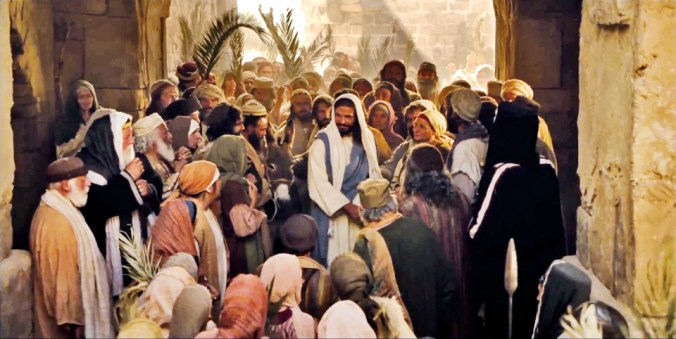
21:8 A very large crowd [some estimate as many as 2 million people were present in Jerusalem at Passover (cf. Jn. 12:12)] spread their cloaks on the road, while others cut branches from the trees [“palm branches” as per Jn. 12:13 (celebrated today as Palm Sunday)] and spread them on the road [“red carpet” treatment; sign of honor and submission].

21:9 The crowds [saw Jesus as the possible political or military Messiah] that went ahead of him and those that followed shouted [repeatedly], “[cf. Ps. 118:25-26] Hosanna [means “grant salvation” or “save now” / here used as a cry of greeting, a shout of joyous praise, an homage “glory, or hail, or welcome to David’s son”] to the Son of David [refers to the Messiah]!” “Blessed is he who comes in the name of [as a representative] the Lord [“he who comes in the name of the Lord” was a messianic title]!” “Hosanna in the highest [means “May God (in heaven) save now”]!”

21:10 When Jesus entered Jerusalem, the whole city was stirred [from Greek word seio, from which we get our word seismic] and asked, “Who is this?”

21:11 The crowds answered, “This is Jesus, the prophet [possibly the eschatological prophet foretold by Moses (Deut. 18:15)] from Nazareth in Galilee.”

21:12 Jesus entered the temple area [Court of the Gentiles] and drove out [with force] all who were buying and selling [originally started as a service and convenience for visitors to Jerusalem to provide unblemished sacrificial animals and exchange foreign currency for coins to pay the Temple tax (cf. Matt. 17:24)] there [temple looked more like a marketplace than a holy place]. He overturned the tables of the money changers and the benches of those selling doves [Jesus began ministry with similar act (Jn. 2:13-25)].

21:13 “It is written,” he said to them, “‘My house will be called a house of prayer [cf. Isa. 56:7; legitimate use of temple space: prayer, meditation, fellowship, spiritual devotion to God],’ but you are making it a ‘den of robbers [people were exploited by sellers who charged exorbitant prices; cf. Jer. 7:11].’”

21:14 The blind and the lame came to him at the temple, and he healed [Jesus’ public ministry (Matt. 4:23) and final week (Matt. 21:14) began with healing] them.

21:15 But when the chief priests and the teachers of the law saw the wonderful things he did and the children shouting [innocent children revealed God’s truth] in the temple area, “Hosanna to the Son of David,” they were indignant.

21:16 “Do you hear what these children are saying?” they [religious leaders rejected or ignored what God was doing] asked him. “Yes,” replied Jesus, “have you never read [Ps. 8:2], “‘From the lips of children and infants you have ordained praise’?”

21:17 And he left them [departed] and went out of [outside] the city to Bethany, where he spent the night [to find lodging].

Matthew 24

Matthew 24:42-44

24:42 “Therefore [word points to previous discussion or illustration (read 24:38-39)] keep watch [be prepared for the fulfillment of Jesus’ words; do not be caught off guard], because you do not know on what day [time] your Lord will come [His coming will be sudden].

24:43 But understand this: If the owner of the house had known at what time of night the thief was coming [Jesus’ coming is compared to that of a thief in the night (cf. 1 Thess. 5:2; Rev. 3:3; 16:15)], he would have kept watch and would not have let his house be broken into.

24:44 So [because Jesus had told His disciples in advance about His return His followers had no excuse for being unprepared] you also must be ready, because the Son of Man [this was Jesus’ favorite self description (cf. Dan. 7:13-14); a seldom used title for the Messiah; Jesus filled this title with meaning] will come [cf. Titus 2:13] at an hour when you do not expect him.

Matthew 26

Matthew 26:26-29

26:26 [Jesus and disciples gathered to celebrate the Passover, the annual springtime festival commemorating the Exodus (Ex. 12:1-11)] While they were eating [meal included roasted lamb, unleavened bread, wine, and other items], Jesus took bread [an unleavened loaf], gave thanks and broke it, and gave it to his disciples, saying, “Take and eat; this is my body [the bread represented His body which was about to be sacrificed on the cross].”

26:27 Then he took the cup, gave thanks [our term “Eucharist” comes from the Gr. “eukharistia” which means “thanksgiving” (some denominations use “Eucharist” as alternate term for the Lord’s Supper)] and offered it to them, saying, “Drink from it, all of you.

26:28 This [contents of the cup represented His blood which was about to be shed on the cross] is my blood of the covenant [cf. Jer. 31:31-34], which is poured out for many [Jesus died in the place of sinners (substitutionary atonement); cf. Matt. 20:28] for the forgiveness of sins [cf. Heb. 10:12].

26:29 I tell you, I will not drink of this fruit of the vine from now on [or in this life] until [anticipates His resurrection] that day when I drink it anew with you in my Father’s kingdom [cf. Lk. 22:30].”

Matthew 26:36-41

26:36 Then [following the Lord’s Supper in the upper room] Jesus went with his disciples [all but Judas] to a place called Gethsemane [means “oil press”], and he said to them, “Sit here while [as long as] I go over there and pray.”

26:37 He took [Jesus wanted the companionship and fellowship of others] Peter and the two sons [James and John (Mk. 1:19)] of Zebedee [Jesus’ inner circle; cf. Matt. 17:1-8; Mk. 5:37-42] along with him, and he began to be sorrowful and troubled [distressed].

26:38 Then he said to them, “My soul is overwhelmed [surrounded by] with sorrow [distress] to the point of death [a way of expressing the greatest amount of sorrow one can experience]. Stay here and keep watch [keep awake (and pray)] with me [implies association, intimacy, support].

26:39 Going a little farther [“about a stone’s throw beyond them” (Lk. 22:41)], he fell with his face to the ground [shows utmost attitude of submission and humility; indicates the pressure Jesus felt] and prayed [Luke (the physician) added that “his sweat was like drops of blood” (Lk. 22:44)], “My Father, if it is possible [if there is another way within God’s will], may this cup [metaphor for punishment and suffering (cf. Ps. 75:8; Isa. 51:17)] be taken from me. Yet not as I will, but as you will [Jesus affirmed His submission to His Father].”

26:40 Then he returned to his disciples and found them sleeping. “Could you men not keep watch with me for one hour [duration of Jesus’ intense prayer time]?” he asked Peter.

26:41 “Watch [be awake and prepared] and pray so that you will not fall into temptation [means test, try, prove, examine]. The spirit is willing, but the body [our weak human nature] is weak [disciples gave in to human exhaustion].”

Matthew 26:47-56

26:47 While he was still speaking, Judas, one of the Twelve, arrived [after arranging with the religious leaders to betray Jesus, Judas “watched for an opportunity to hand Jesus over to them when no crowd was present” (Lk. 22:6)]. With him was a large crowd armed with swords [carried primarily by temple police and Roman soldiers] and clubs [carried primarily by Jewish laymen; also carried torches and lanterns (Jn. 18:3)], sent from [but not accompanied by] the chief priests and the elders [the Sanhedrin] of the people.

26:48 Now the betrayer had arranged a signal with them: “The one I kiss [to love, to kiss; a mark of friendship] is the man; arrest him.”

26:49 Going at once to Jesus, Judas said, “Greetings, Rabbi [means “master” or “teacher;” Judas did not call Jesus “Lord” (cf. Matt. 26:22,25)]!” and kissed [strong, outward form of affection] him.

26:50 Jesus replied, “Friend [perhaps intended to remind Judas of the years they had spent together; “an open-hearted but not intimate greeting” (Expositor’s, Vol. 8, p. 547)], do what you came for [Jesus already knew why Judas had come (Matt. 26:21)].” Then the men [temple police, perhaps accompanied by some Roman soldiers] stepped forward, seized Jesus and arrested him.

26:51 With that, one of Jesus’ companions [Peter] reached for his sword, drew it out and struck the servant of the high priest [Malchus (Jn. 18:10)], cutting off his ear [Luke (the physician) added that Jesus “touched the man’s ear and healed him” (Lk. 22:51)].

26:52 “Put your sword back in its place, [Jesus did not want His cause to be advanced by physical violence]” Jesus said to him, “for all who draw the sword will die by the sword [violence begets violence].

26:53 Do you think I cannot call [to summon, to call to one’s side for help] on my Father, and he will at once put at my disposal more than twelve legions [a legion was about 6,000 men; twelve legions would be 72,000] of angels?

26:54 But how then would the Scriptures [OT messianic prophecies] be fulfilled that say it must happen in this way?”

26:55 At that time Jesus said to the crowd, “Am I leading a rebellion, that you have come out with swords and clubs to capture me? Every day I sat in the temple courts [a public place] teaching, and you did not arrest me [they could have easily identified Jesus in the daytime (no need for a signal as in 26:48)].

26:56 But this has all taken place that the writings of the prophets might be fulfilled [re: Jesus’ sufferings (Ps. 22; Isa. 53)].” Then all the disciples deserted him and fled [Zech. 13:7; Jesus traveled to the cross alone].

Matthew 27

Matthew 27:27-51

27:27 Then the governor’s [Pontius Pilate (appointed by the emperor as procurator of Judea)] soldiers [the soldiers had earlier flogged Jesus (Matt. 27:26)] took Jesus into the Praetorium [or headquarters; either a military headquarters or the governor’s palace; likely refers to tower or fortress of Antonia, near the temple] and gathered the whole company [Gr. “speira” or Latin “cohort” referred to a military unit of about 600, a tenth of a legion] of soldiers [also the Sanhedrin and the angry mob] around him.

27:28 [notice the shameful ways in which the soldiers mocked Jesus] [1] They stripped him and [2] put a scarlet [a royal color] robe [possibly one of the short red cloaks worn by the soldiers of that period] on him,

27:29 and [3] then twisted together a crown of thorns and set it on his head. [4] They put a staff in his right hand and [5] knelt [unknowingly they knelt before the King of kings; cf. Phil. 2:10-11] in front of him and mocked him. “Hail, king of the Jews!” they said.

27:30 [6] They spit [a great insult; the Jews also spit on Jesus (cf. Matt. 26:67)] on him, and took the staff and [7] struck him on the head again and again [these repeated blows drove the thorns deeper into Jesus’ head].

27:31 After they had mocked him, they took off the robe and put his own clothes on him. Then they led him away to crucify him [they took Jesus outside the city gates (cf. Heb. 13:12) to a place called Golgotha (cf. Matt. 27:33), a Heb. word meaning “skull” (Latin “calvaria”)].

27:32 As they were going out, they met a man from Cyrene, named Simon, and they forced him to carry the cross.

27:33 They came to a place called Golgotha (which means The Place of the Skull).

27:34 There they offered Jesus wine to drink, mixed with gall; but after tasting it, he refused to drink it.

27:35 When they had crucified him [the people of that day were familiar with the horror of crucifixion], they [four soldiers as per Jn. 19:23-24] divided up his clothes [the soft and seamless undergarment worn beneath the outer robe] by casting lots [similar to rolling dice; cf. prophecy recorded in Psalm 22:18].

27:36 And sitting down, they kept watch [to insure no one tried to rescue Him; to ensure that He died] over him there [at the place of crucifixion].

27:37 Above his head they placed the written charge against him [sign written in Hebrew, Latin, and Greek (cf. Jn. 19:19-20)]: THIS IS JESUS, THE KING OF THE JEWS [to the Jews this was a reference to their Messiah].

27:38 Two robbers were crucified with him, one on his right and one on his left.

27:39 Those who passed by hurled insults at him, shaking their heads

27:40 and saying, “You who are going to destroy the temple and build it in three days, save yourself! Come down from the cross, if you are the Son of God!”

27:41 In the same way the chief priests, the teachers of the law and the elders mocked him.

27:42 “He saved others,” they said, “but he can’t save himself! He’s the King of Israel! Let him come down now from the cross, and we will believe in him.

27:43 He trusts in God. Let God rescue him now if he wants him, for he said, ‘I am the Son of God.’”

27:44 In the same way the robbers who were crucified with him also heaped insults on him.

27:45 From the sixth hour until the ninth hour darkness came over all the land.

27:46 About the ninth hour Jesus cried out in a loud voice, “Eloi, Eloi, lama sabachthani?”—which means, “My God, my God, why have you forsaken me?”

27:47 When some of those standing there heard this, they said, “He’s calling Elijah.”

27:48 Immediately one of them ran and got a sponge. He filled it with wine vinegar, put it on a stick, and offered it to Jesus to drink.

27:49 The rest said, “Now leave him alone. Let’s see if Elijah comes to save him.”

27:50 And when Jesus had cried out again in a loud voice [the words He shouted were “It is finished” (Jn. 19:30), and then, “Father, into Your hands I entrust My spirit” (Lk. 23:46)], he gave up his spirit [an idiom for death].

27:51 At that moment [moment of death] the curtain [two curtains in the Jewish temple, one at the entrance to the holy place and the other separated the holy place from the holy of holies (only the high priest could enter holy of holies, the special room representing God’s presence)] of the temple was torn in two from top [indicating that God Himself tore the curtain thus signifying that the way to Him was now available on the basis of Jesus death (cf. Heb. 10:19-20)] to bottom. The earth shook [an earthquake] and the rocks split [allowing the release of the bodies of many saints who had died and who appeared in Jerusalem (cf. Matt. 27:52-53].

Matthew 28

28:1 After the Sabbath [24-hour period from sunset on Friday till sunset Saturday], at dawn on the first day of the week [Sunday], Mary Magdalene [from the village of Magdala on western shore of Sea of Galilee; cf. Lk. 8:2] and the other Mary [the mother of James and Joseph (Matt. 27:56)] went [came with spices in order to anoint body of Jesus for burial (Mk. 16:1)] to look at the tomb [they expected to find Jesus’ corpse there].

28:2 There was a violent earthquake [or “a great tempest or commotion”], for an angel of the Lord came down from heaven and, going to the tomb, rolled back the stone [cf. Mk. 16:3 re: concern of women re: how to move stone; the stone was moved not to let Jesus out but to let the world in] and sat [only Matt. notes that angel “sat” on the stone] on it.

28:3 His appearance [the angel’s entire form] was like lightning [brilliant], and his clothes were white [emblem of purity and righteousness] as snow.

28:4 The guards [Romans; cf. Matt. 27:65] were so afraid of him [the angel] that they shook [Gr. “seismos” (same word for “earthquake” in 28:2)] and became like dead men [they were paralyzed by fear].

28:5 The angel said to the women, “Do not be afraid, for I know that you are looking for Jesus, who was crucified [perfect tense of verb points to completed action with ongoing results].

28:6 He is not here; he has risen, just as he said [Jesus predicted His resurrection in Matt. 16:21; 17:23; 20:19; 26:32]. Come [invitation to enter the open tomb] and see the place where he lay [no body present].

28:7 Then go quickly and tell [the women who were expecting to anoint body of Jesus were given an important new task] his disciples: ‘He has risen from the dead and is going ahead of you into Galilee. There you will see him.’ Now I have told you.”

28:8 So the women hurried away from the tomb [as instructed by the angel], afraid yet filled with joy, and ran to tell his disciples.

28:9 Suddenly Jesus met them. “Greetings [Gr. “chairete”],” he said. They came to him, clasped his feet and worshiped [appropriate response to the risen Lord] him.

28:10 Then Jesus said to them, “Do not be afraid. Go and tell my brothers [His disciples] to go to Galilee [just as Jesus had told them during the Last Supper (cf. Matt. 26:32)]; there they will see me.”

28:11 While the women were on their way, some of the guards [cf. Matt. 27:62-66; Roman guards assigned to the service of the religious leaders] went into the city and reported to the chief priests [rather than to Pilate thus indicating these religious leaders were the driving force behind Jesus’ crucifixion] everything that had happened.

28:12 When the chief priests [controlled the temple] had met with the elders [influential leaders from key families; chief priests and elders represented the strongest leaders among the Jews] and devised a plan, they gave the soldiers a large sum of money [gave the soldiers a bribe to perpetuate a lie],

28:13 telling them, “You are to say, ‘His disciples [if the disciples were responsible the chief priests could easily have had them arrested and prosecuted] came during the night and stole him away while we were asleep [by admitting that they had fallen asleep the guards incriminated themselves in an offense that could have fatal results; however, if the guards were indeed asleep, they could not know what happened and had no basis to accuse the disciples of stealing the body].’

28:14 If this report gets to the governor [Pilate], we will satisfy him [possibly means they would also bribe Pilate to ignore the story] and keep you out of trouble.”

28:15 So the soldiers took the money and did as they were instructed. And this story has been widely circulated among the Jews to this very day [Matthew probably written between AD 60–65 before the fall of Jerusalem in AD 70].

28:16 Then the eleven disciples went to Galilee, to the mountain where Jesus had told them to go [cf. Matt. 28:10; the ascension took place at a later time, after Jesus had ministered to His disciples in Jerusalem (Lk. 24:44-53)].

28:17 When they saw him, they worshiped [to prostrate oneself (in homage)] him; but some [this possibly was occasion when over 500 followers of Jesus saw Him alive (cf. 1 Cor. 15:6)] doubted [either some among the 500 or people other than the disciples; this word can also mean “hesitated”].

28:18 [see also Mk. 16:15-16; Lk. 24:46-49; Jn. 20:21-23] Then Jesus came to them and said, “All authority [absolute power and the right to act, make choices, issue commands] in heaven and on earth [scope of Jesus’ authority] has been given to me.

Note: Charles Spurgeon, preaching from the text, “All power is given unto Me … lo I am with you always,” said the following: “You have a factor here that is absolutely infinite, and what does it matter as to what other factors may be. ‘I will do as much as I can,’ says one. Any fool can do that. He that believes in Christ does what he cannot do, attempts the impossible and performs it.”

28:19 Therefore [on the basis of Jesus’ authority and because He is worthy of our obedience] go [we must not just “come” to church, we must “go”] and make disciples [imperative; a command; a disciple is more than a convert] of all nations [people groups rather than political-geographical regions], baptizing them in the name of [“under the authority of” or “in allegiance to”] the Father and of the Son and of the Holy Spirit,

Note: Someone wisely said that the church must evangelize or it will fossilize.

28:20 and teaching [an imperative; essential to making disciples; a lifelong process that requires the study of God’s Word; “A disciple is not simply one who has been taught but one who continues to learn.” (Mounce)] them to obey [to heed; to keep] everything I have commanded you. And [what follows is more than an unconditional promise, it is a fact] surely I am with [Jesus is with His followers in the Person of the Holy Spirit] you [read Acts 18:9-10 re: words of Jesus to Paul at Corinth when things got tough: “For I am with you…”] always [cf. Matt. 1:23 re: Jesus as Immanuel (God with us)], to the very end of the age [if understood in the spatial sense: “to the end of the inhabited world;” if understood in the temporal sense: “throughout all time”].”

2 Corinthians 4

4:1 Therefore, since through God’s mercy [cf. Acts 9:1-19; Eph. 2:4; Titus 3:5] we have this ministry [God uses us because He is good, not because we are good], we do not lose heart [to not become discouraged or behave with cowardice].

4:2 Rather, we have renounced secret and shameful ways [unlike some of Paul’s critics whose methods and motives were suspect]; we do not use deception, nor do we distort [word commonly used in the marketplace to describe tactics of unscrupulous merchants who, for example, adjusted their scales to take advantage of customers] the word of God [as did Paul’s opponents]. On the contrary, by setting forth the truth plainly we commend ourselves to every man’s conscience in the sight of God.

4:3 And even if our gospel is veiled [obscure], it is veiled to those who are perishing [those who refuse to place their trust in Christ].

4:4 The god of this age [Satan, whose agenda is to steal, kill, and destroy (cf. Jn. 10:10)] has blinded [Satan uses the things of this world to blind people] the minds of unbelievers [cf. 2 Cor. 11:14-15], so that they cannot see the light of the gospel of the glory of Christ, who [Jesus who lived and walked among us] is the image [cf. Col. 1:15] of God [who is invisible (cf. 1 Tim. 6:16)].

Paul marveled that God had chosen him to tell others about Jesus. Before his conversion, he had been a sworn enemy of Jesus Christ and His followers. However, Christ Himself had stopped Paul on his way to persecute believers in Damascus and commissioned him to preach the gospel. Paul knew that it was only by the mercy of God that he had been called to preach the gospel of Jesus Christ. He was always careful to preach with right motives and never resorted to methods that distorted the message or jeopardized his integrity.

In his previous letter to the Corinthians, Paul said that the message of the cross is foolishness to those who are perishing (1 Cor. 1:18). Those who use human wisdom to try to understand the gospel often minimize both the effect and impact of the cross. For many unbelievers the cross is an insurmountable stumbling block and for others it is just plain foolishness.

Although Paul’s presentation of the gospel was clear and straightforward, it was veiled or obscure to those who refuse to believe in Christ. Paul used the imagery of blindness to describe the spiritual condition of unbelievers who are unable or unwilling to comprehend spiritual truth. Ultimately, Satan himself is responsible for obscuring the message of the cross and blinding the minds of the unbelievers.

Those whose minds are blinded by Satan cannot think straight, resist God’s truth, and are vulnerable to false information about God. While on an international flight, I met a young man who was reading Bertrand Russell’s essay entitled “Why I Am Not a Christian.” When I engaged him in conversation, he remarked that he agreed with Russell. He also admitted to me that he had never talked with a Christian nor read any Christian literature that might challenge Russell’s conclusions. We then spent the remainder of the flight talking about Christianity and why Jesus had come to earth. Like Russell, this young man’s mind had been blinded by Satan to the light of the gospel.

The Psalmist said that the entrance of God’s Word gives light (see Ps. 119:130). That is why Satan seeks to blind the minds of unbelievers to the light of the gospel. As the god of this age, or the god of those who live according to the fallen world order, Satan will stop at nothing to influence the human mind. He is a schemer (2 Cor. 2:11) who employs any and all measures to prevent the entrance of light into darkened minds and hearts. Light enables people to see what they otherwise would be unable to see. Satan does not want for people to see and understand their desperate spiritual condition and need for salvation through Jesus Christ.

Satan, the prince of darkness (Eph. 6:12), cleverly disguises himself as an angel of light and his servants can disguise themselves as servants of righteousness (2 Cor. 11:14-15). Paul cautioned against these deceivers who convincingly preached another Jesus and a different gospel (2 Cor. 11:4).

Unlike the smooth-talking false teachers of his day, Paul always kept Jesus as the focal point of his preaching (2 Cor. 4:5). Jesus, after all, is the light of the world and the only antidote to spiritual darkness. We must share the message about Jesus in dependence on the Holy Spirit, who counteracts the work of Satan by revealing the truth of the gospel. He can enable the spiritually blind to see!

4:5 For we do not preach ourselves, but Jesus Christ as Lord [cf. 1 Cor. 2:1-2], and ourselves as your servants [cf. Rom. 1:1; 1 Cor. 4:1; 2 Cor. 11:23; Gal. 1:10] for Jesus’ sake.

4:6 For God, who said, “Let light shine out of darkness [cf. Gen. 1:2-5],” made his light [which can illumine dark hearts and minds] shine in our hearts to give us the light of the knowledge of the glory of God in the face of Christ.

4:7 But we have this treasure in jars of clay to show that this all-surpassing power is from God and not from us.

4:8 We are hard pressed on every side, but not crushed; perplexed, but not in despair;

4:9 persecuted, but not abandoned; struck down, but not destroyed.

4:10 We always carry around in our body the death of Jesus, so that the life of Jesus may also be revealed in our body.

4:11 For we who are alive are always being given over to death for Jesus’ sake, so that his life may be revealed in our mortal body.

4:12 So then, death is at work in us, but life is at work in you.

4:13 It is written: “I believed; therefore I have spoken.” With that same spirit of faith we also believe and therefore speak,

4:14 because we know that the one who raised the Lord Jesus from the dead will also raise us with Jesus and present us with you in his presence.

4:15 All this is for your benefit, so that the grace that is reaching more and more people may cause thanksgiving to overflow to the glory of God.

4:16 Therefore we do not lose heart [Paul endured because he had an eternal perspective and knew there was more than just this life]. Though outwardly we are wasting away [our physical bodies are in the process of wasting away], yet inwardly [the part of us (soul) that will survive physical death] we are being renewed day by day.

4:17 For our light and momentary troubles [cf. 2 Cor. 11:23-29 re: the hardships Paul endured] are achieving [sufferings produced something that would last for all eternity…] for us an eternal glory that far outweighs them all [cf. Rom. 8:18].

4:18 So we fix our eyes not on what is seen [the decay of the outer person], but on what is unseen [the eternal glory believers will enjoy]. For what is seen is temporary, but what is unseen is eternal.