Leviticus 3

The Fellowship Offering

3:1 “‘If someone’s offering is a fellowship [or peace; symbolized peace between God and worshiper] offering [voluntarily offered to give thanks to God; offered as a result of a vow; freewill offering; cf. Lev. 7:12-26], and he offers an animal from the herd [a cow], whether male or female, he is to present before the LORD an animal without defect [cf. Mal. 1:8, 13-14 re: violation of this command].

3:2 He is to lay his hand on the head of his offering [thus symbolically transferring the offerer’s sins to the animal] and slaughter it at the entrance to the Tent of Meeting. Then Aaron’s sons the priests shall sprinkle the blood against the altar on all sides.

3:3 From the fellowship offering he is to bring a sacrifice made to the LORD by fire: [note: only fat and kidneys burned on the altar (vv. 3-5)…] all the fat that covers the inner parts or is connected to them,

3:4 both kidneys with the fat on them near the loins, and the covering of the liver, which he will remove with the kidneys.

3:5 Then Aaron’s sons are to burn it on the altar on top of the burnt offering that is on the burning wood, as an offering made by fire, an aroma pleasing to the LORD.

3:6 “‘If he offers an animal from the flock [sheep] as a fellowship [or peace; symbolized peace between God and worshiper] offering [voluntarily offered to give thanks to God; offered as a result of a vow; freewill offering; cf. Lev. 7:12-26] to the LORD, he is to offer a male or female without defect.

3:7 If he offers a lamb, he is to present it before the LORD.

3:8 He is to lay his hand on the head of his offering [thus symbolically transferring the offerer’s sins to the animal] and slaughter it in front of the Tent of Meeting. Then Aaron’s sons shall sprinkle its blood against the altar on all sides.

3:9 From the fellowship offering he is to bring a sacrifice made to the LORD by fire: [note: only fat and kidneys burned on the altar (vv. 9-11)…] its fat, the entire fat tail cut off close to the backbone, all the fat that covers the inner parts or is connected to them,

3:10 both kidneys with the fat on them near the loins, and the covering of the liver, which he will remove with the kidneys.

3:11 The priest shall burn them on the altar as food, an offering made to the LORD by fire.

3:12 “‘If his offering is a goat, he is to present it before the LORD.

3:13 He is to lay his hand on its head and slaughter it in front of the Tent of Meeting. Then Aaron’s sons shall sprinkle its blood against the altar on all sides.

3:14 From what he offers he is to make this offering to the LORD by fire: [note: only fat and kidneys burned on the altar (vv. 14-16)…] all the fat that covers the inner parts or is connected to them,

3:15 both kidneys with the fat on them near the loins, and the covering of the liver, which he will remove with the kidneys.

3:16 The priest shall burn them on the altar as food, an offering made by fire, a pleasing aroma. All the fat is the LORD’s.

3:17 “‘This is a lasting ordinance for the generations to come, wherever you live: You must not eat any fat [to be set aside as God’s portion] or any blood [life is in the blood].'”
Leviticus 2

The Grain Offering

2:1 “‘When someone brings a grain [word “meat” is used in KJV in the sense of “food”; sometimes referred to as “meal” or “cereal” offering; no blood associated with this offering] offering to the LORD, his offering is to be of [note four kinds of grain offerings in vv. 1, 4, 5, 7…] [A] fine flour [flour after worked and refined by human hands (sweat equity / represented what man had done with God’s gift of grain)]. He is to pour oil [olive oil] on it, put incense [frankincense was expensive] on it

2:2 and take it to Aaron’s sons the priests. The priest shall take a handful of the fine flour and oil, together with all the incense, and burn this as a memorial [suggests the offerer is remembered or that God is reminded of His promise to look after those whom He loves; Ps. 38 and 70 possibly recited with this offering] portion on the altar, an offering made by fire, an aroma pleasing to the LORD.

2:3 The rest of the grain offering belongs to Aaron and his sons [see instructions in Lev. 6:16-18]; it is a most holy part of the offerings made to the LORD by fire.

2:4 “‘If you bring a [B] grain offering baked in an oven, it is to consist of fine flour: cakes made without yeast and mixed with oil, or wafers made without yeast and spread with oil.

2:5 If your grain [C] offering is prepared on a griddle, it is to be made of fine flour mixed with oil, and without yeast.

2:6 Crumble it and pour oil on it; it is a grain offering.

2:7 If your grain [D] offering is cooked in a pan, it is to be made of fine flour and oil.

2:8 Bring the grain offering made of these things to the LORD; present it to the priest, who shall take it to the altar.

2:9 He shall take out the memorial portion from the grain offering and burn it on the altar as an offering made by fire, an aroma pleasing to the LORD.

2:10 The rest of the grain offering belongs to Aaron and his sons; it is a most holy part of the offerings made to the LORD by fire.

2:11 “‘Every grain offering you bring to the LORD must be made without yeast, for you are not to burn any yeast [also forbidden with the Passover meal] or honey [this prohibition against honey only appears in this verse; honey, like yeast, can ferment] in an offering made to the LORD by fire.

2:12 You may bring them to the LORD as an offering of the firstfruits, but they are not to be offered on the altar as a pleasing aroma.

2:13 Season all your grain offerings with salt. Do not leave the salt of the covenant of your God out of your grain offerings; add salt to all your offerings.

2:14 “‘If you bring a grain offering of firstfruits to the LORD, offer crushed heads of new grain roasted in the fire.

2:15 Put oil and incense on it; it is a grain offering.

2:16 The priest shall burn the memorial portion of the crushed grain and the oil, together with all the incense, as an offering made to the LORD by fire.

Leviticus 1

The Burnt Offering

1:1 The LORD [God Himself instructed Moses regarding sacrifices] called to Moses and spoke to him [God spoke to Moses and through Moses to all Israel] from the Tent of Meeting [a temporary tent of worship; cf. Ex. 33:7-10 and 38:8]. He said,

1:2 “Speak to the Israelites and say to them: ‘When any of you brings [voluntarily] an offering to the LORD, bring as your offering an animal from either the herd [cattle] or the flock [sheep and goats].

1:3 “‘If the offering [provision was made for the financial ability of a worshiper (cf. 1:2-3,10,14)] is a burnt offering [totally consumed on the altar (as opposed to fellowship offerings which were partly eaten); cf. 2 Sam. 24:24] from the herd [the rich would offer a young bull], he is to offer a male without defect [a clean animal]. He must present it at the entrance to the Tent of Meeting so that it will be acceptable to the LORD.

1:4 He [the worshiper] is to lay his hand on the head of the burnt offering [thus symbolically transferring the offerer’s sins to the animal], and it will be accepted on his behalf to make atonement [purpose of the burnt offering; Heb. “kipper” (to make atonement) used almost 50 times in Leviticus] for him.

1:5 He is to slaughter the young bull [the hide was given to the priest as per Lev. 7:8] before the LORD, and then Aaron’s sons the priests shall bring the blood [cf. Lev. 17:14] and sprinkle it against the altar [roaring fire on altar gave off much heat, this “sprinkle” from a distance] on all sides at the entrance to the Tent of Meeting.

1:6 He is to skin the burnt offering and cut it into pieces.

1:7 The sons of Aaron the priest are to put fire on the altar and arrange wood on the fire.

1:8 Then Aaron’s sons the priests shall arrange the pieces, including the head and the fat, on the burning wood that is on the altar.

1:9 He is to wash the inner parts and the legs with water, and the priest is to burn all of it on the altar. It is a burnt offering, an offering made by fire, an aroma pleasing [from Heb. word meaning “rest”; “…gives an aroma of tranquility by bringing peace between God and the worshiper” (Expositor’s Bible Commentary, Vol. 2, p. 539); cf. Eph. 5:2] to the LORD.

1:10 “‘If the offering is a burnt offering from the flock [the person of average means would offer a sheep or goat], from either the sheep or the goats, he is to offer a male without defect.

1:11 He is to slaughter it at the north side of the altar before the LORD, and Aaron’s sons the priests shall sprinkle its blood against the altar on all sides.

1:12 He is to cut it into pieces, and the priest shall arrange them, including the head and the fat, on the burning wood that is on the altar.

1:13 He is to wash the inner parts and the legs with water, and the priest is to bring all of it and burn it on the altar. It is a burnt offering, an offering made by fire, an aroma pleasing to the LORD.

1:14 “‘If the offering to the LORD is a burnt offering of birds [the poor would offer a bird], he is to offer a dove or a young pigeon.

1:15 The priest shall bring it to the altar, wring off the head and burn it on the altar; its blood [obviously very little blood, but still effective] shall be drained out on the side of the altar.

1:16 He is to remove the crop [NIV notes that the meaning of the Hebrew for this word is uncertain; perhaps a reference to internal organs] with its contents [meaning is uncertain] and throw it to the east side of the altar, where the ashes are.

1:17 He shall tear it open by the wings, not severing it completely, and then the priest shall burn it on the wood that is on the fire on the altar. It is a burnt offering, an offering made by fire, an aroma pleasing to the LORD.

Genesis 50

Genesis 50:12-26
50:12 So Jacob’s sons did as he had commanded them [cf. Gen. 49:29-33]:

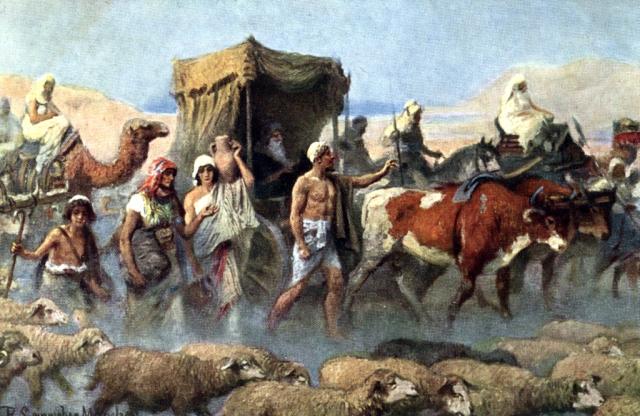
50:13 They carried him to the land of Canaan and buried him in the cave in the field of Machpelah, near Mamre, which Abraham had bought as a burial place from Ephron the Hittite, along with the field.

50:14 After burying his father, Joseph returned to Egypt, together with his brothers and all the others who had gone with him to bury his father.

50:15 When Joseph’s brothers saw that their father was dead, they said [Joseph’s brothers feared the worst], “What if Joseph holds a grudge against us and pays us back for all the wrongs we did to him?”

50:16 So they sent word to Joseph, saying, “Your father [Jacob] left these instructions before he died:

50:17 ‘This is what you are to say to Joseph [there is no indication that Jacob actually spoke these words although one can safely assume that he would have agreed with their sentiment …]: I ask you to forgive your brothers the sins and the wrongs [the words “sins” and “wrongs” accentuate the true nature of their past deeds] they committed in treating you so badly.’ Now please forgive the sins of the servants of the God of your father.” When their message came to him, Joseph wept [perhaps Joseph thought of all that he had suffered because of “the sins and the wrongs” committed against him; perhaps he wept because he felt bad about the guilt and anxiety that his brothers still felt; perhaps he wept because these words indicated that his brothers were genuinely sorry for their past sins and wrong].

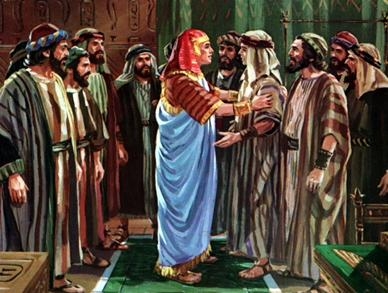
50:18 His brothers [still anxious because of what they had done to Joseph in the past] then came [personally] and threw themselves down [cf. Gen. 37:5-11] before him [Joseph]. “We are your slaves [indicates attitude of complete submission],” they said [the brothers wanted Joseph’s forgiveness].

50:19 But Joseph said to them, “Don’t be afraid. Am I in the place of God [Joseph was unwilling to evaluate why God had chosen to work as He had; Joseph was unwilling to seek revenge]?
50:20 [cf. Gen. 45:5-8; this verse has been called the Romans 8:28 of the OT] You intended to harm me, but God [who is always at work behind the scenes] intended it [the evil his brothers had done to him] for good [Joseph came to this conviction over a period of years] to accomplish what is now being done, the saving of many lives [both his own family and many people in the land of Egypt].

50:21 So then, don’t be afraid. I will provide [indication that Joseph harbored no ill feelings toward his brothers] for you and your children.” And he reassured them and spoke kindly to them [Joseph reassured his frightened brothers by speaking to their hearts].

50:22 Joseph stayed in Egypt, along with all his father’s family. He lived a hundred and ten years [Joseph lived a long and full life]

50:23 and saw the third generation of Ephraim’s children. Also the children of Makir son of Manasseh were placed at birth on Joseph’s knees.

50:24 Then Joseph said to his brothers, “I am about to die [cf. Jacob’s awareness of his approaching death in Gen. 49:29]. But God will surely come to your aid and take you up out of this land to the land he promised on oath to Abraham, Isaac and Jacob [Joseph added the name of his father to the list of patriarchs].”

50:25 And Joseph made the sons of Israel swear an oath and said, “God will surely come to your aid, and then you must carry [not immediately as in the case of Jacob (cf. Gen. 49:29-30)] my bones up from this place [to the land of Canaan for final burial; Joseph buried at Shechem (Josh. 24:32)].”

50:26 So Joseph died at the age of a hundred and ten. And after they embalmed [Joseph had ordered the physicians in his service to embalm the body of Jacob (Gen. 50:1-3)] him, he was placed in a coffin [a sarcophagus] in Egypt [until the time of the Exodus; cf. Ex. 13:19].

Genesis 49

Genesis 49:9-10
God’s promise of a Messiah is progressively revealed in Scripture. Jacob’s prophecy concerning Jesus was made 19 centuries before Jesus was born. We can submit to Jesus’ rule in our lives because He is God’s promised ruler.

49:9 You are a lion’s cub [young and full of vigor], O Judah [Jacob’s fourth son; Reuben was oldest and Joseph was favorite]; you return from the prey [describes lion feasting on flesh taken as prey; protective/defensive of its food], my son. Like a lion [common in Israel in Bible times; imagery of lion conveys power and authority] he crouches and lies down, like a lioness [fierce in defending its young] — who dares to rouse him?

49:10 The scepter [symbol of power and authority] will not depart from Judah [the royal tribe; cf. Matt. 1:2], nor the ruler’s staff [symbol of power and authority] from between his feet [when king sat down the scepter rested between his feet], until [Judah would hold a leadership status among tribes of Israel] he [ future ruler would come from tribe of Judah; anticipates rise of Davidic monarchy (cf. 2 Sam. 7:15-16); ultimately fulfilled in coming of Messiah] comes to whom it [the kingdom] belongs [no other has a legitimate claim to royalty through Judah] and the obedience of the nations [leadership, kingship, sovereignty over Israel and non-Israelite peoples] is his.

Genesis 49:29-33
49:29 Then he gave them these instructions: “I am about to be gathered to my people. Bury me with my fathers [in the promised land] in the cave in the field of Ephron the Hittite,

49:30 the cave in the field of Machpelah [name means “the double cave”], near Mamre in Canaan, which Abraham bought [Abraham paid 400 shekels of silver; cf. Gen. 23:17-20] as a burial place from Ephron the Hittite, along with the field.
49:31 There Abraham [cf. Gen. 25:9] and his wife Sarah [cf. Gen. 23:19] were buried, there Isaac and his wife Rebekah were buried, and there I buried Leah.
49:32 The field and the cave in it were bought from the Hittites [Noah’s great grandson (original ancestor of the Hittites), a people group living in Canaan].”

49:33 When Jacob had finished giving instructions to his sons, he drew his feet up [perhaps suggests a fetal position] into the bed, breathed his last [died] and was gathered to his people [joined his ancestors].

Genesis 46

Genesis 46:1-5
46:1 So Israel set out [from Hebron] with all that was his, and when he reached Beersheba [located in the semi-desert region known as the Negeb; in the southernmost part of the promised land (cf. 1 Sam. 3:20; 2 Sam. 24:2 re: expression “from Dan to Beersheba”)], he offered sacrifices [Jacob took the time to worship before continuing his journey to Egypt] to the God of his father Isaac.

46:2 And God spoke to Israel in a vision at night and said, “Jacob! Jacob!” “Here I am,” he replied.

46:3 “I am God, the God of your father,” he said. “Do not be afraid [Jacob had reason to fear because he was old, because he was leaving the promised land, and because he was going to a strange land] to go down to Egypt [God confirmed that Jacob was doing the right thing in going to Egypt; cf. Gen. 15:13], for I will make you into a great nation [cf. Balaam’s words in Num. 23:10, “Who can count the dust of Jacob…”] there [in Egypt].
46:4 I will go down to Egypt with you, and I will surely bring you back again [after they had become a great nation]. And Joseph’s own hand will close your eyes [Joseph would be with his father at death].”
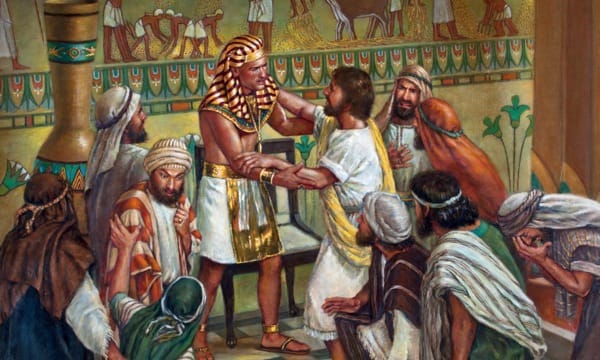
46:5 Then Jacob left Beersheba, and Israel’s sons took their father Jacob and their children and their wives in the carts that Pharaoh had sent to transport him.

Genesis 45

Genesis 45:3-8
45:3 Joseph said to his brothers, “I am Joseph [imagine the shock his brothers must have felt at hearing these words]! Is my father [Jacob] still living [an indication that Joseph’s affection for his father was still strong]?” But his brothers were not able to answer him, because they were terrified [perhaps because they realized that Joseph had the authority and power to exact revenge] at his presence.
45:4 Then Joseph said to his brothers, “Come close to me.” When they had done so, he said, “I am your brother Joseph, the one you sold into Egypt [this detail validated Joseph’s claim]!

45:5 And now, do not be distressed and do not be angry with yourselves for selling me here, because [note that Joseph was a bigger picture person…] it was to save lives that God sent me ahead of you [Joseph understood God’s providence].

45:6 For two years now there has been famine in the land, and for the next five years [as indicated by Pharaoh’s dreams (cf. Gen. 41:1-7)] there will not be plowing and reaping.

45:7 But God [used the evil intentions of Joseph’s brothers to accomplish His purposes] sent me ahead of you to preserve for you a remnant on earth and to save your lives by a great deliverance.

45:8 “So then, it was not you who sent me here, but God [these words must have alleviated much anxiety]. He made me father to Pharaoh [or Pharaoh’s counselor], lord of his entire household and ruler of all [indicates the scope of Joseph’s authority] Egypt.

Genesis 45:25-28
45:25 So they went up out of Egypt and came to their father Jacob in the land of Canaan.

45:26 They told him, “Joseph is still alive! In fact, he is [at the present time] ruler of all Egypt.” Jacob was stunned [he probably went limp; or to use an old Texas expression, “he was slack-jawed”]; he did not believe them.

45:27 But when they told him everything [cf. Gen. 45:9-13] Joseph had said to them, and when he saw the carts [tangible evidence of Joseph’s concern for his family] Joseph had sent to carry him back, the spirit of their father Jacob revived [he felt better or came to life].

45:28 And Israel [Jacob] said, “I’m convinced! My son Joseph is still alive [the fact that Joseph was “alive” was more important to him than Joseph’s wealth or status in Egypt]. I will go and see him before I die.”

Genesis 42

Genesis 42:1-8
42:1 When Jacob [previous mention of Jacob is in Gen. 37:34] learned that there was grain in Egypt, he said to his sons, “Why do you just keep looking at each other?”

42:2 He continued, “I have heard that there is grain in Egypt. Go [from Canaan] down there [to Egypt] and buy some [grain] for us, so that we may live and not die.”

42:3 Then ten of Joseph’s brothers [the sons of Jacob] went down to buy grain from Egypt.

42:4 But Jacob did not send Benjamin [the youngest of his sons; younger son of Rachel, Jacob’s favorite wife], Joseph’s brother, with the others, because he was afraid that harm might come to him.

42:5 So Israel’s sons were among those who went [indicates that others also went from Canaan to Egypt to buy grain] to buy grain, for the famine was in the land of Canaan also.
42:6 Now Joseph was the governor [cf. Gen. 41:40-43] of the land, the one who sold grain to all its people. So when Joseph’s brothers arrived, they bowed down [cf. Gen. 37:7,9] to him with their faces to the ground.
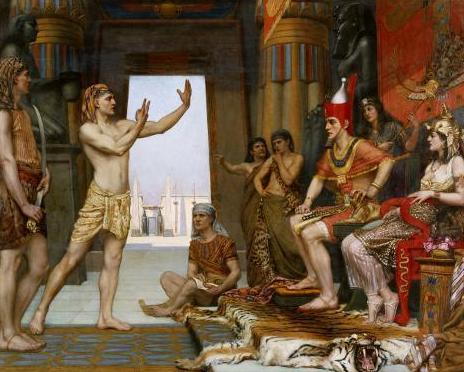
42:7 As soon as Joseph saw his brothers [first time Joseph had seen his brothers since they had sold him into slavery] he recognized them, but he pretended to be a stranger [perhaps Joseph feared his brothers might recognize him] and spoke [Joseph spoke through an interpreter (cf. Gen. 42:23)] harshly [Joseph spoke with authority] to them. “Where do you come from?” he asked. “From the land of Canaan,” they replied, “to buy food.”

42:8 Although Joseph recognized his brothers, they did not recognize him [Joseph was 17 years old when sold into slavery almost twenty years earlier; Joseph dressed in royal Egyptian garb and spoke through an interpreter].

Genesis 41

Genesis 41:1-7
41:1 When two full years had passed [since the release of the chief cupbearer from prison; cupbearer forgot Joseph (cf. Gen. 40:23)], Pharaoh had a dream: He was standing by the Nile [provided water for crops in Egypt],

41:2 when out of the river there came up seven cows, sleek and fat, and they grazed among the reeds.

41:3 After them, seven other cows, ugly and gaunt, came up out of the Nile and stood beside those on the riverbank.

41:4 And the cows that were ugly and gaunt ate up the seven sleek, fat cows. Then Pharaoh woke up.

41:5 He fell asleep again and had a second dream: Seven heads of grain, healthy and good, were growing on a single stalk.

41:6 After them, seven other heads of grain sprouted—thin and scorched by the east wind [the wind that came from the area of the Arabian Desert; hot and dry wind that withered everything in its path; cf. Jonah 4:8].

41:7 The thin heads of grain swallowed up the seven healthy, full heads. Then Pharaoh woke up; it had been a dream [Pharaoh was troubled by his two dreams; (cf. Gen. 41:8)].

Genesis 41:15-16
41:15 Pharaoh said to Joseph, “I had a dream, and no one can interpret it. But I have heard it said [from the cupbearer who had forgotten Joseph (cf. Gen. 40:23)] of you that when you hear a dream you can interpret it.”

41:16 “I cannot do it [Joseph refused to take the credit for himself],” Joseph replied to Pharaoh, “but God [a significant statement because people in Egypt worshiped many gods] will give Pharaoh [considered a god in Egypt] the answer he desires [a favorable answer; one that would calm and reassure the troubled monarch].”

Genesis 41:25-40
41:25 Then Joseph said to Pharaoh, “The dreams of Pharaoh are one and the same. God has revealed to Pharaoh what he is about to do.

41:26 The seven good cows are seven years, and the seven good heads of grain are seven years [years of bumper crops throughout Egypt]; it is one and the same dream.

41:27 The seven lean, ugly cows that came up afterward are seven years, and so are the seven worthless heads of grain scorched by the east wind: They are seven years of famine.

41:28 “It is just as I [Joseph was merely the spokesman describing for Pharaoh what God was about to do] said to Pharaoh: God has shown [in advance; a warning to help them prepare for the coming difficulties] Pharaoh what he is about to do.

41:29 Seven years [represented by the seven good cows and the seven good heads of grain] of great abundance are coming throughout the land of Egypt,

41:30 but seven years [represented by the lean, ugly good cows and the seven worthless heads of grain] of famine will follow them. Then all the abundance [everything gained during the seven years of plenty] in Egypt will be forgotten, and the famine will ravage [or consume] the land [indicates the magnitude of the famine].

41:31 The abundance in the land will not be remembered, because the famine that follows it will be so severe.

41:32 The reason the dream was given to Pharaoh in two forms [this emphasized the importance of the message of the dreams; recall that Joseph’s dream about his brothers was also repeated (cf. Gen. 37:5-1)] is that the matter has been firmly decided [speaks of certainty] by God, and God will do it soon [speaks of imminence].

41:33 “And now [after interpreting Pharaoh’s dreams, Joseph courageously offered practical advice about how to deal with the situation] let Pharaoh look for a discerning and wise man and put him in charge of the land of Egypt [the Scripture does not indicate that Joseph was seeking this job for himself].

41:34 Let Pharaoh appoint commissioners over the land to take a fifth [20%] of the harvest of Egypt during the seven years of abundance.

41:35 They should collect all the food of these good years that are coming and store up the grain under the authority of Pharaoh, to be kept in the cities [perhaps cities strategically located for distribution efforts in the future and cities where the grain could be protected] for food.

41:36 This food should be held in reserve for the country, to be used during the seven years of famine that will come upon Egypt, so that the country may not be ruined by the famine.”

41:37 The plan seemed good [they saw the wisdom of Joseph’s suggestion to prepare for coming difficulties] to Pharaoh and to all his officials.

41:38 So Pharaoh asked [his question was rhetorical] them [his officials and advisors], “Can we find anyone like this man, one in whom is the spirit of God?”

41:39 Then Pharaoh said to Joseph, “Since God has made all this known to you [Pharaoh gave God the credit for Joseph’s insight and wisdom], there is no one so discerning and wise as you.

41:40 You shall be in charge of my palace, and all my people are to submit to your orders [Joseph’s word would be law throughout the land]. Only with respect to the throne will I be greater than you [Joseph was made one of the most powerful men in Egypt].”

Note: Pharaoh had gained valuable administrative experience while in Potiphar’s household (Gen. 39:1-6) and while he was in prison (Gen. 39:21-23).

Genesis 48

Genesis 48:21-22
48:21 Then Israel said [Israel’s words show his faith that God would return his descendants to Canaan just as He had promised (cf. Gen. 46:41)] to Joseph, “I am about to die, but [consolation given to survivors…] God will be with you and take you back to the land of your fathers.

48:22 And to you, as one who is over your brothers, I give the ridge of land I took from the Amorites with my sword and my bow.”