Acts 5

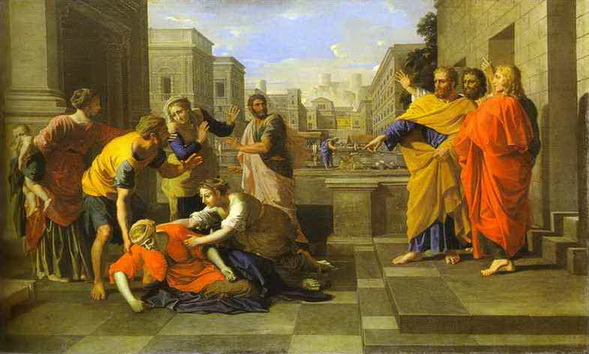
5:1 Now a man named Ananias, together with [emphasizes joint responsibility] his wife Sapphira, also [cf. Barnabas in Acts 4:36-37] sold a piece of property [it is possible they knew about Barnabas’ act; they were motivated to seek praise or recognition for themselves].

5:2 With his wife’s full knowledge he kept back part of the money for himself, but [unlike Barnabas] brought the rest and put it at the apostles’ feet [they wanted people to think they were as generous as Barnabas].

5:3 Then Peter said [Peter was more concerned with the heart of the giver than the money], “Ananias, how is it that Satan [the father of lies and deception (Jn. 8:44)] has so filled your heart that you have lied to the Holy Spirit [this was Ananias’ greater sin] and have kept for yourself some of the money you received for the land?

5:4 Didn’t it belong to you before it was sold [members of the church had a right to own personal property; they were not obligated to sell their property]? And after it was sold, wasn’t the money at your disposal [Ananias did not have to give any of the money to the church; he and his wife could have kept all the proceeds]? What made you think of doing such a thing [they gave some of the money while claiming to have given all of the money; they were trying to appear more generous than they really were]? You have not lied to men but to God [their sin was deceit; this act of deception threatened the unity of the church and was a poor witness to the community].”

Note: Can you recall a time when you gave with an attitude of duplicity? How can we guard against duplicity in our giving and in our lives in general?

5:5 When Ananias heard this, he fell down and died [Luke does not record cause of death, only that he died under the judgment of God.] And great fear seized all who heard what had happened.

5:6 Then the young men came forward, wrapped up his body, and carried him out and buried him.

5:7 About three hours later his wife came in, not knowing what had happened.

5:8 Peter asked her [gave her an opportunity to tell the truth], “Tell me, is this the price you and Ananias got for the land?” “Yes,” she said, “that is the price.”

5:9 Peter said to her [Sapphira could have told the truth but confirmed her guilt by continuing the deception], “How could you agree to test [to see how much they could get away with] the Spirit of the Lord? Look! The feet of the men who buried your husband are at the door, and they will carry you out also.”

5:10 At that moment she fell down at his feet [in contrast to those who laid their gifts at the apostles’ feet (cf. Acts 4:35,37)] and died. Then the young men came in and, finding her dead, carried her out and buried her beside her husband.

5:11 [after this display of God’s judgment] Great fear [a deeper reverence for the Lord] seized the whole church [first use of the term “church” (Gr. ekklesia) in Acts] and all who heard about these events.

Note: What would happen if events like these took place in the lives of believers and churches today? How would you respond if such an event happened in your church?

5:12 The apostles performed many miraculous signs and wonders among the people. And all the believers used to meet together in Solomon’s Colonnade.

5:13 No one else dared join them, even though they were highly regarded by the people.

5:14 Nevertheless, more and more men and women believed in the Lord and were added to their number.

5:15 As a result, people brought the sick into the streets and laid them on beds and mats so that at least Peter’s shadow might fall on some of them as he passed by.

5:16 Crowds gathered also from the towns around Jerusalem, bringing their sick and those tormented by evil spirits, and all of them were healed.

5:17 Then the high priest and all his associates, who were members of the party of the Sadducees, were filled with jealousy.

5:18 They arrested the apostles and put them in the public jail.

5:19 But during the night an angel of the Lord opened the doors of the jail and brought them out.

5:20 “Go, stand in the temple courts,” he said, “and tell the people the full message of this new life.”

5:21 At daybreak they entered the temple courts, as they had been told, and began to teach the people. When the high priest and his associates arrived, they called together the Sanhedrin—the full assembly of the elders of Israel—and sent to the jail for the apostles.

5:22 But on arriving at the jail, the officers did not find them there. So they went back and reported,

5:23 “We found the jail securely locked, with the guards standing at the doors; but when we opened them, we found no one inside.”

5:24 On hearing this report, the captain of the temple guard and the chief priests were puzzled, wondering what would come of this.

5:25 Then someone came and said, “Look! The men you put in jail are standing in the temple courts teaching the people.”

5:26 At that, the captain went with his officers and brought the apostles. They did not use force, because they feared that the people would stone them.

5:27 Having brought the apostles, they made them appear before the Sanhedrin to be questioned by the high priest.

5:28 “We gave you strict orders not to teach in this name,” he said. “Yet you have filled Jerusalem with your teaching and are determined to make us guilty of this man’s blood.”

5:29 Peter and the other apostles replied: “We must obey God rather than men!

5:30 The God of our fathers raised Jesus from the dead—whom you had killed by hanging him on a tree.

5:31 God exalted him to his own right hand as Prince and Savior that he might give repentance and forgiveness of sins to Israel.

5:32 We are witnesses of these things, and so is the Holy Spirit, whom God has given to those who obey him.”

5:33 When they heard this, they were furious and wanted to put them to death.

5:34 But a Pharisee named Gamaliel, a teacher of the law, who was honored by all the people, stood up in the Sanhedrin and ordered that the men be put outside for a little while.

5:35 Then he addressed them: “Men of Israel, consider carefully what you intend to do to these men.

5:36 Some time ago Theudas appeared, claiming to be somebody, and about four hundred men rallied to him. He was killed, all his followers were dispersed, and it all came to nothing.

5:37 After him, Judas the Galilean appeared in the days of the census and led a band of people in revolt. He too was killed, and all his followers were scattered.

5:38 Therefore, in the present case I advise you: Leave these men alone! Let them go! For if their purpose or activity is of human origin, it will fail.

5:39 But if it is from God, you will not be able to stop these men; you will only find yourselves fighting against God.”

5:40 His speech persuaded them. They called the apostles in and had them flogged. Then they ordered them not to speak in the name of Jesus, and let them go.

5:41 The apostles left the Sanhedrin, rejoicing because they had been counted worthy of suffering disgrace for the Name.

5:42 Day after day, in the temple courts and from house to house, they never stopped teaching and proclaiming the good news that Jesus is the Christ.

Acts 4

4:1 The priests [mostly Sadducees] and the captain of the temple guard [a high-ranking Sadducee; kept order in and around the temple] and the Sadducees came up to Peter and John while they were speaking to the people [at Solomon’s Colonnade (cf. Acts 3:11)].

4:2 They [especially the Sadducees who did not believe in the resurrection of the dead] were greatly disturbed [irritated; annoyed] because the apostles were teaching the people and proclaiming in Jesus the resurrection of the dead [this teaching contradicted beliefs of the Sadducees].

4:3 They seized [arrested] Peter and John, and because it was evening [too late to hold an official inquiry], they put them in jail until the next day.

4:4 But many who heard the message [religious leaders arrested the messengers but could not stop the message] believed, and the number of men [not counting women and children] grew to about five thousand.

4:5 The next day the rulers [perhaps Sadducees], elders [heads of families] and teachers [scribes; professional interpreters of the law] of the law [these made up the Sanhedrin; same council that had condemned Jesus to death (cf. Lk. 22:66); consisted of seventy regular members plus the high priest] met in Jerusalem.

Within hours of Peter’s and John’s arrest, the same council of men that had condemned Jesus to death (Luke 22:66) assembled in Jerusalem. Charged with the responsibility of protecting the Jewish faith, the powerful members of the Sanhedrin (see Acts 4:15) met to assess this latest threat to the faith. The seventy-member council served as the supreme court of the land with the current high priest serving as the presiding officer. Although the members of this elite intellectual group knew the Scriptures, they had failed to recognize Jesus as the Messiah.

4:6 Annas [a former high priest and father-in-law to Caiaphas] the high priest [high priests retained title for life] was there, and so were Caiaphas [the ruling priest; cf. Jn. 18:24], John, Alexander and the other men of the high priest’s family.

Annas was among the dignitaries present that day. Although deposed from the priesthood by the Romans, he retained the title high priest for life. He was perhaps the most powerful political figure among the Jews and functioned in something of a “godfather” role. Caiaphas, the current high priest, and his father-in-law Annas were instrumental in the conviction of Jesus a few months earlier. These men now met to consider what to do about Jesus’ troublesome followers.

4:7 They had Peter and John [and the healed man as per 4:14] brought before [or “in the middle” of] them and began to question them: “By what power or what name did you do this [the message and the miracle of healing of the lame man]?”

After spending a night in jail, Peter and John were summoned before the Sanhedrin. Caiaphas, the presiding officer, most likely started the interrogation. He asked by what kind of power or what name they had used to heal the lame beggar—suggesting they might have used a magic formula such as those used by exorcists.

4:8 Then [in response to their question] Peter, filled with [empowered by] the Holy Spirit, said [under the guidance of the Holy Spirit (cf. Matt. 10:18-20)] to them [note that Peter was respectful…]: “Rulers and elders [members of the Sanhedrin] of the people!

Jesus had promised His disciples that the Holy Spirit would give them the words (Luke 12:11-12) and wisdom (Luke 21:14-15) to defend themselves when they encountered opposition (Matt. 10:18-20). Peter experienced the fulfillment of that promise as he stood before the Sanhedrin. Filled or empowered by the Holy Spirit, Peter stood his ground and spoke the truth courageously yet courteously.

4:9 If [or “since”] we are being called to account today for an act of kindness shown to a cripple [one who was weak, helpless, powerless, and dependent on others] and are asked how he was healed [made whole; this word is translated “to be saved” in verse 12],

Ironically, Peter and John were called to account for performing an act of kindness. The religious leaders could not deny that the lame man had been healed because he stood before them as Exhibit A (see Acts 4:14). They knew the man and had likely walked past him every time they entered the temple complex (see Acts 3:2). Perhaps some of them had even given him alms or prayed for him. Yet Peter and John did for this man what no one else had been able to do—they healed him in the name of Jesus.

While God may not use us to heal someone, we can meet others’ physical needs in many ways, such as giving clothes to people who need them, providing food for hungry people, and building homes for the homeless. Such acts of kindness often open doors that allow us to share the gospel with others.

4:10 then know this, you [rulers and elders] and all the people of Israel: It is by the name of Jesus Christ of Nazareth [Jesus of Nazareth was the promised Messiah], [Peter the accused became Peter the accuser…] whom you crucified but whom God raised from the dead, that this man stands before you healed.

Peter addressed his reply to the Sanhedrin as well as to all the people of Israel. As he stood before an assembly of the most important religious leaders in Jerusalem, Peter the accused became the accuser. Without hesitation he attributed the healing to Jesus the Christ—a term that clearly identified Jesus as God’s promised Messiah. The religious leaders and the people had crucified Him but God raised Jesus from the dead, thus affirming that He is indeed the Messiah and God’s own Son (see Rom. 1:4).

4:11 He [Jesus Christ] is [cf. Ps. 118:22] “‘the stone you builders rejected [implies contempt or scorn], which has become the capstone [or cornerstone; the reference point for aligning the other stones in the building].’

4:12 [cf. 1 Tim. 2:5] Salvation is found in no one else [cf. Jn. 14:6], for there is no other name under heaven given to men by which we must be saved.”

Without concern for any negative consequences, Peter proclaimed that salvation comes only through Jesus.  Other religions may have prophets or charismatic leaders, but only Christianity offers the world a Savior who is uniquely qualified to save people from their sins.

In an age that celebrates tolerance and pluralism, we must be ready to face the heat of political incorrectness and possibly the charge of ‘hate crime’ as we witness to Christ’s exclusive claims. Salvation is not available from any political, religious, or ideological leader. Salvation is found in no other name under heaven but the name of Jesus.

4:13 When they [the members of the Sanhedrin] saw the courage [boldness] of Peter and John and realized that they were unschooled [did not have rabbinical training], ordinary men [laymen], they were astonished and they took note that these men had been with Jesus.

The members of the Sanhedrin were amazed at the boldness of Peter and John. Peter spoke with confidence and articulated his defense with an eloquence that puzzled the influential Jewish scholars. They recognized that these ordinary fishermen had no formal rabbinical training nor did they have any religious credentials.

Perhaps some of those present had heard Jesus teach in the temple complex and wondered, “How does He know the Scriptures, since He hasn’t been trained?” (John 7:15). And now, the uneducated and untrained followers of Jesus displayed a similar ability to speak and gave evidence that they had been with Jesus.

4:14 But since they could see the man who had been healed standing there with them, there was nothing they could say [the evidence left them speechless].

4:15 So they ordered them to withdraw from the Sanhedrin and then conferred together.

4:16 [perhaps Gamaliel (cf. Acts 5:34; 22:3) was the source re: what was said in this meeting] “What are we going to do with these men?” they asked [the Jewish Council members were obviously concerned and in a quandary]. “Everybody living in Jerusalem knows they have done an outstanding miracle, and we cannot deny it.

4:17 But to stop this thing from spreading any further [they wanted to maintain the status quo; damage control] among the people, we must warn these men to speak no longer to anyone in this name [Jesus’ name].”

4:18 Then they called them in again and commanded [probably used intimidating tone] them not to speak or teach at all [to completely or entirely stop] in the name of Jesus.

The members of the Sanhedrin found themselves in an awkward predicament. Peter and John had not broken any laws and had the support of the people. In order to save face and to try to contain the situation, the council decided to scare Peter and John into silence. They called them back into the room and ordered them to completely stop preaching or teaching in the name of Jesus. This warning would serve as the foundation for taking additional punitive action against them should they disobey the order (see Acts 5:28,40).

Satan’s agenda remains the same today—to silence and discredit God’s people. Sadly, too many in the church have become entangled in that agenda.

4:19 But Peter and John replied [they boldly rejected the ban on speaking in Jesus’ name], “Judge for yourselves whether it is right in God’s sight to obey you rather than God [the will of the Council was at odds with the will of God; cf. Acts 5:29].

The Sanhedrin had asked Peter and John to do the one thing they could not do—to remain silent about Jesus. Peter and John were not interested in doing what was popular, expedient, or safe. They were interested in doing what was right in the sight of God! Therefore, because the order of the Council was at odds with Jesus’ command to witness (Acts 1:8) they rejected the ban on speaking about Jesus. In so doing they joined the ranks of the Jewish midwives (Ex. 1), Moses’ parents (Heb. 11:23), Daniel, (Dan. 1 and 6), and Daniel’s three friends (Dan. 3)—all conscientious objectors who disobeyed authorities in order to serve God.

4:20 For we cannot help speaking [because they were utterly convinced of the truth of the gospel] about what we have seen and heard.”

Peter and John could not remain silent, regardless of the consequences. They were eyewitnesses to Jesus’ entire ministry. They knew that He was resurrected from the dead and were utterly convinced of the truth of the gospel. Like Paul, they felt obligated to those without Christ (see Rom. 1:14) and would not keep the good news about Jesus to themselves.

4:21 After further threats they let them go. They could not decide how to punish them, because all the people were praising God [this should have made the religious leaders happy] for what had happened.

4:22 For the man who was miraculously healed was over forty years old [accentuates the significance of the miracle and why the people were thrilled that he had been healed].

4:23 On their release, Peter and John went back to their own people [other believers] and reported all that the chief priests and elders had said to them.

4:24 When they heard this [the account of Peter and John’s He arrest/persecution] they raised their voices together in prayer to God. “Sovereign Lord [from Gr. “despota” (used also in Lk. 2:29; 2 Pet. 2:1; Jude 1:4; Rev. 6:10); reminder that God is powerful and in control],” they said, [cf. Ps. 146:6; Isa. 37:16] “you made the heaven and the earth and the sea, and everything in them.

4:25 You spoke by the Holy Spirit through the mouth of your servant, our father David [cf. Ps. 2:1-2]: “‘Why do the nations rage and the peoples plot in vain?

4:26 The kings of the earth take their stand and the rulers gather together against the Lord and against his Anointed One. ‘

4:27 Indeed Herod and Pontius Pilate met together with the Gentiles and the people of Israel in this city to conspire against your holy servant Jesus, whom you anointed.

4:28 They did what your power and will had decided beforehand should happen [reminder that God is sovereign].

4:29 Now, Lord, consider their threats and enable your servants to speak your word with great boldness [notice that they did not ask God to remove threats or danger of persecution but to enable them to continue speaking with boldness].

4:30 Stretch out your hand to heal and perform miraculous signs and wonders [these would confirm their message] through the name of your holy servant Jesus.”

4:31 After they prayed, the place where they were meeting was shaken [an indication of that God had heard their prayer]. And they were all filled [the purpose of the filling was to empower them to witness] with the Holy Spirit and spoke the word of God boldly.

After further threats, the Sanhedrin released Peter and John who went and reported to their own fellowship what had happened. After listening to their report, the believers entered into a time of prayer. They did not pray for relief from persecution but for complete boldness to continue speaking His message.

After praying, the place where they were assembled was shaken—an indication that God had heard their prayer. And, the Holy Spirit filled or empowered those present to speak God’s message with boldness. Boldness follows filling. The Holy Spirit still empowers believers today to speak God’s message with complete boldness.

4:32 All the believers were one [unity] in heart and mind. No one claimed that any of his possessions was his own [unselfish spirit], but they shared [they did so voluntarily, lovingly, and spontaneously; an expression of unity] everything they had.

These final verses are a window into the early church and its inner workings. While persecution can have a demoralizing impact upon believers, the arrest of Peter and John drew the early church together. The believers in Jerusalem were of one heart and soul. One of the evidences of this unity was their unselfish and giving spirit. The believers lovingly and voluntarily shared everything they had with those in need.

Sharing financial resources is a way to meet others’ physical needs and also expresses Christian love and promotes unity in the church. The world recently took notice of Christians who responded with outpourings of love, time, and resources in the wake of tsunamis, hurricanes, and earthquakes. This is to be a continual lifestyle for followers of Jesus.

4:33 With great power [provided by the Holy Spirit] the apostles continued to testify [apostles maintained focus on proclaiming the gospel; the church did not just focus on the needs of the saints] to the resurrection of the Lord Jesus, and much grace [enabled these believers to share goods and proclaim Christ] was upon them all.

The apostles maintained their focus on proclaiming the gospel. Ignoring the threats of the Sanhedrin, they continued to testify to the resurrection of the Lord Jesus with the power provided by the Holy Spirit. Their message was validated by the generosity and kindness of the believers to those in need. This unselfish sharing made it obvious that Christ had made a difference in their lives and gave evidence that great grace, or God’s favor and blessing, was on all of them.

4:34 There were no needy persons among them [cf. Acts 4:32b; a testimony to the mutual love among believers; cf. Deut. 15:1-11]. For from time to time [when a genuine need arose] those who owned lands or houses sold [voluntary, spontaneous act of sacrificial love] them, brought the money from the sales

Note: What are some situations that usually cause you to feel more inclined to give sacrificially to help another in need?

4:35 and put it at the apostles’ feet [a gesture of submission to Christ whom the apostles represented; indicates they trusted the apostles completely; implies a giving up of rights to the property/proceeds], and it was distributed to anyone as he had need [Gr. “chreia” can refer to needs in general or someone poor enough to be dependent on others (cf. 1 Jn. 3:17)].

Because of the kindness the believers had demonstrated toward those in need, there was not a needy person among them. Those who had assets such as lands or houses voluntarily sold them and made the proceeds available to the apostles. The apostles in turn distributed these resources to anyone who had a need. In this way the needs of all the believers in Jerusalem were met. No believer in the fellowship had to beg for bread or suffer indignities because of the lack of financial resources.

We give evidence of the Spirit’s work in our lives by sharing our financial resources with others. Sharing financial resources is a way in which to express Christian love and to promote unity in the church. However, giving money should never preclude our personal involvement in the lives of others.

4:36 Joseph, a Levite [tribe with priestly role; in earlier times Levites forbidden from owning land (Num. 18:20; Deut. 10:9)] from Cyprus, whom the apostles called Barnabas (which means Son of Encouragement [a nickname that described his character and his work]),

4:37 sold [a voluntary act] a field he owned [likely that restrictions on Levites owning property were no longer observed at this time] and brought the money [all of the proceeds or the sale] and put it at the apostles’ feet.

Note: What are ways in which you can share what you have with those in need? What could help you become more like Barnabas? How can you involve your family in giving to God’s work?

Acts 3

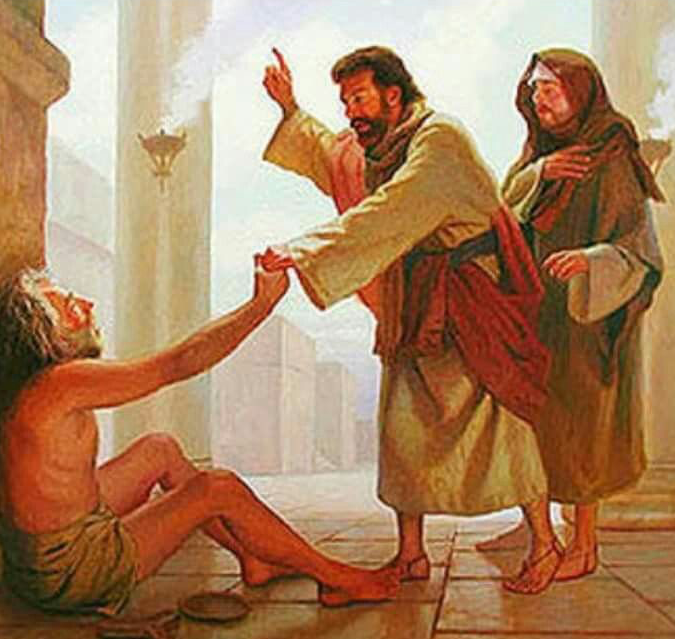
3:1 One day Peter and John were going up [perhaps suggests climbing the steps which led up into the temple] to the temple at the time of prayer [Jews observed prayer in the morning (9:00 AM), afternoon (3:00 PM), and evening (sunset)]—at three in the afternoon [“the ninth hour” (KJV)].

3:2 Now a man crippled from birth [the man was forty years old (Acts 4:22)] was being carried [accentuates the helplessness of the man and his dependence on the kindness of others; cf. Lk. 5:18] to the temple gate called Beautiful [only Luke mentioned a gate by this name], where he was put every day to beg [probably his only means of support] from those [beggars probably believed they were more likely to receive help from religious people at the temple] going into the temple courts.

3:3 When he saw Peter and John about to enter, he asked them for money.

3:4 Peter looked straight at him, as did John. Then Peter said, “Look at us [possibly indicates that the beggar avoided looking directly at those from whom he asked alms]!”

3:5 So the man gave them his attention, expecting [expectant faith honors God and God honors expectant faith] to get something from them.

3:6 Then Peter said, “Silver or gold I do not have, but what I have I give you. In the name of [by the authority and power of] Jesus [Gr. equivalent of Heb. Joshua; means Savior] Christ [Messiah; Anointed One] of Nazareth, walk [Peter gave the man what he really needed rather than what he had asked for; the man got more than he expected (cf. Eph. 3:20-21)].”

3:7 Taking him by the right hand, he [Peter] helped him up, and instantly [the healing was immediate and complete] the man’s feet and ankles became strong [his feet and ankles had never been able to support him].

3:8 He jumped to his feet and began to walk. Then he went with them into the temple courts, walking and jumping [cf. Isa. 35:6], and praising God [he gave God the credit for his healing].

3:9 When all the people saw him walking and praising God [the beggar continued to give God credit for his healing],

3:10 they recognized him as the same man who used to sit begging at the temple gate called Beautiful, and they were filled with wonder and amazement at what had happened to him.

3:11 While the beggar held on to [perhaps an indication of gratitude] Peter and John, all the people were astonished and came running to them in the place called Solomon’s Colonnade [a favorite meeting place of the early Christians (cf. Acts 5:12); ran along the length of the eastern side of the court of the Gentiles].

3:12 When Peter saw this [the astonishment of the people], he said to them [Peter took advantage of the opportunity to preach a sermon]: “Men of Israel, why does this surprise you? Why do you stare at us as if by our own power or godliness [holiness, piety] we had made this man walk?

3:13 The God of Abraham, Isaac and Jacob [cf. Ex. 3:6], the God of our fathers [cf. Ex. 3:15], has glorified [honored or exalted; the purpose of the miracle] his servant Jesus [cf. Jn. 13:31-32; Phil. 2:9]. You handed him over to be killed [an event that had happened in Jerusalem only weeks earlier], and you disowned him before Pilate, though he had decided to let him go.

3:14 You disowned the Holy and Righteous One [cf. Isa. 53:11] and asked that a murderer [Barabbas; what a contrast to Jesus who was holy and righteous] be released to you [cf. Lk. 23:13-25].

3:15 You killed the author [may also be translated ruler, leader, founder] of life, but God [cf. 1 Cor. 6:14; Heb. 13:20] raised him from the dead. We [Peter, John, and others] are witnesses [cf. 1 Cor. 15:5-8] of this.

3:16 By faith in the name of Jesus, this man whom you see and know [the healed man’s identity and condition was no secret] was made strong. It is Jesus’ name and the faith that comes through him that has given this complete healing to him, as you can all see [the man’s condition was obvious].

3:17 “Now, brothers, I know that you acted in ignorance [cf. Eph. 4:18], as did your leaders.

3:18 But this is how God fulfilled what he had foretold through all the prophets [cf. Ps. 22, Isa. 50:6; Isa. 53:1-12], saying that his Christ would suffer [Jews were expecting a conquering Messiah].

3:19 Repent, then, and turn to God, so that your sins may be wiped out [erased; completely forgiven], that times of refreshing may come from the Lord,

3:20 and that he may send the Christ, who has been appointed for you—even Jesus.

3:21 He must remain in heaven until the time comes for God to restore everything, as he promised long ago through his holy prophets.

3:22 For Moses said, ‘The Lord your God will raise up for you a prophet like me from among your own people; you must listen to everything he tells you.

3:23 Anyone who does not listen to him will be completely cut off from among his people.’

3:24 “Indeed, all the prophets from Samuel on, as many as have spoken, have foretold these days.

3:25 And you are heirs of the prophets and of the covenant God made with your fathers. He said to Abraham, ‘Through your offspring all peoples on earth will be blessed.’

3:26 When God raised up his servant, he sent him first to you to bless you by turning each of you from your wicked ways.”

Acts 2

Outline
Gift of the Spirit — 2:1-3
Witness of the Disciples — 2:4-6
Responses of the People — 2:7-13
Response of Peter — 2:14-36
Conviction — 2:37
Conversion — 2:38-41
Church Ministries — 2:42-47

2:1 When the day of Pentecost [Gr. “pentekostos” means “fifty” or “fiftieth” because Pentecost celebrated 50 days after Passover (cf. Lev. 23:15-16)] came, they [cf. Acts 1:15] were all together in one place [most likely the upper room mentioned in 1:13].

After the ascension of Jesus (Acts 1:9-11), the disciples returned to Jerusalem (Acts 1:12). They gathered in an upper room (Acts 1:13), along with other believers, and spent time together in prayer (Acts 1:14). Peter also spoke to those assembled concerning choosing a replacement for Judas (Acts 1:15-22). Matthias was chosen as Judas’ successor by means of prayer and the casting of lots (Acts 1:23-26).

Pentecost is one of three major annual festivals celebrated by the Jews. Pentecost, meaning “fifty,” was celebrated fifty days after Passover (Lev. 23:15-16). This festival was also known as the Feast of the Firstfruits. When the day of Pentecost had arrived, or was being fulfilled, “about a hundred and twenty” (Acts 1:15) believers were assembled together in one place. Most likely these believers were praying together (Acts 1:14) in the upper room (Acts 1:13). They would experience a day of Pentecost unlike any other and would be used by God to usher in the firstfruits of a spiritual harvest that continues to our day.

Note: Three major annual feasts celebrated by the Jews:
1. Passover
2. Pentecost
3. Feast of Tabernacles

2:2 [audible evidence of the Spirit’s coming] Suddenly [without warning] a sound [suggests that they heard but did not necessarily feel a rush of wind] like [compared to; resembling] the blowing of a violent [like a tornado] wind [Gr. “pnoes” means “wind” and “pneuma” means “spirit”; a symbol of power (e.g., Ex. 14:21; 1 Kings 19:11)] came from heaven [the source of the sound] and filled the whole house [upper room as per 1:13] where they were sitting.

The Holy Spirit arrived suddenly and made His presence known in an audible way. Those present heard a sound comparable to that created by a violent rushing wind or tornado. Wind often was used as a symbol of God’s power (Ex. 14:21) and presence (2 Sam. 5:24). The disciples heard but did not necessarily feel this violent rush of wind. The Greek words for wind and spirit are similar in sound and spelling. The Holy Spirit is like the wind—unseen but not unnoticed (John 3:8) and available in limitless supply. We who are Christians today have the Holy Spirit dwelling in us, and His power is thus available to help us as we witness.
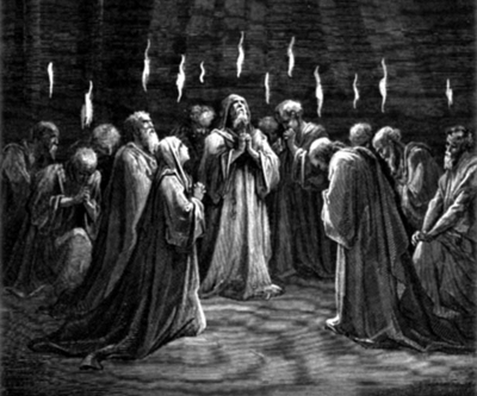
2:3 [visual evidence of the Spirit’s coming] They saw what seemed to be tongues of fire [a symbol of power (1 Kings 19:12); God’s presence (Ex. 3:2; 13:21); cleansing (Isa. 6:6-7; Rev. 3:18); and judgment (Deut. 4:24); cf. John the Baptist’s words in Lk. 3:16; no indication that those present felt heat or burning] that separated and came to rest on each of them [God’s Spirit is available to all believers].

The Holy Spirit also made His presence known in a visual way, appearing as fire. Fire often was used as a symbol of God’s presence (Ex. 3:2-4; 13:21), power (1 Kings 19:12), and cleansing (Isa. 6:6-7). There is no indication that those present felt any physical heat or burning from this fire.

This unusual fire resembled the shape of a tongue—a symbol of speech and communication. These flames of fire separated and settled on each person present, suggesting that God’s Spirit is available to all believers. The Holy Spirit empowered these believers and employed their tongues to proclaim God’s message in a supernatural way. He still desires to use our tongues as instruments to share the divine message that can ignite a fire in the hearts of others.

2:4 [oral evidence of the Spirit’s coming] All [not just the apostles] of them [believers in Jesus] were filled with the Holy Spirit [cf. promise of Jesus in Jn. 14:17; cf. Lk. 24:49] and began to speak in other tongues [known languages previously unknown to those speaking them; not ecstatic utterances or “glossalalia” of 1 Cor. 12–14; cf. Acts 10:46: 19:6] as the Spirit [the Person of power who sovereignly bestows gifts on believers] enabled [for this particular occasion] them.

All of those present were filled with the Holy Spirit, thus fulfilling the promise of John 14:17 that the Spirit “will be in you.” To be filled means that they received all of the Spirit’s presence they could contain and that the indwelling Spirit controlled their lives. As a result, the Spirit enabled these believers to speak of God’s mighty deeds (Acts 2:11) in different languages.

The word languages does not refer to ecstatic or unintelligible utterances, but rather to known languages and dialects previously unknown to those speaking them. The people of various nationalities (Acts 2:8-11) present at the feast clearly understood what was being spoken.

Today, many people groups are still waiting to read or hear the gospel in their own languages. Through the initiatives of missionaries and Bible translators, more and more people are learning of the wonders of God and of His love for them.

Note: D. L. Moody reportedly said, “You might as well try to see without eyes, hear without ears, or breathe without lungs, as to try to live the Christian life without the Holy Spirit.”

2:5 Now there were staying [some had been there since Passover and knew about Jesus’ death and had likely heard reports of His resurrection] in Jerusalem God-fearing [devout; pious] Jews from every nation [Jews of the Diaspora] under heaven.

Devout or pious Jewish people from every nation under heaven resided in Jerusalem. These were Jews of the Diaspora whose families had been driven from Jerusalem and scattered among the Gentile world but who had returned to Jerusalem to dwell there. Many of those present had been born and raised in other countries and spoke other languages. These Jews, as well as pilgrims visiting Jerusalem, were likely aware of the crucifixion of Jesus and rumors of His resurrection.

2:6 When they heard this sound [perhaps both the sound of the violent wind and the languages being spoken], a crowd came together in bewilderment, because each one heard [without the aid of an interpreter] them speaking in his own language [Gr. “dialekto”].

Those empowered by the Holy Spirit did not stay in the upper room but instead bolted! They poured out into the streets declaring the wonders of God (Acts 2:11). The sound of so many languages being spoken at the same time attracted a crowd. The multi-lingual crowd was astonished at hearing their native dialects being spoken by Galileans.

The Holy Spirit continues to help Christians today to communicate the gospel clearly in words people can understand. The word language translates the Greek word “dialekto” from which we get our English word “dialect.” God intended for all peoples to hear the gospel in their own languages.

Today, the Bible has been translated into 2300 of the world’s 6913 languages. Many of the 272 million people without the Bible in their native languages are still waiting to hear what the Jews in Jerusalem heard on the day of Pentecost.

2:7 Utterly amazed, they asked: “Are not all these men who are speaking Galileans?

2:8 Then how is it that each of us hears [without the aid of an interpreter] them in his own native language [the purpose of this occurrence of “tongues” was to get the gospel message out to the world]?

2:9 Parthians, Medes and Elamites; residents of Mesopotamia, Judea and Cappadocia, Pontus and Asia,

2:10 Phrygia and Pamphylia, Egypt and the parts of Libya near Cyrene; visitors from Rome

2:11 (both Jews and converts to Judaism Cretans and Arabs—we hear them declaring the wonders of God [this was the content of their speeches] in our own tongues!”

2:12 Amazed and perplexed, they asked one another, “What does this mean?”

2:13 Some, however, made fun of them and said, “They have had too much wine [a senseless explanation that does not account for how “drunks” could so clearly speak a language they had not previously spoken].”

Luke recorded the responses of those in Jerusalem who heard Christ’s followers speaking in other languages. Some of the people who witnessed the remarkable events on the day of Pentecost were bewildered (v. 6). Others were “utterly amazed” (v. 7) and likely stood around with their mouths opened wide. Still others were curious (vv. 8-11) and asked one another, “What does this mean?” (v. 12). And, as always, some scoffed and said, “They have had too much wine” (v. 13).

2:14 Then Peter [spokesman for the disciples] stood up [Peter’s confidence came from the Holy Spirit] with [suggests the others stood with Peter] the Eleven [the other apostles], raised his voice and addressed [means to speak seriously; the first of Peter’s sermons in Acts; Peter’s response to the charge of drunkenness (2:13); sermon was simple, scriptural, and Christ-centered (Swindoll)] the crowd [all those gathered in the Temple area for the Feast of Pentecost]: “Fellow Jews and all of you who live in Jerusalem, let me explain this [behavior of the disciples] to you; listen carefully to what I say [behavior of the disciples was related to fulfillment of Joel’s prophecy; cf. Joel 2:28-32; Acts 2:14-21; Jesus of Nazareth is the long-awaited Messiah (2:14-36)].

The charge of drunkenness became the occasion for Peter’s first and perhaps most influential sermon. Peter, filled and emboldened by the Holy Spirit, stood up and addressed the crowd of people (v. 14). He dismissed the charge of drunkenness as unreasonable, pointing out that it was too early in the day for someone to be drunk (v. 15). Peter then offered an explanation of what had happened.

2:15 These men are not drunk, as you suppose. It’s only nine in the morning!

2:16 No, this is what was spoken by the prophet Joel [cf. Joel 2:28-32]:

2:17 “‘In the last days [the time between Jesus’ first and second comings], God says, I will pour out my Spirit on all [refers to those who are born again] people [all races and nationalities]. Your sons and daughters [cf. Acts 21:8-9 re: the daughters of Philip the evangelist] will prophesy [proclaim God’s saving message], your young men will see visions [a means used by God to reveal Himself to people], your old men will dream dreams [a means used by God to reveal Himself to people].

Peter anchored the miraculous events of Pentecost in the Old Testament (vv. 16-21). He told the crowd that what they had witnessed was the fulfillment of the prophecy found in Joel 2:28-32. Joel spoke of a time when God would pour out His Spirit on all people (v. 17). As a result, they would all prophesy, or proclaim God’s saving message (v. 18). The time Joel had spoken of had finally come. The Holy Spirit was now available to empower all of God’s people for service, without regard to sex or age (vv. 17,18). The Holy Spirit, Peter said, was responsible for transforming ordinary people into people of power.

Have you ever thought of yourself as a person of power? Wealth and material possessions make some people feel powerful. Others feel powerful because they occupy positions of authority. But, as a believer, you have the greatest power of all available to you. And, the best part is, you do not have to be wealthy or in a position of authority to tap into this power. The Holy Spirit resides within you and stands ready to give you the power to have a part in advancing the gospel.

2:18 Even on my servants, both men and women, I will pour out my Spirit in those days, and they will prophesy.

2:19 I will show wonders in the heaven above and signs on the earth below, blood and fire and billows of smoke.

2:20 The sun will be turned to darkness and the moon to blood before the coming of the great and glorious day of the Lord.

2:21 And everyone [including Gentiles] who calls on the name of the Lord will be saved.’

2:22 “Men of Israel [Jews], listen to this: Jesus of Nazareth was a man [incarnation] accredited [publicly endorsed] by God to you by miracles [mighty works; indicates manifestation of power], wonders [calls attention to impression made upon those who witnessed miracles] and signs [indicates miracles were to direct attention of people to God], which God did [miracles were expressions of God’s power working through Jesus] among you through him, as you yourselves know [many of those present had either witnessed or heard of the miracles of Jesus].

2:23 This man was handed over to you by God’s set purpose and foreknowledge; and you [accused Jews of participation in Jesus’ death], with the help of wicked men [Romans], put him to death by nailing him to the cross [crucifixion].

2:24 But God [responsible for the resurrection] raised him from the dead [one of two references to the resurrection in Peter’s sermon (see also 2:32); many had seen the risen Christ], freeing him from the agony of death, because it was impossible for death to keep its hold on him [the Creator and Author of life].

2:25 David said [Ps. 16:8-11] about him [the Messiah]: “‘I saw the Lord always before me. Because he is at my right hand, I will not be shaken.

2:26 Therefore my heart is glad and my tongue rejoices; my body also will live in hope,

2:27 because you will not abandon me to the grave, nor will you let your Holy One see decay [Jesus’ body did not remain in the grave to decay].

2:28 You have made known to me the paths of life; you will fill me with joy in your presence.’

2:29 “Brothers, I can tell you confidently that the patriarch David died and was buried [therefore David was not writing about himself], and his [David’s] tomb [possibly located near pool of Siloam on south side of Jerusalem] is here to this day.

2:30 But he [David] was a prophet [because he wrote of One who would be resurrected from the dead] and knew that God had promised him on oath [cf. Ps. 132:11; 2 Sam. 7:15-16] that he [God] would place one of his [David’s] descendants on his throne.

2:31 Seeing what was ahead, he spoke of the resurrection of the Christ, that he was not abandoned to the grave, nor did his body see decay.

2:32 God has raised this Jesus to life [His tomb was close by and open to inspection], and we are all witnesses of the fact.

2:33 Exalted to the right hand [position of honor, authority, and equality] of God [cf. Acts 5:30-31; Eph. 1:20; Col. 3:1; Heb. 1:3; 8:1; 10:12; 12:2; 1 Pet. 3:22], he has received from the Father the promised Holy Spirit and has poured out what you now see and hear.

2:34 For David did not ascend to heaven, and yet he said [Ps. 110:1; this verse occurs 13 times in NT; most quoted OT verse in NT], “‘The Lord said to my Lord: “Sit [indicates completion of task] at my right hand

2:35 until I make your enemies a footstool for your feet.”‘

2:36 “Therefore let all Israel be assured of this: God has made this Jesus, whom you crucified, both Lord and Christ [glorification].”

As the crowd continued to listen attentively, Peter spoke about the life and works of Jesus (v. 22). Many of those listening knew of the “miracles, wonders and signs” (v. 22) which Jesus had performed through God’s power. Many of them also knew about the recent arrest, trial, and crucifixion of Jesus, which was part of God’s divine plan to redeem sinful humanity (v. 23). Death, however, could not hold Jesus (v. 24). Peter presented various proofs to support the claim that God raised Jesus from the dead (v. 25-35). Peter called upon his listeners to know with certainty that God declared Jesus, whom they crucified, both Lord and Christ (v. 36).

2:37 When the people heard this, they were cut to the heart [from Gr. katanussõ which means to be pierced or stabbed with a sharp point; suggests deep conviction; cf. John 16:8 and Heb. 4:12-13] and said to Peter and the other apostles, “Brothers, what shall we do?”

Perplexed by what they heard, the international crowd asked the question, “What could this be?” (Acts 2:12). This question became the springboard for Peter’s first sermon. Empowered by the Holy Spirit, Peter stood up and put the events of that day and also the life, crucifixion, and resurrection of Christ into Scriptural context.

When the people heard what Peter had to say they were pierced to the heart or profoundly convicted. It is likely that some of those present had cried “Crucify Him!” in Pilate’s hall (Matt. 27:22). Now they asked, “Brothers, what must we do?” Peter would later write that we should always be prepared to give an answer to those who ask us about the hope that we have (1 Pet. 3:15).

2:38 Peter replied, “Repent [from Gr. metanoeo which means to turn from sin and to Christ, the One who can solve the sin problem; change of heart and mind (adopt a different view of Christ) that results in a change of direction; means more than feeling sorry for past behavior; urgency: do it now!] and [implies a process; baptism is a response to repentance] be baptized [beautiful picture of death, burial, resurrection of Jesus and of believer’s death to sin and resurrection to new life in Christ (Rom. 6:2-7); outward display of inner conviction], every one of you [Peter’s message is for all people], in the name of Jesus Christ [acknowledge Him as Messiah and Lord] for [Greek preposition eis which can also be translated to mean “on the ground of” or “on the basis of”] the forgiveness of your sins. And you will receive [at the point of becoming a Christian] the gift of the Holy Spirit.

Peter answered the crowd’s question by telling them to repent, or to turn from their sin to Christ— the only One capable of solving their sin problem. In addition, Peter told the crowd that they should be baptized—not to receive forgiveness of sins, but as a testimony that they had already received forgiveness through their repentance and faith in Jesus. As believers, Peter assured them that they too would receive the gift of the Holy Spirit. God’s promise in Joel 2:32 was for them, their children, and even extended to all whom the Lord our God will call.

2:39 The promise is for you [personal application] and your children [generational application] and for all who are far off [global application; Gentiles]—for all [including future generations] whom the Lord our God will call.”

2:40 With many other words [indicates Luke only recorded a part of Peter’s sermon] he warned them; and he pleaded [to call, beseech, exhort, comfort] with them, “Save yourselves from [only way to do this was by becoming followers of Christ] this corrupt [crooked or perverse; Gr. word for perverse is skolios which means twisted, winding] generation [Peter spoke to people who had witnessed the Messiah’s coming and had rejected Him].”

Luke recorded only a portion of Peter’s sermon. With many other words Peter strongly urged the crowd to do more than avoid hell’s fires. He pleaded with them to save themselves from the influence of their corrupt generation through repentance and faith in Jesus.

Many people today are kept in darkness by our perverse society and its intolerance of Christ’s claim to be the only way of salvation. Jesus came to make provision for our eternal salvation and to empower His followers to live distinctive lives that reflect their heavenly citizenship.

2:41 Those [indicates that not all in the crowd accepted the message] who accepted [to receive] his message were baptized [first step of obedience; public identification with Christ; outward sign of inward decision], and about three thousand were added to their number that day.

Three thousand of those who heard Peter’s message placed their faith in Christ for salvation, were baptized and added to the small number of believers. What a response!

I have often thought that I will look for Peter in heaven and ask him what it was like to preach in Jerusalem on that day and have so many respond. And yet I wonder if Peter will look for us and ask us what it was like to proclaim God’s message throughout the world in the 21st century.

Those who join God on mission today continue the spiritual harvest inaugurated on that first Pentecost after Christ ascended into heaven.

The day of Pentecost began like any other day for Peter and the other followers of Christ. By the end of the day however, their lives would never be the same again. The Holy Spirit empowered these ordinary people for the divine task of sharing the gospel of Christ. As a result of their witness, the church was born and a fire ignited that has swept across countries and centuries.

How did this day begin for you? As a believer, you have the same power available to you that transformed the followers of Christ on the day of Pentecost. You too, can expect people to respond positively to the gospel when they see the results of the power of God’s Spirit in your life and hear your testimony. Will you allow God’s Holy Spirit to govern and guide your life today? Will you allow Him to use you to share Christ with someone today? If so, by the end of this day, your life may never be the same again.

2:42 [note four marks of the Jerusalem church] [1] They devoted [gave constant attention to] themselves to the apostles’ [those who had personally walked with Jesus] teaching [or doctrine; content of teaching was life and teaching of Jesus] and to the [2] fellowship [Gr. “koinonia”; the only use of this word by Luke in the books of Luke and Acts], to the [3] breaking of bread [observing the Lord’s Supper and sharing meals together] and to [4] prayer [essential in life of individual believers and churches].

2:43 Everyone was filled with awe [Gr. “phobos” is common term for fear; reverence], and many wonders [emphasizes the reactions the people had to what God did] and miraculous signs [point beyond the events to the power and purpose behind them] were done by the apostles.

2:44 All the believers were together [suggests unity; together in purpose and spirit] and had everything [their faith in the Lord Jesus] in common [Gr. “koina”].

2:45 Selling their possessions and goods, they gave to anyone as he had need [one person’s need felt by all].

2:46 Every day [consistency matters] they continued to meet [an intentional act] together [we need one another] in the temple courts [public meeting spaces available there]. They broke bread in their homes [this was the beginning of house churches] and ate [mealtimes provided opportunities to share about the beauty of Jesus] together [there are 35 “one another” passages in the NT] with glad and sincere hearts,

2:47 praising [praise is thanking God for who He is and what He has done] God and enjoying the favor of all the people [this general favor ceased after Stephen’s death]. And the Lord added to their number daily those who were being saved [evangelism is an essential function of the church].
Acts 1

1:1 In my former book [Gospel of Luke], Theophilus [means “loved of God” or “friend of God” (Lk. 1:3)], I wrote about all that Jesus began to do and to teach [Acts is record of what Jesus continued to do and teach through His followers]

The book of Acts opens with a brief account of the events between the resurrection and ascension of Jesus (Acts 1:3-11). After His resurrection, Jesus appeared to the disciples at various times “over a period of forty days” (Acts 1:3). During that period, He spoke to the disciples “about the kingdom of God” (Acts 1:3). Jesus used the Old Testament (Luke 24:27) to help the disciples understand the necessity of His death and resurrection (Luke 24:45-46). He also commissioned the disciples to share His message of salvation with all nations (see Luke 24:47 and Matt. 28:19-20).

1:2 until the day he was taken up to heaven, after giving instructions through the Holy Spirit to the apostles [“one sent forth;” they would spread message] he had chosen.

1:3 After his suffering, he showed himself to these men [apostles] and gave many convincing proofs [evidence manifest to the senses to assure the disciples they were not the victims of a delusion] that he was alive. He appeared [not an optical illusion] to them over a period of forty days [only NT passage that notes time between resurrection and ascension] and spoke about the kingdom of God [the rule and reign of God in the hearts of people; kingdom of God is not political or geographical’].

1:4 On one occasion [Lk. 24:43], while he was eating with them [a “convincing proof” that He was alive (cf. 1:3)], he gave them this command [Lk. 24:49]: “Do not leave Jerusalem, but wait [note: disciples not instructed to rush out and spread news about resurrected Christ, instead told to wait for the power to do so effectively; they would need power to spread the message and to endure persecution] for [reason for waiting] the gift my Father promised [outpouring of Holy Spirit (Acts 2:33); cf. Jn. 14:16-17; Lk. 24:49], which you have heard me speak about [cf. Jn. 15:26].

On one occasion prior to His ascension, Jesus commanded His disciples to stay in Jerusalem. Instead of fleeing opposition or going their separate ways, Jesus’ followers were to wait patiently for the Holy Spirit—the gift His Father had promised. Jesus had previously spoken to His disciples about the Holy Spirit’s role (John 14:16-17; Luke 24:49). They would need the Spirit’s power in order to effectively preach the gospel and endure the persecution they would undoubtedly experience.

1:5 For John baptized [means to immerse or totally submerge; Matt. 3:11] with [or “in”] water [John spoke of One who would baptize them “with the Holy Spirit and with fire” (Lk. 3:16)], but in a few days [the time of the Spirit’s coming was near; at Pentecost (Acts 2:4) ten days after Jesus’ ascension] you will be baptized with the Holy Spirit [Through the indwelling of the Holy Spirit, “all that Jesus is, is made available through all that I am.” (Ray Stedman)].”

Jesus reminded His disciples that John had baptized with or immersed others in water. John’s baptism in the Jordan River demonstrated repentance or a willingness to turn from sin. His baptism did not give salvation (in fact, no water baptism gives salvation) but prepared people to welcome the Messiah who would baptize them “with the Holy Spirit and with fire” (Matt. 3:11). In a few days, the Spirit would come to indwell believers at Pentecost. However, from that time on, believers have received the Holy Spirit and been baptized by Him into the Body of Christ—the Church (1 Cor. 12:13)—at the moment of conversion.

Note: “Do not pray for easy lives. Pray to be stronger men. Do not pray for tasks equal to your powers. Pray for powers equal to your tasks.” (Phillips Brooks)

1:6 So when they [apostles] met together, they asked him, “Lord, are you at this time going to restore the kingdom to Israel [restore Israel’s political sovereignty; Israel had been under Roman domination since 63 BC]?”

Jesus spoke to His disciples about the kingdom of God (Acts 1:3). His teaching prompted the disciples to ask a question that was not entirely unreasonable, but reflected their misunderstanding of the kingdom. Like other Jews, they expected the Messiah to set up a political kingdom—restoring Israel to the political sovereignty and glory the nation had enjoyed in the days of King David. On one occasion they had argued among themselves as to who would have the highest rank in the kingdom (Luke 22:24-30). They now wondered if Jesus was going to free the nation from Roman rule.

1:7 He said to them: “It is not for you to know the times [general period of an event] or dates [precise time of an occurrence] the Father has set by his own authority.

Jesus gently rebuked the disciples for asking about God’s timetable for the restoration of the kingdom. The Father alone has the authority to set the timetable for all events. Instead of speculating about the future, they needed to focus on more immediate concerns—namely their new assignment. Perspiration for the kingdom is more important than speculation about the end times! We should live and serve as though Jesus will return at any moment (Mark 13:32-37).

1:8 [the promise of power] But you will receive power [supplied by the Holy Spirit; “Divine work can only be accomplished in dependence upon divine power.” (Nee)] when [the Person of power] the Holy Spirit comes on you; and [the purpose of power] you [all disciples, believers] will [the plan of power] be my witnesses [those who tell what they have experienced] in Jerusalem [Acts 1–7], and in all Judea and Samaria [Acts 8–12], and to the ends of the earth [Acts 13–28].”

In His last recorded statement on earth, Jesus gave His disciples a task rather than a timetable. He charged them with the responsibility of being His witnesses. Witnesses are those who testify about what they know and have experienced. Jesus also promised His followers that they would receive power from the Holy Spirit. This divine power would enable them to effectively tell others about Jesus. Starting in Jerusalem (Acts 1-7), Jesus’ followers were to take the good news to Judea and Samaria (Acts 8-12) and all the way to the ends of the earth (Acts 13-28).

Sharing the gospel with others is the responsibility of every believer. However, we cannot effectively share Christ with others apart from the power and guidance of the Holy Spirit. The divine work of evangelism can only be accomplished in dependence upon divine power (Acts 1:8). The Holy Spirit plays a key role in every aspect of evangelism. He guides believers as they communicate the message of salvation with unbelievers (see Luke 12:12).

The Holy Spirit also convicts unbelievers “of guilt in regard to sin and righteousness and judgment” (John 16:8). He persuades unbelievers to place their faith in Jesus for salvation. You can count on the Holy Spirit to empower you to share the gospel with others. But, can the Holy Spirit count on you?

Like the early disciples, Christians today need the Holy Spirit’s power as we live for Christ and witness to others about Him. We must not keep silent about Jesus. The cost of such silence is high for those waiting to hear.

Note: The early Christians never witnessed about the church at all; they witnessed about the Lord—what He could do, how He would work, what a fantastic person He was, how amazing His power was, and what He could do in human hearts.” (Ray Stedman • Acts 1–12: Birth of the Body • p. 21)

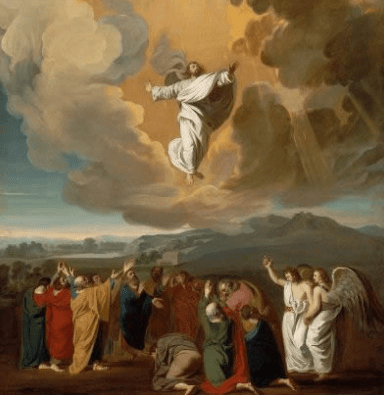
1:9 After he said this, he was taken up [the Ascension confirms deity of Jesus; to His heavenly home] before their [those who witnessed the Ascension now had the responsibility of carrying on the work] very eyes, and a cloud [a symbol of God’s glory; cf. Ex. 13:21-22; 16:10; 19:9,16; 24:15-18; 33:9-10; 34:5; 40:34-35; cf. Lk. 9:34-35 re: cloud at Transfiguration] hid him from their sight.

1:10 They were looking intently up into the sky as he was going, when suddenly two men dressed in white stood beside them.

1:11 “Men of Galilee,” they said, “why do you stand here looking into the sky? This same Jesus, who has been taken from you into heaven, will come back in the same way you have seen him go into heaven [cf. Lk. 21:27; Matt. 24:30; 26:64; Mk. 13:26].”

1:12 Then they returned to Jerusalem from the hill called the Mount of Olives, a Sabbath day’s walk [a half mile] from the city.

1:13 When they arrived, they went upstairs to the [use of the definite article indicates this was a specific place known to the disciples] room [may have been the upper room in which they had eaten the Last Supper (Lk. 22:12); this particular room became the first meeting place of he church] where they were staying. Those present were Peter [an Aramaic word meaning “stone” or “rock”], John, James [along with Peter and John formed Jesus’ inner circle (see Mk. 5:37; 9:2)] and Andrew [Peter’s brother; had the gift of introducing others to Jesus as per John 1:40-42; 6:8-9; 12:20-22]; Philip [see Jn. 1:43-45] and Thomas [means twin; see John 20:24-29], Bartholomew [or Nathanael; recruited by Philip; see John 1:43-51] and Matthew [the tax collector]; James son of Alphaeus [possibly Matthew’s brother; see Mk. 2:14] and Simon the Zealot [either a man of religious zeal or a member of the revolutionary (terrorist) party known as the Zealots (committed to the violent overthrow of Roman rule in Israel)], and Judas son of James [most likely Thaddaeus (cf. Lk. 6:16].

1:14 They all joined together constantly in prayer [a mark of the early church], along with the women [cf. Lk. 8:2-3; 23:49; 23:55–24:10 re: the women present at the Crucifixion] and Mary the mother of Jesus, and with his brothers [the other sons of Mary and Joseph who did not believe Jesus was the Messiah (Jn. 7:5) and that He was out of His mind (Mk. 3:21-35)].

Note: According to Matthew 13:55-56 and Mark 6:3, Jesus’ brothers were…
• James
• Joses (or Joseph)
• Judas (or Jude)
• Simon

1:15 In those days Peter [served as spokesman for the group] stood up among the believers (a group numbering about a hundred and twenty)

1:16 and said [Peter pointed those assembled to the Scriptures], “Brothers, the Scripture had to be [a divine necessity; because verses were regarded as a prophecy] fulfilled [these words put Judas’ betrayal and suicide into biblical perspective] which the Holy Spirit spoke long ago through the mouth of David [cf. Ps. 69:25; 109:8] concerning Judas, who served as guide for those who arrested Jesus—

1:17 he was one of our number and shared in this ministry.”

1:18 [vv. 17-18 are not part of Peter’s speech but Luke’s explanation of Judas’ suicide] (With the reward he got for his wickedness, Judas bought a field; there he [cf. Matt. 27:7 re: Judas’ suicide] fell [likely because the branch from which he hung broke] headlong, his body burst open and all his intestines spilled out.

1:19 Everyone in Jerusalem heard about this, so they called that field in their language Akeldama, that is, Field of Blood.)

1:20 “For,” said Peter, “it is written in the book of Psalms, “‘May his place be deserted; let there be no one to dwell in it [cf. Ps. 69:25],’ and, “‘May another take his place of leadership [cf. Ps. 109:8].’

1:21 [the first decision of the church was to replace Judas] Therefore it is necessary [perhaps to fulfill the promises in Matt. 19:28 and Lk. 22:28-30] to choose [note two qualifications for Judas’ replacement…] [1] one of the men [an indication that, in addition to disciples, others had followed Jesus] who have been with us the whole time the Lord Jesus went in and out among us [thus one who was an eyewitness and could serve as a credible witness to what Jesus said and did],

1:22 beginning from John’s baptism to the time when Jesus was taken up from us. [2] For one of these must become a witness with us of his resurrection.”

1:23 So they proposed two men: Joseph called Barsabbas [name means “son of the Sabbath”] (also known as Justus) and Matthias [name means “gift of God”].

1:24 Then they prayed, “Lord, you know everyone’s heart. Show us which of these two you have chosen

1:25 to take over this apostolic ministry, which Judas left to go where he belongs.”

1:26 Then they cast lots [an OT method of determining God’s will; cf. Prov. 16:33; cf. Urim and Thummim in Lev. 8:8; 1 Chron. 26:13; Ezra 2:63; Neh. 7:65; this is the last biblical instance of seeking God’s will by casting lots; Holy Spirit guided Christians at Antioch to set aside Paul and Barnabas for missionary work (Acts 13:2)], and the lot fell to Matthias; so he was added to the eleven apostles [“apostle” means messenger or missionary].

Christ in the Word

Genesis  Jesus, the Seed of the Woman Genesis 3:15 
Exodus  Jesus, the Passover Lamb Exodus 12:3 
Leviticus  Jesus, the Atoning Sacrifice Leviticus 16:33 
Numbers  Jesus, the Smitten Rock Numbers 20:11; 1 Corinthians 10:4 
Deuteronomy  Jesus, the Prophet Yet to Come Deuteronomy 18:15 
Joshua  Jesus, Captain of the Lord’s Host Joshua 5:14 
Judges  Jesus, Great Deliverer Judges 5:20 
Ruth  Jesus, Celestial Kinsman Ruth 4:14
1 Samuel  Jesus, King!  
2 Samuel  Jesus, King! 2 Samuel 5:3; Revelation 1:5-6  
1 Kings  Jesus, King!  
2 Kings  Jesus, King!  
1 Chronicles  Jesus, King!  
2 Chronicles  Jesus, King!  
Ezra  Jesus, Restorer of the Temple  Ezra 7:27 
Nehemiah  Jesus, Restorer of the Nation Nehemiah 2:5 
Esther  Jesus, Advocate and Propitiator Esther 4:16 
Job  Jesus, “My Redeemer” Job 19:25 
Psalms  Jesus, Our All in All Psalm 3:3 
Proverbs  Jesus, Beginning of All Proverbs 1:7
Ecclesiastes  Jesus, End of All Ecclesiastes 12:13; 1 John 3:23  
Song of Songs  Jesus, Center and Heart of All  Song of Songs 2:16 
Isaiah  Jesus, Prince of Peace Isaiah 2:4 
Jeremiah  Jesus, “Righteous Branch” Jeremiah 23:5 
Lamentations  Jesus, “Man of Sorrows” Lamentations 3:1 
Ezekiel  Jesus, the “Tender Twig” Ezekiel 17:22 
Daniel  Jesus, “The Stone that Smote the Image” Daniel 2:35 
Hosea  Jesus, the “Dew unto Israel” Hosea 14:5 
Joel  Jesus, the “Hope of His People” Joel 3:16 
Amos  Jesus, the Heavenly Husbandman Amos 9:9-15 
Obadiah  Jesus, Our Savior Obadiah 1:17-21 
Jonah  Jesus, the Resurrection and the Life Jonah 1:17 
Micah  Jesus, Witness Against the Nations Micah 1:2-3 
Nahum  Jesus, “A Stronghold in the Day of Trouble” Nahum 1:7 
Habakkuk  Jesus, “The Salvation of Thy People” Habakkuk 3:13 
Zephaniah  Jesus, “Mighty to Save” Zephaniah 3:17 
Haggai  Jesus, “The Desire of All Nations” Haggai 2:7 
Zechariah  Jesus, “The Headstone” of the Corner Zechariah 4:7 
Malachi  Jesus, “Sun of Righteousness” Malachi 4:2 
Matthew  Jesus, The Promised Messiah Matthew 1:21 
Mark Jesus, the “Righteous Servant” Mark1:10; Isaiah 53:11
 Luke  Jesus, Son of Man Luke 4:18 
John  Jesus, Son of God John 1:43; 20:31 
Acts  Jesus, Our Risen Lord Acts 1:2 
Romans  Jesus, Our Righteousness Romans 1:17 
1 Corinthians  Jesus, God’s Grace to Us 1 Corinthians 1:4 
2 Corinthians  Jesus, God’s Comfort for Us 2 Corinthians 1:3 
Galatians  Jesus, Our LIberty in the Gospel Galatians 1:4; 5:1 
Ephesians  Jesus, Fulness of Life Ephesians 1:3 
Philippians  Jesus, Fulness of Joy Philippians 4:4 
Colossians  Jesus, Fulness of Power Colossians 2:9-10 
1 Thessalonians  Jesus, the Coming One 1 Thess. 1:19 
2 Thessalonians  Jesus, the Glorified 2 Thess. 1:10-12 
1 Timothy  Jesus, Our Teacher 1 Timothy 1:3 
2 Timothy  Jesus, Our Keeper 2 Timothy 1:12 
Titus  Jesus, Our Portion Forever Titus 2:10-14 
Philemon  Jesus, Our Master and Owner Philemon 1:1 
Hebrews  Jesus, Our High Priest and Intercessor Hebrews 3:1 
James  Jesus, Our Pattern of Faith and Works James 2:1 
1 Peter  Jesus, The Precious Corner Stone of Our Faith 1 Peter 2:6 
2 Peter  Jesus, The Glorious Pinnacle of Our Hope 2 Peter 3:13 
1 John  Jesus, “The Life” 1 John 1:2 
2 John  Jesus, “The Truth” 2 John 1:2-3 
3 John  Jesus, “The Way” 3 John 1:3-4 
Jude  Jesus, Preserver Jude 1:1 
Revelation  Jesus, Conqueror! Revelation 1:18 


John Weaver Weddell
• “Your Study Bible”
Published by The Sunday School Times Company • 1918

Christ in the Word

Genesis  Jesus, the Seed of the Woman Genesis 3:15 
Exodus  Jesus, the Passover Lamb Exodus 12:3 
Leviticus  Jesus, the Atoning Sacrifice Leviticus 16:33 
Numbers  Jesus, the Smitten Rock Numbers 20:11; 1 Corinthians 10:4 
Deuteronomy  Jesus, the Prophet Yet to Come Deuteronomy 18:15 
Joshua  Jesus, Captain of the Lord’s Host Joshua 5:14 
Judges  Jesus, Great Deliverer Judges 5:20 
Ruth  Jesus, Celestial Kinsman Ruth 4:14
1 Samuel  Jesus, King!  
2 Samuel  Jesus, King! 2 Samuel 5:3; Revelation 1:5-6  
1 Kings  Jesus, King!  
2 Kings  Jesus, King!  
1 Chronicles  Jesus, King!  
2 Chronicles  Jesus, King!  
Ezra  Jesus, Restorer of the Temple  Ezra 7:27 
Nehemiah  Jesus, Restorer of the Nation Nehemiah 2:5 
Esther  Jesus, Advocate and Propitiator Esther 4:16 
Job  Jesus, “My Redeemer” Job 19:25 
Psalms  Jesus, Our All in All Psalm 3:3 
Proverbs  Jesus, Beginning of All Proverbs 1:7
Ecclesiastes  Jesus, End of All Ecclesiastes 12:13; 1 John 3:23  
Song of Songs  Jesus, Center and Heart of All  Song of Songs 2:16 
Isaiah  Jesus, Prince of Peace Isaiah 2:4 
Jeremiah  Jesus, “Righteous Branch” Jeremiah 23:5 
Lamentations  Jesus, “Man of Sorrows” Lamentations 3:1 
Ezekiel  Jesus, the “Tender Twig” Ezekiel 17:22 
Daniel  Jesus, “The Stone that Smote the Image” Daniel 2:35 
Hosea  Jesus, the “Dew unto Israel” Hosea 14:5 
Joel  Jesus, the “Hope of His People” Joel 3:16 
Amos  Jesus, the Heavenly Husbandman Amos 9:9-15 
Obadiah  Jesus, Our Savior Obadiah 1:17-21 
Jonah  Jesus, the Resurrection and the Life Jonah 1:17 
Micah  Jesus, Witness Against the Nations Micah 1:2-3 
Nahum  Jesus, “A Stronghold in the Day of Trouble” Nahum 1:7 
Habakkuk  Jesus, “The Salvation of Thy People” Habakkuk 3:13 
Zephaniah  Jesus, “Mighty to Save” Zephaniah 3:17 
Haggai  Jesus, “The Desire of All Nations” Haggai 2:7 
Zechariah  Jesus, “The Headstone” of the Corner Zechariah 4:7 
Malachi  Jesus, “Sun of Righteousness” Malachi 4:2 
Matthew  Jesus, The Promised Messiah Matthew 1:21 
Mark Jesus, the “Righteous Servant” Mark1:10; Isaiah 53:11
 Luke  Jesus, Son of Man Luke 4:18 
John  Jesus, Son of God John 1:43; 20:31 
Acts  Jesus, Our Risen Lord Acts 1:2 
Romans  Jesus, Our Righteousness Romans 1:17 
1 Corinthians  Jesus, God’s Grace to Us 1 Corinthians 1:4 
2 Corinthians  Jesus, God’s Comfort for Us 2 Corinthians 1:3 
Galatians  Jesus, Our LIberty in the Gospel Galatians 1:4; 5:1 
Ephesians  Jesus, Fulness of Life Ephesians 1:3 
Philippians  Jesus, Fulness of Joy Philippians 4:4 
Colossians  Jesus, Fulness of Power Colossians 2:9-10 
1 Thessalonians  Jesus, the Coming One 1 Thess. 1:19 
2 Thessalonians  Jesus, the Glorified 2 Thess. 1:10-12 
1 Timothy  Jesus, Our Teacher 1 Timothy 1:3 
2 Timothy  Jesus, Our Keeper 2 Timothy 1:12 
Titus  Jesus, Our Portion Forever Titus 2:10-14 
Philemon  Jesus, Our Master and Owner Philemon 1:1 
Hebrews  Jesus, Our High Priest and Intercessor Hebrews 3:1 
James  Jesus, Our Pattern of Faith and Works James 2:1 
1 Peter  Jesus, The Precious Corner Stone of Our Faith 1 Peter 2:6 
2 Peter  Jesus, The Glorious Pinnacle of Our Hope 2 Peter 3:13 
1 John  Jesus, “The Life” 1 John 1:2 
2 John  Jesus, “The Truth” 2 John 1:2-3 
3 John  Jesus, “The Way” 3 John 1:3-4 
Jude  Jesus, Preserver Jude 1:1 
Revelation  Jesus, Conqueror! Revelation 1:18 

John Weaver Weddell • “Your Study Bible”
Published by The Sunday School Times Company • 1918

You Say. God Says.

You Say… God Says… Reference
“It’s impossible” All things are possible Luke 18:27
“I’m too tired” I will give you rest Matthew 11:28-30
“Nobody really loves me” I love you John 3:16; 3:34
“I can’t go on” My grace is sufficient 2 Corinthians 12:9; Psalm 91:15
“I can’t figure things out” I will direct your steps Proverbs 3:5-6
“I can’t do it” You can do all things through Christ Philippians 4:13
“I’m not able” I am able 2 Corinthians 9:8
“It’s not worth it” It will be worth it Roman 8:28
“I can’t forgive myself” I forgive you 1 John 1:9; Romans 8:1
“I can’t manage” I will supply all your needs Philippians 4:19
“I’m afraid” I have not given you a spirit of fear 2 Timothy 1:7
“I’m always worried and frustrated” Cast all your cares on Me 1 Peter 5:7
“I’m not smart enough” I will give you wisdom 1 Corinthians 1:30
“I feel all alone” I will never leave you nor forsake you Hebrews 13:5

Seven Great Changes

Insights from D. L. Moody

1.  Justification  A change of standing.  Before God. 
2.  Repentance  A change of mind.  About God. 
3.  Regeneration  A change of nature.  From God. 
4.  Conversion  A change of life.  For God. 
5.  Adoption  A change of family.  In God. 
6.  Sanctification  A change of service.  Unto God. 
7.  Glorification  A change of place.  With God. 

One Sentence Themes of Bible Books


Genesis  Begin with God. 
Exodus  Come out for God. 
Leviticus  Get right with God. 
Numbers  Get somewhere! 
Deuteronomy  Stop and think. 
Joshua  Take the land. 
Judges  Watch the borders. 
Ruth  Gather the grain. 
1 Samuel  Light the altar lamps. 
2 Samuel  Call David—God’s anointed. 
1 Kings  Set the King on his throne. 
2 Kings  Get the mantle. 
1 Chronicles  Keep the royal line. 
2 Chronicles  Honor the King. 
Ezra  Repair God’s house. 
Nehemiah  Rebuild God’s city. 
Esther  Trust God’s grace. 
Job  “Let Him have His way with you.” 
Psalms  Praise and pray. 
Proverbs  Walk and work. 
Ecclesiastes  “Fear God”—if you be wise. 
Song of Songs  Love Him with all your heart. 
Isaiah  He is coming! 
Jeremiah  Get ready with cleansing. 
Lamentations  Get ready with weeping. 
Ezekiel  He will restore the Temple. 
Daniel  He will bring the Kingdom. 
Hosea  Return, therefore, O Israel. 
Joel  Sound the alarm. 
Amos  Drop the plumb line. 
Obadiah  Possess your possessions. 
Jonah  “Preach the preaching I bid thee.” 
Micah  Look and live. 
Nahum  Behold, the mountains quake! 
Habakkuk  But there’s light ahead. 
Zephaniah  So sing, as you go. 
Haggai  Work as you go. 
Zechariah  “For the Lord shall yet comfort Zion.” 
Malachi  Lo! His Messenger! 
Matthew  The Messiah is here! 
Mark His wonderful works prove Him. 
 Luke  He is a friend of sinners. 
John  He is the Son of God! 
Acts  He is at God’s right hand for us! 
Romans  Come to Him for righteousness. 
1 Corinthians  For all the gifts of His grace. 
2 Corinthians  For comfort and riches. 
Galatians  For freedom and power. 
Ephesians  For fulness of life. 
Philippians  Take Him for joy. 
Colossians  “Ye are complete in Him.” 
1 Thessalonians  He is surely coming again! 
2 Thessalonians  But wait and work till He comes. 
1 Timothy  Guard the gospel. 
2 Timothy  Guard the witness. 
Titus  Adorn the doctrine. 
Philemon  Be kind to all for His sake. 
Hebrews  He is our intercessor at the throne. 
James  Work out His salvation. 
1 Peter  “To you who believe He is precious.” 
2 Peter  To you who believe He is gracious—and glorious.
1 John  He is the life. 
2 John  He is the truth. 
3 John  He is the way. 
Jude  He is able to keep you from falling. 
Revelation  And to present you faultless at His appearing.

John Weaver Weddell • “Your Study Bible”
Published by The Sunday School Times Company • 1918