Ezra 3

Someone has said, “You can tell it’s going to be a rotten day when you call Suicide Prevention, and they put you on hold. You can tell it’s going to be a bad day when you turn on the news and they’re showing emergency routes out of the state. You can tell it’s going to be a rotten day when your car horn goes off accidentally and remains stuck as you follow a group of Hell’s Angels on the freeway.”

Have you ever had a day like that? Who among us does not have to deal with problems every day of the week?

Problems seem to be woven into the fabric of our lives. They often come upon us unexpectedly and hold on tenaciously. Problems also seem to come upon us most frequently when we have made a commitment to begin anew some aspect of our lives. Just when we make a commitment to obey God, we encounter opposition!

Even Jesus was not exempt from this dilemma. You will recall that after His baptism came the battle, after the dove came the devil, and after the voice from heaven came the roar from hell in the wilderness temptations. In our study today, we will see that opposition often comes after obedience. We will also see the importance of looking to God as our strength, shield, and refuge in times of trouble.

Purpose and Priorities
Ezra 3:1-6

Ezra 3:1-6 tells us much about the common purpose and priorities of the Jews who returned to Judah. On the seventh month, the people, who had returned to their former villages and cities, “gathered together as one man to Jerusalem” (Ezra 3:1). This indicates a sense of common purpose among the people. They had a common desire to rebuild the Temple which had been destroyed years earlier by Nebuchadnezzar.

We can only imagine what a special day this must have been for the people. It was a day they had probably dreamed and thought about many times during their years in exile (Psalm 137:1-5).

Ezra 3:2 informs us that the first thing the people did was to “build the altar of the God of Israel, to offer burnt offerings on it, as it is written in the law of Moses, the man of God.” This indicates that the people had proper priorities.

According to Ezra 3:3, one of the factors that motivated the Jews to rebuild the altar was their great fear of the peoples of the land. It is interesting that they did not rebuild the walls of the city first. After all, the very reason walls were built around cities in ancient times was for protection and security from enemies and outside threats. The Jews however, made the rebuilding of the altar their top priority because they had finally learned that the Lord was their greatest source of strength and protection.

Project and Progress
Ezra 3:7-9

Ezra 3:7-9 informs us that once the altar had been rebuilt and the sacrificial system reinstituted, the people were ready to turn their attention to the major project of rebuilding the Temple. The first order of business was the rebuilding of the foundation. Notice three things that helped the people to make progress in the work.

First, the people contributed to the work. The people contributed money to hire the workmen and provisions to be used in negotiating with other provinces for building supplies.

Second, the people cooperated in the work. There was something for everyone to do. Some were capable of giving, others were capable of working, while still others were capable of negotiating with the Phoenicians for cedar wood. In like manner, the work of ministry in the local church today depends on both the contributions and cooperation of the people. Paul made clear in I Corinthians 12:14-18 that the contribution and cooperation of every church member is needed and necessary.

Third, the work was coordinated. Such a major project required careful planning and capable coordination. The Levites were responsible for overseeing the work (Ezra 3:8) and the workmen (Ezra 3:9).
Ezra 3:10-13

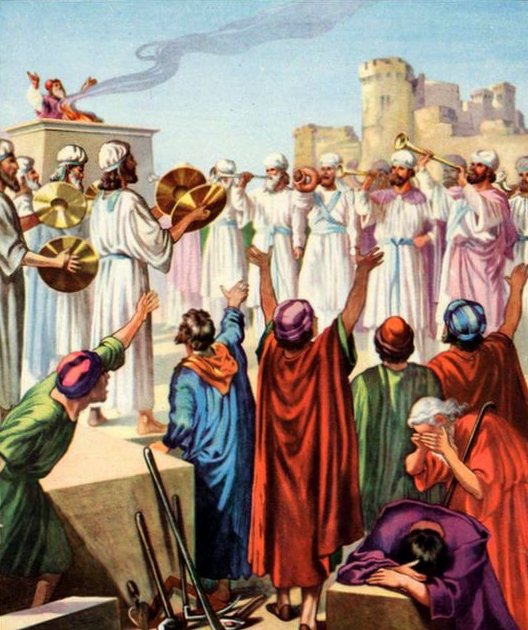
Once the foundation of the Temple had been laid, a worship service was held to celebrate this new beginning. This was an emotional event for all who participated. The emotions ranged from praise to pathos. Ezra 3:11 tells us that “the people sang, praising and giving thanks to the Lord.”

While some people rejoiced and shouted aloud for joy however, those who were older and had seen the glory of the first Temple “wept with a loud voice.” Perhaps the older generation wept because they felt that the second Temple would be less-than-adequate in both size and splendor. Ezra 3:13 records that the mingled shouts of praise and loud weeping resulted in a terrible cacophony of sound that “was heard far away.”

Practical Considerations:

Problems are woven into the fabric of life.
We should not be surprised or despair when we encounter problems or when problems encounter us. Someone has said that problems will either make us or break us. When we encounter problems we should try to understand how God can use them to strengthen us. Problems are woven into the fabric of life!

The Weaver
My life is but a weaving, between my Lord and me,
I cannot choose the colors, He worketh steadily.
Oft times He weaveth sorrow, and I in foolish pride,
Forget He sees the upper, and I, the underside!
Not ’till the loom is silent, and the shuttles cease to fly,
Shall God unroll the canvas, and explain the reason why,
The dark threads are as needful,
In the Weaver’s skillful hand,
As the threads of gold and silver,
In the pattern He has planned.

The Lord is the greatest source of strength and protection.
The repatriates made the rebuilding of the altar their first priority when they returned to Judah. Even though they were fearful of the people of the land, they did not rebuild the walls of the city as their first line of protection. They rebuilt the altar and in so doing acknowledged their dependence upon God for protection. In our search for protection and security may we remember, “Unless the Lord builds the house, They labor in vain who build it; Unless the Lord guards the city, The watchman keeps awake in vain” (Psalm 127:1).

There is a place for each of us in God’s work.
The Jewish repatriates made progress in laying anew the foundation of the Temple because each person did his part. The people contributed to the work and cooperated in the work while still others coordinated the work. The Apostle Paul reminds us (I Corinthians 12:14-18) that the contribution of every member of the church is needed and necessary in order to perform the work of ministry. We are responsible for using the gifts God has given us.

Serving God brings joy to the one who serves.
After the successful completion of the foundation of the Temple, the people who participated in the work rejoiced and gave thanks to God. Others however, looked back and became saddened because they felt the new Temple would be less-than-adequate. We should maintain Paul’s attitude in life as expressed in Philippians 3:13, “forgetting what lies behind and reaching forward to what lies ahead.”

Ezra 2

The People Who Returned
Ezra 2:1-67

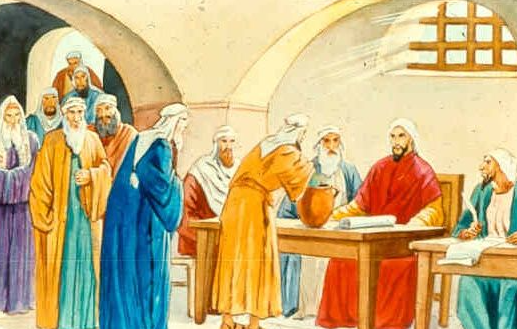
Ezra 2:1-67 contains a register of the people who returned to Judah. The list begins with the leaders of the people and then lists the numbers of repatriates according to their clan, their hometown, the priests, and those who were not able to give evidence of their origin. One commentator has noted that “the protective hand of God and the vitality of Israel are clearly evident in this genealogical listing.”

The Priority of the Repatriates
Ezra 2:68-70

Upon arriving in Jerusalem and viewing the depressing ruins of the Temple, the repatriates “offered willingly to the house of God to restore it on its foundation. According to their ability they gave to the treasury” (Ezra 2:68b-69a). Their priority was to rebuild the Temple. In so doing they would also rebuild their homes and their lives. The people faced both the joys and challenges of a new beginning. The road ahead would certainly be filled with hazards and discouragements as well as victories and triumphs, but after all, that is what the road to the land of Beginning Again is paved with.

Ezra 1

The Land of Beginning Again

Who among us has never longed for a fresh start, for a second chance, or for a new beginning in some aspect of life? New beginnings have a way of giving new meaning to life. They have a way of invigorating us with new purpose, energy, and resolve to meet new challenges. New beginnings have a way of reminding us that past failures do not have to devastate or defeat us.

The people of Israel were ready for a new beginning. They were ready to cast aside their past failures and sins like a shabby old coat at the door. The Old Testament book of Ezra records the events in the life of Israel after they had spent seventy years in Babylonian captivity. They had the opportunity to begin anew by returning to their homeland to rebuild their Temple, the walls of their beloved city of Jerusalem, and their lives.

Understanding Why Israel Needed A New Beginning

Why did Israel need a new beginning? The answer is found in the pages of Israel’s tumultuous history. When Moses brought the children of Israel out of Egypt, God gave the people very specific commandments and instructions by which their lives were to be governed (see Exodus 20:3-23:33). God made very clear to the people that there were two possible paths of life – the path of obedience and the path of disobedience (see Deuteronomy 30:15-20). Each path led directly to specific consequences, those being life or death, blessing or curse.

Israel’s history chronicles their journey down both of these paths. For the most part however, Israel experienced a recurring cycle of apostasy, judgment, repentance, and deliverance. This cycle is best illustrated in the book of Judges where the dizzying details are recorded. Each new generation seemed to either ignore or forget the lesson of the earlier generation and consequently, the cycle was repeated. Israel’s proclivity to disobedience and idolatry continued through the Davidic and Solomonic kingdoms and throughout the period when the kingdom was divided into the Northern Kingdom of Israel and the Southern Kingdom of Judah.

Eventually both kingdoms were punished for their sins as God allowed them to be carried away into captivity. The Assyrians carried the Northern Kingdom away into captivity in 722 B.C. and the Babylonians carried the Southern Kingdom away into captivity in 586 B.C.

Life in Captivity

The Babylonian Captivity was a trying, humiliating, and sorrowful experience for the Jews. They had to deal with radical changes in every area of their lives as well as cope with the pain of homesickness and feelings of bitterness and hatred toward their captors. Psalm 137 records the anguish of the captivity and the longing of the Jews for their release and return to Jerusalem, as well as their desire for calamity on the Babylonians. They had lost their freedom, were separated from friends and neighbors, and experienced the emotional trauma of seeing the Temple destroyed and the city of Jerusalem razed. We can only imagine how difficult this experience must have been to the Jews. Yet, it was all part of the harvest (Galatians 6:7)!

God Sets the Stage for a New Beginning

We have noted that the national and personal sins of the people brought the wrath and judgment of God. After their many years in exile however, it was time for them to experience the compassion and mercy of God. Through a series of events in the international political scene, Cyrus king of Persia successfully expanded his empire. The Babylonian Empire fell to Cyrus in 539 B.C.

The Person of Cyrus
Ezra 1:1

We are introduced to Cyrus in Ezra 1:1. He was the King of Persia who had overthrown Babylon and who ruled over a vast empire. Some two hundred years before Cyrus appeared on the political scene of the Ancient Near East, Isaiah prophesied that God would raise up a deliverer from the east and give him victory over the nations (Isaiah 41:2). Isaiah identified this deliverer by name – Cyrus! (see Isaiah 44:28 and 45:1). Isaiah further prophesied that Cyrus would let the exiles go free (Isaiah 45:13).

The Prophecy of Jeremiah
Ezra 1:1

Ezra 1:1 points out the fact that the actions of Cyrus fit into a larger scheme. Cyrus was serving a purpose bigger than his own, as indicated by the phrase, “in order to fulfill the word of the Lord by the mouth of Jeremiah.” The fulfillment of prophesy points out the fact that God is at work shaping history and directing human affairs. History has a purpose. History is actually “His story.”

The Proclamation of Release
Ezra 1:1-4

Ezra 1:1 tells us that God stirred up the spirit of Cyrus to issue a proclamation allowing all of the captive people within his empire to return to their homelands. In the case of the Jews Cyrus granted permission for them to return to Judah and to rebuild their Temple in Jerusalem.

The Patronage of the People and King
Ezra 1:5-11

Ezra 1:4 informs us that Cyrus encouraged the people to become patrons of the rebuilding effort by financially supporting the project. Ezra 1:6 informs us that those who chose to undertake the difficult task of returning were encouraged by the generous financial support of those who chose to stay behind. Ezra 1:7-11 informs us that even Cyrus helped by releasing the articles of the Temple which Nebuchadnezzar had taken as plunder.

Practical Considerations:

There is one law that we cannot break: The Law of the Harvest!
The period of history after the Exodus and before the exiles is marked by the willful disobedience of the Israelites. Their sin eventually brought God’s judgment upon both the Northern and Southern Kingdoms as He allowed heathen nations to take them into captivity. The seeds of sin that were sown by so many generations eventually brought forth a painful harvest. Paul spoke of the law of the harvest in Galatians 6:7, “”Do not be deceived, God is not mocked; for whatever a man [or nation!] sows, this he will also reap.”

God’s discipline has a redemptive purpose.
God does not punish His people solely for the sake of punishment. God’s discipline and punishment of His people always has a redemptive purpose. The period that the Jews spent in captivity was painful and difficult, but it was a time when God had their attention and was able to do some wonderful things in their lives.

God is in control of history.
God has a purpose for mankind and for this world. History has a destination. God’s purposes are being worked out in history. We should never despair or think that events in this world have no relation to God’s purposes. God is able to use even the most unlikely events to accomplish His purposes.

“For all things are Thy servants.” (Psalm 119:91b)
God can use anyone or anything He so desires to accomplish His purposes. In the case of the erring Balaam, God used “a dumb donkey, speaking with the voice of a man” (II Peter 2:16) to restrain his madness. God can use a drunk on the street to convict you that you shouldn’t drink. In the case of Israel, God even used heathen nations and rulers to fulfill His purposes for His people. King Cyrus thought that he was serving his own interests, but he was unknowingly serving the interests of God.

God keeps His promises.
The Lord kept His promises through the prophets Isaiah and Jeremiah to restore His people. Jeremiah did not live to see his prophecy fulfilled, neither did many of the people who heard Jeremiah’s prophesy, but God kept His word. God also kept His promises to Abraham (Genesis 12:2-3 and 13:14-18).

New beginnings are possible with God.
God gave His people the opportunity to begin anew by allowing them to return to their homeland. The Jews had a wonderful opportunity to rebuild their lives, their Temple, and their beloved city of Jerusalem. New beginnings are possible in our relationship with the Lord.

Nehemiah 13

The Reforms of Nehemiah
Nehemiah 13:1-31

Nehemiah 13 records the events of Nehemiah’s second term as governor. After his first twelve-year term as governor, Nehemiah returned to the court of King Artaxerxes. During his absence, the people slipped back into many of their old sinful practices. When Nehemiah heard about these things, he asked permission of the king to return to Jerusalem. Upon returning, Nehemiah encountered four problems that required his immediate attention.

The first problem Nehemiah encountered is recorded in verses 4-9. Upon returning to Jerusalem, Nehemiah was shocked to learn that Eliashib, the high priest, had provided Tobiah a suite of rooms in the Temple complex. Tobiah was Nehemiah’s old archenemy who had tried to frustrate the work of God during Nehemiah’s first term as governor. Nehemiah wasted no time in dealing with the problem. He personally evicted Tobiah, throwing all of his belongings out of the room and ordering that the rooms be fumigated!

The second problem which Nehemiah encountered is recorded in Nehemiah 13:35-39. This problem concerned the support of the Temple and the Temple servants. The people stopped tithing and bringing their gifts into the storehouse. Because of this, many of the Levites had to find support away from the Temple thus neglecting the work of God and the education of the people. Nehemiah rebuked the leaders for allowing this to happen, restored the Levites to their posts, and reestablished the system of collecting tithes.

The third problem with which Nehemiah had to contend is recorded in Nehemiah 13:15-22. This problem concerned the violation of the Sabbath. The spiritual laxity of the people found expression in their violation of the Sabbath. The day had become just another day on the calendar. It was business as usual on the Sabbath. Nehemiah addressed the problem by rebuking the leaders for allowing the problem to continue. He also ordered that the gates of the city be closed throughout the Sabbath to keep out the merchants who were guilty of violating the Sabbath. Nehemiah posted guards at all the city gates to insure that his orders were carried out. He even threatened to use force against any who violated his orders.

The fourth problem with which Nehemiah had to contend is recorded in Nehemiah 13:23-29. This problem was the old recurring problem of intermarriage of the Jews with pagans. This was of grave concern to Nehemiah because the integrity and distinctiveness of the Jewish people was being compromised. The children could not speak the Hebrew language and as such could not read the Scripture. This was a dangerous situation that threatened the very existence of the Jewish people.

Nehemiah dealt with the violators by contending with them and even striking them and pulling out their hair. He reminded them that if wise Solomon’s heart had been turned away from the Lord by his foreign wives, then they could not expect to do any better. Nehemiah concluded his memoirs with a prayer, asking God to remember him for the work that he had done. That prayer has certainly been answered. His memoirs have become a part of the Holy Scripture!

Practical Considerations:

We should not allow evil to dwell in our hearts.
During his absence from Jerusalem, Eliashib the high priest allowed Tobiah, an enemy of God, to take up residence in God’s house. We should be careful lest we allow the enemies of God to take up residence in our hearts and consequently cause our love and loyalty to God to wane. F.B. Meyer said, “When Nehemiah returned from a long sojourn in Persia, he cast out all Tobiah’s goods and restored the chamber to its proper use. If we have given up a chamber in our hearts to any Tobiah, we must be prepared to do likewise.”

We should be careful lest we allow past sins to trouble us.
During Nehemiah’s absence from Jerusalem, the people allowed many of their past sins to rise and trouble them anew. These were the very sins that had brought the wrath of God upon their fathers. Nehemiah addressed the matter by having the people put their sin away immediately and make things right immediately. He wasted no time in dealing with the sins that threatened the spiritual and national well being of the people. We too, should deal with sin swiftly and be on guard lest old sins rise to haunt and trouble us anew.

Nehemiah 12

The Register of Priests and Levites
Nehemiah 12:1-26

Nehemiah 12:1-26 provides us with a register of priests and Levites. To the twentieth-century reader such lists seem uninteresting, but to the Jew such lists were important. Postexilic Jews were concerned about the genuineness and legitimacy of their clergy. Such genealogical lists helped to verify the credentials of those who led them in worship.

The Rejoicing at the Wall
Nehemiah 12:27-47

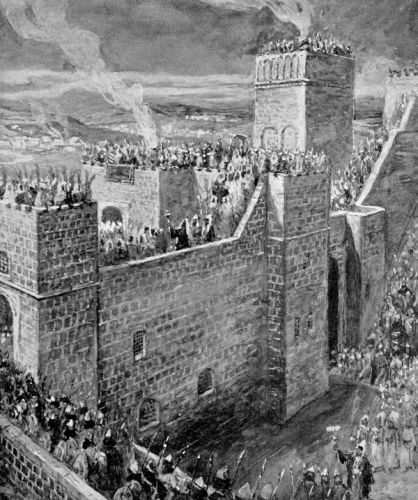
The story of the dedication of the wall is recorded in Nehemiah 12:27-47. Although the account of the dedication of the wall is removed from the account of the completion of the wall (chapter 6) by several chapters, only a two or three month period of time separated these events. This was a joyous event in the life of the people. Before the ceremony actually began, the priests and the Levites purified themselves, the people, the gates, and the wall. The purification process involved bathing, sprinkling with water or blood, shaving the body, and special sacrifices.

Nehemiah 12:31-43 record the events of the dedication ceremony. Nehemiah divided the people into two groups. One group was led by Ezra (verses 31-37) and the second group was led by Nehemiah (verses 38-39). The groups formed two great choirs that marched atop the wall in opposite directions toward the Temple area. When the groups met at the Temple, “they offered great sacrifices and rejoiced because God had given them great joy, even the women and children rejoiced, so that the joy of Jerusalem was heard from afar” (verse 43).

Practical Considerations:

We should support those who serve the Lord.
According to Nehemiah 12:44-47, provision was made for the support of those who served the Lord in and through the Temple. These men were responsible for leading the people in worship and educating the people regarding the Word of God. In like manner, we should support those who faithfully serve the Lord in a vocational capacity and so undergird the work of God.

Nehemiah 11

Urban Renewal and Urgent Reforms

A study of the Old Testament books of Ezra and Nehemiah will take you on an interesting journey through the Jewish post-exilic period. During this period, the Jews returned to their homeland after seventy years in captivity and rebuild the altar, the Temple, and the wall of Jerusalem. The prophets Haggai and Zechariah motivated the people of Jerusalem to give attention to the rebuilding of the Temple. Ezra instituted marriage reforms to help ensure the integrity of the Jewish faith. Nehemiah and the inhabitants of Jerusalem struggled to build the wall of Jerusalem under persistent pressure and opposition. And, the people wept at the reading of God’s Word and commit themselves to live by that Word.

Nehemiah 11 addresses the repopulation of Jerusalem after the completion of the walls and the matter of how Nehemiah addressed the backslidden condition of the Jews during his second term as governor. This chapter addeesses the matters of urban renewal and urgent reforms.

The Repopulation of Jerusalem
Nehemiah 11:1-36

According to Nehemiah 7:4, “the city [of Jerusalem] was large and spacious, but the people in it were few and the houses not built.” Several reasons for this can be offered. First, the city had been without walls for nearly a century and a half. A city without walls was vulnerable and at the mercy of any invading army or band of marauders. Second, the city was sparsely populated because it was in ruins. A decision to live in Jerusalem was a decision to engage in long hours of backbreaking hard work and rebuilding. Many people therefore, chose to live in the “suburbs.”

After the completion of the walls of the city, Nehemiah turned his attention to the matter of urban renewal and the repopulation of the city. The city was repopulated in two ways. First, lots were cast to determine who should live in the city. One out of every ten families was asked to move to Jerusalem. Second, some families volunteered to move to Jerusalem. These volunteers were praised for their willingness to make the sacrifice to move to the holy city. Nehemiah 11:3-19 is a record of those who settled in Jerusalem. Nehemiah 11:20-36 is a record of those who settled outside of the city of Jerusalem. These people comprised about ninety percent of the Jewish population.

Practical Considerations:

We should express appreciation to volunteers.
When Nehemiah was concerned about repopulating the city of Jerusalem, some people volunteered to move their families to the city. This meant great sacrifice and hard work. The inhabitants of Jerusalem expressed their appreciation to these volunteers. In like manner, we should express appreciation to those who volunteer, endure hardship, and make sacrifices for the sake of God’s work.

There is great joy in the accomplishment of God’s will.
After the completion of the wall, Nehemiah and Ezra led the people in a joyous ceremony of dedication and celebration. The people had faithfully followed Nehemiah’s leadership and successfully completed the wall in the face of persistent problems, pressures, and opposition. In like manner, we should rejoice in the victories and advances made in God’s work.

Nehemiah 10

 Recommitment to the Covenant
Nehemiah
9:38—10:39

Nehemiah 9:38 is the first verse of Chapter 10 in the Hebrew Bible. It provides the transition between the penitent prayer of Chapter 9 to the recommitment to the covenant in Chapter 10.

The desire to make a fresh commitment to obey God came about as the result of the things they expressed in Chapter 9. Nehemiah 10:1-27 records the names of those who signed and sealed the agreement. Along with those mentioned in verses 1-27 were many others (see verse 28).

According to Nehemiah 10:29, the people made provision to be held accountable for their obedience to God’s Word by “taking on themselves a curse and an oath to walk in God’s law.” This indicated their earnest desire to live their lives in accordance with God’s Word.

The details of the agreement are recorded in Nehemiah 10:30-39. The people had pledged themselves to make the observance of God’s law a priority in their lives. They had truly experienced a “back to the Bible” revival!

Nehemiah 9

Repentance of Sin
Nehemiah 9:1-4

Two days after the observance of the Feast of Booths, the people “assembled with fasting, in sackcloth, and with dirt upon them.” The people were under deep personal conviction as a result of the days spent in Bible study. Their sorrow over their sins and the sins of their fathers was expressed in the wearing of sackcloth, fasting, and dirt upon their heads. The people continued to listen to daily readings from the law of Moses and participated in periods of worship and confession of sin.

Review of History
Nehemiah 9:5-37

Nehemiah 9:5-37 records the longest prayer in the Bible.


It is a penitent prayer of confession that offers a remarkable survey of Old Testament history. As the people confessed their sins they reviewed God’s love and grace toward them from creation and the election of Abraham, through their deliverance from Egypt and rebellion in the wilderness, through their disobedience in the period of the judges and the monarchy, and through the period of the exile to their present state of affairs.

The people acknowledged that the discipline and judgment of God upon them was well deserved. They were however, ready to make things right. They realized that the success of their future was dependent upon their relationship with God. They were ready to get serious about the matter of living their lives in obedience to God’s Word. The “back to the Bible” revival had reached their hearts.

Practical Considerations:

The study of God’s Word is profitable.
As the people listened to the teaching of God’s Word, they were convicted of their sin and shortcomings to the point of tears and repentance. That, in turn, led the people to make some life-changing decisions based upon the teaching of Scripture. II Timothy 3:16 and 17 declare, “All Scripture is inspired by God and profitable for teaching [God’s Word teaches us the path in which to walk.], for reproof [God’s Word tells us when we get off the path.], for correction [God’s Word tells us how to get back on the path.], for training in righteousness [God’s Word teaches us how to stay on the path.]; that the man of God may be adequate, equipped for every good work.” 

We should be faithful in Bible Study attendance.
Several people asked Ezra to lead them in Bible study “that they might gain insight into the words of the law.” We should earnestly desire to study God’s Word to the end that we might gain insight and understanding into the issues and concerns of life and might become better equipped to walk in a manner pleasing to the Lord. (See Psalm 119:97-104.)

Nehemiah 8

The Back to The Bible Revival

The wall was a mighty symbol of security. This significant accomplishment testified to the providence, protection, and provision of God. But there was yet a greater work of rebuilding that required the attention of both Nehemiah and Ezra.

That greater work involved the rebuilding of the spiritual foundation upon which the nation rested. That greater work included educating the people in the truths of God’s Word and instructing them regarding the importance of living in obedience to that Word. After all, it was the unfaithfulness of their fathers and their refusal to obey God’s Word that had resulted in their being carried into captivity.

The Jews needed to be in a right relationship with God if they were to prosper as a nation. The people needed to focus their attention on spiritual matters. It was time for a “back to the Bible” revival!

Reading of the Law
Nehemiah 8:1-18

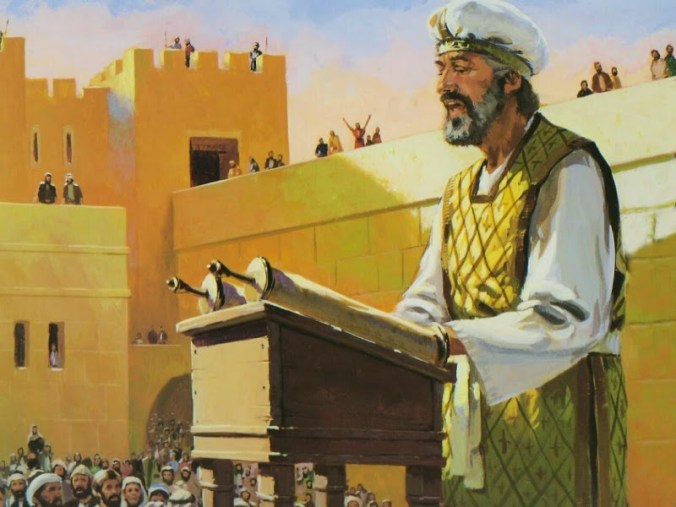
The events of Nehemiah 8 occurred one week after the completion of the walls. The people gathered at the Water Gate southeast of the Temple on the first day of the seventh month (Tishri). They asked Ezra the scribe to read to them from the book of the law of Moses. They were interested in reviewing the basics of God’s Word and in instructing their children in the truths of the Scripture. The people were ready for a “back to the Bible” revival. Scholars estimate that between thirty and sixty thousand people gathered to hear Ezra read from God’s Word. A special wooden podium was built for the occasion.

Ezra began the meeting with prayer. After praying, Ezra opened the book of the law and the people stood in reverence for God’s Word. As Ezra read from the book of the law of Moses, the Levites circulated among the people and translated and explained the Scripture to them. This was necessary because many of the people were no longer fluent in Hebrew because they had either grown up speaking Aramaic while in exile or had adopted the tongues of their pagan spouses/parents.

The people were deeply moved and convicted by what they heard. They were moved to tears as they saw themselves against the standard of God’s Word. The Levites encouraged the people not to weep but rather to rejoice because “this day is holy to the Lord your God.” The people were encouraged to eat and to share their food with those who had none.

On the following day, a group of people, priests, and Levites met with Ezra for a time of in-depth Bible study. Nehemiah 8:13 declares that these people met with Ezra the scribe “that they might gain insight into the words of the law.” One of the signs of genuine revival is a renewed interest in the study and practice of the Word of God.

As these people studied with Ezra they were reminded that they had been commanded to observe the Feast of Booths. The booths were brush arbors or leafy shelters that were reminiscent of the living conditions of the Israelites while in the wilderness. With the Feast of booths just two weeks away, the people sent out a proclamation that people gather materials to construct booths to observe the occasion. The people did so and lived in them for seven days. This must have had a tremendous educational impact on the youth and children as they learned about their history in such a vividly dramatic way. Ezra read from God’s Word daily throughout the duration of the observance.

Practical Considerations:

We should begin our Bible Study times with prayer.
Ezra led the people in prayer (Nehemiah 8:6) before leading them in Bible study. It is important to pray before studying the Bible. Prayer can us help to focus our thoughts on the God of the Bible. Through prayer we should ask God for insight into the truths of His Word. We should pray with the attitude of the Psalmist (119:18) before Bible study: “Open my eyes that I may see wonderful things in your law.”

Bible study teachers should strive to communicate effectively.
Ezra was not just interested in reading God’s law to the people, he was also concerned that they understood what he was reading. To that end he appointed Levites to translate and interpret what he was reading to the people. Effective communication took place in small groups. Like Ezra, we should be concerned with communicating the truths of God’s Word to our students as clearly and creatively as possible.

Nehemiah 7

Consolidation: An Intelligent Policy
Nehemiah 7:1-73

The work of rebuilding the walls was the first phase of Nehemiah’s plan. The second phase involved the consolidation of the work. Knowing that the Jews had many enemies on both sides of the city walls, Nehemiah wasted no time in taking measures to safeguard the city.

Nehemiah appointed men to guard the gates and ordered that the gates be opened for only a brief period of time each day. In addition, he organized a “Neighborhood Watch” program by appointing citizens to help guard the city.

Nehemiah was also concerned that the city of Jerusalem was only sparsely populated. He therefore ordered a census to determine the Jewish demographic patterns in Judah and to lay the groundwork for repopulating the city of Jerusalem.

Nehemiah was truly a man who lived for God and others. His whole life was devoted to serving God, his fellow Jews, and to helping the city and people of Jerusalem to become great once more.