2 Kings 20

What does the Bible tell us about the illness that struck Hezekiah?
Hezekiah became ill to the point of death (2 Kings 20:1). Although the nature of the illness is not specifically stated, it involved a boil that was treated by a poultice (2 Kings 20:7).

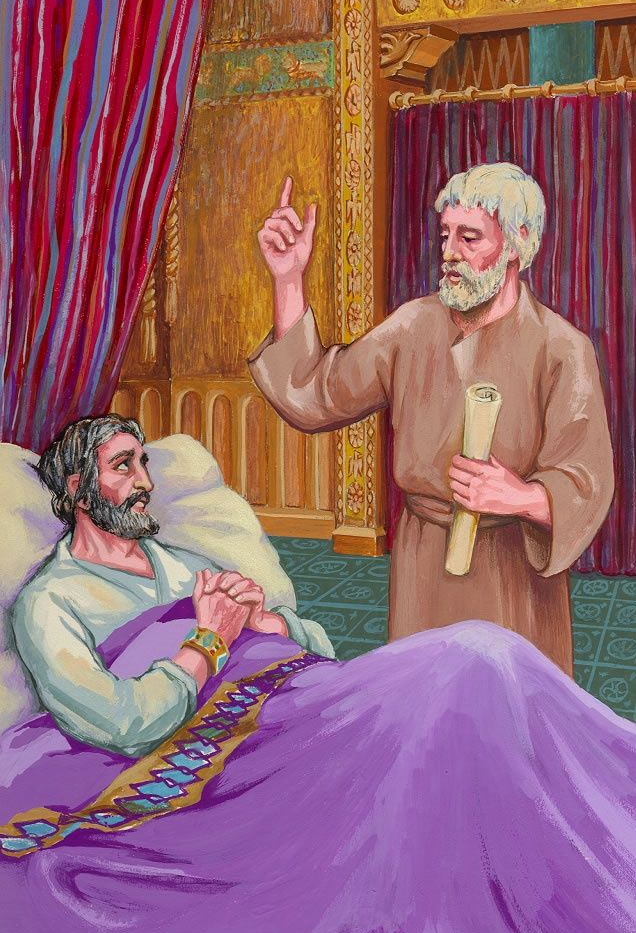
Isaiah the prophet instructed Hezekiah to set his house in order because he was going to die (2 Kings 20:1). The news caused Hezekiah to weep and to cry out to the Lord in prayer (2 Kings 20:2-3).

Once again, God heard the sincere prayer of Hezekiah and told Isaiah to inform the king that God would add fifteen years to his life and deliver and defend Jerusalem from the Assyrians (2 Kings 20:5-6).

As a confirmation that these things would happen, God caused the sun to move backwards ten steps (perhaps degrees) on the stairway of Ahaz, believed to have been a sundial or time-telling device (2 Kings 20:8-11).

Who came to visit Hezekiah after his recovery?
The Babylonians sent envoys with letters and a gift to Hezekiah after his recovery (2 Kings 20:12). These envoys were also interested in hearing about the turning back of the shadow on the sundial (see 2 Chronicles 32:31). From a practical standpoint, they were probably also interested in the prospect of an alliance to keep the Assyrians in check. Hezekiah was so pleased by their overtures that he showed them everything in his house, armory, and treasury (2 Kings 20:13-15).

Isaiah was not pleased to learn of Hezekiah’s actions and prophesied that Babylon would carry away Judah’s treasures and members of the royal family (2 Kings 20:16-19). The writer of Kings noted that the rest of Hezekiah’s acts, including the tremendous engineering feat of the tunnel, are detailed in the book of Chronicles (see 2 Chronicles 29-32). After Hezekiah died, “Manasseh his son became king in his place” (2 Kings 20:21).

2 Kings 21

Who was Manasseh?
Manasseh was the son of good King Hezekiah (2 Kings 20:21). He became king over Judah at the age of twelve and reigned fifty-five years in Jerusalem (2 Kings 21:1), longer than any other king of Judah. (Uzziah’s reign lasted fifty-two years – 2 Kings 15:2). His mother’s name was Hephzibah.

What characterized the reign of Manasseh?
Manasseh’s reign was characterized by unbridled evil. According to the Scripture, “he did evil in the sight of the Lord” (2 Kings 21:2). Manasseh’s evil was not only “according to the abominations of the nations whom the Lord dispossessed before the sons of Israel” (2 Kings 21:2), but in fact surpassed the wickedness of “the nations whom the Lord destroyed before the sons of Israel” (2 Kings 21:9 and 2 Chronicles 33:9) and the wickedness of the Amorites (2 Kings 21:11). Note the evil things that characterized his reign:

[A] “For he rebuilt the high places which Hezekiah his father had destroyed” (2 Kings 21:3). He undid all of the religious reforms of his father. He reintroduced the very things that had caused the nation to stumble for generations.

[B] “and he erected altars for Baal and made an Asherah, as Ahab king of Israel had done, and worshiped all the host of heaven and served them” (2 Kings 21:3). Manasseh obviously did not learn anything from the destruction of the Northern Kingdom. He did not take into consideration the fact that the house of Ahab experienced the judgment of God (2 Kings 9:6-10) for doing the very things he was doing in Judah. Manasseh desecrated the house of the Lord with altars and Asherah (2 Kings 21:4-5 and 2 Chronicles 33:7-8).

[C] Manasseh violated the law of God at every turn (see Leviticus 20:1-6). He “made his sons pass through the fire, practiced witchcraft and used divination, and dealt with mediums and spiritists” (2 Kings 21:6 and 2 Chronicles 33:6). Manasseh failed to learn from the judgment Ahaz suffered for doing the same things he was doing (see 2 Kings 16:1-4 and 2 Chronicles 28:1-4 for similar information on Ahaz).

[D] Manasseh “seduced” (2 Kings 21:9) and “misled Judah and the inhabitants of Jerusalem” (2 Chronicles 33:9) to sin against God (see also 2 Kings 21:11).

[E] In addition to leading the nation astray, “Manasseh shed very much innocent blood until he had filled Jerusalem from one end to another” (2 Kings 21:16). It is believed that among those killed by Manasseh were many of the prophets of God. Tradition says that Manasseh had Isaiah the prophet sawn in two with a woodcutting saw (see Hebrews 11:37).

Practical Consideration: God is not an indifferent spectator.
Manasseh sinned as though God were an indifferent spectator. He brazenly committed sins that had brought the judgment of God upon others who had committed the same sins. He acted as though he would not be held accountable for his sin. He was wrong! God not only took note of Manasseh’s sin, but held both him and the nation accountable. Paul reminds us, “Do not be deceived, God is not mocked; for whatever a man sows, this he will also reap” (Galatians 6:7).

What would result from the apostasy of Manasseh and Judah?
The apostasy of Manasseh and Judah marked the Southern Kingdom for destruction (2 Kings 21:10-15). Two analogies are used to describe the extent of the coming judgment. First, Judah had been measured and found crooked. It would have to be destroyed (2 Kings 21:13a). Second, Judah was like to a dirty dish and would therefore be wiped clean and turned upside down (2 Kings 21:13b). God had had His fill and would turn the nation over to her enemies (2 Kings 21:14-15).

What event changed Manasseh’s life?
Because Manasseh and the people of Judah turned a deaf ear to the Lord (2 Chronicles 33:10), God allowed the nation to be invaded by the Assyrians. Manasseh was captured and led away like an animal (the Assyrians put hooks through his nose and thus led him away) to Babylon (see also Psalm 32:9).

While in captivity, Manasseh did not entreat Baal or any of the host of heaven or any mediums or spiritists. Instead, “he entreated the Lord his God, and humbled himself greatly before the God of his fathers” (2 Chronicles 33:12). God finally had Manasseh’s attention. The proud, rebellious, stiff-necked king was brought to his knees. Perhaps he acknowledged the attitude of the Psalmist (119:75), “I know, O Lord, that Thy judgments are righteous, And that in faithfulness Thou hast afflicted me.”

The Lord “was moved by his entreaty and heard his supplication, and brought him again to Jerusalem to his kingdom” (2 Chronicles 33:13). All of this served to convince Manasseh that “the Lord was God” (2 Chronicles 33:13).

Practical Consideration: Adversity has a way of changing some people’s theology.
Manasseh zealously advanced his idolatrous agenda while he sat on his throne. He worshiped and served strange gods and misled the people of Judah to do the same. When Manasseh found himself in captivity however, he did not entreat any of the false gods he had so zealously served. Instead, Manasseh humbled himself and called upon the God of his fathers. God graciously and mercifully heard his prayer and allowed him to return to Jerusalem. Manasseh returned home with a new theology and understanding of God.

What reforms did Manasseh institute after his repentance?
Upon returning to Jerusalem, Manasseh strengthened Jerusalem and Judah militarily (2 Chronicles 33:14). He also destroyed all of the idolatrous things he had instituted and tried to restore religious order to Judah (2 Chronicles 33:16), although the people continued to worship on the high places (2 Chronicles 33:17).

Practical Consideration: It is not always possible to undo the damage we have done.
When Humpty Dumpty was broken, not even all the king’s horses and men could put him back together again! When Manasseh returned to Jerusalem from Babylon, he tried to undo the damage he had done. Unfortunately, he could not. We should be careful about the decisions we make and actions we take lest we find ourselves unable to repair any resulting damage.

Who was Amon?
Amon was the son of Manasseh. He became king over Judah at the age of twenty-two, after the death of his father (2 Kings 21:19). His “mother’s name was Meshullemeth the daughter of Haruz of Jotbah” (2 Kings 21:19). His two-year reign was characterized by evil (2 Kings 21:20). He continued serving and worshiping the idols that Manasseh had served and worshiped (2 Kings 21:21 and 2 Chronicles 33:22). Amon forsook the Lord, did not walk in His ways, and did not humble himself before the Lord as his father had done (2 Kings 21:22 and 2 Chronicles 33:23). His servants assassinated him (2 Kings 21:23 and 2 Chronicles 33:24). The people of the land, in turn, killed them (2 Kings 21:24 and 2 Chronicles 33:25).

Practical Consideration: Some people never learn!
Manasseh’s son Amon repeated the sins of his father, in spite of the fact that his father suffered God’s judgment for those sins. Some people never learn! Some people engage in the same behavior that they have seen destroy others. Go figure!

Who was Josiah?
Josiah was the son of Amon (2 Kings 21:26). He became king over Judah at the age of eight and reigned thirty-one years (2 Kings 22:1). His “mother’s name was Jedidah the daughter of Adaiah of Bozkath” (2 Kings 22:1). Josiah “did what was right in the sight of the Lord” (2 Kings 22:2 and 2 Chronicles 34:2). He began to seek the Lord “while he was still a youth” (2 Chronicles 34:3). He is remembered as a king among kings because of his zeal for the Lord (2 Kings 23:25).

Practical Consideration: We should be concerned about what God thinks.
Josiah “did right in the sight of the Lord” (2 Kings 22:2). Too often we are not concerned about what God thinks but about what others think. Too often we are concerned about doing what others think is right rather than what God says is right. The Scripture records that Josiah did not “turn aside to the right or to the left” (2 Kings 22:2). He was consistent in his obedience to God and did not allow himself to be swayed from following God and doing what was right in His sight.
2 Kings 22

What reforms did Josiah initiate early in his reign?
[A] In the twelfth year of his reign, Josiah “began” to destroy all of the idolatrous things that had been reintroduced by his father. He purged Jerusalem and Judah “of the high places, the Asherim, the carved images, and the molten images” (2 Chronicles 34:3 and 34:6-7). He led the people to tear down every vestige of idolatry. He had all of the idolatrous images and items ground to powder and scattered the powder “on the graves of those who had sacrificed to them” (2 Chronicles 34:4). Furthermore, “he burned the bones of the priests on their altars (this was the fulfillment of a prophesy uttered 360 years earlier – see 1 Kings 13:2), and purged Judah and Jerusalem” (2 Chronicles 34:5).

[B] He began the work of restoring the house of the Lord, “which the kings of Judah had let go to ruin” (2 Chronicles 34:11), during the eighteenth year of his reign (2 Kings 22:3 and 2 Chronicles 34:8). A building fund offering was collected and delivered to the workmen (2 Kings 22:4-7 and 2 Chronicles 34:9-11). While this restoration work was taking place (2 Chronicles 34:12-13), “Hilkiah the priest found the book of the law of the Lord given by Moses” (2 Chronicles 34:12). “Hilkiah gave the book to Shaphan who read it” (2 Kings 22:8 and 2 Chronicles 34:15). Shaphan gave Josiah an update on the progress of the work, he also reported to him that Hilkiah had found a book (2 Kings 22:9-10 and 2 Chronicles 34:16-18). “And Shaphan read from it in the presence of the king” (2 Chronicles 34:18).

Practical Consideration: Our attitude toward God determines our attitude toward sin.
Josiah began seeking the Lord when he was sixteen years old. By the age of twenty he began a reformation that would purge Judah of the sinful things his father had done. Josiah loathed idolatry because he sought to know and serve the Lord. Our attitude toward God determines our attitude toward sin. The more we love God the less tolerant we are of sin. The more we love sin the less tolerant we are of God and anything godly.

What was Josiah’s response when he heard the words of the lost book?


Josiah “tore his clothes” (2 Kings 22:11 and 2 Chronicles 34:19) and asked the priest and some men to inquire of the Lord concerning the words of the book (2 Kings 22:12-13 and 2 Chronicles 34:20-21). Josiah was fearful because the lives of the people did not match the message of the book. The delegation sought the counsel of a prophetess named Huldah who lived in Jerusalem (2 Kings 22:14 and 2 Chronicles 34:22). Huldah confirmed that the nation would indeed be judged for its sin (2 Kings 22:15-17 and 2 Chronicles 34:23-25), but that Josiah would not experience the coming judgment because of his tender heart and humility (2 Kings 22:18-20 and 2 Chronicles 34:26-28).

After receiving Huldah’s message, Josiah called all the people of Jerusalem to the house of the Lord where he read to them “all the words of the book of the covenant, which was found in the house of the Lord” (2 Kings 23:1-2 and 2 Chronicles 34:29-30). Josiah then made a covenant to faithfully follow the Lord and all the people made the same covenant with him (2 Kings 23:3 and 2 Chronicles 34:31-33).

Practical Consideration: We should not treat the Bible like a lost book.
When Hilkiah found the lost book of the law in the house of the Lord, it changed the course of events in the life of Judah. We are fortunate to have Bibles in our homes. We treat the Bible like a lost book however, when we fail to read, study, and obey its message.

2 Kings 23

What reforms were initiated as a result of the covenant into which Josiah and the people entered?
Josiah intensified the reforms he began in the twelfth year of his reign.

[A] He ordered Hilkiah the priest to remove and destroy anything in the house of the Lord that had been “made for Baal, for Asherah, and for all the host of heaven” (2 Kings 23:4 and 6).

[B] He did away with the priests who served in any idolatrous capacity (2 Kings 23:5 and 8).

[C] He dealt with the male cult prostitutes (2 Kings 23:7).

[D] He defiled the place where children were made to pass through the fire (2 Kings 23:10).

[E] He destroyed everything related to idolatrous practices (2 Kings 23:11-14).

[F] His reforms even extended to the former Northern Kingdom (2 Kings 23:15 and 19-20). He also burned the bones of the priests (2 Kings 23:16-18) who had served and worshiped at the altar that was at Bethel in fulfillment of the word spoken by the man of God to Jeroboam in 1 Kings 13:1-2.

[G] He “removed the mediums and the spiritists and the teraphim [small idols] and the idols and all the abominations that were seen in the land of Judah and in Jerusalem” (2 Kings 23:24).

Practical Consideration: God’s Word defines what is pleasing and displeasing to God.
Josiah began his reforms before the lost book of the law was found. He did a commendable job of removing and destroying that that was displeasing to God. After he heard the words of the book found in the house of the Lord, Josiah had an even clearer understanding of what God required of His people and intensified his reforms. The more we study God’s Word the more we understand about what pleases and displeases God.

What feast did Josiah reinstitute?
Josiah reinstituted the Passover feast as Hezekiah had done (see 2 Chronicles 30). The celebration was so great (see 2 Chronicles 35:1-18 for details) that “such a Passover had not been celebrated from the days of the judges who judged Israel, nor in all the days of the kings of Israel and of the kings of Judah” (2 Kings 23:22).

What impact did Josiah’s life and reforms have on the timing of God’s judgment?
God’s judgment was delayed because of Josiah’s tender heart and humble spirit and faithfulness to the Lord (2 Kings 22:18-20 and 23:26-27). God’s judgment however, would still come.

How did Josiah die?
The archers of Pharaoh Neco king of Egypt killed Josiah in battle (2 Kings 23:29-30). Read 2 Chronicles 35:20-25 for more information. Jehoahaz, his son, succeeded him (2 Kings 23:30).

Who was Jehoahaz?
Jehoahaz was the son of Josiah. The people of Judah anointed him king after his father was killed in battle (2 Kings 23:30 and 2 Chronicles 36:1). The twenty-three year old monarch reigned a total of three months in Jerusalem (2 Kings 23:31 and 2 Chronicles 36:2). Unlike his father, “he did evil in the sight of the Lord” (2 Kings 23:32). He was captured and taken to Egypt by Pharaoh Neco where he later died (2 Kings 23:33-34). Pharaoh Neco imposed a tribute upon Judah during Jehoahaz’s brief reign (2 Kings 33:34 and 2 Chronicles 36:3).

Practical Consideration: We should be concerned about how we will be remembered.
Jehoahaz was the son of a godly father. He was the beneficiary of a good parental example. He witnessed the favor of God upon his father’s reign. Yet, in the three short months that he occupied the throne, “he did evil in the sight of the Lord.” He did enough wrong in three months to mark his reign as evil. He is not remembered for anything good, only that he did that which was displeasing in the sight of God. We should be concerned about how we will be remembered. If someone were to add up the influence of our lives, would we be remembered for evil or good?

2 Kings 24

Who was Eliakim (Jehoiakim)?
After the capture of Jehoahaz, Pharaoh Neco appointed Eliakim, the twenty-five year old son of Josiah, king over Judah and changed his name to Jehoiakim (2 Kings 23:34 and 36 and 2 Chronicles 36:4). Notice that Pharaoh Neco appointed Jehoiakim to reign “in the place of Josiah his father” (2 Kings 23:34) rather than in the place of Jehoahaz. This suggests that Pharaoh never recognized or acknowledged Jehoahaz’s succession. Like so many before him, Jehoiakim also “did evil in the sight of the Lord” (2 Kings 23:37 and 2 Chronicles 36:5). During his eleven-year reign he taxed the people of Judah in order to pay tribute to Pharaoh Neco. Read Jeremiah 36 to learn of the account of Jehoiakim burning the scroll of Jeremiah, which contained a call from God to repentance.

Practical Consideration: God’s Word is indestructible.
When the scroll containing the words which God had spoken to Jeremiah “concerning Israel, and concerning Judah, and concerning all the nations” (Jeremiah 36:2) was read in the presence of Jehoiakim, “the king and all his servants who heard all these words were not afraid, nor did they rend their garments” (Jeremiah 36:24). Instead, the king showed his disrespect for the word of God by burning the scroll (Jeremiah 36:23 and 27). Perhaps he thought he could abrogate God’s Word by burning it. How wrong he was.

Jeremiah dictated the words of the Lord to Baruch once again, with an added message about the fate of Jehoiakim (Jeremiah 36:27-32). Men do not break God’s Word, they only break themselves against it. Isaiah reminds us, “The grass withers, the flower fades, but the word of our God stands forever” (Isaiah 40:8).

Note: The name Eliakim means “whom God has set.” The name Jehoiakim means “whom Jehovah has set.” Some suggest that Neco made the following distinction: He felt that God (El) was a supreme being but that Jehovah (Yah) was merely a local deity. Therefore he changed Eliakim’s name to Jehoiakim to show his (Neco) authority over him (Jehoiakim).

What problems did he encounter during his reign?
The Babylonians gained military momentum during his reign and spread their empire as far as Egypt (2 Kings 24:7). Jehoiakim became a vassal of the Babylonian Empire for a period of three years (2 Kings 24:1). When Jehoiakim rebelled against Babylon, they, along with other nations, swept into Judah “to destroy it, according to the word of the Lord” (2 Kings 24:2-4). Nebuchadnezzar took Jehoiakim captive to Babylon (2 Chronicles 36:6). The Babylonian king also plundered the house of the Lord (2 Chronicles 36:7). It was at this time that Daniel and his friends were taken into exile by the Babylonians (see Daniel 1:1-7).

Practical Consideration: When God is not for you, you are at the mercy of those who are against you.
Judah’s last kings were not concerned about pleasing God. They persisted in leading the nation in a way contrary to God’s will. As a result, God marked them for destruction and allowed their enemies to harass them. In the final years of the kingdom of Judah, the nation was unable to withstand even the attacks of marauding bands from the surrounding nations. It was also unable to stand against the Babylonian war machine. A nation without God is defenseless.

Who was Jehoiachin?
Jehoiachin, the son of Jehoiakim, became king over Judah at the age of eighteen (2 Kings 24:8). His three-month reign was also characterized by evil (2 Kings 24:9). He is also known as Coniah in Scripture (Jeremiah 22:24). Read Jeremiah 22:24-30 for more information on Jehoiachin, the last king in a direct line from Solomon to rule over Judah.

What problems did he encounter during his reign?
During the reign of Jehoiachin, Nebuchadnezzar besieged Jerusalem (2 Kings 24:10-11 and 2 Chronicles 36:10a). During the siege, Jehoiachin, his family, and his leaders, surrendered to the Babylonians (2 Kings 24:12) and were taken away into exile along with thousands of others (2 Kings 24:14-16). Only the poorest people of the land were left behind (2 Kings 24:14). Nebuchadnezzar also took with him the treasures of the house of the Lord and of the king’s house (2 Kings 24:13). Jehoiachin remained in prison until Evil-merodach became king of Babylon (2 Kings 25:27). Jehoiachin remained a house prisoner and was treated kindly by the Babylonian monarch until his (Jehoiachin’s) death (2 Kings 25:28-30).

Who became king over Judah after Jehoiachin’s surrender?
Nebuchadnezzar appointed Mattaniah, Jehoiachin’s twenty-one year old uncle, king over Judah and changed his name to Zedekiah (2 Kings 24:17-18 and 2 Chronicles 36:10b). In typical fashion, he too, did evil in the Lord’s sight and showed no respect for God, God’s Word, or God’s prophets (2 Kings 24:19 and 2 Chronicles 36:11-16). He too, rebelled against Nebuchadnezzar (2 Kings 24:20).

2 Kings 25

What did Nebuchadnezzar do when Zedekiah rebelled against him?
Nebuchadnezzar went to Jerusalem and besieged the city (2 Kings 25:1-2). The siege resulted in a severe famine that left the inhabitants of Jerusalem without food (2 Kings 25:3). When the Chaldeans (Babylonians) broke into the city, the king and his army fled the city but were overtaken on the plains of Jericho (2 Kings 25:4-5). Zedekiah was captured and sentenced (2 Kings 25:6). His sons were killed in his presence after which he was blinded (the last thing he saw was the death of his sons), fettered, and taken to Babylon by his captors (2 Kings 25:7).

Practical Consideration: God is faithful to warn of danger, but it is our responsibility to heed His warnings.
Zedekiah was an evil ruler. God, however, made every attempt to call Zedekiah and the nation to repentance. Zedekiah and the people responded by stiffening their necks, hardening their hearts (2 Chronicles 36:13), mocking God’s messengers, despising God’s words, and scoffing at God’s prophets (2 Chronicles 36:16). Because they did not heed God’s call to repentance, both Zedekiah and the nation suffered great loss. Zedekiah lost his sons, his sight, and his throne. The people lost their freedom and their homeland.

What did Nebuchadnezzar do to the city of Jerusalem?
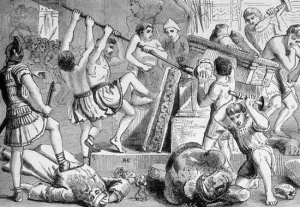
Nebuzaradan, the captain of the guard and a servant of Nebuchadnezzar, went to Jerusalem (2 Kings 25:8). He plundered (2 Kings 25:13-17) and burned the temple and the city (2 Kings 25:9) and broke down the walls around Jerusalem (2 Kings 25:10 and 2 Chronicles 36:18-19). He also carried many of the Jews into exile, leaving only the poorest to cultivate the land (2 Kings 25:8-12 and 2 Chronicles 36:20) and put to death various religious, civic, and military leaders (2 Kings 25:18-21). “So Judah was led away into exile from its land” (2 Kings 25:21). The Southern Kingdom fell in 586 B.C., which marked the end of any independent Jewish state until May 14, 1948.

Practical Consideration: The book of misery is written with the ink of disobedience.
Both the rulers and people of Judah experienced great personal losses and sufferings at the hands of their enemies. These things, however, could have been avoided through obedience to God. The people chose instead to continue in their sinful ways. We too, author our own misery every time we chose to disobey God’s Word and walk in a manner contrary to His will.

Who was given charge over Judah after the destruction of Jerusalem?
Nebuchadnezzar appointed Gedaliah to serve as governor over Judah who encouraged those who remained behind to “live in the land and serve the king of Babylon” and thus avoid any further trouble (2 Kings 25:22-24). Gedaliah was assassinated by a member of the royal family named Ishmael and a group of ten men who afterward fled to Egypt for refuge (2 Kings 25:25-27).

1 Kings 11

1 Kings 11:1-13
11:1 King Solomon, however, loved many foreign women besides Pharaoh’s daughter [cf. 1 Kings 3:1]—Moabites [Moab located east of the Dead Sea], Ammonites [Ammon located northeast of the Dead Sea], Edomites [Edom located southeast and southwest of the Dead Sea], Sidonians [from the area of the Phoenician city of Sidon] and Hittites [kingdom had existed north of Israel; had become integrated into Israel; Bathsheba’s first husband was a Hittite (2 Sam. 11:3); Hittites conscripted to serve as laborers (1 Kings 9:20-21)].

11:2 They were from nations about which the LORD had told the Israelites [cf. Ex. 34:15-16; Deut. 7:1-5 re: warnings about the dangers of intermarriage with other nations], “You must not [this prohibition based on spiritual reasons, not racial reasons] intermarry with them, because [note the reason behind the prohibition; behind every negative command stand the positive principles of protection from harm and provision of something better] they will surely turn your hearts after their gods.” Nevertheless, Solomon held fast to them in love [means “a strong emotional attachment” (implies a desire to be in the presence of the object of love); what or who we love can impact our allegiance to God].

Note: Ask these questions before entering into any association…
• What do they believe? — Are their beliefs consistent with the Word of God?
• How do they behave? — How will their behavior impact my life?
• What will I become? — Will I have to compromise my convictions in order to get along with them?

11:3 He had seven hundred wives of royal birth [indicates that marriages were primarily political (to maintain peace and mutual economic benefits); considered good politics from a worldly perspective] and three hundred concubines [sort of second-class wives], and his wives led him [Solomon placed greater value on the words of his wives than on the Word of God] astray [cf. Deut. 17:16-17; conscious disobedience can only lead to disaster (cf. Prov. 13:13); cf. Ps. 1:1].

Note: What worldly beliefs and lifestyles threaten to endanger your commitments to God and His purposes?

11:4 As Solomon grew old [through the years Solomon’s wives led him to become tolerant of the very things God had told him to reject (a reminder that deterioration is never sudden); old age does not exempt us from temptation], his wives turned his heart [indicates the inner being of a person, including mind, emotion, and will] after other gods, and his heart [Solomon’s actions followed the direction of his heart] was not fully devoted [Solomon quit worshiping the Lord exclusively] to the LORD his God, as the heart of David his father had been.

11:5 He followed [literally “walked after”; he no longer hated the things that God hated; he accepted the things that were detestable in God’s sight; violated the first commandment (Ex. 20:3)] Ashtoreth [also called Astarte (Gr. name); a fertility goddess and consort of Baal (a fertility god); associated with fertility, love, and war; worship practices included lewd sexual rites] the goddess of the Sidonians, and Molech [the worship of Molech involved passing children through fire (Lev. 18:21; 20:2-5; 2 Kings 23:10; Jer. 32:35) as either a burnt offering to Molech or as a rite dedicating children to service of Molech] the detestable god of the Ammonites.

11:6 So Solomon did evil [by facilitating and participating in the worship of idols] in the eyes [everything we do is in the sight of God; no one can do anything “behind God’s back”] of the LORD [cf. Deut. 4:25]; he did not follow the LORD completely [the Lord requires our total allegiance (cf. Matt. 6:24)], as David his father had done.

11:7 On a hill east of Jerusalem [identified as the Hill of Corruption at the time Josiah destroyed the shrines Solomon built to the idols (cf. 2 Kings 23:13); the Mount of Olives], Solomon built a high place [a place where pagan gods were worshiped (most of these places were located on mountains or hills); the high places that Solomon built survived for approximately three centuries until the time of Josiah (2 Kings 23:13)] for Chemosh the detestable god of Moab [cf. 2 Kings 3:26-27], and for Molech the detestable god of the Ammonites.

Note: Solomon’s decision to build high places of worship for Ashtoreth, Chemosh, and Molech served as a stumbling block for Israel for approximately three centuries. How will our choices impact future generations?

11:8 He did the same [provided places of worship in direct violation of God’s command (Ex. 20:1-6; 23:13; Deut. 5:6-10; 6:14); Solomon’s love for his wives (11:2) motivated him to provide shrines where they could worship their gods] for all his foreign wives, who burned incense and offered sacrifices to their gods.

Note: How could Solomon, who displayed such wisdom early in his reign, have acted so foolishly and sinfully toward the end of his life?

11:9 The LORD [does not tolerate idolatry; cf. Deut. 4:24] became angry [disobedience is costly] with Solomon because his heart had turned away from the LORD, the God of Israel, who had appeared to him twice [cf. 1 Kings 3:5 (beginning of his reign) and 1 Kings 9:2 (24 years later at dedication of temple); this wonderful privilege accentuated the grievous nature of Solomon’s sin; God had emphasized the importance of commitment to Him on the occasions He had appeared to Solomon (1 Kings 3:14; 9:4-9)].

11:10 Although he had forbidden Solomon to follow other gods, Solomon did not keep the LORD’S command [we must say “no” to God before we can say “yes” to sin].

11:11 So the LORD said to Solomon [no record that Solomon repented when confronted by the Lord], “Since this is your attitude and you have not kept my covenant and my decrees, which I commanded you, I will most certainly tear the kingdom away from you and give it to one of your subordinates [one who was serving Solomon; Jeroboam, head of the labor force of the tribes of Joseph (1 Kings 11:28), became king of the northern tribes after Solomon’s death (1 Kings 11:31,34-36; 12:20)].

Note: Does the severity of God’s judgment on Solomon for his disobedience challenge you to a higher level of commitment?

11:12 Nevertheless, for the sake of David your father, [note that God tempered His judgment on Solomon] I will not do it during your lifetime. I will tear it out of the hand of your son [Rehoboam (1 Kings 14:21)].

11:13 Yet I will not tear the whole kingdom from him, but will give him one tribe [Judah (the tribe of David); the Southern Kingdom] for the sake of David my servant and for the sake of Jerusalem, which I have chosen.”

1 Kings 12

1 Kings 12:6-16
12:6 Then King Rehoboam [Solomon’s son; did evil in the sight of the Lord during his 17 year reign] consulted [Rehoboam wisely sought advice to determine the best course of action] the elders [men who understood the complexities of ruling a kingdom; these men realized the people had a valid complaint] who had served his father Solomon during his lifetime. “How would you advise me to answer [read 12:3-4] these people?” he asked.

12:7 They replied [their advice reflected a wealth of experience and knowledge; the elders were aware of the growing resentment under Solomon’s reign], “If today you will be a servant to these people and serve them and give them a favorable answer, they will always be your servants.”

12:8 But Rehoboam rejected the advice the elders gave him and consulted the young men [as opposed to “the elders” in 12:6] who had grown up with him [indicates limited experience and knowledge] and were serving him [Rehoboam had quickly enlisted his friends to serve in his administration].

12:9 He asked them, “What is your advice? How should we answer these people who say to me, ‘Lighten the yoke [used figuratively to refer to hardship and burden] your father [Solomon] put on us’?”

12:10 The young men who had grown up with him replied [these young men urged Rehoboam to rule by fear and force rather than by concern and service; their advice expressed ambition, greed, and indifference for the well being of the people], “Tell these people who have said to you, ‘Your father put a heavy yoke on us, but make our yoke lighter’—tell them, ‘My little finger is thicker than my father’s waist [proverb emphasized that Rehoboam’s weakest measures would be stronger than his father’s sternest measures].

12:11 My father laid on you a heavy yoke; I will make it even heavier. My father scourged you with whips; I will scourge you with scorpions [a reference to metal-spiked leather lashes].’”

Note: What are ways we can weigh advice carefully? What principles guide you in evaluating advice? What factors influence you as you listen to advice and decide on a course of action?

12:12 Three days later Jeroboam and all the people returned to Rehoboam, as the king had said [cf. 12:5], “Come back to me in three days.”

12:13 The king answered the people harshly [refers to action that can be cruel or stubborn]. Rejecting the advice [to ease the people’s burden, even at the expense of revenues for the king and his court] given him by the elders,

Note: What makes advice godly? Godly advice…
• has a concern for people
• guides us in ethical and moral paths
• encourages us to lead through service
• focuses on bringing glory to God
(Source: ETB Adult Leader Guide, Spring 2003, p. 84)

12:14 he followed [the king chose to act on the bad advice] the advice [advice that was brash, selfish, and callous] of the young men and said, “My father made your yoke heavy; I will make it even heavier. My father scourged [the term used to beat a slave] you with whips; I will scourge [use of this word indicates that Rehoboam saw the people as slaves] you with scorpions.”

12:15 So the king did not listen to the people, for this turn of events was from the LORD, to fulfill the word the LORD had spoken to Jeroboam son of Nebat through Ahijah the Shilonite.

12:16 When all Israel [“all Israel” a reference to northern tribes] saw that the king refused to listen to them [Rehoboam destroyed in one moment what David and Solomon had built over a period of 80 years], they answered the king: “What share do we have in David, what part in Jesse’s son [rhetorical question that declares they were severing all ties with Judah (the tribe of David)]? To your tents, O Israel [a call for the leaders of the northern tribes to return home]! Look after your own house, O David [a way of telling Rehoboam he could reign over Judah, but not over them]!” So the Israelites went home.

1 Kings 12:26-28
12:26 Jeroboam [the Northern Kingdom’s first king; made Shechem his capital; read the words of Ahijah the prophet concerning Jeroboam in 11:29-31] thought to himself, “The kingdom will now likely revert to the house of David [David still recognized as a great national hero; Jeroboam feared that the people would change their minds and accept Rehoboam as king].

12:27 If [Jeroboam, unsure of how firmly he was in control, began to think of an unpleasant scenario] these people go up to offer sacrifices at the temple of the LORD in Jerusalem, they will again give their allegiance to their lord, Rehoboam king of Judah. They will kill me and return to King Rehoboam.”

12:28 After seeking advice [the source of the advice he sought is unspecified], the king [Jeroboam established a new place of worship and new symbols to use in worship] made [Jeroboam’s actions were politically motivated and designed to keep the people from going to Jerusalem to worship; Jeroboam interested in self-preservation] two golden calves [this was a violation of God’s commandments in Ex. 20:4-6; one calf was set up in Bethel in the south (located ten miles north of Jerusalem) and Dan in the north (north of the Sea of Galilee) as per 12:29; Jeroboam sowed the seeds of evil and idolatry that would eventually result in the fall of the Northern Kingdom (cf. 2 Kings 17:21-23)]. He said to the people, “It is too much for you to go up to Jerusalem. Here are your gods [a violation of the first and second commandments], O Israel, who brought you up out of Egypt. [cf. Aaron’s words in Ex. 32:4]

1 Kings 10

1 Kings 10:4-7
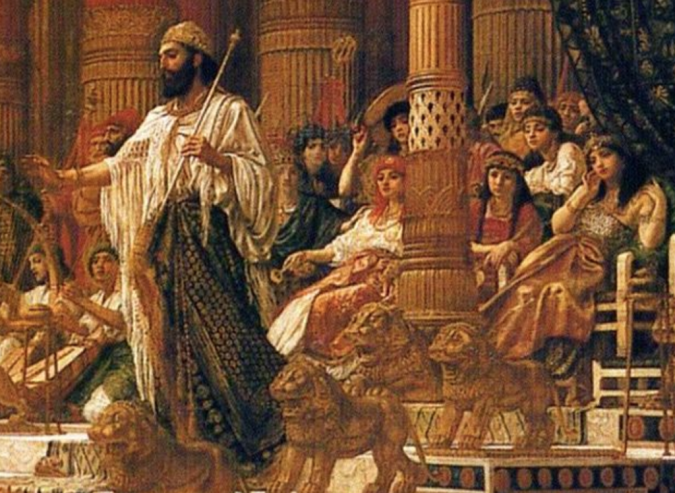
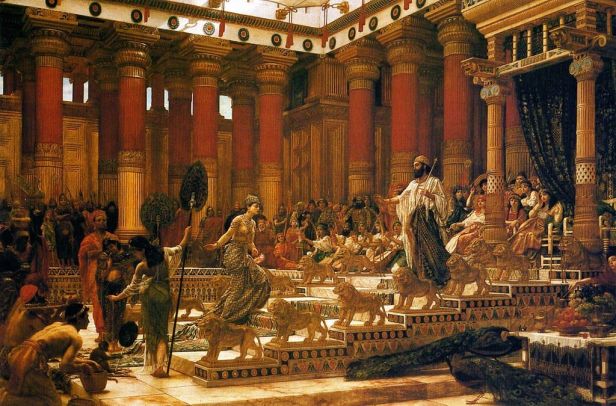
10:4 When the queen of Sheba saw [in Solomon’s answers to her questions and in his administration of the kingdom] all the wisdom of Solomon and the palace he had built [the palace was mute testimony to Solomon’s power and organizational genius],

10:5 [Solomon’s organizational genius was obvious in every detail the queen of Sheba observed] the food on his table, the seating of his officials, the attending servants in their robes, his cupbearers, and the burnt offerings he made at the temple of the LORD, she was overwhelmed [literally “there was no more spirit in her”; the grandeur of all she saw took her breath away; queen later acknowledged source of Solomon’s wisdom and honor (10:9)].

10:6 She said to the king, “The report I heard in my own country about your achievements and your wisdom is true.

10:7 But I did not believe [she had been skeptical about what she had heard about Solomon] these things until I came and saw with my own eyes [she took the time to personally investigate]. Indeed, not even half [the reports she had heard were clearly understated] was told me; in wisdom and wealth you have far exceeded the report I heard.

1 Kings 10:14-15
10:14 The weight of the gold that Solomon received yearly was 666 talents [almost 25 tons of gold; talent roughly equivalent to 75 pounds],

10:15 not including [Solomon had other sources of income] the revenues from merchants and traders [taxes levied on those who moved their merchandise through Solomon’s territory] and from all the Arabian kings [tribal chiefs in the desert to the south and east of Jerusalem; they paid tribute to Solomon] and the governors of the land.

1 Kings 10:22
10:22 The king had a fleet of trading ships [“trading ships” translates Heb. word “Tarshish” which was a trading center somewhere in the western Mediterranean Sea (some believed it was a port in southern Spain); ships that could travel as far as Tarshish came to be called “Tarshish” which means “large trading vessels”; Solomon constructed fleet of ships at Ezion Geber (cf. 1 Kings 9:26)] at sea along with the ships of Hiram[king of Tyre (1 Kings 5:1); both Solomon and Hiram benefited from this alliance]. Once every three years it returned, carrying gold, silver and ivory, and apes and baboons.

1 Kings 9

1 Kings 9:15-19
9:15 Here is the account of the forced labor [cf. 1 Sam. 8:11-18 re: Samuel’s warning that a king would use them and their resources for his own ends] King Solomon conscripted to build the LORD’S temple, his own palace, the supporting terraces [may refer to earthworks connecting David’s city of Jerusalem and newly constructed temple], the wall of Jerusalem [probably extended the wall to include the area of the new temple and palace complex; made the city more easily defended], and Hazor [located three miles north of the Sea of Galilee at junction of two major trade routes], Megiddo [a fortress northwest of Jerusalem] and Gezer [located west on the road from Joppa to Jerusalem; these three cities occupied strategic locations].

9:16 (Pharaoh king of Egypt had attacked and captured Gezer. He had set it on fire. He killed its Canaanite inhabitants and then gave it as a wedding gift to his daughter, Solomon’s wife.

9:17 And Solomon rebuilt Gezer.) He built up [strengthened] Lower Beth Horon [located northwest of Jerusalem; cf. 2 Chron. 8:5; along with its sister city, Upper Beth Horon, guarded an important travel route],

9:18 Baalath [precise location uncertain], and Tadmor [all of the places named were strategic places; Solomon strengthened these places to protect trade routes and to fortify Israel against attack] in the desert, within his land,

9:19 as well as all his store cities and the towns [Solomon used these cities and towns to stockpile provisions he and his army might need; these cities were strategically located, enabling the forces stationed there to move quickly to defend Israel; Solomon stored tax revenues in these cities] for his chariots and for his horses [archaeological excavations unearthed remains of stables in Megiddo (capable of housing from 300-500 horses)]—whatever he desired to build in Jerusalem, in Lebanon and throughout all the territory he ruled.

1 Kings 9:25
9:25 Three times a year [Feasts of Passover (or Unleavened Bread), Weeks (Pentecost), and Booths (Tabernacles); cf. Ex. 23:14-19; cf. parallel passage in 2 Chron. 8:12-13] Solomon sacrificed burnt offerings and fellowship offerings on the altar he had built for the LORD, burning incense before the LORD along with them, and so fulfilled the temple obligations [although he was busy, Solomon took time to focus on the Lord].

Note: King Solomon maintained his focus on God and His work even while completing many impressive building projects. What, if any, earthly concerns or responsibilities distract you from spiritual priorities?