Job 2

Satan’s Second Challenge   (2:1-10)

2:1
Notice that this verse begins with the word “Again.” The word “again” reminds us that Satan is persistent. He does not give up. He comes again and again to carry out his diabolical agenda (see John 10:10a). Luke 4:13 records that after unsuccessfully tempting Jesus in the wilderness, Satan “departed from Him [Jesus] until an opportune time.” Satan tirelessly works to set men in opposition to God.

2:2
The Lord asked Satan the same question He asked in Job 1:7. Satan’s answer was the same as his answer in Job 1:7. It is interesting to note that Satan makes no mention of Job when he presents himself before the Lord the second time. Satan did not say, “I’ve just come from roaming about on the earth where I unsuccessfully tried to get Job to curse You to Your face.”

2:3
The Lord once again asked Satan if he had considered His servant Job who did not curse God as Satan had hoped. It is interesting that the Lord asked Satan if he had “considered” Job. Satan had done nothing but consider Job. Satan had been totally occupied with the matter of Job’s destruction. It was God’s way of emphasizing Job’s triumph over Satan’s attacks. In spite of all that Satan had done, Job remained true to God and did not loosen his grip on his integrity. Thomas Robinson notes, “Satan’s object in trial is to destroy; God’s, to prove and purify.”

2:4-6
Again, Satan questioned Job’s motives for remaining faithful to God. He used a bartering term, “skin for skin,” which means to trade one skin for another. Satan asserted that Job was only too glad to save his own skin, even if it was at the expense of the skin of his livestock and children. A man will part with anything to save his own life, Satan said. Satan confidently challenged that Job would change his tune if he personally experienced physical pain and suffering. Satan believes that every man has his price and he felt that Job’s price was his own skin. Satan felt certain Job would crumble under the weight of personal physical pain and consequently curse God to His face. God then permitted Satan to touch Job’s body but to spare his life. Once again, God’s sovereignty kept Satan in check. Thomas Robinson writes, “Though God lengthens Satan’s chain, he never loosens it.”

2:7-8
Satan wasted absolutely no time in departing from heaven to carry out his cruel mission of destruction. He unleashed his full diabolical fury on Job. Satan “smote Job with sore boils from the sole of his foot to the crown of his head.” Job was in intense agony as a result and sought to find relief by scraping himself with a potsherd. There are several graphically descriptive references throughout the book to the pain and suffering Job experienced for months (7:3 and 29:2) as a result of the boils.

  • 2:7…………………………. ulcerous sores
  • 2:8…………………………. itching
  • 2:12……………………….. boils made Job unrecognizable
  • 3:24……………………….. loss of appetite
  • 3:24-26…………………… depression
  • 7:5…………………………. worms, hardened skin, running sores
  • 9:18……………………….. difficulty in breathing
  • 16:16……………………… dark eyelids
  • 19:17……………………… offensive breath
  • 19:20……………………… weight loss
  • 30:17……………………… continual pain
  • 30:30……………………… blackened skin and fever

2:9-10
The words of Job’s wife (who had the spiritual gift of discouragement) are recorded in verse 9. At the time when Job most needed the comfort and encouragement of his wife, she questioned why Job was still holding fast to his integrity. She unwittingly aided Satan in his efforts to get Job to curse God. She felt that in view of all that had befallen her husband, God was no longer worthy of his allegiance (or hers). And so, she counseled him to “Curse God and die!” Job sternly rebuked his wife for her foolish suggestion and refused to sin against God. These are the only words of Job’s wife that are recorded in the book. We do not know what she did after Job rebuked her. Perhaps she left him.

Note: Job’s wife asked a question that every individual must answer on a daily basis: “Are you still holding on to your integrity?” It seems that every day we are tempted, by either an individual or circumstance, to compromise our integrity. Perhaps we hear the voice of Job’s wife when we are driving on a stretch of lonely highway with a posted speed limit that tests every fiber of our patience. That is when we hear the voice of Job’s wife asking, “Are you still holding on to your integrity? Curse the speed limit signs and speed!” Perhaps we hear the voice of Job’s wife when we are faced with having to keep a promise, “Are you still holding on to your integrity? Forget your promise and do what you want to do?” Perhaps we hear the voice of Job’s wife when we are tempted to be dishonest, “Are you still holding on to your integrity? Nobody will ever know that you did this!” The challenge of being people of integrity is a daily challenge. We become people of integrity one decision at a time. If we will make the right decisions and ignore the voice of Job’s wife, then perhaps we will be able to say along with Job, “till I die, I will not deny my integrity” (see Job 27:5).
The Arrival of Job’s Friends (2:11-13)

2:11-13
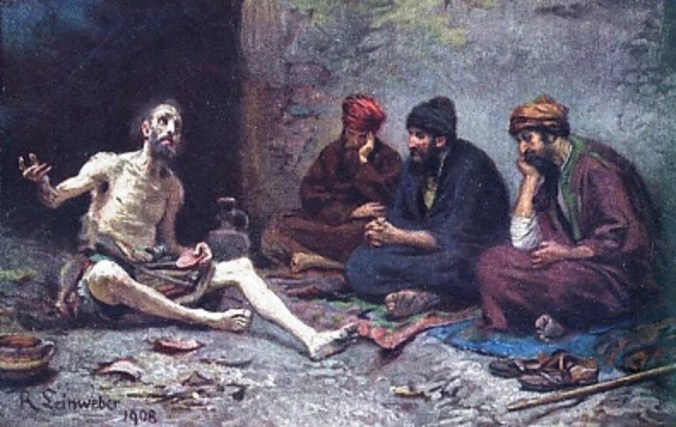
The news of Job’s misfortune must have spread throughout the land of Uz. When Job’s friends heard of his awful misfortune, they “made an appointment together to come to sympathize with him and comfort him” (2:11). Job’s friends (Eliphaz, Bildad, and Zophar) had the very best of intentions. They hoped to bring comfort to their friend. Affliction should certainly draw us to our friends. When these three friends approached Job they “did not recognize him” (2:12). Job was so disfigured by the boils that even his best friends did not recognize him. They were stunned by what they saw and immediately wept and grieved with him (2:12). In addition, they were so horrified at what they saw that did not speak a word to him (2:13). They just silently sat with him for an entire week and waited for Job to speak first (according to the custom of the day).

Job 1

Job’s Piety and Prosperity (1:1-5)

1:1
The Book of Job begins by affirming that Job was an actual historical character: “There was a man in the land of Uz, whose name was Job.” The location of Uz is uncertain. Some believe it was located southeast of Palestine near modern-day Jordan. Uz is mentioned in Jeremiah 25:20 and Lamentations 4:21.

The Bible paints a stunning portrait of Job in one small verse. Job 1:1 records four things about Job. He was “blameless, upright, fearing God, and turning away from evil.” These four things tell us a great deal about Job’s faith and show him to be a devout man who was fully committed to God.

First, Job was “blameless.” This does not mean that Job was sinless. Sinlessness has to do with our vertical relationship. The word “blameless” refers to Job’s horizontal relationships. He was a man who lived his life before others in such a way that no charge of moral failure or duplicity could be brought against him. He was a man of unquestionable integrity.

Second, Job was “upright.” The word “upright” means “straight.” Job did not stray from God’s path. He did not take crooked or perverse paths. He did not wander off on side roads leading away from God. His walk was consistent with his talk. He was a man of high moral character. What he was on the inside was reflected on the outside.

Third, Job feared God. Job took God seriously. He had deep reverence and respect for God. He was completely devoted to God and would not entertain any thought of violating His will. Oswald Chambers said, “The remarkable thing about fearing God is that, when you fear God, you fear nothing else; whereas, if you do not fear God, you fear everything else.”

Fourth, Job turned away from evil. Job avoided every and any thing that was unworthy in God’s sight. He was not attracted to anything that was wicked or evil. Job did not give in to the lure of the world. He knew how to say “no.” He avoided both the presence and practice of evil (see 1 Thessalonians 5:22).

1:2
The Bible tells us that Job had a large family. He had “seven sons and three daughters.” This was a sign of Divine favor and blessing (see Psalm 127:3-5 and Psalm 128:3-4). Job’s name and reputation would be perpetuated beyond his lifetime through his sons. According to Job 1:4, Job’s children were very close. They enjoyed one another’s company on a regular basis: “each one on his day.”

1:3
Job lived in a day when wealth was measured by property. Job possessed land, animals, and servants, the symbols of wealth and success in his day. He possessed 7,000 sheep (which provided him with clothing). He possessed 3,000 camels (which provided him with transportation). He possessed 500 yoke of oxen (which provided him with food and the ability to plow). He possessed 500 female donkeys (which provided him with even more animals). He had “very many servants” (tending to the work of his vast estate). The Bible also tells us that Job “was the greatest of all the men in the east.” He was held in high regard by God and his fellow man. He was well-known throughout the land. He cast a long shadow. He had the highest standing in the community.

1:4-5
Job was a man who was concerned about the spiritual welfare of his family. He was successful both in the marketplace and the home. He knew how to balance his career and his family, as well as his spiritual walk. Job 1:4 tells us that Job’s children met regularly for times of feasting. Job 1:5 tells us that after such times Job would offer burnt offerings for each of his children. Job wanted for his children to have a right relationship with God. He was the spiritual leader of his home. Howard Hendricks said, “If your faith doesn’t work at home, don’t export it.” Job’s faith worked at home.

Satan’s First Challenge (1:6-22)

1:6
The Bible pulls back the curtains and allows us to witness a remarkable exchange between God and Satan. As the “sons of God” (the angelic host) were presenting themselves before the Lord, Satan appeared with them. Although an outcast from heaven, Satan was still permitted to appear in heaven.

1:7
God asked Satan, “From where do you come?” God knew the answer to the question. He asked the question to raise an issue. Satan answered by saying, “From roaming about on the earth and walking around on it.” Peter tells us, “Be of sober spirit, be on the alert. Your adversary, the devil, prowls about like a roaring lion, seeking someone to devour” (1 Peter 5:8). The name Satan means “adversary” and the name Devil means “slanderer.” Satan’s delights in opposing and slandering us before God. He is the author of a destructive agenda. Jesus said that Satan’s three-fold agenda is to “steal, and kill, and destroy” (John 10:10).

1:8
God asked Satan if, in his roaming about on the earth, he had noticed “My servant Job.” This verse reveals what God thought of Job. It is worth parenthetically stating that what God thinks of us is more important than what men think of us. God and Job had a close personal relationship. God endorsed the character and conduct of Job by saying that “there is no one like him on the earth, a blameless and upright man, fearing God and turning away from evil.”

1:9-11
Satan responded to God by saying that the only reason Job was faithful was because God had bought him with blessings and spoiled him. Satan said that Job’s allegiance to God was held together by blessings. “Remove those blessings,” Satan asserted, “and you will see what Job is really like. You will see that he will stop worshiping and serving You and indeed curse You to Your face. Job’s allegiance to You will quickly unravel once you remove the blessings from his life.”

It is interesting to note that the words of Satan are recorded in only three places in the Scripture. First, Satan’s words are recorded in Genesis 3. Satan told the woman that God was holding out on her, in essence, “God is not good to you.” Second, Satan’s words are recorded in Job 1. Satan told God He was too good to man. Third, Satan’s words are recorded in Matthew 4. Satan told Jesus to bow and worship him and he (Satan) would be better to Him than God.

1:12
God accepted Satan’s challenge. He permitted Satan to ferret out Job’s motives for serving Him. Satan’s power however, was limited by God’s sovereignty as seen in the phrase, “only do not put forth your hand on him.”

1:13-19
Satan wasted no time in working to prove God wrong about Job. He was intent on securing Job as a trophy of his evil agenda. Satan therefore launched a four-fold attack against Job in an attempt to prove that he served God only for selfish reasons. Satan worked his evil in a fast sequence in an effort to stun and overwhelm Job. His intent was to try to engulf and drown Job in tormenting waves of affliction (compare Psalm 42:7).

First, Satan stirred up the Sabeans to attack and steal Job’s oxen and donkeys and slay his servants. Satan is never at a loss for instruments to do his work. Job received word of his loss from a sole servant who had survived and escaped the attack (1:13-15). Satan cleverly began with Job’s cattle as he worked his evil toward a climax.

Second, while the first servant was reporting to Job concerning his loss at the hands of the Sabeans, another servant entered to report yet another tragic loss to Job. The second servant reported the loss of all of Job’s sheep and the servants who tended them. The cause of the loss was fire from heaven (lightning). Satan used the weather to inflict more tragedy on Job (1:16).

Third, before the second servant completed his report, a third servant entered to report that the Chaldeans had stolen Job’s camels and slain the servants who tended them (1:17).

Fourth, the final report of disaster came while the third servant was still speaking. A fourth servant entered to report to Job the most tragic news of all, namely the death of his ten children (1:18-19). The “great wind” which struck and destroyed the house that fell on his children was perhaps a tornado. This was the climax of Satan’s evil efforts to prove God wrong concerning the faithfulness of Job.

In a brief period of time Job experienced the loss of everything he had worked for and everyone he loved. He went from a state of being a happy father to being childless in one stroke. He found himself without his children to comfort him and help him deal with the other tragic losses he experienced. Job’s grief must have been unbelievable. Martin Luther, in his hymn entitled “A Mighty Fortress Is Our God,” wrote,

For still our ancient foe
Doth seek to work us woe —
His craft and power are great,
And, armed with cruel hate,
On earth is not his equal.

1:20-22
Job responded to his personal disaster in five ways.

First, according to verse 20, “Job arose and tore his robe and shaved his head.” In Job’s day, these were expressions of grief and sorrow. Job allowed himself to grieve over his loss. Job did not try to put on a stoic or super-pious front. He wept. He grieved.

Second, Job “fell to the ground and worshiped” (1:20). Job did not curse God as Satan had asserted. Job did not stand on his feet and defiantly curse God for his troubles as Satan expected. Job “fell to the ground and worshiped.” Thomas Robinson wrote, “Afflictions draw a godly man nearer to God instead of driving him from Him.”

Third, Job did not lose sight of the bigger picture. He acknowledged that he had entered the world empty-handed and would leave it the same way (1:21a).

Fourth, Job opened his mouth and spoke. He did not, however, speak what Satan expected. Job acknowledged the sovereignty of God. He said, “The Lord gave and the Lord has taken away.” (1:21b). Job acknowledged God’s ownership of all things. He understood that everything he had was on loan from God.

Fifth, Job refused to become bitter. He said, “Blessed be the name of the Lord” (1:21b). And the Scripture adds, “Through all this [see 1:13-19] Job did not sin nor did he blame God” (1:22).

Malachi 3

3:1 “See, I will send My messenger [forerunner; see Mal. 4:5 re: Elijah; see Matt. 11:10 re: fulfillment in John the Baptist], who will prepare the way before Me. Then suddenly [unexpectedly] the Lord [Jesus Christ] you are seeking [even in their sin the people longed for deliverance through the Messiah] will come to His temple; the messenger of the covenant [only use of this phrase in OT], who you desire, will come [fulfilled in coming of Jesus],” says the Lord Almighty.

Note: Use of the pronoun “Me” establishes identification between the First and Second persons of the Trinity.
Christ came “to His temple” first as a baby to be dedicated, annually for festivals, and in the last week of His life.

3:2 But who can endure the day of His coming [cf. Amos 5:18-20]? Who can stand when He appears [to vindicate the righteous and punish the wicked]? For He will be like a refiner’s fire [eliminate impurities and refine; God’s refining fire morally transforms individuals] or a launderer’s soap [cleanses stains].

Note: Note that the first advent of Christ is pictured in 3:1 and His second coming in 3:2. “The day of His coming” or “Day of the Lord” refers to any day God steps into history to do a special work, whether judgment or deliverance.

3:3 He will sit [and wait for the fire to do its purifying work] as a refiner and purifier of silver; He will purify the Levites [see 3:1 re: “come to His temple”] and refine them [because they were responsible for the people’s spiritual decline; see 2:1-9] like gold and silver [see Matt. 23 re: Jesus’ words to religious leaders]. Then [after the refining process] the Lord will have men [righteous individuals] who will bring offerings in righteousness,

3:4 and the offerings of Judah and Jerusalem will be acceptable to the Lord, as in days gone by, as in former years [cf. 2:5-6; symbolic of cleansed/sanctified church].

Note: What impurities would God have to take out of your life to qualify you to bring offerings that are acceptable to the Lord? Remember: the heart of giving is the state of the heart.

3:5 “So I will come near to you for judgment. I [God] will be quick to testify [like a witness to a crime] against [activities condemned in the Law of Moses] sorcerers [perform witchcraft/magic], adulterers [violation of 7th Commandment] and perjurers [swear falsely; forbidden by 9th Commandment], against those who defraud laborers of their wages, who oppress the widows and the fatherless [those who are helpless and have no one to protect them], and deprive aliens of justice, but do not fear Me [cause for all the preceding sins; see Prov. 1:7],” says the Lord Almighty.

3:6 I the Lord do not change [immutability of God; contrary to the attitude expressed by the people in 2:17; see Heb. 13:8]. So you [as a result of God’s unchangeableness], O descendants of Jacob, are not destroyed [ended].

3:7 Ever since the time of your forefathers [past 900+ years] you have [1] turned away from My decrees and [2] have not kept them [terms of covenant]. Return [repent; people, not God, had broken the relationship] to Me, and I will return to you [indicates God’s willingness to receive His people],” says the Lord Almighty. “But you ask, ‘How are we to return? [attitude expressed is “Why do we need to return?” and suggests the people felt that they had never left God]

3:8 [because of sins listed in 3:5 and more specifically the specific sin listed here] “Will a man rob God [rhetorical question]? Yet you rob Me [evidence of why they needed to return to God]. “But you [people] ask, ‘How do we rob you?’ [God’s response] “In tithes [assigned to the Levites for their services as per Num. 18:21,24; see also Lev. 27:30-33] and offerings [voluntary contributions above the tithe].

Note: How much stealing takes place at your church on Sunday?

3:9 You are under a curse [see v. 11] — because you are robbing Me [God owns everything; Deut. 10:14; Ps. 24:1; Ps. 89:11].

3:10 [imperative] Bring the whole [no such thing as partial tithe] tithe into the storehouse [“house of supplies”], that there may be food [to support Levites, priests, temple workers; Levites depended on these gifts to feed their families since they had received no allotment of land; for poor and homeless — Deut. 14:28-29] in My house. Test Me in this,” says the Lord Almighty, “and see if I will not throw open the floodgates of heaven [see Gen. 7:11 re: “floodgates of heaven”] and pour out [probably a reference to rain; see mention of crops in vv. 11-12] so much blessing [not necessarily money; that which promotes your well-being] that you will not have room enough for it.

Note: In the Old Testament, tithes were to be taken to the place chosen by God (Deut. 12:11). Malachi challenged God’s people to bring their tithes into the storehouse (Mal. 3:10), a large chamber adjacent to the Temple (see Neh. 13:4-13). Respond to the following statement: Our commitment to God is reflected in our giving.

3:11 [see v. 9; see also Haggai 1:4-11] I will prevent pests [such as locusts, sometimes sent by God to devour crops as in Joel 2:25; can destroy an entire food supply overnight] from devouring your crops, and vines in your fields will not cast their fruit [see Matt. 6:33],” says the Lord Almighty.

3:12 “Then all the nations [those outside the covenant relationship with God] will [see God’s abundant blessings] call you blessed, for yours will be a delightful land,” says the Lord Almighty.

3:13 “You have said harsh things against me,” says the Lord. “Yet you ask, ‘What have we said against you?’

3:14 “You have said, ‘It is futile to serve God. What did we gain by carrying out his requirements and going about like mourners before the Lord Almighty?

3:15 But now we call the arrogant blessed. Certainly the evildoers prosper, and even those who challenge God escape.'”

3:16 Then those who feared the Lord talked with each other, and the Lord listened and heard. A scroll of remembrance was written in his presence concerning those who feared the Lord and honored his name.

3:17 “They will be mine,” says the Lord Almighty, “in the day when I make up my treasured possession. I will spare them, just as in compassion a man spares his son who serves him.

3:18 And you will again see he distinction between the righteous and the wicked, between those who serve God and those who do not.

Malachi 2

Note: The priests of Malachi’s day were guilty of breaking God’s covenant with Levi and his descendants.


2:1 “And now this admonition [command or rebuke] is for you, O priests [responsible for spiritual welfare of the nation; failed to fulfill their covenant obligations].

2:2 [1] If you do not listen [important for priest], and [2] if you do not set your heart to honor my name,” says the Lord Almighty, “I will [see Deut. 11:26-28] send a curse upon you [we forfeit blessings when we fail to honor God], and I will curse your blessings [on the worshipers at the conclusion of worship]. Yes, I have already cursed them, because you have not set your heart to honor me [see sins in vv. 8-9].

Note: Do you take the time to listen to God through His Word? Is your heart inclined to honor His name?

2:3 Because of you [curse 1] I will rebuke your descendants; [curse 2] I will spread on your faces the offal [dung] from your festival sacrifices [thus making the priests ceremonially unclean; humiliation; reflection of what they were on the inside], and [curse 3] you [no longer fit to serve] will be carried off with it [lose place of service].

Note: Priests would be removed from the Temple along with dung and refuse of sacrifices.

2:4 [vv. 4-7 look back to the days when Levi fulfilled covenant] And you will know that I have sent you this admonition so that [the purpose of the aforementioned judgments was to preserve the priesthood] my covenant with Levi [see Deut. 33:8-11 re: Moses’ blessing on the tribe of Levi] may continue,” says the Lord Almighty.

Note: The word “covenant” appears six times in the Book of Malachi. A covenant is a binding mutual agreement between two parties. A suzerainty treaty is a covenant in which the superior party, in this case God, dictates the terms.

2:5 “My covenant was with him, a covenant of life [that they might serve God] and peace [see Num. 25:10-13], and I gave them to him; this [covenant] called for reverence and he revered me and stood in awe of my name [Levi’s attitude toward God].

2:6 [fear of God motivated priests] True instruction was in his mouth and nothing false was found on his lips. He [past priests] walked with me [in close fellowship] in peace and uprightness [description of the priests’ moral life], and turned many from sin [because of godly instruction and exemplary life].

Note: How have we positively influenced others?

2:7 “For [ideally] the lips [speech] of a priest ought to preserve [guard and keep] knowledge [God’s will; so that it is not forgotten, twisted, denied, or ignored], and from his mouth [speech] men should seek [with the view of finding] instruction [“torah” or Law; see Lev. 10:11 and Hos. 4:6] — because he is [must be] the [credible] messenger [responsible for sharing the message entrusted to him] of the Lord Almighty.

2:8 But [signals a contrast between priests in Levi’s day and priests of Malachi’s day] you have turned from the way [of godliness] and by your teaching have caused many to stumble [also by being poor spiritual role models]; you have violated [corrupted or failed to live up to] the covenant with Levi,” says the Lord Almighty.

Note: Do our lives build up or damage God’s kingdom?

2:9 “So I have caused you to be despised and humiliated before all the people, because you have not followed [guarded or kept] my ways [cf. “preserve knowledge” in v. 7] but have shown partiality [allowed bribes to taint their service] in matters of the law [misinterpreted God’s Word in favor of wrongdoers].”

2:10 Have we [Jews: members of same genetic/spiritual family] not all one Father [God or Abraham or Jacob]? Did not one God create us? Why do we profane [degrade] the covenant of our fathers [given at Sinai; specifies conduct toward God/others] by breaking faith [deceptive/ disloyal behavior; used 5 times in vv. 10-16] with one another [members of family of faith]?

Note: Some people in Malachi’s day were guilty of mistreating others under the same covenant. The first two questions in 2:10 emphasize that the people were members of God’s covenant people.

2:11 Judah [Jews of post-exilic Israel] has broken faith. A detestable thing [abomination; thing out of harmony with God’s will] has been committed in Israel and in Jerusalem: Judah has desecrated the sanctuary the Lord loves, by marrying [and bringing into the covenant community] the daughter [devotee(s)] of a foreign god [see Deut. 7:3].

Note: What evidence of “foreign gods” can be found in our homes today?

2:12 As for the man who does this, whoever he may be, may the Lord cut him off [banish] from the tents [family and community] of Jacob — even though he [practices religious rituals] brings offerings to the Lord Almighty.

2:13 Another thing you do: You flood the Lord’s altar with [bogus] tears. You weep and wail because he no longer pays attention to your offerings or accepts them [created a crisis for the worshiper] with pleasure from your hands.

2:14 You ask, “Why [people were clueless]?” It is because the Lord is acting as the witness [to the marriage covenant] between you and the wife of your youth, because you have broken faith [divorce; and perhaps married idolaters – v. 11] with her [see 1 Pet. 3:7], though she is your partner [companionship and friendship shared in marriage], the wife of your marriage covenant [no escape clauses in this covenant].

Note: Jewish men in Malachi’s day were guilty of breaking their marriage covenant. Remember: Our dealings with others affects our relationship with God.

2:15 [truths about marriage] Has not [the Lord] made them one [God’s original intention; Gen. 2:24]? In flesh and spirit they are his. And why one? Because he was seeking godly offspring. So guard yourself in your spirit [a key to resisting temptations to be unfaithful], and do not break faith [divorce] with the wife of your youth.

2:16 “I hate [always] divorce [“putting away”],” says the Lord God of Israel, “and I hate a man’s covering himself with violence [cruelty; mistreating a wife by sending her away; pain that results from divorce] as well as with his garment,” says the Lord Almighty. So guard yourself in your spirit, and do not break faith [divorce].

Note: Read about divorce in Deuteronomy 24:1-4; Matthew 19:8; Matthew 5:31-32; 19:9; and 1 Corinthians 7:5. God hates divorce but still loves divorced persons.

2:17 [prophetic dispute: 1 = statement] You have wearied the Lord with your words. [2 = question by people] “How have we wearied Him?” you ask [challenge]. [3 = response by God] By saying [cynical accusation], “All who do evil are good in the eyes of Lord [accused God of being morally indifferent], and He is pleased [accused God of endorsing evil] with them [see Ps. 73:3-14]” or “Where is the God of justice [and why is He unconcerned about administering justice in the world; answer to this question is in Malachi 3:5]?”

Deuteronomy 34

The Death of Moses

Deuteronomy 34:1-8

34:1-8
After blessing the people, Moses departed and ascended to the top of Mount Nebo (34:1). From the top of the mountain God showed him the Promised Land that he would not be permitted to enter (34:2-4). Ackland comments, “We may be sure that Moses was allowed all the time he wanted to feast his eyes on this magnificent panorama. For this moment he had risked the wrath of Pharaoh, endured the hardships of the wilderness, suffered the moods of a rebellious people, borne with bitter disappointment at Kadesh, advised and governed and judged a pilgrim host for forty years.” After seeing the land, Moses died (34:5) and received a private burial by God (34:6). Jude 9 implies that the body of Moses remained in heavenly care. The people of Israel mourned for thirty days for their departed leader (34:8). Someone has said, “It is infamy to die and not be missed” (Wilcox). It is told that when Augustus died the Romans wished that either he had never been born or had never died. Moses’ ministry ended the same way it began: in the presence of God. Moses appeared again in history on the mount of transfiguration together with Jesus and Elijah (Matthew 17:3; Mark 9:4; and Luke 9:30-31).

Practical Consideration: We contribute the material that will be used in our eulogies. The only thing a preacher has to work with in the preparation of a funeral sermon is the life of the deceased. We should live our lives in such a manner that the person who conducts our funeral will have more than enough good material to use!

Joshua Full of the Spirit and Wisdom

Deuteronomy 34:9

34:9
Moses ordained Joshua as his successor. He was given the gift of wisdom and was acknowledged by the people as their new, divinely ordained leader.

Moses’ Place in History

Deuteronomy 34:10-12

34:10-12
These verses constitute Moses’ epitaph. Notice the following things concerning Moses.

First, Moses enjoyed a unique relationship with God (34:10). Wolfendale comments. “Intercourse with God gives power with man. None [are] great and successful without this.”

Second, Moses was unequaled in the performance of great signs and wonders in Egypt (34:11).

Third, Moses was unequaled in the performance of great signs and wonders among the people of Israel (34:12).

Maxwell notes the following regarding the greatness of Moses.

First, he holds a unique position among God’s prophets.

Second, “he was the first to proclaim the attributes of God.”

Third, “he was the first to give love as the impetus for obedience (5:9; 6:5).”

Fourth, he “was the first to give us God’s law.”

Fifth, “he was the first to give a plan of education in the family.”

Deuteronomy 33

Moses’ Farewell Blessing of Israel

Deuteronomy 33:1-29

33:1-25
Moses gave a blessing to the people before his death. It was a common practice for the head of a family to bless his family prior to his death. Schultz comments, “The words of a dying father were very significant in ancient Near Eastern culture.” Maxwell notes, “Such blessings were more than empty wishes; once uttered, they carried the promise of fulfillment.” The blessing of Moses praised God for forming the nation of Israel (33:2-3) and giving them His law (33:4-5).

Moses blessed the tribes of Israel before his death.

First, he blessed the tribe of Reuben (33:6). Moses prayed that the tribe, which had once been in danger of dying out, would “live and not die.”

Second, the tribe of Simeon, which is included in the tribal listing in Genesis 49, is omitted. It is possible that the tribe of Simeon was either absorbed by the tribe of Judah or ceased to exist as a tribe by this time.

Third, Moses prayed that the tribe of Judah would be helped to stand against her enemies (33:7).

Fourth, Moses praised the tribe of Levi for their faithfulness to God in the wilderness (33:8) and for placing their loyalty to God above loyalty to family (33:9). Moses prayed that any nation that attacked Levi would never rise again (33:11). Levi’s role in spiritual leadership is addressed in verses 8 and 10. As spiritual leaders, the Levites were to help the people discern God’s will (33:8), teach God’s word to the people (33:10a), and lead the people in worship (33:10b).

Fifth, the blessing on Benjamin is positive and expresses the special care and protection enjoyed by this tribe (33:12).

Sixth, the tribe of Joseph is pictured as being the leader of all the tribes (33:13-17). Just as Jacob had great expectations for Joseph, Moses had great expectations for the tribe of Joseph. Moses prayed that this tribe might enjoy the blessings of fruitful fields (33:13-16) and military victories (33:17). The large tribe of Joseph was divided. The two divisions were named for his sons Manasseh (the firstborn) and Ephraim.

Seventh and Eighth, Moses acknowledged that the tribes of Zebulun and Issachar were blessed with riches (33:18-19).

Ninth, Gad was blessed (33:20-21). The tribe of Gad had some of the best land east of the Jordan.

Tenth, Dan was blessed and pictured as dangerous (33:22).

Eleventh, Naphtali was pictured as “satisfied with favor, and full of the blessings of the Lord” (33:23). The tribe settled in the area around the Sea of Galilee.

Twelfth, Asher (which means “blessed, happy”) was pictured as being both rich and strong (33:24-25).

33:26-29
Moses praised God for the marvelous way in which He had helped and blessed Israel. Moses referred to Israel as “Jeshurun” (33:26), which means “the upright one.” This was, perhaps, an expression of his hope that the people would be upright and true to God.

Deuteronomy 32

Moses’ Song of Witness — continued

32:1-3
These verses summon the heavens and the earth to serve as witnesses to the truths that will follow. This message was as needed by the people as dry ground needed rain from heaven. Only the refreshing showers of God’s word would make the barren hearts of the people fruitful.

32:4-6
These verses contrast the faithfulness of God to the unfaithfulness of the people. God’s faithfulness and justice was rock-solid. God is, for the first time in Scripture, referred to as a “Rock” (32:4, 18, 30, and 31). The description of God as a rock pictures Him as strong, secure, dependable, immovable, and unchangeable. The people, by contrast, were perverse and crooked. They are pictured as being on the rocks! Verse 6 points out the foolishness of the people for repaying God’s goodness with rebellion.

32:7-14
These verses call to mind the election of Israel and God’s gracious care of Israel. Notice that God led (32:10, 12), developed (32:10, 11), provided for (32:13-14), and loved Israel as a parent loved a child. Verse 13 recalls the supernatural provision of God for the people. God provided for them even in the most barren places.

32:15-18
These verses (like verses 5-6) charge Israel with having grown fat, satisfied, and scornful. Israel is charged with forsaking God (to whom they owed everything) for strange gods and demons and “new gods who come lately” (32:17), perhaps a reference to religious fads which come and go. Israel is charged with neglecting and forgetting God (32:18).

32:19-29
These verses announce the sentence of judgment on the people. Having kindled the anger of God (32:19-22), the Israelites would suffer terrible misfortunes (32:23-29) as a result. National calamity follows national sin. God however, would stop short of totally annihilating the people (32:26-27). Maxwell notes, “God’s decision is to exercise restraint, not because Israel deserves it, but because His honor is at stake.”

32:30-33
These verses reflect on verses 19-29 and conclude that the only way in which the Israelites could suffer such judgment is because God had indeed abandoned them.

32:34-43
These verses indicate that after judgment has done its work God will vindicate His people and deal with their enemies. He will show the impotence of idols to help when He judges Israel’s enemies. The people are called to rejoice and praise the Lord for overcoming their adversaries (32:43). Verse 39 indicates that the purpose of God’s judgment is to bring the people to understand that there is no god besides God.

32:44-47
These verses record that after Moses had sung the song to the people, he again exhorted them to take God’s word to their hearts, teach them to their children, and obey them that their days in the land may be prolonged. God’s word, after all, “is not an idle word” (32:47). They were to remember the words of the law as well as the song of Moses. Both of these could serve as powerful deterrents to future rebellion.

Announcement of Moses’ Impending Death

Deuteronomy 32:48-52

32:48-52
These verses record God’s instructions to Moses regarding his death. God instructed Moses (32:48) to ascend Mount Nebo. From that high point opposite Canaan Moses was permitted to see the Promised Land (32:49). God also told Moses that he would die on Mount Nebo even as his brother Aaron had died atop Mount Hor (32:50). Moses was not permitted to enter Canaan (32:51-52) because of the incident recorded in Numbers 20:1-13. Moses had disobeyed God’s instructions regarding how to bring forth water from the rock at Meribah. Because of that brief act of disobedience Moses forfeited the right to lead the people into Canaan. Wolfendale comments. “Sin imparted mournful interest to last days of Moses.”

Watts comments that the instruction given to Moses to view the land “was a legal act by which one appropriated a newly acquired piece of real estate. In this way Moses claimed by his glance the country promised to him and his people which still remained to be conquered by Joshua.”

Practical Consideration: One sin can cause great grief and loss. Someone has said, “A small sin may be followed by great punishment.” In the battle of Jericho, a man named Achan took some things under God’s ban and hid them in his tent (Joshua 7:20-21). As a result, Achan and his family lost their lives (Joshua 7:24-26). Sin always takes more than it gives.

Practical Consideration: There is no diplomatic immunity with God. God held Moses accountable for his actions. He could not escape God’s judgment by appealing on the basis of diplomatic immunity. God held David accountable. He could not stop the law of the harvest on the basis of diplomatic immunity. Pulling rank does not work with God. When we do wrong we will be held accountable for the wrong that we do, regardless of who we are or who we think we are. Colossians 3:25 states, “For he who does wrong will receive the consequences of the wrong which he has done, and that without partiality.”

Deuteronomy 31

Assurance of God’s Presence with Israel After Moses’ Death

Deuteronomy 31:1-8

31:1-8
Moses, at the age of one hundred and twenty (40 years in Pharaoh’s court, 40 years in Midian, 40 years as leader of Israel), announced to the people that a transition of leadership would take place prior to their crossing the Jordan (31:2). Moses told the people that he would be unable to cross the Jordan with them (31:2). They could, however, be assured of the Lord’s presence with them as Joshua led them across the Jordan into the Promised Land (31:3). While there are periods of transition in human leadership among the Israelites, there is always a continuity of divine leadership. Wesley said, “God buries His workmen, but carries on His work.”

Practical Consideration: No man is indispensable but all men should be faithful. It is a humbling thought to know that God’s work will go on after we have gone on! While no man is indispensable, all men should be faithful. Every man has a responsibility to faithfully serve the Lord while he has opportunity. In the New Testament, James was the first apostle to be martyred for his faith. His brother John was the last apostle to die. One lived a short life and the other a long life, but both lived faithful lives. And God’s work has continued through the centuries.

Moses also assured the people that God would overthrow their enemies west of the Jordan (31:4-6) just as surely as He had overthrown their enemies east of the Jordan (31:4). Moses told the people to “be strong and courageous” and “not be afraid or tremble” at the people in Canaan (31:6). It was such fear that had paralyzed their fathers at Kadesh-barnea and kept them from entering the land.

Moses then presented Joshua to the people as his successor (31:7a). Joshua was an excellent successor to Moses for several reasons.

First, because Joshua was a man who was experienced in battle (Exodus 17:8-16). He led the Israelites in the defeat of the Amalekites at Rephidim.

Second, because Joshua was a man who was trained under Moses. He accompanied Moses to Sinai (Exodus 24:13) and was with Moses when the Israelites sinned against God by constructing the golden calf (Exodus 32:17-18).

Third, because Joshua was a man with the ability to correctly judge a situation (Numbers 14:6-9). He and Caleb were the only two spies who felt confident that the Promised Land could be conquered.

Fourth, because Joshua knew how to stand firm in the midst of a difficult situation and intense opposition (Numbers 14:10). He did not change his views (regarding the ability to take the land) in the face of public pressure. God honored the faith of Joshua and Caleb by allowing them to live to enter the Promised Land (Numbers 14:30, 38).

Moses publicly commissioned Joshua to succeed him (31:7-8). Thomas Carlyle said, “Show me the man you honor and I will know what kind of man you are, for it shows me what your ideal of manhood is and what kind of man you long to be.” Joshua was a man of integrity. He lived a credible life before the Israelites. He was qualified to lead others. Albert Schweitzer said, “Example is not the main thing in influencing others; it is the only thing.” Moses wanted for the Israelites to know that he had confidence in Joshua. Notice the following things concerning the public commissioning of Joshua.

First, Moses assured the people that Joshua was God’s choice to be their next leader: “Joshua is the one who will cross ahead of you, just as the Lord has spoken” (31:3).

Second, Moses assured Joshua that God would guide him: “And the Lord is the One who goes ahead of you” (31:8a).

Third, Moses assured Joshua that God would empower him and be present with him: “He will be with you. He will not fail you or forsake you. Do not fear, or be dismayed” (31:8b).

Practical Consideration: Leaders need encouragement, too. Moses took proper steps to affirm and encourage Joshua before the people. Moses’ public affirmation of Joshua helped the people understand that they should have confidence in the new leader. Moses’ encouragement of Joshua helped the new leader understand that he should have confidence in God. Moses reminded Joshua that he would not have to lead alone. God would guide and assist him. Someone has noted, “There is no inspiration so great as to feel the influence of a spirit greater and nobler than our own. When we listen to His voice, when we are ready to do His will, our whole nature is liberated and exalted, and out of this the greatest and noblest work comes” (Dr. Allon as quoted by James Wolfendale).

Instructions Concerning Public Reading of the Law

Deuteronomy 31:9-13

31:9-13
Moses “wrote this law” (31:9) and charged the spiritual leaders (31:9) with the responsibility of reading it “in front of all Israel” (31:11) every seventh year at the Feast of Booths (31:10). The leaders were responsible for cultivating knowledge of God’s word among the people. According to Deuteronomy 16:16, only the males were required to be present for the major feasts. But on every seventh year every member of society was to be present for this particular reading of the law (31:12). There was a two-fold purpose for this reading of the law.

First, to “hear and learn and fear the Lord your God, and be careful to observe all the words of this law” (31:12). The people at large did not own copies of the Scripture. They depended on hearing the word of God taught by the community’s spiritual leaders and their parents.

Second, to pass the word on to the next generation (31:13): “And their children, who have not known, will hear and learn to fear the Lord your God … ” (31:13).

Moses understood the importance of reading, studying, and obeying God’s word. George Mueller said, “The vigor of our spiritual life will be in exact proportion to the place held by the Word in our life and thoughts. I solemnly state this from experience of fifty-four years. I have read the Bible through a hundred times and always with increasing delight. Each time it seems like a new book to me. Great has been the blessing from consecutive, diligent, daily study.”

Practical Consideration: Everybody needs to hear God’s word. Deuteronomy is filled with references to the importance of reading, studying, obeying, and sharing God’s word. Moses impressed upon the people the importance of studying God’s word in private and in public, in the home as well as in the place of worship. An important theme that is woven into the fabric of Deuteronomy is summed up in Proverbs 13:13, “The one who despises the word will be in debt to it, But the one who fears the commandment will be rewarded.”

God’s Charge to Moses and Joshua

Deuteronomy 31:14-23

31:14-23
These verses record the minutes of a private meeting between God, Moses, and Joshua (31:14). The private meeting was held in the “tent of meeting” (31:14) where God appeared “in a pillar of cloud” (31:15). The purpose of the meeting was two-fold.

First, God called the meeting for the purpose of commissioning Joshua as the new leader (31:14, 23).

Second, God shared some bad news with Moses (the past leader) and Joshua (the future leader) regarding the Israelites: they would inevitably follow after and serve strange gods and break the covenant in spite of the goodness of God (31:16, 20). The people would do the very things they had been repeatedly warned not to do. Their disobedience would result in the judgment and punishment of God (31:17-18). God would hide His face from them (31:17-18 and 32:20). Without the presence of God the people would become the easy prey of every hostile power surrounding them. God instructed Moses to write a song that would testify to future generations concerning what God had done for them and why they had experienced judgment (31:19-22).

Consider the impact of such news on the two leaders.

Moses must have felt the full impact of the news that the people he had led for forty years would, at a future date, “turn to other gods and serve them, and spurn [God] and break [His] covenant” (31:21).

Joshua never said a word. What must this future leader have thought as he heard the news that the people he was being commissioned to lead would eventually forsake God? From the moment he received his assignment he knew it was going to be tough. Neither his leadership nor the reading of the law every seventh year (31:9-13) would keep the people from eventually breaking the covenant. And yet, Joshua accepted his assignment. God comforted Joshua with the assurance that he would successfully lead the Israelites into the Promised Land (31:23). But more important, God assured Joshua that He would be with him (31:23). Moses knew the loneliness of leadership. Joshua too, would experience the loneliness of leadership. But, God would be with him. Joshua, like Moses, would not have to lead alone.

Instructions Concerning Placing the Law Book by the Ark

Deuteronomy 31:24-29

31:24-29
Upon completing the book containing the words of the law (31:24), Moses gave it to the Levites who carried the ark of the covenant (31:25). He instructed them to place the book beside (not in) the ark of the covenant where it would serve as a reminder to the people of what God had done for them and what God required of them (31:26). Moses then spoke to the people words that expressed his disappointment in them. Moses told the people that because they had been rebellious while he was alive (31:27), he had no reason to believe that they would do otherwise after his death (31:29).

Moses’ Song of Witness

Deuteronomy 31:30 – 32:47

31:30
The use of the “song” was a good way to encourage the people to memorize the message. Paul knew the importance of communicating messages in song when he encouraged the Ephesians to “[speak] to one another in psalms and hymns and spiritual songs, singing and making melody in your heart to the Lord” (Ephesians 5:19). Donald F. Ackland comments, “Moses’ song, committed to memory and passed from generation to generation, would be a ‘witness’ (v. 19) for God … Throughout the centuries, the psalms of Israel and songs of Christian faith and testimony have rendered similar service. When stored in people’s minds they have been used by the Holy Spirit to bring conversion’s blessing or to restore flagging faith.” The song of Moses is believed by scholars to be in the form of a covenant lawsuit.

Deuteronomy 30

Prediction of Eventual Establishment of the Covenant

Deuteronomy 30:1-10

30:1-10
These verses illustrate the hope that God offers to people who have turned away from Him. “To anyone ready to turn, obey, and commit himself fully,” comments Watts, “the way is clear.” These verses illustrate the steps that must be taken by a people in captivity in order to be restored to a right relationship with God.

First, the people must again think right: “and call them to mind” (30:1). Like the prodigal son who “came to his senses” in a pigpen (Luke 15:17), the Israelites must come to their senses. They must again cause God’s words to return to their hearts.

Second, the people must turn right: “return to the Lord” (30:2). A return to right thinking will lead to a return to the Lord.

Practical Consideration: God invites prodigals to return. Moses told the people that if they violated the terms of the covenant and experienced the awful consequences as a result, there was a way for them to return to the Lord. God made provision for the return of the prodigal nation. They could exit from the road of rebellion and return to the Lord via the road of repentance at any time.

Third, the people must live right: “obey Him” (30:2) without reservation. Obedience is the best way in which to stay with the Lord once you return to Him.

Practical Consideration: Repentance must result in reformation. Reformation (not rhetoric or promises or good intentions) is the evidence of repentance. Moses told the people that the proof of genuine repentance was that they would “again obey the Lord, and observe all His commandments which I command you today” (30:8).

Only after remembering, repenting/returning, and renewing a commitment to obey God’s word would the people again experience the matchless blessings of God. Moses identified those blessings as …

First, a gathering of the people from the ends of the earth (30:4).

Second, a prosperity and multiplication of the people beyond that which their fathers experienced (30:5).

Third, a heart inclined to obeying and loving God (30:6, 8). God would circumcise the hearts of the people, “cutting away [their] selfish ambition and stubbornness which caused spiritual insensitivity and lack of devotion” (Samuel J. Schultz).

Fourth, a curse upon Israel’s enemies (30:7).

Fifth, the favor of God (30:9).

Appeal to Renew the Covenant

Deuteronomy 30:11-20

30:11-14
As Moses challenged the people to commit themselves to the terms of the covenant, he reminded them of two things.

First, God’s word is not incomprehensible (30:11). God had communicated with His people in terms that were clear, simple, and unmistakable. James Wolfendale comments, “God had revealed His will, and made the performance of it easy. Ignorance is inexcusable, and disobedience unreasonable.”

Second, God’s word is not inaccessible (30:11). No one had to go to heaven (30:12) or cross the sea (30:13) to get it. The law had been written on tablets of stone and it had been orally transmitted throughout their wilderness wanderings. According to verse 14, the people could speak it (“in your mouth”) and knew it (“in your heart”). Therefore, challenged Moses, they were to do it.

30:15-20
The entire matter now came down to a choice. The people were required to make a choice between “life and prosperity, and death and adversity” (30:15). Their choice would have an impact on them and on the generations to come. As someone correctly stated, “Future results follow from present action.” Moses again reminded the people of the consequences of turning away from God (30:17-18) and the blessings of loving and obeying God (30:19-20).

Deuteronomy 29

Need for Renewal of the Covenant

Deuteronomy 29:1-15

29:1-9
Moses appealed to the people to renew the covenant with God that had been established at Mount Horeb. He spoke to the people about the demonstrations of God’s goodness in their past as a means of encouraging them to commit to the covenant. He reminded the Israelites of three important historical facts that illustrated the goodness of God.

First, their deliverance from Egypt (29:2-3).

Second, the way in which God miraculously provided for them in the wilderness (29:5-6).

Third, their victories over Sihon and Og and subsequent occupation of their lands (29:7-8).

Yet, in spite of the fact that they personally witnessed God’s great acts and had seen more than enough evidence of His goodness (29:2-3), the people failed to fully comprehend the significance of those acts (29:4). God allowed them to see and experience great things that they might know that He is God (29:6).

29:10-15
These verses list all those who were present for the covenant renewal ceremony. Notice the following things from this passage.

First, notice that the various groups of people listed are in descending order. The leaders were listed first. They were to set the example that the others were to follow. Every member of society was represented, including children and foreigners.

Second, notice the use of the word “today” in verses 10, 12, and 13. Moses did not want for the people to delay in their response. He wanted for the people to make a commitment to the covenant “today.” There was a note of urgency in Moses’ appeal. They had more than adequate information to make an intelligent decision. They had heard the penalties/curses that would come upon them for violating the terms of the covenant as well as the blessings for honoring the terms of the covenant.

Third, notice that the covenant would clearly establish them as God’s people (29:13). The covenant obligated God to the people, but it also obligated the people to God. They were to be His people. They were to depend upon Him and to live their lives according to the terms of the covenant.

Fourth, notice also that the covenant was to include those not present on that day (29:14-15). The decision of the generation present at the covenant renewal ceremony would have an impact on the generations to come.

Practical Consideration: We should leave a legacy of obedience to the next generation. Moses called upon the people to commit themselves to the terms of the covenant. He knew that the decision of the present generation would impact future generations. As Samuel Johnson said, “The future is purchased by the present.” Moses could not decide for the people, he could only encourage them to make the right decision. A contemporary gospel song states, “May those who come behind us find us faithful. May the fire of our devotion light their way. And may the footprints that we leave, lead them to believe, and the lives we live inspire them to obey.” Someone has said that the evil that men do, as well as the good, follows after them.

Consequences of Rejecting the Covenant

Deuteronomy 29:16-29

29:16-29
Moses again warned the people against involvement in idolatry, which was one way in which they could violate the terms of the covenant. Notice the following things from this passage.

First, the people had firsthand experience with idolatry: “for you know … ” (29:16) and “you have seen … ” (29:17). Someone has said, “Experience is an excellent schoolmaster.” The people’s experience should have taught them the worthlessness of idolatry. Moses wanted for the Israelites to understand that saying, “yes” to the covenant meant saying “no” to idolatry.

Second, it was the responsibility of every individual (29:18a) to shun idolatry, which Moses likened to a poisonous plant (29:18b). It was the personal responsibility of each person to obey the terms of the covenant lest they have a corrupting influence on others (see 1 Corinthians 5:6). Moses warned the people of the deceptiveness of sin and the danger of being presumptuous while involved in sin (29:19).

Third, God’s judgment would certainly come against those who participated in idolatry (29:20-23). Sin, cautioned Moses, would bring God’s judgment against the whole nation. God’s judgment would cause other nations to wonder why God had chastised His own people (29:24). The answer was simple: because God’s people forsook Him and violated the terms of the covenant and followed after other gods whom they knew not and to whom they were under no obligation (29:25-28). God is never impulsive in His judgment. God always has a reason for sending judgment even though some may not understand those reasons (29:29).

Fourth, our responsibility is not to worry about the secret things” (the things which motivate God to take disciplinary action). Our responsibility is to obey “the things revealed” (29:29).

Practical Consideration: It is in our best interest to obey God. Moses repeatedly told the people of the dangers of disobeying God. He repeatedly told them that their prosperity and success in the Promised Land was directly linked to their obedience to God. He repeatedly warned them of the consequences of forsaking God to follow after other gods. If the people chose to disobey God in the Promised Land then they would do it with a full understanding of the dangerous consequences of such a foolish choice. They had heard enough to understand that it was clearly in their best interest to obey God.