Genesis 32

Genesis 32:1-12
32:1 Jacob also went on his way, and the angels of God met him.

32:2 When Jacob saw them, he said, “This is the camp of God!” So he named that place Mahanaim.
32:3 Jacob sent
[we should take the initiative in resolving conflict (cf. Matt. 5:23-24; Matt. 18:15-17; Col. 3:12-14)] messengers ahead of him to his brother Esau in the land of Seir [a region southeast of the Dead Sea], the country of Edom [an area southeast and southwest of the Dead sea characterized by red sandstone terrain; Edom from Semitic root which means “red”].

32:4 He instructed them: “This is what you are to say to my master [a term of respect; addressing Esau in this way would tell Esau that Jacob recognized him as the older brother and a person of value] Esau: ‘Your servant [an indication of humility and desire to serve his older brother; indicates a change in Jacob’s heart] Jacob says, I have been staying with Laban [their mother Rebekah’s brother (Gen. 24:29) and father of Leah and Rachel (Gen. 29:16)] and have remained there till now [a period of 20 years].

32:5 I have cattle and donkeys, sheep and goats, menservants and maidservants [this inventory would indicate to Esau that God had been good to Jacob]. Now I am sending this message to my lord, that I may find favor in your eyes [Jacob wanted to make peace with his estranged brother; cf. Prov. 18:19].’”

32:6 When the messengers returned to Jacob, they said, “We went to your brother Esau, and now he is coming to meet you, and four hundred men are with him.”

32:7 In great fear and distress Jacob divided the people who were with him into two groups, and the flocks and herds and camels as well.

32:8 He thought, “If Esau comes and attacks one group, the group that is left may escape.”

32:9 Then Jacob prayed [an important step in dealing with broken relationships], “O God of my father Abraham, God of my father Isaac [this form of address recalled the faithfulness of God to Abraham and Isaac], O LORD, who said to me [Jacob reminded God of what He had commanded him to do (and how obeying that command now put him at risk)], ‘Go back to your country and your relatives, and I will make you prosper,’

32:10 I [the one who was a master manipulator and deceiver] am unworthy [Jacob approached God in humility; Jacob felt that he was too little to derive anything from God; cf. Jas. 4:6,10] of all the kindness and faithfulness [God remained loyal in keeping His promises to Jacob] you have shown your servant. [note the kindness God had shown Jacob…] I had only my staff [his sole possession] when [20 years earlier] I crossed this Jordan, but now I have become two groups [his family, possessions, and livestock were so numerous that he had to travel in two groups; Jacob acknowledged God as the Source of all his blessings].

32:11 Save me, I pray, from the hand of my brother Esau, for I am afraid [he knew that Esau was coming to meet him with 400 men] he will come and attack me, and [Jacob’s concern extended to others…] also the mothers with their children.

32:12 But you have said [cf. 32:9], ‘I will surely make you prosper and will make your descendants like the sand of the sea, which cannot be counted.’”

Genesis 22

Genesis 22:1-18
22:1 Some time later God tested [purpose: to reveal true character, to grow spiritually; Abraham was not aware that he was about to be tested] Abraham. He said to him, “Abraham!” “Here I am,” he replied.

Parents often have to make difficult decisions regarding the welfare of their children. Abraham had to make an extremely difficult decision regarding his son. Some time after the birth of Isaac and after sending Hagar and Ishmael away, God tested Abraham. God examines and tests people to reveal and to refine their character. God also uses tests and trials to teach us patience and to help us grow to be the people He wants. To his credit, when Abraham heard God call his name he replied without hesitation. Although Abraham was listening and willing to obey, he did not know that God was about to test him.

22:2 Then God said, “Take [imperative] your son, your only [Abraham had other sons; word refers to uniqueness: Isaac was the son through whom God’s promise would be fulfilled (17:19-21)] son, Isaac [born 25 years after God called Abraham (12:4; 21:5)], whom you love [first mention of love in Bible: in context of a father’s love for his son; implies intimate relationship], and go [imperative] to the region of Moriah [the place where Solomon would later build the temple, cf. 2 Chron. 3:1]. Sacrifice [imperative] him there as a burnt offering on one of the mountains I will tell you about [cf. 12:1, “the land I will show you”].”

God gave clear instructions to Abraham.

First, he instructed Abraham to take a journey with his son Isaac to the land of Moriah, the place where Solomon would later build the temple. The word love is used for the first time in the Bible in this passage. Interestingly, this word is used in the context of a father’s love for a son and not a man’s love for a woman.

Second, God told Abraham to offer Isaac as a burnt offering — the kind of offering that was to be totally consumed by fire. Although the Bible does not record any protest or revulsion on Abraham’s part, we should not assume that Abraham gladly accepted the idea of sacrificing his son or that the concept of child sacrifice was acceptable to him. However, Abraham was willing to trust and obey God, even when doing so was extraordinarily difficult.

22:3 Early [Abraham did not delay in doing what God had commanded] the next morning Abraham got up and saddled his donkey. He took with him two of his servants and his son Isaac. When he had cut enough wood [perhaps an indication that wood was not available or in short supply in the place where he was going] for the burnt offering [offering totally consumed leaving nothing but ashes], he set out [resolve overcame resistance] for the place God had told him about.

The following morning, Abraham promptly gathered the supplies he needed to obey God’s instructions. Because Abraham’s resolve to obey God was greater than any resistance he might have had, he set out to go to Moriah along with Isaac and two servants.

22:4 On the third day Abraham looked up and saw the place in the distance.

22:5 He said to his servants, “Stay here with the donkey while I and the boy go over there. We will worship and then we [indicates Abraham’s hope for Isaac’s survival] will come back to you.”

22:6 Abraham took the wood for the burnt offering and placed it on his son Isaac [identified Isaac with the offering], and he himself carried the fire and the knife [Abraham carried the lethal materials]. As the two of them went on together,

22:7 Isaac spoke up [Isaac’s only recorded words] and said to his father Abraham, “Father?” “Yes, my son?” Abraham replied. “The fire and wood are here,” Isaac said, “but where is the lamb for the burnt offering?”

Finally, on the third day, Abraham arrived at Moriah, the place God had told him about. As Abraham and Isaac walked to the place of sacrifice, Isaac asked his father, “where is the lamb for the burnt offering?” Abraham replied that God would provide the lamb. Although he did not know how God would provide, Abraham trusted that God would provide.

Note: …in a greater sense, Isaac’s question sums up the Old Testament; the New Testament answer is John 1:29.” (Hobbs)

22:8 Abraham answered, “God himself will provide [later immortalized in the name Abraham gave to the place (22:14)] the lamb for the burnt offering, my son.” And the two of them went on together.

22:9 When they reached the place God had told him about, Abraham built an altar there and arranged the wood on it. He bound his son Isaac and laid him on the altar, on top of the wood [Isaac loved and trusted his father; he was willing to submit to being put to death as a sacrifice (just as Jesus later submitted Himself to death on a cross)].

Abraham built the altar and then bound and placed Isaac, the son whom he loved, on that altar. Abraham believed that if Isaac died, God would raise him from the dead in order to fulfill His promise to bring a great nation out of Isaac (Heb. 11:9). While we often talk about Abraham’s faith, we often overlook Isaac’s faith. Isaac loved and trusted his father and was willing to submit himself to being offered as a sacrifice, even as Christ would later do on the cross. Finally, Abraham took the knife in his hand and raised it to slay his son. This was the moment that had likely occupied Abraham’s thoughts since first receiving God’s command to sacrifice his son. This was the ultimate test of his faith in God.
22:10 Then he reached out his hand and took the knife to slay his son
[Abram believed that even if he offered Isaac as a sacrifice, God would be able to raise him from the dead (Heb. 11:17-19)].

22:11 But [at last moment] the angel of the LORD called out to him from heaven, “Abraham! Abraham [double expression = urgency]!” “Here I am,” he replied.

At the last moment, as Abraham prepared to slay his son, God intervened. The little conjunction but in verse 11 changed the rest of the story. But the angel of the Lord spoke to Abraham from heaven and used a double-expression to urgently get Abraham’s attention — Abraham, Abraham! As when he first heard the voice of God (22:1), Abraham replied, Here I am.

Abraham’s immediate reply indicates his complete willingness and readiness to carry out the will of God. Parenting is hard work and filled with many competing distractions. That is why it is important for parents to be tuned in to God — ready to hear and obey just like Abraham. Parents should rely on God to guide them through His Word so that they can make decisions that honor Him.

22:12 “Do not lay a hand on the boy,” he said. “Do not do anything to him. Now I know that you fear God [Abram proved his loyalty to God], because [evidenced by] you have not withheld from me your son, your only son.”

The angel’s instructions to Abraham were clear and simple: do not harm Isaac in any way. Abraham’s faith had been tested and proven genuine. He had given evidence that he feared God. One way to show that we fear or have reverence for God is by our willingness to follow Him in absolute obedience.

Abraham had been willing to sacrifice his only son in obedience to God’s command. His willingness to obey God was evidence that he both loved and trusted God. When Abraham placed his son on the altar and raised the knife in his hand to slay him, he passed the supreme test of obedience. Although the text does not mention it, Abraham and Isaac must have breathed a heavy sigh of relief.

22:13 Abraham looked up and there in a thicket he saw a ram caught by its horns. He went over and took the ram and sacrificed it as a burnt offering instead [just as Jesus died in the stead of sinners] of his son.

When Abraham looked up, he saw a ram that had been providentially caught by its horns in a nearby thicket. God gave Abraham this ram to sacrifice instead of his son. Abraham went and took the ram and then offered it as a burnt offering in place of Isaac. It is when we are dependent on God in faith that we learn firsthand of His willingness to provide.

God can provide even when we see no help in sight. The ram was the substitute that God provided for Isaac. Abraham sacrificed this ram in the place of Isaac. Abraham’s sacrifice on Mount Moriah foreshadowed the sacrificial system and also Christ’s substitutionary atonement on the cross.

22:14 So Abraham called that place The LORD Will Provide [Jehovah Jireh; to commemorate how the Lord had provided; cf. 22:8]. And to this day it is said, “On the mountain of the LORD it will be provided.”

God commended Abraham for the depth of his trusting obedience, and Abraham acknowledged God as the One who provides. Abraham named the place where he sacrificed the ram The Lord Will Provide, or Jehovah-jireh. He did so to memorialize God’s provision of a sacrifice to take the place of Isaac.

Through the centuries, the name of this place has served as a reminder that God is able to meet the needs of those who trust Him. Isaac was present when his father memorialized the place of God’s provision. Parents should keep in mind that their children, like Isaac, can learn important lessons about trusting God by observing how they handle life’s challenges. These lessons can make a difference in how our children deal with the challenges they will face later in life.

22:15 The angel of the LORD called to Abraham from heaven a second time

22:16 and said, “I swear by myself, declares the LORD, that because you have done this and have not withheld your son, your only son,

22:17 [reaffirmation of God’s promise to Abraham in 12:1-3] I will surely bless you and make your descendants as numerous as the stars in the sky and as the sand on the seashore. Your descendants will take possession of the cities of their enemies,

22:18 and through your offspring [seed; cf. Gal. 3:16] all nations on earth will be blessed [messianic element of God’s promise to Abraham: fulfilled in the birth, death, resurrection of Jesus Christ], because you have obeyed me.”


Note: Each of us will leave a legacy. The question is what kind of legacy we will leave. Our faith and obedience to God can influence the next generation, our nation, and our world. If we are to leave a legacy of faith, then we must take intentional steps to do so. Here are a few suggestions concerning how to ensure that our faithfulness to God impacts others while we are living and after we have died.

F = Future | Faith impacts more than our daily living, it impacts the future. Had Abraham refused to obey God, things would have turned out much differently. Make it a point to think deeply about how responding to life’s daily challenges with faith in God can impact the next generation.

A = Awareness | Regardless of whether we have children, we should live with the awareness that others are watching us. We can encourage those around us and the next generation to put their confidence in God by our example of faith.

I = Interaction | Parents should interact with their children concerning what it means to trust God. They should be sensitive to teachable moments to help their children learn to trust God in both the big and small challenges they face every day.

T = Talk | Talk often about what it means to trust God. Share with others about your faith and obedience to God and about God’s faithfulness to you. Share about your victories as well as about occasions when you failed to trust God.

H = Heritage | Think heritage! Make certain that you leave more than stuff to the next generation. Be intentional about leaving something of eternal value and that will help the next generation to continue to advance God’s purposes in the world.

Genesis 26

26:1 Now there was a [another] famine [famines were periodic occurrences that often forced nomads to leave their country in order to survive; cf. Ruth 1:1] in the land—besides the previous famine in Abraham’s time [Abraham had also faced famine; cf. Gen. 12:10]—and Isaac went to Abimelek [possibly a title like “pharaoh”; Abraham also encountered an Abimelek at Gerar (Gen. 20:1-2)] king of the Philistines in Gerar [a city of the Negev that receives limited rainfall].

Children of believers eventually need to make their parents’ faith their own. Years after the experience on Mount Moriah, Isaac faced a challenge to his own faith. This challenge came in the form of a famine. Famines occurred periodically and often forced nomadic peoples to travel far in order to survive. In some cases, people traveled to other countries in order to find relief (read Ruth 1:1). Abraham had previously faced a severe famine that forced him to go to Egypt for a period of time.

Sooner or later, children face many of the same challenges that their parents faced. When famine came, Isaac sought refuge in the Philistine city of Gerar. Although located in the Negev, an area that receives little rainfall, Gerar had possibly escaped some of the effects of the famine.

26:2 The LORD appeared [just as He had often appeared to Abraham] to Isaac and said, “Do not go down to Egypt [this decision represented the easy way out]; live in the land [to stay meant hardship and risk] where I tell you to live [cf. Gen. 12:1 re: God’s instructions to Abraham].

The Lord appeared to Isaac, just as He had appeared to his father, and specifically instructed him to not go down to Egypt. Going to Egypt represented the most logical solution for surviving the effects of the famine. Yet, God’s instructions were clear — God told Isaac to stay. On the surface, staying did not make much sense and was a decision that represented certain hardship. In this case, staying in the land was riskier than going to Egypt.

Our faith is always tested at the point where God’s instructions run contrary to our limited human understanding. At such times God will not give us the satisfaction of answering all of our questions. But, the answers will come in due time if we will trust Him. God never leads us where He will not sustain us.

26:3 Stay [this was Isaac’s test of faith] in this land for a while [as a resident alien or pilgrim], [note six great promises] and [1] I will be with you [a beautiful and comforting promise] and [2] will bless you [included spiritual and material blessings]. For to you and your descendants [both physical and spiritual descendants (descendants by faith in Christ)] [3] I will give all these lands and will confirm the oath I swore to your father Abraham [God’s covenant with Abraham would be continued in Isaac].

God told Isaac to stay in this land as a foreigner rather than flee the famine. Isaac exercised faith in God by not fleeing to Egypt but choosing instead to believe that God would provide during the famine. This was reminiscent of Abraham’s faithful obedience in Genesis 22:2-3. When the Lord appeared to Isaac, He confirmed the covenant He had previously made with Abraham. God promised to be with Isaac. God never forsakes His own people even in difficult times.

God also promised to bless Isaac. This promise included both spiritual and material blessings. God reassured Isaac that He would make his offspring as numerous as the stars in the sky, a promise He had made to Abraham (Gen. 15:5). God promised to give Isaac’s descendants all these lands and to bless all the nations or peoples of the earth through his offspring.

26:4 [4] I will make your descendants as numerous as the stars in the sky [cf. Gen. 15:5] and [5] will give them all these lands, and [6] through your offspring all nations on earth will be blessed,

26:5 because [note Abraham’s wholehearted obedience to God’s call…] Abraham obeyed me and did everything I required of him, keeping my commands, my decrees and my instructions.”

God blessed Isaac because of Abraham’s faith and wholehearted obedience to God. Abraham had obeyed God’s mandate, commands, statutes, and instructions. The blessing experienced by Isaac, his offspring, and all the nations of the earth came as a result of Abraham’s faithful obedience.

We need to understand that, like Abraham, our faithful obedience to God can have lasting impact that we will not see in our lifetime. Like Isaac, we owe a debt to those spiritual leaders and parents who have gone before us. And, we should live in such a way that the generation to come will be blessed because of our faithfulness. The greatest and most lasting legacy that we can leave to the next generation is that of a lifetime example of faith in action.

26:6 So Isaac stayed in Gerar.

26:7 When the men of that place asked him about his wife, he said, “She is my sister,” because he was afraid to say, “She is my wife.” He thought, “The men of this place might kill me on account of Rebekah, because she is beautiful.”

26:8 When Isaac had been there a long time, Abimelek king of the Philistines looked down from a window and saw Isaac caressing his wife Rebekah.

26:9 So Abimelek summoned Isaac and said, “She is really your wife! Why did you say, ‘She is my sister’?” Isaac answered him, “Because I thought I might lose my life on account of her.”

26:10 Then Abimelek said, “What is this you have done to us? One of the men might well have slept with your wife, and you would have brought guilt upon us.”

26:11 So Abimelek gave orders to all the people: “Anyone who harms this man or his wife shall surely be put to death.”

26:12 Isaac planted crops in that land and the same year reaped a hundredfold, because the LORD blessed him.

26:13 The man became rich, and his wealth continued to grow until he became very wealthy.

26:14 He had so many flocks and herds and servants that the Philistines envied him.

26:15 So all the wells that his father’s servants had dug in the time of his father Abraham, the Philistines stopped up, filling them with earth.

26:16 Then Abimelek said to Isaac, “Move away from us; you have become too powerful for us.”

26:17 So Isaac moved away from there [the city of Gerar, the place where Abimelech, king of the Philistines, lived (Gen. 26:1)], and encamped in the Valley of Gerar [Isaac stayed in the same general area] and settled there.

Who was Isaac?
• the promised son born to Abraham and Sarah in their old age
• the second of the Hebrew patriarchs
• married Rebekah
• father of twins sons, Jacob and Esau

26:18 Isaac reopened the wells that had been dug in the time of his father Abraham [read Gen. 21:22-34 re: Abraham’s treaty with Abimelech], which the Philistines had stopped up [indicates that the Philistines no longer honored the treaty between Abraham and Abimelech] after Abraham died, and he gave them the same names his father had given them [thereby reclaiming them].

26:19 Isaac’s servants dug in the valley [Valley of Gerar] and discovered a well of fresh water there.

26:20 But the herdsmen of Gerar quarreled with Isaac’s herdsmen and said, “The water is ours!” So he named the well Esek [means strife, dispute, or contention], because they disputed with him.

26:21 Then [rather than fighting over the well in dispute] they dug another [at a different location] well, but they quarreled over that one also; so he named it Sitnah [means opposition or enmity].
26:22 He [Isaac] moved on [in an effort to avoid conflict] from there and dug another well [apparently beyond Philistine territorial claims], and no one quarreled over it. He named it Rehoboth [means room or broad places], saying, “Now the LORD has given us room [open spaces represent prosperity or salvation in Heb. thought (cf. Isa. 54:2-3)] and we will flourish in the land.”

Reflect (26:20-22)
• How do you handle conflict?
• When is ignoring or running away from conflict not necessarily the best way to handle conflict?
• When should people avoid conflict?
• How may God be leading you to make peace?
• What sacrifice may you have to make for peace?

26:23 From there he went up to Beersheba [located in the southern part of the promised land].

26:24 That night the LORD appeared to him and said, “I am the God of your father Abraham. Do not be afraid [read 26:7 re: Isaac’s fear; perhaps Isaac had feared the herdsmen of Gerar and moved on as a result (26:20)], for I am with you [God’s presence dispels fear]; I will bless you and will increase the number of your descendants [cf. Gen. 12:1-3] for the sake of my servant Abraham.”

Reflect (26:24)
• How can God’s presence and promises give us peace in our lives?
• How does an awareness of God’s presence affect the inner peace you feel?

26:25 Isaac [note his response to God’s promise of presence, blessing, and descendants] built an altar there [at the place where God had appeared to him] and called on the name of the LORD. There he pitched his tent, and there his servants dug a well.

26:26 Meanwhile, Abimelech had come to him from Gerar, with Ahuzzath his personal adviser and Phicol the commander of his forces.

26:27 Isaac asked them, “Why have you come to me, since you were hostile to me and sent me away [cf. Gen. 26:16]?”

26:28 They answered, “We saw clearly that the LORD was with you [indicates they saw Isaac as the stronger party]; so we said, ‘There ought to be a sworn agreement between us’—between us and you. Let us make a treaty [a nonaggression treaty] with you

26:29 that you will do us no harm, just as we did not molest [to violently strike or defeat an opponent] you but always treated you well and sent you away in peace [in this situation refers to the absence of conflict]. And now you are blessed by the LORD.”

Note: The basic meaning of the Hebrew term “shalom” is wholeness, well-being, or completeness.

26:30 Isaac [acted as a peacemaker; cf. Matt. 5:9] then made a feast for them, and they ate and drank.

Reflect (26:30)
• What are the characteristics of a peacemaker?
• As a Christian, how can you work for peace?
• When was the last time you set aside your rights and sacrificed personally in order to make peace with a stranger, acquaintance, friend, or family member?

26:31 Early the next morning the men swore an oath [a way of sealing their agreement; indicates seriousness of their commitment] to each other. Then Isaac sent them on their way, and they left him in peace.

26:32 That day Isaac’s servants came and told him about the well they had dug. They said, “We’ve found water!”

26:33 He called it Shibah, and to this day the name of the town has been Beersheba.

26:34 When Esau was forty years old, he married Judith daughter of Beeri the Hittite, and also Basemath daughter of Elon the Hittite. 35 They were a source of grief to Isaac and Rebekah.

Genesis 24

Note: This is the longest chapter in Genesis.

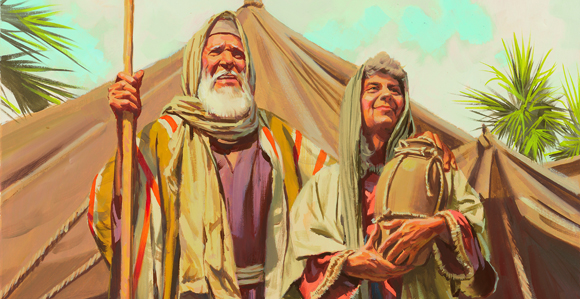
24:1 Abraham was now old and well advanced in years [indicates that he was close to death], and the LORD had blessed him in every way.

24:2 He said to the chief servant [identified as Eliezer of Damascus in Gen. 15:2] in his household, the one in charge of all that he had [indicates that this was his most trusted servant], “Put your hand under my thigh [an oath-making position (cf. Gen. 47:29)].

24:3 I want you to swear by the LORD, the God of heaven and the God of earth, that you will not get a wife for my son from the daughters of the Canaanites [a general designation for the peoples who lived in Canaan; Canaan was the on of Ham and grandson of Noah (Gen. 9:22; 10:15-19); Jews later forbidden from marrying foreigners because of spiritual and moral corruption (cf. 1 Kings 11:1-2; Ezra 10; Neh. 13:23-27; Mal. 2:11); in NT believers told to not marry unbelievers (cf. 1 Cor. 7:39; 2 Cor. 6:14-18)], among whom I am living,

24:4 but will go to my country [Haran (Gen. 11:31)] and my own relatives and get a wife for my son Isaac.”

24:5 The servant asked him, “What if the woman is unwilling to come back with me to this land? Shall I then take your son back to the country you came from?”

24:6 “Make sure that you do not take my son back there,” Abraham said.

24:7 “The LORD, the God of heaven, who brought me out of my father’s household and my native land and who spoke to me and promised me on oath, saying, ‘To your offspring I will give this land’—he will send his angel before you so that you can get a wife for my son from there.

24:8 If the woman is unwilling to come back with you, then you will be released from this oath of mine. Only do not take my son back there.”

24:9 So the servant put his hand under the thigh of his master Abraham and swore an oath to him concerning this matter.

24:10 Then the servant took ten of his master’s camels and left, taking with him all kinds of good things [provisions as well as gifts for the potential bride and her family] from his master. He set out for Aram Naharaim [located in upper Syria where Habor and Euphrates Rivers converge] and made his way to the town of Nahor [son of Terah and brother of Abraham (Gen. 11:26; 24:15); Rebekah’s grandfather].

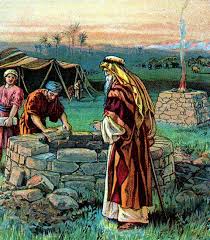
24:11 He had the camels kneel down near the well outside the town; it was toward evening, the time the women go out to draw water.

24:12 Then he prayed [directly to God; a simple and selfless prayer], “O LORD, God of my master Abraham, give me success today, and show kindness [Heb. “chesed” refers to covenant loyalty or God’s steadfast love in keeping His promises] to my master Abraham.

24:13 See, I am standing beside this spring, and the daughters of the townspeople are coming out to draw water.

24:14 May it be that when I say to a girl, ‘Please let down your jar that I may have a drink,’ and she says, ‘Drink, and I’ll water your camels too [an indication of a wonderful spirit of hospitality]’—let her be the one you have chosen for your servant Isaac. By this I will know that you have shown kindness to my master.”

24:15 Before he had finished praying, Rebekah [Isaac’s second cousin] came out with her jar on her shoulder. She was [her lineage made her an appropriate bride for Isaac…] the daughter of Bethuel son of Milcah, who was the wife of Abraham’s brother Nahor.

24:16 The girl was very beautiful, a virgin; no man had ever lain with her. She went down to the spring, filled her jar and came up again.

24:17 The servant hurried to meet her and said, “Please give me a little water from your jar.”

24:18 “Drink, my lord,” she said, and quickly lowered the jar to her hands and gave him a drink.

24:19 After she had given him a drink, she said, “I’ll draw water for your camels too, until they have finished drinking.”

24:20 So she quickly emptied her jar into the trough, ran back to the well to draw more water, and drew enough [ten camels (Gen. 24:10) would require much water after a journey] for all his camels.

24:21 Without saying a word, the man watched her closely to learn whether or not the LORD had made his journey successful.

24:22 When the camels had finished drinking, the man took out a gold nose ring weighing a beka and two gold bracelets weighing ten shekels.

24:23 Then he asked, “Whose daughter are you? Please tell me, is there room in your father’s house for us to spend the night?”

24:24 She answered him, “I am the daughter of Bethuel, the son that Milcah bore to Nahor.”

24:25 And she added, “We have plenty of straw and fodder, as well as room for you to spend the night.”

24:26 Then the man bowed down and worshiped the LORD,

24:27 saying, “Praise be to the LORD, the God of my master Abraham, who has not abandoned his kindness and faithfulness to my master. As for me, the LORD has led me on the journey to the house of my master’s relatives.”

24:28 The girl ran and told her mother’s household about these things.

24:29 Now Rebekah had a brother named Laban, and he hurried out to the man at the spring.

24:30 As soon as he had seen the nose ring, and the bracelets on his sister’s arms, and had heard Rebekah tell what the man said to her, he went out to the man and found him standing by the camels near the spring.

24:31 “Come, you who are blessed by the LORD,” he said. “Why are you standing out here? I have prepared the house and a place for the camels.”

24:32 So the man went to the house, and the camels were unloaded. Straw and fodder were brought for the camels, and water for him and his men to wash their feet.

24:33 Then food was set before him, but he said, “I will not eat until I have told you what I have to say.” “Then tell us,” Laban said.

24:34 So he said, “I am Abraham’s servant.

24:35 The LORD has blessed my master abundantly, and he has become wealthy. He has given him sheep and cattle, silver and gold, menservants and maidservants, and camels and donkeys.

24:36 My master’s wife Sarah has borne him a son in her old age, and he has given him everything he owns.

24:37 And my master made me swear an oath, and said, ‘You must not get a wife for my son from the daughters of the Canaanites, in whose land I live,

24:38 but go to my father’s family and to my own clan, and get a wife for my son.’

24:39 “Then I asked my master, ‘What if the woman will not come back with me?’

24:40 “He replied, ‘The LORD, before whom I have walked, will send his angel with you and make your journey a success, so that you can get a wife for my son from my own clan and from my father’s family.

24:41 Then, when you go to my clan, you will be released from my oath even if they refuse to give her to you—you will be released from my oath.’

24:42 “When I came to the spring today, I said, ‘O LORD, God of my master Abraham, if you will, please grant success to the journey on which I have come.

24:43 See, I am standing beside this spring; if a maiden comes out to draw water and I say to her, “Please let me drink a little water from your jar,”

24:44 and if she says to me, “Drink, and I’ll draw water for your camels too,” let her be the one the LORD has chosen for my master’s son.’

24:45 “Before I finished praying in my heart, Rebekah came out, with her jar on her shoulder. She went down to the spring and drew water, and I said to her, ‘Please give me a drink.’

24:46 “She quickly lowered her jar from her shoulder and said, ‘Drink, and I’ll water your camels too.’ So I drank, and she watered the camels also.

24:47 “I asked her, ‘Whose daughter are you?’ “She said, ‘The daughter of Bethuel son of Nahor, whom Milcah bore to him.’ “Then I put the ring in her nose and the bracelets on her arms,

24:48 and I bowed down and worshiped the LORD. I praised the LORD, the God of my master Abraham, who had led me on the right road to get the granddaughter of my master’s brother for his son.

24:49 Now if you will show kindness and faithfulness to my master, tell me; and if not, tell me, so I may know which way to turn.”

24:50 Laban and Bethuel answered [their answer indicates they believed Eliezer’s story], “This is from the LORD; we can say nothing to you one way or the other.

24:51 Here is Rebekah; take her and go, and let her become the wife of your master’s son, as the LORD has directed.”

24:52 When Abraham’s servant heard what they said, he bowed down to the ground before the LORD.

24:53 Then the servant brought out gold and silver jewelry and articles of clothing and gave them to Rebekah; he also gave costly gifts to her brother and to her mother.

24:54 Then he and the men who were with him ate and drank and spent the night there. When they got up the next morning, he said, “Send me on my way to my master.”

24:55 But her brother and her mother replied, “Let the girl remain with us ten days or so; then you may go.”

24:56 But he said to them, “Do not detain me, now that the LORD has granted success to my journey. Send me on my way so I may go to my master.”

24:57 Then they said, “Let’s call the girl and ask her about it.”

24:58 So they called Rebekah and asked her, “Will you go with this man?” “I will go,” she said.

24:59 So they sent their sister Rebekah on her way, along with her nurse [Deborah (Gen. 35:8)] and Abraham’s servant and his men.

24:60 And they blessed Rebekah and said to her [note twofold blessing…], “Our sister, [1] may you increase to thousands upon thousands; [2] may your offspring possess the gates of their enemies [cf. Noah’s blessing on his sons Shem and Japheth (Gen. 9:26-27)].”

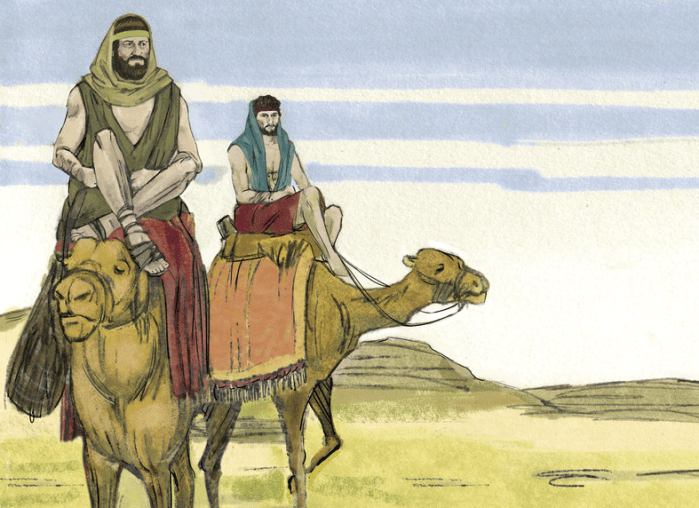
24:61 Then Rebekah and her maids [her personal female servants] got ready and mounted their camels and went back with the man. So the servant took Rebekah and left.

24:62 Now Isaac had come from Beer Lahai Roi, for he was living in the Negev.

24:63 He went out to the field one evening to meditate, and as he looked up, he saw camels approaching.

24:64 Rebekah also looked up and saw Isaac. She got down from her camel

24:65 and asked the servant, “Who is that man in the field coming to meet us?” “He is my master,” the servant answered. So she took her veil and covered herself.

24:66 Then the servant told Isaac all he had done.

24:67 Isaac [once the wedding ceremony was completed…] brought her into the tent of his mother Sarah, and he married Rebekah. So she became his wife, and he loved her; and Isaac was comforted after his mother’s death.
Genesis 19

19:1 The two angels arrived at Sodom in the evening, and Lot was sitting in the gateway of the city. When he saw them, he got up to meet them and bowed down with his face to the ground.

19:2 “My lords,” he said, “please turn aside to your servant’s house. You can wash your feet and spend the night and then go on your way early in the morning.” “No,” they answered, “we will spend the night in the square.”

19:3 But he insisted so strongly that they did go with him and entered his house. He prepared a meal for them, baking bread without yeast, and they ate.

19:4 Before they had gone to bed, all the men from every part of the city of Sodom—both young and old—surrounded the house.

19:5 They called to Lot, “Where are the men who came to you tonight? Bring them out to us so that we can have sex with them.”


Homosexuality
• God judged the cities of Sodom and Gomorrah because of homosexuality.
• Moses condemned homosexuality as a capital offense (Lev. 18:22; 20:13).
• Homosexuality is a grave offense to God that He condemns and judges (Rom. 1:26-27; 1 Cor. 6:9; 1 Tim. 1:10).
• Homosexuality—and all sexual sin—is offensive to God.

19:6 Lot went outside to meet them and shut the door behind him

19:7 and said, “No, my friends. Don’t do this wicked thing.

19:8 Look, I have two daughters who have never slept with a man. Let me bring them out to you, and you can do what you like with them. But don’t do anything to these men, for they have come under the protection of my roof.”

19:9 “Get out of our way,” they replied. And they said, “This fellow came here as an alien, and now he wants to play the judge! We’ll treat you worse than them.” They kept bringing pressure on Lot and moved forward to break down the door.

19:10 But the men inside reached out and pulled Lot back into the house and shut the door.

19:11 Then they struck the men who were at the door of the house, young and old, with blindness so that they could not find the door.

19:12 The two men [angels as per 19:1] said to Lot, “Do you have anyone else here—sons-in-law, sons or daughters, or anyone else in the city who belongs to you? Get them out of here [the destroying angel could not destroy the city until all of Lot’s family had left],

19:13 because we are going to destroy this place [Sodom]. The outcry [the source of the outcry is not indicated; perhaps the outcry was from victims of Sodom’s injustices] to the LORD against its people is so great that he has sent us [cf. Ps. 103:20-21] to destroy it.”

19:14 So Lot went out and spoke to his sons-in-law, who were pledged to marry his daughters. He said, “Hurry and get out of this place, because the LORD is about to destroy the city!” But his sons-in-law thought he was joking […and consequently perished when the city was destroyed].

19:15 With the coming of dawn, the angels urged Lot, saying, “Hurry! Take your wife and your two daughters who are here, or you will be swept away when the city is punished.”

19:16 When he hesitated, the men grasped [forceful deliverance] his hand and the hands of his wife and of his two daughters and led them safely out of the city, for the LORD was merciful to them.

19:17 As soon as they had brought them out, one of them said, “Flee for your lives! Don’t look back [they needed to stay focused on their destination], and don’t stop anywhere in the plain! Flee to the mountains or you will be swept away!”

19:18 But Lot said to them, “No, my lords, please!

19:19 Your servant has found favor in your eyes, and you have shown great kindness to me in sparing my life. But I can’t flee to the mountains; this disaster will overtake me, and I’ll die.

19:20 Look, here is a town near enough to run to, and it is small. Let me flee to it—it is very small, isn’t it? Then my life will be spared.”

19:21 He said to him, “Very well, I will grant this request too; I will not overthrow the town you speak of.

19:22 But flee there quickly, because I cannot do anything until you reach it.” (That is why the town was called Zoar.)

19:23 By the time Lot reached Zoar, the sun had risen over the land.

19:24 Then the LORD rained down burning sulfur on Sodom and Gomorrah [cf. 2 Pet. 2:6]—from the LORD out of the heavens.

19:25 Thus he overthrew [a demonstration of His grief and anger against sin] those cities [these cities became the ultimate symbol of destruction (cf. Amos 4:11)] and the entire plain, including all those living in the cities—and also the vegetation in the land [cf. Gen. 13:10 re: what this region looked like prior to its destruction].

19:26 But Lot’s wife [cf. Lk. 17:32] looked back [disobeyed the instructions given in 19:17], and she became a pillar of salt [perhaps overcome by the heat of the burning sulfur].

19:27 Early the next morning Abraham got up and returned to the place where he had stood before the LORD.

19:28 He looked down toward Sodom and Gomorrah, toward all the land of the plain, and he saw dense smoke rising from the land, like smoke from a furnace [an indication that judgment had fallen].

19:29 So when God destroyed the cities of the plain, he remembered Abraham, and he brought Lot out of the catastrophe that overthrew the cities where Lot had lived.

19:30 Lot and his two daughters left Zoar and settled in the mountains, for he was afraid to stay in Zoar. He and his two daughters lived in a cave.

19:31 One day the older daughter said to the younger, “Our father is old, and there is no man around here to lie with us, as is the custom all over the earth.

19:32 Let’s get our father to drink wine and then lie with him and preserve our family line through our father.”

19:33 That night they got their father to drink wine, and the older daughter went in and lay with him. He was not aware of it when she lay down or when she got up.

19:34 The next day the older daughter said to the younger, “Last night I lay with my father. Let’s get him to drink wine again tonight, and you go in and lie with him so we can preserve our family line through our father.”

19:35 So they got their father to drink wine that night also, and the younger daughter went and lay with him. Again he was not aware of it when she lay down or when she got up.

19:36 So both of Lot’s daughters became pregnant by their father.

19:37 The older daughter had a son, and she named him Moab; he is the father of the Moabites of today.

19:38 The younger daughter also had a son, and she named him Ben-Ammi; he is the father of the Ammonites of today.

Genesis 18

18:1 The LORD appeared to Abraham near the great trees of Mamre while he was sitting at the entrance to his tent in the heat of the day.

18:2 Abraham looked up and saw three men [angels; cf. Heb. 13:2] standing nearby. When he saw them, he hurried from the entrance of his tent to meet them and bowed low to the ground.

18:3 He said, “If I have found favor in your eyes, my lord, do not pass your servant by.

18:4 Let a little water be brought, and then you may all wash your feet and rest under this tree.

18:5 Let me get you something to eat, so you can be refreshed and then go on your way—now that you have come to your servant.” “Very well,” they answered, “do as you say.”

18:6 So Abraham hurried into the tent to Sarah. “Quick,” he said, “get three seahs of fine flour and knead it and bake some bread.”

18:7 Then he ran to the herd and selected a choice, tender calf and gave it to a servant, who hurried to prepare it.

18:8 He then brought some curds and milk and the calf that had been prepared, and set these before them. While they ate, he stood near them under a tree.

18:9 “Where is your wife Sarah?” they asked him. “There, in the tent,” he said.

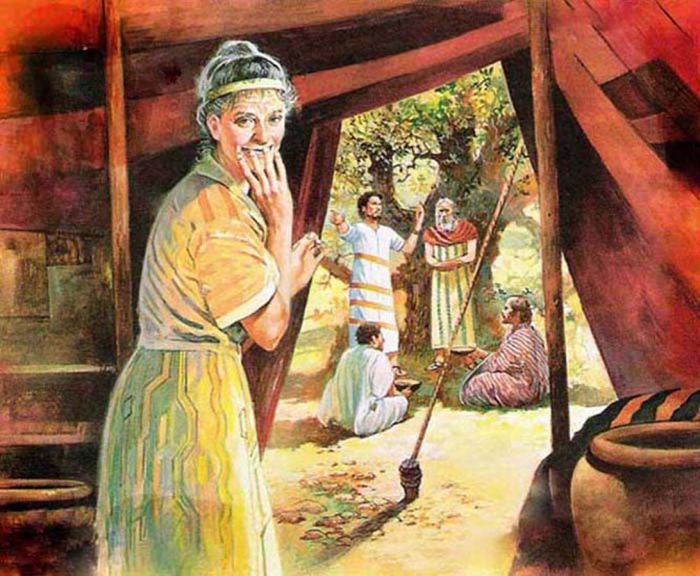
18:10 Then the LORD said [what God says can drive away our doubts], “I will surely [a guarantee] return to you about this time next year, and Sarah your wife will have a son [the fulfillment of this promise made possible by God’s power; cf. Gen. 17:21].” Now Sarah was listening at the entrance to the tent, which was behind him.

18:11 Abraham and Sarah were [note three phrases that stress the human impossibility of Abraham and Sarah having a child…] [1] already old and [2] well advanced in years [their age would not hinder the fulfillment of God’s promise], and [3] Sarah was past the age of childbearing [she no longer had a monthly period thus making it impossible for her to conceive naturally].

18:12 So Sarah laughed [cf. Gen. 17:17 re: Abraham’s laughter; but God “would have the last laugh”] to herself as she thought, “After I am worn out and my master is old, will I now have this pleasure?”

18:13 Then the LORD said to Abraham, “Why did Sarah laugh [the name “Isaac” means laughter (cf. Gen. 17:19)] and say, ‘Will I really have a child, now that I am old?’

18:14 Is anything too hard for the LORD [cf. Jer. 32;17]? I will return to you at the appointed time next year and Sarah will have a son.”

18:15 Sarah was afraid, so she lied and said, “I did not laugh.” But he said, “Yes, you did laugh.”

18:16 When the men got up to leave, they looked down toward Sodom, and Abraham walked along with them to see them on their way.

18:17 Then the LORD said, “Shall I hide from Abraham what I am about to do?

18:18 Abraham will surely become a great and powerful nation, and all nations on earth will be blessed through him.

18:19 For I have chosen him, so that he will direct his children and his household after him to keep the way of the LORD by doing what is right and just, so that the LORD will bring about for Abraham what he has promised him.”

18:20 Then the LORD said, “The outcry against Sodom and Gomorrah is so great and their sin so grievous

18:21 that I will go down and see if what they have done is as bad as the outcry that has reached me. If not, I will know.”

18:22 The men turned away and went toward Sodom, but Abraham remained standing before the LORD.

18:23 Then Abraham approached him and said: “Will you sweep away the righteous with the wicked?

18:24 What if there are fifty righteous people in the city? Will you really sweep it away and not spare the place for the sake of the fifty righteous people in it?

18:25 Far be it from you to do such a thing—to kill the righteous with the wicked, treating the righteous and the wicked alike. Far be it from you! Will not the Judge of all the earth do right?”

18:26 The LORD said, “If I find fifty righteous people in the city of Sodom, I will spare the whole place for their sake.”

18:27 Then Abraham spoke up again: “Now that I have been so bold as to speak to the Lord, though I am nothing but dust and ashes,

18:28 what if the number of the righteous is five less than fifty? Will you destroy the whole city because of five people?” “If I find forty-five there,” he said, “I will not destroy it.”

18:29 Once again he spoke to him, “What if only forty are found there?”
He said, “For the sake of forty, I will not do it.”

18:30 Then he said, “May the Lord not be angry, but let me speak. What if only thirty can be found there?” He answered, “I will not do it if I find thirty there.”

18:31 Abraham said, “Now that I have been so bold as to speak to the Lord, what if only twenty can be found there?” He said, “For the sake of twenty, I will not destroy it.”

18:32 Then he said, “May the Lord not be angry, but let me speak just once more. What if only ten can be found there?” He answered, “For the sake of ten, I will not destroy it.”

18:33 When the LORD had finished speaking with Abraham, he left, and Abraham returned home.

Genesis 17

Genesis 17:1-22
17:1 When Abram was ninety-nine years old [the Bible tell us nothing about what happened between the time Abraham was 86 and 99 years old], the LORD appeared [a theophany (“appearance of God”); purpose of theophany was for God to reveal His character, message, or plans] to him and said, “I am God Almighty [translates Heb. name “El Shaddai” and means the “God who is sufficient”; emphasizes God’s power]; walk [live in dependence on God; live in a manner pleasing to God] before me and be blameless [to be completely devoted to the Lord; moral purity (not perfection); cf. Gen. 6:9].

17:2 I will confirm [by restating covenant promises and designating covenant sign] my [covenant was God’s initiative] covenant between me and you and [note that God would do what seemed impossible…] will greatly increase your numbers.”

17:3 Abram fell facedown [position of humility indicates that Abram did not see himself as an equal partner in covenant; indicates Abram’s surrender to God’s will], and God said to him,

17:4 “As for me, this is my covenant with you: You will be the father of many nations [people groups (other than Israel); cf. Gen. 12:2; Rom. 4:6-9,17-18].

17:5 No longer will you be called Abram [means “exalted father”]; your name will be Abraham [means “father of many”], for I have made you a father of many nations [Gal. 3:7].

Note: How can you enable God to bless other nations through you?

17:6 I will [a promise] make you very fruitful; I will make nations of you, and kings [e.g. Midianiates (Gen. 25:2-4), Ishmaelites (Gen. 25:12-18), Edomites (Gen. 36:40) all traced their lineage back to Abraham; read genealogy of Jesus in Matt. 1:1-17] will come from you.

17:7 I will establish my covenant as an everlasting [would last beyond Abraham’s lifetime] covenant between me and you and your descendants [covenant would extend beyond Abraham] after you for the generations to come, to be your God and the God of your descendants [both physical and spiritual descendants] after you.

17:8 The whole land of Canaan, where you are now an alien, I will give as an everlasting possession to you and your descendants after you; and I will be their God [and thus the only God they are to worship].”

17:9 Then God said to Abraham, “As for you, you must keep my covenant, you and your descendants after you for the generations to come.

17:10 This is my covenant with you and your descendants after you, the covenant you are to keep: Every male among you shall be circumcised [God designated circumcision as the sign of the covenant with Abraham].

17:11 You are to undergo circumcision, and it will be the sign of the covenant between me and you.

17:12 For the generations to come every male among you who is eight days old [cf. Gen. 21:4; Lk. 2:21] must be circumcised, including those born in your household or bought with money from a foreigner—those who are not your offspring.

17:13 Whether born in your household or bought with your money, they must be circumcised. My covenant in your flesh is to be an everlasting covenant.

17:14 Any uncircumcised male, who has not been circumcised in the flesh, will be cut off from his people; he has broken my covenant.”

17:15 God also said to Abraham, “As for Sarai [Abraham’s wife (and half-sister); Sarai was a barren woman] your wife, you are no longer to call her Sarai; her name will be Sarah [name means “princess”; Sarah would be a mother].

17:16 I will bless [by giving her the ability to conceive and bear a son] her and will surely give you a son by her. I will bless her so that she will be the mother of nations [cf. 17:4]; kings of peoples will come from her [cf. 17:6].”

17:17 Abraham fell facedown [cf. 17:3]; he laughed [suggests a lapse of faith; some believe Abraham laughed with wonder and joy; cf. Gen. 18:12 re: Sarah’s laughter] and said to himself, “Will a son be born to a man a hundred years old [Abraham mistakenly thought that his age would be an obstacle to God’s plan]? Will Sarah bear a child at the age of ninety [cf. Gen. 21:1-7]?”

Note: In what circumstances have you wondered how God would fulfill His plans?

17:18 And Abraham said [offered God an alternative] to God, “If only Ishmael [name means “God hears”; cf. Gen. 16:10-12] might live under your blessing!”

17:19 Then God said, “Yes, but [God rejected Abraham’s suggestion] your wife Sarah will bear you a son [cf. Gen. 18:14], and you will call him Isaac [name means “he laughs” (and would serve as a reminder of his miraculous birth)]. I will establish my covenant with him [Isaac; cf. Gen. 26:4; Rom. 9:8] as an everlasting covenant for his descendants [e.g., Jacob, Joseph, David, Jesus Christ] after him.

17:20 And as for Ishmael [13 years old at this time; Abraham was 86 years old when Ishmael was born (Gen. 16:16)], I have heard you: I will surely bless him; I will make him fruitful and will greatly increase his numbers. He will be the father of twelve rulers, and I will make him into a great nation [cf. Gen. 25:12-18; 1 Chron. 1:29-31; many of Ishmael’s descendants today are followers of Mohammad].

Note: What does God’s blessing of Ishmael tell us about His care for those outside the nation of Israel?

17:21 But my covenant I will [a promise] establish with Isaac, whom Sarah will bear to you by this time next year [God gave a specific time for the birth of Isaac; cf. Gen. 21:5].”

17:22 When he had finished speaking with Abraham, God went up from him.

Genesis 27

Genesis 27:41
27:41 Esau [Isaac and Rebekah’s firstborn son; Esau’s favorite; gave up his birthright to his (non-identical) twin brother Jacob for some hot stew (Gen. 25:29-34); read Gen. 27:39-40 re: the blessing Esau received from his father Isaac] held a grudge [to hold hostility or hatred toward another] against Jacob [name means “he grasps the heel” (cf. Gen. 25:25-26) and was a figurative expression for the act of deceiving another (cf. Gen. 27:36); favored by his mother Rebekah] because of the blessing [included prosperity, dominion, and protection (Gen. 27:28-29)] his father had given him. He said to himself, “The days of mourning for my father are near [Esau knew that his father was near death]; then I will kill my brother Jacob.”

Genesis 21

Genesis 21:1-5
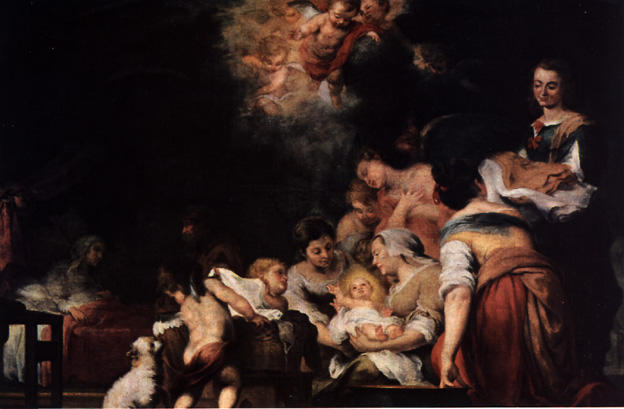
21:1 Now the LORD was gracious to Sarah as he had said [God faithful to His word in every detail], and the LORD did for Sarah [90 years old] what he had promised.

21:2 Sarah became pregnant and bore a son to Abraham in his old age [100 years old], at the very time [precisely on divine schedule] God had promised him.

21:3 Abraham gave the name Isaac [cf. 17:19; name means “laughter”] to the son Sarah bore him.

21:4 When his son Isaac was eight days old, Abraham circumcised him, as God commanded [cf. Gen. 17:10] him.

21:5 Abraham was a hundred years old when his son Isaac was born to him [cf. Gen. 17:21].

Genesis 13

13:1 So Abram [would later be renamed Abraham (Gen. 17:5)] went up from Egypt [Abram went to Egypt because of famine in Canaan (cf. Gen. 12:10-20)] to the Negev [the southern desert area of Canaan], with his wife and everything he had, and Lot [the son of Abram’s brother Haran] went with him.

13:2 Abram had become very wealthy [first Bible reference to anyone being rich] in livestock and in silver and gold.

13:3 From the Negev he went from place to place [possibly seeking pasture for his animals] until he came to Bethel [means “the house of God”], to the place between Bethel and Ai where his tent had been earlier

13:4 and where he had first built an altar [cf. Gen. 12:8]. There Abram called on the name of the LORD.

13:5 Now Lot, who was moving about with Abram, also had flocks and herds and tents.

13:6 But the land could not support them [their large flocks and herds and tents] while they stayed together, for their possessions were so great that they were not able to stay together.

13:7 And quarreling [strife often threatens families; wealth and prosperity created tensions between Abram and Lot] arose between Abram’s herdsmen and the herdsmen of Lot. The Canaanites [a general designation for the inhabitants of Canaan] and Perizzites were also living in the land at that time.

13:8 So Abram [took the initiative to settle the quarrel; Abram did not demand his rights as the older man; cf. Eph. 4:26,32] said to Lot, “Let’s not have any quarreling [at this point the strife was verbal and had not yet led to physical strife] between you and me [Abram acknowledged joint responsibility for the problem], or between your herdsmen and mine, for we are brothers [close relatives; Abram understood the importance of family].

Note: What are some ways to resolve family conflicts?

13:9 Is not the whole land before you? Let’s part company. [Abram gave Lot the power to make the decision; shows Abram’s humility, generosity, and unselfish attitude] If you go to the left, I’ll go to the right; if you go to the right, I’ll go to the left.”

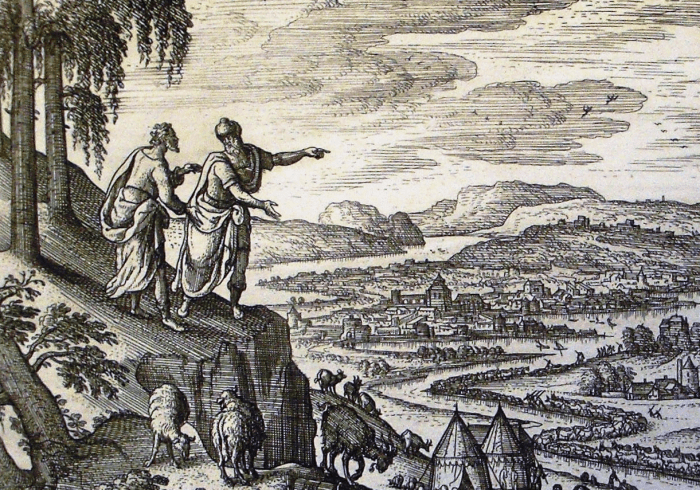
13:10 Lot looked up and saw that the whole plain of the Jordan was well watered [essential for the survival of his flocks], like the garden of the LORD [reference to the garden of Eden (cf. Isa. 51:3)], like the land of Egypt, toward Zoar [a small village (Gen. 19:22-23); a fertile area]. (This was before the LORD destroyed Sodom and Gomorrah [indicates that God’s judgment changed the geography of the area].)

13:11 So Lot chose for himself the whole plain of the Jordan [in spite of the moral degeneracy of those who already lived there (cf. Gen. 13:13)] and set out toward the east. The two men parted company:

Note: What does Lot’s choice tell you about his character and the kind of man he was?

13:12 Abram lived in the land of Canaan, while Lot lived among the cities of the plain and pitched his tents near Sodom [Lot lived there until the city was destroyed (Gen. 19); cf. 2 Pet. 2:7-8].

13:13 [Lot’s decision to settle in this area would result in his family’s ruin] Now the men of Sodom were wicked and were sinning [cf. Gen. 19:4-5] greatly against the LORD.

13:14 The LORD said to Abram after Lot had parted from him, “Lift up your eyes from where you are and look north [toward Shechem] and south [toward Jerusalem], east [toward the Jordan Valley] and west [toward the Plain of Sharon].

13:15 All the land that you see I will give to you and your offspring [this must have been perplexing to Abram since he and his wife Sarai were advanced in age] forever.

13:16 I will make your offspring like the dust of the earth [hyperbole meaning too numerous to count], so that if anyone could count the dust, then your offspring could be counted.

13:17 Go, walk [a symbolic claiming of all the land] through the length and breadth of the land, for I am giving it to you.”

13:18 So Abram moved his tents and went to live near the great trees [lush oaks which grow to a height of up to twenty-five feet] of Mamre at Hebron [located about 20 miles south of what would later be known as Jerusalem], where he built an altar to the LORD [third mention that Abram worshiped at an altar to the Lord (cf. Gen. 12:8; 13:3-4)].