Nehemiah 11

Urban Renewal and Urgent Reforms

A study of the Old Testament books of Ezra and Nehemiah will take you on an interesting journey through the Jewish post-exilic period. During this period, the Jews returned to their homeland after seventy years in captivity and rebuild the altar, the Temple, and the wall of Jerusalem. The prophets Haggai and Zechariah motivated the people of Jerusalem to give attention to the rebuilding of the Temple. Ezra instituted marriage reforms to help ensure the integrity of the Jewish faith. Nehemiah and the inhabitants of Jerusalem struggled to build the wall of Jerusalem under persistent pressure and opposition. And, the people wept at the reading of God’s Word and commit themselves to live by that Word.

Nehemiah 11 addresses the repopulation of Jerusalem after the completion of the walls and the matter of how Nehemiah addressed the backslidden condition of the Jews during his second term as governor. This chapter addeesses the matters of urban renewal and urgent reforms.

The Repopulation of Jerusalem
Nehemiah 11:1-36

According to Nehemiah 7:4, “the city [of Jerusalem] was large and spacious, but the people in it were few and the houses not built.” Several reasons for this can be offered. First, the city had been without walls for nearly a century and a half. A city without walls was vulnerable and at the mercy of any invading army or band of marauders. Second, the city was sparsely populated because it was in ruins. A decision to live in Jerusalem was a decision to engage in long hours of backbreaking hard work and rebuilding. Many people therefore, chose to live in the “suburbs.”

After the completion of the walls of the city, Nehemiah turned his attention to the matter of urban renewal and the repopulation of the city. The city was repopulated in two ways. First, lots were cast to determine who should live in the city. One out of every ten families was asked to move to Jerusalem. Second, some families volunteered to move to Jerusalem. These volunteers were praised for their willingness to make the sacrifice to move to the holy city. Nehemiah 11:3-19 is a record of those who settled in Jerusalem. Nehemiah 11:20-36 is a record of those who settled outside of the city of Jerusalem. These people comprised about ninety percent of the Jewish population.

Practical Considerations:

We should express appreciation to volunteers.
When Nehemiah was concerned about repopulating the city of Jerusalem, some people volunteered to move their families to the city. This meant great sacrifice and hard work. The inhabitants of Jerusalem expressed their appreciation to these volunteers. In like manner, we should express appreciation to those who volunteer, endure hardship, and make sacrifices for the sake of God’s work.

There is great joy in the accomplishment of God’s will.
After the completion of the wall, Nehemiah and Ezra led the people in a joyous ceremony of dedication and celebration. The people had faithfully followed Nehemiah’s leadership and successfully completed the wall in the face of persistent problems, pressures, and opposition. In like manner, we should rejoice in the victories and advances made in God’s work.

Nehemiah 10

 Recommitment to the Covenant
Nehemiah
9:38—10:39

Nehemiah 9:38 is the first verse of Chapter 10 in the Hebrew Bible. It provides the transition between the penitent prayer of Chapter 9 to the recommitment to the covenant in Chapter 10.

The desire to make a fresh commitment to obey God came about as the result of the things they expressed in Chapter 9. Nehemiah 10:1-27 records the names of those who signed and sealed the agreement. Along with those mentioned in verses 1-27 were many others (see verse 28).

According to Nehemiah 10:29, the people made provision to be held accountable for their obedience to God’s Word by “taking on themselves a curse and an oath to walk in God’s law.” This indicated their earnest desire to live their lives in accordance with God’s Word.

The details of the agreement are recorded in Nehemiah 10:30-39. The people had pledged themselves to make the observance of God’s law a priority in their lives. They had truly experienced a “back to the Bible” revival!

Nehemiah 9

Repentance of Sin
Nehemiah 9:1-4

Two days after the observance of the Feast of Booths, the people “assembled with fasting, in sackcloth, and with dirt upon them.” The people were under deep personal conviction as a result of the days spent in Bible study. Their sorrow over their sins and the sins of their fathers was expressed in the wearing of sackcloth, fasting, and dirt upon their heads. The people continued to listen to daily readings from the law of Moses and participated in periods of worship and confession of sin.

Review of History
Nehemiah 9:5-37

Nehemiah 9:5-37 records the longest prayer in the Bible.


It is a penitent prayer of confession that offers a remarkable survey of Old Testament history. As the people confessed their sins they reviewed God’s love and grace toward them from creation and the election of Abraham, through their deliverance from Egypt and rebellion in the wilderness, through their disobedience in the period of the judges and the monarchy, and through the period of the exile to their present state of affairs.

The people acknowledged that the discipline and judgment of God upon them was well deserved. They were however, ready to make things right. They realized that the success of their future was dependent upon their relationship with God. They were ready to get serious about the matter of living their lives in obedience to God’s Word. The “back to the Bible” revival had reached their hearts.

Practical Considerations:

The study of God’s Word is profitable.
As the people listened to the teaching of God’s Word, they were convicted of their sin and shortcomings to the point of tears and repentance. That, in turn, led the people to make some life-changing decisions based upon the teaching of Scripture. II Timothy 3:16 and 17 declare, “All Scripture is inspired by God and profitable for teaching [God’s Word teaches us the path in which to walk.], for reproof [God’s Word tells us when we get off the path.], for correction [God’s Word tells us how to get back on the path.], for training in righteousness [God’s Word teaches us how to stay on the path.]; that the man of God may be adequate, equipped for every good work.” 

We should be faithful in Bible Study attendance.
Several people asked Ezra to lead them in Bible study “that they might gain insight into the words of the law.” We should earnestly desire to study God’s Word to the end that we might gain insight and understanding into the issues and concerns of life and might become better equipped to walk in a manner pleasing to the Lord. (See Psalm 119:97-104.)

Nehemiah 8

The Back to The Bible Revival

The wall was a mighty symbol of security. This significant accomplishment testified to the providence, protection, and provision of God. But there was yet a greater work of rebuilding that required the attention of both Nehemiah and Ezra.

That greater work involved the rebuilding of the spiritual foundation upon which the nation rested. That greater work included educating the people in the truths of God’s Word and instructing them regarding the importance of living in obedience to that Word. After all, it was the unfaithfulness of their fathers and their refusal to obey God’s Word that had resulted in their being carried into captivity.

The Jews needed to be in a right relationship with God if they were to prosper as a nation. The people needed to focus their attention on spiritual matters. It was time for a “back to the Bible” revival!

Reading of the Law
Nehemiah 8:1-18

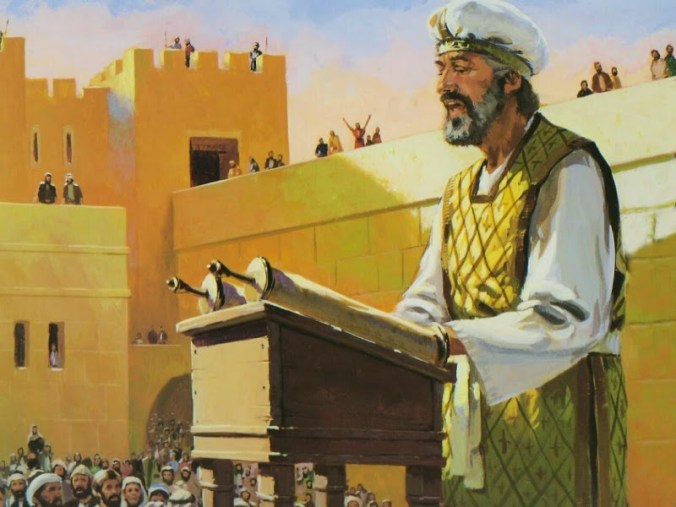
The events of Nehemiah 8 occurred one week after the completion of the walls. The people gathered at the Water Gate southeast of the Temple on the first day of the seventh month (Tishri). They asked Ezra the scribe to read to them from the book of the law of Moses. They were interested in reviewing the basics of God’s Word and in instructing their children in the truths of the Scripture. The people were ready for a “back to the Bible” revival. Scholars estimate that between thirty and sixty thousand people gathered to hear Ezra read from God’s Word. A special wooden podium was built for the occasion.

Ezra began the meeting with prayer. After praying, Ezra opened the book of the law and the people stood in reverence for God’s Word. As Ezra read from the book of the law of Moses, the Levites circulated among the people and translated and explained the Scripture to them. This was necessary because many of the people were no longer fluent in Hebrew because they had either grown up speaking Aramaic while in exile or had adopted the tongues of their pagan spouses/parents.

The people were deeply moved and convicted by what they heard. They were moved to tears as they saw themselves against the standard of God’s Word. The Levites encouraged the people not to weep but rather to rejoice because “this day is holy to the Lord your God.” The people were encouraged to eat and to share their food with those who had none.

On the following day, a group of people, priests, and Levites met with Ezra for a time of in-depth Bible study. Nehemiah 8:13 declares that these people met with Ezra the scribe “that they might gain insight into the words of the law.” One of the signs of genuine revival is a renewed interest in the study and practice of the Word of God.

As these people studied with Ezra they were reminded that they had been commanded to observe the Feast of Booths. The booths were brush arbors or leafy shelters that were reminiscent of the living conditions of the Israelites while in the wilderness. With the Feast of booths just two weeks away, the people sent out a proclamation that people gather materials to construct booths to observe the occasion. The people did so and lived in them for seven days. This must have had a tremendous educational impact on the youth and children as they learned about their history in such a vividly dramatic way. Ezra read from God’s Word daily throughout the duration of the observance.

Practical Considerations:

We should begin our Bible Study times with prayer.
Ezra led the people in prayer (Nehemiah 8:6) before leading them in Bible study. It is important to pray before studying the Bible. Prayer can us help to focus our thoughts on the God of the Bible. Through prayer we should ask God for insight into the truths of His Word. We should pray with the attitude of the Psalmist (119:18) before Bible study: “Open my eyes that I may see wonderful things in your law.”

Bible study teachers should strive to communicate effectively.
Ezra was not just interested in reading God’s law to the people, he was also concerned that they understood what he was reading. To that end he appointed Levites to translate and interpret what he was reading to the people. Effective communication took place in small groups. Like Ezra, we should be concerned with communicating the truths of God’s Word to our students as clearly and creatively as possible.

Nehemiah 7

Consolidation: An Intelligent Policy
Nehemiah 7:1-73

The work of rebuilding the walls was the first phase of Nehemiah’s plan. The second phase involved the consolidation of the work. Knowing that the Jews had many enemies on both sides of the city walls, Nehemiah wasted no time in taking measures to safeguard the city.

Nehemiah appointed men to guard the gates and ordered that the gates be opened for only a brief period of time each day. In addition, he organized a “Neighborhood Watch” program by appointing citizens to help guard the city.

Nehemiah was also concerned that the city of Jerusalem was only sparsely populated. He therefore ordered a census to determine the Jewish demographic patterns in Judah and to lay the groundwork for repopulating the city of Jerusalem.

Nehemiah was truly a man who lived for God and others. His whole life was devoted to serving God, his fellow Jews, and to helping the city and people of Jerusalem to become great once more.

Nehemiah 6

From Mission Impossible to Mission Accomplished

There is something about attempting and accomplishing what is considered impossible that captures our imagination. Whether it is scaling Mount Everest, traveling across Antarctica to the South Pole, searching for and finding the Titanic, or walking on the moon, people are fascinated by the accounts of those who attempt and accomplish the impossible.

The popular and recently revised television program Mission Impossible appeals to our fascination with the impossible. It is always interesting to see what new impossible mission will be assigned to Mr. Phelps and to watch him undertake that mission with the full knowledge that if he or any of his Impossible Mission Force companions are captured or killed, “the secretary will disavow any knowledge of your actions.” The appeal of the program lies in watching a “mission impossible” become a “mission accomplished.”

In the first chapter of Nehemiah we learned of Nehemiah and how God put upon his heart what seemed like a “mission impossible.” We have seen Nehemiah working toward the completion of his God-appointed mission in spite of great opposition, problems, and pressures. In our lesson today we will study how that “mission impossible” became a “mission accomplished.”

Intrigue: An Invitation to a Summit Conference
Nehemiah 6:1-4

Thus far in our study, we have seen Nehemiah and the Jews experience and deal with problems and threats from both without and within. The opposition made yet additional efforts to frustrate the work as the completion of the project drew near. These new renewed efforts from without were aimed at Nehemiah. The enemies of the Jews knew that their only hope of success lay in eliminating the man at the top. When all else fails, shoot the leader! Nehemiah 6 records three attempts to destroy, defame, and discredit Nehemiah.

According to Nehemiah 6:1-4, Sanballat, Tobiah, and Geshem resorted to intrigue in an effort to destroy Nehemiah. These men put their villainous plot into action the moment they heard that Nehemiah “had rebuilt the wall, and that no breach remained in it.” These men sent an invitation to Nehemiah to attend a summit conference at a place called Ono, about twenty-five miles northwest of Jerusalem. Nehemiah turned down their invitation on the basis of his priorities, “I am doing a great work and I cannot come down. Why should the work stop while I leave it and come down to you?” Furthermore, Nehemiah perceived that these men were trying to lure him away from the safety of Jerusalem, perhaps for the purpose of either kidnapping or assassinating him. Not satisfied with Nehemiah’s reply, they sent Nehemiah the same invitation four times only to be turned down four times.

Innuendo: An Implication of Treason
Nehemiah 6:5-9

Having failed in their efforts to destroy Nehemiah through intrigue, his enemies resorted to innuendo. According to Nehemiah 6:5, Sanballat sent Nehemiah an open letter stating that it was reported that Nehemiah’s real purpose for rebuilding the wall was to put himself in a position to become king of Judah and to rebel against Artaxerxes. Sanballat threatened to send this false report to Artaxerxes unless Nehemiah agreed to meet with him. Nehemiah responded by telling Sanballat that the report was not true, but simply a fabrication of his overactive imagination. Nehemiah then prayed for God to strengthen him.

Intimidation: An Intent to Discredit
Nehemiah 6:10-14

Having failed once again in their attempts to destroy Nehemiah, his ever-resourceful enemies turned to intimidation in the hope of discrediting Nehemiah before the people. They hired a prophet to tell Nehemiah that there was a plot to assassinate him and to advise him to seek refuge in the Temple (within the Holy Place). This was a clear violation of God’s Word (Numbers 18:7). Nehemiah thus perceived that this advice was not from God and that Tobias and Sanballat had hired the phony prophet to frighten him and cause him to sin that they might have grounds for calling his leadership into question.

Inspiration: An Impossible Task Accomplished
Nehemiah 6:15-19

In spite of pernicious and persistent opposition, Nehemiah and the people completed the wall in fifty-two days. This was a remarkable accomplishment (the wall was about one and one-half to two and one-half miles in extent). The completion of the work had an impact on the enemies of the Jews: “they lost their confidence.” The enemies of the Jews recognized that the work had been accomplished with the help of God. The Jews did a remarkable work in just fifty-two days. There are fifty-two weeks in one year. It is worth considering what contribution we have made to God’s work in the past fifty-two weeks? Have we helped to further the work of the Gospel?

Practical Considerations:
As the work on the wall neared completion, the opposition to the work intensified. Nehemiah teaches us how to properly respond to problems and pressures.

Priorities
Nehemiah did not allow problems and pressures to keep him from his priorities. He was able to avoid potential danger to his own life by refusing to abandon his priorities. Rather than question the motives of his enemies, he simply refused their invitation to meet with them on the basis of a higher priority: “I am doing a great work and I cannot come down.”

Prayer
When Nehemiah’s motives for rebuilding the wall were impugned, he did not respond with a publicity campaign to address the rumors or file suit against the rumormongers. Nehemiah simply denied the rumors and resorted to prayer: “But now, O God, strengthen my hands.” Nehemiah set a consistent example of praying in and through every difficulty.

Perception
When the phony prophet Shemaiah warned Nehemiah about a plot to assassinate him and suggested that Nehemiah seek refuge in the Temple, Nehemiah was perceptive enough to see that “God had not sent [Shemaiah].” His ability to perceive the subtle evil in Shemaiah’s suggestion came about as a result of Nehemiah’s knowledge of the Word of God. Psalm 119:98 states; “Thy commandments make me wiser than my enemies, for they are ever mine [with me].”

Persistence
Nehemiah did not expend precious time and energy in defending himself from the intrigue, innuendo, and intimidation of his enemies. He simply persisted in the work, steadily moving toward the realization of his God-given goal. He did not allow his enemies to either distract or delay him. As a result of his persistence, “the wall was completed…in fifty-two days.”

Planning
Nehemiah did not rest after the completion of the work. Knowing the character and nature of his enemies, he consolidated the work by appointing gatekeepers and mobilizing the citizens of Jerusalem into a “Neighborhood Watch” team. By so doing, he insured that the people would be ready to deal with any further problems and pressures from their enemies.

Nehemiah 5

Who Needs the Devil — We’ve Got Each Other

“The devil made me do it!”

That was an expression coined by the comedian Flip Wilson. It was an expression that was humorously used in the skits on his comedy television series a number of years ago. Flip Wilson played the role of Geraldine, who was always trying to stay in the good graces of her boyfriend Killer. Whenever Geraldine did anything wrong she would simply tell Killer, “The devil made me do it!”

While Flip’s expression makes for good comedy, it makes for bad theology. Many Christians have a tendency to blame everything on the devil. As a result they do not accept responsibility for their own actions. It may come as a surprise to learn that we can’t blame everything on the devil.

We must come to grips with the fact that there are some things we do simply because we are sinful, mean, nasty, and unforgiving. And when we do not allow Christ to govern our lives then we are all the more inclined to be as mean as the devil. In fact, Christians can sometimes treat one another so shamefully that one might be inclined to exclaim, “Who needs the devil — we’ve got each other!”

The Jews treated one another so poorly that one could have easily exclaimed, “Who needs our enemies — we’ve got each other!”

Exploitation: The Outcry of the People
Nehemiah 5:1-5

Nehemiah and the people deal with a variety of external threats, opposition, and problems. We are introduced to a new threat to the work of rebuilding the walls in Nehemiah 5:1. This new threat was an internal threat.

Nehemiah 5:1 records, “Now there was a great outcry of the people and of their wives against their Jewish brothers.” The complaints of the people are enumerated in Nehemiah 5:2-5.

Notice first that the some people cried out because of a shortage of food (verse 2). Many of the people who gave themselves to the work had large families and had sacrificed all to contribute to the work. Now they had no food to feed their families.

Second, others had to mortgage their property in order to buy food (verse 3).

Third, the people were suffering under a heavy burden of taxes (verse 4). These taxes were especially burdensome in light of the poor economic conditions in Jerusalem.

Finally, some people had to sell their children into slavery in an effort to pay off their debts (verse 5). The people felt totally helpless because they could see no prospect of relief.

Indignation: The Anger of Nehemiah
Nehemiah 5:6-7

Nehemiah’s response is recorded in Nehemiah 5:6-7: “Then I was very angry when I heard their outcry and these words. And I consulted with myself.”

Nehemiah became angry when he learned of the selfishness, greed, and lack of compassion on the part of the rich. The rich were more concerned about how they could make another dollar through the difficult days of the rebuilding effort than with how they could help the less fortunate who had sacrificed so much to participate in the work.

Nehemiah was very angry. Nehemiah 5:7 tells us how he handled his anger: “And I consulted with myself.” Rather than impulsively “fly off the handle,” Nehemiah took some time to “cool down” before acting. He took the time to get his facts together and get some perspective on the issue before tackling it.

Confrontation: The Rebuke of Nehemiah
Nehemiah 5:7-11

Once Nehemiah had prayed and thought the matter through, he was ready to take action. He did not ignore the problem in the hope that it would go away but rather confronted the problem head-on.

Nehemiah 5:7 informs us that he went to the source of the problem by contending with the nobles and the rulers. He accused them of violating the Mosaic Law which did not allow the Jews to charge a fellow countryman any interest. He further stated that while he and others had worked to redeem Jews from slavery to pagan masters, they were guilty of enslaving their fellow Jews. Nehemiah considered it an outrage to have to redeem Jewish slaves from fellow Jews. Nehemiah’s words were so convicting that the nobles and the rulers “were silent and could not find a word to say” (verse 8).

According to Nehemiah 5:9, Nehemiah pressed the issue further by telling the nobles and the rulers that the Jews were in danger of losing their distinctiveness in the eyes of their neighbors because of these evil practices.

In Nehemiah 5:10 he asked the guilty individuals to stop their abusive practices. That is always the best way to deal with sin, just determine to stop it immediately.

Nehemiah again pressed the matter by asking the guilty individuals to return what they had taken “this very day.” He did not ask them to go home and think about what they had done. He didn’t even ask them to pray about it. He simply asked them to rectify the situation at once. That is another good lesson regarding how to deal with sin. We should always deal with sin immediately and without delay.

Restoration: The Response of the Guilty
Nehemiah
5:12-13

The response of the guilty nobles and rulers is recorded in Nehemiah 5:12. “Then they said, ‘We will give it back and require nothing from them; we will do exactly as you say.’” In order to ensure that they would carry out their promise, Nehemiah had the guilty individuals take an oath before the priests stating that they would fulfill their word. In addition, Nehemiah symbolically pronounced a curse upon anyone who violated the oath. He shook out the front of his garment which had a fold used as a pocket for carrying possessions. This was a dramatic way of showing the violators that God would shake them and empty them of their possessions if they violated the oath which they had taken before the priests.

Illustration: The Example of Nehemiah
Nehemiah 5:14-19

At this point in the story, Nehemiah inserted a summary statement concerning his conduct while serving as governor of Jerusalem. It is a statement of Nehemiah’s integrity through his twelve year term (444 to 432 B.C.) as governor. He recorded the fact that although he was entitled to a food allowance as governor, he never used it. He bore the operating expenses of the office out of his own pocket because he feared the Lord and did not want to add to the burden of an already heavily burdened people.

In addition, Nehemiah did not use his position as governor to try to line his own pockets or increase his land holdings. He simply concentrated on giving guidance to the rebuilding project and on being a godly leader. Nehemiah concluded with a prayer (verse 19) which reveals that part of his motivation for living a godly life as a leader was to secure the blessings of God. And that’s o.k.!

Practical Considerations:

Sin has a greater social impact.
We must realize that our sin often has a greater social impact. When Achan sinned by taking things under the ban during the battle of Jericho, the entire nation suffered the consequences (see Joshua 7). When the wealthy inhabitants of Jerusalem took advantage of the poor during the rebuilding effort, many families suffered as they went hungry and experienced the agony of having to give their children into debt slavery. The rich failed to realize and recognize the impact of their sin on their community.

When angry, we must take time to “cool down” before acting.
Nehemiah did not impulsively “fly off the handle” when he was angry. He took some time to “cool down” to gather the facts, gain some perspective, and contemplate his course of action. We would be wise to follow Nehemiah’s example when angry.

We must face difficult problems head-on.
Nehemiah did not ignore problems in the hope that they would go away, deny problems and pretend that they did not exist, or rationalize problems. Nehemiah dealt with problems by facing them head-on. He went straight to the source of the problem rather than just dealing with the symptoms of the problem. Swindoll comments, “Correcting any problem begins by facing it head-on.”

We must be sensitive to the cry of the needy.
Nehemiah was touched by the cry of the poor and needy. He listened to the concerns of their hearts and then took the appropriate action to assist them. We too, must be sensitive to the cry of desperate humanity and be ready to respond with assistance in the name of Christ.

We must deal with sin expeditiously.
When Nehemiah confronted the nobles and rulers regarding their sin, he asked them to deal with their sin immediately. He did not leave them room to gradually stop sinning. He appealed to them to stop sinning and make restitution “this very day.” We must deal with sin in the same manner. We must not tolerate sin in our lives or try to gradually stop sinning. When the Holy Spirit convicts us of sin we must deal with it immediately.

It is helpful to be held accountable for decisions.
In order to insure that the guilty nobles and rulers followed through on their decision to make restitution, Nehemiah asked them to take an oath before the priests stating that they would keep their word. In addition to that, Nehemiah warned them (through enacted prophetic judgment) that they would be held accountable by God as well. Nehemiah 5:13 tells us that “the people did according to this promise.”

Leaders must set the example.
Nehemiah’s credibility as a leader was wrapped up in his godly lifestyle and example. Nehemiah did not abuse his privileges as governor of Jerusalem to promote selfish ends. Rather, he remained faithful to God and a servant of the people. His altruism is seen in his willingness to support himself while in office in order to lighten the heavy load of the people. Nehemiah’s credibility also strengthened his position when contending with those who were abusing the people through usury.

Nehemiah 4

Prescription for Problems and Pressures

Who among us is exempt from problems and pressures?

Problems and pressures do not discriminate. They have no respect for rank, race, or riches. Problems and pressures do not care whether you are an honorable person in pursuit of noble ends or a troubled person longing for relief.

Problems and pressures have no respect for your privacy, person, or property. They keep no hours and respect no barriers. They will visit you in public or in private, in your work place or in your home. They do not wait for an invitation but are always ready to take the initiative.

In addition, problems and pressures are thieves. They will rob you of sleep, they will rob you of peace, and they will keep happiness at bay. Our lesson today will address how Nehemiah dealt with the problems and pressures that he and the people encountered when they were doing a great work for God.

Problems and Pressures
Nehemiah 4:1-3

We have noted several times in our study of Ezra and Nehemiah that God’s work will not go unchallenged by God’s enemies. We read in Nehemiah 2:10 that Sanballat and Tobiah were displeased that Nehemiah had come to seek the welfare of the Jews. We read in Nehemiah 2:19 that after Nehemiah announced his plans for the rebuilding of the walls, Sanballat tried to discourage the people from any thought of initiating the work by hurling gibes and insults at them. We read in Nehemiah 4:1 that when Sanballat learned that the Jews were rebuilding the walls, his displeasure turned to raging anger. It was one thing for the people to talk about rebuilding and quite another to rebuild. It was the actual initiation of the work that incited Sanballat to wrath.

According to Nehemiah 4:2, Sanballat’s opposition was vocal. He assembled his cronies and mocked the people (“feeble Jews”), the plan (“will they finish in a day”), and the materials (“stones and rubbish”). As usual, his friend Tobiah was with him and threw in his two cents by sarcastically calling into question the strength of the wall (Nehemiah 4:3). Neither Sanballat nor Tobiah ever stopped to consider that they were not only criticizing God’s people, but they were also criticizing God’s project. Nehemiah 4:5 informs us that the caustic words of these critics had a demoralizing impact upon the people.

Prayer and Persistence
Nehemiah 4:4-6

Nehemiah’s response to the rotten rhetoric of his critics is recorded in Nehemiah 4:4-6. Notice that Nehemiah did not engage his critics in debate, nor did he try to responded to their sarcastic remarks point for point, nor did he retaliate. Nehemiah took the matter to the Lord in prayer.

As we have already noted in our study of Nehemiah, prayer was a key element of Nehemiah’s problem-solving strategy. At first glance his prayer is rather shocking. It is shocking because it is an imprecatory prayer, that is a prayer calling God’s judgment down upon His enemies.

Notice also that Nehemiah did more than pray, he also persevered. He kept the people working. He knew that the best way to deal with the problems and pressures of the opposition was through prayer and perseverance. The people continued to work and built the wall to half its height.

Prayer and Preparedness
Nehemiah 4:7-15

When the enemies of the Jews learned that their tactics had failed and that the Jews had progressed to the half-way point in the project, they intensified their opposition to the work. According to Nehemiah 4:7, the Ashdodites (the ancient Philistines) joined forces with Sanballat, Tobiah, and Geshem. These disgruntled men then conspired together to fight against Jerusalem.

Once again we see Nehemiah’s response to these problems and pressures: “But we prayed to our God.” Notice that this time the people (“we”) joined Nehemiah in prayer. But not only did they pray, they also “set up a guard against them day and night (Nehemiah 4:8).” Nehemiah and the people met this new crisis with prayer and preparedness.

According to Nehemiah 4:10-11, the people finally grew weary. They had been working long hours without any rest or relaxation, while under the threat of attack. According to these verses, four things happened.

First, the people lost their strength. They were simply physically exhausted.

Second, they lost their vision: “Yet there is much rubbish.” They were so tired that they began to see things as bigger than they really were. Molehills looked like mountains.

Third, they lost their confidence: “And we ourselves are unable to rebuild the wall.”

Fourth, they lost their security: “And our enemies said, ‘They will not know or see until we come among them, kill them, and put a stop to the work.”

The people were tired and became fearful because of a persistent rumor that their enemies were going to launch an attack on the city when least expected.

Nehemiah responded to this new set of problems and pressures in a practical way. He organized the people into military contingents and stationed them around the city. He further exhorted the people to stand ready to fight and to be willing to die in defense of their families and city. He told the people to remember the Lord and be ready to fight. This was an exhortation to “Trust God and keep your powder dry!” Through this effort, Nehemiah and the people sent a strong message to Sanballat and his colleagues that they were ready to battle to insure the success of the work.

Precaution and Progress
Nehemiah 4:16-23
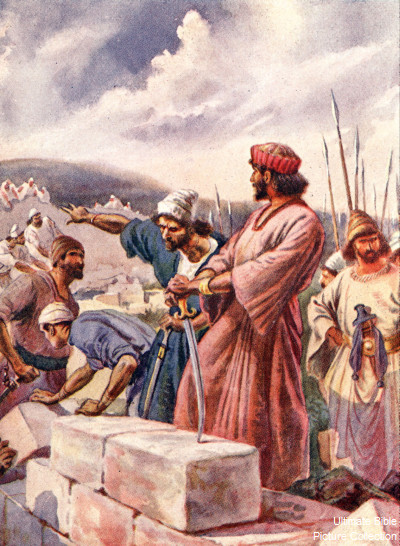
Nehemiah 4:16-20 records a change of strategy for the duration of the project. Nehemiah adopted a new organizational strategy to prevent another crisis and another threat to morale. He organized the people into workers, warriors, and watchmen. He had the people work with either a weapon in their hand or at their side. He appointed others to stand guard. As an additional precaution, he appointed buglers to stand guard around the city and to sound an alarm at the first sign of trouble.

Nehemiah 4:21-23 is a summary of the events of the problem and pressure-filled days of chapter 4. Notice that the people worked from “dawn until the stars appeared (Nehemiah 4:21).” Notice also that Nehemiah asked the “commuters” to stay within the walls of the city to help guard the city and finish the walls (Nehemiah 4:22).

Finally, notice that the problems and pressures of those days were so great that Nehemiah and his men slept in their clothes with their weapons at their side. They lived in a constant state of readiness. The people thus dealt with the problems and pressures they encountered by having faith in God (“Our God will fight for us,” 4:20), and by working hard (“So we carried on the work,” 4:21).

Practical Considerations:

Listening to the enemy can lead to discouragement.
The words of a children’s song caution, “Be careful little ears what you hear!” We learn from Nehemiah 4 that listening to the words of the enemy can lead to discouragement. The opposition to the work of rebuilding the walls of Jerusalem was loud and cruel. Every word was filled with venom and spoken to the end that the Jews would become discouraged, demoralized, and debilitated. We must be careful what we listen to lest we be rendered ineffective in God’s work.

Prayer puts problems and pressures into perspective.
Nehemiah was successful in dealing with problems and pressures because he was a man of prayer. Prayer always puts things into proper perspective. Problems never seem quite as ominous before our omnipotent and awesome God. We should follow Nehemiah’s example and pray, rather than panic, in the face of problems and pressures.

We should not lose heart in doing good.
Nehemiah dealt with problems and pressures not only through praying alone, but through persistent work as well. By so doing he modeled Paul’s counsel to the Corinthians, “Therefore, my beloved brethren, be steadfast, immovable, always abounding in the work of the Lord, knowing that your toil is not in vain in the Lord” (I Corinthians 15:58). We too, should keep at the task even in the face of opposition.

We should never do things just “half-way” in God’s work.
When the Jews reached the half-way point in the work of rebuilding the walls of Jerusalem, they were ready to stop the work because of fatigue and fear. We must guard against the tendency to do things half-way in God’s work. We should look to God when we are weary that He may renew our strength. We should look to God when we are fearful that He may remind us of His presence and protection. And, we should look to God when we are discouraged that He may bolster our resolve.

Fatigue can cause us to lose our vision.
The Jews began the rebuilding of the walls with great enthusiasm and energy. As they continued the work however, they became both physically and emotionally exhausted as they daily contended with the rubble of the walls and the rumors of their enemies. This relentless pressure finally took its toll as the people lost sight of their progress and became discouraged at the thought of the remainder of the work. We must learn the value of rest and relaxation and learn to schedule such moments into our busy days lest we too, lose sight of the bigger picture.
Nehemiah 3

Perspiration: Nehemiah Involves The People
Nehemiah 3:1-32

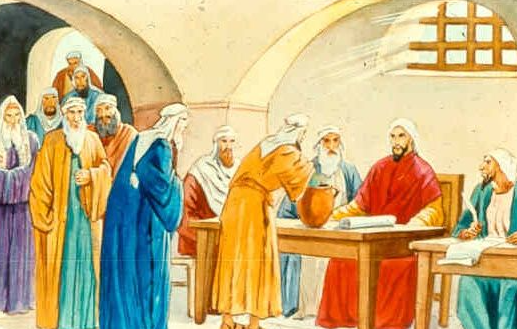
At first glance, Nehemiah 3 is a chapter filled with lists of names of people and locations in Jerusalem, most of which are difficult to pronounce. It is tempting to skip over chapter three and take up the story again in chapter four. But upon closer examination, chapter three outlines the principles that led to the success of the project.

First, notice the principle of coordination. Every person knew where he belonged and where he was to work. We see this in phrases such as “next to him,” or “beside his house.”

Second, notice the principle of cooperation. People of all ages and from all walks of life cooperated to achieve a common objective.

Third, notice the principle of commendation. This principle is more implied than stated in the chapter, but we can see it illustrated in the fact that Nehemiah knew the names of the people who were working and noticed the work they did. He acknowledged the work of each individual. We can imagine what an encourager Nehemiah must have been as he supervised the work and thanked the people for their involvement.

Fourth, notice the principle of communication. We must not overlook the fact that Nehemiah had to communicate with the people about the work. He had to assign leaders, make work assignments, give instructions, delegate authority, and answer questions. He kept the channels of communication open. Thus, the fact that the work was coordinated, the people cooperated and were commended, and the lines of communication were open all contributed to the success of the project.

Nehemiah teaches us the importance of encouraging others.

Nehemiah 3 is a testimony to the fact that Nehemiah was a “people-person.” He noticed and affirmed the work of those who were helping to reconstruct the wall. He was an encourager. He knew how to develop morale in the workplace.

There are three “morale-mashers” in the workplace: First, lack of appreciation from those above us. Second, lack of cooperation from those around us. Third, lack of commitment from those below us. Nehemiah worked to keep the “morale-mashers” out of the workplace.

Nehemiah 2

From Motivation to Perspiration

Winston Churchill has been called the Man of the Century. History records his marvelous talents as a statesman, orator, and world leader. His leadership through the bleak, crucial days of World War II helped preserve our democratic way of life. He was a gifted orator who could stir the masses to persevere in the face of any odds. Churchill knew how to motivate people. He knew people were itching on the inside and knew exactly where to scratch.

Like Churchill, Nehemiah was a man who knew how to motivate and inspire his countrymen. He knew the Jews in Jerusalem were itching on the inside and knew exactly where to scratch. He motivated the people to rebuild the walls of Jerusalem to the end that God be glorified and the city of Jerusalem regain its prestige. He knew how to motivate others to work. He knew that motivation must lead people to perspiration.

The Personal Petition of Nehemiah
Nehemiah 2:1-8

After four months of praying, the day finally arrived for Nehemiah to present his petition before the king. Over the four month period of praying, Nehemiah had come under the conviction that God had an important role for him to play in solving the dilemma of his people.

Nehemiah’s opportunity came one day in April as he was performing his official duties as cupbearer. The king noticed Nehemiah’s sad countenance and asked him why he was so sad. Nehemiah responded by explaining to the king that he was sad because he had learned that the city of his fathers’ was in a deplorable condition.

Perhaps sensing that Nehemiah wanted to make a request, the king asked, “In what way can I help?” This is the moment Nehemiah had in mind when he prayed, “make Thy servant successful today, and grant him compassion before this man” (Nehemiah 1:11). Nehemiah breathed a quick prayer and asked the king for permission to return to the city of his fathers’ to rebuild it.

Concerned about the length of time Nehemiah would be away, the king asked, “How long will your journey be and when will you return?” Nehemiah gave the king a definite time and further asked that he might be granted the proper written authorization for the journey back to Judah as well as for supplies to do the work which awaited him.

Nehemiah 2:8 records, “and the king granted them to me because the good hand of my God was on me.” Nehemiah gave God the credit for the king’s generous permission and provisions. Thus Nehemiah teaches us about the power of prevailing prayer, the importance of proper planning, and the value of tireless perseverance.

Examination: Nehemiah Inspects The Walls
Nehemiah 2:9-16

Beginning with Nehemiah 2:9, Nehemiah lays aside his role as cupbearer and takes up the role of builder. We read in Nehemiah 2:9 that the king granted Nehemiah an escort to Jerusalem. This undoubtedly added to his prestige and verified his credentials as he made the long journey to Jerusalem.

Upon arriving in Jerusalem, Nehemiah immediately experienced opposition. Sanballat and Tobiah, two politicians from neighboring areas, were not at all pleased that someone had come to seek the welfare of the Jews. This should not surprise us, for as we have noted in previous lessons, God’s work will not go unchallenged by the enemy.

Three days after his arrival in Jerusalem, Nehemiah made an inspection of the damaged walls by night. He wanted to be certain that he had all of the facts in hand before formulating his plan of action. So while the city slept, Nehemiah made his way around the rubble to gain a better perspective of the situation. He, no doubt, saw more at night than most people saw in the light. Nehemiah did not tell anyone what God was putting into his heart to do for Jerusalem. He did not want to risk anyone inadvertently “leaking” information to the enemy lest they gain an advantage in frustrating the work once again.

Motivation: Nehemiah Inspires The People
Nehemiah 2:17-18

After his nocturnal inspection of the walls, Nehemiah was ready to disclose his plans to the people. Nehemiah 2:17-18 is a précis of his inspiring speech to the people. Notice four things in particular.

First, Nehemiah addressed the serious plight of the people: “You see the bad situation we are in.”

Second, he called people to action: “Come, let us rebuild the wall of Jerusalem.” He even gave the people a reason to get involved in the work: “That we may no longer be a reproach.”

Third, Nehemiah shared an encouraging personal word of testimony. He shared with the people how God had worked things out for him to journey to Jerusalem. By sharing his testimony he pointed the people away from their fears to the Lord.

Fourth, Nehemiah identified himself with the people: “You see the bad situation we are in…Come, let us rebuild the wall of Jerusalem that we may no longer be a reproach” (Nehemiah 2:17).

Nehemiah’s speech was so inspiring that the people responded by affirming their support: “Let us arise and build.” The response of the people was prompt (there was no discussion), practical (they were ready to get to work), and unanimous (notice the use of the word “us”).

Intimidation: Nehemiah Impugns the Opposition
Nehemiah 2:19-20

As we have already noted, God’s work will not go unchallenged by God’s enemies. As soon as Nehemiah announced his plans and motivated the people to get to work, Sanballat, Tobiah, and Geshem began to intimidate and mock the people. They used every demoralizing technique they knew to try to discourage the people.

Nehemiah however, swiftly addressed the opposition in a confident, firm, and dignified manner. He did not draw them into argument or debate. He simply informed the opponents that God would grant them success, that the work would proceed in spite of their threats, and that they had no religious claims to the privileges of Jerusalem.

Sanballat, Tobiah, and Geshem had not reckoned on dealing with a Nehemiah. They had come to intimidate the Jews and instead were impugned by Nehemiah. We can just imagine the admiration of the people for Nehemiah at this point.

Practical Considerations:

God honors prayerful planning.
It is evident from Nehemiah 2:1-8 that Nehemiah had spent much time in prayerful planning before he ever made his petition known to the king. He was prepared to answer all of the king’s questions and to request the necessary authorization to secure his passage and provisions. We noted in our lesson, “Planning that arises from and is the product of prayer is far superior to planning that is merely backed by prayer” (White).

We must be willing to allow God to reorder our priorities.
As a result of his time in prayer, Nehemiah came to an understanding of how God wanted to use him as part of the answer to his own prayer. He was willing to allow God to reorder his personal priorities and plans for the purpose of serving his fellow Jews in Jerusalem. Nehemiah discovered an opportunity for service through prayer. 

Nehemiah teaches us the importance of careful planning.
Nehemiah was convinced that it was God’s will for the wall of Jerusalem to be rebuilt. He was also confident that God had called him to play a major leadership role in the project. But before undertaking the great task, Nehemiah carefully inspected the damaged walls in order to gain a better perspective on the situation. This helped Nehemiah to formulate a practical plan of action to meet the challenge of rebuilding the walls. Nehemiah was successful because he coupled specific prayer with careful planning.

Nehemiah teaches us the importance of sharing our testimony.
Nehemiah assembled the people for the purpose of revealing his plans and motivating them to take part in the project. Nehemiah shared his personal testimony of how God had performed what seemed impossible by granting him an extended leave of absence from the king’s service with the proper authorizations to undertake the work of rebuilding the walls. By sharing his testimony he inspired the people to turn their gaze from their fears to their God. Nehemiah’s testimony inspired the people to “put their hands to the good work” (Nehemiah 2:18).

Nehemiah teaches us the importance of standing firm.
When the enemies of the Jews learned that the repatriates were being challenged to rebuild the walls, they wasted no time in mobilizing themselves to counterattack. They used every demoralizing trick they knew to try to frustrate the hopes of the people. Nehemiah however, stood tall in the face of the opposition because he was confident that God would grant the people success. He did not argue or debate the opposition, but merely stood on the firm convictions of his heart. By so doing Nehemiah impugned the opponents and once again inspired the people.