1 Samuel 26

26:1 The Ziphites [had revealed David’s whereabouts to Saul on a previous occasion (23:19)] went to Saul at Gibeah and said, “Is not David hiding on the hill of Hakilah [there were “strongholds” at Hakilah (23:19) that offered places to hide], which faces Jeshimon?”

26:2 So Saul went down [from Gibeah] to the Desert of Ziph, with his three thousand chosen men [cf. 1 Sam. 24:2] of Israel, to search there for David [David had six hundred men (1 Sam. 23:13)].

26:3 Saul made his camp beside the road on the hill of Hakilah facing Jeshimon, but David stayed in the desert. When he saw that Saul had followed him there,

26:4 he sent out scouts and learned that Saul had definitely arrived.

26:5 Then David set out and went to the place where Saul had camped. He saw where Saul and Abner [Saul’s chief military officer] son of Ner, the commander of the army, had lain down. Saul [note that Saul apparently was safely buffered on all sides by his army…] was lying inside the camp, with the army encamped around him.

26:6 David then asked Ahimelech the Hittite [a mercenary, not to be confused with the priest mentioned in 21:1] and Abishai [a nephew of David (1 Chron. 2:13-16)] son of Zeruiah [David’s sister; also mother of Joab (1 Chron. 2:15-16)], Joab’s brother, “Who will go down into the camp with me to Saul? [obviously a very dangerous mission]” “I’ll go with you,” said Abishai.

26:7 So David and Abishai went to the army by night, and there was Saul, lying asleep inside the camp with his spear stuck in the ground near his head. Abner and the soldiers were lying around him.

26:8 Abishai said to David, “Today [indicates Abishai’s sense of urgency re: opportunity to kill Saul] God has delivered your enemy into your hands. Now [indicates Abishai’s sense of urgency re: opportunity to kill Saul] let me pin him to the ground with one thrust of my spear; I won’t strike him twice.”

26:9 But David [David would not do wrong in order to execute justice] said to Abishai, “Don’t destroy him [see the titles of Psalms 57–59 re: the tune “Do Not Destroy”]! Who can lay a hand on the LORD’S anointed and be guiltless?

Note: How do you handle opposition from people who have authority over you?

26:10 As surely as the LORD lives,” he said, “the LORD himself will strike him [David left Saul’s destiny in God’s hands; cf. 1 Sam. 25:38 re: Nabal]; either his time will come and he will die, or he will go into battle and perish [literally “be swept away”].

26:11 But the LORD forbid that I should lay a hand on the LORD’S anointed [David had respect for Saul’s authority and position]. Now get the spear [a symbol of Saul’s authority and a symbol of death] and water jug [a symbol of life] that are near his head, and let’s go.”

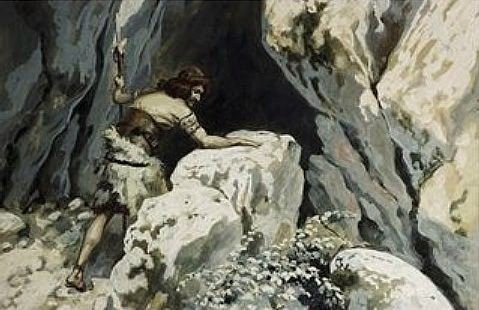
26:12 So David took the spear and water jug [both of these items helped David make his point that he respected God and God’s anointed king] near Saul’s head, and they left. No one saw or knew about it, nor did anyone wake up. They were all sleeping, because the LORD had put them into a deep sleep.

26:13 Then David crossed over to the other side and stood on top of the hill some distance [a safe distance] away; there was a wide space between them.

26:14 He called out to the army and to Abner son of Ner, “Aren’t you going to answer me, Abner [questions implies David had to call several times]?” Abner replied, “Who are you who calls to the king?”

26:15 David said [note that David taunted Abner…], “You’re a man, aren’t you? And who is like you in Israel? Why didn’t you guard your lord the king? Someone [Abishai] came to destroy your lord the king.

26:16 What you have done [failure to guard the king] is not good. As surely as the LORD lives, you and your men deserve to die, because you did not guard your master, the LORD’S anointed. Look around you. Where are the king’s spear and water jug that were near his head?”

26:17 Saul recognized David’s voice and said, “Is that your voice, David my son?” David replied, “Yes it is, my lord the king.”

26:18 And he added [cf. 1 Sam. 20:1], “Why is my lord pursuing his servant? What have I done, and what wrong am I guilty of?

26:19 Now let my lord the king listen to his servant’s words. [David wanted to know if Saul was pursuing him because he had listened to the Lord or to men…] If the LORD has incited you against me, then may he accept an offering. If, however, men have done it, may they be cursed before the LORD! They have now driven me from my share in the LORD’S inheritance [the land of Israel] and have said, ‘Go, serve other gods [or the gods of an alien land].’

26:20 Now do not let my blood fall to the ground far from [away from the Lord’s land] the presence of the LORD. The king [the most powerful person in the land] of Israel has come out to look for a flea—as one hunts a partridge in the mountains [implies that Saul’s search for David was not worthy of his time and beneath his dignity].”

26:21 Then Saul said, “I have sinned [cf. 1 Sam. 15:24,30]. Come back, David my son. Because you considered my life precious today, I will not try to harm you again. Surely I have acted like a fool and have erred greatly.”

26:22 “Here is the king’s spear [a symbol of death; note that David did not offer to return the water jug, the symbol of life],” David answered. “Let one of your young men come over and get it.

26:23 The LORD rewards every man for his righteousness and faithfulness. The LORD delivered you into my hands today, but I would not lay a hand [refers to a violent act] on the LORD’S anointed.

26:24 As surely as I valued your life today, so may the LORD value my life and deliver me from all trouble.”

26:25 Then Saul said to David, “May you be blessed, my son David; you will do great things and surely triumph.” So David went on his way, and Saul returned home.

1 Samuel 3

1 Samuel 3:10-21
3:10 The LORD came and stood there, calling [whether voice was inner or auditory is not made clear] as at the other times, “Samuel! Samuel! [cf. Gen. 22:11 and Ex. 3:4 re: other double expressions; God could not speak to Eli’s sons because they had no regard for the Lord (2:12)]” Then Samuel said, “Speak, for your servant [indicates willingness to hear and obey] is listening [Samuel’s attitude was different than that of Eli’s two sons; his heart was open and attentive to God’s words].”

3:11 And the LORD said [what God said became Samuel’s first prophetic message] to Samuel: “See, I am about to do something in Israel that will make the ears of everyone who hears of it tingle [cf. 2 Kings 21:12; Jer. 19:3 re: use of this phrase to introduce prophecies of disaster].

3:12 At that time I will carry out against Eli everything I spoke [cf. 1 Sam. 2:27-36] against his family – from beginning to end [an idiom implying the accomplishment of God’s full purpose].

3:13 For I told him [Eli] that I would judge his family forever because of the sin he knew about [cf. 2:22]; his sons [Hophni and Phineas: wicked and immoral sons who had no regard for the Lord (2:12,22); they used the sacrificial system for their personal gain, engaged in sexual sins at the entrance to the Tent of Meeting, and refused to heed their father’s warnings (cf. 2:12-17,22-25)] made themselves contemptible [means “to make light of something or someone that deserves honor or respect”], and he [as both a father and a priest, Eli was responsible for stopping any abuse of the tabernacle; Eli rebuked his sons (2:22-25) but failed to take sterner measures against them; honored his sons (by failing to relieve them of their duties as priests) more than God (2:29)] failed to restrain them.

3:14 Therefore, I swore to the house of Eli, ‘The guilt of Eli’s house will never be atoned [to cover] for by sacrifice or offering [cf. Lev. 4:3-12 re: restoration of priest who sinned unintentionally; Hophni and Phineas sinned intentionally and repeatedly; these rebellious priests deserved death (cf. Num. 15:30-31)].’”

3:15 Samuel lay down until morning [probably restless as he thought about the message he had received re: Eli’s sons] and then opened the doors of the house of the LORD. He was afraid [perhaps because of his love for Eli] to tell Eli the vision,

3:16 but Eli called him and said, “Samuel, my son [Eli’s son in the faith].” Samuel answered, “Here I am.”

3:17 “What was it he [the Lord] said to you?” Eli asked. “Do not hide [to his credit, Eli wanted to know the complete message Samuel had received from God] it from me. [Samuel invoked an oath] May God deal with you, be it ever so severely, if you hide from me anything he told you.”

3:18 So Samuel told him everything [the complete message he had received from the Lord], hiding nothing from him. Then Eli [accepted God’s judgment upon his family; Eli trusted God to do what was just and right] said, “He is the LORD; let him do what is good in his eyes [cf. David’s words in Ps. 51:4].”

3:19 The LORD was with Samuel as he grew up [both physical and spiritual growth (cf. 2:21,26); protected him from the evil influence of Eli’s sons], and he let none of his words fall to the ground [phrase means that Samuel’s words as a prophet came true; everything Samuel said with divine authorization came true; cf. Deut. 18:22; confirmed Samuel’s call].

3:20 And all Israel from Dan to Beersheba [from the northern to the southern border of the nation; indicates the scope of Samuel’s ministry] recognized that Samuel was attested [true] as a prophet [from Hebrew word that means “to speak”] of the LORD.

3:21 The LORD continued to appear at Shiloh [located 30 miles north of Jerusalem; Joshua erected tabernacle there after conquest of Canaan (cf. Josh. 18:1)], and there he revealed himself to Samuel through his word.

1 Samuel 1

1:1 There was [context: during the time of the judges (at this particular time characterized by anarchy and immorality as per Judg. 21:25)] a certain man from Ramathaim [or Ramah (cf. 1 Sam. 1:19; 2:11)], a Zuphite from the hill country of Ephraim, whose name was Elkanah [a religious man as per v. 3] son of Jeroham, the son of Elihu, the son of Tohu, the son of Zuph, an Ephraimite.

1:2 He had two wives; one was called Hannah [possibly the first wife; name means grace] and the other Peninnah. Peninnah had children, but Hannah had none [childlessness viewed as a sign of divine disapproval; possible reason why Elkanah had also married Peninnah].

About Hannah
• only woman in OT shown going up to the Lord’s house
• only woman shown making and fulfilling a vow to the Lord
• only woman who is specifically said to pray (her prayer among the longest in OT)

1:3 Year after year this man went up from his town to worship and sacrifice to the LORD Almighty at Shiloh, where Hophni and Phinehas, the two sons of Eli, were priests of the LORD.

1:4 Whenever the day came for Elkanah to sacrifice [see v. 3], he would give [indicates offering where worshipers would eat part of the animal offered in sacrifice] portions of the meat to his wife Peninnah and to all her sons and daughters.

1:5 But to Hannah he gave a double portion because he loved her, and the LORD had closed her womb.

Hannah, Samuel’s mother, was a remarkable woman. She was the first of Elkanah’s two wives (1:2). Elkanah, Samuel’s father, was a devout man who led his family on an annual pilgrimage “to worship and to sacrifice to the Lord” (1:3) at Shiloh. Elkanah likely married Peninnah, his second wife, because Hannah was unable to bear children. Children, especially sons, were important to the welfare and survival of the family. However, in spite of the fact that she had borne him no children, Elkanah loved Hannah (1:5). Perhaps motivated by jealousy, Peninnah taunted and provoked Hannah severely year after year.

1:6 And because the LORD had closed her womb [afflictions call for endurance], her rival [Heb. “sara” which means adversary or “one who inflicts or troubles someone else”] kept provoking [Heb. kaas means “to provoke to anger”] her in order to irritate [hurts inflicted by others call for forbearance] her.

Note: In what areas of life do you face opposition? In what ways can perseverance during difficult times strengthen our faith?

1:7 This [provocation] went on year after year [prolonged ridicule indicates Peninnah was either jealous of Hannah (cf. 1:5a) or that she had a mean spirit (or both)]. Whenever Hannah [continued to worship God despite ridicule/verbal abuse from Peninnah] went up to the house of the LORD, her rival provoked [read Prov. 18:21 re: the power of words to hurt or to help] her till she wept and would not eat.

Deeply hurt by Peninnah’s taunting, Hannah went to the Lord’s tabernacle at Shiloh where she wept and prayed. Prayer is always a right response when we are experiencing difficult situations. The Lord invites us to cast our concerns upon Him because He cares for us (1 Pet. 5:7).

When I was a child I sometimes had to stand on tip-toes to be able to see things that were out of my reach. As an adult, I have found that the best way to gain perspective about the things out of my reach and beyond my understanding is by getting on my knees (Ps. 73:16-17). I have learned that I can see God clearly and hear him best when I am on my knees.
Q: In what ways are you able to gain perspective in difficult times?

1:8 Elkanah her husband would say [his words indicate that he failed to understand the depth of Hannah’s misery] to her, “Hannah, why are you weeping? Why don’t you eat? Why are you downhearted? Don’t I mean more to you than ten sons?”

1:9 Once when they had finished eating and drinking in Shiloh, Hannah stood up. Now Eli the priest was sitting on a chair by the doorpost of the LORD’S temple.

1:10 In bitterness [Heb. mara; cf. Ruth 1:13,19-20; Job 3:20] of soul Hannah wept [v. 8 seems to indicate that Elkanah was insensitive to Hannah’s pain] much and prayed to the LORD.

Note: Hannah turned to the Lord in her time of need. Who do you turn to when you face difficulties? Why do you think we sometimes turn to God as a “last resort” instead of as a “first choice”?

1:11 And she made a vow [not an attempt to bargain with God; rather a promise of what she would do if God gave her a son], saying, “O LORD Almighty [or Lord of hosts; a recognition of and appeal to God’s power], if you will only look upon your servant’s misery and remember me, and not forget your servant but give her a son, then [1] I will give him to the LORD [Hannah fulfilled this vow after Samuel was weaned (1 Sam. 1:24-28)] for all the days of his life, and [2] no razor will ever be used on his head [implied her son would be a Nazirite (from Heb. “nazar” meaning “to separate” or “to consecrate”)].”

Elements of a Nazirite vow (read Num. 6:1-8)
• avoiding a razor
• abstaining from wine and other products of the grapevine
• avoiding contact with the dead

1:12 As she kept on [persistence in prayer (cf. Lk. 18:1)] praying to the LORD, Eli observed her mouth.
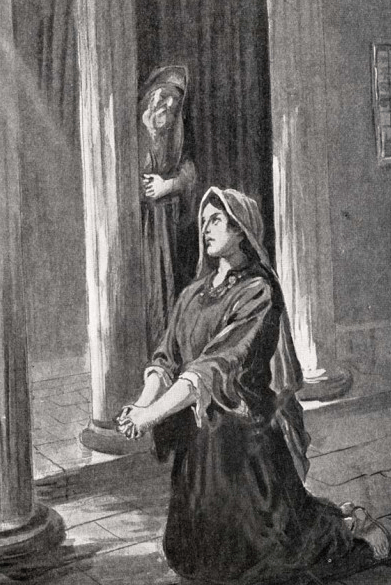
1:13 Hannah was praying in her heart, and her lips were moving but her voice was not heard [Hannah was praying silently]. Eli thought [misjudged Hannah’s behavior/jumped to conclusions] she was drunk

1:14 and said to her [Eli should have spoken these words to his evil sons instead (cf. 1 Sam. 2:12-17)], “How long will you keep on getting drunk? Get rid of your wine.”

Driven to her knees out of desperation, Hannah pleaded with God for a son. She was so overcome with emotion that she failed to notice that anyone else was in the tabernacle. As Eli the priest watched her praying silently from a distance, he mistakenly concluded that she was drunk and scolded her.

Hannah explained that she was not drunk but instead had been pouring out her heart before the Lord. Every word that she had prayed had seeped out of the depths of her anguish and resentment. Hannah was desperate for a child. While this passage does not imply that childless individuals and couples can bargain with God, it does teach that prayer is very appropriate.

1:15 “Not so, my lord,” Hannah [Eli’s hasty words to Hannah show that sometimes even church people have bad experiences] replied, “I am a woman who is deeply troubled. I have not been drinking wine or beer; I was pouring out my soul [indicates earnestness] to the LORD.

Note: How can we know that God cares for us even when our prayers are not answered in the way we want? How do you respond when your prayers are not answered in the way you want? How long do you pray for something before you get discouraged and give up?

1:16 Do not take your servant for a wicked woman; I have been praying here out of my great anguish and grief.”

1:17 Eli [recognized his mistake] answered, “Go in peace, and may the God of Israel grant you what you have asked of him.” [cf. 1:18 re: impact of Eli’s words of blessing]

Eli affirmed the sincerity of Hannah’s faith by adding his own priestly prayer that God grant her petition. Encouraged by Eli’s words, Hannah returned home a different woman.

Although she was still childless, she felt assured that God had heard and would answer her petition for a son. And, she was prepared to fulfill her vow to give the son that she so desperately wanted back to God (1:11) to live as a Nazirite — one separated and consecrated to the Lord (see Num. 6:1-21; Judg. 13:5-7).

1:18 She said, “May your servant find favor in your eyes.” Then she went her way and ate something, and her face was no longer downcast.

1:19 Early the next morning they [Elkanah and his family] arose and worshiped before the LORD and then went back to their home at Ramah. Elkanah lay with Hannah his wife, and the LORD remembered [cf. 1:11] her.

1:20 So in the course of time Hannah conceived and gave birth to a son. She named him Samuel [Heb. name sounds like word for “heard of God”], saying, “Because I asked the LORD for him.”

After an unspecified period of time, Hannah gave birth to a son and named him Samuel, whose name served as a reminder that she had requested him from the Lord.

About Samuel
• key figure in transition period between the judges and the kings
• the last judge
• a priest and a prophet
• anointed Israel’s first two kings, Saul and David

1:21 When the man Elkanah went up with all his family to offer the annual sacrifice to the LORD and to fulfill his vow,

1:22 Hannah did not go. She said to her husband, “After the boy is weaned, I will take him and present him before the LORD, and he will live there always.”

1:23 “Do what seems best to you,” Elkanah her husband told her. “Stay here until you have weaned him; only may the LORD make good his word.” So the woman stayed at home and nursed her son until she had weaned him.

1:24 After he was weaned, she took the boy with her, young as he was, along with a three-year-old bull, an ephah of flour and a skin of wine, and brought him to the house of the LORD at Shiloh.

1:25 When they had slaughtered the bull, they brought the boy to Eli,

1:26 and she said to him, “As surely as you live, my lord, I am the woman who stood here beside you praying to the LORD.

1:27 I prayed for this child, and the LORD has granted me what I asked of him.

1:28 So now I give him to the LORD. For his whole life he will be given over to the LORD.” And he worshiped the LORD there.

Hannah did not forget the promise she had made when she poured out her heart before the Lord. When we make a promise to the Lord He expects us to keep it (Ecc. 5:5). After the birth of Samuel, Hannah was determined to follow through on her promise to give the boy to the Lord — essentially to dedicate him to God for a lifetime of service.

Although Hannah later gave birth to other children (1 Samuel 2:21), at this point in time Samuel was her only son. And yet, Hannah did not hesitate to give God what she had wanted and treasured most — the son that God had given to her in answer to prayer.

Elkanah supported Hannah’s decision to fulfill her promise. Like Hannah and Elkanah, many parents dedicate their children to God as babies. However, it is not enough to go through a ceremony and receive a certificate for having dedicated a child to God. It takes more than that to bring up a child “in the training and instruction of the Lord” (Eph. 6:4).

Parents must prayerfully and intentionally embrace their responsibility to serve as the primary faith-trainers in the lives of their children. They must teach their own children by word and example, day in and day out. With so many world-views competing for the hearts and minds of our children, parents cannot afford to be slack in their responsibility to guide their children to love and serve God.


My Mom told me that when she and Dad took me home from the hospital after I was born, they stopped by the church and dedicated me to God. No ceremony — just Mom, Dad, their first-born son, and God.

As new parents, Mom and Dad had the wisdom to ask God for help. They understood that they could not raise me, and later my siblings, apart from divine help. They were right. Apart from trusting and hoping in God, we can easily become disoriented, distracted, and discouraged.

I’m grateful for my mother’s example of trusting God through all of life’s challenges. By so doing she left our family a legacy grounded in hope.

Challenges and difficulties can easily cause us to lose perspective, to lose hope, or to place our hope in the wrong things. Those who place their hope in anything or anyone other than God will be disappointed. Here are four things to consider that can help us to leave a legacy grounded in hope.

H = Look to heaven first when hard times comes. Our culture tempts us to look to everything but God for hope. However, God Himself invites us to cast our cares upon Him and to approach His throne for timely help. We should make God our first rather than our last resort.

O = Look for opportunities to teach your children about trusting God. Parents should teach their children about God’s faithfulness that they might put their confidence in God (Ps. 78:7). We must not leave this important lesson to chance but instead intentionally teach it to our children.

P = Remember that prayer and hope go hand in hand. It is often despair that drives us to our knees but hope that helps us to get up again. Always allow prayer to tether your heart to hope.

E = Those who hope in God should watch expectantly (Ps. 5:3). Expectant faith honors God and God honors expectant faith.

Regardless of whether you are a parent or an empty nester, married or single, male or female, we can each leave a legacy grounded in hope that will continue to bless those in our respective spheres of influence. Hope in God first and then trust him to the last.

1 Samuel 21

1 Samuel 21:1
21:1a David went to Nob [located near Jerusalem (cf. Isa. 10:32); site of a large contingent of priests (cf. 1 Sam. 22:18)], to Ahimelech [a great grandson of Eli, the priest (14:3); name means “my brother is king”] the priest. Ahimelech trembled when he met him, and asked, “Why are you alone? Why is no one with you?”

1 Samuel 21:10
21:10 That day David fled from Saul and went to Achish king of Gath [major Philistine city and birthplace of Goliath (17:4); located 23 miles from Nob; perhaps David thought Saul would not consider looking for him in Gath].

1 Samuel 22

1 Samuel 22:1-2


22:1 David left Gath and escaped [probably refers to David’s continuing flight from Saul] to the cave of Adullam [located about 10 miles southeast of Gath; names means “sealed off place” and was natural stronghold, however David’s greatest stronghold was the Lord (Ps. 18:2)]. When his brothers and his father’s household [they were likely in danger of being held hostage by Saul (cf. 22:3)] heard about it, they went down to him there.

22:2 All those who were in distress [someone under great pressure, perhaps from oppression of Saul’s unreasonable rule] or in debt [perhaps those repaying debts with usurious interest rates; perhaps they saw David as only hope of repaying debt through sharing spoils of victory] or discontented [means “bitter in soul” (cf. Ruth 1:20); perhaps these found a new family and home with David] gathered around him, and he became their leader. About four hundred men [force later grew to six hundred men (23:13)] were with him.

22:3-4 David took his aging parents to the king of Moab and asked him to protect them.

1 Samuel 23

1 Samuel 23:19-23 [Read also Psalm 54]
23:19 The Ziphites [saw opportunity to betray David; perhaps motivated by desire for profit or fear of facing similar fate as Nob (cf. 22:6-23)] went up to Saul at Gibeah [Saul’s capital] and said, “Is not David hiding among us in the strongholds [possibly caves] at Horesh, on the hill of Hakilah [Ziphites told Saul David’s location], south of Jeshimon?

23:20 Now, O king, come down whenever it pleases you to do so, and we will be responsible for handing him over to the king.”

23:21 Saul replied, “The LORD bless you for your concern for me [“a stereotyped expression that tells nothing about his piety (or lack of it)” (Expositor’s · Vol. 3 · p. 742)].

23:22 Go and make further preparation. Find out [Ziphites became Saul’s personal spies; Saul requested more specific information] where David usually goes and who has seen him there. They tell me he is very crafty [from same root as Hebrew word used to describe serpent in garden (Gen. 3:1) or a prudent individual (Prov. 12:23)].

23:23 Find out about all the hiding places [perhaps to avoid possibility of being ambushed by David in rugged and unfamiliar terrain] he uses and come back to me with definite information. Then I will go with you; if he is in the area, I will track him down among all the clans of Judah

1 Samuel 27

1 Samuel 27:1
27:1 But David thought to himself, “One of these days I will be destroyed by the hand of Saul. The best thing I can do is to escape to the land of the Philistines [because there was no place left to hide in Israel]. Then Saul will give up searching for me anywhere in Israel, and I will slip out of his hand.”

1 Samuel 27:6
27:6 So on that day Achish [commander of the Philistine army; ruler of Gath (1 Sam. 21:10)] gave him Ziklag [Philistine town located about 40 miles southwest of Jerusalem], and it has belonged to the kings of Judah ever since.

1 Samuel 29

1 Samuel 29:6-7
29:6 So Achish called David and said to him, “As surely as the LORD lives, you have been reliable, and I would be pleased to have you serve with me in the army. From the day you came to me until now, I have found no fault in you, but the rulers [other rulers of the Philistines] don’t approve of you.

29:7 Turn back and go in peace [David thus protected from having to accompany the Philistines in their fight against Israel]; do nothing to displease the Philistine rulers.”

1 Samuel 30

1 Samuel 30:1-8

30:1-2 Amalekites raided Ziklag and took all who lived there captive.

30:3 When David and his men came to Ziklag, they found it destroyed by fire and their wives and sons and daughters taken captive.

30:4 So David and his men wept aloud until they had no strength left to weep.

30:5 David’s two wives taken captive by the Amalekites.

30:6 David was greatly distressed because the men [Amalekite raid shook their confidence in David] were talking of stoning him [likely that David’s previous assaults on Amalekites (27:8) incited their wrath and desire for vengeance]; each one was bitter in spirit because of his sons and daughters [perhaps upset that David had taken all his troops to Aphek (29:1-2) thus leaving Ziklag unprotected]. But [instead of despairing] David found strength in the LORD his God [Ps. 25:16-17 seem to describe what David must have felt at this time].

30:7 David turned to Abiathar the priest in order to seek an answer.

30:8 and David inquired of the LORD, “Shall I pursue this [Amalekite] raiding party? Will I overtake them?” “Pursue them,” he answered. “You will certainly overtake them and succeed in the rescue.”

1 Samuel 30:17-19
30:17 David fought them [Amalekites] from dusk until the evening of the next day, and none of them got away, except four hundred young men who rode off on camels and fled.

30:18 David recovered everything the Amalekites had taken, including his two wives.

30:19 Nothing was missing: young or old, boy or girl, plunder or anything else they had taken. David brought everything back.

2 Samuel 18

2 Samuel 18:1-17
18:1-4 David sent his troops into battle against his son Absalom. David’s men insisted that he remain behind in Mahanaim (2 Sam. 17:24,27) since all of Absalom’s men would be seeking to kill him.

18:5 The king commanded [likely out of love for his son and in spite of his son’s treachery and destructive ambition] Joab [oldest son of David’s sister Zeruiah (2 Sam. 2:13; 1 Chron. 2:16); overall military commander during most of David’s reign; name means “Yahweh is father”], Abishai [Joab’s brother; name means “father exists”] and Ittai [a Philistine loyal to David; name means “with God”], “Be gentle [indicates that David did not desire vengeance; cf. Rom. 12:19-21] with the young man Absalom [name means “father of peace”] for my sake.” And all the troops heard [thus no one could claim ignorance] the king giving orders concerning Absalom to each of the commanders.

18:6-8 David’s troops defeated Absalom’s troops in a battle in the forest of Ephraim.

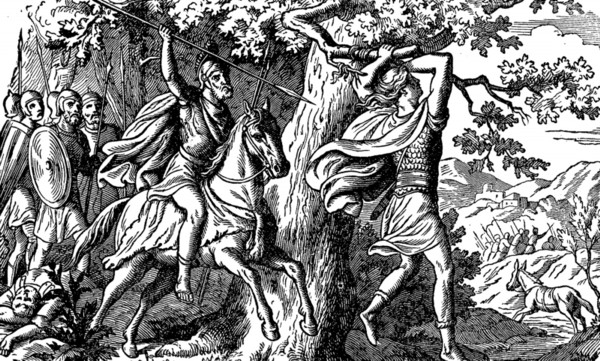
18:9-13 Absalom’s hair became entangled in a tree as he rode through the forest, thus leaving him in a vulnerable position. One of David’s men reported this incident to Joab.

18:14 Joab [Joab had killed in cold blood before (2 Sam. 3:27)] said [perhaps motivated by the belief that, if left alive, Absalom might seize an opportunity to kill David and take the throne], “I’m not going to wait like this for you [Joab believed he needed to seize the opportunity himself; took matters into his own hand].” So he [Joab consciously disobeyed David’s clear and direct order] took three javelins [refers to some kind of shafted weapon; can also mean “rod,” “dart,” or “spear”] in his hand and plunged them into Absalom’s heart while Absalom was still alive in the oak tree.

18:15-17 Ten of Joab’s men joined in the brutal murder of Absalom and then unceremoniously buried him in a pit in the forest.

2 Samuel 18:32-33
18:32 The king asked [direct question; king still concerned about welfare of his wayward son] the Cushite, “Is the young man Absalom safe [or, “Is there peace (shalom) for the young man Absalom?”]?” The Cushite replied [indirect answer], “May the enemies of my lord the king and all who rise up to harm you be like that young man.”

18:33 The king was shaken [cf. 1 Sam. 14:15 and Joel 2:10 re: shaking of the ground; same word translated “tremble” in Deut. 2:25 and Joel 2:1]. He went up to the room over the gateway and wept. As he went [these words suggest that David was overcome with grief and wept before he made it all the way to the room over the gateway], he said: “O my son Absalom! My son, my son Absalom! If only I had died instead of you—O Absalom, my son, my son!”