1 Samuel 15

1 Samuel 15:2-3
15:2 This is what the LORD Almighty [literally “Lord of hosts” or “Lord of armies”] says: ‘I will punish the Amalekites [loosely allied group of nomads who occupied territory south of Judah; had a long history of hostility against the Jews and God’s purposes] for what they did to Israel when they waylaid [by means of barbaric guerrilla warfare (cf. Ex. 17:8; Deut. 25:17-19)] them as they came up from Egypt [cf. Deut. 25:17-19].

15:3 Now go, attack the Amalekites and totally destroy everything [Heb. cherem: term used to describe something entirely given over to God, devoted to Him; without reservation or exception] that belongs to them. Do not spare them [Israelites were to fight as God’s agents of judgment, not for their own profit; cf. Deut. 20:18 re: reason for total destruction of enemy; would also serve as an example to those who would do evil against God’s people]; put to death men and women, children and infants, cattle and sheep, camels and donkeys.’”

15:4-7 Saul led army of 210,000 to victory over Amalekites.

15:8-9 Saul spared Agag king of the Amalekites and the best of the sheep and cattle.

15:10-12 The Lord grieved that He had made Saul king.

1 Samuel 15:13-15
15:13 When Samuel reached him, Saul said [with enthusiasm], “The LORD bless you! I have carried out the LORD’S instructions.”
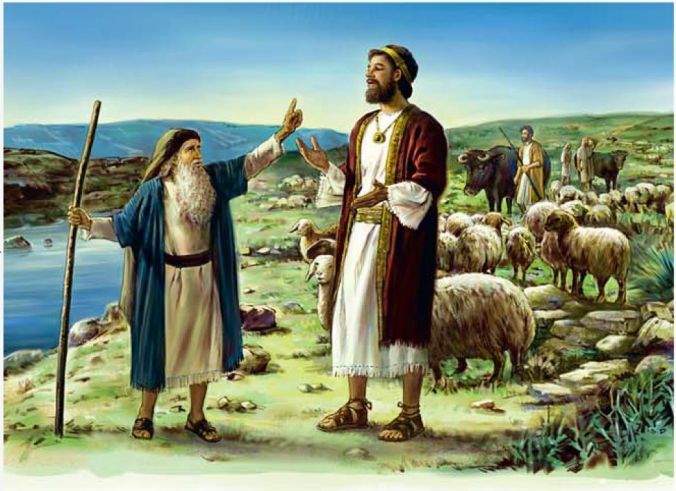
15:14 But Samuel said [exposed Saul’s lie], “What then [in essence: “If you have obeyed God’s instructions, then explain what I am hearing. How can slaughtered livestock make sounds?”] is this bleating of sheep in my ears? What is this lowing of cattle that I hear [Samuel heard the sounds of Saul’s disobedience]?”

15:15 Saul answered [rationalization: twisting facts and misstating motives], “The soldiers [Saul blamed others and excused himself (a common response of those caught in disobedience); soldiers could not have acted without Saul’s consent] brought them from the Amalekites; they spared the best of the sheep and cattle to [attempt to excuse and to justify actions] sacrifice [Saul did nor grasp contradiction between disobeying God and then offering sacrifices with these animals; “a gross deception, an attempt to conceal the selfishness of the original motive under the cloak of religious zeal and gratitude” (Jameison-Faussett-Brown Commentary)] to the LORD your God, but we totally destroyed the rest.”

15:16-18 Samuel told Saul what God had revealed to him the previous night.

1 Samuel 15:19-23
15:19 [Samuel put Saul on the spot] Why did you not obey [or “hear” – hearing to the Hebrews implied obedience] the LORD? Why did you pounce on the plunder [Saul cared more for “plunder” than for the Lord] and do evil [to disobey is to do evil] in the eyes of the LORD [everything we do and fail to do is in God’s sight]?”

15:20 “But I did obey the LORD,” Saul said. “I went on the mission the LORD assigned me. I completely [means without reservation or exception] destroyed the Amalekites and [Saul revealed his disobedience and condemned himself] brought back Agag their king [God’s command was to “totally destroy everything” (v. 3)].

15:21 The soldiers took [God never instructed them to take anything] sheep and cattle from the plunder, the best of what was devoted to God, in order to [Saul tried to cast their actions in a spiritual light] sacrifice [neither God nor Samuel had instructed Saul to do this] them to the LORD your God at Gilgal.”

15:22 But Samuel replied [a lesson in spiritual priorities]: “Does the LORD delight in burnt offerings and sacrifices as much as in obeying the voice of the LORD [obvious answer is “no” – God delights in our obedience]? To obey [the central tenet of Israel’s law (cf. Ex. 19:5; Deut. 6:24-25; 30:14)] is better than sacrifice, and to heed is better than the fat [the choicest part of the sacrifice] of rams.

15:23 For rebellion [disobedience to God’s command] is like [is equally sinful to] the sin of divination [the use of magical means to seek guidance or know the future], and arrogance [Saul made himself the final authority on obedience] like the evil of idolatry [the worship of false gods]. Because you have rejected [cf. Prov. 13:13; 28:9] the word of the LORD, he has rejected you as king [position of responsibility; Saul not rejected as a person].”

15:24-31 Samuel told Saul that the Lord was going to take the kingdom away from him.

15:32-33 Samuel killed Agag king of the Amalekites.

15:34-35 Samuel and Saul parted company, never to see each other again.

1 Samuel 11

• Ammonites’ Threat — 1 Samuel 11:1-2
• Jabesh’s Cry for Help — 1 Samuel 11:3-4
• Saul’s Deliverance — 1 Samuel 11:5-11
• Saul’s Compassion — 1 Samuel 11:12-13
• Saul’s Establishment as King — 1 Samuel 11:14-15
• Samuel’s Exhortation to Obey God — 1 Samuel 12:1-25

1 Samuel 11:1-15
11:1 Nahash [a warlord (king) whose name likely means “snake”] the Ammonite [nomadic people who lived east of the Jordan River] went up and besieged Jabesh Gilead [small and vulnerable city located east of the Jordan River]. And all the men [believed surrender was their best option] of Jabesh said to him, “Make a treaty [actually an agreement made under duress] with us, and we will be subject to you.”

11:2 But Nahash the Ammonite replied [his response demonstrated his cruelty], “I will make a treaty with you only on the condition that I gouge out the right eye [history indicates he had done this before] of every one of you and so bring disgrace on all Israel [and on Israel’s God].”

11:3 The elders of Jabesh said to him, “Give us seven days [perhaps Nahash allowed the grace period so that he could assemble more forces] so we can send men throughout Israel [Jabesh Gilead had not enjoyed cooperative relations with the other Israelites (cf. Judg. 11:4-11; 21:8-14)]; if no one rescues us [Nahash felt confident no one would rescue them] we will surrender to you [giving Nahash a victory without a battle].”

11:4 When the messengers [from Jabesh Gilead] came to Gibeah [in territory of Benjamin] of Saul and reported these terms [cf. 11:2] to the people, they all wept aloud [the people of Gibeah probably had friends and relatives in Jabesh Gilead (cf. Judg, 21:14)].

11:5 Just then Saul [about to face his first great test as Israel’s new king] was returning from the fields [at this time Saul had no palace or advisors], behind his oxen, and he asked, “What is wrong with the people? Why are they weeping?” Then they repeated to him what the men of Jabesh had said.

11:6 When Saul heard their words, the Spirit of God came upon him [just as the Spirit was on the judges before him (cf. Judg. 3:10; 6:34; 11:29)] in power [“Divine work can only be done in dependence upon divine power.” (W. Nee)], and he burned with anger [moral indignation against the Ammonites].

11:7 He [acted with courage and determination; took strong and decisive action] took a pair of oxen [perhaps the oxen he had used for plowing (v. 5)], cut them into pieces [if these were his own oxen, Saul burned a bridge to his farming past by killing his oxen], and sent the pieces by messengers throughout Israel, proclaiming, “This is what will be done to the oxen [Saul did not threaten any of his people with death, only the oxen of those who refused to help rescue their fellow Israelites] of anyone who does not follow Saul [Israel’s king] and Samuel [Saul recognized Samuel’s continuing authority].” Then the terror [alarm, dread, paralyzing fear – perhaps fear of consequences of failing to follow God’s appointed king] of the Lord fell on the people, and they turned out as one man [concerted action].

11:8 When Saul mustered them at Bezek [located on western side of Jordan River about 13 miles southwest of Jabesh Gilead], the men of Israel numbered three hundred thousand and [note mention of two regions: Israel and Judah; the nation would later split along these lines after Solomon’s death] the men of Judah thirty thousand [these numbers indicate overwhelming response to God’s call].

11:9 Inhabitants of Jabesh Gilead received Saul’s assurance of deliverance.

11:10 Jabesh Gilead convinced Ammonites they would surrender.

11:11 The next day Saul separated his men into three divisions; during his last watch of the night [from 2:00 am to 6:00 am] they broke into the camp of the Ammonites and slaughtered them until the heat of the day. Those who survived were scattered, so that no two of them [utterly defeated and humiliated] were left together.

11:12-13 Israel wanted to put skeptics (cf. 10:27) to death.

11:14 Then Samuel [seized opportunity to reaffirm Saul as king] said to the people, “Come, let us go to Gilgal [located on border between Judah and Israel; served as religious and administrative center for Israel] and there reaffirm the kingship.”

11:15 So all the people went to Gilgal and confirmed Saul as king in the presence of the Lord [ceremony had spiritual as well as political meaning]. There they sacrificed fellowship offerings [part burned on altar to God, part consumed in celebratory meal] before the Lord, and Saul and all the Israelites held a great celebration.

1 Samuel 10

1 Samuel 10:20-27
10:20 When Samuel brought all the tribes of Israel near, the tribe of Benjamin was chosen [probably by means of casting lots; cf. Prov. 16:33; God made His will known].

10:21 Then he brought forward the tribe of Benjamin [a small (and insignificant) tribe], clan by clan, and Matri’s clan was chosen. Finally Saul son of Kish was chosen. But when they looked for him, he was not to be found.

10:22 Saul hiding among the baggage.

10:23 Saul brought before the people. Saul stood a head taller than others.

10:24 Samuel said to all the people, “Do you see [1] the man the LORD has chosen? There is [2] no one like him among all the people.” Then the people shouted [indicates great excitement; the people were satisfied with the new king], “Long live the king!”

10:25 Samuel explained regulations of the kingship. People dismissed to go home.

10:26 Saul returned to his home with valient men.

10:27 Not everyone (troublemakers) accepted Saul.

1 Samuel 8

• Request for a King — 1 Samuel 8:1-9
• Warnings about a King — 1 Samuel 8:10-22
• God’s Choice of a King — 1 Samuel 9:1-10:16
• Public Identification of a King — 1 Samuel 10:17-27

1 Samuel 8:1-9
8:1 When Samuel [had led Israel both politically and spiritually] grew old, he appointed [judges usually appointed by God and empowered by His Spirit] his sons [Samuel felt they had potential to give leadership to Israel] as judges for Israel.

8:2 The name [names of Samuel’s sons indicate his desire that his sons be rightly related to God] of his firstborn was Joel [name means the Lord is God] and the name of his second was Abijah [name means the Lord is my Father], and they served at Beersheba [southernmost town of Israel].

8:3 But his sons did not walk in his ways [even as Eli’s sons had not walked in their father’s ways (cf. 1 Sam. 2:12-17)]. They turned aside [personal decision] after dishonest gain and accepted bribes [cf. Ex. 23:8] and perverted justice [abused their authority as judges by selling justice to the highest bidder].

8:4 So all the elders [older man, bearded man, perhaps leaders of the tribes or clans] of Israel gathered together and came to Samuel at Ramah [the birthplace (1:19), home (7:17), and burial place (25:1) of Samuel].

8:5 They said [no mention that the elders had prayed before making their request] to him, “You are old [by implication, not able to lead much longer], and [to make matters worse] your sons do not walk in your ways [therefore unfit to judge; others noticed the godless behavior of Samuel’s sons]; now [because of a crisis in leadership] appoint a king [not another judge; people unwilling to wait for God’s timing on appointment of a king (cf. Deut. 17:14-20)] to lead us, such as [the kind of leader other nations have; Israelites made an error in timing and motivation] all the other nations have [people looked to the example of other nations for guidance instead of to God].”

8:6 But when they said, “Give us a king to lead us,” this displeased [perhaps because he felt the people had rejected him (cf. v. 7) or because of the burdens a king would inflict on the people] Samuel; so [Samuel did not dispute, deny, or rationalize the behavior of his sons] he prayed [sought divine direction] to the LORD.

8:7 And the LORD told him: “Listen [obey; God authorized Samuel to appoint a king] to all that the people are saying to you; it is not you they have rejected, but they have rejected [to spurn, to despise; basis of rejection lies in distrust and contempt] me [God’s system of ruling Israel through the mediation of judges; cf. 1 Sam. 12:12] as their king [although God used many different kinds of human leaders to guide His people, He was still their real Ruler].

8:8 As they have done [indicates that their rejection of God was nothing new] from the day I brought them up out of Egypt [past behavior] until this day [present behavior], forsaking me [must take this step before serving other gods] and serving other gods [idolatry], so they are doing to you.

8:9 Now listen [obey the people’s wish] to them; but warn them solemnly and let them know [good and bad aspects concerning kingship] what the king who will reign over them will do.”

8:10-18 Samuel warned of disadvantages of having a king.

8:19-22 People insisted that Samuel appoint a king.

1 Samuel 7

• Philistines Returned the Ark — 1 Samuel 6:1-7:2
• Samuel Called Israel to Spiritual Renewal — 1 Samuel 7:3-14
• Summary of Samuel’s Ministry — 1 Samuel 7:15-17

1 Samuel 7:3-15
7:3 And Samuel said to the whole house of Israel, “If you are returning [must leave something (in this case, the foreign gods and Ashtoreths) in order to return] to [to center lives on the Lord; to exclusively worship and obey] the LORD with all [not part; wholehearted devotion] your hearts, then [practical steps] [1] rid yourselves of the foreign [Canaanite] gods [Baals] and the Ashtoreths [wife of Baal and goddess of fertility and love] and [2] commit [“establish your hearts” (cf. Josh. 24:14-15 and Matt. 6:24)] yourselves to the LORD and [3] serve him only, and [once conditions are met] he [God] will deliver [rescue; good news for oppressed people; cf. 7:8] you out of the hand of the Philistines.”

7:4 So [in response to Samuel’s spiritual challenge] the Israelites put away [abandon; an intentional act of repentance; necessary in order to experience spiritual renewal] their Baals and Ashtoreths [chief Canaanite god and goddess respectively, during this period; people carried small images of these gods; that which caused their love for God to grow cold], and served the LORD only [cf. Deut. 6:13; Matt. 4:10].

7:5 Then Samuel said, “Assemble all [probably representatives from all the tribal territories] Israel at Mizpah [name means “watchtower”; a place located about five miles north of Jerusalem; cf. Judg. 20:1] and I [Samuel] will intercede [a function of a true prophet] with the LORD for you.”

7:6 When they had assembled at Mizpah, [1] they drew water and poured it out before the LORD [meaning of this act is uncertain; this practice not described elsewhere in OT; perhaps represented their lives poured out to God; perhaps to symbolize their reliance on the Lord; perhaps a symbol of contrition]. On that day [emphasizes immediacy; no delay] [2] they fasted [denying physical needs to focus on spiritual needs; spiritual discipline that often accompanied repentance and renewal] and there [at Mizpah] [3] they confessed [essential to spiritual renewal; must lay aside pride in order to confess; people confessed sin to God not to Samuel], “We have sinned against the LORD [cf. Ps. 51:4].” And Samuel was leader [spiritual leader rather than chief of state] of Israel at Mizpah.

7:7 When the Philistines heard that Israel had assembled [perhaps Philistines thought Israel had assembled in preparation for a military strike] at Mizpah, the rulers of the Philistines came up to attack them. And when the Israelites heard of it, they were afraid because of the Philistines.

7:8 They said to Samuel, “Do not stop crying out to the LORD our God for us, that he [people looked to God rather than to Baals and Ashtoreths] may rescue us from the hand of the Philistines.”

7:9 Then Samuel took a suckling lamb [at least eight days old (cf. Lev. 22:27)] and offered it up as a whole burnt offering [an offering completely consumed on the altar; priest and worshiper received no part of the animal] to the LORD. He cried out to the LORD on Israel’s behalf, and the LORD answered him.

7:10 While Samuel was sacrificing the burnt offering, the Philistines drew near to engage Israel in battle. But that day the LORD thundered [showing He (and not Baal) was in control of the weather] with loud thunder [a ferocious storm] against the Philistines and threw them into such a panic that they were routed [to put to disorderly flight or retreat] before the Israelites.

7:11 The men of Israel rushed out [boldly] of Mizpah and pursued the Philistines, slaughtering them along the way to a point below Beth Car.

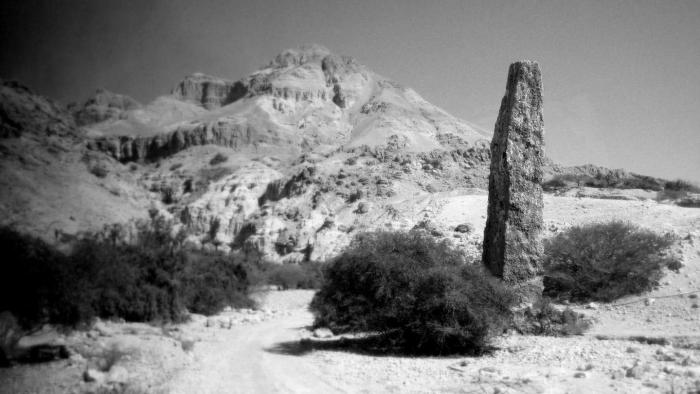
7:12 Then Samuel took a stone and set it up [as a commemoration and reminder to future generations; a tribute to God apart from whom victory is inconceivable] between Mizpah and Shen. He named it Ebenezer [means “stone of help” (cf. Gen. 49:24; Ps. 46:1)], saying, “Thus far has the LORD helped us.”

7:13 So the Philistines were subdued and did not invade Israelite territory again [for the remainder of Samuel’s lifetime].

7:14 Hebrews regained territory previously lost to Philistines.

7:15 Samuel was the judge over Israel the rest of his life.

1 Samuel 18

1 Samuel 18:1-4
18:1 After David had finished talking with Saul, Jonathan became [note two things that indicate that David and Jonathan enjoyed an intimate friendship] [1] one in spirit with David [their lives were bound together; what hurt the one hurt the other; “Friendship is one mind in two bodies.” (Mencius)], and he [2] loved [Heb. verb “aheb”; note: this is not a reference to homosexual desire or activity; the OT employs the word “yada” (“know”) to describe homosexual activity] him as himself.

Note: “The quality of friendship is nearly always determined by the quality of that which we have in common. We share our lives with people who share a like vision. … The deepest interest Jonathan and David shared was the well-being of God’s kingdom (see 1 Sam. 14:6; 17:47). Every link with a friend is useful, but until we are knit together by a commitment to the Lord, we are wading in the shallows of biblical friendship.” (Gary Irving, “Moody Monthly” magazine, 02.79)

18:2 From that day Saul kept David with him and did not let him return to his father’s house.

18:3 And Jonathan made [cut] a covenant [terms of covenant not recorded here; terms apparently included pledge of mutual loyalty and friendship (cf. 20:14-17,42)] with David because he loved him as himself.

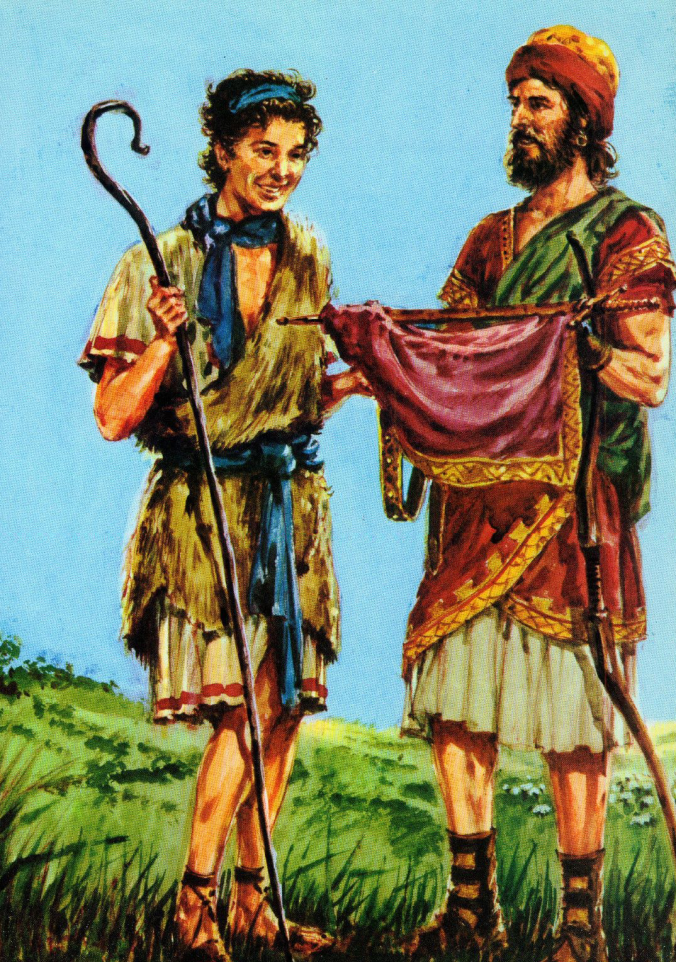
18:4 Jonathan took off the robe [a symbol of the Israelite kingdom; cf. 1 Sam. 15:27-28; a symbol of Jonathan’s right to the throne] he was wearing and gave [an expression/indication of Jonathan’s great love for David; a recognition of David’s worth; “Friendship without self-interest is one of the rare and beautiful things of life.” (James F. Byrnes)] it to David, along with [Jonathan gave his all to David] his tunic, and even his sword, his bow and his belt [note that earlier David had refused to receive similar items from Saul (cf. 1 Sam. 17:38-39)].

Note: Dale Carnegie said, “You can make more friends in two months by becoming really interested in other people, than you can in two years by trying to get other people interested in you.”

1 Samuel 18:8-9
18:8 Saul was very angry [unjustified anger; Saul should have been grateful for David’s military victories against the Philistines]; this refrain galled him [literally, “the words were evil in his eyes”]. “They have credited David with tens of thousands [hyperbole for a large number],” he thought, “but me with only thousands. What more can he get but the kingdom [saw David as a threat or a liability rather than as an asset]?”

18:9 And from that time on [marks beginning of Saul’s active opposition against David; perhaps Saul recalled Samuel’s words that God had rejected him as king and would give the kingdom to someone better (cf. 1 Sam. 13:13-14; 15:23,26,28)] Saul kept a jealous eye [looked at David differently than before] on David.

1 Samuel 19

19:1 Saul told [Saul’s instructions meant to drive a wedge between Jonathan and David] his son Jonathan and all the attendants to kill [and thus eliminate him as a rival to the throne] David. But Jonathan was very fond of David

19:2 and warned [indication of Jonathan’s love and loyalty to David; communication is essential in friendship] him, “My father Saul is looking for a chance to kill you. Be on your guard [cf. 1 Pet. 5:8] tomorrow morning; go into hiding and stay there.

Note: Jonathan was concerned about David’s welfare.

19:3 I will go out and stand with my father in the field where you are. I’ll speak to him about you [Jonathan was David’s advocate] and will tell you what I find out.”

19:4 Jonathan spoke well of David to Saul his father and said to him, “Let not the king do wrong to his servant David; he has not wronged you, and what he has done has benefited you greatly.

Note: Jonathan was concerned about David’s reputation.

19:5 He took his life in his hands when he killed the Philistine. The LORD won a great victory for all Israel, and you saw it and were glad. Why then would you do wrong to an innocent man like David by killing him for no reason? [cf. 1 Sam. 20:32]

19:6 Saul listened [Jonathan’s words (temporarily) brought Saul back to his senses] to Jonathan and took this oath: “As surely as the LORD lives, David will not be put to death. [Saul quickly and conveniently forgot his promise as per v. 11]

19:7 So Jonathan called David and told him the whole conversation. He brought him to Saul, and David was with Saul as before.

1 Samuel 19:11-12
19:11 Saul [jealousy progressed to murderous plot] sent men [assassins] to David’s house to watch it and to kill him in the morning. But Michal [Saul’s daughter found out about the plot], David’s wife [chose to be loyal to her husband], warned him, “If you don’t run for your life tonight, tomorrow you’ll be killed.”

19:12 So Michal let David down through a window [apparently, David’s house built into the city wall; cf. Acts 9:23-25], and he fled and escaped.

1 Samuel 19:18
19:18 When David had fled and made his escape, he went to Samuel at Ramah [birthplace of Samuel (cf. 1:19); David found shelter with Samuel] and told him [David received comfort and counsel from Samuel, a man he could trust] all that Saul had done to him. Then he and Samuel went to Naioth [located near Ramah; probably a compound of dwellings/community of prophets (like a monastery or convent)] and stayed there.

1 Samuel 20

1 Samuel 20:4
20:4 Jonathan said to David, “Whatever [indicates Jonathan’s great love for David] you want me to do, I’ll do for you.”

1 Samuel 20:12-14
20:12 Then Jonathan [cf. 1 Sam. 18:1-4 re: friendship between David and Jonathan] said to David: “By the LORD, the God of Israel [Jonathan made a pledge], I will surely sound out [assess the situation] my father by this time the day after tomorrow! If he is favorably disposed toward you, will I not send you word and let you know?

20:13 But if my father is inclined to harm you, may the LORD deal with me [Jonathan made another pledge], be it ever so severely, if I do not let you know [true friends never deceive one another] and send you away safely. May the LORD be with you as he has been with my father.

20:14 But show me [Jonathan] unfailing kindness [a love that remains faithful] like that of the LORD as long as I live, so that I may not be killed [common practice for new king to kill all male members of old dynasty],

1 Samuel 20:17
20:17 And Jonathan had David reaffirm his oath [his side of the agreement] out of love for him, because he loved him as he loved himself [cf. Lev. 19:18b; Matt. 22:398; Jn. 13:34b].

1 Samuel 20:31-33
20:31 [Saul appealed to Jonathan’s ambition] As long as the son of Jesse lives on this earth, neither you [Jonathan] nor your kingdom will be established. Now send and bring him to me, for he must die!”

20:32 “Why should he be put to death? What has he done?” Jonathan asked [with courage and conviction; cf. 1 Sam. 19:4 re: Jonathan’s earlier words to Saul] his father.

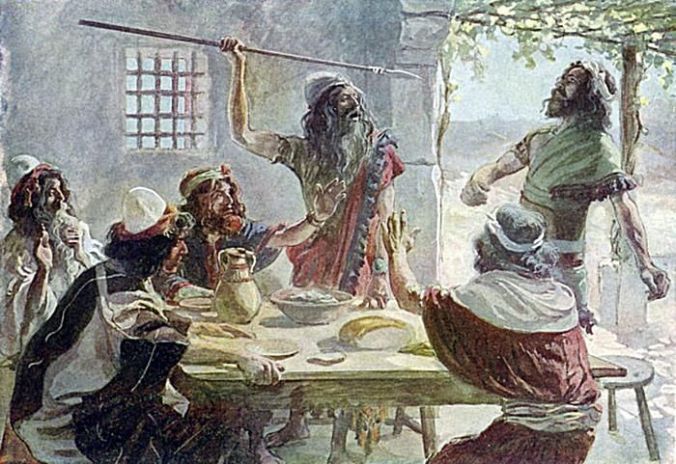
20:33 But Saul hurled his spear at him [his own son] to kill him. Then Jonathan knew that his father intended to kill David.

1 Samuel 20:42
20:42 Jonathan said to David, “Go in peace, for we [emphasizes mutual nature of their friendship] have sworn [their oath would keep them united even through physical separation] friendship [cf. 1 Sam. 20:13-17] with each other in the name of the LORD, saying, ‘The LORD is witness between you and me, and between your descendants and my descendants [cf. 2 Sam. 9:3-13 re: David’s care of Mephibosheth, Jonathan’s son] forever.’” Then David left, and Jonathan went back to the town [they would only briefly meet again once more (cf. 1 Sam. 23:16-18)].

1 Samuel 24

1 Samuel 24:4-6 [Read also Psalms 57 and 142]
24:3 Saul went in to cave (where David and his men were hiding) to relieve himself.

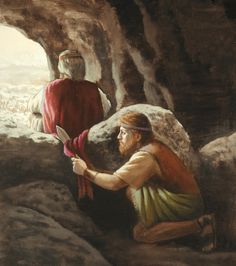
24:4 The men said, “This is the day the LORD spoke of when he said to you, ‘I will give your enemy [Saul obviously in a vulnerable position] into your hands for you to deal with as you wish.’” Then David crept up unnoticed [quietly] and cut off a corner of Saul’s robe [evidence that he could have cut off Saul’s life but chose not to do so].

24:5 Afterward, David was conscience-stricken [indicates respect David had for Saul as “the anointed of the Lord” (v. 6)] for having cut off a corner of his robe.

24:6 He said to his men, “The LORD forbid that I should do such a thing to my master, the LORD’S anointed, or lift my hand against him [cf. 1 Sam. 24:12-13 re: David’s decision not to raise his hand against Saul]; for he is the anointed of the LORD [David trusted God to deal with Saul].”

24:8-15 David told Saul he could have killed him in the cave.

24:16-22 Saul acknowledged that David would one day be king.

1 Samuel 25

• Nabal’s Needless Affront — 1 Samuel 25:1-11
• David’s Planned Vengeance — 1 Samuel 25:12-13
• Abigail’s Gracious Intercession — 1 Samuel 25:14-31
• David’s Grateful Response — 1 Samuel 25:32-35
• The Lord’s Vengeance — 1 Samuel 25:36-38
• David and Abigail’s Marriage — 1 Samuel 25:39-44

1 Samuel 25:21-35
25:21 David had just said, “It’s been useless-all my watching [David and his men had provided security for Nabal’s shepherds and flocks] over this fellow’s [Nabal, a wealthy sheep owner; described as “surly and mean” (25:3)] property in the desert so that nothing of his was missing. He has paid me back evil [implies betrayal or cruelty; Nabal did this by refusing to help David and his men (25:5-12)] for good.

25:22 May God deal with David, be it ever so severely, if by morning I leave alive one male [included Nabal’s sons, thus insuring that no one would survive to avenge Nabal’s death] of all who belong to him!”

25:23 When Abigail [Nabal’s wife; she defused a dangerous situation] saw David [Abigail appealed to David rather than to her foolish husband], she quickly got off her donkey and bowed down [posture indicated deep respect] before David with her face to the ground [posture revealed her humility].

25:24-25 Abigail asked David to listen to her / acknowledged Nabal’s foolishness.

25:26 “Now since the LORD [Abigail’s arrival providential; helped David focus on God’s will] has kept you, my master [demonstrated attitude of submission], from bloodshed and from avenging yourself with your own hands, as surely as the LORD lives and as you live, may your enemies and all who intend to harm my master be like [as foolish as; suffer a similar fate as] Nabal [name means “fool” or “folly” (25:25)].

25:27 And let this gift [cf. 25:18-19; reminder that there is a cost in restoring relationships], which your servant has brought to my master [Nabal referred to David as a servant (25:10); Abigail called David master], be given [David and his men deserved this assistance from Nabal for the service they had rendered him (25:4-8)] to the men who follow you.

25:28 Please forgive your servant’s [refers to Abigail, thus indicating that she accepted blame for her husband’s foolish behavior] offense, for the LORD will certainly make a lasting dynasty for my master [the first to prophesy this; cf. 2 Sam. 7:16], because [reason why the Lord would establish David’s dynasty or house] he fights the LORD’S [rather than his own personal battles] battles. Let no wrongdoing be found in you as long as you live.

25:29 Even though someone [Saul; Philistines; others] is pursuing you to take your life, the life of my master will be bound securely in the bundle [people often kept most precious possessions in a bundle; a secure place] of the living by the LORD your God. But [by contrast] the lives of your enemies he will hurl away as [a stone] from the pocket of a sling [cf. 25:37-38 – Nabal “became like a stone”; cf. Prov. 20:22].

25:30 When the LORD has done for my master every good thing [Abigail recognized that God had great things in store for David] he promised concerning him and has appointed him leader over Israel,

25:31 my master will not have on his conscience the staggering burden of needless bloodshed [something he would later regret] or of having avenged himself. And when the LORD has brought my master success [Abigail affirmed her belief in God’s plan for David’s life], remember [has idea of acting on an earlier promise] your servant [Abigail and her family].”

25:32 David said to Abigail, “Praise be to the LORD, the God of Israel, who has sent you today to meet me [David recognized how the Lord had used Abigail’s words and actions; we must learn to discern God at work through others; cf. 25:26].

25:33 May you be blessed for your good judgment [Abigail showed discretion, admirable quality in a woman (Prov. 11:22)] and for keeping me from bloodshed this day and from avenging myself with my own hands [cf. Rom. 12:19 re: vengeance].

25:34 Otherwise, as surely as the LORD, the God of Israel, lives, who has kept me from harming you, if [indicates what might have happened if Abigail had failed to go to David] you had not come quickly [and courageously] to meet me, not one male belonging to Nabal would have been left alive by daybreak.”

25:35 Then David accepted from her hand what she had brought [25:18] him and said, “Go home in peace [without fear]. I have heard your words and granted your request.” [God’s judgment overtook Nabal within days of this encounter]