Jonah 2

Jonah’s prayer as recorded in this chapter is a prayer of thanksgiving after his deliverance.

2:1 From inside the fish [“no place is amiss for prayer”] Jonah prayed [first mention of Jonah praying; affliction and crisis should lead men to pray] to the LORD his God [the God from whom he had tried to escape].

2:2 He said: “In my distress [a word with the root idea of “restrict” — a tight spot; God redemptively used “distress” to get Jonah back in line] I called to the LORD, and He answered me. From the depths [gates] of the grave [sheol; the place of those who are dead] I called for help [compare language to Ps. 130:1-2], and you listened [while Jonah had not listened to God, God graciously listened to Jonah] to my cry.

2:3 [a confession of God’s sovereignty] You [Jonah recognized that God (through the instrumentality of the sailors) had cast him into the deep; Jonah knew he was being fairly disciplined by God because of his sin] hurled me into the deep, into the very heart of [in the depths of trouble] the seas, and the currents swirled about me; all your [God’s] waves and breakers [God’s instruments; see also Ps. 42:7] swept over me.

2:4 I [Jonah came to his senses like the prodigal son in Luke 15:17] said, ‘I have been banished [outcast] from your sight [felt the intense loneliness of his folly]; yet I will look again toward your holy [heavenly] temple [rather than temple in Jerusalem].’

2:5 The engulfing waters threatened me [sin always puts people in danger], the deep surrounded me; seaweed was wrapped around my head [Jonah was in real danger of death by drowning].

2:6 To the roots [depths; the point of no return] of the mountains I sank down; the earth beneath barred me in forever [the place where “the earth with its bars” incarcerates men in a watery grave]. But you [Jonah acknowledged that his deliverance was from God] brought my life up from the pit [Jonah felt like he was in Sheol, the place of the dead], O LORD my God.

2:7 [this verse is a parallel to verse 2] “When my life was ebbing away, I remembered [remembering what God has done in the past can give us hope in the present] you, LORD [Jonah’s circumstances caused him to focus on God], and my prayer [circumstances caused Jonah to pray to the Lord] rose to you [God heard Jonah’s prayer], to your holy temple [either refers to temple in Jerusalem or is a description of restoration to God’s favor].

2:8 “Those who cling to [reverence and seek the help of] worthless [empty; impotent] idols [cf. Jonah 1:5] forfeit the grace [there is no salvation or help in idols] that could be theirs.

2:9 [Jonah’s repentance led him to a recommitment to God’s call] But I [Jonah drew a contrast between himself and the idolators mentioned in verse 8], with a song of thanksgiving [prayer/psalm of deliverance from a watery grave], will sacrifice [Jonah’s repentance led to a recommitment to obedient service] to you. What I [voluntarily] have vowed [deliverance motivated Jonah to make a vow to the Lord, perhaps to go to Nineveh] I will make good [see Ecc. 5:4-5]. Salvation comes from [belongs to] the LORD.”

2:10 And [after Jonah’s repentance] the LORD commanded the fish, and it vomited Jonah onto dry land [Jonah had run from God in rebellion and returned in repentance, ready to be used in service to God].

Jonah 1

Outline of Jonah
Jonah 1 — Jonah ran away from God.
Jonah 2 — Jonah ran to God.
Jonah 3 — Jonah ran with God.
Jonah 4 — Jonah ran against God.

1:1 The word of the LORD [God initiated the process of communication] came to [when God speaks we should listen carefully and prayerfully] Jonah son of Amittai:

Note: Jonah lived in the northern kingdom of Israel during reign of Jeroboam II (2 Kings 14:23-29).

1:2 “Go [imperative; urgent/authoritative command; call to immediate action; not optional] to the great city of Nineveh [Assyrian city great in wealth, power, and dominion] and preach [proclaim God’s message of judgment] against it, because its wickedness [stench of their sin] has come up before me.”

Note: In a sense, the Ninevites had “sinned unto high heaven.” The Hebrew text reads, “for it has come upwards, their evil, to My face.”

1:3 But Jonah ran away from the LORD and headed for Tarshish [Phoenician city in southern Spain; “for Tarshish” possibly means “to the farthest west” or “to the end of the world”]. He went down [direction people go when running from God] to Joppa [city on the coast; present day Tel Aviv], where he found a ship bound for that port. After paying the fare [those running from God always pay for it; running from God is a costly endeavor; sinners always pay their fare], he went aboard and sailed for Tarshish [most distant port] to flee [as far away as possible] from the [presence/face of] LORD.

1:4 Then the LORD sent [Hebrew (causative voice): God responsible for the storm] a great wind [used by God to accomplish His purpose] on the sea, and such a violent [furious] storm arose that the ship threatened to break up.

Note: See Psalm 119:91b; 104:4; 135:7.

1:5 All the sailors were afraid and each cried out [prayer] to his own god [the god of his country in hope that the offended deity could be petitioned for mercy]. And they threw [practical action: sailors did what they could to help themselves] the cargo into the sea to lighten the ship. But Jonah had gone below deck, where he lay down and fell into a deep sleep [deep and heavy sleep; mental and emotional exhaustion].

Note: Someone has said, “We should never sleep in self-security when men are perishing around us.” Sadly, God’s representative was asleep while others cried out to their (false and impotent) gods for help. This is a picture of many believers and churches today — asleep with the truth, unaware of the dangers others are facing, and characterized by no visible sense of urgency.

1:6 The captain [a heathen] went to him [God’s prophet] and said, “How can you sleep? [amazed anyone could sleep through a life-threatening storm] Get up [sad when the world must summon us out of our indifference] and call on your god! Maybe he will take notice of us, and we will not perish.”

1:7 Then the sailors [fearing for their lives] said to each other, “Come, let us cast lots [probably inscribed stones that were placed in a vessel or in the folds of a garment and then either drawn out or cast forth] to find out who is responsible for this calamity.” They cast lots and the lot fell on Jonah [Numbers 32:23 declares, “be sure your sin will find you out.”].

Note: Was the casting of lots reliable? Proverbs 16:33 states, “The lot is cast into the lap, but its every decision is from the Lord.” See Joshua 7:14 and Acts 1:26 for examples. Note: This method of selection was not repeated by the apostles after the descent of the Holy Spirit.

1:8 So they asked him [test validity of the lot by a personal confession or rejection], “Tell us [unwilling to condemn Jonah without giving him the opportunity to defend himself (a spirit Jonah was unwilling to show the Ninevites)], who is responsible for making all this trouble for us? What do you do? Where do you come from? What is your country? From what people are you?”

1:9 He answered, “I am a Hebrew [Israelites known to foreigners by this term; Jews referred to themselves as “the sons of Israel”] and I worship the LORD, the God of heaven, who made the sea and the land.”

1:10 This terrified [Hebrew text: “feared a great fear”] them and they asked, “What have you done? [first feared the storm, now feared the Lord behind the storm]” (They knew [recognized their plight was related to Jonah’s disobedience] he was running away from the LORD, because he had already told them so.)

1:11 The sea was getting rougher and rougher. So they asked him, “What should we do to you [fair question because the matter was between Jonah and his God] to make the sea calm down for us?”

1:12 “Pick me up and throw me into the sea,” he replied [some feel Jonah’s response was noble, others feel it indicates his preference to die rather than preach to the Ninevites.], “and it will become calm. I know that it is my fault [acknowledged his guilt] that this great storm has come upon you.”

1:13 Instead [sailors made every effort to save Jonah from death and themselves from the storm], the men did their best to row back to land. But they could not, for the sea grew even wilder than before.

1:14 Then they cried to the LORD, “O LORD, please do not let us die for taking this man’s life. Do not hold us accountable [do not consider action willful murder] for killing an innocent man, for you, O LORD, have done as you pleased.”

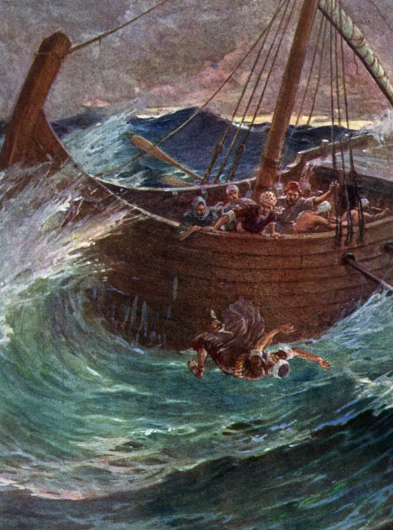
1:15 Then they took Jonah and threw him overboard [helped carry out Lord’s will so other heathen might receive God’s Word], and the raging sea grew calm [perhaps as quickly as it had started its raging].

1:16 At this the men greatly feared [reverenced and worshiped] the LORD, and they offered a sacrifice to the LORD and made vows to him.

Note: Verse 16 is the last verse of the first chapter in the Hebrew text.

1:17 But the LORD [once again we see divine activity] provided [appointed, ordained, or assigned to be at the right place and time to swallow Jonah; reminder that God is in control] a great fish [Psalm 119:91b, “All things are Thy servants” — a reminder that God can use anything He desires to accomplish His will] to swallow Jonah [rescued or delivered him from drowning while serving a corrective purpose in his life], and Jonah was inside [miracle is not that Jonah was swallowed by fish, but that he survived inside the fish] the fish [this detention gave Jonah time to reflect on his rebellious behavior] three days and three nights [speaks much about the sustaining power of God].

Note: We should understand that Jonah’s unusual experience presented no problem of faith in the Jewish community. As one scholar stated, “If one’s God is great enough, the miraculous elements are not disturbing, even to the modern mind.”

Daniel 7

7:1 [this chapter marks a division between historical narratives and prophetic visions] In the first year [553 BC] of Belshazzar king of Babylon [Daniel had these visions before Belshazzar saw the writing on the palace wall (5:24-31)], Daniel [had been in captivity since 605 BC; was about sixty-seven years old at this time] had a dream, and visions passed through his mind as he was lying on his bed. He wrote down the substance of his dream.

7:2 Daniel said: “In my vision at night I looked [cf. 7:9,13], and there before me were the four [number represents the four points of the compass; implies that devastation created by winds affected entire world] winds [Heb. word may also be translated “spirits” (thereby referring to angels of judgment; c. Rev. 7:1-3; 9:13-19)] of heaven churning [tossed about by decisions and actions of evil rulers] up the great sea [a metaphor for humanity].

Note: Characteristics of Apocalyptic literature.
• the revelation is given by God
• the revelation refers to future events
• written during times of persecution or crisis
• contains a great deal of symbolism
• major message is the ultimate triumph of God’s kingdom

7:3 Four great beasts [traditionally interpreted as the kingdoms of Babylon, Medo-Persia, Greece, Rome], each different from the others [yet each one was powerful, fierce, and cruel; each more ruthless than its predecessor], came up out of the sea [humanity; the nations and peoples of the world].

7:4 [1–Babylon] “The first was like a lion [a common symbol of royal power; cf. 1 Kings 10:20; 2 Chron. 9:19], and it had the wings of an eagle [cf. Jer. 4:7; Ezek. 17:3 re: lion and eagle as symbols of Babylon]. I watched until its wings were torn off and it was lifted from the ground so that it stood on two feet like a man, and the heart of a man was given to it.

7:5 [2–Medo-Persia] “And there before me was a second beast, which looked like a bear [a very strong animal]. It was raised up on one of its sides [perhaps an indication that the union between the Persians and the Medes was not an equal one], and it had three ribs in its mouth between its teeth. It was told, ‘Get up and eat your fill of flesh!’

7:6 [3–Greece] “After that, I looked, and there before me was another beast, one that looked like a leopard [a swift and feared animal of prey]. And on its back it had four wings [these would make the leopard swifter; cf. swiftness with which Alexander the Great conquered much of civilized world in his day] like those of a bird. This beast had four heads, and it was given authority to rule.

7:7 [4–Rome] “After that, in my vision at night I looked, and there before me was a fourth beast [Rome]—terrifying and frightening and very powerful. It had large iron teeth; it crushed and devoured its victims and trampled underfoot whatever was left. It was different from all the former beasts, and it had ten [number ten probably symbolized completeness] horns [typically represented power of kings or kingdoms in apocalyptic visions; represented ten kings who would rise in the kingdom (cf. 7:24)].

7:8 “While I was thinking about the horns, there before me was another horn, a little one [represented a king who would violently overthrow three of the kings; traditionally understood to represent the Antichrist], which came up among them; and three of the first horns were uprooted before it. This horn had eyes [indicated the intelligence and cleverness of the king] like the eyes of a man and a mouth that spoke boastfully [a characteristic of those who oppose God].

7:9 “As I looked [cf. 7:2,13], “thrones were set in place, and the Ancient of Days [title designates the sovereign, eternal God; this phrase occurs only in this chapter] took his seat [indicates judgment was about to begin]. His clothing [cf. Isa. 6:1 re: majestic robe] was as white as snow [emphasizes purity and holiness]; the hair of his head was white like wool [stresses the Lord’s eternal nature and holiness]. His throne was flaming with fire [emphasized the wrath of God’s judgment], and its wheels [cf. Ezek. 10:18-19] were all ablaze.

7:10 A river of fire was flowing, coming out from before him [describes God’s judgment going forth against the horn and the beast and all who oppose Him]. Thousands upon thousands attended him; ten thousand times ten thousand [these were the largest numbers people in the ancient world could imagine] stood before him [cf. Rev. 5:11-12; 7:9-10]. The court was seated, and the books [God keeps a records of every person’s thoughts, words, and deeds; these books recorded what the king and others rulers had done] were opened [the time of judgment and accountability had come].

7:11 “Then I continued to watch because of the boastful words [words spoken against God and His purpose] the horn [the Antichrist; ancient kings often thought themselves equal to the gods] was speaking. I kept looking until the beast was slain and its body destroyed and thrown into the blazing fire [a typical way of referring to divine punishment; cf. Rev. 19:20].

7:12 (The other beasts had been stripped of their authority [when they were conquered by the succeeding empire], but were allowed to live for a period of time.)

7:13 “In my vision at night I looked [cf. 7:2,9], and there before me was one like a son of man [Jesus commonly used this title to refer to Himself (Mk. 10:45; Jn. 3:13-14)], coming with the clouds [cf. Matt. 24:29-31; 1 Thess. 4:16-17; Jesus’ return will be visible to everyone] of heaven [Jesus quoted this verse at His trial before the high priest (Matt. 26:64) thus identifying Himself as the Messiah]. He approached the Ancient of Days and was led into his presence.

7:14 He was given authority, glory and sovereign power [kingly rule]; all peoples, nations and men of every language [everyone everywhere] worshiped [served] him. His dominion is an everlasting dominion [as opposed to the temporary dominions of earthly rulers] that will not pass away, and his kingdom is one that will never be destroyed.

7:15 “I, Daniel, was troubled in spirit, and the visions that passed through my mind disturbed me.

7:16 I approached one of those standing there and asked him the true meaning of all this. 
  “So he told me and gave me the interpretation of these things:

7:17 ‘The four great beasts are four kingdoms that will rise from the earth.

7:18 But the saints of the Most High will receive the kingdom and will possess it forever—yes, for ever and ever.’

7:19 “Then I wanted to know the true meaning of the fourth beast, which was different from all the others and most terrifying, with its iron teeth and bronze claws—the beast that crushed and devoured its victims and trampled underfoot whatever was left.

7:20 I also wanted to know about the ten horns on its head and about the other horn that came up, before which three of them fell—the horn that looked more imposing than the others and that had eyes and a mouth that spoke boastfully.

7:21 As I watched, this horn was waging war against the saints and defeating them,

7:22 until the Ancient of Days came and pronounced judgment in favor of the saints of the Most High, and the time came when they possessed the kingdom.

7:23 “He gave me this explanation: ‘The fourth beast is a fourth kingdom that will appear on earth. It will be different from all the other kingdoms and will devour the whole earth, trampling it down and crushing it.

7:24 The ten horns are ten kings who will come from this kingdom. After them another king will arise, different from the earlier ones; he will subdue three kings.

7:25 He will speak against the Most High and oppress his saints and try to change the set times and the laws. The saints will be handed over to him for a time, times and half a time.

7:26 ” ‘But the court will sit, and his power will be taken away and completely destroyed forever.

7:27 Then the sovereignty, power and greatness of the kingdoms under the whole heaven will be handed over to the saints, the people of the Most High. His kingdom will be an everlasting kingdom, and all rulers will worship and obey him.’

7:28 “This is the end of the matter. I, Daniel, was deeply troubled by my thoughts, and my face turned pale, but I kept the matter to myself.”

Daniel 9

9:1 In the first year [538 BC] of Darius [possibly another name/title for Cyrus] son of Xerxes [not to be confused with the king in Esth. 1:1] (a Mede by descent), who was made [indicates that Darius came to the throne by divine appointment and not by chance] ruler over the Babylonian kingdom–

9:2 in the first year of his reign, I, Daniel, understood from the Scriptures [literally “writings” (could be rendered “rolls” or “scrolls”); words of Jeremiah recorded on a scroll (cf. Jer. 36:1-4)], according to the word of the LORD given to Jeremiah [Jer. 25:11-12 promised the defeat of the Babylonians after 70 years; Jer. 29:10 promised exiles that God would deliver them after 70 years] the prophet, that the desolation of Jerusalem would last seventy years [Daniel realized the end of the captivity could be imminent].

9:3 So [as a result of his time in personal Bible study] I turned [literally “and I gave my face to”] to the Lord [its use here does not designate God’s proper name (only the first letter is capitalized) but rather has the sense of “ruler” or “sovereign”; Daniel believed God controlled history] God and pleaded [literally “to seek”; Daniel prayed that God would fulfill His word concerning Jerusalem] with him in prayer and petition [supplications], in fasting [allowed him to totally concentrate on the Lord; confirmed the importance that Daniel attached to his prayer], and in sackcloth and ashes [these were used to express deep emotion and humility].

Note: Daniel served in high government positions and was, undoubtedly, a busy man. However, Daniel found time to read God’s Word and to pray. What about us?

9:4 I prayed to the LORD [printed in all capitals thus indicating the personal name of God (Yahweh), His covenant name] my [first person possessive pronoun emphasizes Daniel’s personal relationship with God] God and confessed [literally “to throw oneself down”]: “O Lord [the word for “ruler” as in v. 3], the great [word indicated the magnitude of God’s power and character; cf. Rom. 11:33 re: greatness of God] and awesome [“to fear”] God, who [note reference to God’s faithfulness…] keeps his covenant [the equivalent in the ancient world to an international treaty or a legal contract; refers to the agreement made between the Lord and Israel at Mount Sinai during time of Moses] of love [“faithfulness” or “lovingkindness” (denotes all that comes to us because we belong to God] with all who love him and obey [a way to show our love for God; cf. Jn. 14:15] his commands,

Note: When was the last time you prayed for something fervently? How can knowing that God is great help you focus your prayers on Him? How would your prayer life be different if you began your prayers by acknowledging and praising God for His greatness?

9:5 [note: underlined words emphasize the depth of the people’s sin against God] we [Daniel included himself among the guilty] have sinned [to fall short of God’s standard] and done wrong [means “to twist”]. We have been wicked [these words reveal the people’s guilt] and have rebelled; we have turned away from your commands and laws [can also mean “judgments”].

Note: Are you honest and open before God in confession of your sins or do you find it difficult to honestly acknowledge and confess your sins to God?

9:6 We [Daniel included himself among the guilty] have not listened to your servants the prophets [Jeremiah, Ezekiel, Habakkuk, Nahum, and Obadiah preached to Daniel’s generation; cf. Jer. 25:4; Matt. 23:29-32], who spoke in your name [prophets spoke by God’s authority] to [prophets spoke to people at all levels of society; note that prophets spoke to leaders…] our kings, our princes and our fathers, and [note that prophets spoke to the general population…] to all the people of the land.

9:7 “Lord, you are righteous [an attribute of His character; God always behaved and acted as He had promised Israel], but [in contrast to God’s righteousness] this day we are covered with shame [literally “shame of face”; describe a people who could not bear to look at God]—the men of Judah and people of Jerusalem and all Israel, both near and far, in all the countries where you have scattered [the penalty for unfaithfulness] us because of our [Daniel included himself among the guilty] unfaithfulness to you.

9:8 O LORD, we and our kings, our princes and our fathers are covered with shame because we [Daniel included himself among the guilty] have sinned against you [all sin is against God].

9:9 The Lord our God is merciful [compassionate] and forgiving, even though we [Daniel included himself] have rebelled [connotes defiant attitude and action] against him;

9:10 [Israel’s sin resulted from rebellion rather than ignorance…] we have not obeyed the LORD our God or kept the laws [“teachings” or “instructions”] he gave us through his servants the prophets.

9:11 All Israel has transgressed your law and turned away, refusing to obey you [literally “not listening to your voice”]. “Therefore the curses and sworn judgments written in the Law of Moses [cf. Lev. 26:33; Deut. 28:36-37], the servant of God, have been poured out on us, because we have sinned against you.

9:12 You have fulfilled the words spoken against us and against our rulers by bringing upon us great disaster. Under the whole heaven nothing has ever been done like what has been done to Jerusalem.

9:13 Just as it is written in the Law of Moses, all this disaster has come upon us, yet we have not sought the favor of the LORD our God by turning from our sins and giving attention to your truth.

9:14 The LORD did not hesitate to bring the disaster upon us, for the LORD our God is righteous [or “straightness”] in everything he does; yet we have not obeyed him.

9:15 “Now, O Lord our God, who [Bible always gives God the credit for the exodus] brought your people out of Egypt with a mighty hand and who made for yourself a name [has connotation of a good and mighty reputation] that endures to this day, we have sinned, we have done wrong.

9:16 O Lord, in keeping with all your righteous acts [possibly refers to God’s great works of righteousness on behalf of His people in the past (cf. Judg. 5:11; 1Sam. 12:7)], turn away your anger and your wrath from Jerusalem, your city, your holy hill [Mount Zion (name eventually came to designate the entire city)]. Our sins and the iniquities of our fathers have made Jerusalem and your people an object of scorn to all those around us.

9:17 “Now, our God, hear the prayers [denotes intercessory prayer] and petitions [derived from verbal root meaning “to be gracious”; reminder that prayer is on the basis of God’s grace; “prayer” and “petitions” may imply that this was not the only time Daniel prayed in this manner] of your servant [term often meant “slave”]. For your sake, O Lord, look with favor [literally “cause your face to shine upon”] on your desolate sanctuary [lay in ruins amidst Jerusalem’s ruins (cf. Jer. 52:12-13)].

9:18 Give ear [urgent plea for God to listen carefully and grant request], O God, and hear; open your eyes and see the desolation [a way of calling God to be moved with compassion and to give His full attention to the plight of His people] of the city [the entire situation: plight of city, temple, people] that bears your Name. We do not make requests of you because we are righteous [they were in fact wicked], but because of your great mercy [withholding the punishment they deserved].

9:19 O Lord, listen [listen closely]! O Lord, forgive [denotes the divine pardon and forgiveness of a sinner]! O Lord, hear and act [to restore the people to Jerusalem]! For your sake, O my God, do not delay, because your city and your people bear your Name [in OT a name represented one’s character and reputation].”

9:20 While I was speaking and praying, confessing my sin and the sin of my people Israel and making my request to the LORD my God [Daniel recognized God’s sovereignty] for his holy hill [Mount Zion (sometimes used as a designation for Jerusalem]

9:21 while I was still in prayer, Gabriel [cf. Dan. 8:15-16], the man [although an angel, Gabriel appeared in human form] I had seen in the earlier vision, came to me in swift flight about the time of the evening sacrifice [the Jews in Babylon maintained the evening (around twilight as per Num. 28:3-4) sacrifice as a time of prayer; cf. Dan. 6:10; Ezra 9:5].

9:22 He instructed me and said to me, “Daniel, I have now come to give you insight and understanding [into God’s work in human history].

9:23 As soon as you began to pray, an answer was given, which I have come to tell you, for you are highly esteemed [treasured; indicates God valued Daniel]. Therefore, consider the message and understand the vision:

9:24 “Seventy ‘sevens’ are decreed for your people and your holy city to finish transgression, to put an end to sin, to atone for wickedness, to bring in everlasting righteousness, to seal up vision and prophecy and to anoint the most holy.

9:25 “Know and understand this: From the issuing of the decree to restore and rebuild Jerusalem until the Anointed One, the ruler, comes, there will be seven ‘sevens,’ and sixty-two ‘sevens.’ It will be rebuilt with streets and a trench, but in times of trouble.

9:26 After the sixty-two ‘sevens,’ the Anointed One will be cut off and will have nothing. The people of the ruler who will come will destroy the city and the sanctuary. The end will come like a flood: War will continue until the end, and desolations have been decreed.

9:27 He will confirm a covenant with many for one ‘seven.’ In the middle of the ‘seven’ he will put an end to sacrifice and offering. And on a wing of the temple he will set up an abomination that causes desolation, until the end that is decreed is poured out on him.”

Daniel 6

6:1 It pleased Darius to appoint 120 satraps [governors (Persian officials) who ruled territories known as satrapies] to rule throughout the kingdom,

6:2 with three administrators [heads or chiefs] over them, one of whom was Daniel [now 80 years old]. The satraps were made accountable to them [to the administrators] so that the king might not suffer loss [to be defrauded; to suffer financial damage].

6:3 Now Daniel so distinguished himself among the administrators and the satraps by his exceptional qualities that the king planned to set him [to be the chief administrator] over the whole kingdom [second in power only to Darius; this appointment demonstrated the king’s high level of trust in Daniel; cf. Joseph (Gen. 41:39-40)].

6:4 At this, the administrators and the satraps [these officials had a negative reaction to the king’s plan to appoint Daniel to such a high position; likely were jealous of Daniel’s rise to power] tried to find grounds for charges against Daniel [a foreigner and not a Persian] in his conduct of government affairs, but they were unable to do so. They could find no corruption in him, because he was trustworthy [Daniel was honest in character] and neither corrupt nor negligent [attentive to performance of his duties].

6:5 Finally these men said, “We will never find any basis for charges [in regards to matters of his administration] against this man Daniel unless it has something to do with the law of his God.”

6:6 So the administrators and the satraps went as a group to the king and said: “O King Darius, live forever [this was a customary greeting; cf. Dan. 6:21]!

6:7 The royal administrators, prefects, satraps, advisers and governors have all [indicates they had arrived at a joint decision] agreed that the king should issue an edict and enforce the decree that anyone who prays to any god or man during the next thirty days [they felt this was sufficient opportunity to trap Daniel], except to you [real intent of edict was not to exalt Darius but to entrap Daniel], O king, shall be thrown into the lions’ den.

6:8 Now, O king, issue the decree and put it in writing so that it cannot be altered—in accordance with the laws of the Medes and Persians, which cannot be repealed [cf. Esth. 3:12-13; 8:11-12 where King Ahasuerus could not change decree but could issue a supplemental decree].

6:9 So King Darius put the decree in writing [this decree would put Daniel’s faith in God in direct opposition to King Darius].

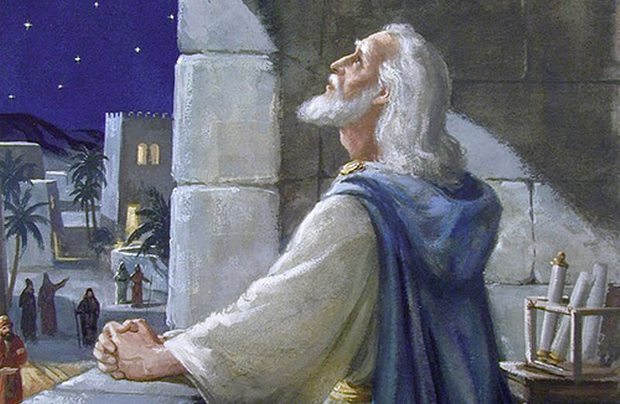
6:10 Now when Daniel learned [indicates Daniel had not been present during signing of the decree] that the decree had been published, he went home to his upstairs room where the windows opened [open windows indicate that Daniel was not trying to conceal, his actions] toward Jerusalem [the place where temple had stood until it was destroyed by Nebuchadnezzar’s armies]. Three times a day he got down on his knees and prayed, giving thanks to his God, just as he had done before [emphasizes Daniel’s consistent habit of devotion to God].

6:11 Then these men went as a group and found Daniel praying and asking God for help.

6:12 So they went to the king and spoke to him about his royal decree: “Did you not publish a decree that during the next thirty days anyone who prays to any god or man except to you, O king, would be thrown into the lions’ den?” The king answered, “The decree stands—in accordance with the laws of the Medes and Persians, which cannot be repealed.”

6:13 Then they said to the king, “Daniel, who is one of the exiles from Judah, pays no attention to you, O king, or to the decree you put in writing. He still prays three times a day.”

6:14 When the king heard this, he was greatly distressed [because Daniel had proved himself to be a trusted advisor and excellent administrator]; he was determined to rescue Daniel and made every effort until sundown to save him.

6:15 Then the men went as a group to the king and said to him, “Remember, O king, that according to the law of the Medes and Persians no decree or edict that the king issues can be changed.”

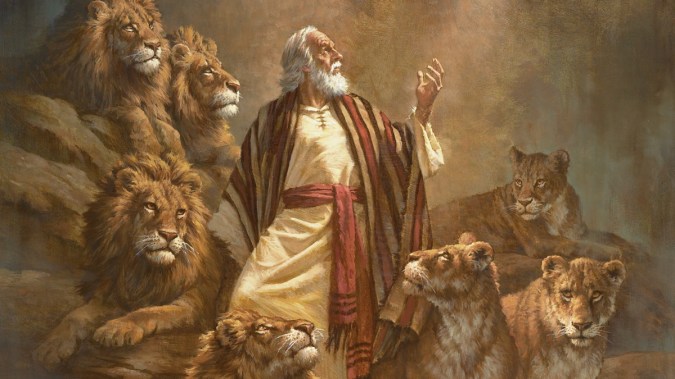
6:16 So the king gave the order, and they brought Daniel and threw him into the lions’ den [cf. 1 Pet. 2:20]. The king said to Daniel, “May your God, whom you serve continually, rescue [something that Darius could not do for Daniel] you!”

6:17 A stone was brought and placed over the mouth of the den, and the king sealed it with his own signet ring and with the rings of his nobles [an official act that signified no one had the right to rescue or release Daniel from the lion’s den], so that Daniel’s situation might not be changed.

6:18 Then the king returned to his palace and spent the night without eating and without any entertainment being brought to him. And he could not sleep.

6:19 At the first light of dawn, the king got up and hurried to the lions’ den.

6:20 When he came near the den, he called to Daniel in an anguished voice, “Daniel, servant of the living God, has your God, whom you serve continually, been able to rescue you from the lions?”

6:21 Daniel [instead of the lions] answered, “O king, live forever [emphasized Daniel’s continued loyalty to the king, in spite of his foolish decree]!

6:22 [Daniel’s personal testimony of divine deliverance and vindication…] My God [has power to intervene in desperate situations] sent his angel, and he shut the mouths of the lions. They have not hurt me [note: God does not deliver every faithful person from harm or death (cf. Heb. 11:35b-40)], because I was found innocent in his sight [Daniel’s accusers had judged him guilty, but God found him innocent]. Nor have I ever done any wrong [just as lions had not hurt Daniel, Daniel had not hurt the king] before you, O king.”

6:23 The king was overjoyed and gave orders to lift Daniel out of the den. And when Daniel was lifted from the den, no wound was found on him, because he had trusted in his God.

6:24 At the king’s command, the men who had falsely accused Daniel were brought in and thrown into the lions’ den, along with their wives and children [the king, and not Daniel, retaliated against those who had maliciously accused Daniel]. And before they reached the floor of the den, the lions overpowered them and crushed all their bones.

6:25 Then King Darius wrote to all the peoples, nations and men of every language throughout the land: “May you prosper greatly!

6:26 “I issue a decree that in every part of my kingdom people must fear and reverence the God of Daniel. “For he is the living God and he endures forever; his kingdom will not be destroyed, his dominion will never end.

6:27 He rescues and he saves; he performs signs and wonders in the heavens and on the earth. He has rescued Daniel from the power of the lions.”

6:28 So Daniel prospered during the reign of Darius and the reign of Cyrus the Persian.

Daniel 3

3:1 King Nebuchadnezzar [king of Babylon] made an image [text does not reveal whether image was of the king or of a god (such as Babylon’s principal god Marduk); 3:28 seems to indicate image was of a god] of gold, ninety feet high and nine feet wide, and set it up on the plain [such a location would make the statue visible from a great distance] of Dura [likely was an area south of the city of Babylon] in the province of Babylon.

3:2 He then summoned the satraps [a Persian title meaning “protector of the realm” and referred to a ruler of a large area of the empire], prefects [a high-ranking official directly responsible to the satraps], governors [administrators of smaller regions or provinces], advisers [probably were counselors], treasurers [handled finances across the empire], judges [dealt with the law], magistrates [responsible for enforcing local laws] and all the other provincial officials to come to the dedication of the image he had set up.

3:3 So the satraps, prefects, governors, advisers, treasurers, judges, magistrates and all the other provincial officials assembled for the dedication of the image that King Nebuchadnezzar had set up, and they stood before it.

3:4 Then the herald [the official spokesman for public functions] loudly proclaimed, “This is what you are commanded to do, O peoples [included Greeks, Phoenicians, Jews, Arabs, Assyrians, Babylonians], nations and men of every language [official language spoken was Aramaic]:

3:5 As soon as you hear the sound of the [wind instruments…] horn, flute, [stringed instruments…] zither, lyre, harp, pipes [probably similar to a bagpipe] and all kinds of music [other instruments not specifically mentioned], you must fall down and worship the image of gold that King Nebuchadnezzar has set up.

3:6 Whoever does not fall down and worship will [note consequences of disregarding king’s orders] immediately be thrown into a blazing furnace [probably used to smelt ore for statue or for making bricks].”

3:7 Therefore, as soon as they heard the sound of the horn, flute, zither, lyre, harp and all kinds of music, all the peoples, nations and men of every language fell down and worshiped the image of gold that King Nebuchadnezzar had set up.

3:8 At this time some astrologers came forward and denounced the Jews.

3:9 They said to King Nebuchadnezzar, “O king, live forever!

3:10 You have issued a decree, O king, that everyone who hears the sound of the horn, flute, zither, lyre, harp, pipes and all kinds of music must fall down and worship the image of gold,

3:11 and that whoever does not fall down and worship will be thrown into a blazing furnace.

3:12 But there are some Jews whom you have set over the affairs of the province of Babylon—Shadrach, Meshach and Abednego—[1] who pay no attention to you, O king. They [2] neither serve your gods [3] nor worship the image of gold you have set up.”

3:13 Furious with rage [extreme anger], Nebuchadnezzar summoned Shadrach [pagan name meaning “command of Aku,” the moon god; Heb. Name was Hananiah (cf. Dan. 1:6) which means “Yahweh is gracious”], Meshach [pagan name meaning “who is what Aku is?” (a slander against his Heb. Name); Heb. Name was Mishael (cf. Dan. 1:6) which means “Who is like God?”] and Abednego [pagan name meaning “servant of Nebo,” the second greatest deity in the Babylonian pantheon; Heb. name was Azariah (cf. Dan. 1:6) which means “Yahweh will help”]. So these men were brought before the king,

3:14 and Nebuchadnezzar said to them [the king wanted to hear from these men whether they had refused to worship the statue], “Is it true, Shadrach, Meshach and Abednego, that you do not serve my gods or worship the image of gold I have set up?

3:15 Now [the king gave them a second chance to comply] when you hear the sound of the horn, flute, zither, lyre, harp, pipes and all kinds of music, if you are ready to fall down and worship the image I made, very good. But if you do not worship it, you will be thrown immediately into a blazing furnace. Then what god will be able to rescue you from my hand [the king could conceive of no power greater than his own or that of his gods]?”

3:16 Shadrach, Meshach and Abednego replied to the king, “O Nebuchadnezzar, we do not need to defend ourselves before you in this matter [obeying the king’s command would mean violating two of the Ten Commandments].

3:17 If we are thrown into the blazing furnace, the God we serve is able [if He pleases] to save us from it, and he will rescue us from your hand, O king.

3:18 But even if he does not [these men did not dictate to God what to do], we want you to know, O king, that we will not [the three men chose to die rather than deny the living God] serve your gods or worship the image of gold you have set up.”

3:19 Then Nebuchadnezzar was furious with Shadrach, Meshach and Abednego, and his attitude toward them changed. He ordered the furnace heated seven times hotter than usual

3:20 and commanded some of the strongest soldiers in his army to tie up Shadrach, Meshach and Abednego and throw them into the blazing furnace.

3:21 So these men [Shadrach, Meshach and Abednego], wearing their robes, trousers, turbans and other clothes, were bound and thrown into the blazing furnace [which the king ordered “heated seven times hotter than usual” (3:19); cf. Isa. 43:2].

3:22 The king’s command was so urgent and the furnace so hot that the flames of the fire killed the soldiers who took up Shadrach, Meshach and Abednego,

3:23 and these three men, firmly tied, fell [from the top into the furnace (shaped like an old-fashioned milk jug; ore added from the top and wood inserted through opening in the bottom)] into the blazing furnace.

3:24 Then King Nebuchadnezzar leaped to his feet in amazement [astonished; dazed; dismayed] and asked his advisers, “Weren’t there three men that we tied up and threw into the fire?” They replied, “Certainly, O king.”

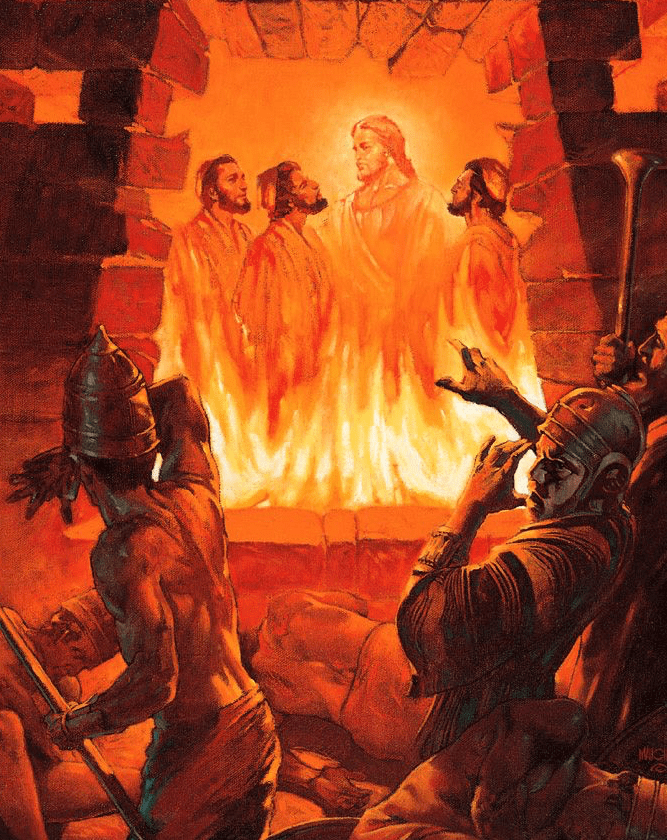
3:25 He said, “Look! I see four men walking around in the fire, unbound and unharmed, and the fourth looks like a son of the gods [not another human being but a god-like individual; some believe this was an angel; others believe this was a Christophany (an OT appearance of God’s Son in human form)].”

3:26 Nebuchadnezzar then approached the opening of the blazing furnace and shouted, “Shadrach, Meshach and Abednego, servants of the Most High God, come out! Come here!” So Shadrach, Meshach and Abednego came out of the fire,

3:27 and the satraps, prefects, governors and royal advisers crowded around them. They saw [these officials were witnesses of their condition] that the fire had not harmed their bodies, nor was a hair of their heads singed; their robes were not scorched, and there was no smell of fire on them.

3:28 Then Nebuchadnezzar said, “Praise be to the God [not an expression of faith in God but perhaps an indication of the king’s willingness to add Israel’s God to his pantheon of gods] of Shadrach, Meshach and Abednego, who has sent his angel [messenger] and rescued his servants! They trusted in him and defied the king’s command and were willing to give up their lives rather than serve or worship any god except their own God.

3:29 Therefore I decree that the people of any nation or language who say anything against the God of Shadrach, Meshach and Abednego be cut into pieces and their houses be turned into piles of rubble, for no other god can save in this way.”

3:30 Then the king promoted Shadrach, Meshach and Abednego in the province of Babylon.

Daniel 4

4:1 King Nebuchadnezzar, 
To the peoples, nations and men of every language, who live in all the world: 
May you prosper greatly!

4:2 It is my pleasure to tell you about the miraculous signs and wonders that the Most High God has performed for me.

4:3 How great are his signs, 
how mighty his wonders! 
His kingdom is an eternal kingdom; 
his dominion endures from generation to generation.

4:4 I, Nebuchadnezzar, was at home in my palace, contented and prosperous.

4:5 I had a dream that made me afraid. As I was lying in my bed, the images and visions that passed through my mind terrified me.

4:6 So I commanded that all the wise men of Babylon be brought before me to interpret the dream for me.

4:7 When the magicians, enchanters, astrologers and diviners came, I told them the dream, but they could not interpret it for me.

4:8 Finally, Daniel came into my presence and I told him the dream. (He is called Belteshazzar, after the name of my god, and the spirit of the holy gods is in him.)

4:9 I said, “Belteshazzar, chief of the magicians, I know that the spirit of the holy gods is in you, and no mystery is too difficult for you. Here is my dream; interpret it for me.

4:10 These are the visions I saw while lying in my bed: I looked, and there before me stood a tree in the middle of the land. Its height was enormous.

4:11 The tree grew large and strong and its top touched the sky; it was visible to the ends of the earth.

4:12 Its leaves were beautiful, its fruit abundant, and on it was food for all. Under it the beasts of the field found shelter, and the birds of the air lived in its branches; from it every creature was fed.

4:13 “In the visions I saw while lying in my bed, I looked, and there before me was a messenger, a holy one, coming down from heaven.

4:14 He called in a loud voice: ‘Cut down the tree and trim off its branches; strip off its leaves and scatter its fruit. Let the animals flee from under it and the birds from its branches.

4:15 But let the stump and its roots, bound with iron and bronze, remain in the ground, in the grass of the field. 
”‘Let him be drenched with the dew of heaven, and let him live with the animals among the plants of the earth.

4:16 Let his mind be changed from that of a man and let him be given the mind of an animal, till seven times pass by for him.

4:17 ” ‘The decision is announced by messengers, the holy ones declare the verdict, so that the living may know that the Most High is sovereign over the kingdoms of men and gives them to anyone he wishes and sets over them the lowliest of men.’

4:18 “This is the dream that I, King Nebuchadnezzar, had. Now, Belteshazzar, tell me what it means, for none of the wise men in my kingdom can interpret it for me. But you can, because the spirit of the holy gods is in you.”

4:19 Then Daniel [name means “God is judge”] (also called Belteshazzar) [probably means “Bel (a reference to the chief Babylonian god), guard his life”] was greatly perplexed for a time, and his thoughts terrified him [dream and its interpretation had a negative focus]. So the king said, “Belteshazzar, do not let the dream or its meaning alarm you.” Belteshazzar answered, “My lord, if only the dream applied to your enemies and its meaning to your adversaries [this was a statement of loyalty]!

4:20 The tree you saw, which grew large and strong, with its top touching the sky, visible to the whole earth,

4:21 with beautiful leaves and abundant fruit, providing food for all, giving shelter to the beasts of the field, and having nesting places in its branches for the birds of the air-

4:22 you, O king, are that tree! You have become great and strong; your greatness has grown until it reaches the sky, and your dominion extends to distant parts of the earth.

4:23 “You, O king, saw a messenger, a holy one, coming down from heaven and saying, ‘Cut down the tree and destroy it, but leave the stump, bound with iron and bronze, in the grass of the field, while its roots remain in the ground. Let him be drenched with the dew of heaven; let him live like the wild animals, until seven times pass by for him.’

4:24 “This is the interpretation, O king, and this is the decree the Most High has issued against my lord the king:

4:25 You will be driven away from people and will live with the wild animals; you will eat grass like cattle and be drenched with the dew of heaven. Seven times will pass by for you until you acknowledge that the Most High is sovereign over the kingdoms of men and gives them to anyone he wishes.

4:26 The command to leave the stump of the tree with its roots means that your kingdom will be restored to you when you acknowledge that Heaven rules.

4:27 Therefore, O king, be pleased to accept my advice [Daniel lovingly advised the king to repent]: Renounce your sins by doing what is right, and your wickedness by being kind to the oppressed [the king lived lavishly at the expense of his people]. It may be that then your prosperity will continue.”

4:28 All this happened to King Nebuchadnezzar.

4:29 Twelve months later, as the king was walking on the roof of the royal palace of Babylon,

4:30 he said, “Is not this the great Babylon I have built as the royal residence, by my mighty power and for the glory of my majesty?”

4:31 The words were still on his lips when a voice came from heaven, “This is what is decreed for you, King Nebuchadnezzar: Your royal authority has been taken from you.

4:32 You will be driven away from people and will live with the wild animals; you will eat grass like cattle. Seven times will pass by for you until you acknowledge that the Most High is sovereign over the kingdoms of men and gives them to anyone he wishes.”

4:33 Immediately what had been said about Nebuchadnezzar was fulfilled. He was driven away from people and ate grass like cattle. His body was drenched with the dew of heaven until his hair grew like the feathers of an eagle and his nails like the claws of a bird.

4:34 At the end of that time, I, Nebuchadnezzar, raised my eyes toward heaven, and my sanity was restored. Then I praised the Most High; I honored and glorified him who lives forever. 
His dominion is an eternal dominion; 
his kingdom endures from generation to generation.

4:35 All the peoples of the earth 
are regarded as nothing. 
He does as he pleases 
with the powers of heaven 
and the peoples of the earth. 
No one can hold back his hand 
or say to him: “What have you done?”

4:36 At the same time that my sanity was restored, my honor and splendor were returned to me for the glory of my kingdom. My advisers and nobles sought me out, and I was restored to my throne and became even greater than before.

4:37 Now I, Nebuchadnezzar, praise and exalt and glorify the King of heaven, because everything he does is right and all his ways are just. And those who walk in pride he is able to humble.

Daniel 2

2:1 In the second year of his reign, Nebuchadnezzar had dreams; his mind was troubled and he could not sleep.

2:2 So the king summoned the magicians, enchanters, sorcerers and astrologers to tell him what he had dreamed. When they came in and stood before the king,

2:3 he said to them, “I have had a dream that troubles me and I want to know what it means. “

2:4 Then the astrologers answered the king in Aramaic [Dan. 2:4b–7:28 written in Aramaic, a language related to Hebrew], “O king, live forever! Tell your servants the dream, and we will interpret it.”

2:5 The king replied to the astrologers, “This is what I have firmly decided: If you do not tell me what my dream was and interpret it, I will have you cut into pieces and your houses turned into piles of rubble.

2:6 But if you tell me the dream and explain it, you will receive from me gifts and rewards and great honor. So tell me the dream and interpret it for me.”

2:7 Once more they replied, “Let the king tell his servants the dream, and we will interpret it.”

2:8 Then the king answered, “I am certain that you are trying to gain time, because you realize that this is what I have firmly decided:

2:9 If you do not tell me the dream, there is just one penalty for you. You have conspired to tell me misleading and wicked things, hoping the situation will change. So then, tell me the dream, and I will know that you can interpret it for me.”

2:10 The astrologers answered the king, “There is not a man on earth who can do what the king asks! No king, however great and mighty, has ever asked such a thing of any magician or enchanter or astrologer.

2:11 What the king asks is too difficult. No one can reveal it to the king except the gods, and they do not live among men.”

2:12 This made the king so angry and furious that he ordered the execution of all the wise men of Babylon.

2:13 So the decree was issued to put the wise men to death, and men were sent to look for Daniel and his friends to put them to death.

2:14 When Arioch, the commander of the king’s guard [Aramaic word translated “guard” comes from a root meaning “to slaughter”], had gone out to put to death the wise men [this included Daniel and his friends] of Babylon, Daniel spoke to him with wisdom [discretion] and tact [prudence].

2:15 He asked the king’s officer, “Why did the king issue such a harsh [urgent] decree?” Arioch then explained the matter to Daniel.

2:16 At this [upon hearing Arioch’s explanation], Daniel [knew he must act quickly; believed that God would reveal the interpretation to him] went in to the king and asked for time, so that he might interpret the dream for him.

2:17 Then Daniel returned to his house and explained the matter to his friends Hananiah, Mishael and Azariah.

2:18 He urged them to plead for mercy from the God of heaven concerning this mystery, so that he and his friends might not be executed with the rest of the wise men of Babylon.

2:19 During the night the mystery was revealed to Daniel in a vision. Then Daniel praised the God of heaven

2:20 and said: 
”Praise be to the name of God for ever and ever; wisdom and power are his.

2:21 He changes times and seasons; 
he sets up kings and deposes them. He gives wisdom to the wise 
and knowledge to the discerning.

2:22 He reveals deep and hidden things; he knows what lies in darkness, and light dwells with him.

2:23 I thank and praise you, O God of my fathers: 
You have given me wisdom and power, 
you have made known to me what we asked of you, 
you have made known to us the dream of the king.”

Daniel Interprets the Dream

2:24 Then Daniel went to Arioch, whom the king had appointed to execute the wise men of Babylon, and said to him, “Do not execute the wise men of Babylon. Take me to the king, and I will interpret his dream for him.”

2:25 Arioch took Daniel to the king at once and said, “I have found a man among the exiles from Judah who can tell the king what his dream means.”

2:26 The king asked Daniel (also called Belteshazzar), “Are you able to tell me what I saw in my dream and interpret it?”

2:27 Daniel replied, “No wise man, enchanter, magician or diviner can explain to the king the mystery he has asked about,

2:28 but there is a God in heaven who reveals mysteries. He has shown King Nebuchadnezzar what will happen in days to come. Your dream and the visions that passed through your mind as you lay on your bed are these:

2:29 “As you were lying there, O king, your mind turned to things to come, and the revealer of mysteries showed you what is going to happen.

2:30 As for me, this mystery has been revealed to me [Daniel was only the instrument of God to make known to the king the dream’s interpretation; Daniel did not take credit for the dream’s interpretation], not because I have greater wisdom than other living men, but so that you, O king, may know the interpretation and that you may understand what went through your mind.
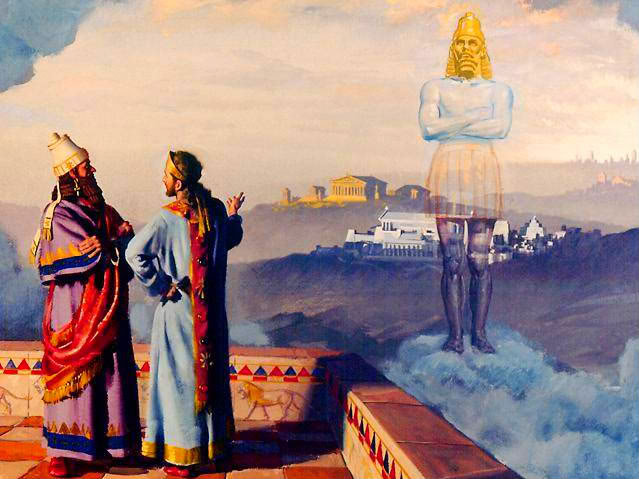
2:31 “You looked, O king, and there before you stood a large statue—an enormous, dazzling statue, awesome in appearance.

2:32 The head of the statue was made of pure gold, its chest and arms of silver, its belly and thighs of bronze,

2:33 its legs of iron, its feet partly of iron and partly of baked clay.

2:34 While you were watching, a rock was cut out, but not by human hands. It struck the statue on its feet of iron and clay and smashed them.

2:35 Then the iron, the clay, the bronze, the silver and the gold were broken to pieces at the same time and became like chaff on a threshing floor in the summer. The wind swept them away without leaving a trace. But the rock that struck the statue became a huge mountain and filled the whole earth.

2:36 “This was the dream, and now we will interpret it to the king.

2:37 You, O king, are the king of kings. The God of heaven has given you dominion and power and might and glory;

2:38 in your hands he has placed mankind and the beasts of the field and the birds of the air. Wherever they live, he has made you ruler over them all. You are that head of gold.

2:39 “After you, another kingdom will rise, inferior to yours. Next, a third kingdom, one of bronze, will rule over the whole earth.

2:40 Finally, there will be a fourth kingdom, strong as iron—for iron breaks and smashes everything—and as iron breaks things to pieces, so it will crush and break all the others.

2:41 Just as you saw that the feet and toes were partly of baked clay and partly of iron, so this will be a divided kingdom; yet it will have some of the strength of iron in it, even as you saw iron mixed with clay.

2:42 As the toes were partly iron and partly clay, so this kingdom will be partly strong and partly brittle.

2:43 And just as you saw the iron mixed with baked clay, so the people will be a mixture and will not remain united, any more than iron mixes with clay.

2:44 “In the time of those kings, the God of heaven will set up a kingdom that will never be destroyed, nor will it be left to another people. It will crush all those kingdoms and bring them to an end, but it will itself endure forever.

2:45 This is the meaning of the vision of the rock cut out of a mountain, but not by human hands—a rock that broke the iron, the bronze, the clay, the silver and the gold to pieces. 
  “The great God has shown the king what will take place in the future. The dream is true and the interpretation is trustworthy.”

2:46 Then King Nebuchadnezzar fell prostrate before Daniel and paid him honor and ordered that an offering and incense be presented to him.

2:47 The king said to Daniel, “Surely your God is the God of gods and the Lord of kings and a revealer of mysteries, for you were able to reveal this mystery.”

2:48 Then the king placed Daniel in a high position and lavished many gifts on him. He made him ruler over the entire province of Babylon and placed him in charge of all its wise men.

2:49 Moreover, at Daniel’s request the king appointed Shadrach, Meshach and Abednego administrators over the province of Babylon, while Daniel himself remained at the royal court.

Daniel 1

1:1 In the third year of the reign [605 BC] of Jehoiakim [a wicked king whose reign was characterized by dishonesty, oppression, injustice (2 Kings 23:36-37; Jer. 36)] king of Judah, Nebuchadnezzar king of Babylon came to Jerusalem and besieged it [2 Kings 24:1-4].

1:2 And the Lord [Adonai: title that magnifies God’s sovereignty] delivered [read Deut. 28:36-37,49-68 re: warnings that captivity would be one of the consequences of disobeying God] Jehoiakim king of Judah into his hand, along with some of the articles from the temple of God. These he carried off to the temple of his god [primary Babylonian god was Marduk, also called Bel] in Babylonia and put in the treasure house of his god [Nebuchadnezzar presumed his god had given him victory over God’s people].

Note: Have you recently experienced events in your life that remind you that you are not in control?

1:3 Then the king ordered Ashpenaz, chief of his court officials, to bring in some of the Israelites from [Babylonian practice was to deport the best and brightest from conquered nation to reduce/eliminate possibility of defeated nation rebuilding and posing a new threat] the royal family and the nobility—

Note: How do you think you would respond if you were exiled from your homeland? Do you think you would remain committed to your religious and moral convictions?

1:4 young [perhaps teenagers] men without any physical defect [cf. Lev. 21:17-23 re: requirement that priests have no physical defects], handsome, showing aptitude for every kind of learning, well informed [young men who had received the best education available in Israelite society], quick to understand, and qualified to serve in the king’s palace. He was to teach them the language [Babylonians spoke a form of the Akkadian language now called Neo-Babylonian] and literature [included Babylonian philosophy, religion, magic, astrology, science, medicine] of the Babylonians [Chaldeans (KJV)].

1:5 The king assigned them a daily amount of food [could be translated “rich food”] and wine from the king’s table [the best food available; considered a high honor to eat from king’s table]. They were to be trained for three years, and after that they were to enter the king’s service.

1:6 Among these were some from Judah: Daniel [name means “God is my Judge”], Hananiah [name means “The Lord is gracious”], Mishael [name means “Who is what God is”] and Azariah [name means “The Lord has/will help”].

1:7 The chief official gave them new names [perhaps to make it easier for the young men to be assimilated into the Babylonian culture; perhaps because these names were easier for the Babylonians to pronounce; note that new names included a reference to Babylonian gods]: to Daniel, the name Belteshazzar [cf. Dan. 4:8; may mean either “Lady/wife of Marduk”]; to Hananiah, Shadrach [means “I am very fearful (of God)”]; to Mishael, Meshach [means “who is what (Aku) is”]; and to Azariah, Abednego [means “servant of the Shining One [or of Nego, a Babylonian deity)].

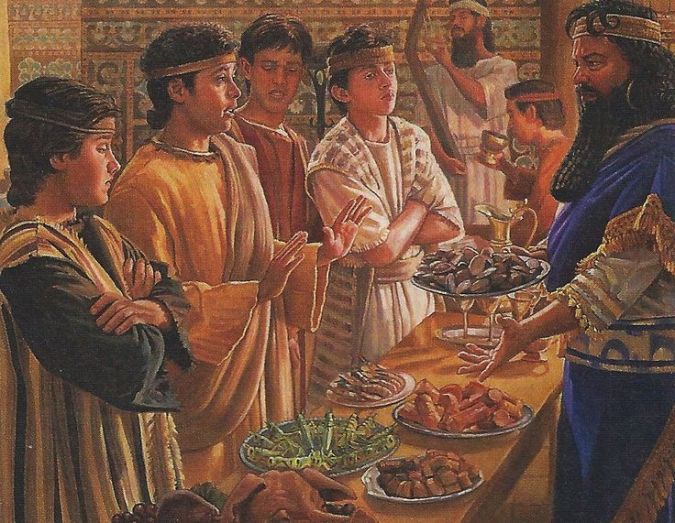
1:8 But Daniel resolved [took a firm stance on what he considered to be moral issue based on God’s Word] not to defile [contaminate] himself with the royal food and wine, and he asked the chief official for permission not to defile [first portion of food and wine had been offered to pagan gods (Marduk, Nebo, Ishtar) in their honor (cf. 1 Cor. 10:28); food most likely unclean according to Jewish dietary rules (cf. Lev. 11; 17:13-14; Deut. 14:3-21)] himself this way.

Note: When have you recently practiced self-control? In what areas of life do you struggle most with self-control and temptation to moral compromise?

On what recent occasion have you felt a tension between your Christian values and our culture’s values? What choice did you make?

How might Daniel’s life have been easier if he had just eaten the food given to him?

Do you think it is easier to demonstrate self-control when faced with temptation if you have thought through your convictions long before the temptation arises? Why or why not?

1:9 Now God [God had not forsaken Daniel in this foreign land] had caused the official to show favor and sympathy to Daniel,

1:10 but the official told Daniel, “I am afraid of my lord the king, who has assigned your food and drink. Why should he see you looking worse than the other young men your age? The king would then have my head because of you.”

1:11 Daniel then said [Daniel went through proper channels and respected those in authority] to the guard [Melzar (KJV) may have been man’s name but more likely described his function] whom the chief official had appointed over Daniel, Hananiah, Mishael and Azariah,

1:12 “Please test your servants for ten days: Give us nothing but vegetables [something grown from seed (could include vegetables, grains, fruits, bread made from grains)] to eat and water to drink.

1:13 Then [at the end of ten days] compare our appearance with that of the young men who eat the royal food, and treat your servants in accordance with what you see [Daniel left the decision with the guard].”

1:14 So he agreed to this [he listened to them] and tested them for ten days.

1:15 At the end of the ten days they looked healthier [literally “fatter of flesh”] and better nourished than any of the young men who ate the royal food.

1:16 So the guard took away their choice food and the wine they were to drink and gave them vegetables instead.

1:17 To these four young men God gave knowledge and understanding of all kinds of literature and learning. And Daniel could understand visions and dreams of all kinds.

1:18 At the end of the time set by the king to bring them in, the chief official presented them to Nebuchadnezzar.

1:19 The king talked with them, and he found none equal to Daniel, Hananiah, Mishael and Azariah; so they entered the king’s service.

1:20 In every matter of wisdom and understanding about which the king questioned them, he found them ten times better than all the magicians and enchanters in his whole kingdom.

1:21 And Daniel remained there until the first year of King Cyrus.

Hosea 6

Hosea 6:1-6


6:1 “Come, let us return [indicates true repentance; involved change of attitudes and a turning away from false gods and sinful ways] to the LORD. He has torn [done by God in love; done redemptively and with the hope that they would recognize and turn from their sinful ways] us to pieces [like a devouring lion (cf. 5:14); describes the damage caused by their sins] but he will heal [restoration to God’s favor and blessings; forgiveness] us; he has injured [see comment on “torn”] us but he will bind up our wounds.

6:2 After two days [figure for a short period of time] he will revive [to bring to life] us; on the third day [figure for a short period of time] he will restore [to raise up; to establish] us, that [result of restoration] we may live in his presence.

6:3 Let us acknowledge [to know Him personally (requires personal fellowship with God)] the LORD; let us press on [determination; overcome obstacles that kept them from God] to acknowledge him. As surely as the sun rises [and chases away the night], he will appear; he will come to us like the winter rains, like the spring rains that water the earth.”

6:4 “What can I do with you, Ephraim [Israel; Northern Kingdom; worshiped image of golden calf]? What can I do with you, Judah [Southern Kingdom]? Your love [word for covenant loyalty; refers to highest and best of which people are capable] is like the morning mist [love for and commitment to God was shallow, temporary, meaningless], like the early dew that disappears [“mist” and “dew” without substance or the ability to last].

6:5 Therefore [because they failed to respond to God’s tender invitation (6:1-3); introduces steps taken by God to turn people back to covenant loyalty] I cut [“cut to fashion” refers to punitive and redemptive judgments] you in pieces with my prophets, I killed you with the words [sharp and painful] of my mouth; my judgments flashed like lightning [brilliant, illuminating, penetrating] upon you.

6:6 For [instead of the insincere and hypocritical worship they offered the Lord] I desire mercy [same word as love in 6:4], not sacrifice [“sacrifice” and “burnt offerings” not ends in themselves], and acknowledgment of God [to know Him personally] rather than burnt offerings.

Practical Consideration: Shallow repentance does not result in deep changes.
Israel’s shallow repentance did not result in deep changes. Israel was only interested in repentance that would remove the inconvenience of judgment in order to return to the sins that had led to judgment. God is not impressed with our words or our sacrifices. He is interested in our hearts and the sincerity of our repentance. True repentance leads to deep changes in the lives of people.