Amos 8

Amos 8:1-2
8:1 This is what the Sovereign LORD showed me: a basket of ripe fruit [symbolized a completed harvest; summer fruit included grapes, dates, and figs; signaled the end of the growing season].

8:2 “What do you see, Amos?” he asked. “A basket of ripe fruit [Heb. word qayis],” I answered. Then the LORD said to me, “The time is ripe [Heb. word qes (sounds like Heb. qayis) and means here “the end has come;” the season for repentance was now over] for my people Israel; I will spare them no longer.

Amos 8:11-12
8:11 “The days are coming,” declares the Sovereign LORD, “when I will send a famine through the land—not a famine of food or a thirst for water, but a famine of hearing the words of the LORD [God would give the people what they wanted: no preaching or word from Him (cf. 2:11-12; 7:12-13,16); the prophets would be silent; God would leave the people alone].

8:12 Men will stagger [describes the anxious and unsteady gait of a person in search of a message from God] from sea to sea [possibly Dead Sea to Mediterranean Sea] and wander from north to east [along with “sea to sea” probably meant “everywhere” or “from one end of the world to the other” or may refer to the length and breadth of their own land], searching for the word [a message of hope, direction, instruction] of the LORD, but they will not find it [the people would find only silence].

Note
• What makes people indifferent to the words of the Lord?
• What makes people eager for His words?
• Why is Bible reading and study so important?
• How well do you take advantage of opportunities to hear from God?
• How would your life be different if you did not have access to God’s Word?
• Would you find it more difficult to live with a famine of watching TV or a famine of hearing the words of the Lord?

Amos 7

• Visions of Israel’s destruction (locusts, fire, plumb line) — 7:1-9
• Conflict between Amaziah and Amos — 7:10-17

Amos 7:10-17
7:10 Then Amaziah the priest [chief priest; not a true priest of the Lord (cf. 1 Kings 12:31)] of Bethel [chief worship center in Northern Kingdom] sent a message [in which he attributed a political motive to Amos’ message] to Jeroboam [lived in Samaria, about fifty miles from Bethel] king of Israel: “Amos is raising a conspiracy against you in the very heart of Israel. The land cannot bear [hold, contain, endure] all his words [suggests Amos’ words were undermining the government].

7:11 For this [note two threats Amaziah reported] is what Amos [Amaziah did not attribute Amos’ words to God] is saying [Amaziah misquoted Amos’ words]: “‘[1] Jeroboam will die by the sword [Amos actually had said the sword would come on the “house” or dynasty of Jeroboam (cf. v. 9)], and [2] Israel will surely go into exile [cf. 5:5,27; 6;7], away from their native land.’”

7:12 Then Amaziah said to Amos, “Get out, you seer [synonymous with term translated “prophet” (7:14); literally “to gaze intently, so as to discern”; Amaziah likely used the term sarcastically]! Go back to the land of Judah [Amos’ home territory]. Earn your bread there [implied Amos was preaching for money] and do your prophesying there [anywhere but at Bethel].

7:13 Don’t prophesy [message from God not welcomed at Bethel] anymore at Bethel, because [political reason] this is the king’s [no mention of God] sanctuary [literally “the holy place of the king”] and the temple of the kingdom [the national shrine; principal place of worship for the nation].”

7:14 Amos answered [note his emphatic response] Amaziah, “I was neither a prophet [a professional prophet] nor a prophet’s son [term for one enrolled in a school of the prophets or who belonged to a prophetic order], but I was [and still am] a shepherd [herdsman; general word for one who tends animals; occupation of the poor], and I also took care of sycamore-fig trees [yielded bland fruit consumed by the poor; trees not located in Tekoa suggesting Amos had to occasionally leave herds to work in orchards].

7:15 But [introduced source of Amos’ call and authority to prophesy] the LORD took [“to capture, to seize, to carry along”] me [Amos under divine compulsion] from tending the flock and said to me, ‘Go [not an option; Amos obeyed God’s call; cf. Amos 3:8], prophesy [“to speak under the Lord’s inspiration”] to my people Israel [Amos obeyed God command to prophesy rather than Amaziah’s command to stop prophesying (7:13)].’

7:16 Now then, hear the word of the LORD [spoken to Amaziah and his family; only time Amos prophesied against an individual]. You [Amaziah] say [cf. 7:13], “‘Do not prophesy against Israel [Northern Kingdom], and stop preaching against the house of Isaac [synonymous with Israel].’

7:17 “Therefore this is what the LORD says: “‘Your wife will become a prostitute [either in an effort to survive after the invasion of the land or as a prostitute for the invading soldiers] in the city, and your sons and daughters will fall by the sword [during Assyrian invasion]. Your [Amaziah’s] land will be measured [surveyed] and divided up [given to those who resettled the land], and you yourself will die in a pagan [unclean] country. And Israel will certainly go into exile, away from their native land. [fulfilled when Assyria destroyed Israel as a nation (2 Kings 17:6)]’”

Amos 6

6:1 Woe to you who are complacent [at ease] in Zion [original hill on which Jerusalem had been built; Amos used Zion to refer to Southern Kingdom of Judah], and to you who feel secure [looked to a fortified city for security rather than the Lord] on Mount Samaria [capital of Israel; Amos used Samaria to refer to Northern Kingdom of Israel], you notable [literally “first”] men [the nation’s leaders; privileged and powerful but morally and spiritually corrupt] of the foremost nation [perhaps described how the people (of Northern and Southern Kingdoms) viewed themselves; many mistakenly thought such a status would protect them from consequences of their sins], to whom the people of Israel come!

6:2 Go to [cities that once were great but had fallen] Calneh [city in Aram (Syria)] and look at it; go from there to great Hamath [city in Aram], and then go down to Gath in Philistia. Are they better off than your two kingdoms [the answer was no]? Is their land larger than yours [the answer was no]?

6:3 You put off the evil day [Israelites never expected to face the Lord’s judgment—they did not think judgment would come] and [because they assumed they would not be brought to justice] bring near a reign of terror [literally “a seat of violence”—a reference to judicial or governmental injustice; refusal to face spiritual ills would bring disaster and judgment].

6:4 You [Israel’s leaders enjoyed a life of ease and comfort (in many cases financed at the expense of those they oppressed)] lie on beds inlaid with ivory [imported from Africa or India; common people slept on straw mats or dirt floors] and [in the daytime] lounge [means “to pour out” or “to be unrestrained” and conveys idea of one completely without control] on your couches. You dine on [the best cuts of meat] choice lambs and fattened [grain-fed] calves.

6:5 [the wealthy and powerful did not spend long hours at work] You strum away on your harps like [or hoping to be like] David [pridefully thought themselves equal to David, recognized as a significant musician (1 Sam. 16:18)] and improvise on musical instruments.

6:6 You drink wine by the bowlful [indicating heavy use of alcohol was a regular practice] and use the finest lotions [skin moisteners and fragrances, probably imported from Arabia or farther places], but you do not grieve over the ruin [the breaking; spiritual and moral condition] of Joseph [signified Northern Kingdom].

6:7 Therefore [introduces impending judgment] you [leaders; the self-indulgent wealthy and powerful] will be among the first [these “notable men” (6:1) would be the first to go into captivity; Assyrians carried off first those capable of stirring up rebellion (leaders; wealthy)] to go into exile; your feasting and lounging will end [and replaced by submission, suffering, death].

6:8 The Sovereign LORD has sworn by himself—the LORD God Almighty declares: “I abhor the pride of Jacob and detest his fortresses; I will deliver up the city and everything in it.”

6:9 If ten men are left in one house, they too will die.

6:10 And if a relative who is to burn the bodies comes to carry them out of the house and asks anyone still hiding there, “Is anyone with you?” and he says, “No,” then he will say, “Hush! We must not mention the name of the LORD.”

6:11 For the LORD has given the command, and he will smash the great house into pieces and the small house into bits.

6:12 Do horses run on the rocky crags [obvious answer is no]? Does one plow there [“on the rocky crags” or “on the sea”] with oxen [obvious answer is no]? But [Amos noted equally absurd actions of Israel’s leaders—actions that had undermined their personal and national security] you [1] have turned [a reversal of ethical standards] justice [treating others as God’s law instructed] into poison [produces sickness and death] and [2] the fruit of righteousness [living according to God’s laws] into bitterness [means “to curse”]

6:13 [3] you who rejoice [boast about petty accomplishments] in the conquest of Lo Debar [Heb. name meaning “no thing” or “nothing”] and say, “Did we not take Karnaim [Heb. name means “horns,” symbol of strength] by our own strength [people had an inflated view of themselves and their military victories; people did not give God credit for their military victories]?”

6:14 For the LORD God Almighty declares, “I will stir up a nation [name of nation not specified; God used Assyria to execute His wrath on Northern Kingdom some 40 years later] against you, O house of Israel [Northern Kingdom], that will oppress you all the way from [note extent of the coming judgment] Lebo Hamath [located on the northern border of Israel] to the valley of the Arabah [marked southern boundary of Israel].”

Amos 5

• Lament Over Israel’s Coming — Fall 5:1-3
• Warning Against Ignoring the Lord — 5:4-17
• Rebuke of Hypocritical Worship — 5:18-27

Amos 5:4-15
5:4 This is what the LORD says [reminder that Amos’ message was the Lord’s] to the house of Israel [Northern Kingdom; an invitation to forgiveness that would remain open up to the moment of the nation’s destruction]: “Seek [includes idea of desiring to please God] me and [or “in order to”] live [refers to avoidance of judgment or meaningful life in general];

5:5 [prohibitions regarding going to places of false worship] do not seek [or do not make pilgrimages to popular shrines, such as…] Bethel, do not go to Gilgal [first encampment of Israelites (west of the Jordan) during conquest of the land (Josh. 4:19); a place of worship (1 Sam. 10:8; Hos. 4:15)], do not journey to Beersheba [located in southern Judah; a place of idolatrous worship]. For [destruction of Gilgal and Bethel part of God’s judgment] Gilgal will surely go into exile, and Bethel will be reduced to nothing.”

5:6 Seek the LORD and live [exhortation of 5:4 repeated], or [consequences of not seeking the Lord and receiving His forgiveness] he will sweep through the house of Joseph [designation for the Northern Kingdom] like a fire [symbol of God’s wrath, destruction, war]; it [the fire of God’s judgment] will devour, and Bethel [false sanctuary located there] will have no one to quench it.

5:7 You [charge against the wealthy, powerful, and influential who used the judicial system to exploit other people] who turn justice [important to the stability of society] into bitterness [or “wormwood,” a bush with a bitter taste; results of perverted justice; poor and oppressed tasted the bitterness of injustice] and cast righteousness [the demands of our relationship with God; “to be and do right”] to the ground [as something worthless; signified that they had ignored their obligation]

5:8 (he [God is in control of nature] who made the Pleiades and Orion [two constellations], who turns blackness into dawn and darkens day into night, who calls for the waters of the sea [process of evaporation] and pours them out over the face of the land [rainfall]—the LORD [Yahweh: personal name by which God identified Himself to Moses (Ex. 6:3)] is his name—

5:9 he [God is in control of history] flashes destruction on the stronghold and brings the fortified city [strongholds and fortification no match for God] to ruin),

5:10 you [those who planned to exploit the poor and helpless] hate the one [perhaps an elder or an advocate who championed the cause of the innocent] who reproves in court [held at the city gate] and despise him [an honest witness] who tells the truth.

5:11 You trample [by charging exorbitant rent or making excessive demands of grain] on the poor [tenant farmers] and force him to give [thus making the rich richer and the poor poorer] you grain [planted and harvested by poor tenant farmers]. Therefore, though you have built stone mansions [the fruit of greed and unjust practices], you will not live in them; though you have planted lush vineyards [the fruit of greed and unjust practices], you will not drink their wine.

5:12 For I know how many are your offenses [disobedience to covenant responsibilities] and how great your sins [missing mark of God’s standards/commands]. You oppress the righteous [the just; innocent/good people] and take bribes [one of the chief ways they deprived the poor of justice] and you deprive the poor of justice in the courts.

5:13 Therefore the prudent [Heb. sakal refers to one with insight or understanding] man keeps quiet [perhaps for fear of getting into trouble for speaking up; perhaps in quiet acquiescence to God’s judgment] in such times [could refer to Amos’ day or to coming judgment (future Assyrian exile)], for the times are evil.

5:14 Seek good, not evil [Isa. 5:20 warned about the moral confusion that called good evil and evil good], that you may live. Then the LORD God Almighty will be with you, just as you say he is.

5:15 [note practical ways in which to seek good] [1] Hate evil, love good; [2] maintain justice [meant they would have to remove injustice] in the courts. Perhaps [introduces a conditional promise] the LORD God Almighty will have mercy on the remnant of Joseph.

Amos 5:21-27
5:21 [note three strong verbs (underlined) that describe God’s rejection of the people’s hypocritical worship] “I [God] hate [because worship had become hollow and empty and did not result in righteous living], I despise your religious feasts [the three great festivals—Tabernacles, Passover or Unleavened Bread, and Weeks or Pentecost (Ex. 23:14-17; 34:22,25; Deut. 16:1-16]; I cannot stand your assemblies [solemn assemblies].

5:22 Even though you bring me burnt offerings [offerings entirely consumed by fire and sent up in smoke to God; Lev. 1:3-17] and grain offerings [expressed gratitude to God for blessing agricultural endeavors; Lev. 2:1-16], I will not accept [God will not savor or smell] them. Though you bring choice fellowship [or peace] offerings [offerings partially consumed by fire and remainder eaten at a communion meal; Lev. 3:1-17; 7:11-34], I will have no regard for [God will not look upon them (closes His eyes)] them.

5:23 Away with the noise of your songs! I will not listen [God closes His ears] to the music of your harps [because the music did not flow from devoted hearts].

5:24 But let justice [“deciding a case correctly”] roll on [cascade; flow consistently] like a river [from the hearts of those who claimed to worship Him], righteousness [“doing what is right” in every area of life] like a never-failing [flow perpetually; justice and righteousness should never stop] stream!

5:25 “Did you bring me sacrifices and offerings forty years in the desert, O house of Israel [the answer is no; yet the Lord was with them]?

5:26 [Israelites worshiped at other shrines: evidence of insincere worship of God] You have lifted up the shrine of your king [probably refers to the Assyrian war god Sikkut], the pedestal of your idols [probably refers to an Assyrian astral deity named Kiyyun], the star of your god—which you made for yourselves.

5:27 Therefore I will send you into exile beyond Damascus [capital of Syria],” says the LORD, whose name is God Almighty.

Amos 4

Amos 4:1-13
4:1 Hear this word [not a call to repentance but an announcement of judgment], you cows [cf. Ps. 22:12 re: the bulls of Bashan] of Bashan [northernmost region of the promised land east of the Jordan River, east of the Sea of Galilee, given to half-tribe of Manasseh because its people desired to raise cattle (Num. 32:1,33)] on Mount Samaria [capital city of the Northern Kingdom; name means “mountain of watching or keeping”], you women [most likely the wives of rulers and other leaders of the Northern Kingdom] who oppress [to take by force or threat] the poor and crush [to break into pieces] the needy and say to your husbands, “Bring us some drinks [implies their desire for drunkenness and carousing]!”

4:2 The Sovereign LORD has sworn [taken an oath] by his holiness [comprehensive term for the nature of God (cf. Isa. 6:3); for God to swear by Himself indicates strongest possible pledge]: “The time will surely come [payday would come!] when you will be taken away with hooks [probably refers to Assyrian practice of hooking their captives through their noses to lead them away], the last of you with fishhooks.

4:3 You will each go straight out through breaks in the wall [the same breaks the invaders used to gain entry into the city], and you will be cast out [indicates the wicked women would be violently taken from their homes] toward Harmon [an unidentified place in Assyria beyond Damascus],” declares the LORD.

4:4 [this verse is a parody of a call to worship] “Go to Bethel [a center of false worship] and sin [rebel]; go to Gilgal [a center of false worship] and sin yet more. Bring your sacrifices [general term for the offering of animals] every morning, your [but not God’s] tithes every three years.

4:5 Burn leavened bread as a thank offering and brag about your freewill offerings—boast about them, you Israelites, for this is what you love to do,” declares the Sovereign Lord.

4:6 [disciplinary warning: famine] “I gave you empty stomachs [literally “cleanness of teeth”] in every city and lack of bread in every town [“city…town” indicates broad or nationwide scope of famine], yet you have not returned to me [Israelites did not learn from God’s warning; indicates redemptive intent of judgments],” declares the LORD.

Note: Amos 4:6-13 record disciplinary warnings designed to encourage the people of Northern Kingdom to repent. These warnings testify to the long-suffering patience of God with the Northern Kingdom.

4:7 [disciplinary warning: drought] “I also withheld rain [drought: chief cause of famine; also insult to Baal, god of storms and fertility] from you when the harvest was still three months away [inopportune time of the drought; time when crops needed water the most (resulted in stunted growth of plants)]. I sent rain on one town, but withheld it from another [illustrates God’s control of rain; God chooses where the rain falls]. One field had rain; another had none and dried up.

4:8 [effect of drought on people] People [from area that received no rain] staggered from [to area that had received rain] town to town [cisterns generally had only enough for local citizens] for water but did not get enough to drink, yet you have not returned to me,” declares the LORD.

4:9 [disciplinary warning] “Many times I struck your gardens and vineyards, I struck them with blight [means “scorching:” crops withered by burning winds] and mildew [pale or yellow; “blight and mildew” represent crop diseases in general]. Locusts devoured your fig and olive trees, yet you have not returned to me,” declares the LORD.

4:10 [disciplinary warnings/signs: pestilence and sword] “I sent plagues among you as I did to Egypt [cf. Deut. 28:58-60]. I killed [in warfare] your young men with the sword, along with your captured horses. I filled your nostrils with the stench [from rotting corpses; cf. Isa. 34:3] of your camps [not enough men left alive to bury the dead], yet you have not returned to me,” declares the LORD.

4:11 [disciplinary warning] “I overthrew some of you [cities] as I overthrew Sodom and Gomorrah [reminders of great destruction; cf. Gen. 19:24]. You were like a burning stick snatched [indicating they had been spared from complete destruction] from the fire [disaster], yet you have not returned to me,” declares the LORD.

Note: The phrase “a burning stick snatched from the fire” is “proverbial for a narrow escape from utter extinction.” (Jamieson, Fausset, Brown • Commentary on the Whole Bible)

4:12 “Therefore [because people had failed to repent after ample warnings] this [pointed to certain judgment] is what I will do [keep on doing] to you, Israel, and because I will do this to you, prepare [brace for the onslaught] to meet [encounter] your God [a warning that judgment was near/certain; not meet another prophet they might also ignore], O Israel.”

4:13 [description of God’s awesome power; indication that God’s power was adequate for the task of impending judgment] He who forms the mountains, creates the wind, and reveals his thoughts to man, he who turns dawn to darkness [the opposite of what one would expect, i.e., darkness to dawn], and treads the high places of the earth—the LORD [personal name by which God revealed Himself to Moses] God [Heb. generic word for God] Almighty [literally “of hosts”] is his name.

Amos 3

Amos 3:1-8
3:1 Hear [listen with the intention of obeying] this word the LORD has spoken against you, O people of Israel—against [or “on behalf of;” emphasizes that the message to follow is one of judgment] the whole [included Israel and Judah] family [presupposes a relationship] I brought up out of [exodus] Egypt:

3:2 “You only [no one else] have I chosen [for service, not for exaltation; for responsibility, not to privilege; God chose them to share His truth with other nations; cf. Deut. 7:6-8] of all the families of the earth; therefore [because they had failed to fulfill the responsibility God had given them; election meant obligation for Israel] I will punish [Israel not exempt because of status] you for all your sins [their failure to live as His covenant people].”

Amos 3:3-8 [Amos’ justification for his ministry]
3:3 Do two walk together [effect] unless they have agreed to do so [cause]?

3:4 Does a lion roar in the thicket when he has no prey? Does he growl in his den when he has caught nothing?

3:5 Does a bird fall into a trap on the ground [effect] where no snare has been set [cause]? Does a trap spring up [effect] from the earth when there is nothing [cause: something to trigger the trap] to catch?

3:6 When a trumpet sounds [to warn of an enemy’s approach] in a city, do not the people tremble [obvious answer is “yes”]? When disaster [natural disasters, adversities, afflictions, military attack] comes to a city, has not the LORD [who is sovereign over all things] caused [commanded or permitted] it?

3:7 Surely the Sovereign LORD does nothing without revealing [in advance; warning precedes judgment] his plan to his servants the prophets [must declare what God has revealed; prophets also interpreted meaning of events (as Moses interpreted exodus as an event wrought by God, or as Jeremiah and Ezekiel interpreted the Babylonian exile of Judah in 587 BC as God’s punishment of Judah for her sins)].

3:8 The lion has roared [lion does nor roar when stalking or chasing its victim; roar implies Israel is as good as dead]—who will not fear? The Sovereign LORD has spoken [cause]—who [prophet must not keep secret the message God has given him] can but prophesy [effect]?

Amos 3:11-15
3:11 Therefore [cf. 3:9-10] this is what the Sovereign [God is in control of all things and can use whatever He chooses to accomplish His purposes (cf. Ps. 119:91b)] LORD says [concerning how He would destroy Samaria]: “An enemy [an unnamed invading nation] will overrun the land [the Northern Kingdom; cf. 6:1 re: the security people felt in Samaria]; he will pull down your strongholds [defensive fortifications] and plunder your fortresses [fortified towers; houses/palaces of the wealthy].”

3:12 This is what the LORD says [portrait of the Northern Kingdom’s ultimate fate]: “As a shepherd saves from the lion’s mouth only two leg bones or a piece of an ear [shepherd required to provide evidence to verify an animal had been killed and not stolen (cf. Gen. 31:39; Ex. 22:13)], so will the Israelites be saved [some suggest this means only a few Israelites would remain], those who sit in Samaria on the edge of their beds and in Damascus [Israel’s borders extended to Damascus (2 Kings 14:25); perhaps wealthy Israelites lived in that city] on their couches.

3:13 “Hear this [unnamed witnesses summoned to hear the court proceedings] and testify against the house of Jacob,” declares the Lord, the LORD God Almighty [this expression designates God as all-powerful].

3:14 “On the day [the day of the Lord (here depicted as a nightmare rather than as the great day the Israelites expected); cf. Amos 5:18-20] I punish Israel for her sins, I will destroy the altars [numerous altars to accommodate many worshipers who went to Bethel to engage in idolatrous/immoral religious practices] of Bethel [established as a center of worship by King Jeroboam (1 Kings 12:28-31)]; the horns of the altar will be cut off [signified that all hope for sanctuary would be gone; cf. Ex. 21:14; 1 Kings 1:50-53; 2:28-34] and fall to the ground [a desecration of the altar].

3:15 I will tear down [wrecking that leaves nothing but broken pieces] the winter house along with the summer house [homes of the royal family and the wealthy]; the houses adorned with ivory [imported from Africa/India; expensive item found only in homes of the wealthy] will be destroyed and the mansions will be demolished [utter destruction],” declares the LORD.

Amos 2

Amos 2:4-8
2:4 This is what the LORD says: “For three sins of Judah [Amos was from Judah and familiar with their sins], even for four, I will not turn back my wrath. Because they have rejected the law [included Ten Commandments] of the LORD and have not kept his decrees [ordinances or statutes; specific rules governing behavior], because they have been led astray by false gods [literally “by lies”], the gods their ancestors followed,

2:5 I will send fire [of judgment; Judah was accountable for her sins] upon Judah that will consume the fortresses of Jerusalem [the place where God’s temple was].”

2:6 This is what the LORD says: “For three sins of Israel, even for four, I will not turn back my wrath. [note the charge: dealing harshly with righteous and poor] They sell [justice perverted by bribes] the righteous [poor and innocent people; those whose cause was just] for silver [money valued more than human life], and the needy [the poor; those in want] for a pair of sandals [a trifling sum; perhaps indicates needy were sold into slavery and their property confiscated as signified by “pair of sandals”–often used in legal transactions (see Ruth 4:1-8)].

2:7 They trample on the heads of the poor as upon the dust of the ground and deny justice to the oppressed. [note the charge: shameless immorality] Father and son [families did not attempt to hide their immorality from one another] use the same girl [prostitute; perhaps a reference to temple prostitution; perhaps a reference to abusing girls who had been sold into slavery because of family’s poverty; see Deut. 22:30 and Lev. 18:7,15] and so [in order to] profane my holy name.

2:8 They lie down beside every [indicates a common or widespread practice] altar on garments taken in pledge [garments taken in pledge for repayment of debts; note what the law said in Ex. 22:26-27]. In the house of their god they drink wine taken as [purchased with] fines [revenue from the poor].

Amos 1

Historical Setting: Amos’ contemporaries were Hosea (preached in northern kingdom after Amos) and Isaiah and Micah (prophets in the southern kingdom).

Amos 1:1-5


1:1 The words of Amos [name means “burden” / some interpret his name to mean “the pain” and if so, then perhaps this name used by those who hated him; see 7:15 re: his call], one of the shepherds [“also took care of sycamore-fig trees” (7:14)] of Tekoa [located six miles south of Bethlehem and ten miles south of Jerusalem; means “a camping ground”]—what he saw [what God had revealed to him; see 7:1,4,7; 8:1; 9:1 re: visions of Amos] concerning Israel two years before the earthquake [must have been a memorable event because Zechariah also referred to it (Zech. 14:5)], when Uzziah was king of Judah and Jeroboam [a wicked king (cf. 2 Kings 14:24)] son of Jehoash was king of Israel [Israel had strong king, secure borders, and greatest prosperity it had known since the division of the kingdom; Amos sent by God to issue final warning to Israel that judgment would come if they did not repent/return to God (judgment came forty years later in 722 BC when Assyrians crushed Northern Kingdom)].

1:2 He said: “The LORD roars [like a lion; a metaphorical announcement of judgment] from Zion [the hill on which the temple was built] and thunders [like a storm] from Jerusalem; the pastures of the shepherds dry up, and the top of Carmel withers. [describes the scope and devastating effects of God’s judgment/wrath]

1:3 This is what the LORD says: “For three [enough to warrant God’s judgment] sins [rebellion] of Damascus [capital city of Aram (Syria), Israel’s northern neighbor and chief adversary], even for four [more than enough to warrant God’s judgment], I will not turn back my wrath. Because she threshed Gilead [located east of the Jordan] with sledges having iron teeth [in a battle that occurred fifty years earlier (2 Kings 10:32-33; 13:3,7), the Syrians mercilessly rode over the bodies of the dead and their helpless prisoners with iron threshing instruments thus chopping and flaying their bodies on the battlefield],

Note: How did a farm-boy from the south get the attention of the people of Israel? By pronouncing judgment against six of her heathen neighbors. People would rather hear sermons about other people’s sins than their own!

Each judgment is introduced by the formula, “for three transgressions … and for four” (Amos 1:3,6,9,11,13; & 2:1,4,6). This is a way of stating that God had sufficient cause for punishing those nations and even an extra reason (compare to Proverbs 6:16). Amos’ audience probably enjoyed this part of his discourse! They probably shouted “Amens” as the rugged prophet from Tekoa delivered his diatribes against the heathen. Amos then masterfully turned his attention to the sins of his listeners (Amos 2:6ff).

1:4 I will [certainty] send fire [judgment, perhaps in the form of an invading army] upon the house of Hazael that will consume [signifies that God’s judgment would be thorough] the fortresses [fortified towers set up to defend Damascus from invaders] of Ben-Hadad [son of Hazael].

1:5 I will break down [thus making the entire city vulnerable and defenseless] the gate [main city gate not strong enough to stop invaders’ battering ram] of Damascus; I will destroy the king who is in the Valley of Aven and the one who holds the scepter in Beth Eden. The people of Aram will go into exile [less than 50 years later, the Assyrians, led by Tiglath-Pileser, destroyed Damascus and exiled inhabitants to Kir (2 Kings 16:9)] to Kir,” says the LORD.

Jonah 4

4:1 But Jonah was greatly [intensely] displeased [or seethed with burning anger; he did not want to see God’s mercy extended to any people but his own; Jonah was displeased with what pleased God] and became angry [perhaps because he knew that the Assyrians were the enemies of his people or because the Ninevites’ response threatened to discredit him as a prophet (because his prophesy did not come to pass)].

4:2 [Jonah’s prayer gives us insight into his prejudiced mind] He prayed [or perhaps bitterly whined] to the LORD, “O LORD, is this not what I said when I was still at home [indicates Jonah may have protested to God prior to his flight to Tarshish]? That is why I was so quick to flee to Tarshish. I knew that you are a gracious [gives sinners what they do not deserve] and compassionate [loving and merciful] God, slow to anger [patient and long-suffering] and abounding in love [Hebrew, chesed — God’s covenant faithfulness and love; see also Ps. 103:8], a God who relents from sending calamity [this experience should have taught Jonah a lesson about the magnitude of God’s love, instead it embittered him].

4:3 Now, O LORD, take away my life [others might ask to die because their message failed, but Jonah asked to die because his message succeeded], for it is better for me to die [perhaps because he felt he was a discredited prophet] than to live [indication of Jonah’s deep prejudice].”

4:4 But the LORD replied, “Have you any right [justification] to be angry [to burn]? [a convicting question designed to get Jonah to examine whether his anger was justified; in essence, God was telling Jonah to think about what he was saying and to reevaluate his attitude]

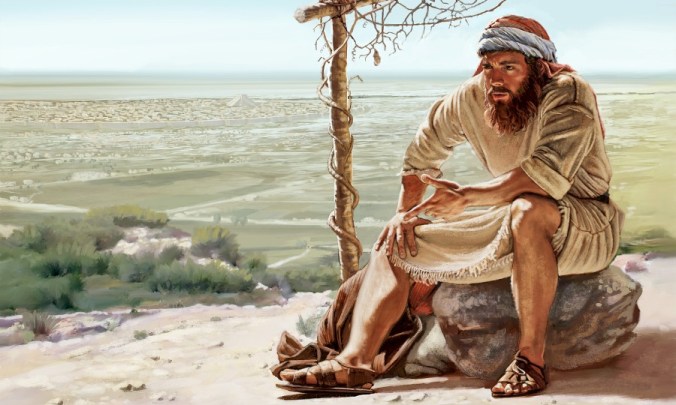
4:5 Jonah went out and sat down at a place east of the city [where he could observe the city from a distance]. There he made himself a shelter, sat in its shade and waited to see what would happen to the city [perhaps he thought that the Ninevites’ repentance would be short-lived and God would send judgment anyway].

4:6 Then the LORD God provided [for a distinct purpose; just as God appointed a great fish to rescue Jonah from drowning in 1:17] a vine and made it grow up over Jonah to give shade for his head to ease his discomfort, and Jonah was very happy [first time Jonah was happy; his comfort was more important to him than the welfare of Nineveh] about the vine [he was happy about his personal comfort but sad over Nineveh’s response].

4:7 But at dawn the next day God provided [cf. 1:17; 4:6] a worm, which chewed the vine so that it withered [the only thing that was destroyed in the book].

4:8 When the sun rose, God [controls nature] provided [cf. 1:17; 4:6,7] a scorching east wind [a hot and scorching sirocco wind from the east], and the sun blazed on Jonah’s head so that he grew faint. He wanted to die, and said, “It would be better for me to die than to live.”

4:9 But God said to Jonah, “Do you have a right to be angry [cf. v. 4] about the vine?” “I do,” he said [Jonah felt justified in his anger over the death of the plant]. “I am angry enough to die [Jonah’s values were wrong — he was more concerned about his interests, comfort, and convenience than about the welfare of the Ninevites].”

4:10 But the LORD said [explained the object lesson of the vine and the worm], “You have been concerned [pity or compassion] about this vine, though you did not tend it or make it grow. It sprang up overnight and died overnight.

4:11 [God explains to Jonah that people are more important than things (plants)] But Nineveh has more than a hundred and twenty thousand people who cannot tell their right hand from their left [perhaps a reference to children or infants, suggesting population of the city was more than 600,000 people; perhaps a reference to the Ninevites lack of clear moral discernment], and many cattle as well. Should I not be concerned [pity, spare, or grieve for] about that great city? [Nineveh was to God as the plant was to Nineveh]

Note: Jonah could not understand how God could love all people, especially the Ninevites. God is not willing that any should perish but that all men should come to repentance (see Ezekiel 33:11 and 2 Peter 3:9). We should see people as God sees them. Someone has written:

Lord, help me see in those I meet,
On country road or city street,
Not just people passing by,
But those for whom Jesus came to die.

Jonah 3

3:1 Then the word of the LORD [God is the God of second chances] came to Jonah a second time [after repentance Jonah received second chance; God may give but does not guarantee a second chance; no indication of time period between 2:10 and 3:1]:

3:2 “[Arise and…] Go [imperative; same instruction as in 1:2; journey would have been long because Nineveh was several hundred miles inland] to the great [in significance, size, and sin] city [important to God because it was filled with people with whom He longed for relationship] of Nineveh and proclaim [imperative] to [rather than “against” as in 1:2] it [Nineveh] the message [see 3:4b] I [God told Jonah where to go and what to say] give you.”

3:3 Jonah obeyed [in contrast to his first response; perhaps obedience was part of what Jonah vowed in 2:9; obedience is the only appropriate response to God] the word of the LORD and went to Nineveh. Now Nineveh was a very important city — a visit required three days [possible that “Nineveh” included surrounding villages and towns, a sort of metropolitan area (see Gen. 10:11-12), the breadth of which could be traveled in three days; may refer to the time Jonah needed to accomplish his mission].

Note: The response of the Ninevites stands in stark contrast to Jonah’s initial response to God’s word and to the response of Israel to the prophets who faithfully proclaimed God’s word to the nation.

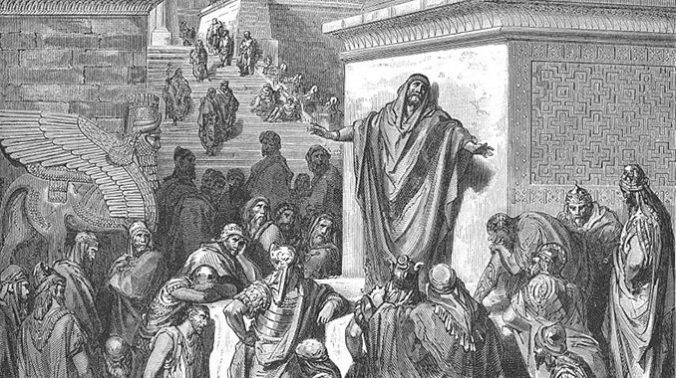
3:4 On the first day, Jonah started into the city [“walking one day”]. He proclaimed [an eight word sermon]: “Forty more days [note of urgency; possibly indicates time period in which to repent] and Nineveh will be overturned [means judged, turned upside down, reversed, or changed; may refer to God’s judgment or to Nineveh’s repentance or change of heart].”

3:5 The Ninevites believed [from Hebrew aman from which we get our word amen] God [attests to power of God’s message]. They declared a fast [demonstration of humility], and all of them, from the greatest to the least, put on sackcloth [coarse garment woven of camel or goat hair; demonstration of humility].

3:6 [personal response of the king] When the news [perhaps of both Jonah’s message and the people’s response; grass-roots movement] reached the king [unnamed] of Nineveh, he rose from his throne, took off his royal robes, covered himself with sackcloth and sat down in the dust [indication of sincere repentance for sins and an earnest plea for mercy; indicates the king humbled himself in the presence of his people; see also Gen. 37:34 and Job 16:15].

Note: The response of the king stands in contrast to the response of many of Israel’s kings to the messages of the prophets. In the case of Nineveh, the leaders set the proper example. In the case of Israel, the leaders too often set the wrong example.

3:7 [official response of the king in vv. 7-9] Then he [the king] issued a proclamation [indicates the urgency the king felt after hearing the news of Jonah’s message] in Nineveh: “By the decree of the king and his nobles: Do not let any man or beast, herd or flock, taste anything; do not let them eat or drink [a total fast includes abstaining from food and water].

3:8 But let man and beast be covered with sackcloth [external signs of humility]. Let everyone [personally/corporately] call urgently [with strength] on God [in repentance]. Let them give up [description of repentance; inner change with outward expressions] their evil ways and their violence [moral wickedness; aggressive violence toward others — individuals and nations].

3:9 [compare with 1:6] Who knows [no presumption, only hope]? God may yet relent [repent; decide to act otherwise] and with compassion turn from His fierce anger so that we will not perish [see 2:9 — “Salvation comes from the Lord.”].”

3:10 [Ninevites repented and so did God] When God saw what they did [talk is cheap] and how they turned [action rather than mere talk got the attention of God] from their evil [destructive, wicked, immoral] ways, He had compassion [change on the part of the people resulted in change in the action of God] and did not bring upon them the destruction He had threatened [unfortunately, this revival did not last beyond this generation; Assyrians later destroyed the Northern Kingdom of Israel].

Note: See Matthew 12:41 and Luke 11:30-32. Jesus’ words indicate the repentance of the Ninevites was true and genuine.