Song of Songs 1

1:1 Solomon’s Song of Songs [this is the title; the song begins in verse 2; the song is not linked to any event or person in Solomon’s life; the song has three singing parts: a male, a female, a female chorus].

1:15-17
1:15
[male exchanging compliments with female] How beautiful you are, my darling! Oh, how beautiful! Your eyes are doves [either round or peaceful in appearance].

1:16 [female returns the compliment] How handsome you are, my lover! Oh, how charming! And our bed is verdant [lush and luxurious, like a tree with thick, green foliage].

1:17 The beams of our house are cedars [having a house paneled with cedar was a luxury; refers to an arbor of cedars and firs (an idyllic love setting on a verdant bed under open skies)]; our rafters are firs.

Isaiah 6

Isaiah’s Call and Commission

6:1-8
What event led to Isaiah’s call?
Isaiah’s call came in the year of King Uzziah’s death. Isaiah had grown up during the prosperous and secure years of Uzziah’s fifty-two year reign (2 Kings 15:2; 2 Chron. 26:3).

In the year of King Uzziah’s death Isaiah had a vision of the Lord seated upon His throne. Judah’s throne was empty but the God of the universe who reigns forever and ever occupied heaven’s throne. Isaiah saw seraphim, heavenly angelic beings, attending to and declaring the glory of God.

This marvelous vision of God’s holiness made Isaiah aware of his sin and that of the people of Judah. Isaiah was cleansed and forgiven of his sin by a seraph that touched his mouth with a burning coal.

After his sin had been dealt with, Isaiah heard the voice of the Lord inquiring who would deliver His message to the people of Judah. Isaiah quickly volunteered to be that messenger. Warren Wiersbe comments, “Before he announced any ‘woes’ on others, he first confessed his own sin and said, ‘Woe is me!'”

6:9-13
What was Isaiah commissioned to do?
After Isaiah said, “Here am I. Send me,” God said, “Go, and tell… .” Isaiah was commissioned to take God’s message of warning to the people.

Wiersbe notes, “Isaiah’s ministry would actually make some people’s eyes more blind, their ears more deaf, and their hearts more calloused.” They would resist God’s truth. Isaiah then asked regarding the length of his commission and learned that he was to serve until the land became desolate.

Isaiah 6:13, a reference to a remnant, contains a glimmer of hope. It offered the big-picture perspective that would keep Isaiah going.

Practical Consideration: We should be prepared to go wherever God sends.
When God asked for a volunteer to bear His message, Isaiah responded without hesitation, even before he knew the nature of the mission. Someone noted that our attitude regarding service should be, “The answer is ‘yes’ Lord … now, what’s the question?”

Verse by Verse (NIV)

6:1 In the year that King Uzziah [also known as Azariah; his 52-year reign was the longest reign of any of the kings in Southern Kingdom of Judah; cf. 2 Kings 15:2; 2 Chron. 26:3; brought peace, prosperity, and security to Judah] died [about 740 BC; Uzziah died after a long illness caused by his improper offering of incense in the temple (2 Chron. 26:16-23)], I saw the Lord seated on a throne [Judah’s throne was empty but the God of the universe who reigns forever and ever occupied heaven’s throne], high and exalted [higher and more exalted than any earthly monarch], and the train of his robe [majesty; length of robe signified the wealth and power of a king] filled the temple.

6:2 Above him were seraphs [from Heb. word “to burn” (may indicate they had a fiery appearance); one of the highest orders of angels; their purpose is to magnify the Lord], each with six wings: With two wings they covered [because of God’s holiness; this act signified humility before God] their faces [so as not to look on God’s unveiled glory], with two they covered their feet [perhaps indicates ancient display of modesty], and with two they were flying [suggests their readiness to carry of the Lord’s commands].

6:3 And they were calling to one another: “Holy [means “to separate;” primary meaning is “otherness” or “apartness”], holy [emphasizes that God does no wrong but always does right], holy [repetition of the word emphasized God’s holiness] is the LORD Almighty [or “Lord of Hosts”]; the whole earth is full of his glory.”

6:4 At the sound of their voices the doorposts and thresholds shook [cf. Ex. 19:18] and the temple was filled with smoke [Moses’ tabernacle (Ex. 40:34-38) and Solomon’s temple (1 Kings 8:10-11) were filled with smoke (represented God’s presence) upon their completion and dedication].

6:5 “Woe to me [Isaiah expressed personal feelings of distress and sorrow after seeing God’s holiness]!” I cried. “I am ruined [word literally means “cut off” or “separated”]! For [note reasons why Isaiah felt he was ruined…] [1] I am a man of unclean lips [Isaiah confessed his own sinfulness and acknowledged that he was unworthy of the God he served], and I live among a people of unclean lips [Isaiah was part of a larger sinful community], and [2] my eyes have seen the King, the LORD Almighty.”

6:6 Then one of the seraphs flew to me with a live coal in his hand, which he had taken with tongs from the altar [reference to the altar of incense that stood before the entrance to the holy of holies in the earthly tabernacle (Ex. 30:1-10)].

6:7 With it he touched my mouth and said, “See, this has touched your lips; your guilt is taken away and your sin atoned for [not because of anything Isaiah had done but because of God’s grace; God cleansed Isaiah of whatever made him unable or reluctant to serve].”

6:8 Then I heard the voice of the Lord saying, “Whom shall I send? And who will go for us? [these questions remind us that God works through people]” And I said [Isaiah responded immediately and affirmatively to God’s call], “Here am I. Send me!”

6:9 He said [God commissioned Isaiah for service (a fruitless mission)…], “Go and tell this people: ” ‘Be ever hearing [they would hear Isaiah’s unpopular message], but never understanding [the people would continue in their rebellion]; be ever seeing, but never perceiving.’

6:10 [note description of how the people would respond to God’s message preached by Isaiah…] Make the heart of this people calloused; make their ears dull and close their eyes [Isaiah’s message would crystallize the Israelite’s rebellion; all of their senses would be shut off to Isaiah’s message of warning and salvation]. Otherwise they might see with their eyes, hear with their ears, understand with their hearts, and turn and be healed.”

6:11 Then I said, “For how long [Isaiah asked how long he must proclaim God’s message of judgment on sin], O Lord?” And he [God] answered [note that Isaiah was to continue preaching until God’s judgment had fallen on the nation…]: “Until the cities lie ruined and without inhabitant, until the houses are left deserted and the fields ruined and ravaged,

6:12 until the LORD has sent everyone far away [exile (Assyrians destroyed Northern Kingdom about 17 years after Isaiah’s visionary call; Southern Kingdom would fall to the Babylonians more than 150 years later); Isaiah was to continue preaching God’s message until there was no one left to hear it] and the land is utterly forsaken.

6:13 And though a tenth remains in the land [a remnant of people], it will again be laid waste. But as the terebinth and oak leave stumps [signify the potential for new growth] when they are cut down, so the holy seed will be the stump in the land.”

Isaiah 5

Parable of the Vineyard

5:1-7
What method did Isaiah employ to communicate with his listeners regarding the state of their relationship with God?
Isaiah captured the attention of his listeners by singing a song (parable) to them (5:1). He probably appeared in the guise of a minstrel at one of the harvest festivals where he sang a song about a vineyard to his listeners.

The song related the story of an individual who planted a vineyard and employed every measure to insure its success (5:2). The individual who planted the vineyard chose a fertile site, carefully cultivated the soil, planted it with the best vine, and made careful provision for harvesting and storing his crop. In light of the careful preparations, the owner of the vineyard had high hopes and expectations for his vineyard. At harvest time however, the vineyard produced only worthless fruit.

Isaiah then asked his listeners what more the farmer could have done to insure the success of his vineyard (5:3-4). Although their response is not recorded, the listeners probably condemned the vineyard. Isaiah then proceeded to inform his listeners of what the farmer was going to do with his vineyard. The farmer was going to abandon and neglect it, the most effective way to destroy a vineyard (5:5-6).

In concluding the parable, Isaiah must have shocked his listeners by identifying the owner of the vineyard as the Lord of hosts and the vineyard as the house of Israel (5:7). God, expecting a harvest of justice and righteousness, found only bloodshed and cries of distress from the victims of injustice and oppression.

Note: This style of parable is described as a “Trojan horse” parable because the speaker disguises his intent until the end of the parable and leads his listeners to pass judgment on themselves. Nathan employed this technique in his rebuke of David (see 2 Samuel 2:1-12).

Practical Consideration: The most effective way to destroy a vineyard is to abandon it.
In the parable of the vineyard, the farmer abandoned the vineyard when it produced only bitter and worthless fruit. Biblical commentator Page H. Kelley comments, “When all divine restraints are removed, the sinner is certain to wreck his own life. One writer has observed that the saddest day in any man’s life is the day when God says to him, ‘Thy will be done!'” This is, indeed, the worst punishment of all.

Judgment on the Wealthy, Proud, and Frivolous

5:8-25
How did Isaiah accentuate the point of his parable?
Isaiah accentuated the point of his parable by uttering six woes, which some have identified as the worthless fruit produced by the vineyard.

First, Isaiah cried out against the greedy (5:8) who amassed lands and houses, consequently reducing many people to poverty. Micah 2:1-2 affirms that dishonest means were used to acquire such properties. Isaiah pronounced God’s judgment on the greedy land-grabbers: their mansions would become desolate and their fields unproductive (5:9-10).

Second, Isaiah cried out against drunkenness (5:11). The men of Judah had an insatiable desire for strong drink which made them unaware of what the Lord was doing in their day (5:12). Isaiah predicted that in the coming judgment these people would become food for the grave (5:13-17).

Third, Isaiah cried out against those who were harnessed to their sin like animals to a cart (5:18). These skeptical individuals challenged God to prove Himself to them by doing mighty works (5:19).

Fourth, Isaiah cried out against those who had lost their moral bearings (Isaiah 5:20 and see also Amos 5:7).

Fifth, Isaiah cried out against those filled with conceit and who esteemed themselves too highly (5:21). Proverbs 3:7 declares, “Do not be wise in your own eyes; Fear the Lord and turn away from evil.”

Sixth, Isaiah cried out against drunkards who perverted the judicial system of the day (5:22-23). This was a cry against injustice. Isaiah 5:24-25 describe the nature of the judgment that would be experienced by all those mentioned in the woe oracles.

5:26-30
What prediction did Isaiah make following the woe oracles?
Isaiah 5:26-30 contains a vivid description of the coming judgment. Isaiah pictured God whistling to a distant nation (Assyria) which speedily responded to His call to execute judgment upon His people. The Assyrians would eventually destroy the Northern Kingdom and devastate the Southern Kingdom, which would be delivered but go into captivity in Babylon a century later.

Isaiah 4

God’s Redemptive Purpose in Judging Zion

4:2-6
What new thing would God bring about in the last days?
Like the oracle in Isaiah 2:1-5, this passage is eschatological in its content. These verses look ahead to a purified city inhabited by a purified remnant enjoying the beneficent protection of God’s presence. It describes the state of the remnant, or those who survive God’s judgments on Jerusalem. They “will be called holy” (4:3), will have their names recorded in God’s census book or the Book of Life (4:3), and will be cleansed (4:4). After the cleansing of verse 4, God will create an environment in which the people also enjoy the blessing of His protection from all harm and danger (4:5-6).

Note: The word “Branch” in verse 2 can refer either to [1] the Messiah, [2] the remnant which survives God’s judgment, or to [3] the fertility of the land in the eschatological age.

Isaiah 3

3:1-12
What fate awaited Jerusalem and Judah?
A day was coming when God would take away from the nation all of the things in which they were trusting, including bread and water (3:1), leaders and warriors, and judges and prophets (3:2). A day was coming when Jerusalem and Judah would experience a crisis in leadership. God would remove the supports of Judah’s political structure (3:1-3). The administration of the country would fall into the hands of incompetent and inexperienced weaklings (3:4). As a result, there would be a collapse of law and order and anarchy would reign (3:5). The people would search in vain for a competent leader (3:6-7). Jerusalem and Judah would come to ruin because of their rebellion against the Lord. (3:8). The wicked would also come to ruin, but the righteous would be rewarded (3:9-12).

3:13-15
What charge did God bring against Judah‘s leaders?
God charged Judah’s leaders with abusing and crushing the weaker members of society. They failed in their responsibility to care for God’s vineyard. Their houses were filled with the plunder of the poor. They had abused their judicial and political power to feather their own nests. They made life miserable and unbearable for the weaker members of society. They had failed in their social and moral responsibilities.

Practical Consideration: God takes notice of how leaders use their position, power, and influence.
The elders and princes of the people abused their power with impunity. They crushed the weaker members of society for their own selfish gain. They thought nothing of destroying people and families in their pursuit of wealth. God however, took notice of the plight of the poor and served notice to the elders and princes that He would contend with and judge them for their abuses.

3:16-4:1
What fate awaited the women of Jerusalem?
Isaiah had a stern message for the proud “daughters of Zion who profited from their husband’s crimes (see also Amos’ message to the women in the Northern Kingdom in Amos 4:1-3). The wealthy women were guilty of proud, sensual, self-serving behavior. They proudly displayed their wealth in their adornment as they pranced through the streets of the city. Isaiah prophesied that they would be stripped of their fine clothing and cosmetics and wear sackcloth instead. Their heads would be covered with scabs and many would become bald. The men of the land would be slain in battle and those remaining would receive numerous proposals for marriage by women seeking to escape the shame of being unmarried and childless.

Isaiah 2

Prophecy of Hope for a New Jerusalem

2:1-5
What was in store for Jerusalem in the last days?
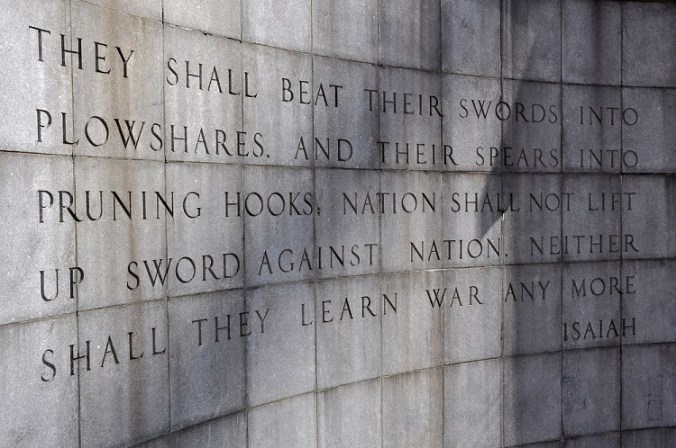
In Isaiah 2:1-5, an eschatological passage, Isaiah envisioned Jerusalem as the world’s spiritual center in the last days (compare to Micah 4:1-5). He envisioned it as the place where the peoples of the earth would come to learn the ways of God and depart to walk in His paths. The central function of the Temple would be to impart God’s Word to the nations rather than serve as the place for sacrifices. Isaiah envisioned a day when peace would reign in the world and there would be no more war. Instead, implements of war would be made into farm implements and men would be able to live their lives free from the fears and consequences associated with war. Warren Wiersbe points out, “When prophets declare a vision of the future, they do it to encourage people to obey God today.” In light of the glorious future envisioned by Isaiah, he exhorted the “house of Jacob” to “walk in the light of the Lord” (2:5) in the present.


Note: Isaiah 2:4 is inscribed on the walls of the United Nations Plaza in New York.

A Vision of Unrepentant Jerusalem

2:6-11
What characterized the state of affairs in Isaiah’s day?
Isaiah 2:6-11 gives us some insight into the state of affairs in Isaiah’s day. Isaiah described a situation in which the people had excluded God from their lives. Instead of depending upon the Lord and walking according to His ways, the people relied on foreign influences and alliances. These foreign influences caused the people’s love for God to grow cold. The people listened to soothsayers rather than God’s prophets (2:6). They filled their land with wealth and implements of war (2:7), and trusted in those things rather than in the Lord. The people worshiped idols made with their own hands rather than the Lord (2:8). The land was so filled with foreign influences, silver and gold (materialism), horses and chariots (military might), and idols that there was no room for God. The enormity and scope of these sins prompted Isaiah to ask God to withhold forgiveness from the people (2:9). Isaiah then warned the people to try to hide from God’s judgment, something that was not possible (2:10). The coming judgment would humble men and the Lord alone would be exalted (2:11).

Practical Consideration: It is foolish to fill ourselves with the wrong things.
Isaiah 2:6-8 records the things that “filled” the nation and the lives of the people. They were “filled” with influences from the east (2:6). Their land was “filled” with silver and gold and “filled” with horses and chariots (2:7). Their land was also “filled” with idols that the people worshiped. The land and people were so full of the wrong things that there was no room for God. They had crowded God completely out of their lives. If we allow ourselves to be filled with the wrong things then we will have no room for God. If, however, we allow God to fill our lives then we will have no room for the wrong things.

2:12-22
What fate awaited the proud and haughty?
Isaiah 2:12-22 records the fate awaiting the proud. The proud, who are always interested in their standing, would be brought low. Using graphic descriptions of great and lofty things as symbols of man’s pride (2:13-17), Isaiah accentuated the fate of the proud. They would be humbled and the Lord alone would be exalted. They would cast their idols in fear into the habitations of moles and bats and try in vain to find refuge from judgment in caverns. Isaiah ended this oracle with a rhetorical question designed to accentuate the folly of trusting in man.

Practical Consideration: Pride is the quickest way to the bottom.
God’s message to the proud and lofty was that they would be brought low. Throughout Scripture, God’s message to the proud, haughty, and arrogant is the same: all such people will be brought low, will be humbled, and will fall. The Scripture notes no exceptions to the rule.

Isaiah 1

Before giving the account of his call to ministry in chapter 6, Isaiah started with an examination of Judah’s present situation and his earnest appeals for the nation to return to God.

Indictment and Judgment of Judah

1:1-9

What complaint or charge did God bring against His people?
In a dramatic courtroom scene in which heaven and earth were called to listen to the case (1:2), God brought charges against His people. He accused them of being dumber than beasts of burden, which at least know their master and recognize his care for them. God’s own people were not as devoted to Him as animals to their masters. God accused His own people, reared and brought up by Him (1:2), of revolting against Him (1:2) and not knowing Him (1:3). The people were guilty of indifference and ingratitude toward God. Isaiah likened the nation to a victim who had been beaten and bruised and lay sick and dying (1:5-6). And indeed, while the nation was enjoying a period of prosperity, it was morally and spiritually sick.

Isaiah 1:7-9 is an oracle spoken by the prophet that presupposes the destruction of the land of Judah. These verses reflect a concrete historical situation. Judah is pictured as turning away from God (1:4) and being punished by God (1:7-8). Jerusalem is pictured as escaping a fate similar to Sodom and Gomorrah only by the grace of God who left a few survivors (1:9).

Practical Consideration: It is insane to be insensible toward God.
It is interesting to notice how men try to advance themselves by making the right contacts and knowing the right people. Our success-oriented society stresses the importance of being rightly related to the people in a position to assist us in the advancement of our careers. Men are careful not to offend anyone who might be in a posture to dismiss them or set them back. And yet, men who would not think of neglecting or ignoring other men readily neglect and ignore God. Men who would not think of forgetting minor appointments with small men are inconsiderate to the great God who created and gave them life. Men who would not think of dishonoring other men think nothing of dishonoring God with their ingratitude and thoughtlessness.

Judah’s Religious Practices Rejected 

1:10-15
How religious were the people of
Judah?
The people of Judah and Jerusalem were very religious. They were regular in their appearance at the Temple, in the offering of prescribed sacrifices, and in the utterance of the appropriate prayers. In fact, the people offered more sacrifices than the law required. They felt that all of this religious activity kept them in favor and right standing with God.

What did Isaiah tell the people about their religious activity?
Isaiah delivered a strong message to the people regarding their religious activity. The message recorded in Isaiah 1:10-15 was probably delivered during one of the great religious festivals. The Temple was probably very crowded with worshipers and the altars piled high with sacrifices. Against such a setting, Isaiah told the people that God had had enough of their sacrifices and wanted no more. Imagine the surprised looks of the listeners. Isaiah informed his stunned audience that God was not pleased with people whose creed and conduct did not match. God was not pleased with religious activity that was divorced from right living. Furthermore, God refused to listen to the prayers of those whose hands were dripping with the blood of their unacceptable sacrifices and of violence and murder. God was not pleased with people whose behavior was pious in the holy place yet iniquitous in the market place.

Practical Consideration: Personal religion must find expression in practical righteousness.
The people of Isaiah’s day were very religious. They were faithful and careful to offer the prescribed offerings on the prescribed days. They were faithful to observe all the dates on the religious calendar. They were however, guilty of divorcing their worship from their work and their creed from their conduct. They did not allow the activities of the holy days to impact their conduct in the market place. They did not practice the ethics and morality to which their ceremonies and observances pointed. Their religion had no impact on their conduct and character. God expressed His displeasure and rejection of personal religion that found no expression in practical righteousness.

A Call to Repent

1:16-20

What course of corrective action did Isaiah prescribe to the people?
Isaiah 1:16-17 defines nine practical imperatives, each designed to correct the abuses which had become an abomination in God’s sight (see also Hosea 12:6, Amos 5:24, and Micah 6:8). Notice the third injunction in verse 17: “Reprove the ruthless,” which could also be translated “set right/straighten out the oppressor.” God wanted for the people to deal with the root of the problem rather than just treating the symptoms. God called upon the people to come before Him to settle the case against them (1:18-19). God explained the alternatives open to the people. If they repented they would be blessed and would “eat the best of the land” (1:19). If they continued along their present course they would “be devoured by the sword” (1:20). In essence, “If you obey, you shall eat; if you disobey, you shall be eaten.”

Practical Consideration: We must forsake that which is displeasing to God.
God prescribed a practical, specific, and corrective course of action to those whose conduct was offensive to Him, destructive to themselves, and dangerous to others. We must forsake anything which is displeasing to God. We must heed His instructions for correcting our conduct. Failure to do so will result in a forfeiture of divine favor and blessings and invite stern discipline.

Judgment Pronounced on Jerusalem

1:21-23
What charge did God bring against Jerusalem?
The words of verses 21-23 describe Jerusalem past and present. In the past, Jerusalem was a city characterized by justice and righteousness. In the present, Jerusalem was the home of murderers. Jerusalem, once faithful, was now a harlot. Jerusalem, once concerned about the welfare of others, now tolerated social injustice. Jerusalem, once as pure as silver, was now dross. The rulers of the city (various classes of government officials and leaders and judges) had become unruly and unprincipled. The plight of the defenseless members of society had become worse.

Practical Consideration: We should guard ourselves lest we become useless.
Jerusalem, once like silver, became dross through neglect of moral responsibility. We should guard ourselves and our influence lest, like Jerusalem, we too are rendered useless. Someone cautioned that the silver of our character can become dross because of little failings, the silver of our service can become dross because of unholy motives, the silver of our money can become dross because of selfishness, and the silver of our talents can become dross because of idleness.

1:24-31
What was in store for Jerusalem in the future?
Isaiah declared that judgment was in store for Jerusalem in the future. God would deal sternly, yet redemptively, with His people. Through the process of judgment God would purify and restore the city and give it a new character and name, “the city of righteousness” (1:26). There was hope for the repentant (1:27). Idolaters, however, would meet the same fate as the things they worshiped (1:29-30). The wicked would be utterly destroyed (1:31).

Ezekiel 33

33:1 The word of the LORD came to me:

33:2 “Son of man, speak to your countrymen and say to them: ‘When I bring the sword against a land, and the people of the land choose one of their men and make him their watchman,

33:3 and he sees the sword coming against the land and blows the trumpet to warn the people,

33:4 then if anyone hears the trumpet but does not take warning and the sword comes and takes his life, his blood will be on his own head.

33:5 Since he heard the sound of the trumpet but did not take warning, his blood will be on his own head. If he had taken warning, he would have saved himself.

33:6 But if the watchman sees the sword coming and does not blow the trumpet to warn the people and the sword comes and takes the life of one of them, that man will be taken away because of his sin, but I will hold the watchman accountable for his blood.’

33:7 “Son of man, I have made you a watchman [stood atop city wall and watched for an enemy’s approach; sounded alarm to warn city’s inhabitants of imminent danger; cf. 2 Kings 9:17] for the house of Israel [in this context refers to Judah]; so hear the word I speak [Ezekiel’s message came from God] and give them warning from me [God was the source of Ezekiel’s warning].

33:8 When I say to the wicked [a guilty or ungodly person], ‘O wicked man, you will surely die [cf. God’s words to Adam in the garden of Eden (Gen. 2:17)],’ and you [as a watchman Ezekiel was to warn people of impending divine judgment] do not speak out to dissuade him from his ways [from a consistent pattern of sin], [note twofold result of failing to sound the warning] [1]that wicked man will die for his sin [one’s relationship with God matters when death comes], and [2] I will hold you accountable [believers will give an account for their lives after they die (1 Cor. 3:10-15)] for his blood.

33:9 But if you do warn the wicked man to turn from his ways [from a consistent pattern of sin] and he does not do so, [1] he will die for his sin, but [2] you will have saved yourself [watchman was not held accountable if he had fulfilled his responsibility].

33:10 “Son of man, say to the house of Israel [the Southern Kingdom of Judah], ‘This is what you are saying: “Our offenses [transgressions; rebellion; deliberate revolt against the Lord] and sins weigh us down, and we are wasting [decaying or rotting] away because of them. How then can we live?”‘

33:11 Say to them, ‘As surely as I live [this phrase emphasizes the seriousness of the Lord’s reply], declares the Sovereign LORD, I take no pleasure in the death of the wicked, but rather that they turn from their ways and live [cf. 2 Pet. 3:9]. Turn! Turn [repetition of this word emphasizes the seriousness of God’s urging] from your evil ways! Why will you die [they could avoid this by accepting the Lord’s remedy for their spiritual condition], O house of Israel?’

33:12 “Therefore, son of man, say to your countrymen, ‘The righteousness of the righteous man will not save him when he disobeys, and the wickedness of the wicked man will not cause him to fall when he turns from it. The righteous man, if he sins, will not be allowed to live because of his former righteousness.’

33:13 If I tell the righteous man that he will surely live, but then he trusts in his righteousness and does evil, none of the righteous things he has done will be remembered; he will die for the evil he has done.

33:14 And if I say to the wicked man, ‘You will surely die,’ but he then turns away from his sin and does what is just and right-

33:15 if he gives back what he took in pledge for a loan, returns what he has stolen, follows the decrees that give life, and does no evil, he will surely live; he will not die.

33:16 None of the sins he has committed will be remembered against him. He has done what is just and right; he will surely live.

33:17 “Yet your countrymen say, ‘The way of the Lord is not just.’ But it is their way that is not just.

33:18 If a righteous man turns from his righteousness and does evil, he will die for it.

33:19 And if a wicked man turns away from his wickedness and does what is just and right, he will live by doing so.

33:20 Yet, O house of Israel, you say, ‘The way of the Lord is not just.’ But I will judge each of you according to his own ways.”

33:21 In the twelfth year of our exile, in the tenth month on the fifth day, a man who had escaped from Jerusalem came to me and said, “The city has fallen!”

33:22 Now the evening before the man arrived, the hand of the LORD was upon me, and he opened my mouth before the man came to me in the morning. So my mouth was opened and I was no longer silent.

33:23 Then the word of the LORD came to me:

33:24 “Son of man, the people living in those ruins in the land of Israel are saying, ‘Abraham was only one man, yet he possessed the land. But we are many; surely the land has been given to us as our possession.’

33:25 Therefore say to them, ‘This is what the Sovereign LORD says: Since you eat meat with the blood still in it and look to your idols and shed blood, should you then possess the land?

33:26 You rely on your sword, you do detestable things, and each of you defiles his neighbor’s wife. Should you then possess the land?’

33:27 “Say this to them: ‘This is what the Sovereign LORD says: As surely as I live, those who are left in the ruins will fall by the sword, those out in the country I will give to the wild animals to be devoured, and those in strongholds and caves will die of a plague.

33:28 I will make the land a desolate waste, and her proud strength will come to an end, and the mountains of Israel will become desolate so that no one will cross them.

33:29 Then they will know that I am the LORD, when I have made the land a desolate waste because of all the detestable things they have done.’

33:30 “As for you, son of man, your countrymen are talking together about you [Ezekiel and his messages were the topic of conversation] by the walls and at the doors of the houses, saying to each other, ‘Come and hear [these commands are plural in Hebrew] the message that has come from the LORD.’

33:31 My people come to you, as they usually do, and sit before you to listen to your words [the people hung on his every word], but they do not put them into practice [cf. Isa. 29:13; Jas. 2:14-18]. With their mouths they express devotion [the people talked a good spiritual game], but their hearts are greedy for unjust gain.

33:32 Indeed, to them you are nothing more than one who sings love songs with a beautiful voice and plays an instrument well [the people admired Ezekiel’s voice and eloquence], for they hear your words but do not put them into practice.

33:33 “When all this [divine judgment] comes true—and it surely will [emphasizes the certainty of judgment]—then they will know that a prophet has been among them.”

Ezekiel 25

25:1 The word of the LORD came to me [Ezekiel functioned as God’s messenger]:

25:2 “Son of man [this expression designated Ezekiel as a member of the human race], set your face against [indicates that the Ammonites were to be the focus of Ezekiel’s prophetic attention] the Ammonites [people descended from Abraham’s nephew Lot (through Lot’s incestuous relationship with his daughter (Gen. 19:36-38); resided in region east of Jordan River and generally hostile toward God’s people; note: Amman is the capital of modern day Jordan] and prophesy against them [no evidence that the Ammonites actually heard Ezekiel’s words, but his words served to encourage God’s people].

Note: Ammonite and Israelite hostilities include:
• Judges 11:32-33 Jephthah fought against and defeated the Ammonites
• 1 Samuel 11:11 Saul defeated the Ammonites
• 2 Samuel 10:6-14; 12:26-31 David defeated the Ammonites
• Amos 1:13 Ammonites pushed into Gilead and slaughtered pregnant women

25:3 Say to them [the Ammonites; the people on whom God’s judgment would fall], ‘Hear the word of the Sovereign LORD. This is what the Sovereign LORD says: Because you said “Aha! [a cry of malicious satisfaction over the misfortune of God’s people] [1] over my sanctuary when it was desecrated and [2] over the land of Israel when it was laid waste [Assyrians defeated Northern Kingdom in 722 BC] and [3] over the people of Judah [the Southern Kingdom] when they went into exile [587 BC; Jews remained in exile until Cyrus, king of Persia, allowed them to return in 538 BC],

25:4 therefore [note hat God’s judgment was imminent] I am going to give you to the people of the East [denotes the Babylonians or Chaldeans] as a possession. They will set up their camps and pitch their tents among you; they will eat your fruit and drink your milk.

25:5 I will turn Rabbah into a pasture for camels and Ammon into a resting place for sheep. Then you will know that I am the LORD.

25:6 For this is what the Sovereign LORD says: Because you have clapped your hands and stamped your feet, rejoicing with all the malice of your heart against the land of Israel,

25:7 therefore I will stretch out my hand against you and give you as plunder to the nations. I will cut you off from the nations and exterminate you from the countries. I will destroy you, and you will know that I am the LORD.’”

25:8 “This is what the Sovereign LORD says: ‘Because Moab and Seir said, “Look, the house of Judah has become like all the other nations,”

25:9 therefore I will expose the flank of Moab, beginning at its frontier towns—Beth Jeshimoth, Baal Meon and Kiriathaim—the glory of that land.

25:10 I will give Moab along with the Ammonites to the people of the East as a possession, so that the Ammonites will not be remembered among the nations;

25:11 and I will inflict punishment on Moab. Then they will know that I am the LORD.’”

25:12 “This is what the Sovereign LORD says: ‘Because Edom took revenge on the house of Judah and became very guilty by doing so,

25:13 therefore this is what the Sovereign LORD says: I will stretch out my hand against Edom and kill its men and their animals. I will lay it waste, and from Teman to Dedan they will fall by the sword.

25:14 I will take vengeance on Edom by the hand of my people Israel, and they will deal with Edom in accordance with my anger and my wrath; they will know my vengeance, declares the Sovereign LORD.’”

25:15 “This is what the Sovereign LORD says [this expression stresses Ezekiel’s role as God’s messenger]: ‘Because the Philistines [lived along southwest coastline of the promised land; modern day designation Palestine derived from term meaning “Philistines”] acted in vengeance and took revenge with malice in their hearts [the Philistines were committed to the total destruction of God’s people], and with ancient hostility sought to destroy Judah,

25:16 therefore this is what the Sovereign LORD says: I am about to stretch out my hand against the Philistines, and I will cut off the Kerethites and destroy those remaining along the coast.

25:17 I will carry out great vengeance on them and punish them in my wrath [God’s judgment designed to awaken the Philistines to the evil of their actions]. Then [as a result of God’s judgment] they [the Philistines] will know that I am the LORD, when I take vengeance on them [the Lord held the Philistines accountable for how they had treated others].’”

Ezekiel 28

28:1 The word of the LORD came to me:

28:2 “Son of man, say to the ruler [God’s attention shifted from the city to its ruler or king; although not named, this ruler was probably Ethbaal II who ruled Tyre in Ezekiel’s time] of Tyre, ‘This is what the Sovereign LORD says: “‘In the pride of your heart you say, “I am a god [an arrogant claim to divinity often made by many ancient rulers]; I sit on the throne of a god in the heart of the seas [the king felt that he and his island city were safe from all enemies].” But [note God’s evaluation of Tyre’s king] you are a man and not a god, though you think you are as wise as a god.

28:3 Are you wiser than Daniel? Is no secret hidden from you?

28:4 By your wisdom and understanding you have gained wealth for yourself and amassed gold and silver in your treasuries.

28:5 By your great skill in trading [setting up trade routes and trading colonies] you have increased your wealth, and because of your wealth your heart has grown proud.

28:6 “‘Therefore this is what the Sovereign LORD says: “‘Because you think you are wise, as wise as a god,

28:7 I am going to bring foreigners against you [Tyre fell to Alexander the Great in 322 BC)], the most ruthless of nations; they will draw their swords against your beauty and wisdom and pierce your shining splendor.

28:8 They will bring you down to the pit, and you will die a violent death in the heart of the seas.

28:9 Will you then say, “I am a god,” in the presence of those who kill you? You will be but a man, not a god, in the hands of those who slay you.

28:10 You will die the death of the uncircumcised at the hands of foreigners. I have spoken, declares the Sovereign LORD.’”

28:11 The word of the LORD came to me:

28:12 “Son of man, take up a lament concerning the king of Tyre and say to him: ‘This is what the Sovereign LORD says: “‘You were the model of perfection, full of wisdom and perfect in beauty.

28:13 You were in Eden, the garden of God; every precious stone adorned you: ruby, topaz and emerald, chrysolite, onyx and jasper, sapphire, turquoise and beryl. Your settings and mountings were made of gold; on the day you were created they were prepared.

28:14 You were anointed as a guardian cherub, for so I ordained you. You were on the holy mount of God; you walked among the fiery stones.

28:15 You were blameless in your ways from the day you were created till wickedness was found in you.

28:16 Through your widespread trade you were filled with violence, and you sinned. So I drove you in disgrace from the mount of God, and I expelled you, O guardian cherub, from among the fiery stones.

28:17 Your heart became proud on account of your beauty, and you corrupted your wisdom because of your splendor. So I threw you to the earth; I made a spectacle of you before kings.

28:18 By your many sins and dishonest trade you have desecrated your sanctuaries. So I made a fire come out from you, and it consumed you, and I reduced you to ashes on the ground in the sight of all who were watching.

28:19 All the nations who knew you are appalled at you; you have come to a horrible end and will be no more.’”

28:20 The word of the LORD came to me:

28:21 “Son of man, set your face against Sidon; prophesy against her

28:22 and say: ‘This is what the Sovereign LORD says: “‘I am against you, O Sidon, and I will gain glory within you. They will know that I am the LORD, when I inflict punishment on her and show myself holy within her.

28:23 I will send a plague upon her and make blood flow in her streets. The slain will fall within her, with the sword against her on every side. Then they will know that I am the LORD.

28:24 “‘No longer will the people of Israel have malicious neighbors who are painful briers and sharp thorns. Then they will know that I am the Sovereign LORD.

28:25 “‘This is what the Sovereign LORD says: When I gather the people of Israel from the nations where they have been scattered, I will show myself holy among them in the sight of the nations. Then they will live in their own land, which I gave to my servant Jacob.

28:26 They will live there in safety and will build houses and plant vineyards; they will live in safety when I inflict punishment on all their neighbors who maligned them. Then they will know that I am the LORD their God.’”