Jeremiah 2

Jeremiah 2:1-13
2:1 The word of the LORD came to me [cf. 2 Pet. 1:21]:

2:2 “Go and proclaim in the hearing of [“cry in the ears of”] Jerusalem: “‘I remember the devotion [Heb. chesed refers to faithful love] of your youth [a reminder to the people of their earlier devotion to Him], how as a bride [Israel pictured as a bride] you loved [Heb. ‘ahabah (the quality of love which led the Lord to initiate the covenant)] me and followed me through the desert [a honeymoon period], through a land not sown.

2:3 Israel was holy to the LORD, the firstfruits [dedicated to the Lord (cf. Lev. 23:10-14); imply a full harvest to follow; set aside for the priest and his family (cf. Lev. 22:10,16)] of his harvest; all [those (nations) who harmed Israel] who devoured her were held guilty, and disaster overtook them,’” declares the LORD.

2:4 Hear the word of the LORD, O house of Jacob [Jacob’s name changed to Israel (Gen. 32:22-32)], all you clans of the house of Israel.

2:5 This is what the LORD says: “What fault did your fathers find in me [what did they find lacking in their relationship with God that caused them to stray from Him], that they [the people had broken the marriage covenant by pursuing other lovers] strayed so far from me ? They followed [to go after; Jeremiah is essentially an elaboration of the people’s sin of idolatry (cf. Jer. 1:16)] worthless [empty or vain; cf. 1 Kings 16:13] idols [straying from God made the people vulnerable to god-substitutes; “an idol is nothing at all in the world” (1 Cor. 8:4)] and became [we become like that which we pursue] worthless themselves.

2:6 They did not ask [implication is that they were not concerned about God’s presence], ‘Where is the LORD, who brought us up out of Egypt and led us through the barren wilderness [describes a place where there are no settled inhabitants], through a land of deserts and rifts, a land of drought and darkness [literally ‘shadow of death” (cf. Ps. 23:4)], a land where no one travels [hyperbole] and no one lives?’

2:7 I brought you into a fertile land [a productive land] to eat its fruit and rich produce [a reminder of God’s faithfulness to His promise]. But you came and defiled [by idolatry (cf. Ps. 106:34-39)] my land and made my inheritance detestable.

2:8 [note four classes of leaders charged with responsibility for the prevailing idolatry] The [1] priests [Israel’s spiritual leaders] did not ask [implication is that they were not concerned about God’s presence], ‘Where is the LORD?’ [2] Those who deal with the law [probably the scribes who were responsible for studying and interpreting the law to the people] did not [a sad commentary] know [more than mere knowledge, to “know” indicates personal commitment to God] me; the [3] leaders [literally “shepherds” (temporal or political rulers) as in Ezek. 34:2] rebelled against me. The [4] prophets [probably professional Temple employees; these were some of Jeremiah’s worst enemies] prophesied by Baal [the principal deity (storm and fertility god) of Canaanite worship; reference here is to idols in general], following worthless idols [cf. Jer. 2:5].

2:9 [God declared His intention to enter into legal proceedings] “Therefore I bring charges against you again,” declares the LORD. “And I will bring charges against your children’s children [descendants].

2:10 Cross over to the coasts of Kittim [to the west] and look, send to Kedar [to the east] and observe closely; see if there has ever been anything like this:

2:11 Has a nation [heathen nation] ever changed its gods [heathen nations remained faithful to their worthless idols]? (Yet they are not gods at all.) But [how sad when God’s people “outpagan” the pagans] my people have exchanged their Glory for worthless [that which does not profit; a play on the name Baal in Heb.] idols.

2:12 Be appalled [be astonished] at this [the people’s breach of faith], O heavens [served as witnesses], and shudder [be agitated] with great horror [be devastated],” declares the LORD.

2:13 “My people have committed two sins: They have forsaken me [the living God], the spring of living water [the source of life (cf. Ps. 36:9); metaphor often used of God, salvation, Christ (cf. Isa. 12:3; 55:1; Jn. 4:10-14; 7:37-39)], and have dug their own cisterns [used to store rain water; often yielded stagnant water], broken cisterns [cannot hold water to satisfy the thirsty] that cannot hold water [worthless and powerless idols that could not satisfy spiritual thirst; god-substitutes that inevitably disappoint].


Jeremiah 1

1:1 The words [may also be translated “matters” or “affairs” or “deeds” as in 5:28] of Jeremiah [meaning of name is uncertain, but possibly “Yahweh loosens (the womb)” or “Yahweh exalts” or “the Lord hurls”] son of Hilkiah [name means “the Lord is the portion”; most likely not the same Hilkiah who discovered the book of the law (2 Kings 22)], one of the priests at Anathoth [a city set aside for priests and their families (Josh. 21:18); located 3 miles northeast of Jerusalem] in the territory of Benjamin [name means “son of the right hand” or “son of the south”; lay on the northern frontier of the Southern Kingdom of Judah; remained with Judah when the kingdom divided (1 Kings 12:1-25)].

1:2 The word [used here in the customary sense meaning “message”] of the LORD [Jeremiah’s message had a divine source] came to him in [Jeremiah’s message given in a historical context] the thirteenth year [626 BC] of the reign of Josiah [name means “the Lord heals”] son of Amon king of Judah [reigned from circa 640 to 609 BC],

1:3 and through the reign of Jehoiakim [name means “the Lord raises up”; reigned circa 609-598 BC] son [third son] of Josiah king of Judah, down to the fifth month of the eleventh year of Zedekiah [598-587 BC; name means “the Lord is righteous”; ignored Jeremiah’s warnings; encouraged idolatry; permitted social injustice] son of Josiah king of Judah, when [587 BC] the people of Jerusalem went into exile.

1:4 The word of the LORD came to me, saying,

1:5 [God had taken the initiative and set Jeremiah apart for prophetic ministry before his birth…] “Before I formed you in the womb [cf. Ps. 139:13-16] I knew you, before you were born I set you apart [consecrated or set apart for a specific use]; I appointed [to a specific assignment] you as a prophet [Heb. nabi means ”one who announces”; cf. Deut. 18:18] to the nations [included the Gentiles, not just Judah alone; a reminder that there are no limits to God’s sovereignty].”

1:6 “Ah [or “Alas” (suggesting lament)], Sovereign LORD,” I said [Jeremiah was reluctant], “I do not know how to speak [Jeremiah did not feel qualified or equipped for the task before him]; I am only a child [Heb. noun is flexible and is used to denote a person from infancy to manhood].”

1:7 But the LORD said to me, “Do not say, ‘I am only a child.’ You must [suggests moral obligation] go [God empowers those He sends] to everyone [those nations to whom God would send him] I send you to and say whatever [Jeremiah was to speak only God’s message] I command you.

1:8 Do not be afraid of them [literally “do not be afraid of their faces”; cf. Ezek.3:9], for I am with you [cf. Ex. 3:12; Matt. 28:20] and will rescue you,” declares the LORD.

1:9 Then the LORD [God would be personally involved with Jeremiah throughout his ministry] reached out his hand and touched my mouth [reminiscent of Deut. 18:18] and said to me, “Now, I have put my words in your mouth.

1:10 See, today I appoint you over nations and kingdoms to [note four verbs of destruction that describe some of the themes of Jeremiah’s prophecies…] [1] uproot and [2] tear down, to [3] destroy and [4] overthrow, to build and to plant [these two words remind us that God’s final word is redemptive].”

1:11 The word of the LORD came to me: “What do you see, Jeremiah?” “I see the branch of an almond [Heb. word shaqed] tree [the first tree to bud in spring; Anathoth was a center for almond growing],” I replied.

1:12 The LORD said to me, “You have seen correctly, for [as the almond (shaqed) tree blossoms in the spring] I am watching [Heb. word shoqed] to see that my word is fulfilled.”

1:13 The word of the LORD came to me again: “What do you see?” “I see a boiling pot [a symbol of tragedy and doom], tilting away from the north [and thus about to spill its scalding contents on the south],” I answered.

1:14 The LORD said to me, “From the north [the source of a coming national disaster] disaster will be poured out [impending disaster will be judgment of God] on all who live in the land [God’s people].

1:15 I am about to summon all the peoples of the northern kingdoms,” declares the LORD. “Their kings will come [suggests a massive invasion of Judah from the north] and set up their thrones [a symbol of conquest and new rulers over the land] in the entrance of the gates of Jerusalem; they will come against all her surrounding walls [the figure of a siege] and against all the towns of Judah.

1:16 I will pronounce my judgments on my people because [note that God’s judgments are never capricious] of their wickedness in forsaking me, in burning incense to other gods [those who forsake God replace him with other gods] and in worshiping what their hands have made [cf. Ps. 115:4-8].

1:17 [note threefold charge (cf. charge to Joshua in Deut. 31:6-8; Josh. 1:6-9)] [1] “Get yourself ready [literally “gird your loins”; prepare for action]! [2] Stand up and say to them whatever [not just what is convenient or expedient] I command you [cf. Jer. 1:7]. [3] Do not be terrified by them [mere men], or I [God would deal with Jeremiah if he fled from his mission] will terrify you before them.

1:18 Today I have made you a fortified city [impregnable], an iron pillar [strong] and a bronze wall [difficult to breach] to stand against the whole land—against [the establishment…] the kings of Judah, its officials, its priests and [ordinary citizens…] the people of the land.

1:19 They [the powerful and influential] will fight against you but [note strong assurance…] will not overcome you, for I am with you and will rescue you,” declares the LORD.

Jeremiah 33

Jeremiah 33:6-9


33:6 “‘Nevertheless [prophecy of future deliverance and restoration of the nation following Babylonian captivity…], I will bring health and healing to it; I will heal my people and will let them enjoy abundant peace and security.

33:7 I will bring Judah [Southern Kingdom] and Israel [Northern Kingdom] back from captivity and will rebuild [God is a forgiving God] them as they were before.

33:8 I will cleanse them from all the sin [from a word that means twisted or bent] they have committed against me [we must recognize that all sin, including violations of the sanctity of human life, is against God] and will forgive all their sins [from a word that means “to miss the mark”] of rebellion against me.

33:9 Then [after the disaster] this city [Jerusalem] will bring me renown, joy, praise and honor before all nations on earth that hear of all the good things I do for it; and they will be in awe and will tremble at the abundant prosperity and peace I provide for it.’

Jeremiah 50

Jeremiah 50:11-32
50:11 “Because you rejoice and are glad, you who pillage my inheritance [the land God had given His people], [note how Babylon delighted at her capture of Jerusalem and Judah…] because you frolic like a heifer threshing grain and neigh like stallions,

50:12 your mother [the city of Babylon] will be greatly ashamed [like a mother who is disgraced by the actions of her child]; she who gave you birth will be disgraced. She will be the least [Babylon had been first among the nations] of the nations—a wilderness, a dry land, a desert.

50:13 Because of the LORD’S anger she will not be inhabited but will be completely desolate. All who pass Babylon will be horrified and scoff because of all her wounds.

50:14 [instructions to the attacking forces] “Take up your positions around Babylon, all you who draw the bow. Shoot at her! Spare no arrows, for she has sinned against the LORD [by attacking Judah].

50:15 Shout against her on every side! She surrenders [literally “it has given its hand”], her towers fall, her walls are torn down [Cyrus took the city without resistance in 539 BC]. Since this is the vengeance of the LORD, take vengeance on her; do to her as she has done to others.

50:16 Cut off from Babylon the sower, and the reaper with his sickle at harvest [the Babylonians had destroyed farmers and killed farmers in her military campaigns–the same thing would now happen to her]. Because of the sword of the oppressor let everyone [captives from other lands] return to his own people, let everyone flee to his own land.

50:17 “Israel is a scattered flock that lions [enemy nations (Assyria and Babylon)] have chased away. The first to devour him was the king of Assyria [Samaria fell in 722 BC (cf. 2 Kings 17:1-6)]; the last to crush his bones was Nebuchadnezzar king of Babylon [cf. 2 Kings 24].”

50:18 Therefore this is what the LORD Almighty, the God of Israel, says: “I will punish the king of Babylon and his land as I punished the king of Assyria [Assyrians fell to Babylonians (612–609 BC)].

50:19 But I [God] will bring Israel back to his own pasture and he will graze on Carmel and Bashan; his appetite will be satisfied on the hills of Ephraim and Gilead.

50:20 In those days, at that time,” declares the LORD, “search will be made for Israel’s guilt, but there will be none, and for the sins of Judah, but none will be found, for I will forgive the remnant I spare.

50:21 “Attack the land of Merathaim [region in southern Babylonia (near mouth of Tigris and Euphrates rivers); means “double rebellion” or “double bitterness”] and those who live in Pekod [name means “punishment”; located in eastern Babylonia]. Pursue, kill and completely destroy them,” declares the LORD. “Do everything I have commanded you.

50:22 The noise of battle is in the land, the noise of great destruction!

50:23 How broken and shattered is the hammer [like a hammer, Babylon had mercilessly shattered and pounded others nations into submission and desolation] of the whole earth! How desolate is Babylon among the nations!

50:24 I set a trap for you, O Babylon, and […like a bird caught in a trap] you were caught before you knew it; you were found and captured because [note the theological explanation for Babylon’s catastrophe…] you opposed the LORD.

50:25 The LORD has opened his arsenal and brought out the weapons [in this case, the Persian conqueror spoken of in Isa. 44:28–45:1] of his wrath, for the Sovereign [God is sovereign over all armies of all nations] LORD Almighty has work to do in the land of the Babylonians.

50:26 Come against her from afar. Break open her granaries; pile her up like heaps of grain. Completely destroy her and leave her no remnant.

50:27 Kill all her young bulls [refers to Babylonian soldiers]; let them go down to the slaughter! Woe to them! For their day has come, the time for them to be punished.

50:28 Listen to the fugitives and refugees from Babylon declaring in Zion [can refer to Jerusalem or to the temple hill] how the LORD our God has taken vengeance, vengeance for his temple.

50:29 “Summon archers against Babylon, all those who draw the bow. Encamp all around her; let no one escape. Repay her for her deeds; do to her as she has done. For [the reason for the assault on Babylon] she has defied the LORD, the Holy One of Israel.

50:30 Therefore, her young men will fall in the streets; all her soldiers will be silenced in that day,” declares the LORD.

50:31 “See, I am against you, O arrogant one,” declares the Lord, the LORD Almighty, “for your day has come, the time for you to be punished.

50:32 The arrogant [proud] one will stumble and fall [cf. Prov. 16:18] and no one will help her up; I will kindle a fire in her towns that will consume all who are around her.”

2 Kings 3

Who was Jehoram?
The son of Ahab (2 Kings 3:1).

He became king over Israel after the death of his brother Ahaziah (2 Kings 1:17).

He reigned twelve years (2 Kings 3:1) and did evil in the sight of the Lord (2 kings 3:2, 3), although not on the scale of that of his parents (2 Kings 3:2).

Note: Not one king who reigned over Israel (since the time of Jeroboam) was ever commended as good.

Jehoram “put away the sacred pillar of Baal which his father had made” (2 Kings 3:2). See 1 Kings 16:32-33 for information on the location of the sacred pillar of Baal. Jehoram’s reforms, however, did not go far enough. His mother Jezebel was still living and probably continued to exert her strong evil influence over her son. Jehoram did not abolish the evil worship system instituted by Jeroboam (2 Kings 3:3).

Note: Jehoram’s attempts to reform the corrupt and idolatrous worship system in Israel are commendable. It was a step in the right direction. It was a reformation, however, that fell short. The evil shadow of Jeroboam continued to darken the reign of yet another of Israel’s kings. Someone has noted, “Nothing short of a thorough reformation can be acceptable to God. … Men do less than they ought, unless they do all that they can.”

What major political event did Jehoram have to deal with after the death of his father and brother?
After the death of Ahab, Moab (located east of the Jordan) rebelled against Israel (2 Kings 1:1 and 2:5). The Moabites had been vassals of Israel and paid a heavy annual tribute to the king (2 Kings 3:4). Moab was reputed to have good pasture, which would account for the abundance of sheep.

How did Jehoram deal with the problem?
He “mustered all Israel” (2 Kings 3:6).

He formed a military coalition with Jehoshaphat the king of Judah (2 Kings 3:7) and the king of Edom (2 Kings 3:8-9). Edom was south of Moab. Both the king of Israel and the king of Edom would have reason to be concerned about the situation in Moab.

What strategy did this coalition employ?
They decided to launch their attack from the south by way of the wilderness of Edom (2 Kings 3:8). Seven days into their campaign however, they ran out of water for both man and beast (2 Kings 3:9). Jehoram despaired and thought the campaign would end in disaster (2 Kings 3:10). Jehoshaphat, on the other hand, encouraged the coalition to turn to a prophet of God for direction and insight. A servant informed the kings that Elisha was in the vicinity. The three kings then journeyed to visit and inquire of Elisha (2 Kings 3:12).

Note: Notice the different responses of the kings. Jehoram despaired. He evidently found no comfort in his idolatrous religion. In a time of distress Jehoram was without resources. In fact, Jehoram accused the Lord of having put the kings in a posture for destruction (2 Kings 3:10). Jehoshaphat called for a prophet of the Lord (2 Kings 3:11). The man who believes in God knows where to turn for help.

What bold reproof did Elisha issue to the king of Israel?
Elisha told the king of Israel to go consult the powerless prophets (of Baal) of his father and mother (2 Kings 3:13). He did not neglect this opportunity to reprove Jehoram. Someone has noted, “The relation in which a man stands to God is decisive for his relation to other men.” Elisha and Jehoram stood worlds apart. Elisha served the living God while Jehoram bowed to the calf-god.

Elisha acknowledged that were it not for the presence of Jehoshaphat (king of Judah) he would not even look at or acknowledge the presence of the king of Israel (2 Kings 3:14). One commentator has noted, “God does not let the righteous perish with the unrighteous; it rather comes to pass that, for the sake of a single righteous man, many godless persons are saved and preserved.” And so, because of Jehoshaphat, Elisha agreed to consult the Lord.

What instructions did Elisha give to the three kings?


Elisha instructed the three kings to dig trenches in the valley (2 Kings 3:15-16). He told the kings that God would fill the trenches with water to satisfy both the thirst of man and beast (2 Kings 17-18). In addition, he told them that God would grant them victory over the Moabites ( 2 Kings 3:18) and that they should destroy their fortified cities and the surrounding environs (2 Kings 3:19). As told by Elisha, the trenches were filled with water which flowed into the valley from the eastern mountains of Edom the next morning (2 Kings 3:20).

What did the Moabites see when they mobilized for battle and looked into the valley?
The Moabites prepared for battle (2 Kings 3:21) and looked down into the valley the next morning (2 Kings 3:22). The water in the trenches looked as red as blood in the early morning light. Perhaps the water had been tainted as it flowed through the red sandstone hills of “Edom,” which means “red.” The Moabites reasoned that their enemies had probably turned against and slain one another thus leaving them to plunder the self-defeated army (2 Kings 3:23).

As soon as they arrived at the camp of the Israelites, however, they were met with a surprise attack (2 Kings 3:24). The coalition routed the Moabites and fulfilled the word of Elisha by striking their fortified cities, destroying their (fruit) trees, stopping the springs of water, and ruining their good land with stones (2 Kings 3:25).

Note: Many have been lured into destruction by appearances or optical illusions — a false glitter or impression or conclusion.

To what extreme measure did the Moabite king resort in an attempt to turn the tide of the battle?
The Moabite king was unsuccessful in a counter-attack with an elite group of swordsmen (2 Kings 3:26) so he sacrificed his oldest son (his heir) to the god Chemosh (the national deity of the Moabites) in full view of the besieging army. The act so unnerved the coalition that they returned to their own lands (2 Kings 3:27).

Practical Considerations

Partial reformations are not pleasing to God.
While Jehoram is to be commended for his efforts at reform in Israel, his reforms fell far short of the mark. As noted on page 8 of these notes, “Nothing short of a thorough reformation can be acceptable to God.Ê.Ê.Men do less than they ought, unless they do all that they can.” In like manner, we must be willing to forsake any and every thing in our lives that keeps us from following God. We must not forsake some things while clinging (2 Kings 3:3) to others. “Nothing short of a thorough reformation can be acceptable to God.”

We should turn to God in times of distress.
Jehoram had nowhere to turn when he felt the pressure of troubling circumstances. Jehoshaphat knew exactly where to turn in the same circumstances. Difficult circumstances have a way of revealing the strength of our theology. We must turn to God in times of distress.

Appearances can be deceiving.
The Moabites suffered great losses because they did not take the time to carefully verify what they thought they saw. They impetuously rushed to their deaths. All that glitters is not gold! We should take the time to prayerfully and carefully evaluate the things that seem too good to be true.

2 Kings 2

What does the Scripture tell was going to happen to Elijah?
The Scripture tells us that the Lord was going to take Elijah to heaven by a whirlwind (2 Kings 2:1). God, however, did not prepare for Elijah’s departure from this world until He had made arrangements for Elijah’s work to be carried on through a successor. Someone has noted, “God knows the best time to take away His instruments. Men depart; but the work of God proceeds.”

Where did Elijah journey prior to his departure?
Elijah visited Gilgal, Bethel, and Jericho. There were schools of the prophets at each of these locations where young men were trained for the ministry. Elijah paid a farewell visit to each of these schools. Elisha accompanied Elijah to each of these locations (2 Kings 2:1,2,4). The sons of the prophets, and Elisha, had received divine revelation that Elijah was to be taken away (2 Kings 2:3,5).

Where did Elijah go to await his departure?
Elijah, accompanied by Elisha and fifty sons of the prophets, went to the Jordan (2 Kings 2:6,7). As the sons of the prophets watched from a distance, Elijah and Elisha approached the Jordan River. At the Jordan, Elijah divided the waters with his mantle and the two men crossed to the opposite shore.

What did Elijah ask Elisha and what was the significance of Elisha’s response?
Elijah asked Elisha what he might do for him prior to his departure. Elisha asked that a double portion of Elijah’s spirit rest upon him (2 Kings 2:9). Elisha was not asking for something to make him twice as great as his spiritual mentor. His request was that of a first-born son who was entitled to a double portion of his father’s goods. Elisha was asking to become Elijah’s heir/successor in Israel and so continue the work which he had begun. Elijah responded by telling Elisha that he had asked for a hard thing, but one that would be granted on the condition that Elisha witness Elijah’s departure (2 Kings 2:10).

Note: Elisha could have asked for a number of other things. He could have asked Elijah to delay his departure. He could have asked Elijah for permission to accompany him on this final journey. He could have asked Elijah to send a chariot to carry him home at the time of his departure in the future. Instead, Elisha asked for the assurance of God’s power and presence to continue the difficult work yet to be done. Elijah was going to heaven. Elisha was to remain and face the pressures and trials of ministering in Israel. Elisha would indeed need a double portion of Elijah’s spirit to continue a difficult ministry in an idolatrous nation.

How was Elijah transported to heaven?


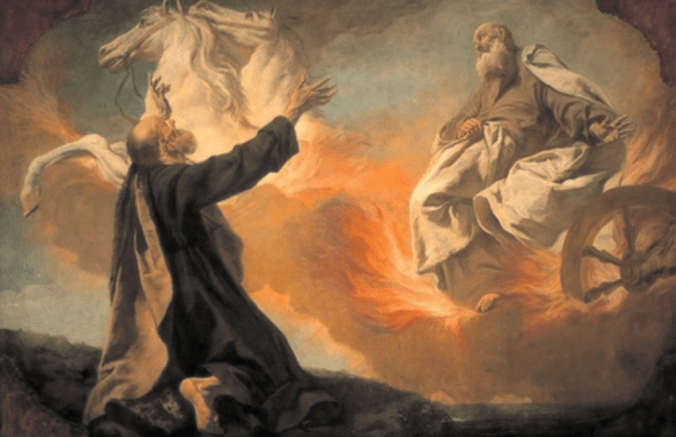
Elijah was transported to heaven in a whirlwind. The “chariot of fire” drawn by “horses of fire” symbolized the national security that Elijah had provided by his spiritual leadership (2 Kings 2:11). As Elijah was taken up in the whirlwind, Elisha tore his clothes and cried, “My father, my father, the chariots of Israel and its horsemen!” (2 Kings 2:12). Elisha grieved at the loss of Elijah who had been a defense more powerful than war chariots and their horses. However, like Elijah before him, Elisha himself would become the chariot of Israel and its horsemen (cf. 2 Kings 13:14).

What confirmation did Elisha receive regarding the matter of his request?
As Elijah was taken up in the whirlwind, his mantle fell to the ground. Elisha picked up his master’s mantle and returned to the banks of the Jordan. Once there he struck the waters with the mantle and parted the waters (2 Kings 2:13-14). The sons of the prophets who witnessed these events recognized and acknowledged that “the spirit of Elijah rests on Elisha” (2 Kings 2:15). These men then humbly bowed before Elisha.

What did the sons of the prophets request of Elisha?
The sons of the prophets asked permission to search for the body of Elijah (2 Kings 2:16-18). Elisha reluctantly consented. A group of fifty “searched three days, but did not find him” (2 Kings 2:17). This event probably served to authenticate Elisha’s call to be Elijah’s successor.

What two miracles did Elisha perform (that helped to authenticate his call as Elijah’s successor)?
First, the men of Jericho complained to Elisha about the bad water supply of the area. It should be noted that the leaders of the city had enough confidence in Elisha to approach him with their concern. The water was so bad that the land was unfruitful. Elisha purified the waters so that they would no longer be the cause of death and unfruitfulness (2 Kings 2:19-22).

Second, as Elisha journeyed from Jericho to Bethel (the center of idolatrous worship), he was mocked by a large group of boys (2 Kings 2:23). These boys mocked Elisha (which was probably an accurate reflection of how the entire community felt about God’s prophets). Elisha “cursed them in the name of the Lord” and consequently two female bears emerged from the woods and injured forty-two of the boys (2 Kings 2:24). This probably served as a lesson to the boys and the entire community of the importance of respecting the prophets of God.

Practical Considerations

God’s work must go on.
When a servant of God dies or is called to a new field of service the work of God must go on. God prepares people to carry on His work in such cases. Oftentimes, a dynamic new leader emerges to successfully carry on the work of ministry.

God’s servants are worthy of respect.
We must be careful how we treat God’s servants. The young boys who mocked Elisha paid a heavy price for their disrespect. The writer of Hebrews said (13:17), “Obey your leaders, and submit to them; for they keep watch over your souls, as those who will give an account. Let them do this with joy and not with grief, for this would be unprofitable for you.”

2 Kings 1

Who was Ahaziah?
[A] The son of Ahab (1 Kings 22:51). He succeeded his father as king over Israel (1 Kings 22:40, 51).

[B] “And he did evil in the sight of the Lord and walked in the way of his father and in the way of his mother…” (1 Kings 22:52). Ahaziah is the only king of which the writer noted that he walked “in the way of his mother.” Ahaziah’s evil mother, Jezebel, was still living when he ascended the throne and surely continued to exert her evil influence over her son. As for “the way of his father,” Ahaziah apparently failed to learn from all of the acts of God performed during his father’s reign. Two godless parents raised poor Ahaziah.

[C] He served and worshiped Baal (1 Kings 22:53). Ahaziah knew about the God of Israel but chose instead to serve Baal and in so doing “provoked the Lord God of Israel to anger according to all that his father had done” (1 Kings 22:53).

[D] He reigned two years over Israel (2 Kings 22:51).

What initial trouble did Ahaziah face when he became king?
As soon as Ahab died Moab rebelled against Israel (2 Kings 1:1). The Moabites had been vassals to Israel since the time of David. They saw Ahab’s death as an opportunity to cast off their yoke of tribute.

Why was Ahaziah unable to suppress the Moabite revolt?
Ahaziah was unable to suppress the revolt because he was incapacitated by a fall from his upper chamber which was in Samaria (2 Kings 1:2).

What course of action did Ahaziah take to ascertain the outcome of his health?
Ahaziah sent messengers to the Philistine city Ekron to inquire of Baal-zebub (the lord of the flies) regarding whether he would recover from his injury (2 Kings 1:2). This action was a direct violation of the first commandment (Exodus 20:3) and the prohibitions of Leviticus 20:6 and Deuteronomy 18:14. This was nothing less than a public declaration that the king placed and sought the counsel of a Philistine god above the God of Israel. It is no wonder why Ahaziah “provoked the Lord God of Israel to anger” (1 Kings 22:53).

What course of action did God take to hold the king accountable for his foolish decision to send messengers to inquire of Baal-zebub?
God sent Elijah to intercept the king’s messengers. Elijah confronted them and asked, “Is it because there is no God in Israel that you are going to inquire of Baal-zebub, the god of Ekron?” (2 Kings 1:3). A convicting question, to say the least. Ahaziah did not turn to God in his distress, but to a heathen idol. Someone has said, “The man who has forsaken God is without refuge in his distress.”

Elijah then pronounced God’s judgment upon the wicked and idolatrous Ahaziah: “You shall not come down from the bed where you have gone up, but you shall surely die” (2 Kings 1:4). Elijah’s words made such an impression on Ahaziah’s messengers that they did not fulfill their errand, but returned at once to their bed-ridden king (2 Kings 1:5).

What report did Ahaziah’s messengers deliver to him upon returning?
The messengers reported to Ahaziah exactly what happened and exactly what Elijah had said to them (2 Kings 1:6). The messengers referred to Elijah as “a man” who met them on the road. Ahaziah asked, “What kind of man was he who came up to meet you and spoke these words to you?” (2 Kings 1:7). The messengers described the man in detail (2 Kings 1:8) and the king said, “It is Elijah the Tishbite.” Ahaziah would have gladly received and accepted any word from Baal-zebub, but was unwilling to receive any word from God!

What did Ahaziah attempt to do to Elijah?
[A] Ahaziah decided to capture the prophet. He appointed “a captain of fifty with his fifty” (2 Kings 1:9) to find the prophet and bring him back to Samaria. They found Elijah, a lone figure on a hill, and commanded him to return with them to the king. Elijah instead called down fire from heaven, which consumed the entire military company (2 Kings 1:10).

[B] The king then sent out another group of fifty, which met the same fate as the first group (2 Kings 1:11-12).

[C] Finally, a third group of fifty went to Elijah. The captain of this group bowed before Elijah and pleaded for mercy for himself and his men (2 Kings 1:13-14). Elijah, having been instructed by an angel, accompanied this group to the king (2 Kings 1:15) where Elijah simply repeated the message of God’s judgment upon the king (2 Kings 1:16).

What happened to Ahaziah?

[A] “So Ahaziah died according to the word of the Lord which Elijah had spoken” (2 Kings 1:17).

[B] Jehoram, Ahaziah’s younger brother, became king in his place because he had no son (2 Kings 1:17).

Practical Considerations

Both parents influence children.
Ahaziah was influenced to do evil by both his father and his mother. In some cases, the evil influence of one parent is offset by the godly influence of the other. In Ahaziah’s case however, he was influenced to do evil by both parents. God will hold parents accountable for their influence on their children.

We should seek the Lord in times of distress.
When Ahaziah was severely injured as a result of a fall from an upper story chamber, he did not turn to the Lord. He sought the counsel of a pagan system and did not acknowledge the Lord in any way. Many people do not turn to the Lord in their distress but to the god of Ekron. Many people today turn to the Ekron god of their own resources and pride and try to deal with their distress with their limited strength and understanding. “The man who has forsaken God is [indeed] without refuge in his distress.”

God will hold men accountable for their insolent foolishness.
Ahaziah’s foolish action of seeking the counsel of a pagan idol did not go unnoticed by God. The king’s action declared that he did not acknowledge the God of Israel. Ahaziah’s blatant disregard for God and His Word brought a severe judgment upon him.

Isaiah 66

Terrible Judgment and Great Salvation

66:1-6
What message did God declare to the repatriates regarding the temple and their worship practices?
The message of Isaiah 66:1-4 is addressed to the repatriates who felt the temple needed to be rebuilt in order to provide a dwelling place for God. The message of these verses should not be seen as condemning the rebuilding of the temple, but rather a woefully inadequate view of God.

Verse 1 contains two questions. The first question challenges the listeners to consider the folly of building a temple to house God whose throne is heaven and whose footstool is the earth.

The second question is answered in verse 2. God’s dwelling place is not in houses made with hands but in humble and contrite hearts of men who revere His word. God also expresses His displeasure with the corrupt worship system of the people, which still has noticeable traces of pagan syncretism (66:3).

Verse 3 states that those involved in such practices have chosen their ways above God’s ways. In response, God declares that He will choose their punishments. God will hold accountable all men who are a party to faithless and corrupt worship.

Practical Considerations: Believers should choose God’s way over their own way.
The Bible teaches that God is interested in our choices. Isaiah spoke condemning words to those who chose their own ways above God’s ways. They would experience the judgment of God as a result. We should choose God’s ways above our own. We should choose those things that are pleasing in His sight.

Verses 5-6 announce the judgment that will befall those religious and political leaders involved in casting out (excommunicating) the righteous from the temple. They mistakenly think that they are rendering a service to God (“Let the Lord be glorified”) but will themselves be put to shame on the day of God’s judgment.

66:7-17
What lay in store for Jerusalem?


These verses employ the metaphor of motherhood to describe Jerusalem’s future. Verses 7-9 declare that Jerusalem will give birth to a new citizenry (66:7) without experiencing labor pains. To the skeptics who deny that such a thing is possible (66:8) God affirms that He will bring to completion what He has begun (66:9).

Those who love and mourn over Jerusalem are invited to rejoice for Jerusalem’s coming blessings. The righteous will be suckled, nourished, and comforted at her breast (66:11-13). God will vindicate Jerusalem and His servants and destroy His enemies (66:14-16) and all who continue to practice idolatry (66:17).

66:18-24
What is the concluding message of the book of Isaiah?
The concluding message of the book of Isaiah is both hopeful and somber. God declares that He will gather all nations and tongues that they might see His glory (66:18) and go forth as evangelists declaring that glory (66:19). They will also bring back to Jerusalem their brethren by every available means of transportation (66:20-21).

God promises that both Jerusalem’s descendants and name will endure (66:22) and that they will worship Him (66:23). Those who transgress against the Lord and fail to worship and serve Him will experience severe punishment (66:24). Thus ends the book of Isaiah on a somber note that challenges us to choose to worship, honor, and serve God.

Isaiah 65

God’s Answer to the Prayer

65:1-25
What was God’s answer to the prophet’s prayer?
God reminded the prophet of several things.

First, He reminded the prophet of how He had called and waited for His people with open arms (65:1-2).

Second, He reminded the prophet of how His people had engaged in abominable religious practices (65:3-5).

Third, He reminded the prophet that He had taken note of the rebellion and that the people would be repaid for their iniquities (65:6-7).

Fourth, God announced to the prophet that He would deal graciously with His people because of the presence of a righteous remnant (65:8-10).

Fifth, God announced to the prophet that the unrighteous would be condemned (65:11-12) and not enjoy the privileges and blessings of the righteous (65:13-16).

Sixth, God revealed to the prophet something of the glorious destiny awaiting His people (65:17-25). That glorious destiny includes the creation of a new heaven and earth (65:17), the elimination of sorrow (65:18-19), the promise of long lives (65:20), the enjoyment of the fruit of one’s labor (65:21-23), the promise of answered prayers (65:24), and harmony on the earth (65:25).

Isaiah 64

The Prophet’s Intercessory Prayer

63:15-64:12
What did the prophet ask God to do?
The prophet asked God to “Look down from heaven” (63:15) and to “come down” from heaven (64:1). The prophet asked God to look down from heaven to behold the condition of His people and the temple, both of which were in a ruined condition (63:15-19 and 64:10-11). The prophet confessed the sins of the people (64:5) and asked God to come down in a mighty display of power as in the days of old (recalled in 63:7-14) to rescue His people from their present distress (64:1-12).