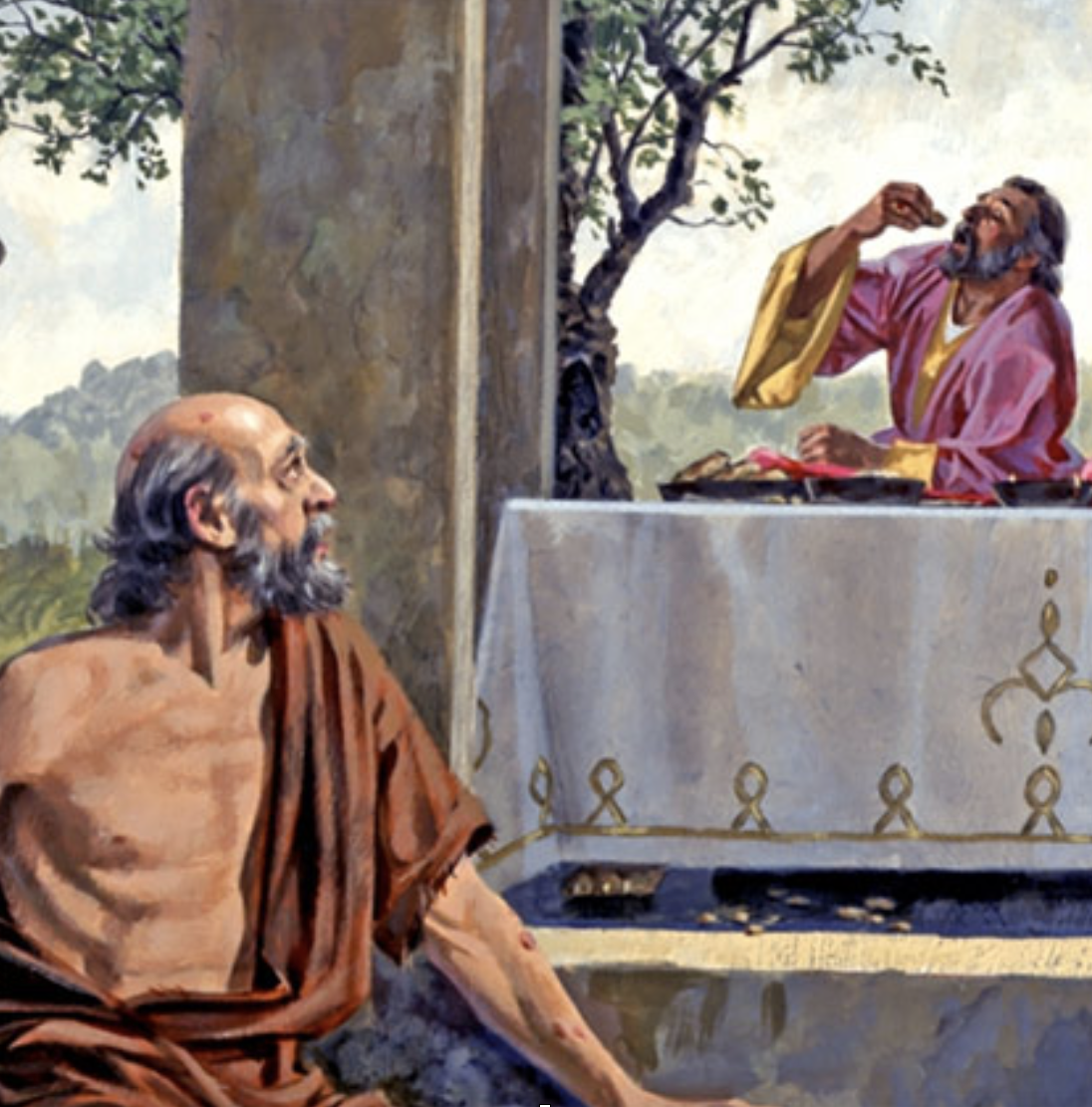
Luke 7 ft

7:1 When Jesus had finished saying all this in the hearing of the people, he entered Capernaum [large city located on northwestern shore of Sea of Galilee].

7:2 There a centurion’s [Roman military office in charge of 100 men] servant, whom his master valued highly, was sick [“paralyzed and in terrible suffering” as per Matt. 8:6] and about to die.

7:3 The centurion heard of Jesus [likely had heard of Jesus’ healing power] and sent some elders [dealing with centurion’s messengers same as dealing with the centurion] of the Jews to him, asking [centurion’s request indicates he believed Jesus had the power to heal his servant] him to come and heal his servant.

7:4 When they [“elders of the Jews” (7:3)] came to Jesus, they pleaded earnestly [shows how much they appreciated and respected the centurion] with him, “This man deserves to have you do this,

7:5 because he loves our nation and has built [probably provided financial support; indicates the centurion’s interest in the worship of God] our synagogue.”

7:6 So Jesus went with them. He was not far from the house [Jews not allowed to enter homes of Gentiles] when the centurion sent friends to say to him: “Lord [shows centurion’s respect for Jesus], don’t trouble yourself, for I do not deserve to have you come under my roof.

7:7 That is why I did not even consider myself worthy to come to you. But say the word [Jesus did not need medicines or rituals or even to be present in order to heal], and my servant will be healed.

7:8 For I myself am a man under authority [centurion understood what it meant to obey others as well as to be obeyed by those under his command], with soldiers under me. I tell this one [Roman soldiers were trained to obey orders unquestioningly], ‘Go,’ and he goes; and that one, ‘Come,’ and he comes. I say to my servant, ‘Do this,’ and he does it.”
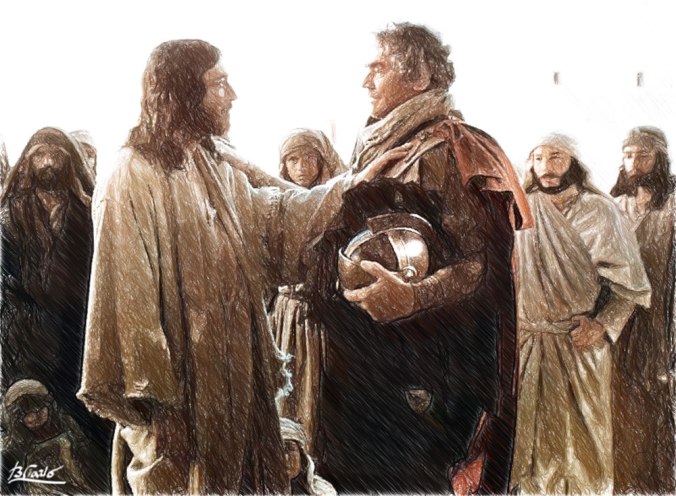
7:9 When Jesus heard this, he was amazed [cf. Mk. 6:6 where Jesus was “amazed” at the lack of faith of the Jews] at him, and turning to the crowd following him, he said, “I tell you, I have not found such great faith [cf. the “great faith” of the Canaanite woman whose daughter Jesus delivered from demon-possession (at a distance as in the case of the centurion’s servant); cf. Jn. 4:46-54 re: Jesus healing the son of a royal official at a distance] even in Israel.”

7:10 Then the men who had been sent returned to the house and found the servant well [“his servant was healed at that very hour” (Matt. 8:13)].

7:11 Soon afterward, Jesus went to a town called Nain [located about 25 miles from Capernaum], and his disciples and a large crowd went along with him.

7:12 As he approached the town gate, a dead person [the Jews buried their dead on the same day (Deut. 21:23; Acts 5:5-10)] was being carried out [funeral procession heading for burial ground]—the only son [Jesus too, was an “only Son” (Jn. 3:16)] of his mother, and she was a widow [one of the most vulnerable members of society]. And a large crowd [relatives of the dead person, hired mourners, bystanders] from the town was with her.

7:13 When the Lord saw her, his heart went out to her and he [the “man of sorrows” (Isa. 53:3); Jesus could identify with the widow’s suffering] said, “Don’t cry [a difficult request under the circumstances].”

7:14 Then he went up and touched [would result in ceremonial defilement according to the law (cf. Num. 19:11-22)] the coffin [death is “the last enemy” (1 Cor. 15:26); probably an open stretcher], and those carrying it stood still. He said, “Young man, I say to you, get up!”

7:15 The dead man [note two evidences of life…] [1] sat up and [2] began to talk [we are not told what the man said], and Jesus gave him back to his mother [cf. 1 Kings 17:23 re: Elijah bringing the widow of Zarephath’s only son back to life].

7:16 They [those present who witnessed this miracle] were all filled with awe and praised God. “A great prophet [cf. Deut. 18:15; Jn. 1:21; Acts 3:22-23] has appeared among us,” they said. “God has come to help his people.”

7:17 This news about Jesus spread throughout Judea [throughout “the land of the Jews”] and the surrounding country.

7:18 John’s disciples told him [John was in prison (Lk. 3:19-20)] about all these things [the things Jesus was doing and saying]. Calling two of them,

7:19 he sent them to the Lord to ask, “Are you the one who was to come [the promised Messiah], or should we expect someone else?”

Note: Other spiritual leaders who had periods of doubt and uncertainty include…
• Moses Numbers 11:10-15
• Elijah 1 Kings 19
• Jeremiah Jeremiah 20:7-9,14-18
• Paul 2 Corinthians 1:8-9

7:20 When the men came to Jesus, they said, “John the Baptist sent us to you to ask, ‘Are you the one who was to come [the promised Messiah], or should we expect someone else?'”

7:21 At that very time Jesus [note the credentials (observable deeds) that Jesus offered to John’s disciples…] cured many who had diseases, sicknesses and evil spirits, and gave sight to many who were blind [cf. Isa. 29:18-19; 35:4-6; 42:1-7; 61:1].

7:22 So he replied to the messengers [John’s disciples], “Go back and report to John what you have seen and heard: The blind receive sight, the lame walk, those who have leprosy are cured, the deaf hear, the dead are raised, and the good news is preached to the poor.

7:23 Blessed is the man who does not fall away [offended] on account of me.”

7:24 After John’s messengers left, Jesus began to speak [what Jesus thinks of us is more important than what others think or say about us] to the crowd about John: “What did you go out into the desert to see? A reed [weak and vulnerable to the wind; suggests an individual without backbone or moral fiber] swayed by the wind [cf. Eph. 4:14]?

7:25 If not, what did you go out to see? A man dressed in fine clothes? No [cf. Matt. 3:4 re: John’s attire], those who wear expensive clothes and indulge in luxury are in palaces.

7:26 But what did you go out to see? A prophet? Yes, I tell you, and more [because of his key role in introducing the Messiah (cf. Jn. 1:15)] than a prophet [John was the last of the OT prophets].

7:27 This is the one about whom it is written [John was a prophet whose ministry was prophesied]: ” ‘I will send my messenger ahead of you, who will prepare your way [this expression anticipates the arrival of a king] before you [cf. Isa. 40:3; Mal. 31].’

7:28 I tell you, among those born of women there is no one greater than John [the forerunner of the Messiah]; yet the one [believer] who is least in the kingdom of God is greater [not in character or ministry, but in being children of the King whom John introduced] than he.”

7:29 (All the people [the crowds], even the tax collectors [hated and ostracized members of society], when they heard Jesus’ words, acknowledged that God’s way was right [agreed with what God said about them (cf. Ps. 51:4)], because they had been baptized [proof of their repentance] by John.

7:30 But the Pharisees and experts in the law rejected God’s purpose for themselves, because they had not been baptized by John [they rejected John and his message].)

7:31 “To what, then, can I compare the people of this generation [those who had rejected John the Baptist and Jesus]? What are they like?

7:32 They are like children sitting in the marketplace [the place where the town’s business was conducted, usually centrally located in a community] and calling out to each other [the children called their friends to join them at play; note two extremes…]: “‘We played the flute for you, and you did not dance [the children invited others to play “wedding” but their invitation to play was ignored]; we sang a dirge, and you did not cry [the children invited others to play “funeral” but their invitation to play was ignored].’

7:33 [note two extremes in 7:33-34…] [1] For John the Baptist came neither eating bread [John fasted] nor drinking wine [John was an ascetic], and you say, ‘He has a demon.’

7:34 [2] The Son of Man [Jesus] came eating and drinking [Jesus interacted with others and enjoyed life], and you say, ‘Here is a glutton and a drunkard, a friend of tax collectors and “sinners.” ‘ [7:33-34 illustrate that some were so stubborn that they refused to listen to either John or Jesus]

7:35 But wisdom [personified as a woman (cf. Prov. 1:20; 4:6; 7:4; 8:1)] is proved right [justified] by all her children [the followers of Jesus and John who lived changed lives (their lives affirmed the validity of what Jesus and John taught)].”

7:36 Now one of the Pharisees invited Jesus to have dinner with him, so he went to the Pharisee’s house and reclined at the table [customary way to sit at a formal meal].

7:37 When a woman [do not confuse this event with the one involving Mary of Bethany (Jn. 12:1-8); do not confuse this woman with Mary Magdalene (Lk. 8:2; Mk. 16:9)] [text does not specify her sins; she obviously had a bad reputation] in that town learned that Jesus was eating at the Pharisee’s house, she brought an alabaster jar [an expensive and beautiful carved jar] of perfume,

7:38 and as she stood behind [those who “reclined at the table” sat with their feet stretched behind them] him at his feet weeping [evidence that she was a repentant sinner], she began to wet his feet with her tears. Then she wiped them with her hair, kissed them and poured perfume on them.

7:39 When the Pharisee who had invited him saw this, he said to himself [these words were not spoken aloud], “If this man were a prophet, he would know who is touching him and what kind of woman she is—that she is a sinner [it is always easier to look at others and to say that they are sinners, rather than to admit that we are sinners].”

7:40 Jesus answered him [indicates Jesus knew what Simon had been thinking to himself (7:39)], “Simon, I have something to tell you.” “Tell me, teacher,” he said.

7:41 “Two men owed money to a certain moneylender [creditor]. One owed him five hundred denarii [a denarius was a day’s wage for a laborer], and the other fifty.

7:42 Neither of them had the money to pay him back [a difficult and vulnerable position to be in (cf. Matt. 18:21-35)], so he canceled the debts of both. Now which of them will love him more?”

7:43 Simon replied, “I suppose the one who had the bigger debt canceled.” “You have judged correctly,” Jesus said.

7:44 Then he turned toward the woman and said to Simon, “Do you see [Simon saw her past; Jesus saw her future] this woman? I came into your house [notice three courtesies that Simon neglected to extend to Jesus…]. [1] You did not give me any water for my feet [washing the feet of guests was the job of a slave], but she wet my feet with her tears and wiped them with her hair.

7:45 [2] You did not give me a kiss, but this woman [the woman did what Simon neglected to do], from the time I entered, has not stopped kissing my feet.

7:46 [3] You did not put oil on my head, but she has poured perfume on my feet.

7:47 Therefore, I tell you, her many sins have been forgiven—for she loved much [cf. Gal. 5:6b]. But he who has been forgiven little loves little.”

7:48 Then Jesus said to her, “Your sins are forgiven.”

7:49 The other guests began to say among themselves, “Who is this who even forgives sins [Pharisees believed that God alone could forgive sins]?”

7:50 Jesus said to the woman, “Your faith [not her tears or her gift but rather her total trust in Jesus as the only one who could forgive her sins and save her; cf. Eph. 2:8-9] has saved you; go in peace [cf. Rom. 5:1].”

Luke 8

NIV

8:1 After this, Jesus traveled about from one town and village to another, proclaiming the good news of the kingdom of God. The Twelve were with him,


8:2 and also some women who had been cured of evil spirits and diseases: Mary (called Magdalene) from whom seven demons had come out;


8:3 Joanna the wife of Chuza, the manager of Herod’s household; Susanna; and many others. These women were helping to support them out of their own means.

8:4 While a large crowd was gathering and people were coming to Jesus from town after town, he told this parable:

8:5  “A farmer went out to sow his seed. As he was scattering the seed, some fell along the path; it was trampled on, and the birds ate it up.

8:6 Some fell on rocky ground, and when it came up, the plants withered because they had no moisture.

8:7 Other seed fell among thorns, which grew up with it and choked the plants.

8:8 Still other
[of the same kind] seed fell on good soil. It came up and yielded a crop [design and intent of the sower], a hundred times more than was sown.” When he said this, he called out, “He who has ears to hear [spiritual capacity], let him [personal responsibility] hear [ponder the parable and make appropriate application].”

8:9 His disciples asked him what this parable meant.

8:8 Still other [of the same kind] seed fell on good soil. It came up and yielded a crop [design and intent of the sower], a hundred times more than was sown.” When he said this, he called out, “He who has ears to hear [spiritual capacity], let him [personal responsibility] hear [ponder the parable and make appropriate application].”

8:9 His disciples asked him what this parable meant.

8:10 He said, “The knowledge of the secrets of the kingdom of God has been given to you, but to others I speak in parables[parables used to reveal truth (make it clearer) to those who wanted to understand and conceal it from those who only wanted to criticize/reject it], so that, “ ‘though seeing, they may not see; though hearing, they may not understand.’

8:11 “This is the meaning of the parable: The seed is the word of God.

8:12 Those along the path [hard, packed path; heart made hard by the traffic of the world] are the ones who hear [“the message about the kingdom” (Matt. 13:19)], and then the devil [Satan] comes and takes [to rob/plunder] away [before person really understands it and has an opportunity to believe] the word from their hearts [heart represents soil; the place of decision], so that they may not believe and be saved.

8:13 Those on the rock [thin layer of dirt on top of solid rock, allowing no chance for deep roots that enable plants to survive] are the ones who receive [immediately and impulsively] the word with joy when they hear it, but they have no root [superficial response to the gospel with temporary results; no inner conviction; no root means no fruit]. They believe [profess to follow Christ] for a while [temporary], but in the time of testing [pressure, affliction associated with accepting and following Christ] they fall [Gr. skandalizo: to stumble over] away [cf. John 6:66 re: crowds in Galilee who ceased to follow Jesus when He made demands on them] .

8:14 The seed [nothing wrong with either seed or sower] that fell among thorns [grow quickly, absorb nutrients, and choke out life] stands for those who hear, but as they go on their way they are choked by [note the competing thorns] [1] life’s worries [undue cares/ concerns; preoccupations/distractions], [2] riches [cf. 1 Tim. 6:9 and Matt. 6:24; the good life; see 2 Tim. 4:10 re: Demas and his love for the world] and [3] pleasures, and they do not mature.

8:15 But the seed [same as the seed that fell on other soils] on good soil stands for those with a noble and good heart, who hear the word, retain it, and by persevering produce a crop [because of obedience to what he has heard].


8:16 “No one lights a lamp [small oil-filled lamps used to illuminate home] and hides it in a jar or puts it under a bed. Instead, he puts it on a stand [visible location], so that those who come in can see the light [dispels darkness; light enables others to see what they otherwise would be unable to see; those who possess the light are to transmit the light; Christ is the true “light of the world” (Jn. 8:12); believers cannot shine apart from Christ].

8:17 For there is nothing hidden that will not be disclosed, and nothing concealed that will not be known or brought out into the open.

8:18 Therefore consider carefully how you listen [to the Word of God]. Whoever has
[those who listen and understand the words of Jesus] will be given more; whoever does not have [those who fail to listen and understand the words of Jesus], even what he thinks he has will be taken from him.”

8:19 Now Jesus’ mother [Mary (cf. 1:30-31)] and brothers [the other children of Mary and Joseph (cf. Mk. 6:3-4); Jesus’ half-brothers (cf. Matt. 13:55-56; Acts 1:14)] came to see him [Mk. 3:21 records that they thought Jesus was out of His mind], but they were not able to get near him because of the crowd.

8:20 Someone told him, “Your mother and brothers are standing outside, wanting to see you.”

8:21 He replied, “My mother and brothers [i.e., those closest to Jesus] are [note the binding nature of spiritual relationships…] those who hear God’s word and put it into practice.”

8:22 One day Jesus said to his disciples, “Let us go over to the other side of the lake.” So they got into a boat and set out.


8:23 As they sailed, he fell asleep. A squall came down on the lake, so that the boat was being swamped, and they were in great danger.

8:24 The disciples went and woke him, saying, “Master, Master, we’re going to drown!” He got up and rebuked the wind and the raging waters; the storm subsided, and all was calm.

8:25 “Where is your faith?” he asked his disciples. In fear and amazement they asked one another, “Who is this? He commands even the winds and the water, and they obey him.”

8:26 They sailed to the region of the Gerasenes, which is across the lake from Galilee.


8:27 When Jesus stepped ashore, he was met by a demon-possessed man from the town. For a long time this man had not worn clothes or lived in a house, but had lived in the tombs.

8:28 When he saw Jesus, he cried out and fell at his feet, shouting at the top of his voice, “What do you want with me, Jesus, Son of the Most High God? I beg you, don’t torture me!”

8:29 For Jesus had commanded the impure spirit to come out of the man. Many times it had seized him, and though he was chained hand and foot and kept under guard, he had broken his chains and had been driven by the demon into solitary places.

8:30 Jesus asked him, “What is your name?”
“Legion,” he replied, because many demons had gone into him.


8:31 And they begged Jesus repeatedly not to order them to go into the Abyss.

8:32 A large herd of pigs was feeding there on the hillside. The demons begged Jesus to let them go into the pigs, and he gave them permission.

8:33 When the demons came out of the man, they went into the pigs, and the herd rushed down the steep bank into the lake and was drowned.

8:34 When those tending the pigs saw what had happened, they ran off and reported this in the town and countryside,

8:35 and the people went out to see what had happened. When they came to Jesus, they found the man from whom the demons had gone out, sitting at Jesus’ feet, dressed and in his right mind; and they were afraid.


8:36 Those who had seen it told the people how the demon-possessed man had been cured.

8:37 Then all the people of the region of the Gerasenes asked Jesus to leave
[compare with the reception Jesus received when returned to Capernaum in verse 40] them, because they were overcome with fear. So he got into the boat and left.

8:38 The man from whom the demons had gone out begged to go with him, but Jesus sent him away, saying,

8:39 “Return home and tell how much God has done for you.” So the man went away and told all over town how much Jesus had done for him.

8:40 Now when Jesus returned
[from across the Sea of Galilee; likely arrived at Capernaum], a crowd welcomed him [compare with the reception Jesus received when he visited region of the Gerasenes (verse 37)], for they were all expecting him [the people expectantly waited for and looked for Jesus; among the crowd were two people who were fighting personal battles with fears and doubts; a reminder that you never know who is in the crowd and what they are dealing with (Prov. 14:13)].

8:41 Then a man
[among the crowd waiting for Jesus to return] named Jairus [a man facing the worst thing a parent could face, the impending death of his daughter; desperation had driven him to look for Jesus; his name means “he will awaken”], a synagogue leader [a layman with assigned responsibilities that included the care of the scrolls, caring for the building, assisting with the distribution of alms, and scheduling rabbis to teach on the Sabbath], came and fell at Jesus’ feet [a sign of humility and also respect and ultimately desperation], pleading [a sign of desperation] with him to come to his house [he wanted the presence of Jesus in his home]

8:42 because his only [precious and irreplaceable] daughter, a girl of about twelve, was dying [a nightmare for a parent].

As Jesus was on his way
[Jesus honored Jairus’ desperate plea for help], the crowds [followed Jesus, perhaps out of curiosity or to see what Jesus would do] almost crushed [suggests the crowd may have been large] him.

8:43 And a woman
[tradition says she was from Caesarea Philippi and traveled to Capernaum to find Jesus] was there [among the crowd] who had been subject to bleeding for twelve years [this condition made her ceremonially unclean (Lev. 15:25-33) and ultimately drove her to seek Jesus], but no one [an indication that she had exhausted all possible avenues for healing] could heal her [according to Mark 5:25, she had spent all that she had on medical care; doctors had tried but failed; her conditioned had only grown worse].

8:44 She came up behind him
[perhaps she thought that Jesus would not touch her because of her uncleanness] and touched the edge of his cloak [see Mark 6:56 and Acts 19:11-12 regarding people who believed that the clothes of a holy man imparted healing; Malachi (4:2) spoke of “the sun of righteousness” — a reference to the Messiah — and said that when he arrived there would be healing in his wings; the wings, among other things, is a reference to the edge or corner of a garment; the fact that the woman touched the wings of Jesus’ garment may indicate her belief that He was the Messiah and therefore there was healing in His wings; she specifically and intentionally touched the wings or edge of his garment], and immediately [speaks to the power that flowed from Jesus] her bleeding stopped [she was no longer in pain; she knew that she had been healed in and instant; touching the edge of Jesus’ cloak accomplished what no doctor was able to do].

8:45
[Jesus knew immediately about the healing] “Who touched me?” [seemed like a strange question to ask in the middle of a crowd; Jesus knew who had touched Him but wanted that person to step forward] Jesus asked.
When they all denied it [
perhaps because no one had intentionally touched Jesus], Peter said [stated the obvious], “Master, the people are crowding and pressing against you.”

8:46 But Jesus said, “Someone
[one person not many] touched [in a purposeful way and not just the press of the crowd] me; I know that power has gone out from me [this is why Jesus knew that someone had touched him with a specific intention].”

8:47 Then the woman, seeing that she could not go unnoticed
[or could not slip away], came trembling and fell at his feet [a sign of humility]. In the presence of all the people [what she had done privately she confessed publicly], she told why she [in her state of uncleanness] had touched him [a rabbi and a man] and how she had been instantly healed [the woman knew she was healed].

8:48 Then he said
[Jesus was kind in His response] to her, “Daughter [a tender expression; she was one of two daughters Jesus would help on that day], your faith [which she had properly placed in Jesus] has healed [physically but also emotionally (imagine the tears she had cried over the years) and mentally (imagine the anxiety that had kept her up so many nights)] you. Go in peace [she had come out of desperation and could now leave in peace].”

8:49 While Jesus was still speaking
[with the woman who had interrupted His walk to Jairus’ house], someone [who knew that Jairus had left home to find Jesus] came from the house of Jairus, the synagogue leader. “Your daughter is dead,” [the worst possible news] he said. “Don’t bother the teacher anymore [the messenger did not see any reason for Jairus to bring Jesus to his home; he had likely not heard that Jesus had raised a young man from the dead in a town called Nain (Luke 7:11-15)].”

8:50 Hearing this, Jesus said to Jairus, “Don’t be afraid; just believe
[Jesus had commended the woman with the issue of blood for her faith and now told Jairus to have faith; desperation had driven both the woman and Jairus to seek help from Jesus], and she will [this word speaks of certainly] be healed [the fact that the little girl was dead did not deter Jesus because He has power over death].”

8:51 When he arrived
[indicates that Jairus continued to believe because he led Jesus to his home in spite of the fact that his daughter was dead] at the house of Jairus, he did not let anyone [the crowd followed Jesus all the way to Jairus’ house where there were others who were present] go in with him except Peter, John and James [these three disciples were Jesus’ inner circle (the only ones to see the transfiguration (Matt. 17:1; Mk. 13:3 and 14:33)], and the child’s father and mother.

8:52 Meanwhile, all the people
[family, neighbors, possibly professional mourners, the crowd that had followed Jesus] were wailing and mourning [the expression of grief was a way for people to show respect for Jairus and his family] for her. “Stop wailing,” Jesus said. “She is not dead but asleep [a metaphor for death and a way to indicate that her condition was temporary].”

8:53 They laughed at him
[perhaps thinking that Jesus was misinformed about the girl’s condition], knowing that she was dead [the people could not see beyond the actualities to see the possibilities offered by the presence of Jesus].

8:54 But he took her by the hand
[Jesus defied Jewish ceremonial law by touching the dead girl, something that would have made Him unclean] and said, “My child, get up! [Jesus’ command changed everything]

8:55 Her spirit returned, and at once she stood up
[the girl came back to life healed and whole]. Then Jesus told them to give her something to eat.

8:56 Her parents were astonished, but he ordered them not to tell anyone what had happened
[telling others might cause them to see Jesus as only a miracle worker and miss the fact that He had come to heal broken spiritual lives].

Luke 9

9:1 When Jesus had called the Twelve [cf. Lk. 6:13-16] together, he gave them power [“Divine work can only be accomplished in dependence upon divine power.” (Watchman Nee)] and authority [the right to accomplish a task] to drive out all demons and to cure diseases,

9:2 and he sent them out [“two by two” as per Mk. 6:7] to preach [to proclaim or herald a message] the kingdom of God and to heal the sick [healing authenticated their ministry].

9:3 He told them: “Take nothing for the journey [travel light]—no staff [aided in walking long distances and could also be used for protection], no bag [used to carry supplies; beggars often carried bags], no bread, no money, no extra tunic.

9:4 Whatever house you enter [an indication of hospitality], stay there [do not move to a better or more comfortable place should the opportunity present itself] until you leave that town.

9:5 If people do not welcome you [warning to expect opposition], shake the dust off your feet [this action had strong cultural implications; indicated contempt for an area and no further involvement with the people of that area; cf. Lk. 10:10-11; Acts 13:51] when you leave their town, as a testimony against them.”

9:6 So they [six teams of two] set out and went from village to village, preaching the gospel and healing people everywhere.

9:7 Now Herod [Herod Antipas (a son of Herod the Great); had John the Baptist executed (Lk. 3:19-20; Matt. 14:1-12); Jesus taken to Herod before the Crucifixion (Lk. 23:6-12)] the tetrarch heard about all that was going on. And he was perplexed, because some were saying that John had been raised from the dead,

9:8 others that Elijah [the OT prophet taken to heaven in a whirlwind (2 Kings 2:1-11)] had appeared [some applied the prophecy in Mal. 4:5 applied to Jesus], and still others that one of the prophets [such as Moses, Isaiah, or Jeremiah] of long ago had come back to life.

9:9 But Herod said, “I beheaded John [cf. Matt. 14:1-12; Mk. 6:14-29]. Who, then, is this I hear such things about?” And he tried to see him.

9:10 When the apostles returned, they reported to Jesus what they had done. Then he took them with him and they withdrew by themselves to a town called Bethsaida [Andrew and his brother Simon and Philip were from Bethsaida (Jn. 1:44), a small town located on the northeast shore of the Sea of Galilee; name Bethsaida means “house of fish”],

9:11 but the crowds learned about it and followed [continuous action: kept following] him. He welcomed them and spoke to them about the kingdom of God, and healed those who needed healing.

9:12 Late in the afternoon the Twelve came to him and said [note that the Twelve essentially were unwilling to accept responsibility for the welfare of the crowd…], “Send the crowd away so they can go to the surrounding villages and countryside and find food and lodging, because we are in a remote place here.”

9:13 He replied [note that Jesus placed the responsibility for the welfare of the crowd on the shoulders of the Twelve…], “You give them something to eat.” They answered, “We have only five loaves of bread [“five small barley loaves” (Jn. 6:9), the cheapest of all grains; considered an inferior sort of bread] and two fish [probably small pickled fish]—unless we go and buy food for all this crowd.”

9:14 (About five thousand [indication of Jesus’ popularity] men were there.) But he said to his disciples, “Have them sit [recline; it was spring (cf. Jn. 6:4) and there was plenty of green (cf. Mk. 6:39) grass on hillside] down [to facilitate serving] in groups of about fifty each.”

9:15 The disciples did so, and everybody sat down.

9:16 Taking the five loaves and the two fish [meager human resources in divine hands] and looking up to heaven, he gave thanks [a reminder that God is the source of everything we have and need; important to express gratitude to God for providing for our material needs; similar to what was done by the head of each family at the Passover] and broke them. Then he gave them to the disciples [disciples involved in this process] to set before the people [many of these probably seldom had enough to eat].

9:17 They all ate and were satisfied [completely filled; suggests an ample supply of food], and the disciples picked up [good stewardship] twelve basketfuls [cf. Jn. 6:13 re: “baskets” from Gr. kophinos: usually denotes a large basket, such as might be used to carry bulky objects] of broken pieces [excess bread rather than scraps; the pieces broken by Jesus and not consumed (cf. Mk. 6:41); including leftover fish as per Mk. 6:43] that were left over [Jesus was and able to abundantly meet needs].

9:18 Once when Jesus was praying in private and his disciples were with him, he asked [the most significant question people must answer] them, “Who [asking questions was one of Jesus’ favorite means of teaching] do the crowds [popular opinion] say I am [Jesus used this question as an opportunity to clarify His mission to His disciples ; cf. Matt. 16:13: “Who do people say the Son of Man (Jesus’ favorite self description; a seldom used title for the Messiah) is?”]?”

9:19 They replied, “Some say John the Baptist [whose ministry brought great spiritual renewal in Israel ; executed by Herod Antipas who later thought Jesus was John raised from the dead (Matt. 14:1-2)]; others say Elijah [Jews considered Elijah their most honored prophet; some believed Jesus was Elijah appearing in fulfillment of end-time prophecy as per Mal. 4:5]; and still others, that one of the prophets [term falls short of who Jesus is; popular opinion failed to recognize Jesus for who He really is] of long ago has come back to life.”

9:20 “But what about you [ultimately every person must decide for themselves the answer to this question]?” he asked. “Who do you say I am?” Peter [acting as a spokesman] answered [correctly; cf. Matt. 16:17], “The [use of the article defines Christ as the one promised in the OT] Christ [the Greek equivalent for the Hebrew word Messiah (one anointed by God); many Jews were expecting a military leader] of God.”

9:21 Jesus strictly warned [to order, to instruct; strong prohibition] them not [until they fully comprehended His mission] to tell this [that He was the Christ; many Jews expecting an earthly Messiah different than the kind of Messiah Jesus was; to avoid “messianic misunderstanding”] to anyone.

9:22 And he said, “The Son of Man [Jesus’ favorite designation of Himself: links Him with the Son of Man mentioned in the OT] must [Jesus’ death was a divine necessity — God’s plan for His life — He voluntarily laid down His life] suffer many things and be rejected [as a result of fulfilling His mission] by [all the key Jewish religious leaders…] the elders [lay leaders; those who ruled the synagogues; responsible for religious and civil issues], chief priests [current and past; those in charge of temple worship — Sadducees] and teachers of the law [Pharisees; scribes or legal experts in the law], and he must be killed [Jesus had an awareness of His destiny] and on the third day be raised to life [see Mark 9:10; Jesus ultimate destiny was life, not death].”

9:23 Then he said to them all [His disciples (9:18)]: “If anyone would come after me [to be Jesus’ disciple], he must deny himself [willingness to let go of selfish desires or anything that would prevent complete commitment] and take up his cross [the cross meant one thing to Jesus: death; those who took up the cross in Jesus’ day went on “a one-way journey;” follow Jesus to death if necessary; die to selfish desires/ambitions; Jesus’ followers understood the meaning of the cross, the Roman instrument of execution] daily [as they faced new situations, new people, new challenges, new problems] and follow [to take the same road of self-denial and self-sacrifice as Jesus] me.

Note: “It is certainly the case that the Roman world was largely unanimous that crucifixion was a horrific, disgusting business.” (“Crucifixion” • by Martin Hengel • p. 37)

“But the executioner, the veiling of the head and the very word ‘cross’ should be far removed not only from the person of a Roman citizen but from his thoughts, his eyes and his ears.” (Crucifixion • by Martin Hengel • [Cicero quote] p. 42)

“Muhammad had such an extreme aversion to the cross that he broke everything brought into his house that had such a form.” (“Unveiling Islam” by Ergun & Emir Caner, p. 93)

9:24 For whoever wants to save his life [reflects attitude of those interested in holding on to earthly rewards and security; those who refuse to serve others] will lose it, but whoever loses his life [reflects attitude of one willing to give up earthly rewards and security] for me [for Christ and His kingdom] will save it.

9:25 What good [profit] is it for a man to gain [to win, to make a profit] the whole world, and yet lose or forfeit [to suffer loss, to suffer confiscation] his very self?

9:26 If anyone is ashamed of me and my words, the Son of Man will be ashamed of him when he comes in his glory and in the glory of the Father and of the holy angels.

9:27 I tell you the truth, some who are standing here will not taste death before they see [“before they see the Son of Man coming in his kingdom” (cf. Matt. 16:28)] the kingdom of God.”

9:28 About eight days after Jesus said this, he took [Jesus’ inner circle of disciples…] Peter, John and James [nicknamed “Sons of Thunder” (Mk. 3:17); James was the first disciple to be martyred (Acts 12:2)] with him and went up onto a mountain [exact site not identified; possibilities include Mount Tabor, Mount Hermon, and Mount Meron] to pray.

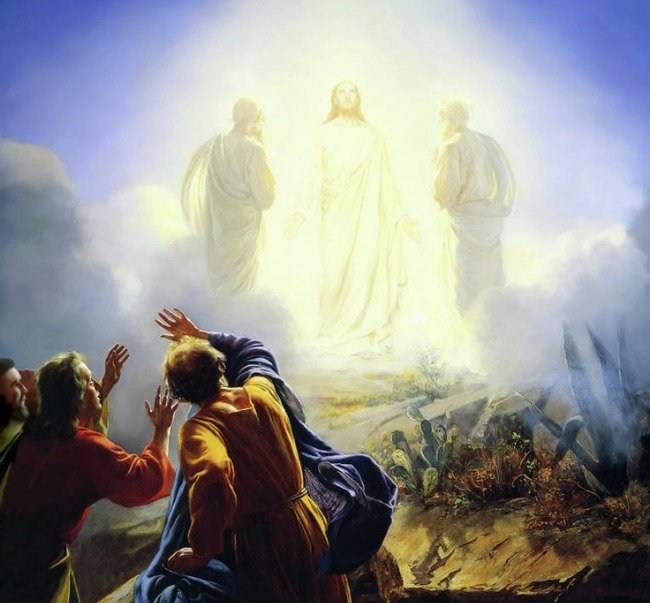
9:29 As he was praying, the appearance of his face changed [“transfigured” (Matt. 17:2) from Gr. metamorphoomai: to transform or to change in form, in this case an instant metamorphosis; allowed Peter, James, and John to glimpse His eternal glory], and his clothes became as bright [“white” (Matt. 17:2) is a symbol of purity] as a flash of lightning.

9:30 Two men, Moses [represented the Law] and Elijah [represented the prophets; cf. Matt. 5:17; Heb. 1:2],

9:31 appeared in glorious splendor, talking with Jesus. They spoke about his departure [term means “exodus”], which he was about to bring to fulfillment at Jerusalem.

9:32 Peter and his companions were very sleepy, but when they became fully awake, they saw his glory and the two men standing with him.

9:33 As the men were leaving Jesus, Peter [emotional; could not restrain feelings] said to him, “Master, it is good for us to be here [Peter wanted to prolong the experience on the mountain (but they were needed in the valley: cf. Matt. 17:14-16)]. Let us put up three shelters [temporary shelters made of branches such as the ones erected during the Feast of Tabernacles (cf. Lev. 23:42-43)]—one for you, one for Moses and one for Elijah.” (He did not know what he was saying.)

9:34 While he [Peter] was speaking, a cloud [in OT often represented/signified God’s presence among His people (cf. Ex. 13:21-22; 24:15-18; 1 Kings 8:10)] appeared and enveloped them [Jesus, Moses, and Elijah], and they were afraid as they entered the cloud.

9:35 A voice came from the cloud, saying [God interrupted Peter; words spoken for benefit of Peter, James, and John], “This is my Son, whom I have chosen [cf. Matt. 17:5]; listen [command; implies obedience; must stop talking in order to listen] to him.”

9:36 When the voice had spoken, they found that Jesus was alone. The disciples kept this to themselves, and told no one at that time what they had seen [cf. Matt. 17:9].

9:37 The next day [after the Transfiguration], when they [Jesus, Peter, James, John] came down from the mountain, a large crowd [included the rest of Jesus’ disciples] met him.

9:38 A man in the crowd called out, “Teacher, I beg you to look at my son, for he is my only child.

9:39 A spirit [demon; had “robbed him of speech” (Mk. 9:17); “deaf and mute spirit” (Mk. 9:25)] seizes him and he suddenly screams; it throws him into convulsions so that he foams at the mouth. It scarcely ever leaves him and is destroying [part of the Satanic agenda as per Jn. 10:10] him.

9:40 I begged your disciples [Jesus had given them power and authority to heal demon possession (Lk. 9:1)] to drive it out, but they could not [due to lack of faith (Matt. 17:19-20) and need for prayer (Mk. 9:28-29)].”

9:41 “O unbelieving and perverse generation,” Jesus replied, “how long shall I stay with you and put up with you? Bring your son here.”

9:42 Even while the boy was coming, the demon threw him to the ground in a convulsion. But Jesus rebuked the evil spirit [the evil spirit had to obey Jesus], healed the boy and gave him back to his father.

9:43 And they were all amazed at the greatness of God. While everyone was marveling at all that Jesus did, [the recent exorcism] he said [for the second time (cf. Lk. 9:21-22)] to his disciples,

9:44 “Listen carefully to what I am about to tell you: The Son of Man is going to be betrayed [in Lk. 9:22 Jesus made reference to his death and now added the element of betrayal] into the hands of men.”

9:45 But they did not understand what this [the reference to His death] meant. It was hidden [cf. Lk. 24:16] from them, so that they did not grasp it, and they were afraid to ask him about it.

9:46 An argument [illustrates that they did not yet understand Jesus’ mission] started among the disciples as to which of them would be the greatest [the disciples were still thinking in terms of an earthly kingdom; they were concerned about personal glory, fame, and honor rather than service].

9:47 Jesus, knowing their thoughts [indicates the argument probably occurred away from Jesus’ presence], took a little child [helpless, vulnerable, dependent on others, without power; child became an object lesson/visual aid] and had him stand beside him.

9:48 Then he said to them, “Whoever welcomes this little child in my name welcomes me; and whoever welcomes me welcomes the one who sent me. For he who is least among you all—he is the greatest [Jesus taught that we are to descend into greatness].”

9:49 [cf. Mark 9:38] “Master,” said John [part of Jesus’ inner circle, along with James and John], “we saw a man driving out demons [apparently this man (unlike the disciples in Lk. 9:40) had some success in driving out demons] in your name and we tried to stop him, because he is not one of us [disciples mistakenly thought they had a monopoly on Jesus’ power].”

9:50 “Do not stop him,” Jesus said, “for whoever is not against you is for you [there is no middle ground; cf. Matt. 12:30].”

9:51 As the time approached [Jesus knew He only had months to live] for him to be taken up to heaven, Jesus resolutely set out [from Galilee] for Jerusalem [persecution and death awaited Jesus in Jerusalem].

9:52 And he sent messengers [probably some of His own disciples] on ahead, who went into a Samaritan village [Samaria located between Galilee and Judea] to get things ready [perhaps lodging] for him;

9:53 but the people [Samaritans; half-breeds hated by the Jews] there did not welcome him [Jesus (and those traveling with Him)], because he was heading for Jerusalem.

9:54 When the disciples James and John saw this, they asked, “Lord, do you want us to call fire down from heaven [Jesus had instructed them earlier to shake the dust off their feet when they were not welcomed into a village (Lk. 9:5) but James and John wanted to do more than that; cf. 2 Kings 1] to destroy them?”

9:55 But Jesus turned and rebuked them,

9:56 and they went to another village [the name and location of this village is not provided].

9:57 As they were walking along the road, [1] a man [“a teacher of the law” (Matt. 8:19); took the initiative to approach Jesus] said to him, “I will follow you wherever you go.”

9:58 Jesus replied [note the cost of discipleship…], “Foxes have holes and birds of the air have nests, but the Son of Man has no place to lay his head [following Jesus (“wherever you go” as per Lk. 9:57) would mean putting aside worldly security and the comforts of home and being constantly on the move].”

9:59 He said [Jesus took the initiative to approach this man] to [2] another man, “Follow me.” But the man replied, “Lord, first [cf. “first” in Lk. 9:61] let me go and bury my father [text does not indicate whether the father had already dies, was near death, or was merely elderly; the man may have meant that he would follow Jesus after his father died and he had fulfilled his sacred duty to properly bury him (an indefinite period of time)].”

9:60 Jesus said to him, “Let the dead [or “the dying”] bury their own dead [yet another indication of the cost of following Jesus], but you go and proclaim the kingdom of God.”

9:61 [3] Still another [took the initiative to approach Jesus] said, “I will follow you, Lord; but first [cf. “first” in Lk. 9:59] let me go back and say good-by to my family.”

9:62 Jesus replied, “No one who puts his hand to the plow and looks back [looking back distracts us from what is ahead; cf. Phil. 3:13-14] is fit for service in the kingdom of God.”

Luke 10

10:1 [this event recorded only by Luke] After this the Lord appointed seventy-two [represents number of nations in the world (according to Gen. 10 / Septuagint); some manuscripts say 70 as per Heb. OT reading of Gen. 10; indication that one day all nations would hear message] others and sent [as official authoritative representatives or messengers of Jesus] them two by two [thirty-six teams of two] ahead of [sent “by” Jesus and “before” Him to prepare towns for His later visit; our task is to prepare the way for Jesus to come into lives and towns] him to every town and place [places Jesus had not yet been able to visit] where he was about to go.

10:2 He told them, “The harvest [the harvest does not wait; if it is not reaped it is ruined by weather or withering] is plentiful, but the workers are few. Ask [part of every workers responsibility is to pray for more workers and helpers; laborers (not spectators) sense the urgency of praying for more laborers] the Lord of the harvest, therefore, to send out workers [every believer has a responsibility to share gospel; there is no unemployment in Christian service; no one has the luxury of sitting while others work] into his harvest field.

10:3 Go! I am sending you out like lambs [indicates vulnerability and the need to trust God; cf. Isa. 11:6; 65:25] among wolves [represent opposition; indicates the assignment had an element of danger; courage and discernment essential to survival and success].

Note: Jesus’ specific instructions to those going into the harvest fields.
• Go courageously.
• Be alert and discerning.

10:4 [instruction to travel light; put each person in a position to have to trust God] Do not [do not always carry] take a purse [moneybag] or bag or sandals; and do not greet anyone on the road [indicates that their task was urgent and they needed to stay focused on that task; cf. 2 Kings 4:29; does not mean that they were to be impolite or unfriendly, but rather that they were not to waste precious time in idle chit-chat or socializing because the harvest was ready].

Note: Jesus’ specific instructions to those going into the harvest fields.
• Go in faith, trusting God to provide for daily needs.
• Travel light and do not allow material things to weigh you down.
• Go with a sense of urgency.
• Do not allow lesser things to keep you from greater things.

10:5 “When you enter a house, first say, ‘Peace [shalom: a wish for the other person’s well being] to this house.’

Note: Jesus’ specific instructions to those going into the harvest fields.
• Be congenial.

10:6 If a man of peace [a person with a proper attitude toward God; one open to the gospel message] is there, your peace will rest on him; if not, it will return to you.

Note: According to Thom Wolf (Golden Gate Baptist Theological Seminary), a man (or woman) of peace can be identified by three R’s.
First: Receptive to the gospel.
Second: Reputation to gain attention for the gospel message among others (family and community).
Third: Refers gospel messengers to those who are receptive to gospel message.

10:7 Stay [settle in and concentrate on the appointed task, not on personal desire for better accommodations; the harvest is more important than living arrangements] in that house, eating and drinking whatever [messengers were relieved of the burdens and restrictions imposed by Jewish food laws] they give you, for the worker deserves his wages [cf. 1 Cor. 9:4-14; 1 Tim. 5:18]. Do not move [lest host be offended and think hospitality offered not good enough] around from house to house [as if looking for a better quarters and more congenial company].

Note: Jesus’ specific instructions to those going into the harvest fields.
• Go with gratitude and acceptance.

10:8 “When you enter a town and are welcomed, eat what is set before you [for the seventy-two, might include eating meals in non-Jewish homes].

10:9 Heal the sick who are there and tell them, ‘The kingdom of God [the rule and reign of God in the hearts of people] is near [already here; soon to come] you [people could enter into God’s kingdom by receiving their message].’

Note: Jesus gave specific instructions to those going into the harvest fields.
• Go with clarity of purpose.
• Go out with the message of salvation.

Note: Jesus’ commission to us emphasizes the proclamation of the gospel rather than the performing of miracles (Matt. 28:19-20; Mark 16:15; Luke 24:46-49).

10:10 But when you enter a town and are not [indicates possibility of rejection in some places] welcomed [instead, people chose to take a road that leads away from the kingdom], go into its streets and say,

10:11 ‘Even the dust of your town that sticks to our feet we wipe off against you [vivid illustration of the kingdom demand for decision]. Yet be sure of this: The kingdom of God is near.’

Note: Jesus’ specific instructions to those going into the harvest fields.
• Go with the understanding that some will not accept the message.

10:12 I tell you, it will be more bearable [endurable] on that day for Sodom [cf. Gen. 19:1-29; a byword for evil and immorality] than for that town [the town that rejected the Messiah and His kingdom and the salvation He freely offered them].

Note: It is a serious thing to reject God’s messengers and God’s message.

10:13 “Woe to you, Korazin! Woe to you, Bethsaida! For if the miracles that were performed in you had been performed in Tyre and Sidon, they would have repented long ago, sitting in sackcloth and ashes.

10:14 But it will be more bearable for Tyre and Sidon at the judgment than for you.

10:15 And you, Capernaum, will you be lifted up to the skies? No, you will go down to the depths.

10:16 “He who listens to you listens to me; he who rejects you rejects me; but he who rejects me rejects him who sent me.”

10:17 The seventy-two returned with joy [because of what they had experienced] and said, “Lord, even the demons submit to us in your name [indicates they were able to perform exorcisms].”

10:18 He replied [note: some scholars connect these words with Isa. 14:12-17; others see Jesus’ words as referring to the defeat Satan suffered as the seventy-two cast out demons; others connect these words with Jn. 12:31-32], “I saw Satan fall like lightning from heaven [a place of power].

10:19 I have given you authority to trample on [figurative reference to authority over evil forces…] snakes [cf. Gen. 3:1-15; Rev. 12:9] and scorpions and to overcome all the power of the enemy; nothing [should be understood in terms of spiritual warfare; they were still liable to physical injury] will harm you.

10:20 However, do not rejoice that the spirits [demonic hosts] submit to you, but rejoice that your names are written in heaven [indicates spiritual security].”

10:21 At that time Jesus, full of joy through the Holy Spirit, said, “I praise you, Father, Lord of heaven and earth, because you have hidden these things from the wise and learned, and revealed them to little children. Yes, Father, for this was your good pleasure.

10:22 “All things have been committed to me by my Father. No one knows who the Son is except the Father, and no one knows who the Father is except the Son and those to whom the Son chooses to reveal him.”

10:23 Then he turned to his disciples and said privately, “Blessed are the eyes that see what you see.

10:24 For I tell you that many prophets and kings wanted to see what you see but did not see it, and to hear what you hear but did not hear it.”

10:25 On one occasion an expert in the law [jurist, lawyer; one knowledgeable in the interpretation and application of Jewish religious law] stood up to test [perhaps to test Jesus’ insight and knowledge or perhaps to trick Jesus into making statements that could be used to discredit Him] Jesus. “Teacher,” he asked, “what must I do to inherit eternal life [means same thing as being saved; life that will never end; quality of life enjoyed as a result of a relationship with God; cf. Jn. 17:3 re: Jesus’ definition of eternal life; this question also asked by others: Matt. 19:16-22; Mk. 10:17; Lk. 18:18-23]?”

10:26 “What is written in the Law [OT Law]?” he replied. “How do you read it?”

10:27 [cf. Mk. 12:28-34] He answered: “‘Love the Lord your God with all [total being] your heart and with all your soul and with all your strength [determined and forceful effort] and with all your mind [expresses humanity’s relationship with God (sum up first four commandments); cf. Deut. 6:5]’; and, ‘Love your neighbor as yourself [expresses humanity’s relationship to others (sum up last six commandments); cf. Lev. 19:18].’”

Note: Jesus taught that we must love God with more than emotions; we must love Him with intelligent minds (see also Matthew 22:37). Christians cannot afford to have flabby minds in a culture that is increasingly anti-Christian. We must be able to intelligently speak about what we believe. And, our behavior must demonstrate that we think like Christ rather than like our culture.

Here are a few ways you can make certain you are in the right mind.

R = Read your Bible daily. Discipline yourself to memorize Scripture. The only way to think like Jesus is to know what He said and how He lived.

I = Do not fear the criticisms of worldly thinking. Instead, investigate the anti-Christian views and philosophies that confront you and prepare a reasoned response.

G = Guard your mind against Satan’s influences. Do not pollute your mind with things that will cause your love for God to grow cold.

H = Pursue holiness. Do more than defend the faith — live the faith. Live a life that causes others to ask good questions about God.

T = Talk to others about Jesus and how wonderful He is. Make Him the focus of your life and conversations with others.

10:28 “You have answered correctly [right],” Jesus replied. “Do this [keep on doing this without fail (no one can in fact do this perfectly)] and you will live.”

10:29 But he wanted to justify [to declare righteous, to justify, to clear one’s self of a charge; perhaps wanted to justify personal behavior toward people he refused to consider as neighbors] himself, so he asked Jesus [perhaps an attempt to back Jesus into a theological corner], “And who is my neighbor [most Jews defined neighbor as fellow Jew (ethnic prejudice); others defined neighbor as Jew who strictly observed law]?”

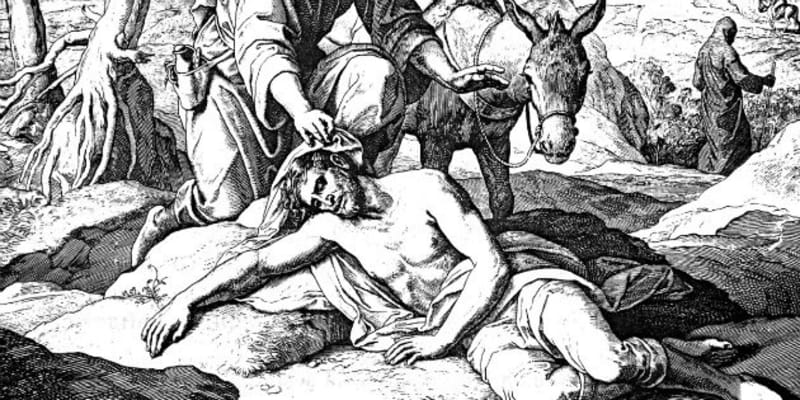
10:30 In reply [to take up discussion; these words indicate that Jesus told parable to correct lawyer’s prejudicial attitudes] Jesus said: “A man was going down from Jerusalem to Jericho [distance of about 17 miles; a downhill trek; countryside is barren, rocky, full of caves (ideal for robbers)], when he fell into the hands of [to be encompassed by] robbers [exhibited attitude: “What is your is mine; I’ll take it.”]. They stripped him of his clothes, beat him and went away, leaving him half dead.

10:31 A priest [served God, but failed to serve man] happened [by chance or coincidence] to be going down the same road, and when he saw the man, he passed by on the other side [perhaps to avoid ceremonial contamination with one who appeared to be dead (cf. Lev. 21:1-4); one may hold a sacred place and yet have a cold heart].

10:32 So too, a Levite [one of the helpers in the Temple], when he came to the place and saw him, passed by on the other side [priest and Levite exhibited attitude: “What is mine is mine; I’ll keep it.”].

10:33 But a Samaritan [half-breeds hated by Jews (cf. Jn. 4:9)], as he traveled, came where the man was; and when he saw him, he took pity [compassion, from Latin compati: com (together) pati (suffer), thus “to suffer with another”; cf. Matt. 9:36] on him.

10:34 He [exhibited attitude: “What is mine is yours; I’ll give it.”] went to him and bandaged his wounds, pouring on oil [served as a soothing lotion / healing salve] and wine [served as a disinfectant: oil and wine were common household remedies for wounds]. Then he put the man on his own donkey [which meant the Samaritan had to walk], took him to an inn and took care of [perhaps redressed and cleaned the wounds] him.

10:35 The next day [implies the Samaritan stayed the night to care for the wounded man] he took out two silver coins [denarii; Roman coin worth about 18 cents; the workman’s average daily wage, thus the Samaritan gave two day’s wages] and gave them to the innkeeper. ‘Look after him,’ he said, ‘and when I return, I will reimburse you for any extra expense you may have.’

10:36 “Which of these three do you think was a neighbor [Jesus expanded definition of neighbor] to the man who fell into the hands of robbers?”

10:37 The expert in the law replied, “The one [note that the lawyer did not say “the Samaritan”] who had mercy [compassion] on him.” Jesus told him, “Go and do likewise [make it a habit; in the sense of lifelong action].”

Note: What “valid” excuses might we give for not helping others? What risks might prevent us from helping? What kept the priest and Levite from helping?
• perhaps it was pride – “I am better than that man.”
• perhaps it was prejudice – “According to my interpretation of the law, that man is not my neighbor. We don’t help his kind.”
• perhaps it was principle – “If I touch the man I will become ceremonially unclean and unable to perform my duties at the Temple.”
• perhaps it was pressure – “I have urgent business to attend to. I don’t have time to stop.”
• perhaps it was prognosis – “This man is beyond hope of recovery, so why bother to help?”
• perhaps it was peril – “The robbers who beat this man might be close by and do the same to me if I linger.”
• perhaps it was possibility – “Maybe someone else will come along who is better equipped to render aid.”

10:38 As Jesus and his disciples were on their way, he came to a village where a woman named Martha opened her home to him.

10:39 She had a sister called Mary, who sat at the Lord’s feet listening to what he said.

10:40 But Martha was distracted by all the preparations that had to be made. She came to him and asked, “Lord, don’t you care that my sister has left me to do the work by myself? Tell her to help me!”

10:41 “Martha, Martha,” the Lord answered, “you are worried and upset about many things,

10:42 but only one thing is needed. Mary has chosen what is better, and it will not be taken away from her.”

Luke 11

11:1 One day Jesus was praying [prayer was important to Jesus (Matt. 14:23; Mk. 1:35)] in a certain place [re: place cf. Matt. 6:6 and “solitary place” in Mk. 1:35]. When he finished, one of his disciples said to him, “Lord, teach us [only thing the disciples asked Jesus to teach them] to pray, just as John [obviously a man of prayer] taught his disciples. [consider those who served as your examples in learning to pray and who is inspired to pray by your example]

Note: In a survey on prayer, USA Today reported responses of persons asked in a survey what they would ask a god or supreme being if they could get a direct answer.
• 34% What is my purpose here?
• 19% Will I have life after death?
• 16% Why do bad things happen?
• 7% Is there intelligent life elsewhere?
• 6% How long will I live?
(USA Today • 05.28.99)

11:2 [1: pray for God’s glory] He said to them, “When [whenever] you [plural] pray, say: “‘Father [assumes a personal relationship (only possible through faith in Christ); denotes authority and intimacy; God is not an impersonal deity], hallowed [declare, acknowledge, treat as holy; to set apart; to hold in reverence] be your name [represented the person and his character; exalt God in prayer], your kingdom [the reign and rule of God in the hearts of people] come [attitude is that of submission to the reign of God].

11:3 [2: pray for our good] [prayer for physical provisions] Give [attitude of dependence on God to give what is needed; keep on giving; a request for ongoing provision] us each day our daily [for the coming day; cf. Ex. 16:18-19 re: manna] bread [basic human needs].

11:4 [prayer for spiritual provisions] Forgive [to dismiss, release, send away] us our sins, for we also [we must treat others as we are treated by God; forgiveness is a two-way street (cf. Mk. 11:25)] forgive everyone who sins against us. And lead us not [keep us from yielding to; expresses a desire to avoid sin; acknowledgment of our weakness and vulnerability] into temptation. [cf. Jas. 1:13]’”

11:5 Then he said [illustration; cf. Lk. 18:1-8] to them, “Suppose [imagine] one of you has a friend, and he goes to him at midnight and says, ‘Friend [term implies host had a personal relationship with the neighbor], lend [to allow the use of (a friendly act)] me three [sufficient to meet the needs of the guest] loaves of bread,

11:6 because a friend of mine on a journey has come [presumably arrived at night (v. 5); people often traveled at night to avoid intense heat of the day] to me [a guest; hospitality important among first-century Jews], and I have nothing to set before him.’

11:7 “Then the one inside answers, ‘Don’t [stop an action in progress] bother [trouble] me. The door is already locked [in Palestinian homes the father slept on pallet next to door], and my children are with me in bed [children slept on pallets next to father, thus, in order to get bread (and then open the door) the father would risk disturbing the sleep of the entire household]. I can’t get up and give you anything.’

Note: “[Jesus] meant … that if we can get what we need from a human friend who does not want to give it, how much more can we be sure that we will receive what we need from God, who does want to give.” (Commentary on Luke • Ray Summers • p. 140)

11:8 I tell you, though he will not get up and give him the bread because he is his friend, yet because of the man’s boldness [lack of feeling of shame; persistence] he will get up and give him as much as he needs.

11:9 “So [based on verses 5-8] I say to you: Ask [imperative; make a habit of] and it will [promise] be given to you; seek [imperative; make a habit of] and you will [promise] find; knock [imperative; make a habit of] and the door will [promise] be opened to you.

11:10 [a promise that God will answer prayer (requests must be in accordance with His will); the blessings of persistence in prayer] For everyone who asks receives; he who seeks finds; and to him who knocks, the door will be opened.

11:11 [illustration of God’s willingness to answer prayer] “Which of you fathers, if your son asks for a fish [something good], will give him a snake [something harmful] instead?

11:12 Or if he asks for an egg [something good], will give him a scorpion [something harmful]?

11:13 If you [imperfect parents] then, though you are evil [refers to our sinful human nature], know how to give good gifts to your children, how much more will your Father in heaven give the Holy Spirit [the gift of His abiding presence] to those who ask him!”

11:14 Jesus was driving out a demon that was mute. When the demon left, the man who had been mute spoke, and the crowd was amazed.

11:15 But some of them said, “By Beelzebub, the prince of demons, he is driving out demons.”

11:16 Others tested him by asking for a sign from heaven.

11:17 Jesus knew their thoughts and said to them: “Any kingdom divided against itself will be ruined, and a house divided against itself will fall.

11:18 If Satan is divided against himself, how can his kingdom stand? I say this because you claim that I drive out demons by Beelzebub.

11:19 Now if I drive out demons by Beelzebub, by whom do your followers drive them out? So then, they will be your judges.

11:20 But if I drive out demons by the finger of God, then the kingdom of God has come to you.

11:21 “When a strong man, fully armed, guards his own house, his possessions are safe.

11:22 But when someone stronger attacks and overpowers him, he takes away the armor in which the man trusted and divides up the spoils.

11:23 “He who is not with me is against me, and he who does not gather with me, scatters.

11:24 “When an evil spirit comes out of a man, it goes through arid places seeking rest and does not find it. Then it says, ‘I will return to the house I left.’

11:25 When it arrives, it finds the house swept clean and put in order.

11:26 Then it goes and takes seven other spirits more wicked than itself, and they go in and live there. And the final condition of that man is worse than the first.”

11:27 As Jesus was saying these things, a woman in the crowd called out, “Blessed is the mother who gave you birth and nursed you.”

11:28 He replied, “Blessed rather are those who hear the word of God and obey it.”

11:29 As the crowds increased, Jesus said, “This is a wicked generation. It asks for a miraculous sign, but none will be given it except the sign of Jonah.

11:30 For as Jonah was a sign to the Ninevites, so also will the Son of Man be to this generation.

11:31 The Queen of the South will rise at the judgment with the men of this generation and condemn them; for she came from the ends of the earth to listen to Solomon’s wisdom, and now one greater than Solomon is here.

11:32 The men of Nineveh will stand up at the judgment with this generation and condemn it; for they repented at the preaching of Jonah, and now one greater than Jonah is here.

11:33 “No one lights a lamp and puts it in a place where it will be hidden, or under a bowl. Instead he puts it on its stand, so that those who come in may see the light.

11:34 Your eye is the lamp of your body. When your eyes are good, your whole body also is full of light. But when they are bad, your body also is full of darkness.

11:35 See to it, then, that the light within you is not darkness.

11:36 Therefore, if your whole body is full of light, and no part of it dark, it will be completely lighted, as when the light of a lamp shines on you.”

11:37 When Jesus had finished speaking, a Pharisee invited him to eat with him; so he went in and reclined at the table.

11:38 But the Pharisee, noticing that Jesus did not first wash before the meal, was surprised.

11:39 Then the Lord said to him, “Now then, you Pharisees clean the outside of the cup and dish, but inside you are full of greed and wickedness.

11:40 You foolish people! Did not the one who made the outside make the inside also?

11:41 But give what is inside the dish to the poor, and everything will be clean for you.

11:42 “Woe to you Pharisees, because you give God a tenth of your mint, rue and all other kinds of garden herbs, but you neglect justice and the love of God. You should have practiced the latter without leaving the former undone.

11:43 “Woe to you Pharisees, because you love the most important seats in the synagogues and greetings in the marketplaces.

11:44 “Woe to you, because you are like unmarked graves, which men walk over without knowing it.”

11:45 One of the experts in the law answered him, “Teacher, when you say these things, you insult us also.”

11:46 Jesus replied, “And you experts in the law, woe to you, because you load people down with burdens they can hardly carry, and you yourselves will not lift one finger to help them.

11:47 “Woe to you, because you build tombs for the prophets, and it was your forefathers who killed them.

11:48 So you testify that you approve of what your forefathers did; they killed the prophets, and you build their tombs.

11:49 Because of this, God in his wisdom said, ‘I will send them prophets and apostles, some of whom they will kill and others they will persecute.’

11:50 Therefore this generation will be held responsible for the blood of all the prophets that has been shed since the beginning of the world,

11:51 from the blood of Abel to the blood of Zechariah, who was killed between the altar and the sanctuary. Yes, I tell you, this generation will be held responsible for it all.

11:52 “Woe to you experts in the law, because you have taken away the key to knowledge. You yourselves have not entered, and you have hindered those who were entering.”

11:53 When Jesus left there, the Pharisees and the teachers of the law began to oppose him fiercely and to besiege him with questions,

11:54 waiting to catch him in something he might say.

Luke 12

12:1 Meanwhile, when a crowd of many thousands had gathered, so that they were trampling on one another, Jesus began to speak first to his disciples, saying: “Be on your guard against the yeast of the Pharisees, which is hypocrisy.

12:2 There is nothing concealed that will not be disclosed, or hidden that will not be made known.

12:3 What you have said in the dark will be heard in the daylight, and what you have whispered in the ear in the inner rooms will be proclaimed from the roofs.

12:4 “I tell you, my friends, do not be afraid of those who kill the body and after that can do no more.

12:5 But I will show you whom you should fear: Fear him who, after the killing of the body, has power to throw you into hell. Yes, I tell you, fear him.

12:6 Are not five sparrows sold for two pennies? Yet not one of them is forgotten by God.

12:7 Indeed, the very hairs of your head are all numbered. Don’t be afraid; you are worth more than many sparrows.

12:8 “I tell you, whoever acknowledges me before men, the Son of Man will also acknowledge him before the angels of God.

12:9 But he who disowns me before men will be disowned before the angels of God.

12:10 And everyone who speaks a word against the Son of Man will be forgiven, but anyone who blasphemes against the Holy Spirit will not be forgiven.

12:11 “When you are brought before synagogues, rulers and authorities, do not worry about how you will defend yourselves or what you will say,

12:12 for the Holy Spirit will teach you at that time what you should say.”

12:13 Someone in the crowd [cf. Lk. 12:1] said to him, “Teacher [“Rabbi” or “Master,” a title of respect; people often looked to rabbis to settle disputes (cf. Lk. 10:38-42)], tell my [probably a younger brother] brother [probably an older brother] to divide the inheritance [read Num. 26–27; 33:54; 36; Deut. 21:17 re: OT law concerning inheritance] with me.”

12:14 Jesus replied, “Man [a term of rebuke], who appointed me a judge [an official mediator on a disputed matter] or an arbiter between you?”

12:15 Then [Jesus used this as an opportunity to teach about greed] he said to them [the man and everyone in the crowd (possibly including the man’s brother)], “Watch out [be alert lest a spirit of greed overtake you]! Be on your guard against all kinds of greed [excessive and consuming desire to have more; Paul identified greed as idolatry in Eph. 5:5 and Col. 3:5]; a man’s life does not consist in [is not measured by] the abundance of his possessions. [Jesus issued a moral judgment rather than a legal one]”

Note: How can we guard against greed?

12:16 And he told them [the surrounding crowd] this parable [note the repeated use of “I” and “my” in this parable]: “The ground of a certain rich [note that the man in the story was already rich] man produced a good crop.

12:17 He thought to himself, ‘What shall I do? I have no place to store my crops.’


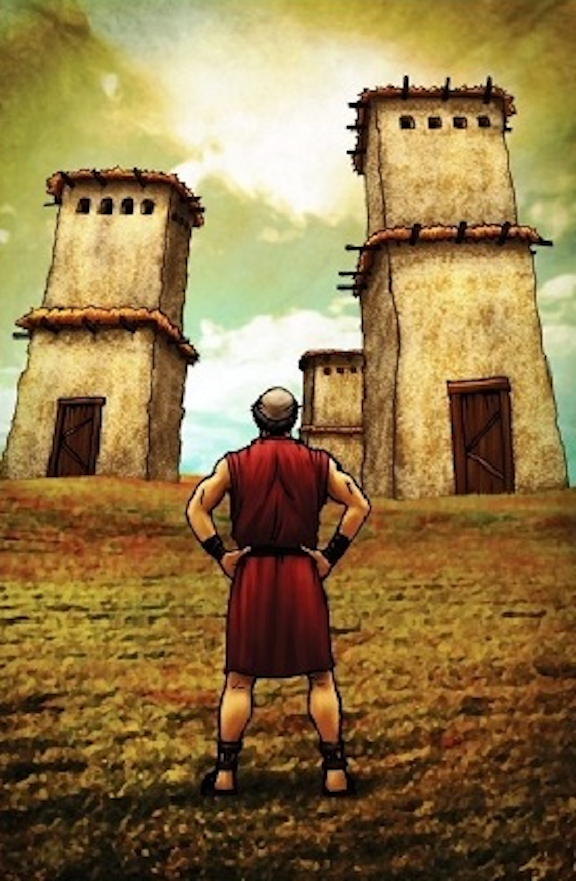
12:18 “Then he said, ‘This is what I’ll do. I will tear down my barns and build bigger ones, and there I will store all my grain and my goods [Jesus was not condemning the farmer for adding storage facilities; Jesus was concerned because the farmer based his actions on wrong priorities and wrong motives].

12:19 [cf. Jas. 4:13-17] And I’ll say to myself [the rich man’s short-range and long-range plans totally focused on himself to the exclusion of others and God], “You have plenty of good things laid up for many years [temporal rather than eternal focus]. Take life easy; eat, drink and be merry [desire was for mere self-indulgence].”’

12:20 “But God said to him, ‘You fool [not a reference to intellectual stupidity but to spiritual folly or blindness (cf. Ps. 53:1); the man was a fool because he ignored God, did not think of others, and assumed money could buy security]! This very night your life will be demanded from you. Then who will get [inherit] what you have prepared for yourself? [the answer to this question is: somebody else]

12:21 [cf. Matt. 6:19-21; 1 Tim. 6:17-19] “This is how it will be with anyone who stores up things for himself but is not rich toward God.”

Note: What should be a Christian’s attitude toward whatever abundance God has allowed him or her to acquire?

12:22 Then Jesus said to his disciples: “Therefore [links what follows with previous verses] I tell you, do not [an imperative or command] worry [to be anxious or to fret] about your life [the physical necessities of life…], what you will eat; or about your body, what you will wear [trust God with the details of your life].

12:23 Life is more than food, and the body more than clothes.

12:24 Consider [observe for the purpose of learning] the ravens [they are dependent on God’s daily provision; birds are not idle, but neither are they anxious]: They do not [illustration of normal activities in an agricultural society…] sow or reap, they have no storeroom or barn [this is not an excuse for laziness (cf. 2 Thess. 3:10)]; yet God [Jesus identified God as the sole basis of provision] feeds them [this is not teaching that every hungry person in the world will be fed]. And how much more valuable you are than birds!

12:25 Who of you by worrying can add [prolong or lengthen] a single hour to his life?

12:26 Since you cannot do this very little thing, why do you worry about the rest?

12:27 “Consider how the lilies grow. They do not labor [refers to hard work that leads to fatigue] or spin. Yet I tell you, not even Solomon [Israel’s richest king] in all his splendor was dressed like one of these.

12:28 If that is how God clothes the grass of the field, which is here today, and tomorrow is thrown into the fire [fuel for clay ovens], how much more will he clothe you, O you of little faith [anxiety is one of the results of unbelief; faith is the antidote to worry]!

12:29 And [because God provides] do not set your heart on what you will eat or drink; do not worry [worry shows a lack of faith in God] about it.

12:30 For the pagan world [unbelievers; those who have no sense of God’s care for them; worry puts believers on the same level with unbelievers] runs after all such things, and your Father knows that you need them.

12:31 But seek [continuous action] his kingdom [submit to God’s sovereignty; work to advance His kingdom], and [when your priorities are right] these things [needs; the things that people worry about] will be given to you as well.

12:32 “Do not be afraid, little flock, for your Father has been pleased to give you the kingdom.

12:33 Sell your possessions and give to the poor. Provide purses for yourselves that will not wear out, a treasure in heaven that will not be exhausted, where no thief comes near and no moth destroys.

12:34 For where your treasure is, there your heart will be also.

12:35 “Be dressed ready for service and keep your lamps burning,

12:36 like men waiting for their master to return from a wedding banquet, so that when he comes and knocks they can immediately open the door for him.

12:37 It will be good for those servants whose master finds them watching when he comes. I tell you the truth, he will dress himself to serve, will have them recline at the table and will come and wait on them.

12:38 It will be good for those servants whose master finds them ready, even if he comes in the second or third watch of the night.

12:39 But understand this: If the owner of the house had known at what hour the thief was coming, he would not have let his house be broken into.

12:40 You also must be ready, because the Son of Man will come at an hour when you do not expect him.”

12:41 Peter asked, “Lord, are you telling this parable to us, or to everyone?”

12:42 The Lord answered, “Who then is the faithful and wise manager, whom the master puts in charge of his servants to give them their food allowance at the proper time?

12:43 It will be good for that servant whom the master finds doing so when he returns.

12:44 I tell you the truth, he will put him in charge of all his possessions.

12:45 But suppose the servant says to himself, ‘My master is taking a long time in coming,’ and he then begins to beat the menservants and maidservants and to eat and drink and get drunk.

12:46 The master of that servant will come on a day when he does not expect him and at an hour he is not aware of. He will cut him to pieces and assign him a place with the unbelievers.

12:47 “That servant who knows his master’s will and does not get ready or does not do what his master wants will be beaten with many blows.

12:48 But the one who does not know and does things deserving punishment will be beaten with few blows. From everyone who has been given much, much will be demanded; and from the one who has been entrusted with much, much more will be asked.

12:49 “I have come to bring fire on the earth, and how I wish it were already kindled!

12:50 But I have a baptism to undergo, and how distressed I am until it is completed!

12:51 Do you think I came to bring peace on earth? No, I tell you, but division.

12:52 From now on there will be five in one family divided against each other, three against two and two against three.

12:53 They will be divided, father against son and son against father, mother against daughter and daughter against mother, mother-in-law against daughter-in-law and daughter-in-law against mother-in-law.”

12:54 He said to the crowd: “When you see a cloud rising in the west, immediately you say, ‘It’s going to rain,’ and it does.

12:55 And when the south wind blows, you say, ‘It’s going to be hot,’ and it is.

12:56 Hypocrites! You know how to interpret the appearance of the earth and the sky. How is it that you don’t know how to interpret this present time?

12:57 “Why don’t you judge for yourselves what is right?

12:58 As you are going with your adversary to the magistrate, try hard to be reconciled to him on the way, or he may drag you off to the judge, and the judge turn you over to the officer, and the officer throw you into prison.

12:59 I tell you, you will not get out until you have paid the last penny.”

Luke 13

13:1 Now there were some present at that time [see 12:54-59 for immediate context] who told Jesus about [the new reported to Jesus likely was current or had recently occurred] the Galileans [killed as they were offering their sacrifices] whose blood Pilate [the Roman governor of the province of Judea (AD 26-36); probably ordered the killing of the Galilean worshipers] had mixed with their sacrifices [incident occurred at temple in Jerusalem because Jews forbidden to offer sacrifices elsewhere].

13:2 Jesus answered, “Do you think that these Galileans were worse sinners [indicates popular belief that bad things happened to bad people] than all the other Galileans because they suffered this way?

13:3 I tell you, no [those killed were no worse sinners than others just because of the nature of their death]! But unless you repent [means a change of mind, a transformation of attitude about God and about sin], you too will all perish [suffer God’s judgment for their sins].

13:4 Or [note that Jesus referred to another “current event” to reinforce His point…] those eighteen who died when the tower in Siloam [tower probably part of wall of Jerusalem and located near pool of Siloam] fell on them [a construction accident]—do you think they [the victims of the construction accident] were more guilty [because of he nature of their deaths] than all the others living in Jerusalem?

13:5 I tell you, no! But unless you repent, you too will all perish [failure to repent of sin has serious consequences].”

13:6 Then he told this parable [Jesus used a familiar situation to make spiritual application]: “A man had a fig tree [in this parable, the fig tree likely represented the people of Israel (as in Hos. 9:10; Mic. 7:1-2; Jer. 24:1-10) who failed to believe in Jesus as God’s Messiah and Son], planted in his vineyard, and he went to look for fruit on it [a reasonable expectation], but did not find any.

13:7 So he said to the man who took care of the vineyard, ‘For three years [indicates patience on the part of the owner of the vineyard] now I’ve been coming to look for fruit on this fig tree and haven’t found any. Cut it down! Why should it use up the soil [deplete the soil of water and nutrients]?’

13:8 “‘Sir,’ the man [the worker who tended the tree] replied, ‘leave it alone for one more year, and I’ll dig around it and fertilize it.

13:9 If [indicates the possibility of change] it bears fruit next year, fine! If not, then cut it down [some view this prophecy as fulfilled in AD 70 when Titus (eldest son of Roman emperor Vespasian) invaded Jerusalem].’”

13:10 On a Sabbath Jesus was teaching in one of the synagogues,

13:11 and a woman was there who had been crippled by a spirit for eighteen years. She was bent over and could not straighten up at all.

13:12 When Jesus saw her, he called her forward and said to her, “Woman, you are set free from your infirmity.”

13:13 Then he put his hands on her, and immediately she straightened up and praised God.

13:14 Indignant because Jesus had healed on the Sabbath, the synagogue ruler said to the people, “There are six days for work. So come and be healed on those days, not on the Sabbath.”

13:15 The Lord answered him, “You hypocrites! Doesn’t each of you on the Sabbath untie his ox or donkey from the stall and lead it out to give it water?

13:16 Then should not this woman, a daughter of Abraham, whom Satan has kept bound for eighteen long years, be set free on the Sabbath day from what bound her?”

13:17 When he said this, all his opponents were humiliated, but the people were delighted with all the wonderful things he was doing.

13:18 Then Jesus asked, “What is the kingdom of God like? What shall I compare it to?

13:19 It is like a mustard seed, which a man took and planted in his garden. It grew and became a tree, and the birds of the air perched in its branches.”

13:20 Again he asked, “What shall I compare the kingdom of God to?

13:21 It is like yeast that a woman took and mixed into a large amount of flour until it worked all through the dough.”

13:22 Then Jesus went through the towns and villages, teaching as he made his way to Jerusalem.

13:23 Someone asked him, “Lord, are only a few people going to be saved?” He said to them,

13:24 “Make every effort to enter through the narrow door, because many, I tell you, will try to enter and will not be able to.

13:25 Once the owner of the house gets up and closes the door, you will stand outside knocking and pleading, ‘Sir, open the door for us.’ “But he will answer, ‘I don’t know you or where you come from.’

13:26 “Then you will say, ‘We ate and drank with you, and you taught in our streets.’

13:27 “But he will reply, ‘I don’t know you or where you come from. Away from me, all you evildoers!’

13:28 “There will be weeping there, and gnashing of teeth, when you see Abraham, Isaac and Jacob and all the prophets in the kingdom of God, but you yourselves thrown out.

13:29 People will come from east and west and north and south, and will take their places at the feast in the kingdom of God.

13:30 Indeed there are those who are last who will be first, and first who will be last.”

13:31 At that time some Pharisees came to Jesus and said to him, “Leave this place and go somewhere else. Herod [the same Herod who had killed John the Baptist] wants to kill you.”

13:32 He replied [to the Pharisees (13:31)], “Go tell that fox [a reference to Herod Antipas (son of Herod the Great) who was as crafty as a fox], ‘I will drive out demons and heal people [these activities were spiritual rather than political] today and tomorrow, and on the third day I will reach my goal [Jesus would complete His work on His own timetable].’

13:33 In any case, I must keep going today and tomorrow and the next day—for surely no prophet can die outside Jerusalem [Jesus continued to Jerusalem because that is where He would die]!

13:34 “O Jerusalem, Jerusalem [this city represented the core of the nation; spiritual and political capital of Israel], you who kill the prophets and stone those sent to you [cf. 1 Kings 19:10; 2 Chron. 24:19-21; Jer. 2:3-; 26:20-23], how often I have longed to gather your children together, as a hen gathers her chicks under her wings [cf. Ruth 2:12; Ps. 17:8; 36:7; 57:1; 61:4; 63:7; 91:4], but you were not willing!

13:35 Look, your house [may refer to the temple, the city, or to the people themselves] is left to you desolate [abandoned; the consequence of rejecting the Messiah; cf. Jer. 12:7]. I tell you, you will not see me again until [prophetic statement points to His future return and anticipates the day when all will acknowledge him as Lord (cf. Phil. 2:10-11)] you say, ‘Blessed is he who comes in the name of the Lord.’”

Luke 14

14:1 One Sabbath, when Jesus went to eat in the house of a prominent Pharisee [literally “ruler of the Pharisees”; Jesus had previously been a dinner guest of Simon, another Pharisee (Lk. 7:36)], he was being carefully watched [the religious leaders often looked for an opportunity to find fault with Jesus].

14:2 There in front of him was a man [may have come on his own; Pharisees may have invited him as a possible way of trapping Jesus; may have been a friend or a relative of the “prominent Pharisee”] suffering from dropsy [also called edema (excessive water in the flesh)].

14:3 Jesus asked the Pharisees and experts in the law, “Is it lawful to heal on the Sabbath or not [their oral traditions (not the written law) said that healing on the Sabbath was prohibited (with the possible exception of life-threatening situations)]?”

14:4 But they remained silent [if they answered “yes” they would be seen as violating their own traditions; if they answered “no” they would be seen as heartless and uncompassionate]. So taking hold of [Jesus healed the man with a touch] the man, he healed him [Jesus was more concerned about the welfare of the man than about the oral traditions of the Pharisees] and sent him away [this may indicate that the man was not a guest but had come in anticipation of being healed by Jesus].

14:5 Then he asked [Jesus question designed to show the religious leaders that they worked on the Sabbath when it served their personal interests or purposes] them, “If one of you has a son or an ox that falls into a well on the Sabbath day, will you not immediately pull him out?”

14:6 And they had nothing to say [they could not explain why they would “work” on the Sabbath to serve their own interests but not to help a fellowman in need; the religious leaders had a distorted sense of values].

14:7 When he noticed how the guests picked the places of honor [literally the first or the chief couches or the seats nearest the host; the seats closest to the host were the most desired] at the table, he told them this parable:

14:8 “When someone invites you to a wedding feast, do not take the place of honor [indication of pride and presumption], for a person more distinguished than you may have been invited.

14:9 If so, the host who invited both of you will come and say to you, ‘Give this man your seat.’ Then, humiliated, you will have to take the least important place [probably the only place left after everyone else was already seated].

14:10 But when you are invited, take the lowest place [shows a person has not overestimated his or her own importance], so that when your host comes, he will say to you, ‘Friend, move up to a better place.’ Then you will be honored in the presence of all your fellow guests.

14:11 [a paradox…] For everyone who exalts himself will be humbled [the way down is up], and he who humbles himself will be exalted [the way up is down].”

14:12 Then Jesus said to his host [the “prominent Pharisee” (14:1) who had invited Jesus to be his guest], “When you give a luncheon or dinner, do not invite your friends, your brothers or relatives, or your rich neighbors [those with whom the host associated; his own class of people]; if you do, they may invite you back and so you will be repaid [people often do things in the hope that they might benefit or be rewarded in some way].

14:13 But when you give a banquet, invite the poor, the crippled, the lame, the blind [those with whom the host did not naturally associate; those without position or who, because of their physical condition, would be unable to scramble for the choice seats; some of these guests would have required assistance to get to the table],

14:14 and you will be blessed. Although they cannot repay you, you will be repaid at the resurrection of the righteous [those who have trusted in Christ alone for their salvation; cf. Jn. 5:29].”

14:15 When one of those at the table with him heard this, he said to Jesus, “Blessed is the man who will eat at the feast in the kingdom of God [the messianic banquet which the Jews anticipated when the Messiah came to rule].”

14:16 Jesus replied [Jesus told another parable]: “A certain man was preparing a great banquet [such a banquet would have taken place at night] and invited many guests [had already sent out initial invitation so that he could know how many to plan for].

14:17 At the time of the banquet he sent his servant to tell those who had been invited [the second invitation issued to let guests know that banquet was ready], ‘Come, for everything is now ready.’

14:18 “But they all alike began to make excuses. The first said, ‘I have just bought a field, and I must go and see it [since the great banquet was most likely at night, it makes this excuse all the more ridiculous]. Please excuse me.’

14:19 “Another said, ‘I have just bought five yoke of oxen, and I’m on my way to try them out [once again, since the great banquet was most likely at night, it makes this excuse rather ridiculous]. Please excuse me.’

14:20 “Still another [previously invited like the others] said, ‘I just got married, so I can’t come.’

14:21 “The servant came back and reported this to his master. Then the owner of the house became angry [since the guests had offered no real reasons for refusing his gracious invitation] and ordered his servant, ‘Go out quickly into the streets and alleys of the town and bring in the poor, the crippled, the blind and the lame [these were the most unlikely to ever receive an invitation to “a great banquet”].’

14:22 “‘Sir,’ the servant said, ‘what you ordered has been done, but there is still room.’

14:23 “Then the master told his servant, ‘Go out to the roads [rural roads] and country lanes [hedges that served as fences to divide fields] and make them come in, so that my house will be full.

14:24 I tell you, not one of those men who were invited will get a taste of my banquet.’”

14:25 Large crowds were traveling with Jesus, and turning to them he said:

14:26 “If anyone comes to me and does not hate [hyperbole (an exaggeration to make a point); does not mean to actually hate, but that love for Christ is so great that all other loves look like hate by comparison] his father and mother, his wife and children, his brothers and sisters—yes, even his own life—he cannot be my disciple.

14:27 And anyone who does not carry his cross [the cross was an instrument of death in Jesus’ day; the cross as a symbol of service was unknown in Jesus’ day (it only meant death)] and follow me cannot be my disciple.

14:28 [Jesus used two parables to illustrate the importance of counting the cost of what it meant to follow him…] [1] “Suppose one of you wants to build a tower [towers often erected in vineyards to guard them against anyone or anything that might cause damage]. Will he not first sit down and estimate the cost to see if he has enough money to complete it?

14:29 For if he lays the foundation and is not able to finish it, everyone who sees it will ridicule him,

14:30 saying, ‘This fellow began to build and was not able to finish.’

14:31 [2] “Or suppose a king is about to go to war against another king. Will he not first sit down and consider whether he is able with ten thousand men to oppose the one coming against him with twenty thousand?

14:32 If he is not able, he will send a delegation while the other is still a long way off and will ask for terms of peace.

14:33 In the same way, any of you who does not give up everything [total commitment] he has cannot be my disciple.

14:34 “Salt [a seasoning; preservative: prevents and retards decay, combats deterioration; believers are to combat moral and spiritual decay, but can only do so if they retain their virtue] is good, but if it loses its saltiness [tasteless, insipid, inability to fulfill its purpose], how can it be made salty again?

14:35 It is fit neither for the soil nor for the manure pile; it is thrown out [discarded on the streets to be “trampled by men” (Matt. 5:13)]. “He who has ears to hear [exercise spiritual discernment], let him hear [listen and apply the teaching].”

Luke 15

15:1 Now the tax collectors [Jews who collected taxes for the Roman Empire; usually overcharged and pocketed the difference] and “sinners” [those in need of help; cf. Lk. 5:31-32] were all gathering around to hear him.

15:2 But the Pharisees and the teachers of the law muttered, “This man welcomes sinners [those considered social and religious outcasts by the Pharisees] and eats with them.”

Note: Jesus shared three parables in response to the condemnation He received from religious leaders because of His association with sinners (Lk. 15:1-2).
[1] The Parable of the Lost Sheep Luke 15:1-7
[2] The Parable of the Lost Coin Luke 15:8-10
[3] The Parable of the Lost Son Luke 15:11-32

15:3 Then Jesus told them this parable:

15:4 “Suppose one of you has a hundred sheep and loses [perhaps the sheep strayed away] one of them. Does he not leave [the shepherd took the initiative] the ninety-nine [these sheep were safe (left in the care of a fellow shepherd)] in the open country and go after the lost sheep [this sheep was in danger] until he finds it?

15:5 And when he finds it, he joyfully puts it on his shoulders

15:6 and goes home. Then he calls his friends and neighbors together and says, ‘Rejoice with me; I have found my lost sheep.’

15:7 I tell you that in the same way there will be more rejoicing in heaven over one [each individual is of value to God] sinner [“the tax collectors and sinners” (15:1)] who repents than over ninety-nine righteous persons who do not need to repent.

15:8 “Or suppose a woman has ten silver coins [may have been part of her wedding dowry; may represent her household budget or perhaps her life’s savings] and loses one [one-tenth]. Does she not [note the woman’s diligence in searching for her lost coin…] [1] light a lamp [to enable her to see into every dark corner of her house], [2] sweep the house and [3] search carefully until she finds it?

15:9 And when she finds it, she calls her friends and neighbors together and says, ‘Rejoice with me; I have found my lost coin.’

15:10 In the same way, I tell you, there is rejoicing in the presence of the angels of God [God Himself rejoices in the presence of His angels] over one sinner who repents.”

15:11 Jesus continued: “There was a man who had two sons.

15:12 The younger one [selfish; only interested in himself] said to his father, ‘Father, give me my share [an inheritance normally received after father’s death; older brother entitled to a double share of the father’s estate (cf. Deut. 21:17); son not concerned about how his request might impact the father’s ability to provide for himself and estate] of the estate.’ So he divided his property between them.

15:13 “Not long after [soon] that, the younger son got together all he had [perhaps converted his inheritance to cash], set off [anxious to get away from his father] for a distant [as far as possible from his father; away from the influence of his father; a place where no one knew him] country [probably Gentile territory since pigs were raised there as per v. 15; cf. Isa. 53:6] and there squandered [to waste; to throw to the wind; to scatter in various directions] his wealth in wild [includes broad range of self-indulgent, irresponsible, and immoral activities] living [Gr. asotos: word only occurs here in the NT; means debauched lifestyle, one without purpose, a reckless experience; older brother accused him of having squandered his money with prostitutes (cf. Lk. 15:30)].

15:14 After he had spent everything [something he had control over], there was a severe famine [something beyond his control] in that whole country, and he began to be in need [needs: what we must have in order to survive; to be behind; to fall short].

15:15 So he went and hired himself out [to glue together, to join, denotes he forced himself on a citizen of the country] to a citizen [probably a Gentile] of that country, who sent him to his fields to feed pigs [most degraded occupation known to the Jews; cf. Lev. 11:7 and Deut. 14:8 re: what Mosaic law said about pigs].

15:16 He longed [lusted] to fill his stomach with the pods [sweet-tasting pods of the carob tree] that the pigs were eating, but no one [including his former friends] gave him anything.

15:17 “When he came to his senses [began to think more clearly about his situation; convicted of his sin and aware of his desperate plight; an idiom for repentance], he said, ‘How many of my father’s hired men [lowest ranking servants; day laborers with little personal security] have food to spare [indicates kindness of father to hired men], and here I am starving to death [he was physically and spiritually starving]!

15:18 I will set out and go back [required an act of the will] to my father and say [his words indicate that a change had occurred in his heart] to him: Father, I have sinned [note order] against [1] heaven [God; cf. Ps. 51:4] and against [2] you [disobeyed the fifth commandment].

15:19 I am no longer worthy [cf. with attitude of older brother who felt he was worthy (v. 29)] to be called your son; make me like one of your hired men.’

15:20 So he got up and went [acted on his decision] to his father. “But while he was still a long way off, his father saw him [perhaps the father had been looking down the road every day, hoping that his son would return] and was filled with compassion for him; he ran to [an unthinkable thing for a father to do in that day] his son, threw his arms around him and kissed him [signs of emotion, acceptance, and forgiveness].

15:21 “The son said [cf. Lk. 15:18-19] to him, ‘Father, I have sinned against heaven and against you. I am no longer worthy to be called your son [the son was not able to finish his confession as he had planned it (note 15:19b)].’

15:22 “But the father said to his servants, ‘Quick! Bring the best robe [worn by people of substance; given to a guest of honor] and put it on him. Put a ring [signet ring; probably engraved with family seal or mark] on his finger and sandals [a symbol of freedom and sonship; slaves did not wear shoes] on his feet [restored to status of a son, not a servant].

15:23 Bring the fattened calf [reserved for a special occasion] and kill it [the height of hospitality]. Let’s have a feast [younger son was guest of honor] and celebrate.

15:24 For this son [represents “the tax collectors and sinners” of verse 1] of mine was dead [as one dead or lost to his father] and is alive again [found]; he was lost and is found.’ So they began to celebrate [cf. Lk. 15:6,9].

15:25 “Meanwhile, the older son [represents “the Pharisees and the teachers of the law” of verse 2] was in the field. When he came near the house, he heard music [instrumental music] and dancing.

15:26 So he called one of the servants and asked him what was going on.

15:27 ‘Your brother has come,’ he replied, ‘and your father has killed the fattened calf because he has him back safe and sound [or in good health].’

15:28 “The older brother became angry [he did not rejoice that his brother had returned] and refused to go in. So his father went out [just as he had gone out to meet the returning younger brother (15:20)] and pleaded with him.

15:29 But he answered [the older son had much pent-up anger and frustration] his father, ‘Look! All these years I’ve been slaving for you and never disobeyed your orders. Yet you never gave me even a young goat so I could celebrate with my friends.

15:30 But when this son of yours [rather than “my brother”] who has squandered your property with prostitutes comes home, you kill the fattened calf for him!’

15:31 “‘My son,’ the father [obviously loved the older son very much] said, ‘you are always with me, and everything I have is yours.

15:32 But we had to celebrate and be glad, because this brother of yours was dead and is alive again; he was lost and is found.’

Luke 16

16:1 Jesus told his disciples [the Pharisees were also listening as per 16:14]: “There was a rich man [the rich often had managers or stewards to oversee their financial affairs] whose manager was accused of wasting [squandering (as in Lk. 15:13)] his possessions.

16:2 So he called him in and asked him, ‘What is this I hear about you? Give an account [people often forget that sooner or later they will have to give an account; cf. 1 Pet. 4:5] of your management [stewardship], because you cannot be manager any longer.’

16:3 “The manager said to himself [he carefully considered his options concerning the future], ‘What shall I do now? My master is taking away my job. I’m not strong enough to dig [the manager considered his physical limitations], and I’m ashamed to beg [the manager considered his psychological limits]

16:4 I know what I’ll do [the manager had a dramatic and sudden idea concerning how he could ingratiate himself to others] so that, when I lose my job here, people will welcome me into their houses.’

16:5 “So he called in each one of his master’s debtors [possibly tenant farmers, merchants who received goods on promissory notes, borrowers]. He asked the first, ‘How much do you owe my master?’

16:6 “‘Eight hundred gallons of olive oil [used both for cooking and for lamps],’ he replied. “The manager told him, ‘Take your bill, sit down quickly, and make it four hundred.’

16:7 “Then he asked the second [the manager likely continued this process of debt reduction with other tenants], ‘And how much do you owe?’ “‘A thousand bushels of wheat,’ he replied. “He told him, ‘Take your bill and make it eight hundred.’

16:8 “The master [the “rich man” of 16:1] commended the dishonest manager because he had acted shrewdly [note that the praise was not for cheating]. For the people of this world [unbelievers] are more shrewd in dealing with their own kind than are the people of the light [those who belong to God’s kingdom].

16:9 I tell you [this phrase connects Jesus’ words to the preceding parable], use worldly wealth [“mammona” is an Aramaic word for “riches,” money,” or “material possessions”] to [Jesus’ instructed the disciples to use money in ways that would benefit God’s kingdom (cf. Matt. 6:19-20)…] gain friends for yourselves, so that when it is gone, you will be welcomed into eternal dwellings [heaven].

16:10 “Whoever can be trusted with very little [material possessions] can also be trusted with much, and whoever is dishonest [unfaithful or untrustworthy] with very little [worldly wealth] will also be dishonest with much.

16:11 So [note the application of the statement in the preceding verse…] if you have not been trustworthy in handling worldly wealth [temporary material wealth], who will trust you with true [real or permanent] riches?

16:12 And if you have not been trustworthy with someone else’s property [material wealth], who will give you property of your own [cf. “true riches” in 16:12]?

16:13 [cf. Matt. 6:24] “No servant can serve [Gr. douleuein means to serve as a slave (Gr. doulos)] two masters [Gr. kurios]. Either he [a slave in the ancient world belonged to his owner absolutely and had no personal rights] will hate the one and love the other [attitude toward one master determined attitude toward the other], or he will be devoted to the one and despise the other. You cannot serve both God and Money [mammon: Aramaic, Syriac, and Punic word for the money-god or the devil (Robertson); denotes material possessions; refers to that which a person trusted].”

16:14 The Pharisees, who loved money, heard all this and were sneering at Jesus.

16:15 He said to them, “You are the ones who justify yourselves in the eyes of men, but God knows your hearts. What is highly valued among men is detestable in God’s sight.

16:16 “The Law and the Prophets were proclaimed until John. Since that time, the good news of the kingdom of God is being preached, and everyone is forcing his way into it.

16:17 It is easier for heaven and earth to disappear than for the least stroke of a pen to drop out of the Law.

16:18 “Anyone who divorces his wife and marries another woman commits adultery, and the man who marries a divorced woman commits adultery.

16:19 “There was a rich man who was dressed in purple and fine linen and lived in luxury every day.

16:20 At his gate was laid a beggar named Lazarus, covered with sores

16:21 and longing to eat what fell from the rich man’s table. Even the dogs came and licked his sores.

16:22 “The time came when the beggar died and the angels carried him to Abraham’s side. The rich man also died and was buried.

16:23 In hell, where he was in torment, he looked up and saw Abraham far away, with Lazarus by his side.

16:24 So he called to him, ‘Father Abraham, have pity on me and send Lazarus to dip the tip of his finger in water and cool my tongue, because I am in agony in this fire.’

16:5 “But Abraham replied, ‘Son, remember that in your lifetime you received your good things, while Lazarus received bad things, but now he is comforted here and you are in agony.

16:26 And besides all this, between us and you a great chasm has been fixed, so that those who want to go from here to you cannot, nor can anyone cross over from there to us.’

16:27 “He answered, ‘Then I beg you, father, send Lazarus to my father’s house,

16:28 for I have five brothers. Let him warn them, so that they will not also come to this place of torment.’

16:29 “Abraham replied, ‘They have Moses and the Prophets; let them listen to them.’

16:30 “‘No, father Abraham,’ he said, ‘but if someone from the dead goes to them, they will repent.’

16:31 “He said to him, ‘If they do not listen to Moses and the Prophets, they will not be convinced even if someone rises from the dead.'”