Acts 4

4:1 The priests [mostly Sadducees] and the captain of the temple guard [a high-ranking Sadducee; kept order in and around the temple] and the Sadducees came up to Peter and John while they were speaking to the people [at Solomon’s Colonnade (cf. Acts 3:11)].

4:2 They [especially the Sadducees who did not believe in the resurrection of the dead] were greatly disturbed [irritated; annoyed] because the apostles were teaching the people and proclaiming in Jesus the resurrection of the dead [this teaching contradicted beliefs of the Sadducees].

4:3 They seized [arrested] Peter and John, and because it was evening [too late to hold an official inquiry], they put them in jail until the next day.

4:4 But many who heard the message [religious leaders arrested the messengers but could not stop the message] believed, and the number of men [not counting women and children] grew to about five thousand.

4:5 The next day the rulers [perhaps Sadducees], elders [heads of families] and teachers [scribes; professional interpreters of the law] of the law [these made up the Sanhedrin; same council that had condemned Jesus to death (cf. Lk. 22:66); consisted of seventy regular members plus the high priest] met in Jerusalem.

Within hours of Peter’s and John’s arrest, the same council of men that had condemned Jesus to death (Luke 22:66) assembled in Jerusalem. Charged with the responsibility of protecting the Jewish faith, the powerful members of the Sanhedrin (see Acts 4:15) met to assess this latest threat to the faith. The seventy-member council served as the supreme court of the land with the current high priest serving as the presiding officer. Although the members of this elite intellectual group knew the Scriptures, they had failed to recognize Jesus as the Messiah.

4:6 Annas [a former high priest and father-in-law to Caiaphas] the high priest [high priests retained title for life] was there, and so were Caiaphas [the ruling priest; cf. Jn. 18:24], John, Alexander and the other men of the high priest’s family.

Annas was among the dignitaries present that day. Although deposed from the priesthood by the Romans, he retained the title high priest for life. He was perhaps the most powerful political figure among the Jews and functioned in something of a “godfather” role. Caiaphas, the current high priest, and his father-in-law Annas were instrumental in the conviction of Jesus a few months earlier. These men now met to consider what to do about Jesus’ troublesome followers.

4:7 They had Peter and John [and the healed man as per 4:14] brought before [or “in the middle” of] them and began to question them: “By what power or what name did you do this [the message and the miracle of healing of the lame man]?”

After spending a night in jail, Peter and John were summoned before the Sanhedrin. Caiaphas, the presiding officer, most likely started the interrogation. He asked by what kind of power or what name they had used to heal the lame beggar—suggesting they might have used a magic formula such as those used by exorcists.

4:8 Then [in response to their question] Peter, filled with [empowered by] the Holy Spirit, said [under the guidance of the Holy Spirit (cf. Matt. 10:18-20)] to them [note that Peter was respectful…]: “Rulers and elders [members of the Sanhedrin] of the people!

Jesus had promised His disciples that the Holy Spirit would give them the words (Luke 12:11-12) and wisdom (Luke 21:14-15) to defend themselves when they encountered opposition (Matt. 10:18-20). Peter experienced the fulfillment of that promise as he stood before the Sanhedrin. Filled or empowered by the Holy Spirit, Peter stood his ground and spoke the truth courageously yet courteously.

4:9 If [or “since”] we are being called to account today for an act of kindness shown to a cripple [one who was weak, helpless, powerless, and dependent on others] and are asked how he was healed [made whole; this word is translated “to be saved” in verse 12],

Ironically, Peter and John were called to account for performing an act of kindness. The religious leaders could not deny that the lame man had been healed because he stood before them as Exhibit A (see Acts 4:14). They knew the man and had likely walked past him every time they entered the temple complex (see Acts 3:2). Perhaps some of them had even given him alms or prayed for him. Yet Peter and John did for this man what no one else had been able to do—they healed him in the name of Jesus.

While God may not use us to heal someone, we can meet others’ physical needs in many ways, such as giving clothes to people who need them, providing food for hungry people, and building homes for the homeless. Such acts of kindness often open doors that allow us to share the gospel with others.

4:10 then know this, you [rulers and elders] and all the people of Israel: It is by the name of Jesus Christ of Nazareth [Jesus of Nazareth was the promised Messiah], [Peter the accused became Peter the accuser…] whom you crucified but whom God raised from the dead, that this man stands before you healed.

Peter addressed his reply to the Sanhedrin as well as to all the people of Israel. As he stood before an assembly of the most important religious leaders in Jerusalem, Peter the accused became the accuser. Without hesitation he attributed the healing to Jesus the Christ—a term that clearly identified Jesus as God’s promised Messiah. The religious leaders and the people had crucified Him but God raised Jesus from the dead, thus affirming that He is indeed the Messiah and God’s own Son (see Rom. 1:4).

4:11 He [Jesus Christ] is [cf. Ps. 118:22] “‘the stone you builders rejected [implies contempt or scorn], which has become the capstone [or cornerstone; the reference point for aligning the other stones in the building].’

4:12 [cf. 1 Tim. 2:5] Salvation is found in no one else [cf. Jn. 14:6], for there is no other name under heaven given to men by which we must be saved.”

Without concern for any negative consequences, Peter proclaimed that salvation comes only through Jesus.  Other religions may have prophets or charismatic leaders, but only Christianity offers the world a Savior who is uniquely qualified to save people from their sins.

In an age that celebrates tolerance and pluralism, we must be ready to face the heat of political incorrectness and possibly the charge of ‘hate crime’ as we witness to Christ’s exclusive claims. Salvation is not available from any political, religious, or ideological leader. Salvation is found in no other name under heaven but the name of Jesus.

4:13 When they [the members of the Sanhedrin] saw the courage [boldness] of Peter and John and realized that they were unschooled [did not have rabbinical training], ordinary men [laymen], they were astonished and they took note that these men had been with Jesus.

The members of the Sanhedrin were amazed at the boldness of Peter and John. Peter spoke with confidence and articulated his defense with an eloquence that puzzled the influential Jewish scholars. They recognized that these ordinary fishermen had no formal rabbinical training nor did they have any religious credentials.

Perhaps some of those present had heard Jesus teach in the temple complex and wondered, “How does He know the Scriptures, since He hasn’t been trained?” (John 7:15). And now, the uneducated and untrained followers of Jesus displayed a similar ability to speak and gave evidence that they had been with Jesus.

4:14 But since they could see the man who had been healed standing there with them, there was nothing they could say [the evidence left them speechless].

4:15 So they ordered them to withdraw from the Sanhedrin and then conferred together.

4:16 [perhaps Gamaliel (cf. Acts 5:34; 22:3) was the source re: what was said in this meeting] “What are we going to do with these men?” they asked [the Jewish Council members were obviously concerned and in a quandary]. “Everybody living in Jerusalem knows they have done an outstanding miracle, and we cannot deny it.

4:17 But to stop this thing from spreading any further [they wanted to maintain the status quo; damage control] among the people, we must warn these men to speak no longer to anyone in this name [Jesus’ name].”

4:18 Then they called them in again and commanded [probably used intimidating tone] them not to speak or teach at all [to completely or entirely stop] in the name of Jesus.

The members of the Sanhedrin found themselves in an awkward predicament. Peter and John had not broken any laws and had the support of the people. In order to save face and to try to contain the situation, the council decided to scare Peter and John into silence. They called them back into the room and ordered them to completely stop preaching or teaching in the name of Jesus. This warning would serve as the foundation for taking additional punitive action against them should they disobey the order (see Acts 5:28,40).

Satan’s agenda remains the same today—to silence and discredit God’s people. Sadly, too many in the church have become entangled in that agenda.

4:19 But Peter and John replied [they boldly rejected the ban on speaking in Jesus’ name], “Judge for yourselves whether it is right in God’s sight to obey you rather than God [the will of the Council was at odds with the will of God; cf. Acts 5:29].

The Sanhedrin had asked Peter and John to do the one thing they could not do—to remain silent about Jesus. Peter and John were not interested in doing what was popular, expedient, or safe. They were interested in doing what was right in the sight of God! Therefore, because the order of the Council was at odds with Jesus’ command to witness (Acts 1:8) they rejected the ban on speaking about Jesus. In so doing they joined the ranks of the Jewish midwives (Ex. 1), Moses’ parents (Heb. 11:23), Daniel, (Dan. 1 and 6), and Daniel’s three friends (Dan. 3)—all conscientious objectors who disobeyed authorities in order to serve God.

4:20 For we cannot help speaking [because they were utterly convinced of the truth of the gospel] about what we have seen and heard.”

Peter and John could not remain silent, regardless of the consequences. They were eyewitnesses to Jesus’ entire ministry. They knew that He was resurrected from the dead and were utterly convinced of the truth of the gospel. Like Paul, they felt obligated to those without Christ (see Rom. 1:14) and would not keep the good news about Jesus to themselves.

4:21 After further threats they let them go. They could not decide how to punish them, because all the people were praising God [this should have made the religious leaders happy] for what had happened.

4:22 For the man who was miraculously healed was over forty years old [accentuates the significance of the miracle and why the people were thrilled that he had been healed].

4:23 On their release, Peter and John went back to their own people [other believers] and reported all that the chief priests and elders had said to them.

4:24 When they heard this [the account of Peter and John’s He arrest/persecution] they raised their voices together in prayer to God. “Sovereign Lord [from Gr. “despota” (used also in Lk. 2:29; 2 Pet. 2:1; Jude 1:4; Rev. 6:10); reminder that God is powerful and in control],” they said, [cf. Ps. 146:6; Isa. 37:16] “you made the heaven and the earth and the sea, and everything in them.

4:25 You spoke by the Holy Spirit through the mouth of your servant, our father David [cf. Ps. 2:1-2]: “‘Why do the nations rage and the peoples plot in vain?

4:26 The kings of the earth take their stand and the rulers gather together against the Lord and against his Anointed One. ‘

4:27 Indeed Herod and Pontius Pilate met together with the Gentiles and the people of Israel in this city to conspire against your holy servant Jesus, whom you anointed.

4:28 They did what your power and will had decided beforehand should happen [reminder that God is sovereign].

4:29 Now, Lord, consider their threats and enable your servants to speak your word with great boldness [notice that they did not ask God to remove threats or danger of persecution but to enable them to continue speaking with boldness].

4:30 Stretch out your hand to heal and perform miraculous signs and wonders [these would confirm their message] through the name of your holy servant Jesus.”

4:31 After they prayed, the place where they were meeting was shaken [an indication of that God had heard their prayer]. And they were all filled [the purpose of the filling was to empower them to witness] with the Holy Spirit and spoke the word of God boldly.

After further threats, the Sanhedrin released Peter and John who went and reported to their own fellowship what had happened. After listening to their report, the believers entered into a time of prayer. They did not pray for relief from persecution but for complete boldness to continue speaking His message.

After praying, the place where they were assembled was shaken—an indication that God had heard their prayer. And, the Holy Spirit filled or empowered those present to speak God’s message with boldness. Boldness follows filling. The Holy Spirit still empowers believers today to speak God’s message with complete boldness.

4:32 All the believers were one [unity] in heart and mind. No one claimed that any of his possessions was his own [unselfish spirit], but they shared [they did so voluntarily, lovingly, and spontaneously; an expression of unity] everything they had.

These final verses are a window into the early church and its inner workings. While persecution can have a demoralizing impact upon believers, the arrest of Peter and John drew the early church together. The believers in Jerusalem were of one heart and soul. One of the evidences of this unity was their unselfish and giving spirit. The believers lovingly and voluntarily shared everything they had with those in need.

Sharing financial resources is a way to meet others’ physical needs and also expresses Christian love and promotes unity in the church. The world recently took notice of Christians who responded with outpourings of love, time, and resources in the wake of tsunamis, hurricanes, and earthquakes. This is to be a continual lifestyle for followers of Jesus.

4:33 With great power [provided by the Holy Spirit] the apostles continued to testify [apostles maintained focus on proclaiming the gospel; the church did not just focus on the needs of the saints] to the resurrection of the Lord Jesus, and much grace [enabled these believers to share goods and proclaim Christ] was upon them all.

The apostles maintained their focus on proclaiming the gospel. Ignoring the threats of the Sanhedrin, they continued to testify to the resurrection of the Lord Jesus with the power provided by the Holy Spirit. Their message was validated by the generosity and kindness of the believers to those in need. This unselfish sharing made it obvious that Christ had made a difference in their lives and gave evidence that great grace, or God’s favor and blessing, was on all of them.

4:34 There were no needy persons among them [cf. Acts 4:32b; a testimony to the mutual love among believers; cf. Deut. 15:1-11]. For from time to time [when a genuine need arose] those who owned lands or houses sold [voluntary, spontaneous act of sacrificial love] them, brought the money from the sales

Note: What are some situations that usually cause you to feel more inclined to give sacrificially to help another in need?

4:35 and put it at the apostles’ feet [a gesture of submission to Christ whom the apostles represented; indicates they trusted the apostles completely; implies a giving up of rights to the property/proceeds], and it was distributed to anyone as he had need [Gr. “chreia” can refer to needs in general or someone poor enough to be dependent on others (cf. 1 Jn. 3:17)].

Because of the kindness the believers had demonstrated toward those in need, there was not a needy person among them. Those who had assets such as lands or houses voluntarily sold them and made the proceeds available to the apostles. The apostles in turn distributed these resources to anyone who had a need. In this way the needs of all the believers in Jerusalem were met. No believer in the fellowship had to beg for bread or suffer indignities because of the lack of financial resources.

We give evidence of the Spirit’s work in our lives by sharing our financial resources with others. Sharing financial resources is a way in which to express Christian love and to promote unity in the church. However, giving money should never preclude our personal involvement in the lives of others.

4:36 Joseph, a Levite [tribe with priestly role; in earlier times Levites forbidden from owning land (Num. 18:20; Deut. 10:9)] from Cyprus, whom the apostles called Barnabas (which means Son of Encouragement [a nickname that described his character and his work]),

4:37 sold [a voluntary act] a field he owned [likely that restrictions on Levites owning property were no longer observed at this time] and brought the money [all of the proceeds or the sale] and put it at the apostles’ feet.

Note: What are ways in which you can share what you have with those in need? What could help you become more like Barnabas? How can you involve your family in giving to God’s work?
Acts 3

3:1 One day Peter and John were going up [perhaps suggests climbing the steps which led up into the temple] to the temple at the time of prayer [Jews observed prayer in the morning (9:00 AM), afternoon (3:00 PM), and evening (sunset)]—at three in the afternoon [“the ninth hour” (KJV)].

3:2 Now a man crippled from birth [the man was forty years old (Acts 4:22)] was being carried [accentuates the helplessness of the man and his dependence on the kindness of others; cf. Lk. 5:18] to the temple gate called Beautiful [only Luke mentioned a gate by this name], where he was put every day to beg [probably his only means of support] from those [beggars probably believed they were more likely to receive help from religious people at the temple] going into the temple courts.

3:3 When he saw Peter and John about to enter, he asked them for money.

3:4 Peter looked straight at him, as did John. Then Peter said, “Look at us [possibly indicates that the beggar avoided looking directly at those from whom he asked alms]!”

3:5 So the man gave them his attention, expecting [expectant faith honors God and God honors expectant faith] to get something from them.

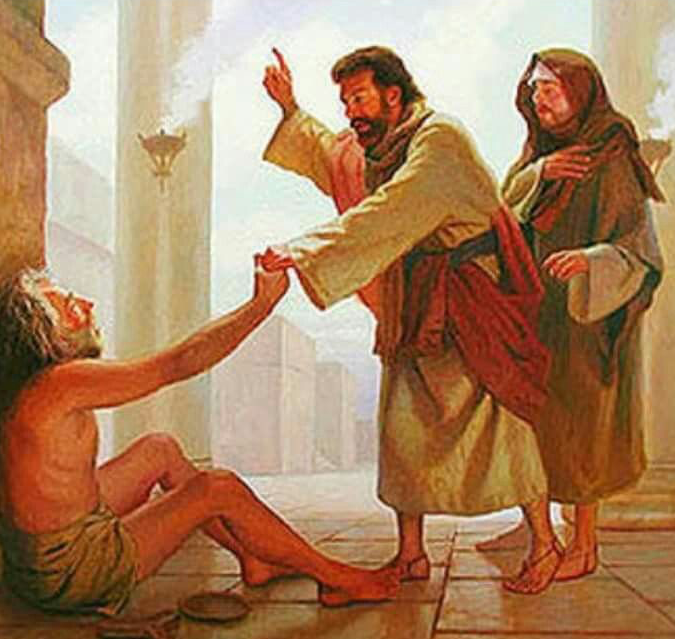
3:6 Then Peter said, “Silver or gold I do not have, but what I have I give you. In the name of [by the authority and power of] Jesus [Gr. equivalent of Heb. Joshua; means Savior] Christ [Messiah; Anointed One] of Nazareth, walk [Peter gave the man what he really needed rather than what he had asked for; the man got more than he expected (cf. Eph. 3:20-21)].”

3:7 Taking him by the right hand, he [Peter] helped him up, and instantly [the healing was immediate and complete] the man’s feet and ankles became strong [his feet and ankles had never been able to support him].

3:8 He jumped to his feet and began to walk. Then he went with them into the temple courts, walking and jumping [cf. Isa. 35:6], and praising God [he gave God the credit for his healing].

3:9 When all the people saw him walking and praising God [the beggar continued to give God credit for his healing],

3:10 they recognized him as the same man who used to sit begging at the temple gate called Beautiful, and they were filled with wonder and amazement at what had happened to him.

3:11 While the beggar held on to [perhaps an indication of gratitude] Peter and John, all the people were astonished and came running to them in the place called Solomon’s Colonnade [a favorite meeting place of the early Christians (cf. Acts 5:12); ran along the length of the eastern side of the court of the Gentiles].

3:12 When Peter saw this [the astonishment of the people], he said to them [Peter took advantage of the opportunity to preach a sermon]: “Men of Israel, why does this surprise you? Why do you stare at us as if by our own power or godliness [holiness, piety] we had made this man walk?

3:13 The God of Abraham, Isaac and Jacob [cf. Ex. 3:6], the God of our fathers [cf. Ex. 3:15], has glorified [honored or exalted; the purpose of the miracle] his servant Jesus [cf. Jn. 13:31-32; Phil. 2:9]. You handed him over to be killed [an event that had happened in Jerusalem only weeks earlier], and you disowned him before Pilate, though he had decided to let him go.

3:14 You disowned the Holy and Righteous One [cf. Isa. 53:11] and asked that a murderer [Barabbas; what a contrast to Jesus who was holy and righteous] be released to you [cf. Lk. 23:13-25].

3:15 You killed the author [may also be translated ruler, leader, founder] of life, but God [cf. 1 Cor. 6:14; Heb. 13:20] raised him from the dead. We [Peter, John, and others] are witnesses [cf. 1 Cor. 15:5-8] of this.

3:16 By faith in the name of Jesus, this man whom you see and know [the healed man’s identity and condition was no secret] was made strong. It is Jesus’ name and the faith that comes through him that has given this complete healing to him, as you can all see [the man’s condition was obvious].

3:17 “Now, brothers, I know that you acted in ignorance [cf. Eph. 4:18], as did your leaders.

3:18 But this is how God fulfilled what he had foretold through all the prophets [cf. Ps. 22, Isa. 50:6; Isa. 53:1-12], saying that his Christ would suffer [Jews were expecting a conquering Messiah].

3:19 Repent, then, and turn to God, so that your sins may be wiped out [erased; completely forgiven], that times of refreshing may come from the Lord,

3:20 and that he may send the Christ, who has been appointed for you—even Jesus.

3:21 He must remain in heaven until the time comes for God to restore everything, as he promised long ago through his holy prophets.

3:22 For Moses said, ‘The Lord your God will raise up for you a prophet like me from among your own people; you must listen to everything he tells you.

3:23 Anyone who does not listen to him will be completely cut off from among his people.’

3:24 “Indeed, all the prophets from Samuel on, as many as have spoken, have foretold these days.

3:25 And you are heirs of the prophets and of the covenant God made with your fathers. He said to Abraham, ‘Through your offspring all peoples on earth will be blessed.’

3:26 When God raised up his servant, he sent him first to you to bless you by turning each of you from your wicked ways.”

Acts 2

Outline
Gift of the Spirit — 2:1-3
Witness of the Disciples — 2:4-6
Responses of the People — 2:7-13
Response of Peter — 2:14-36
Conviction — 2:37
Conversion — 2:38-41
Church Ministries — 2:42-47

2:1 When the day of Pentecost [Gr. “pentekostos” means “fifty” or “fiftieth” because Pentecost celebrated 50 days after Passover (cf. Lev. 23:15-16)] came, they [cf. Acts 1:15] were all together in one place [most likely the upper room mentioned in 1:13].

After the ascension of Jesus (Acts 1:9-11), the disciples returned to Jerusalem (Acts 1:12). They gathered in an upper room (Acts 1:13), along with other believers, and spent time together in prayer (Acts 1:14). Peter also spoke to those assembled concerning choosing a replacement for Judas (Acts 1:15-22). Matthias was chosen as Judas’ successor by means of prayer and the casting of lots (Acts 1:23-26).

Pentecost is one of three major annual festivals celebrated by the Jews. Pentecost, meaning “fifty,” was celebrated fifty days after Passover (Lev. 23:15-16). This festival was also known as the Feast of the Firstfruits. When the day of Pentecost had arrived, or was being fulfilled, “about a hundred and twenty” (Acts 1:15) believers were assembled together in one place. Most likely these believers were praying together (Acts 1:14) in the upper room (Acts 1:13). They would experience a day of Pentecost unlike any other and would be used by God to usher in the firstfruits of a spiritual harvest that continues to our day.

Note: Three major annual feasts celebrated by the Jews:
1. Passover
2. Pentecost
3. Feast of Tabernacles

2:2 [audible evidence of the Spirit’s coming] Suddenly [without warning] a sound [suggests that they heard but did not necessarily feel a rush of wind] like [compared to; resembling] the blowing of a violent [like a tornado] wind [Gr. “pnoes” means “wind” and “pneuma” means “spirit”; a symbol of power (e.g., Ex. 14:21; 1 Kings 19:11)] came from heaven [the source of the sound] and filled the whole house [upper room as per 1:13] where they were sitting.

The Holy Spirit arrived suddenly and made His presence known in an audible way. Those present heard a sound comparable to that created by a violent rushing wind or tornado. Wind often was used as a symbol of God’s power (Ex. 14:21) and presence (2 Sam. 5:24). The disciples heard but did not necessarily feel this violent rush of wind. The Greek words for wind and spirit are similar in sound and spelling. The Holy Spirit is like the wind—unseen but not unnoticed (John 3:8) and available in limitless supply. We who are Christians today have the Holy Spirit dwelling in us, and His power is thus available to help us as we witness.

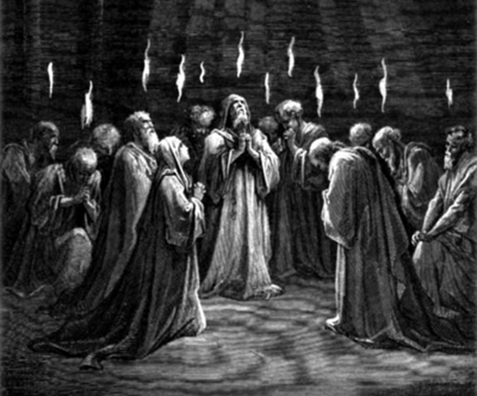
2:3 [visual evidence of the Spirit’s coming] They saw what seemed to be tongues of fire [a symbol of power (1 Kings 19:12); God’s presence (Ex. 3:2; 13:21); cleansing (Isa. 6:6-7; Rev. 3:18); and judgment (Deut. 4:24); cf. John the Baptist’s words in Lk. 3:16; no indication that those present felt heat or burning] that separated and came to rest on each of them [God’s Spirit is available to all believers].

The Holy Spirit also made His presence known in a visual way, appearing as fire. Fire often was used as a symbol of God’s presence (Ex. 3:2-4; 13:21), power (1 Kings 19:12), and cleansing (Isa. 6:6-7). There is no indication that those present felt any physical heat or burning from this fire.

This unusual fire resembled the shape of a tongue—a symbol of speech and communication. These flames of fire separated and settled on each person present, suggesting that God’s Spirit is available to all believers. The Holy Spirit empowered these believers and employed their tongues to proclaim God’s message in a supernatural way. He still desires to use our tongues as instruments to share the divine message that can ignite a fire in the hearts of others.

2:4 [oral evidence of the Spirit’s coming] All [not just the apostles] of them [believers in Jesus] were filled with the Holy Spirit [cf. promise of Jesus in Jn. 14:17; cf. Lk. 24:49] and began to speak in other tongues [known languages previously unknown to those speaking them; not ecstatic utterances or “glossalalia” of 1 Cor. 12–14; cf. Acts 10:46: 19:6] as the Spirit [the Person of power who sovereignly bestows gifts on believers] enabled [for this particular occasion] them.

All of those present were filled with the Holy Spirit, thus fulfilling the promise of John 14:17 that the Spirit “will be in you.” To be filled means that they received all of the Spirit’s presence they could contain and that the indwelling Spirit controlled their lives. As a result, the Spirit enabled these believers to speak of God’s mighty deeds (Acts 2:11) in different languages.

The word languages does not refer to ecstatic or unintelligible utterances, but rather to known languages and dialects previously unknown to those speaking them. The people of various nationalities (Acts 2:8-11) present at the feast clearly understood what was being spoken.

Today, many people groups are still waiting to read or hear the gospel in their own languages. Through the initiatives of missionaries and Bible translators, more and more people are learning of the wonders of God and of His love for them.

Note: D. L. Moody reportedly said, “You might as well try to see without eyes, hear without ears, or breathe without lungs, as to try to live the Christian life without the Holy Spirit.”

2:5 Now there were staying [some had been there since Passover and knew about Jesus’ death and had likely heard reports of His resurrection] in Jerusalem God-fearing [devout; pious] Jews from every nation [Jews of the Diaspora] under heaven.

Devout or pious Jewish people from every nation under heaven resided in Jerusalem. These were Jews of the Diaspora whose families had been driven from Jerusalem and scattered among the Gentile world but who had returned to Jerusalem to dwell there. Many of those present had been born and raised in other countries and spoke other languages. These Jews, as well as pilgrims visiting Jerusalem, were likely aware of the crucifixion of Jesus and rumors of His resurrection.

2:6 When they heard this sound [perhaps both the sound of the violent wind and the languages being spoken], a crowd came together in bewilderment, because each one heard [without the aid of an interpreter] them speaking in his own language [Gr. “dialekto”].

Those empowered by the Holy Spirit did not stay in the upper room but instead bolted! They poured out into the streets declaring the wonders of God (Acts 2:11). The sound of so many languages being spoken at the same time attracted a crowd. The multi-lingual crowd was astonished at hearing their native dialects being spoken by Galileans.

The Holy Spirit continues to help Christians today to communicate the gospel clearly in words people can understand. The word language translates the Greek word “dialekto” from which we get our English word “dialect.” God intended for all peoples to hear the gospel in their own languages.

Today, the Bible has been translated into 2300 of the world’s 6913 languages. Many of the 272 million people without the Bible in their native languages are still waiting to hear what the Jews in Jerusalem heard on the day of Pentecost.

2:7 Utterly amazed, they asked: “Are not all these men who are speaking Galileans?

2:8 Then how is it that each of us hears [without the aid of an interpreter] them in his own native language [the purpose of this occurrence of “tongues” was to get the gospel message out to the world]?

2:9 Parthians, Medes and Elamites; residents of Mesopotamia, Judea and Cappadocia, Pontus and Asia,

2:10 Phrygia and Pamphylia, Egypt and the parts of Libya near Cyrene; visitors from Rome

2:11 (both Jews and converts to Judaism Cretans and Arabs—we hear them declaring the wonders of God [this was the content of their speeches] in our own tongues!”

2:12 Amazed and perplexed, they asked one another, “What does this mean?”

2:13 Some, however, made fun of them and said, “They have had too much wine [a senseless explanation that does not account for how “drunks” could so clearly speak a language they had not previously spoken].”

Luke recorded the responses of those in Jerusalem who heard Christ’s followers speaking in other languages. Some of the people who witnessed the remarkable events on the day of Pentecost were bewildered (v. 6). Others were “utterly amazed” (v. 7) and likely stood around with their mouths opened wide. Still others were curious (vv. 8-11) and asked one another, “What does this mean?” (v. 12). And, as always, some scoffed and said, “They have had too much wine” (v. 13).

2:14 Then Peter [spokesman for the disciples] stood up [Peter’s confidence came from the Holy Spirit] with [suggests the others stood with Peter] the Eleven [the other apostles], raised his voice and addressed [means to speak seriously; the first of Peter’s sermons in Acts; Peter’s response to the charge of drunkenness (2:13); sermon was simple, scriptural, and Christ-centered (Swindoll)] the crowd [all those gathered in the Temple area for the Feast of Pentecost]: “Fellow Jews and all of you who live in Jerusalem, let me explain this [behavior of the disciples] to you; listen carefully to what I say [behavior of the disciples was related to fulfillment of Joel’s prophecy; cf. Joel 2:28-32; Acts 2:14-21; Jesus of Nazareth is the long-awaited Messiah (2:14-36)].

The charge of drunkenness became the occasion for Peter’s first and perhaps most influential sermon. Peter, filled and emboldened by the Holy Spirit, stood up and addressed the crowd of people (v. 14). He dismissed the charge of drunkenness as unreasonable, pointing out that it was too early in the day for someone to be drunk (v. 15). Peter then offered an explanation of what had happened.

2:15 These men are not drunk, as you suppose. It’s only nine in the morning!

2:16 No, this is what was spoken by the prophet Joel [cf. Joel 2:28-32]:

2:17 “‘In the last days [the time between Jesus’ first and second comings], God says, I will pour out my Spirit on all [refers to those who are born again] people [all races and nationalities]. Your sons and daughters [cf. Acts 21:8-9 re: the daughters of Philip the evangelist] will prophesy [proclaim God’s saving message], your young men will see visions [a means used by God to reveal Himself to people], your old men will dream dreams [a means used by God to reveal Himself to people].

Peter anchored the miraculous events of Pentecost in the Old Testament (vv. 16-21). He told the crowd that what they had witnessed was the fulfillment of the prophecy found in Joel 2:28-32. Joel spoke of a time when God would pour out His Spirit on all people (v. 17). As a result, they would all prophesy, or proclaim God’s saving message (v. 18). The time Joel had spoken of had finally come. The Holy Spirit was now available to empower all of God’s people for service, without regard to sex or age (vv. 17,18). The Holy Spirit, Peter said, was responsible for transforming ordinary people into people of power.

Have you ever thought of yourself as a person of power? Wealth and material possessions make some people feel powerful. Others feel powerful because they occupy positions of authority. But, as a believer, you have the greatest power of all available to you. And, the best part is, you do not have to be wealthy or in a position of authority to tap into this power. The Holy Spirit resides within you and stands ready to give you the power to have a part in advancing the gospel.

2:18 Even on my servants, both men and women, I will pour out my Spirit in those days, and they will prophesy.

2:19 I will show wonders in the heaven above and signs on the earth below, blood and fire and billows of smoke.

2:20 The sun will be turned to darkness and the moon to blood before the coming of the great and glorious day of the Lord.

2:21 And everyone [including Gentiles] who calls on the name of the Lord will be saved.’

2:22 “Men of Israel [Jews], listen to this: Jesus of Nazareth was a man [incarnation] accredited [publicly endorsed] by God to you by miracles [mighty works; indicates manifestation of power], wonders [calls attention to impression made upon those who witnessed miracles] and signs [indicates miracles were to direct attention of people to God], which God did [miracles were expressions of God’s power working through Jesus] among you through him, as you yourselves know [many of those present had either witnessed or heard of the miracles of Jesus].

2:23 This man was handed over to you by God’s set purpose and foreknowledge; and you [accused Jews of participation in Jesus’ death], with the help of wicked men [Romans], put him to death by nailing him to the cross [crucifixion].

2:24 But God [responsible for the resurrection] raised him from the dead [one of two references to the resurrection in Peter’s sermon (see also 2:32); many had seen the risen Christ], freeing him from the agony of death, because it was impossible for death to keep its hold on him [the Creator and Author of life].

2:25 David said [Ps. 16:8-11] about him [the Messiah]: “‘I saw the Lord always before me. Because he is at my right hand, I will not be shaken.

2:26 Therefore my heart is glad and my tongue rejoices; my body also will live in hope,

2:27 because you will not abandon me to the grave, nor will you let your Holy One see decay [Jesus’ body did not remain in the grave to decay].

2:28 You have made known to me the paths of life; you will fill me with joy in your presence.’

2:29 “Brothers, I can tell you confidently that the patriarch David died and was buried [therefore David was not writing about himself], and his [David’s] tomb [possibly located near pool of Siloam on south side of Jerusalem] is here to this day.

2:30 But he [David] was a prophet [because he wrote of One who would be resurrected from the dead] and knew that God had promised him on oath [cf. Ps. 132:11; 2 Sam. 7:15-16] that he [God] would place one of his [David’s] descendants on his throne.

2:31 Seeing what was ahead, he spoke of the resurrection of the Christ, that he was not abandoned to the grave, nor did his body see decay.

2:32 God has raised this Jesus to life [His tomb was close by and open to inspection], and we are all witnesses of the fact.

2:33 Exalted to the right hand [position of honor, authority, and equality] of God [cf. Acts 5:30-31; Eph. 1:20; Col. 3:1; Heb. 1:3; 8:1; 10:12; 12:2; 1 Pet. 3:22], he has received from the Father the promised Holy Spirit and has poured out what you now see and hear.

2:34 For David did not ascend to heaven, and yet he said [Ps. 110:1; this verse occurs 13 times in NT; most quoted OT verse in NT], “‘The Lord said to my Lord: “Sit [indicates completion of task] at my right hand

2:35 until I make your enemies a footstool for your feet.”‘

2:36 “Therefore let all Israel be assured of this: God has made this Jesus, whom you crucified, both Lord and Christ [glorification].”

As the crowd continued to listen attentively, Peter spoke about the life and works of Jesus (v. 22). Many of those listening knew of the “miracles, wonders and signs” (v. 22) which Jesus had performed through God’s power. Many of them also knew about the recent arrest, trial, and crucifixion of Jesus, which was part of God’s divine plan to redeem sinful humanity (v. 23). Death, however, could not hold Jesus (v. 24). Peter presented various proofs to support the claim that God raised Jesus from the dead (v. 25-35). Peter called upon his listeners to know with certainty that God declared Jesus, whom they crucified, both Lord and Christ (v. 36).

2:37 When the people heard this, they were cut to the heart [from Gr. katanussõ which means to be pierced or stabbed with a sharp point; suggests deep conviction; cf. John 16:8 and Heb. 4:12-13] and said to Peter and the other apostles, “Brothers, what shall we do?”

Perplexed by what they heard, the international crowd asked the question, “What could this be?” (Acts 2:12). This question became the springboard for Peter’s first sermon. Empowered by the Holy Spirit, Peter stood up and put the events of that day and also the life, crucifixion, and resurrection of Christ into Scriptural context.

When the people heard what Peter had to say they were pierced to the heart or profoundly convicted. It is likely that some of those present had cried “Crucify Him!” in Pilate’s hall (Matt. 27:22). Now they asked, “Brothers, what must we do?” Peter would later write that we should always be prepared to give an answer to those who ask us about the hope that we have (1 Pet. 3:15).

2:38 Peter replied, “Repent [from Gr. metanoeo which means to turn from sin and to Christ, the One who can solve the sin problem; change of heart and mind (adopt a different view of Christ) that results in a change of direction; means more than feeling sorry for past behavior; urgency: do it now!] and [implies a process; baptism is a response to repentance] be baptized [beautiful picture of death, burial, resurrection of Jesus and of believer’s death to sin and resurrection to new life in Christ (Rom. 6:2-7); outward display of inner conviction], every one of you [Peter’s message is for all people], in the name of Jesus Christ [acknowledge Him as Messiah and Lord] for [Greek preposition eis which can also be translated to mean “on the ground of” or “on the basis of”] the forgiveness of your sins. And you will receive [at the point of becoming a Christian] the gift of the Holy Spirit.

Peter answered the crowd’s question by telling them to repent, or to turn from their sin to Christ— the only One capable of solving their sin problem. In addition, Peter told the crowd that they should be baptized—not to receive forgiveness of sins, but as a testimony that they had already received forgiveness through their repentance and faith in Jesus. As believers, Peter assured them that they too would receive the gift of the Holy Spirit. God’s promise in Joel 2:32 was for them, their children, and even extended to all whom the Lord our God will call.

2:39 The promise is for you [personal application] and your children [generational application] and for all who are far off [global application; Gentiles]—for all [including future generations] whom the Lord our God will call.”

2:40 With many other words [indicates Luke only recorded a part of Peter’s sermon] he warned them; and he pleaded [to call, beseech, exhort, comfort] with them, “Save yourselves from [only way to do this was by becoming followers of Christ] this corrupt [crooked or perverse; Gr. word for perverse is skolios which means twisted, winding] generation [Peter spoke to people who had witnessed the Messiah’s coming and had rejected Him].”

Luke recorded only a portion of Peter’s sermon. With many other words Peter strongly urged the crowd to do more than avoid hell’s fires. He pleaded with them to save themselves from the influence of their corrupt generation through repentance and faith in Jesus.

Many people today are kept in darkness by our perverse society and its intolerance of Christ’s claim to be the only way of salvation. Jesus came to make provision for our eternal salvation and to empower His followers to live distinctive lives that reflect their heavenly citizenship.

2:41 Those [indicates that not all in the crowd accepted the message] who accepted [to receive] his message were baptized [first step of obedience; public identification with Christ; outward sign of inward decision], and about three thousand were added to their number that day.

Three thousand of those who heard Peter’s message placed their faith in Christ for salvation, were baptized and added to the small number of believers. What a response!

I have often thought that I will look for Peter in heaven and ask him what it was like to preach in Jerusalem on that day and have so many respond. And yet I wonder if Peter will look for us and ask us what it was like to proclaim God’s message throughout the world in the 21st century.

Those who join God on mission today continue the spiritual harvest inaugurated on that first Pentecost after Christ ascended into heaven.

The day of Pentecost began like any other day for Peter and the other followers of Christ. By the end of the day however, their lives would never be the same again. The Holy Spirit empowered these ordinary people for the divine task of sharing the gospel of Christ. As a result of their witness, the church was born and a fire ignited that has swept across countries and centuries.

How did this day begin for you? As a believer, you have the same power available to you that transformed the followers of Christ on the day of Pentecost. You too, can expect people to respond positively to the gospel when they see the results of the power of God’s Spirit in your life and hear your testimony. Will you allow God’s Holy Spirit to govern and guide your life today? Will you allow Him to use you to share Christ with someone today? If so, by the end of this day, your life may never be the same again.

2:42 [note four marks of the Jerusalem church] [1] They devoted [gave constant attention to] themselves to the apostles’ [those who had personally walked with Jesus] teaching [or doctrine; content of teaching was life and teaching of Jesus] and to the [2] fellowship [Gr. “koinonia”; the only use of this word by Luke in the books of Luke and Acts], to the [3] breaking of bread [observing the Lord’s Supper and sharing meals together] and to [4] prayer [essential in life of individual believers and churches].

2:43 Everyone was filled with awe [Gr. “phobos” is common term for fear; reverence], and many wonders [emphasizes the reactions the people had to what God did] and miraculous signs [point beyond the events to the power and purpose behind them] were done by the apostles.

2:44 All the believers were together [suggests unity; together in purpose and spirit] and had everything [their faith in the Lord Jesus] in common [Gr. “koina”].

2:45 Selling their possessions and goods, they gave to anyone as he had need [one person’s need felt by all].

2:46 Every day [consistency matters] they continued to meet [an intentional act] together [we need one another] in the temple courts [public meeting spaces available there]. They broke bread in their homes [this was the beginning of house churches] and ate [mealtimes provided opportunities to share about the beauty of Jesus] together [there are 35 “one another” passages in the NT] with glad and sincere hearts,

2:47 praising [praise is thanking God for who He is and what He has done] God and enjoying the favor of all the people [this general favor ceased after Stephen’s death]. And the Lord added to their number daily those who were being saved [evangelism is an essential function of the church].

Acts 1

1:1 In my former book [Gospel of Luke], Theophilus [means “loved of God” or “friend of God” (Lk. 1:3)], I wrote about all that Jesus began to do and to teach [Acts is record of what Jesus continued to do and teach through His followers]

The book of Acts opens with a brief account of the events between the resurrection and ascension of Jesus (Acts 1:3-11). After His resurrection, Jesus appeared to the disciples at various times “over a period of forty days” (Acts 1:3). During that period, He spoke to the disciples “about the kingdom of God” (Acts 1:3). Jesus used the Old Testament (Luke 24:27) to help the disciples understand the necessity of His death and resurrection (Luke 24:45-46). He also commissioned the disciples to share His message of salvation with all nations (see Luke 24:47 and Matt. 28:19-20).

1:2 until the day he was taken up to heaven, after giving instructions through the Holy Spirit to the apostles [“one sent forth;” they would spread message] he had chosen.

1:3 After his suffering, he showed himself to these men [apostles] and gave many convincing proofs [evidence manifest to the senses to assure the disciples they were not the victims of a delusion] that he was alive. He appeared [not an optical illusion] to them over a period of forty days [only NT passage that notes time between resurrection and ascension] and spoke about the kingdom of God [the rule and reign of God in the hearts of people; kingdom of God is not political or geographical’].

1:4 On one occasion [Lk. 24:43], while he was eating with them [a “convincing proof” that He was alive (cf. 1:3)], he gave them this command [Lk. 24:49]: “Do not leave Jerusalem, but wait [note: disciples not instructed to rush out and spread news about resurrected Christ, instead told to wait for the power to do so effectively; they would need power to spread the message and to endure persecution] for [reason for waiting] the gift my Father promised [outpouring of Holy Spirit (Acts 2:33); cf. Jn. 14:16-17; Lk. 24:49], which you have heard me speak about [cf. Jn. 15:26].

On one occasion prior to His ascension, Jesus commanded His disciples to stay in Jerusalem. Instead of fleeing opposition or going their separate ways, Jesus’ followers were to wait patiently for the Holy Spirit—the gift His Father had promised. Jesus had previously spoken to His disciples about the Holy Spirit’s role (John 14:16-17; Luke 24:49). They would need the Spirit’s power in order to effectively preach the gospel and endure the persecution they would undoubtedly experience.

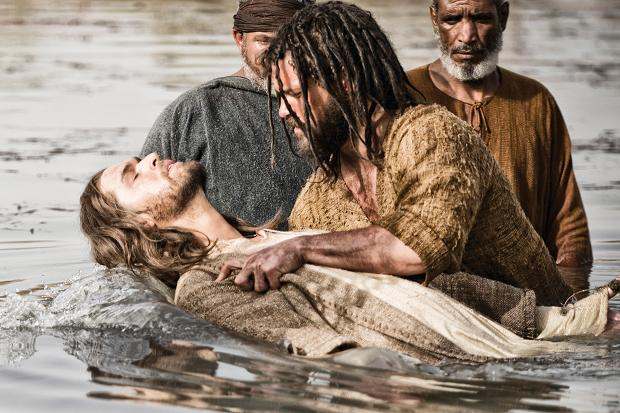
1:5 For John baptized [means to immerse or totally submerge; Matt. 3:11] with [or “in”] water [John spoke of One who would baptize them “with the Holy Spirit and with fire” (Lk. 3:16)], but in a few days [the time of the Spirit’s coming was near; at Pentecost (Acts 2:4) ten days after Jesus’ ascension] you will be baptized with the Holy Spirit [Through the indwelling of the Holy Spirit, “all that Jesus is, is made available through all that I am.” (Ray Stedman)].”

Jesus reminded His disciples that John had baptized with or immersed others in water. John’s baptism in the Jordan River demonstrated repentance or a willingness to turn from sin. His baptism did not give salvation (in fact, no water baptism gives salvation) but prepared people to welcome the Messiah who would baptize them “with the Holy Spirit and with fire” (Matt. 3:11). In a few days, the Spirit would come to indwell believers at Pentecost. However, from that time on, believers have received the Holy Spirit and been baptized by Him into the Body of Christ—the Church (1 Cor. 12:13)—at the moment of conversion.

Note: “Do not pray for easy lives. Pray to be stronger men. Do not pray for tasks equal to your powers. Pray for powers equal to your tasks.” (Phillips Brooks)

1:6 So when they [apostles] met together, they asked him, “Lord, are you at this time going to restore the kingdom to Israel [restore Israel’s political sovereignty; Israel had been under Roman domination since 63 BC]?”

Jesus spoke to His disciples about the kingdom of God (Acts 1:3). His teaching prompted the disciples to ask a question that was not entirely unreasonable, but reflected their misunderstanding of the kingdom. Like other Jews, they expected the Messiah to set up a political kingdom—restoring Israel to the political sovereignty and glory the nation had enjoyed in the days of King David. On one occasion they had argued among themselves as to who would have the highest rank in the kingdom (Luke 22:24-30). They now wondered if Jesus was going to free the nation from Roman rule.

1:7 He said to them: “It is not for you to know the times [general period of an event] or dates [precise time of an occurrence] the Father has set by his own authority.

Jesus gently rebuked the disciples for asking about God’s timetable for the restoration of the kingdom. The Father alone has the authority to set the timetable for all events. Instead of speculating about the future, they needed to focus on more immediate concerns—namely their new assignment. Perspiration for the kingdom is more important than speculation about the end times! We should live and serve as though Jesus will return at any moment (Mark 13:32-37).

1:8 [the promise of power] But you will receive power [supplied by the Holy Spirit; “Divine work can only be accomplished in dependence upon divine power.” (Nee)] when [the Person of power] the Holy Spirit comes on you; and [the purpose of power] you [all disciples, believers] will [the plan of power] be my witnesses [those who tell what they have experienced] in Jerusalem [Acts 1–7], and in all Judea and Samaria [Acts 8–12], and to the ends of the earth [Acts 13–28].”

In His last recorded statement on earth, Jesus gave His disciples a task rather than a timetable. He charged them with the responsibility of being His witnesses. Witnesses are those who testify about what they know and have experienced. Jesus also promised His followers that they would receive power from the Holy Spirit. This divine power would enable them to effectively tell others about Jesus. Starting in Jerusalem (Acts 1-7), Jesus’ followers were to take the good news to Judea and Samaria (Acts 8-12) and all the way to the ends of the earth (Acts 13-28).

Sharing the gospel with others is the responsibility of every believer. However, we cannot effectively share Christ with others apart from the power and guidance of the Holy Spirit. The divine work of evangelism can only be accomplished in dependence upon divine power (Acts 1:8). The Holy Spirit plays a key role in every aspect of evangelism. He guides believers as they communicate the message of salvation with unbelievers (see Luke 12:12).

The Holy Spirit also convicts unbelievers “of guilt in regard to sin and righteousness and judgment” (John 16:8). He persuades unbelievers to place their faith in Jesus for salvation. You can count on the Holy Spirit to empower you to share the gospel with others. But, can the Holy Spirit count on you?

Like the early disciples, Christians today need the Holy Spirit’s power as we live for Christ and witness to others about Him. We must not keep silent about Jesus. The cost of such silence is high for those waiting to hear.

Note: The early Christians never witnessed about the church at all; they witnessed about the Lord—what He could do, how He would work, what a fantastic person He was, how amazing His power was, and what He could do in human hearts.” (Ray Stedman • Acts 1–12: Birth of the Body • p. 21)

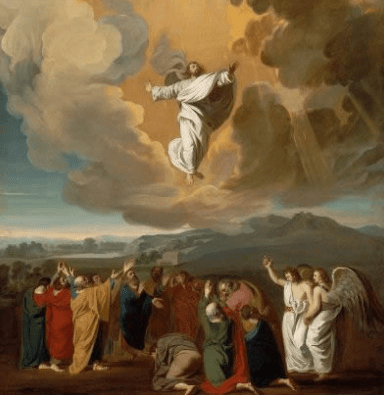
1:9 After he said this, he was taken up [the Ascension confirms deity of Jesus; to His heavenly home] before their [those who witnessed the Ascension now had the responsibility of carrying on the work] very eyes, and a cloud [a symbol of God’s glory; cf. Ex. 13:21-22; 16:10; 19:9,16; 24:15-18; 33:9-10; 34:5; 40:34-35; cf. Lk. 9:34-35 re: cloud at Transfiguration] hid him from their sight.

1:10 They were looking intently up into the sky as he was going, when suddenly two men dressed in white stood beside them.

1:11 “Men of Galilee,” they said, “why do you stand here looking into the sky? This same Jesus, who has been taken from you into heaven, will come back in the same way you have seen him go into heaven [cf. Lk. 21:27; Matt. 24:30; 26:64; Mk. 13:26].”

1:12 Then they returned to Jerusalem from the hill called the Mount of Olives, a Sabbath day’s walk [a half mile] from the city.

1:13 When they arrived, they went upstairs to the [use of the definite article indicates this was a specific place known to the disciples] room [may have been the upper room in which they had eaten the Last Supper (Lk. 22:12); this particular room became the first meeting place of he church] where they were staying. Those present were Peter [an Aramaic word meaning “stone” or “rock”], John, James [along with Peter and John formed Jesus’ inner circle (see Mk. 5:37; 9:2)] and Andrew [Peter’s brother; had the gift of introducing others to Jesus as per John 1:40-42; 6:8-9; 12:20-22]; Philip [see Jn. 1:43-45] and Thomas [means twin; see John 20:24-29], Bartholomew [or Nathanael; recruited by Philip; see John 1:43-51] and Matthew [the tax collector]; James son of Alphaeus [possibly Matthew’s brother; see Mk. 2:14] and Simon the Zealot [either a man of religious zeal or a member of the revolutionary (terrorist) party known as the Zealots (committed to the violent overthrow of Roman rule in Israel)], and Judas son of James [most likely Thaddaeus (cf. Lk. 6:16].

1:14 They all joined together constantly in prayer [a mark of the early church], along with the women [cf. Lk. 8:2-3; 23:49; 23:55–24:10 re: the women present at the Crucifixion] and Mary the mother of Jesus, and with his brothers [the other sons of Mary and Joseph who did not believe Jesus was the Messiah (Jn. 7:5) and that He was out of His mind (Mk. 3:21-35)].

Note: According to Matthew 13:55-56 and Mark 6:3, Jesus’ brothers were…
• James
• Joses (or Joseph)
• Judas (or Jude)
• Simon

1:15 In those days Peter [served as spokesman for the group] stood up among the believers (a group numbering about a hundred and twenty)

1:16 and said [Peter pointed those assembled to the Scriptures], “Brothers, the Scripture had to be [a divine necessity; because verses were regarded as a prophecy] fulfilled [these words put Judas’ betrayal and suicide into biblical perspective] which the Holy Spirit spoke long ago through the mouth of David [cf. Ps. 69:25; 109:8] concerning Judas, who served as guide for those who arrested Jesus—

1:17 he was one of our number and shared in this ministry.”

1:18 [vv. 17-18 are not part of Peter’s speech but Luke’s explanation of Judas’ suicide] (With the reward he got for his wickedness, Judas bought a field; there he [cf. Matt. 27:7 re: Judas’ suicide] fell [likely because the branch from which he hung broke] headlong, his body burst open and all his intestines spilled out.

1:19 Everyone in Jerusalem heard about this, so they called that field in their language Akeldama, that is, Field of Blood.)

1:20 “For,” said Peter, “it is written in the book of Psalms, “‘May his place be deserted; let there be no one to dwell in it [cf. Ps. 69:25],’ and, “‘May another take his place of leadership [cf. Ps. 109:8].’

1:21 [the first decision of the church was to replace Judas] Therefore it is necessary [perhaps to fulfill the promises in Matt. 19:28 and Lk. 22:28-30] to choose [note two qualifications for Judas’ replacement…] [1] one of the men [an indication that, in addition to disciples, others had followed Jesus] who have been with us the whole time the Lord Jesus went in and out among us [thus one who was an eyewitness and could serve as a credible witness to what Jesus said and did],

1:22 beginning from John’s baptism to the time when Jesus was taken up from us. [2] For one of these must become a witness with us of his resurrection.”

1:23 So they proposed two men: Joseph called Barsabbas [name means “son of the Sabbath”] (also known as Justus) and Matthias [name means “gift of God”].

1:24 Then they prayed, “Lord, you know everyone’s heart. Show us which of these two you have chosen

1:25 to take over this apostolic ministry, which Judas left to go where he belongs.”

1:26 Then they cast lots [an OT method of determining God’s will; cf. Prov. 16:33; cf. Urim and Thummim in Lev. 8:8; 1 Chron. 26:13; Ezra 2:63; Neh. 7:65; this is the last biblical instance of seeking God’s will by casting lots; Holy Spirit guided Christians at Antioch to set aside Paul and Barnabas for missionary work (Acts 13:2)], and the lot fell to Matthias; so he was added to the eleven apostles [“apostle” means messenger or missionary].

Luke 1

1:1 Many have undertaken to draw up an account [Luke likely had heard or read these other accounts in doing research for his gospel] of the things that have been fulfilled among us,

Note: How thoroughly have you investigated the Bible’s claims about Jesus?

1:2 just as they were handed down to us [refers to oral transmission] by those who from the first were eyewitnesses [those who had seen Jesus’ life and ministry; includes the apostles; could have included Mary, Jesus’ mother, as well as others who followed Jesus; cf. 2 Pet. 1:16-18] and servants of the word.

1:3 Therefore, since I [Luke, an educated Gentile believer (cf. Col. 4:11 and 4:14); a medical doctor (cf. Col. 4:14); one of Paul’s traveling companions (cf. “we” sections: Acts 16:10-17; 20:4-15; 21:1-18; 27:1-28:16) and fellow workers (Philemon 24)] myself have carefully investigated everything [written and oral accounts concerning Jesus’ birth, life, death, resurrection] from the beginning, it seemed good also to me to write an orderly account [with few exceptions, Luke’s gospel is chronological] for you, most excellent [same title Paul used when addressing Felix (Acts 24:3) and Festus (Acts 26:25); cf. Acts 23:26; title suggests that Theophilus was a person of rank] Theophilus [name means “friend of God” or “one who loves God”; Luke dedicated this Gospel and Acts (cf. 1:1) to this individual],

Note: Who was Theophilus? Suggestions include…
• “Theophilus” was a name for all friends and lovers of God.
• Theophilus was an unknown Christian.
• Theophilus was a Roman official involved in Paul’s defense in Rome and therefore in need of an orderly account of Jesus’ life.
• The “most excellent” Theophilus was an official or person of prominence.
• Theophilus may have been a benefactor who supported Luke.

1:4 so that you may know the certainty of the things you have been taught [our Eng. word “catechumen” (one being taught basics of the Christian faith); Theophilus had probably learned about Jesus through oral teaching].

Note: Luke wrote his gospel and Acts to help his friend Theophilus better understand the significance of the life and ministry of Jesus. How can God use you to help your family and friends get better acquainted with Jesus?

1:5 In the time of Herod [a cruel ruler; ruled from 37 to 4 BC; also called “the Great”] king of Judea there was [Zechariah and Elizabeth stand in stark contrast to evil Herod] a priest named Zechariah [name means “Yah (the Lord) remembers”], who belonged to the priestly division of Abijah [leading priest in the days of the return from Exile (Neh. 12:4), and then a priestly house (Neh. 12:17)]; his wife Elizabeth [name means “my God is good fortune” or “God is my oath”] was also a descendant of Aaron.

1:6 Both of them [Zechariah and Elizabeth would be model parents to John the Baptist] were upright [righteous; refers to those whose lives are wholly conformed to God’s will] in the sight of God [not just in outward appearance], observing all the Lord’s commandments and regulations blamelessly [does not mean without sin].

1:7 But [in spite of their faithfulness to God] they had no children [resulted in a sense of disgrace; cf. Elizabeth’s words in Lk. 1:25; often viewed as a judgment of God (cf. Gen. 20:18; Hos. 9:14)], because Elizabeth was barren; and [like Abraham and Sarah] they were both well along in years [therefore the promise of 1:13 could only happen by God’s intervention; reminder that we can and should continue serving God through our senior years].

Note: How can senior adults today use their gifts, talents, and experiences to enhance the ministries of the church?

1:8 Once when Zechariah’s division [priests divided into 24 divisions (cf. 1 Chron. 24) and served an entire week twice a year] was on duty and he was serving as priest before God, [note three surprises Zechariah experienced…]

1:9 [1] he [Zechariah] was chosen by lot [casting of lots took place twice a day at the morning and at the evening offering of incense; cf. Prov. 16:33], according to the custom of the priesthood, to go into the temple of the Lord and burn incense [in the holy place on the golden altar; burning of incense represented the prayers of the people; a privilege given to a priest only once in his lifetime because of the large number of priests].

1:10 And when the time [incense burned in the temple in the morning and in the evening; Luke does not specify time of day] for the burning of incense [rising smoke of the incense signifies the prayers of the assembled worshipers] came, all the assembled worshipers were praying outside.

1:11 Then [2] an angel [messenger; Gabriel as per Lk. 1:19] of the Lord appeared [a divine manifestation; Luke does not indicate what angel looked like] to him, standing at the right side [near holy of holies; between the altar and the golden lampstand] of the altar of incense.

1:12 When Zechariah saw him, he was startled [troubled; terrified] and was gripped with fear.

1:13 But the angel said to him: “Do not be afraid [command to stop an action in progress], Zechariah; your [personal] prayer has been heard [perhaps indicates Zechariah was praying for a son while performing his duty as a priest; perhaps indicates Zechariah was praying for the coming of the Messiah]. [3] Your wife Elizabeth will bear you a son, and you are to give him the name John [name means “the Lord is gracious” or “the Lord is merciful”].

1:14 He will be a joy and delight to you, and many will rejoice because of his birth,

1:15 for he will be great [cf. Lk. 7:24-28] in the sight of the Lord [the true measure of greatness]. He is never [strong prohibition] to take wine or other fermented [strong or intoxicating] drink [indicating that John was to be a Nazirite (cf. Num. 6:2-8); cf. Lk. 7:33], and he will be filled with the Holy Spirit even from [or before; cf. Lk. 1:41] birth.

1:16 [re: nature of John’s ministry] Many of the people of Israel will he bring back [to cause to return; cf. Isa. 40:1-5] to the Lord their God [because of his prophetic ministry; cf. Jn. 1:15-34].

1:17 And he will go on before the Lord [Jesus, the Messiah], in the spirit and power of Elijah [strength and an uncompromising presentation of the truth; cf. Matt. 17:10-13], to turn the hearts of the fathers to their children [perhaps means John would be instrumental in restoring broken family relationships or in bringing the hearts of his contemporaries into harmony with the devotion of their forefathers] and the disobedient to the wisdom of the righteous [cf. Mal. 4:6] — to make ready a people prepared for the Lord [Messiah].”

1:18 Zechariah asked [his question indicates his doubt/unbelief (cf. 1:20)] the angel, “How can I be sure of this? [Zechariah focused on the obstacles and physical limitations…] I am an old man and my wife is well along in years.”

Note: Can you recall an occasion when you doubted God because you focused on obstacles or apparent difficulties instead of on Him and His power?

1:19 The angel answered, “I am Gabriel [one of two angels actually named in Scripture]. I stand in the presence of God, and I have been sent to speak to you and to tell you this good news.

Note: Only two angels are named in the Bible:
• Michael: Dan. 10:13,21; 12:1; Jude 9; Rev. 12:7
• Gabriel: Dan. 8:16;9:21; Lk. 1:19,26

1:20 And now you will be silent and not able to speak [and possibly deaf as per 1:62] until the day this happens, because you did not believe my words, which will come true at their proper time.”

1:21 Meanwhile, the people were waiting for Zechariah and wondering why he stayed so long in the temple.

1:22 When he came out, he could not speak to them [unable to give priestly benediction (Num. 6:22-27)]. They realized he had seen a vision in the temple, for he kept making signs to them but remained unable to speak.

1:23 When his time [a week] of service was completed, he returned home [located in the hill country of Judea, south of Jerusalem (cf. 1:39)].

1:24 After this his wife Elizabeth became pregnant [just as Gabriel had announced in 1:13] and for five months remained in seclusion.

1:25 “The Lord has done this for me,” she said. “In these days he has shown his favor and taken away my disgrace among the people [cf. the experiences of Sarah (Gen. 21:1-7) and Rachel (Gen. 30:22-24)].”

1:26 In the sixth month [after Gabriel had informed Zechariah about the coming birth of his son; after Elizabeth became pregnant], God sent the angel Gabriel [fourth appearance in Scripture; previously appeared twice to Daniel (Dan. 8:15-27; 9:20-27) and once to Zechariah (Lk. 1:8-20)] to Nazareth, a town [located north of Jerusalem] in Galilee,

1:27 to a virgin [probably in her teens] pledged [engaged; couple regarded as husband and wife during this period] to be married to a man named Joseph [a carpenter (cf. Matt. 13:55)], a descendant of David [David had ruled Israel approximately one thousand years earlier; this kinship important in qualifying Jesus to be Messiah/King promised to David]. The virgin’s name was Mary.

1:28 The angel went to her and said, “Greetings, you who are highly favored [graced; implies that Mary was recipient of divine favor]! The Lord is with you [indicates she was already a person of faith].”

1:29 Mary was greatly [thoroughly] troubled [confused, perplexed] at his words and wondered [consider, reckon up different reasons] what kind of greeting this might be.

1:30 But the angel [Gabriel as per 1:26] said to her, “Do not be afraid [Gr., phobeo: frightened; compare with Zechariah’s response to Gabriel’s visit in 1:12-13], Mary [Greek form of Hebrew name Miriam], you have found [not earned; recipient] favor [Greek charis: grace or undeserved favor] with God [because God chose her to be Jesus’ mother].

1:31 You will be with child and give birth to a son, and you are to give Him the name Jesus [Greek form of Hebrew name Joshua; means “the Lord is salvation”].

1:32 He will be great and will be called the [messianic title] Son of the Most High [refers to God as exalted, holy, distinct]. The Lord God will give Him the throne of His father David [Messiah would come from David’s line: see 2 Sam. 7:13-14],

1:33 and He will reign over the house of Jacob [Israel] forever; His kingdom will never end [see Ps. 89:3-4].”

1:34 “How will this be,” Mary [perhaps puzzled] asked [requested an explanation] the angel, “since I am a virgin [“know not a man” (KJV); am not intimate with a man]?”

1:35 The angel answered, “The Holy Spirit [not a male partner] will come upon you [to effect the conception], and the power of the Most High will overshadow you. So the holy one to be born will be called the Son of God.

1:36 Even Elizabeth your relative is going to have a child in her old age, and she who was said to be barren is in her sixth month.

1:37 [the pregnancies of Elizabeth and Mary illustrate the following point…] For nothing is impossible with God [cf. Jer. 32:17; Matt. 17:20; 19:26; Mk. 10:27].

1:38 “I am the Lord’s servant [Greek doulos: means servant or slave],” Mary answered [recognized and willingly submitted to God’s will]. “May it be to me as you have said [Greek rhema: refers to a specific word spoken by God].” Then the angel left her.

1:39 At that time Mary got ready and hurried [from Nazareth] to a town [perhaps Hebron, the city of priests (Josh. 21:11)] in the hill country of Judea [possibly a distance of fifty to seventy miles],

Note: Mary went to visit Elizabeth, who was also pregnant. Why is it important to have family and friends with which to share our blessings, sorrows, hopes, difficulties, or challenges?

1:40 where she entered Zechariah’s home and greeted Elizabeth.

1:41 When Elizabeth heard Mary’s greeting, the baby leaped in her womb, and Elizabeth was filled with the Holy Spirit [cf. Lk. 1:15].

1:42 In a loud voice she [Elizabeth] exclaimed: “Blessed [“having been favored”] are you among [not above] women, and blessed is the child [no ordinary child] you will bear!

Note: How do you think Elizabeth’s words may have strengthened Mary and challenged her faith?

1:43 But why am I so favored, that the mother of my Lord [indicates Elizabeth recognized Mary would give birth to the Messiah] should come to me?

1:44 As soon as the sound of your greeting reached my ears, the baby in my womb leaped for joy.

1:45 Blessed [happy] is she [Mary] who has believed [trusted; in spite of the difficulties caused by the pregnancy] that what the Lord has said to her will be accomplished!”

1:46 And Mary said [Mary’s song is often called the “Magnificat” (first word of Latin translation of this passage: “Magnificat anima mea Dominum”)]: “My soul glorifies [tense indicates a habitual act] the Lord

1:47 and my spirit rejoices in God my Savior,

1:48 for he has been mindful [regarded or looked with favor upon her] of the humble [refers to low social class] state of his servant. From now on all generations will call me blessed,

1:49 for the Mighty One [title used 14 times in OT; used by Jesus in Matt. 26:64; Mk. 14:62] has done great things [cf. Deut. 11:7] for me—holy [cf. Lev. 19:2] is his name.

1:50 His mercy [cf. Ex. 33:19] extends to those who fear him, from generation to generation.

Note: What do verses 49 and 50 reveal about Mary’s understanding of God’s character and about her knowledge of the Scripture?

1:51 He has performed mighty deeds with his arm [symbol of strength and power; cf. Ex. 6:6; Isa. 51:5; Jer. 32:17]; he has scattered those who are proud [cf. Ps. 138:6; Prov. 3:34] in their inmost thoughts.

1:52 He has brought down rulers from their thrones [political position and power] but has lifted up [to positions of importance] the humble [cf. Ps. 147:6].

1:53 He has filled the hungry with good things [cf. Ps. 107:9] but has sent the rich away empty.

1:54 He has helped his servant Israel, remembering to be merciful

1:55 to Abraham and his descendants forever, even as he said to our fathers.”

1:56 Mary [probably was helpful to Elizabeth who was pregnant in her old age] stayed with Elizabeth [probably helpful to Mary and sensitive to what she would face upon returning to her home three months pregnant] for about three months and then returned home [Mary willing to bear disgrace and misunderstanding in order to be used by God for His divine purposes].

1:57 When it was time for Elizabeth to have her baby, she gave birth to a son.

1:58 Her neighbors and relatives heard that the Lord [God given the credit for this miraculous birth] had shown her great mercy, and they shared her joy [cf. 1:14; birth of a male child cause for rejoicing in that day; God had taken away Elizabeth’s disgrace (Lk. 1:25)].

1:59 On the eighth day [cf. Lev. 12:3] they came to circumcise [a sign of the covenant with Abraham (cf. Gen. 17:9-14)] the child, and they [neighbors and relatives] were going to name him after his father [as per the usual custom] Zechariah,

1:60 but his mother spoke up and said, “No! He is to be called John [cf. Lk. 1:13].”

1:61 They said to her, “There is no one among your relatives who has that name.”

1:62 Then they made signs [indicates Zechariah had also been stricken deaf] to his father, to find out what he would like to name the child.

1:63 He asked for a writing tablet [small wooden boards, covered with a film of wax (E. Earle Ellis)], and to everyone’s astonishment he wrote, “His name is John [cf. Lk. 1:13].”

1:64 Immediately [instantly] his mouth was opened and his tongue was loosed, and he began to speak, praising God [Zechariah’s first words after the return of his speech were words of praise].

1:65 The neighbors were all filled with awe [at the birth of a baby to an elderly couple and the other events at his birth], and throughout the hill country of Judea people were talking [continuously] about all these things.

1:66 Everyone who heard this wondered about it, asking, “What then is this child going to be?” For the Lord’s hand was with him.

1:67 His father Zechariah was filled with the Holy Spirit and prophesied [Zechariah’s song often called the “Benedictus” (first word in Latin translation)]:

1:68 “Praise be to the Lord, the God of Israel, because he has come [or “has visited”] and has redeemed [or “accomplished redemption”; just as He had redeemed Israel from Egyptian slavery (cf. Ex. 15:13; Deut. 13:5; Ps. 77:15; 111:9)] his people.

1:69 He has raised up a horn [symbol of strength and power] of salvation for us in the house of [reference to David’s ancestral line] his servant David

1:70 (as he said through his holy prophets [cf. 2 Sam. 7:11-13,26; Ps. 89; 132:17; Ezek. 34:23-24; Amos 9:11-12; Heb. 1:1] of long ago),

1:71 salvation [people looking for salvation from Roman Empire rather than salvation from sin] from our enemies and from the hand of all who hate us—

1:72 to show mercy to our fathers and to remember his holy covenant,

1:73 the oath he swore to our father Abraham [cf. Gen. 22:16-18]:

1:74 to rescue us from the hand of our enemies, and to enable us to serve him without fear

1:75 in holiness and righteousness before him all our days.

1:76 And you, my child, will be called [note John’s key role in history of redemption…] a prophet [first prophet since Malachi, ending 400 years of silence] of the Most High; [cf. Mal. 3:1; 4:5-6] for you will go on before the Lord to prepare the way for him [the forerunner promised in Mal. 3:1],

1:77 [ministry of John h Baptist included…] to give his people the knowledge of salvation through the forgiveness of their sins,

1:78 because of the tender mercy of our God, by which the rising sun [cf. Mal. 4:2] will come to us from heaven

1:79 to [cf. Isa. 9:2-3] shine on those living in darkness [darkness of death and sin] and in the shadow of death, to guide our feet into the path of peace [spiritual peace; cf. Jn. 14:27].”

1:80 And the child [John] grew and became strong in spirit [moral development]; and he lived in the desert [in isolation; period of preparation for public ministry] until he appeared publicly to Israel.

Luke 2

2:1 In those days Caesar Augustus [first emperor of Roman Empire] issued a decree [taxation decree] that a census [to register, to record information (name, occupation, property) in public registers] should be taken of the entire Roman world [inhabited earth].

2:2 (This was the first [can mean former or prior; (cf. Acts 5:37)] census [enrollment, tax registration] that took place while Quirinius was governor of Syria [Roman province].)

2:3 And everyone [Jews] went [traveled] to his own town [Jewish census was according to tribe, ancestral home, family, lineage] to register.

2:4 So Joseph also went up [Nazareth at lower elevation than Bethlehem] from the town of Nazareth in Galilee to Judea, to [85-90 mile journey] Bethlehem [located about 5 miles southwest of Jerusalem; the place foretold in prophecy for the Messiah’s birth (cf. Mic. 5:2)] the town of David, because he belonged to the house and line of David.

2:5 He went there [Bethlehem] to register with Mary [women not usually required to register; perhaps Mary accompanied Joseph because she was in the last trimester of her pregnancy and therefore possibly the subject of insult], who was pledged [engaged; had not yet consummated their marriage] to be married to him and was expecting a child [pregnancy probably made the journey difficult for Mary].

2:6 While [we do not know length of time] they were there [Bethlehem], the time [cf. Gal. 4:4] came for the baby to be born,

2:7 and she gave birth [miraculous conception but normal birth] to her firstborn [use of this word suggests that Mary gave birth to other children at a later time (cf. Lk. 8:19-21; Acts 1:14)], a son. She wrapped him in cloths [strips of cloth intended to strengthen the back and bones and provide proper growth; cloths and manger would serve as a sign to the shepherds (cf. v. 12)] and placed [to lay down] him in a manger [trough or box for feeding cattle; Jesus born in humble circumstances (cf. 2 Cor. 8:9)], because there was no room [due to crowds that had arrived for the census and soldiers and civil servants present to administer the census] for them in the inn [lodging, guest room, any place for lodging].

2:8 And there were shepherds [had a low reputation; looked upon with suspicion; regarded as ceremonially unclean; implication: the gospel first came to social outcasts of Jesus’ day] living out in the fields nearby [the area around Bethlehem], keeping watch over their flocks at night.

2:9 An angel of the Lord appeared [suddenly/unexpectedly; at very hour of Jesus’ birth (cf. v. 11)] to them, and [in addition to appearance of angel] the glory [radiance, brightness] of the Lord shone around them, and they were terrified [to fear with a great fear].

2:10 But the angel said to them, “Do not [prohibition of an action in progress] be afraid. I bring [preach] you good news [gospel] of great joy [replaced their great fear] that will be for all [everybody, not just the Jews; cf. Acts 15:1-29] the people.

2:11 Today in the town of David a Savior [the One who could rescue people from the penalty and power of sin; healer; deliverer; benefactor; title used only here and in Jn. 4:42] has been born to you; he is Christ [Messiah; anointed one; descendant of David who will reign over an everlasting kingdom (cf. 1 Chron. 7:14)] the Lord.

2:12 This will be a sign [a way to easily identify the baby] to you [cf. v. 7]: You will find a baby wrapped in cloths and lying in a manger [the first bed of the King of kings].”

2:13 Suddenly a great company of the heavenly host [military term for an army; band of soldiers: however, an army announcing peace] appeared with the angel, praising God [proper response of all created beings to the good news] and saying,

2:14 “Glory to God in the highest, and on earth peace [result of His coming; only those who know the Prince of Peace can know His peace] to men on whom his favor rests.”

2:15 When the angels had left them and gone into heaven, the shepherds said to one another, “Let’s go [sense of urgency; the first Christmas rush; cf. v. 11 re: “today”] to Bethlehem and see this thing that has happened, which the Lord has told us about [shepherds accepted the angels words as message from God].”

2:16 So they hurried off and found [after searching] Mary and Joseph, and the baby, who was lying in the manger [cf. 2:12].

2:17 When they had seen him [Jesus; things change when people truly encounter Jesus], they spread [made known] the word [the shepherds (considered outcasts by their own people) became the first preachers/witnesses of gospel message] concerning what had been told [a wonderful message] them about this [specific] child,

2:18 and all who heard it were amazed [to wonder] at what the shepherds said to them.

2:19 But Mary treasured up all these things [shepherds probably told Mary and Joseph about their experience with the angels] and pondered [deep reflection; mulling over] them in her heart.

2:20 The shepherds returned [to their flocks in the fields; as different individuals than they were before; never heard from again but never forgotten for the role they played], glorifying and praising [proper response to the mighty works of God] God for all the things they had heard [from the angels] and seen [verified with their own eyes], which were just as [exactly] they had been told.

2:21 On the eighth day [Jewish males circumcised and named eight days after birth (cf. Lev. 12:3; Lk. 1:59-60)], when it was time to circumcise [symbolized Jews unique relationship with God and separation from Gentiles (who were called “uncircumcised”; Eph. 2:11); sign and seal of covenant between God and Abraham (cf. Gen. 17:9-14)] him, he was named Jesus [which means “Jehovah is salvation” (Matt. 1:21)], the name the angel had given him before he had been conceived [cf. Lk. 1:31].

2:22 When the time of their purification [mother considered ceremonially unclean for forty days after birth of a son (eighty days after birth of a daughter) and not permitted to enter the temple] according to the Law of Moses had been completed [at the end of Mary’s time of separation], Joseph and Mary took him to Jerusalem to present him to the Lord [firstborn son presented to God forty days after birth (cf. Ex. 13:2,11-16; Num. 18:15-16); child bought back (redeemed) from God through an offering (a way of acknowledging that child belonged to the Lord)]

2:23 (as it is written in the Law of the Lord [cf. Ex. 13:2,12,15], “Every firstborn male is to be consecrated to the Lord”),

2:24 and to offer a sacrifice in keeping with what is said in the Law of the Lord: “a pair of doves or two young pigeons [suggests Mary and Joseph were too poor to bring a lamb].”

2:25 Now there was a man in Jerusalem called Simeon, who was righteous [conforming to the standard, will, or character of God; maintained right relationship with God; this word also used to describe Zechariah, Elizabeth, and Joseph (cf. Lk. 1:6; Matt. 1:19)] and devout [cautious, conscientious; lived life carefully/reverently in presence of God; took his religious duties seriously]. He was waiting [expecting; looking forward to; yearning] for the consolation [literally, “calling to one’s side for comfort”; encouragement; times were tough and people needed consolation; term refers to the restoration of Israel as a nation] of Israel [comprehensive term for the fulfillment of the messianic hope for the salvation of Israel; another way of describing the Messiah], and the Holy Spirit [gave Simeon power to discern the revelation of God’s purpose (cf. v. 26)] was upon [suggests continually] him.

2:26 It had been revealed [to instruct] to him by the Holy Spirit that [content of Holy Spirit’s revelation] he would not die [phrase suggests that Simeon was not a young man] before he had seen the Lord’s Christ [messiah, anointed one].

2:27 Moved [guided] by the Spirit, he went [providential timing] into the temple courts [either the court of the women or the court of the Gentiles]. When the parents [Luke previously established that Joseph was not Jesus’ biological father (cf. 1:34-38)] brought in the child Jesus to do for him what the custom of the Law required [to dedicate Him to the Lord],

2:28 Simeon took him [Jesus] in his arms and praised [blessed] God, saying:

2:29 “Sovereign Lord [appropriate way for a servant to address his God], as you have promised, you now [because Simeon had lived to see God’s promise fulfilled] dismiss your servant [this phrase is an ancient Jewish way of saying, “Let me die.” / perhaps request to be dismissed from his vigil or service] in peace [refers to comfort of knowing the Messiah had come].

2:30 For my eyes have seen your [cf. Ps. 51:12 re: “your salvation”] salvation [described Jesus’ mission; name Jesus means “the Lord is salvation”; cf. Acts 4:12],

2:31 which you have prepared in the sight of all people,

2:32 a light for revelation to the Gentiles and [additionally] for glory to your people Israel [salvation is intended for all people; cf. Lk. 2:10].”

2:33 The child’s father [legally; actually stepfather] and mother marveled [perhaps Simeon had enlarged their understanding about Jesus’ ministry, i.e., learning that His influence would reach beyond Israel as per v. 32] at what was said about him [see 2:29-32; divinely inspired prophecy/message about Jesus ; see 2:34-35 re: opposition Jesus would face (perhaps this was a new revelation to Mary)].

2:34 Then Simeon [see 2:25] blessed them and said [prophesied] to Mary, his mother: “This child is destined to cause the falling [for those who reject Him; falling before God’s judgment] and rising [for those who accept Him and experience God’s salvation; see John 1:12] of many in Israel, and to be a sign that will be spoken against [Jesus became an object of hostility and slander that found its culmination in His crucifixion],

2:35 so that the thoughts [schemes; cf. the hostility and slander Jesus experienced: these acts revealed the inner character of many] of many hearts will be revealed [unveiled; no neutrality; everyone must decide for or against Jesus]. And a sword [a large wide sword, signifying extreme anguish; probably a reference to Jesus’ death] will pierce your own soul too.”

2:36 There was also a prophetess [indicates she had previously received revelations; means she had a special gift of declaring and interpreting God’s message], Anna [same as OT name Hannah; name means “grace” or “gracious”], the daughter of Phanuel, of the tribe of Asher [one of ten tribes that formed northern kingdom of Israel; Moses referred to the tribe of Asher as “most blessed” and “favored by his brothers” and strong (Deut. 33:24-25); these details were included to establish Anna’s Jewishness]. She was very old; she had lived with her husband seven years after her marriage,

2:37 and then was a widow [cf. 1 Tim. 5:5] until she was eighty-four [NIV marginal note: “widow for eighty-four years;” great age and great devotion; assuming she married at about age 15, Anna would have been about 106 years old at the time]. She never left the temple but worshiped night and day [rather, “all the time” or “she was there every time the doors were opened”], fasting and praying [indicates deep devotion to God / a disciplined life; perhaps she fasted and prayed concerning the coming of the Messiah].

2:38 Coming up [to approach, to stand by] to them [Mary, Joseph, Simeon, and the infant Jesus] at that very moment, she gave thanks [thanksgiving in return for benefits; kept giving thanks] to God and spoke [kept speaking] about the child to all who were looking forward to [expecting] the redemption of Jerusalem [cf. Isa. 52:9; has messianic implications; phrase is synonymous with “the consolation of Israel” (Lk. 2:25)].

2:39 When Joseph and Mary had done everything [humbly and obediently submitted; indicates their determination to have and build a godly home] required by the Law of the Lord, they returned to Galilee to their own town of Nazareth [located in lower Galilee].

Note:
• Mary was a poor person as indicated by her offering for her purification after the birth of Jesus.
• The last mention of Mary is found in Acts 1:14 — the upper room in Jerusalem at Pentecost.
• According to tradition, Mary died in Ephesus.

2:40 [statements emphasize humanity of Jesus; cf. v. 52] And [this one verse covers the period from the time Jesus and His family returned to Nazareth (approximately nine years earlier) to the age of twelve] the child grew [continuous action] and became strong [physical growth]; he was filled with wisdom [insights from God; mental and intellectual growth as well as spiritual growth (using knowledge to live a life pleasing to God], and the grace [favor] of God was upon [directed toward] him.

Note: Luke 2:40 — Jesus from infancy to age 12.

2:41 Every year [emphasizes that it was a practice] his parents [Joseph functioned in role as His earthly father; Mary and Joseph set godly example for Jesus] went [traveled] to Jerusalem for the Feast of the Passover [law required all male Jews to celebrate three main feasts each year (cf. Ex. 23:14-17); included Feast of Unleavened Bread].

Note: Luke 2:41-50 — Jesus in the temple at age 12.

2:42 When he was twelve years old [bar mitzvah (son of the commandment) at age 12-13 when boy became part of community of faith and member of synagogue; transition from boyhood to manhood], they went up to the Feast, according to the custom.

2:43 After the Feast was over [“when the days were completed” (seven-day feast)], while his parents were returning home, the boy Jesus stayed behind in Jerusalem, but they were unaware of it.

2:44 Thinking [to suppose, to believe] he was in their company [pilgrims traveled to the Feast in large groups or caravans], they traveled on for a day. Then they began looking [thorough and prolonged search] for him among their relatives and friends.

2:45 When they did not find him, they went back to Jerusalem [a day of travel] to look for him.

2:46 After three days [perhaps from the time they discovered he was missing] they found him in the temple courts, sitting [normal position for teachers and pupils in Jesus’ day] among the teachers [Jesus exhibited a thirst for knowledge], listening [Jesus pictured as a learner] to them and asking them questions [listening and asking was normal method of learning and instruction].

2:47 Everyone [teachers and others who were present] who heard [His responses to questions as well as questions He asked] him was amazed [astonished] at his understanding and his answers [Jesus demonstrated unusual insight].

2:48 When his parents saw him, they were astonished [astonished, overwhelmed; perhaps at Jesus’ display of wisdom; cf. Lk. 2:33 re: their reaction to Simeon’s words]. His mother said to him, “Son, why have you treated us like this? Your father [contrast with “my Father” in Jesus’ reply (v. 49); Joseph not referred to again; perhaps Joseph died before Jesus began His public ministry; Jesus later referred to as “the carpenter’s son” (Matt. 13:55) and “the carpenter” (Mk. 6:3)] and I have been anxiously [emphasizes deep mental pain and distress] searching for you.”

2:49 [first spoken words of Jesus recorded in Gospels] “Why were you searching for me?” he asked. “Didn’t you know [based on their experiences in Luke 1-2] I had to be [a divine necessity] in my [distinction between Jesus’ relationship with Joseph and with God; indicates Jesus had an awareness of His unique relation to His Father; perhaps Mary and Joseph had told Jesus of the unique manner of His birth] Father’s house [“about My Father’s business, affairs, things”; Jesus embraced the Father’s priorities]?”

2:50 But [at this time; Mary and Joseph had to grow in their understanding of Jesus’ identity] they did not understand [comprehend] what he was saying to them.

2:51 Then he went down to Nazareth [home] with them and was obedient [continually respectful and submissive] to them [Mary and Joseph]. But his mother treasured [to keep, to guard safely] all these things in her heart [cf. Lk. 2:19; perhaps “all these things” became clear to Mary after death and resurrection of her Son].

Note: Luke 2:51-52 — Jesus’ growth from age 12 to age 30 (Lk. 3:23). Sometimes called “the silent years.”

2:52 [cf. v. 40] And Jesus grew [conveys idea of moving forward by cutting a path; increased] in wisdom [insight from His Father] and stature [indicates physical growth], and in favor with God [indicates spiritual growth] and men [indicates social growth].

Luke 3

3:1 In the fifteenth year of the reign of Tiberias Caesar [followed Augustus as Roman emperor; ruled from AD 14–37; he was 54 when he ascended to the throne and died at the age of 79 (in AD 37)]—when Pontius Pilate [came to power about AD 26] was governor of Judea, Herod tetrarch [political position in Roman Empire; term designated size of territory ruled (literally the “fourth part”)] of Galilee, his brother Philip tetrarch of Iturea [located northeast of Galilee] and Traconitis [political and geographic district located in northern Palestine on the east side of the Jordan River], and Lysanias tetrarch of Abilene [located about eighteen miles northwest of Damascus]

3:2 during the high priesthood of Annas [removed as high priest by the Romans about 15 years earlier, but still wielded considerable influence] and Caiaphas [current high priest; son-in-law of Annas], the word [Gr. rhema] of God came to John son of Zechariah [cf. Lk. 1:13-17] in [place] the desert [uninhabitable land; cf. Lk. 1:80; Isa. 40:3].

3:3 He went into all the country around [both sides of] the Jordan [water available for baptism], preaching [to herald] a baptism [outward sign of inward change; symbolized that repentance had already taken place] of repentance [change of mind; to turn around; our response to God’s offer of salvation] for [Gr. eis; “with reference to” or “as the result of”] the forgiveness [release, pardon] of sins [barrier between God and man].

3:4 As is written [“it stands written”] in the book of the words [Luke saw Isaiah passage as a clear prophecy of the ministry of John the Baptist] of Isaiah [cf. Isa. 40:3-5] the prophet: “A voice of one calling [to shout, to call aloud] in the desert, ‘Prepare [do so by repenting and being forgiven] the way for the Lord, make straight [right or upright; moral life] paths [stresses the moral dimension of life] for him.

3:5 Every valley shall be filled in [figuratively: exalting of the humble], every mountain and hill made low [figuratively: the humbling of the proud]. The crooked roads [metaphor for moral corruption] shall become straight, the rough ways smooth.

3:6 And [purpose of the coming King] all [not just Jews; salvation is a spiritual issue, not an ethnic one; cf. 2 Pet. 3:9] mankind will see God’s salvation.’”

3:7 John said to the crowds [an assorted group of people, including religious leaders (cf. Matt. 3:7)] coming out to be baptized by him, “[John recognized insincerity of some who presented themselves for baptism] You brood of vipers [poisonous snakes; cf. Matt. 23:33]! Who warned [to point out, to give a tip or private hint] you to flee [snakes often seen slithering from a fire] from the coming wrath [wanting to be baptized was proper thing to do, but their motives were in question]?

3:8 Produce fruit [evidence of repentance] in keeping with [demonstrate the reality of] repentance. And do not begin to say [presumptuously] to yourselves, ‘We have Abraham as our father [many trusted their physical heritage as descendants of Abraham to ensure their salvation; we become children of God by faith, not by ancestry; God has no grandchildren].’ For I tell you that out of these stones God can raise up children for Abraham [God can create his own children out of stones].

3:9 The ax [image of judgment] is already [suggests urgency] at the root of the trees, and every tree that does not produce good fruit will be cut down and thrown into the fire [images of judgment].”

3:10 [1] “What should we do then?” the crowd asked [indicates they were sincerely concerned about their spiritual condition; wanted to know what was involved in truly repenting; cf. Lk. 18:18; Acts 2:37; 16:30; 22:10].

3:11 John answered [practical examples of how repentant people should behave], “The man with two tunics [inner garment worn beneath outer cloak] should share with him who has none, and the one who has food should do the same. [unselfishness / concern for poor / needy should characterize those who have repented]

3:12 [2] Tax collectors [generally despised; worked for the Romans; would have been considered most in need of repentance] also came to be baptized. “Teacher,” they asked, “what should we do?”

3:13 “Don’t collect any more [to extort] than you are required to, [honesty is a characteristic of repentance; needs of others set against personal greed]” he told them.

3:14 [3] Then some soldiers [may have been Roman soldiers; more likely Jewish soldiers who assisted tax collectors] asked him, “And what should we do?” He replied, “Don’t extort [to extort money by violence; literally to shake violently or to shake someone down; to intimidate] money and don’t accuse people falsely [to extort money by blackmail] — be content [antidote to sins of violence and extortion] with your pay [ration; a denarius, worth about 18 cents, was the normal day’s wages for a soldier; food, clothing, and arms deducted from soldiers wages].”

3:15 The people were waiting expectantly [for the Messiah] and were all wondering [to discuss, to reason, to debate] in their hearts if John might possibly be the Christ [anointed one or messiah].

3:16 John answered them all, [1] “I baptize you with water [as a symbol of repentance]. But one more powerful [strong, mighty] than I will come, the thongs [leather straps] of whose sandals I am not worthy [sufficient] to untie [a task done by lowliest slave; emphasizes true humility of John; cf. Jn. 3:30]. [2] He will baptize you with the Holy Spirit and with fire [possibly tongues of fire as on day of Pentecost; possibly fire of judgment; fire symbolizes purification, spiritual cleansing].

3:17 [3] [Jesus as Judge] His winnowing fork is in his hand to clear his threshing floor and to gather the wheat into his barn, but he will burn up the chaff with unquenchable fire.”

3:18 And with many other words John exhorted [to urge; warning] the people [Gr. laos; term indicates not just a crowd, but a potentially responsive group] and preached the good news to them.

3:19 But when John rebuked Herod [Herod Antipas] the tetrarch because of Herodias, his brother’s [Philip] wife, and all the other evil things he had done,

3:20 Herod added this [this evil or sin] to them all: He locked John up in prison.


3:21 [cf. parallel accounts in Matt. 3:13-17; Mk. 1:9-11; Jn. 1:32-34] When all the people were being baptized, Jesus was baptized too [not because he was a sinner, but as a way of identifying himself with those he came to save]. And as he was praying [only Luke notes that Jesus was praying at the time of His baptism; Luke contains more on Jesus’ prayer life than the other Gospels], heaven [equivalent to our expression “the skies”] was opened

3:22 and the Holy Spirit descended on him in bodily form [the expression “in bodily form” only used by Luke] like a dove. And a voice [perhaps was what rabbis referred to as Bath Qol, a Heb. term meaning “daughter of the voice” (concept similar to the word “echo”)] came from heaven: “You [Jesus is the unique and only Son of God] are my Son, whom I love; with you I am well pleased.”

3:23 Now Jesus himself was about thirty years old when he began his ministry. He was the son, so it was thought, of Joseph,

3:24 the son of Heli, the son of Matthat, the son of Levi, the son of Melki, the son of Jannai, the son of Joseph,

3:25the son of Mattathias, the son of Amos, the son of Nahum, the son of Esli,

3:26the son of Naggai, the son of Maath, the son of Mattathias, the son of Semein, the son of Josech, the son of Joda,

3:27the son of Joanan, the son of Rhesa, the son of Zerubbabel, the son of Shealtiel,

3:28the son of Neri, the son of Melki, the son of Addi, the son of Cosam, the son of Elmadam, the son of Er,

3:29the son of Joshua, the son of Eliezer, the son of Jorim, the son of Matthat,

3:30the son of Levi, the son of Simeon, the son of Judah, the son of Joseph, the son of Jonam, the son of Eliakim,

3:31the son of Melea, the son of Menna, the son of Mattatha, the son of Nathan,

3:32the son of David, the son of Jesse, the son of Obed, the son of Boaz, the son of Salmon, the son of Nahshon,

3:33the son of Amminadab, the son of Ram, the son of Hezron, the son of Perez,

3:34the son of Judah, the son of Jacob, the son of Isaac, the son of Abraham, the son of Terah, the son of Nahor,

3:35the son of Serug, the son of Reu, the son of Peleg, the son of Eber,

3:36the son of Shelah, the son of Cainan, the son of Arphaxad, the son of Shem, the son of Noah, the son of Lamech,

3:37the son of Methuselah, the son of Enoch, the son of Jared, the son of Mahalalel,

3:38the son of Kenan, the son of Enosh, the son of Seth, the son of Adam, the son of God.

Luke 4

4:1 Jesus, full of the Holy Spirit, returned from the Jordan [cf. Lk. 3:21-22] and was led [sent or compelled] by the Spirit in the desert [a lonely and dangerous place],

Note: The late evangelist Angel Martinez once said: “After the baptism came the battle. After the dove came the devil. After the voice from heaven came the roar from hell.”

4:2 where for forty days he was tempted [temptation often follows a commitment to obey/serve God; spiritual victory often followed by spiritual conflict; temptation tries to divert us from God and what He has called us to do; cf. Heb. 4:15] by [points to source of temptation] the devil [slanderer or accuser; the devil is real]. He ate nothing [fasting helps individual draw near to and focus on God] during those days, and at the end of them he was hungry [famished; result of fast; Satan attacked Jesus at vulnerable point].

Note: Other biblical events occurred in time periods involving the number forty.
40 days of rain in Flood Gen. 7:17
• Moses spent 40 days on Mount Sinai Ex. 24:18
• Israel wandered 40 years in wilderness Deut. 29:5
• Goliath taunted Israel’s army 40 days 1 Sam. 17:16
• Elijah spent 40 days in wilderness 1 Kings 19:8

4:3 The devil [tempting is a function of the devil] said to him, “If [does not express doubt; first class condition in Greek construction: the reality of a condition affirmed from viewpoint of the speaker; can be translated “since”] you are the Son of God [same title for Jesus used at His baptism (cf. Matt. 3:17)], tell this stone to become bread.”

4:4 Jesus answered, “It is written [Deut. 8:2-3]: ‘Man does not live on bread [people do need bread or physical nourishment; cf. Matt. 6:11] alone [we cannot depend solely on own resources; people have greater need for spiritual nourishment].'”

4:5 The devil led him up to a high place and showed him in an instant all the kingdoms of the world [cf. Jn. 12:31].

4:6 And he said to him, “I will give you [resulting in instant power, authority, wealth apart from the suffering of the cross] all their authority [cf. Jn. 12:31; 14:30; 1 Jn. 5:19 re: Satan’s delegated authority from God] and splendor, for it has been given to me, and I can give it to anyone I want to.

4:7 So if [condition] you worship me [cf. Isa. 14:13-14], it will all be yours [beware: Satan may give you want you want but he will take what you have].”

4:8 Jesus answered, “It is written [Deut. 6:4-5,13]: ‘Worship the Lord your God and serve him only.'”

4:9 The devil led him to Jerusalem [religious and political seat of Palestine] and had him stand on the highest point [pinnacle or summit; portico on southeast corner of temple complex; about 450 feet high] of the temple [tallest building in Jerusalem]. “If you are the Son of God,” he said, “throw yourself down from here [temptation to misuse/abuse power available to Him; a presumptuous act rather than a great act of faith].

4:10 For it is written [devil quoted but twisted the meaning of Ps. 91:11-12 to suit his purposes; this passage not a license to abuse God’s power to satisfy a personal whim]: ” ‘He will command his angels [messengers] concerning you to guard you carefully;

4:11 they will lift you up in their hands, so that you will not strike your foot against a stone [a spectacular rescue would have impressed the masses].'”

4:12 Jesus answered [Deut. 6:16], “It says: ‘Do not put the Lord your God to the test [to put on a decisive test].'”

4:13 When the devil had finished all this tempting, he left him until an opportune time [Satan continued to tempt Jesus (cf. Matt. 16:23; 26:36-46); Matt. 4:11 adds: and angels (Ps. 103:20-21) came and attended him].

Luke 4:14 — 9:50 Jesus’ Galilean Ministry

4:14 Jesus returned to Galilee in the power of the Spirit, and news about him [John’s Gospel records that Jesus had already turned water into wine (Jn. 2:1-12); cleared the temple (Jn. 2:12-25); ministered in Samaria (Jn. 4:1-42) and then returned to Galilee] spread through the whole countryside.

4:15 He taught in their synagogues [came into existence during the Exile when the Jews no longer had their temple; at least ten Jewish families required to have a synagogue; place of worship on Sabbath and education for young boys during week], and everyone praised him [Jesus taught with authority (cf. Matt. 7:29; Lk. 4:32)].

4:16 He went to Nazareth [Jesus’ first visit there after he had begun His public ministry; referred to as a town (or city, from Gr. polis) in Lk. 2:4], where he had been brought up [to nourish, to rear], and on the Sabbath day he went into the synagogue [place for worship and instruction], as was his custom [synagogue attendance expected of every devout Jew; Jesus set example re: importance of worship; cf. Heb. 10:24-25]. And he stood up [customary posture (for reader and people) for reading the Scriptures] to read.

Note: Three parts of a synagogue service: First, worship. Second, reading from the law and the prophets. Third, teaching.

4:17 The scroll [Gr: biblion] of the prophet Isaiah was handed to him [by the attendant (cf. v. 20); the person in charge of keeping safe the sacred scrolls]. Unrolling it, he found [implies Jesus chose the passage to read; Jesus knew the Scriptures] the place where it is written [cf. Isa. 61:1-2; 58:6]:

4:18 [Lk. 4:18-19 is “the gospel according to Jesus” (cf. Lk. 7:22)] “The Spirit of the Lord is on me [cf. Lk. 3:22; 4:1], because he has anointed [the title “Christ” is derived from this word] me to [for this purpose; the Messiah’s job description; note fivefold mission statement] [1] preach good news [one word in Greek text: euangelizo] to the poor [economically poor; spiritually poor; those humbly dependent on God; poor more receptive to good news than the rich]. He has sent [to send on a mission; to send as an authoritative representative] me to [2: emancipation] proclaim [herald] freedom [forgiveness, deliverance] for the prisoners [those shackled by their sins; cf. Jn. 8:34] and [3: illumination] recovery of sight for the blind [Jesus restored the sight of many who were physically blind, but primarily came to give sight to those spiritually blind], to [4: liberation] release [set at liberty; freedom] the oppressed [bruised; people broken in pieces, both in heart and body; those oppressed by slavery to sin; those whipped down by life or crushed by their circumstances],

Note: Ask the following questions…
• To what are you enslaved? How can Jesus set you free from your enslavement?
• In what ways are people today spiritually blind? How can Jesus open the eyes of the blind today?
• What things oppress people today? How can Jesus set people free from the things that oppress them?

4:19 to [5: salvation] proclaim the year [Year of Jubilee (Lev. 25) which occurred every 50 years (debts forgiven, forfeited land returned, prisoners set free); Jesus brought the fulfillment of that year] of the Lord’s favor [or that the day of salvation had come].”

4:20 Then he rolled up the scroll, gave it back to the attendant and sat down [the one teaching generally sat down to teach (cf. Matt. 5:1)]. The eyes of everyone in the synagogue were fastened on [to look or gaze intently; listening with rapt attention] him,

4:21 and he began [implies that Jesus said more than is recorded here; this is the heart of what He said] by saying to them, “Today [the decisive time of God’s action; cf. 2 Cor. 6:1-2] this scripture is fulfilled in your hearing [a declaration that He was the Messiah God had promised Israel].

4:22 [initial response of the people] All spoke well [positive attitude] of him and were amazed [admired; held in wonder] at the gracious [winsome or attractive] words that came from his lips. [initial enthusiasm became skepticism; admiration turned into antagonism] “Isn’t this Joseph’s son? [cf. Matt. 13:53-28; apparently, Jesus did not fit their concept of the Messiah]” they asked.

4:23 Jesus said to them, “Surely [certainly] you will quote this proverb to me: ‘Physician, heal yourself! Do [in order to prove claims] here in your hometown what [miracles] we have heard that you did in Capernaum.’”

4:24 “I tell you the truth,” he continued, “no prophet is accepted in his hometown.

4:25 [example 1 of how God’s grace was extended to the Gentiles (a lowly widow in need of food)] I assure you that there were many widows in Israel in Elijah’s time, when the sky was shut for three and a half years and there was a severe famine throughout the land.

4:26 Yet Elijah was not sent to any of them [for sustenance], but to a widow [a Gentile; cf. 1 Kings 17:7-16] in Zarephath in the region of Sidon.

4:27 [example 2 of how God’s grace was extended to the Gentiles (a high government official in need of healing)] And there were many in Israel with leprosy in the time of Elisha [Elijah’s successor] the prophet, yet not one of them was cleansed [or healed by Elisha] — only Naaman [a Gentile] the Syrian.”

4:28 All the people in the synagogue were furious [greatly angered; infuriated; wrath that boils up in a burst of rage; this fury foreshadowed the crucifixion; St. Augustine said, “They love truth when it enlightens them, but hate truth when it accuses them.”] when they heard this [Jesus’ illustrations of two Gentiles who were the recipients of God’s grace].

4:29 They got up, drove [or threw] him out of the town, and took him to the brow [ridge] of the hill on which the town was built, in order to throw him down the cliff [fury had turned to murderous rage].

4:30 But [because His hour had not yet come; Jesus still had a mission to fulfill] he walked right through the crowd and went on his way [to announce the good news to others].

4:31 Then he went [from Nazareth] down [in elevation] to Capernaum, a town in Galilee, and on the Sabbath began to teach the people [at the synagogue “as was His custom” (Lk. 4:16)].

4:32 They were amazed at his teaching, because his message had authority.

4:33 In the synagogue there was a man possessed by a demon [demons are fallen angels who joined Satan in his rebellion in heaven], an evilspirit. He cried out at the top of his voice,

4:34 “Ha! What do you want with us, Jesus of Nazareth? Have you come to destroy us [demon recognized that Jesus has power to destroy evil]? I know [there is no atheism or agnosticism among demons; cf. Jas. 2:19] who you are–the Holy One of God!”

4:35 “Be quiet [term means “to muzzle”]!” Jesus said sternly. “Come out of him [not a request or an option but a command]!” Then the demon threw the man down [cf. Mk. 1:26] before them all and came out without injuring him.

4:36 All the people were amazed and said to each other, “What is this teaching? With authority and power he gives orders to evil spirits and they come out!”

4:37 And the news about him spread throughout the surrounding area.


4:38 [cf. Matt. 8:14-17; Mk. 1:29-38] Jesus left the synagogue and went to the home [Peter from Bethsaida (Jn. 1:44) but must have moved to Capernaum where he and his brother worked as fishermen] of Simon [Peter]. Now Simon’s mother-in-law [cf. 1 Cor. 9:5 re: Peter’s wife] was suffering from a high fever, and they asked Jesus to help her.

4:39 So he bent over her and rebuked the fever, and it left her. She got up at once [indicates that her strength was immediately restored] and began to wait on them.

4:40 When the sun was setting [marking the end of the Sabbath (Lk. 4:31)], the people brought [“to move by carrying” (carrying burdens prohibited on the Sabbath)] to Jesus all who had various kinds of sickness, and laying his hands on each one, he healed them.

4:41 Moreover, demons came out of many people, shouting, “You are the Son of God!” But he rebuked them and would not allow them to speak [shows His authority over demons], because they knew he was the Christ [Jesus would reveal His identity on His timetable].

4:42 At daybreak Jesus went out to a solitary place [a place without distractions; a place where He could have quiet fellowship with God; a time for spiritual replenishment; cf. Mk. 1:35]. The people were looking for him and when they came to where he was, they tried to keep him from leaving them.

4:43 But he said, “I must [conveys sense of call and urgency] preach the good news of the kingdom of God [the rule of God in the hearts of people] to the other towns also, because that is why I was sent [cf. Lk. 19:10].”

4:44 And he kept on preaching in the synagogues of Judea.

Luke 5

5:1 One day as Jesus was standing by the Lake of Gennesaret [Sea of Galilee, a freshwater lake 650 feet below sea level, 13 miles long and 7 miles wide], with the people crowding around him and listening to the word of God,

5:2 he saw at the water’s edge two boats [boats used by fishermen were up to twenty feet long with a sail attached to a central mast], left there by the fishermen, who were washing their nets [fishermen cared properly for the equipment that was vital to their livelihood].

5:3 He got into one of the boats, the one belonging to Simon [Peter], and asked him to put out a little from shore [gave Jesus visual and vocal access to the people on the shore]. Then he sat down and taught the people from the boat.

5:4 When he had finished speaking, he said to Simon [the owner of the boat who was not yet a disciple of Jesus], “Put out into deep water, and let down the nets [a dragnet was used in deep water] for a catch.”

5:5 Simon answered, “Master [Simon would address Jesus as “Lord” in 5:8], we’ve worked hard all night [indicates Simon was probably physically tired] and haven’t caught anything. But [Simon was willing to obey Jesus] because you say so, I will let down the nets.”

5:6 When they [indicates Simon enlisted the help of others (cf. 5:9-10)] had done so, they caught such a large number of fish that their nets began to break.

5:7 So they signaled their partners in the other boat to come and help them, and they came and filled both boats so full that they began to sink.

5:8 When Simon Peter saw this [the miracle of catching so many fish], he fell at Jesus’ knees and said, “Go away from me [Simon did not feel worthy to be in the presence of Jesus], Lord [note that Simon addressed Jesus as “Master” in 5:5]; I am a sinful man!”

5:9 For he and all his companions [those who had assisted him on the boat (5:6) as well as James and John (5:10)] were astonished at the catch of fish they had taken,

5:10 and so were James and John, the sons of Zebedee, Simon’s partners. Then Jesus said to Simon, “Don’t be afraid; from now on you will catch men [Jesus used the figure of their old work to describe their new calling; instead of dragging the Sea of Galilee for fish these men would now cast their nets into “the sea of sin” to “rescue the perishing”].”

5:11 So they pulled their boats up on shore, left everything [including the largest single catch of fish in their careers as fishermen; their boats and nets represented their livelihood and security] and followed him [in following Jesus their lives took on an eternal dimension; instead of making a living, they would now be making a life].

5:12 While Jesus was in one of the towns, a man came along who was covered [indicates the disease was at an advanced stage] with leprosy [cf. Lev. 13-14 re: instructions about skin diseases; lepers were required to keep a certain distance from others (they had to call out “unclean” to warn others of their approach as per Lev. 13:45) and prohibited from participation in social and religious activities]. When he saw Jesus [people in need moved in the direction of Jesus], he fell with his face to the ground and begged [indicates the leper desperately wanted to be cleansed] him, “Lord, if you are willing [the leper believed that Jesus could heal him], you can make me clean [cleansing meant that this man would be restored to his family and could again participate in the social and religious life of his town`].”

5:13 Jesus reached out his hand and touched [Jewish law prohibited touching lepers (Lev. 5:3; 13:1-46; Num. 5:2); possible that no one had touched this man in years; Jesus moved in the direction of people in need] the man. “I am willing,” he said. “Be clean!” And immediately the leprosy left him [indicates complete restoration of health rather than just a remission; healing lepers a sign of Messiah’s arrival (Matt. 11:5)].

5:14 Then Jesus ordered him, “Don’t tell anyone [lest doing so create a hindrance to Jesus’ ministry and cause others to seek Jesus for the wrong reasons], but go, show yourself to the priest [as per instructions in Lev. 14] and offer the sacrifices [Lev. 14:2-32] that Moses commanded for your cleansing, as a testimony to them [to those who witnessed the healing and to the priest].”

5:15 Yet the news about him [Jesus] spread all the more, so that crowds of people came to hear him and to be healed of their sicknesses.

5:16 But Jesus often withdrew to lonely places [places free of distraction] and prayed [Luke recorded many occasions on which Jesus prayed (cf. 3:21; 5:16; 6:12; 9:29; 23:46) and also taught about prayer (cf. 11:1-4, 9-13; 18:9-14)].

5:17 One day as he was teaching, Pharisees and teachers of the law [scribes: scholars of the Mosaic law; trained in interpreting, teaching, and enforcing the Law], who had come from every village of Galilee and from Judea and Jerusalem, were sitting there. And the power of the Lord was present for him to heal the sick.

5:18 Some men came carrying a paralytic [could not get to Jesus by himself] on a mat and tried to take him into the house to lay him before Jesus.

5:19 When they could not find a way to do this because of the crowd [represented an obstacle], they [resourcefully and single-mindedly] went up on the roof [probably climbed an outside staircase leading to the roof and “made an opening” (Mk. 2:4); roof probably flat and had beams and rafters covered with branches and sod] and lowered him on his mat [the paralytic’s bed] through the tiles into the middle of the crowd, right in front of Jesus.

5:20 When Jesus saw [actions demonstrated faith] their [friends and the paralytic] faith, he said [authoritatively], “Friend, your sins [spiritual need deeper than the physical need; Mark did not indicate if there was a cause-effect relationship between the man’s sins and his paralysis] are forgiven [“to release” or “to leave” or “to cancel a debt;” what the man needed most; read analogies of forgiveness in Isa. 1:18; Ps. 103:12; Mic. 7:19].”

5:21 The Pharisees [means “separated ones;” the major religious party in Jesus’ day] and the teachers of the law [scribes: scholars of the Mosaic law; trained in interpreting, teaching, and enforcing the Law] began thinking [to reason, to debate] to themselves, “Who is this fellow who speaks blasphemy [to insult, defame, or profane God or God’s name, in this case by claiming prerogatives and privileges that belong only to God: an act punishable by stoning: Lev. 24:10-23; Num. 15:30]? Who can forgive sins but God alone [according to first-century Jewish tradition, not even the Messiah could forgive sins]?”

Note: Jesus encountered conflict and experienced opposition almost from the beginning of His ministry. What can we expect as His disciples (see John 16:1-4; 17:14)? How should we respond? (see Matt. 5:10-12)

5:22 Jesus knew [to perceive; to recognize; cf. Jn. 2:24-25] what they were thinking and asked, “Why are you thinking these things in your hearts?

5:23 Which is easier: to say, ‘Your sins are forgiven [something not open to direct observation],’ or to say, ‘Get up and walk [something more difficult because everyone can witness the result]‘?

5:24 But that you may know that the Son of Man [Jesus’ favorite self-designation during His earthly ministry; title for Messiah (cf. Dan. 7:13-14); a less familiar title for the Messiah that Jesus filled with His own meaning] has authority [power; moral or legal right to use power; Jesus claimed the moral right to forgive sins] on earth to forgive sins….” He said to the paralyzed man, “I tell you, get up, take your mat and go home.”

5:25 Immediately he stood up [immediately obeyed the command of Jesus] in front of them, took what he had been lying on and went home praising [to give glory to] God.

5:26 Everyone was amazed [to be beside one’s self] and gave praise to God. They were filled with awe and said, “We have seen remarkable things today.”

5:27 After this, Jesus went out and saw a tax collector by the name of Levi [Matthew (cf. Matt. 9:9); son of Alphaeus (Mk. 2:14)] sitting at his tax booth [custom office; toll booth; may have been a tax station on the trade route (Damascus to Egypt) or a place for port duties and fishing tolls; he collected taxes for Herod Antipas; tax collectors had a reputation for overcharging in order to line their own pockets, as in the case of Zacchaeus in Lk. 19:8]. “Follow me [a brief and urgent call; a call to relationship],” Jesus said to him,

5:28 and Levi got up, left everything [left his financial security] and followed [to follow as a disciple] him [knowing that he could never again return to his work as a tax-collector; a decisive break with his past; his response was immediate and his commitment total].

5:29 Then Levi held a great banquet for Jesus at his house [first act as a follower of Jesus was to host a dinner to introduce his friends to Jesus], and a large crowd of tax collectors [not Roman, but native Jews who had been contracted to collect taxes in a small town or district; publicans] and others were eating with them.

5:30 But the Pharisees [means “separated ones;” the major religious party in Jesus’ day] and the teachers of the law [scribes: experts in the law of Moses] who belonged to their sect complained to his disciples, “Why do you eat and drink with [to recline at the table together] tax collectors and ‘sinners’ [term used by Pharisees to designate those who did not keep requirements of Mosaic Law; cf. Lk. 15:1-2]?”

5:31 Jesus answered them, “It is not the healthy [strong] who need a doctor, but the sick [“to have it badly”].

5:32 I have not come to call the righteous [Jesus was not implying that the Pharisees were righteous; Pharisees thought they were righteous when they too were among the sick Jesus came to save], but sinners [conscious of their unworthiness before holy God and their need for salvation (cf. Lk. 18:9-14)] to repentance.”

5:33 They said to him, “John’s disciples often [regularly/habitually: Pharisees voluntarily fasted two days each week as in Luke 18:12] fast [going without food in order to focus on spiritual matters/prayer; an accepted and expected religious expression in Jesus’ day] and pray, and so do the disciples [Pharisees-in-training] of the Pharisees [required by law to fast only on Day of Atonement (Lev. 16:29)], but yours [this was an indirect criticism of Jesus] go on eating and drinking [do not observe formal times of fasting].”

5:34 Jesus answered [used illustration of a Jewish wedding feast], “Can you make the guests [those who had come to believe in Jesus] of the bridegroom [Jesus; cf. Jn. 3:29] fast [rather than feast (something unthinkable and inappropriate)] while he is with them?

5:35 But the time will come when the bridegroom [Jesus] will be taken [abruptly] from [veiled reference to Jesus’ death on the cross] them [disciples]; in those days [the appropriate time: cf. 2 Sam. 12:22-23] they will fast [an expression of grief and sadness].”

5:36 He told them this parable: “No one tears a patch from a new garment and sews it on an old one. If he does [doing so ruins both garments], he will have torn the new garment, and the patch from the new will not match the old.

5:37 And no one pours new wine [expands as it ferments] into old wineskins [have lost elasticity]. If he does, the new wine will burst the skins, the wine will run out and the wineskins will be ruined.

5:38 No, new wine [unfermented] must be poured into new wineskins [have the elasticity to stretch as wine ferments].

5:39 And no one after drinking old wine wants the new, for he says, ‘The old is better.'”

Luke 6

6:1 One Sabbath Jesus was going through [roads/paths often went through fields] the grainfields, and his disciples began to pick [technically considered harvesting by religious leaders] some heads of grain [permitted by Deut. 23:25], rub them in their hands [this was regarded as threshing and forbidden on the Sabbath as per laws as set up by religious leaders] and eat the kernels [in an attempt to satisfy their hunger].

6:2 Some of the Pharisees asked, “Why are you doing what is unlawful [reaping grain; not a violation of God’s law, but a violation of a man-made rule by Pharisees] on the Sabbath?”

6:3 Jesus answered them, “Have you never read [Jesus knew that the Pharisees were very familiar with this story recorded in 1 Sam. 21:1-6] what David did when he and his companions were hungry?

6:4 He entered the house of God, and taking the consecrated bread [also called the bread of the Presence or showbread; 12 consecrated loaves (represented 12 tribes) placed in the tabernacle; replaced with fresh loaves at end of week; old loaves eaten by priests (Lev. 24:9)], he ate what is lawful only for priests to eat [the needs of people are more important than priestly regulations/technicalities]. And he also gave some to his companions [therefore if Pharisees condemned Jesus they also should condemn David].”

6:5 Then Jesus said to them, “The Son of Man [messianic reference Jesus used to refer to Himself (cf. Dan. 7:13-14); Jesus’ most commonly used title for Himself] is Lord [He created the Sabbath; He had authority to interpret meaning of Sabbath and corresponding laws] of the Sabbath.”

6:6 On another Sabbath he went into the synagogue and was teaching, and a man was there whose right [Luke paid close attention to physical details] hand was shriveled [text does not specify if this was a birth defect or result of disease or an accident; not a life-threatening condition].

6:7 The Pharisees and the teachers of the law were looking for a reason to accuse Jesus, so they watched him closely to see if he would heal [considered practicing medicine; a violation of the Sabbath according to the Pharisees] on the Sabbath.

6:8 But Jesus knew what they were thinking [cf. Lk. 5:22] and said to the man with the shriveled hand, “Get up and stand in front of everyone [publicly; everyone present would have an opportunity to witness Jesus’ act of kindness and healing].” So he got up and stood there.

6:9 Then Jesus said to them, “I ask you, which is lawful on the Sabbath: to do good [cf. Matt. 12:11-12 (a farmer could rescue animal from pit on Sabbath even though this act considered “work”] or to do evil, to save life or to destroy it? [religious leaders did not answer Jesus’ question]

6:10 He looked around at them all, and then said to the man, “Stretch out your hand.” He did so, and his hand was completely restored [to its former condition].

6:11 But they were furious [indication of how their own legalism had caused their hearts to grow cold and insensitive to human needs] and began to discuss with one another what they might do to Jesus [their hatred drove them to consider how they might actually kill Jesus (cf. Matt. 12:14; Mk. 3:6), a clear violation of God’s law].

6:12 One of those days [no exact time reference provided] Jesus went out to a mountainside [a place without distractions] to pray, and spent the night praying to God [Jesus prayed before choosing twelve disciples].

6:13 When morning came, he called [Jesus took the initiative] his disciples to him and chose twelve [reminiscent of Israel’s twelve tribes] of them, whom he also designated apostles [refers to one sent on a mission]:

6:14 Simon (whom he named Peter [an Aramaic word meaning “stone” or “rock”]), his brother Andrew [Peter’s brother; had the gift of introducing others to Jesus as per John 1:40-42; 6:8-9; 12:20-22], James, John [James, John, and Peter formed Jesus’ inner circle (see Mk. 5:37; 9:2); Mk. 3:16 adds: “to them (James and John) He gave the name Boanerges, which means Sons of Thunder,” perhaps because of their fiery temperaments (Lk. 9:54)], Philip [see Jn. 1:43-45], Bartholomew [or Nathanael; recruited by Philip; see John 1:43-51],

6:15 Matthew [the tax collector], Thomas [means twin; see John 20:24-29], James son of Alphaeus [possibly Matthew’s brother; see Mk. 2:14], Simon who was called the Zealot [either a man of religious zeal or a member of the revolutionary (terrorist) party known as the Zealots],

6:16 Judas son of James [most likely Thaddaeus (cf. Lk. 6:16; Acts 1:13)], and Judas Iscariot [from the village of Kerioth], who became a traitor.

Note: Although the twelve were different, Jesus expected them to work together in His cause. Jesus calls all kinds of people to follow Him and to join with others in working together to serve Him. He still desires unity in diversity among His followers.

6:17 He went down [from “mountainside” (Lk. 6:12)] with them and stood on a level place [a place from which He could teach those present]. A large crowd of his disciples was there and a great number of people from all over Judea [southernmost region of Israel], from Jerusalem [key city in Judea], and from the coast of Tyre and Sidon [Gentile cities located on coast of Mediterranean Sea],

6:18 who had come [indicates word about Jesus teaching and healing had spread] to hear him and to be healed of their diseases [physical illnesses]. Those troubled by evil spirits were cured,

6:19 and the people all tried to touch him , because power was coming from him and healing them all [no one returned home disappointed].

6:20 Looking at his disciples, he said: “Blessed [Gr. makarioi means more than happiness; word refers to inner peace and security regardless of external circumstances] are you who are poor [Gr. ptochoi means absolute or abject poverty as opposed to Gr. word penes which refers to someone who works to provide for his needs but has nothing left over], for yours is the kingdom of God.

6:21 Blessed are you who hunger [a hunger that is the result of poverty; to have an intense longing that needs to be satisfied] now, for you will be satisfied. Blessed are you who weep [those who mourn for their own sins (what their sins have done to them and to God); those who mourn as a result of suffering] now, for you will laugh.

6:22 Blessed [means one who is approved by God or one whose actions meet with God’s approval] are you when men hate [attitude of those who oppose God’s people; active resistance and persecution] you, when they exclude [by-product of hatred; means to mark off from by boundary, to separate, excommunication from the congregation as well as from social intercourse] you and insult [by-product of hatred; means to reproach, to heap insults on (either directly or behind your back)] you and reject [to cast out; to throw out; to not allow anyone to talk about you in a positive way; sometimes used of hissing an actor off the stage] your name [character, reputation; also refers to the name we bear: “Christian”] as evil, because [reason or cause; cf. 1 Peter 4:15-16] of the Son of Man.

6:23 “Rejoice in that day and leap for joy [or exult], because great is your reward in heaven. For that is how their fathers treated the prophets [e.g., Elijah (1 Kings 19:2,13-14); Micaiah (1 Kings 22:26-27); Jeremiah (Jer. 37:17; 38:6)].

6:24 “But woe [this word expresses regret and sorrow] to you who are rich [riches can cause people to feel self-sufficient and blind them to their need for God], for you have already received your comfort [the comfort that money can buy].

6:25 Woe to you who are well fed [those who have what the world has to offer (material possessions, financial security, etc)] now, for you will go hungry [cf. Lk. 16:19-31]. Woe to you who laugh [those who mock God and the things of God] now, for you will mourn and weep.

6:26 Woe to you when all [trying to please all people usually requires spiritual compromise at some point] men speak well of you, for that is how their fathers treated the false prophets [they told rulers and people what they wanted to hear and thus were popular].

6:27 “But I tell you who hear me [phrase refers to those paying attention to or trying to follow Jesus’ practical teachings about everyday life]: Love [Gr. agape: this kind of love is an act of the will; goes against our natural tendency to hate our enemies; continuous action] your enemies [those who do the four things in v. 22], do good [act in the best interests of another; we must make a decision to do so] to those who hate you,

6:28 bless [show kindness; to desire the best for another; ask God’s favor on that person; cf. Rom. 12:14] those who curse [the attempt to bring evil upon someone; to desire the worst for someone] you, pray for those who mistreat [to abuse; to display a despiteful spirit] you.

6:29 [examples of mistreatment in Jesus’ day] [1] If someone strikes [to hit; a violent blow to the jaw with the fist or a contemptuous backhanded slap on the cheek] you on one cheek [jawbone], turn [offer] to him the other also. [2] If someone takes [to rob] your cloak [outward garment], do not stop [hinder, prevent] him from taking your tunic [undergarment].

6:30 Give to everyone who asks you, and [3] if anyone takes [to rob, to confiscate, to loot] what belongs to you, do not demand it back.

6:31 [the Golden Rule] Do [emphatic; take the initiative] to others as you would have them do to you.

6:32 [situation 1] “If you love those who love you, what credit is that to you? Even ‘sinners’ [term in quotes because it was the term the religiously strict Jews used to refer to people such as prostitutes, tax collectors, and thieves] love those who love them.

6:33 [situation 2] And if you do good to those who are good to you, what credit is that to you? Even ‘sinners’ do that [thus there is nothing distinctive or noteworthy].

6:34 [situation 3] And if you lend to those from whom you expect repayment, what credit is that to you? Even ‘sinners’ lend to ‘sinners,’ expecting to be repaid in full [behavior of believers must be distinctively different than that of sinners].

6:35 But [introduces contrast] love your enemies, do good to them, and lend to them without expecting [to hope to have something in return] to get anything back. [two incentives to encourage us to return good for evil] [1] Then your reward [cf. Matt. 19:28-30; 25:31-40,46; Lk. 6:20-21] will be great, [2] and you will [“will show yourselves to be”] be [demonstrate sonship by emulating Heavenly Father] sons of the Most High, because he is kind to the ungrateful and wicked.

6:36 Be [we should do for others (even our enemies) what the Father does for us] merciful [involves compassion, understanding, desire to alleviate pain and difficulties], just as your Father is merciful [cf. Rom. 5:8].

6:37 “Do not judge [judgmental attitude and condemning spirit based on personal rules and laws; prejudice, hasty and critical judgment; this is not a prohibition against critical thinking], and you will not be judged. Do not condemn [to pass sentence against], and you will not be condemned. Forgive [release], and [forgiveness is a two-way street] you will be forgiven.

6:38 Give, and it will be given to you. A good measure, pressed down, shaken together and running over [The picture is of grain poured into a container, pressed down and shaken so that every little corner is filled and the grain is poured in until it runs over. (Arndt)], will be poured into your lap [the fold formed by a loose garment overhanging a girdle]. For with the measure you use, it will be measured to you.”

6:39 He also told them this parable: “Can a blind man lead a blind man [obvious answer is no]? Will they not both fall into a pit [obvious answer is yes]?

6:40 A student [disciple; apprentice] is not above his teacher [one who guides the student or leads others], but everyone [allows for no exceptions] who is fully trained [when thoroughly taught and qualified] will be like his teacher [will think, act, and live in the same manner as his teacher].

6:41 “Why do you look at the speck of sawdust [splinter] in your brother’s eye [it is easy to spot sin in the lives of others] and pay no attention to the plank [beam] in your own eye [it is easy to overlook sins in ourselves]?

6:42 How can you say to your brother, ‘Brother, let me take the speck [represents sin or some fault] out of your eye,’ when you yourself fail to see the plank in your own eye? You hypocrite, first take the plank out of your eye, and then you will see clearly to remove the speck from your brother’s eye.


6:43 “No good [healthy] tree bears bad fruit, nor does a bad [unhealthy] tree bear good fruit.

6:44 Each tree [person] is recognized by its own fruit [metaphor for character and conduct; what they produce]. People do not pick figs [important agricultural product in Jesus’ day] from thornbushes, or grapes [important agricultural product in Jesus’ day] from briers.

6:45 The good man brings good things [deeds and speech] out of the good stored up in his heart, and the evil man brings evil things [deeds and speech] out of the evil stored up in his heart. For out of the overflow of his heart his mouth speaks [Spurgeon said that what lies in the well of the heart comes up in the bucket of speech].

6:46 “Why do you call me, ‘Lord, Lord,’ and do not do what I say [those who call Jesus Lord must obey Him; the words “No, Lord” are an oxymoron]?

6:47 I will show you what he is like who comes to me and hears my words and puts them into practice [cf. Lk. 11:28; Jas. 1:22-25].

6:48 He is like a man [a wise man (Matt. 7:24)] building a house, who dug down deep and laid the foundation on rock [legitimate commitment]. When a flood came, the torrent struck that house but could not shake it, because it was well built.

6:49 But the one who hears my words and does not put them into practice is like a man [a foolish, stupid, unreflecting person; cf. Matt. 7:26] who built a house on the ground without a foundation. The moment the torrent [not a matter of if but when the rain will come] struck that house, it collapsed and its destruction was complete [often a crisis makes evident the difference in how something is built; cf. Matt. 7:27].”