Acts 14

14:1 At Iconium [important trade center in Roman province of Galatia; major population center] Paul and Barnabas went as usual [same approach as used at Pisidian Antioch (cf. Acts 13:14)] into the Jewish synagogue [cf. Rom. 9:1-4 re: Paul’s desire to see Israel saved; began their ministry where there were many people]. There they spoke so effectively that a great number of Jews and Gentiles believed.

The church at Antioch had a concern that extended to those who lived beyond their community. They were the first local church to act upon such a concern by commissioning Paul and Barnabas to serve as missionaries. Like many missionaries to follow, these first missionaries would face many troubles as a result of their faith in Jesus and their efforts to spread the gospel.

Paul and Barnabas strategically went to cities where there were many people. When they arrived in Iconium in the Roman province of Galatia, they went first into the Jewish synagogue (see also Acts 13:14). Paul never lost his desire to see his fellow Jews saved (Rom. 9:1-4). Preaching in the synagogues gave Paul and Barnabas the opportunity to speak to Jews, to Gentile proselytes, and to other Gentiles who would be open to their message. A great number of both Jews and Greeks in Iconium listened to their message and believed.

14:2 But the Jews who refused to believe [to disobey, used here as the opposite of belief; “Unbelief and disobedience are both involved in the rejection of the gospel.” (Rienecker/Rogers)] stirred up [to excite; cf. Acts 13:45,50 re: similar experience at Pisidian Antioch] the Gentiles and poisoned [make evil, injure, irritate, harm, embitter] their minds against the brothers.

Not all of the Jews, however, were receptive to the gospel. As in Pisidian Antioch (see Acts 13:45,50), the Jews who refused to believe, or who rejected the gospel, stirred up opposition among the Gentiles. These unbelieving Jews initiated a smear campaign against Paul and Barnabas and also against all those who believed. The “phrase poisoned the minds” literally means “to cause their minds to think evil.” Those who oppose the gospel today still resort to such tactics.

After leading a team to share the gospel with hundreds of people on an island in the Bay of Bengal, we learned that the local religious leaders had a meeting immediately after our departure. They went about telling the people not to believe our message concerning Jesus Christ and to destroy the copies of the Scriptures that we had distributed.

14:3 So [therefore, because of the opposition] Paul and Barnabas spent considerable time [persisted] there, speaking boldly [with reliance upon the Lord] for the Lord, who confirmed [authenticated] the message of his grace [the gospel] by enabling them to do miraculous signs and wonders.

Instead of shaking the dust off their feet (see Luke 10:10-11) and moving on to the next city, Paul and Barnabas chose to stay in Iconium. In spite of the opposition, they stayed there for some time and continued to preach the message of His grace—the gospel. God authenticated their message and their credentials by enabling them to perform signs and wonders, which likely included healing the sick and casting out demons.

My friend Abdul has suffered repeated threats on his life for sharing the gospel in dark and hostile parts of South Asia. When I asked him why he did not flee to safety, he said that God had convicted him to stay, and by so doing, encourage other believers to continue speaking boldly in the face of opposition.

14:4 The people of the city were divided [split; polarized]; some sided with the Jews, others with the apostles [those who are sent; specifically Paul and Barnabas in this context].

The impact of Paul and Barnabas’ ministry was felt throughout the city. Some of the people believed the rumors started by the unbelieving Jews and sided with them. Others sided with the apostles. The term apostles means “those who are sent.” Originally used to describe the twelve who had witnessed the life, ministry, death, and resurrection of Jesus Christ, Luke used the term in this context to refer specifically to Paul and Barnabas. When the unbelieving Jews and Gentiles conspired with their rulers to assault and stone these missionaries (Acts 14:5), they fled Iconium and took the gospel to other cities (Acts 14:6-7).

14:5 There was a plot [violent impulse or assault; cf. Acts 9:23-24] afoot among the Gentiles and Jews, together with their leaders [perhaps synagogue leaders or city magistrates], to mistreat [treat shamefully; “insulting and outrageous treatment which is calculated publicly to insult and openly to humiliate the person who suffers from it” (Rienecker/Rogers)] them and stone them.

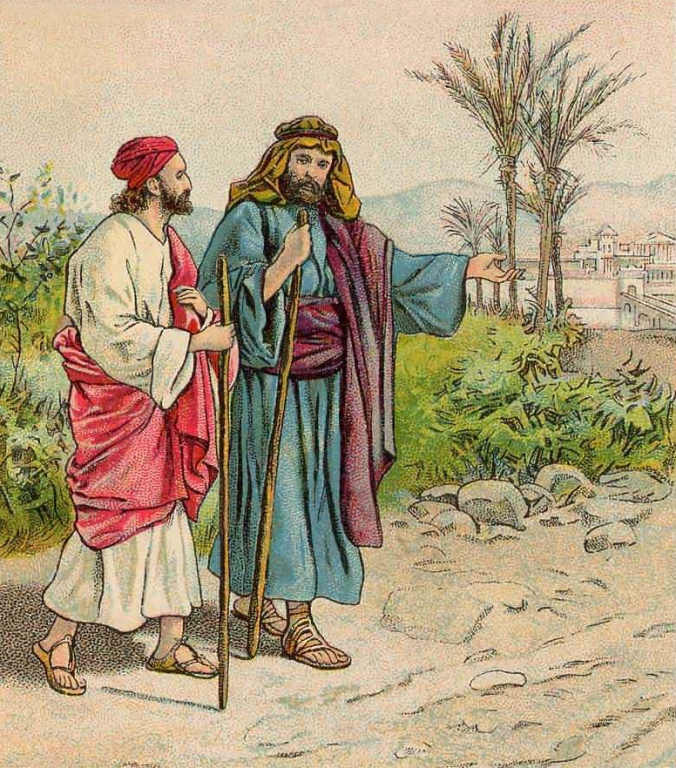
14:6 But they found out [to become conscious of, “to get wind of”] about it [plot] and fled to the Lycaonian [area in Roman province of Galatia] cities of Lystra [about 20 miles from Iconium; Timothy lived in this city (Acts 16:1)] and Derbe and to the surrounding country,

Note: “Did the missionaries lack faith because they escaped when their lives were threatened? No, their actions demonstrated the use of common sense in determining God’s will. Since God had provided them a way of escape, to stay would have been foolish.” (Swindoll • The Growth of an Expanding Mission • p. 89)

14:7 where [Lystra and Derbe] they [Paul and Barnabas] continued [cf. 1 Cor. 15:58; they did not give up] to preach the good news.

14:8 In Lystra [small town located about twenty miles south of Iconium; evidently no Jewish synagogue there] there sat a man crippled in his feet, who was lame from birth and had never walked [cf. Acts 3 re: Peter and John healing a lame beggar].

14:9 He listened to Paul as he was speaking. Paul looked directly at him, saw that he had faith to be healed

14:10 and called out, “Stand up on your feet!” At that, the man jumped up and began to walk.

14:11 When the crowd saw what Paul had done, they [the crowd reacted in a manner consistent with their pagan beliefs] shouted in the Lycaonian language [Paul and Barnabas did not speak or understand this language], “The gods have come down to us in human form! [they people believed an ancient legend that said Zeus and Hermes (the Roman names were Jupiter and Mercury) had once visited their region disguised as humans]

Paul and Barnabas fled from Iconium and traveled twenty miles south to the smaller town of Lystra. Evidently there was no Jewish synagogue in this predominantly Gentile town. There they met and healed a lame man who had never walked.

When the native Lystrans saw what Paul had done they interpreted this event in light of their pagan mythology. The emotional crowd cried out, “The gods have come down to us in the form of men!” They believed an ancient legend that said Zeus and Hermes had once visited their region disguised as humans.

Paul and Barnabas did not speak the Lycaonian language and therefore had no idea what the crowd was shouting.

14:12 Barnabas they called Zeus [head of Greek pantheon; Roman name Jupiter], and Paul they called Hermes [Roman name Mercury; spokesman for Jupiter; Greek god of oratory and inventor of speech] because he was the chief speaker.

The crowd started to call Barnabas, Zeus. According to Greek mythology, Zeus was the head of the Greek pantheon. Perhaps they gave Barnabas this designation because he had a reserved and dignified appearance. Paul, who had done most of the speaking, was thought to be Hermes, the spokesman for Zeus and the inventor of speech.

14:13 The priest [saw this as an opportunity to lead the people of the city in honoring Zeus] of Zeus, whose temple was just outside the city [Zeus was the patron deity of Lystra], brought bulls and wreaths to the city gates because he and the crowd wanted to offer sacrifices to them.

The temple of Zeus, the patron deity of Lystra, was located just outside the town. The priest of Zeus saw this occasion as an opportunity to lead the people in honoring their patron deity. He arrived on the scene with sacrificial oxen draped in garlands. He and the people intended to offer sacrifice to Paul and Barnabas, who by now sensed that something was terribly wrong.

Like Lystra, many towns and villages in the world today have plenty of religion, however misguided it may be. Religion does not satisfy the deepest hunger of the soul. Only a relationship with Jesus Christ can do that.

14:14 But when the apostles Barnabas and Paul heard of this [that the people intended to offer a sacrifice on their behalf], they tore their clothes [gesture expressive of sorrow (cf. Gen. 37:29,34), distress (cf. Josh. 7:6), or horror or protest (cf. Mk. 14:63)] and rushed out into the crowd, shouting:

When Barnabas and Paul finally understood what was happening they were horrified. They expressed their protest in a visually dramatic way—they tore their robes. Tearing one’s garments was a gesture that could express sorrow, distress, or protest. In this case, Barnabas and Paul rushed into the crowd to protest the intended sacrifice. Even today, people cannot resist the temptation to exalt the messenger above the message. We must always be careful to give glory to God alone.

14:15 “Men, why are you doing this [Paul and Barnabas wanted off the pedestal]? We too are only men, human like you. We are bringing you good news, telling you to turn from these worthless things [their pantheon of gods] to the living God, who made heaven and earth and sea and everything in them.

The last place Paul and Barnabas wanted to be was on a pedestal. They told the misguided crowd that they were not visiting gods, as they supposed, but mere men. They were no different than any of them.

Earlier in Acts, a crowd had shouted to Herod Antipas that his was “the voice of a god and not of a man” (Acts 12:22). The prideful Herod had accepted the people’s worship instead of giving glory to God and died as a result.

Paul and Barnabas understood that there is but one God. They tried to direct the people from the worship of worthless things to the living God who had made heaven and earth and all that exists.


Note: Luke recorded Paul’s messages in…
• Acts 13:16-41 — to Jews in the synagogue at Antioch of Pisidia
• Acts 14:15-17 — to Gentiles on the streets of Lystra
• Acts 17:22-31 — to intellectuals on Mars Hill
• Acts 20:17-38 — to church leaders (the Ephesian elders) at Miletus

14:16 In the past, he let all nations go their own way.

14:17 Yet he has not left himself without testimony: He has shown kindness by giving you rain from heaven and crops in their seasons; he provides you with plenty of food and fills your hearts with joy.”

14:18 Even with these words, they had difficulty keeping the crowd from sacrificing to them.

Paul and Barnabas designed their message to their audience—people who were not literate in the Scripture but rather were accustomed to superstition. Instead of quoting Old Testament scriptures, they appealed to the evidence in nature that point to the existence of God. They pointed out that God is the Creator of all life, has demonstrated great patience and mercy to the nations, and has revealed Himself in nature. Such evidence leaves people without excuse (see Rom. 1:20). However, in spite of their words, they had a difficult time countering the impact of the miracle of the healed man and stopping the crowds from sacrificing to them.

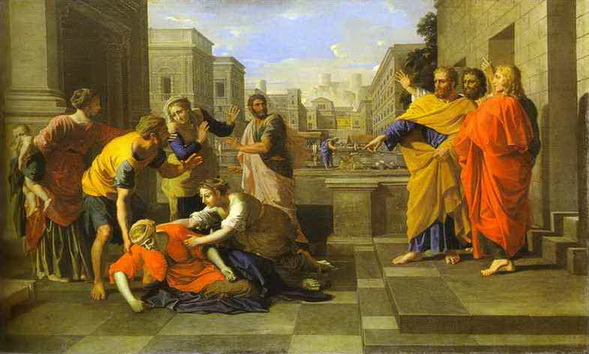
14:19 Then [trouble followed closely behind them] some Jews came [to Lystra] from Antioch [about 100 miles away] and Iconium and won [persuaded] the crowd [who earlier had acclaimed Paul and Barnabas as gods] over. They stoned [previous threats escalated to actual violence; cf. 2 Cor. 1:8-9; 11:25] Paul and dragged him outside the city, thinking [supposing] he was dead [apparently Paul was unconscious].

As if Paul and Barnabas did not have enough to deal with, more trouble was close at hand. Some Jews from as far away as Antioch and nearby Iconium arrived on the scene. They may have been traveling Jewish merchants or Jews who had intentionally followed Paul and Barnabas. They were unquestionably hostile and persuaded the crowds to turn against Paul and Barnabas.

The fickle crowds, perhaps frustrated that their expectations had not been fulfilled, became violent and stoned Paul. Luke did not record what the crowds did to Barnabas, who was evidently not present. Paul later wrote about his experiences in Asia (2 Cor. 1:8-9) and about the stoning (2 Cor. 11:25).

Note: Paul “was enduring the same kind of brutality that killed Stephen, the martyr whom he had once eagerly watched die in Jerusalem.” (Swindoll • The Growth of an Expanding Mission • p. 92)

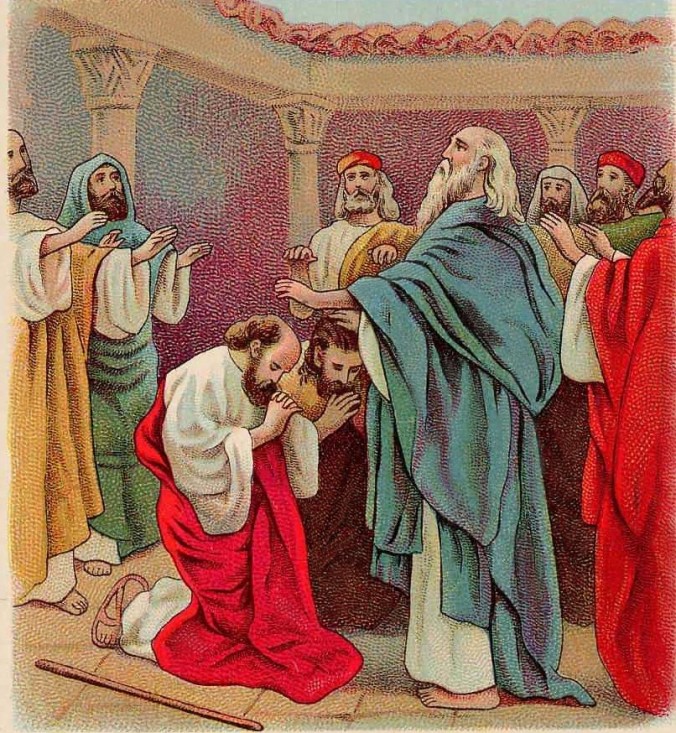
14:20 But after the disciples had gathered around [encircled; after the mob had disbanded; perhaps prayed for him] him, he got up and went back into the city [did not leave town, went back to spend the night]. The next [following] day he and Barnabas left for Derbe.

Those of us who live in the relatively safety of America often forget that opposition to the gospel takes the form of hostile and physical violence in some parts of the world. Paul not only suffered serious physical injuries that resulted from the stoning, his injuries were further aggravated when the mob dragged his limp body out of town where he was left for dead.

A group of unnamed believers went to the place where the angry mob dumped Paul’s body and surrounded him. Perhaps they prayed for him. At some point, Paul regained consciousness and saw these concerned believers standing over him. He got up, most likely to their amazement, and then did something unthinkable. He walked back to the town where he had been assaulted by the angry mob.—a courageous act.

Paul and Barnabas did not allow difficulties or discouragements to cause them to lose sight of their purpose. They persevered, as should we when we encounter set-backs in sharing the gospel. The following day Paul and Barnabas set out for Derbe, a small town located about sixty miles southwest of Lystra. Every step must have been painful for Paul in light of his injuries.

Note: Trouble will come. Be prepared!
T = Troubles will come sooner or later to those who faithfully live out their faith. Expect it.
R = Remember that you are not the first to experience opposition because of your Christian faith.
O = Opposition to the gospel takes many forms. Be wise.
U = Unite with other believers when facing trouble. There is strength in numbers.
B = Bounce back quickly. Don’t let troubles keep you down.
L = Lean on the Lord and continue to serve Him, no matter what.
E = Explain the truth to those who misunderstand you or your presentation of the gospel.

14:21 They preached the good news in that city [Derbe] and won a large number of disciples. Then they returned [backtracked or retraced their route; stresses their concern for the churches they had planted] to [places where they had been in danger and had faced intense hostility] Lystra, Iconium and Antioch,

Paul and Barnabas preached the gospel in Derbe and made many disciples there. They likely did not encounter opposition and were therefore able to move from evangelism to discipleship. Making disciples was essential for the continuing evangelization of the region. New believers must be taught how to share their faith with others.

The results that Paul and Barnabas experienced in Derbe remind us of the importance of persevering in sharing the good news. How sad it would have been if Paul and Barnabas had retreated home to Antioch after their painful experience at Lystra. Giving up ultimately hurts those who are still waiting to hear the good news.

When Paul and Barnabas completed their work in Derbe, they started their journey home. However, in typical fashion, they decided to take the hard route home by retracing their bloody steps back to Lystra and then to Iconium and Pisidian Antioch.

Note: “While the first part of the journey had been for evangelism, this last part is for edifying new converts.” (Swindoll • The Growth of an Expanding Mission • p. 97)

14:22 strengthening [to make more firm; “to beef up” or add additional strength] the disciples and encouraging [“word is used of exhorting troops who are about to go into battle” (Rienecker/Rogers); give vital spiritual instruction] them to remain true to the faith. “We must [future is not trouble-free for believers; no rosy or misleading picture painted for these new believers] go through many hardships to [when we] enter the kingdom of God,” they said.

Paul and Barnabas had a specific purpose for retracing their steps. They wanted to strengthen the hearts of the disciples in each of the cities they had visited. This process likely included further instruction about their new faith and answering any questions these new believers might have had. They also encouraged them to remain true to the Lord despite hardships and opposition. These new believers were not exempt from the many troubles Paul and Barnabas had experienced. Persecution is not reserved solely for missionaries, but for all who bear the name of Christ.

Note: “They took great care to preserve the fruit of their work, by encouragement, instruction, and organization.” (Curtis Vaughan • “Acts” • p. 96)

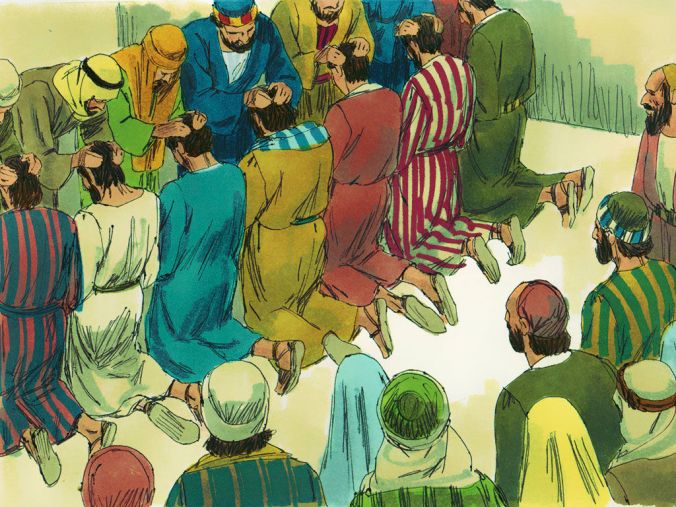
14:23 Paul and Barnabas appointed [Gr. cheirotoneo: cheir = hand; teino = to stretch; to elect by a show of hands] elders [Gr. presbuteros; first reference to elders in NT; these individuals had to meet the spiritual qualifications Paul later listed in 1 Timothy 3:1-7 and Titus 1:5-9] for them in each church [organization and leadership are essential to the health of any church] and, with prayer and fasting [important part of decision-making process], committed them to the Lord [this commissioning probably involved laying on of hands], in whom they had put their trust.

Organization and leadership are essential to the health of any church. By the time Paul and Barnabas returned to the churches they had established, they were able to identify those who had gifts of leadership. They therefore appointed elders in every church and gave them the responsibility of caring for the flock. These individuals had to meet the spiritual qualifications Paul later listed in 1 Timothy 3:1-7 and Titus 1:5-9.

The selection of these elders came only after a period of prayer and fasting. Once selected, Paul and Barnabas commissioned these men who would have oversight for the spiritual welfare of their respective congregations. This commissioning likely included the laying on of hands. Thus the first missionary journey came to an end. Paul and Barnabas had visited four provinces and founded churches in Pisidian Antioch, Iconium, Lystra, and Derbe.

14:24 After going through Pisidia, they came into Pamphylia,

14:25 and when they had preached [no mention of preaching in Perga in Acts 13:13-14] the word in Perga [located about six miles from the coast; the place where John Mark had left them, cf. Acts 13:13], they went down to Attalia [seaport].

14:26 From Attalia they sailed back to [Syrian] Antioch, where [approximately 2-3 years earlier] they had been committed to the grace [enabled them to complete their task] of God for the work they had now completed [fulfilled].

14:27 On arriving there, they gathered the church [people, not the building; perhaps John Mark was present] together and reported all that God [gave credit to God] had done through them and how he had opened the door of faith to the Gentiles.

14:28 And they stayed there a long time with the disciples.
Acts 13

13:1 In the church [first church to send out missionaries to those beyond own geographical area; a church with a large vision] at Antioch [Roman capital of Syria; multicultural city; temple of Daphne on outskirts of town, a center of prostitution and pagan worship] there were prophets [those gifted to address God’s word to specific situations; cf. Acts 15:32; 1 Cor. 14:3; forthteller more than foreteller] and teachers [those gifted to teach the Scriptures, to teach others how to live the Christian life]: [cosmopolitan leadership team reflects a great diversity of backgrounds…] Barnabas [means Son of Encouragement (cf. Acts 4:36); cf. Acts 11:22-26; a Cyprian Jew], Simeon called Niger [Latin term meaning “black-skinned”], Lucius [Greek name suggesting he was possibly a Gentile] of Cyrene [located in Libya in North Africa], Manaen [Greek name for the Hebrew “Menahem”; a member of high society] (who had been brought up with [childhood companion] Herod [Herod Antipas, son of Herod the Great and murderer of John the Baptist: ruled Galilee 4 BC to AD 39; cf. Lk. 3:1; Acts 4:27] the tetrarch [term meaning ruler of a fourth]) and Saul [called Paul (Roman name) for first time in Acts 13:9].

13:2 While [Holy Spirit spoke while they were busy; opportunities for greater service often come to those faithfully performing their present duties] they [refers either to entire church or to prophets and teachers of v. 1] were worshiping [ministering] the Lord and fasting [indicates church was earnestly seeking God’s direction], the Holy Spirit said, “Set apart [to separate, to take away; to appoint; cf. Gal. 1:15-16; Rom. 1:1] for me Barnabas [mentioned first, perhaps because he was considered the leader at this time] and Saul for the work [a specific work] to which I [Holy Spirit] have called [Gr. proskaleo: pros is preposition meaning to, toward; kaleo means call; called to preach the gospel to unreached peoples] them.”

13:3 So after they [church] had fasted and prayed, they [refers either to prophets and teachers (v. 1), elders of congregation, or entire church] placed their hands [validation of Spirit’s work; recognition of the divine call; expression of support, affirmation; a formal setting apart for service] on them and sent them off [let go; released them to follow God’s call; willing to part with some of their best leaders in order to expand the kingdom].

Note: “There were more than half a million pagans in Antioch, but God wanted two of His choicest servants to go to fields abroad.” (Curtis Vaughan • “Acts” • p. 88)

13:4 The two of them, sent on their way [first missionary journey lasted approximately two years (about AD 46 to AD 47/48)] by the Holy Spirit, went [obediently] down to Seleucia [a port city located 16 miles from Antioch] and sailed from there to Cyprus [island home of Barnabas; cf. Acts 11:19-20 re: how the gospel arrived at Cyprus; population mainly Greek, but had a large Jewish community].

13:5 When they arrived at Salamis [city located on east coast of island of Cyprus], they proclaimed the word of God in the Jewish synagogues [Paul would use this approach for years]. John [John Mark] was with them as their helper [assistant; reminder that we must work as a team to share gospel].

13:6 They traveled through the whole island [about one hundred miles in length] until they came to Paphos. There they met a Jewish sorcerer [Gr. “magos” means magician] and false prophet named Bar-Jesus [name means “son of Jesus”],

13:7 who was an attendant of the proconsul [a high government official; functioned as governor of Cyprus], Sergius Paulus. The proconsul, an intelligent man, sent for Barnabas and Saul because he wanted to hear the word of God.

13:8 But Elymas [Bar-Jesus] the sorcerer (for that is what his name [the name Elymas] means) opposed them and tried to turn the proconsul from the faith [Satan’s agenda includes keeping people from hearing and responding to gospel].

13:9 Then Saul, who was also called Paul [his Roman name; so called from this point on in Acts], filled with the Holy Spirit [necessary in order to confront evil], looked straight at Elymas [means “sorcerer” or “magician”] and said,

13:10 “You are a child [literally “son”] of the devil [Gr. “diabolos”; the source of Elymas’ sorcery] and an enemy of everything that is right [literally “righteousness”]! You are full of all kinds of deceit and trickery [cf. Jn. 8:44]. Will you never stop perverting the right ways of the Lord?

13:11 Now the hand of the Lord is against you [an announcement of judgment]. You are going to be blind, and for a time you will be unable to see the light of the sun.” Immediately mist and darkness came over him, and he groped about, seeking someone to lead him by the hand.

13:12 When the proconsul [Sergius Paulus] saw what had happened, he believed [became the highest ranking converted government official in NT], for he was amazed at the teaching about the Lord.

13:13 From Paphos, Paul and his companions sailed to Perga [a port town] in Pamphylia, where John [John Mark] left them [we are not told why] to return to Jerusalem [many years later John Mark would again earn Paul’s respect (cf. Col. 4:10; 2 Tim. 4:11)].

13:14 From Perga they went on to [“traveled inland to” (NLT)] Pisidian Antioch [located in southern Galatia; not Antioch of Syria; a Roman colony]. On the Sabbath they entered the synagogue and sat down.

13:15 After the reading from the Law and the Prophets, the synagogue rulers sent word to them, saying [it was customary to invite visiting rabbis/itinerant teachers to speak], “Brothers, if you have a message of encouragement for the people, please speak.”

13:16 Standing up, Paul motioned with his hand and said [sermon continues to 13:41]: “Men of Israel [Jews by birth] and you Gentiles [God-fearing Gentiles (cf. Acts 13:26); proselytes] who worship God, listen to me!

Note: Luke recorded Paul’s messages in…
• Acts 13:16-41 — to Jews in the synagogue at Antioch of Pisidia
• Acts 14:15-17 — to Gentiles on the streets of Lystra
• Acts 17:22-31 — to intellectuals on Mars Hill
• Acts 20:17-38 — to church leaders (the Ephesian elders) at Miletus

13:17 [history of Israel from patriarchs to David (13:17-22)] The God of the people of Israel chose our fathers [beginning with Abraham]; he made the people prosper during their stay in Egypt, with mighty power [“uplifted arm” (NRSV); cf. Ex. 6:1,6; Ps. 136:11-12] he led them out of that country,

13:18 he endured their conduct for about forty years in the desert,

13:19 he overthrew seven nations [cf. Deut. 7:1] in Canaan and gave their land to his people as their inheritance.

13:20 All this took about 450 years. “After this, God gave them judges until the time of Samuel the prophet [the first].

13:21 Then the people asked for a king, and he gave them Saul son of Kish [cf. 1 Sam. 9:1-2], of the tribe of Benjamin, who ruled forty years.

13:22 After removing [because of his disobedience (cf. 1 Sam. 13:1-14; 15:1-25)] Saul, he made David their king. He testified concerning him [cf. 1 Sam. 13:14]: ‘I have found David son of Jesse a man after my own heart; he will do everything I want him to do.’

13:23 [God’s messianic promise to David fulfilled in Jesus (13:23-25)] “From this man’s [David’s] descendants God has brought to Israel the Savior [only place in Acts where Paul referred to Jesus as Savior] Jesus, as he promised.

13:24 Before the coming of Jesus, John [John the Baptist; cf. Jn. 1:6-8] preached repentance [to turn from sin and to God] and baptism [a public demonstration of one’s commitment to repent] to all the people of Israel.

13:25 As John was completing his work, he said [cf. Mk. 1:7]: ‘Who do you think I am? I am not that one. No, but he is coming after me, whose sandals I am not worthy to untie.’

13:26 “Brothers, children of Abraham [Jews], and you God-fearing Gentiles, it is to us [salvation through Jesus is for both Jews and Gentiles] that this message of salvation has been sent.

13:27 The people of Jerusalem and their rulers did not recognize Jesus, yet in condemning him they fulfilled the words of the prophets [cf. Ps. 118:22; Isa. 53:3] that are read every Sabbath [they had heard and were familiar with the prophecies but missed their fulfillment].

13:28 Though they found no proper ground for a death sentence, they asked Pilate [because they (the Jewish leaders) could not execute Jesus; cf. Lk. 23:1-25] to have him executed.

13:29 When they had carried out all that was written about him, they took him down from the tree and laid him in a tomb [cf. Lk. 23:44-56].

13:30 But God raised him from the dead [cf. Lk. 24],

13:31 and for many days he was seen [there were witnesses to affirm the truth of the resurrection] by those who had traveled with him from Galilee to Jerusalem. They are now his witnesses to our people.

13:32 “We [Paul and Barnabas] tell you the good news: What God promised our fathers

13:33 he has fulfilled for us [“in our own time” (NLT)], their children, by raising up Jesus. As it is written in the second Psalm [Ps. 2:7]: “‘You are my Son; today I have become your Father.’

13:34 The fact that God raised him from the dead, never to decay [cf. Ps. 16:10], is stated in these words [cf. Isa. 55:3]: “‘I will give you the holy and sure blessings promised to David.’

13:35 So it is stated elsewhere [cf. Ps. 16:10]: “‘You will not let your Holy One see decay.’

13:36 “For when David [cf. Acts 13:22] had served [serving God is a privilege and one way in which we can impact our generation] God’s purpose [God has a purpose for each of our lives] in his own generation [we only have our generation in which to serve the purpose of God, however, if we serve well then our lives can have an impact beyond our generation], he fell asleep [a reminder that the clock is ticking; we cannot afford to kill time because time is killing us]; he was buried with his fathers [cf. Ps. 30:9] and his body decayed [thus Ps. 16:10 is not a reference to David but to Jesus].

13:37 But the one whom God raised from the dead did not see decay.

13:38 “Therefore, my brothers, I want you to know that through Jesus [through His sacrificial death on the cross] the forgiveness of sins is proclaimed to you.

13:39 Through him everyone who believes [this is necessary] is justified [counted righteous or acquitted; cf. Rom. 5:9] from everything you could not be justified from by the law of Moses [the law exposes sin (Rom. 3:20), provokes to sin (Rom. 7:7-8) but cannot justify].

13:40 [a warning not to miss what God was doing among them…] Take care that what the prophets have said does not happen to you:

13:41 [cf. Hab. 1:5; Habakkuk had warned Judah of impending judgment but the people failed to understand what God was doing among them] “‘Look, you scoffers, wonder and perish, for I am going to do something in your days that you would never believe, even if someone told you.’”

13:42 As Paul and Barnabas were leaving the synagogue, the people [both Jews and Gentiles] invited them to speak further about these things on the next Sabbath.

13:43 When the congregation was dismissed, many [indicates impact of Paul’s message] of the Jews and devout converts [Gentiles who had been inducted into Judaism] to Judaism followed Paul and Barnabas, who talked with them and urged them to continue in the grace of God [or to remain steadfast in their Christian faith].

13:44 On the next Sabbath almost the whole city [Pisidian Antioch was a Gentile city] gathered to hear the word of the Lord [gospel].

13:45 When the Jews saw the crowds, they were filled with jealousy [envy] and talked abusively [blaspheme, slander, defame] against [contradict] what Paul was saying [that, in Christ Jesus, God accepts Gentiles also].

13:46 Then Paul and Barnabas answered them boldly [evidence of Holy Spirit; cf. Acts 4:8,13,31]: “We had to [necessary] speak the word of God to you [Jews] first [cf. Rom. 1:16]. Since you reject it [to push away from one’s self] and do not consider yourselves worthy of eternal life, we now turn to the Gentiles.

13:47 For this is what the Lord has commanded us [cf. Isa. 49:6]: “‘I have made you a light for the Gentiles, that you may bring salvation to the ends of the earth.'”

13:48 When the Gentiles heard this, they were glad and honored the word of the Lord; and all who were appointed [emphasizes the divine role in salvation] for eternal life [salvation] believed [emphasizes personal responsibility in salvation].

13:49 The word of the Lord spread through the whole region.

13:50 But the Jews incited the God-fearing [Gentiles who attended the Jewish synagogue] women of high standing [prominent, perhaps rich] and the leading [foremost in importance] men of the city. They stirred [rouse, excite] up persecution against Paul and Barnabas, and expelled [to cast out] them from their region.

13:51 So they shook the dust from their feet [cf. Lk. 10:8-12] in protest against them [the Jews who stirred up persecution, not to show disdain for Gentiles] and went to Iconium [continued to do what God had called them to do].

Note: “The shaking off of dust might mean that the missionaries cleared themselves of all further responsibilities.” (Rienecker/Rogers • “Linguistic Key to the Greek NT” • p. 295)

13:52 And the disciples [new disciples at Pisidian Antioch] were filled with joy and with the Holy Spirit.

Acts 12

Acts 12:1-17
12:1 It was about this time that King Herod [Herod Agrippa I (grandson of Herod the Great); ruled AD 37–34; first Roman authority to persecute Christians; Acts 12:20-23 re: his death] arrested some who belonged to the church, intending to persecute them.

12:2 He had James [the first of the twelve to be martyred; a “pillar” of the Jerusalem church (cf. Gal. 2:9)], the brother of John, put to death with the sword [possibly beheaded or run through with the sword].

Note: What is the difference between the persecution of believers and discrimination against believers?

12:3 When he saw that this pleased [suggests politically motivated persecution] the Jews, he proceeded to seize Peter also. This happened during the Feast of Unleavened Bread [two holy-days celebrated in sequence: Passover (one-day annual celebration of deliverance from Egypt) and Feast of Unleavened Bread (week-long event)].

12:4 After arresting him, he put him in prison, handing him over to be guarded by four squads of four soldiers each [total of 16 soldiers working in shifts]. Herod intended to bring him out for public trial after the Passover.

12:5 So Peter was kept in prison [within Fortress of Antonia near the temple area; Peter’s third arrest/imprisonment (Acts 4,5); against Jewish law to have a trial or execution during the Feast of Unleavened Bread], but [conjunction marks a turning point] the church [cf. Matt. 18:19; “God works when churches pray, and Satan still trembles when he sees the weakest saint upon his knees” (Wiersbe)] was earnestly [“to stretch out, to extend”: could refer either to extension in time (unceasingly) or to extension in intensity (earnestly); cf. Lk. 22:44] praying [fighting a battle with the weapon of prayer; cf. 2 Cor. 10:4; Jas. 5:16] to God [appealed to throne of heaven rather than throne of Herod; pray according to what God can do] for him [specific prayer is most effective].

Note: “If we put so little heart into our prayers, we cannot expect God to put much heart into answering them.”
(R.A. Torrey)

“God works when churches pray, and Satan still trembles when he sees the weakest saint upon his knees” (Wiersbe)

12:6 The night before Herod was to bring him to trial, Peter was sleeping [cf. Ps. 3:5; 4:8] between two soldiers, bound with two chains, and sentries stood guard at the entrance.

12:7 Suddenly [at just the right moment] an angel of the Lord appeared [at the darkest hour] and a light shone in the cell. He struck Peter on the side [poked him in the ribs] and woke him up. “Quick, get up [words convey urgency]!” he said, and the chains fell off Peter’s wrists.

Note: An impossible situation can turn into an opportunity for God to show His power.” (Swindoll)

12:8 Then the angel said to him [like a parent talking to a child awakened from sound sleep], “Put on your clothes and sandals.” And Peter did so. “Wrap your cloak around you and follow me,” the angel told him.

12:9 Peter followed him out of the prison, but he had no idea that what the angel was doing was really happening [Peter was still groggy, not yet fully alert]; he thought [to suppose] he was seeing a vision.

12:10 They passed the first and second guards and came to the iron gate leading to the city. It opened for them by itself, and they went through it. When they had walked the length of one street, suddenly the angel left him.

12:11 Then Peter came to himself and said, “Now I know without a doubt [fully convinced] that [Peter recognized and gave God the credit for His work] the Lord sent his angel and rescued me from Herod’s clutches and from everything the Jewish people were anticipating.”

12:12 When this had dawned on him [having realized or having perceived what had happened to him], he went [because his life was still in danger] to the house of Mary [some believe the church met there regularly; others believe this was the location of the Last Supper and where the disciples gathered on Day of Pentecost] the mother of John, also called Mark [first mention of Mark in Acts; would later write the Gospel of Mark], where many [considerable] people had gathered and were praying [apparently had been praying all night].

12:13 Peter knocked at the outer entrance [likely a courtyard separated outer entrance from house], and a servant girl named Rhoda came to answer the door.

12:14 When she recognized Peter’s voice [may be indication that Mary’s house was a regular meeting place for Christians], she was so overjoyed she ran back without opening it and exclaimed, “Peter is at the door!”

Note: Why are we so often surprised when God answers our prayers?

12:15 “You’re out of your mind [mad, crazy],” they told her [failed to realize that God had answered their prayers]. When she kept insisting [vigorous and confident assertion] that it was so, they said, “It must be his angel [or his ghost].”

Note: Jews believed that each person had a guardian angel, a sort of spiritual counterpart, that often appeared immediately after the person’s death.

12:16 But Peter kept on knocking, and when they opened the door and saw him, they were astonished [to be beside one’s self; response points to lack of faith].

12:17 Peter motioned with his hand for them to be quiet [lest their loud voices alert Herod’s soldiers to his presence] and described [to relate, narrate, report; we can encourage others by sharing how God has helped us] how the Lord [Peter emphasized what God had done] had brought him out of prison. “Tell James [became leader of the Jerusalem church; author of the Epistle of James] and the brothers [either the Jerusalem church elders, other members of the church, or the other half-brothers of Jesus] about this,” he said, and then he left for another place [went into hiding].

Note: “…God often gives us more than we expect and always more than we deserve.” (Curtis Vaughan)

Acts 11

11:1 The apostles and the brothers throughout Judea heard that the Gentiles also had received the word of God.

11:2 So when Peter went up to Jerusalem, the circumcised believers criticized him

11:3 and said, “You went into the house of uncircumcised men and ate with them.”

11:4 Peter began and explained everything to them [“the circumcised believers” (v. 2); a group of conservative Jewish believers who expected Gentile converts to be circumcised and follow other Jewish proselyte procedure] precisely as it had happened [a step by step account]:

Several years after Peter preached his first sermon on the Day of Pentecost (see Acts 2:14-40), he was privileged to preach in the home of Cornelius at what became the Pentecost of the Gentile world. Peter honored Cornelius’ invitation (Acts 10:33) to share the message of salvation (Acts 10:34-43) with those assembled in his home. As a result, all those who heard Peter’s sermon placed their faith in Jesus Christ for salvation, received the Holy Spirit, and were baptized (Acts 10:44-48).

When Peter returned to Jerusalem he was confronted and criticized by a group of Jewish believers who expected Gentile converts to follow Jewish proselyte procedure, including circumcision. Peter explained to them what had happened by giving a precise step by step account.

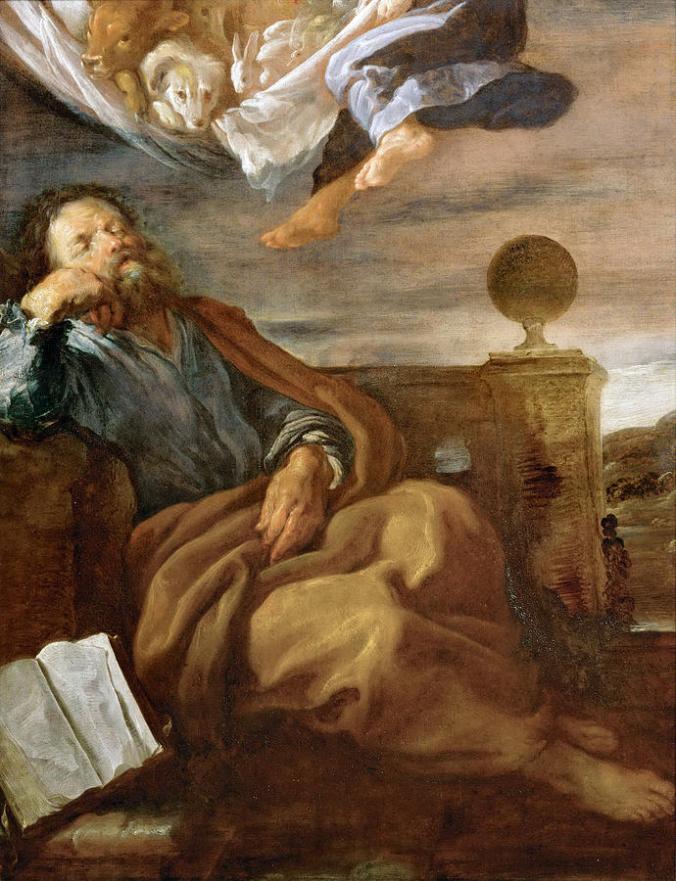
11:5 “I was in the city of Joppa [approximately thirty miles south of Caesarea and sixty-five miles northwest of Jerusalem; the Roman capital of Judea] praying [on the roof of a house belonging to Simon, a leatherworker (Acts 10:6,9)], and in a trance [Peter fell into a trance while a meal was being prepared for him (Acts 10:10)] I saw a vision. I saw something like a large sheet [perhaps like a ship’s sail or like the awning that covered some rooftops] being let down from heaven by its four corners, and it came down to where I was.

While staying as a guest in the home of a leatherworker named Simon (Acts 10:6), Peter went up to the roof of the house to pray. As he prayed he became hungry and wanted something to eat. While a meal was being prepared, Peter fell into a trance and saw a vision. In his vision he saw something that resembled a large sheet, perhaps like a ship’s sail or like the cloth awnings that covered some rooftop porches. This sheet was being lowered from heaven by its four corners. Some interpreters suggest that the four corners represent the ends of the earth and signal that the gospel is intended for every person on the planet.

11:6 [cf. Acts 10:12] I looked into it and saw four-footed animals [included clean and unclean animals; cf. Lev. 11; generally speaking, animals which chewed the cud or which had cloven hoofs were considered clean] of the earth, wild beasts, reptiles [considered unclean], and birds of the air [considered unclean].

When Peter looked closely at the sheet, he saw that it contained a picnic spread of the four-footed animals of the earth—including clean and unclean animals (see Lev. 11). Generally speaking, animals which chewed the cud or which had cloven hoofs were considered clean. Reptiles and birds were among the unclean animals. These Jewish food laws made it difficult for Jewish Christians to reach out to Gentiles or to share a meal with them.

11:7 [cf. Acts 10:13] Then I heard a voice [from heaven; the “Lord” as per verse 8] telling me [this command must have perplexed Peter], ‘Get up, Peter. Kill and eat [from among the animals in the sheet].’

Peter heard a voice from heaven telling him to kill and eat from among the animals in order to satisfy his hunger. This request undoubtedly perplexed Peter. Like other Jews, he was familiar with what the law taught about clean and unclean foods. These food laws set Israel apart from the rest of the nations (see Lev. 20:24-26). They were woven into an entire fabric of laws designed to set apart as holy and to accentuate the distinctiveness of God’s people.

11:8 [cf. Acts 10:14] “I replied, ‘Surely not, Lord! Nothing impure or unclean has ever entered my mouth [Peter had adhered strictly to the dietary laws outlined in the Scriptures; these food laws set Israel apart from the rest of the nations (see Lev. 20:24-26)].’

Shocked, Peter protested and said, No, Lord! He bolstered his protest by appealing to his own personal history. Like other devout Jews, Peter had never allowed anything common or unclean to enter his mouth. He had adhered strictly to the dietary laws outlined in the Scriptures. He was not about to break rank with his consistent observance of those laws by consuming anything unclean or not prepared in a kosher fashion.

11:9 [cf. Acts 10:15] “The voice [God did not accept Peter’s answer] spoke from heaven a second time [God reissued the command to kill and eat], ‘Do not call anything impure that God has made clean.’

The same voice that had issued the initial command answered Peter from heaven a second time. Reprimanding him, the Lord reissued the command to kill and eat from among the animals in the sheet. Although Peter did not realize it at the time, God was reeducating him to understand that there was no distinction between Jews and Gentiles. Both were unclean before God and in equal need of redemption.

11:10 [cf. Acts 10:16] This happened three times [cf. Peter denied Jesus three times (Jn. 18:17, 25-27) and Jesus asked Peter if he loved Him three times (Jn. 21:15-17)], and then it was all pulled up to heaven again.

The Lord repeated the command to kill and eat three times and each time Peter protested. Teachers throughout the centuries have used repetition to help their students grasp a new concept or to help them retain important information. The repetition of the command to Peter emphasizes the seriousness of what the Lord was trying to teach him about accepting an “unclean” people group. After the third time the sheet was drawn up again into heaven, leaving Peter to contemplate the meaning of the vision (Acts 10:17).

Perhaps Peter reflected on what he had heard Jesus say—“Nothing that goes into a person from the outside can defile him…” (Mark 7:14)”—and was beginning to understand that “Jesus made all foods clean” (Mark 7:19).

If we are open to learning new truths about the gospel and will listen to God, He will lead us to them. Bible study is one obvious way to listen for God’s message today and Sunday School is a readily available opportunity for Bible study.

11:11 [cf. Acts 10:17] “Right then three men [sent by Cornelius (Acts 10:5-8); sent by God (Acts 10:20)] who had been sent to me from Caesarea stopped at the house where I was staying.

An angel had instructed Cornelius in a vision to send men to a specific house in Joppa to find Peter. Cornelius recruited three members of his household staff (Acts 10:7) to journey from Caesarea to Joppa. These men approached Simon the tanner’s house about the time Peter was praying on the housetop. Their arrival coincided with the end of Peter’s vision.

11:12 The Spirit told me to have no hesitation about going with them [cf. Acts 10:20]. These six [these six men would serve as witnesses (Jewish law required two witnesses)] brothers [circumcised believers as per Acts 10:45] also went [to Caesarea] with me [cf. Acts 10:23], and we entered the man’s house [cf. Acts 10:24-25].

The men from Caesarea explained to Peter why they had come and who had sent them (Acts 10:22). After listening to their story, Peter invited the three men to spend the night (Acts 10:23). As Peter considered their invitation, the Spirit told him to have no hesitation about returning to Caesarea with them. The following day Peter set out for Cornelius’ home. He invited six circumcised believers (Acts 10:45) to accompany him. These men would serve as witnesses of what they would see and experience in Caesarea.

11:13 [cf. Acts 10:1-7; 30-32] He told us how he had seen an angel [this fact was important to Peter’s Jewish audience] appear in his house and say, ‘Send to Joppa for Simon who is called Peter.

When Peter arrived at the home of Cornelius, he found a large audience already gathered there. Cornelius had called together his relatives and close friends because he wanted them to hear the message of salvation. Peter asked Cornelius why he had sent for him. Cornelius then told Peter the details of his vision. God had paved the way for the gospel to reach many through the obedience and invitation of Cornelius.

While on a short-term mission trip to Bangladesh, a friend and I went in search of a man of peace (Luke 10:5-6). A man of peace is an individual who is receptive to the gospel and who opens the door for others to hear the message. Such a man invited us to his home. Like Cornelius, he had gathered family and friends to hear what we had to say. Eight of the men present placed their faith in Christ for salvation. We rejoiced at this wonderful harvest. However, when we returned the following year we learned of more than four hundred believers in that village. Those eight men had faithfully shared the gospel with others.

11:14 [this detail is not included in Acts 10] He [Peter] will bring you a message [cf. 2 Cor. 5:19 re: the message of reconciliation] through which you and all your household will be saved.’

The angel that had instructed Cornelius to send for Peter also told him that Peter would bring an important message. This would be no ordinary message, but one that would lead Cornelius and his household to salvation. As ambassadors for Christ, God “has committed the message of reconciliation to us” (2 Cor. 5:19).

Like Peter, we are responsible for speaking the words that can help others understand how to be reconciled to God. Several years ago while on a short-term mission trip to Ukraine, an elderly woman asked one of our team members how long she had known the story of Jesus. “Most of us have known about Jesus since childhood,” my friend replied. “Then why did it take you so long to bring this message to me?” the woman asked.

11:15 [cf. Acts 10:44-46] “As I began to speak, the Holy Spirit came on them [Gentile believers] as he had come on us [Jewish believers] at the beginning [refers to Pentecost (Acts 2)].

Peter spoke to those assembled in Cornelius’ house about Jesus and the forgiveness that is available to everyone who believes in Him (Acts 10:34-43). While he was speaking the Holy Spirit interrupted his sermon and “came down on all those who heard the message” (Acts 10:44). The Holy Spirit had come upon the Gentile believers just as He had come upon the Jewish believers at the beginning—or at Pentecost (Acts 2). This was an indication that the gospel is for all peoples and that God does not show favoritism (Acts 10:34; Rom. 2:11).

11:16 Then I remembered what the Lord had said [just prior to His ascension; Acts 1:5]: ‘John baptized with water, but you will be baptized with the Holy Spirit [Mark 1:4-8; Luke 3:15-17].’

The coming of the Spirit upon the Gentile believers prompted Peter to remember the word of the Lord. Incidentally, it is always good for believers to remember what the Lord has said. Just prior to His ascension, Jesus told His followers that John had baptized with water, but, in a few days they would be baptized with the Holy Spirit (see Acts 1:5). The apostles experienced the fulfillment of Jesus’ words at Pentecost. However, the baptism of the Holy Spirit was not reserved exclusively for Jewish believers. God intended this baptism for all who place their faith in Christ for salvation.

11:17 So if God gave them [Gentile believers] the same gift [the Holy Spirit] as he gave us [Jewish believers], who believed in the Lord Jesus Christ, who was I to think that I could oppose God?”

Peter and the six circumcised brothers from Joppa witnessed something new in Cornelius’ home. God had bestowed the gift of the Holy Spirit on the Gentile believers just as He had on them when they believed on the Lord Jesus. God had chosen to deal with the Gentiles the same way He dealt with the Jews. Peter realized that opposition to the Gentiles’ baptism with the Holy Spirit would be tantamount to opposition to God. Rather than stand in God’s way, Peter chose to accept what God was doing among the Gentiles.

11:18 When they [those who stressed circumcision (Acts 11:4)] heard this, they had no further objections and praised God [a mature and appropriate response], saying, “So then, God has granted even the Gentiles repentance unto life [this issue would surface again and be addressed in he Jerusalem Conference (Acts 15)].”

When “those who stressed circumcision” (Acts 11:4) heard Peter’s explanation they became silent and offered no further objections. The evidence was compelling. Peter and the six brothers who accompanied him stood as seven witnesses to the fact that God had granted repentance resulting in life to even the Gentiles! The church in Jerusalem accepted that Gentiles became Christians by believing in the Lord Jesus—period! Although the issue of Gentile conversion would be challenged again (Acts 15), for the time being all those present glorified God.

11:19 [cf. Acts 8:4] Now those [Hellenistic or Greek-speaking Jewish Christians] who had been scattered by the persecution in connection with Stephen [as a result of his martyrdom] traveled as far as Phoenicia [a seacoast area that included the cities of Ptolemais, Tyre, Sidon, Zarephath], Cyprus [island located about 100 miles off Syrian coast; Barnabas’ birthplace (Acts 4:36)] and Antioch [located 300 miles north of Jerusalem; third largest city in Roman Empire (pop. 500k to 800k) after Rome and Alexandria; capital of province of Syria; much pagan worship that promoted sexual immorality; also called Antioch of Syria to distinguish it Pisidian Antioch (Acts 13:14) and other cities with the same name], telling the message only to Jews [followed same pattern as Paul (Acts 9:20)].

This verse continues the narrative that began in Acts 8:4. The Greek-speaking Jewish Christians in Jerusalem left their homes and possessions to escape the persecution that followed Stephen’s violent death.

Escaping with only their faith, these believers blazed new trails for the gospel in predominantly Gentile areas. Some made their way north along the Phoenician coastline and settled in cities like Tyre and Sidon. Others boarded ships and sailed to the island of Cyprus, the birthplace of Barnabas. Still others made their way three hundred miles to the north of Jerusalem and settled in Antioch, the third largest city in the Roman Empire.

Unaware of Peter’s experience with Cornelius and that the gospel was also meant for Gentiles, these scattered believers followed Paul’s pattern (Acts 9:20) and preached the message to no one except Jews.

11:20 Some of them, however, men [who had come to Jerusalem and were there at the time of Stephen’s death] from Cyprus [island located about 100 miles off Syrian coast; cf. Acts 4:36; 21:16] and Cyrene [city in northern Africa; Simon, who carried Jesus’ cross, was from Cyrene (Lk. 23:26); Cyrenians were present at Pentecost (Acts 2:10)], went to Antioch and began to speak to Greeks [perhaps proselytes to Judaism or unconverted Gentiles] also [these men had a passion to do more than speak to their fellow Jews in Antioch], telling them the good news about the Lord Jesus [the content and substance of their preaching].

Some of those present in Jerusalem at the time of Stephen’s death were men from Cyprus and Cyrene. Cyprus is an island located in the Mediterranean Sea and Cyrene was a city in northern Africa in what is Libya today. The man named Simon who carried Jesus’ cross was from Cyrene (Luke 23:26).

Cyrenians were also present at Pentecost (Acts 2:10). These men expressed a concern that extended beyond the synagogues and their fellow Jews. Because they had been raised in a Gentile environment, these men had a more global perspective than their Palestinian brothers. They boldly began speaking to the Hellenists, or Greeks, about the Lord Jesus.

11:21 The Lord’s hand [His power and Spirit] was with them [the Cypriot and Cyrenian men who shared with the Hellenists], and [as a result] a great number of people believed and turned to the Lord.

God honored the initiative of these unnamed individuals who dared to proclaim the good news to Gentiles in Antioch. And, because the Lord’s hand was with them, many of the Gentiles who heard the gospel turned to the Lord.

Cornelius had previously taken the initiative to send for Peter. At times believers are approached by those who are seeking the way of salvation. And, like Peter, we should be ready to respond. This verse shows us that the Cypriot and Cyrenian believers did not wait for the lost to come to them. Instead they took the initiative to seek the lost. Like these believers, we too should take the initiative to share the gospel with others—from Jerusalem to the ends of the earth.

11:22 News of this [Gentiles being added to the church in Antioch] reached the ears of the church at Jerusalem, and they sent Barnabas [a Levite and native of the island of Cyprus; being from Cyprus made Barnabas a good choice because some of the men who had started the movement in Antioch were from Cyprus (cf. 11:20); name means Son of Encouragement; cf. Acts 4:36] to Antioch [major commercial center; third largest city in Roman Empire; the church in Antioch was growing (cf. 11:19-21)].

The exciting news about what God was doing among the Gentiles could not be contained in Antioch. Reports about the large numbers of Gentile conversions traveled south all the way to the ears of the church in Jerusalem. At this time, the church in Jerusalem was the “mother church” of the Christian movement. The church therefore had an interest in all that God was doing through the many believers dispersed after Stephen’s death.

The church sent Barnabas, a man with a big heart, to travel to Antioch to help these new Christians. Barnabas was the right choice because of his reputation as an encourager. New believers need encouragers to come alongside to help them take their first steps.

11:23 When he arrived and saw the evidence of the grace of God, he was glad and encouraged [from Gr. parekalei which carries idea of encouragement, comfort, help, strong urging, counsel] them all to remain true to the Lord with all their hearts.

When Barnabas finally arrived in Antioch, he saw evidence that God was at work there. As he spent time with these new believers and listened to their personal stories of how they came to faith in Christ, Barnabas was glad and affirmed them and the work of God in their lives. And, living up to his name, he encouraged them all—the new Christians and those who had started the church.

Barnabas likely encouraged them in practical ways by offering comfort, help, counsel, and advice on living as followers of Christ. He strongly urged these new believers to remain true to the Lord in the midst of a culture whose strong currents could easily sweep them into godless and immoral behavior. Like Barnabas, we can encourage other Christians by affirming them and the work of God in their lives.

11:24 [great summary of Barnabas’ character…] He was [1] a good [he had a benevolent disposition] man, [2] full of the Holy Spirit [thus making him effective in ministry] and [3] faith, and [note that the spread of the gospel was thriving in Antioch…] a great number of people were brought to the Lord.

Barnabas was effective in his ministry to the new believers in Antioch for several reasons. First, he was a good man. This is the only time in Acts that Luke uses the word good to describe an individual. Churches today need people with kind and benevolent dispositions like Barnabas. Second, Barnabas depended on the Holy Spirit to live as a Christian and serve others. Third, Barnabas was a man full of faith and thus willing to go beyond his fears in order to encourage others. It is not surprising that his arrival in Antioch stimulated the work and many more people were added to the Lord.

11:25 Then [realizing he needed help with the work at Antioch] Barnabas went to Tarsus [Saul had returned to Tarsus when some in Jerusalem were trying to kill him (Acts 9:26-30)] to look [Gr. anazēteō = to seek out; implies Barnabas put forth effort in order to locate Saul] for Saul [had been commissioned to reach out to Gentiles (Acts 9:15; 22:21; 26:17)],

Barnabas did not return to Jerusalem but instead stayed in Antioch to assist the church. Because of the rapid growth of the church, Barnabas realized he could not handle the work alone. He therefore went to Tarsus to search for Saul. Saul had returned to Tarsus when the Hellenistic Jews in Jerusalem plotted to kill him (Acts 9:26-30). He was the perfect choice of someone to help with the work in Antioch because God had commissioned him to minister to Gentiles (see Acts 9:15; 22:21; 26:17).

By enlisting Saul, Barnabas helped strengthen the church at Antioch while affirming Saul and his particular calling to reach out to Gentiles. We can encourage Christians by helping them recognize they have spiritual gifts and helping them find how they can use their gifts to serve God.

11:26 and when he found him, he brought him to Antioch. So for a whole year Barnabas and Saul met with the church and taught [they nurtured and taught the great number of people who came to the Lord (Acts 11:24)] great numbers of people. The disciples were called Christians [Gr. word Christos plus Latin ending ianus which means “belonging to” or “identified by”; Christ’s ones; those belonging to Christ; term appears only three times in NT (Acts 11:26; 26:28; 1 Pet. 4:16)] first at Antioch.

Barnabas found Saul and brought him to Antioch to assist him with the work of ministry there. Their top priority was to nurture the large numbers (see Acts 11:24) of people who had been brought to the Lord. Barnabas and Saul devoted a whole year to teaching these new believers how to live distinctive and holy lives in the midst of a culture characterized by widespread immorality.

It was against this dark backdrop that the non-Christian culture of Antioch first called believers Christians—a term that means “Christ followers” or “people of Christ’s party.” This new designation reminds us that the world is watching how we, as believers, live our lives and that we are “letters recognized and read by everyone” (2 Cor. 3:3). We should ask ourselves the question, “If I were arrested for being a Christian, would there be enough evidence to convict me?”

11:27 During this time some prophets [persons who spoke for God under the inspiration of the Holy Spirit; fore-tellers and forth-tellers] came down from Jerusalem to Antioch.

During the time Barnabas and Saul were in Antioch, some prophets arrived from Jerusalem. Like their Old Testament counterparts, these itinerant prophets were both fore-tellers and forth-tellers. Quoting Joel 2:28-32 in his sermon on the day of Pentecost, Peter said that God would pour out His Spirit in the last days and that people would prophesy (see Acts 2:17-18).

Paul ranked prophets after apostles in his list of those gifted by the Holy Spirit (1 Cor. 12:28). Speaking under the inspiration of the Holy Spirit (see Acts 11:28; 21:10-11), these prophets sometimes foretold the future but more often offered practical instruction, guidance, and encouragement to God’s people (1 Cor. 14:31).

11:28 One of them, named Agabus, stood up and through the Spirit predicted that a severe famine would spread over the entire Roman world. (This happened during the reign of Claudius.)

Among the prophets who arrived from Jerusalem was a man named Agabus. We have no evidence that he or any of the other prophets had been sent by the Jerusalem church. Prophets at this time were itinerant and were not generally associated with any single church.

Speaking under the direction of the Spirit, Agabus predicted the coming of a severe famine throughout the Roman world. Luke noted that this famine indeed took place during the reign of Claudius, the Roman Emperor from AD 41–54. His reign was marked by crop failures in various parts of the empire, including Judea. Years later, Agabus would predict that Paul would be arrested in Jerusalem (see Acts 21:10-11).

11:29 The disciples, each according to his ability [cf. 1 Cor. 16:1-2; 2 Cor. 9:7], decided to provide help [cf. Acts 2:45; 4:32-34 re: giving in the early church] for the brothers [possibly some of these had been impoverished because of persecution following Stephen’s martyrdom (Acts 8:1)] living in Judea [this help was sent to the church at Jerusalem (cf. Acts 12:25)].

One mark of spiritual growth is concern for the welfare of others. Agabus’ message of a coming famine throughout the Roman world moved the disciples in Antioch to take action. Although the Jerusalem church did not ask for help, the believers in Antioch took the initiative to collect an offering for the brothers who lived in Judea. Most likely many of the believers in Judea had been impoverished because of the persecution following Stephen’s martyrdom. A famine would make life even more difficult for these already struggling believers. Each of the believers in Antioch participated in the offering and sacrificially gave according to his ability. The significance of this initiative is accentuated by the fact that these believers were only a few years old in the Lord.

Following Hurricane Katrina in 2005, believers, like those in Antioch, from all over America sent assistance to the churches of Louisiana and Mississippi. In addition, many churches around the country served as shelters for evacuees. Our church served as a shelter for several weeks and helped evacuees find new housing, provided transportation, and offered legal assistance to those who had lost all of their possessions and documents. We can be a source of encouragement to Christians and non-Christians alike by showing we are concerned about them and will help them in their difficulties.

11:30 This they did, sending their gift to the elders [first mention of elders in NT; these individuals and not the apostles received the gift] by Barnabas [had ties to the Jerusalem church] and Saul [Barnabas and Saul had good reputations and were men of integrity].

The church at Antioch selected Barnabas and Saul to personally deliver their gift to the church at Jerusalem (see Acts 12:25). These men were regarded as having the highest integrity and later would be commissioned to go out as the first missionary team from Antioch (Acts 13:1-3).

Barnabas and Saul traveled south to Jerusalem and delivered the financial gift to the elders of the Jerusalem church. This is the first mention of elders in the New Testament whose responsibilities apparently included managing the church’s financial affairs. This special offering sent from the Gentile-Christian church at Antioch to the Jewish-Christian church at Jerusalem highlights the positive impact the gospel had in the lives of the Gentile believers in Antioch.

Note: Here are a few things to keep in mind that can help you to become an encourager like Barnabas.
B = Be a good finder.
A = Affirm the best in others.
R = Rejoice with those who rejoice.
N = Notice the little things.
A = Assist others in need.
B = Build others up.
A = Acknowledge the contributions of others.
S = Show love in practical ways.

Acts 10

10:1 At Caesarea [capital of the Roman province of Judea; first city to have Gentile Christians and non-Jewish church] there was a man named Cornelius, a centurion [commander of one hundred soldiers] in what was known as the Italian Regiment [included up to six hundred soldiers, under the command of a tribune].


10:2 He and all his family were [1] devout and [2] God-fearing [a seeker, one sincerely desiring to follow God; Gentile who attended synagogue, followed Jewish laws, but was not circumcised]; he [3] gave generously to those in need [Cornelius put his faith into action] and [4] prayed to God regularly [possibly for guidance about the way of salvation (cf. Acts 11:14)].


10:3 One day at about three in the afternoon he had a vision. He distinctly saw an angel of God, who came to him and said, “Cornelius!”

10:4 Cornelius stared at him in fear. “What is it, Lord?” he asked. The angel answered, “Your prayers and gifts to the poor have come up as a memorial offering before God.

10:5 Now send men to Joppa to bring back a man named Simon who is called Peter.

10:6 He is staying with Simon the tanner, whose house is by the sea.”

10:7 When the angel who spoke to him had gone, Cornelius called two of his servants and a devout soldier who was one of his attendants.

10:8 He told them everything that had happened and sent them to Joppa.

10:9 About noon the following day as they were on their journey and approaching the city, Peter went up on the roof to pray.

10:10 He became hungry and wanted something to eat, and while the meal was being prepared, he fell into a trance.

10:11 He saw heaven opened and something like a large sheet being let down to earth by its four corners.

10:12 [cf. Acts 11:6] It contained all kinds of four-footed animals [included clean and unclean animals; cf. Lev. 11; generally speaking, animals which chewed the cud or which had cloven hoofs were considered clean], as well as reptiles [considered unclean] of the earth and birds of the air [considered unclean].

10:13 [cf. Acts 11:7] Then a voice [from heaven; the “Lord” as per verse 14] told him [this command must have perplexed Peter], “Get up, Peter. Kill and eat [from among the animals in the sheet].”

10:14 [cf. Acts 11:8] “Surely not, Lord!” Peter replied. “I have never eaten anything impure or unclean [Peter had adhered strictly to the dietary laws outlined in the Scriptures; these food laws set Israel apart from the rest of the nations (see Lev. 20:24-26)].”

10:15 [cf. Acts 11:9] The voice [God did not accept Peter’s answer] spoke to him a second time [God reissued the command to kill and eat], “Do not call anything impure that God has made clean.”

10:16 [cf. Acts 11:10] This happened three times [cf. Peter denied Jesus three times (Jn. 18:17, 25-27) and Jesus asked Peter if he loved Him three times (Jn. 21:15-17)], and immediately the sheet was taken back to heaven.

10:17 While Peter was wondering about the meaning of the vision, the men sent by Cornelius [cf. Acts 10:5-7] found out where Simon’s house was and stopped at the gate.

10:18 They called out, asking if Simon who was known as Peter was staying there.

10:19 While Peter was still thinking about the vision, the Spirit said to him, “Simon, three men are looking for you.

10:20 So get up and go downstairs. Do not hesitate to go with them, for I have sent them.”

10:21 Peter went down and said to the men, “I’m the one you’re looking for. Why have you come?”

10:22 The men replied, “We have come from Cornelius the centurion. He is a righteous and God-fearing man, who is respected by all the Jewish people. A holy angel told him to have you come to his house so that he could hear what you have to say.”

10:23 Then Peter [a Jew] invited the men [Gentiles; men sent by Cornelius (10:5)] into the house to be his guests. The next day Peter started out with them, and some of the brothers [six believers (Acts 11:12); would serve as witnesses to what God was about to do in Caesarea] from Joppa went along.

10:24 The following day he arrived in Caesarea. Cornelius was expecting [indicates he was confident Peter would come] them and had called together his relatives and close friends.

10:25 As Peter entered the house, Cornelius met him and fell at his feet in reverence.

10:26 But Peter made him get up. “Stand up,” he said, “I am only a man myself.”

10:27 Talking with him, Peter went inside [suggests that Peter and Cornelius initially talked outside the house; Peter had to overcome prejudice in order to enter home of a Gentile] and found a large gathering of people.

10:28 He said to them: “You are well aware that it is against our law [taboo] for a Jew to associate [in such a way as to become ceremonially unclean] with a Gentile or visit him. But God has shown me [through the vision of the sheet from heaven (Acts 10:9-16)] that I should not call any man impure or unclean.

10:29 So when I was sent for [Acts 10:17-23], I came without raising any objection. May I ask why you sent for me?”

10:30 Cornelius answered: “Four days ago I was in my house praying at this hour, at three in the afternoon. Suddenly a man in shining clothes [an angel as per v. 3] stood before me

10:31 and said, ‘Cornelius, God has heard your prayer and remembered your gifts to the poor.

10:32 Send to Joppa [a thirty-mile journey] for Simon who is called Peter. He is a guest in the home of Simon the tanner, who lives by the sea.’

10:33 So I [Cornelius] sent for you [Peter] immediately [Cornelius wasted no time], and it was good of you to come. Now we [Cornelius had gathered family and friends to hear the gospel] are all here in the presence of God to listen to everything the Lord has commanded [Cornelius was a military man and here used a military term] you to tell us.”

Note: Cornelius was eager to hear from God. What about you? Do you thirst for God? Are you eager to hear from God and to do His will?

10:34 Then Peter began to speak: “I now realize [to perceive; to grasp with the mind] how true it is that God does not show favoritism [literally “acceptor of faces, or persons;” God does not discriminate on the basis of race, rank, or riches]

Note: Ten years after Peter preached his first sermon on the Day of Pentecost (see Acts 2:14-40), he was privileged to preach in the home of Cornelius at what became the Pentecost of the Gentile world. Peter honored Cornelius’ invitation (Acts 10:33) to share the message of salvation (Acts 10:34-43) with those assembled in his home. As a result, all those who heard Peter’s sermon placed their faith in Jesus Christ for salvation, received the Holy Spirit, and were baptized (Acts 10:44-48).

10:35 but accepts men from every nation [men from every nation can be saved even though they are not Jews] who fear him and do what is right.

10:36 You know the message God sent to the people of Israel, telling the good news of peace through Jesus Christ, who is Lord of all.

10:37 You know what has happened throughout Judea, beginning in Galilee after the baptism that John preached—

10:38 how God anointed Jesus of Nazareth with the Holy Spirit and power, and how he went around doing good and healing all who were under the power of the devil, because God was with him.

10:39 “We are witnesses of everything he did in the country of the Jews and in Jerusalem. They killed him by hanging him on a tree,

10:40 but God raised him from the dead on the third day and caused him to be seen.

10:41 He was not seen by all the people, but by witnesses whom God had already chosen—by us who ate and drank with him after he rose from the dead.

10:42 He commanded us to preach to the people and to testify that he is the one whom God appointed as judge of the living and the dead.

10:43 All the prophets testify about him that everyone who believes in him receives forgiveness of sins through his name.”

10:44 While Peter was still speaking these words, the Holy Spirit [original Pentecost recorded in Acts 2; “Samaritan Pentecost” recorded in Acts 8; this event can be called the “Gentile Pentecost”] came on all who heard the message.

10:45 The circumcised believers [Jewish Christians] who had come with Peter were astonished [beside themselves] that the gift of the Holy Spirit had been poured out even on the Gentiles.

10:46 For they heard them speaking in tongues and praising God. Then Peter said,

10:47 “Can anyone keep these people from being baptized with water? They have received the Holy Spirit just as we have.”

10:48 So he ordered that they be baptized in the name of Jesus Christ. Then they asked Peter to stay with them for a few days.

Acts 9

Note: See also Acts 22 and 26 for other accounts of Saul’s conversion.

9:1 Meanwhile, Saul was still [cf. Acts 8:1] breathing out murderous threats [a consuming obsession (cf. Acts 26:11)] against the Lord’s disciples. He went [Saul took the initiative] to the high priest [either Caiaphas or Theophilus (a son of Annas)]

What did Saul look like?
According to “The Acts of Paul and Thecla,” a second-century writing, Paul is described as “a man little of stature, thin-haired upon the head, crooked in the legs, of good state of body, with eyebrows joining, a nose somewhat hooked, full of grace: for sometimes he appeared like a man, and sometimes he had the face of an angel.”

9:2 and asked him for letters [letters of introduction to Jewish leaders in Damascus; letters demanding extradition of Christians] to the synagogues in Damascus [150+ miles northeast of Jerusalem in Roman province of Syria; one of the ten cities known as the Decapolis (cf. Mk. 5:20; 7:31); Saul’s determination to go to Damascus reveals his intense hatred of Christianity], so that if he found any there [Christianity continued its spread beyond Jerusalem to Judea and Samaria and regions beyond; Saul trying to prevent spread of Christianity to other cities] who belonged to the Way [see also Acts 19:9,23; 22:4; 24:14,22], whether men or women, he might take them as prisoners [cf. Phil. 3:6] to Jerusalem.

Note: Why would God use a person like Saul? Do you know anyone who is openly rebellious to the gospel? Do you ever think, “God surely cannot use a person like that?” or “I don’t think that person could ever be a Christian?”

9:3 As he neared [the time was “about noon” (cf. Acts 22:6; 26:13)] Damascus [Jesus “took hold of” Saul on the road to Damascus (cf. Phil. 3:12)] on his journey, suddenly [unexpectedly; cf. Lk. 2:13] a light [“brighter than the sun” (cf. Acts 26:13)] from heaven flashed around him.

9:4 He [and his companions (cf. Acts 26:14)] fell [perhaps in fright or worship and submission] to the ground and heard a voice say [in Aramaic (cf. 26:14), a Hebrew dialect and the language of the marketplace] to him, “Saul, Saul [this is one of five double expressions in the NT], why do you persecute me [to persecute Jesus’ followers is to persecute Him; cf. Matt. 25:40,45]?”

9:5 “Who are you, Lord [or “sir”]?” Saul asked. “I am Jesus, whom you are persecuting,” he replied [according to Acts 22:10, Saul asked a second question: “What shall I do, Lord?” (a question that indicates submission to God’s will)].

9:6 “Now get up and go into the city [Damascus], and you will be told what you must do.”

9:7 The men traveling with Saul stood there speechless; they heard the sound [“but did not understand the voice” as per Acts 22:9] but did not see anyone.

9:8 Saul got up from the ground, but when he opened his eyes he could see nothing. So they [those traveling with Saul] led [powerful Saul was now blind and helpless] him by the hand into Damascus.

9:9 For three days he was blind [Saul’s physical eyes closed but spiritual eyes opened], and did not eat or drink anything.

9:10 In Damascus [a city located northeast of Israel in the country of Syria] there was a disciple [follower of Christ] named Ananias [a Jew who had become a believer in Jesus; see Acts 22:12 re: Paul’s description of Ananias]. The Lord called to him in a vision, “Ananias!” “Yes Lord,” he answered.

9:11 The Lord told him [specific instructions], “Go to the house of Judas [a common Jewish name] on Straight Street and ask for a man from Tarsus named Saul, for he is praying [see 1 Tim. 1:12-17 regarding Paul’s gratitude for what God had done in his life].

9:12 In a vision he [Saul] has seen [Saul’s vision created an expectation] a man named Ananias come and place his hands [a personal touch] on him to restore his sight [Saul was blind for 3 days; Acts 9:9].”

9:13 “Lord,” Ananias answered, “I have heard [perhaps he had heard firsthand accounts from those who had escaped the persecution in Jerusalem] many [numerous] reports about this man [Saul’s reputation] and all the harm he has done to your saints [the first reference to believers as saints in the book of Acts] in Jerusalem [see Acts 8:3].

Saul or Paul?
• The name Saul used during time he spent among the Jews (Acts 9:1,17,19; 12:25).
• The name Paul used when he turned his attention to the Gentiles (Acts 13:9,13,16).

9:14 And he has come here with authority from the chief priests [in Jerusalem] to arrest all [scattered by the persecution following the stoning of Stephen; see Acts 8:1] who call on your name [who call on Jesus as Lord].”

9:15 But the Lord said to Ananias, “Go [emphatic imperative]! This man is my chosen [see Gal. 1:15] instrument [God had a special plan for Saul] to carry my name before the Gentiles [first reference in Acts to the Gospel going to the Gentiles; cf. Acts 22:21; 26:17] and their kings and [in addition] before the people of Israel.

Blinded as a result of his encounter with Jesus, Saul’s traveling companions led him to the house of a man named Judas in Damascus. While there, the blind and broken Pharisee had a vision of a man named Ananias placing his hands on him in order to regain his sight. When Ananias, a Jewish believer, had a corresponding vision telling him to go to Saul, he expressed reluctance because of Saul’s reputation. However, the Lord told Ananias about the significant role Saul would play in taking the gospel to the Gentiles as well as to the Jews. This verse summarizes Paul’s life and ministry and signaled that the church’s evangelism strategy must include Gentiles. The gospel is for all peoples, not just for people like us!

Note: Ananias saw what Saul was (v. 13). The Lord saw what Saul had the potential to become (v. 15).

9:16 I will show him how much he must suffer [fulfillment began in Acts 9:23-25; see also 2 Cor. 11:16-33] for my name.”

The Lord also revealed to Ananias that Saul, who had already caused many to suffer (Acts 8:3; 9:1-1), would himself suffer for the name of Christ (see 2 Cor. 11:16-33). I met the late Calvin Fox several years ago in India. A missionary, Calvin served among the Kui people in the Khond Hills of northeast India. Calvin told me that the song “I Have Decided to Follow Jesus” originated among the Kui people. Kui believers often face social alienation, persecution, and sometimes death. They understand that suffering will be a part of the equation of following Christ. And yet, when they embrace Christ they are able to sing, “no turning back, no turning back.”

9:17 Then Ananias went to the house and entered it. Placing his hands on Saul [a caring touch], he said, “Brother Saul [a caring word and affirmation that he was now accepted as a member of God’s family], the Lord — Jesus, who appeared to you on the road as you were coming here — has sent me so that you may see again [physical sight; see v. 18] and be filled with the Holy Spirit [spiritual sight and power].”

God called on Ananias to do a difficult task. It is often difficult to demonstrate love and acceptance to those whom we fear. However Ananias overcame his fears and went to Judas’ house where Saul was staying. Entering the house, Ananias placed his hands on the blind and vulnerable Saul and addressed the feared persecutor as brother—an endearing term that affirmed that Saul was now accepted as a member of God’s family. Ananias explained to Saul that the Lord had sent him so that he could regain his sight and be filled with the Holy Spirit. God’s purpose for Saul, and for us, included the filling with the Holy Spirit that he might be able to do all that the Lord had called him to do.

Note: Who was the first person to call you “Brother” after your conversion? Who was your first friend after your conversion? How has that person’s influence made a difference in your life?

9:18 Immediately, something like scales [flakes] fell from Saul’s eyes, and he could see again. He got up and was baptized [presumably by Ananias], and

When Ananias placed his hands on Saul something like scales or flakes fell from his eyes. As a result, Saul’s physical sight was restored and his spiritual eyes were opened. He saw Ananias standing before him, not as an enemy but as a brother. Saul then got up and was baptized, presumably by Ananias. Saul submitted to baptism, publicly confessing his commitment to Jesus Christ and accepting the task that God gave him and that Ananias conveyed. He now joined the growing ranks of believers in Jerusalem, Samaria, Damascus, Ethiopia, and other places where persecuted believers and new converts had taken the gospel.

9:19 after taking some food [cf. Acts 9:9], he regained his strength [nothing more is known about Ananias after this encounter]. Saul spent several days with the disciples in Damascus. Saul spent several days with the disciples in Damascus [and probably received oral instruction from them].

Saul had fasted for three days (Acts 9:9). As a Pharisee (Phil. 3:5), he was no stranger to fasting. Fasting was a way for Saul to prayerfully express to God his earnest desire to properly understand the significance of the events that had resulted in his blindness. When Saul regained his sight and heard what Ananias had to say, he ended his fast, took some food, and regained his strength.

The first days following conversion are important in the lives of new believers. Saul spent the days following his conversion with the disciples in Damascus. These few days likely included instruction and study of what the Scriptures say concerning the Messiah. Saul’s years of study of the Old Testament were not wasted. God gave him fresh new insight on familiar old passages.

9:20 At once [indicates he was soon ready; cf. Gal. 1:17] he began to preach [before he went away to Arabia or after he returned to Damascus] in the synagogues [in Damascus] that Jesus [the content of his message] is the Son of God [not merely a man or an imposter or dead as he had once thought; only time this title is used in Acts].

Saul wasted little time before he began to preach. His zeal as a new follower of Christ seemed greater than his zeal as a persecutor. After spending a few days with the disciples in Damascus, Saul began proclaiming Jesus—a pattern that would hold true throughout the remainder of his ministry (see 1 Cor. 2:2). He began his ministry in the synagogues, the places where he had previously hoped to arrest followers of Jesus. Prior to his encounter with Jesus on the road to Damascus, Saul had thought that Jesus was merely a man, an imposter who was no longer alive. He now understood that Jesus is the living Son of God and long-awaited Messiah of Israel.

9:21 All those who heard him were astonished [because of Saul’s message and transformed life] and asked, “Isn’t he the man who raised havoc in Jerusalem among those who call on this name [Saul was a changed man]? And [the believers in Damascus had expected trouble from Saul] hasn’t he come here to take them as prisoners to the chief priests [in Jerusalem (Acts 9:2)]?”

Those who heard Saul speak about Jesus were astounded. News of Saul’s rage toward Christians had already spread from Jerusalem to Damascus. The believers in Damascus expected the full force of Saul’s rage to reach within the walls of their own city. They had likely discussed the possibility that Saul would drag some of them back to Jerusalem as prisoners.

However, the man from whom they had expected the worst now stood before them preaching the Christian message. As the transformed life of this former persecutor became slowly but surely more evident, his preaching and teaching became more and more powerful. His transformed life convinced his audiences that his conversion was sincere and genuine.

9:22 Yet Saul grew more and [continually] more powerful [mature in his faith and understanding of the gospel] and baffled [confounded] the Jews living in Damascus by proving [“to join together” bits of evidence from the Scripture (e.g., prophecies) to make his case; Paul effectively interpreted the Scriptures] that Jesus [historical person] is the Christ [God’s Messiah].

Saul grew more capable or continued to mature in his faith and understanding of the Christian message. As a disciplined student of the Scriptures, he used Old Testament texts to prove or make his case that the historical person of Jesus was actually God’s Messiah. As a result, the Damascene Jews who heard him speak were baffled and unable to respond to him.

We cannot expect to master the Bible by occasionally reading a verse or two. We must intentionally set aside time daily for quiet reading and careful study of God’s Word. We will not impact our culture if we are unable to intelligently articulate what we believe and why we believe it. We grow in our commitment to Jesus Christ by deepening our understanding of Scripture and developing our ability to talk to others about who Jesus is.

9:23 After many days had gone by [see Gal. 1:17-18; then Saul returned to Damascus and], the Jews conspired to kill him,

9:24 but Saul learned of their plan. Day and night they kept close watch [cf. 2 Cor. 11:32] on the city gates in order to kill him.

9:25 But his followers [unnamed] took him by night and lowered him in a basket through an opening in the wall [cf. 2 Cor. 11:33].

Note: Paul’s followers took him at night, put him in a basket, and lowered him to safety through a window. As a result, Paul was able to escape from Damascus and continue his travels to tell others about Jesus. But, do not overlook the fact that someone had to hold the ropes for Paul. Those who held the ropes for Paul were…

• not selfish: they risked their lives to help him.
• not named: we do not know their identity.
• not rewarded: they received no recognition or honors

• they cooperated: the task could not be done by one individual
• they coordinated efforts: they worked in harmony with one another
• they combined strength: they shared the responsibility

9:26 When he came [3 years after his conversion as per Gal. 1:18] to Jerusalem [his first visit to Jerusalem since his conversion], he tried to join [associate with] the disciples, but they were afraid of him [see Acts 9:13-14], not believing that he really was a disciple [perhaps fearing that this was a ploy to infiltrate their ranks and then expose and punish them].

Sometime after his conversion and before his arrival in Jerusalem, Saul spent a period of three years in Arabia (see Gal. 1:17-18), the desert region southeast of Damascus. Although no one had heard from Saul during this time, his reputation as a persecutor was still fresh in the minds of believers, especially those in Jerusalem.

When Saul returned to Jerusalem for the first time since his conversion, he tried to associate with the disciples. However, the disciples spurned him. They were suspicious of Saul and probably thought that he was only pretending to be a disciple so that he could infiltrate their fellowship and have them arrested.

9:27 But [the conjunction that introduces a difference] Barnabas [Son of Encouragement (Acts 4:36); a bridge builder who facilitated Saul’s assimilation into the church; see Acts 4:36 re: Barnabas] took him [perhaps by the arm as suggested by the Greek word epilabomenos] and brought him to the apostles [Peter and James, the half-brother of Jesus (Gal. 1:17-19); these men were leaders of the Jerusalem church]. He [Barnabas probably took the time to get to know Saul] told them [Barnabas had credibility in the Jerusalem church] how Saul on his journey had seen the Lord and that the Lord had spoken to him, and how in Damascus he had preached fearlessly in the name of Jesus.

Everything changed for Saul when Barnabas, the Son of Encouragement (Acts 4:36), arrived on the scene. Barnabas was a bridge builder. Unlike others, Barnabas did not treat Saul with suspicion nor did he hold his past against him. Instead, in characteristic fashion, Barnabas came alongside Saul and took him by the arm to meet Peter and James, the Lord’s half-brother (see Gal. 1:18-19).

These men were two of the key leaders of the Jerusalem church. Barnabas spoke to them about Saul’s conversion and how God had already used him to speak boldly in the name of Jesus. The church still needs people like Barnabas—individuals who can look beyond the actualities to behold the possibilities in others.

Note: Consider the investment of Barnabas in Saul’s life:
• helped him gain acceptance among the disciples in Jerusalem
• invited Saul to assist him in teaching the new church at Antioch (Acts 11:25-26)
• helped deliver an offering to the needy at Jerusalem (Acts 11:30)
• Barnabas and Saul commissioned to go on first missionary journey by church at Antioch (Acts 13:1-3)

9:28 So [as a result] Saul stayed with them [was fully accepted into their circle; literally “going in and out among them”; Saul stayed for 15 days as per Gal. 1:18] and moved about freely in Jerusalem, [continually] speaking boldly in the name of the Lord [which caused conflict among the Jews and resulted in Saul leaving Jerusalem and returning to his native Tarsus; see Acts 9:29-30].

As a result of Barnabas’ character reference, Saul was fully accepted by the apostles into their fellowship. New believers with bad reputations need mature believers to come alongside to encourage and disciple them and to help them find acceptance among other believers. Peter demonstrated his acceptance of the former persecutor by extending Christian hospitality to him. Saul stayed with Peter for a period of 15 days. During that time Saul engaged other Jews in dialogue about Jesus. For the remainder of his life Saul would be deeply burdened for the spiritual welfare of his own people (see Rom. 9:1-5).

9:29 He talked and debated with the Grecian [Hellenistic or Greek speaking] Jews [the same audience that had stoned Stephen (Acts 6:9-15); Saul’s former friends], but they tried to kill him [the likely saw Saul as a traitor].

During his short stay in Jerusalem, Saul actively conversed and debated with the Hellenistic Jews. These Hellenistic or Greek speaking Jews were from the same group of people (see Acts 6:9) and perhaps the very ones who false accusations led to Stephen’s death. Saul may have debated with them in the same synagogue where he had once listened to Stephen speak.

Saul showed the intensity of his commitment by debating with these Jews about Jesus’ identity, even at great personal risk. We show the intensity of our commitment by convincing others—even Christians who have every reason to be skeptical—of our faith, by talking about Jesus at every opportunity, and by witnessing even to unlikely prospects.

9:30 When the brothers [fellow believers] learned of this, they took him down to Caesarea and sent him off to Tarsus [Saul’s hometown; located in Cilicia; Saul does not appear again until Acts 11:26 when Barnabas found him and took him to Antioch; cf. Gal. 1:21-24].

The Hellenistic Jews responded to Saul the in the same way they had responded to Stephen—they tried to silence him by killing him. When the believers in Jerusalem found out about the attempts on Saul’s life, they escorted him to Caesarea on the coast and then sent him off to his hometown of Tarsus in Asia Minor.

Saul claimed that Jesus appeared to him in a vision in Jerusalem, urging him to leave quickly and to reach out to the Gentiles (see Acts 22:17-21). Saul returned to his hometown of Tarsus and remained there for the next seven years. He presumably continued his witness for Christ during these years.

9:31 Then the church throughout Judea, Galilee and Samaria enjoyed a time of peace. It was strengthened; and encouraged by the Holy Spirit, it grew in numbers, living in the fear of the Lord.

9:32 As Peter traveled about the country, he went to visit the saints in Lydda.

9:33 There he found a man named Aeneas, a paralytic who had been bedridden for eight years.

9:34 “Aeneas,” Peter said to him, “Jesus Christ heals you. Get up and take care of your mat.” Immediately Aeneas got up.

9:35 All those who lived in Lydda and Sharon saw him and turned to the Lord.

9:36 In Joppa there was a disciple named Tabitha (which, when translated, is Dorcas), who was always doing good and helping the poor.

9:37 About that time she became sick and died, and her body was washed and placed in an upstairs room.

9:38 Lydda was near Joppa; so when the disciples heard that Peter was in Lydda, they sent two men to him and urged him, “Please come at once!”

9:39 Peter went with them, and when he arrived he was taken upstairs to the room. All the widows stood around him, crying and showing him the robes and other clothing that Dorcas had made while she was still with them.

9:40 Peter sent them all out of the room; then he got down on his knees and prayed. Turning toward the dead woman, he said, “Tabitha, get up.” She opened her eyes, and seeing Peter she sat up.

9:41 He took her by the hand and helped her to her feet. Then he called the believers and the widows and presented her to them alive.

9:42 This became known all over Joppa, and many people believed in the Lord.

9:43 Peter stayed in Joppa for some time with a tanner named Simon.

Acts 8

8:1 And Saul was there, giving approval to his death. On that day a great persecution broke out against the church at Jerusalem, and all except the apostles were scattered throughout Judea and Samaria.

8:2 Godly men buried Stephen and mourned deeply for him.

8:3 But Saul began to destroy the church. Going from house to house, he dragged off men and women and put them in prison.

8:4 [cf. Acts 11:19] Those [lay people (apostles stayed in Jerusalem as per 8:1)] who had been scattered [Gr. “diaspeiro” means “to scatter seed” (cf. Matt. 13:37-38)] preached [to announce to others the good news of God’s forgiveness through Jesus Christ] the word wherever [the persecution that followed Stephen’s death scattered the believers beyond Jerusalem; Judea and Samaria as per Acts 8:1] they went.

Stephen’s death marked the start of a great persecution against the church in Jerusalem. This persecution was the key event which ignited the expansion of the church. The believers who fled Jerusalem carried the good news with them throughout Judea and Samaria. These ordinary believers were the first to take the gospel beyond Jerusalem—a reminder that each of us, not just missionaries, are responsible for taking the good news to unreached peoples.

8:5 Philip [not the apostle of Jn. 1:43-44; one of the seven Greek-speaking Jews chosen to distribute food to widows (Acts 6:5); later known as Philip the evangelist per Acts 21:8; had four daughters per Acts 21:9] went down to a [unnamed] city [perhaps to the ancient capital of the Northern Kingdom of Israel or to Sychar, the city located near Jacob’s well where Jesus talked with the woman (Jn. 4:4-7)] in Samaria [a place most Jewish believers never thought they would enter (cf. Jn. 4:9)] and proclaimed the Christ [the focus of Philip’s preaching] there.

Philip, later known as Philip the evangelist (Acts 21:8), serves as an example of what the scattered Christians did. He ventured to an unnamed city in Samaria, a place where most Jewish believers never thought they would go, and unwittingly became the first missionary in Acts. The Jews considered the Samaritans half-breeds and religious apostates and did not associate with them (see John 4:9).

Believers today must venture to places they never thought they would go in order to connect with those in need of the gospel. Though he was in new circumstances as a result of the persecution after Stephen’s death, Philip continued to spread the good news about Jesus. He made Jesus the Messiah the focal point of his preaching. We too are to spread the gospel even when we find ourselves in new circumstances that we did not choose.

8:6 When the crowds heard Philip [the first missionary in Acts] and saw the miraculous signs [the apostles (2:43; 5:12) and Stephen (6:8) had also performed signs and wonders; signs point beyond themselves to something else] he did, they all paid close attention to what he said [the signs and wonders made people receptive to the Word].

Like the apostles (2:43) and Stephen (6:8), Philip performed signs and wonders. These signs pointed beyond themselves to the reality and power of Jesus whom Philip preached. They also served to authenticate Philip and his message. The crowds were attentive and receptive to what Philip had to say because of what they had seen him do. However, ultimately it was not the signs but Philip’s message that led people to faith in Christ.

8:7 [an example of the signs Philip was performing…] With shrieks [perhaps angry that they had been cast out of their human hosts], evil spirits [although under the control of Satan they must submit to the authority of Christ] came out of many, and many paralytics and cripples were healed.

8:8 So [as a result of the exorcisms and physical healings] there was great joy [a recurring theme of Acts; where Christ is there is real joy] in that city.

Exorcism and physical healing are two examples of the signs performed by Philip. Many were delivered from the unclean spirits that had possessed and tormented their lives. Although demons are under the control of Satan, they must submit to the authority of Christ. These exorcised spirits shrieked with a loud voice as they were cast out of their human hosts. God also used Philip to bring physical healing to many who were paralyzed and lame. As a result, the people of the community experienced great joy they had never known before.

8:9 Now for some time a man named Simon [a charlatan who used his magic to line his pockets] had practiced sorcery [utilized Satanic/demonic power to do so (cf. Matt. 24:24; 2 Thess. 2:9)] in the city and amazed [thus they believed the things Simon said] all the people of Samaria. He boasted [Simon had a big ego] that he was someone great [Philip proclaimed Christ and Simon promoted himself; cf. Theudas in Acts 5:36],

Philip’s ministry caught the attention of a man named Simon, a sorcerer who utilized Satanic and demonic powers to work his magic. He was a well-known and popular figure who had swept the Samaritans off their feet with his magic. As with any charlatan, Simon had a big ego and was quite impressed with himself. He claimed to be somebody great. In contrast to Philip who proclaimed Christ, Simon shamelessly promoted himself.

8:10 and all the people, both high and low [Simon had swept people from all segments of society off their feet], gave him their attention and exclaimed, “This man is the divine power [Simon’s power did not come from God (cf. Acts 8:18-19)] known as the Great Power [Simon certainly encouraged people to think about him in this way as per v. 9; extrabiblical second-century sources refer to a Simon who was revered as a high god among the Samaritans].”

Like popular magicians of our day who command large television audiences, Simon had developed a following of people from all segments of society. People from the least to the greatest hung on Simon’s every word and lapped up his manipulative and egotistical rhetoric. He had cleverly deceived others in order to magnify himself. The people were so impressed by this sorcerer that they called him the Great Power of God. Simon had certainly encouraged people to think about him in this way and undoubtedly wore the title proudly.

8:11 They followed him because he had amazed [bewitched; astounded] them for a long time with his magic [probably included healings, exorcisms, astrology, magic tricks].

People were attentive to Simon because of the amazing things they had seen him do. Simon likely had performed healings, practiced astrology, and dazzled people with a variety of magic tricks. However, these sorceries did not point people to anyone or anything beyond Simon. His agenda was to promote himself and not to point people to God. Simon had managed to keep people in darkness for a long time.

Today, many people groups are kept in darkness by hostile cultures, governments, and religions and have been waiting a long time for someone to tell them the good news of salvation in Jesus Christ.

8:12 But when they [the Samaritans; those who followed Simon the magician] believed Philip as he preached the good news of the kingdom of God [the rule of God in the hearts of people; the coming reign of Christ on earth] and the name of Jesus Christ [cf. Acts 4:12], they were baptized [baptism is by immersion and is a visible testimony to God’s inner work of salvation; baptism follows salvation as an act of obedience to Jesus Christ’s command], both men and women.

Philip’s arrival in Samaria changed things for the people who had blindly followed Simon. He did not allow Simon’s popularity to intimidate or deter him from spreading the gospel. In the absence of any other message, what Simon said made sense to the people. Nobody questioned Simon or his message. However, everything changed when Philip arrived. Those who had previously followed Simon embraced Philip’s message about the kingdom and about Jesus Christ. Many men and women responded by placing their faith in Christ for salvation and were baptized.

Today, many unreached people groups are still waiting for someone to come to their village to proclaim the good news about God’s kingdom. Things will not change for these people until someone comes to explain the good news to them.

8:13 Simon himself believed [no object is given for Simon’s believing; no indication that he repented of his sins] and was baptized [many people who are not genuinely converted through religious motions]. And he followed [the man with a large following now followed Philip] Philip everywhere [Simon likely followed Philip because he wanted to “learn new tricks”], astonished by the great signs and miracles he saw [Simon’s primary interest appears to be professional rather than spiritual].

Simon was caught up in the excitement generated by Philip’s ministry. As a result he believed and later was baptized. However, verses 18-24 indicate that Simon’s belief was not genuine saving faith. Although Simon followed Philip everywhere, his primary interest seems to have been professional rather than spiritual. He was astounded by the signs and great miracles that Philip performed and likely wanted to learn some new tricks.

Like Simon, many people today who have never experienced a genuine conversion go through all sorts of religious exercises for the wrong reasons. For some, joining the church is often more cultural than it is a testimony of conversion or real faith.

8:14 When the apostles in Jerusalem heard that Samaria had accepted the word of God, they sent Peter and John to them.

8:15 When they arrived, they prayed for them that they might receive the Holy Spirit,

8:16 because the Holy Spirit had not yet come upon any of them; they had simply been baptized into the name of the Lord Jesus.

8:17 Then Peter and John placed their hands on them, and they received the Holy Spirit.

8:18 When Simon saw that the Spirit was given at the laying on of the apostles’ hands, he offered them money

8:19 and said, “Give me also this ability so that everyone on whom I lay my hands may receive the Holy Spirit.”

8:20 Peter answered: “May your money perish with you, because you thought you could buy the gift of God with money!

8:21 You have no part or share in this ministry, because your heart is not right before God.

8:22 Repent of this wickedness and pray to the Lord. Perhaps he will forgive you for having such a thought in your heart.

8:23 For I see that you are full of bitterness and captive to sin.”

8:24 Then Simon answered, “Pray to the Lord for me so that nothing you have said may happen to me.”

8:25 When they had testified and proclaimed the word of the Lord, Peter and John returned to Jerusalem, preaching the gospel in many Samaritan villages.

Note: “Acts 8:26-40 illustrates how God’s search for sinners and seekers’ searching for God converge … God led Philip to be at the right place at the right time to guide the Ethiopian to faith in Jesus Christ.” ( Hobbs)

8:26 Now an angel of the Lord said [either by vision or by inward suggestion] to Philip, “Go [out of your way] south to the road — the desert road [camel track] — that goes down from Jerusalem to Gaza [an important trade route in earlier times].”

Philip
• one of the seven chosen to wait on tables (Acts 6:1-6).
• forced to leave Jerusalem after the stoning of Stephen (Acts 8:1-4).
• preached good news in Samaria (Acts 8:5-13).
• had four unmarried daughters who prophesied (Acts 21:8-9).

8:27 So he started out [Philip was sensitive to God’s call and available for God’s use], and on his way he met an Ethiopian [in biblical times, Ethiopia refered to the area south of Egypt] eunuch [eunuchs often employed to fill high government posts; according to the early church historian Eusebius, the name of the Ethiopian was “Indich”], an important official in charge of all the treasury of Candace [a dynastic title (like Pharaoh) rather than a proper name], queen of the Ethiopians. This man had gone to Jerusalem to worship [either a proselyte to Judaism or (more likely) a Gentile who respected the faith of the Jews (because eunuchs were excluded from full participation in Israel’s worship as per Deut. 23:1)],

8:28 and on his way home was sitting in his chariot reading [probably a Greek translation] the book [scroll] of Isaiah the prophet [God was preparing the Ethiopian eunuch for Philip’s visit].

8:29 The Spirit told Philip, “Go [take the initiative] to that [specific] chariot and stay near [walk beside] it.”

An angel of the Lord commanded Philip to leave Samaria and go south to a desert road which runs from Jerusalem to the Phoenician city of Gaza. On that road, Philip encountered an Ethiopian eunuch who was on his way home from Jerusalem. This man had traveled a long distance from his home to worship God in Jerusalem. The Ethiopian was sitting in his chariot and reading the prophet Isaiah when the Holy Spirit told Philip to take the initiative to go and walk beside the chariot.

We should be sensitive to the Spirit’s promptings to take the initiative in sharing our faith. When we do we will find open doors for sharing the gospel that we otherwise would have missed.

8:30 Then Philip ran up to the chariot and heard the man [Philip listened first] reading [aloud] Isaiah the prophet. “Do you understand what you are reading?” Philip [tactfully and respectfully] asked.

When Philip approached the chariot he heard the Ethiopian reading the prophet Isaiah. Philip was familiar with the text and recognized it as coming from Isaiah. Listening enabled Philip to discover where the Ethiopian was in his understanding.

We often miss opportunities to share the gospel with others when we fail to listen first. Listening can help us determine what questions to ask that may further open an individual’s heart to a gospel witness. Philip took advantage of the opportunity to tactfully ask the man if he understood what he was reading.

8:31 “How can I [understand],” he said, “unless someone explains it to me?” So he invited Philip to come up and sit with him [see Rom. 10:14].

Frustrated at being unable to understand the passage he was reading, the Ethiopian told Philip that he needed for someone to guide him. He then invited Philip to sit with him in the chariot. There is, perhaps, no greater invitation than this that a follower of Jesus can receive from someone seeking after the truth.

More than once on my travels I have received such an invitation to sit and explain the Scriptures to someone holding their first copy of the Bible. On such occasions I never cease to wonder at how God’s Word can bring people of different backgrounds and nationalities together, and closer to God’s great gift of salvation.

8:32 The eunuch was reading this passage of Scripture [Isaiah 53:7-8]: “He was led like a sheep to the slaughter, and as a lamb before the shearer is silent, so he did not open his mouth [see Matt. 27:14].

8:33 In his humiliation [see Matt. 27:28-29] he was deprived of justice [see Matt. 26:60]. Who can speak of his descendants? For his life was taken from the earth [see Matt. 27:50].

8:34 The eunuch asked Philip, “Tell me, please, who is the prophet talking about, himself or someone else?”

8:35 Then Philip began with that very passage [became the starting point of Philip’s gospel presentation: “Like Philip, we have to meet (people) on whatever road they’re on and from there lead them to Calvary.” (Swindoll)] of Scripture [in which Isaiah foretold the suffering and death of Jesus of Nazareth] and told [with precision] him the good news about Jesus.

The Ethiopian was reading from Isaiah 53—a passage in which Isaiah foretold the suffering and death of the Messiah. Jesus had quoted portions of Isaiah 53 to speak of His own suffering and death (see Matt. 8:17; Luke 22:37; John 12:38). Philip had likely learned the significance of this Old Testament passage from the teaching of the apostles. So, when the Ethiopian asked Philip to explain whether Isaiah was writing of himself or someone else, Philip was ready to answer him (see 1 Pet. 3:15). He could not have had a better starting point for sharing the good news about Jesus. Like Philip, we have to meet people where they are and then use the Scriptures to point them to Jesus.

8:36 As they traveled along the road, they came to some water [perhaps a spring or stream or a pool of water] and the eunuch [eager to obey what he had been taught] said, “Look, here is water. Why shouldn’t I be baptized [Philip likely mentioned that baptism was the next step of obedience after trusting Christ]?”

Philip may have concluded his explanation of the gospel in the same way that he had heard Peter do earlier (Acts 2:38)—by explaining that baptism was the next step of obedience after trusting Christ. As Philip and the eunuch traveled down the road, they came to some water, perhaps a spring or a stream. Eager to obey what he had been taught, the eunuch took the initiative and asked to be baptized.

New believers all over the world today are taking the same step as the Ethiopian—being baptized as a testimony of their faith in Christ. For many of these baptism is a bold step that often invites persecution. God however, is using such boldness to encourage others to consider the life-changing claims of Christ.

8:37 [this verse not included in the earliest manuscripts of the Book of Acts] Philip said, “If you believe with all your heart, you may [emphasizes that baptism was and is for believers].” The eunuch answered, “I believe that Jesus is the Son of God.”

Although this verse is not included in the earliest manuscripts of the book of Acts, it serves to reinforce an important truth—one must believe that Jesus Christ is the Son of God prior to baptism. Baptism was and is for believers. The early church did not baptize converts unless they first testified that they believed that Jesus is the Son of God. In the case of the Ethiopian, those traveling with him would have heard this clear and simple testimony of his newfound faith in Jesus Christ.

8:38 And he gave orders to stop the chariot. Then both Philip and the eunuch went down into the water and Philip [convinced that the eunuch had genuinely committed his life to Christ (verse 37 added later to clarify that the Ethiopian had indeed believed in Christ before his baptism)] baptized [by immersion] him.

Eager to obey the command of Christ to be baptized (Matt. 28:19), the Ethiopian and Philip went down into the water and then “came up out of the water” (Acts 8:39). This language reinforces the fact that baptism, from the Greek word “baptizo” meaning to dip or submerge, was always by total immersion.

Baptism was and is a powerful testimony to others about one’s identification with Christ. However, the focus on this verse is not baptism, but the conversion of an Ethiopian official to Christ. Philip took advantage of a special opportunity to spread the gospel by doing as God directed in meeting and conversing with an Ethiopian eunuch and leading him to faith in Christ. We too are to spread the gospel in special God-given situations.

8:39 When they came up out of the water, the Spirit of the Lord suddenly took [snatched up and transported] Philip away [to another place], and the eunuch did not see him again, but went on his way [and likely became the first preacher of the gospel in Ethiopia, a fulfillment of Psalm 68:31] rejoicing.

8:40 Philip, however, appeared [was found: idiomatic for “he came”] at Azotus [a town on the coast; known as Ashdod, a Philistine city, in the OT] and traveled about, preaching the gospel in all the towns until he reached Caesarea.

Acts 7

7:1 Then the high priest asked him, “Are these charges true?”

7:2 To this he replied: “Brothers and fathers, listen to me! The God of glory appeared to our father Abraham while he was still in Mesopotamia, before he lived in Haran.

7:3 ‘Leave your country and your people,’ God said, ‘and go to the land I will show you.’

7:4 “So he left the land of the Chaldeans and settled in Haran. After the death of his father, God sent him to this land where you are now living.

7:5 He gave him no inheritance here, not even a foot of ground. But God promised him that he and his descendants after him would possess the land, even though at that time Abraham had no child.

7:6 God spoke to him in this way: ‘Your descendants will be strangers in a country not their own, and they will be enslaved and mistreated four hundred years.

7:7 But I will punish the nation they serve as slaves,’ God said, ‘and afterward they will come out of that country and worship me in this place.’

7:8 Then he gave Abraham the covenant of circumcision. And Abraham became the father of Isaac and circumcised him eight days after his birth. Later Isaac became the father of Jacob, and Jacob became the father of the twelve patriarchs.

7:9 “Because the patriarchs were jealous of Joseph, they sold him as a slave into Egypt. But God was with him

7:10 and rescued him from all his troubles. He gave Joseph wisdom and enabled him to gain the goodwill of Pharaoh king of Egypt; so he made him ruler over Egypt and all his palace.

7:11 “Then a famine struck all Egypt and Canaan, bringing great suffering, and our fathers could not find food.

7:12 When Jacob heard that there was grain in Egypt, he sent our fathers on their first visit.

7:13 On their second visit, Joseph told his brothers who he was, and Pharaoh learned about Joseph’s family.

7:14 After this, Joseph sent for his father Jacob and his whole family, seventy-five in all.

7:15 Then Jacob went down to Egypt, where he and our fathers died.

7:16 Their bodies were brought back to Shechem and placed in the tomb that Abraham had bought from the sons of Hamor at Shechem for a certain sum of money.

7:17 “As the time drew near for God to fulfill his promise to Abraham, the number of our people in Egypt greatly increased.

7:18 Then another king, who knew nothing about Joseph, became ruler of Egypt.

7:19 He dealt treacherously with our people and oppressed our forefathers by forcing them to throw out their newborn babies so that they would die.

7:20 “At that time Moses was born, and he was no ordinary child. For three months he was cared for in his father’s house.

7:21 When he was placed outside, Pharaoh’s daughter took him and brought him up as her own son.

7:22 Moses was educated in all the wisdom of the Egyptians and was powerful in speech and action.

7:23 “When Moses was forty years old, he decided to visit his fellow Israelites.

7:24 He saw one of them being mistreated by an Egyptian, so he went to his defense and avenged him by killing the Egyptian.

7:25 Moses thought that his own people would realize that God was using him to rescue them, but they did not.

7:26 The next day Moses came upon two Israelites who were fighting. He tried to reconcile them by saying, ‘Men, you are brothers; why do you want to hurt each other?’

7:27 “But the man who was mistreating the other pushed Moses aside and said, ‘Who made you ruler and judge over us?

7:28 Do you want to kill me as you killed the Egyptian yesterday?’

7:29 When Moses heard this, he fled to Midian, where he settled as a foreigner and had two sons.

7:30 “After forty years had passed, an angel appeared to Moses in the flames of a burning bush in the desert near Mount Sinai.

7:31 When he saw this, he was amazed at the sight. As he went over to look more closely, he heard the Lord’s voice:

7:32 ‘I am the God of your fathers, the God of Abraham, Isaac and Jacob.’ Moses trembled with fear and did not dare to look.

7:33 “Then the Lord said to him, ‘Take off your sandals; the place where you are standing is holy ground.

7:34 I have indeed seen the oppression of my people in Egypt. I have heard their groaning and have come down to set them free. Now come, I will send you back to Egypt.’

7:35 “This is the same Moses whom they had rejected with the words, ‘Who made you ruler and judge?’ He was sent to be their ruler and deliverer by God himself, through the angel who appeared to him in the bush.

7:36 He led them out of Egypt and did wonders and miraculous signs in Egypt, at the Red Sea and for forty years in the desert.

7:37 “This is that Moses who told the Israelites, ‘God will send you a prophet like me from your own people.’

7:38 He was in the assembly in the desert, with the angel who spoke to him on Mount Sinai, and with our fathers; and he received living words to pass on to us.

7:39 “But our fathers refused to obey him. Instead, they rejected him and in their hearts turned back to Egypt.

7:40 They told Aaron, ‘Make us gods who will go before us. As for this fellow Moses who led us out of Egypt—we don’t know what has happened to him!’

7:41 That was the time they made an idol in the form of a calf. They brought sacrifices to it and held a celebration in honor of what their hands had made.

7:42 But God turned away and gave them over to the worship of the heavenly bodies. This agrees with what is written in the book of the prophets: ” ‘Did you bring me sacrifices and offerings forty years in the desert, O house of Israel?

7:43 You have lifted up the shrine of Molech and the star of your god Rephan, the idols you made to worship. Therefore I will send you into exile’ beyond Babylon.

7:44 “Our forefathers had the tabernacle of the Testimony with them in the desert. It had been made as God directed Moses, according to the pattern he had seen.

7:45 Having received the tabernacle, our fathers under Joshua brought it with them when they took the land from the nations God drove out before them. It remained in the land until the time of David,

7:46 who enjoyed God’s favor and asked that he might provide a dwelling place for the God of Jacob.

7:47 But it was Solomon who built the house for him.

7:48 “However, the Most High does not live in houses made by men. As the prophet says:

7:49 ” ‘Heaven is my throne, and the earth is my footstool. What kind of house will you build for me? says the Lord. Or where will my resting place be?

7:50 Has not my hand made all these things?’

7:51 “You stiff-necked [cf. Ex. 33:3; stubborn] people, with uncircumcised hearts [evidenced by religious activity but no real relationship with God] and ears! You are just like your fathers [disobedient and rebellious]: You always resist [through disobedience or rebellion] the Holy Spirit!

After his accusers rested their case, the high priest asked Stephen: “Is this true?” Using drab colors from the pallet of Jewish history, Stephen painted a troubling portrait. Beginning with Abraham, he sketched a panoramic view of Jewish history that accentuated their unbelief, disobedience, and rebellion. Using the language of the prophets, he concluded by accusing his accusers of having ears that did not hear the truth, hearts that were unreceptive to the truth, and stiff necks that refused to bow to the truth. They were guilty of resisting the Holy Spirit, just like their forefathers.

7:52 Was there ever a prophet your fathers did not persecute? They even killed [cf. Jesus’ words in Matt. 23:37; Lk. 11:47-48 and 20:9-19; see also Heb. 11:35-38] those who predicted the coming of the Righteous One [the Messiah, Jesus Christ; term used by Peter in his temple sermon (3:14)]. And now you have betrayed and murdered him [Jesus; Peter also accused his audience of having murdered the Righteous One (3:14-15)]

7:53 you who have received the law that was put into effect through angels but have not obeyed it.”

Their own history attested to the truth of Stephen’s words. Their fathers had persecuted and killed the prophets. They had constantly rejected God’s messengers and had even killed those who announced the coming of the Messiah, the Righteous One.

Like their fathers, they too failed to see what God was doing in their midst. Their treatment of Jesus was proof they had not learned from their fathers’ mistakes. And just as Peter had done (Acts 3:14-15), Stephen charged his audience with having betrayed and murdered Jesus, the Righteous One. They were the ones who had received yet failed to obey the law.

Stephen exhibited boldness in his defense by intelligently anchoring his case in Jewish history. We exhibit boldness and wisdom when we anchor our Christian beliefs and values in both history and experience as a way of defending ourselves in the face of false accusations.

7:54 When they heard this, they [the seventy members of the Sanhedrin] were furious [enraged; cf. Acts 5:33] and gnashed their teeth at him [a sign of anger; cf. Ps. 35:16].

Although Stephen’s defense was brilliant, he offered it to men who were afraid of the light. Rather than considering Stephen’s words, the seventy members of the council became enraged in their hearts. They had listened to Stephen’s defense with clenched teeth and were absolutely furious that he had placed them on trial. With their faces distorted with rage, the council became a lynch mob. Stephen’s fate was sealed.

One of my seminary professors once remarked that he would rather be a sinner in the hands of an angry God than a sinner in the hands of an angry sinner. Stephen would find neither mercy nor grace at the hands of these religious leaders.

7:55 But Stephen, full of the Holy Spirit [the source of Stephen’s strength], looked up [where we should fix our gaze when things “look down”] to heaven and saw the glory of God, and [first mention of the appearance of the resurrected Christ since his ascension] Jesus standing [cf. Mk. 14:62; Col. 3:1; Heb. 1:3,13; 8:1; 10:12; 12:2 re: Jesus “seated” upon completion of His work] at the right hand [the place of honor] of God.

In contrast to the enraged religious leaders, Stephen was filled by the Holy Spirit, the source of his strength and courage. As the situation became worse, Stephen gazed into heaven where he saw God’s glory and Jesus standing at God’s right hand.

This is the first mention of the appearance of Jesus since His ascension. Others passages of Scripture speak of Jesus being seated at God’s right hand, the place of honor, upon completion of His work. However, Stephen saw Jesus standing. Perhaps Jesus was standing to welcome the first Christian martyr into heaven.

7:56 “Look,” he said, “I see heaven open [cf. Lk. 3:21-22 re: baptism of Jesus] and the Son of Man [only time in NT this messianic title (Dan. 7:13-14) used by anyone other than Jesus] standing [perhaps to honor and welcome the first Christian martyr into heaven] at the right hand [the place of honor] of God.”

Stephen described his vision just before his death. He said that he saw the heavens opened, just as they had opened on the day that Jesus was baptized (Luke 3:21-22). Stephen also saw the Son of Man or Jesus. This is the only time in the New Testament that this messianic title is used by anyone other than Jesus and the last time it is used in the Bible.

Stephen saw Jesus standing at God’s right hand. Stephen had faithfully acknowledged Jesus before men. And now, Jesus stood and acknowledged Stephen “before the angels of God” (Luke 12:8).

7:57 At this [Stephen’s testimony of his vision of Jesus standing at God’s right hand] they covered their ears [to keep the truth out] and, yelling at the top of their voices, they all [like one man] rushed at him,

Upon hearing Stephen speak of seeing Jesus standing at God’s right hand, the religious leaders did three things. First, they screamed at the top of their voices in an attempt to drown out Stephen’s voice. Second, they stopped or covered their ears to keep from hearing more of what they considered to be blasphemous words. Finally, the enraged religious leaders took on the demeanor of a violent lynch mob and rushed together against Stephen with the intent of doing him harm.

7:58 dragged him out of the city and began to stone [process: criminal thrown down from a height and then stoned by witnesses] him. Meanwhile, the witnesses [according to Mosaic law, the witnesses were required to cast the first stone; cf. Deut. 17:7; Lev. 24:14; Jn. 8:7] laid their clothes at the feet of a young man [Gr. neanias; probably between ages of 24 and 40] named Saul [likely later related the details of this event to Luke; Saul (Heb. name) later changed to Paul (Gr. equivalent) when he began ministry to Gentiles].

The enraged mob dragged Stephen out of the city where they began to stone him. The Sanhedrin did not have the authority to execute Stephen without permission from Roman authorities and made no attempt to stop this illegal action against him. The usual process of stoning was to throw the criminal down from a height. If the fall did not kill the victim, then, according to the Mosaic law (see Deut. 17:7), the witnesses were required to cast the first stone (see John 8:7).

In Stephen’s case, the angry mob laid their robes at the feet of a young man named Saul and then pelted Stephen with stones. Saul, whose name would later be changed to Paul, was in agreement with putting Stephen to death (Acts 8:1).

7:59 While they were stoning him, Stephen prayed, “Lord Jesus [this must have further offended his opponents and Saul], receive my spirit [Jewish children taught to pray this prayer (based on Ps. 31:5) at bedtime; cf. Lk. 23:46].”

Stephen’s final moments of life were marked by behavior that was different than that of his opponents. His final words echoed those spoken by Jesus just before He died on the cross (Luke 23:46). As Stephen felt the painful impact of each stone, he prayed a prayer based on Psalm 31:5 which Jewish children were taught to pray at bedtime: “Into your hands I entrust my spirit.” However, Stephen directed his words to the Lord Jesus, which must have further offended his opponents and Saul.

7:60 Then he fell on his knees and cried out, “Lord, do not hold this sin against them [cf. Lk. 23:34-36].” When he had said this, he fell asleep [a euphemism for death; cf. 1 Cor. 11:30; 15:6,18,20; 1 Thess. 4:13-15; from Gr. word “ekoimethe” from which we get our Eng. word “cemetery”].

Seconds from death, Stephen fell on his knees and cried out with his last breath, “Lord, do not charge them with this sin.” Instead of cursing those who were mistreating him, Stephen prayed for them as Jesus had taught (Luke 6:27-28). The Holy Spirit enabled Stephen to forgive and to intercede on behalf of those who stoned him.

One final stone was hurled at Stephen and ended his life. He fell asleep, a euphemism for death, with a vision of the Lord Jesus. Stephen demonstrated boldness to the end by referring to Jesus’ place in heaven and by seeking forgiveness for those stoning him. Saul, who likely related these events to Luke, heard and remembered Stephen’s last words.

Acts 6

6:1 In those days when the number of disciples was increasing, the Grecian Jews [Jews from other lands who spoke Greek and had converted to Christianity at Pentecost] among them complained [tension] against the Hebraic Jews [native Jewish Christians who spoke Hebrew (language of religion) and Aramaic (Hebrew dialect; spoken in marketplace)] because their [Greek-speaking Jewish converts; suggests tension because other widows (Hebraic Jews) not being overlooked] widows [vulnerable members of society; cf. 1 Tim. 5:3-16 re: widows] were being overlooked [to look beyond, to neglect; possibly intentional; possibly fueled by cultural prejudices; problem may have persisted for some time] in the daily distribution of food [Gr. diakonia].

6:2 So [intentional effort to address problem rather than place blame] the Twelve [the original apostles (except Judas Iscariot) including Matthias (cf. Acts 1:13,26)] gathered all [entire church; indicates problem was serious] the disciples [the rest of the believers] together and said, “It would not be right [fit or pleasing] for us to neglect [to abandon] the ministry of the word of God [spiritual food] in order to [distribution of spiritual and physical food were important but apostles understood what they had been called to do] wait [serve tables] on tables [distribution of physical food].

Note: Leaders must set their priorities and enlist others to assist with legitimate needs. Had “the Twelve” abandoned the preaching and teaching of God’s Word to administer the care of the widows, they would have solved one problem but created another.

6:3 [the solution to the problem; note the five requirements for the candidates] Brothers, choose [select carefully; note that they did not ask for volunteers] seven [1] men [2] from among you [i.e., believers] who [3] are known to be [have good reputations; give evidence that the Spirit was working in them] [4] full of the Spirit and [5] wisdom [able to apply God’s truth to life situations]. We [“The twelve were to give their approval to the congregation’s selection of the seven.” (FF Bruce)] will turn [delegate] this responsibility over to them [cf. Eph. 4:12]

Note: According to Acts 6:5, all seven men chosen for this work had Greek names.

6:4 and will give our [the apostles kept their priorities straight] attention to [“to be intently engaged in”] prayer and the ministry of the word [proclaiming the gospel].”

6:5 This proposal pleased the whole group. They chose Stephen, a man full of faith and of the Holy Spirit; also Philip, Procorus, Nicanor, Timon, Parmenas, and Nicolas from Antioch, a convert to Judaism.

6:6 They presented these men to the apostles, who prayed and laid their hands on them.

6:7 So the word of God spread. The number of disciples in Jerusalem increased rapidly, and a large number of priests became obedient to the faith.

6:8 Now Stephen [one of seven selected to serve tables (4:5)], a man full of God’s grace and power [these are the things the church recognized in his character], did great wonders and miraculous signs [the first non-apostle to whom miracles are ascribed; his ministry was not confined to serving tables] among the people [some of whom opposed him (4:9-15)].

We are introduced to Stephen in verse 5 where he is listed first among those chosen to distribute food to widows. He is described as “a man full of faith and the Holy Spirit.” The early church chose the godliest men they could find to assist with ministry tasks. Stephen was also full of grace and power.

John had described Jesus as being “full of grace and truth” (John 1:14). Grace gives us the capacity to be kind and gentle toward others and often opens the door for others to be receptive to the truth of the gospel.

Stephen’s ministry was not confined to serving tables. He is the first New Testament character, apart from Jesus and the apostles, who is described as one who performed great wonders and signs among the people.

6:9 Opposition arose, however, from members of the Synagogue of the Freedmen [former slaves or the children of former slaves who had been freed by Rome and had formed their own synagogue in Jerusalem] (as it was called)—Jews of Cyrene [located in northern Africa] and Alexandria [located in Egypt] as well as the provinces of Cilicia [Paul’s home province; perhaps Paul heard Stephen speak] and Asia. These men [Hellenistic Jews] began to argue with Stephen,

Stephen’s message and miracles caught the attention of those who belonged to the Freedmen’s Synagogue—a group of former slaves or the children of former slaves who had been freed by Rome. These Hellenistic Jews had come to Jerusalem from various regions and had formed their own synagogue there. Some, like Saul, had come to Jerusalem from Cilicia. Saul likely was among those who came forward to argue with Stephen.

6:10 but they could not stand up against his wisdom [Stephen knew what he believed and why and could intelligently articulate his beliefs; cf. Matt. 22:37 re: loving God “with all your mind”] or the Spirit by whom he spoke.

The members of the synagogue soon learned that Stephen was not a second-rate debater. He intelligently spoke about what he believed and why he believed it. Stephen reminds us that it is not enough to “love the Lord your God with all your heart” and “with all your soul.” You must also love Him “with all your mind” (see Matt. 22:37).

We must cultivate strong minds for God that will prepare us to intelligently contend for the faith. That takes discipline and hard work, but it will pay off. Stephen boldly discussed the gospel with members of the Freedman’s Synagogue and was enabled to refute all the arguments they used.

6:11 Then they [Hellenist Jews] secretly persuaded [or induced; to put someone up to something] some men to say [the false witnesses were coached in what to say (and perhaps paid to say it)], “We have heard Stephen speak words of blasphemy against Moses and against God.”

Unable to stand up against Stephen’s godly wisdom, the members of the synagogue resorted to underhanded tactics. They induced or secretly persuaded some men to accuse Stephen of blasphemy against Moses and against God. More than likely they bribed these false witnesses and coached them in exactly what to say. The Sadducees, the group that controlled the Sanhedrin, accepted and believed only the writings of Moses (Genesis through Deuteronomy). They considered blasphemy against Moses and against God a punishable crime.

6:12 So they stirred up the people [general population] and the elders [representing the Sadducees] and the teachers of the law [representing the Pharisees]. They seized [they rushed at him and dragged him off] Stephen and brought him before the Sanhedrin.

As in the case of Jesus, Stephen’s opponents stirred up the general population and the religious leaders. Since their charges were vague and difficult to prove, they stirred up more than enough dust to obscure the truth. They used inflammatory rhetoric to recruit others to join their cause against Stephen. And, for the first time, the masses were hostile toward a follower of Jesus. They rushed at Stephen, seized him, and dragged him off to the Sanhedrin, the same Council that had tried to silence Peter and John.

6:13 They produced false witnesses, who testified [cf. Matt. 26:59-61 re: same accusation brought against Jesus by religious leaders], “This fellow never stops speaking against this holy place [considered an attack against God] and against the law [considered an attack against Moses].

The Freedmen vigilante group produced false witnesses who resorted to exaggerated claims: This man does not stop speaking. They made it sound as though Stephen incessantly spoke against the holy place and the law. The Jews believed that the temple was God’s dwelling place and the only valid place where He could be truly worshiped. So, to speak against this holy place was tantamount to speaking against God. They also considered any attack against the law as an attack against Moses, the recipient of the law.

6:14 For we have heard him say [Stephen apparently quoted John 2:19] that this Jesus of Nazareth will destroy this place [the temple was precious to the Jews] and change the customs [Jews believed the Law could never be changed] Moses handed down to us.”

The false witnesses bolstered their exaggerated claims with misinformation. Stephen had apparently quoted Jesus’ words in John 2:19, “Destroy this sanctuary, and I will raise it up in three days.” This was not a threat to destroy the temple, as the false witnesses charged, but rather a prophecy about Jesus’ own death and resurrection.

Additionally, the false witnesses said that Jesus had no regard for the customs that Moses handed down to them. The law was precious to the Jews and they believed that it could never be changed. Jesus however, did not nullify Moses’ Law, but rather completely fulfilled it. Nevertheless, Stephen’s opponents managed to accuse him of nothing less than heresy and sedition.

6:15 All who were sitting in the Sanhedrin looked intently at Stephen, and they saw that his face was like the face of an angel [cf. Moses’ face when descending from Sinai (Ex. 34:29-35) and Jesus on mount of transfiguration (Lk. 9:29)].

When Stephen’s accusers finally stopped their tirade, all eyes turned to Stephen to see how he would respond. They may have expected an angry, bitter, or even fearful response. Stephen however, modeled peace under pressure. Those who had falsely accused him saw that his face was like the face of an angel.

Ironically, the face of the man accused of opposing Moses shone like the face of Moses when he descended from Mount Sinai (Ex. 34:29-35). With the glow of Moses on his face, the words of Moses in his head, and the courage of Moses in his heart, Stephen answered his accusers. We exhibit boldness when we continue to stand by our Christian beliefs even though others are hostile to us.

Acts 5

5:1 Now a man named Ananias, together with [emphasizes joint responsibility] his wife Sapphira, also [cf. Barnabas in Acts 4:36-37] sold a piece of property [it is possible they knew about Barnabas’ act; they were motivated to seek praise or recognition for themselves].

5:2 With his wife’s full knowledge he kept back part of the money for himself, but [unlike Barnabas] brought the rest and put it at the apostles’ feet [they wanted people to think they were as generous as Barnabas].

5:3 Then Peter said [Peter was more concerned with the heart of the giver than the money], “Ananias, how is it that Satan [the father of lies and deception (Jn. 8:44)] has so filled your heart that you have lied to the Holy Spirit [this was Ananias’ greater sin] and have kept for yourself some of the money you received for the land?

5:4 Didn’t it belong to you before it was sold [members of the church had a right to own personal property; they were not obligated to sell their property]? And after it was sold, wasn’t the money at your disposal [Ananias did not have to give any of the money to the church; he and his wife could have kept all the proceeds]? What made you think of doing such a thing [they gave some of the money while claiming to have given all of the money; they were trying to appear more generous than they really were]? You have not lied to men but to God [their sin was deceit; this act of deception threatened the unity of the church and was a poor witness to the community].”

Note: Can you recall a time when you gave with an attitude of duplicity? How can we guard against duplicity in our giving and in our lives in general?

5:5 When Ananias heard this, he fell down and died [Luke does not record cause of death, only that he died under the judgment of God.] And great fear seized all who heard what had happened.

5:6 Then the young men came forward, wrapped up his body, and carried him out and buried him.

5:7 About three hours later his wife came in, not knowing what had happened.

5:8 Peter asked her [gave her an opportunity to tell the truth], “Tell me, is this the price you and Ananias got for the land?” “Yes,” she said, “that is the price.”

5:9 Peter said to her [Sapphira could have told the truth but confirmed her guilt by continuing the deception], “How could you agree to test [to see how much they could get away with] the Spirit of the Lord? Look! The feet of the men who buried your husband are at the door, and they will carry you out also.”

5:10 At that moment she fell down at his feet [in contrast to those who laid their gifts at the apostles’ feet (cf. Acts 4:35,37)] and died. Then the young men came in and, finding her dead, carried her out and buried her beside her husband.

5:11 [after this display of God’s judgment] Great fear [a deeper reverence for the Lord] seized the whole church [first use of the term “church” (Gr. ekklesia) in Acts] and all who heard about these events.

Note: What would happen if events like these took place in the lives of believers and churches today? How would you respond if such an event happened in your church?

5:12 The apostles performed many miraculous signs and wonders among the people. And all the believers used to meet together in Solomon’s Colonnade.

5:13 No one else dared join them, even though they were highly regarded by the people.

5:14 Nevertheless, more and more men and women believed in the Lord and were added to their number.

5:15 As a result, people brought the sick into the streets and laid them on beds and mats so that at least Peter’s shadow might fall on some of them as he passed by.

5:16 Crowds gathered also from the towns around Jerusalem, bringing their sick and those tormented by evil spirits, and all of them were healed.

5:17 Then the high priest and all his associates, who were members of the party of the Sadducees, were filled with jealousy.

5:18 They arrested the apostles and put them in the public jail.

5:19 But during the night an angel of the Lord opened the doors of the jail and brought them out.

5:20 “Go, stand in the temple courts,” he said, “and tell the people the full message of this new life.”

5:21 At daybreak they entered the temple courts, as they had been told, and began to teach the people. When the high priest and his associates arrived, they called together the Sanhedrin—the full assembly of the elders of Israel—and sent to the jail for the apostles.

5:22 But on arriving at the jail, the officers did not find them there. So they went back and reported,

5:23 “We found the jail securely locked, with the guards standing at the doors; but when we opened them, we found no one inside.”

5:24 On hearing this report, the captain of the temple guard and the chief priests were puzzled, wondering what would come of this.

5:25 Then someone came and said, “Look! The men you put in jail are standing in the temple courts teaching the people.”

5:26 At that, the captain went with his officers and brought the apostles. They did not use force, because they feared that the people would stone them.

5:27 Having brought the apostles, they made them appear before the Sanhedrin to be questioned by the high priest.

5:28 “We gave you strict orders not to teach in this name,” he said. “Yet you have filled Jerusalem with your teaching and are determined to make us guilty of this man’s blood.”

5:29 Peter and the other apostles replied: “We must obey God rather than men!

5:30 The God of our fathers raised Jesus from the dead—whom you had killed by hanging him on a tree.

5:31 God exalted him to his own right hand as Prince and Savior that he might give repentance and forgiveness of sins to Israel.

5:32 We are witnesses of these things, and so is the Holy Spirit, whom God has given to those who obey him.”

5:33 When they heard this, they were furious and wanted to put them to death.

5:34 But a Pharisee named Gamaliel, a teacher of the law, who was honored by all the people, stood up in the Sanhedrin and ordered that the men be put outside for a little while.

5:35 Then he addressed them: “Men of Israel, consider carefully what you intend to do to these men.

5:36 Some time ago Theudas appeared, claiming to be somebody, and about four hundred men rallied to him. He was killed, all his followers were dispersed, and it all came to nothing.

5:37 After him, Judas the Galilean appeared in the days of the census and led a band of people in revolt. He too was killed, and all his followers were scattered.

5:38 Therefore, in the present case I advise you: Leave these men alone! Let them go! For if their purpose or activity is of human origin, it will fail.

5:39 But if it is from God, you will not be able to stop these men; you will only find yourselves fighting against God.”

5:40 His speech persuaded them. They called the apostles in and had them flogged. Then they ordered them not to speak in the name of Jesus, and let them go.

5:41 The apostles left the Sanhedrin, rejoicing because they had been counted worthy of suffering disgrace for the Name.

5:42 Day after day, in the temple courts and from house to house, they never stopped teaching and proclaiming the good news that Jesus is the Christ.