Nehemiah 4

Prescription for Problems and Pressures

Who among us is exempt from problems and pressures?

Problems and pressures do not discriminate. They have no respect for rank, race, or riches. Problems and pressures do not care whether you are an honorable person in pursuit of noble ends or a troubled person longing for relief.

Problems and pressures have no respect for your privacy, person, or property. They keep no hours and respect no barriers. They will visit you in public or in private, in your work place or in your home. They do not wait for an invitation but are always ready to take the initiative.

In addition, problems and pressures are thieves. They will rob you of sleep, they will rob you of peace, and they will keep happiness at bay. Our lesson today will address how Nehemiah dealt with the problems and pressures that he and the people encountered when they were doing a great work for God.

Problems and Pressures
Nehemiah 4:1-3

We have noted several times in our study of Ezra and Nehemiah that God’s work will not go unchallenged by God’s enemies. We read in Nehemiah 2:10 that Sanballat and Tobiah were displeased that Nehemiah had come to seek the welfare of the Jews. We read in Nehemiah 2:19 that after Nehemiah announced his plans for the rebuilding of the walls, Sanballat tried to discourage the people from any thought of initiating the work by hurling gibes and insults at them. We read in Nehemiah 4:1 that when Sanballat learned that the Jews were rebuilding the walls, his displeasure turned to raging anger. It was one thing for the people to talk about rebuilding and quite another to rebuild. It was the actual initiation of the work that incited Sanballat to wrath.

According to Nehemiah 4:2, Sanballat’s opposition was vocal. He assembled his cronies and mocked the people (“feeble Jews”), the plan (“will they finish in a day”), and the materials (“stones and rubbish”). As usual, his friend Tobiah was with him and threw in his two cents by sarcastically calling into question the strength of the wall (Nehemiah 4:3). Neither Sanballat nor Tobiah ever stopped to consider that they were not only criticizing God’s people, but they were also criticizing God’s project. Nehemiah 4:5 informs us that the caustic words of these critics had a demoralizing impact upon the people.

Prayer and Persistence
Nehemiah 4:4-6

Nehemiah’s response to the rotten rhetoric of his critics is recorded in Nehemiah 4:4-6. Notice that Nehemiah did not engage his critics in debate, nor did he try to responded to their sarcastic remarks point for point, nor did he retaliate. Nehemiah took the matter to the Lord in prayer.

As we have already noted in our study of Nehemiah, prayer was a key element of Nehemiah’s problem-solving strategy. At first glance his prayer is rather shocking. It is shocking because it is an imprecatory prayer, that is a prayer calling God’s judgment down upon His enemies.

Notice also that Nehemiah did more than pray, he also persevered. He kept the people working. He knew that the best way to deal with the problems and pressures of the opposition was through prayer and perseverance. The people continued to work and built the wall to half its height.

Prayer and Preparedness
Nehemiah 4:7-15

When the enemies of the Jews learned that their tactics had failed and that the Jews had progressed to the half-way point in the project, they intensified their opposition to the work. According to Nehemiah 4:7, the Ashdodites (the ancient Philistines) joined forces with Sanballat, Tobiah, and Geshem. These disgruntled men then conspired together to fight against Jerusalem.

Once again we see Nehemiah’s response to these problems and pressures: “But we prayed to our God.” Notice that this time the people (“we”) joined Nehemiah in prayer. But not only did they pray, they also “set up a guard against them day and night (Nehemiah 4:8).” Nehemiah and the people met this new crisis with prayer and preparedness.

According to Nehemiah 4:10-11, the people finally grew weary. They had been working long hours without any rest or relaxation, while under the threat of attack. According to these verses, four things happened.

First, the people lost their strength. They were simply physically exhausted.

Second, they lost their vision: “Yet there is much rubbish.” They were so tired that they began to see things as bigger than they really were. Molehills looked like mountains.

Third, they lost their confidence: “And we ourselves are unable to rebuild the wall.”

Fourth, they lost their security: “And our enemies said, ‘They will not know or see until we come among them, kill them, and put a stop to the work.”

The people were tired and became fearful because of a persistent rumor that their enemies were going to launch an attack on the city when least expected.

Nehemiah responded to this new set of problems and pressures in a practical way. He organized the people into military contingents and stationed them around the city. He further exhorted the people to stand ready to fight and to be willing to die in defense of their families and city. He told the people to remember the Lord and be ready to fight. This was an exhortation to “Trust God and keep your powder dry!” Through this effort, Nehemiah and the people sent a strong message to Sanballat and his colleagues that they were ready to battle to insure the success of the work.

Precaution and Progress
Nehemiah 4:16-23
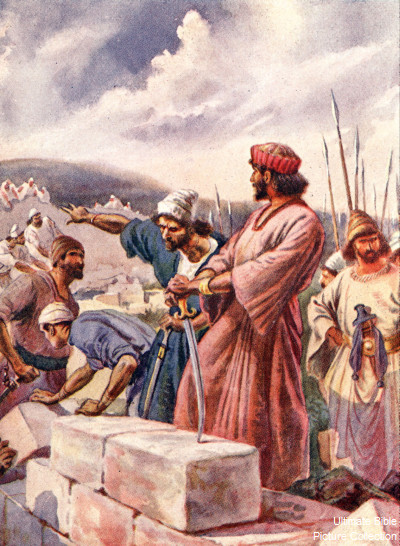
Nehemiah 4:16-20 records a change of strategy for the duration of the project. Nehemiah adopted a new organizational strategy to prevent another crisis and another threat to morale. He organized the people into workers, warriors, and watchmen. He had the people work with either a weapon in their hand or at their side. He appointed others to stand guard. As an additional precaution, he appointed buglers to stand guard around the city and to sound an alarm at the first sign of trouble.

Nehemiah 4:21-23 is a summary of the events of the problem and pressure-filled days of chapter 4. Notice that the people worked from “dawn until the stars appeared (Nehemiah 4:21).” Notice also that Nehemiah asked the “commuters” to stay within the walls of the city to help guard the city and finish the walls (Nehemiah 4:22).

Finally, notice that the problems and pressures of those days were so great that Nehemiah and his men slept in their clothes with their weapons at their side. They lived in a constant state of readiness. The people thus dealt with the problems and pressures they encountered by having faith in God (“Our God will fight for us,” 4:20), and by working hard (“So we carried on the work,” 4:21).

Practical Considerations:

Listening to the enemy can lead to discouragement.
The words of a children’s song caution, “Be careful little ears what you hear!” We learn from Nehemiah 4 that listening to the words of the enemy can lead to discouragement. The opposition to the work of rebuilding the walls of Jerusalem was loud and cruel. Every word was filled with venom and spoken to the end that the Jews would become discouraged, demoralized, and debilitated. We must be careful what we listen to lest we be rendered ineffective in God’s work.

Prayer puts problems and pressures into perspective.
Nehemiah was successful in dealing with problems and pressures because he was a man of prayer. Prayer always puts things into proper perspective. Problems never seem quite as ominous before our omnipotent and awesome God. We should follow Nehemiah’s example and pray, rather than panic, in the face of problems and pressures.

We should not lose heart in doing good.
Nehemiah dealt with problems and pressures not only through praying alone, but through persistent work as well. By so doing he modeled Paul’s counsel to the Corinthians, “Therefore, my beloved brethren, be steadfast, immovable, always abounding in the work of the Lord, knowing that your toil is not in vain in the Lord” (I Corinthians 15:58). We too, should keep at the task even in the face of opposition.

We should never do things just “half-way” in God’s work.
When the Jews reached the half-way point in the work of rebuilding the walls of Jerusalem, they were ready to stop the work because of fatigue and fear. We must guard against the tendency to do things half-way in God’s work. We should look to God when we are weary that He may renew our strength. We should look to God when we are fearful that He may remind us of His presence and protection. And, we should look to God when we are discouraged that He may bolster our resolve.

Fatigue can cause us to lose our vision.
The Jews began the rebuilding of the walls with great enthusiasm and energy. As they continued the work however, they became both physically and emotionally exhausted as they daily contended with the rubble of the walls and the rumors of their enemies. This relentless pressure finally took its toll as the people lost sight of their progress and became discouraged at the thought of the remainder of the work. We must learn the value of rest and relaxation and learn to schedule such moments into our busy days lest we too, lose sight of the bigger picture.

Nehemiah 3

Perspiration: Nehemiah Involves The People
Nehemiah 3:1-32

At first glance, Nehemiah 3 is a chapter filled with lists of names of people and locations in Jerusalem, most of which are difficult to pronounce. It is tempting to skip over chapter three and take up the story again in chapter four. But upon closer examination, chapter three outlines the principles that led to the success of the project.

First, notice the principle of coordination. Every person knew where he belonged and where he was to work. We see this in phrases such as “next to him,” or “beside his house.”

Second, notice the principle of cooperation. People of all ages and from all walks of life cooperated to achieve a common objective.

Third, notice the principle of commendation. This principle is more implied than stated in the chapter, but we can see it illustrated in the fact that Nehemiah knew the names of the people who were working and noticed the work they did. He acknowledged the work of each individual. We can imagine what an encourager Nehemiah must have been as he supervised the work and thanked the people for their involvement.

Fourth, notice the principle of communication. We must not overlook the fact that Nehemiah had to communicate with the people about the work. He had to assign leaders, make work assignments, give instructions, delegate authority, and answer questions. He kept the channels of communication open. Thus, the fact that the work was coordinated, the people cooperated and were commended, and the lines of communication were open all contributed to the success of the project.

Nehemiah teaches us the importance of encouraging others.

Nehemiah 3 is a testimony to the fact that Nehemiah was a “people-person.” He noticed and affirmed the work of those who were helping to reconstruct the wall. He was an encourager. He knew how to develop morale in the workplace.

There are three “morale-mashers” in the workplace: First, lack of appreciation from those above us. Second, lack of cooperation from those around us. Third, lack of commitment from those below us. Nehemiah worked to keep the “morale-mashers” out of the workplace.

Nehemiah 2

From Motivation to Perspiration

Winston Churchill has been called the Man of the Century. History records his marvelous talents as a statesman, orator, and world leader. His leadership through the bleak, crucial days of World War II helped preserve our democratic way of life. He was a gifted orator who could stir the masses to persevere in the face of any odds. Churchill knew how to motivate people. He knew people were itching on the inside and knew exactly where to scratch.

Like Churchill, Nehemiah was a man who knew how to motivate and inspire his countrymen. He knew the Jews in Jerusalem were itching on the inside and knew exactly where to scratch. He motivated the people to rebuild the walls of Jerusalem to the end that God be glorified and the city of Jerusalem regain its prestige. He knew how to motivate others to work. He knew that motivation must lead people to perspiration.

The Personal Petition of Nehemiah
Nehemiah 2:1-8

After four months of praying, the day finally arrived for Nehemiah to present his petition before the king. Over the four month period of praying, Nehemiah had come under the conviction that God had an important role for him to play in solving the dilemma of his people.

Nehemiah’s opportunity came one day in April as he was performing his official duties as cupbearer. The king noticed Nehemiah’s sad countenance and asked him why he was so sad. Nehemiah responded by explaining to the king that he was sad because he had learned that the city of his fathers’ was in a deplorable condition.

Perhaps sensing that Nehemiah wanted to make a request, the king asked, “In what way can I help?” This is the moment Nehemiah had in mind when he prayed, “make Thy servant successful today, and grant him compassion before this man” (Nehemiah 1:11). Nehemiah breathed a quick prayer and asked the king for permission to return to the city of his fathers’ to rebuild it.

Concerned about the length of time Nehemiah would be away, the king asked, “How long will your journey be and when will you return?” Nehemiah gave the king a definite time and further asked that he might be granted the proper written authorization for the journey back to Judah as well as for supplies to do the work which awaited him.

Nehemiah 2:8 records, “and the king granted them to me because the good hand of my God was on me.” Nehemiah gave God the credit for the king’s generous permission and provisions. Thus Nehemiah teaches us about the power of prevailing prayer, the importance of proper planning, and the value of tireless perseverance.

Examination: Nehemiah Inspects The Walls
Nehemiah 2:9-16

Beginning with Nehemiah 2:9, Nehemiah lays aside his role as cupbearer and takes up the role of builder. We read in Nehemiah 2:9 that the king granted Nehemiah an escort to Jerusalem. This undoubtedly added to his prestige and verified his credentials as he made the long journey to Jerusalem.

Upon arriving in Jerusalem, Nehemiah immediately experienced opposition. Sanballat and Tobiah, two politicians from neighboring areas, were not at all pleased that someone had come to seek the welfare of the Jews. This should not surprise us, for as we have noted in previous lessons, God’s work will not go unchallenged by the enemy.

Three days after his arrival in Jerusalem, Nehemiah made an inspection of the damaged walls by night. He wanted to be certain that he had all of the facts in hand before formulating his plan of action. So while the city slept, Nehemiah made his way around the rubble to gain a better perspective of the situation. He, no doubt, saw more at night than most people saw in the light. Nehemiah did not tell anyone what God was putting into his heart to do for Jerusalem. He did not want to risk anyone inadvertently “leaking” information to the enemy lest they gain an advantage in frustrating the work once again.

Motivation: Nehemiah Inspires The People
Nehemiah 2:17-18

After his nocturnal inspection of the walls, Nehemiah was ready to disclose his plans to the people. Nehemiah 2:17-18 is a précis of his inspiring speech to the people. Notice four things in particular.

First, Nehemiah addressed the serious plight of the people: “You see the bad situation we are in.”

Second, he called people to action: “Come, let us rebuild the wall of Jerusalem.” He even gave the people a reason to get involved in the work: “That we may no longer be a reproach.”

Third, Nehemiah shared an encouraging personal word of testimony. He shared with the people how God had worked things out for him to journey to Jerusalem. By sharing his testimony he pointed the people away from their fears to the Lord.

Fourth, Nehemiah identified himself with the people: “You see the bad situation we are in…Come, let us rebuild the wall of Jerusalem that we may no longer be a reproach” (Nehemiah 2:17).

Nehemiah’s speech was so inspiring that the people responded by affirming their support: “Let us arise and build.” The response of the people was prompt (there was no discussion), practical (they were ready to get to work), and unanimous (notice the use of the word “us”).

Intimidation: Nehemiah Impugns the Opposition
Nehemiah 2:19-20

As we have already noted, God’s work will not go unchallenged by God’s enemies. As soon as Nehemiah announced his plans and motivated the people to get to work, Sanballat, Tobiah, and Geshem began to intimidate and mock the people. They used every demoralizing technique they knew to try to discourage the people.

Nehemiah however, swiftly addressed the opposition in a confident, firm, and dignified manner. He did not draw them into argument or debate. He simply informed the opponents that God would grant them success, that the work would proceed in spite of their threats, and that they had no religious claims to the privileges of Jerusalem.

Sanballat, Tobiah, and Geshem had not reckoned on dealing with a Nehemiah. They had come to intimidate the Jews and instead were impugned by Nehemiah. We can just imagine the admiration of the people for Nehemiah at this point.

Practical Considerations:

God honors prayerful planning.
It is evident from Nehemiah 2:1-8 that Nehemiah had spent much time in prayerful planning before he ever made his petition known to the king. He was prepared to answer all of the king’s questions and to request the necessary authorization to secure his passage and provisions. We noted in our lesson, “Planning that arises from and is the product of prayer is far superior to planning that is merely backed by prayer” (White).

We must be willing to allow God to reorder our priorities.
As a result of his time in prayer, Nehemiah came to an understanding of how God wanted to use him as part of the answer to his own prayer. He was willing to allow God to reorder his personal priorities and plans for the purpose of serving his fellow Jews in Jerusalem. Nehemiah discovered an opportunity for service through prayer. 

Nehemiah teaches us the importance of careful planning.
Nehemiah was convinced that it was God’s will for the wall of Jerusalem to be rebuilt. He was also confident that God had called him to play a major leadership role in the project. But before undertaking the great task, Nehemiah carefully inspected the damaged walls in order to gain a better perspective on the situation. This helped Nehemiah to formulate a practical plan of action to meet the challenge of rebuilding the walls. Nehemiah was successful because he coupled specific prayer with careful planning.

Nehemiah teaches us the importance of sharing our testimony.
Nehemiah assembled the people for the purpose of revealing his plans and motivating them to take part in the project. Nehemiah shared his personal testimony of how God had performed what seemed impossible by granting him an extended leave of absence from the king’s service with the proper authorizations to undertake the work of rebuilding the walls. By sharing his testimony he inspired the people to turn their gaze from their fears to their God. Nehemiah’s testimony inspired the people to “put their hands to the good work” (Nehemiah 2:18).

Nehemiah teaches us the importance of standing firm.
When the enemies of the Jews learned that the repatriates were being challenged to rebuild the walls, they wasted no time in mobilizing themselves to counterattack. They used every demoralizing trick they knew to try to frustrate the hopes of the people. Nehemiah however, stood tall in the face of the opposition because he was confident that God would grant the people success. He did not argue or debate the opposition, but merely stood on the firm convictions of his heart. By so doing Nehemiah impugned the opponents and once again inspired the people.

Nehemiah 1

The Power of Prevailing Prayer

The book of Nehemiah is a book of action, adventure, accomplishment, and advancement. It is a book that challenges us to exercise faith in the face of the overwhelming, to persevere in the face of problems, and to stand firm in the face of opposition. But behind the stirring scenes of this great book we find a great man on his knees before a great and awesome God.

Nehemiah was a man of prayer. He was a man who understood the importance of spending time with God in prayer. Someone has said that the self-sufficient do not pray but merely talk to themselves, the self-satisfied will not pray because they have no knowledge of their need, and the self-righteous will not pray because they have no basis on which to approach God. Nehemiah was not that kind of individual. He was a man whose life and activities were successful because he was a man of prayer.

The book of Nehemiah opens with the first of Nehemiah’s eleven prayers and shows us the power of prevailing prayer.

The Person and Position of Nehemiah
Nehemiah 1:1 and 11

Who was Nehemiah? According to Nehemiah 1:1 he was the son of Hacaliah. Although we do not know anything about his childhood, youth, or family background, we can surmise at least four things about him. First, his family had been taken into captivity when Jerusalem fell to Nebuchadnezzar and he was probably born in captivity. Second, his family had not availed themselves of the opportunity to return to Judah with either Zerubbabel or Ezra. Third, his parents were probably godly people because they named their son Nehem-Yah, which means “comfort of Yahweh.” Fourth, Nehemiah remained deeply devoted to God although he grew up in a pagan land filled with corrupting influences.

What was his position? According to Nehemiah 1:11, Nehemiah was the cupbearer to King Artaxerxes. While that does not sound very impressive, it was a very important position. As cupbearer, Nehemiah was responsible for tasting the king’s food and wine to insure that it was not poisoned, guarding the king’s sleeping quarters, and held the role of prime minister and master of ceremonies rolled into one. Ancient historians suggest that the cupbearer, like no one other than the queen, was in a position to influence the king.

The Plight of the Jews in Jerusalem
Nehemiah 1:1-3

The story of the book of Nehemiah opens in the winter time in 445 B.C. At that time, Nehemiah was approached by a delegation made up of his brother Hanani and some important men from Judah. Nehemiah asked these men about the welfare of the Jews (repatriates) who had returned to Judah and Jerusalem.

The reply of the messengers was brief, to the point, and came as a blow to Nehemiah. They reported to him about the condition of the people saying, “The people are in great distress and reproach.” The Jews were the objects of ridicule and taunting by their enemies.

They also reported to him about the condition of the city walls saying, “The wall of Jerusalem is still torn down and the gates are burned.” [Read Ezra 4:7-23 for more information on how the walls were torn down and the gates burned.]

The Prevailing Prayer of Nehemiah
Nehemiah 1:4-11

Nehemiah’s response to the distressing news from Jerusalem reveals the depth of his concern, sensitivity, and compassion for his people. According to Nehemiah 1:4, Nehemiah’s grief was intense (“I sat down and wept”), enduring (“and mourned for days”), and self-denying (“and I was fasting and praying before the God of heaven”).


Bad news drives people to do many things. Some people are driven to anger, some to drink, others to denial, and still others to depression. But bad news drove Nehemiah to his knees in prayer. The kneeling position is a good position to be in when facing problems. Someone has said that knees don’t knock when you kneel on them!

Notice five things about Nehemiah’s prayer.

First, Nehemiah began his prayer by focusing on God rather than on the problem that distressed him. He recognized God as the One who kept His word and showed mercy.

Second, notice that Nehemiah, like Ezra (Ezra 9:5-15), identified himself with Israel in the confession of sin. He did not just point the finger at others, he identified himself as part of the problem.

Third, notice Nehemiah’s persistence in prayer. According to Nehemiah 1:6, he prayed before God day and night (see I Thessalonians 5:17).

Fourth, Nehemiah claimed God’s promise to Moses. He had seen God restore His people to Jerusalem after the captivity and fully expected God to bring about the rebuilding of the walls and the restoration of Jerusalem’s prestige.

Finally, notice the impact that Nehemiah’s prevailing prayer had on his own life. He was given a new perspective on the problem as he began to understand the role he would play in answer to his own prayer. He was also led to reestablish his priorities as he was willing to leave the comforts and security of the royal court to help his people. He was further given a new purpose in life as he prepared to invest himself in a project bigger than himself.

Practical Considerations:

Problems present us with an opportunity to pray.
When Nehemiah learned of the plight of the Jews in Jerusalem, he took the matter to the Lord in prayer. As stated in our lesson, bad news drives people to do many things, but bad news should always drive the Christian to the Lord in prayer.

Prayer gives us a new perspective on problems.
It was while on his knees in prayer that Nehemiah received a new perspective on the problem. Prayer reminded Nehemiah of the greatness of God and thus put the concern of his heart in proper perspective. As one commentator noted, “The greater God becomes to him, the smaller becomes his problem.”

We should pray and not lose heart.
We read in Luke 18:1 that Jesus taught His disciples “that at all times they ought to pray and not lose heart.” Nehemiah teaches us the importance of persistence in prayer. He prayed about the plight of the Jews in Jerusalem for four months. Swindoll comments, “The prayer warrior quickly learns the patience of waiting. And so Nehemiah was doing just that – waiting. In the diary he kept, nothing was entered for those four months because nothing happened. He waited. There was no visible glimmer of hope, no change. He kept waiting and trusting and counting on God to move the heart of his superior.” We would be well advised to heed Paul’s admonition to “pray without ceasing” (I Thessalonians 5:17).

Micah 1

What does the Bible tell us about Micah?

[A]   The name Micah means “who is like Jehovah?”

[B]   He was from Moresheth (Micah 1:1 and Jeremiah 26:18), a place located about twenty miles southwest of Jerusalem. The town/village was probably adjacent to Gath since it is referred to as Moresheth-gath in Micah 1:14.

[C]   He prophesied during the reigns of “Jotham, Ahaz, and Hezekiah, kings of Judah (Micah 1:1).

[D]   He was a contemporary of Isaiah, Hosea, and Amos.

[E]   Jeremiah quoted Micah’s words in Jeremiah 26:18.

To whom did Micah direct his prophesies?

Micah spoke the word of the Lord (a divine message), which came to him concerning Samaria and Jerusalem (Micah 1:1). Samaria, the capital of the Northern Kingdom of Israel, was a city built on a hill (see 1 Kings 16:23-24). Jerusalem, the capital city of the Southern Kingdom of Judah, was also a city built on a hill. Jesus said, “A city set on a hill cannot be hidden” (Matthew 5:14). A city set on a hill has much influence. These cities represented the seat of government for their respective kingdoms and exerted a powerful influence upon their surrounding areas.

Practical Consideration: We have a responsibility to pray for our leaders.
Jerusalem and Samaria were cities set on a hill. Jerusalem was a center of worship and government. Samaria was a center of false worship and government. The decisions made by the civic and religious rulers in these cities had a far-reaching impact on their respective kingdoms. We have a responsibility to pray for our leaders and to communicate with them about the decisions they make. We forfeit our right to criticize our leaders when we fail to exercise our right to vote, when we fail to express to them our views and concerns regarding the issues, and when we fail to pray for them.

What did Micah prophesy would happen to Samaria and Jerusalem?

Micah announced (Micah 1:2) that the judgment of God would come upon Samaria and Jerusalem. Note the description of that judgment:

[A]   Micah prophesied that the Lord “will come down and tread on the high places of the earth” (Micah 1:3). The high places were the locations of idol worship. Remember also that the two capital cities were built on high places or mountains. Micah declared that God would level everything raised in opposition to Him.

[B]   Micah prophesied that there would be natural catastrophes included in God’s judgment (Micah 1:4). This verse also reminds us that all things are God’s servants (see Psalm 119:91) and at His disposal as instruments of judgment.

[C]   Micah indicated that the reason for God’s judgment “is for the rebellion of Jacob and for the sins of the house of Israel (Micah 1:5). Notice that the blame falls upon the capital cities: “What is the rebellion of Jacob? Is it not Samaria? What is the high place of Judah? Is it not Jerusalem?” (Micah 1:5). The decisions made in these cities by the leaders impacted their respective kingdoms. Trickle-down corruption!

[D]   Micah prophesied that the judgment of God would be so terrible that Samaria would be leveled to its foundations and idolatry destroyed. Everything built and gained apart from God would be lost (Micah 1:6-7).

[E]   Micah prophesied that the sin of the Northern Kingdom “is incurable [they had stepped over the line and gone too far], for it has come to Judah; it has reached the gate of my people, even to Jerusalem(Micah 1:8-9). Jerusalem would not escape God’s judgment. This caused Micah to lament, wail, and mourn (Micah 1:8). Like Jeremiah (see Jeremiah 20:7-9), Micah too, was a weeping prophet. He was a tender-hearted prophet with a tough message.

Practical Consideration: Sin inevitably leads to ruin.
Both the Northern and Southern Kingdom came to ruin because of their sin. Sin is destructive. Sin will give you what you want, but it will take what you have. The wages of sin has always been death and destruction. Men err when they think they can court sin without inviting disaster, destruction, and death.

What did Micah prophesy would happen to other cities?

Micah prophesied that several other cities would experience panic and calamity as a result of the coming judgment (Micah 1:10-14). Using a play on words, Micah described the panic that would result during the coming judgment.

[A]   Gath: (Micah 1:10) A Philistine city. Micah did not want for this Philistine city to know that judgment was coming upon Judah.

[B]   Beth-le-aphrah: (Micah 1:10) The name of this city means “house of dust.” The inhabitants of this city would roll themselves in the dust and mourn after God’s judgment. This verse might be read, “The people of Dustown will roll themselves in the dust!” Micah used this same word-play formula in describing events in the other towns and villages he listed.

[C]   Shaphir: (Micah 1:11) The name of this town means “pleasantness” or “beauty.” The inhabitants would go about in shameful nakedness as a result of God’s judgment.

[D]   Zaanan: (Micah 1:11) The name of this town means “going out.” The inhabitants would not escape (go out) God’s judgment.

[E]   Beth-ezel: (Micah 1:11) The name of this town means “house of removal.” They would have no place left to stand after God’s judgment.

[F]   Maroth: (Micah 1:12) The name of this town means “bitterness,” which is what they would experience through the events of God’s judgment.

[G]   Lachish: (Micah 1:13) This was the place through which idolatry was introduced into the Southern Kingdom of Judah. Some believe that pagan practices from Egypt were introduced at Lachish and then made their way to Jerusalem. Lachish would not escape God’s judgment.

[H]   Moresheth-gath: (Micah 1:14) Even Micah’s home-town would suffer in the coming judgment.

[I]   Achzib: (Micah 1:14) The name of this town means “lie” or “deceit.” Anyone expecting to find help or comfort from Achzib would find it a faithless and unreliable source of help.

[J]   Mareshah: (Micah 1:15) The name of this town means “possession.” It would be invaded by “the one who takes possession.”

[K]   Adullam: (Micah 1:15) This town, situated the farthest distance from the Assyrian Empire, would not escape God’s judgment.

Practical Consideration: Sin has a shadow.
Sin has a shadow. It casts is cold darkness upon the innocent or the passer-by. The sins committed in the capital cities of the Northern and Southern Kingdoms cast a pall upon the surrounding villages and towns. Our sin also has a shadow. The sins we commit cast a dark shadow upon those nearest to us or those who come within the sphere of our influence.

What did Micah call upon the nation to do?

Micah called upon the nation to mourn because their children would be carried off into captivity in the coming judgment (Micah 1:16).

Micah 2

What specific sins did Micah denounce?

Micah spoke out against the sins of the rich and powerful against the poor and needy. Micah accused the rich and powerful of scheming against the poor twenty-four hours a day. He accused the rich of plotting evil at night and practicing it by day (Micah 2:1). Micah also accused the rich of seizing whatever their evil hearts coveted (much like Naboth’s vineyard was unlawfully seized by Jezebel for Ahab in 1 Kings 21). The rich took every advantage of the poor, robbing them of field, home, and inheritance (Micah 2:2). There was a clear disregard for the law of God and for the rights of others. Selfishness ruled the hearts of the rich and powerful.

Practical Consideration: The eyes of man are never satisfied.
Micah accused the rich and powerful of scheming against their fellowman twenty-four hours a day. The greedy and powerful rich lay awake at night plotting how to increase their wealth at the expense of others. Their eyes were never satisfied. They wanted more at any cost. Proverbs 27:20 states, “Sheol and Abaddon are never satisfied, Nor are the eyes of man ever satisfied.” We must allow Jesus to be Lord of our eyes.

What sentence did God pronounce against the wicked?

Notice that God pronounced a punishment in kind against the rich and powerful. They had plotted evil against their fellowman so God would plan calamity against them (Micah 2:3a). Those who had perpetrated the evil described in Micah 2:1-2 would not be able to escape God’s judgment: “from which you cannot remove your necks” (Micah 2:3). Those who had seized the lands of others would lose their own lands “to the apostate” (heathen) without hope of recovering their property (Micah 2:4-5). Notice also that God’s punishment would be humiliating. God declared, “and you will not walk haughtily, for it will be an evil time” (Micah 2:3b). God would humble the proud and arrogant rich. They would become the objects of insult and jesting (Micah 2:4).

Practical Consideration: We should heed the Golden Rule.
The judgment of God upon the rich and powerful was punishment in kind. Those who took the possessions of others would lose their possessions (Micah 2:4-5). Those who turned a deaf ear to the cries of those they oppressed would find no one to listen to their cries in their distress (Micah 3:4). Jesus said, ” By your standard of measure, it will be measured to you (Matthew 7:2b). . .Therefore, however you want people to treat you, so treat them, for this is the Law and the Prophets” (Matthew 7:12). James 2:13 states, “For judgment will be merciless to one who has shown no mercy; mercy triumphs over judgment.” Someone has said, “Those that will not be ruled by grace will be overcome by judgment.”

What was the attitude of the wicked toward the Word of God?

They tried to silence God’s prophets, in this case, Micah himself (Micah 2:6a). They did not want to hear words that condemned them. They did not want to be held accountable. The faithful proclamation of God’s Word offended them. They lost sight of the protecting and preserving power of God’s Word (Micah 2:6b) and the good that it does in the lives of those who obey it (Micah 2:7). See also Amos 2:11-12 and 7:10-13. Micah proclaimed that the proof that his hearers had no regard for God’s Word was the way in which they treated their fellowman. The rich and powerful had become an enemy to the people of the land. They oppressed and exploited the poor, the unsuspecting, the helpless, and even women and children (Micah 2:8-9). They destroyed homes so that children did not have the opportunity to be educated to know the splendor or glory of God (Micah 2:9). Micah told the oppressors that they would be carried away and find no rest in their own land (Micah 2:10). Micah then told his audience that he knew the kind of preacher and preaching they would like: one whose sermons were full of hot air (Micah 2:11a) and one who condoned their vices and sins (Micah 2:11b). They would gladly listen to that kind of preacher (Micah 2:11c).

Practical Consideration: The truth of God’s Word is unwelcome to those who live in sin.
There were people in both the Northern and Southern Kingdoms who did not want to hear the truth of God’s Word. They tried in many instances to silence the prophets or to run them out of town. Those who live in sin do not want to hear the Word of God. It makes them feel uncomfortable. It offends because it condemns them. The writer of Hebrews declared, “For the word of God is living and active and sharper than any two-edged sword, and piercing as far as the division of soul and spirit, of both joints and marrow, and able to judge the thoughts and intentions of the heart” (Hebrews 4:12).

What ray of hope shines at the end of Micah 2?

Micah introduced a ray of hope at the end of his prophesy against the oppressive rich and powerful. He spoke of a day when God would gather the scattered remnant from among the nations. In that day God would be like a Shepherd (Micah 2:12) and Liberator to His people (Micah 2:13).

Micah 3

What word did Micah have for the political leaders?

Micah denounced the political leaders for failing to practice justice (Micah 3:1 and 9), for losing their moral compass (Micah 3:2a) in that they hated good and loved evil, and for fiercely and thoughtlessly devouring the people (Micah 3:2b and 10). Micah warned them that they would experience a punishment in kind. The day would come when their enemies would treat these evil leaders in the same manner that they treated their poor countrymen. In the day of their distress their cries for help would go unheeded (Micah 3:4).

Practical Consideration: We should heed the Golden Rule.
The judgment of God upon the rich and powerful was punishment in kind. Those who took the possessions of others would lose their possessions (Micah 2:4-5). Those who turned a deaf ear to the cries of those they oppressed would find no one to listen to their cries in their distress (Micah 3:4). Jesus said, ” By your standard of measure, it will be measured to you (Matthew 7:2b) … Therefore, however you want people to treat you, so treat them, for this is the Law and the Prophets” (Matthew 7:12). James 2:13 states, “For judgment will be merciless to one who has shown no mercy; mercy triumphs over judgment.” Someone has said, “Those that will not be ruled by grace will be overcome by judgment.”

What word did Micah have for the prophets?

Micah denounced the spiritual leaders for adjusting their preaching according to their pay (Micah 3:5 and 11). As one commentator noted, “What came out of their mouths depended on what went in.” Micah announced that these false prophets would find themselves in darkness and no longer see visions (Micah 3:6) and find themselves without anything to say (Micah 3:7). Micah presented his credentials in Micah 3:8. In contrast to the false prophets, Micah announced that he was “filled with power – with the Spirit of the Lord – and with justice and courage.” He was willing to preach God’s message without compromise.

Practical Consideration: Divine work must be done in dependence upon divine power.
Micah denounced the spiritual leaders and prophets of his day for adjusting their message according to their income and prophesying for the benefit of those who paid them. Micah, on the other hand, preached God’s message without compromise. He was an untouchable! He could not be bought for a bribe. Micah’s heart and life was filled with power and with the Spirit of the Lord. He delivered a divine message in dependence upon divine power. His heart was filled with justice and courage. He preached the word of the Lord regardless of how unpopular the message might be to his hearers. God could count on Micah. Can He count on us?

What word did Micah have for all the leaders?

Micah announced that all the leaders of the land had become oppressors/exploiters of the weak, had lost their sense of what was right and fair, could be bought for a price, and yet felt immune from God’s judgment (Micah 3:9-11). Micah however, announced that because of the rampant sins of the leaders, God’s judgment would come. Jerusalem would be destroyed (Micah 3:12). Micah was the first prophet to predict doom for Jerusalem. Micah’s prophecy was fulfilled a century later.

Micah 4

What distinguishes Micah 4 from the first three chapters of the book?

Chapters 1-3 of Micah pronounce judgment. They are dark and foreboding chapters that address the sins of the cities of Samaria and Jerusalem, the sins of the rulers, and the sins of the rich and powerful. The third chapter of Micah concludes with a prophecy concerning the destruction of Jerusalem and the Temple because of the sins of the nation (Micah 3:12).

In contrast, Micah 4 begins with a note of hope. Looking far into the future (the Messianic age), Micah envisioned a day when the Temple would be rebuilt (Micah 4:1) and many nations would come there to learn God’s ways and depart to walk in a manner pleasing to Him (Micah 4:2). The central function of the Temple would be to give God’s Word to the nations rather than serve as the place for sacrifices.

Micah also envisioned a day when peace would reign in the world and there would be no more war, no more manufacturing of arms, and no more training of armies for war (Micah 4:3). Instead, war implements would be made into farm implements (Micah 4:3) and men would be able to live their lives free from the fears associated with war (Micah 4:4).

Practical Consideration: Envisioning the possibilities can help you deal with the actualities.
The first three chapters of Micah address the actualities through which the nation would pass because of her sin. Those actualities included God’s judgment and much suffering at the hands of foreign armies and nations. Those actualities included the despair and frustration, which the poor and weak experienced at the hands of the rich and powerful. Those actualities included people who felt they could sin without prospect of judgment and others who felt they had no avenue through which to pursue justice.

Micah 4 and 5 address the possibilities, the purpose behind God’s judgment of His people. They are chapters filled with the hope of a better and glorious future. They are chapters that remind us that we can endure present sufferings when we have the hope of a better future.

What advice did Micah have for the people?

Micah instructed his hearers to live their lives in obedience to God, unlike their heathen neighbors (Micah 4:5). God’s people must be distinctive. There must be a significant line of demarcation between the lives of God’s people and those who do not know God.

Practical Consideration: God’s people must be distinctive.
The theme that God’s people must be distinctive runs through the pages of Scripture. God’s people must live lives that show the difference that God makes. Our lives serve as letters of recommendation either for or against God. The key to living lives that are distinctive is obedience to the Word of God.

What would become of the scattered remnant?

Micah prophesied that “in that [future] day” God would gather the lame and scattered remnant (those who experienced the judgment of Micah 3:12) of Israel and transform them into a strong nation over which He would rule forever (Micah 4:7). In addition, Jerusalem would be restored and raised to its former dominion as head over a united kingdom (Micah 4:8).

Practical Consideration: God’s people have a future and a hope.
An agnostic writer noted, “In a modern society, man can live without hope only when kept dazed and out of breath by incessant hustling.” Many in our world live their lives without the assurance of a future and a hope. God’s people are fortunate indeed because they have the assurance that there is a purpose behind present sufferings and a reason to persevere. God is not finished with us yet!

What reference did Micah make to the coming exile?

Micah reminded his hearers that they would experience the loss of their king as well as pain like that of a woman in childbirth in the events leading to (and including) their deportation to Babylon. Micah however, introduced a word of hope by declaring that the Lord would rescue the people from their enemies. The purpose of the calamity and trials the people would experience was not to annihilate them, but to purge the land of idolatry and sin. (Micah 4:9-10).

Practical Consideration: God has a purpose for present sufferings.
The Northern and Southern Kingdoms experienced the judgment of God because of their sin. These nations had strayed far from God and allowed pagan practices to be incorporated into their polity and theology. God used other nations to purge His people and their land of those things that caused their love for Him to cool. This judgment was awesome proof of God’s love for His people and His desire to help them better fulfill their role as His representatives in the world.

What reference did Micah make to what Israel would experience in the last days?

Some scholars believe that Micah 4:11 refers to a reunified Israel in the last days because of the reference to “many nations.” Micah prophesied that many nations would try to destroy Israel (Micah 4:11) but that the Lord would act on behalf of His people (Micah 4:12) to give them victory over their enemies (Micah 4:13).

Others believe that Micah 4:11-13 refers to the attitude of neighboring nations during the destruction of the Southern Kingdom. They stand by and watch with delight and try to take advantage of her in her weakened condition (Micah 4:11). God however, has allowed these neighboring nations to gather around Israel to be like grain on the threshing floor (Micah 4:12). The Lord will then empower His people to destroy them and employ the spoil in the service of the Lord (Micah 4:13).

Micah 5

What reference did Micah make to the nation’s present predicament?

Micah declared (Micah 5:1) that the nation would be besieged by her enemies and her king(s) smitten on the cheek (a reference to insult and humiliation).

What assurance of deliverance did Micah proclaim?

While the nation’s present kings suffered at the hands of oppressors (Micah 5:1), Micah envisioned the day when God would raise up one from the seed of David who would rule Israel in glory and majesty (Micah 5:2). Micah’s prophesy about the coming ruler (Messiah) was uttered about 700 years before the birth of Christ. Notice the description of the Messiah in Micah 5:2:

[A]   He will be born in Bethlehem Ephrathah.

[B]   He will “go forth for Me,” that is, He will do the will and work of God.

[C]   He will be One who has always existed: “His goings forth are from long ago, from the days of eternity.”

In the meantime, Israel would continue to suffer (like a woman in labor) at the hands of her enemies (Micah 5:3), but would one day experience the protection and guidance of this ruler (Messiah) who would be like a Shepherd to them (Micah 5:4).

Practical Consideration: It’s Friday, but Sunday is coming!
Tony Campolo tells the story of hearing the Easter story told by a black preacher in an interesting way. The preacher pointed out that hell must have rejoiced when Christ hung on the cross, and then added, “That’s because it was Friday, but Sunday is coming!” Micah announced that while the nation and her leaders would suffer humiliation and defeat at the hands of her enemies, God was going to send a deliverer. Defeat is never the last word for God’s people. No matter how dark it gets on Friday, Sunday is just around the corner!

What did the people do in the meantime to deal with the pressures from Assyria?

After the Assyrians conquered the Northern Kingdom in 722 BC, they laid siege to Jerusalem in 701 BC. The Southern Kingdom raised up shepherds (kings) and leaders to oppose the Assyrians under Sennacherib (Micah 5:5). Micah 5:6 addresses the hope that one day Judah will conquer Assyria.

What did Micah prophesy would be the future of those surviving the judgment that he had announced?

Micah prophesied that God would not abandon the surviving remnant, but would work with them to strengthen them and assure them of a future. They would become like the dew (Micah 5:7) which spreads its influence over all the earth and as strong as a lion (Micah 5:8-9).

What steps would the Lord take to purify His people?

Micah declared that the Lord would purge Israel of everything that distracted and directed them away from God. The things that the Lord would remove included:

[A]   Military might (Micah 5:10-11): Trusting in horses, chariots, and fortifications.

[B]   False religious practices (Micah 5:12-14): Sorcery, fortune telling, carved images, sacred pillars, and Asherim.

In addition, Israel’s idolatrous neighbors, from whom she learned wrongdoing, would experience God’s judgment (Micah 5:15).

Practical Consideration: We should trust in the Lord.
It is easy to trust in things. God’s people trusted in military strength and looked for divine guidance from the wrong sources through the wrong methods. It is foolish for God’s people to trust in anyone or anything other than God. Why settle for less?

Micah 6

What charges did the Lord bring against His people?

The setting of Micah 6 is a courtroom. God called upon the mountains, hills, and foundations of the earth to hear His case against His people (Micah 6:1-2). The latter part of verse 2, “even with Israel He will dispute,” should be understood, “and He will plead [reason] with Israel.” God’s case was not built upon anger but love. God asked His people how His treatment of them could have possibly led to their present attitude (Micah 6:3). He asked for an answer, but none was given.

God then proceeded to appeal to history. He reminded them of the things He had done to redeem them, not weary them. He delivered them from bondage in Egypt and provided leaders for them (Micah 6:4). He protected them in the wilderness when Balak sought to curse and destroy them (Micah 6:5a). He was with them in Shittim, the last encampment in the wilderness, and miraculously led them across Jordan to Gilgal, the first encampment on the west side of the Jordan. God did these acts in order that His people “might know the righteous acts of the Lord” (Micah 6:5b). These events should have caused the people to respond to God in gratitude and obedience.

Practical Consideration: God takes notice of our ingratitude and faithlessness.
God’s faithfulness and goodness to us should cause us to respond to Him in gratitude (see Psalm 103:1-5). God never gives us cause to respond to Him in disobedience and faithlessness. In fact, God’s goodness and faithfulness accentuates our ingratitude and faithlessness. How would we respond if God were to ask us, “My people, what have I done to you, and how have I wearied you? Answer Me.” (Micah 6:3).

How did the people respond to God’s charges?

An unidentified speaker interrupted Micah and asked what God required of them. Did God want them to bow before Him? Did He want more and better sacrifices? Would He be satisfied with thousands of rivers of oil? Should they go so far as to sacrifice a first-born son to please Him? (Micah 6:6-7). Micah’s religious audience claimed to be doing all of the right religious things. They were, outwardly, very pious. They did every religious thing they knew to be rightly related to God. They seemed to be very concerned about their vertical relationship. But something was wrong! The people were doing right things with a wrong heart. As one commentator noted, they had lost their religion in religiousness. Their piety was devoid of ethics and character.

Practical Consideration: Religion cannot make men right with God.
Micah’s audience was very religious. They outwardly did all of the right things and said all of the right words. They appeared to be very zealous in religious matters. Their piety however, was devoid of ethics and character. They went through the activity of worship one day and then abused their fellowman the next day. They offered all of the right sacrifices in the daytime and then plotted evil on their beds at nighttime. And yet they did not feel that they were wrong with God (see Micah 3:11b). Religious activity does not make men right with God.

What was Micah’s response to the people?
Micah responded to the people by reminding them that while they were concerned with their vertical relationship, they had neglected their horizontal relationships. They were interested in doing the religious things that they thought would make them right with God, but neglected doing the things that would make them right with their fellowman. Micah reminded his audience that God had already told them what was good (Micah 6:8a). They did not need a new revelation, they needed to obey the revelation they already had. Micah reminded the people of the missing dimension in their lives (Micah 6:8b).

[A]   God requires His people “to do justice.” This means to set right what is wrong and to do what is right, fair, and honest between men.

[B]   God requires His people “to love kindness” or to practice faithful love. God requires His people to love others even when there is nothing that merits that love. We are to love others as God has loved us.

[C]   God requires His people “to walk humbly with your God.” A man who practices justice and faithful love can walk humbly with God. To “walk humbly” with God means to willingly submit to His will.

Practical Consideration: We should obey the truth that we have.
Micah reminded his audience that God had already told them what He required of them. Many believers today are also without excuse when it comes to knowing what God expects. We have the benefit of exposure to God’s Word through worship gatherings, Bible studies, and multi-media. The problem most believers have is not the need for more Bible study, but obeying what they already know from the Bible. Our need is not so much “to know” as it is “to do” what we already know.

What charges did God bring against the people of Judah and Jerusalem?

Once again, God brought charges against the city (Micah 6:9). The city of Jerusalem was a very influential city and its sins would not go unpunished. While God required His people “to do justice, to love kindness, and to walk humbly with your God” (Micah 6:8), the verses that follow show the corrupt state into which the nation had fallen.

[A]   The people were guilty of deception and dishonesty. They used false weights and measures to their advantage (Micah 6:10-11). See also Amos 8:5.

[B]   The wealthy used violence to advance their plans for gain (Micah 6:12a).

[C]   The people in general were deceitful and wicked (Micah 6:12b).

[D]   The people patterned their conduct after that of Omri and Ahab (Micah 6:16).

Practical Consideration: God notices how we treat one another.
The book of Micah illustrates the fact that God notices how we treat one another. Our horizontal relationships have an impact upon our vertical relationship. Jesus had much to say about this subject (see Matthew 5:23-24 and 6:14-15). The New Testament is filled with “one another” passages that accentuate the importance of how to properly interact with others.

How would the people be judged for their sinfulness?

Micah (6:13-16) declared that God would judge His people “because of your sins” (Micah 6:13b). They were marked for destruction, derision, and humiliation (Micah 6:16b). Notice that the people would experience frustration and futility (see also Amos 5:11b):

[A]   They would eat but not be satisfied (Micah 6:14).

[B]   They would try to save their earnings/possessions but not preserve anything (Micah 6:14).

[C]   They would sow but not reap (Micah 6:15).

[D]   They would tread olives and grapes but not enjoy the benefits of that labor (Micah 6:15).