Genesis 11

On December 30, 1968, the late Frank Sinatra recorded the song entitled “My Way.” Written especially for him by songwriter Paul Anka, this song resonated with Baby Boomers, dubbed the Me Generation. The lyrics tell the story of a man who is nearing the end of his life and reflects on the challenges he faced and the choices he made. He ultimately concludes that he is satisfied with his life because he did things his way.

Sinatra’s song would have been popular among the people who set out to build the Tower of Babylon. Within a few short generations after the Flood, humanity had already lost sight of the judgment that had wiped every living thing off the face of the earth. People continued to disobey God and instead stubbornly determined to do things their own way. They pursued their own selfish ambitions and sought to find ways to make themselves famous.

The builders of the Tower of Babylon were certainly neither the first nor the last to insist on doing things their own way. There is certainly something about our sinful nature that delights in self-centered pursuits, in doing things the way we want to do them. Life ultimately is about the choices we make and whether we give any consideration to God and His purposes. One day, we will all likely look back and reflect on how we lived our lives and whether we did things our way or God’s way.

The Context
God charged Noah’s three sons and their wives with the responsibility of multiplying and populating the earth. The descendants of Noah’s sons are listed in Genesis 10, a passage often called The Table of Nations. This genealogical list includes the descendants of Japheth (Gen. 10:2-5), the descendants of Ham (Gen. 10:6-20), and the descendants of Shem (Gen. 10:21-31). Nimrod, the father of the Babylonian civilization, was a descendant of Ham while the Hebrew people are descendants of Shem. Babylon would become the enemy of God’s people. For several generations after the Flood, all of the people in the world spoke the same language.

Many people chose to settle in the cities of Nimrod in the land of Shinar. Those who settled in the place that later came to be called Babylon decided to build an impressive tower. This tower was a symbol of their arrogance and independence from God. The tower builders cleverly utilized available natural resources to fashion the bricks that would enable them to build a tower so high that the world would take notice. God, however, took notice and concluded that if the people built their tower they would become emboldened to pursue other projects apart from Him. He therefore confused the language of the people which resulted in their being scattered throughout the earth.

After the account of the Tower of Babylon, Shem’s genealogy is repeated and expanded to include his descendants leading up to Abram. Abram, later known as Abraham, became the father of the Jewish nation. Beginning with Abraham, the Bible tells the story of God’s interaction with this man and his descendants. The Messiah, whose coming was foretold in Genesis 3:15, was a descendant of Abraham. His birth changed the course of human history.

11:1 Now the whole world had one language and a common speech.

Human beings alone have the power of speech. While animals have ways of communicating with one another, only humans use spoken words. We use language to express thoughts and ideas, to forge friendships, and even to communicate with future generations. Speaking a common language certainly makes it easier to promote unity among people. Differences in language, however, can create barriers, suspicion, and even separation between individuals and groups.

We don’t know what language Adam and Eve spoke or if eventually more than one language was spoken before the Flood. However, for several generations after the Flood, the whole earth spoke the same language, essentially the language that Noah and his family had spoken. The population of the whole earth at that time had probably spread only as far as the Mesopotamian Valley.

11:2 As people moved eastward, they found a plain in Shinarb and settled there.

As the descendants of Noah multiplied, they also began to migrate from the east. After God had driven Adam and Eve out of the garden, He stationed cherubim east of the garden to restrict their access to the tree of life (see Gen. 3:4). When God cast Cain from His presence, Cain settled in a place east of Eden (see Gen. 4:16). The east became the starting point of the movement to multiply and fill the earth.


Nimrod, one of Noah’s descendants, apparently led many people to settle in a valley in the land of Shinar. Nimrod was “the first powerful man on earth” (Gen. 10:8). He was, undoubtedly, an extremely influential man whose fame endured for many generations.

Micah, the Old Testament prophet, later referred to the land of Assyria as “the land of Nimrod” (Micah 5:6). Nimrod is regarded as the founder of the Babylonian civilization. His name means “we shall rebel” — an appropriate moniker since he influenced many to settle in his city rather than to obey God’s command to scatter and fill the earth.

11:3 They said to each other, “Come, let’s make bricks and bake them thoroughly.” They used brick instead of stone, and tar for mortar.

Those who migrated to Shinar chose to stay there and disregarded God’s command to scatter and subdue the earth. These settlers determined to build a city with an impressive tower as its defining feature. Those who choose to disobey God are often very resourceful. The scarcity of stones in the area did not deter the people from pursuing their ambitious building project.

Instead of building with stones, they made oven-fired bricks from materials readily available in the area. Brick-making was already common in the construction of homes. The adobe-type bricks used in simple home construction were made of mud and water mixed with a binding material and then sun dried. However, the multi-story building project in Shinar was much more ambitious and required durable oven-fired bricks. Asphalt, another material readily available, was used to mortar the bricks together.

11:4 Then they said, “Come, let us build ourselves a city, with a tower that reaches to the heavens, so that we may make a name for ourselves; otherwise we will be scattered over the face of the whole earth.”

The phrase let us is used twice in this verse and once in the previous verse, suggesting that the ambition of the people was egocentric. Their desire was to build for themselves a city and a tower. Their motivation for building was to make a name for ourselves. The people were filled with pride and interested in promoting their own fame rather than God’s. The people were united in their efforts. The passage gives no indication that any person offered pushback or tried to suggest that they consult God before proceeding. It is never wise to leave God out of any building enterprise (see Ps. 127:1).

The tower is described as having its top in the sky. This does not mean that the tower would literally reach to heaven but instead was a structure of great height in relation to everything else around it. The construction of the tower was likely in the form of a ziggurat, a pyramidal structure with receding tiers and a flat top. The people thought that the presence of such a tower in their city would make them famous. The also believed that their tower would serve as a landmark to attract others and to dissuade people from “being scattered over the face of the earth.”

The word Babel means “the gate of the gods.” The Tower of Babylon was a religious structure. Like other ziggurats, it was designed for the worship of pagan gods and even for the practice of human sacrifice. It was a place where people hoped to make a connection with the gods or goddesses they worshiped. The Tower of Babylon is an indication that in the few short generations after the Flood, humanity had again wandered far from God and neglected to worship Him alone. Those who are far from God tend to make bad decisions.

11:5 But the Lord came down to see the city and the tower the people were building.

The people who settled in Shinar determined to construct the city and the tower without God’s approval. They were undoubtedly proud of their plans, especially their plans to build a grand tower that would reach up to the sky. Their plans and construction activity did not go unnoticed. The Lord, in fact, took an interest in what they were doing and came down to look things over. The expression came down is a human way of describing the involvement of God in the matter. God, of course, is omniscient and did not need to come down in order to to see what was going on.

The city and the tower that seemed great in the people’s eyes were not so great in God’s eyes. Although the people were proud of their tall tower, God still had to come down to look at it. When we lose sight of how big God is, then it becomes easier for us to see our own accomplishments as bigger than they actually are. Our pride always grows in proportion to the distance between us and God. The father from God the greater the pride.

To the Creator of the macroscopic — the universe and everything in it — the Tower of Babylon was microscopic and unimpressive by comparison. God came down to look at the tiny tower and, more importantly, to hold the people accountable for engaging in this prideful initiative without His approval and without regard for Him. This would become among the first of many occasions in the Scriptures that illustrate the truth that pride often goes before destruction (see Prov. 16:18).

11:6 The Lord said, “If as one people speaking the same language they have begun to do this, then nothing they plan to do will be impossible for them.

God was concerned about humanity’s inclination to pursue their own ambitions without regard for Him. With a common language to unite them and to facilitate communication, the people were poised to fulfill whatever evil purposes they desired. Filled with pride, they were intent on building a civilization that did not acknowledge God. Humanity was on a slippery slope that would plunge mankind into deeper rebellion against God. God, therefore, had no choice but to intervene. He had to restrain the people and to frustrate their plans which would have driven them even farther away from Him and His redemptive purposes.

11:7 Come, let us go down and confuse their language so they will not understand each other.”

11:8 So the Lord scattered them from there over all the earth, and they stopped building the city.

God had finally had enough and decided to go down there and deal with the rebellion. He was not interested in destroying the people but in keeping the people from destroying themselves by establishing a way of life that excluded Him. And, rather than destroying the tower, God instead intervened by confusing the language of the people so that the builders could no longer understand one another’s speech. The inability to communicate with one another brought the people’s prideful project to a halt — “they stopped building the city.”

Ultimately, what the people feared most is what God allowed to happen to them. The people had followed Nimrod to his cities in defiance of God’s command to fill the earth. They did not want to be scattered but preferred instead to determine their own future. The Lord Himself, however, scattered them from their comfortable valley in the land of Shinar over the face of the whole earth. It is likely that those who spoke the same language united and then eventually wandered off to find new places to live and ultimately to fulfill God’s command to replenish and subdue the earth. This is the only account in the Bible of how mankind was divided into people groups by means of different languages.

11:9 That is why it was called Babel—because there the Lord confused the language of the whole world. From there the Lord scattered them over the face of the whole earth.

The name of the place where these events took place came to be known as Babylon. Nimrod’s impressive city of Babylon eventually became a great empire, one that troubled the people of God for generations.

Babylon also became a symbol of defiance against God. The word “babel” originally meant “the gate of the gods.” The people thought that their great building enterprise would connect them with alleged deities other than the God who had created them. The word, however, came to mean “confusion” to commemorate what God did when He confused the language of the whole earth.

Centuries later, God reversed the confusion of languages on the Day of Pentecost. The Holy Spirit enabled believers to speak of God’s mighty deeds (Acts 2:11) in different languages. The word languages does not refer to ecstatic or unintelligible utterances, but rather to known languages and dialects previously unknown to those speaking them. The people of various nationalities (Acts 2:8-11) present at the feast clearly understood what was being spoken.

Today, many people groups are still waiting to read or hear the gospel in their own heart languages. Through the initiatives of missionaries and Bible translators, more and more people are learning of the wonders of God and of His love for them.

11:10 This is the account of Shem’s family line. Two years after the flood, when Shem was 100 years old, he became the father[d] of Arphaxad.

11:11 And after he became the father of Arphaxad, Shem lived 500 years and had other sons and daughters.

11:12 When Arphaxad had lived 35 years, he became the father of Shelah.

11:13 And after he became the father of Shelah, Arphaxad lived 403 years and had other sons and daughters.

11:14 When Shelah had lived 30 years, he became the father of Eber.

11:15 And after he became the father of Eber, Shelah lived 403 years and had other sons and daughters.

11:16 When Eber had lived 34 years, he became the father of Peleg.

11:17 And after he became the father of Peleg, Eber lived 430 years and had other sons and daughters.

11:18 When Peleg had lived 30 years, he became the father of Reu.

11:19 And after he became the father of Reu, Peleg lived 209 years and had other sons and daughters.

11:20 When Reu had lived 32 years, he became the father of Serug.

11:21 And after he became the father of Serug, Reu lived 207 years and had other sons and daughters.

11:22 When Serug had lived 30 years, he became the father of Nahor.

11:23 And after he became the father of Nahor, Serug lived 200 years and had other sons and daughters.

11:24 When Nahor had lived 29 years, he became the father of Terah.

11:25 And after he became the father of Terah, Nahor lived 119 years and had other sons and daughters.

11:26 After Terah had lived 70 years, he became the father of Abram, Nahor and Haran.

11:27 This is the account of Terah’s family line. Terah became the father of Abram, Nahor and Haran. And Haran became the father of Lot.

11:28 While his father Terah was still alive, Haran died in Ur of the Chaldeans, in the land of his birth.

11:29 Abram and Nahor both married. The name of Abram’s wife was Sarai, and the name of Nahor’s wife was Milkah; she was the daughter of Haran, the father of both Milkah and Iskah.

11:30 Now Sarai was childless because she was not able to conceive.

11:31 Terah took his son Abram, his grandson Lot son of Haran, and his daughter-in-law Sarai, the wife of his son Abram, and together they set out from Ur of the Chaldeans to go to Canaan. But when they came to Harran, they settled there.

11:32 Terah lived 205 years, and he died in Harran.

Introduction to Genesis

In 1976, Alex Haley published “Roots, The Saga of an American Family,” a novel about his family’s journey to America aboard a slave ship. His story resonated with millions of readers, prompting many to investigate their respective ancestries. Today, online ancestry registries make it easy to learn about our origins. Knowing something about our roots is important because it gives context to our existence and reminds us that we are here because of those who came before us.

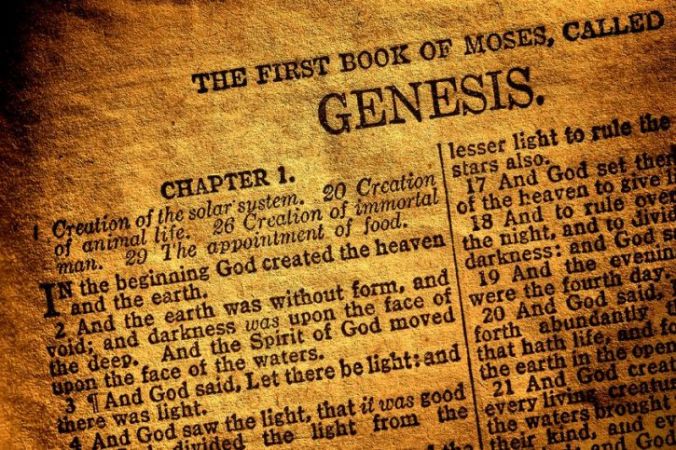
The book of Genesis addresses the roots or origin of all things except God. If you are curious about the first time things happened in our collective human history, then Genesis is the place to look. Among the many firsts recorded in Genesis are references to the first man and woman, the first sin, the first sabbath, the first sacrifice, the first murder, the first global catastrophe, the first cities, the first languages, and more.

An important first in the book of Genesis is the protoevangelium or the first mention of God’s plan to send a Messiah to redeem sinful humanity (see Gen. 3:15). The first eleven chapters of the book address the bigger picture happenings like creation, the fall, the flood, and the spread of the nations. However, the remaining chapters of the book address God’s dealings with a man named Abraham and his descendants. God used Abraham and his family to ultimately fulfill His promise in the protoevangelium.

BACKGROUND

Author — Moses is regarded as the human author of Genesis and the four books that follow. These first five books of the Bible are called the Pentateuch, a Greek term that means five scrolls. These books are also called the Torah, from a Hebrew term meaning law, teaching, or instruction. Although there are direct and indirect references to Mosaic authorship of the Pentateuch throughout the Old and New Testaments, the name of the author is not explicitly stated in any of these books. Jesus, for example, said that Moses had written about Him (see John 5:46). He also used the expression “the Law of Moses” (Luke 24:44) to refer to the Pentateuch.

Theme — The theme of Genesis is God’s choice of Abraham — the man whose descendants became the nation through whom God would bless all other nations. Jesus Christ, the promised Messiah, was a descendant of Abraham. The story of God’s plan to redeem fallen humanity begins in Genesis and unfolds through the remaining books of the Bible. Genesis provides the context and perspective for understanding the scope of God’s redemptive plan.

Date — A key word in the book of Genesis is “generations.” Genesis is, essentially, a book of biographies or a record of the roots of the human family. The phrase “these are the generations of” is used to introduce all of the major divisions of the book. The first eleven chapters of Genesis tell the story of God’s dealings with humanity in general. These chapters cover a time span of approximately 2,000 years, from 4000 to 2090 BC. Starting in the twelfth chapter, however, Genesis traces the story of God’s interaction with one family — Abraham and his descendants Isaac, Jacob, and Joseph. These remaining chapters cover a time period of approximately 300 years, from 2090 to 1804 BC.

KEY MESSAGES/THEMES

As you study the book of Genesis, look for the following key themes.

God created humans in His image therefore all human life is sacred. From the start, the Bible affirms the dignity and worth of all human beings.

Sin is the most destructive force in the universe. Once sin entered into the world, everything changed and sin put mankind at enmity with God.

God judges sin and offers opportunities for a fresh start. God is holy and holds human beings responsible for their choices. God is also merciful and kind and offers people the opportunity to make new beginnings.

God established important covenants with humanity in general and one man in particular. God promised humanity that He would never again destroy the earth with flood waters and promised Abraham that his descendants would be as numerous as the stars.

God is trustworthy, even when things look bleak. From an altar on a mountain in the land of Moriah to a man in search of a wife to a pit in the desert sands to a famine that threatened to destroy His people, God consistently proved Himself trustworthy.

Esther 8

Esther 8:11-13


8:11 [Haman’s earlier decree made in the king’s name remained in force because Persian laws were permanently binding (cf. 1:19), so the king allowed Mordecai (promoted to position of prime minister) to issue a decree that would offset the earlier decree] The king’s edict granted the Jews in every city the right to assemble and protect themselves; to destroy, kill and annihilate any armed force of any nationality or province that might attack them [the Jews were authorized to defend themselves from attackers, including Persians] and their women and children; and to plunder the property of their enemies.

8:12 The day appointed for the Jews to do this in all the provinces of King Xerxes was the thirteenth day of the twelfth month, the month of Adar [corresponds to our mid-February to mid-March].

8:13 A copy of the text of the edict was to be issued as law in every province and made known to the people of every nationality so that the Jews would be ready on that day to avenge themselves on their enemies.

Esther 8:16
8:16 For the Jews it was a time of happiness and joy, gladness and honor [Feast of Purim celebrated to commemorate their deliverance from Haman and his plan to exterminate them (cf. 9:20-22); this festival often includes a reenactment of the story of Esther; Purim comes from the Akkadian word for “lots” (used by Haman to determine the best day for the Jews destruction; cf. 3:7)].

Esther 7

Esther 7:1-3


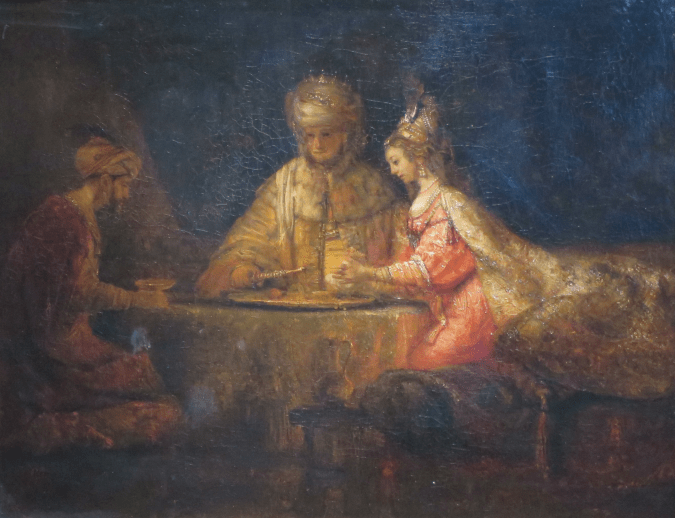
7:1 So the king and Haman went to dine [Esther used a banquet as the setting in which to tell the king of Haman’s plan to destroy her people] with Queen Esther,

7:2 and as they were drinking wine on that second day, the king again asked, “Queen Esther, what is your petition? It will be given you. What is your request? Even up to half the kingdom [an indication of how much the king loved Esther], it will be granted.”

7:3 Then Queen Esther answered [Esther did not hesitate any longer but seized the moment], “If I have found favor with you, O king, and if it pleases your majesty, grant me my life—this is my petition. And spare my people—this is my request [Esther explained to the king that Haman had targeted her people for annihilation].

Note: Paul wrote of redeeming the time (Gr. “kairos”) in Ephesians 5:16. The Greeks had two words for time. Chronos refers to ongoing time (clock and calendar kind of time). Kairos refers to seizing opportunities or special moments.

Esther 4

Esther 4:13-17
4:13 he sent back this answer: “Do not think that because you are in the king’s house you alone of all the Jews will escape.

4:14 For if you remain silent at this time, relief and deliverance for the Jews will arise from another place [a reminder that no one is indispensable to God’s purpose and kingdom], but you and your father’s family will perish [because of Haman’s plot]. And who knows but that you [a Jewish orphan who had become queen of Persia at a time when her people faced annihilation] have come to royal position [election is for service and not merely for one’s own benefit] for such a time as this [Esther was the key in God’s plan to save the Jews from Haman’s evil scheme]?”

4:15 Then Esther sent this reply to Mordecai:

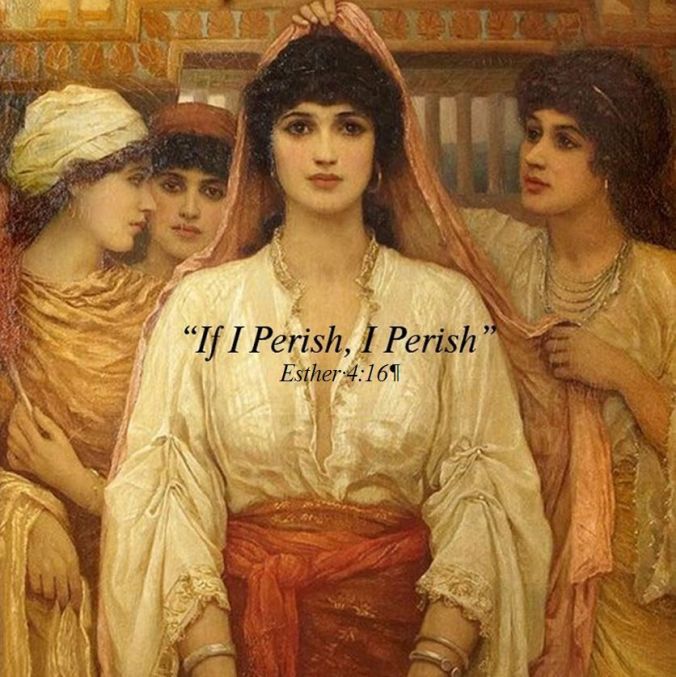
4:16 “Go, gather together all the Jews who are in Susa, and fast for me. Do not eat or drink for three days [this would allow them to focus their attention on their prayers for Esther and her success when she went into the king’s presence], night or day. I and my maids will fast [a way of expressing deep grief] as you do. When this is done, I will go to the king, even though it is against the law. And if I perish, I perish [illustrates Esther’s commitment to follow-through regardless of what happened to her].”

4:17 So Mordecai went away and carried out all of Esther’s instructions [re: organizing the fast].

Esther 3

Esther 3:5-6


3:5 When Haman [an Amalekite (longtime enemies of Israel that started when Israel fought with them in the wilderness; cf. Ex. 17:8-16; Deut. 25:17-19); promoted to second highest rank in Ahasuerus’ kingdom] saw that Mordecai would not kneel down [when he passed by] or pay him honor [as commanded by the king (cf. 3:2); Mordecai refused to bow before anyone other than God], he was enraged.

3:6 Yet having learned who Mordecai’s people [the Jews] were, he scorned the idea of killing only Mordecai. Instead Haman looked for a way to destroy [genocide] all Mordecai’s people, the Jews, throughout the whole kingdom of Xerxes [same person as Ahasuerus; reigned from 486-464 BC; son of Darius the Great and grandson of Cyrus the Great].

Esther 2

Esther 2:7
2:7 Mordecai [a Jew from the tribe of Benjamin who lived in Susa, the winter location for the Persian King Ahasuerus’ palace; Mordecai exiled in Persia] had a cousin named Hadassah [name means “myrtle”], whom he had brought up [Mordecai was her legal guardian] because she had neither father nor mother. This girl, who was also known as Esther [name means “star”], was lovely in form and features, and Mordecai had taken her as his own daughter when her father and mother died.

Esther 2:17
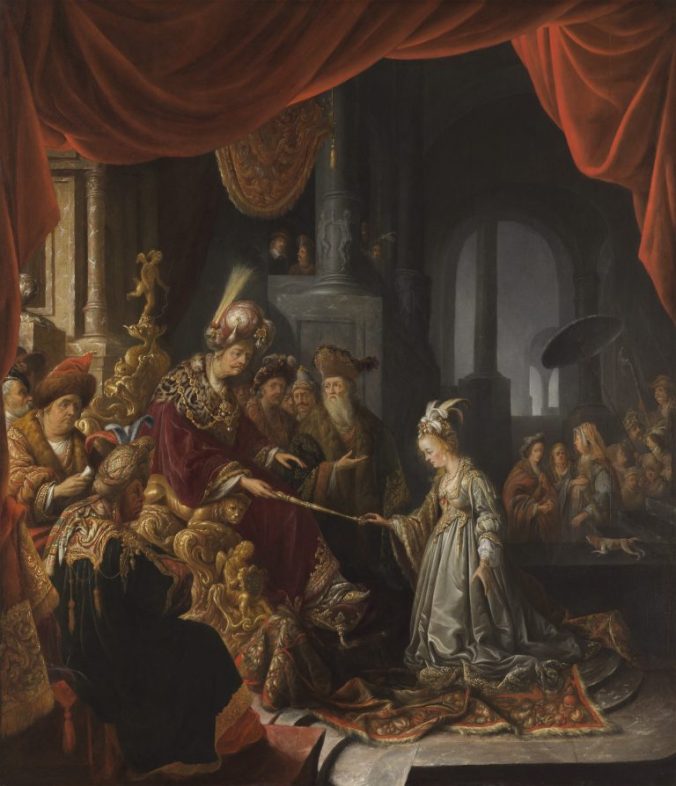
2:17 Now the king was attracted to Esther [underwent a beauty treatment along with the other virgins (cf. 2:3,9,12)] more than to any of the other women [the virgins who appeared before him in his search for a new queen], and she won his favor and approval more than any of the other virgins. So he set a royal crown on her head and made her queen instead of Vashti [removed as queen because she refused to display her physical beauty before her husband’s drunken dinner guests (cf. 1:12)].

Introduction to Song of Songs

We live in a culture that needs clear answers about the relationship between love and sex. Song of Songs answers questions about the limits and joys of appropriately expressing human love.

Contents — Song of Songs is a collection of love songs or poems that tastefully portray the genuine love between a man and a woman in marriage. Some scholars see the book as a picture of Christ’s love for the church.

Purpose — The book describes love between a man and a woman as God intended it to be.

Themes — The book celebrates the beauty of sexual love and emphasizes the importance of a man and woman finding mutual satisfaction exclusively in the marriage relationship.

Writer and Date — The authorship of the book is traditionally ascribed to Solomon, whose name appears several times in the book, and was probably written in the tenth century BC.

Introduction to Ecclesiastes

As a result of feverishly pursuing the things that make life pleasurable and comfortable, many people are left feeling dry and thirsting for something more. Ecclesiastes maps the routes that Solomon explored while searching for the meaning of life under the sun. Ecclesiastes can help us to chart a course past dead-end routes to the source of life’s true meaning.

Contents — Ecclesiastes examines and questions a variety of efforts to find fulfillment in life apart from God. The book cautions against searching for life’s meaning in the accumulation of things, in the pursuit of human wisdom, and in pleasurable experiences. The book concludes with the practical instruction to trust and obey God.

Purpose — Ecclesiastes is Solomon’s candid journal of his experiments with various pleasures, possessions, power, and knowledge in an effort to find the meaning of life under the sun. When he summed up the total of his findings, Solomon concluded that life apart from God had no meaning.

Themes — The theme of Ecclesiastes appears in the prologue, “Everything is futile” (1:2), and moves toward the conclusion in the epilogue, “Fear God and keep His commands” (12:13). The discourses between these verses lead to the conclusion that life’s ultimate meaning is not found under the sun (where “everything is futile”), but above or beyond the sun (in God).

Writer and Date — The absence of the writer’s name in Ecclesiastes has led scholars to debate its authorship. Assuming, however, that Solomon was the author, Ecclesiastes was written in the tenth century B.C.

Introduction to Job

People take all kinds of measures to build hedges around their lives to keep suffering and pain at bay. And yet, often without warning, suffering and pain intrude—and life is never the same again. Their arrival prompts a search for answers to renew hope and strengthen resolve to go on. The book of Job offers wisdom to navigate the dark and perplexing territory of human suffering and pain.

Contents — The first two chapters present the problem of evil and describe Satan’s assault on Job. Chapters three to thirty-seven contain three cycles of speeches in which Job’s friends misrepresented God by claiming to know why Job was suffering and by thinking that they knew why and how God does what He does. The final chapters present Job’s humbling encounter with God and the restoration of his fortunes.

Purpose — The book explores the mystery of human suffering and the question of divine justice. The Bible teaches that no one sins with impunity and that trust and obedience to God are rewarded. Job, however, does not fit neatly into that pattern. A pious and upright man, Job was buffeted by waves of indescribable suffering. His friends erroneously concluded that he was being punished for some terrible sin. The book challenges the notion that all suffering is caused by sin and suggests that God may have other purposes for suffering.

Themes — The opening chapters introduce the theme of why one serves God. Satan contended that people like Job serve God because of God’s blessings and not because of God Himself. The theme of undeserved and unexplained suffering is introduced when God allowed Satan to unleash his fury against Job and his family. The book also explores the theme of God’s sovereignty.

Writer and Date — The Scripture does not supply the answer to the authorship of Job. Although the book offers few indications of its date, some scholars believe it was written either prior to or in the days of the patriarchs because of the absence of any clear reference to any known historical event.