1 Samuel 17

17:1 Now the Philistines [enemies of Saul throughout his reign] gathered their forces for war [this would become the occasion and setting in which David’s courage and faith would be demonstrated] and assembled at Socoh in Judah. They pitched camp at Ephes Dammim, between Socoh and Azekah [two towns in the foothills of western Judah].

17:2 Saul and the Israelites assembled and camped in the Valley of Elah [approximately 15 miles west of Bethlehem] and drew up their battle line to meet the Philistines.

17:3 The Philistines occupied one hill and the Israelites another, with the [fertile] valley between them.

17:4 A champion named Goliath, who was from Gath [a town located 5 miles west of Azekah], came out of the Philistine camp. He was over nine feet tall.

Note: The Philistines cleverly used Goliath to wage psychological warfare against the Israelites.

17:5 He had a bronze helmet on his head and wore a coat of scale armor of bronze weighing five thousand shekels [about 125 pounds];

17:6 on his legs he wore bronze greaves [protected the legs below the knees], and a bronze javelin was slung on his back.

17:7 His spear shaft was like a weaver’s rod, and its iron point weighed six hundred shekels [about 15 pounds]. His shield bearer went ahead of him.

17:8 Goliath stood [appearing invincible with his armor] and shouted to the ranks of Israel [a form of psychological warfare], “Why do you come out and line up for battle? Am I not a Philistine, and are you not the servants of Saul? Choose a man and have him come down to me.

The story of David and Goliath is a favorite among children and adults alike. This story of a shepherd boy’s courage in the face of incredible odds has captured the imaginations of generations of Bible readers. The setting for the story is the Valley of Elah (17:2), located west of David’s hometown of Bethlehem.

The Philistines, enemies of King Saul throughout his reign, assembled for war on a hilltop overlooking the Valley of Elah. Saul and the Israelites occupied a hill on the opposite side of the valley (17:3). From these hilltop vantage points the Philistine and Israelite armies took inventory of one another.

The Philistine and Israelite armies seemed equally matched until the Philistines introduced their secret weapon — a man named Goliath who stood “over nine feet tall” (17:4). The Philistines cleverly used Goliath to wage psychological warfare against the Israelites. Goliath’s heavy bronze armor and oversized weapons made him appear invincible (17:5-7).

Towering above his countrymen, Goliath stood and shouted to the ranks of Israel (v. 8). He challenged the cowering Israelite army to send a champion against him in a one-on-one, winner-take-all fight to the death (17:9-10). The arrogant giant was confident he could defeat any man sent to fight against him.

17:9 If he is able to fight and kill me, we will become your subjects; but if I overcome him and kill him, you will become our subjects and serve us. [this one-on-one contest was proposed to avoid an all-out battle]

17:10 Then the Philistine said, “This day I defy [confront, challenge, dare] the ranks of Israel! Give me a man and let us fight each other.”

17:11 On hearing the Philistine’s words, Saul and all the Israelites were dismayed and terrified.

Note: Whose words cause you to become dismayed or terrified?

17:12 Now David was the son of an Ephrathite named Jesse, who was from Bethlehem in Judah. Jesse had eight sons, and in Saul’s time he was old and well advanced in years.

17:13 Jesse’s three oldest sons had followed Saul to the war: The firstborn was Eliab; the second, Abinadab; and the third, Shammah.

17:14 David was the youngest. The three oldest followed Saul,

17:15 but David went back and forth from Saul to tend his father’s sheep at Bethlehem.

17:16 For forty days the Philistine came forward every morning and evening [a reminder that the giants keep coming] and took his stand [cf. Ps. 2:2].

Goliath continued his defiant challenge twice a day for forty days (17:16), but no Israelite dared to answer that challenge. Goliath’s repeated insults had a demoralizing impact on the Israelite army. His thundering voice and imposing presence struck fear in the hearts of the Israelites (17:11,24).

Even Saul, who was “a head taller” than his own countrymen (9:2; 10:23), was afraid to face the giant. Instead, he offered generous incentives to any man brave enough to face and kill Goliath (17:25) — an offer no man was willing to take.

Saul and his men were immobilized by fear. No man dared to put on his armor or draw his sword. No man dared to descend from the relative security of the hill to face Goliath in the valley below.

17:17 Now Jesse said to his son David, “Take [supplementary provisions] this ephah of roasted grain and these ten loaves of bread for your brothers and hurry [emphasizes Jeese’s concern for the well-being and safety of his sons] to their camp.

17:18 Take along these ten cheeses to the commander of their unit [perhaps to insure that the provisions would be allowed to reach Jeese’s sons]. See how your brothers are and bring back some assurance from them.

17:19 They are with Saul and all the men of Israel in the Valley of Elah, fighting against the Philistines.”

17:20 Early in the morning David left [note the word “left” which indicates the start of David’s journey out of obscurity] the flock with a shepherd, loaded up and set out, as Jesse had directed. He reached the camp as the army was going out to its battle positions, shouting the war cry.

17:21 Israel and the Philistines were drawing up their lines facing each other.

17:22 David left [once again, David “left” that which represented previous responsibilities] his things with the keeper of supplies, ran to the battle lines and greeted his brothers.

17:23 As he was talking with them, Goliath, the Philistine champion from Gath, stepped out from his lines and shouted his usual defiance, and David heard it [and then caught his first glimpse of the defiant giant].

Note: What “Goliaths” are you facing in your life?

17:24 When the Israelites saw the man, they all ran from him [cf. v. 48] in great fear [Israelite morale was low; the psychological warfare strategy of the Philistine army proved to be effective].

Note: Do you scurry for cover when others verbally assault your faith?

17:25 Now the Israelites had been saying [words of resignation], “Do you see how this man [as opposed to David’s “this uncircumcised Philistine” in v. 26] keeps coming out? He comes out to defy Israel [cf. David’s remarks in v. 26]. The king will give [incentives] great wealth to the man [note Saul’s unwillingness to face the giant] who kills him. He will also give him his daughter in marriage and will exempt his father’s family from taxes in Israel.”

17:26 David asked [words of indignation] the men standing near him, “What will be done for the man who kills this Philistine and removes this disgrace from Israel? Who is this uncircumcised Philistine [as opposed to “this man” in v. 25] that he should defy the armies of the living God? [David knew that God is bigger than Goliath]

All seemed hopeless for Saul and his men until Jesse sent his youngest son with supplementary provisions for his older brothers (17:12-19). Soon after David arrived at Saul’s camp, Goliath stepped out from the Philistine ranks and darkened the horizon (17:20-23). Morale was so low among the Israelites that they “ran from him in great fear” (17:24).

David heard Goliath’s insults and understood that to insult the army of the living God was to insult God Himself (17:26). The young shepherd boy wondered why no man was willing to face the arrogant and defiant “uncircumcised Philistine” (17:26).

Goliath was not the first and certainly not the last person to oppose God’s people or God’s way. Christianity faces increasing opposition in today’s world. Many adults are hesitant to talk openly of their faith or to base decisions on their Christian worldview for fear of reprisal from powerful persons or organizations.

Some adults lack confidence in their ability to confront appropriately those who oppose God’s way. Others are fearful that if their stand for God proves costly, God may not help them in ways they want. We must not allow our fears to keep us from standing faithfully with God. Standing firm in the face of opposition honors God. And God honors those who stand firm for Him. Don’t let fear defeat you.

Note: “We see things not as they are but as we are.” (John Maxwell)

17:27 They repeated to him what they had been saying and told him, “This is what will be done for the man who kills him.”

17:28 When Eliab, David’s oldest brother, heard him speaking with the men, he burned with anger at him [did not support David] and asked, “Why have you come down here? And with whom did you leave those few sheep in the desert? I know how conceited you are and how wicked your heart is; you came down only to watch the battle. [note: expect opposition when you attempt to do something great for God]

17:29 “Now [this word indicates these brothers might have been at odds before] what have I done?” said David [respectfully but firmly]. “Can’t I even speak? [David stayed focused on the real enemy]

17:30 He then turned away to someone else and brought up the same matter, and the men answered him as before.

17:31 What David said was overheard and reported to Saul, and Saul sent for him.

17:32 David [knowing the Lord was on his side] said to Saul, “Let no one lose heart [become discouraged] on account of this [Goliath] Philistine [Philistines were enemies of Saul throughout his reign]; your servant [David already in Saul’s service (cf. 1 Sam. 16:21)] will [voluntarily] go and fight him [what others were unwilling to do].”

The Philistine strategy to wage psychological warfare against the Israelites proved to be effective. Goliath’s imposing presence made the Israelites feel small and weak. His thundering verbal volleys sent Saul and his men scurrying for cover. Their weapons seemed small and useless in the face of such opposition.

Those who oppose God’s way still employ psychological warfare today. Many believers allow themselves to be easily intimidated by those who oppose God’s way. Rather than take a stand for their convictions, some believers scurry for cover at the first sign of trouble. Others choose to remain silent rather than respond to verbal assaults on the faith.

The cowardly behavior of Saul and his men puzzled the young shepherd boy who had come to visit his brothers. When David asked those around him for an explanation, he received the same answer from every one he asked (17:26-30). No one was willing to face the giant.

However, someone who heard David’s courageous words “reported to Saul, and Saul sent for him” (17:31). David was immediately ushered into Saul’s presence. The handsome young shepherd boy stood confidently before Israel’s king and volunteered to do what no man in Saul’s army was willing to do — fight Goliath (v. 32).

17:33 Saul replied [stated the obvious], “You [physically small in comparison to Goliath] are not able [because of size and inexperience as a warrior] to go out against this Philistine and fight him; you are only a boy [cf. 1 Sam. 16:7], and he has been a fighting man from [indicates Goliath was an experienced warrior] his youth.”

17:34 But David [remembering past victories achieved with God’s help] said to Saul, “Your servant has been keeping his father’s sheep. When a lion or a bear came and carried off a sheep from the flock,

Note: God prepares us for what He has prepared for us.

17:35 I went after [David did not passively accept the loss of a sheep] it, struck it and rescued the sheep from its mouth. When it turned on me, I seized it by its hair, struck it and killed it.

17:36 Your servant has killed both the lion and the bear [little Did David realize how those experiences would prepare him to face Goliath; perhaps these feats were accomplished with his sling or with his shepherd’s crook (crude weapons at best); lion and bear were threats to David and his sheep]; this uncircumcised Philistine [a threat to God’s people] will be like one of them [on the same level as a wild animal], because he has defied the armies of the living God [David was prepared the kill the predator threatening the flock of God].

17:37 The Lord [the source of David’s courage] who delivered me [indication of David’s humility; he did not boast about his gallantry or prowess] from the paw of the lion and the paw of the bear will [indicates David’s ongoing confidence and faith in God] deliver me [see Rom. 8:31] from the hand of this Philistine [David prepared to fight giants in the solitude of the sheep pens].” Saul [who was a head taller than any other Israelite (1 Sam. 9:2)] said [David’s examples impressed and convinced Saul that God was with David] to David [fate of the kingdom depended on this young man], “Go, and [prayer for protection and success] the Lord be with you.”

Saul protested that David was not qualified to fight the experienced giant because he was only an inexperienced boy (v. 33). David however, related to Saul the accounts of his victories over a lion and a bear that had threatened his father’s flock (17:34-36). God had used these past encounters to prepare David for greater battles in the future.

Remembering past victories can fortify our faith and give us the courage to face present challenges. David was confident God would give him victory over Goliath, the predator threatening God’s flock (v. 37).

Perhaps relieved that he did not have to face the giant, Saul said to David, “Go, and the Lord be with you” (v. 37).

17:38 Then Saul dressed David in his own tunic. He put a coat of armor on him and a bronze helmet on his head.

17:39 David fastened on his sword over the tunic and tried walking around, because he was not used to them. “I cannot go in these [we cannot meet our Goliath’s in someone else’s strength],” he said to Saul, “because I am not used to them.” So he took them off [David trusted in God rather than in armor: see v. 45].

17:40 Then he took his staff in his hand, chose five smooth stones from the stream, put them in the pouch of his shepherd’s bag and, with his sling in his hand, approached the Philistine [fighting giants can be a lonely experience].

Saul tried unsuccessfully to dress David in his own armor (17:38-39). David chose to place his trust in God rather than in the king’s armor. Someone observed that we cannot meet our Goliath’s in somebody else’s armor.

As David walked to the battle field, he paused to select five smooth stones from a stream (17:40). Armed only with these stones and his sling, he walked on to the field of battle to face Goliath. The Philistine and Israelite soldiers watched from the hilltops as the courageous boy and the arrogant giant walked toward each other in the valley below.

Christians in many parts of our world live in the face of intimidating opposition every day. Many are ridiculed, bullied, and threatened by those who oppose God’s way. Some pay the ultimate price for standing for God — death.

I met a 78 year-old believer in a remote area of India who had experienced a lifetime of opposition because of his belief in God. He had endured much hardship through the years. He understood that God does not always deliver His people out of difficulties caused by those who oppose God’s way. However, he testified to the fact that God’s help is sure and that God delivers His people through their trials. This dear and faithful man understood the importance of depending on God’s help. We too, can count on God to help us when facing those opposed to His ways.

Note: Name “five smooth stones” God has made available for you to use in battle against your giants.

17:41 Meanwhile, the Philistine, with his shield bearer in front of him, kept coming closer to David [with the eyes of those on the hilltops riveted on the combatants on the valley floor].

17:42 He looked David over and saw that he was only a boy, ruddy and handsome, and he despised him.

17:43 He said to David, “Am I a dog, that you come at me with sticks?” And the Philistine [insulted that a boy was sent to face him on the battle field] cursed David by his gods.

17:44 “Come here,” he said [threatened to kill David and make certain he did not receive a decent burial], “and I’ll give your flesh to the birds of the air and the beasts of the field! [see Prov. 16:18]

17:45 David said [David’s words were full of trust in God to whom he ascribed the triumph he anticipated] to the Philistine, “You [bring the weapons of your realm] come against me with sword and spear and javelin, but I [bring the weapons of God’s realm] come against you in the name of the Lord Almighty, the God of the armies of Israel [cf. Ex. 14:14; 15:3 re: God as a warrior], whom you have defied [blasphemed: punishable by stoning as per Lev. 24:16].

Note: Our behavior in the valley can encourage those watching from the hilltops to put their faith into action by standing courageously for God.

17:46 [David prophesied the destruction of the Philistines] This day the Lord will hand you over to me, and I’ll strike you down and cut off your head. Today I will give the carcasses of the Philistine army to the birds of the air and the beasts of the earth, and [purpose of victory] the whole world will know that there is a God in Israel.

17:47 All those gathered here will know that it is not by sword or spear [Saul earlier had indicated that victory was dependent on the skillful use of these kinds of weapons (17:33)] that the Lord saves; for the battle is the Lord’s, and he will give all of you into our hands.”

Fighting giants can be a lonely experience. As the Israelites watched from the hilltops they followed the solitary figure of the shepherd boy in the valley below. How absurd it must have seemed to them to send a boy into the valley to face the giant warrior alone. Yet in the Valley of Elah and in other valleys throughout the centuries, solitary figures have stood courageously for God.

Countless men and women through the centuries have descended into the valley between the hilltops of truth and error to fight for God’s truth. Others have sustained the blows of ridicule and rejection from those opposed to God’s way. Still others have given their lives while holding fast to the confession “Jesus is Lord.”

As Goliath approached David, he noticed that “he was only a boy…and he despised him” (17:42). The giant warrior “cursed David by his gods” (17:43) and boasted of what he would do with the boy’s dead body (17:44).

David was not fazed by Goliath’s curses and threats. He told Goliath that he was coming against him in the name of the Lord Almighty (v. 45), not with the kinds of weapons Goliath employed. David declared his faith that God would help him defeat Goliath, and the victory would be a witness of God’s presence and power among His people (v. 46-47).

17:48 As the Philistine moved closer to attack him, David ran quickly toward [cf. v. 24; motivated by great zeal for God] the battle line to meet him.
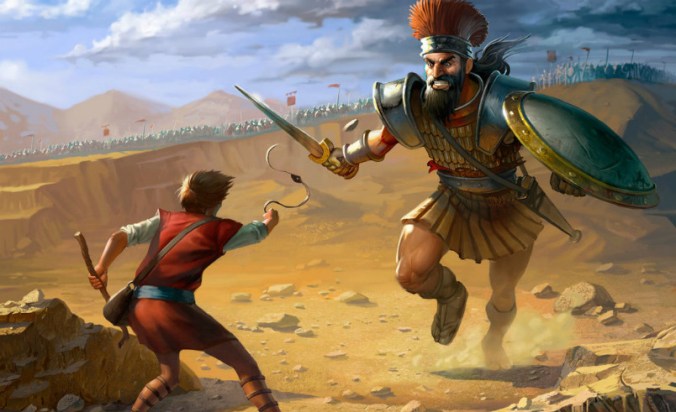
17:49 Reaching into his bag and taking out a stone [God achieved victory by weak means], he slung it and struck the Philistine on the forehead [area not covered by his helmet]. The stone sank into his forehead, and he fell facedown on the ground.

17:50 So David triumphed over the Philistine with a sling and a stone [see Judg. 20:16]; without a sword in his hand he struck down the Philistine and killed him.

17:51 David ran and stood over him. He took hold of the Philistine’s sword and drew it from the scabbard. After he killed him, he cut off his head with the sword. When the Philistines saw that their hero was dead, they turned and ran [Goliath’s death resulted in panic in the Philistine ranks].

17:52 Then [inspired by David’s courage and victory] the men of Israel and Judah surged forward with a shout and pursued the Philistines to the entrance of Gath [Goliath’s hometown (17:4)] and to the gates of Ekron. Their dead were strewn along the Shaaraim road [more than ten miles of road] to Gath and Ekron.

17:53 When the Israelites returned from chasing the Philistines, they plundered their camp.

Fighting shepherd boys can be a hazardous experience. David “ran quickly toward the battle line” (17:48) to meet Goliath. As their respective armies watched the scene, David reached into his bag and armed his sling with a stone. David skillfully released the stone from his sling and struck Goliath in the forehead. The impact of the stone stopped the giant in his tracks and “he fell facedown on the ground” (17:49).

In a matter of minutes the battle was over. The faith of the shepherd boy triumphed over the pride of the giant (v. 50). Goliath’s death resulted in panic in the Philistine ranks (v. 51) and paved the way for victory for the Israelite army (vv. 52-53).

From the moment David saw Goliath and heard his defiant threats, he acted in ways that honored God. He did not run in fear and hide like others. He did not acquiesce to Goliath’s threats. He did not try to fight the battle in another’s armor. He did not volunteer to fight Goliath to advance selfish or self-righteous aims.

David simply exercised his faith in God and put that faith into action by facing Goliath. David’s faith honored God and God honored David’s faith by giving him victory in battle. We too, must act in ways that honor God when facing opposition. Our behavior in the valley can encourage those watching from the hilltops to put their faith into action by standing courageously for God.

17:54 David took the Philistine’s head and brought it to Jerusalem, and he put the Philistine’s weapons [refer to 1 Sam. 21:9] in his own tent [perhaps Goliath’s tent which David claimed by right of victory].

17:55 As Saul watched David going out to meet the Philistine, he said to Abner [Saul’s cousin; 14:50-51], commander of the army, “Abner, whose son is that young man?” Abner replied, “As surely as you live, O king, I don’t know.”

17:56 The king said, “Find out whose son this young man is.”

17:57 As soon as David returned from killing the Philistine, Abner took him and brought him before Saul, with David still holding the Philistine’s head.

17:58 “Whose son are you, young man?” Saul asked him. David said, “I am the son of your servant Jesse of Bethlehem.”

Practical Consideration: How can you stand courageously for God when others oppose God’s way?
Refuse to be intimidated by the giants who oppose God (1 Sam. 17:11).
Remember that God is bigger than any giant you will ever face. Don’t lose perspective (1 Sam. 17:26).
Recall God’s past victories. Doing so can fortify your faith and give you courage to face present challenges (1 Sam. 17:34-36).
Remove anything that will hinder you or rob you of effectiveness (1 Sam 17:39).
Rely on God and His strength in the battle (1 Sam 17:45-47).
Rejoice in the victory only God can give (1 Sam. 17:50).
1 Samuel 16

1 Samuel 16:1-13
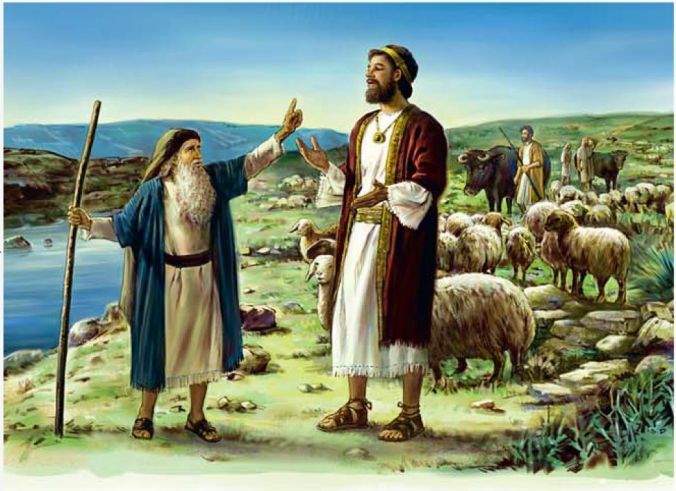
16:1 The Lord said to Samuel [Israel’s first prophet (1 Sam. 3:20-21) and last judge (1 Sam. 7:15)], “How long [a prophetic rebuke] will you mourn [see 15:35] for Saul [perhaps over his loss of the kingdom, his disobedience, or for him personally], since I have rejected him as king over Israel [see 1 Sam. 15:26]? Fill your horn with oil [read Ex. 30:22-25 regarding preparation of anointing oil] and be on your way; I am sending you to Jesse [of the tribe of Judah; see Ruth 4:12, 18-22] of Bethlehem [his hometown in Judah]. I have chosen [seen; Saul was the people’s choice; David was God’s choice; 1 Sam. 13:14] one of his sons to be king [see Ps. 75:6-7].”

David is one of the most remarkable and best known characters in the Bible. He is instantly known as the boy who slew the giant (1 Sam. 17) and the man who was felled by his own lust (2 Sam. 11). He also bears the unique distinction of being known as the man after God’s own heart (see 1 Sam. 13:14; Acts 13:22).

The Bible frankly records more information about David’s life than that of any other scriptural character. The details of David’s life are preserved in the pages of Samuel and Chronicles. The testimony of his deep love for God is safeguarded in the treasury of his psalms. David’s life and legacy should inspire us to love and willingly serve God.

David was the youngest of Jesse’s sons and responsible for tending his father’s sheep. He spent many days and nights watching over his father’s flock in lonely desert places. On more than one occasion David acted decisively and courageously to protect the sheep from danger (see 1 Sam. 17:34-36). He also cultivated an intimate relationship with God that found expression in many beautiful psalms.

Someone wisely observed that God prepares us for what He has prepared for us. God had a plan for David’s life. David’s experiences as a shepherd boy helped to prepare him to face the challenges of shepherding a nation (see Ps. 78:70-72). Perhaps you have wondered if God has a plan for your life. God may not call you to lead a nation like He did David, but He nevertheless has expectations and plans for you to serve Him.

God’s plan for David’s life began to unfold when God commanded Samuel to visit David’s hometown (v. 1). Years earlier, Samuel had reluctantly anointed Saul as Israel’s first king. However, because of his acts of disobedience, God eventually rejected Saul as king over Israel (15:23). After mourning for Saul (15:35; 16:1), God instructed Samuel to fill his horn with oil and go to Jesse of Bethlehem (v. 1). God had chosen one of Jesse’s sons to be Israel’s new king (see Ps. 75:6-7). Samuel would soon meet the shepherd boy who is first described in Scripture as a man after God’s own heart (13:14).


God has a plan for your life. His plan includes that you serve Him regardless of your vocation. Perhaps you feel unqualified or unskilled to serve the Lord. Maybe you don’t know how or in what capacity to serve Him. Determine to seek God’s plan for your life. Ask your pastor to suggest ways in which you can serve the Lord. Be willing to serve God even in the small things or behind the scenes. Like David, you may discover that God has been preparing you for a special place of service.

16:2 But Samuel [understandably afraid] said, “How can I go [Samuel wanted to know how he might anoint David without attracting attention]? Saul will hear about it and kill me.” The Lord said, “Take a heifer with you and say, ‘I have come to sacrifice [presumably a fellowship offering; cf. Lev. 3:1] to the Lord.’

16:3 Invite Jesse to the sacrifice, and I [emphatic] will show you what to do. You are to anoint for me the one I indicate [see Deut. 17:15].”

16:4 Samuel [obediently] did what the Lord said. When he arrived at Bethlehem, the elders of the town trembled [quaked with fear] when they met him [perhaps because they had heard about the recent execution of Agag, the Amalekite king (see 15:33) or because they thought he had come to punish some wrong or sin]. They asked, “Do you come in peace?”

16:5 Samuel [reassuringly] replied, “Yes, in peace; I have come to sacrifice to the Lord. Consecrate yourselves and come to the sacrifice with me.” Then he consecrated [ceremonial cleansing often accompanied by putting on fresh garments to heighten the symbolism; see Gen. 35:2-3; Ex. 19:10-14] Jesse and his sons and invited them to the sacrifice.

Samuel did as the Lord instructed him and journeyed to Bethlehem. When Samuel arrived at Bethlehem, “the elders of the town trembled when they met him” (16:4). Perhaps they feared the renowned prophet had come to punish some wrong or sin. Samuel reassured the concerned elders that he had come peacefully “to sacrifice to the Lord.” The prophet then “consecrated Jesse and his sons and invited them to the sacrifice.” The process of consecration probably involved ceremonial cleansing and putting on clean garments (see Gen. 35:2-3; Ex. 19:10,22).

16:6 When they arrived, Samuel saw Eliab [David’s oldest brother (17:28); name means: “My God Is Father”] and thought [surely this guy is “king material”], “Surely the Lord’s anointed stands here before [in the presence of] the Lord.”

Samuel was eager to begin the process of selecting and anointing Israel’s next king. When he saw Eliab, Jesse’s oldest son, Samuel decided he surely was the Lord’s choice for king (v. 6). Eliab, a soldier in Saul’s army (17:13), made an immediate impression on Samuel because of his outward appearance. Samuel must have thought, “This guy is definitely king material, after all, he certainly does have kingly features!” Perhaps Eliab was ruggedly handsome or a tall individual like King Saul (see 10:23). Eliab’s impressive outward appearance almost caused Samuel to make a serious mistake.

16:7 But the Lord said to Samuel, “Do not consider his appearance or his height [as in case of Saul; 1 Sam. 9:2], for I have rejected [as a choice for king, not as an individual] him. The Lord does not look at the things man looks at [people are usually deceived by what their eyes tell them]. Man looks at the outward appearance, but the Lord looks at the heart [godliness, attitude, character].”

The Lord told Samuel that Eliab was not His choice for king (v. 7). He cautioned Samuel about selecting leaders based merely on outward appearance or height (v. 7). Like Samuel, we too can be easily deceived by what our eyes tell us.

Our society places considerable importance on physical attractiveness. From infancy, we are saturated with images and messages that define the ideal look and dress. We must be careful that we do not make determinations about others based on their outward appearance. We must not allow outward features to overshadow or cause us to overlook important inward qualities.

The Lord told Samuel that, unlike man, He looks at the heart (v. 7). He is able to see what we so easily overlook or fail to see in ourselves and others. An essential element for serving God well is a godly and willing heart. We should not judge our own or other’s capacity to serve God by thinking only of physical appearances or other outward qualities. We must determine to make a godly heart our priority.

16:8 Then Jesse called Abinadab [Jesse’s second oldest son; name means: “My (Divine) Father Is Noble”] and had him pass in front of Samuel. But Samuel said, “The Lord has not chosen this one either.”

16:9 Jesse then had Shammah [Jesse’s third oldest son; name probably means: “Heard by God”] pass by, but Samuel said, “Nor has the Lord chosen this one.”

16:10 Jesse had seven of his sons pass [probably in the order of their birth] before Samuel, but Samuel said to him, “The Lord has not chosen these [God is never ignorant of what we are best suited for].”

God always makes responsible choices that are best for all concerned. The Lord rejected Eliab as a candidate for king but not as an individual. God knows what we are best suited for. God did not see in Eliab’s heart the right stuff to lead a nation. Jesse then called his son Abinadab and had him pass in front of Samuel (v. 8). Abinadab, also a soldier in Saul’s army (17:13), was not chosen by God. Jesse’s third son Shammah, a soldier like his older brothers (17:13), passed in front of the prophet but was not chosen either. Jesse had all of his sons pass before Samuel, but none of them were chosen (v. 10).

16:11 So he asked Jesse [David’s father; a respected elder of Bethlehem], “Are these all the sons you have?” [a probing question; heaven’s purposes often uncover what men overlook]. “There is still the youngest [literally, the smallest; the least in rank, influence, and expectation; God specializes in calling the underestimated; this “nobody” was really a “somebody” in God’s eyes],” Jesse answered. “He is tending the sheep.” [actively shepherding; fulfilling a lowly but necessary responsibility; engaged in unseen labor] Samuel [the prophet speaking with divine authority] said, “Send for him [an immediate and urgent command; no delay; no debate; the overlooked must now be summoned]; we will not sit down [we will not recline; we will not begin the sacrificial meal; we will not proceed with ceremony] until he arrives [until the hidden one is present; until the overlooked son stands in the room].”

Samuel, perhaps a little confused, asked Jesse, Are these all the sons you have? (v. 11). After all, God had told Samuel He had chosen one of Jesse’s sons to be king (16:1). Jesse replied that his youngest (perhaps smallest) son was tending the sheep. No one had thought of calling the youngest family member in from the fields. Perhaps no one thought he possessed any kingly qualities (see 17:28). Samuel instructed Jesse to send for the youngest son. We will not sit down, said the prophet, until he arrives.

16:12 So [at Samuel’s request] he sent and had him brought in [see Ps. 78:70-72]. He was ruddy [red or auburn-haired; handsome with a reddish complexion], with a fine appearance [literally, beautiful eyes] and handsome features [pleasant to look at]. Then the Lord said, “Rise and anoint him; he is the one.”

Jesse immediately sent for his youngest son and had him brought in (v. 12). David had no idea that the journey from the sheep pens to his father’s house would change the course of his life (see Ps. 78:70-72). He had no idea that his heart had attracted the attention of God.

The Bible describes David as having a reddish complexion, beautiful eyes, and handsome features (v. 12). More importantly, God saw in David’s heart the right stuff for the task of ruling a nation.

When Samuel saw David, the Lord said, “Rise and anoint him; he is the one.” The young shepherd boy had proven himself faithful in his service to his father. In the solitude of the sheep pens and grazing areas, David had quietly nurtured his relationship with God. When the time came to anoint a new king, David did not promote himself. Instead, God sought out and promoted the young shepherd boy.

God takes notice of our service. I once heard someone say that those who feel they are too big to do a small job are too small to do a big job. Sometimes God leads us into new kinds of service that involve changes in life direction. Serving God faithfully in present situations is a strong indication that God can count on us to serve well in new kinds of service. Like David, determine to be faithful in your present work. After all, you never know who is going to take notice!

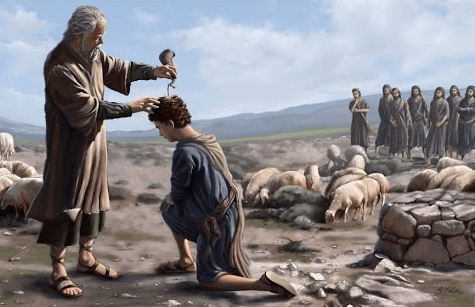
16:13 So Samuel took the horn of oil and anointed [Heb. mashach from which we get our word Messiah] him [oil symbolized anointing with the Holy Spirit] in the presence of his brothers [witnesses], and from that day on the Spirit of the Lord came upon David [first mention of his name in the books of Samuel; name means: “Beloved of the Lord”] in power. Samuel then went to Ramah [and David returned to sheep field].

Samuel waited patiently for Jesse’s youngest son to arrive from the fields. As David approached, Samuel noticed that he was a handsome boy like his older brothers. However, Samuel did not act until the Lord instructed him to do so (v. 12). Only then did the aging prophet take the horn of oil to anoint David in the presence of his brothers (v. 13). The Jewish historian Josephus wrote that Samuel whispered in David’s ear that God had chosen him to be Israel’s next king.

After David was anointed by Samuel, the Spirit of the Lord came upon him in power. David experienced the Spirit’s powerful presence from that day on. God had set David apart to lead a nation. The young shepherd boy would certainly need the power of God’s Spirit to fulfill his responsibilities. Once Samuel anointed David, the prophet returned to Ramah, his hometown. David returned to the sheep fields where he continued to faithfully serve until the insults of a Philistine giant beckoned him out of obscurity into the public arena.


The Holy Spirit is the Person of power. He enables believers today to serve with confidence. The Holy Spirit empowers Billy Graham to stand before thousands to preach the gospel. He also empowers people like you and me to quietly share the gospel with neighbors and friends. The Holy Spirit strengthens missionaries serving in remote areas of the world. He also strengthens believers faithfully serving God through the ministries of their local churches. Every believer can count on the presence and power of the Holy Spirit. But can the Holy Spirit count on our willingness to serve? We can serve God with confidence when we depend upon the power of God’s Holy Spirit.


Note: You Can Serve God Well If You Will Use…
• Your Heart: Cultivate intimacy in your relationship with God by spending time alone with Him. Set aside time daily to pray and to read God’s Word.
• Your Head: Be observant. Look at the needs around you. Consider how God might use you to meet some of the needs in your world.
• Your Hands: Roll up your sleeves and get to work. Be willing to do anything for the sake of advancing God’s kingdom.
• Your Home: Jesse’s sons were raised in a home that encouraged them to love and serve God. Determine to provide a home that will encourage your children to love and serve God.

1 Samuel 15

1 Samuel 15:2-3
15:2 This is what the LORD Almighty [literally “Lord of hosts” or “Lord of armies”] says: ‘I will punish the Amalekites [loosely allied group of nomads who occupied territory south of Judah; had a long history of hostility against the Jews and God’s purposes] for what they did to Israel when they waylaid [by means of barbaric guerrilla warfare (cf. Ex. 17:8; Deut. 25:17-19)] them as they came up from Egypt [cf. Deut. 25:17-19].

15:3 Now go, attack the Amalekites and totally destroy everything [Heb. cherem: term used to describe something entirely given over to God, devoted to Him; without reservation or exception] that belongs to them. Do not spare them [Israelites were to fight as God’s agents of judgment, not for their own profit; cf. Deut. 20:18 re: reason for total destruction of enemy; would also serve as an example to those who would do evil against God’s people]; put to death men and women, children and infants, cattle and sheep, camels and donkeys.’”

15:4-7 Saul led army of 210,000 to victory over Amalekites.

15:8-9 Saul spared Agag king of the Amalekites and the best of the sheep and cattle.

15:10-12 The Lord grieved that He had made Saul king.

1 Samuel 15:13-15
15:13 When Samuel reached him, Saul said [with enthusiasm], “The LORD bless you! I have carried out the LORD’S instructions.”

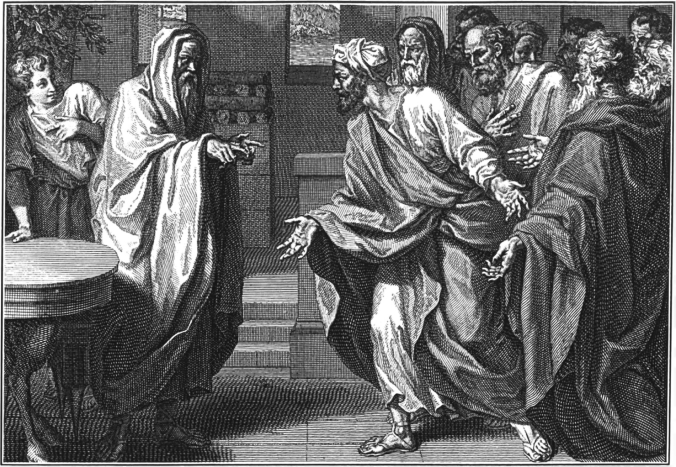
15:14 But Samuel said [exposed Saul’s lie], “What then [in essence: “If you have obeyed God’s instructions, then explain what I am hearing. How can slaughtered livestock make sounds?”] is this bleating of sheep in my ears? What is this lowing of cattle that I hear [Samuel heard the sounds of Saul’s disobedience]?”

15:15 Saul answered [rationalization: twisting facts and misstating motives], “The soldiers [Saul blamed others and excused himself (a common response of those caught in disobedience); soldiers could not have acted without Saul’s consent] brought them from the Amalekites; they spared the best of the sheep and cattle to [attempt to excuse and to justify actions] sacrifice [Saul did nor grasp contradiction between disobeying God and then offering sacrifices with these animals; “a gross deception, an attempt to conceal the selfishness of the original motive under the cloak of religious zeal and gratitude” (Jameison-Faussett-Brown Commentary)] to the LORD your God, but we totally destroyed the rest.”

15:16-18 Samuel told Saul what God had revealed to him the previous night.

1 Samuel 15:19-23
15:19 [Samuel put Saul on the spot] Why did you not obey [or “hear” – hearing to the Hebrews implied obedience] the LORD? Why did you pounce on the plunder [Saul cared more for “plunder” than for the Lord] and do evil [to disobey is to do evil] in the eyes of the LORD [everything we do and fail to do is in God’s sight]?”

15:20 “But I did obey the LORD,” Saul said. “I went on the mission the LORD assigned me. I completely [means without reservation or exception] destroyed the Amalekites and [Saul revealed his disobedience and condemned himself] brought back Agag their king [God’s command was to “totally destroy everything” (v. 3)].

15:21 The soldiers took [God never instructed them to take anything] sheep and cattle from the plunder, the best of what was devoted to God, in order to [Saul tried to cast their actions in a spiritual light] sacrifice [neither God nor Samuel had instructed Saul to do this] them to the LORD your God at Gilgal.”

15:22 But Samuel replied [a lesson in spiritual priorities]: “Does the LORD delight in burnt offerings and sacrifices as much as in obeying the voice of the LORD [obvious answer is “no” – God delights in our obedience]? To obey [the central tenet of Israel’s law (cf. Ex. 19:5; Deut. 6:24-25; 30:14)] is better than sacrifice, and to heed is better than the fat [the choicest part of the sacrifice] of rams.

15:23 For rebellion [disobedience to God’s command] is like [is equally sinful to] the sin of divination [the use of magical means to seek guidance or know the future], and arrogance [Saul made himself the final authority on obedience] like the evil of idolatry [the worship of false gods]. Because you have rejected [cf. Prov. 13:13; 28:9] the word of the LORD, he has rejected you as king [position of responsibility; Saul not rejected as a person].”

15:24-31 Samuel told Saul that the Lord was going to take the kingdom away from him.

15:32-33 Samuel killed Agag king of the Amalekites.

15:34-35 Samuel and Saul parted company, never to see each other again.

1 Samuel 11

• Ammonites’ Threat — 1 Samuel 11:1-2
• Jabesh’s Cry for Help — 1 Samuel 11:3-4
• Saul’s Deliverance — 1 Samuel 11:5-11
• Saul’s Compassion — 1 Samuel 11:12-13
• Saul’s Establishment as King — 1 Samuel 11:14-15
• Samuel’s Exhortation to Obey God — 1 Samuel 12:1-25

1 Samuel 11:1-15
11:1 Nahash [a warlord (king) whose name likely means “snake”] the Ammonite [nomadic people who lived east of the Jordan River] went up and besieged Jabesh Gilead [small and vulnerable city located east of the Jordan River]. And all the men [believed surrender was their best option] of Jabesh said to him, “Make a treaty [actually an agreement made under duress] with us, and we will be subject to you.”

11:2 But Nahash the Ammonite replied [his response demonstrated his cruelty], “I will make a treaty with you only on the condition that I gouge out the right eye [history indicates he had done this before] of every one of you and so bring disgrace on all Israel [and on Israel’s God].”

11:3 The elders of Jabesh said to him, “Give us seven days [perhaps Nahash allowed the grace period so that he could assemble more forces] so we can send men throughout Israel [Jabesh Gilead had not enjoyed cooperative relations with the other Israelites (cf. Judg. 11:4-11; 21:8-14)]; if no one rescues us [Nahash felt confident no one would rescue them] we will surrender to you [giving Nahash a victory without a battle].”

11:4 When the messengers [from Jabesh Gilead] came to Gibeah [in territory of Benjamin] of Saul and reported these terms [cf. 11:2] to the people, they all wept aloud [the people of Gibeah probably had friends and relatives in Jabesh Gilead (cf. Judg, 21:14)].

11:5 Just then Saul [about to face his first great test as Israel’s new king] was returning from the fields [at this time Saul had no palace or advisors], behind his oxen, and he asked, “What is wrong with the people? Why are they weeping?” Then they repeated to him what the men of Jabesh had said.

11:6 When Saul heard their words, the Spirit of God came upon him [just as the Spirit was on the judges before him (cf. Judg. 3:10; 6:34; 11:29)] in power [“Divine work can only be done in dependence upon divine power.” (W. Nee)], and he burned with anger [moral indignation against the Ammonites].

11:7 He [acted with courage and determination; took strong and decisive action] took a pair of oxen [perhaps the oxen he had used for plowing (v. 5)], cut them into pieces [if these were his own oxen, Saul burned a bridge to his farming past by killing his oxen], and sent the pieces by messengers throughout Israel, proclaiming, “This is what will be done to the oxen [Saul did not threaten any of his people with death, only the oxen of those who refused to help rescue their fellow Israelites] of anyone who does not follow Saul [Israel’s king] and Samuel [Saul recognized Samuel’s continuing authority].” Then the terror [alarm, dread, paralyzing fear – perhaps fear of consequences of failing to follow God’s appointed king] of the Lord fell on the people, and they turned out as one man [concerted action].

11:8 When Saul mustered them at Bezek [located on western side of Jordan River about 13 miles southwest of Jabesh Gilead], the men of Israel numbered three hundred thousand and [note mention of two regions: Israel and Judah; the nation would later split along these lines after Solomon’s death] the men of Judah thirty thousand [these numbers indicate overwhelming response to God’s call].

11:9 Inhabitants of Jabesh Gilead received Saul’s assurance of deliverance.

11:10 Jabesh Gilead convinced Ammonites they would surrender.

11:11 The next day Saul separated his men into three divisions; during his last watch of the night [from 2:00 am to 6:00 am] they broke into the camp of the Ammonites and slaughtered them until the heat of the day. Those who survived were scattered, so that no two of them [utterly defeated and humiliated] were left together.

11:12-13 Israel wanted to put skeptics (cf. 10:27) to death.

11:14 Then Samuel [seized opportunity to reaffirm Saul as king] said to the people, “Come, let us go to Gilgal [located on border between Judah and Israel; served as religious and administrative center for Israel] and there reaffirm the kingship.”

11:15 So all the people went to Gilgal and confirmed Saul as king in the presence of the Lord [ceremony had spiritual as well as political meaning]. There they sacrificed fellowship offerings [part burned on altar to God, part consumed in celebratory meal] before the Lord, and Saul and all the Israelites held a great celebration.

1 Samuel 10

1 Samuel 10:20-27
10:20 When Samuel brought all the tribes of Israel near, the tribe of Benjamin was chosen [probably by means of casting lots; cf. Prov. 16:33; God made His will known].

10:21 Then he brought forward the tribe of Benjamin [a small (and insignificant) tribe], clan by clan, and Matri’s clan was chosen. Finally Saul son of Kish was chosen. But when they looked for him, he was not to be found.

10:22 Saul hiding among the baggage.

10:23 Saul brought before the people. Saul stood a head taller than others.

10:24 Samuel said to all the people, “Do you see [1] the man the LORD has chosen? There is [2] no one like him among all the people.” Then the people shouted [indicates great excitement; the people were satisfied with the new king], “Long live the king!”

10:25 Samuel explained regulations of the kingship. People dismissed to go home.

10:26 Saul returned to his home with valient men.

10:27 Not everyone (troublemakers) accepted Saul.

1 Samuel 8

• Request for a King — 1 Samuel 8:1-9
• Warnings about a King — 1 Samuel 8:10-22
• God’s Choice of a King — 1 Samuel 9:1-10:16
• Public Identification of a King — 1 Samuel 10:17-27

1 Samuel 8:1-9
8:1 When Samuel [had led Israel both politically and spiritually] grew old, he appointed [judges usually appointed by God and empowered by His Spirit] his sons [Samuel felt they had potential to give leadership to Israel] as judges for Israel.

8:2 The name [names of Samuel’s sons indicate his desire that his sons be rightly related to God] of his firstborn was Joel [name means the Lord is God] and the name of his second was Abijah [name means the Lord is my Father], and they served at Beersheba [southernmost town of Israel].

8:3 But his sons did not walk in his ways [even as Eli’s sons had not walked in their father’s ways (cf. 1 Sam. 2:12-17)]. They turned aside [personal decision] after dishonest gain and accepted bribes [cf. Ex. 23:8] and perverted justice [abused their authority as judges by selling justice to the highest bidder].

8:4 So all the elders [older man, bearded man, perhaps leaders of the tribes or clans] of Israel gathered together and came to Samuel at Ramah [the birthplace (1:19), home (7:17), and burial place (25:1) of Samuel].

8:5 They said [no mention that the elders had prayed before making their request] to him, “You are old [by implication, not able to lead much longer], and [to make matters worse] your sons do not walk in your ways [therefore unfit to judge; others noticed the godless behavior of Samuel’s sons]; now [because of a crisis in leadership] appoint a king [not another judge; people unwilling to wait for God’s timing on appointment of a king (cf. Deut. 17:14-20)] to lead us, such as [the kind of leader other nations have; Israelites made an error in timing and motivation] all the other nations have [people looked to the example of other nations for guidance instead of to God].”

8:6 But when they said, “Give us a king to lead us,” this displeased [perhaps because he felt the people had rejected him (cf. v. 7) or because of the burdens a king would inflict on the people] Samuel; so [Samuel did not dispute, deny, or rationalize the behavior of his sons] he prayed [sought divine direction] to the LORD.

8:7 And the LORD told him: “Listen [obey; God authorized Samuel to appoint a king] to all that the people are saying to you; it is not you they have rejected, but they have rejected [to spurn, to despise; basis of rejection lies in distrust and contempt] me [God’s system of ruling Israel through the mediation of judges; cf. 1 Sam. 12:12] as their king [although God used many different kinds of human leaders to guide His people, He was still their real Ruler].

8:8 As they have done [indicates that their rejection of God was nothing new] from the day I brought them up out of Egypt [past behavior] until this day [present behavior], forsaking me [must take this step before serving other gods] and serving other gods [idolatry], so they are doing to you.

8:9 Now listen [obey the people’s wish] to them; but warn them solemnly and let them know [good and bad aspects concerning kingship] what the king who will reign over them will do.”

8:10-18 Samuel warned of disadvantages of having a king.

8:19-22 People insisted that Samuel appoint a king.

1 Samuel 7

• Philistines Returned the Ark — 1 Samuel 6:1-7:2
• Samuel Called Israel to Spiritual Renewal — 1 Samuel 7:3-14
• Summary of Samuel’s Ministry — 1 Samuel 7:15-17

1 Samuel 7:3-15
7:3 And Samuel said to the whole house of Israel, “If you are returning [must leave something (in this case, the foreign gods and Ashtoreths) in order to return] to [to center lives on the Lord; to exclusively worship and obey] the LORD with all [not part; wholehearted devotion] your hearts, then [practical steps] [1] rid yourselves of the foreign [Canaanite] gods [Baals] and the Ashtoreths [wife of Baal and goddess of fertility and love] and [2] commit [“establish your hearts” (cf. Josh. 24:14-15 and Matt. 6:24)] yourselves to the LORD and [3] serve him only, and [once conditions are met] he [God] will deliver [rescue; good news for oppressed people; cf. 7:8] you out of the hand of the Philistines.”

7:4 So [in response to Samuel’s spiritual challenge] the Israelites put away [abandon; an intentional act of repentance; necessary in order to experience spiritual renewal] their Baals and Ashtoreths [chief Canaanite god and goddess respectively, during this period; people carried small images of these gods; that which caused their love for God to grow cold], and served the LORD only [cf. Deut. 6:13; Matt. 4:10].

7:5 Then Samuel said, “Assemble all [probably representatives from all the tribal territories] Israel at Mizpah [name means “watchtower”; a place located about five miles north of Jerusalem; cf. Judg. 20:1] and I [Samuel] will intercede [a function of a true prophet] with the LORD for you.”

7:6 When they had assembled at Mizpah, [1] they drew water and poured it out before the LORD [meaning of this act is uncertain; this practice not described elsewhere in OT; perhaps represented their lives poured out to God; perhaps to symbolize their reliance on the Lord; perhaps a symbol of contrition]. On that day [emphasizes immediacy; no delay] [2] they fasted [denying physical needs to focus on spiritual needs; spiritual discipline that often accompanied repentance and renewal] and there [at Mizpah] [3] they confessed [essential to spiritual renewal; must lay aside pride in order to confess; people confessed sin to God not to Samuel], “We have sinned against the LORD [cf. Ps. 51:4].” And Samuel was leader [spiritual leader rather than chief of state] of Israel at Mizpah.

7:7 When the Philistines heard that Israel had assembled [perhaps Philistines thought Israel had assembled in preparation for a military strike] at Mizpah, the rulers of the Philistines came up to attack them. And when the Israelites heard of it, they were afraid because of the Philistines.

7:8 They said to Samuel, “Do not stop crying out to the LORD our God for us, that he [people looked to God rather than to Baals and Ashtoreths] may rescue us from the hand of the Philistines.”

7:9 Then Samuel took a suckling lamb [at least eight days old (cf. Lev. 22:27)] and offered it up as a whole burnt offering [an offering completely consumed on the altar; priest and worshiper received no part of the animal] to the LORD. He cried out to the LORD on Israel’s behalf, and the LORD answered him.

7:10 While Samuel was sacrificing the burnt offering, the Philistines drew near to engage Israel in battle. But that day the LORD thundered [showing He (and not Baal) was in control of the weather] with loud thunder [a ferocious storm] against the Philistines and threw them into such a panic that they were routed [to put to disorderly flight or retreat] before the Israelites.

7:11 The men of Israel rushed out [boldly] of Mizpah and pursued the Philistines, slaughtering them along the way to a point below Beth Car.

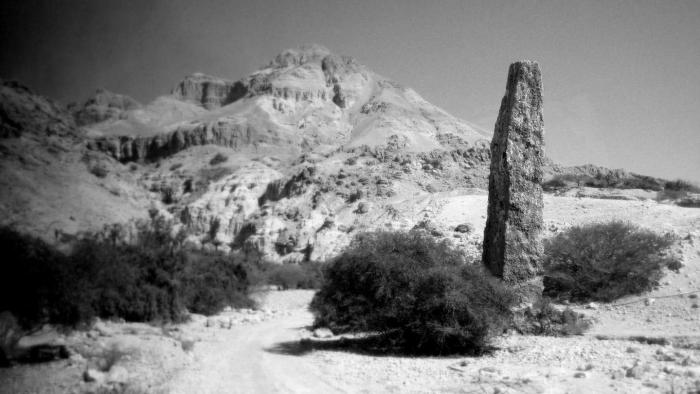
7:12 Then Samuel took a stone and set it up [as a commemoration and reminder to future generations; a tribute to God apart from whom victory is inconceivable] between Mizpah and Shen. He named it Ebenezer [means “stone of help” (cf. Gen. 49:24; Ps. 46:1)], saying, “Thus far has the LORD helped us.”

7:13 So the Philistines were subdued and did not invade Israelite territory again [for the remainder of Samuel’s lifetime].

7:14 Hebrews regained territory previously lost to Philistines.

7:15 Samuel was the judge over Israel the rest of his life.

1 Samuel 18

1 Samuel 18:1-4
18:1 After David had finished talking with Saul, Jonathan became [note two things that indicate that David and Jonathan enjoyed an intimate friendship] [1] one in spirit with David [their lives were bound together; what hurt the one hurt the other; “Friendship is one mind in two bodies.” (Mencius)], and he [2] loved [Heb. verb “aheb”; note: this is not a reference to homosexual desire or activity; the OT employs the word “yada” (“know”) to describe homosexual activity] him as himself.

Note: “The quality of friendship is nearly always determined by the quality of that which we have in common. We share our lives with people who share a like vision. … The deepest interest Jonathan and David shared was the well-being of God’s kingdom (see 1 Sam. 14:6; 17:47). Every link with a friend is useful, but until we are knit together by a commitment to the Lord, we are wading in the shallows of biblical friendship.” (Gary Irving, “Moody Monthly” magazine, 02.79)

18:2 From that day Saul kept David with him and did not let him return to his father’s house.

18:3 And Jonathan made [cut] a covenant [terms of covenant not recorded here; terms apparently included pledge of mutual loyalty and friendship (cf. 20:14-17,42)] with David because he loved him as himself.

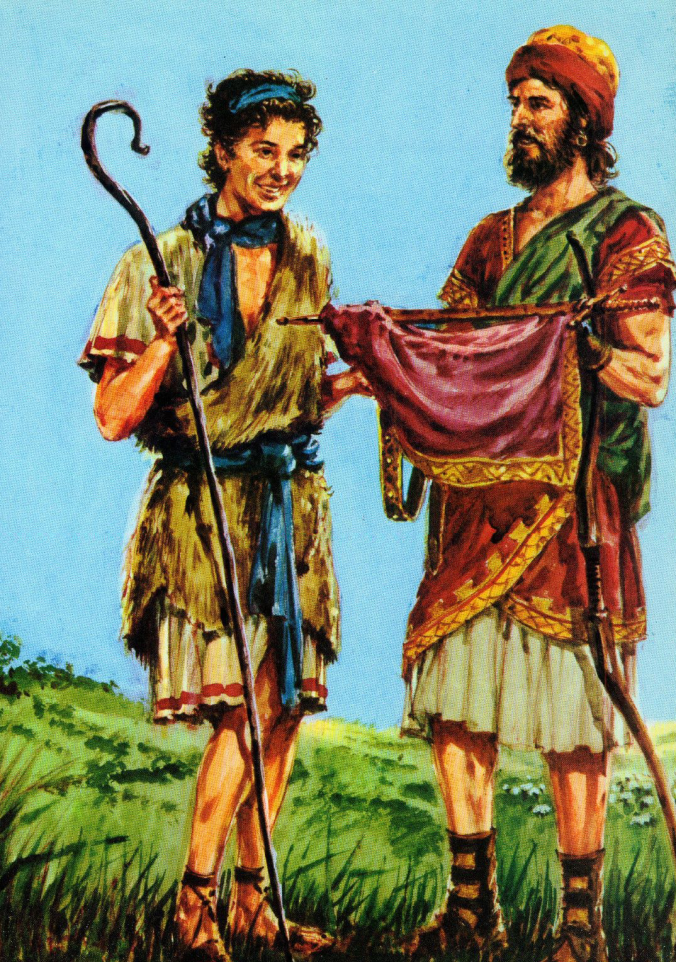
18:4 Jonathan took off the robe [a symbol of the Israelite kingdom; cf. 1 Sam. 15:27-28; a symbol of Jonathan’s right to the throne] he was wearing and gave [an expression/indication of Jonathan’s great love for David; a recognition of David’s worth; “Friendship without self-interest is one of the rare and beautiful things of life.” (James F. Byrnes)] it to David, along with [Jonathan gave his all to David] his tunic, and even his sword, his bow and his belt [note that earlier David had refused to receive similar items from Saul (cf. 1 Sam. 17:38-39)].

Note: Dale Carnegie said, “You can make more friends in two months by becoming really interested in other people, than you can in two years by trying to get other people interested in you.”

1 Samuel 18:8-9
18:8 Saul was very angry [unjustified anger; Saul should have been grateful for David’s military victories against the Philistines]; this refrain galled him [literally, “the words were evil in his eyes”]. “They have credited David with tens of thousands [hyperbole for a large number],” he thought, “but me with only thousands. What more can he get but the kingdom [saw David as a threat or a liability rather than as an asset]?”

18:9 And from that time on [marks beginning of Saul’s active opposition against David; perhaps Saul recalled Samuel’s words that God had rejected him as king and would give the kingdom to someone better (cf. 1 Sam. 13:13-14; 15:23,26,28)] Saul kept a jealous eye [looked at David differently than before] on David.

1 Samuel 19

19:1 Saul told [Saul’s instructions meant to drive a wedge between Jonathan and David] his son Jonathan and all the attendants to kill [and thus eliminate him as a rival to the throne] David. But Jonathan was very fond of David

19:2 and warned [indication of Jonathan’s love and loyalty to David; communication is essential in friendship] him, “My father Saul is looking for a chance to kill you. Be on your guard [cf. 1 Pet. 5:8] tomorrow morning; go into hiding and stay there.

Note: Jonathan was concerned about David’s welfare.

19:3 I will go out and stand with my father in the field where you are. I’ll speak to him about you [Jonathan was David’s advocate] and will tell you what I find out.”

19:4 Jonathan spoke well of David to Saul his father and said to him, “Let not the king do wrong to his servant David; he has not wronged you, and what he has done has benefited you greatly.

Note: Jonathan was concerned about David’s reputation.

19:5 He took his life in his hands when he killed the Philistine. The LORD won a great victory for all Israel, and you saw it and were glad. Why then would you do wrong to an innocent man like David by killing him for no reason? [cf. 1 Sam. 20:32]

19:6 Saul listened [Jonathan’s words (temporarily) brought Saul back to his senses] to Jonathan and took this oath: “As surely as the LORD lives, David will not be put to death. [Saul quickly and conveniently forgot his promise as per v. 11]

19:7 So Jonathan called David and told him the whole conversation. He brought him to Saul, and David was with Saul as before.

1 Samuel 19:11-12
19:11 Saul [jealousy progressed to murderous plot] sent men [assassins] to David’s house to watch it and to kill him in the morning. But Michal [Saul’s daughter found out about the plot], David’s wife [chose to be loyal to her husband], warned him, “If you don’t run for your life tonight, tomorrow you’ll be killed.”

19:12 So Michal let David down through a window [apparently, David’s house built into the city wall; cf. Acts 9:23-25], and he fled and escaped.

1 Samuel 19:18
19:18 When David had fled and made his escape, he went to Samuel at Ramah [birthplace of Samuel (cf. 1:19); David found shelter with Samuel] and told him [David received comfort and counsel from Samuel, a man he could trust] all that Saul had done to him. Then he and Samuel went to Naioth [located near Ramah; probably a compound of dwellings/community of prophets (like a monastery or convent)] and stayed there.

1 Samuel 20

1 Samuel 20:4
20:4 Jonathan said to David, “Whatever [indicates Jonathan’s great love for David] you want me to do, I’ll do for you.”

1 Samuel 20:12-14
20:12 Then Jonathan [cf. 1 Sam. 18:1-4 re: friendship between David and Jonathan] said to David: “By the LORD, the God of Israel [Jonathan made a pledge], I will surely sound out [assess the situation] my father by this time the day after tomorrow! If he is favorably disposed toward you, will I not send you word and let you know?

20:13 But if my father is inclined to harm you, may the LORD deal with me [Jonathan made another pledge], be it ever so severely, if I do not let you know [true friends never deceive one another] and send you away safely. May the LORD be with you as he has been with my father.

20:14 But show me [Jonathan] unfailing kindness [a love that remains faithful] like that of the LORD as long as I live, so that I may not be killed [common practice for new king to kill all male members of old dynasty],

1 Samuel 20:17
20:17 And Jonathan had David reaffirm his oath [his side of the agreement] out of love for him, because he loved him as he loved himself [cf. Lev. 19:18b; Matt. 22:398; Jn. 13:34b].

1 Samuel 20:31-33
20:31 [Saul appealed to Jonathan’s ambition] As long as the son of Jesse lives on this earth, neither you [Jonathan] nor your kingdom will be established. Now send and bring him to me, for he must die!”

20:32 “Why should he be put to death? What has he done?” Jonathan asked [with courage and conviction; cf. 1 Sam. 19:4 re: Jonathan’s earlier words to Saul] his father.

20:33 But Saul hurled his spear at him [his own son] to kill him. Then Jonathan knew that his father intended to kill David.

1 Samuel 20:42
20:42 Jonathan said to David, “Go in peace, for we [emphasizes mutual nature of their friendship] have sworn [their oath would keep them united even through physical separation] friendship [cf. 1 Sam. 20:13-17] with each other in the name of the LORD, saying, ‘The LORD is witness between you and me, and between your descendants and my descendants [cf. 2 Sam. 9:3-13 re: David’s care of Mephibosheth, Jonathan’s son] forever.’” Then David left, and Jonathan went back to the town [they would only briefly meet again once more (cf. 1 Sam. 23:16-18)].