Micah 5

What reference did Micah make to the nation’s present predicament?

Micah declared (Micah 5:1) that the nation would be besieged by her enemies and her king(s) smitten on the cheek (a reference to insult and humiliation).

What assurance of deliverance did Micah proclaim?

While the nation’s present kings suffered at the hands of oppressors (Micah 5:1), Micah envisioned the day when God would raise up one from the seed of David who would rule Israel in glory and majesty (Micah 5:2). Micah’s prophesy about the coming ruler (Messiah) was uttered about 700 years before the birth of Christ. Notice the description of the Messiah in Micah 5:2:

[A]   He will be born in Bethlehem Ephrathah.

[B]   He will “go forth for Me,” that is, He will do the will and work of God.

[C]   He will be One who has always existed: “His goings forth are from long ago, from the days of eternity.”

In the meantime, Israel would continue to suffer (like a woman in labor) at the hands of her enemies (Micah 5:3), but would one day experience the protection and guidance of this ruler (Messiah) who would be like a Shepherd to them (Micah 5:4).

Practical Consideration: It’s Friday, but Sunday is coming!
Tony Campolo tells the story of hearing the Easter story told by a black preacher in an interesting way. The preacher pointed out that hell must have rejoiced when Christ hung on the cross, and then added, “That’s because it was Friday, but Sunday is coming!” Micah announced that while the nation and her leaders would suffer humiliation and defeat at the hands of her enemies, God was going to send a deliverer. Defeat is never the last word for God’s people. No matter how dark it gets on Friday, Sunday is just around the corner!

What did the people do in the meantime to deal with the pressures from Assyria?

After the Assyrians conquered the Northern Kingdom in 722 BC, they laid siege to Jerusalem in 701 BC. The Southern Kingdom raised up shepherds (kings) and leaders to oppose the Assyrians under Sennacherib (Micah 5:5). Micah 5:6 addresses the hope that one day Judah will conquer Assyria.

What did Micah prophesy would be the future of those surviving the judgment that he had announced?

Micah prophesied that God would not abandon the surviving remnant, but would work with them to strengthen them and assure them of a future. They would become like the dew (Micah 5:7) which spreads its influence over all the earth and as strong as a lion (Micah 5:8-9).

What steps would the Lord take to purify His people?

Micah declared that the Lord would purge Israel of everything that distracted and directed them away from God. The things that the Lord would remove included:

[A]   Military might (Micah 5:10-11): Trusting in horses, chariots, and fortifications.

[B]   False religious practices (Micah 5:12-14): Sorcery, fortune telling, carved images, sacred pillars, and Asherim.

In addition, Israel’s idolatrous neighbors, from whom she learned wrongdoing, would experience God’s judgment (Micah 5:15).

Practical Consideration: We should trust in the Lord.
It is easy to trust in things. God’s people trusted in military strength and looked for divine guidance from the wrong sources through the wrong methods. It is foolish for God’s people to trust in anyone or anything other than God. Why settle for less?

Micah 6

What charges did the Lord bring against His people?

The setting of Micah 6 is a courtroom. God called upon the mountains, hills, and foundations of the earth to hear His case against His people (Micah 6:1-2). The latter part of verse 2, “even with Israel He will dispute,” should be understood, “and He will plead [reason] with Israel.” God’s case was not built upon anger but love. God asked His people how His treatment of them could have possibly led to their present attitude (Micah 6:3). He asked for an answer, but none was given.

God then proceeded to appeal to history. He reminded them of the things He had done to redeem them, not weary them. He delivered them from bondage in Egypt and provided leaders for them (Micah 6:4). He protected them in the wilderness when Balak sought to curse and destroy them (Micah 6:5a). He was with them in Shittim, the last encampment in the wilderness, and miraculously led them across Jordan to Gilgal, the first encampment on the west side of the Jordan. God did these acts in order that His people “might know the righteous acts of the Lord” (Micah 6:5b). These events should have caused the people to respond to God in gratitude and obedience.

Practical Consideration: God takes notice of our ingratitude and faithlessness.
God’s faithfulness and goodness to us should cause us to respond to Him in gratitude (see Psalm 103:1-5). God never gives us cause to respond to Him in disobedience and faithlessness. In fact, God’s goodness and faithfulness accentuates our ingratitude and faithlessness. How would we respond if God were to ask us, “My people, what have I done to you, and how have I wearied you? Answer Me.” (Micah 6:3).

How did the people respond to God’s charges?

An unidentified speaker interrupted Micah and asked what God required of them. Did God want them to bow before Him? Did He want more and better sacrifices? Would He be satisfied with thousands of rivers of oil? Should they go so far as to sacrifice a first-born son to please Him? (Micah 6:6-7). Micah’s religious audience claimed to be doing all of the right religious things. They were, outwardly, very pious. They did every religious thing they knew to be rightly related to God. They seemed to be very concerned about their vertical relationship. But something was wrong! The people were doing right things with a wrong heart. As one commentator noted, they had lost their religion in religiousness. Their piety was devoid of ethics and character.

Practical Consideration: Religion cannot make men right with God.
Micah’s audience was very religious. They outwardly did all of the right things and said all of the right words. They appeared to be very zealous in religious matters. Their piety however, was devoid of ethics and character. They went through the activity of worship one day and then abused their fellowman the next day. They offered all of the right sacrifices in the daytime and then plotted evil on their beds at nighttime. And yet they did not feel that they were wrong with God (see Micah 3:11b). Religious activity does not make men right with God.

What was Micah’s response to the people?
Micah responded to the people by reminding them that while they were concerned with their vertical relationship, they had neglected their horizontal relationships. They were interested in doing the religious things that they thought would make them right with God, but neglected doing the things that would make them right with their fellowman. Micah reminded his audience that God had already told them what was good (Micah 6:8a). They did not need a new revelation, they needed to obey the revelation they already had. Micah reminded the people of the missing dimension in their lives (Micah 6:8b).

[A]   God requires His people “to do justice.” This means to set right what is wrong and to do what is right, fair, and honest between men.

[B]   God requires His people “to love kindness” or to practice faithful love. God requires His people to love others even when there is nothing that merits that love. We are to love others as God has loved us.

[C]   God requires His people “to walk humbly with your God.” A man who practices justice and faithful love can walk humbly with God. To “walk humbly” with God means to willingly submit to His will.

Practical Consideration: We should obey the truth that we have.
Micah reminded his audience that God had already told them what He required of them. Many believers today are also without excuse when it comes to knowing what God expects. We have the benefit of exposure to God’s Word through worship gatherings, Bible studies, and multi-media. The problem most believers have is not the need for more Bible study, but obeying what they already know from the Bible. Our need is not so much “to know” as it is “to do” what we already know.

What charges did God bring against the people of Judah and Jerusalem?

Once again, God brought charges against the city (Micah 6:9). The city of Jerusalem was a very influential city and its sins would not go unpunished. While God required His people “to do justice, to love kindness, and to walk humbly with your God” (Micah 6:8), the verses that follow show the corrupt state into which the nation had fallen.

[A]   The people were guilty of deception and dishonesty. They used false weights and measures to their advantage (Micah 6:10-11). See also Amos 8:5.

[B]   The wealthy used violence to advance their plans for gain (Micah 6:12a).

[C]   The people in general were deceitful and wicked (Micah 6:12b).

[D]   The people patterned their conduct after that of Omri and Ahab (Micah 6:16).

Practical Consideration: God notices how we treat one another.
The book of Micah illustrates the fact that God notices how we treat one another. Our horizontal relationships have an impact upon our vertical relationship. Jesus had much to say about this subject (see Matthew 5:23-24 and 6:14-15). The New Testament is filled with “one another” passages that accentuate the importance of how to properly interact with others.

How would the people be judged for their sinfulness?

Micah (6:13-16) declared that God would judge His people “because of your sins” (Micah 6:13b). They were marked for destruction, derision, and humiliation (Micah 6:16b). Notice that the people would experience frustration and futility (see also Amos 5:11b):

[A]   They would eat but not be satisfied (Micah 6:14).

[B]   They would try to save their earnings/possessions but not preserve anything (Micah 6:14).

[C]   They would sow but not reap (Micah 6:15).

[D]   They would tread olives and grapes but not enjoy the benefits of that labor (Micah 6:15).

Micah 7

What note of grief and despair did Micah utter?

Micah lamented that he was like a hungry man in search of food but could find none (Micah 7:1). He cried that there was no godly or upright person left in the land, only murderers and thieves (Micah 7:2). He cried that rulers and judges could be bought and that men were skillful at doing evil with both hands (Micah 7:3a). Men of the upper class were not ashamed to have their evil desires known by others and wove their evil plans with their partners to cheat and deceive and take from others (Micah 7:3b). Even the best of men was like a briar or thorn bush (Micah 7:4a). Surely the judgment announced by God’s prophets was imminent (Micah 7:4b). In the midst of and immediately after that judgment it would become unsafe to trust anyone, including family members and neighbors (Micah 7:5-6).

Practical Consideration: Society suffers when there is an absence of godly people.
Micah lamented that the godly had perished from the land and that there was an absence of upright people (see Micah 7:2). The godly play a vital role in society. Jesus said we are to be salt and light in the world (see Matthew 5:13-16). Salt preserves and spices and light enables men to see what they otherwise would not be able to see. Someone has also noted that when godly men do nothing evil runs rampant.

What note of hope concludes the book of Micah?

[A]   Micah declared that his trust was in the Lord and that he eagerly watched for the Lord who would act on his behalf (Micah 7:7).

[B]   Micah 7:8-10 are spoken from the viewpoint of Jerusalem who had suffered defeat and taunting at the hands of her enemies (Micah 7:8 and 10a). Jerusalem reminded her enemies that though she had fallen she would rise again and that though she was in darkness the Lord would be a light for her (Micah 7:8). Jerusalem also acknowledged that God’s judgment had come in response to her sins but that God would use the judgment in a redemptive way (Micah 7:9). In addition, Jerusalem’s enemies would suffer humiliation and defeat (Micah 7:10b). Micah 7:11-13 are hope-filled verses which declare the restoration of Jerusalem. Jerusalem’s walls would be rebuilt (Micah 7:11a), her boundaries would be enlarged (Micah 7:11b), and her exiles would return from throughout the earth (Micah 7:12). As for the rest of the world, it would suffer because of its wickedness (Micah 7:13).

[C]   Micah 7:14-17 beseech God to shepherd His people and restore to them the territory of Bashan and Gilead (territory east of the Jordan taken by the Assyrians after 734 BC). God responded by declaring that He would show His people miracles like those associated with the exodus from Egypt (Micah 7:15) and that their enemies would suffer defeat and humiliation (Micah 7:16-17).

[D]   Micah 7:18-20 are moving verses that deal with forgiveness. The hope contained in these verses is anchored in God’s promise to the patriarchs (Micah 7:20). These verses contain seven statements regarding God’s forgiveness:

[1] “Who is a God like Thee who pardons iniquity” – God is a forgiving God.

[2]   “And passes over the rebellious act of the remnant of His possession?” – God will not allow our sin to destroy our relationship with Him.

[3]   “He does not retain His anger forever” – God is redemptive in His attitude toward His people.

[4]   “Because He delights in unchanging love” – God is committed to honoring the terms of His covenant with His people. He continues to love His people even when they do not merit that love.

[5]   “He will again have compassion on us” – God cares for His people in a tender way. See also Psalm 103:13.

[6]   “He will tread our iniquities underfoot” – God will wash or cleanse His people of their sin.

[7]   “Yes, Thou wilt cast all their sins into the depth of the sea” – God is victorious over sin.

Habakkuk 3

Habakkuk 3:17-19
3:17 [a detailed description of disasters (the loss of food sources) associated with God’s coming judgment at the hands of the Babylonians] Though the fig tree does not bud and there are no grapes on the vines, though the olive crop fails and the fields produce no food, though there are no sheep in the pen and no cattle in the stalls,

3:18 [a statement of how Habakkuk would respond to the disasters listed in 3:17] yet I will rejoice in the LORD, I will be joyful in God my Savior.

3:19 [the basis for Habakkuk’s confident hope…] The Sovereign LORD is my strength; he makes my feet like the feet [swift and sure-footed] of a deer, he enables me to go on the heights [either places of potential danger or inner spiritual heights or both]. For the director of music [indicates that Habakkuk intended that the words be put to music]. On my stringed instruments.

Habakkuk 2

Habakkuk 2:1-4


2:1 I will stand at my watch and station myself on the ramparts; I will look to see what he will say to me, and what answer I am to give to this complaint.

2:2 Then the LORD replied: “Write down the revelation [vision] and make it plain [legible so that it can be easily read] on tablets so that a herald may run with it.

2:3 For the revelation [note six facts concerning the revelation (vision)] [1] awaits an appointed time [God has determined the time (in the future) for its fulfillment]; [2] it speaks of the end [refers to events by which God will complete His work of judging Babylon] and [3] will not prove false [in the sense of disappointing those who trust in God]. [4] Though it linger [according to human expectations], wait for it [for the fulfillment (the fall of Babylon)]; [5] it will certainly come and [6] will not delay [will happen according to God’s timetable].

2:4 “See, he [Babylonians] is puffed up [with pride and self-importance]; his desires are not upright—but the righteous will live by his faith [refers to the faith and steadfastness of the Israelites; cf. Rom. 1:15; Gal. 3:11]

Habakkuk 2:18-20
2:18 “Of what value is an idol, since a man has carved it? Or an image [the demonic spirits that inspire the worship of idols are real and deadly (cf. 1 Cor. 10:20)] that teaches lies [by encouraging people to seek life in anything other than a personal relationship with God through Christ]? For he who makes it trusts in his own creation; he makes idols that cannot speak.

2:19 Woe [a mocking song used to pronounce doom on evil doers] to him who says to wood, ‘Come to life!’ Or to lifeless stone, ‘Wake up!’ Can it give guidance? It is covered with gold and silver; there is no breath in it.

2:20 But [in contrast to idols] the LORD is in his holy temple [a reference to heaven and earth rather than to a building in one location]; let all the earth be silent before him.”

Habakkuk 1

1:1 The oracle [means “burden” or perhaps “pronouncement”] that Habakkuk [probably a Babylonian name] the prophet [pre-exilic prophet who lived in Judah; contemporary of Jeremiah] received.

1:2 [Habakkuk’s first complaint] How long [implies Habakkuk had prayed before but seen no evidence God had heard], O LORD, must I call for help, but you do not listen [Habakkuk would not believe God heard until he saw God act]? Or cry out to you, “Violence! [King Jehoiakim was cruel and corrupt]” but you do not save?

1:3 Why do you make me [Habakkuk] look at injustice? Why do you tolerate [cf. Hab. 1:13] wrong? Destruction and violence [those who tolerated “destruction and violence” would be overtaken by the destruction and violence of the Babylonians] are before me; there is strife, and conflict abounds.

1:4 Therefore the law [refers to God’s law in the general sense; may refer to religious and civil reforms instituted by Josiah (cf. 2 Kings 23:2-3)] is paralyzed [to grow numb or cold, to cease, to be helpless; conveys idea of ineffectiveness], and justice never prevails [because the wealthy controlled the courts]. The wicked hem in the righteous, so that justice is perverted.

1:5 [God’s answer to Habakkuk’s complaint indicates that He was neither indifferent nor inattentive] “Look at the nations and watch–and be utterly amazed. For I am going to do something [give His people over to the Babylonians] in your days that you would not believe, even if you were told.

1:6 I am raising up the Babylonians [God would use them as His instrument of judgment; cf. Ps. 119:91b], that ruthless and impetuous people, who sweep across the whole earth to seize dwelling places not their own.

1:7 They are a feared and dreaded people; they are a law to themselves and promote their own honor [indicates arrogant attitude].

1:8 [the speed and ferocity of the Babylonians in battle had become proverbial] Their horses are swifter than leopards, fiercer than wolves at dusk. Their cavalry gallops headlong; their horsemen come from afar. They fly like a vulture swooping to devour;

1:9 they all come bent on violence. Their hordes advance like a desert wind and gather prisoners like sand.

1:10 They deride kings and scoff at rulers. They laugh at all fortified cities; they build earthen ramps [a siege strategy] and capture them.

1:11 Then they sweep past like the wind and go on–guilty men, whose own strength [their military might] is their god.”

1:12 O LORD, are you not from everlasting? My God, my Holy [a comprehensive term for God (cf. Isa. 6:3) that includes all that He is] One, we will not die [an expression of confidence that God’s people would not be totally destroyed]. O LORD, you have appointed them [the Babylonians (a nation of ungodly people)] to execute judgment [on God’s own people]; O Rock, you have ordained them [the Babylonians] to punish [carries the idea of rebuking to correct God’s erring people].

1:13 Your eyes are too pure to look [i.e., to look with favor] on evil; you cannot tolerate [or endure] wrong . Why [for what purpose] then do you tolerate the treacherous [an obvious reference to the Babylonians]? Why are you silent while the wicked [an obvious reference to the Babylonians] swallow up those more righteous [describes those like Habakkuk who were right in conduct toward God and people] than themselves?

1:14 You have made men like fish in the sea, like sea creatures that have no ruler.

1:15 The wicked foe pulls all of them up with hooks, he catches them in his net, he gathers them up in his dragnet; and so he rejoices and is glad.

1:16 Therefore he sacrifices to his net and burns incense to his dragnet, for by his net he lives in luxury and enjoys the choicest food.

1:17 Is he to keep on emptying his net, destroying nations without mercy?

2 Samuel 15

2 Samuel 15:5-14
15:5 [Absalom acted to intercept those who came to Jerusalem with problems (15:1-4)] Also, whenever anyone approached him to bow down [because Absalom was a prince or because people considered him to be a powerful person] before him, Absalom would reach out his hand, take hold of him and kiss him [a display of false humility meant to manipulate people and to undermine his father David].

Note: What are some methods people use to manipulate others? How do you recognize when you are being manipulated? How can you help others understand what is happening to them when they are being manipulated?

Note: Read Proverbs 12:6; 15:1 and 16:24 to learn more about the power of words for good and bad.

15:6 Absalom behaved in this way toward all [not just the wealthy and powerful] the Israelites who came to the king asking for justice, and so he stole the hearts [by leading people to believe that in him they had a friend in the royal court] of the men of Israel.

15:7 At the end of four years [time reckoned from the time of Absalom’s reunion with David (14:33); Absalom had quietly undermined David’s authority by casting doubt about the king’s concern for his subjects], Absalom said [his request was reasonable and raised no alarms] to the king, “Let me go to Hebron [located about twenty miles south of Jerusalem] and fulfill a vow I made to the LORD.

About Hebron (15:7)
• Abraham lived & worshiped there Gen. 13:18
• Sarah buried there Gen. 23:19
• Abraham buried there Gen. 25:9
• A city of refuge Josh. 20:7
• A Levitical city Josh. 21:11
• David crowned king of Judah 2 Sam. 2:4; 5:1-3
• Absalom’s birthplace 2 Sam. 3:2-3

Note
• How would you define ambition?
• Why is it important that our ambition be grounded in the will and purposes of God?
• When does ambition become dangerous??
• What are some practical ways to bridle our ambitions rather than doing irreparable damage to other people?

15:8 While your servant was living at Geshur [Absalom spent three years there after killing Amnon (2 Sam. 13:37-38)] in Aram [term that signifies Syria], I made this vow [his vow had been made at least six-years earlier; vows must be fulfilled promptly (cf. Deut. 23:21; Ecc. 5:5)]: ‘If the LORD takes me back to Jerusalem, I will worship the LORD in Hebron.’”

15:9 The king [suspected no evil intent] said to him, “Go in peace.” So he went to Hebron.

15:10 Then Absalom sent secret messengers throughout the tribes of Israel [indicates Absalom had support in every tribe] to say, “As soon as you hear the sound of the trumpets [signaled an important announcement; typically accompanied the announcement of a new king (cf. 1 Kings 1:34; 2 Kings 9:13)], then say [Absalom’s announcement was to be made as simultaneously as possible throughout the land], ‘Absalom is king in Hebron.’”

15:11 Two hundred men [may have included some of David’s key administrators and advisors] from Jerusalem [the absence of some of David’s key people would have deprived David of their counsel and aid after Absalom’s announcement (15:10)] had accompanied Absalom. They had been invited as guests and went quite innocently [indicates that these individuals were pawns in Absalom’s plot], knowing nothing about the matter.

15:12 While Absalom was offering sacrifices [perhaps a pretense to add the appearance of propriety to his actions], he also sent for Ahithophel [Bathsheba’s grandfather (2 Sam. 11:3; 23:34); his siding with Absalom may have helped Absalom’s conspiracy to gain strength; a valuable and respected advisor as per 2 Sam. 16:23] the Gilonite, David’s counselor, to come from Giloh, his hometown. And so the conspiracy [illegal, subversive plot] gained strength, and Absalom’s following kept on increasing [indication that many were dissatisfied with David’s leadership].

15:13 A messenger [perhaps a resident of Hebron; apparently someone loyal to David] came and told David, “The hearts of the men of Israel [reference to Israel’s army (cf. 1 Sam. 7:11; 14:24)] are with Absalom.”

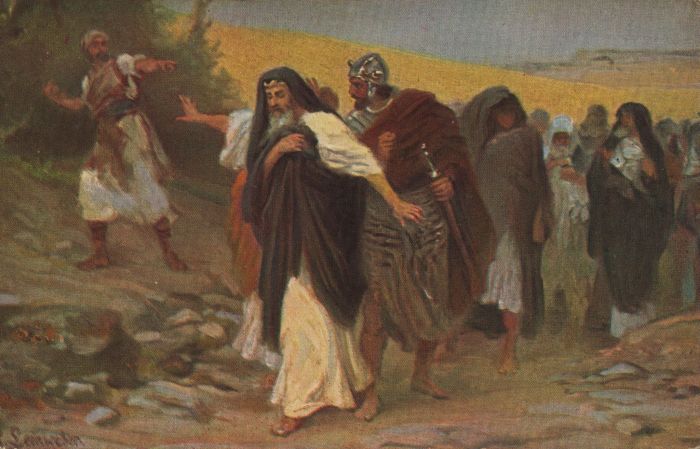
15:14 Then David said [note that David weighed and understood the impact of his decision on others] to all his officials who were with him in Jerusalem, “Come! We must flee, or [David understood the potential danger to himself and his staff] none of us will escape from Absalom. We must leave immediately, or [David understood the potential danger to the residents of Jerusalem] he will move quickly to overtake us and bring ruin upon us and put the city to the sword.”

2 Samuel 11

2 Samuel 11:1-5
11:1 In the spring [literally “at the return of the year”], at the time when kings go off to war, David sent Joab out with the king’s men [David’s own small standing army] and the whole Israelite army [common working people who served as soldiers]. They destroyed the Ammonites [probably indicates total conquest of Ammonite territory east of Jordan River] and besieged Rabbah [Ammon’s capital city]. But David remained [to administer the kingdom; David not needed in battle] in Jerusalem.

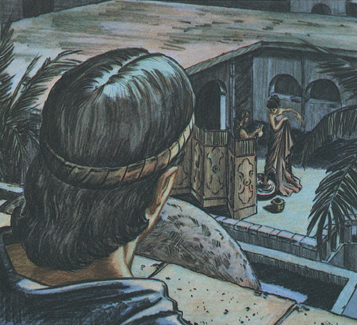
11:2 One evening David got up from his bed and walked around [paced back and forth; no indication given that David went to his roof looking for temptation] on the roof of the palace. From the roof he saw a woman bathing [literally “washing”]. The woman was very beautiful [literally “very good of appearance”],

Note: What are some situations that lead adults today into the trap of sexual immorality? Why is it important to decide beforehand how we will act in certain situations?

11:3 and David [note that he took the situation to the next level…] sent someone to find out about her. The man said, “Isn’t this Bathsheba, the daughter of Eliam [the son of Ahithophel, one of David’s chief advisors] and the wife of Uriah the Hittite [a member of David’s elite guard along with Eliam (2 Sam. 23:39); Uriah was away at war making it easy for David to take advantage of Bathsheba]?”

11:4 Then David [had many wives to satisfy his sexual desires] sent [intentional action; David acted on his lust (cf. Matt. 5:27-28) and initiated the events that led to adultery] messengers to get her [the sole wife of another]. She came to him, and he [like David, we must say no to God before we can say yes to sin] slept with her [no indication that she cried out for help when David’s intentions became clear (cf. Deut. 22:23-24)]. (She had purified herself from her uncleanness [following her menstruation (cf. Lev. 15:19-33); time of her ovulation near and likelihood for pregnancy high].) Then she went back home [David probably felt the matter was now closed].

Note: How might our sin drag others into trouble? How does Satan tempt us to believe that our sin is our private decision? Why do you think believers choose to sin knowing the pain inflicted on others?

11:5 The woman conceived and sent word to David, saying, “I am pregnant [David’s secret was about to become visible].”

2 Samuel 11:14-17
11:14 In the morning David wrote a letter [David’s intentional and final action to deal with Uriah after two previous failed attempts to give Uriah opportunity to have sexual relations with his wife (cf. 2 Sam. 11:6-13); this letter was an abuse of royal power] to Joab and sent it with Uriah [David felt confident that Uriah would not break the seal of the letter to read it (a testimony to Uriah’s honesty and integrity); Uriah never knew or suspected he carried his own death sentence].

11:15 In it he wrote, “Put Uriah in the front line where the fighting is fiercest. Then withdraw from him so he will be struck down and die.” [Joab followed David’s instructions, even though in so doing other soldiers were also killed]

Note: What are some common results of attempting to cover up sins? Why do we sometimes attempt to cover our sins? Why does one person’s sin sometimes affect many others?

11:16 So while Joab had the city under siege, he [Joab chose loyalty to the king over loyalty to his own conscience; perhaps Joab chose to follow the king’s orders knowing that by doing so it would strengthen his own position with the king] put Uriah at a place where he knew the strongest defenders were.

11:17 When the men of the city came out and fought against Joab, some of the men in David’s army fell; moreover, Uriah the Hittite died [as a casualty of war].

2 Samuel 11:26-27
11:26 When Uriah’s wife heard that her husband was dead, she mourned [involved actions such as tearing one’s clothes, putting on sackcloth, weeping, and wailing (cf. Gen. 37:34; Jer. 4:8)] for him.

11:27 After the time [mourning period typically lasted seven days (cf. Gen. 50:10; 1 Sam. 31:13)] of mourning was over, David had her brought to his house, and she became his wife and bore him a son. [David apparently kept silent about his sin (Ps. 32:1-5)] But the thing David had done displeased [sin always displeases God] the LORD [He sees and knows everything we do and say (cf. Ps. 139:1-4)].

2 Samuel 9

2 Samuel 9:1-10
9:1 David [remembered his covenant with Jonathan (1 Sam. 20:14-17) and Saul (1 Sam. 24:21-22)] asked [note that David did not wait for an opportunity to show kindness but instead took the initiative to do so], “Is there anyone still left of the house of Saul to whom I [David sought to keep his personal promise to Jonathan] can show kindness [Heb. chesed: a loyal love that is expressed in actions rather than emotions; “Kindness motivated by kindness is merely repayment, but kindness motivated by grace is godly.” (ETB Adult Commentary, Summer 2002, p. 54)] for Jonathan’s sake [David was determined to honor Jonathan’s memory]?”

9:2 Now there was a servant of Saul’s household named Ziba [cf. 9:10]. They called him to appear before David, and the king said to him, “Are you Ziba?” “Your servant,” he replied.

9:3 The king asked, “Is there no one still left of the house of Saul to whom I can show God’s [David understood that God was about to use him to be a blessing to the house of Saul] kindness?” Ziba answered the king, “There is still a son of Jonathan; he is crippled in both feet [literally “crushed of feet”; cf. 2 Sam. 4:4 re: childhood injury that resulted in Mephibosheth’s disability].”

Note: “The greatest thing a man can do for his Heavenly Father is to be kind to some of His other children.” (Henry Drummond)

“The best portion of a good man’s life is his little, nameless, unremembered acts of kindness and of love.” (William Wordsworth)

9:4 “Where is he?” the king asked. Ziba answered, “He is at the house of Makir [apparently had been a loyal supporter of Saul since he had taken in Saul’s grandson; Makir later provided for David during Absalom’s rebellion (2 Sam. 17:27-29)] son of Ammiel in Lo Debar [located in the region of Gilead east of the Jordan River].”

9:5 So King David had [suggests David issued order rather than invitation] him brought [literally “sent and took him”] from Lo Debar, from the house of Makir son of Ammiel.

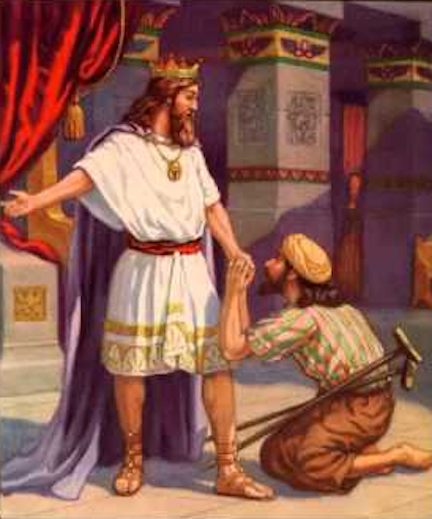
9:6 When Mephibosheth [means “from the mouth of shame” or “one who scatters shame”; reasons why Jonathan gave his son this name are not known] son of Jonathan, the son of Saul, came to David, he bowed down to pay him honor. David said, “Mephibosheth!” “Your servant [indicates submission/subservience],” he replied.

9:7 “Don’t be afraid [implies that David sensed Mephibosheth’s fear],” David said [David’s words completely changed Mephibosheth’s life] to him, “for I will surely show you kindness [note two ways in which David demonstrated kindness to Mephibosheth] for the sake of your father Jonathan [David’s kindness motivated by his love for Jonathan and not by pity over Mephibosheth’s physical condition]. [1] I will restore to you all the land [ownership of land represented power, wealth, stability] that belonged to your grandfather Saul, and [2] you will always eat at my table.”

Note: What privileges and blessings has God given you? How can you use those privileges and resources to benefit others?

9:8 Mephibosheth bowed down and said, “What is your servant, that you should notice a dead dog [emphasizes complete unworthiness; common expression of Middle Eastern humility] like me?”

9:9 Then the king summoned Ziba, Saul’s servant, and said [David informed Ziba of his decisions re: Mephibosheth] to him, “I have given your master’s grandson everything [David’s kindness provided Mephibosheth with a more secure future] that belonged to Saul and his family.

9:10 You [Ziba would function as chief steward of Saul’s former estate] and your sons and your servants are to farm the land for him and bring in the crops, so that your master’s grandson [the ongoing affairs of Mephibosheth’s estate] may be provided for. And Mephibosheth, grandson of your master, will always eat at my table.” (Now Ziba had fifteen sons and twenty servants.)

2 Samuel 14

14:1 Joab [David’s nephew and general; willing to facilitate reconciliation between David and Absalom] son of Zeruiah knew that the king’s heart longed for Absalom.

14:2 So Joab [devised a plan to confront David and convince him to bring Absalom back to Jerusalem; Nathan had used a similar technique in 12:1-7] sent someone to Tekoa [located approx. 10 miles south of Jerusalem; Amos the prophet was from Tekoa (Amos 1:1)] and had a wise [or skillful (someone capable of acting out a role in a convincing manner)] woman [had to be old enough to look as though she could have two grown sons (see 14:6)] brought from there. He said to her, “Pretend you are in mourning. Dress in mourning clothes, and don’t use any cosmetic lotions. Act like a woman who has spent many days grieving for the dead.

14:3-12 The woman told her sad story to David.

14:13 The woman said, “Why then have you devised a thing like this against the people of God [David’s refusal to bring back Absalom deprived him of a son and Israel of a potential king]? When the king says this, does he not convict himself, for the king has not brought back his banished son [Absalom who killed his own (half) brother]?

14:14 [the woman used a proverb to remind David that all people die] Like water spilled on the ground, which cannot be recovered, so we must die. But God does not take away life; instead, he devises ways [literally, “thinks thoughts;” by providing forgiveness and mercy to the penitent] so that a banished person may not remain estranged from him.

Note: How might God be encouraging you to seek reconciliation or to help others do so?

14:15-18 David sensed a hidden agenda and insisted the woman answer truthfully the question he was about to ask.

14:19 The king asked [David suspected that Joab had coached the woman], “Isn’t the hand of Joab with you in all this?” The woman answered [her answer indicates her perception of David’s powers of discernment], “As surely as you live, my lord the king, no one can turn to the right or to the left from anything my lord the king says. Yes, it was your servant Joab who instructed me to do this and who put all these words into the mouth of your servant.

14:20 Your servant Joab did this [woman defended Joab’s intention; Joab took a risk to bring David and Absalom back together] to change the present situation [literally “change the face of the matter” (David’s strained relationship with Absalom)]. My lord has wisdom like that of an angel of God—he knows everything that happens in the land.”

Note: Read Romans 12:18. What steps could you take to move toward reconciliation or to help another do so?

14:21 The king said to Joab, “Very well, I will do it. Go, bring back the young man Absalom.”

14:22 Joab [probably knew that his actions could have resulted in his dismissal or even death] fell with his face to the ground to pay him honor, and he blessed [literally means “to bend the knee”] the king. Joab said, “Today your servant knows that he has found favor in your eyes, my lord the king, because the king has granted his servant’s request.”

Note: How does Joab’s reaction to David show us how we should react to God’s grace and mercy?

14:23 Then Joab went to Geshur [an Aramean city-state just beyond the northeastern border of Israel (2 Sam. 3:3) where Absalom had lived in exile for three years] and brought Absalom back to Jerusalem.

Note: How do you think Joab must have felt when he brought Absalom back to Jerusalem?

14:24 But the king [failed to seize the opportunity for genuine reconciliation] said, “He must go to his own house; he must not see my face [reference to a person’s being or presence (cf. Ex. 10:11); David was unwilling to grant Absalom an audience].” So Absalom went to his own house and did not see the face of the king.

Note: What indicates David still harbored bitterness toward Absalom?

14:25-27 All of Israel was impressed with Absalom’s good looks. Absalom had three sons and a daughter named whom he named Tamar (apparently named after his sister).

14:28-31 Absalom had not seen David for two years and took drastic measures to get Joab’s attention.

14:32 Absalom [who lived at home but was still separated from his father; he was living in exile at home just as he had in Geshur] said to Joab, “Look, I sent word to you and said, ‘Come here so I can send you to the king to ask, “Why have I come from Geshur? It would be better for me if I were still there!”’ Now then [note how desperately Absalom wanted to see his father], I want to see [Absalom had not seen David for five years and wanted the matter resolved once and for all] the king’s face, and if I am guilty of anything, let him put me to death.”

Note: Why is partial reconciliation no reconciliation at all?

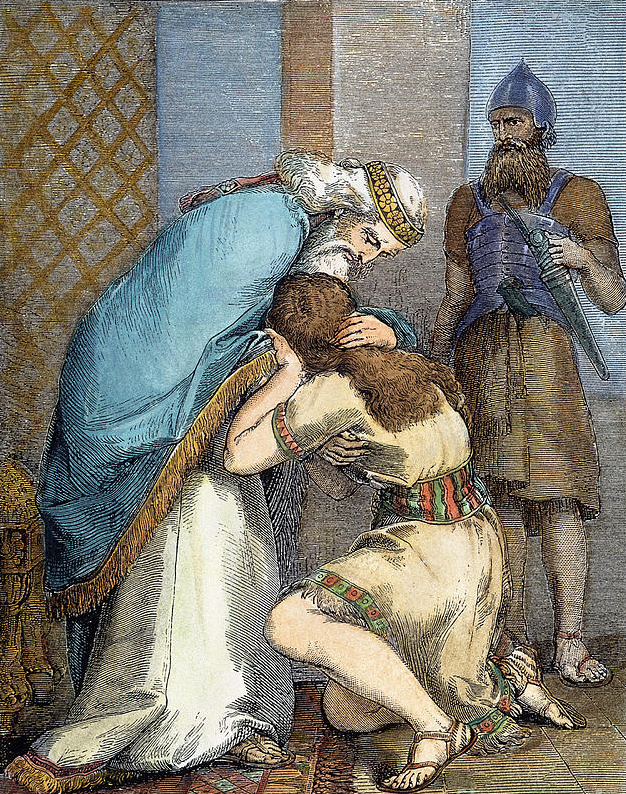
14:33 So Joab went to the king and told him this. Then the king summoned Absalom, and he came in and bowed down with his face to the ground [the posture of a servant] before the king. And the king kissed [indicates affection; gesture of peace and good will] Absalom.