Matthew 4:1-11
4:1 Then [immediately (Mark 1:12) following His baptism; after the heavens opened, the Spirit descended, and the Father affirmed His identity — divine approval was followed by divine testing] Jesus was led [not driven by accident; intentionally brought, guided with purpose; the wilderness was not outside God’s will but part of it] by the Spirit [the same Spirit who descended in affirmation led Jesus into testing; the Spirit leads not only into empowerment but into preparation through conflict] into the desert [desolate, solitary, stripped of distraction; the historic place of testing for Israel; the forty days echo Israel’s forty years; where Israel failed, Jesus would remain faithful] to be tempted [tested or tried; from Satan’s perspective, a temptation to cause failure; from God’s perspective, a test to prove faithfulness; the same event with two different intents; temptation often follows a commitment to obey/serve God; spiritual victory often followed by spiritual conflict; temptation tries to divert us from God and what He has called us to do; see Hebrews 4:15] by [points to source of temptation] the devil [diabolos — the slanderer, the accuser; a personal adversary].
Note: The late evangelist Angel Martinez once said: After the baptism came the battle. After the dove came the devil. After the voice from heaven came the roar from hell.
4:2 After fasting [helps individual draw near to and focus on God] forty days and forty nights, he was hungry [famished; result of fast; Satan attacked Jesus at vulnerable point].
Note: Other biblical events occurred in time periods involving the number forty.
• The Flood Genesis 7:12
• Moses on Mount Sinai Exodus 24:18
• Wilderness wandering Deuteronomy 8:2
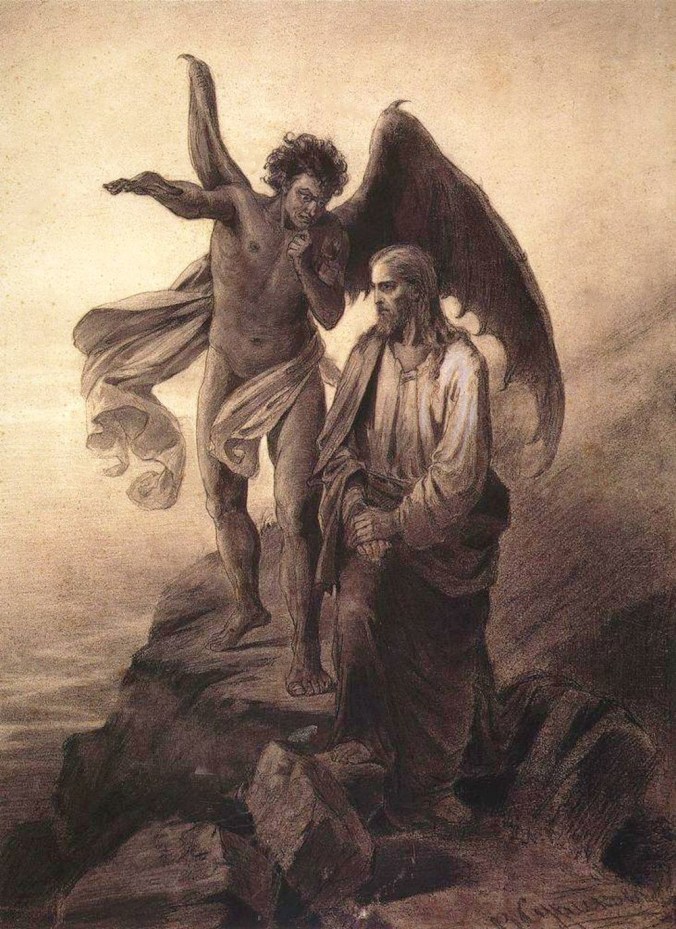
4:3 The tempter [emphasizes a function of the devil] came to him and said, “If [does not express doubt; first class condition in Greek construction: the reality of a condition affirmed from viewpoint of the speaker; can be translated “since”] you are the Son of God [same title for Jesus used at His baptism (cf. Matt. 3:17)], tell these stones to become bread.”
4:4 Jesus answered [cf. Deut. 8:3], “It is [stands] written: ‘Man does not live on bread alone [people do need bread or physical nourishment; cf. Matt. 6:11], but [cannot depend solely on own resources; people have greater need for spiritual nourishment] on every word that comes from the mouth of God.’”
4:5 Then the devil took [to lead] him to the holy city [Jerusalem] and had him stand on the highest point [pinnacle or summit; portico on southeast corner of temple complex; about 450 feet high] of the temple.
4:6 “If [since] you are the Son of God,” he said, “throw yourself down [temptation to misuse/abuse power available to Him; a presumptuous act rather than a great act of faith]. For it is written [devil quoted but twisted the meaning of Ps. 91:11-12 to suit his purposes; this passage not a license to abuse God’s power to satisfy a personal whim]: “‘He will command his angels [messengers] concerning you, and they will lift you up in their hands, so that you will not strike your foot against a stone [a spectacular rescue would have impressed the masses].’”
4:7 Jesus answered him [cf. Deut. 6:16], “It is also written: ‘Do not put the Lord your God to the test [to put on a decisive test].’”
4:8 Again, the devil took him to a very high mountain and showed him all the kingdoms of the world and their splendor [brightness, glory].
4:9 “All this I [cf. Jn. 12:31; 1 Jn. 5:19] will give you [resulting in instant power, authority, wealth apart from the suffering of the cross],” he said, “if [condition] you will bow down and worship me.”
4:10 Jesus said [cf. Deut. 6:13] to him, “Away from me, Satan [adversary]! For it is written: ‘Worship the Lord your God, and serve him only.’”
4:11 Then the devil left him [“until an opportune time” (Lk. 4:13); Satan continued to tempt Jesus (cf. Matt. 16:23; 26:36-46)], and angels [Ps. 103:20-21] came and attended him.
Matthew 4:18-20
4:18 As Jesus was walking beside the Sea of Galilee, he saw two brothers, Simon called Peter [cf. Jn. 1:42] and his brother Andrew. They were casting a net [two kinds of nets used by fishermen: a circular casting net (used while standing in the water) and a dragnet (used from a boat)] into the lake, for they were fishermen [commercial fishermen who earned their living by selling their catch].
4:19 “Come [a decisive summons; not a suggestion but a command requiring movement; Jesus initiates the relationship], follow me [literally “come behind Me”; attach your life to Mine; adopt My direction, submit to My authority, conform to My way of life],” Jesus said, “and I will make you [to make, form, fashion intentionally over time; implying process, shaping, and transformation rather than instant promotion; indicates that Jesus Himself would equip them for the work to which He was calling them; Jesus cannot make or form you into anything apart from a commitment to follow Him; the journey toward the realization of our fullest potential begins when we follow Him] fishers of men [a redeemed vocation; Jesus used the figure of their old work to describe their new calling; instead of dragging the Sea of Galilee for fish these men would now cast their nets into “the sea of sin” to “rescue the perishing”].”
4:20 At once [their response was immediate] they left their nets [represented their livelihood and security] and followed him [and by so doing their lives took on an eternal dimension; instead of making a living, they would now be making a life].
 Bible Teaching Notes