Genesis 12

Note: Genesis 1-11 is the story of God’s dealings with humanity at large. Genesis 12 begins the story of God’s dealing with one man and his family. The rest of the Bible is the unfolding of that story.

12:1 The LORD [YHWH; the covenant name of God; self-existent, sovereign, personal; the initiative in salvation and calling always begins with Him] had said [indicates prior divine revelation; God had already spoken before Abram moved; obedience is rooted in received revelation, not impulse] to Abram [means “exalted father” though he had no child; name changed to Abraham in Gen. 17:5; God often calls a man into a future that contradicts his present reality; he was 75 years old at the time God called him], “Leave [an emphatic, personal command—“go for yourself”; decisive, forward movement required; faith acts before it sees] your country [Haran (Gen. 11:31); leave national identity and geographic security; surrender what is familiar and politically protective], your people [separate from clan structures and inherited support systems; obedience may require relational risk] and your father’s household [the deepest layer of stability—inheritance, tradition, authority, generational worldview; covenant identity demands greater allegiance than family loyalty] and go to the land [destination unnamed; God gives direction without full disclosure; clarity unfolds progressively] I will show you [future promise of revelation; guidance is promised, but not preloaded; obedience precedes detailed understanding; cf. Heb. 11:8; Canaan].

Note: Is there something in your life that you know God wants you to do but you have not done yet? What steps can you take to obey God?

12:2 [note sevenfold promise, challenge, blessing][1] I will make you into a great nation [a reference to Israel] and [2] I will bless you; [3] I will make your name great [refers to respect accorded by Jews and Christians and Muslims], and [4] you will be a blessing [literally “be a (channel of) blessing”].

12:3 [5] I will bless those who bless you, and [6] whoever curses you I will curse; and [7] all peoples on earth will be blessed through you [Jesus descended from Abraham (Matt. 1:1) and the seed through whom promises are fulfilled (Gal. 3:16)].”

12:4 So Abram left, as the LORD had told him; and Lot went with him. Abram was seventy-five years old [we are never too old to obey the Lord] when he set out from Haran.

12:5 He took his wife Sarai, his nephew Lot, all the possessions they had accumulated and the people they had acquired in Haran, and they set out for the land of Canaan, and they arrived there.

12:6 Abram traveled through the land as far as the site of the great tree of Moreh at Shechem. At that time the Canaanites were in the land.

12:7 The LORD appeared to Abram [he found God’s presence in new surroundings; cf. Ps. 139:7] and said, “To your offspring I will give this land.” So he built an altar [cf. Gen. 12:6-7; 13:4; 13:18; 22:9; 26:25 for info on other altars Abram built or at which he worshiped] there to the LORD, who had appeared to him.

12:8 From there he went on toward the hills east of Bethel and pitched his tent, with Bethel on the west and Ai on the east. There he built an altar to the LORD and called on the name of the LORD.

12:9 Then Abram set out and continued toward the Negev.

12:10 Now there was a famine in the land, and Abram went down to Egypt [occupants of Canaan likely also migrated to Egypt to find food for themselves and their animals] to live there for a while because the famine was severe.

12:11 As he was about to enter Egypt, he said to his wife Sarai [note that the Bible makes absolutely no attempt to cover up Abram’s shortcomings but rather presents him as a real person], “I know what a beautiful woman you are.

12:12 When the Egyptians see you, they will say, ‘This is his wife.’ Then they will kill me but will let you live.

12:13 Say you are my sister, so that I will be treated well for your sake and my life will be spared because of you.”

12:14 When Abram came to Egypt, [1] the Egyptians saw that she was a very beautiful woman.

12:15 And when Pharaoh’s officials saw her, [2] they praised her to Pharaoh, and [3] she was taken into his palace [to become a member of his harem].

12:16 He treated Abram well [cf. Gen. 12:13] for her sake, and Abram acquired sheep and cattle, male and female donkeys, menservants and maidservants, and camels [indication that Pharaoh viewed Abram as a nobleman; may possibly be a dowry for Sarai].

12:17 But the LORD [intervened to rescue Sarai and protect Abram] inflicted serious diseases [or plagues] on Pharaoh and his household because of Abram’s wife Sarai.

12:18 So Pharaoh summoned Abram. [1] “What have you done to me? [a question concerning the diseases inflicted on Pharaoh and his household]” he said. [2] “Why didn’t you tell me she was your wife? [a question concerning Abram’s motives]

12:19 [3] Why did you say, ‘She is my sister,’ so that I took her to be my wife? [a question concerning Abram’s morality] Now then, here is your wife. Take her and go!”

12:20 Then Pharaoh gave orders about Abram to his men, and they sent him on his way, with his wife and everything [including the gifts (cf. 12:16) given to him by Pharaoh] he had.

Genesis 9

Genesis 9:1-17
9:1 Then God blessed Noah and his sons [cf. divine blessing in Gen. 1:28], saying [God’s blessing was followed by a command] to them, “Be fruitful and increase in number and fill the earth.

Noah and his family represented the hope of a new beginning for humanity. In the same way in which God had blessed Adam and Eve (see Gen. 1:28), God blessed Noah and his sons. God also gave them the same charge He had given Adam and Eve — to reproduce and fill the earth. Noah was like a “second Adam” whom God would use to usher in a fresh start for the human race. His sons and their wives would repopulate the planet.

Ultimately the Messiah, whose coming was foretold in Genesis 3:15, would come from the line of Abraham who had come from the line of Noah’s son Shem. When we look back and connect the dots, they eventually lead us to the eight human beings who survived the Flood aboard the ark.

9:2 The fear and dread of you will fall upon all the beasts of the earth and all the birds of the air, upon every creature that moves along the ground, and upon all the fish of the sea; they are given into your hands.

9:3 Everything that lives and moves will be food for you. Just as I gave you the green plants [cf. Gen. 1:29-30], I now [after the flood] give you everything [human beings were allowed to add meat to their diet].

9:4 “But you must not [important prohibition that applied to all people and was permanently binding] eat meat that has its lifeblood [blood equated with life itself] still in it [see Lev. 17:10-14; Deut. 12:23 for God’s reason for this restriction].

9:5 And for your lifeblood I will surely demand an accounting [threefold use of these words emphasize God’s attitude about the taking of a human life]. I will demand an accounting from every animal [e.g., Ex. 21:28-29]. And from each man, too, I will demand an accounting for the life of his fellow man.

Note: What are you doing in your family to help promote respect for human life? Are your attitudes and actions regarding the value of all created life consistent with biblical teachings, including the truths contained in God’s covenant with Noah?

9:6 “Whoever sheds the blood of man, by man [cf. Rom. 13:1-4] shall his blood be shed [offender’s punishment must be in proportion to the crime; sometimes referred to as lex talionis (Latin) or “law of retaliation”]; for in the image of God has God made man.

9:7 As for you [Noah and his family], be fruitful and increase in number; multiply on the earth and increase upon it.”

9:8 Then God said to Noah and to his sons with him:

9:9 “I now establish [“to make stand something previously instituted”] my covenant [basic meaning is “obligation” (in this particular covenant God placed an obligation to His creation on Himself)] with you and with your descendants after you [God’s covenant commitment was universal and inclusive]

9:10 [God’s covenant commitment extended to animal life as well] and with every living creature that was with you—the birds, the livestock and all the wild animals, all those that came out of the ark with you—every living creature on earth.

9:11 I establish my covenant with you: Never again [an expression of grace] will all life be cut off by the waters of a flood; never again will there be a flood [a universal flood (not a reference to localized flooding)] to destroy the earth.”

God had told Noah before the Flood that He would establish a covenant with him (see Gen. 6:18) but waited until after the Flood to reveal the details of that covenant. Theologians refer to this as the Noahic Covenant — a binding agreement between God and Noah and “all future generations” (Gen. 9:12).

In this covenant, God promised that He would never again use a flood to destroy all life on the earth. The words “never again” are repeated three times (see Gen. 9:11,15) for emphasis. God did not say that He would never again judge people for their sins but instead that He would never again use a universal flood as a form of judgment.

Unlike other covenants in the Bible, this particular covenant is unconditional. God did not require humanity to do anything in order for Him to keep His promise.

9:12 And God said, “This is the sign [visible symbol; a sign is designed to point beyond itself, not to itself] of the covenant [the obligations and promises God had made to Noah] I am making between me and you and every living creature with you, a covenant for all generations to come [i.e., forever or as long as the earth exists]:

9:13 I have set my rainbow [“a bridge of beauty that joins heaven and earth” (Wiersbe)] in the clouds, and it will be the sign of the covenant between me and the earth.

God often included visible signs to help His people remember His covenants. Circumcision, for example, was the sign of the covenant between God and Abraham (see Gen. 17:11). God designated the bow as the sign or pledge of His covenant with Noah.

The bow is a symbol of warfare and destruction. After the Flood, however, God put down His bow and turned it into a symbol and guarantee of peace. God placed His bow in the clouds as a visible reminder that He would never again destroy all flesh with a universal flood.

Interestingly, the bow is pointed upward to heaven and not downward to the earth, toward those who deserve judgment. The appearance and position of the rainbow is a reminder to all mankind of God’s gracious promise to Noah. God’s promise, however, extended beyond Noah and his family to include all future generations — an indication that His covenant is an enduring and unending one with every living creature. The phrase every living creature includes more than people. It also includes all of the animals that Noah had cared for on the ark and that later multiplied and filled the earth.

Note: What thoughts do you have when you see a rainbow? What do you imagine God thinks?

9:14 Whenever I bring clouds over the earth and the rainbow appears in the clouds,

9:15 I will remember my covenant between me and you and all living creatures of every kind. Never again will the waters become a flood to destroy all life.

God assured Noah that every time the bow appears in the clouds He would remember His covenant. This, of course, does not suggest that God forgets or needs to be reminded of His covenant with Noah. The phrase I will remember is instead a way to assure human beings that they do not need to be afraid that God will break His promise.

God promised Noah that water will never again become a deluge to destroy all flesh. God keeps His promises. And, because the Noahic Covenant is unconditional, we can count on God to do what He said He will do. He is utterly reliable and faithful.

A rainbow is indeed a beautiful sign displayed in a place where it can be seen by all. Scientists have discovered that a rainbow is caused by light filtering through rain droplets in the air. These droplets become a prism that separates sunlight into the seven colors of the spectrum. The Apostle Peter would later write about “the varied” or many-colored “grace of God” (1 Peter 4:10). The rainbow is a reminder of the beauty of God’s grace and His faithfulness to keep His promise to Noah and every succeeding generation.

9:16 Whenever the rainbow appears in the clouds, I will see it and remember the everlasting covenant between God and all living creatures of every kind on the earth.”

Whenever we see a rainbow in the clouds we should remember that God also sees the same rainbow. When God sees the rainbow He remembers the everlasting covenant He made with all the living creatures on the earth. We too should remember and reflect on God’s goodness and the opportunities He offers to all who need to make a fresh start.

9:17 So God said [cf. 9:12] to Noah, “This is the sign of the covenant I have established [a completed action that continues in force] between me and all life on the earth.”

Genesis 8

At one time or another every person finds themselves in a place where they long for a fresh start, a second chance, a new beginning. Fresh starts have a way of invigorating us with a resolve to do better. Fresh starts remind us that while past failures may be devastating they do not have to defeat or ultimately define us.

We always encounter fresh starts at the intersection between the actualities of the past and the possibilities of the future. When we mess up we can’t go back and start again, but we can make a fresh start from where we are that will lead us to a better ending.

Fresh starts often mean going through an interim period — one of those in-between times of life when we find ourselves between what was and what may be. These can easily be some of the most difficult yet some of the best days of our journey. In-between days offer us the opportunity to consider or reconsider what the future can look like.

Noah and his family experienced more than a year’s worth of in-between days when they lived in the ark with the animals. These were likely days of reflecting on the catastrophic events that had wiped the earth clean of sinful humanity and considering what the future would look like.

When the ark finally came to rest on dry ground, Noah and his family embraced the opportunity to make a fresh start. They left the security of the vessel that had carried them to safety and stepped across the threshold to a place of beginning again.

THE CONTEXT
Noah and his family spent more than a year in the ark. After it stopped raining, the waters began to slowly recede over a period of several months and then the ark came to rest on the mountains of Ararat. A short time later, Noah sent out a dove to search for dry land. When the dove returned from one of its reconnaissance flights with an olive leaf in its mouth, Noah knew that the waters had subsided. A week later he sent the dove out once again but it did not return. Noah remained in the ark until God instructed him to leave. When Noah again stood on dry ground, he built an altar and sacrificed some of the clean animals to the Lord.

God charged Noah and his family with the responsibility of multiplying and filling the earth. And, for the first time, God gave human beings permission to eat the flesh of animals. He also affirmed the sanctity of human life, condemned the act of murder, and warned that those who take another human life will be held accountable. God then revealed to Noah the nature of His covenant. He explained that the rainbow would become the universal symbol of His promise to never again send a universal flood.

When life returned to normal, Noah became a farmer and planted a vineyard. On one occasion he became drunk and lay naked in his tent. His son Ham found him in this embarrassing state and, rather than covering his father, reported it to his brothers. Ham’s brothers honored their father by not looking upon his nakedness but instead placing a cover on him. When Noah awoke, he blessed his two oldest sons but cursed Ham for what he had done. Noah lived another 350 years after the flood.

8:1 But God remembered Noah and all the wild animals and the livestock that were with him in the ark, and he sent a wind over the earth, and the waters receded.

8:2 Now the springs of the deep and the floodgates of the heavens had been closed, and the rain had stopped falling from the sky.

8:3 The water receded steadily from the earth. At the end of the hundred and fifty days the water had gone down,

8:4 and on the seventeenth day of the seventh month the ark came to rest on the mountains of Ararat.

8:5 The waters continued to recede until the tenth month, and on the first day of the tenth month the tops of the mountains became visible.

8:6 After forty days Noah opened a window he had made in the ark

8:7 and sent out a raven, and it kept flying back and forth until the water had dried up from the earth.

8:8 Then he sent out a dove to see if the water had receded from the surface of the ground.

8:9 But the dove could find nowhere to perch because there was water over all the surface of the earth; so it returned to Noah in the ark. He reached out his hand and took the dove and brought it back to himself in the ark.

8:10 He waited seven more days and again sent out the dove from the ark.

8:11 When the dove returned to him in the evening, there in its beak was a freshly plucked olive leaf! Then Noah knew that the water had receded from the earth.

8:12 He waited seven more days and sent the dove out again, but this time it did not return to him.

8:13 By the first day of the first month of Noah’s six hundred and first year, the water had dried up from the earth. Noah then removed the covering from the ark and saw that the surface of the ground was dry.

8:14 By the twenty-seventh day of the second month the earth was completely dry.

8:15 Then God said to Noah,

8:16 “Come out of the ark, you and your wife and your sons and their wives.

8:17 Bring out every kind of living creature that is with you—the birds, the animals, and all the creatures that move along the ground—so they can multiply on the earth and be fruitful and increase in number on it.”

8:18 So Noah came out, together with his sons and his wife and his sons’ wives.

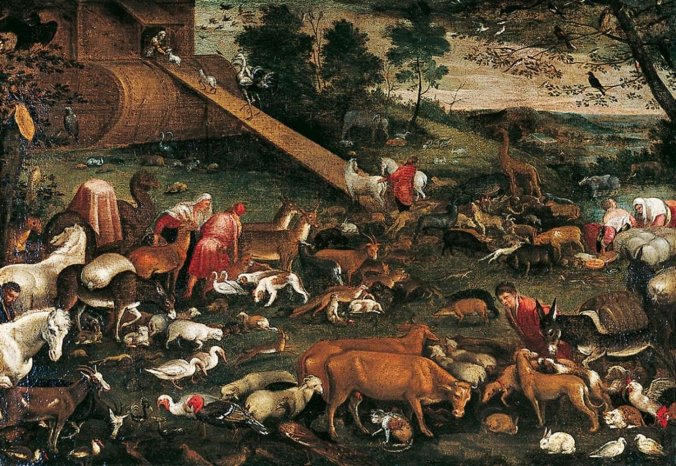
8:19 All the animals and all the creatures that move along the ground and all the birds—everything that moves on land—came out of the ark, one kind after another.

Noah’s time aboard the ark is framed by two commands from God. When the time of judgment was near, God commanded Noah and his family to “enter the ark” (Gen. 7:1). Over the next week they welcomed the animals on board. Then God shut the only door on the vessel that would preserve the lives of Noah, his family, and the animals.

A little more than a year later, after the waters had receded, God commanded Noah to come out of the ark. Although Noah had sent out a dove from the ark to search for dry land, he waited until God affirmed that it was safe for him to disembark. His life illustrates what it means to trust and to patiently wait upon the Lord.

After God had created the animals in the beginning, He commanded them to multiply and fill the earth. The Flood, however, had destroyed every living creature with the exception of the fish. The animals on the ark were God’s provision for again populating the planet with animal life. Noah patiently waited until God told him it was safe to take the animals off the ark. Too much was at stake to risk disembarking early. The loss of certain animals could have compromised the survival of a particular species.

A year earlier, the animals had entered the ark two by two (Gen. 7:9). When they exited the ark they did so after their kinds or by their groups. This phrase suggests that the animals exited in an orderly fashion.

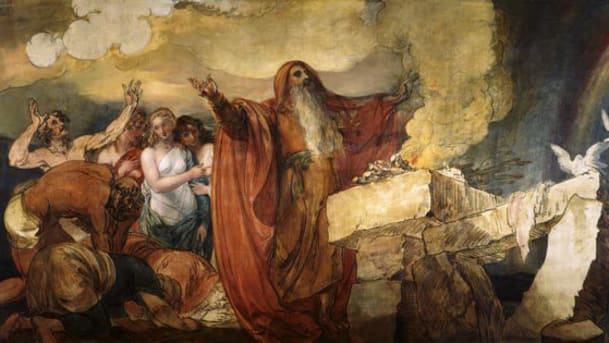
8:20 Then [after Noah, his family, and the animals came out of the ark] Noah built [the first thing that Noah did on dry ground] an altar [no record that anyone had ever built an altar before; “altar” means “place of slaughter”] to the LORD and, taking some of all the clean animals and clean birds, he sacrificed [in order to show his gratitude to God] burnt offerings [wholly consumed on the altar to symbolize the entire consecration of the sacrifices to God] on it.

The first thing that Noah did when he came out of the ark and again stood on dry land was to build an altar to the Lord. This is the first mention of the word altar, a place of sacrifice, in the Bible. Noah took some of the clean animals and birds and offered them as burnt offerings on the altar.

This is also the first mention of a burnt offering in the Bible — a type of offering that was completely consumed by fire. Like Abel before him (see Gen. 4:4), Noah offered the Lord the very best. The fact that he offered animal sacrifices indicates that the animals had reproduced while on the ark. Sacrificing any of these particular animal would not have threatened the survival of their respective species.

Noah’s sacrifice was an act of worship. As the head of his home, he demonstrated for his family members the priority of worshiping and praising God. His sacrifice was also an expression of his gratitude to God for bringing him and all on board the ark safely through the Flood.

We should always acknowledge the goodness and kindness of God when we worship Him. Additionally, Noah’s sacrifice was a sign of his devotion to God. Noah had demonstrated his commitment to God’s purposes throughout the years he had spent building the ark and witnessing to those around him. He would continue to love and serve God after the Flood as he had before the first drops of rain splashed onto the roof of the ark.

8:21 The LORD smelled the pleasing aroma [i.e., God was pleased with what Noah had done and accepted his sacrifice] and said in his heart [or “to Himself”]: “[1] Never again will I curse the ground because of man, even though [note that the flood did not change human nature] every inclination of his heart is evil [bad, miserable] from childhood. And [2] never again will I destroy all living creatures, as I have done.

The Lord smelled the pleasing aroma of Noah’s sacrifice. This is an indication that He was pleased with Noah and found his sacrifice acceptable. We too tend to lean toward smells that are pleasing and distance ourselves from those that are not. To refuse to smell something shows our displeasure with that particular thing (see Lev. 26:31). The Apostle Paul would later refer to the death of Christ on the cross as “a fragrant offering to God” (Eph. 5:2), an indication that God was pleased with Christ’s sacrifice.

The Lord said that, in spite of humanity’s inclination toward evil, He would never again curse the ground because of man. Previously God had cursed the ground because of Adam (see Gen. 3:17) and also after Cain had murdered his brother Abel (see Gen. 4:11-12). Had God chosen to curse the ground again it would have made it even more difficult for humanity to eke out a living. God’s decision to not curse the ground and add to humanity’s affliction was an expression of His kindness. The Lord also determined that He would never again send a universal flood as a form of judgment — yet another expression of His grace.

8:22 “[3] As long as the earth endures, [note the seasons that mark the flow of time…] seedtime and harvest, cold and heat, summer and winter, day and night will never cease.”

The cataclysmic flood had disrupted the normal rhythm of the seasons. While the floodwaters covered the earth, there was no seedtime and harvest — both essential for the sustenance of human life. Planting and harvesting, interrupted for the duration of the Flood, are activities that are dependent on the seasons and the weather. After the Flood, God reaffirmed that the seasons would return to their normal cycles and would never again be interrupted. Humanity would be able to plant, grow, and harvest the crops needed in order to survive.

Genesis 7

Genesis 7:1-5
7:1 The LORD then said to Noah, “Go into the ark, you and your whole family, because I have found you righteous in this generation.

7:2 Take with you seven [seven pairs of clean animals; they were used for sacrifices after the flood (cf. Gen. 8:20)] of every kind of clean animal, a male and its mate, and two of every kind of unclean animal, a male and its mate,

Note: Read Leviticus 11 concerning clean and unclean animals.

7:3 and also seven of every kind of bird, male and female, to keep their various kinds alive throughout the earth.

7:4 Seven days from now I will send rain on the earth for forty days and forty nights, and I will wipe from the face of the earth every living creature I have made.”

7:5 And Noah did all that the LORD commanded him [reaffirms the statement in 6:22].

Note: What do you think it cost Noah to be obedient to God? Do you think it ever costs you to be faithful to God? How?

7:6 Noah was six hundred years old when the floodwaters came on the earth.

7:7 And Noah and his sons and his wife and his sons’ wives entered the ark to escape the waters of the flood.

7:8 Pairs of clean and unclean animals, of birds and of all creatures that move along the ground,

7:9 male and female, came to Noah and entered the ark, as God had commanded Noah.

7:10 And after the seven days the floodwaters came on the earth.

7:11 In the six hundredth year of Noah’s life, on the seventeenth day of the second month–on that day all the springs of the great deep burst forth, and the floodgates of the heavens were opened.

7:12 And rain fell on the earth forty days and forty nights.

Noah faithfully called sinners to repentance throughout the hundred-plus years that he and his family spent building the ark. The Apostle Peter referred to Noah as “a preacher of righteousness” (2 Pet. 2:5). He stood courageously for God in the midst of a corrupt society. He spoke the truth even when it was unpopular to do so.

Apparently no one took Noah or his preaching seriously and no one responded to his call to repent. When God’s patience finally ran its course, the first drops of rain fell from the sky. The rains soon became torrential and mixed with the waters that burst forth from the springs below to create an inescapable and cataclysmic flood.

The first raindrops signaled that the time of judgement had arrived. Those who thought they had sinned with impunity, who had likely ridiculed Noah, and who had spurned repeated opportunities to repent, now faced certain death. There was no escape. As God had warned, every breathing creature would be wiped out from the face of the earth. Those who thought judgment would never come were mistaken. While the wheels of God’s justice sometime seem to move slowly, when they come they do grind finely.

The rain continued for 40 days and 40 nights. As soon as the ground became completely saturated, the water had nowhere to go but up! The “waters surged” or continued to rise for “150 days” (Gen. 7:24). The waters rose so high that they even covered the highest mountains (Gen. 7:20). After the waters peaked they slowly and steadily receded for the next 150 days (see Gen. 8:3) until the ark came to rest “on the mountains of Ararat” (see Gen. 8:4) in the region that is modern-day Turkey.

7:13 On that very day Noah and his sons, Shem, Ham and Japheth, together with his wife and the wives of his three sons, entered the ark.

7:14 They had with them every wild animal according to its kind, all livestock according to their kinds, every creature that moves along the ground according to its kind and every bird according to its kind, everything with wings.

God instructed Noah and his entire family to “enter the ark” (Gen. 7:1) seven days before the start of the rains (Gen. 7:4). Noah obeyed God and entered the ark with his wife, his sons, and his son’s wives — a total of eight individuals. Although they did not know how long they would live in the ark, they trusted God. One year and ten days later God would tell Noah and his family to “come out of the ark” (Gen. 8:15) — the vessel that had saved them from the flood.

The week before the rains came, Noah and his family welcomed male and female animals of every species aboard the ark. Noah did not have to go out and gather these creatures. God brought them to the ark. Noah situated all of these animals in their respective rooms on the various decks. This must have been a monumental task in itself.

Once all were safely aboard, God Himself shut the door of the ark and by so doing also took responsibility for those who remained outside the door and would perish in the floodwaters. No one outside the ark escaped God’s judgment. His mercy was found only within the ark. As the water began to rise, the ark began to float. All the earth was flooded, as God had said, as an act of His judgment. Noah and his family, however, were rescued as an act of God’s grace.

7:15 Pairs of all creatures that have the breath of life in them came to Noah and entered the ark.

7:16 The animals going in were male and female of every living thing, as God had commanded Noah. Then the LORD shut him in.

7:17 For forty days the flood kept coming on the earth, and as the waters increased they lifted the ark high above the earth.

7:18 The waters rose and increased greatly on the earth, and the ark floated on the surface of the water.

7:19 They rose greatly on the earth, and all the high mountains under the entire heavens were covered.

7:20 The waters rose and covered the mountains to a depth of more than twenty feet.

7:21 Every living thing that moved on the earth perished–birds, livestock, wild animals, all the creatures that swarm over the earth, and all mankind.

7:22 Everything on dry land that had the breath of life in its nostrils died.

7:23 Every living thing on the face of the earth was wiped out; men and animals and the creatures that move along the ground and the birds of the air were wiped from the earth. Only Noah was left, and those with him in the ark.

7:24 The waters flooded the earth for a hundred and fifty days.

Genesis 6

From bad to worse! These words are perhaps the best way to summarize the progress made by humanity after the Fall. Once sin had entered into the world, human beings quickly advanced backwards! They became increasingly preoccupied with finding new ways to sin and collectively moved in a direction that took them farther away from God and all the goodness that is found in Him. Instead of becoming more like God, as the serpent had promised Eve, human beings became more and more unlike God, or ungodly.

Sin had quickly made a mess of things after the Fall. When people get caught up in sin they often lose sight of two things. First, no one is exempt from the consequences of sin. Sin does not discriminate — it is an equal opportunity destroyer. Second, sin must be judged. God cannot look the other way when it comes to sin. Because He is holy He must judge sin and, by so doing, keep it in check.

Noah lived in what may have been the most corrupt and sinful period in human history. By the time Noah was born the earth had already been inundated by the floodwaters of sin. And, those waters continued to rise throughout the period that Noah and his family constructed the ark. Finally, God decided that he would flood the earth and start over with a clean slate — Noah and his family. God would save a remnant in order to repopulate the earth and begin anew.

The Context
Adam and Eve obeyed God’s command to multiply and fill the earth. The names of their descendants are recorded in Genesis 5. As the population of the earth increased, so did the wickedness of mankind. Adam and Eve’s son Cain was the first to commit a senseless act of violence but would not be the last to do so. Many others followed after him. The wicked and evil deeds of mankind became so widespread that God was sorry that He had made man. God was so grieved that He decided to wipe every living creature off the face of the earth and begin anew.

In the midst of all the wickedness that filled the earth, God noticed a man named Noah. Unlike his contemporaries, Noah was a righteous and blameless man. He sought to please God and to walk with Him. God told Noah of His plan to wipe all flesh from the face of the earth with the exception of him and his family. He told Noah to build an ark, the vessel that would preserve Noah and his family from the coming judgment. By faith, Noah and his family trusted God and spent the next 120-years constructing the ark. During that period, God gave the world ample opportunities to be saved. The world, however, refused Noah’s witness.

Once completing construction of what was the largest vessel of his time, Noah and his family had one week to load the ark. As part of His divine plan for beginning anew, God brought male and female of every living species to the ark. God would use Noah and his family to repopulate the earth and the animals to do the same. When Noah and his family were safely abroad the ark, God Himself shut the door. Once the door was shut it began to rain. The rains continued for the next forty days and forty nights and flooded the earth. As God had promised, only Noah and his family escaped the flood. All other living creatures perished.

6:1 When men began to increase in number on the earth and daughters were born to them,

6:2 the sons of God saw that the daughters of men were beautiful, and they married any of them they chose.

6:3 Then the LORD said, “My Spirit will not contend with man forever, for he is mortal; his days will be a hundred and twenty years.”

6:4 The Nephilim were on the earth in those days–and also afterward–when the sons of God went to the daughters of men and had children by them. They were the heroes of old, men of renown.

6:5 [what God saw] [note: underlined words describe the extent of humanity’s sin] The LORD saw [everything we do is in the sight of the Lord] how great man’s wickedness on the earth had become [sin left to itself gets worse and worse], and that every inclination [intent; imagination] of the thoughts of his heart was only evil all the time.

6:6 [what God felt] The LORD was grieved [a basic meaning of the verb is “to breathe strongly” (literally, God breathed a heavy sigh because of the sinful choices of humanity)] that he had made man on the earth, and his heart was filled with pain.

6:7 [what God decided] So the LORD said, “I will wipe [to blot out or to erase by washing] mankind, whom I have created, from the face of the earth—men and animals, and creatures that move along the ground, and birds of the air—for I am grieved that I have made them.”

6:8 But Noah [unlike sinful people around him; caught God’s attention because he was a righteous man in a wicked world; cf 2 Chron. 16:9a] found favor in the eyes of the LORD.

Note: What do you think it took for Noah to remain faithful to God when everyone around him was unfaithful?

6:9 This is the account of Noah. [note three important traits about Noah] [1] Noah was a righteous [Heb. saddiq which means to be continually righteous; right actions and right motives resulting from a right relationship with God] man, [2] blameless [Heb. word can also be rendered “whole” or “complete”; Noah was a man of integrity] among the people of his time, and [3] he walked [conduct or way of life] with [indicates a close, intimate relationship] God [Noah’s good life flowed out of a right relationship with God].

Note: What set Noah apart from the rest of humanity? What three traits stand out as people examine your character? Do others view you as a person who does right for the right reasons? Do others view you as a person of integrity? Do others view you as an individual who consistently walks with God?

6:10 Noah had three sons: Shem, Ham and Japheth.

6:11 Now the earth was corrupt in God’s sight and was full of violence.

The single spark of Adam and Eve’s sin ignited a wildfire that soon raged out of control. As humans multiplied and filled the earth, their wickedness also increased, spread, and soon reached an intolerable level. People did not live in harmony but instead hurt and abused one another. As a result, the earth was corrupt and filled with violence — an indication of what happens when people no longer fear God or respect His commands.

Sin always strains relationships, promotes selfishness, separates people from each other, destroys what is good, and minimizes God’s influence. As a result of the growing sin of humanity, creation faced God’s certain judgment.

6:12 God saw how corrupt the earth had become, for all the people on earth had corrupted [verb means “ruin” or “spoil”] their ways.

The corruption and violence that filled the earth was the legacy of people who thought of “nothing but evil all the time” (Gen. 6:5). What a difference sin had made in the world in such a short span of time. Sin had damaged everything that God had created and once declared good. However, neither “man’s wickedness” (Gen. 6:5) nor the corruption and violence that filled the earth escaped God’s notice.

Everything that human beings do, whether good or evil, is always done “in God’s sight” (Gen. 6:11). He pays attention to what we do (see Ps. 139:1-4). No one ever does anything behind God’s back and no one ever sins with impunity. God will ultimately “bring every act to judgment” (see Ecc. 12:14).

6:13 So God said to Noah [first mention of God speaking directly to Noah], “I am going to put an end to all people, for the earth is filled with violence [refers to the severe treatment of others, often involving physical harm] because of them. I am surely going to destroy both them and the earth.

Noah’s corrupt and violent society had presumed upon the patience of God. The time came, however, when God finally said, “Enough is enough!” Any society marked by corruption and violence is offensive to God and in danger of His judgment. As a result of the growing sin of humanity, creation faced God’s judgment.

God however, extended grace to Noah and his family. Noah was a man whose righteousness set him apart from the wickedness that characterized his contemporaries. He was neither sinless nor perfect but instead had qualities that found him favor with God. He was the first to know that God’s judgment was on its way, that God would put an end to all flesh.

6:14 So make yourself an ark [basic meaning is “box”] of cypress [or possibly pine; also translated “gopher”] wood; make rooms in it and coat it with pitch [used to make the vessel watertight] inside and out.

God instructed Noah to build an ark — essentially something that looked like a floating box. Noah was to construct the ark from gofer wood. While this type of wood remains a mystery, some scholars suggest the word refers to cypress wood, commonly used in ship building. Others think it refers to the shape of the wood rather than the type of wood. The important thing to keep in mind is that regardless of the type or shape of gofer wood, it was a material suitable for building a seaworthy vessel. Because the ark would house many animals, God told Noah to make rooms in the ark and then to make it waterproof by sealing it with pitch, a tar-like substance.

Note: What do you think was the biggest obstacle Noah faced in building the ark? What obstacles keep you from being more obedient to God?

6:15 This is how you are to build it: The ark is to be 450 feet long, 75 feet wide and 45 feet high.

God gave Noah specific instructions regarding the length, width, and height of the ark. Noah followed God’s instructions to the inch. According to the dimensions, the ark was a boxy vessel designed for flotation instead of navigation. While the dimensions of the ark are not big compared to today’s ships, the size of this vessel was enormous by ancient standards. The ark would have been about half the length of a ship the size of the Titanic. The boxy design maximized the interior space and provided adequate room for Noah and his entire family and all of the animals with them.

6:16 Make a roof for it and finisH the ark to within 18 inches of the top. Put a door in the side of the ark and make lower, middle and upper decks.

6:17 I am going to bring floodwaters on the earth to destroy all life under the heavens, every creature that has the breath of life in it. Everything on earth will perish.

The ark had lower, middle, and upper decks of compartments to house the animals as well as Noah and his family. The vessel was well-ventilated all the way around under the roof line — an important consideration because of all of the animals on board. This gap also allowed natural light to filter in to the upper deck.

A single door on the side was the only entrance and exit. When the rains finally came and Noah and his family were safely aboard the ark, God Himself shut the door (see Gen. 7:16). The ark is a type of Christ. Like the single door on the ark, Jesus referred to Himself as “the door of the sheep” (John 10:7) as well as the only way to the Father (see John 14:6). Just as God provided the ark to save Noah and his family, God has made provision for salvation through Jesus Christ for all who believe and take refuge in Him.

Noah and his family likely spent as many as 120 years building the ark (see Gen. 6:3). Throughout those years, Noah remained steadfast to the task because he had faith that what God had told him about the coming deluge was true (see Heb. 11:7). God had revealed to Noah that He would bring floodwaters that would destroy every living, breathing creature — including humans, animals, and birds. Apparently, creatures of the sea were excluded. This deluge was God’s judgment on evil that had completely saturated and corrupted the earth. When the floodwaters finally came, they confirmed Noah’s faith as well as His faithfulness to follow God’s instructions.

6:18 But I will establish my covenant with you, and you will enter the ark–you and your sons and your wife and your sons’ wives with you.

Only Noah, his family, and the animals in the ark would be spared from the coming deluge. God would later bless Noah and his sons and tell them to “multiply and fill the earth “ (Gen. 9:1). The animals on the ark would also reproduce and fill the earth.

For the first time in human history, God established a covenant with a man. This is also the first time the word covenant is used in the Bible. A covenant is a solemn agreement between two parties in which each party is under obligation to perform his part. Covenants generally included conditions, benefits, and promises. God later revealed the details of this covenant after Noah and his family left the ark (see Gen. 8:20-9:17).

6:19 You are to bring into the ark two of all living creatures, male and female, to keep them alive with you.

6:20 Two of every kind of bird, of every kind of animal and of every kind of creature that moves along the ground will come to you to be kept alive.

6:21 You are to take every kind of food that is to be eaten and store it away as food for you and for them.”

6:22 Noah [willingly followed God’s call; no hint of reservation on his part to follow God’s instructions; referred to as “a preacher of righteousness” in 2 Peter 2:5 (cf. Lk. 17:26-27)] did [Noah’s faithfulness seen in what he did] everything [Noah was not selective in his obedience] just as God commanded him.

Note: In what area of your life is God testing your obedience? How are you responding to the test?


Genesis 4

Genesis 4:1-16
4:1 Adam lay [means “know” (a common idiom for sexual relations)] with his wife Eve [name means “living” or “life”; cf. Gen. 3:20], and she became pregnant and gave birth [from Heb. qanah] to Cain [Heb. qayin (sounds like Heb. word for birth)]. She said, “With the help of [together with] the LORD [acknowledgment that God is the ultimate source of life; cf. Acts 17:12] I have brought forth [Heb. qaniti] a man.”

4:2 Later she gave birth to his brother Abel [means “breath” or “temporary”; a name that foreshadowed this child’s fate]. Now Abel [a shepherd] kept flocks, and Cain [a farmer] worked the soil.

4:3 In the course of time [phrase suggests Cain and Abel established in their respective vocations] Cain brought some of the fruits [does not say that he brought “first fruits” or first results of his harvest (which could only be offered at certain times of the year), a practice later commanded of Israel (Ex. 23:16,19; Neh. 10:35)] of the soil [possibly a grain offering; cf. Ex. 22:29-30] as an offering [general term for a present or tribute to God; similar to first fruits Israelites presented to God (Deut. 26:2-4)] to the LORD.

Note: The Scripture is silent concerning…
• when and why this first act of worship occurred.
• whether this act of worship was commanded by God or spontaneous.
• whether Adam had made similar offerings.
• the exact purpose of the offerings (e.g. to atone for sins or to accomplish some other purpose).

4:4 But Abel brought [cf. Heb. 11:4; Matt. 23:35] fat portions [the choicest portions] from some of the firstborn [the choicest animals; this was consistent with laws later given to Israel (Ex. 13:12; 34:19)] of his flock. The LORD looked [to look and give approval] with favor on Abel and his offering,

4:5 but on Cain and his offering he did not look with favor. So Cain [cf. 1 Jn. 3:12] was very angry [to burn; Cain became very hot; improper reaction to Lord’s judgment], and his face was downcast [outward expression of inward attitude].

Note: What does Cain’s reaction show us about his heart? How do you respond when your sins are exposed? What makes you angry? What are some appropriate and productive ways of expressing anger?

4:6 Then the LORD [initiated conversation and expressed loving concern for Cain] said to Cain [Cain had opportunity to make things right with God], “Why are you angry? Why is your face downcast?

4:7 If you do what is right, will you not be accepted? But if you do not do what is right, sin [first use of “sin” in the Bible] is crouching [sin personified as ravenous beast waiting to pounce on its prey; cf. 1 Pet. 5:8] at your door [signifies that sin was very close by]; it desires to have you, but you [indicates that Cain had a choice concerning the beast waiting to pounce on him] must master it.”

Note: What steps can we take to master sin?
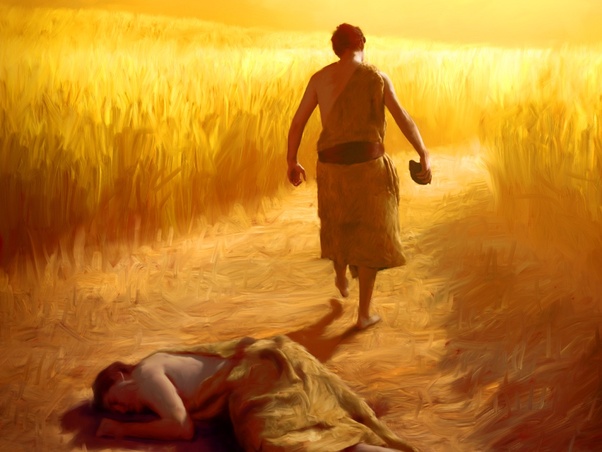
4:8 Now Cain said to his brother [from a Heb. root meaning to surround and to protect] Abel, “Let’s go out [words imply premeditated murder] to the field [a solitary place].” And while they were in the field, Cain attacked [from Heb. qum meaning “rise up”] his brother Abel [the first victim of violence] and killed him.

Note: What statements imply this murder was a premeditated event?

4:9 Then the LORD said to Cain, “Where is your brother Abel [not a request for knowledge; God knew where Abel was as per 4:10; intent of question to elicit confession]?” “I don’t know [a lie],” he replied. “Am I my brother’s keeper [word derived from a verb with basic idea of exercising great care over someone or something; no indication that Cain was remorseful for his terrible deed]?”

Note: What does Cain’s response to the Lord’s question reveal about his heart? When God had confronted Adam about his sin, Adam tried to shift the blame, refusing to accept responsibility for his own actions. How did Cain try to dodge personal responsibility for his actions?

4:10 The LORD said, “What have you done? Listen! Your brother’s blood cries out [Abel’s blood cried out on behalf of justice and legal rights] to me from the ground [a reminder that God sees and knows all (cf. Ps. 139:1-12)].

4:11 Now [sin always has consequences; cf. Col. 3:25] you are under a curse and driven from the ground, which opened its mouth to receive your brother’s blood from your hand.

4:12 When you work the ground, it will no longer yield its crops for you [Cain would no longer be able to sustain himself as a farmer]. You will be a restless wanderer [a fugitive and a vagabond] on the earth [indicates a larger area than the word “ground”; Cain would be unable to escape the impact of this curse; cf. Col. 3:25].”

Note: What did Cain lose by committing murder? Is it easier to remove the consequences of some sins more than others? Why or why not?

4:13 Cain said [notice that Cain showed no remorse for his crime nor did he cry out for forgiveness] to the LORD, “My punishment is more than I can bear [Cain was more concerned about his punishment than about his sin].

Note: What is missing from Cain’s response?

4:14 Today [indicates that Cain immediately began to experience consequences of his sin] you are driving me from the land [note: sin may give you what you want but it will always take what you have], and I will be hidden from your presence [sin separates us from God]; I will be a restless wanderer on the earth, and whoever [Cain was most fearful of people just like him] finds me will kill me [better to be a sinner in the hands of an angry God than to be a sinner in the hands of an angry sinner].”

Note: What would it be like to be hidden from God’s presence?

4:15 But the LORD said to him, “Not so [implication is that God continued to give Cain every opportunity to repent of his sin; also indicates that every sinner has the potential to experience God’s grace]; if anyone kills Cain, he will suffer vengeance seven times over [to the fullest measure].” Then the LORD put a mark [a visible sign; we do not know what the mark was] on [“for” or “for the sake of”] Cain so that no one who found him would kill him.

4:16 So Cain went out from the LORD’S presence and lived in the land of Nod [makes a pun on the verb “to wander” (Heb. nud)], east of Eden.

Numbers 27

Numbers 27:15-20
27:15 Moses [now 120 years old (Deut. 31:2; 34:7); did not grumble because he would not be permitted to enter the promised land; more concerned for the people than for himself; leaders must see to it that the next generation is equipped to carry on God’s work (2 Tim. 2:2)] said to the LORD,

27:16 “May the LORD, the God of the spirits of all mankind [expression emphasized the sovereignty of God over all people], appoint [Moses left the appointment of a successor to God, who alone knew the inner qualities demanded for the task of leading His people into the promised land; the choice to select or elect a leader was not left to the people] a man [a leader] over [Moses’ main concern was that God provide a spiritual leader] this community [the people of Israel]

27:17 to go out and come in before them, one who will lead them out and bring them in [expressions refer to presiding over/directing activities of the people], so the LORD’S people will not be like sheep without a shepherd [thus wander aimlessly].”

27:18 So the LORD said to Moses, “Take [imperative] Joshua [one of the faithful spies] son of Nun, a man in whom is the spirit [divine endowment for leadership], and lay your hand on him [a visual representation of the transfer of leadership/power from Moses to Joshua].

ABOUT JOSHUA
Read Deuteronomy 31:7-8 Joshua was an excellent successor to Moses for several reasons.

First, Joshua was a man who was experienced in battle (Exodus 17:8-16).

Second, Joshua was a man trained under Moses.

Third, Joshua was a man with the ability to correctly judge a situation (Numbers 14:6-9).

Fourth, Joshua knew how to stand firm in the midst of a difficult situation and intense opposition (Numbers 14:10).

Moses publicly commissioned Joshua to succeed him (31:7-8). Thomas Carlyle said, “Show me the man you honor and I will know what kind of man you are, for it shows me what your ideal of manhood is and what kind of man you long to be.” Joshua was a man of integrity. He lived a credible life before the Israelites. He was qualified to lead others. Albert Schweitzer said, “Example is not the main thing in influencing others; it is the only thing.” Moses wanted for the Israelites to know that he had confidence in Joshua.

Notice the following things concerning the public commissioning of Joshua.

First, Moses assured the people that Joshua was God’s choice to be their next leader: “Joshua is the one who will cross ahead of you, just as the Lord has spoken” (31:3).

Second, Moses assured Joshua that God would guide him: “And the Lord is the One who goes ahead of you” (31:8a).

Third, Moses assured Joshua that God would empower him and be present with him: “He will be with you. He will not fail you or forsake you. Do not fear, or be dismayed” (31:8b).

27:19 Have him stand before Eleazar [Aaron’s son and successor (Num. 20:22-29)] the priest and the entire assembly and commission [command] him in their presence [read Deut. 31:7-8].

27:20 Give him some [indicates the transfer of leadership was to be done on a gradual basis while Moses was still alive; Joshua was a servant before he was a leader; “He who has never learned to obey cannot be a good commander.” (Aristotle)] of your authority so the whole Israelite community will obey him.

Numbers 24

Numbers 24:1-9
Israelites encamped at Moab across the Jordan from Jericho (22:1). Balak, king of Moab, was fearful of the Israelites. He hired Balaam, a corrupt man, to curse the Israelites. These events took place 14 centuries before Jesus’ birth.

Note: Balaam announced in four oracles or messages that God would bless Israel (Num. 23-24). These verses are part of Balaam’s third oracle or message, spoken from the top of Mount Peor, the center in Moab for the worship of the god Baal (23:28).

24:1 Now when Balaam [a prophet for hire; a non-Hebrew who knew about the Lord] saw that it pleased the LORD to bless Israel, he did not resort to sorcery [divinations] as at other times [his customary practice], but turned his face toward the desert.

24:2 When Balaam looked out and saw Israel encamped tribe by tribe, the Spirit of God came upon him [we do not know the precise nature of this experience; the Spirit of God forced Balaam to deliver true prophecies of the coming King]

24:3 and he uttered [unwittingly] his oracle: “The oracle of Balaam son of Beor, the oracle of one whose eye sees clearly [God had opened his eyes to understand and communicate His message],

24:4 the oracle of one who hears the words of God, who sees a vision [spiritual and future realities revealed to him by God’s Spirit] from the Almighty, who falls prostrate, and whose eyes are opened:

24:5 [positive picture of Israel as beautiful and prosperous] “How beautiful are your tents, O Jacob, your dwelling places, O Israel!

24:6 [picture of fertility and abundance] “Like valleys they spread out, like gardens beside a river, like aloes planted by the LORD, like cedars beside the waters.

24:7 Water will flow from their buckets; their seed will have abundant water [ultimately fulfilled in Christ through whom rivers of living water flow out in blessing]. “[Notice two things about the king and his kingdom] [1] Their king will be greater than Agag; [2] their kingdom will be exalted [veiled reference to coming Messiah].

24:8 “God brought them out of Egypt; they have the strength of a wild ox. They devour hostile nations and break their bones in pieces; with their arrows they pierce them.

24:9 [cf. Gen. 49:9 re: the words spoken by Jacob over 450 years earlier] Like a lion [pictures Israel as secure and powerful in the promised land] they crouch and lie down, like a lioness — who dares to rouse them? [cf. Gen. 12:3 re: God’s words to Abraham] “May those who bless you be blessed [to endue with power for success, prosperity, fruitfulness, longevity (Dean)] and those who curse you be cursed [to bind with a spell, hem in with obstacles, render powerless to resist (Dean)]!”

Numbers 24:17-19
Balaam’s fourth oracle is recorded in Numbers 24:15-19. God’s plan for the Messiah was revealed to and recognized by even the enemies of Israel.

24:17 “I [Messianic prophecy through a non-Israelite] see [spiritual seeing] him [the coming Messiah-King], but not now [words point to the future]; I behold him, but not near [words point to the future]. A star [denoted a royal figure; symbol of glory] will come out of Jacob; a scepter [denoted a royal figure; symbol of power and authority; cf. Gen. 49:10] will rise out of Israel. [note four historical references] [1] He will crush the foreheads of Moab, [2] the skulls of all the sons of Sheth [possibly early inhabitants of Moab].

24:18 [3] Edom [descendants of Esau] will be conquered; [4] Seir [chief mountain range in Edom; home to Esau and his descendants], his [refers to the one designated “star” and “scepter” in v. 17] enemy, will be conquered, but Israel will grow strong [experience victory over enemies through a coming ruler].

Note: Prophecy fulfilled initially in David who achieved victories over both Moab and Edom (cf. 2 Sam. 8:2,13-14; 1 Kings 11:15-16). Ultimately, this prophecy fulfilled by Messiah (cf. Ps. 2; Ps. 110; Rev. 22:16). In an eschatological context, the words Edom and Seir stand for any enemies of God’s people and God’s Messiah.

24:19 A ruler [a coming Ruler, a prophecy ultimately fulfilled in Christ] will come out of Jacob [i.e., Israel] and destroy the survivors of the city [possibly refers to city in Moab named Ar (cf. Num. 21:28)].”

Numbers 14

Numbers 14:6-9
14:6 Joshua [first mention of Joshua (Israel’s general) is in Ex. 17:8-16; later became Moses’ successor and led Israel in conquest of Canaan (Num. 27:15-20)] son of Nun and Caleb [first mention of Caleb in 13:6; Caleb had confidence in his people (13:30) and in His God (14:8)] son of Jephunneh, who were among those who had explored the land, tore their clothes [an action symbolic of mourning for the dead (cf. Gen. 37:29,34); they mourned “the loss of faith, the death of hope” (Expositors)]

14:7 and said to the entire Israelite assembly [in an effort to “revive the dead”], “The land we passed through and explored is exceedingly good.

14:8 If the LORD is pleased with us [“to smile over;” refers to God’s favor toward His people and expresses the relationship God desires with them], he will lead us into that land, a land flowing with milk and honey [a general way of referring to the rich and fertile promised land; milk and honey were among principle products of Canaan], and will give it to us.

14:9 Only [note two things necessary to take possession of the land] [1] do not rebel [word often refers in the OT to the breaking of covenant obligations] against the LORD. And [2] do not be afraid of the people of the land, because we will swallow them up [literally, “they (are) our bread” / cf. Num. 13:32 “devours;” “We shall destroy them as easily as we eat our bread.” (Wesley)]. Their protection [defense; shadow or shade from searing heat of desert sun] is gone [while the other spies saw only the power of the enemy, Caleb and Joshua saw their weakness], but the LORD is with us [cf. Rom. 8:31]. [therefore] Do not be afraid of them.”

The people threatened to stone Joshua and Caleb 14:10

Numbers 14:26-30
14:26 The LORD said to Moses and Aaron:

14:27 “How long will this wicked community grumble [“to be obstinate,” “to complain,” “to murmur”] against me [ultimately our grumbling is against God, not against His leaders (cf. 14:2)]? I have heard the complaints of these grumbling Israelites.

14:28 So tell them, ‘As surely as I live [an oath; God swore by Himself because He is the highest authority], declares the LORD, I will do to you the very things I heard you say [cf. 14:2 re: their remarks about dying in Egypt or in the desert]:

14:29 In this desert [the place where they complained] your bodies will fall [the high cost of grumbling against God]—every one of you twenty years old or more who was counted in the census and who has grumbled against me.

14:30 Not one of you will enter the land I swore with uplifted hand to make your home [refers to the reward they would receive in the future following 40 years (14:34) of wandering in the wilderness], except [God rewarded the two who demonstrated faith] Caleb son of Jephunneh and Joshua son of Nun.

Numbers 14:36-37
14:36 So the men Moses had sent to explore the land, who returned and made [by means of their negative report] the whole community [indicates the sphere of their negative influence; “The spirit of rebellion is very contagious.” (Nee)] grumble [indicates result of their negative influence] against him [God] by spreading a bad report about it—

14:37 these men [fearful and faithless] responsible for spreading the bad report [not including Caleb and Joshua] about the land were struck down and died [an immediate death; on the spot] of a plague [God’s judgment on their unfaithfulness] before the LORD.

14:38 Of the men who went to explore the land, only Joshua son of Nun and Caleb son of Jephunneh survived [a reminder that the majority is not always right].

Numbers 12

Numbers 12:3
12:3 (Now Moses was a very humble [this word has the same basic meaning as the Greek word rendered “gentleness” in Gal. 5:23] man, more humble than anyone else on the face of the earth.)

Note: Read about the humility of Jesus in Philippians 2:1-11. Who is the most humble person you know? What about this person convinces you that he or she is humble? What word would you like for people to use when they describe you?