Hosea 5

5:1 “Hear this, you priests [would experience judgment because of their failure to lead the people in the ways of God; their failure was in large measure the reason why the nation was at an all-time spiritual and moral low]! Pay attention, you Israelites [particularly the free, landholding citizens or the elders/representatives of the people; would be held accountable for their failure to heed the Word of God and live according to the terms of the covenant]! Listen, O royal house [politicians and rulers would be held accountable because of their failure to lead the people in a manner consistent with God’s law]! This judgment is against you: [false worship] You have been a snare at Mizpah [city located about seven miles north of Jerusalem; became a place where false gods were worshiped], a net spread out on Tabor [mountain that overlooked the Jezreel Valley; Israelites built a high place there to worship false gods].

Practical Consideration: Leaders without high standards lead people into low places.

Israel’s spiritual leaders did not have high and godly standards. They were only interested in using their positions for personal gain and the pursuit of sensual pleasures. As a result, those who looked to them for guidance were led away from a true knowledge of God and into the depths of sin. Religious leadership carries great responsibility. God will hold leaders accountable for how they use their influence.

5:2 The rebels are deep in slaughter [murder and other vicious crimes]. I will [judgment was inevitable] discipline [indicates coming judgment had a redemptive purpose] all [none would escape the coming judgment] of them.

5:3 I know all about Ephraim [refers to Northern Kingdom]; Israel is not hidden from me. Ephraim, you have now turned to prostitution [judgment would come because Israel had played the harlot; sexual immorality associated with fertility cults]; Israel is corrupt.

5:4 “Their deeds [refers to the cultic/idolatrous activities associated with Baal worship] do not permit them [emphasized addictive power of sin] to return to their God [people were so steeped in sin they had lost the capacity “to return to their God”]. A spirit of prostitution is in their heart; they do not acknowledge the LORD.

5:5 Israel’s arrogance [pride became the cause of Israel’s problems and stumblings] testifies against them; the Israelites, even Ephraim, stumble in their sin; Judah [Southern Kingdom] also stumbles with them.

5:6 When they go [to worship] with their flocks and herds [used for offerings] to seek the LORD, they will not find him [Israel’s worship was superficial and would not lead the people to find God]; he has withdrawn himself from them [a consequence of their sin].

5:7 They are unfaithful to the LORD; they give birth to illegitimate [literally and spiritually] children [evidence of this faithlessness was “illegitimate children” produced by Israel’s adulterous spiritual activities; these “illegitimate children” knew nothing about the true God of Israel’s history because they grew up in a nation whose worship was perverted and an abomination to God]. Now their New Moon festivals [observed at the beginning of every lunar month (cf. Isa. 1:13)] will devour them and their fields.

5:8 “Sound the trumpet in Gibeah, the horn in Ramah. Raise the battle cry in Beth Aven; lead on, O Benjamin.

5:9 Ephraim will be laid waste on the day of reckoning. Among the tribes of Israel I proclaim what is certain.

5:10 Judah’s leaders are like those who move boundary stones. I will pour out my wrath on them like a flood of water.

5:11 Ephraim is oppressed, trampled in judgment, intent on pursuing idols.

5:12 I am like a moth to Ephraim, like rot to the people of Judah.

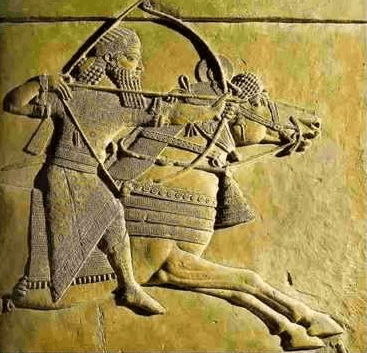
5:13 “When Ephraim [refers to Northern Kingdom] saw his sickness [God was putting pressure on Israel through the growing military might of the surrounding nations], and Judah [the Southern Kingdom] his sores, then Ephraim [cf. King Menahem (2 Kings 15:19-21); King Ahaz (2 Kings 16:5-9); King Hoshea (2 Kings 17:3)] turned to Assyria [they failed to turn to God; committed apostasy by turning to Assyria], and sent to the great king for help. But he is not able to cure you, not able to heal your sores.

5:14 For I [God Himself] will be like a lion [a lion stalking prey] to Ephraim [fell to the Assyrians in 722 BC], like a great lion to Judah [fell to the Babylonians in 586 BC]. I will tear them to pieces and go away; I will carry them off, with no one to rescue them.

5:15 Then I [like a lion] will go [leaving the people in the hands of their foe] back to my place [lion’s lair] until [after an undetermined period of time] they admit their guilt. And [as a result of their suffering] they will seek my face [God used severe judgment to lead His people to repentance and to see their spiritual need and return to Him]; in their misery they will earnestly seek me.”

Hosea 4

Hosea 4:1-9
4:1 [God summoned the nation to court and outlined His case against the inhabitants of the land] Hear the word of the LORD, you Israelites, because the LORD has a charge to bring against you who live in the land: [sins of omission] “There is no faithfulness [the people had not sustained or remained true to their covenant relationship with God], no love [the people demonstrated no loyalty or love to God or to their fellowman], no acknowledgment of God in the land [God gave the land of Israel to the people as a place where they might live out their covenant obligations and grow in their knowledge of Him; Israel’s rebellion and idolatry made her a squatter deserving of eviction].

Practical Consideration: When God does not govern our lives they are ruined by sin.
The people of Israel neglected the most fundamental aspects of their relationship with God: faithfulness, kindness, and an intimate walk with Him. As a result, they fell into gross sin and violations of God’s commandments. Lives not governed by God are easily ruined by sin. Only an intimate walk with God and a proper understanding of His Word can keep people from becoming ruined and ravaged by sin.

4:2 [sins of commission: these were the result of Israel’s sins of omission or their rebellion against the covenant of God as described in 4:1b] There is only cursing [violation of the third commandment], lying [violation of the ninth commandment] and murder [violation of the sixth commandment], stealing [violation of the eighth commandment] and adultery [violation of the seventh commandment]; they break all bounds [perhaps means that the sins listed were breaking out in the land or that the people were breaking all bounds with their sins], and bloodshed follows bloodshed [the land was so filled with violence and evil that one violent crime followed another].

4:3 Because of this [indicates far-reaching impact of Israel’s sins (4:1-2)] [1] the land mourns [result of drought and famine], [2] and all who live in it waste away; [3] the beasts of the field and the birds of the air and the fish of the sea are dying [even nature itself suffered because of Israel’s sin].

4:4 “But let no man bring a charge, let no man accuse another [God would not allow the people to deny His charges against them], for your people are like those who bring charges against a priest.

4:5 You stumble [means that the Israelites would have a difficult time as they walked through life] day and night, and the prophets [shared responsibility in bringing about this miserable existence] stumble with you. So I will destroy your mother [likely refers to the nation]

4:6 [note three harsh consequences of sin…] my people [term of covenant relationship] are [1] destroyed from lack of knowledge [the people lacked real knowledge of God]. “Because you have rejected knowledge [the people had failed to acknowledge Him as their God], I also [2] reject you [the nation as a whole] as my priests [God’s people were to give witness of the knowledge of God to the world (cf. Ex. 19:6)]; because you have ignored [disobeyed] the law of your God, I also will [3] ignore your children.

4:7 The more the priests increased, the more they sinned against me; they exchanged their Glory [honor] for something disgraceful.

4:8 They [the Levitical priests] feed on the sins of my people [the offerings the people brought when they worshiped at their pagan shrines] and relish [to have an appetite for] their wickedness.

4:9 And it will be: Like people, like priests. I will punish both of them [the unfaithful priests and the unfaithful people] for their ways and repay them for their deeds [no one can sin with impunity].

Hosea 3

Hosea 3:1-2
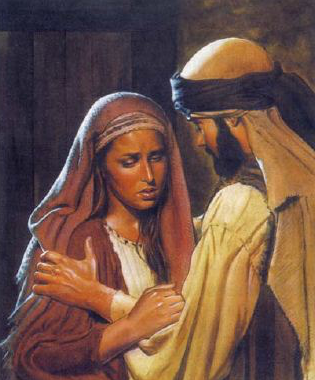
3:1 The LORD said to me, “Go, show your love to your wife again [means to help and heal the relationship], though she is loved by another and is an adulteress. Love [the basis for restoring broken relationships] her as the LORD loves the Israelites [God likened Hosea’s marriage to His relationship with Israel who had also played the harlot by turning to other gods; Hosea experienced and understood what it was like to love another and not have that love returned], though they turn to other gods and love the sacred raisin cakes [enjoyed during part of the worship of “other gods”].

3:2 So I bought her for fifteen shekels of silver and about a homer and a lethek of barley [price of a slave was generally 30 shekels of silver (cf. Ex. 21:32; Lev. 27:4); Hosea, probably at great personal financial sacrifice, redeemed Gomer; some scholars suggest that the purchase price of fifteen shekels (the barley notwithstanding) was indicative of the fact that Gomer was “damaged goods;” this action on the part of Hosea illustrates the redemptive nature of God’s love].

Practical Consideration:The paths of sin lead to misery and enslavement.
When Gomer left her home and family she eventually ended up enslaved to another “lover.” Hosea had to purchase his own wife at great personal expense. Sin enslaves. Sin is costly for both the sinner and the one who redeems the sinner.

Practical Consideration:Love is redemptive.

Hosea’s love for Gomer was a gracious and forgiving love. He was willing to pay a price to buy back his wayward wife. He could have easily divorced her but instead chose to restore her. God’s judgment had redemption as its ultimate goal. God too, said Hosea, would bring home His faithless wife.

Hosea 3:3-5
3:3 Then I told her, “You are to live with me many days; you must not be a prostitute or be intimate with any man [this action illustrates the disciplining nature of love], and I will live with you [just as Gomer would undergo a period of isolation, Israel would undergo a period of isolation; Gomer’s isolation would help her get her moral bearings back; Israel’s isolation would help her to get religious bearings back].”

Practical Consideration: Love must be tough.

Hosea exercised tough love to help Gomer forget her “lovers.” He isolated her from temptation and even kept himself from having intimate relations with her.

3:4 For the Israelites will live many days without king or prince [without benefit of national leaders; implied domination by another nation], without sacrifice or sacred stones [stone pillars raised in honor of a deity], without ephod [worn by high priest] or idol [without temple and priesthood, implying exile].

Practical Consideration:The Lord disciplines those He loves (Heb. 12:6).
God will hold individuals and nations accountable for their sin. His discipline is redemptive in nature.

3:5 Afterward [after their separation from God (3:4), Hosea looked to the day when…] the Israelites will return [repent and return to God] and seek the LORD their God [once again worship God] and David their king. They will come trembling to the LORD [suggests a new fear of the Lord based upon the hard lessons learned when they forsook the Lord] and to his blessings in the last days.

Hosea 1

1:1 The word of the LORD that came to Hosea son of Beeri during the reigns of Uzziah, Jotham, Ahaz and Hezekiah, kings of Judah, and during the reign of Jeroboam son of Jehoash king of Israel:

1:2 When the LORD began to speak through Hosea [name means “salvation” or “deliverance” and is from the same root as the names Joshua and Jesus], the LORD said to him, “Go, take to yourself an adulterous wife [perhaps a temple prostitute at a Baal temple who had forsaken her sinful career to marry Hosea; perhaps a woman actively involved in prostitution; perhaps a woman who was not a prostitute when Hosea married her but would later become one] and children of unfaithfulness [perhaps suggests that the children would have the faithless tendencies of their mother], because the land is guilty of the vilest adultery in departing from the LORD.”

1:3 So he married Gomer [this marriage would serve as a living object lesson to the people of Israel of their unfaithfulness to God] daughter of Diblaim, and she conceived and bore him [Hosea] a son.

Practical Consideration: Our home life is important.
Hosea must have experienced great personal grief and humiliation as a result of Gomer’s immoral behavior. However, God was able to use the events of Hosea’s life to teach him and the nation about the redemptive nature of His love.

1:4 Then the LORD said to Hosea, “Call him Jezreel [name means “God scatters” or “God sows”], because I will soon [indicated that judgment for sin was imminent] punish the house of Jehu for the massacre at Jezreel [2 Kings 9:1-10:31], and I will put an end to the kingdom of Israel.

1:5 In that day I will break Israel’s bow [Israel’s army] in the Valley of Jezreel [Israel’s military strength would be broken here].”

Note: “In that day” Hosea’s prophecy was fulfilled in 734 BC when the Assyrian monarch named Tiglath-pileser III was victorious against Israel and turned her into a vassal state. Tiglath-pileser III was succeeded by Shalmaneser V (726-722) who besieged the city of Samaria for three years before it fell in 722 BC marking the end of the Northern Kingdom of Israel.

1:6 Gomer conceived again and gave birth to a daughter. Then the LORD said to Hosea, “Call her Lo-Ruhamah [name means “not loved” or “no mercy” or “unpitied” or “she has not obtained compassion” and indicated a further deterioration in the Northern Kingdom’s relationship with God], for I will no longer show love [Israel would no longer experience the loving compassion of God] to the house of Israel, that I should at all forgive them.

Note: Some suggest that Lo-ruhamah and Lo-ammi were not Hosea’s children but children born out of Gomer’s adulterous activities. The reason for this is seen in the language of verses 3, 6, and 8. Notice: “and she conceived and bore him a son” (v. 3). Notice the absence of the pronoun “him” in verse 6: “Gomer conceived again and gave birth to a daughter,” and again in verse 8: “Gomer had another son.”

1:7 Yet I will show love to the house of Judah; and I will save them-not by bow, sword or battle, or by horses and horsemen, but by the LORD their God [Assyria not allowed to destroy Judah; cf. 2 Kings 19:14-36].”

1:8 After she had weaned Lo-Ruhamah, Gomer had another son.

1:9 Then the LORD said, “Call him Lo-Ammi [means “not my people” and indicated further deterioration in Israel’s relationship with God; name suggested God no longer claimed the sinful people of Israel and that God finally rejected those who rejected Him], for you are not my people, and I am not your God [“You are not My people and I am not your I AM”].

1:10 “Yet the Israelites will be like the sand on the seashore [cf. Gen. 22:17; 32:12], which cannot be measured or counted [cf. promise to Abraham (Gen. 12:1-3)]. In the place where it was said to them, ‘You are not my people,’ they will be called ‘sons of the living God [cf. Rom. 9:25-26].’

1:11 The people of Judah [the Southern Kingdom] and the people of Israel [the Northern Kingdom] will be reunited [partially (because they could not choose their own head of government) realized when the people returned from Babylonian exile; in May 1948 Israel became an autonomous, undivided nation], and they will appoint one leader and will come up out of the land, for great will be the day of Jezreel [literally, “God sows”; cf. Hos. 1:4-5].

Hosea 7

Hosea 7:13-16
7:13 Woe [a sorrowful announcement of doom] to them, because [reason for woe and destruction] [1] they have [deliberate transgression] strayed [wandered away and embraced idolatrous practices] from me [God]! Destruction to them [indicates national scope of destruction], because they have rebelled against me! I long to redeem [to obtain release by payment of a price] them [expressed the Lord’s tender heart] but [2] they speak lies [perhaps theological lies that misled people from true worship of God; perhaps by trusting in alliances with other nations and thereby testifying that the Lord could not protect them] against me.

7:14 [3] They do not cry out to me [failure to look to the Lord for help] from their hearts but wail upon their beds [perhaps refers to sexual aspects of Baal worship; trusted false gods]. [4] They gather together [not for solemn assemblies] for [indicates true purpose for their assemblies] grain and new wine but turn away from me.

7:15 [5] I trained them and strengthened them, but they plot evil against me [by making treaties with foreign powers].

7:16 [6] They do not turn to [look in every direction for help but to the Lord] the Most High [proclaimed God’s exalted position]; they are like a faulty [treacherous or slack] bow [they were unreliable and habitually missed the target; their worship looked good but had no power (like a slack bow); cf. Ps. 78:57]. [7] Their leaders will fall by the sword [killed in warfare/coming destruction of the nation] because of their insolent words [against God and His prophets]. For this they will be ridiculed [the subject of jokes] in the land of Egypt [of no help to Israel].

Note: “Like their fathers they were disloyal and faithless, as unreliable as a faulty bow” (Ps. 78:57).
Consider three characteristics of a faulty (treacherous, slack) bow:
• First, a treacherous or slack bow is without power and unresponsive to the archer’s aim.
• Second, a treacherous bow is without purpose. An archer has no use for a treacherous bow because it is unreliable, uncontrollable, and unpredictable.
• Third, a treacherous bow gives no pleasure to the archer because it is a defective and dangerous instrument.

Hosea 8

Hosea 8:1-10
8:1 “Put the trumpet [warned of approaching danger] to your lips! An eagle [better understood as a bird of prey; the symbol of the instrument of judgment (Assyria); Heb. word also can mean “vulture”] is over the house of the LORD because [reason for God’s judgment] the people have broken [by failing to keep terms of covenant] my covenant [agreement made at Sinai] and rebelled against my law.

8:2 Israel cries out to me, ‘O our God, we acknowledge you [in the midst of the crisis the people (who had broken God’s covenant and rebelled against His law) would try to appeal to God on the basis of their status as His chosen people, but to no avail; the lips of the people, which had praised Baal, would be unable to carry their desperate cries to God; God wanted more than lip service]!’

Practical Consideration:You can’t have it both ways!

Israel transgressed against God’s covenant, rebelled against His law, and rejected everything good (Hos. 8:1-2). When they found themselves in the midst of a crisis, however, they cried out to God saying, “O our God, we acknowledge you!” (Hos. 8:2). They did not want to listen to God but they wanted God to listen to them. They had willfully turned a deaf ear to God but wanted God to lend a listening ear to them. They had said “no” to God but wanted God to say “yes” to them. Proverbs 28:9 warns, “If anyone turns a deaf ear to the law, even his prayers are detestable.”

8:3 But Israel has rejected [unwilling to accept; to throw out and discard] what is good [everything for which God stood; terms of the covenant]; an enemy [implied by image of “eagle” or “vulture” in 8:1] will pursue [relentlessly] him.

8:4 [examples of Israel’s sinful folly] They set up kings without my consent [rapid succession of kings; people did not seek God’s will in regard to selection of their kings]; they choose princes without my approval [throne filled without God’s approval; many times throne filled through coups, assassinations, violence, and intrigue]. With their silver and gold they make idols [Jeroboam I set up idols (golden calves) at Bethel and Dan and started the Northern Kingdom down a disastrous course (cf. 1 Kings 12:28-30)] for themselves to their own destruction.

8:5 Throw out your calf-idol [set up in Bethel and Dan to keep the Israelites from returning to worship in Jerusalem where David’s descendants continued to rule (see note on 8:4); this political move had disastrous spiritual results], O Samaria! My anger burns against them [because of their idol worship]. How long will they be incapable of purity [purity possible only through faith in the Lord]?

8:6 They [idols] are from Israel! This calf-a craftsman has made it [the people worshiped a product of their own hands]; it is not God. It will be broken in pieces [in coming judgment], that calf of Samaria.

8:7 “They sow the wind and reap the whirlwind [the law of the harvest]. The stalk has no head [wind cannot produce a head of grain]; it will produce no flour [crop failure]. Were it to yield grain, foreigners would swallow it up [pillaging of any crops by foreigners].

Practical Consideration: You cannot break the law of the harvest.

Israel had sown the wind and would reap the whirlwind (Hos. 8:7). Paul wrote, “Do not be deceived: God cannot be mocked. A man reaps what he sows.” (Gal. 6:7). Paul warned, “Anyone who does wrong will be repaid for his wrong, and there is no favoritism” (Col. 3:25).

8:8 Israel is swallowed up; now she is among the nations like a worthless thing [a vessel].

8:9 For they have gone [for help] up to Assyria [instead of to the Lord] like a wild donkey wandering alone. Ephraim has sold [like a prostitute] herself to lovers.

8:10 Although they have sold themselves [formed alliances with foreign nations like Assyria (8:9)] among the nations, I will now gather them together. They will begin to waste away under the oppression of the mighty king [probably the king of Assyria].

Practical Consideration: God’s people should be distinctive.

Israel lost its identity and distinctiveness as a nation when she formed alliances with foreign/heathen nations. Such alliances introduced practices and beliefs contrary to God’s law. Rather than influencing the world for God, Israel was influenced by the world and lost sight of God. Paul stated in Romans 12:2 that believers should not allow the world to press them into its mold. Our message has no power if our lives are not distinctive.

Hosea 9

Hosea 9:15
9:15 “Because of all their wickedness in Gilgal [Israelites built shrines to other gods in this city], I hated them there. Because of their sinful deeds, I will drive them out of my house. I will no longer love them; all their leaders [failed to guide nation in righteous paths] are rebellious.

Hosea 9:17
9:17 My God will reject [disobedience to God is costly] them because they have not obeyed him; they will be wanderers among the nations.

Hosea 10

Hosea 10:12


10:12 Sow for yourselves righteousness [has to do with works and with obedience to God’s commands], reap [the result of sowing] the fruit of unfailing love [inward commitment to the Lord], and break up your unplowed ground [fallow ground; ground capable of yielding especially abundant fruit (cf. Prov. 13:23)]; for it is time to seek the LORD, until he comes and showers righteousness [salvation; in OT designates fullness of life, abundance, peace, security, room to live] on you.

1 Samuel 17

17:1 Now the Philistines [enemies of Saul throughout his reign] gathered their forces for war [this would become the occasion and setting in which David’s courage and faith would be demonstrated] and assembled at Socoh in Judah. They pitched camp at Ephes Dammim, between Socoh and Azekah [two towns in the foothills of western Judah].

17:2 Saul and the Israelites assembled and camped in the Valley of Elah [approximately 15 miles west of Bethlehem] and drew up their battle line to meet the Philistines.

17:3 The Philistines occupied one hill and the Israelites another, with the [fertile] valley between them.

17:4 A champion named Goliath, who was from Gath [a town located 5 miles west of Azekah], came out of the Philistine camp. He was over nine feet tall.

Note: The Philistines cleverly used Goliath to wage psychological warfare against the Israelites.

17:5 He had a bronze helmet on his head and wore a coat of scale armor of bronze weighing five thousand shekels [about 125 pounds];

17:6 on his legs he wore bronze greaves [protected the legs below the knees], and a bronze javelin was slung on his back.

17:7 His spear shaft was like a weaver’s rod, and its iron point weighed six hundred shekels [about 15 pounds]. His shield bearer went ahead of him.

17:8 Goliath stood [appearing invincible with his armor] and shouted to the ranks of Israel [a form of psychological warfare], “Why do you come out and line up for battle? Am I not a Philistine, and are you not the servants of Saul? Choose a man and have him come down to me.

The story of David and Goliath is a favorite among children and adults alike. This story of a shepherd boy’s courage in the face of incredible odds has captured the imaginations of generations of Bible readers. The setting for the story is the Valley of Elah (17:2), located west of David’s hometown of Bethlehem.

The Philistines, enemies of King Saul throughout his reign, assembled for war on a hilltop overlooking the Valley of Elah. Saul and the Israelites occupied a hill on the opposite side of the valley (17:3). From these hilltop vantage points the Philistine and Israelite armies took inventory of one another.

The Philistine and Israelite armies seemed equally matched until the Philistines introduced their secret weapon — a man named Goliath who stood “over nine feet tall” (17:4). The Philistines cleverly used Goliath to wage psychological warfare against the Israelites. Goliath’s heavy bronze armor and oversized weapons made him appear invincible (17:5-7).

Towering above his countrymen, Goliath stood and shouted to the ranks of Israel (v. 8). He challenged the cowering Israelite army to send a champion against him in a one-on-one, winner-take-all fight to the death (17:9-10). The arrogant giant was confident he could defeat any man sent to fight against him.

17:9 If he is able to fight and kill me, we will become your subjects; but if I overcome him and kill him, you will become our subjects and serve us. [this one-on-one contest was proposed to avoid an all-out battle]

17:10 Then the Philistine said, “This day I defy [confront, challenge, dare] the ranks of Israel! Give me a man and let us fight each other.”

17:11 On hearing the Philistine’s words, Saul and all the Israelites were dismayed and terrified.

Note: Whose words cause you to become dismayed or terrified?

17:12 Now David was the son of an Ephrathite named Jesse, who was from Bethlehem in Judah. Jesse had eight sons, and in Saul’s time he was old and well advanced in years.

17:13 Jesse’s three oldest sons had followed Saul to the war: The firstborn was Eliab; the second, Abinadab; and the third, Shammah.

17:14 David was the youngest. The three oldest followed Saul,

17:15 but David went back and forth from Saul to tend his father’s sheep at Bethlehem.

17:16 For forty days the Philistine came forward every morning and evening [a reminder that the giants keep coming] and took his stand [cf. Ps. 2:2].

Goliath continued his defiant challenge twice a day for forty days (17:16), but no Israelite dared to answer that challenge. Goliath’s repeated insults had a demoralizing impact on the Israelite army. His thundering voice and imposing presence struck fear in the hearts of the Israelites (17:11,24).

Even Saul, who was “a head taller” than his own countrymen (9:2; 10:23), was afraid to face the giant. Instead, he offered generous incentives to any man brave enough to face and kill Goliath (17:25) — an offer no man was willing to take.

Saul and his men were immobilized by fear. No man dared to put on his armor or draw his sword. No man dared to descend from the relative security of the hill to face Goliath in the valley below.

17:17 Now Jesse said to his son David, “Take [supplementary provisions] this ephah of roasted grain and these ten loaves of bread for your brothers and hurry [emphasizes Jeese’s concern for the well-being and safety of his sons] to their camp.

17:18 Take along these ten cheeses to the commander of their unit [perhaps to insure that the provisions would be allowed to reach Jeese’s sons]. See how your brothers are and bring back some assurance from them.

17:19 They are with Saul and all the men of Israel in the Valley of Elah, fighting against the Philistines.”

17:20 Early in the morning David left [note the word “left” which indicates the start of David’s journey out of obscurity] the flock with a shepherd, loaded up and set out, as Jesse had directed. He reached the camp as the army was going out to its battle positions, shouting the war cry.

17:21 Israel and the Philistines were drawing up their lines facing each other.

17:22 David left [once again, David “left” that which represented previous responsibilities] his things with the keeper of supplies, ran to the battle lines and greeted his brothers.

17:23 As he was talking with them, Goliath, the Philistine champion from Gath, stepped out from his lines and shouted his usual defiance, and David heard it [and then caught his first glimpse of the defiant giant].

Note: What “Goliaths” are you facing in your life?

17:24 When the Israelites saw the man, they all ran from him [cf. v. 48] in great fear [Israelite morale was low; the psychological warfare strategy of the Philistine army proved to be effective].

Note: Do you scurry for cover when others verbally assault your faith?

17:25 Now the Israelites had been saying [words of resignation], “Do you see how this man [as opposed to David’s “this uncircumcised Philistine” in v. 26] keeps coming out? He comes out to defy Israel [cf. David’s remarks in v. 26]. The king will give [incentives] great wealth to the man [note Saul’s unwillingness to face the giant] who kills him. He will also give him his daughter in marriage and will exempt his father’s family from taxes in Israel.”

17:26 David asked [words of indignation] the men standing near him, “What will be done for the man who kills this Philistine and removes this disgrace from Israel? Who is this uncircumcised Philistine [as opposed to “this man” in v. 25] that he should defy the armies of the living God? [David knew that God is bigger than Goliath]

All seemed hopeless for Saul and his men until Jesse sent his youngest son with supplementary provisions for his older brothers (17:12-19). Soon after David arrived at Saul’s camp, Goliath stepped out from the Philistine ranks and darkened the horizon (17:20-23). Morale was so low among the Israelites that they “ran from him in great fear” (17:24).

David heard Goliath’s insults and understood that to insult the army of the living God was to insult God Himself (17:26). The young shepherd boy wondered why no man was willing to face the arrogant and defiant “uncircumcised Philistine” (17:26).

Goliath was not the first and certainly not the last person to oppose God’s people or God’s way. Christianity faces increasing opposition in today’s world. Many adults are hesitant to talk openly of their faith or to base decisions on their Christian worldview for fear of reprisal from powerful persons or organizations.

Some adults lack confidence in their ability to confront appropriately those who oppose God’s way. Others are fearful that if their stand for God proves costly, God may not help them in ways they want. We must not allow our fears to keep us from standing faithfully with God. Standing firm in the face of opposition honors God. And God honors those who stand firm for Him. Don’t let fear defeat you.

Note: “We see things not as they are but as we are.” (John Maxwell)

17:27 They repeated to him what they had been saying and told him, “This is what will be done for the man who kills him.”

17:28 When Eliab, David’s oldest brother, heard him speaking with the men, he burned with anger at him [did not support David] and asked, “Why have you come down here? And with whom did you leave those few sheep in the desert? I know how conceited you are and how wicked your heart is; you came down only to watch the battle. [note: expect opposition when you attempt to do something great for God]

17:29 “Now [this word indicates these brothers might have been at odds before] what have I done?” said David [respectfully but firmly]. “Can’t I even speak? [David stayed focused on the real enemy]

17:30 He then turned away to someone else and brought up the same matter, and the men answered him as before.

17:31 What David said was overheard and reported to Saul, and Saul sent for him.

17:32 David [knowing the Lord was on his side] said to Saul, “Let no one lose heart [become discouraged] on account of this [Goliath] Philistine [Philistines were enemies of Saul throughout his reign]; your servant [David already in Saul’s service (cf. 1 Sam. 16:21)] will [voluntarily] go and fight him [what others were unwilling to do].”

The Philistine strategy to wage psychological warfare against the Israelites proved to be effective. Goliath’s imposing presence made the Israelites feel small and weak. His thundering verbal volleys sent Saul and his men scurrying for cover. Their weapons seemed small and useless in the face of such opposition.

Those who oppose God’s way still employ psychological warfare today. Many believers allow themselves to be easily intimidated by those who oppose God’s way. Rather than take a stand for their convictions, some believers scurry for cover at the first sign of trouble. Others choose to remain silent rather than respond to verbal assaults on the faith.

The cowardly behavior of Saul and his men puzzled the young shepherd boy who had come to visit his brothers. When David asked those around him for an explanation, he received the same answer from every one he asked (17:26-30). No one was willing to face the giant.

However, someone who heard David’s courageous words “reported to Saul, and Saul sent for him” (17:31). David was immediately ushered into Saul’s presence. The handsome young shepherd boy stood confidently before Israel’s king and volunteered to do what no man in Saul’s army was willing to do — fight Goliath (v. 32).

17:33 Saul replied [stated the obvious], “You [physically small in comparison to Goliath] are not able [because of size and inexperience as a warrior] to go out against this Philistine and fight him; you are only a boy [cf. 1 Sam. 16:7], and he has been a fighting man from [indicates Goliath was an experienced warrior] his youth.”

17:34 But David [remembering past victories achieved with God’s help] said to Saul, “Your servant has been keeping his father’s sheep. When a lion or a bear came and carried off a sheep from the flock,

Note: God prepares us for what He has prepared for us.

17:35 I went after [David did not passively accept the loss of a sheep] it, struck it and rescued the sheep from its mouth. When it turned on me, I seized it by its hair, struck it and killed it.

17:36 Your servant has killed both the lion and the bear [little Did David realize how those experiences would prepare him to face Goliath; perhaps these feats were accomplished with his sling or with his shepherd’s crook (crude weapons at best); lion and bear were threats to David and his sheep]; this uncircumcised Philistine [a threat to God’s people] will be like one of them [on the same level as a wild animal], because he has defied the armies of the living God [David was prepared the kill the predator threatening the flock of God].

17:37 The Lord [the source of David’s courage] who delivered me [indication of David’s humility; he did not boast about his gallantry or prowess] from the paw of the lion and the paw of the bear will [indicates David’s ongoing confidence and faith in God] deliver me [see Rom. 8:31] from the hand of this Philistine [David prepared to fight giants in the solitude of the sheep pens].” Saul [who was a head taller than any other Israelite (1 Sam. 9:2)] said [David’s examples impressed and convinced Saul that God was with David] to David [fate of the kingdom depended on this young man], “Go, and [prayer for protection and success] the Lord be with you.”

Saul protested that David was not qualified to fight the experienced giant because he was only an inexperienced boy (v. 33). David however, related to Saul the accounts of his victories over a lion and a bear that had threatened his father’s flock (17:34-36). God had used these past encounters to prepare David for greater battles in the future.

Remembering past victories can fortify our faith and give us the courage to face present challenges. David was confident God would give him victory over Goliath, the predator threatening God’s flock (v. 37).

Perhaps relieved that he did not have to face the giant, Saul said to David, “Go, and the Lord be with you” (v. 37).

17:38 Then Saul dressed David in his own tunic. He put a coat of armor on him and a bronze helmet on his head.

17:39 David fastened on his sword over the tunic and tried walking around, because he was not used to them. “I cannot go in these [we cannot meet our Goliath’s in someone else’s strength],” he said to Saul, “because I am not used to them.” So he took them off [David trusted in God rather than in armor: see v. 45].

17:40 Then he took his staff in his hand, chose five smooth stones from the stream, put them in the pouch of his shepherd’s bag and, with his sling in his hand, approached the Philistine [fighting giants can be a lonely experience].

Saul tried unsuccessfully to dress David in his own armor (17:38-39). David chose to place his trust in God rather than in the king’s armor. Someone observed that we cannot meet our Goliath’s in somebody else’s armor.

As David walked to the battle field, he paused to select five smooth stones from a stream (17:40). Armed only with these stones and his sling, he walked on to the field of battle to face Goliath. The Philistine and Israelite soldiers watched from the hilltops as the courageous boy and the arrogant giant walked toward each other in the valley below.

Christians in many parts of our world live in the face of intimidating opposition every day. Many are ridiculed, bullied, and threatened by those who oppose God’s way. Some pay the ultimate price for standing for God — death.

I met a 78 year-old believer in a remote area of India who had experienced a lifetime of opposition because of his belief in God. He had endured much hardship through the years. He understood that God does not always deliver His people out of difficulties caused by those who oppose God’s way. However, he testified to the fact that God’s help is sure and that God delivers His people through their trials. This dear and faithful man understood the importance of depending on God’s help. We too, can count on God to help us when facing those opposed to His ways.

Note: Name “five smooth stones” God has made available for you to use in battle against your giants.

17:41 Meanwhile, the Philistine, with his shield bearer in front of him, kept coming closer to David [with the eyes of those on the hilltops riveted on the combatants on the valley floor].

17:42 He looked David over and saw that he was only a boy, ruddy and handsome, and he despised him.

17:43 He said to David, “Am I a dog, that you come at me with sticks?” And the Philistine [insulted that a boy was sent to face him on the battle field] cursed David by his gods.

17:44 “Come here,” he said [threatened to kill David and make certain he did not receive a decent burial], “and I’ll give your flesh to the birds of the air and the beasts of the field! [see Prov. 16:18]

17:45 David said [David’s words were full of trust in God to whom he ascribed the triumph he anticipated] to the Philistine, “You [bring the weapons of your realm] come against me with sword and spear and javelin, but I [bring the weapons of God’s realm] come against you in the name of the Lord Almighty, the God of the armies of Israel [cf. Ex. 14:14; 15:3 re: God as a warrior], whom you have defied [blasphemed: punishable by stoning as per Lev. 24:16].

Note: Our behavior in the valley can encourage those watching from the hilltops to put their faith into action by standing courageously for God.

17:46 [David prophesied the destruction of the Philistines] This day the Lord will hand you over to me, and I’ll strike you down and cut off your head. Today I will give the carcasses of the Philistine army to the birds of the air and the beasts of the earth, and [purpose of victory] the whole world will know that there is a God in Israel.

17:47 All those gathered here will know that it is not by sword or spear [Saul earlier had indicated that victory was dependent on the skillful use of these kinds of weapons (17:33)] that the Lord saves; for the battle is the Lord’s, and he will give all of you into our hands.”

Fighting giants can be a lonely experience. As the Israelites watched from the hilltops they followed the solitary figure of the shepherd boy in the valley below. How absurd it must have seemed to them to send a boy into the valley to face the giant warrior alone. Yet in the Valley of Elah and in other valleys throughout the centuries, solitary figures have stood courageously for God.

Countless men and women through the centuries have descended into the valley between the hilltops of truth and error to fight for God’s truth. Others have sustained the blows of ridicule and rejection from those opposed to God’s way. Still others have given their lives while holding fast to the confession “Jesus is Lord.”

As Goliath approached David, he noticed that “he was only a boy…and he despised him” (17:42). The giant warrior “cursed David by his gods” (17:43) and boasted of what he would do with the boy’s dead body (17:44).

David was not fazed by Goliath’s curses and threats. He told Goliath that he was coming against him in the name of the Lord Almighty (v. 45), not with the kinds of weapons Goliath employed. David declared his faith that God would help him defeat Goliath, and the victory would be a witness of God’s presence and power among His people (v. 46-47).

17:48 As the Philistine moved closer to attack him, David ran quickly toward [cf. v. 24; motivated by great zeal for God] the battle line to meet him.
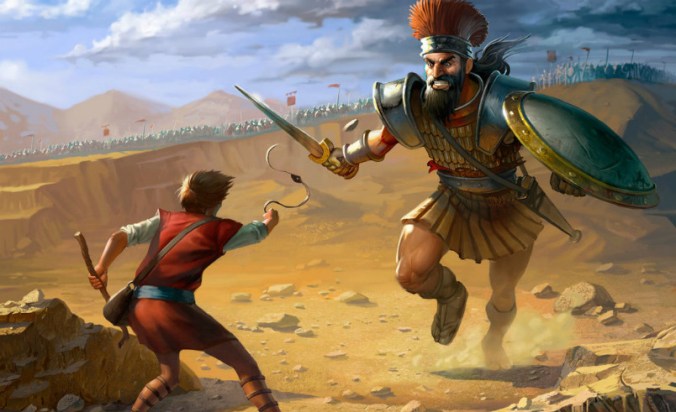
17:49 Reaching into his bag and taking out a stone [God achieved victory by weak means], he slung it and struck the Philistine on the forehead [area not covered by his helmet]. The stone sank into his forehead, and he fell facedown on the ground.

17:50 So David triumphed over the Philistine with a sling and a stone [see Judg. 20:16]; without a sword in his hand he struck down the Philistine and killed him.

17:51 David ran and stood over him. He took hold of the Philistine’s sword and drew it from the scabbard. After he killed him, he cut off his head with the sword. When the Philistines saw that their hero was dead, they turned and ran [Goliath’s death resulted in panic in the Philistine ranks].

17:52 Then [inspired by David’s courage and victory] the men of Israel and Judah surged forward with a shout and pursued the Philistines to the entrance of Gath [Goliath’s hometown (17:4)] and to the gates of Ekron. Their dead were strewn along the Shaaraim road [more than ten miles of road] to Gath and Ekron.

17:53 When the Israelites returned from chasing the Philistines, they plundered their camp.

Fighting shepherd boys can be a hazardous experience. David “ran quickly toward the battle line” (17:48) to meet Goliath. As their respective armies watched the scene, David reached into his bag and armed his sling with a stone. David skillfully released the stone from his sling and struck Goliath in the forehead. The impact of the stone stopped the giant in his tracks and “he fell facedown on the ground” (17:49).

In a matter of minutes the battle was over. The faith of the shepherd boy triumphed over the pride of the giant (v. 50). Goliath’s death resulted in panic in the Philistine ranks (v. 51) and paved the way for victory for the Israelite army (vv. 52-53).

From the moment David saw Goliath and heard his defiant threats, he acted in ways that honored God. He did not run in fear and hide like others. He did not acquiesce to Goliath’s threats. He did not try to fight the battle in another’s armor. He did not volunteer to fight Goliath to advance selfish or self-righteous aims.

David simply exercised his faith in God and put that faith into action by facing Goliath. David’s faith honored God and God honored David’s faith by giving him victory in battle. We too, must act in ways that honor God when facing opposition. Our behavior in the valley can encourage those watching from the hilltops to put their faith into action by standing courageously for God.

17:54 David took the Philistine’s head and brought it to Jerusalem, and he put the Philistine’s weapons [refer to 1 Sam. 21:9] in his own tent [perhaps Goliath’s tent which David claimed by right of victory].

17:55 As Saul watched David going out to meet the Philistine, he said to Abner [Saul’s cousin; 14:50-51], commander of the army, “Abner, whose son is that young man?” Abner replied, “As surely as you live, O king, I don’t know.”

17:56 The king said, “Find out whose son this young man is.”

17:57 As soon as David returned from killing the Philistine, Abner took him and brought him before Saul, with David still holding the Philistine’s head.

17:58 “Whose son are you, young man?” Saul asked him. David said, “I am the son of your servant Jesse of Bethlehem.”

Practical Consideration: How can you stand courageously for God when others oppose God’s way?
Refuse to be intimidated by the giants who oppose God (1 Sam. 17:11).
Remember that God is bigger than any giant you will ever face. Don’t lose perspective (1 Sam. 17:26).
Recall God’s past victories. Doing so can fortify your faith and give you courage to face present challenges (1 Sam. 17:34-36).
Remove anything that will hinder you or rob you of effectiveness (1 Sam 17:39).
Rely on God and His strength in the battle (1 Sam 17:45-47).
Rejoice in the victory only God can give (1 Sam. 17:50).
1 Samuel 16

1 Samuel 16:1-13
16:1 The Lord said to Samuel [Israel’s first prophet (1 Sam. 3:20-21) and last judge (1 Sam. 7:15)], “How long [a prophetic rebuke] will you mourn [see 15:35] for Saul [perhaps over his loss of the kingdom, his disobedience, or for him personally], since I have rejected him as king over Israel [see 1 Sam. 15:26]? Fill your horn with oil [read Ex. 30:22-25 regarding preparation of anointing oil] and be on your way; I am sending you to Jesse [of the tribe of Judah; see Ruth 4:12, 18-22] of Bethlehem [his hometown in Judah]. I have chosen [seen; Saul was the people’s choice; David was God’s choice; 1 Sam. 13:14] one of his sons to be king [see Ps. 75:6-7].”

David is one of the most remarkable and best known characters in the Bible. He is instantly known as the boy who slew the giant (1 Sam. 17) and the man who was felled by his own lust (2 Sam. 11). He also bears the unique distinction of being known as the man after God’s own heart (see 1 Sam. 13:14; Acts 13:22).

The Bible frankly records more information about David’s life than that of any other scriptural character. The details of David’s life are preserved in the pages of Samuel and Chronicles. The testimony of his deep love for God is safeguarded in the treasury of his psalms. David’s life and legacy should inspire us to love and willingly serve God.

David was the youngest of Jesse’s sons and responsible for tending his father’s sheep. He spent many days and nights watching over his father’s flock in lonely desert places. On more than one occasion David acted decisively and courageously to protect the sheep from danger (see 1 Sam. 17:34-36). He also cultivated an intimate relationship with God that found expression in many beautiful psalms.

Someone wisely observed that God prepares us for what He has prepared for us. God had a plan for David’s life. David’s experiences as a shepherd boy helped to prepare him to face the challenges of shepherding a nation (see Ps. 78:70-72). Perhaps you have wondered if God has a plan for your life. God may not call you to lead a nation like He did David, but He nevertheless has expectations and plans for you to serve Him.

God’s plan for David’s life began to unfold when God commanded Samuel to visit David’s hometown (v. 1). Years earlier, Samuel had reluctantly anointed Saul as Israel’s first king. However, because of his acts of disobedience, God eventually rejected Saul as king over Israel (15:23). After mourning for Saul (15:35; 16:1), God instructed Samuel to fill his horn with oil and go to Jesse of Bethlehem (v. 1). God had chosen one of Jesse’s sons to be Israel’s new king (see Ps. 75:6-7). Samuel would soon meet the shepherd boy who is first described in Scripture as a man after God’s own heart (13:14).


God has a plan for your life. His plan includes that you serve Him regardless of your vocation. Perhaps you feel unqualified or unskilled to serve the Lord. Maybe you don’t know how or in what capacity to serve Him. Determine to seek God’s plan for your life. Ask your pastor to suggest ways in which you can serve the Lord. Be willing to serve God even in the small things or behind the scenes. Like David, you may discover that God has been preparing you for a special place of service.

16:2 But Samuel [understandably afraid] said, “How can I go [Samuel wanted to know how he might anoint David without attracting attention]? Saul will hear about it and kill me.” The Lord said, “Take a heifer with you and say, ‘I have come to sacrifice [presumably a fellowship offering; cf. Lev. 3:1] to the Lord.’

16:3 Invite Jesse to the sacrifice, and I [emphatic] will show you what to do. You are to anoint for me the one I indicate [see Deut. 17:15].”

16:4 Samuel [obediently] did what the Lord said. When he arrived at Bethlehem, the elders of the town trembled [quaked with fear] when they met him [perhaps because they had heard about the recent execution of Agag, the Amalekite king (see 15:33) or because they thought he had come to punish some wrong or sin]. They asked, “Do you come in peace?”

16:5 Samuel [reassuringly] replied, “Yes, in peace; I have come to sacrifice to the Lord. Consecrate yourselves and come to the sacrifice with me.” Then he consecrated [ceremonial cleansing often accompanied by putting on fresh garments to heighten the symbolism; see Gen. 35:2-3; Ex. 19:10-14] Jesse and his sons and invited them to the sacrifice.

Samuel did as the Lord instructed him and journeyed to Bethlehem. When Samuel arrived at Bethlehem, “the elders of the town trembled when they met him” (16:4). Perhaps they feared the renowned prophet had come to punish some wrong or sin. Samuel reassured the concerned elders that he had come peacefully “to sacrifice to the Lord.” The prophet then “consecrated Jesse and his sons and invited them to the sacrifice.” The process of consecration probably involved ceremonial cleansing and putting on clean garments (see Gen. 35:2-3; Ex. 19:10,22).

16:6 When they arrived, Samuel saw Eliab [David’s oldest brother (17:28); name means: “My God Is Father”] and thought [surely this guy is “king material”], “Surely the Lord’s anointed stands here before [in the presence of] the Lord.”

Samuel was eager to begin the process of selecting and anointing Israel’s next king. When he saw Eliab, Jesse’s oldest son, Samuel decided he surely was the Lord’s choice for king (v. 6). Eliab, a soldier in Saul’s army (17:13), made an immediate impression on Samuel because of his outward appearance. Samuel must have thought, “This guy is definitely king material, after all, he certainly does have kingly features!” Perhaps Eliab was ruggedly handsome or a tall individual like King Saul (see 10:23). Eliab’s impressive outward appearance almost caused Samuel to make a serious mistake.

16:7 But the Lord said to Samuel, “Do not consider his appearance or his height [as in case of Saul; 1 Sam. 9:2], for I have rejected [as a choice for king, not as an individual] him. The Lord does not look at the things man looks at [people are usually deceived by what their eyes tell them]. Man looks at the outward appearance, but the Lord looks at the heart [godliness, attitude, character].”

The Lord told Samuel that Eliab was not His choice for king (v. 7). He cautioned Samuel about selecting leaders based merely on outward appearance or height (v. 7). Like Samuel, we too can be easily deceived by what our eyes tell us.

Our society places considerable importance on physical attractiveness. From infancy, we are saturated with images and messages that define the ideal look and dress. We must be careful that we do not make determinations about others based on their outward appearance. We must not allow outward features to overshadow or cause us to overlook important inward qualities.

The Lord told Samuel that, unlike man, He looks at the heart (v. 7). He is able to see what we so easily overlook or fail to see in ourselves and others. An essential element for serving God well is a godly and willing heart. We should not judge our own or other’s capacity to serve God by thinking only of physical appearances or other outward qualities. We must determine to make a godly heart our priority.

16:8 Then Jesse called Abinadab [Jesse’s second oldest son; name means: “My (Divine) Father Is Noble”] and had him pass in front of Samuel. But Samuel said, “The Lord has not chosen this one either.”

16:9 Jesse then had Shammah [Jesse’s third oldest son; name probably means: “Heard by God”] pass by, but Samuel said, “Nor has the Lord chosen this one.”

16:10 Jesse had seven of his sons pass [probably in the order of their birth] before Samuel, but Samuel said to him, “The Lord has not chosen these [God is never ignorant of what we are best suited for].”

God always makes responsible choices that are best for all concerned. The Lord rejected Eliab as a candidate for king but not as an individual. God knows what we are best suited for. God did not see in Eliab’s heart the right stuff to lead a nation. Jesse then called his son Abinadab and had him pass in front of Samuel (v. 8). Abinadab, also a soldier in Saul’s army (17:13), was not chosen by God. Jesse’s third son Shammah, a soldier like his older brothers (17:13), passed in front of the prophet but was not chosen either. Jesse had all of his sons pass before Samuel, but none of them were chosen (v. 10).

16:11 So he asked Jesse, “Are these all the sons you have?” “There is still the youngest [or smallest; this “nobody” was really a “somebody” in God’s eyes],” Jesse answered, “but he is tending the sheep [no one thought David possessed any kingly qualities, yet God would use David’s skills as a shepherd for eternal purposes].” Samuel said, “Send for him; we will not sit down until he arrives.”

Samuel, perhaps a little confused, asked Jesse, Are these all the sons you have? (v. 11). After all, God had told Samuel He had chosen one of Jesse’s sons to be king (16:1). Jesse replied that his youngest (perhaps smallest) son was tending the sheep. No one had thought of calling the youngest family member in from the fields. Perhaps no one thought he possessed any kingly qualities (see 17:28). Samuel instructed Jesse to send for the youngest son. We will not sit down, said the prophet, until he arrives.

16:12 So [at Samuel’s request] he sent and had him brought in [see Ps. 78:70-72]. He was ruddy [red or auburn-haired; handsome with a reddish complexion], with a fine appearance [literally, beautiful eyes] and handsome features [pleasant to look at]. Then the Lord said, “Rise and anoint him; he is the one.”

Jesse immediately sent for his youngest son and had him brought in (v. 12). David had no idea that the journey from the sheep pens to his father’s house would change the course of his life (see Ps. 78:70-72). He had no idea that his heart had attracted the attention of God.

The Bible describes David as having a reddish complexion, beautiful eyes, and handsome features (v. 12). More importantly, God saw in David’s heart the right stuff for the task of ruling a nation.

When Samuel saw David, the Lord said, “Rise and anoint him; he is the one.” The young shepherd boy had proven himself faithful in his service to his father. In the solitude of the sheep pens and grazing areas, David had quietly nurtured his relationship with God. When the time came to anoint a new king, David did not promote himself. Instead, God sought out and promoted the young shepherd boy.

God takes notice of our service. I once heard someone say that those who feel they are too big to do a small job are too small to do a big job. Sometimes God leads us into new kinds of service that involve changes in life direction. Serving God faithfully in present situations is a strong indication that God can count on us to serve well in new kinds of service. Like David, determine to be faithful in your present work. After all, you never know who is going to take notice!

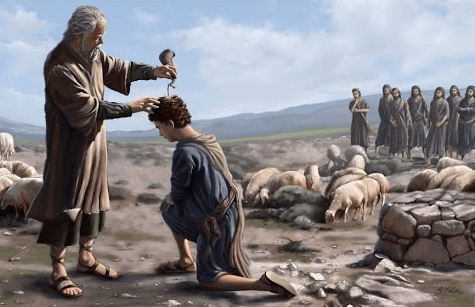
16:13 So Samuel took the horn of oil and anointed [Heb. mashach from which we get our word Messiah] him [oil symbolized anointing with the Holy Spirit] in the presence of his brothers [witnesses], and from that day on the Spirit of the Lord came upon David [first mention of his name in the books of Samuel; name means: “Beloved of the Lord”] in power. Samuel then went to Ramah [and David returned to sheep field].

Samuel waited patiently for Jesse’s youngest son to arrive from the fields. As David approached, Samuel noticed that he was a handsome boy like his older brothers. However, Samuel did not act until the Lord instructed him to do so (v. 12). Only then did the aging prophet take the horn of oil to anoint David in the presence of his brothers (v. 13). The Jewish historian Josephus wrote that Samuel whispered in David’s ear that God had chosen him to be Israel’s next king.

After David was anointed by Samuel, the Spirit of the Lord came upon him in power. David experienced the Spirit’s powerful presence from that day on. God had set David apart to lead a nation. The young shepherd boy would certainly need the power of God’s Spirit to fulfill his responsibilities. Once Samuel anointed David, the prophet returned to Ramah, his hometown. David returned to the sheep fields where he continued to faithfully serve until the insults of a Philistine giant beckoned him out of obscurity into the public arena.


The Holy Spirit is the Person of power. He enables believers today to serve with confidence. The Holy Spirit empowers Billy Graham to stand before thousands to preach the gospel. He also empowers people like you and me to quietly share the gospel with neighbors and friends. The Holy Spirit strengthens missionaries serving in remote areas of the world. He also strengthens believers faithfully serving God through the ministries of their local churches. Every believer can count on the presence and power of the Holy Spirit. But can the Holy Spirit count on our willingness to serve? We can serve God with confidence when we depend upon the power of God’s Holy Spirit.


Note: You Can Serve God Well If You Will Use…
• Your Heart: Cultivate intimacy in your relationship with God by spending time alone with Him. Set aside time daily to pray and to read God’s Word.
• Your Head: Be observant. Look at the needs around you. Consider how God might use you to meet some of the needs in your world.
• Your Hands: Roll up your sleeves and get to work. Be willing to do anything for the sake of advancing God’s kingdom.
• Your Home: Jesse’s sons were raised in a home that encouraged them to love and serve God. Determine to provide a home that will encourage your children to love and serve God.