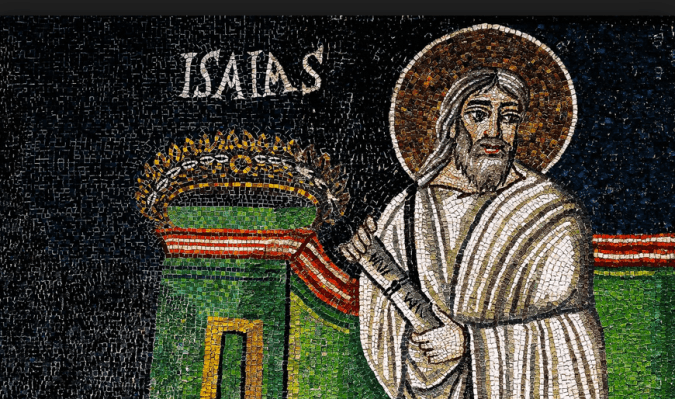
Isaiah 13

After twelve chapters of stern words to Judah, Isaiah turned his attention to foreign nations. The foreign nations denounced in these eleven chapters were guilty of committing the same crimes as Judah: injustice, social and moral abuses, pride, and greed, to name but a few.

Isaiah prophesied that the foreign nations guilty of such crimes would be punished. If God held foreign nations accountable, how much more His own people. If God administered severe judgment on foreign nations, how much more severe would be His judgment on His own people. These chapters also illustrate God’s work in and sovereignty over all nations.

Practical Consideration: Isaiah’s oracles were meant to help Judah.
Isaiah’s oracles against foreign nations were meant to help Judah.

First, they should have reminded Judah of her responsibility to be a distinctive people.

Second, they should have served as a warning to Judah regarding the folly of trusting in foreign alliances for national protection rather than trusting in God.

Third, they should have reminded Judah of her responsibility to have a godly impact upon the nations of the earth rather than allowing herself to be shaped by the godless practices of those nations.

Fourth, they should have helped Judah come to the realization that the God who held heathen nations accountable for their sin would hold His own people accountable for their sin. Judah failed to learn any of these lessons from Isaiah’s oracles.

The Amazing Fall of Babylon

13:1
What is the historical context of Isaiah’s oracle against Babylon?
Isaiah’s oracle against Babylon envisioned the destruction of Babylon. The Babylonians besieged and plundered Jerusalem, destroyed the Temple and the city, broke down the walls around Jerusalem, carried many Jews off into exile, and put to death many religious, civic, and military leaders.

The fall of the Southern Kingdom in 586 B.C. (2 Kings 25) marked the end of any independent Jewish state until May 14, 1948. Isaiah envisioned the destruction of Babylon, which occurred in 539 B.C. at the hands of Cyrus.

13:2-22
What steps would God take to deal with Babylon?
Isaiah 13:2-5 describes the mustering of a great army. This great army (13:3-5) is summoned to assembly by a signal given from the top of a hill (13:2). This army will execute a terrible judgment on Babylon (13:6 and 19) that will cause even the most courageous to lose heart and grow faint (13:7-8). This judgment will be so severe that its impact will be felt by the whole cosmos (13:9-13).

The wicked, the proud, and the ruthless will especially feel the force of God’s judgment (13:11). They will be like hunted animals (13:14) and experience the awful cruelties of war (13:15-16). Isaiah identified the Medes as the instrument of God’s judgment (13:17) who would mercilessly destroy Babylon (13:18-22).

Isaiah 12

Two Songs of Praise and Trust

12:1-6
What would characterize the attitude of the remnant?


Isaiah 12 contains two hymns of thanksgiving. Each hymn is introduced by the phrase, “you will say on that day” (1:1 and 4). Those who experienced the restoration spoken of in Isaiah 11 were to express their thanksgiving to the Lord (11:1-3).

Note: The word “salvation” is used for the first time in Isaiah in verse 2. The second hymn (11:4-6) praises God for His mighty acts and abiding presence.

Isaiah 11

Righteous Reign of the Branch

11:1-16
What did Isaiah envision coming from the stump of Jesse?


This passage contains one of the most detailed descriptions of the Messiah. Isaiah envisioned a day when a shoot (a new king from the royal line of David) from the stump of Jesse (the royal line of David) would spring forth (11:1). The Spirit of the Lord would rest upon this shoot or branch endowing Him with the necessary virtues for godly leadership (11:2-5).

He will have wisdom (11:2), administrative abilities (11:3-4), and piety (11:5). His reign will be characterized by harmony and peace and the earth will be filled with the knowledge of the Lord (11:6-9).

Isaiah also envisioned a day when the remnant of those exiled to foreign lands would be restored to their own land (11:10-16). An end to the strife between Judah and Israel will characterize this day (11:13). God will also prepare a highway for the return of the dispersed remnant in a type of “second Exodus” (11:16).

The immediate fulfillment of this promise was when, after the Assyrian and Babylonian captivities, the Jews were permitted to leave Babylon. Its ultimate fulfillment will be when the Messiah regathers His people at the end of the age.

11:1 A shoot [that would become far greater than the original tree] will come up from the stump [reference to the Babylonian Captivity in 587 BC when it appeared the Davidic kingdom would become nothing] of Jesse [the house of David; Jesse was David’s father (points to humble beginnings); stump indicates it appeared the once mighty dynasty of David was finished]; from his roots [which are still alive] a Branch [used as a name for the Messiah (cf. Zec. 3:8; 6:12; Jer. 23:5; 33:15)] will bear fruit.

11:2 The Spirit of the LORD will rest on him [cf. Isa. 61:1-2; Lk. 4:18-19; Jn. 1:32-33] [note three pairs of divine qualities] the Spirit of [1] wisdom and of understanding [ability to assess facts and make sound judgments], the Spirit of [2] counsel [to actively stand beside and give encouragement (cf. Jn. 14:16); to stand by someone as an advocate or friend (cf. 1 Jn. 2:1)] and of power [ability to use authority effectively], the Spirit of [3] knowledge [of the ways of God] and of the fear of the LORD [awe and submission to the Lord]

11:3 and he will delight in the fear of the LORD. He will not judge by what he sees with his eyes, or decide by what he hears with his ears;

11:4 but with righteousness [capacity for doing the right thing in all circumstances] he will judge the needy, with justice he will give decisions for the poor of the earth. He will [note deadly judgment on oppressors] strike the earth with the rod of his mouth; with the breath of his lips [God has the power to create and destroy through His words] he will slay the wicked.

11:5 Righteousness will be his belt and faithfulness the sash around his waist.

Isaiah 10

God’s Judgment of Unrepentant Israel a Lesson for Judah

10:1-4
The fourth stanza (see Isa. 9:8–10:4) is addressed to the people of Judah (10:1-4). In spite of the chastisement of Israel, Judah continued on its sinful course. In spite of the judgment of God on the Northern Kingdom, Judah did not turn away from injustice, oppression, and exploitation of the poor. As a result, Judah would feel God’s stern judgment at the hands of the Assyrians.

After Judgment Through Assyria, a Remnant to Be Restored

10:5-19
How did Isaiah picture the role of Assyria in God’s plan?

These verses contain an oracle against Assyria. Isaiah pictured Assyria in a two-fold light.

First, Isaiah pictured Assyria as a pawn in God’s hand, a mere instrument of His purpose. Assyria is pictured as being God’s “rod” and “staff” (compare to Psalm 23:4), instruments of discipline and correction. God sent Assyria to punish “a godless [alienated from God] nation” (10:6), that is, Judah. Notice the reference to the name of Isaiah’s son in verse 6.

Second, Isaiah pictured Assyria as a proud nation which did not see itself as an instrument of God’s judgment (10:7-11). Just as God punished the godless nation of Judah, so would He punish the arrogant nation of Assyria (10:12).

The arrogant attitude of Assyria is described in graphic terms in verses 13 and 14. Assyria boasted of plundering nations as easily and effortlessly as one might plunder eggs from an abandoned nest. Isaiah described such boasting as being as foolish as a tool boasting that it controlled its user (10:15).

The judgment that awaited Assyria (10:16-19) would be ignited by “the light of Israel” (10:17) or God Himself. The surviving Assyrian remnant would be so small that a child would be able to count them.

10:20-34
Who would survive the judgment of the Lord?

Isaiah declared that a remnant would survive the judgment of the Lord (10:21-22). Isaiah looked to a day when the surviving remnant would trust in the Lord rather than in foolish alliances (10:20). Recall that the name of Isaiah’s first son meant “a remnant shall return” (7:3).

Isaiah 10:24-27 assure Judah that they will survive the Assyrian threat. God would deal as decisively with the Assyrians as He did with the Midianites (see Judges 6-8). This hope was realized when “the angel of the Lord went out, and struck 185,000 in the camp of the Assyrians” (see 2 Kings 19:35 and 2 Chronicles 32:21) and they withdrew from Jerusalem.

Isaiah 10:28-34 restates the threat of Assyria to Jerusalem. These verses describe the swift movement of the Assyrian army en route to Jerusalem’s doorstep (10:28-32) and the intervention of God on behalf of Jerusalem (10:33-34). While Assyria would be used by God to discipline His people, He would not permit them to do anything outside the scope of His purposes.

Isaiah 9

God’s Light in the Darkness

9:1-7
What message of hope did Isaiah have for those experiencing darkness?
Isaiah 9:1 sets the stage for the messianic poem contained in the verses to follow. This verse informs us of the calamity which was experienced by the two northernmost tribes of Israel (Zebulun and Naphtali), which were the first to experience the wrath of Tiglath-pileser’s Assyrian army.

Isaiah 9:2-7 contains a wonderful message of hope to the north that finds its ultimate fulfillment in the Lord Jesus Christ (although scholars generally agree that its immediate fulfillment was in Hezekiah). Isaiah envisioned a day of victory (9:2) in which the rod of the oppressor will be broken and the people will be released from the yoke of servitude (9:4). In that day the people will rejoice as at harvest-time or as in the dividing of the spoil of battle (9:3). In that day the gear and implements of battle will be burned for fuel (9:5). The king that would inaugurate such a state would be the final king in the Davidic line rather than a king in a continuing succession of kings, as suggested by the phrase “From then on and forevermore” (9:7). The throne-names given to this ideal king emphasize the uniqueness of His person and office (9:6): “Wonderful Counselor” emphasizes administrative ability; “Mighty God” or mighty warrior, stresses supremacy over enemies; “Eternal Father” emphasizes love and care for His people; “Prince of Peace” stresses the nature of His rule and what His people will enjoy.

9:6 For to us a child [God is able to overcome His enemies by becoming vulnerable] is [used to emphasize certainty of what will take place in the future] born [looks back to prophecy of 7:14], to us a son [Isaiah looks beyond the immediate to the ultimate coming of a son who would bear titles beyond those any normal human could claim] is given [gift from God (cf. Jn. 3:16)], and the government will be on his shoulders [he will have all authority; cf. 9:7; cf. Matt. 28:18]. And he will be called Wonderful [may refer to Son’s miraculous origin and ability to do miracles] Counselor , Mighty God [a divine title], Everlasting Father [not oppressive monarch but like a father to His people; enduring fatherly care], Prince of Peace [describes the nature of His being and reign].

9:7 Of the increase of his government and [note three characteristics of kingdom] [1] peace [coming Ruler would make peace possible among individuals and between an individual and God] there will be no end [fulfillment of promise to David in 1 Chron. 17:11-14]. He will reign on David’s throne and over his kingdom, establishing and upholding it with [2] justice and [3] righteousness from that time on and forever. [assurance that God’s promise would be fulfilled by God’s power] The zeal of the LORD Almighty will accomplish this.

God’s Judgment of Unrepentant Israel a Lesson for Judah

9:8-10:4
What measures did God take to deal with Israel and warn Judah?
This section of Isaiah has been called “the refrain song” because it is divided into four stanzas, each ending with the refrain “In spite of all this His anger does not turn away, And His hand is still stretched out” (9:12, 17, 21 and 10:4).

The first stanza concerns the chastisement of the Northern Kingdom because of the nation’s stubborn refusal to listen to and obey God’s Word (9:8-12). The people however, failed to learn from the calamities they suffered and boasted that they would simply rebuild better than before (9:10). The refrain emphasizes that God would send even greater destruction in the future (9:11-12).

The second stanza also concerns the Northern Kingdom (9:13-17). Those who experienced calamities designed to turn them back to God refused to turn back to God (9:13). The people continued to be hard-hearted and obstinate. God therefore warned that He would deal with both the civil and religious leaders who were responsible for leading the people astray (9:14-15). God’s judgment would even fall on widows and orphans (9:17).

The third stanza describes the chaos in the Northern Kingdom in its final years (9:18-21). The nation is pictured as being consumed by its own evil as well as by God’s wrath (9:18-19). The people are pictured as being destroyed by strife and division (9:20). The only thing that temporarily unites the people is their mutual hatred for Judah (9:21).

The fourth stanza is addressed to the people of Judah (10:1-4). In spite of the chastisement of Israel, Judah continued on its sinful course. In spite of the judgment of God on the Northern Kingdom, Judah did not turn away from injustice, oppression, and exploitation of the poor. As a result, Judah would feel God’s stern judgment at the hands of the Assyrians.

Note: God does not take sin lightly.
Sin is a serious matter to God. His judgment of the Northern Kingdom of Israel illustrates that He does not take sin lightly. God’s judgment of Israel should have served as a warning to the Southern Kingdom of Judah. Judah, however, failed to learn any good lessons from Israel’s bad example. 

Isaiah 8

Prophecies in the Crisis with Syria and Israel

8:1-4
What two symbolic acts did God tell Isaiah to perform?
God told Isaiah to perform two symbolic acts to represent the coming destruction of Syria and Israel at the hands of the Assyrians.

First, God instructed Isaiah to take a large clay tablet and inscribe it with the clearly legible message, “Swift is the booty, speedy is the prey” (8:1) or, “Quick pickings – Easy prey” (J.B. Phillips’ translation). Isaiah was also careful to invite two witnesses to attest the recording of the message of the doom of Syria and Israel (8:2). These witnesses would be able to furnish incontrovertible testimony regarding the fulfillment of Isaiah’s prophecy should it be questioned in the future.

Second, God instructed Isaiah to give the name on the clay tablet to his second son (8:3). God also told Isaiah that Syria and Israel would lie in ruins before the boy was old enough to say “mommy” and “daddy” (8:4). The Assyrian army would indeed be “quick to plunder and swift to take the spoil.”

8:5-10
What prophecy of judgment did Isaiah declare?
Isaiah declared that because Ahaz and the people failed to trust in the Lord (“the gently flowing waters of Shiloah”) and trusted instead in Assyria (8:5-7), God was going to allow the Assyrians to engulf the land like a raging river overflowing its banks (8:7). The great Assyrian army would move over Syria and Israel like flood waters and then flow on into Judah (8:8). The alliance with Assyria would bring more than the relief Ahaz and Judah sought from the Syro-Ephraimitic pressure, it would ultimately bring misery and destruction. Verses 9-10 seem to look beyond the present crisis to a time of hope. These verses picture a day when the plots of God’s enemies will backfire and affirm that God is in control of history.

Note: Sin leads to suffering.
The Northern Kingdom of Israel would soon feel the full force of God’s judgment at the hands of the mighty Assyrian war machine. The Southern Kingdom of Judah would also feel the backlash of that judgment within its own borders. Sin always leads to suffering. That is true of both individuals and nations. No man or nation can sin with impunity.

8:11-18
What personal admonitions did God give to Isaiah?
God admonished and encouraged His prophet during the pressure-filled days of the Syro-Ephraimitic crisis. He told Isaiah to continue taking a stand against the popular pro-Assyrian policy of the day (8:11). Isaiah was told to not become involved in the conspiracies or fears of other men (8:12). God told Isaiah to fear God and not man (8:13).

Isaiah was to continue standing for what was right rather than what was expedient. He was to continue urging the people to trust God rather than rely on an alliance with the Assyrians. God would be a sanctuary (refuge) to those who trusted in Him but a stumbling block (ruin) to those who did not trust in Him (8:14). Failure to trust God would surely lead to stumbling (8:15).

According to verses 16-18, Isaiah (perhaps because his message fell on deaf ears) retreated from confronting the king and people and devoted himself to teaching his students (8:16). Isaiah was willing to wait for his words to be vindicated (8:17). His presence and that of his sons (with their convicting/symbolic names) would however, silently testify to and remind the people of the truth of his message (8:18).

Note: We must stand for what is right.
In the face of a nation that refused to trust God and was determined to enter into an imprudent alliance with Assyria, Isaiah did not bend to popular opinion. He dared to swim against the pro-Assyrian policy tide and hold the nation and its leaders accountable for their failure to put their trust in God. Isaiah was bold in declaring God’s message because he feared God and not man. God could count on Isaiah to speak the truth even when it was unpopular to do so. We too, must stand for what is right, regardless of the flow of popular opinion.

God’s Light in the Darkness

8:19-22
What impact did Isaiah’s silence have upon the people?
Isaiah temporarily retreated from public ministry/remained silent, perhaps because his words had fallen on deaf ears. With Isaiah’s silence there would be no Word from the Lord. The people would experience a “famine” of God’s Word much like that which Amos predicted in Israel (see Amos 8:11-12).

Isaiah and his children, however, would serve as “living epistles” to the people of Judah during this period. The presence of Isaiah and his sons, whose names were messages in themselves, would serve to convict the people and remind them of coming judgment. During this period, the people would consult mediums and spiritists for insight into their personal lives (8:19). Isaiah’s disciples, however, were to point the people “To the law and to the testimony!” (8:20) lest they continue to grope in spiritual darkness and despair (8:21-22).

Note: Those who refuse to listen to God are easily tempted to consult wrong sources for help.
Those who will not consult God’s Word for direction, comfort, perspective, and counsel will try to find those things in other sources. People want answers to their problems, perplexities, and pains and will look for those answers in the wrong places if they do not consult God’s Word. Millions of people in our society dial 1-900 numbers daily to speak with psychics, astrologers, or other human beings because they are confused, lonely, and groping in darkness. People who look for answers and help apart from God’s Word will be disappointed, if not immediately, ultimately.

Isaiah 7

Isaiah 1-6 focus on the spiritual situation and needs of the people. Isaiah 7-12 focus on the political situation in which Judah found itself “in the days of Ahaz” (736-725 B.C.; Isaiah 7:1) and the failure of the nation’s leaders to trust the Lord.

Ahaz’s Behavior in a Crisis

7:1-9
What crisis was Ahaz facing?
During the reign of Ahaz, Assyria was growing increasingly stronger as a military power. The Assyrians had a reputation as fierce and ruthless warriors (see Isaiah 5:27-30). Some scholars refer to them as the Nazis of the eighth century B.C.!

Feeling pressured and threatened by Assyria (under the leadership of Tiglath-pileser III), Rezin (king of Syria/Aram) and Pekah (king of Israel) formed a military coalition and asked Ahaz (king of Judah) to join them. When Ahaz refused to join their coalition, Pekah and Rezin put in motion their plan to overthrow Ahaz (known as the Syro-Ephraimitic crisis) and set up a puppet government in Judah which would cooperate with them (7:6).

When Ahaz and the people of Judah learned that the two kings from the north were approaching, their hearts trembled with fear (7:2). God then commanded Isaiah to take his son Shear-jashub (whose name means “a remnant shall return”) and deliver a message of assurance to Ahaz (7:3-4): “Take care, and be calm, have no fear and do not be fainthearted. . .” This is the first recorded encounter between Isaiah and Ahaz, who was inspecting the city’s water supply in anticipation of a siege (7:3).

Isaiah assured Ahaz that the two kings (or “two smoldering stubs of firewood” Isaiah 7:4, NIV), would soon die and that within sixty-five years Ephraim (the Northern Kingdom) would no longer exist (7:5-9). Isaiah spoke these words in 734 B.C. Syria fell to the Assyrians in 732 B.C., Israel fell to the Assyrians in 722 B.C., and by 669 B.C. the nation of Israel no longer existed.

God’s message was plain: trust in the Lord and live or do not trust in the Lord and suffer defeat. The Jerusalem Bible preserves a convicting play on words in the Hebrew text by translating Isaiah 7:9, “If you do not stand by Me, you will not stand at all.”

Note: Alarm is present where there is no confidence in God.
When King Ahaz and the people of Judah learned of the threat from Pekah and Rezin, they “shook as the trees of the forest shake with the wind” (7:1). They had no confidence in the face of difficulties. Ahaz sought in vain to relieve his anxieties by inspecting his water-system and entering into a foolish alliance with Assyria. He sought to calm his fears apart from God. Alarm and panic is always present where there is no confidence and trust in God.

Note: It is foolish to refuse God’s help.
Ahaz foolishly refused God’s help and sought instead the help of Tiglath-pileser III. He sought the help of man above the help of God. He sought help from the arm of flesh rather than from God’s mighty arm. Whenever we are tempted to disregard the help of God we should remember Ahaz and allow his foolishness to be a warning beacon against refusing God’s help. God is worthy of our trust.

7:10-17
What did God offer Ahaz to assure him of victory over Pekah and Rezin?
God offered to give Ahaz any sign to assure him of victory over Pekah and Rezin (7:10-11). Ahaz piously refused to ask God for a sign, probably because his personal plan was to form an alliance with Assyria as indicated by 2 Kings 16:7-8. In addition, had Ahaz accepted the offer for a sign he would have had to alter his plans to ask Assyria for aid. Ahaz chose to seek aid from Assyria rather than from God.

God however, gave Ahaz a sign anyway. While the ultimate fulfillment of the sign (prophecy) is in the Lord Jesus Christ, it had an immediate significance to Ahaz and the people of Judah. A young woman would marry, conceive, and bear a son whose name would be “Immanuel.” Ahaz was told that before this boy reached an age of moral accountability, the two kings (Pekah and Rezin) would be destroyed. This prophecy was fulfilled when Assyria defeated Syria in 732 B.C. and Israel in 722 B.C.

7:10 [8th century BC; Northern Kingdom of Israel (Ephraim) under the leadership of King Pekah and Syria (Aram) under the leadership of King Rezin threatened to invade Judah for refusing to join them in an alliance against Assyria (ruled by Tiglath-Pileser III); God sent Isaiah to reassure Ahaz that Pekah and Rezin would not succeed] Again [cf. 7:4-9 re: what the Lord had spoken through Isaiah] the LORD spoke to Ahaz [an evil king of Judah; God spoke words of encouragement through Isaiah],

 7:11 “Ask the LORD your God for a sign [to assure him that Judah would not fall to its attackers], whether in [no limits placed on what Ahaz might ask] the deepest depths or in the highest heights.”

 7:12 But Ahaz said [his answer sounds pious but is in fact hypocrisy because his personal plan was to form an alliance with Assyria (cf. 2 Kings 16:7-8) rather than to trust God], “I will not ask; I will not put the LORD to the test. [perhaps alluded to Deut. 6:16 which prohibited testing God; in this case God commanded Ahaz to ask for a sign, therefore the only acceptable response was to obey God]

 7:13 Then Isaiah said, “Hear now [Behold], you house of David! Is it not enough to try the patience of men? Will you try the patience [to weary, to wear out] of my God also?

 7:14 Therefore the Lord himself will give [an example of God’s mercy and grace] you a sign [even if you don’t ask for one]: The virgin [Hebrew ‘almah: unmarried woman; some feel this refers to either Isaiah’s wife or Ahaz’s wife: the woman would have been unmarried at time of this prophecy, then married, then pregnant, then give birth to child who became sign to Ahaz] will be with child and will give birth to a son, and will call him Immanuel [means “God with us” — ultimate fulfillment of this prophecy was in virgin birth of Jesus (cf. Matt. 1:23)].

Note: There are differing views regarding the immediate identity (not the ultimate messianic identity) of the child named “Immanuel.” Some scholars believe that the child named “Immanuel” was Isaiah’s own son. Other scholars believe that the child was a son to be born to Ahaz, a royal heir to assure him of the continuance of the royal line. Those who adopt this view believe that the royal heir was Hezekiah.

Prophecies of Assyrian Invasion

7:18-25
What would happen as a result of Ahaz’s refusal to trust God?
Because Ahaz refused to trust the Lord, Isaiah warned him that Assyria and Egypt would invade and ravage the land of Judah. In fact, Judah would experience the worst days since the division of the kingdom (7:18). There are four oracles introduced by the phrase “in that day.”

First, God would whistle for Assyria (and Egypt) to descend upon the land like a swarm of insects (7:18-19).

Second, the Lord would shave the land as with a razor (from head to foot), leaving it completely barren (7:20).

The third and fourth oracles describe the conditions after the Assyrian rape of the land.

Third, the people would be forced to subsist on a meager diet of dairy products (7:21-22).

Fourth, briars and thorns would replace the rich agricultural resources of the land (7:23-25), alluding to the commercial implications of the crisis.

Song of Songs 8

8:6 [the female wanted to be regarded as her lover’s most valuable possession] Place me like a seal [a symbol of ownership and unbreakable devotion and commitment] over your heart, like a seal on your arm [symbol of strength and security; she wanted to feel safe and secure]; for love is as strong [only occurrence of this word in the Song] as death [in the sense that its power cannot be resisted], its jealousy unyielding as the grave [it holds tightly to those whom it has seized]. It [love and passion] burns like blazing fire, like a mighty flame.

8:7 Many waters [represent overwhelming power] cannot quench love; rivers cannot wash it away [indicates perseverance]. If one were to give all the wealth of his house for love, it would be utterly scorned [true love cannot be bought].

Song of Songs 6

6:1 [the chorus is singing here…] Where has your lover gone, most beautiful of women? Which way did your lover turn, that we may look for him with you?

6:2 My lover has gone down to his garden [to her (his lover), in order to make love to her], to the beds of spices [a place of pleasure], to browse in the gardens and to gather lilies [refers to the woman].

6:3 I am my lover’s and my lover is mine [indicates that these lovers were committed to one another]; he browses among the lilies [the female acknowledged that her lover was comfortable in her presence and in their home].

Song of Songs 2

2:1 I am a [only one of many flowers (i.e., girls)] rose [probably a crocus, daffodil, or narcissus] of Sharon, a lily [a flower of an unknown variety] of the valleys.

2:2 [the male’s evaluation of the worth of his lover] Like a lily among thorns is my darling among the maidens [the male esteems her as greater than all others].

2:3 [the female’s response] Like an apple tree among the trees of the forest is my lover among the young men. I delight [she enjoys his company] to sit in his shade [protection], and his fruit [pleasure] is sweet to my taste.

2:4 He has taken me to the banquet hall, and his banner over me is love.

2:5 Strengthen me with raisins, refresh me with apples, for I am faint with love.

2:6 His left arm is under my head, and his right arm embraces me.

2:7 Daughters of Jerusalem, I charge you by the gazelles [associated with sexual potency and fertility] and by the does of the field: Do not arouse or awaken love until it so desires [a charge to not be aroused sexually until the right time and person arrives].