Isaiah 42

The Call and Commission of a Servant

42:1-17
What responsibility was assigned to the Servant called by God?


Isaiah 42:1-7 contains the account of the call and commission of an unidentified Servant. This Servant (perhaps a reference to Israel or Isaiah or to the Messiah as per Matthew 12:14-21) is identified as God’s Servant who is empowered to bring forth justice by God’s Spirit (42:1-2). The Servant will neither break nor extinguish those striving after righteousness (42:3) nor will he be discouraged until he has “established justice in the earth” (42:4).

In Isaiah 42:5-9, God, the creator of the universe (42:5), appointed Israel to be a servant to the nations. Israel’s role as a servant to the nations included being “a light to the nations” (42:6) that still serve graven images (42:8), giving sight to the blind, and setting prisoners free (42:7). God, who was unwilling to share His glory with graven images (42:8), would “declare new things” (42:9) or things previously unknown and unexpected (such as the conquest of Babylon by Cyrus and the return of Israel from captivity).

Isaiah 42:10-13 is a hymn of thanksgiving for the deliverance from Babylon, a type of second Exodus. Isaiah 42:14-17 express that God would prepare a way to lead His blind people home. Idolaters, however, would be held accountable for their apostasy (42:17).`

The Past Performance of a Servant

42:18-25
What characterized the past performance of God’s servant?
This passage identifies the blind (Isaiah 42:14-17) as God’s own people who failed to function as His servant. They were a blind, deaf, and unresponsive people (42:18), yet still identified as God’s servant (42:19). God chose them and gave them His Word (42:21), but they did not obey God’s Word (42:24) and were “plundered and despoiled” (42:22) as a result. Verses 23-24 accentuate the fact that God’s people were in captivity because of their sin rather than because of the strength of their enemies. The people were spiritually insensitive. They were like a man in the midst of a blaze who was insensitive to its heat (42:25).

Isaiah 41

Israel‘s Restoration Under Cyrus

41:1-20
What provision would God make for the restoration of His people?
Isaiah 41:1-4 is a courtroom scene in which God summoned the nations to account for the spectacular military successes of an unnamed conqueror (later identified as Cyrus, king of the Medes and Persians). The nations could not answer. God answered His own question by announcing that it was He who raised up the unidentified conqueror who would play a key role in releasing His people from captivity. God announced that He was in control of history and He who made possible the successes of the unidentified conqueror.

Practical Consideration: God is in control of history.
The national and personal sins of God’s people brought the judgment of God upon them. They were carried away into exile. After seventy years in Babylonian captivity, God was ready to allow them to return to their homeland.

Through a series of events on the international political scene, God allowed a man named Cyrus, king of Persia, to successfully expand his empire by conquering the Babylonians in 539 B.C. The actions of Cyrus however, fit into a larger scheme. He was the deliverer identified by Isaiah (Isaiah 44:28-45:7) and Jeremiah (Jeremiah 25:12 and 29:10).

Ezra reminds us that Cyrus was serving a purpose bigger than his own, as indicated by the phrase “in order to fulfill the word of the Lord by the mouth of Jeremiah” (Ezra 1:1). The fulfillment of prophesy points out that God is at work shaping history and directing human affairs. History has a purpose. History is actually “His Story.”

Isaiah 41:5-7 describes the panic that seized the nations when they learned that Cyrus would be the instrument of God’s purpose. In a frenzy they tried to fashion more powerful idols to deal with Cyrus. All of this effort was vain and futile. Cyrus would accomplish God’s purpose by defeating Babylon.

Isaiah 41:8-20 are messages of reassurance to Israel that they had been chosen by Him and would not be forsaken by Him (41:8-9). They were still His chosen people and owed Him their allegiance and loyalty. God promised to protect and care for His people and give them victory over their enemies (41:10-13). He would transform Israel from a “worm” (41:14) to a “threshing sledge” (41:15) that would pulverize her enemies and all obstacles (41:16). God promised to care for “the afflicted and needy” (41:17), a reference to the exiles, and make provision for their needs on their journey home (41:18-20).

The Idol’s Impotence and God’s Omnipotence

41:21-29
What challenge did God issue to the idols of the nations?
Isaiah 41:21-29 is a courtroom scene in which the idols of the nations (Babylon in particular) are called to demonstrate their power. God called upon the idols to perform three tasks to demonstrate their power.

First, He called upon them to “declare to us what is going to take place” (41:22a and 23a).

Second, He called upon them to interpret past events or explain how things began (41:22).

Third, He called upon them to actively intervene in history by doing either good or bad. They could, of course, do none of these things and were pronounced by God as being “of no account” (41:24). In contrast to the impotent idols of the nations, God actively intervened in history by summoning a ruler (Cyrus) to deliver His people (41:25-29).

Practical Consideration: God can pass the test.
God challenged the idols of the nations to prove themselves by declaring future historical events, interpreting past historical events, and intervening in history. The idols of the nations were silent. They could not pass the test. Only God could pass such as test. This challenge was issued to accentuate the impotence of idols and the omnipotence of God and to remind God’s people of the stupidity of trusting in idols. It is wise to put our trust in God. He alone can pass the test.

Isaiah 40

There is a span of about 150 years between chapter 39 and chapter 40 of Isaiah. The historical background for the material in chapters 40-66 is the Babylonian Exile and the post-exilic period. These chapters have been referred to as “the Book of Consolation” and “the heart of the Old Testament.”

In chapters 1-39 Isaiah spoke to his own generation regarding the ability of God to defend them against the Assyrians.

In chapters 40-66 Isaiah envisioned the day when the Babylonians would destroy Jerusalem and take the Jews into Captivity (586 B.C. and see also 2 Kings 25). He also envisioned the events that would result in the Jews returning to Jerusalem to rebuild and restore their nation.

In chapters 1-39 Sennacherib (king of Assyria) was the predominant world leader. In chapters 40-66 Cyrus (king of Persia) was the predominant world leader.

The Prophet’s Call to Comfort God’s People

40:1-11
What call did the prophet receive from God?
Someone has suggested the Old Testament prophets were called to afflict the comfortable and comfort the afflicted. In Isaiah 40:1-2, God called His prophets to comfort His afflicted people. The prophets were called to reassure (“speak kindly” – 40:2) God’s people that their term of bondage was over and their iniquity (the cause for their captivity) removed or forgiven.

In verses 3-5 God called for a highway to be built over which His people could return to their homeland. The highway would be a smooth path free of obstacles.

In verses 6-9 a voice commanded that the message of man’s frailty and God’s enduring Word be proclaimed. God’s Word must be the source of hope and strength and comfort for frail men.

In verses 9-11 Jerusalem was instructed to ascend a high mountain and proclaim the good news of God coming to deliver His people. This news was to be proclaimed to “the cities of Judah” (40:9). The news of God, the Shepherd of Israel, coming to gather His scattered flock and tenderly guide them home was a reassuring message of comfort.

Practical Consideration: God is the God of new beginnings.
Who among us has never longed for a fresh start, for a second chance, or for the opportunity to begin anew in some aspect of life? New beginnings have a way of giving new meaning to life. They have a way of invigorating us with new purpose, energy, and the resolve to meet new challenges. New beginnings have a way of reminding us that past failures do not have to devastate or defeat us.

God announced a message of comfort and hope to His people. It was a message that announced the opportunity for a new beginning. God would give His people the opportunity to cast aside their past failures like a shabby old coat at the door. He would give them the opportunity to return to their land to rebuild their Temple, the walls of their beloved city of Jerusalem, and their lives.

God the Incomparable Creator

40:12-31
What did the prophet proclaim about the bigness of God?
In ancient times war was regarded as more than a matter between nations, it was also regarded as a matter between deities. The peoples of conquered nations often adopted their conqueror’s religion because they believed their conqueror’s deity was superior to their own. Isaiah addressed this issue by proclaiming a powerful message regarding the incomparable bigness of God to those who had lost perspective.

In verses 12-17 he emphasized the bigness of God through a series of rhetorical questions similar to those found in Job 38-41. No one directed, counseled, or assisted God in the creative process. No one and no nation is big enough to be a threat to God.

In verses 18-20 Isaiah emphasized the bigness of the eternal God over against the man-made idols of the Babylonians.

In verses 21-26 Isaiah emphasized the bigness of God as the ruler of the universe. God sits enthroned in the heavens and is able to deal with the puny princes of the earth (40:23) who are like grasshoppers in His sight (40:22). No one or no thing can compare to God (40:25). He created the stars and “calls them all by name” (40:26). Certainly the God who knew each star by name knew the problems of His people.

In verses 27-31 Isaiah reminded the people that the big God of the universe was aware of and concerned about their condition. He was capable of empowering and strengthening His weary people. God’s power and strength was available to those who “wait” (40:31) for Him. The word “wait” comes from a root that means “rope.” The idea presented in verse 31 is of the Lord being a life-line to people in distress. Those who wait for the Lord will not be disappointed. They will receive the strength necessary to overcome their adversity and make the journey home.

Isaiah 40:12-31 accentuate the bigness of God. Isaiah wanted for the people to understand that God is bigger, greater, and more powerful than any nation, idol, or ruler among men. That was a reassuring message of comfort.

Practical Consideration: God is an awesome God.
Isaiah preached a powerful message regarding the bigness of God. This was a message of encouragement and comfort to a people whose problems seemed bigger than God. This was a message of hope to a people who felt forgotten by God. This was a convicting message to those who were tempted to adopt the gods of their conquerors. Our problems seem big only when our God is small. Our circumstances seem overwhelming when we lose sight of our God. May we always be aware of the fact that our God is bigger than any problem, perplexity, or threatening circumstance that we encounter in life.

Verse by Verse NIV

Isaiah 40:10-11

40:10 See, the Sovereign LORD comes with power, and His arm [symbol of strength and power; cf. Deut. 4:34] rules [overthrows enemies, redeems His people, exercises rule] for Him. See, His reward [compensation for faithful] is with Him, and His recompense accompanies Him [retribution on enemies]. 

40:11 He tends [does what is necessary to insure welfare of flock] His flock like a shepherd [figure of tenderness and compassion; figure used of Israel’s royalty and political leaders and God’s relation to His people]: He gathers the lambs in His arms [powerful arms] and carries them [in fold’s of shepherd’s robe] close to His heart; He gently leads those [nursing ewes or those about to give birth] that have young [newborn lambs]. 

Isaiah 40:18-31

40:18 [rhetorical questions show God’s incomparable nature] To whom, then, will you [people who don’t know truth about God replace Him with idols] compare God [name expresses the all-powerful nature of God]? What image will you compare Him to?

40:19 [description of an idol made for the wealthy] As for an idol, a craftsman casts it, and a goldsmith overlays it with gold and fashions silver chains for it.

40:20 [description of an idol made for the poor] A man too poor to present such an offering selects wood that will not rot. He looks for a skilled craftsman to set up an idol that will not topple [idols must be supported by worshippers not vice versa].

40:21 Do you not know? Have you not heard? Has it not been told [warning against idolatry] you from the beginning [since ancient times or the beginning of Israel’s history; timeless truths]? Have you not understood since the earth was founded [creation itself testifies to its Creator; cf. Ps. 19:1-6]?

40:22 [three works that testify to God’s greatness: 1] He sits enthroned [as the King who governs and maintains creation; unlike regional gods] above the circle of the earth, and its people are like grasshoppers [or so they appear from God’s vantage point]. [2] He stretches out the heavens like a canopy [thin, transparent fabric spread over courtyard], and spreads them out like a tent [figure from nomadic life] to live in.

40:23 [3] He brings [rulers are subject to God…] princes to naught and reduces the rulers of this world to nothing [desolation].

40:24 [rulers compared to plants] No sooner are they [rulers] planted, no sooner are they sown, no sooner do they take root in the ground, than He blows [effortlessly] on them [rulers] and they wither, and a whirlwind sweeps them away like chaff.

40:25 “To whom [contrast between God and Babylonian deities] will you compare me? Or who [any alleged deity] is my equal?” says the Holy [God set apart from all moral imperfection] One.

40:26 Lift your eyes and look to the heavens [heavens testify to sovereignty of God]: Who created all these [starry host; cf. Ps. 8]? He who brings out [military term for marshalling and giving orders to troops] the starry host [military term: group or army; Isaiah wrote prophetically to captives in Babylon where astrology highly regarded] one by one, and calls them each by name [each star assigned particular nature, characteristics, function]. Because of his great power and [terms refer to abundance of strength] mighty strength, not one of them is missing [military image of roll call].

40:27 Why do you say, O Jacob, and complain, O Israel, “My way [life and experiences] is hidden from the LORD [phrase implies God could see but refused to help]; my cause [legal case] is disregarded by my God [people charged God with being unaware of their plight]“?

40:28 Do you not know? Have you not heard? [four facts about the Lord: 1] The LORD is the everlasting [not limited by time] God, [2] the Creator of the ends of the earth [not limited by space]. [3] He will not grow tired or weary [all-powerful; cf. Ps. 121], and [4] his understanding no one can fathom [all-knowing].

40:29 He [who is strong] gives strength to the weary [faint] and increases the power of the weak.

40:30 Even youths [highly conditioned and athletic] grow tired and weary, and young men stumble and fall [from overexertion; possibly early death];

40:31 but [contrast between those who rely on own strength and those who rely on God’s to meet life’s struggles] those who hope [wait for; trust and confidence] in the LORD will renew [experience breakthrough; change your weakness for God’s strength] their strength. [three characteristics of those who rely on God’s strength: 1] They will soar [on wind currents] on wings like eagles; [2] they will run and not grow weary, [3] they will walk and not be faint.


Isaiah 39

Hezekiah’s Entertainment of Babylonian Envoys

39:1-8
Who came to visit Hezekiah after his recovery?
The Babylonians sent envoys with letters and a gift to Hezekiah after his recovery (Isaiah 39:1 and 2 Kings 20:12). These envoys were also interested in hearing about the turning back of the shadow on the sundial (see 2 Chronicles 32:31). From a practical standpoint, they were probably also interested in the prospect of an alliance to keep the Assyrians in check.

Hezekiah was so pleased by their overtures that he showed them everything in his house, armory, and treasury (Isaiah 39:2 and 4 and 2 Kings 20:13-15). Isaiah was not pleased to learn of Hezekiah’s actions and prophesied that Babylon would carry away Judah’s treasures and members of the royal family (Isaiah 39:5-7 and 2 Kings 20:16-19).

The writer of Kings noted that the rest of Hezekiah’s acts, including the tremendous engineering feat of the tunnel, are detailed in the book of Chronicles (see 2 Chronicles 29-32). After Hezekiah died, “Manasseh his son became king in his place” (2 Kings 20:21).

Isaiah 38

Hezekiah’s Sickness and Recovery

38:1-22
What does the Bible tell us about the illness that struck Hezekiah?


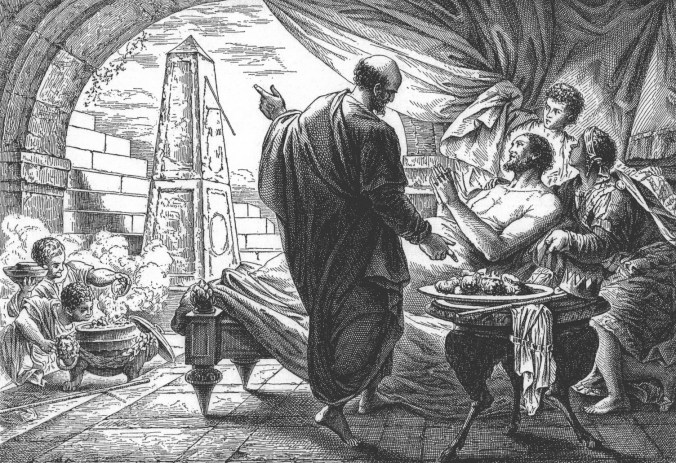
Hezekiah became ill to the point of death (Isaiah 38:1 and 2 Kings 20:1). Although the nature of the illness is not specifically stated, it involved a boil, which was treated by a poultice (Isaiah 38:21 and 2 Kings 20:7).

Isaiah the prophet instructed Hezekiah to set his house in order because he was going to die (Isaiah 38:1 and 2 Kings 20:1). The news caused Hezekiah to weep and to cry out to the Lord in prayer (Isaiah 38:2-3 and 2 Kings 20:2-3). Once again, God heard the sincere prayer of Hezekiah and told Isaiah to inform the king that God would add fifteen years to his life and deliver and defend Jerusalem from the Assyrians (Isaiah 38:4-6 and 2 Kings 20:5-6).

As a confirmation that these things would happen, God caused the sun to move backwards ten steps (perhaps degrees) on the stairway of Ahaz, believed to have been a sundial or time-telling device (Isaiah 38:7-8 and 2 Kings 20:8-11). Isaiah’s account includes Hezekiah’s prayer, which is not a part of the account in 2 Kings 20.

Isaiah 37

37:1-7
How did Hezekiah respond to the report of the Assyrian’s intimidating message?
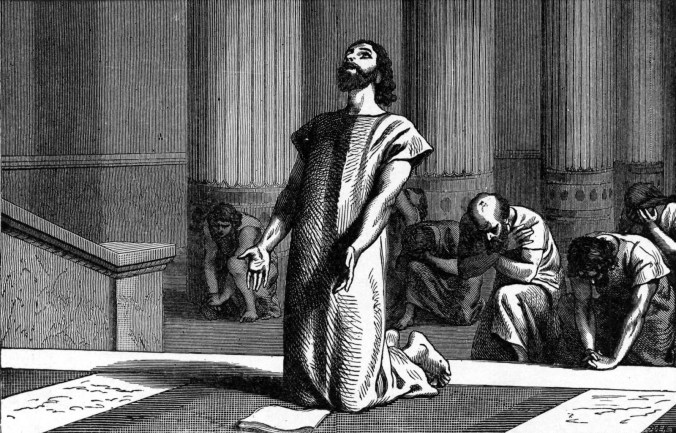
When Hezekiah received the report of the Assyrian’s message, he “tore his clothes, covered himself with sackcloth and entered the house of the Lord” (Isaiah 37:1 and 2 Kings 19:1). He also sent messengers to Isaiah the prophet (Isaiah 37:2 and 2 Kings 19:2) to inform him of the situation and to ask him to “offer a prayer for the remnant that is left” (Isaiah 37:3-4 and 2 Kings 19:4).

When the messengers presented their mournful message to Isaiah, they received a hopeful message from the prophet. Isaiah instructed the messengers to tell Hezekiah not to fear because of the Assyrian’s message. He stated that the Lord would intervene by causing Sennacherib to hear a rumor that would cause him to return to his own land where he would “fall by the sword” (Isaiah 37:6-7 and 2 Kings 19:6-7).

Practical Consideration: We should set a good example in times of trouble.
People take notice of how we handle both our troubles and triumphs. All eyes were on the king when the nation of Judah found itself in trouble. Hezekiah went into the house of the Lord and sent for God’s prophet when he encountered trouble. He set a proper example for the people of Judah by taking his troubles to the Lord. We too, should turn to the Lord in our times of trouble. We should also seek counsel from godly individuals even as Hezekiah sought counsel from Isaiah. We should set a good example for others in our times of trouble by taking our burdens to the Lord.

Practical Consideration: We should ask for the prayers of others when we find ourselves in the midst of troubles and trials.
Hezekiah asked Isaiah to pray for the nation because of the threats of the Assyrians. We too, should ask others to pray for us and with us as we deal with the troubles and trials of life. Someone commented, “Every praying agency we can set in operation is a positive gain.”

37:8-13
How did Sennacherib respond when he learned that his plan of intimidation failed?
When Rabshakeh departed from Jerusalem, he found Sennacherib “fighting against Libnah” (Isaiah 37:8 and 2 Kings 19:8). Sennacherib heard a rumor that Tirhakah king of Cush (Ethiopia) was coming up to fight against him (Isaiah 37:9 and 2 Kings 19:9). He then sent a letter (2 Chronicles 32:17) by messengers to Hezekiah informing him once again of the futility of trusting in the Lord for deliverance. Sennacherib even offered his military victories as indication that no god or army was able to stand before the Assyrians. With such a record Hezekiah should surrender or be prepared to meet the same fate (Isaiah 37:10-13 and 2 Kings 19:9-13).

37:14-35
What did Hezekiah do when he received Sennacherib’s letter?


Hezekiah read the letter and then went into the house of the Lord “and spread it out before the Lord” (Isaiah 37:14 and 2 Kings 19:14). He acknowledged the sovereignty of God (Isaiah 37:15-16 and 2 Kings 19:15) and insolence of Sennacherib (Isaiah 37:17; 2 Kings 19:16; 2 Chronicles 32:19). While he affirmed the Assyrian’s victories over other nations, he attributed those victories to the fact that the gods of those defeated nations were no gods at all, but merely the work of men’s hands (Isaiah 37:18-19 and 2 Kings 19:15-18).

He then asked the Lord to deliver Judah from the boastful Assyrians “that all the kingdoms of the earth may know that Thou alone, O Lord, art God” (Isaiah 37:20 and 2 Kings 19:19). The prophet Isaiah acknowledged that God had indeed heard Hezekiah’s prayer (Isaiah 37:21; 2 Kings 19:20; 2 Chronicles 32:20) and would grant Judah deliverance from the arrogant Sennacherib (Isaiah 37:22-29 and 2 Kings 19:21-28). God promised that Sennacherib would not so much as shoot an arrow against Jerusalem (Isaiah 37:33 and 2 Kings 19:32) but would return home (Isaiah 37:34 and 2 Kings 19:33). The Lord promised that He Himself would defend the city of Jerusalem for His sake and that of His servant David (Isaiah 37:35 and 2 Kings 19:34).

Practical Consideration: Our heart is more important than our words in prayer.
We do not always know how to pray as we should. We sometimes find ourselves without words to express our concerns and anguish in prayer. That is why we must remember that God is not so much concerned with our words in prayer or with the length of our prayers. In the words of Bunyan, “In prayer it is better to have a heart without words, than words without a heart.” The recorded prayers of Hezekiah are brief, but from an earnest and sincere heart. As a result, God heard Hezekiah’s prayers.

Practical Consideration: We should cast all our cares upon God.
God invites us to cast our cares upon Him because He cares for us (see Psalm 55:22 and 1 Peter 5:7). When Hezekiah received Sennacherib’s arrogant and intimidating letter he did not respond in kind. Instead he took the letter into the house of the Lord and spread it out before Him. He allowed God the opportunity to answer the letter. We too, should take our concerns before the Lord in prayer “that we may receive mercy and may find grace to help in time of need” (Hebrews 4:16).

37:36-38
What caused Sennacherib to return home?
During the night “the angel of the Lord went out, and struck 185,000 in the camp of the Assyrians” (Isaiah 37:36; 2 Kings 19:35; 2 Chronicles 32:21). This loss caused Sennacherib to return to Nineveh (Isaiah 37:37 and 2 Kings 19:36) where sometime later (perhaps twenty years) his own sons assassinated him “as he was worshiping in the house of Nisroch his god” (Isaiah 37:38; 2 Kings 19:37; 2 Chronicles 32:21). Esarhaddon, his son, succeeded him (2 Kings 19:37).

Isaiah 36

Siege and Delivery of Jerusalem

36:1
What military crisis did Hezekiah face during his reign?
In the fourteenth year of Hezekiah’s reign (701 B.C.), the Assyrians, under the leadership of King Sennacherib (the son of Sargon II), invaded Judah. The Assyrians “came up against all the fortified cities of Judah and seized them” (Isaiah 36:1 and 2 Kings 18:13).

According to 2 Kings 18:14-16 (not recorded in Isaiah’s account), Hezekiah confessed to Sennacherib that he had done wrong in rebelling against Assyria and agreed to pay tribute to Sennacherib in an effort to deter him from doing further damage to Judah. In order to meet the heavy tribute demanded by the Assyrians, Hezekiah exhausted the silver and gold in the treasuries of his own house and the house of the Lord and even stripped the gold that overlaid the doors and doorposts of the temple.

Hezekiah’s payment of tribute did not deter the Assyrians from their determination to subjugate Judah. Sennacherib took Hezekiah’s wealth and did not keep his word. Hezekiah mistakenly trusted in treasures and treaties to see him through his present crisis rather than in the Lord.

Practical Consideration: Trouble is no respecter of persons.
Even though Hezekiah was a man who trusted in and was loyal to God, he experienced personal trouble and problems. Trouble is no respecter of persons. Trouble often comes unannounced at life’s most inopportune times. Former U.S. Secretary of State Henry Kissinger once said, “There cannot be a crisis next week. My schedule is already full.” God can however, use troubles and crises to shape, mold and strengthen us. As someone noted, “Trouble is a divine factor in human life.”

36:2-22
What steps did Sennacherib take in an effort to intimidate Judah into submission?
Sennacherib sent three of his top officials (2 Kings 18:17) to Judah in an effort to intimidate the people into surrendering. These top officials were the “Tartan” (a word which means field marshal or commander in chief), the “Rab-saris” (a word which means chief eunuch), and the “Rabshakeh” (a word which means chief cupbearer). These officials were accompanied by a large army (Isaiah 36:2 and 2 Kings 18:17).

Upon their arrival in Jerusalem, three of Hezekiah’s officials went out to meet them (Isaiah 36:3 and 2 Kings 18:18). The three Assyrian officials, employing a masterful plan of psychological warfare, proceeded to ridicule Hezekiah’s dependence upon the Lord and said that he would find no help from the Lord or even from a political alliance with Egypt (Isaiah 36:4-10; 2 Kings 18:19-21; 2 Chronicles 32:9-11).

Judah, they said, would find no help in heaven or on earth. They suggested that Hezekiah erred in removing the high places and that they had been commissioned by God to destroy Judah (2 Kings 18:22 and 25 and 2 Chronicles 32:12). To boast about their superiority, the Assyrians offered the Judeans two thousand horses if they thought they could muster up enough men to ride them (2 Kings 18:23-24).

Rabshakeh told the assembled crowd that they were foolish to follow Hezekiah or to trust in the Lord (2 Kings 18:28-30 and 32b and see also 2 Chronicles 32:7-8). He told the crowd to not listen to Hezekiah’s rantings about trusting in the Lord but rather to peacefully surrender and enjoy the beneficent goodness of Sennacherib (Isaiah 36:15-18; 2 Kings 18:31-32; 2 Chronicles 32:18), after all, none of the gods of their defeated foes had been able to deliver their followers from the mighty Assyrian army (Isaiah 36:19-20; 2 Kings 18:33-35; 2 Chronicles 32:13-15). Hezekiah’s three officials then proceeded to report to him the message from Sennacherib (Isaiah 36:21-22 and 2 Kings 18:36-37).

Isaiah 35

God’s Highway in the Wilderness

35:1-10
What future hope lay in store for God’s people?
Isaiah 35 looks to the day (ultimately the eschatological day) when those taken into captivity by the Assyrians and Babylonians will return to their land on a safe highway prepared by the Lord. On that day both nature and man will see and experience the transforming power of God. The desert will blossom and the weak will be made strong.

Isaiah 34

Destruction to Come on the Day of the Lord

34:1-4
How did Isaiah describe the destruction to come on the Day of the Lord?
Isaiah 34:1-4 graphically describes the judgment of God on the nations on the day of the Lord. God’s wrath will destroy the armies of nations, leaving their slain unburied with their stench filling the air and their blood drenching the soil (34:2-3). Verse 4 indicates the apocalyptic nature of this catastrophe that will mark the end of history.

34:5-17
What fate awaited Edom?
Isaiah 5 marks a transition from a general description of God’s judgment on the world to a specific description of how His judgment will impact one nation, that is, Edom (recall that the Edomites came from Israel’s brother Esau as per Genesis 25:30).

According to Obadiah 10-14 and Psalm 137:7, Edom assisted the Babylonians in destroying Jerusalem in 587 B.C. The harsh language of Isaiah 34:5-17 should be read in light of this fact. Edom is referred to as “the people whom I have devoted for destruction” (34:5). The “sword of the Lord” is personified in verses 5-7 as the instrument of vengeance sated with the blood of the Edomites.

Verse 8 defines the day of the Lord as “a day of vengeance.” The utter desolation of the land is graphically described in verses 9-15. Verses 16-17 declare that this judgment will come upon Edom in accordance to what was written in “the book of the Lord,” understood to be a reference to prophecies against Edom recorded in Isaiah and other collections (for example, Amos 1:11-12; Jeremiah 49:7-22; Ezekiel 35).

Isaiah 33

God’s Response to the People’s Cry

33:1-16
What situation caused some of the people of Judah to cry out to God?
Scholars generally agree that this chapter is a record of a later reflection on the Assyrian invasion of Judah in 701 B.C. The first verse is a curse oracle against a “destroyer” (Assyria). This destroyer would “finish destroying” and then “be destroyed” (refer to comments on Isaiah 10:5-19 on page 14 and Isaiah 14:24-27 on page 19 of these notes).

In the midst of their distress, a few faithful people turned to God in prayer (33:2). Their prayer expressed the confidence that the Lord was capable of causing the destroyer to flee (33:3), leaving behind the spoils of war (33:4).

God’s deliverance would cause the people to highly regard the Lord who delivered them and filled Jerusalem with “justice and righteousness” (33:5-6).

Verses 7-9 record the lament of the people over the condition of their land (these verses look back to the crisis alluded to in verses 1 and 2). Those charged with the responsibility of protecting the nation through military measures (“brave men”) and political negotiation (“ambassadors of peace”) wept bitterly (33:7) at their inability to stop the destroyer.

Verse 10 contains the Lord’s response to the people’s entreaty that He arise and come to their aid and deal decisively with their enemies (33:11-12). The Assyrians, pregnant with evil plans against God’s people, would give birth to chaff and stubble (33:11), which the Lord would consume with fire (33:11-12). Their plans would be utterly frustrated by God.

Practical Consideration: Pressure squeezes out our theology.
When the Assyrians threatened Jerusalem, some of the people trusted in themselves and their own resources (see Isaiah 22:8-11 and comments on page 21 of these notes) while others turned to God in prayer. God spared the city because of the faith of those who prayed. Warren Wiersbe comments, “Never underestimate the power of a praying minority.” Pressure will squeeze out our theology. It will reveal the depth of our faith in God. It will reveal who we really are and what we really believe about God.

Isaiah 33:13-16 is recorded in the form known as the “Torah liturgy.” In this literary form, a question is asked regarding the Lord’s requirements of His people (33:14). The response records a list of God’s demands (33:15). The “Torah liturgy” ends with a promise of blessings to those who satisfy the demands of God (33:16). Isaiah 33:13-16 emphasizes the fact that God delivered His people that they might forsake their sin and follow Him. See also Psalms 15 and 24 and Micah 6:6-8 for other examples of the “Torah liturgy” form.

The Divine King in a Blissful Jerusalem

33:17-24
What future hope lay in store for Jerusalem?
The oracle contained in these verses looks forward to the day when a new ruler (ultimately the Lord Jesus Christ) will reign in Jerusalem (33:17, 22). Absent on that day will be those who count and weigh tribute money and spies who take inventory of Jerusalem’s fortifications (33:18). Absent on that day will be the sound of the foreign language of oppressors in the streets of Jerusalem (33:19). On that day Jerusalem will be a stable and undisturbed habitation (33:20) that will not be threatened by ships of war (33:21, 23). The residents of Jerusalem will enjoy health and the forgiveness of sin (33:24).