Acts 21

21:1 After we had torn ourselves away from them, we put out to sea and sailed straight to Cos. The next day we went to Rhodes and from there to Patara.

21:2 We found a ship crossing over to Phoenicia, went on board and set sail.

21:3 After sighting Cyprus and passing to the south of it, we sailed on to Syria. We landed at Tyre, where our ship was to unload its cargo.

21:4 Finding the disciples there, we stayed with them seven days. Through the Spirit they urged Paul not to go on to Jerusalem.

21:5 But when our time was up, we left and continued on our way. All the disciples and their wives and children accompanied us out of the city, and there on the beach we knelt to pray.

21:6 After saying good-by to each other, we went aboard the ship, and they returned home.

21:7 We continued our voyage from Tyre and landed at Ptolemais, where we greeted the brothers and stayed with them for a day.

21:8 Leaving the next day, we reached Caesarea and stayed at the house of Philip the evangelist, one of the Seven.

21:9 He had four unmarried daughters who prophesied.

21:10 After we had been there [in Caesarea at house of Philip the evangelist (cf. 21:9), one of original deacons (Acts 6:1-6) and associate of Stephen; Paul knew value of spending time w/ believers (spiritual / emotional renewal)] a number of days, a prophet named Agabus [previously predicted a famine in Judea (cf. Acts 11:27-28)] came down from Judea [perhaps from Jerusalem, thus he was likely aware of the feeling there toward Paul].

21:11 [example of enacted prophecy (see also Neh. 5:13; Isa. 20:2-6; Ezek. 4:1-13); Agabus’ prophecy reinforced warning Paul had received from God (Acts 20:23, 21:4); not intended to dissuade Paul from going to Jerusalem, but to prepare him for what would happen there] Coming over to us, he took Paul’s belt [long cloth wrapped around the waist], tied his own hands and feet with it and said [Agabus’ prophetic utterance probably a warning rather than a prohibition; not “don’t go” but “this is what to expect if you do go”], “The Holy Spirit [points to the divine origin of the prophecy] says, `In this way the Jews of Jerusalem will bind the owner of this belt and will hand him over to the Gentiles [Jews only had power to persecute, not prosecute; God would use this for His purposes].’”

Note: Have you ever failed to obey the Lord because you feared particular consequences?

Note: “If we are to wait to do a work for the Lord until every possible hindrance has been removed and every obstacle overcome, we will never attempt to do anything.” (Pearls from Many Seas)

21:12 When we heard this, we [Luke included himself] and the people [all present were united in their concern for Paul’s welfare] there pleaded [tried to dissuade Paul from going to Jerusalem as had the Christians in Tyre (Acts 21:4)] with Paul not to go up to Jerusalem.

Note: Have well-meaning friends ever tried to deter you from doing what God wanted?

21:13 Then Paul answered, “Why are you weeping and breaking [crushing, pounding; words describe a powerful emotional experience] my heart? I am ready [prepared] not only to be bound, but also to die [cf. Lk. 22:33] in Jerusalem for the name of the Lord Jesus. [Paul wanted to do God’s will (cf. Lk. 22:42), even at risk to personal safety]

21:14 When he [Paul deeply convicted that he must go to Jerusalem] would not be dissuaded [interplay between individual conviction and counsel of fellow believers], we gave up [to be still; to be quiet] and said, “The Lord’s will be done.”

21:15 After this, we got ready and went up to Jerusalem.

21:16 Some of the disciples from Caesarea accompanied us and brought us to the home of Mnason, where we were to stay. He was a man from Cyprus and one of the early disciples.

21:17 When we [Paul and his entourage, which also included “some of the disciples from Caesarea” (27:15)] arrived at Jerusalem [a sixty-five mile journey from Caesarea], the brothers [either Mnason and his household (27:16) or the Jewish Christian community] received us warmly.

Paul and those traveling with him from Caesarea arrived in Jerusalem after a journey of sixty-five miles. When they reached Jerusalem, they received a warm reception from the brothers there. The term brothers probably includes the Jewish Christian community as well as Mnason, the man with whom Paul and his friends were to stay (see Acts 27:16).

Missionaries like Paul depended on the kindness and hospitality of believers like Mnason. Paul also may have presented these brothers with a large financial gift from the Gentile churches for the poor in Jerusalem (1 Cor. 16:1-3).

21:18 The next day Paul and the rest of us went to see James [the brother of Jesus; leader of the mother church in Jerusalem (see Acts 15:13-21)], and all the elders were present [emphasizes the importance of the meeting].

The following day Paul and the representatives of the Gentile churches met with James, the brother of Jesus. He was the leader of the mother church in Jerusalem (see Acts 15:13-21). The presence of all the elders suggests that this was a very important meeting. Although, we are not told how many elders were present, those there were eager to hear Paul’s report of what God had done among the Gentiles on his third missionary journey.

21:19 Paul greeted them [Paul displayed an attitude of sincere humility and submission before these Christian colleagues] and reported [as on previous occasions (see Acts 14:27; 15:12)] in detail [a step by step account] what God had done among the Gentiles through his ministry.

Paul greeted James and the elders who had assembled to hear his report. God had clearly used Paul in a mighty way on his recent missionary journey, yet Paul displayed an attitude of sincere humility and submission before these Christian colleagues. These men had faithfully labored in Jerusalem while Paul served on the mission field.

The work of God’s kingdom requires faithfulness on the part of those who labor abroad and those who labor at home. Paul, as on previous occasions (see Acts 14:27; 15:12), gave a detailed step by step account of what God did among the Gentiles through his ministry.

21:20 When they heard this [the report of Paul’s successful ministry among the Gentiles], they praised God [for the way in which He had chosen to work among the Gentiles]. Then they said to Paul [had arrived in Jerusalem in A.D. 56 or 57, a time when Jewish nationalism and anti-Gentile attitudes both were at an all time high]: “You see, brother, how many thousands of Jews have believed, and all of them are zealous for the law [indicates these new converts were likely influenced by the Judaizers].

Luke briefly described the reaction of James and the elders to the report of Paul’s successful ministry among the Gentiles. They could not help but praise God for the way in which He had chosen to work among the Gentiles. However, these leaders knew that others in Jerusalem did not share their sentiments.

In the time Paul had been away, thousands of Jews in Jerusalem had believed and were added to the church. These new converts, perhaps having been influenced by the Judaizers, were zealous for the law. Paul had arrived in Jerusalem at a time when Jewish nationalism and anti-Gentile attitudes were at an all time high.

21:21 They have been informed that you teach all the Jews who live among the Gentiles [the dispersion Jews] to turn away [Gr. “apostasian” from which we get our word “apostasy”] from Moses, telling them not to circumcise their children [the truth is that Paul had Timothy circumcised before the second missionary journey (Acts 16:1-3)] or live according to our customs [the truth is that Paul had taken a Jewish vow while in Corinth (Acts 18:18); Paul did not violate Jewish customs or the Law of Moses (1 Cor. 9:19-23)].

After Paul described what God was doing among Gentiles—no doubt emphasizing they were saved by faith and apart from the law of Moses—he was told about some unfair criticism of him by Jewish Christians. Evidently, someone had started a rumor that Paul urged Jews to abandon Moses, that is, to turn away from the law. However, the evidence was to the contrary.

While Paul opposed circumcision of Gentile converts, he had never told Jewish Christians to turn away from the practice. In fact, prior to the second missionary journey Paul had encouraged Timothy to submit to circumcision (16:1-3). Nevertheless, these rumors had spread widely and, as often happens, had taken on a life of their own.

We too may face criticism that is unfair for a variety of reasons, including that it distorts what we believe or have done.

21:22 What shall we do [a rhetorical question; James and elders had already worked out possible solution]? They will certainly hear that you have come [word of Paul’s arrival would spread throughout the Jewish Christian community in Jerusalem],

The leaders then asked the question, So what is to be done? Anyone who has ever dealt with false rumors has asked similar questions in the hope of finding workable solutions. However, the leaders of the Jerusalem church already knew the answer to their own question. Knowing that word of Paul’s arrival would spread throughout the Jewish Christian community in Jerusalem, James and the elders had already worked out a positive response among themselves. While positive responses may not satisfy our critics, God still expects us to react in positive ways.

21:23 so do what we tell you. There are four men [Jewish Christians] with us who have made a vow [a Nazirite vow (Num. 6:13-21); cf. Acts 18:18].

The elders hoped their proposed solution would convince the Jewish Christian community that Paul was still true to the Jewish law. The plan was not complicated at all. There were four Jewish Christian men in the Jerusalem church who had made a vow. These men seem to have taken a Nazirite vow (see Num. 6:13-21) as a way of expressing their piety. This vow required that these men abstain from wine and meat for thirty days and allow their hair to grow. At the end of their vow they were required to cut their hair and offer it at the temple (see Acts 18:18).

21:24 Take these men [four Jewish Christians], join in their purification rites and pay their expenses [a generous gesture], so that they can have their heads shaved. Then [as a result of this public gesture in the precincts of the temple] everybody will know there is no truth in these reports [rumors] about you, but that you yourself are living in obedience to the law.

The leaders suggested that Paul join the men who had made a Nazirite vow. He was to take them to the temple, share in the purification ceremony, and pay for them to get their heads shaved. The leaders hoped that this generous and public gesture would demonstrate to others Paul’s careful observance of the law and silence the false rumors about him. Paul agreed go along with the leaders’ suggestion in order to help preserve the peace in the Jerusalem church.

21:25 [James and the elders restated and reaffirmed the decision of the Jerusalem Council…] As for the Gentile believers, we have written to them our decision that they should abstain from food sacrificed to idols, from blood, from the meat of strangled animals and from sexual immorality.”

James and the elders then restated and reaffirmed the decision of the Jerusalem Council concerning the Gentiles. They assured Paul that the decision of the council, made years earlier, was still in effect and had not changed. While Gentiles were not required to live by the Jewish Torah, they were expected to observe some basic matters that would make fellowship possible between Jewish and Gentile Christians.

21:26 The next day Paul [willing to go a “second mile” in the interest of preventing trouble in the church and advancing the gospel] took the men and purified himself along with them. Then he went to the temple to give notice of the date when the days of purification would end and the offering would be made for each of them.

Paul was willing to go a “second mile” in the interest of preventing trouble in the church and advancing the gospel. By symbolically identifying with the four men carrying out this act of piety, Paul once again became “all things to all people” (1 Cor. 9:22) in the hope of winning some of them.

The next day, Paul went to the temple and purified himself along with these men and announced the date when Nazirite ceremony would be completed. Like Paul, we too should be willing to take positive actions that will help counter unfair criticism made against us that will not compromise our convictions.

21:27 When the seven days [Nazirite purification process required seven days (cf. Num. 6:1-20); James suggested Paul do this to discredit rumors and make him acceptable to the Jews (vv. 23-26)] were nearly over, some Jews from the province of Asia [perhaps from Ephesus] saw Paul at the temple. They stirred up [to pour together, to cause confusion; continual action] the whole crowd and seized [to place hands upon] him,

The Nazirite purification process required seven days. As those days were about to end, some unbelieving Jews from the province of Asia, most likely Ephesus, were in Jerusalem to observe the Feast of Pentecost. Paul had spent three months of his three year stay in Ephesus speaking to Jews in the local synagogue, trying to persuade them that Jesus is the Messiah (Acts 19:8). So, these Jews knew Paul well. These individuals, who had unsuccessfully tried to silence Paul in Ephesus, saw an opportunity to stir up trouble for Paul in Jerusalem. When they saw him in the temple complex, they stirred up the whole crowd into frenzy and seized Paul.

21:28 shouting [screaming], “Men of Israel [an appeal to those who loved the laws and customs of Israel], help us! This is the man who [note charges] [1] teaches all men [Paul had not taught all men] everywhere [Paul had not been everywhere] against our people and our law and this place [a false rumor (cf. Acts 21:21); Paul not antagonistic toward Jews]. And besides, [2] he has brought [led] Greeks [Trophimus as per v. 29] into the temple area [inner courts leading to the temple building, a place where Gentiles were not allowed] and defiled [to pollute; to make common] this holy place.”

The angry Jewish mob appealed for help from the men of Israel, or those who loved the laws and customs of Israel. Pointing at Paul, they leveled two charges against him.

The first charge was similar to that leveled against Stephen—speaking “against this holy place and the laws (see Acts 6:13).”

Second, they accused Paul of having violated the temple by taking Greeks beyond the court of the Gentiles, a violation punishable by death. However, Paul was aware of what could and could not be done at the temple. And, his purpose for being there was to establish his Jewishness in order to silence his critics. He would never have endangered himself or others by violating any restrictions or protocol.

21:29 (They [the Asian Jews] had previously seen Trophimus [representative of Ephesian church who had accompanied Paul to Jerusalem (cf. Acts 20:4)] the Ephesian in the city with Paul and assumed [a wrong assumption; jumped to the conclusion] that Paul had brought him into the temple area.)

The Asian Jews who seized Paul were like the religious leaders who were always looking for opportunities to find fault with Jesus. These Asian Jews had previously seen Paul with Trophimus, his Gentile Christian companion. Without taking the time to check the facts, they erroneously concluded that Paul had taken his Ephesian friend beyond the Court of the Gentiles into the part of the temple reserved exclusively for Jews.

We too may face criticism that is blatantly false and has no basis in fact or is based on false assumptions. This is just one of many ways in which the enemies of Christianity try to make Christians look bad. I have Christian friends who live in countries closed to the gospel who have experienced such false accusations. Many of these individuals have suffered subsequent social ridicule or alienation, physical abuse, and other forms of persecution. To their credit, each of them demonstrated a Christ-like response and, by so doing, discredited their accusers.

21:30 The whole city was aroused [even though they had not examined the validity of the charges], and the people came running [emotions also running at full speed] from all directions. Seizing Paul, they dragged him from the temple, and immediately the gates were shut [Levitical temple police closed the doors separating the temple from the court of the Gentiles].

21:31 While they were trying to kill him, news reached the commander [named Claudius Lysias as per Acts 23:26; military tribune; highest-ranking officer in Jerusalem] of the Roman troops [housed in the fortress of Antonia, which was built into northwest corner of temple area] that the whole city of Jerusalem was in an uproar.

21:32 He at once took some officers [centurions (commanders of one hundred men) and their men] and soldiers and ran down to the crowd. When the rioters saw the commander and his soldiers, they stopped beating Paul.

21:33 The commander came up and arrested him and ordered him to be bound with two chains. Then he asked who he was and what he had done.

21:34 Some in the crowd shouted one thing and some another, and since the commander could not get at the truth because of the uproar, he ordered that Paul be taken into the barracks.

21:35 When Paul reached the steps, the violence of the mob was so great he had to be carried by the soldiers.

21:36 The crowd that followed kept shouting, “Away with him!”

21:37 As the soldiers were about to take Paul into the barracks, he asked the commander, “May I say something to you?” “Do you speak Greek?” he replied.

21:38 “Aren’t you the Egyptian who started a revolt and led four thousand terrorists out into the desert some time ago?”

21:39 Paul answered [see v. 38 re: question asked the commander of the Roman regiment (v. 31)], “I am a Jew, from Tarsus in Cilicia, a citizen [Paul later told Claudius Lysias of his Roman citizenship (see Acts 22:25-29)] of no ordinary city. Please let me speak to the people.”

Paul was rescued from the angry mob by the Roman regiment stationed at the Fortress of Antonia, located next to the temple area. Claudius Lysias (Acts 23:26) was the commander of this regiment. Paul spoke to him in Greek and identified himself as a Jewish man and as a citizen of Tarsus. He later divulged his Roman citizenship to Claudius (Acts 22:25-29).

Paul asked for permission to speak to the people who believed the false criticism against him. He spoke to the angry mob about his zeal for the law, his conversion, and his commission from God; to the Sanhedrin he declared his Pharisaic heritage and beliefs. To help counter any false criticism made against us, like Paul, we can make positive statements that reflect our relationship with God and reveal the charges are indeed false.

Note: How to deal with criticism.
C = Critics are not always correct.
R = Respond to undeserved criticism in positive ways.
I = Ignoring criticism will not make it go away.
T = Take corrective measures when you receive constructive criticism.
I = Investigate the facts carefully before you say anything critical to others.
C = Counter unfair criticism with positive actions that will not compromise your convictions.
I = Inform critics who are misinformed.
S = Speak the truth in love to those who criticize you.
M = Maintain your integrity and a positive Christian witness in the face of all criticism.

21:40 Having received the commander’s permission, Paul stood on the steps and motioned to the crowd. When they were all silent, he said to them in Aramaic:

Acts 20

20:1-6 After the riot in Ephesus, Paul traveled through Macedonia to Troas.
20:7-12 Paul restored Eutychus to life in Troas.
20:13-16 Paul stopped at Miletus on his way back to Jerusalem.

Acts 20:17-24
20:17 From Miletus, Paul sent [to call, to summon from one place to another; Paul (in a hurry to be in Jerusalem in time for Pentecost as per v. 16) asked the Ephesian elders to meet him in Miletus (about thirty miles south of Ephesus)] to Ephesus [Paul spent three years in Ephesus (20:31)] for the elders [spiritual leaders of the church; later called overseers (20:28)] of the church.

Note: Luke recorded Paul’s messages in…
• Acts 13:16-41 — to Jews in the synagogue at Antioch of Pisidia
• Acts 14:15-17 — to Gentiles on the streets of Lystra
• Acts 17:22-31 — to intellectuals on Mars Hill
• Acts 20:17-38 — to church leaders (the Ephesian elders) at Miletus

20:18 When they [Ephesian elders] arrived [in Miletus], he said [this is the only recorded speech of Paul which was delivered to Christians] to them: “You know [understand; knowledge viewed as a result of prolonged practice] how I lived [Paul lived a life of integrity before God and man] the whole time I was with you, from the first day I came into [to set foot on] the province of Asia [Roman province of Asia (part of modern Turkey)].

20:19 I served [to serve as a slave] the Lord [Jesus was the focus of Paul’s ministry] with great humility [recognition of personal weakness as well as recognition of God’s power] and with tears [Paul wept because of those who rejected the gospel; cf. Rom. 9:1-5 for a glimpse into Paul’s heart], although I was severely tested by the plots of the Jews.

20:20 You know that I have not hesitated [to draw back in fear, to shrink from, opposite of to speak boldly] to preach [to tell or announce; Paul had one message he proclaimed in public and private settings] anything that would be helpful [spiritually profitable, of advantage] to you but have taught [instruct] you publicly [in the synagogue (19:8) and then in the school of Tyrannus (19:9)] and from house to house [a more private kind of teaching; individuals, families, home churches].

20:21 [re: the heart of Paul’s message] I have declared to both [Paul was not partial toward any particular group or race] Jews and [cf. Acts 19:8-10] Greeks that they [both Jews and Gentiles are saved exactly the same way] must turn to God in repentance [a change of mind and a change of direction] and have faith [trust, commit, surrender] in our Lord Jesus.

20:22 “And now, compelled [driven, directed] by the Spirit [Paul went where the Spirit directed him to go], I am going to Jerusalem, not knowing what will happen to me there [cf. Rom. 15:31 (probably written shortly before Paul’s meeting with the Ephesian elders at Miletus)].

20:23 I only know that in every city the Holy Spirit warns me [cf. Acts 9:23-24; 14:5-7; 21:3-4,10-14] that prison and hardships [cf. Acts 21:27-36] are facing me.

20:24 However, I consider [reckon] my life worth nothing [of no account] to me [cf. Phil. 3:7-11], if only I may finish the race [cf. 1 Cor. 9:24-27; Gal. 2:2; Phil. 2:16; 3:13-14; 2 Tim. 4:7] and complete the task the Lord Jesus has given me — the task of testifying to the gospel of God’s grace [Paul had profoundly experienced God’s grace; cf. 1 Tim. 1:12-14].

20:25-27 Paul told elders they would not see him again.
20:28-31 Paul warned of persecution from without and apostasy from within.
20:32 Paul commended the Ephesian elders to God.

Acts 20:33-35
20:33 I have not coveted [to desire] anyone’s silver or gold or clothing [Paul had a spiritual focus].

20:34 You yourselves know that these hands of mine have supplied my own needs [Paul was a tentmaker (cf. Acts 18:3)] and the needs of my companions.

20:35 In everything I did, I showed [to show under one’s eyes, to give an object lesson] you that by this kind of hard work [emphasizes the hardness of the work and the weariness it brings] we must help [to take another’s part] the weak, remembering the words the Lord Jesus himself said [the following words not in the gospels, thus indicating that much of what Jesus said was not recorded (cf. Jn. 21:25)]: ‘It is more blessed to give than to receive.'”

20:36-38 Paul and the Ephesian elders prayed and tearfully parted.

Acts 19

19:1 While Apollos was at Corinth, Paul took the road through the interior [cf. Acts 18:23] and arrived at Ephesus [cf. Acts 18:21; temple of Greek goddess Artemis (Diana) located there; Paul stayed in Ephesus about three years and wrote 1 Cor. from there]. There he found some disciples [about twelve of them as per v. 7; John the Baptist’s followers were called disciples (Matt. 11:2; Jn. 1:35); these disciples were likely followers of John the Baptist, but not of Jesus]

After the account of Apollos, Luke continued the story of Paul’s third missionary journey. Starting in Antioch (Acts 18:22), Paul traveled through the interior regions of Galatia and Phrygia, strengthening the disciples along the way (Acts 18:23). Paul eventually arrived in Ephesus, a city located on the west coast of Asia Minor.

On his previous visit to Ephesus, the Jews had asked him to stay a little longer. Unable to do so, Paul told them that he would try to return (Acts 18:21). Paul kept his promise and returned to Ephesus where he found some disciples. These twelve disciples (see Acts 19:7) were most likely followers of John the Baptist, but not of Jesus.

19:2 and asked them, “Did you receive the Holy Spirit [the Spirit imparts life (Jn. 3:5); no salvation apart from the Holy Spirit (Rom. 8:9,16); we receive Holy Spirit when we believe on Jesus Christ (Eph. 1:13)] when you believed?” They answered, “No, we have not even heard that there is a Holy Spirit.”

Paul asked these twelve Ephesian men if they had received the Holy Spirit when they believed. Jesus taught that the Spirit is the one who imparts life (John 3:5). There is no salvation apart from the Holy Spirit (Rom. 8:9,16). We receive the Holy Spirit when we believe on Jesus Christ (Eph. 1:13).

These men replied that they had not even heard that there is a Holy Spirit. As disciples of John the Baptist they most likely knew that there was a Holy Spirit. However, they were unaware that the Spirit had been poured out at Pentecost.

Like Apollos, these men had an incomplete understanding of the message and ministry of Jesus and needed further instruction. Asking questions, as Paul did, of people open to the gospel will help us know how completely they understand Christianity and how we can help them.

19:3 So Paul asked, “Then what baptism did you receive?” “John’s baptism [“a baptism of repentance” (Mark 1:4) that anticipated the coming of Christ who would baptize “with the Holy Spirit” (Mark 1:8)],” they replied.

These men only knew of John’s baptism, nothing more. John’s baptism was “a baptism of repentance” (Mark 1:4) that anticipated the coming of Christ who would baptize “with the Holy Spirit” (Mark 1:8). While John’s baptism looked ahead, Christian baptism looked back on Christ’s finished work on the cross and His resurrection. These men had been baptized but did not understand the significance of the act.

19:4 Paul said, “John’s baptism was a baptism of repentance [did not produce repentance but instead was characterized by repentance]. He told the people to believe in the one coming after him [John’s baptism looked forward to the coming Messiah], that is, in Jesus.”

Paul explained that John’s baptism was a baptism of repentance or a repentance kind of baptism. This baptism did not produce repentance but rather was characterized by repentance from sin. As the forerunner of the Messiah, John told those he baptized that they should believe in the One who would come after him, that is, in Jesus. These men had received John’s baptism but had failed to believe in Jesus and to recognize Him as the promised Messiah.

19:5 On hearing this [Paul’s explanation], they were baptized [Christian baptism looks back to Christ’s finished work on the cross and His resurrection; the only instance of rebaptism in the NT] into the name of the Lord Jesus.

Paul’s explanation included information about baptism and, most likely, other information about the life and ministry of Jesus that Luke did not record. On hearing this, the men responded by being baptized in the name of the Lord Jesus. This is the only instance of rebaptism found in the New Testament.

These baptisms were probably performed by someone other than Paul (see 1 Cor. 1:14-17). Paul helped these Ephesian men understand the difference between John’s baptism and Christian baptism. When we discover areas where people have an incomplete understanding of the gospel, we can help teach them what they need to know.

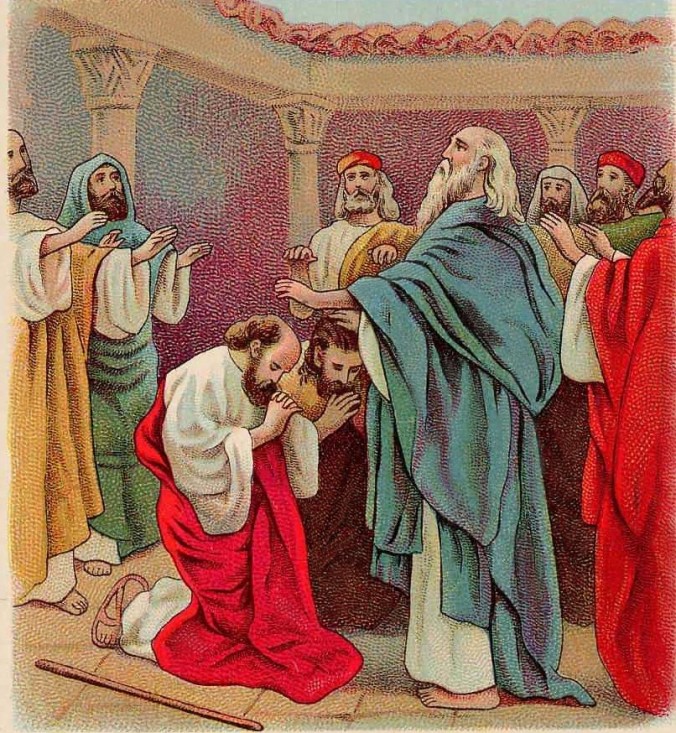
19:6 When Paul placed his hands on them [laying on of hands following baptism only mentioned here in Acts], the Holy Spirit came on them [just as He had on those at Pentecost (Acts 2) and in Cornelius’ household (Acts 10:45-47)], and [note outward demonstrations of the Spirit’s coming…] they spoke in tongues [the last recorded instance of speaking in tongues in Acts] and prophesied.

Following their baptism, Paul laid hands on the new Ephesian converts. The Holy Spirit came on these 12 men just as He had on those at Pentecost (Acts 2) and in Cornelius’ household (Acts 10:45-47). And, they began to speak with other languages and to prophesy—both outward demonstrations of the Spirit’s coming.

The Book of Acts as well as the New Testament always relates salvation and the coming of the Spirit, but neither consistently relates salvation with the laying on of hands or speaking in tongues. Verse 6 records the final instance of speaking in tongues in the book of Acts.

19:7 There were about twelve men in all.

19:8 Paul entered the synagogue [Paul had met a receptive group of Jews at this same synagogue at the end of his second missionary journey (Acts 18:19-21)] and spoke boldly there for three months [suggests that the Ephesian Jews were open to Paul’s witness], arguing persuasively about the kingdom of God.

After his encounter with John’s disciples, Paul followed his customary pattern and went to the local synagogue. Paul had met a receptive group of Jews at this same synagogue at the end of his second missionary journey. These men had urged Paul to stay longer with them. Unable to do so, Paul had pledged to return to them if God provided an opportunity (see Acts 18:19-21). Now, about a year later, Paul returned to the synagogue in Ephesus and spoke there over a period of three months. This lengthy stay suggests that the Ephesian Jews were open to Paul’s witness and wanted to talk about the things related to the kingdom of God.

19:9 But some of them became obstinate [opposition did not take the form of physical persecution at this time; they hardened their hearts]; they refused to believe [the gospel] and publicly maligned [insulted, spoke evil of] the Way [cf. Acts 9:2; 19:23; 24:14]. So Paul left them. He took the disciples [the Jews who had become Christians] with him and had discussions daily in the lecture hall of Tyrannus [“The Tyrant”].

After three months of discussion and debate, some of the Jews still refused to believe. Their opposition to Paul and the gospel took the form of verbal rather than physical persecution at this time. Those who stubbornly refused to believe the gospel publicly slandered the Way, a term that refers to the early Christian movement (see Acts 9:2).

Paul and the disciples, or Jews who had become Christians, left the synagogue and found a new location for sharing the gospel—the lecture hall of Tyrannus. There, Paul had the freedom to speak with those who wanted to know more about the gospel.

19:10 This went on for two years [“daily” as per v. 9], so that all [indicates that the gospel message spread beyond Ephesus] the Jews and Greeks who lived in the province of Asia heard the word of the Lord.

Paul taught daily at the lecture hall for two years, a testimony to his eagerness to tell others about Jesus (see Rom. 1:14-15). Spiritually hungry Jews and Greeks from throughout the province of Asia who were open to but had an incomplete understanding of the gospel traveled to Ephesus to hear Paul speak.

Many of these became believers and carried the gospel back to their own towns and cities. As a result of Paul’s daily initiative in sharing the gospel, many people heard the word of the Lord. Each of us know individuals who are open to the gospel but with an incomplete understanding of it. Like Paul, we must take advantage of opportunities to help them.

Note: Being seeker-sensitive.
S = Be sensitive to those who are seeking to know more about God or have spiritual concerns.
E = Encourage those who have an incomplete understanding of Christianity to ask questions.
E = Help others to examine the Scriptures for answers to their questions.
K = Become knowledgeable about what others believe.
E = Be patient as you explain to others the exclusive claims of Christ.
R = The gospel travels best along lines of relationships, so be a friend to others.
S = Help others understand how they can find salvation through faith in Jesus Christ.

19:11 God did extraordinary [not common; unusual] miracles [Gr. dunameis: mighty works or powerful deeds; confirmed the truth of Paul’s preaching and created opportunities for witnessing] [two types of miracles indicated: 1- direct healings through Paul] through [Jesus healed by His own authority; apostles always healed through divine authority, in the name of Jesus] Paul,

19:12 [2 – indirect healings through the application of Paul’s personal items] so that even [emphasizes extent of miracles] handkerchiefs [sweat rag: worn around the head and used to wipe the sweat off] and aprons [worn by working men; perhaps Paul’s apron worn in his tent-making] that had touched him [Paul; cf. Mark 5:27-34; 6:56; some believed in the healing effect of Peter’s shadow (cf. Acts 5:15)] were taken to the sick, and their illnesses [physical healing] were cured [released] and the evil spirits [spiritual healing] left them.

19:13 Some Jews [exorcists] who went around [itinerant Jewish charlatans] driving out evil spirits tried [attempted] to invoke [as a magical phrase] the name of the Lord Jesus over those who were demon-possessed. They would say [in an abracadabra sort of way], “In the name of Jesus [it takes more than terminology to do a divine work], whom Paul [not “we”] preaches, I command [adjure, charge] you to come out.”

19:14 Seven sons of Sceva, a Jewish chief [high] priest [alleged, no record of his service exists], were doing this [probably for profit].

19:15 One day the evil spirit answered them, “Jesus I know [cf. Jas. 2:19], and I know about Paul [may indicate respect for Paul], but who are you?”

19:16 Then the man who had the evil spirit jumped [to spring upon like a panther] on them and overpowered [to become master of, to subdue; exorcists underestimated the power of evil] them all [seven men]. He gave them such a beating [to wound] that they ran out [to flee, to escape] of the house naked and bleeding [total humiliation].

19:17 When this became known to the Jews and Greeks living in Ephesus, they were all seized with fear [reverential fear], and the name of the Lord Jesus was held in high [to make large, to magnify] honor.

19:18 Many of those who believed now came and openly confessed their evil deeds.

19:19 A number who had practiced sorcery brought their scrolls together and burned them publicly. When they calculated the value of the scrolls, the total came to fifty thousand drachmas.

19:20 In this way the word of the Lord spread widely and grew in power.

19:21 After all this had happened, Paul decided to go to Jerusalem, passing through Macedonia and Achaia. “After I have been there,” he said, “I must visit Rome also.”

19:22 He sent two of his helpers, Timothy and Erastus, to Macedonia, while he stayed in the province of Asia a little longer.

19:23 About that time there arose a great disturbance [riot; standing for righteousness often leads to opposition] about the Way [Christianity; what happened was not simply against Paul personally].

19:24 A silversmith named Demetrius [wealthy and influential, probably head of guild of silversmiths], who made silver shrines [perhaps small shrines (models, statuettes) representing the goddess Artemis sitting in a niche with her lions beside her; used for souvenirs, household idols, gifts, perhaps worn as charms] of Artemis [Diana among the Romans; worshiped as the goddess of fertility in man, beast and nature; patron goddess of the city of Ephesus; temple dedicated to her worship located in Ephesus; visiting pilgrims brought much income to Ephesus], brought in [furnished, supplied] no little [a lucrative trade] business for the craftsmen [artisan].

19:25 He called [organized] them [the whole trade] together [in a protest], along with the workmen in related trades, and said [concerned about the threat to their livelihood created by the preaching and progress of the gospel]: “Men, you know we receive a good income [wealth, affluence] from this business [Demetrius was more dedicated to preserving his income than in religion; money was real motivation behind his actions].

19:26 And you see and hear how this [used to express contempt] fellow Paul has convinced and led astray [to change; to pervert] large numbers of people here in Ephesus and [additionally] in practically the whole province of Asia. He says [preaches] that man-made gods [idols; cf. Acts 17:29 re: Paul’s comments in Athens] are no gods at all [preaching of the gospel threatened the validity of this pagan religion].

19:27 There is danger not only that our trade will lose its good name [resulting in a loss of income], but also that the temple of the great goddess Artemis will be discredited [fall into disrepute; rejection after examination], and the goddess herself, who is worshiped throughout the province of Asia and the world, will be robbed of her divine majesty.”

19:28 When they heard this, they were furious and began shouting: “Great is Artemis of the Ephesians!”

19:29 Soon the whole city was in an uproar. The people seized Gaius and Aristarchus, Paul’s traveling companions from Macedonia, and rushed as one man into the theater.

19:30 Paul wanted to appear before the crowd, but the disciples would not let him.

19:31 Even some of the officials of the province, friends of Paul, sent him a message begging him not to venture into the theater.

19:32 The assembly was in confusion: Some were shouting one thing, some another. Most of the people did not even know why they were there.

19:33 The Jews pushed Alexander to the front, and some of the crowd shouted instructions to him. He motioned for silence in order to make a defense before the people.

19:34 But when they realized he was a Jew, they all shouted in unison for about two hours: “Great is Artemis of the Ephesians!”

19:35 The city clerk quieted the crowd and said: “Men of Ephesus, doesn’t all the world know that the city of Ephesus is the guardian of the temple of the great Artemis and of her image, which fell from heaven?

19:36 Therefore, since these facts are undeniable, you ought to be quiet and not do anything rash.

19:37 You have brought these men here, though they have neither robbed temples nor blasphemed our goddess.

19:38 If, then, Demetrius and his fellow craftsmen have a grievance against anybody, the courts are open and there are proconsuls. They can press charges.

19:39 If there is anything further you want to bring up, it must be settled in a legal assembly.

19:40 As it is, we are in danger of being charged with rioting because of today’s events. In that case we would not be able to account for this commotion, since there is no reason for it.”

19:41 After he had said this, he dismissed the assembly.

Acts 18

18:1 After this [refers to Paul’s experience at Athens (Acts 17:16-34)], Paul left Athens and went to Corinth [a seaport city and major commercial site; had reputation of being extremely wicked; temple of Aphrodite located in Corinth].

18:2 There he met [a providential meeting] a Jew named Aquila, a native of Pontus [a province in northeastern Asia Minor; people from Pontus present during Peter’s sermon at Pentecost (Acts 2:9)], who had recently come from Italy with his wife Priscilla [or Prisca], because Claudius [emperor in AD 41-54] had ordered all the Jews to leave Rome. Paul went to see them,

18:3 and because he was a tentmaker as they were, he stayed and worked [Paul supported himself in Corinth] with them [must have been a blessing for Paul to have a Christian haven in such an immoral city].

Note: What are you doing to encourage your spiritual leaders in the work that God has called them to do? How do you think Paul’s presence benefited Aquila and Priscilla?

18:4 Every Sabbath he reasoned in the synagogue, trying to persuade Jews and Greeks.

18:5 When Silas and Timothy [brought good news about the Christians at Thessalonica (cf. 1 Thess. 3:6)] came from [to join Paul in Corinth] Macedonia [province included towns of Thessalonica, Berea, Philippi; probably bringing an offering from Philippi (cf. 2 Cor. 11:9 and Phil. 4:14-16) or all of the churches in Macedonia], Paul devoted himself exclusively [wholly absorbed in; likely possible because of the offering brought by Silas and Timothy] to preaching, testifying [to solemnly declare] to the Jews that Jesus was the Christ.

Note: What impact do our financial gifts have on the lives of those serving in other countries?

18:6 But when the Jews opposed [resisted] Paul and became abusive [to slander, to blaspheme], he shook out [cf. Matt. 10:14 re: shaking dust off feet] his clothes [an act symbolizing exemption from further responsibility for them] in protest and said to them [cf. Ezek. 33:1-7], “Your blood be on your own heads [for rejecting the precious pearl of the gospel (cf. Matt. 7:6)]! I am clear of my responsibility [those who opposed Paul were responsible for any coming judgment]. From now [a turning point in Paul’s ministry; Paul changed course] on I will go [to those who are receptive] to the Gentiles [cf. Acts 13:44-46 re: Paul turning from synagogue to Gentiles in Pisidian Antioch].”

18:7 Then [Paul did not quit because of the opposition and abuse he had previously encountered in the synagogue (cf. v. 6)] Paul left the synagogue and went next door [to be right next to, to adjoin] to the house of Titius Justus [a place where both Jews and Gentiles were welcome; became the first meeting place of the Corinthian church; possibly Gaius mentioned in Rom. 16:23 and 1 Cor. 1:14], a worshiper of God [God-fearer; perhaps Titius Justus had heard Paul speak in the synagogue (cf. v. 4) and was later saved].

18:8 Crispus [a Jew (indicates that Paul continued his witness to Jews); one of the first to receive Paul’s message; baptized by Paul as per 1 Cor. 1:14; cf. 1 Cor. 16:15 re: Stephanas, the first believer at Corinth], the synagogue ruler [responsible to maintain facility and appoint men to lead service], and his entire household believed in the Lord; and [perhaps because of the conversion of Crispus] many of the Corinthians who heard him [pronoun is indefinite: could refer to Paul or Crispus] believed and were baptized.

18:9 One night the Lord spoke to Paul in a vision [divine encouragement; this vision may indicate that Paul had become discouraged by the opposition, the immorality of the city, and perhaps, loneliness; this vision strengthened Paul for what lay ahead]: “Do not [stop an action in progress] be afraid [perhaps fear of persecution; cf. Jn. 16:33]; keep on speaking, do not be silent.

18:10 [reassurance of God’s protection; note two promises] [1] For I am [words of assurance] with you [cf. Rom. 8:31; His presence dispels fear], and no one is going to attack and harm you [protected from but not free from difficulties], because [2] I have many people in this city [Corinth; i.e., many people in the city were or were to be Christ’s own].”

18:11 So [because of the assurance Paul received in the vision (cf. vv. 9-10)] Paul stayed [in Corinth] for a year and a half [probably from the fall of 50 to the spring of 52], teaching them the word of God [and consequently establishing a large church there].

18:12 While Gallio was proconsul [oversaw administration of civil/military matters in province; appointed by Roman senate] of Achaia [consisted of southern half of ancient Greece; major cities included Sparta, Athens, Corinth], the Jews made [rose up against] a united attack on Paul and brought him into court.

18:13 “This man,” they charged, “is persuading [to seduce, to mislead; suggests that Paul was successful at persuading] the people to worship God in ways contrary to the law [Roman law; Paul charged with preaching a religio illicita — an illegal religion, and therefore acting contrary to Roman law].”

18:14 Just as Paul was about to speak, Gallio said to the Jews, “If you Jews were making a complaint about some misdemeanor or serious crime [rather than a charge of breaking Jewish religious law], it would be reasonable for me to listen to you.

18:15 But since it involves questions about words [possibly reference to Scriptures] and names [possibly reference to name of Jesus] and your own law [not Roman law; not a matter that threatened Roman rule] — settle the matter yourselves. I will not be a judge of such things. [Gallio’s decision was tantamount to the recognition of Christianity as a religio licita]

18:16 So he had them [Jewish religious leaders and Paul] ejected [a rebuke to Jewish religious leaders; this made it possible for Paul to continue his ministry without fear of Roman interference] from the court.

18:17 Then they all turned on Sosthenes the synagogue ruler and beat him in front of the court. But Gallio showed no concern whatever.

18:18 Paul stayed on in Corinth for some time. Then he left the brothers and sailed for Syria, accompanied by Priscilla and Aquila. Before he sailed, he had his hair cut off at Cenchrea because of a vow [a temporary Nazirite vow or a personal vow of thanksgiving] he had taken.

18:19 They arrived at Ephesus, where Paul left [this couple settled in Ephesus, perhaps to help champion the cause of Christ in Asia] Priscilla [named first in four of the six times this couple is mentioned in the NT] and Aquila [always named together as a couple and never individually in the NT]. He himself went into the synagogue and reasoned with the Jews.

18:20 When they asked him to spend more time with them, he declined.

18:21 But as he left, he promised, “I will come back if it is God’s will.” Then he set sail from Ephesus.

18:22 When he landed at Caesarea, he went up and greeted the church and then went down to Antioch [the end of Paul’s second missionary journey].

18:23 After spending some time in Antioch, [the beginning of Paul’s third missionary journey (AD 53–57)] Paul set out from there and traveled from place to place throughout the region of Galatia and Phrygia, strengthening [establishing or making strong] all the disciples.

18:24 Meanwhile [while Paul was en route to Ephesus] a Jew named Apollos, a native of Alexandria [founded by and named for Alexander the Great in 332 BC; capital of Egypt and home to one of the greatest libraries of the ancient world; the Septuagint (Gr. translation of OT) was translated there], came to Ephesus. He was [1] a learned man [indicates he was well-educated], with [2] a thorough [comprehensive grasp of both the content and the meaning] knowledge of the Scriptures [OT books].

Acts 18:23 marks the beginning of Paul’s third missionary journey. Paul set out from Antioch and revisited his former mission fields. While Paul was traveling, a man named Apollos arrived in Ephesus. Apollos was from the Egyptian city of Alexandria. Founded by and named for Alexander the Great, Alexandria was the second largest city in the Roman Empire and boasted one of the largest libraries of the ancient world. Apollos was an eloquent or well-educated man who had a powerful or comprehensive understanding of the Scriptures.

18:25 [3] He had been instructed in the way of the Lord [had heard about Jesus and was familiar with His teachings], and [4] he spoke with great fervor [passionate and zealous] and [5] taught about Jesus accurately [carefully], though he knew only the baptism of John [probably taught the concept of baptism as a symbol of repentance; not familiar with Christian baptism; perhaps knew nothing of the coming of the Spirit at Pentecost].

Apollos had been instructed in the way of the Lord and was familiar with His teachings. We are not told who had instructed him. Presumably, he had learned about Jesus through disciples of John the Baptist. Apollos was fervent in spirit or enthusiastic, a word that means to be inspired or to be “in God.” He was a passionate orator who taught what he knew about Jesus with accuracy. The only problem was that his understanding of the gospel was incomplete. He knew only of John’s baptism but nothing of what had happened at Pentecost.

18:26 He began to speak boldly in the synagogue. When Priscilla and Aquila heard him, they [they obviously saw potential in Apollos] invited him to their home [just as they had used their home to minister to and with Paul (Acts 18:3)] and explained [indicates Aquila and Priscilla were mature in their understanding and experience of the gospel; they had likely learned much from Paul when he had stayed in their home in Corinth] to him the way of God [refers either to the gospel itself or to some application of the gospel to Christian living or some aspects of Christian doctrine] more adequately [or “more perfectly”].

Priscilla and Aquila heard Apollos speak about Jesus in the synagogue. Listening to what people say about Christianity, especially those open to the gospel, will help us know how complete their understanding is and how to help them. Priscilla and Aquila recognized that this gifted orator named Apollos had an incomplete knowledge of the gospel. Rather than correct him in public, they invited him to their home.

Earlier, they had extended the same kind of hospitality to Paul, who had stayed and worked in their home in Corinth (see Acts 18:3). Priscilla and Aquila must have learned much from Paul during that time. Now, they took the time to explain the way of God to Apollos more accurately. Presumably, they told him more about Jesus’ life, death, and resurrection, as well as about the coming of the Holy Spirit. This committed couple used their home as a tool for spreading the gospel (see Rom. 16:3-5) and for strengthening believers.

Note: Who has been a mentor to you in ministry? How has that person encouraged you in your service to the Lord? To whom are you acting as a mentor?

18:27 When Apollos [showed himself to be a humble person who was open to be taught by Aquila and Priscilla; Paul always spoke highly of Apollos (cf. 1 Cor. 1:12; 3:4-6; 4:6; 16:12; Titus 3:13); an Apollos faction became one of the splinter groups in Corinth (1 Cor. 1:12)] wanted to go to Achaia [the region of Greece where Corinth is located; northwest from Ephesus across the Aegean Sea], the brothers [the Christians at Ephesus] encouraged him and wrote [a letter of introduction or recommendation] to the disciples there [Corinth] to welcome him. On arriving, he was a great help to those who by grace had believed.

The time Apollos spent with Aquila and Priscilla was profitable. He humbly received their instruction and gained a better understanding of the gospel. Soon after, Apollos wanted to travel to Achaia, the region of Greece where Corinth is located. We are not told why he decided to go there. One reason may be that Aquila and Priscilla had aroused his interest in Corinth by telling him of Paul’s experiences there. The brothers at Ephesus wrote a letter of introduction to the disciples there, urging them to welcome the gifted apologist and orator. Apollos proved to be a great help to those who had believed by grace.

18:28 For he vigorously refuted the Jews in public debate, proving from the Scriptures that Jesus was the Christ [the Messiah].

Apollos had a brilliant mind and was an excellent debater. He used the Scriptures to convince many unbelieving Jews in Corinth that Jesus was indeed the long-awaited Messiah. Like Stephen, Apollos was an excellent Christian apologist—a term that refers to a person who argues in defense of what he or she believes. Christians today must study the Scriptures and develop the ability to intelligently speak to others about what they believe and why they believe it.

Acts 17

17:1 When [after they had been beaten and imprisoned in Philippi] they had passed through [following the Egnatian Way (main highway through Macedonia)] Amphipolis and Apollonia, they came to Thessalonica [beautiful city; the crown jewel of Macedonia], where there was a Jewish synagogue.

On Paul’s second missionary journey, God led Paul to Troas where he had a vision of a Macedonian man appealing for help. Paul and his companions concluded that God was calling them to take the gospel beyond Asia. So, they sailed across the Aegean Sea to Philippi where Paul led a merchant woman named Lydia to faith in Christ. Paul and his team were later arrested, beaten with rods, and thrown into prison.

After his release from prison, Paul traveled to Thessalonica, the capital city of Macedonia. When Paul arrived, he went first to the Jewish synagogue. Paul’s strategy was to share the gospel in large cities in the hope that they would become centers for evangelizing the surrounding area.

17:2 As his custom [habit] was, Paul went into the synagogue, and on three Sabbath days [note Paul’s three-pronged approach] [1] he reasoned [to revolve in the mind; teach with the idea of intellectual stimulus; question and answer] with them from the Scriptures,

When Paul visited the synagogue at Thessalonica, he first reasoned with the people from the Scriptures. Paul stimulated their thinking by using the Scriptures, asking probing questions, and answering questions. Knowing and using the Scriptures is a key to sharing the gospel.

Earlier in the book of Acts, an evangelist named Philip encountered an Ethiopian man who was reading a passage from the book of Isaiah. Philip took the time to help the man understand the meaning of the passage (Acts 8:30-35).

Peter would later write that Christ-followers should always be ready “to give a defense to anyone who asks” them about why they believe in Jesus (1 Pet. 3:15). Reasoning with others, explaining the meaning of a passage, and giving a defense require that we know the Scriptures.

17:3 [2] explaining [opened OT passages to understanding of listeners] and [3] proving [to present evidence; place illustrations alongside Scripture to strengthen argument] that the Christ had to suffer and rise from the dead. [Paul’s conclusion] “This Jesus I am proclaiming [emphasizes the elevated and solemn style of the proclamation] to you is the Christ, “ he said.

Paul also took the time to explain the Scriptures. The word explaining literally means “opening.” Paul opened or made the passages he was using clear and understandable to his listeners. This is the same thing that Jesus did for the two disciples on the road to Emmaus (Luke 24:32). Jesus explained and clarified the Scriptures for them.

It is also important to remember that another way we clarify the message is by living a life consistent with the message. If we are not careful, what others see in us may invalidate or obscure the truth that we want for them to hear from us. Our lives and our words should make the message of the gospel clear to those we seek to reach.

Finally, Paul took the time to present or to show evidence when he shared the message about Christ. To present evidence means to lay down alongside. Paul illustrated his points with Old Testament passages that showed that the Messiah had to suffer and rise from the dead. He shared the gospel accurately, clearly, and practically in order to help the Thessalonians understand that Jesus is the Messiah.

Although Paul was with the Thessalonians for a short time, he took the time to build relationships with them and disciple them. And, in spite of opposition (1 Thess. 2:2), he led both Jews and Greeks to faith in Christ, including prominent community leaders. Like Paul, we should know how to share the gospel of Jesus Christ using the Scriptures and look for creative ways to effectively communicate God’s love in today’s world.

17:4 [note three groups attracted to the gospel; what influences one person may not convince the next] [1] Some of the Jews were persuaded and joined Paul and Silas, as did [2] a large number of God-fearing [devout, pious] Greeks and not [3] a few prominent [from Gr. word “proton” means “most important” or “first” — or “chief” as in the KJV] women.

17:5 But [opposition to Paul’s work in vv. 5-9] the Jews were jealous; so they rounded up [to accept in the circle of acquaintances] some bad characters [hoodlums, loafers (people they would otherwise disdain)] from the marketplace, formed a mob and started a riot [uproar, confusion] in the city. They rushed to Jason’s [Gr. name for Joshua; perhaps a Diaspora Jew] house in search of Paul and Silas in order to bring them out [to stand before, to appear] to the crowd.

17:6 But when they did not find them, they dragged Jason and some other brothers before the city officials [politarchs], shouting: “These men who have caused trouble [to upset] all over the world have now come here,

17:7 and Jason has welcomed [to receive, to entertain] them into his house. They are all defying [against] Caesar’s decrees, saying that there is another king, one called Jesus.”

17:8 When they heard this, the crowd and the city officials were thrown into turmoil [to confuse, to trouble, to stir up].

17:9 Then they made Jason and the others post bond [perhaps signed an agreement guaranteeing that the missionaries would leave and never return; cf. 1 Thess. 2:18] and let them go.

17:10 As soon as it was night, the brothers sent Paul and Silas away to Berea [located about fifty miles from Thessalonica]. On arriving there [Paul kept at the task in spite of troubles], they went to the Jewish synagogue.

17:11 Now the Bereans were of more noble character than the Thessalonians, for they [people were sensitive and responsive to the truth] received the message with great eagerness [willingness] and examined [to make careful and exact research as in legal processes] the Scriptures every day to see if what Paul said was true [they did not blindly accept the message].

17:12 Many [compare with “some” in Thessalonica (17:4)] of the Jews believed, as did also a number of prominent [perhaps wealthy] Greek women and many Greek men.

17:13 When the Jews in Thessalonica learned that Paul was preaching the word of God at Berea, they went there too, agitating [to shake up] the crowds and stirring them up.

17:14 The brothers immediately sent Paul to the coast, but Silas and Timothy stayed at Berea.

17:15 The men who escorted Paul brought him to Athens and then left with instructions for Silas and Timothy to join him as soon as possible [perhaps because he saw that Athens was a strategic place in which to proclaim the gospel].

17:16 While Paul was waiting for them [Luke (in Philippi) and Silas and Timothy (in Berea)] in Athens, he was greatly distressed [grief, compassion, indignation, exasperation] to see that the city was full [thick with] of idols [images: perhaps memorialized in statues, shrines, temples; Olympian gods].

When Jews from Thessalonica stirred up trouble for Paul in Berea, some brothers immediately escorted him to Athens. Athens was named for Athene, the goddess of wisdom. This ancient city had been the home of men such as Plato, Socrates, and Aristotle.

While Paul was waiting for Silas and Timothy to join him, his spirit was deeply troubled within him. Actually, Paul was infuriated at what he saw in this ancient city. The city of Athens was full of or lined with idols. In fact, one ancient historian satirically remarked that it in Athens it was easier to find a god than a man.

Like Paul, we should open our eyes to the spiritual condition of our own community. Our hearts will never be broken until we clearly see the spiritual danger that the myriads of gods of this present new age have put us in—the terrible effect of what is called pluralism.

Note: In what ways is our world similar to Paul’s world? What idols do people worship today? Like Paul, are we “greatly distressed” at what we see or are we tolerant?

17:17 So [Paul was stirred to action by what he saw] he reasoned [Paul sought to prove from the Scriptures that Jesus was the long-awaited Messiah (as in Acts 13:16-41)] in the synagogue with the Jews and the God-fearing Greeks, as well as in the marketplace [the agora or central public square; open place usually in the heart of the city; the place where people mixed and mingled and shopped for their daily needs] day by day with those who happened to be there.

Paul was stirred to action by what he saw. Following his usual pattern when he visited a new city, Paul reasoned in the synagogue with the Jews and God-fearing Gentiles. There he sought to prove from the Scriptures that Jesus was the long-awaited Messiah. During the week, Paul spent his days in the place where people mixed and mingled and shopped for their daily needs—the agora or central marketplace.

We must not wait for people to come to the holy place to be evangelized but must instead take the gospel to them in the marketplace. We must take the good news to people in the places where daily life takes place.

17:18 A group of Epicurean and Stoic philosophers began to dispute with him. Some of them asked, “What is this babbler [from Gr. word (spermologos) meaning “seed-picker;” word describes “one who picks up scraps of learning here and there and purveyed them where he could” (Bruce)] trying to say?” Others remarked, “He seems to be advocating foreign gods.” They said this because Paul was preaching the good news about Jesus and the resurrection.

Paul differentiated Christianity from the false religions and philosophies of Athens. And he differentiated God from the idols by teaching and preaching about Jesus and His resurrection. Christianity’s uniqueness lies in part in who God is not: He is not an idol, one of many gods, or merely a philosophical idea.

It was not long before some Epicurean and Stoic philosophers began to argue with Paul. Epicureans believed that pleasure was the chief end of life. Stoics were pantheists who stressed the importance of living in harmony with reason.

Both of these groups called Paul a pseudo-intellectual or babbler—a term that translates a Greek word meaning seed-picker. In other words, they saw Paul as someone who had picked up scraps of ideas here and there but had not really thought them through.

Others who heard what Paul had to say about Jesus and the resurrection suggested that he was preaching about a new foreign deity. We should be neither surprised nor deterred when those who do not understand the gospel insult or make fun of us.

Epicureans
Epicurus was an Athenian philosopher (341-270 BC). Epicureans believed that pleasure was the chief end of life.
Stoics School founded by Zeno about 300 BC; named derived from Gr. word stoa (portico) where Zeno taught; pantheistic philosophy.

17:19 Then they took him and brought him to a meeting of the Areopagus [an important tribunal (cf. 17:33-34); Hill of Ares, the Greek god of war; Mars was Roman god of war, thus site sometimes called Mars Hill (as in KJV)], where they said to him, “May we know what this new teaching is that you are presenting?

The philosophers who disputed with Paul took him and brought him to a meeting of the Areopagus. The Areopagus was the name of a council that was responsible for overseeing religious and educational matters in the city.

The council traditionally met on the hill of Ares, the Greek god of war. Mars was the Roman god of war; hence the site is also called Mars Hill. The Athenians were curious about new teachings (17:21). Therefore it is not surprising that the philosophers who listened to Paul in the marketplace wanted to know more about the new teaching Paul was speaking of.

17:20 You are bringing some strange ideas [to surprise or astonish with something new or strange] to our ears, and we want to know what they mean.”

17:21 (All the Athenians and the foreigners who lived there spent their time doing nothing but talking about and listening to the latest [something newer than what they had heard] ideas.)

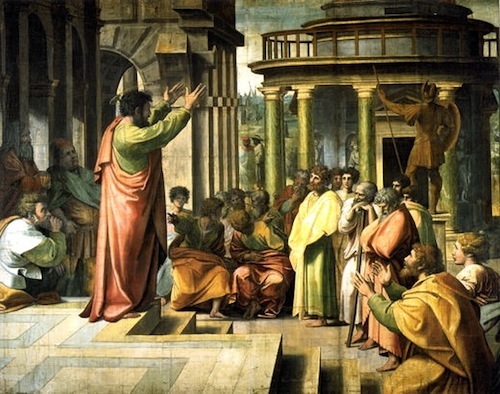
17:22 Paul then stood up in the meeting of the Areopagus [an important tribunal (cf. 17:33-34); Hill of Ares, the Greek god of war; Mars was Roman god of war, thus site sometimes called Mars Hill (as in KJV)] and said: “Men of Athens! I see that in every way you are very religious [ambiguous word that could mean religious or superstitious; use of this word did not alienate audience; Gr. deisidaimonesteros is a combination of Gr. words deido (revere or fear) and daimon (evil spirits), thus to have respect for or fear of the supernatural].

Paul was not ashamed of the gospel (Rom. 1:16) and welcomed the opportunity to speak before the meeting of the Areopagus. As a rabbi trained by Gamaliel (Acts 22:3), the finest scholar of his day, Paul was knowledgeable and prepared to present his beliefs with clarity and conviction.

Paul wisely began his address by affirming the religious interests of his audience. I see, Paul said, that you are extremely religious in every respect. The phrase translated extremely religious actually means to fear or to have respect for the supernatural. This was not an attempt to flatter his audience, but instead a statement of fact. After all, their city was full of idols.

Like Paul, we too should look for common ground with others that can enable us to share the gospel with them.

Note: Like Paul, do we stand up to share the gospel when we have opportunity or do we sit silent?

Note: Luke recorded Paul’s messages in…
• Acts 13:16-41 — to Jews in the synagogue at Antioch of Pisidia
• Acts 14:15-17 — to Gentiles on the streets of Lystra
• Acts 17:22-31 — to intellectuals on Mars Hill
• Acts 20:17-38 — to church leaders (the Ephesian elders) at Miletus

17:23 [two steps that indicate how Paul discovered the spiritual state of his audience] For as I [1] walked around and [2] looked carefully [must be observant to effectively communicate the gospel] at your objects of worship, I even found an altar with this inscription: TO AN UNKNOWN GOD [perhaps done in effort to avoid offending some deity with which they were not acquainted]. Now what [not “who”] you worship as something unknown I [Paul seized opportunity to introduce Christ] am going to proclaim to you.

Paul had learned about the spiritual state of the Athenians by walking around the city and observing the objects of their worship. We must be observant and knowledgeable about what others believe in order to find ways to more effectively communicate the gospel with them.

Paul had noticed an altar with a particularly interesting inscription: TO AN UNKNOWN GOD. For fear of offending some deity with which they were not acquainted, the Athenians had built an altar to something (not “someone”) unknown. Paul used the inscription on this altar to build a bridge between their ignorance and the self-revealed God of the Bible.

17:24 [note four facts about God] [1: He cannot be contained] “The God who made the world [Gr. kosmos] and everything in it [Stoics were pantheistic and did not believe in a divine Creator] is the Lord of [therefore above His creation] heaven and earth and does not live in temples built by hands [cf. Acts 7:48-50].

Paul began his discourse with the most fundamental of beliefs: the existence of a Creator. The God who made the world and everything that exists stands over His creation as Lord of heaven and earth. He alone reigns as sovereign Lord of all and cannot be contained in shrines made by hands, such as the shrines and temples found throughout Athens.

Paul’s entire argument was rooted in Old Testament thought (see Solomon’s prayer in 1 Kings 8:27) and reminds us that we must have more than passion when it comes to witnessing. We must know and use the Scriptures.

17:25 [2: He has no needs] And he is not served by human hands, as if he needed anything, because he himself gives all men life and breath and everything else [we desperately need Him].

Paul added that God has no needs. God is the source of everything and does not require anything that men can give in order to maintain His existence. He is entirely self-sufficient. Instead, it is mankind who desperately needs God. God is the One who gives every human being breath and life and everything else needed in order to survive. He is the source of “every generous act and every perfect gift” (James 1:17).

17:26 [3: He has a plan, He guides and governs human history] From one man [Adam] he made every nation of men, that they should inhabit the whole earth; and he determined [to appoint, to assign, to prescribe] the times [seasons, historical epochs] set for them and the exact places [national boundaries or habitable areas] where they should live.

Unlike the distant and impersonal gods of the Greeks, God is concerned about humanity. As the Creator, He created all people groups from one man—Adam. This thought must have offended some of Paul’s Greek listeners who believed that the Greeks were racially superior to all other nations—the barbarians! God created humanity to inhabit the earth and is still involved in human affairs. He guides and governs human history and determines the appointed times or the rise and fall of nations and civilizations.

17:27 God did this so that men would seek him and perhaps reach out [to touch, to feel; “groping after God in the darkness, when the light of His full revelation is not available” (Bruce)] for him and find him, though [and yet] he is not far [God is close to us and knowable; cf. Ecc. 3:11] from each one of us.

The gods of the Greeks lived in seclusion and were impersonal and unapproachable. However, the sovereign God who created everything that exists is not far from each one of us. He is approachable and knowable. God created us to seek Him—the proper response of the creature to the Creator. His desire is that people might reach out and find Him.

The writer of Ecclesiastes said that God has set eternity in the hearts of every human being (see Ecc. 3:11). Something within us longs to know the truth about God and yearns for eternity.

Note: Read “Eternity in Their Hearts” by Don Richardson. Published by Regal Books.

17:28 [4: He is sustainer] ‘For in him we live and move and have our being [quote from poet Epimenides].’ As some of your own poets [poem about Zeus by Aratus, a Greek poet] have said, ‘We are his offspring [in the sense that we are His creation; not in the sense that we share divinity as Paul’s listeners believed].’

Even ancient Greek literature acknowledged man’s relationship to a creator. Paul quoted lines from two Greek poems that originally were directed at Zeus. Paul however, applied these lines to God in whom we live and move and exist. He is the One who sustains life. We are his offspring, Paul said, in the sense that we are His creation.

The fact that Paul quoted from pagan sources likely enhanced his credentials in the eyes of his skeptical audience. We too can use the literature and other elements of our culture in order to illustrate that life apart from Christ is futile and meaningless.

17:29 “Therefore since we are God’s offspring [cf. Gen. 1:26], we should not think that the divine being is like gold or silver or stone — an image made by man’s design and skill [cf. Ps. 115:4-8].

Therefore since we are God’s offspring and made in His image, it is foolish to fashion gods in our own image. Crafting and bowing to gods made of gold or silver or stone does not make sense. The creature should express true worship directly to the Creator, not to some material representation made by human hands. Idolatry is wrong.

In my travels I have witnessed people bowing and weeping before gold representations of their god. I have watched as animists have offered their gifts to something inanimate. I have listened to individuals seeking guidance from stone representations of gods placed on altars in their homes.

Paul’s message is still relevant today. We must be prepared to help others understand that Christianity’s uniqueness lies in part in who God is: He is the Creator of all, Spirit, Father, Lord over everything, without need of anything from us, and involved in our lives.

17:30 In the past God overlooked [to hold back His divine wrath] such ignorance [cf. Acts 14:16], but now [God had sent a Savior] he commands all people everywhere to repent [and turn to Him].

Paul returned to the theme of ignorance (see Acts 17:23) of which the Athenians were guilty. However piously they had worshiped their pantheon of gods, they had done so in vain. They neither knew nor worshiped the one true God. In the past God had overlooked such ignorance or restrained His divine wrath.

Paul had proclaimed the truth about the one true God to the Athenians. This was no longer an “unknown God” but rather the God who had created them and sent His Son to die for their sins. It is this God who now commands all people everywhere to repent.

17:31 For [if we fail to repent] he has set [appointed] a day when he will judge the world with justice by the man [Jesus Christ: criterion by which people stand/fall, are saved/condemned] he has appointed. He has given proof [validation] of this to all men by raising him from the dead.”

Paul concluded by telling the Areopagites that they had a responsibility to act on what they had heard. God was not only their creator; He was the One who had made provision for their salvation through Jesus Christ. Failing to trust the resurrected Christ for salvation would ultimately lead to judgment. The only course open to them was to repent, renounce their worship of false gods, and turn to God—to whom they would one day be accountable.

Christianity is supremely unique because of what God has done through the death and resurrection of Jesus Christ: He alone makes possible our salvation from final judgment.

17:32 When they heard about the resurrection of the dead [note three types of responses to Paul’s gospel presentation], [1] some of them sneered [to scoff; cf. 1 Cor. 1:23-24], but [2] others [unconvinced, but still open] said, “We want to hear you again on this subject [we should continue to work with those who are open].”

17:33 At that, Paul left the Council [civil and criminal matters decided on hill].

17:34 [3] A few men became followers of Paul and believed. Among them was Dionysius [an Athenian aristocrat; a man of great influence], a member of the Areopagus [an elite and influential group of officials], also a woman named Damaris [probably also a person of influence], and a number of others.

Note: Five factors in Paul’s witnessing.
1. He started where they were (17:22b-23a).
2. He used the familiar to introduce the unfamiliar (17:23b-24a).
3. He developed his theme forcefully and clearly (17:24b-28a).
4. He kept their attention with relevant illustrations (17:28b).
5. He applied the message, personally (17:29-31).
(Swindoll • The Growth of an Expanding Mission)

Acts 16

Acts 16:1-15
16:1 He came to [arrived at] Derbe and then to Lystra [Paul and Barnabas established churches in these cities on their first journey], where a disciple named Timothy [first mention of the man who would become Paul’s protégé and one of the early church’s first pastors] lived, whose mother was a Jewess and a believer, but whose father was a Greek [perhaps he was not a Christian].

16:2 The brothers at Lystra and Iconium spoke well [to be approved] of him.

16:3 Paul wanted to take him [Timothy; cf. 1 Cor. 4:17] along on the journey, so he circumcised [necessary in order for Timothy to preach in synagogues] him because of the Jews who lived in that area, for they all knew that his father [probably dead] was a Greek.

16:4 As they traveled from town to town, they [Silas included; one of two leaders of Jerusalem church chosen to take to Antioch the apostolic letter containing decrees of the Jerusalem Council (cf. 15:32)] delivered [kept on delivering] the decisions reached by the apostles and elders in Jerusalem for the people to obey [observe].

16:5 So the churches were strengthened [to make firm or solid] in the faith and grew daily [continual increase] in numbers.

16:6 Paul and his companions traveled throughout the region of Phrygia [west of the province of Galatia; some Phrygians were present in Jerusalem on the Day of Pentecost (Acts 2:10) and probably had taken news of the gospel to their region] and Galatia, [Paul and his companions recognized that God was responsible for the roadblock] having been kept by the Holy Spirit [the specific means that the Holy Spirit used to keep them from moving into Asia or Bithynia is not recorded] from preaching the word in the province [not to be confused with the name of the continent today] of Asia [located on the western portion of Asia Minor].

16:7 When they came to the border of Mysia [the northwest region of Asia Minor], they tried to enter Bithynia [a district in northern Asia Minor; Christianity took root in Bithynia by some other means (cf. 1 Pet. 1:1)], but the Spirit of Jesus [the Holy Spirit] would not allow them to.

Note: “Sometimes God in His providential care will keep us from something good in order to use us for something better.” (FBS Leader Guide, Spring 2003, p. 30)

16:8 So they passed by Mysia and went down to Troas [Roman colony located on the extreme western shores of Asia Minor; important seaport for those traveling between Asia Minor and Macedonia].

16:9 During the night Paul had a vision of a man of Macedonia [northernmost province in Greece; part of modern-day Greece; a Roman province] standing [erect posture] and begging him, “Come [earnest appeal] over to Macedonia [specific place] and help us [eager plea].”

16:10 After Paul had seen the vision, we [Paul, Silas, Timothy, Luke] got ready at once [realized urgency of the call; moved while the door was open] to leave for Macedonia, concluding [to put together, to infer; they were in tune with God] that God had called us [Paul, Silas, Timothy, Luke] to preach the gospel [to bring the good news] to them.

Note: “Before the Lord can turn us, He often has to stop us. … When a good door closes, a better door opens.” (Charles R. Swindoll • The Growth of an Expanding Mission • p. 138)

16:11 From Troas we put out to sea and sailed straight [wind was at their backs; found a favorable wind; obstacles and friction were gone] for Samothrace [island in the Aegean Sea], and the next day on to Neapolis [ten miles southeast of Philippi; served as seaport of Philippi; first step onto European soil].

16:12 From there we traveled to Philippi [situated on a hill], a Roman colony [like a piece of Rome transplanted abroad; military outpost; citizens enjoyed special privileges and tax exemptions for having aided Octavian in battle] and the leading city [illustrious city, but marked by immorality and paganism] of that district of Macedonia. And we stayed there several days.

16:13 On the Sabbath [not enough Jews (ten required) to make up a synagogue] we went outside the city gate to the river [the Gangites (Angites) which flows into the Strymon], where we expected to find a place of prayer. We sat down and began to speak to the women [Paul was flexible and began a conversation with Macedonian women instead of a Macedonian man] who had gathered there.

16:14 One of those listening was a woman named Lydia [although Paul had seen a man in his vision, the first European believer was a woman], a dealer [seller] in purple cloth [“great demand for this fabric as it was used for the official toga at Rome and in Roman colonies” (Rienecker/Rogers)] from the city of Thyatira [located in western Asia Minor; trade center of purple dye], who was a worshiper of God [a God-fearer; a seeker; open to God; probably attracted to Judaism because of worship of one God and high ethical standards; probably attracted to Judaism while living in Thyatira which had an extensive population of Jews]. The Lord [salvation is God’s initiative] opened her heart to respond to Paul’s [like Paul, our responsibility is to share gospel] message.

16:15 When she and the members of her household [included servants and other dependents] were baptized [signifies they had trusted Christ for salvation], she invited us to her home [practical proof of her conversion]. “If you consider [judge] me a believer in the Lord,” she said, “come and stay at my house [first meeting place of the church in Philippi; cf. 16:40].” And she persuaded [to urge strongly, to insist] us.

16:16-24 Paul and Silas imprisoned on charges of causing civil unrest.

Acts 16:25-33
16:25 About midnight Paul and Silas were praying and singing [despite their pain] hymns to [directly to] God, and the other prisoners were listening [as a doctor places his ear to a patient to listen to his heartbeat; others are always listening to and watching God’s people] to them.

16:26 Suddenly there was such a violent earthquake [divinely appointed] that the foundations of the prison were shaken. At once all the prison doors flew open, and everybody’s chains came loose.

16:27 The jailer woke up, and when he saw the prison doors open, he drew his sword and was about to kill himself [rather than waiting for his superiors to execute him for allowing prisoners to escape; cf. Acts 12:18-19] because he thought the prisoners had escaped.

16:28 But Paul [more concerned about the jailer’s physical welfare than his own freedom] shouted, “Don’t [appeal to prohibit the beginning of an action] harm yourself! We are all here!”

16:29 The jailer called for lights, rushed in [to leap in, to burst in] and fell trembling before Paul and Silas.

16:30 He then brought them out and asked [people often seek spiritual answers in a crisis], “Sirs, what must I do to be saved?”

16:31 They replied [essence of the gospel], “Believe in the Lord Jesus, and you will be saved — you and your [jailer had influence over others] household.”

16:32 Then they spoke the word of the Lord to him and to all the others in his house.

16:33 At that hour of the night the jailer took them and [note two indications of change in jailer’s life] [1] washed their wounds; then immediately he and all his family [those mature enough to make a commitment] were baptized [this spiritual harvest made the physical pain worthwhile].

Acts 15

Acts 15:1-11

Note: The meeting in Jerusalem is often designated as the “Jerusalem Council” or the “Apostolic Council.” The chapter can be outlined as follows:
• Occasion 15:1-3
• Deliberations 15:4-21
• Decision 15:22-29
• Report to Antioch 15:30-35

15:1 Some men [who did not have the authorization of the Jerusalem church for their journey to Antioch as per 15:24; Judean Jews, probably former Pharisees; Judaizers] came down from Judea [probably from Jerusalem] to Antioch and were teaching [began to teach and kept it up] the brothers: [content of their message] “Unless you are [submit to] circumcised [distinctive mark of Judaism; Gen. 17], according to the custom taught by Moses [circumcision was part of the law], you cannot be saved [a denial of salvation solely by grace through faith].”

Trouble often comes when things seem to be going well. Some unnamed men traveled from Judea to the church at Antioch. These Judean Jews were Pharisees (see Acts 15:5) who belonged to a group called the Judaizers. They had traveled to Antioch without the authorization of the Jerusalem church (see Acts 15:24).

Although they did not dispute that Gentiles could be saved, they insisted that they must first be circumcised, as prescribed by the Mosaic law. Essentially, they taught that Gentiles must first become Jews before they could become Christians. By doing so, they denied that salvation was solely by grace through faith.

Even today, we must be wary of those who add to salvation, subtract from Christ’s work, and subsequently divide the church.

15:2 This brought Paul and Barnabas into sharp [intense and prolonged] dispute [questioning, discussion] and debate with them [Judaizers]. So Paul and Barnabas were appointed [by the Antioch church; to serve as delegates], along with some other believers [Titus, a Gentile convert (Gal. 2:1)], to go up to Jerusalem [a journey in excess of 250 miles] to see the apostles [the men selected by Jesus] and elders [other church leaders] about this question [re: nature or basis of Gentile salvation].

Paul and Barnabas disagreed strongly with the Judaizers and engaged them in intense and prolonged debate. Unable to resolve the issue, the church at Antioch appointed Paul and Barnabas and some others to serve as delegates and arranged for them to present their case to the apostles and elders in Jerusalem. The others included Titus (see Gal. 2:1), a Gentile believer who likely served as “Exhibit A” that the Jewish rite of circumcision was not necessary for salvation. At stake in Jerusalem was a decision that would affect both the history of Christianity and the way we view salvation today.

When we are in conflict with others, we need to work with them to understand the problem with all its implications and seek outside help, if necessary, to resolve it.

15:3 The church [at Antioch] sent them [Paul, Barnabas, other representatives] on their way, and as they traveled through Phoenicia and Samaria, they told [to narrate; tell in detail] how the Gentiles had been converted [without undergoing circumcision or submitting to the law of Moses]. This news [re: what God had done among the Gentiles] made all the brothers very glad.

Note: Trouble often comes when things seem to be going well (15:1). We should speak up for what we believe to be right (15:2). Seek outside help, if necessary, to solve problems (15:3).

15:4 When they came to Jerusalem, they were welcomed by the church and the apostles and elders, to whom they reported everything God had done through them [Paul and Barnabas reported what God had done on their missionary journey].

15:5 Then some of the believers who belonged to the party of the Pharisees stood up and said, “The Gentiles must be circumcised and required to obey the law of Moses.”

Note: Tips for handling conflict.
C = Calm down. Keep a cool head.
O = Open your mind and try to understand the opposing viewpoint.
N = Never resort to name-calling or personal insults.
F = Fight fair.
L = Look to the Scriptures for guidance.
I = Invite others who can shed light on the discussion.
C = Consider solutions that all parties can accept.
T = Trust the Lord to help you implement solutions.

15:6 The apostles and elders met to consider this question [concerning the nature of salvation].

Paul and Barnabas visited several congregations while on their way to Jerusalem. These believers rejoiced at the news of Gentile salvation. When they arrived in Jerusalem, they reported to the church the things that God had been doing through their ministry—namely drawing the Gentiles to Himself. However, some of the Judaizers who were present protested that Gentile converts must first obey the law of Moses, especially regarding circumcision, in order to be saved. The apostles and the elders then deliberated this volatile issue.

15:7 After much discussion [both sides allowed to speak], Peter got up and addressed them [Peter spoke from personal experience; note four important points in Peter’s message]: [1] [God had chosen Peter to speak to the Gentiles] “Brothers, you know [to be acquainted with; Peter had given them a full report at the time as per Acts 11:1-18] that some time ago [as many as ten years earlier] God made a choice among you that the Gentiles [cf. Acts 10:24-48 re: Peter preaching to Cornelius’ household at Caesarea] might hear from my lips the message of the gospel and believe.

After both sides had contended for their respective viewpoints, Peter stood up to address the group. Speaking from personal experience, he noted four important things.

First, Peter reminded those assembled that God had chosen him to take the gospel to the Gentiles—specifically to Cornelius’ household at Caesarea. Afterward, Peter had returned to Jerusalem where he gave an account of his experience to the Jerusalem Church. At that time, the church had praised God for granting salvation to Gentiles who believed in Jesus (see Acts 11:1-18).

15:8 [2] [God saves Gentiles and Jews by grace through faith alone] God, who knows the heart, showed [confirmation, approval] that he accepted them [Cornelius and other Gentiles who believed] by [expresses how the approval was expressed] giving the Holy Spirit to them, just as he did to us [on day of Pentecost (cf. Acts 2:38)].

Second, Peter reminded his listeners that God saves Gentiles and Jews in the same way—by grace through faith. God alone sees and knows all that takes place in the human heart (see 1 Sam. 16:7). He confirmed His approval of Cornelius and other Gentiles who believed by giving the Holy Spirit to them, just as He did to those who had believed on the day of Pentecost (Acts 2:38). If these Gentiles had not been saved, then God would not have given them the gift of the Holy Spirit (see Eph. 1:13-14). God had accepted them on the basis of faith.

15:9 He made no distinction [difference; cf. Acts 10:34] between us [Jews] and them [Gentiles], for he purified [cleansed] their hearts by faith [and faith alone].

The Cornelius episode clearly indicated that God made no distinction between us and them—that is, between Jew and Gentile. God is concerned about the internal circumcision of the heart, not the external circumcision of the flesh. Jews and Gentiles alike must have their hearts cleansed by faith in Christ. God placed His wonderful gift of salvation on the lower shelf where it is within the reach of all kinds of people and accessible by grace through faith (see. Eph. 2:8-9).

15:10 [3] [why burden the Gentiles with a yoke even the Jews had not been able to bear] Now then, why do you try to test [challenge] God by putting on the necks of the disciples a yoke [often used in sense of obligation, however, here suggests a burden rather than a religious duty] that neither we nor our fathers have been able to bear [keeping the law is humanly impossible]?

Third, Peter asked why they were putting on the disciples’ necks a yoke. The term yoke refers to a religious obligation. The law was a burdensome yoke that even the Jews had not been able to bear. If they could not keep the law, it made no sense to expect the Gentiles to earn salvation by trying to keep it. Besides, God had already shown His acceptance of Cornelius’ house without requiring circumcision and the yoke of the law. To demand more of the Gentiles would be tantamount to testing God or challenging His acceptance of the Gentiles apart from the law.

15:11 [4] [salvation is by grace] No! We believe it is through the grace [not circumcision and the law] of our Lord Jesus that we are saved, just as they are.”

Finally, Peter summed up his argument by declaring that there is only one way of salvation—through the grace of the Lord Jesus. And, he emphasized, Jews are saved in the same way as Gentiles—through the grace of the Lord Jesus. The need for grace puts all of us on equal footing. There is absolutely nothing we can do to earn grace. God’s grace is, however, readily and abundantly available to all who humbly acknowledge that they cannot save themselves and who trust in Christ alone for salvation.

15:12 The whole assembly [the entire congregation] became silent as they listened to Barnabas and Paul [these men were highly respected by the church as per 15:25-26] telling about the miraculous signs [Gr. “semeia”] and wonders [Gr. “teras”] God [they gave God the credit] had done among the Gentiles through them.

Barnabas and Paul reported on what God had done through them during their missionary travels. While Peter had focused on what God had done in the past, Barnabas and Paul reported on God’s ministry among the Gentiles in the present day. As they related the accounts of the miraculous signs and wonders God had done among the Gentiles, the entire congregation fell silent. These signs and wonders not only affirmed that Barnabas and Paul were God’s chosen messengers, but proof that God was indeed at work among the Gentiles.

Many believers discussed both sides of the issue involving the salvation of Gentiles, including Jewish Christians, Peter, Paul, and Barnabas. To resolve conflict, all parties, including others who will be affected by the outcome, need to be involved in the discussion of the problem and its related issues.

15:13 [speech by James (defended Peter and offered a solution); 15:13-21] When they finished, James [the half-brother of Jesus (Matt. 13:55; Gal. 1:19) who became a pillar of the Jerusalem church (Gal. 2:9) and writer of the Epistle of James] spoke up: “Brothers, listen to me.

When Barnabas and Paul finished their report, James spoke up. James was the half-brother of Jesus (Matt. 13:55). While Jesus was still on earth, James and his siblings had been skeptical of Jesus’ claims. All of that changed for James on the day he saw the resurrected Jesus (1 Cor. 5:7). Within a short period of time he became a prominent leader in the Jerusalem church—a “pillar” (Gal. 2:9). Tradition records that James was called “Camel Knees” because of his earnest prayer life. He had earned the respect of the apostles and of believers in Jerusalem. When he spoke, people listened.

Note: Three men named James.
• James the son of Alphaeus (an apostle) is only mentioned in the lists of the apostles. Tradition says he was crucified in Persia.
• James the brother of John was the first apostle to be martyred (Acts 12:2).
• James the half-brother of Jesus (Matt. 13:55; Gal. 1:19). He was skeptical of Jesus’ claims (Jn. 7:5). James saw Jesus after the resurrection (1 Cor. 15:7) and later became a prominent leader in the Jerusalem church (Gal. 2:9). Tradition says he was called “Camel Knees” because of his earnest prayer life.

15:14 Simon [Peter’s Hebrew name] has described to us how God at first [God showed His concern for the Gentiles before Paul and Barnabas ever arrived on the scene] showed his concern by taking from the Gentiles a people for himself [phrase previously used in reference to the Jews; here refers to the Gentiles].

James voiced his agreement with Simeon that Gentiles are indeed saved by grace. He called Peter by his Hebrew name, perhaps because he was addressing Jewish Christians. God, James emphasized, had already taken the initiative to show His concern for the Gentiles long before Paul and Barnabas ever arrived on the scene. Bringing the Gentiles into His family had been God’s plan all along. James then must have startled his listeners when he called these saved Gentiles a people for His name—a phrase previously used only of the Jews.

15:15 The words of the prophets [Isa. 11:10; 54:3; Jer. 16:19; Mal. 1:11] are in agreement with this [admission of Gentiles into the people of God was in agreement with words of OT prophets], as it is written [James quoted Amos 9:11-12]:

James declared the Scriptures supported the position Peter had taken in his testimony. He quoted the Old Testament prophet Amos to illustrate that what was happening with the Gentiles was the fulfillment of God’s plan and not some idea conceived by Peter, Barnabas, or Paul. The Old Testament prophets never said that Gentiles had to become Jews in order to know God’s blessing. To resolve conflict, we should always look to the wisdom of the Scriptures for guidance and never accept any resolution that violates God’s Word.

15:16 ” ‘After this I will return and rebuild David’s fallen tent. Its ruins I will rebuild, and I will restore it,

15:17 that the remnant of men may seek the Lord, and all the Gentiles who bear my name, says the Lord, who does these things’

15:18 that have been known for ages.

15:19 “It is my judgment, therefore, that we should not make it difficult for the Gentiles who are turning to God.

15:20 Instead we should write to them, telling them to abstain from food polluted by idols, from sexual immorality, from the meat of strangled animals and from blood.

15:21 For Moses has been preached in every city from the earliest times and is read in the synagogues on every Sabbath.”

15:22 [the decision of the conference (conveyed in official letter); 15:22-29] Then the apostles and elders, with the whole church, decided to choose some of their own men and send them to Antioch with Paul and Barnabas. They chose Judas (called Barsabbas) [also mentioned in 15:27; called a leader in this verse and a prophet in 15:32] and Silas [later selected by Paul to accompany him on second missionary journey; sometimes called “Silvanus” (2 Cor. 1:19; 1 Thess. 1:1; 2 Thess. 1:1) which is the Roman equivalent of the Hebrew “Silas”], two men who were leaders [also called “prophets” in 15:32] among the brothers.

The decision of the conference was conveyed to the church in Antioch in an official letter. The leaders and members of the Jerusalem church selected two delegates to accompany Paul and Barnabas. They chose Judas, called Barsabbas, and Silas. Both of these men were recognized leaders in the church and also exercised prophetic gifts (Acts 15:32). Little is known about Judas. Paul later chose Silas to accompany him on the second missionary journey (Acts 15:40).

15:23 With them they sent the following letter: The apostles and elders [the leaders of the Jerusalem church], your brothers, To the Gentile believers in Antioch [the place where the debate had started (Acts 15:1)], Syria and Cilicia [Roman provinces]: Greetings.

The official letter was sent by the apostles and elders—leaders of the Jerusalem church. The letter was addressed to the Gentile believers in the church at Antioch, the place where the debate had started (Acts 15:1), as well as believers in the provinces of Syria and Cilicia.

This letter would serve to validate the verbal testimony of Paul and Barnabas. Written in a formal style, the letter affirmed that the Judaizers had acted without the authorization of the Jerusalem church.

The letter also affirmed the church’s love for Barnabas and Paul as well as their confidence in these men who had “risked their lives for the name of our Lord Jesus Christ” (Acts 15:26).

15:24 We have heard that some went out from us without our authorization and disturbed you, troubling your minds by what they said.

15:25 So we all agreed to choose some men and send them to you with our dear friends Barnabas and Paul—

15:26 men who have risked their lives for the name of our Lord Jesus Christ.

15:27 Therefore we are sending Judas and Silas to confirm by word of mouth what we are writing.

The Jerusalem church was wise to send Judas and Silas along with their letter. These men were authorized to speak on behalf of the elders and apostles. They could address any questions or concerns about the contents of the letter and silence any who might question its validity.

Letters, especially “official” letters, can sometimes sound rather cold, harsh, and impersonal. The leaders of the Jerusalem church safeguarded against this by sending Judas and Silas to personally report and speak to the spirit behind the contents of the letter.

15:28 It seemed good to the Holy Spirit [played key role in inclusion of the Gentiles as per 15:8,12] and to us not to burden you with anything beyond the following requirements [two issues involved morality and two issues of food]:

The letter made it clear that the Holy Spirit had played an instrumental role in the decision reached by the Jerusalem leaders. The letter also emphasized practical things that were necessary for maintaining fellowship between Jewish and Gentile Christians. One of these necessary things involved issues of food. The other involved issues of morality. However, neither of these things was necessary for salvation. Wise, godly people can help those in conflict reach a consensus by offering proposals that are true to the Spirit and that all parties can accept.

15:29 You are to abstain from food sacrificed to idols, from blood, from the meat of strangled animals and from sexual immorality. You will do well to avoid these things. Farewell.

15:30 The men [Antioch delegation and representatives from Jerusalem] were sent off and went down to Antioch, where they gathered the church together and delivered the letter.

15:31 The people read it and were glad [rejoice, burst into exultant joy] for its encouraging [exhortation concerning message of letter; comforting or consoling because it affirmed salvation by grace through faith alone] message.

15:32 [two official representatives from Jerusalem] Judas and Silas [became Paul’s missionary companion], who themselves were prophets, said much to encourage [comfort] and strengthen the brothers.

15:33 After spending some time there, they were sent off by the brothers with the blessing of peace to return to those who had sent them.

15:34 but Silas decided to remain there [this verse not included in the best Greek texts]

15:35 But Paul and Barnabas remained in Antioch, where they and many others taught and preached the word of the Lord.

Acts 14

14:1 At Iconium [important trade center in Roman province of Galatia; major population center] Paul and Barnabas went as usual [same approach as used at Pisidian Antioch (cf. Acts 13:14)] into the Jewish synagogue [cf. Rom. 9:1-4 re: Paul’s desire to see Israel saved; began their ministry where there were many people]. There they spoke so effectively that a great number of Jews and Gentiles believed.

The church at Antioch had a concern that extended to those who lived beyond their community. They were the first local church to act upon such a concern by commissioning Paul and Barnabas to serve as missionaries. Like many missionaries to follow, these first missionaries would face many troubles as a result of their faith in Jesus and their efforts to spread the gospel.

Paul and Barnabas strategically went to cities where there were many people. When they arrived in Iconium in the Roman province of Galatia, they went first into the Jewish synagogue (see also Acts 13:14). Paul never lost his desire to see his fellow Jews saved (Rom. 9:1-4). Preaching in the synagogues gave Paul and Barnabas the opportunity to speak to Jews, to Gentile proselytes, and to other Gentiles who would be open to their message. A great number of both Jews and Greeks in Iconium listened to their message and believed.

14:2 But the Jews who refused to believe [to disobey, used here as the opposite of belief; “Unbelief and disobedience are both involved in the rejection of the gospel.” (Rienecker/Rogers)] stirred up [to excite; cf. Acts 13:45,50 re: similar experience at Pisidian Antioch] the Gentiles and poisoned [make evil, injure, irritate, harm, embitter] their minds against the brothers.

Not all of the Jews, however, were receptive to the gospel. As in Pisidian Antioch (see Acts 13:45,50), the Jews who refused to believe, or who rejected the gospel, stirred up opposition among the Gentiles. These unbelieving Jews initiated a smear campaign against Paul and Barnabas and also against all those who believed. The “phrase poisoned the minds” literally means “to cause their minds to think evil.” Those who oppose the gospel today still resort to such tactics.

After leading a team to share the gospel with hundreds of people on an island in the Bay of Bengal, we learned that the local religious leaders had a meeting immediately after our departure. They went about telling the people not to believe our message concerning Jesus Christ and to destroy the copies of the Scriptures that we had distributed.

14:3 So [therefore, because of the opposition] Paul and Barnabas spent considerable time [persisted] there, speaking boldly [with reliance upon the Lord] for the Lord, who confirmed [authenticated] the message of his grace [the gospel] by enabling them to do miraculous signs and wonders.

Instead of shaking the dust off their feet (see Luke 10:10-11) and moving on to the next city, Paul and Barnabas chose to stay in Iconium. In spite of the opposition, they stayed there for some time and continued to preach the message of His grace—the gospel. God authenticated their message and their credentials by enabling them to perform signs and wonders, which likely included healing the sick and casting out demons.

My friend Abdul has suffered repeated threats on his life for sharing the gospel in dark and hostile parts of South Asia. When I asked him why he did not flee to safety, he said that God had convicted him to stay, and by so doing, encourage other believers to continue speaking boldly in the face of opposition.

14:4 The people of the city were divided [split; polarized]; some sided with the Jews, others with the apostles [those who are sent; specifically Paul and Barnabas in this context].

The impact of Paul and Barnabas’ ministry was felt throughout the city. Some of the people believed the rumors started by the unbelieving Jews and sided with them. Others sided with the apostles. The term apostles means “those who are sent.” Originally used to describe the twelve who had witnessed the life, ministry, death, and resurrection of Jesus Christ, Luke used the term in this context to refer specifically to Paul and Barnabas. When the unbelieving Jews and Gentiles conspired with their rulers to assault and stone these missionaries (Acts 14:5), they fled Iconium and took the gospel to other cities (Acts 14:6-7).

14:5 There was a plot [violent impulse or assault; cf. Acts 9:23-24] afoot among the Gentiles and Jews, together with their leaders [perhaps synagogue leaders or city magistrates], to mistreat [treat shamefully; “insulting and outrageous treatment which is calculated publicly to insult and openly to humiliate the person who suffers from it” (Rienecker/Rogers)] them and stone them.

14:6 But they found out [to become conscious of, “to get wind of”] about it [plot] and fled to the Lycaonian [area in Roman province of Galatia] cities of Lystra [about 20 miles from Iconium; Timothy lived in this city (Acts 16:1)] and Derbe and to the surrounding country,

Note: “Did the missionaries lack faith because they escaped when their lives were threatened? No, their actions demonstrated the use of common sense in determining God’s will. Since God had provided them a way of escape, to stay would have been foolish.” (Swindoll • The Growth of an Expanding Mission • p. 89)

14:7 where [Lystra and Derbe] they [Paul and Barnabas] continued [cf. 1 Cor. 15:58; they did not give up] to preach the good news.

14:8 In Lystra [small town located about twenty miles south of Iconium; evidently no Jewish synagogue there] there sat a man crippled in his feet, who was lame from birth and had never walked [cf. Acts 3 re: Peter and John healing a lame beggar].

14:9 He listened to Paul as he was speaking. Paul looked directly at him, saw that he had faith to be healed

14:10 and called out, “Stand up on your feet!” At that, the man jumped up and began to walk.

14:11 When the crowd saw what Paul had done, they [the crowd reacted in a manner consistent with their pagan beliefs] shouted in the Lycaonian language [Paul and Barnabas did not speak or understand this language], “The gods have come down to us in human form! [they people believed an ancient legend that said Zeus and Hermes (the Roman names were Jupiter and Mercury) had once visited their region disguised as humans]

Paul and Barnabas fled from Iconium and traveled twenty miles south to the smaller town of Lystra. Evidently there was no Jewish synagogue in this predominantly Gentile town. There they met and healed a lame man who had never walked.

When the native Lystrans saw what Paul had done they interpreted this event in light of their pagan mythology. The emotional crowd cried out, “The gods have come down to us in the form of men!” They believed an ancient legend that said Zeus and Hermes had once visited their region disguised as humans.

Paul and Barnabas did not speak the Lycaonian language and therefore had no idea what the crowd was shouting.

14:12 Barnabas they called Zeus [head of Greek pantheon; Roman name Jupiter], and Paul they called Hermes [Roman name Mercury; spokesman for Jupiter; Greek god of oratory and inventor of speech] because he was the chief speaker.

The crowd started to call Barnabas, Zeus. According to Greek mythology, Zeus was the head of the Greek pantheon. Perhaps they gave Barnabas this designation because he had a reserved and dignified appearance. Paul, who had done most of the speaking, was thought to be Hermes, the spokesman for Zeus and the inventor of speech.

14:13 The priest [saw this as an opportunity to lead the people of the city in honoring Zeus] of Zeus, whose temple was just outside the city [Zeus was the patron deity of Lystra], brought bulls and wreaths to the city gates because he and the crowd wanted to offer sacrifices to them.

The temple of Zeus, the patron deity of Lystra, was located just outside the town. The priest of Zeus saw this occasion as an opportunity to lead the people in honoring their patron deity. He arrived on the scene with sacrificial oxen draped in garlands. He and the people intended to offer sacrifice to Paul and Barnabas, who by now sensed that something was terribly wrong.

Like Lystra, many towns and villages in the world today have plenty of religion, however misguided it may be. Religion does not satisfy the deepest hunger of the soul. Only a relationship with Jesus Christ can do that.

14:14 But when the apostles Barnabas and Paul heard of this [that the people intended to offer a sacrifice on their behalf], they tore their clothes [gesture expressive of sorrow (cf. Gen. 37:29,34), distress (cf. Josh. 7:6), or horror or protest (cf. Mk. 14:63)] and rushed out into the crowd, shouting:

When Barnabas and Paul finally understood what was happening they were horrified. They expressed their protest in a visually dramatic way—they tore their robes. Tearing one’s garments was a gesture that could express sorrow, distress, or protest. In this case, Barnabas and Paul rushed into the crowd to protest the intended sacrifice. Even today, people cannot resist the temptation to exalt the messenger above the message. We must always be careful to give glory to God alone.

14:15 “Men, why are you doing this [Paul and Barnabas wanted off the pedestal]? We too are only men, human like you. We are bringing you good news, telling you to turn from these worthless things [their pantheon of gods] to the living God, who made heaven and earth and sea and everything in them.

The last place Paul and Barnabas wanted to be was on a pedestal. They told the misguided crowd that they were not visiting gods, as they supposed, but mere men. They were no different than any of them.

Earlier in Acts, a crowd had shouted to Herod Antipas that his was “the voice of a god and not of a man” (Acts 12:22). The prideful Herod had accepted the people’s worship instead of giving glory to God and died as a result.

Paul and Barnabas understood that there is but one God. They tried to direct the people from the worship of worthless things to the living God who had made heaven and earth and all that exists.


Note: Luke recorded Paul’s messages in…
• Acts 13:16-41 — to Jews in the synagogue at Antioch of Pisidia
• Acts 14:15-17 — to Gentiles on the streets of Lystra
• Acts 17:22-31 — to intellectuals on Mars Hill
• Acts 20:17-38 — to church leaders (the Ephesian elders) at Miletus

14:16 In the past, he let all nations go their own way.

14:17 Yet he has not left himself without testimony: He has shown kindness by giving you rain from heaven and crops in their seasons; he provides you with plenty of food and fills your hearts with joy.”

14:18 Even with these words, they had difficulty keeping the crowd from sacrificing to them.

Paul and Barnabas designed their message to their audience—people who were not literate in the Scripture but rather were accustomed to superstition. Instead of quoting Old Testament scriptures, they appealed to the evidence in nature that point to the existence of God. They pointed out that God is the Creator of all life, has demonstrated great patience and mercy to the nations, and has revealed Himself in nature. Such evidence leaves people without excuse (see Rom. 1:20). However, in spite of their words, they had a difficult time countering the impact of the miracle of the healed man and stopping the crowds from sacrificing to them.

14:19 Then [trouble followed closely behind them] some Jews came [to Lystra] from Antioch [about 100 miles away] and Iconium and won [persuaded] the crowd [who earlier had acclaimed Paul and Barnabas as gods] over. They stoned [previous threats escalated to actual violence; cf. 2 Cor. 1:8-9; 11:25] Paul and dragged him outside the city, thinking [supposing] he was dead [apparently Paul was unconscious].

As if Paul and Barnabas did not have enough to deal with, more trouble was close at hand. Some Jews from as far away as Antioch and nearby Iconium arrived on the scene. They may have been traveling Jewish merchants or Jews who had intentionally followed Paul and Barnabas. They were unquestionably hostile and persuaded the crowds to turn against Paul and Barnabas.

The fickle crowds, perhaps frustrated that their expectations had not been fulfilled, became violent and stoned Paul. Luke did not record what the crowds did to Barnabas, who was evidently not present. Paul later wrote about his experiences in Asia (2 Cor. 1:8-9) and about the stoning (2 Cor. 11:25).

Note: Paul “was enduring the same kind of brutality that killed Stephen, the martyr whom he had once eagerly watched die in Jerusalem.” (Swindoll • The Growth of an Expanding Mission • p. 92)

14:20 But after the disciples had gathered around [encircled; after the mob had disbanded; perhaps prayed for him] him, he got up and went back into the city [did not leave town, went back to spend the night]. The next [following] day he and Barnabas left for Derbe.

Those of us who live in the relatively safety of America often forget that opposition to the gospel takes the form of hostile and physical violence in some parts of the world. Paul not only suffered serious physical injuries that resulted from the stoning, his injuries were further aggravated when the mob dragged his limp body out of town where he was left for dead.

A group of unnamed believers went to the place where the angry mob dumped Paul’s body and surrounded him. Perhaps they prayed for him. At some point, Paul regained consciousness and saw these concerned believers standing over him. He got up, most likely to their amazement, and then did something unthinkable. He walked back to the town where he had been assaulted by the angry mob.—a courageous act.

Paul and Barnabas did not allow difficulties or discouragements to cause them to lose sight of their purpose. They persevered, as should we when we encounter set-backs in sharing the gospel. The following day Paul and Barnabas set out for Derbe, a small town located about sixty miles southwest of Lystra. Every step must have been painful for Paul in light of his injuries.

Note: Trouble will come. Be prepared!
T = Troubles will come sooner or later to those who faithfully live out their faith. Expect it.
R = Remember that you are not the first to experience opposition because of your Christian faith.
O = Opposition to the gospel takes many forms. Be wise.
U = Unite with other believers when facing trouble. There is strength in numbers.
B = Bounce back quickly. Don’t let troubles keep you down.
L = Lean on the Lord and continue to serve Him, no matter what.
E = Explain the truth to those who misunderstand you or your presentation of the gospel.

14:21 They preached the good news in that city [Derbe] and won a large number of disciples. Then they returned [backtracked or retraced their route; stresses their concern for the churches they had planted] to [places where they had been in danger and had faced intense hostility] Lystra, Iconium and Antioch,

Paul and Barnabas preached the gospel in Derbe and made many disciples there. They likely did not encounter opposition and were therefore able to move from evangelism to discipleship. Making disciples was essential for the continuing evangelization of the region. New believers must be taught how to share their faith with others.

The results that Paul and Barnabas experienced in Derbe remind us of the importance of persevering in sharing the good news. How sad it would have been if Paul and Barnabas had retreated home to Antioch after their painful experience at Lystra. Giving up ultimately hurts those who are still waiting to hear the good news.

When Paul and Barnabas completed their work in Derbe, they started their journey home. However, in typical fashion, they decided to take the hard route home by retracing their bloody steps back to Lystra and then to Iconium and Pisidian Antioch.

Note: “While the first part of the journey had been for evangelism, this last part is for edifying new converts.” (Swindoll • The Growth of an Expanding Mission • p. 97)

14:22 strengthening [to make more firm; “to beef up” or add additional strength] the disciples and encouraging [“word is used of exhorting troops who are about to go into battle” (Rienecker/Rogers); give vital spiritual instruction] them to remain true to the faith. “We must [future is not trouble-free for believers; no rosy or misleading picture painted for these new believers] go through many hardships to [when we] enter the kingdom of God,” they said.

Paul and Barnabas had a specific purpose for retracing their steps. They wanted to strengthen the hearts of the disciples in each of the cities they had visited. This process likely included further instruction about their new faith and answering any questions these new believers might have had. They also encouraged them to remain true to the Lord despite hardships and opposition. These new believers were not exempt from the many troubles Paul and Barnabas had experienced. Persecution is not reserved solely for missionaries, but for all who bear the name of Christ.

Note: “They took great care to preserve the fruit of their work, by encouragement, instruction, and organization.” (Curtis Vaughan • “Acts” • p. 96)

14:23 Paul and Barnabas appointed [Gr. cheirotoneo: cheir = hand; teino = to stretch; to elect by a show of hands] elders [Gr. presbuteros; first reference to elders in NT; these individuals had to meet the spiritual qualifications Paul later listed in 1 Timothy 3:1-7 and Titus 1:5-9] for them in each church [organization and leadership are essential to the health of any church] and, with prayer and fasting [important part of decision-making process], committed them to the Lord [this commissioning probably involved laying on of hands], in whom they had put their trust.

Organization and leadership are essential to the health of any church. By the time Paul and Barnabas returned to the churches they had established, they were able to identify those who had gifts of leadership. They therefore appointed elders in every church and gave them the responsibility of caring for the flock. These individuals had to meet the spiritual qualifications Paul later listed in 1 Timothy 3:1-7 and Titus 1:5-9.

The selection of these elders came only after a period of prayer and fasting. Once selected, Paul and Barnabas commissioned these men who would have oversight for the spiritual welfare of their respective congregations. This commissioning likely included the laying on of hands. Thus the first missionary journey came to an end. Paul and Barnabas had visited four provinces and founded churches in Pisidian Antioch, Iconium, Lystra, and Derbe.

14:24 After going through Pisidia, they came into Pamphylia,

14:25 and when they had preached [no mention of preaching in Perga in Acts 13:13-14] the word in Perga [located about six miles from the coast; the place where John Mark had left them, cf. Acts 13:13], they went down to Attalia [seaport].

14:26 From Attalia they sailed back to [Syrian] Antioch, where [approximately 2-3 years earlier] they had been committed to the grace [enabled them to complete their task] of God for the work they had now completed [fulfilled].

14:27 On arriving there, they gathered the church [people, not the building; perhaps John Mark was present] together and reported all that God [gave credit to God] had done through them and how he had opened the door of faith to the Gentiles.

14:28 And they stayed there a long time with the disciples.

Acts 13

13:1 In the church [first church to send out missionaries to those beyond own geographical area; a church with a large vision] at Antioch [Roman capital of Syria; multicultural city; temple of Daphne on outskirts of town, a center of prostitution and pagan worship] there were prophets [those gifted to address God’s word to specific situations; cf. Acts 15:32; 1 Cor. 14:3; forthteller more than foreteller] and teachers [those gifted to teach the Scriptures, to teach others how to live the Christian life]: [cosmopolitan leadership team reflects a great diversity of backgrounds…] Barnabas [means Son of Encouragement (cf. Acts 4:36); cf. Acts 11:22-26; a Cyprian Jew], Simeon called Niger [Latin term meaning “black-skinned”], Lucius [Greek name suggesting he was possibly a Gentile] of Cyrene [located in Libya in North Africa], Manaen [Greek name for the Hebrew “Menahem”; a member of high society] (who had been brought up with [childhood companion] Herod [Herod Antipas, son of Herod the Great and murderer of John the Baptist: ruled Galilee 4 BC to AD 39; cf. Lk. 3:1; Acts 4:27] the tetrarch [term meaning ruler of a fourth]) and Saul [called Paul (Roman name) for first time in Acts 13:9].

13:2 While [Holy Spirit spoke while they were busy; opportunities for greater service often come to those faithfully performing their present duties] they [refers either to entire church or to prophets and teachers of v. 1] were worshiping [ministering] the Lord and fasting [indicates church was earnestly seeking God’s direction], the Holy Spirit said, “Set apart [to separate, to take away; to appoint; cf. Gal. 1:15-16; Rom. 1:1] for me Barnabas [mentioned first, perhaps because he was considered the leader at this time] and Saul for the work [a specific work] to which I [Holy Spirit] have called [Gr. proskaleo: pros is preposition meaning to, toward; kaleo means call; called to preach the gospel to unreached peoples] them.”

13:3 So after they [church] had fasted and prayed, they [refers either to prophets and teachers (v. 1), elders of congregation, or entire church] placed their hands [validation of Spirit’s work; recognition of the divine call; expression of support, affirmation; a formal setting apart for service] on them and sent them off [let go; released them to follow God’s call; willing to part with some of their best leaders in order to expand the kingdom].

Note: “There were more than half a million pagans in Antioch, but God wanted two of His choicest servants to go to fields abroad.” (Curtis Vaughan • “Acts” • p. 88)

13:4 The two of them, sent on their way [first missionary journey lasted approximately two years (about AD 46 to AD 47/48)] by the Holy Spirit, went [obediently] down to Seleucia [a port city located 16 miles from Antioch] and sailed from there to Cyprus [island home of Barnabas; cf. Acts 11:19-20 re: how the gospel arrived at Cyprus; population mainly Greek, but had a large Jewish community].

13:5 When they arrived at Salamis [city located on east coast of island of Cyprus], they proclaimed the word of God in the Jewish synagogues [Paul would use this approach for years]. John [John Mark] was with them as their helper [assistant; reminder that we must work as a team to share gospel].

13:6 They traveled through the whole island [about one hundred miles in length] until they came to Paphos. There they met a Jewish sorcerer [Gr. “magos” means magician] and false prophet named Bar-Jesus [name means “son of Jesus”],

13:7 who was an attendant of the proconsul [a high government official; functioned as governor of Cyprus], Sergius Paulus. The proconsul, an intelligent man, sent for Barnabas and Saul because he wanted to hear the word of God.

13:8 But Elymas [Bar-Jesus] the sorcerer (for that is what his name [the name Elymas] means) opposed them and tried to turn the proconsul from the faith [Satan’s agenda includes keeping people from hearing and responding to gospel].

13:9 Then Saul, who was also called Paul [his Roman name; so called from this point on in Acts], filled with the Holy Spirit [necessary in order to confront evil], looked straight at Elymas [means “sorcerer” or “magician”] and said,

13:10 “You are a child [literally “son”] of the devil [Gr. “diabolos”; the source of Elymas’ sorcery] and an enemy of everything that is right [literally “righteousness”]! You are full of all kinds of deceit and trickery [cf. Jn. 8:44]. Will you never stop perverting the right ways of the Lord?

13:11 Now the hand of the Lord is against you [an announcement of judgment]. You are going to be blind, and for a time you will be unable to see the light of the sun.” Immediately mist and darkness came over him, and he groped about, seeking someone to lead him by the hand.

13:12 When the proconsul [Sergius Paulus] saw what had happened, he believed [became the highest ranking converted government official in NT], for he was amazed at the teaching about the Lord.

13:13 From Paphos, Paul and his companions sailed to Perga [a port town] in Pamphylia, where John [John Mark] left them [we are not told why] to return to Jerusalem [many years later John Mark would again earn Paul’s respect (cf. Col. 4:10; 2 Tim. 4:11)].

13:14 From Perga they went on to [“traveled inland to” (NLT)] Pisidian Antioch [located in southern Galatia; not Antioch of Syria; a Roman colony]. On the Sabbath they entered the synagogue and sat down.

13:15 After the reading from the Law and the Prophets, the synagogue rulers sent word to them, saying [it was customary to invite visiting rabbis/itinerant teachers to speak], “Brothers, if you have a message of encouragement for the people, please speak.”

13:16 Standing up, Paul motioned with his hand and said [sermon continues to 13:41]: “Men of Israel [Jews by birth] and you Gentiles [God-fearing Gentiles (cf. Acts 13:26); proselytes] who worship God, listen to me!

Note: Luke recorded Paul’s messages in…
• Acts 13:16-41 — to Jews in the synagogue at Antioch of Pisidia
• Acts 14:15-17 — to Gentiles on the streets of Lystra
• Acts 17:22-31 — to intellectuals on Mars Hill
• Acts 20:17-38 — to church leaders (the Ephesian elders) at Miletus

13:17 [history of Israel from patriarchs to David (13:17-22)] The God of the people of Israel chose our fathers [beginning with Abraham]; he made the people prosper during their stay in Egypt, with mighty power [“uplifted arm” (NRSV); cf. Ex. 6:1,6; Ps. 136:11-12] he led them out of that country,

13:18 he endured their conduct for about forty years in the desert,

13:19 he overthrew seven nations [cf. Deut. 7:1] in Canaan and gave their land to his people as their inheritance.

13:20 All this took about 450 years. “After this, God gave them judges until the time of Samuel the prophet [the first].

13:21 Then the people asked for a king, and he gave them Saul son of Kish [cf. 1 Sam. 9:1-2], of the tribe of Benjamin, who ruled forty years.

13:22 After removing [because of his disobedience (cf. 1 Sam. 13:1-14; 15:1-25)] Saul, he made David their king. He testified concerning him [cf. 1 Sam. 13:14]: ‘I have found David son of Jesse a man after my own heart; he will do everything I want him to do.’

13:23 [God’s messianic promise to David fulfilled in Jesus (13:23-25)] “From this man’s [David’s] descendants God has brought to Israel the Savior [only place in Acts where Paul referred to Jesus as Savior] Jesus, as he promised.

13:24 Before the coming of Jesus, John [John the Baptist; cf. Jn. 1:6-8] preached repentance [to turn from sin and to God] and baptism [a public demonstration of one’s commitment to repent] to all the people of Israel.

13:25 As John was completing his work, he said [cf. Mk. 1:7]: ‘Who do you think I am? I am not that one. No, but he is coming after me, whose sandals I am not worthy to untie.’

13:26 “Brothers, children of Abraham [Jews], and you God-fearing Gentiles, it is to us [salvation through Jesus is for both Jews and Gentiles] that this message of salvation has been sent.

13:27 The people of Jerusalem and their rulers did not recognize Jesus, yet in condemning him they fulfilled the words of the prophets [cf. Ps. 118:22; Isa. 53:3] that are read every Sabbath [they had heard and were familiar with the prophecies but missed their fulfillment].

13:28 Though they found no proper ground for a death sentence, they asked Pilate [because they (the Jewish leaders) could not execute Jesus; cf. Lk. 23:1-25] to have him executed.

13:29 When they had carried out all that was written about him, they took him down from the tree and laid him in a tomb [cf. Lk. 23:44-56].

13:30 But God raised him from the dead [cf. Lk. 24],

13:31 and for many days he was seen [there were witnesses to affirm the truth of the resurrection] by those who had traveled with him from Galilee to Jerusalem. They are now his witnesses to our people.

13:32 “We [Paul and Barnabas] tell you the good news: What God promised our fathers

13:33 he has fulfilled for us [“in our own time” (NLT)], their children, by raising up Jesus. As it is written in the second Psalm [Ps. 2:7]: “‘You are my Son; today I have become your Father.’

13:34 The fact that God raised him from the dead, never to decay [cf. Ps. 16:10], is stated in these words [cf. Isa. 55:3]: “‘I will give you the holy and sure blessings promised to David.’

13:35 So it is stated elsewhere [cf. Ps. 16:10]: “‘You will not let your Holy One see decay.’

13:36 “For when David [cf. Acts 13:22] had served [serving God is a privilege and one way in which we can impact our generation] God’s purpose [God has a purpose for each of our lives] in his own generation [we only have our generation in which to serve the purpose of God, however, if we serve well then our lives can have an impact beyond our generation], he fell asleep [a reminder that the clock is ticking; we cannot afford to kill time because time is killing us]; he was buried with his fathers [cf. Ps. 30:9] and his body decayed [thus Ps. 16:10 is not a reference to David but to Jesus].

13:37 But the one whom God raised from the dead did not see decay.

13:38 “Therefore, my brothers, I want you to know that through Jesus [through His sacrificial death on the cross] the forgiveness of sins is proclaimed to you.

13:39 Through him everyone who believes [this is necessary] is justified [counted righteous or acquitted; cf. Rom. 5:9] from everything you could not be justified from by the law of Moses [the law exposes sin (Rom. 3:20), provokes to sin (Rom. 7:7-8) but cannot justify].

13:40 [a warning not to miss what God was doing among them…] Take care that what the prophets have said does not happen to you:

13:41 [cf. Hab. 1:5; Habakkuk had warned Judah of impending judgment but the people failed to understand what God was doing among them] “‘Look, you scoffers, wonder and perish, for I am going to do something in your days that you would never believe, even if someone told you.’”

13:42 As Paul and Barnabas were leaving the synagogue, the people [both Jews and Gentiles] invited them to speak further about these things on the next Sabbath.

13:43 When the congregation was dismissed, many [indicates impact of Paul’s message] of the Jews and devout converts [Gentiles who had been inducted into Judaism] to Judaism followed Paul and Barnabas, who talked with them and urged them to continue in the grace of God [or to remain steadfast in their Christian faith].

13:44 On the next Sabbath almost the whole city [Pisidian Antioch was a Gentile city] gathered to hear the word of the Lord [gospel].

13:45 When the Jews saw the crowds, they were filled with jealousy [envy] and talked abusively [blaspheme, slander, defame] against [contradict] what Paul was saying [that, in Christ Jesus, God accepts Gentiles also].

13:46 Then Paul and Barnabas answered them boldly [evidence of Holy Spirit; cf. Acts 4:8,13,31]: “We had to [necessary] speak the word of God to you [Jews] first [cf. Rom. 1:16]. Since you reject it [to push away from one’s self] and do not consider yourselves worthy of eternal life, we now turn to the Gentiles.

13:47 For this is what the Lord has commanded us [cf. Isa. 49:6]: “‘I have made you a light for the Gentiles, that you may bring salvation to the ends of the earth.'”

13:48 When the Gentiles heard this, they were glad and honored the word of the Lord; and all who were appointed [emphasizes the divine role in salvation] for eternal life [salvation] believed [emphasizes personal responsibility in salvation].

13:49 The word of the Lord spread through the whole region.

13:50 But the Jews incited the God-fearing [Gentiles who attended the Jewish synagogue] women of high standing [prominent, perhaps rich] and the leading [foremost in importance] men of the city. They stirred [rouse, excite] up persecution against Paul and Barnabas, and expelled [to cast out] them from their region.

13:51 So they shook the dust from their feet [cf. Lk. 10:8-12] in protest against them [the Jews who stirred up persecution, not to show disdain for Gentiles] and went to Iconium [continued to do what God had called them to do].

Note: “The shaking off of dust might mean that the missionaries cleared themselves of all further responsibilities.” (Rienecker/Rogers • “Linguistic Key to the Greek NT” • p. 295)

13:52 And the disciples [new disciples at Pisidian Antioch] were filled with joy and with the Holy Spirit.

Acts 12

Acts 12:1-17
12:1 It was about this time that King Herod [Herod Agrippa I (grandson of Herod the Great); ruled AD 37–34; first Roman authority to persecute Christians; Acts 12:20-23 re: his death] arrested some who belonged to the church, intending to persecute them.

12:2 He had James [the first of the twelve to be martyred; a “pillar” of the Jerusalem church (cf. Gal. 2:9)], the brother of John, put to death with the sword [possibly beheaded or run through with the sword].

Note: What is the difference between the persecution of believers and discrimination against believers?

12:3 When he saw that this pleased [suggests politically motivated persecution] the Jews, he proceeded to seize Peter also. This happened during the Feast of Unleavened Bread [two holy-days celebrated in sequence: Passover (one-day annual celebration of deliverance from Egypt) and Feast of Unleavened Bread (week-long event)].

12:4 After arresting him, he put him in prison, handing him over to be guarded by four squads of four soldiers each [total of 16 soldiers working in shifts]. Herod intended to bring him out for public trial after the Passover.

12:5 So Peter was kept in prison [within Fortress of Antonia near the temple area; Peter’s third arrest/imprisonment (Acts 4,5); against Jewish law to have a trial or execution during the Feast of Unleavened Bread], but [conjunction marks a turning point] the church [cf. Matt. 18:19; “God works when churches pray, and Satan still trembles when he sees the weakest saint upon his knees” (Wiersbe)] was earnestly [“to stretch out, to extend”: could refer either to extension in time (unceasingly) or to extension in intensity (earnestly); cf. Lk. 22:44] praying [fighting a battle with the weapon of prayer; cf. 2 Cor. 10:4; Jas. 5:16] to God [appealed to throne of heaven rather than throne of Herod; pray according to what God can do] for him [specific prayer is most effective].

Note: “If we put so little heart into our prayers, we cannot expect God to put much heart into answering them.”
(R.A. Torrey)

“God works when churches pray, and Satan still trembles when he sees the weakest saint upon his knees” (Wiersbe)

12:6 The night before Herod was to bring him to trial, Peter was sleeping [cf. Ps. 3:5; 4:8] between two soldiers, bound with two chains, and sentries stood guard at the entrance.

12:7 Suddenly [at just the right moment] an angel of the Lord appeared [at the darkest hour] and a light shone in the cell. He struck Peter on the side [poked him in the ribs] and woke him up. “Quick, get up [words convey urgency]!” he said, and the chains fell off Peter’s wrists.

Note: An impossible situation can turn into an opportunity for God to show His power.” (Swindoll)

12:8 Then the angel said to him [like a parent talking to a child awakened from sound sleep], “Put on your clothes and sandals.” And Peter did so. “Wrap your cloak around you and follow me,” the angel told him.

12:9 Peter followed him out of the prison, but he had no idea that what the angel was doing was really happening [Peter was still groggy, not yet fully alert]; he thought [to suppose] he was seeing a vision.

12:10 They passed the first and second guards and came to the iron gate leading to the city. It opened for them by itself, and they went through it. When they had walked the length of one street, suddenly the angel left him.

12:11 Then Peter came to himself and said, “Now I know without a doubt [fully convinced] that [Peter recognized and gave God the credit for His work] the Lord sent his angel and rescued me from Herod’s clutches and from everything the Jewish people were anticipating.”

12:12 When this had dawned on him [having realized or having perceived what had happened to him], he went [because his life was still in danger] to the house of Mary [some believe the church met there regularly; others believe this was the location of the Last Supper and where the disciples gathered on Day of Pentecost] the mother of John, also called Mark [first mention of Mark in Acts; would later write the Gospel of Mark], where many [considerable] people had gathered and were praying [apparently had been praying all night].

12:13 Peter knocked at the outer entrance [likely a courtyard separated outer entrance from house], and a servant girl named Rhoda came to answer the door.

12:14 When she recognized Peter’s voice [may be indication that Mary’s house was a regular meeting place for Christians], she was so overjoyed she ran back without opening it and exclaimed, “Peter is at the door!”

Note: Why are we so often surprised when God answers our prayers?

12:15 “You’re out of your mind [mad, crazy],” they told her [failed to realize that God had answered their prayers]. When she kept insisting [vigorous and confident assertion] that it was so, they said, “It must be his angel [or his ghost].”

Note: Jews believed that each person had a guardian angel, a sort of spiritual counterpart, that often appeared immediately after the person’s death.

12:16 But Peter kept on knocking, and when they opened the door and saw him, they were astonished [to be beside one’s self; response points to lack of faith].

12:17 Peter motioned with his hand for them to be quiet [lest their loud voices alert Herod’s soldiers to his presence] and described [to relate, narrate, report; we can encourage others by sharing how God has helped us] how the Lord [Peter emphasized what God had done] had brought him out of prison. “Tell James [became leader of the Jerusalem church; author of the Epistle of James] and the brothers [either the Jerusalem church elders, other members of the church, or the other half-brothers of Jesus] about this,” he said, and then he left for another place [went into hiding].

Note: “…God often gives us more than we expect and always more than we deserve.” (Curtis Vaughan)