Overview of Job

Job 1:1-22 — Job was a pious and prosperous man highly regarded on earth and in heaven. Satan accused Job of serving God for selfish reasons. God permitted Satan to test Job’s motives for serving Him with the stipulation that he not harm Job himself. Job responded to Satan’s attacks by worshiping rather than cursing God.

Job 2:1-10 — Satan again questioned Job’s motives for serving God. He received permission to strike but not to kill Job. Satan struck Job’s body with ulcerous sores. Job again accepted this adversity and refused to curse God.

Job 2:11-13 — Three of Job’s friends visited him in hope of offering sympathy and comfort. They wept and grieved with Job for an entire week and did not speak a word because of the intensity of his suffering.

Job 3:1-26 — Following a week of silence, Job spoke in the presence of his friends. Filled with emotion, he cursed the day of his birth and wished he had never been born. Job lamented that he had not been stillborn and expressed his desire to die in the midst of his present sufferings.

Job 4:1–7:21 — Eliphaz believed that Job was suffering because he had sinned against God. He urged Job to turn to God, implying that Job had turned away from God. Job asked Eliphaz to bring up specific charges against him rather than vague insinuations.

Job 8:1–10:22 — Like Eliphaz, Bildad believed that Job’s adversity came because he was guilty of sin. He argued on the basis of cause and effect and callously told Job that his children had sinned and received what they deserved. Job maintained his innocence and concluded that it would have been better for him to go from the womb to the tomb.

Job 11:1–13:19 — Like his companions, Zophar assumed Job was guilty until proven innocent. He too believed that Job was being punished by God and that he needed to repent. Job rejected the explanations of his friends. He called them worthless physicians who were unable to give a proper diagnosis and branded their counsel as worthless as ashes.

Job 13:20–14:22 — Job asked God to reveal to him any sin in his life, including any he might have committed in his youth. He lamented that the future looked hopeless and asked God to let him have a little peace before his death.

Job 15:1–17:16 — Eliphaz challenged Job’s contention that the wicked prosper in this life. He insisted that the wicked are punished, again implying that Job was suffering because he had sinned. Job called Eliphaz and his friends “miserable comforters” and maintained his innocence. Job prayed that his blood would cry out and declare his innocence if he died without being vindicated.

Job 18:1–19:29 — Bildad graphically described the fate of the wicked and told Job that he was getting exactly what he deserved. Job lamented that he felt forsaken by all who were dear to him. Yet, Job looked forward to the day when God Himself would clear him of all charges.

Job 20:1–21:34 — Zophar told Job that he must surely be aware of the end that awaits the wicked. Job responded by telling Zophar that the wicked are not always overtaken by punishment and the righteous do not always enjoy prosperity.

Job 22:1–24:25 — Eliphaz opened the third round of speeches with the direct and heartless precision of a sniper. He took aim at Job and accused him of being a sinner and a hypocrite. Eliphaz offered no supporting evidence for his charges and maintained his simple logic: Since only the wicked suffer and Job was suffering a lot it followed that Job must be very wicked.

Job responded to Eliphaz by ignoring him and speaking to the Lord instead. He lamented that no matter which way he turned he could not find God. Job wanted desperately to be able to present his case before God, if he could but find him or know his court schedule. Job detailed many of the sins of the wicked and complained that they seemed to sin with impunity.

Job 25:1–27:23 — Bildad’s brief speech focused on God’s greatness. He remarked that God is infinitely greater than His creatures—who Bildad described as maggots and worms. Since even the works of God’s creation are not pure when compared to Him, Bildad said that no person (including Job) could claim to be clean before God.

Job rebuked Bildad for talking about God’s greatness but offering no practical help to him. He was well aware of God’s greatness and sovereignty. However, Job was more concerned about God’s justice. He wanted his day in court. He told his friends that he would maintain his integrity and would not give a false confession of his sins just to please them. Job concluded his response with a description of the fate of the wicked.

Job 28:1-28 — Job turned his attention to the matter of wisdom. While his friends had knowledge (intellectual information) they lacked wisdom (spiritual perception). Job said that wisdom is not found by digging shafts deep into the earth, nor can it be purchased at a market. True wisdom begins with the fear of the Lord. God’s wisdom, not that of his friends, would help Job face his perplexing situation.

Job 29:1-25 — Job recalled better days when he had thought his future was secure. In days past, Job had looked forward to dying with his children around him. He had once felt that his life was deeply rooted, secure, and prosperous. He reminisced about the days when he had a good reputation, strength, and was highly regarded for his opinions and judgments.

Job 30:1-31 — The opening words of this chapter signal a contrast to the thoughts of the previous chapter. Job lamented that in his present miserable condition he had to endure the taunts and abuse of others. He complained that even God had turned on him and would not listen to him. Job felt he had lost the respect of others and the friendship of God. He felt alone and forsaken.

Job 31:1-40 — Job turned the spotlight on himself and examined every area of his life. Intent on affirming his innocence, Job examined his marriage, his business, his home, his relationship to his employees and the people of his community, his attitude toward money, his spiritual life, his treatment of enemies, and his stewardship of the land and resources entrusted to him by God. Job then reaffirmed his personal integrity and rested his case.

Job 32:1–33:33 — Elihu, a new voice, entered the debate. He was the youngest of those present and spoke a total of four times. Elihu’s messages form a transition from the words of Job and his critics to the words of God. He rebuked Job’s friends for making unsupported accusations against Job and addressed Job’s complaint that God would not speak to him. Elihu pointed out that God speaks to people through dreams, through pain, and through others.

Job 34:1-37 — In his second speech Elihu rebutted Job’s claim that God was not fair (34:1-9). He affirmed that God is fair and always acts according to His nature (34:10-15). Elihu reminded Job and his critics that no one is in a position to criticize God regarding how He enforces judgment (34:16-20). He praised God as the omniscient Judge of the universe (34:21-30). God is not accountable to us nor does He owe us any explanations (34:31-37).

Job 35:1-16 — Elihu began his third speech by quoting Job’s earlier complaint that God seemed not to punish the wicked. He reminded Job and his friends that God is infinitely higher and beyond the grasp of than human beings. The wickedness or righteousness of people, Elihu said, impacted their fellow human beings but did not change God. He also said that God had no time for those who only called on him in emergencies but disregarded Him in good times.

Job 36:1–37:24 — In his fourth and final speech, Elihu contended that God is powerful and in control. He judges the wicked, helps the oppressed, and exalts the righteous. He reminded Job that no person is in a position to reprove or instruct God concerning His actions. God manages the universe with skill beyond our comprehension. Because we do not know, understand, or can explain how God does wondrous things in nature, we should fear Him and trust Him to do what is right.

Job 38:1–40:2 — The Lord broke His silence and spoke directly to Job from the midst of a whirlwind. This is the longest conversation in the Bible in which the Lord speaks. However, rather than being questioned by Job, the Lord asked Job to answer questions concerning the created order. His questions exposed the inadequacy of human wisdom.

Job 40:3-5 — Job responded by telling the Lord that he could not answer His questions. He concluded that it would be better to remain silent than to try to contend with God.

Job 40:6–41:34 — The Lord confronted Job with trying to discredit His justice and trying to condemn Him in order to justify himself. He then invited Job to try to do a better job than Him of running the universe. If Job was incapable of capturing and controlling a hippopotamus or a crocodile, then he was in no position to question the Creator of these animals. Job, who earlier could not wait to argue his case before the Lord, was speechless.

Job 42:1-6 — Job humbly submitted himself to the Lord and demonstrated a teachable spirit. He acknowledged the Lord’s sovereignty and the inscrutability of His ways. Job admitted that he had presumptuously spoken about things he did not understand and that his own wisdom was woefully inadequate. He repented of his presumptuous words and attitude toward God. Job was a broken man. Satan had lost. God was glorified.

Job 42:7-17 — The Lord addressed Job’s friends and expressed his displeasure over their misrepresentation of Him. They had reduced God to a formula and a cliché. The Lord ordered them to offer a sacrifice for their sin and instructed Job to pray for his friends. The three friends did exactly as the Lord instructed. After Job prayed for his friends, the Lord restored his fortunes and family. Job lived an additional one hundred and forty years.

Overview of Ecclesiastes

Ecclesiastes 1:1-18 — Solomon introduced the theme of futility in the opening verses of the book. He observed the fleeting and transient nature of everything under the sun and concluded that fulfillment is not found in these.

Ecclesiastes 2:1-11 — Solomon experimented with pleasure and possessions to see if these avenues led to fulfillment in life. He tried wine and folly and the accumulation of possessions. Solomon found that these pursuits failed to satisfy and were futile.

Ecclesiastes 2:12-26 — Solomon bemoaned the fact that even his work failed to satisfy. He hated to think that all he had worked for would be bequeathed to others who may be wise or foolish. He concluded that the best thing to do was to simply enjoy the normal activities of daily life as gifts from God.

Ecclesiastes 3:1-15 — Solomon declared that there is “a time for every activity under heaven” (3:1 . He listed a variety of human experiences that come from God and are good in their time. Solomon also affirmed that life is a gift from God and should be enjoyed and lived with eternity in mind.

Ecclesiastes 3:16-22 — Like others before him, Solomon acknowledged the mystery of the wicked prospering in their sin and the righteous suffering in their obedience. Solomon found comfort in the assurance that there is an appointed time when God’s judgment will set matters straight.

Ecclesiastes 4:1-16 — Solomon lamented the oppression and sadness he observed in the world. He said that the dead are better off than the living because they do not have to put up with this evil. He also commented on the loneliness of wealth. Solomon did not see the point in a man without an heir working hard all of his life to acquire wealth. It is better to go through life with friends than to try to make it alone.

Ecclesiastes 5:1-20 — Solomon cautioned against making and breaking vows to God. He also said that bureaucracy and corruption are facts of life and should not surprise us. Returning to the topic of wealth, Solomon stated that wealth cannot satisfy people’s deepest longings. Wealth cannot solve all of the problems of the poor and creates problems for the rich.

Ecclesiastes 6:1-12 — Solomon noted that some who have great wealth are not able to enjoy it at all. Some die with so little that their families are not even able to provide them with a decent burial. Both the wise and the poor give themselves to the futile pursuit of wealth and never seem to get enough.

Ecclesiastes 7:1-13 — Solomon wrote a series of proverbs that illustrate some of the lessons that are learned only when facing death or thinking about it. The inevitability of death gives one a needed perspective on the realities of life. God’s wisdom reminds us of the brevity of life and encourages us to listen to wise critics.

Ecclesiastes 7:14-29 — God allows us to experience days filled with prosperity and days filled with adversity. He uses each of these extremes to give balance to our lives and to help us grow. Solomon also observed other of life’s extremes and urged that one follow a course of wisdom through these.

Ecclesiastes 8:1-17 — Life is filled with all sorts of injustices and inequities that we must deal with. Among these are bad rulers and people who do not get what they deserve. Solomon concluded that while wisdom cannot explain every mystery under the sun, we need wisdom in order to get the most out of life.

Ecclesiastes 9:1-10 — Death is inevitable for the righteous and the wicked. However, the reality of death should not overshadow the enjoyments of life. God wants us to enjoy feasts, family, and our work. And, in doing this, we should allow God’s wisdom to guide us in living each day for His glory.

Ecclesiastes 9:11-18 — Life is not fair and is often unpredictable. At times there seems to be no relation between what we deserve and what we actually receive. Sometimes the race goes to the swift and at other times it does not. Nevertheless, we should look to God for the wisdom to live each day for His glory.

Ecclesiastes 10:1-20 — Just as a dead fly in ointment will cause it to stink, so a little folly can destroy the character and reputation of a wise person. The wise person and the fool can be identified by the way in which they live. The wise display calmness in tense situations and know how to offer gracious words. Unfortunately, kings often make the mistake of promoting fools to positions of power. Fools have a high regard for their opinions, give bad advice, and even presumptuously try to predict the future.

Ecclesiastes 11:1-6 — Solomon counseled that it is best to diversify investments, work hard, and take calculated risks. The one who sits and waits for every condition to be perfect before acting will miss valuable opportunities in life.

Ecclesiastes 11:7-10 — Solomon advised people to enjoy every minute of being young. Young people should live their lives within the boundaries of God’s revealed will because they will one day give an account to God for everything they have done.

Ecclesiastes 12:1-8 — Solomon said that people should make the most of life and its many opportunities while they are young. The young are irresistibly and steadily drawn toward old age and progressively lose the capacity to pursue many opportunities. Solomon poetically and graphically described the physiological changes we undergo as we grow older.

Ecclesiastes 12:9-14 — Regardless of our age, we should continuously seek to learn and to apply the truths of God’s Word. Solomon concluded Ecclesiastes with sober advice — “fear God and keep His commands” and live each day with the knowledge that God “will bring every act to judgment.”

Overview of John 13-21

John 13:1-11 — Jesus and His disciples gathered to eat the Passover meal in an upper room. Before beginning the meal, Jesus got up from the table and washed His disciples’ feet. Peter protested that Jesus should not wash his feet. Jesus explained that those who wanted to be connected to Him had to be cleansed by Him, a reference to the spiritual cleansing He would make possible by His death on the cross. Jesus also explained that not all of those present were clean within, a reference to Judas.

John 13:12-17 — Jesus asked the disciples if they understood what He had done for them. He explained that He had set an example of service He expected them to follow. Jesus did not institute foot washing as a church ordinance but rather set an example of the kind of humble service believers should show one another.

John 13:18-30 — After His startling display of service, Jesus made an equally startling announcement. Jesus informed His disciples that one of them would betray Him. John, who was seated next to Jesus, asked Him to identify the betrayer. Jesus identified His betrayer by giving a piece of bread, a gesture of friendship, to Judas Iscariot. Judas accepted the bread and then left the room. Judas would later betray Jesus with a kiss, another gesture of friendship.

John 13:31-38 — After Judas left the room, Jesus told His disciples that the time had come for Him to be glorified—something which would be accomplished through His death and resurrection. He also commanded His disciples to love one another. Love, said Jesus, should be the distinguishing mark of His followers. Peter boasted that he was willing to protect Jesus with his life. Jesus informed Peter that during the next several hours he would deny Him three times.

John 14:1-7 — The disciples were troubled at the news that one of them would betray Jesus (13:21) and that Jesus was leaving them (13:33). Jesus told the disciples that He was leaving to prepare a place for them in His Father’s house. He identified Himself as the way to the Father.

John 14:8-11 — Philip asked Jesus to show them the Father. Jesus explained that to see Him is to see the Father. After hearing Jesus words and seeing His works, the disciples should have known that Jesus was God in human form (1:14,18).

John 14:12-14,18-21 — When Jesus returned to the Father He would send the Holy Spirit to empower His followers to expand the scope of His kingdom. Jesus promised that God would hear and answer requests in line with His will and kingdom purposes.

John 14:15-17 — Jesus promised to give the disciples the Holy Spirit. He identified the Spirit as the Counselor and the Spirit of truth. Jesus also promised the disciples that the Holy Spirit would be with them forever.

John 14:22-24 — Judas (not Iscariot) asked Jesus to clarify how He would manifest Himself to them but not to the world. Jesus explained that He and the Father would abide with them in the Person of the Holy Spirit. Their obedience would be the proof that they loved Him.

John 14:25-26 — The Holy Spirit would teach the disciples all they needed to know about Jesus and the way of salvation. The Counselor would cause the disciples to remember all that Jesus had said to them.

John 14:27-31 — Jesus gave the disciples His peace—a resource they would need to calm their troubled hearts. He told His disciples that He would complete His redemptive work and return to His Father.

John 15:1-3 — Jesus used the analogy of a vine and its branches to clarify His relationship to believers. God, the gardener, personally tends the vineyard in order to increase the potential for fruit bearing.

John 15:4-8 — Jesus said that He is the Vine and believers are the branches. Believers must remain in vital union with Christ in order to bear fruit. Apart from Christ, believers can do nothing worthwhile or of eternal value. Believers who remain in Him are assured that God will hear and answer prayers that are in line with His will and purposes.

John 15:9-15 — Jesus urged His disciples to obey His commands just as He obeyed His Father’s commands. Jesus called His disciples friends and challenged them to demonstrate a sacrificial kind of love toward others.

John 15:16-17 — Jesus appointed His disciples to bear fruit that will last. He reminded them that prayer is essential to a productive and fruitful spiritual life.

John 15:18-20 — Jesus taught His disciples that they would experience the hatred and opposition of the world. The world hates those who are identified with Christ. Jesus told His disciples to remember that the world hated Him first.

John 15:21-24a — Jesus explained that the world’s hatred is fueled by spiritual ignorance. Jesus’ life and works made people uncomfortably aware of their sin. Those who refused to believe in Jesus were without excuse for their sin.

John 15:24b-25 — In spite of evidence that indicated Jesus is the Christ and God’s Son, many Jews refused to believe in Jesus. Instead, they hated Him, thus fulfilling what was written in their Law.


John 15:26-27 — The Holy Spirit always points others to Jesus. The disciples, under the power of the Holy Spirit, were to tell others about Jesus and how to find salvation in Him.

John 16:1-4 — Jesus warned His disciples about persecution so that they would not be caught off guard when it came. He said that the hatred of the world would manifest itself in expulsion from the synagogue and even death.

John 16:5-15 — Jesus identified the ministry of the Holy Spirit in relation to the world. The Holy Spirit convicts the world in regard to sin and righteousness and judgment. The Holy Spirit guides believers into all truth concerning the significance of Christ’s life, ministry, and death.

John 16:16-18 — The disciples were confused by Jesus’ announcement that they would not see Him and then would see Him. They were also puzzled by what He meant by the statement that He was going to the Father. They discussed their confusion among themselves and wondered what Jesus meant by these statements.


John 16:19-22 — Jesus overheard the disciples’ discussion concerning His statements. He explained to them that they would weep and mourn His death while the world would rejoice. He also assured them that their grief would turn to joy when they saw Him again.

John 16:23-24 — Jesus told the disciples that a day was coming when they would make their requests directly to the Father in Jesus’ name. He assured the disciples that they would be heard.

John 16:25-28 — Jesus told the disciples that a time was coming when they would understand everything He had taught them about the Father. He also spoke to them of a time when they would have direct access to the Father through prayer in His name.

John 16:29-33 — Jesus questioned the disciples’ declaration of faith. He predicted they would forsake Him in the coming hours. Jesus offered hope to the disciples by assuring them that everything He had shared with them was meant to give them peace. He also promised to give them victory over tribulation.

John 17:1-5 — Jesus prayed that the Father would glorify Him so that He might glorify the Father. Jesus glorified the Father by completing the work God had given Him to do. For this reason, Jesus asked the Father to restore to Him the glory He had before He came to earth.

John 17:6-12 — Jesus prayed for His disciples. He acknowledged that God had given them to Him. He asked the Father to protect them and to keep them united.

John 17:13-19 — Jesus not only asked the Father to keep His disciples together but to keep them from the enemy as well. He did not ask that they be taken out of the world, but that they be sanctified and consequently live distinctive lives in the world.

John 17:20-24 — Jesus prayed for those who would believe in Him as a result of the disciples’ message. He specifically prayed that they be one, as He and the Father are one. Christian unity tells the world that Christ makes a difference in the lives of those who believe in Him.

John 17:25-26 — Although the world had failed to recognize who Jesus was, the disciples had come to believe that He was the One sent from God. Jesus prayed that the Father’s love would be in them and that He (Jesus) Himself would be in them.

John 18:1-14 — At the conclusion of His prayer (17:1-26), Jesus took His disciples to the Garden of Gethsemane. Jesus agonized in prayer to the Father (Matt. 26:39; Luke 22:42-44). Soon, Judas escorted an armed crowd to the garden to arrest Jesus. Those who arrested Jesus bound Him and took Him to Annas, a former high priest.

John 18:15-18 — Peter and an unnamed disciple followed Jesus into the high priest’s courtyard. A servant girl asked Peter if he was a disciple of Jesus. Peter replied that he was not one of Jesus’ disciples.

John 18:19-24 — Annas asked Jesus about His disciples and His teaching. Jesus did not disclose any information about His disciples. He told Annas that He had taught openly and challenged him to produce witnesses against Him. An official struck Jesus in the face. Jesus challenged the official to provide proof that He had said or done anything wrong.

John 18:25-27 — Peter denied a second and third time that he knew Jesus. As Jesus had predicted, a rooster began to crow after Peter’s third denial.

John 18:28-40 — The Jewish leaders led Jesus from Caiaphas to Pilate in an effort to secure from him the death sentence for Jesus. Pilate questioned Jesus but did not wait for an answer to the most important question, “What is truth?” Pilate gave in to the pressure of the Jews and released Barabbas instead of Jesus.

John 19:1-7 — Pilate handed Jesus over to Roman soldiers who physically and verbally abused Him and dressed Him in mock royal attire. Pilate then presented Jesus to the crowd. The crowd called on Pilate to crucify Jesus because of His claim to be the Son of God.

John 19:8-12 — Pilate was afraid when he heard that Jesus claimed to be the Son of God. He questioned Jesus a second time and told Jesus he had the authority to crucify or release Him. Jesus reminded Pilate that His only power over Him came from God.

John 19:13-16 — Pilate gave in to the pressure of the Jews to crucify Jesus. He presented Jesus to the Jews as their King. The Jews shouted that they had no king but Caesar. Pilate then washed his hands before the crowd (Matt. 27:24) and handed Jesus over to be crucified.

John 19:17-30 — Jesus was required to carry His own cross to Golgotha where He was crucified between two others. Pilate wrote an inscription and placed it on Jesus’ cross to the dismay of the Jewish leaders. The soldiers who made up the execution squad divided and cast lots for Jesus’ clothing. Jesus instructed “the disciple whom he loved” to care for Mary, His mother. Jesus then uttered His final words from the cross and died.

John 19:31-42 — The Jews asked Pilate to hasten the death of Jesus and of those crucified with Him. When the soldiers came to Jesus they saw that He was already dead. A soldier thrust his spear in Jesus’ side thus confirming that Jesus was dead. Pilate released the body of Jesus to Joseph of Arimathea and Nicodemus. These men prepared His body for burial according to Jewish burial customs and placed Jesus in Joseph’s own new tomb.important question, “What is truth?” Pilate gave in to the pressure of the Jews and released Barabbas instead of Jesus.

John 20:1-9 — Mary Magdalene discovered the empty tomb early on the Sunday morning after the crucifixion. Mary reported the news to Peter and the disciple who Jesus loved. These men ran to the tomb to investigate her report.

John 20:10-18 — After looking into the empty tomb, Peter and the other disciple returned to Jerusalem but Mary stayed outside the tomb crying. Mary saw two angels seated in the tomb who asked her why she was crying. Mary replied that she wanted to know where the body of Jesus was. Mary then turned and saw a man who she presumed was the gardener. When he called her name, she recognized that it was Jesus. Jesus asked Mary to tell the disciples about His resurrection.

John 20:19-29 — The disciples, with the exception of Thomas, were hiding behind locked doors when Jesus appeared to them without announcement. Jesus showed them His hands and side. The disciples tried to convince Thomas that Jesus was alive. Thomas refused to believe without bodily proof. A week later Jesus again appeared to the disciples and Thomas had the opportunity to see Jesus for Himself. Thomas acknowledged the deity of Jesus.

John 20:30-31 — John stated the evangelistic purpose for writing his gospel. He wrote in the hope that his readers would believe in Jesus and that by believing they would receive the gift of eternal life.

John 21:1-11 — Seven of the disciples were together on the Sea of Galilee. As they fished from their boat, Jesus appeared on the shore and called out to them, but they did not recognize Him. He instructed them to cast their net on the right side of the boat. The result was a large catch of fish. John realized and told Peter that the stranger on the shore was Jesus. Peter swam to shore while the others hauled the catch of fish in.

John 21:12-14 — Jesus invited the disciples to share the breakfast He had prepared. He served them bread and the fish He had prepared. This was the third time Jesus appeared to the disciples after His resurrection.

John 21:15-23 — Jesus asked Peter three times if he loved Him. Peter replied that he loved Jesus all three times. Jesus commissioned Peter to feed or shepherd His sheep. Jesus also predicted that Peter would die a martyr’s death. Peter asked Jesus about John’s fate. Jesus told Peter not to be concerned about what God had planned for John. He urged Peter to fulfill his specific calling. Some people misunderstood Jesus’ statement about John remaining until He returned. John included a brief statement to clear up the misunderstanding.

John 21:24-25 — John affirmed that he was an eyewitness to all that he had recorded in his gospel. He also affirmed that Jesus did much more than was contained in his gospel or that could be contained in an endless number of books.

Introduction to John

The Gospel of John is like a photo album containing selected snapshots from the life of Jesus—scenes from everyday life. John included a photo of Jesus at a wedding. On another page he mounted a photo taken at night in which we can make out the figure of Jesus conversing with a nervous religious leader.

John included a photo of a woman at a well who discovered how to find living water and a panoramic photo of Jesus feeding bread to thousands on a mountainside. John took a close-up of Jesus weeping at a friend’s funeral and included a rare photo of Jesus’ washing the dirty feet of His disciples.

He chronicled the gruesome death of Jesus and took a snapshot of His empty tomb in early morning light. John’s candid snapshots help us to understand exactly who Jesus is—the Son of God who came to help real people find real life in the real world.

Contents — John introduced Jesus as God in human flesh. He showed how Jesus related to ordinary people in need. The first twelve chapters of his Gospel cover events that occurred during the three years of Jesus’ public ministry. The last nine chapters of John’s Gospel describe the final days and private ministry of Jesus to His disciples. John recorded intimate details about the twenty-four hour period immediately preceding the crucifixion.

All of the Gospel writers recorded that Jesus observed the Last Supper with His disciples. However, John’s account ushers us in to the upper room and allows us to hear the final words of Jesus to those He dearly loved. Following the crucifixion, John recorded the appearance of Jesus to His disciples as they were fishing on the Sea of Galilee.

Purpose — John clearly stated his strong evangelistic purpose for writing in John 20:31: “But these are written that you may believe that Jesus is the Christ, the Son of God, and that by believing you may have life in His name.” John carefully selected and recorded details of events, miraculous signs, and personal conversations between Jesus and others so that his readers would realize that Jesus is God.

John repeatedly used his favorite word to describe the response he wanted from his readers—“believe.” The term “believe” appears in John’s Gospel more than in the other three Gospels combined. We cannot escape the fact that John wanted his readers to believe in Jesus—to acknowledge the facts about Jesus and to abandon themselves to the truth of those facts.

Themes —  John presented Jesus as the second Person of the Godhead (1:1) who came to take away “the sin of the world” (1:29). In keeping with his evangelistic purpose, John shared facts about Jesus that would lead people to believe “that Jesus is the Christ, the Son of God” and thereby “have life in His name” (John 20:31). John made it clear that real life is found only in Jesus.

John’s portraits of real people searching for meaning in life provide solid answers and hope to earnest seekers today. John also honestly portrays the difficulties Jesus’ followers can expect to experience as they seek to truly follow Christ in the real world. His Gospel challenges us to live out our faith in a real way in the real world.

Author and Date — John the Apostle is considered the writer of the Fourth Gospel. He was one of the closest friends of Jesus. Although his name is not written anywhere in the Gospel, John identified himself in other ways. The author of the Gospel identified himself as the “disciple whom Jesus loved” (John 13:23; 21:20). At the conclusion of the book we read that this was the same person “who testifies to these things and who wrote them down” (John 21:24).

The early church believed that John is the author of the Gospel that bears his name. Irenaeus, an early church leader, identified John as the disciple who had leaned upon the breast of Jesus at the Last Supper (John 13:23). He testified that John had published a Gospel while living in Ephesus in Asia. The Gospel itself does not give us a precise date, but most Bible scholars believe it was written between A.D. 85–95.

Overview of Acts

Acts 1:1-3 — Jesus appeared to His disciples several times during the forty days between His resurrection and ascension. These appearances confirmed that He had been raised from the dead. On these occasions He taught them about the kingdom of God.

Acts 1:4-26 — Jesus told His disciples to wait in Jerusalem until they received God’s promise of power. God would send the Holy Spirit to empower them to be His witnesses. Afterward Jesus ascended into heaven and his followers returned to Jerusalem where they elected Matthias to replace Judas.

Acts 2:1-13 — The Holy Spirit came to the disciples during the Jewish festival of Pentecost. The Spirit enabled them to speak in languages they did not know to people from all over the Roman Empire.

Acts 2:14-36 — Peter explained to the crowd that the disciples’ behavior was the result of the fulfillment of Joel’s prophecy. He then proclaimed the story of Jesus’ life, crucifixion, and resurrection.

Acts 2:37-47 — Peter announced that those who placed their faith in Christ would receive forgiveness of sin and the gift of the Holy Spirit. Three thousand responded, were baptized, and became a part of the church. The members of the church worshiped God and cared for one another in practical ways.

Acts 3:1-10 — As Peter and John were on their way to the temple complex to pray, a lame man asked them for help. Instead of giving alms, they gave the man something far greater—his health. The healed man went about praising God and attracted a large crowd.

Acts 3:11–4:22 — Peter preached the gospel to the curious crowd. He indicted them for having crucified Jesus and called them to repentance. The religious authorities arrested Peter and John and called them to account for their actions. Peter proclaimed Jesus as the only way of salvation and vowed to continue preaching in spite of threats to do otherwise.

Acts 4:23-31 — Upon their release, Peter and John reported to the church all that had happened. The church prayed for boldness and was again filled with the Holy Spirit and empowered to preach the gospel.

Acts 4:32–5:16 — The believers demonstrated their love and unity by sharing their resources with those in need. Barnabas sold property and gave the proceeds to assist believers in need. Ananias and Sapphira also sold property but only pretended to give the proceeds—an act which cost them their lives. The apostles continued to minister and the church continued to grow.

Acts 5:17-42 — The religious leaders had the apostles arrested for preaching but an angel freed them from jail. They continued to preach in the temple complex and were arrested again. Even though they were flogged and warned to stop, they continued to speak about Jesus.

Acts 6:1-15 — A dispute arose in the Jerusalem church about the distribution of food to widows. The church selected seven laymen, including a man named Stephen, to assist with this practical ministry need. Stephen also performed signs and wonders that incited opposition from members of the Freedman’s Synagogue who accused Stephen of blasphemy.

Acts 7:1-53 — Stephen defended himself and his beliefs concerning Christ by appealing to Jewish history. He illustrated how the Jews had failed to see what God was doing in their midst and how they had killed the prophets. He charged the members of the Sanhedrin with the betrayal and murder of Jesus.

Acts 7:54–8:3 — Unable to refute his defense, Stephen’s opponents took him out of the city and stoned him. As he was dying, Stephen sought forgiveness for those stoning him. His death resulted in persecution against the church and launched a young man named Saul on a personal campaign against the church.

Acts 8:4-8 — Stephen’s death resulted in persecution against followers of Christ in Jerusalem. The strong winds of persecution carried the gospel seed to regions beyond Jerusalem. Philip escaped by going to a city in Samaria where he took advantage of the opportunity to preach the Messiah to them.

Acts 8:9-25 — The attention and so-called magical powers of a sorcerer named Simon presented a special challenge to Philip. However, instead of being intimidated, Philip presented the gospel to Simon’s followers. Many of them confessed their faith and were baptized.

Acts 8:26-40 — God directed Philip to leave the harvest in Samaria to a lonely desert road where he encountered an Ethiopian official. Philip took advantage of this special opportunity to spread the gospel by doing as God directed in meeting and conversing with the Ethiopian and leading him to faith in Christ.

Acts 9:1-9 — Saul was deeply committed to the destruction of the church. While on his way to persecute believers in Damascus he was blinded by a bright light. Saul fell to the ground and heard the voice of the risen Lord. Jesus instructed Saul to proceed to Damascus and await further instructions.

Acts 9:10-19 — God instructed Ananias to go to Saul and lay his hands on him to restore his sight. The Lord explained to Ananias the key role that Saul would play in the spread of the gospel. Ananias obeyed and Saul regained his sight and was baptized.

Acts 9:20-31 — Paul began speaking to his fellow Jews in Damascus about Jesus. Some of the Jews plotted to kill him so he escaped Damascus by night. When he returned to Jerusalem, the believers there were skeptical about his conversion. However, Barnabas convinced them that Saul’s conversion was genuine. As Saul continued to preach, the Jews in Jerusalem plotted to kill him, so he left Jerusalem and returned to his hometown of Tarsus.

Acts 9:32-43 — Peter visited believers in Lydda and Joppa where he healed a paralyzed man and raised a woman named Tabitha (Dorcas) from the dead.

Acts 10:1-16 — At Caesarea, a Roman centurion named Cornelius had a vision in which an angel instructed him to send for Peter. In Joppa, Peter had a vision in which he was instructed three times to kill and eat unclean animals. Peter protested on the basis that he had never violated Jewish dietary laws.

Acts 10:17-48 — While Peter contemplated the meaning of the vision, Cornelius’ messengers arrived to escort Peter back to Caesarea. Peter accompanied the men and preached the gospel to those assembled in Cornelius’ home. God poured out His Holy Spirit on these Gentile believers who then were baptized in the name of Jesus Christ.

Acts 11:1-18 — Peter returned to Jerusalem where he gave an account of his experience to the Jerusalem Church. He told of how the Holy Spirit had come on those who responded to the gospel in Cornelius’ home. His testimony convinced them that God had granted salvation to Gentiles who believed in Jesus. The church praised God for His work among the Gentiles.

Acts 11:19-26 — Some of the Jewish believers who fled Jerusalem after Stephen’s death settled in Antioch where they preached the gospel to fellow Jews. Others preached the gospel to Gentiles resulting in many conversions. Barnabas recruited Saul to help him teach and encourage these new believers.

Acts 11:27-30 — A prophet named Agabus predicted that there would be a severe famine throughout the Roman Empire, including Judea. The church at Antioch collected a special offering for their brothers in Judea and recruited Barnabas and Saul to deliver it to the elders in Jerusalem.

Acts 12:1-25 — King Herod Agrippa arrested and executed James, the first of the apostles to be martyred. Then he arrested and imprisoned Peter. While the church prayed for Peter an angel miraculously released him from prison. Peter went to the home of John Mark’s mother where he was reunited with other believers. King Herod later was struck with an illness that took his life. The church continued to grow in spite of persecution.

Acts 13:1-3 — The Holy Spirit told the church at Antioch to set apart Barnabas and Saul for a specific work to which He had called them. The church fasted, prayed, and commissioned these men to serve as missionaries.

Acts 13:4-12 — Barnabas and Saul sailed to the island of Cyprus where they proclaimed the gospel in a Jewish synagogue. There they confronted a sorcerer who opposed their work and led a government official to faith in Christ.

Acts 13:13-52 — Paul and Barnabas sailed next to Pamphylia, where John Mark left them to return to Jerusalem. In Pisidian Antioch, Paul preached before Jews and converts to Judaism. The following Sabbath they preached again but soon encountered opposition from Jewish leaders who drove them from the region.

Acts 14:1-20 — Paul and Barnabas traveled to Iconium where many Jews and Gentiles came to faith in Christ. Once again, unbelieving Jews stirred up opposition against them and forced them to flee to Lystra. There they healed a lame man and were thought to be the incarnation of the Greek gods Zeus and Hermes. Jews from Pisidian Antioch and Iconium stirred up the crowd to stone Paul. He survived the stoning and traveled to Derbe with Barnabas where they led many to faith in Christ.

Acts 14:21-28 — Paul and Barnabas retraced their steps, strengthened new believers, and appointed leaders in the churches they started in Lystra, Iconium, and Pisidian Antioch. They returned to Syrian Antioch where they reported to the church all that God had done.

Acts 15:1-3 — Paul and Barnabas argued and debated with some Jerusalem Jews who taught that circumcision was necessary for salvation. Unable to resolve the controversial issue, the church at Antioch sent Paul and Barnabas and others to discuss the matter with the leaders of the Jerusalem church.

Acts 15:4-12 — The Jerusalem church welcomed Paul and Barnabas and listened to their report of what God had done among the Gentiles on their missionary journey. The opposition party insisted that Gentiles must first be circumcised and observe the law of Moses in order to be saved. Peter affirmed that Jews and Gentiles are saved in the same way—through the grace of the Lord Jesus.

Acts 15:13-21 — James cited a passage from the book of Amos that clearly indicated that the salvation of the Gentiles was part of God’s divine plan. Gentiles did not need to become Jews before becoming Christians. James recommended that Gentile believers observe some basic food considerations and abstain from sexual immorality.

Acts 15:22-35 — The Jerusalem church sent Judas and Silas with Paul and Barnabas to deliver their decision in an official letter to the church at Antioch. The church at Antioch rejoiced when they read the letter.

Acts 15:36–16:5 — When preparing for the second missionary journey, Paul and Barnabas had a disagreement about whether to allow John Mark to accompany them. Unable to come to an agreement, Barnabas took John Mark with him departed for Cyprus. Paul chose a new traveling companion named Silas and later a young man named Timothy.

Acts 16:6–17:15 — God providentially led Paul to Troas where he had a vision of a Macedonian man appealing for help. Paul and his companions concluded that God was calling them to take the gospel to regions beyond Asia. Paul preached the gospel and encountered opposition in Philippi, Thessalonica, and Beroea.

Acts 17:16-34 — Some Beroean believers escorted Paul to Athens, a city lined with idols. While there, Paul was invited to address a meeting of the Areopagus, a council made up of philosophers and intellectuals who spent their time discussing and debating ideas. Paul spoke about Christianity’s uniqueness and of the importance of believing in Jesus Christ.

Acts 18:1-18 — Paul visited Corinth where he met and worked with a couple named Aquila and Priscilla. He stayed in Corinth for a period of 18 months, preaching to both Jews and Gentiles.

Acts 18:19-22 — Paul left Corinth and sailed to Ephesus where he spoke in the synagogue. Paul left Ephesus, although the Jews there asked him to stay longer, and traveled on to Caesarea. He greeted the church there and then went down to Antioch.

Acts 18:23–19:7 — Priscilla and Aquila assisted an eloquent speaker named Apollos to have a better understanding of Christianity. With their help, Apollos became a powerful witness in Ephesus and Corinth. Paul met twelve disciples of John the Baptist in Ephesus and explained to them the meaning of Christian baptism.

Acts 19:8-12 — Paul spent three months teaching at a synagogue in Ephesus. Afterward he lectured daily in a public hall for a period of two years. During that time many in the province of Asia heard the word of the Lord and witnessed extraordinary miracles.

Acts 19:13-20 — Seven sons of a Jewish priest unsuccessfully tried to cast out evil spirits. The report of their failure and humiliation spread throughout the area. As a result, many of the Ephesian converts who had practiced magic publicly burned their magic books and made a clean break with their past. The gospel message continued to spread and flourish.

Acts 19:21-41 — An Ephesian silversmith named Demetrius, who made idols of the Greek goddess Artemis, stirred up trouble against Paul. He convinced other craftsmen that Paul and his message were a threat to their business and to the local economy. A riot followed in which two of Paul’s companions were seized. The city clerk spoke to the crowd and urged them to use legal channels to air their grievances. Afterward he dismissed the mob.

Acts 20:1-38 — Paul traveled from Ephesus to Troas where he revived a young man who had fallen out of a third story window. He then traveled to Miletus and sent for the Ephesian elders to join him there. Paul spoke about his time of service in Ephesus and his determination to go to Jerusalem, He then charged the elders to keep watch over the church and bid them a tearful farewell.

Acts 21:1-14 — When Paul and his companions arrived at Tyre, some disciples there warned Paul not to go to Jerusalem. Later, while staying at the home of Philip the evangelist in Caesarea, a prophet named Agabus strongly warned Paul about the danger awaiting him in Jerusalem. In spite of these warnings, Paul said that he was willing to die in Jerusalem, if necessary, for the name of the Lord Jesus.

Acts 21:15-29 — Paul arrived in Jerusalem and reported to James and the elders about all that God had done among the Gentiles through his ministry. These leaders told Paul about widespread rumors that he had encouraged people to abandon the law and the practice of circumcision. When Paul took steps to dispel these rumors, he was seized by an angry mob at the temple.

Acts 21:30–22:22 — Paul was rescued from certain death by the Roman regiment stationed in a fortress adjacent to the temple. Paul asked the Roman commander for permission to address the angry crowd. He then shared his impressive Jewish credentials, his conversion experience, and his call to take the message of salvation to the Gentiles. The mention of “the Gentiles” once again stirred the crowd into a mad frenzy.

Acts 22:23–23:22 — The Roman commander ordered that Paul be scourged in order learn the reason why the mob wanted to kill him. Paul escaped this scourging by disclosing that he was Roman citizen. The commander then arranged for Paul to speak to the Sanhedrin. Paul declared his Pharisaic heritage and belief in the resurrection. The mention of the resurrection led to a fierce argument between the Pharisees and Sadducees on the council. Later, more than 40 Jews formed a plot to kill Paul. Paul’s nephew learned of this plot and reported it to the Roman commander.

Acts 23:23-35 — Concerned for Paul’s safety, the Roman commander arranged for Paul to be taken from Jerusalem to Caesarea under cover of night. An armed escort transferred Paul to the custody of Felix, the Roman governor in Caesarea. Felix agreed to hear Paul’s case when his accusers arrived and ordered that Paul be kept under guard in Herod’s palace.

Acts 24:1-27 — Paul’s accusers arrived five days later. His opponents hired a lawyer named Tertullus to represent their case. Tertullus spoke on behalf of Ananias the high priest and others who wanted to see Paul discredited and destroyed. However, his eloquent presentation of the false charges against Paul failed to win a favorable verdict. Instead, Paul’s brilliant defense won him a reprieve from Felix. For the next two years, Paul had numerous opportunities to speak on the subject of faith in Christ Jesus with Felix and his wife.

Acts 25:1-22 — Festus succeeded Felix as governor and reopened the case against Paul. Paul’s enemies were still fervent in their resolve to destroy him. They presented their false charges and asked for a judgment against Paul. Paul exercised his right as a Roman citizen and was granted the opportunity for a hearing before Caesar. Festus later discussed Paul’s case with King Agrippa, a descendant of Herod the Great. Festus arranged for Agrippa to hear Paul himself.

Acts 25:23–26:32 — Paul appeared before Agrippa, his sister Bernice, and Festus. Festus asked for Agrippa’s help in determining how the legal charges against Paul should be expressed in writing to the Emperor. Paul presented his Jewish credentials, spoke about his persecution of believers, and shared his personal conversion experience. Agrippa heard and resisted the truth and then left the room.

Acts 27:1-44 — Paul set sail for Rome in winter along with other prisoners. Sensing that the voyage was in danger, Paul warned the centurion in charge of the prisoners. Ignoring Paul’s warning, the ship encountered a severe storm and eventually ran aground off the island of Malta. All those on board made it safely to land as Paul had foretold.

Acts 28:1-10 — The people of the island showed extraordinary kindness to Paul and the other survivors. They were amazed that Paul was bitten by a viper but suffered no harm and said he was a god. Paul showed kindness to the people of the island by healing many who had diseases.

Acts 28:11-29 — After spending three months on the island, Paul finally arrived in Rome where he was placed under house arrest. Although he could not leave his rented quarters, Paul invited the local Jewish leaders to meet with him. He declared his innocence and also talked to them about the kingdom of God and Jesus Christ. Some of those who listened were persuaded by Paul’s message and others did not believe.

Acts 28:30-31 — Paul spent two years under house arrest in Rome but took advantage of the opportunity to invite people to his meet with him. He boldly proclaimed the good news about the kingdom of God and Jesus Christ. As a result, many believed God’s message of salvation through Christ and the gospel continued its advance in Rome and beyond.

Acts 28

28:1-6 Paul bitten by viper on Malta.
28:7-10 Paul’s ministry to those on Malta.
28:11-15 Paul’s safe arrival in Rome.

28:1 Once safely on shore, we found out that the island was called Malta.

28:2 The islanders [of Phoenician ancestry; island of Malta (from Canaanite word for “refuge”)] showed [continued to show] us unusual kindness. They built a fire [to warm survivors who were chilled from being in the sea and because of the foul weather] and welcomed us all because it was raining and cold.

Note: When was the last time you showed “unusual kindness” to someone?
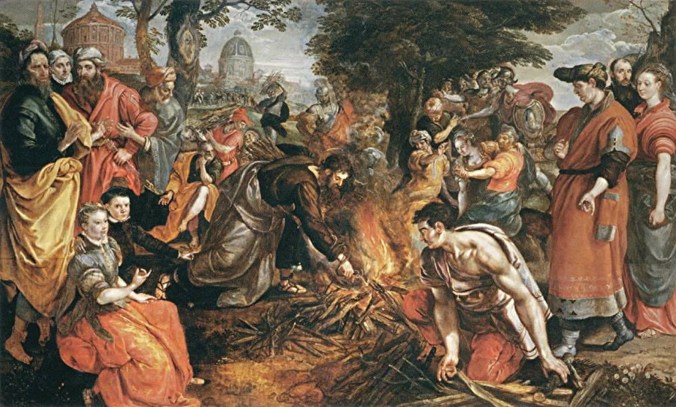
28:3 Paul gathered a pile of brushwood and, as he put it on the fire, a viper, driven out by the heat, fastened itself on his hand.

28:4 When the islanders saw the snake hanging from his hand, they said to each other, “This man must be a murderer; for though he escaped from the sea, Justice has not allowed him to live.”

28:5 But Paul shook the snake off into the fire and suffered no ill effects.

28:6 The people expected him to swell up or suddenly fall dead, but after waiting a long time and seeing nothing unusual happen to him, they changed their minds and said he was a god.

28:7 There was an estate nearby that belonged to Publius, the chief official [probably a political authority, like a governor] of the island [literally “first man of the island”]. He welcomed us [either only Paul (and Luke), Julius, and ship’s owner or the entire crew/passengers (276 people)] to his home and for three days entertained us hospitably.

28:8 His father was sick in bed, suffering from fever and dysentery. Paul went in to see him and, after prayer, placed his hands [only reference in Acts that mentions both prayer and laying on of hands] on him and healed him.

28:9 When this had happened [good news travels fast], the rest of the sick on the island came and were cured.

28:10 They honored us in many ways [a reminder that unbelievers do good deeds] and when we were ready to sail [after spending three winter months on the island (28:11)], they furnished us with the supplies we needed [islanders provided for the needs of their guests].

28:11 After three months we put out to sea in a ship that had wintered in the island. It was an Alexandrian ship with the figurehead of the twin gods Castor and Pollux.

28:12 We put in at Syracuse and stayed there three days.

28:13 From there we set sail and arrived at Rhegium. The next day the south wind came up, and on the following day we reached Puteoli.

28:14 There we found some brothers who invited us to spend a week with them. And so we came to Rome.

28:15 The brothers there had heard that we were coming, and they traveled as far as the Forum of Appius and the Three Taverns to meet us. At the sight of these men Paul thanked God and was encouraged.

28:16 When [after spending three months on the island of Malta (Acts 28:11)] we [Luke was still with Paul] got to Rome [during this two-year period Paul wrote Philippians, Ephesians, Colossians, and Philemon], Paul was allowed to live by himself [Paul considered a low-risk prisoner], with a soldier [to whom Paul apparently was chained, at least some of the time (Acts 28:20)] to guard [“a captive audience”] him.

After spending three months on the island of Malta (Acts 28:11), Paul finally arrived in Rome. He had already visited some of the most beautiful cities of his day and yet had eagerly longed to visit Rome (Rom. 1:15). His arrival in this influential city fulfilled the promise of the Lord that he would one day preach the gospel there (Acts 23:11).

Considered a low-risk prisoner, Paul was permitted to stay by himself in his own rented quarters. This arrangement gave him more freedom than a typical prisoner. However, the presence of a soldier who guarded him was a reminder that he was nevertheless a prisoner. Some of the soldiers who guarded Paul may have become believers as they listened to him share the gospel over a period of two years (see Phil. 1:13).

28:17 Three days later [after arriving in Rome] he called [since Paul could not go to the synagogue, he summoned members of the synagogue to visit him; Paul had freedom to invite people to visit him, but did not have freedom to move about city] together the leaders [capable of influencing others] of the Jews. When they had assembled, Paul said to them: “My brothers, although I have done nothing against our people or against the customs of our ancestors, I was arrested in Jerusalem and handed over to the Romans.

Three days after arriving in Rome and settling into his rented quarters, Paul was ready to meet with Jews in the city. Since he could not go to the synagogue, he summoned the leaders of the Jews to visit him, even though he did not know them. Even within limiting circumstances we can make new acquaintances, which will give us new opportunities to witness. These Jews were likely leaders of various synagogues but not an official ruling body. Paul’s purpose in meeting with them was to state his innocence of the charges against him. He summarized the events that had led to his arrest in Jerusalem and maintained his innocence of all charges of violating Jewish customs.

28:18 They [the Roman authorities (cf. 23:29; 25:25; 26:31)] examined me and wanted to release me [cf. Acts 26:32], because I was not guilty of any crime deserving death.

Paul pointed out that the Roman authorities who examined him wanted to release him. Claudius Lysias, the Roman army commander who had protected Paul from the Jews in Jerusalem, affirmed Paul’s innocence in a personal letter to Felix (Acts 23:29). Festus, Felix’s successor, also said that Paul had done nothing to deserve death (Acts 25:25). And King Agrippa and Festus again reaffirmed that Paul had not committed a capital offense (Acts 26:31).

28:19 But when the Jews objected, I was compelled to appeal to Caesar—not that I had any charge to bring against my own people [Paul was a loyal Jew; although he had been falsely accused, he did not want to retaliate; Paul did not bring counter charges against his own people].

Even though the charges against him were groundless, Paul felt no other recourse than to appeal to Caesar. However, he made it clear to the Roman Jewish leaders that he had no intention of bringing any charges against his own people. Paul was a loyal Jew and did not want to harm his own countrymen. Instead, his greatest desire for his fellow Jews was for them to come to faith in Christ (see Rom. 9:1-5).

28:20 For this reason I have asked to see you and talk with you. It is because of the hope of Israel [cf. 23:6; 24:15; 26:7; 28:20; Paul believed that Jesus was the long-awaited Messiah, the fulfillment of the Old Testament promises to Israel] that I am bound with this chain.”

Paul’s reason for calling the Roman Jewish leaders together was to explain why he was a prisoner. He was a prisoner because of the hope of Israel or because he believed that the resurrected Jesus of Nazareth was the long-awaited Messiah—the fulfillment of the Old Testament promises to Israel. Christianity was not some illegitimate or dangerous sect, but instead the ultimate fulfillment of Judaism. This conviction was the source of contention between Paul and the Jews.

28:21 They replied, “We have not received any letters from Judea concerning you, and none of the brothers who have come from there has reported or said anything bad about you.

The Roman Jews told Paul that they had not received any letters or oral reports about him from Judea. This is not surprising since Paul’s ship was probably among the first to arrive in Rome after winter. And, because of winter travel conditions, it is likely that the Jews in Jerusalem had not yet had an opportunity to send an emissary to communicate with their counterparts in Rome. Or, it is possible that they had given up hope of having Paul prosecuted since he had appealed his case to Caesar.

28:22 But we [Roman Jews] want [indicates they were receptive to what Paul had to say] to hear [because they knew little about this movement] what your views [concerning the Jesus movement] are, for we know that people everywhere [indicates that the awareness of Christianity had spread throughout the Roman world] are talking against this sect [from Gr. word hairesis from which we get our word heresy; considered an illegitimate branch of Judaism].”

While the Jewish religious leaders had not received any reports about Paul, they had heard about the Christian movement. Awareness of Christianity had spread throughout the Roman world. In fact, people everywhere were speaking either against or about this sect. The word sect translates a word from which our word heresy derives. The Jewish leaders in Rome were interested in hearing what Paul had to say about this growing movement. Like Paul, we should always take advantage of opportunities to talk to others about what we believe and why we believe it.

28:23 They arranged to meet Paul on a certain day, and came in even larger numbers to the place where he was staying [lodging; own rented quarters (cf. Acts 28:30)]. From morning till evening [shows intensity of Paul’s appeal and the depth of his concern for his own people (cf. Rom. 9:1-3; 10:1)] he explained [to lay out, to set forth] and declared to them the kingdom of God [the rule of God in the hearts of people] and tried to convince [persuade] them about Jesus [must always be the focus of our witnessing] from [cf. Acts 17:2-3; Paul’s message/witness was grounded in Scripture] the Law of Moses and from the Prophets.

On a prearranged meeting day, large numbers of Roman Jews came to meet with Paul. Though confined to a house, Paul readily made appointments with and witnessed to people who were interested enough to come to him.) Those who came were interested in hearing what Paul had to say about the Christian movement and Paul was eager to preach the gospel to them. He witnessed to his guests from dawn to dusk. Using the Old Testament prophecies and references to the Messiah, Paul tried to persuade them concerning Jesus.

Jesus must always be the focus of our witnessing. Paul explained how passages from both the Law of Moses and the Prophets had been fulfilled in the life, death, and resurrection of Jesus Christ. Every Christian witness should learn how to use the Scriptures to share with others about Jesus.

28:24 Some were convinced [but not necessarily converted] by what he said, but others would not believe [cf. parable of the sower in Matt. 13:1-8, 18-23].

The response to Paul’s teaching and testimony was mixed. As is almost always the case, some of those present were persuaded by what he said. This does not necessarily mean that they were converted, but that they found Paul’s arguments convincing. Some of these may have actually become Christians. Others, however, did not believe. The parable of the sower teaches that all people will not respond in the same way to the message of salvation (see Matt. 13:1-8,18-23).

28:25 They disagreed [out of harmony] among themselves and began to leave after Paul had made this final statement [a desperate warning]: “The Holy Spirit spoke the truth to your forefathers when he said through Isaiah the prophet [cf. Isa. 6:9-10: God told Isaiah that people would not heed his message; cf. Jesus’ use of this passage in Matt. 13:13-15, Mk. 4:12, and Lk. 8:10]:

The Jews who were persuaded by what Paul said and those who did not believe argued among themselves. Paul had a final and solemn word for these unbelieving and arguing Jews. The particular Old Testament prophecy he quoted applied specifically to them. Citing Isaiah 6:9-10, he compared them to their stubborn forefathers who had refused to hear and heed the word of God. Paul’s guests began to leave when they heard this statement, perhaps angered by the comparison. How eternally dangerous to refuse to hear and believe, yet many do just that.

28:26 “‘Go to this people and say, “You will be ever hearing [opportunity to hear] but never understanding [to comprehend]; you will be ever seeing [opportunity to see] but never perceiving.”

28:27 For this people’s heart has become calloused [to become fat, to become dull]; they hardly hear with their ears, and they have closed their eyes. Otherwise they might see with their eyes, hear with their ears, understand with their hearts and turn, and I would heal them.’

28:28 “Therefore I want you to know that God’s salvation has been sent [to send as an authoritative representative] to the Gentiles, and they will [indicates receptivity] listen!”

When the Jewish leaders in Rome rejected the gospel, Paul determined to find others—Gentiles—who would listen and respond to the gospel. He told these unbelieving Jews that God’s salvation has been sent to the Gentiles. This does not mean that the Jews were excluded from the opportunity to receive God’s salvation. Instead it emphasizes the inclusion of the Gentiles in God’s people.

The message of Acts is that God’s salvation has been sent to all peoples. When we encounter people whose hearts and minds are closed to the gospel, we can make plans to find others with open minds, which will give us other opportunities to witness.

28:29 After he said this, the Jews left, arguing vigorously among themselves.

This verse emphasizes again the fact that the Jews were arguing or debating among themselves (see Acts 28:25). The gospel challenges people to think about what they believe and in what or whom they are trusting in for their salvation. Those who left Paul’s residence continued to debate among themselves about what they had heard that day.

We should be patient and understand that these periods of debate and reflection are important in the conversion process. The Holy Spirit continues to work in the hearts and lives of those who have heard the truth of the gospel.

28:30 For two whole years [may indicate that the time period for Paul’s accusers to appear had elapsed] Paul stayed there [cf. Phil 1:12-14 re: how gospel flourished during his imprisonment] in his own rented house and welcomed all [cf. 1 Cor. 9:19-23] who came to see him [indicates many opportunities to witness].

The events recorded in the book of Acts began in Jerusalem and ended in Rome. Paul stayed two whole years under house arrest in Rome. Even though he was confined to his own rented house, Paul enjoyed a measure of freedom. He was allowed to have visitors and graciously welcomed all who came to see him—Jews as well as Gentiles. As a result, God’s work never slowed down.

During this period, Paul wrote a letter to the Philippians and told them that his imprisonment had “actually resulted in the advancement of the gospel” (Phil. 1:12). Even within limiting circumstances Paul took advantage of opportunities to witness to all the people who came his way.

28:31 Boldly [candidly, forcefully] and without hindrance [the Romans did not hinder Paul from sharing the good news; implies that the Romans (at this time) did not see Paul’s message as subversive] he preached the kingdom of God and taught [strong tradition that Paul wrote the prison epistles at this time (his first Roman imprisonment): Ephesians, Philippians, Colossians, Philemon / Paul released and wrote First Timothy and Titus / Paul arrested and wrote Second Timothy (his “last will and testament”) / Paul executed (beheaded) by Roman authorities in A.D. 67/68] about the Lord Jesus Christ.

The book of Acts ends on a triumphant note. The Romans did not hinder Paul from sharing the good news. This indicates that, at this time, they did not consider Paul’s message to be either dangerous or subversive. Sadly, that attitude on the part of the Romans would change in the coming years.

Paul had the freedom to preach with full boldness about the kingdom of God and the Lord Jesus Christ. Luke did not record what happened to Paul, only that in a period of about thirty years, the gospel had spread from Jerusalem, across Asia Minor, all the way to Rome, the center of the world.

From Rome, the gospel has continued its march across continents and oceans, touching people of every tribe, and nation, and tongue. May God use us to write the continuing story of Acts as we faithfully tell others about the Lord Jesus Christ. Amen.

Note: What to do when facing limitations.
L = Look for creative opportunities to share the gospel.
I = Invite others to meet with you.
M = Make the most of difficult situations.
I = Initiate conversations with those around you.
T = Talk freely about what Jesus has done for you.
A = Ask questions that can give you insight into what others believe.
T = Take practical steps to get to know others.
I = Inspire interest in the gospel through godly living.
O = Open the door for others to approach you.
N = Never allow obstacles to discourage you.
S = Stand firm on the truth of the gospel.

Acts 27

27:1-8 Paul sails from Caesarea to Fair Havens.
27:9-12 Paul’s warning about potential danger on the seas ignored.
27:13-20 Paul caught in a storm.

Acts 27:14
27:14 Before very long, a wind [from Gr. word from which we get English word typhoon] of hurricane force, called the “northeaster [a severe winter storm],” swept down from the island [the mountains (over 7,000 feet high) of Crete].

Acts 27:18-26
27:18 We [Luke was present with Paul] took such a violent battering from the storm that the next day they [the crew] began to throw [jettison or eject] the cargo [grain as per v. 38] overboard [desperate measure to lighten the ship; cf. Jonah 1:5].

27:19 On the third day, they threw [to hurl] the ship’s tackle [presumably included the mast and spare sails] overboard with their own hands.

27:20 When neither sun nor stars [navigational aids; without these they had no way of determining where they were] appeared for many days and the storm continued [worsened] raging [to lie upon: describes the pressure of a violent tempest], we finally [after exhausting all personal efforts] gave up all hope of being saved [rescued].

Note: Can you think of a time when you gave up hope but God rescued you?

27:21 After the men had gone a long time without food [probably lost appetite because of desperate situation and/or seasickness], Paul stood up [in the midst of the storm] before them and said: “Men, you should have taken [to obey] my advice [cf. Acts 27:10] not to sail from Crete; then you would have spared yourselves this damage and loss [Paul shared this in order to prepare them to receive his heaven-sent encouragement (vv. 22-26)].

27:22 But now I urge [to advise, to recommend] you to keep up your courage [to cheer up; word occurs three times in this chapter (see also vv. 25, 36)], because [reason] not one of you [276 people on board as per v. 37] will be lost; only the ship will be destroyed.

Note: How do you keep up your courage in times of crisis? How do you encourage others in times of crisis?

27:23 Last night an angel of the God whose I am [stresses Paul’s intimate relationship with God; Paul belonged to God] and whom I serve [stresses Paul’s dedication to God; Paul was faithful to his divine calling] stood beside me

27:24 and said, ‘Do not [command to stop an action in progress] be afraid, Paul. You must stand trial before Caesar [cf. Acts 23:11 re: the Lord’s earlier disclosure that Paul would bear witness in Rome; the storm would not frustrate God’s purpose for Paul]; and God has graciously given [to grant as a present] you the lives of all who sail with you.’

27:25 So keep up your courage, men, for I have faith [unwavering confidence] in God that it will happen just as he [God] told me [a contrary view never entered Paul’s mind].

27:26 Nevertheless, we must [certainty] run aground on some island.”

27:27-32 In the midst of the storm at sea.

Acts 27:33-36
27:33 Just before dawn Paul urged [repeatedly encouraged] them all to eat. “For the last fourteen days,” he said, “you have been in constant suspense and have gone without food — you haven’t eaten anything.

27:34 Now I urge you to take some food. You need it to survive [while they could not save the ship, Paul urged them to take practical measures to insure their own survival]. Not one of you will lose a single hair from his head [stresses God’s providential care (cf. Matt. 10:30); cf. Paul’s reassuring words in v. 22; v. 34 was additional assurance].”

27:35 After he said this, he took some bread and gave thanks [a normal Jewish custom before meals] to God in front of [served as a reminder of the God who had assured their safety; Paul’s example enhanced his witness] them all [many pagans]. Then he broke it and began to eat.

27:36 They were all encouraged [Paul’s confident faith lifted the spirits of those aboard the storm-tossed ship] and ate some food themselves.

Acts 27:42-44


27:42 The soldiers [responsible for safe delivery of prisoners; failure to carry out responsibility meant death (cf. Acts 12:19; 16:27)] planned to kill the prisoners to prevent any of them from swimming away and escaping.

27:43 But the centurion [Julius] wanted to spare Paul’s life and kept [to hinder] them [the soldiers] from carrying out their plan. He [centurion had the authority to make this decision] ordered those who could swim to jump overboard first and get to land.

27:44 The rest were to get there on planks or on pieces of the ship. In this way [swimming or holding on to planks; cf. Acts 27:43-44b] everyone [276 people as per v. 37] reached land [island of Malta] in safety [thus fulfilling Paul’s prophetic utterance in Acts 27:22].

Acts 26

25:1-7 Paul charged before Festus (successor of Felix: Acts 24:27).
25:8-12 Paul’s response and his appeal to Festus to take his case to Caesar.
25:13-27 Festus consults with Agrippa (visiting in Caesarea) re: Paul’s case.
26:1-23 Paul’s testimony.

Acts 26:15-23
26:15 “Then I asked, ‘Who are you, Lord?’ “‘I am Jesus, whom you are persecuting [to persecute Jesus’ disciples was to persecute Jesus (cf. Matt. 25:40)],’ the Lord replied.

26:16 ‘Now get up [cf. commissioning of Ezekiel (Ezek. 2:1,3) and Jeremiah (Jer. 1:7-8)] and stand on your feet. I have appeared to you to appoint [a divine appointment] you as a servant [under-rower: lowest echelon of rowers on a slave galley; word also used in 1 Cor. 4:1] and as a witness [from root word for “martyr”] of what you have seen of me [refers to Paul’s vision of Christ on the Damascus road] and what I will show you [Jesus’ subsequent appearances to Paul (cf. Acts 18:9; 22:17-21; 23:11].

26:17 I will rescue [to take out, to choose] you from [divine protection] your own people [Jews] and from the Gentiles. I am sending [as an authoritative representative; derived from same Greek root that means “apostle”] you to them [Gentiles]

26:18 to [Paul’s ministry objectives] [1] open their eyes [spiritually] and [2] turn them from darkness [spiritual] to light [spiritual], and [3] from the power of Satan to God [cf. Col. 1:13-14], so that [results of salvation] [1] they may receive forgiveness of sins and [2] a place among those who are sanctified by faith in me [cf. Eph. 2:19].’

26:19 “So then, King Agrippa [cf. what Ananias said about Paul in Acts 9:15; others in the room were listening to Paul as well (cf. 26:30)], I was not disobedient [Paul obeyed and followed the call of God] to the vision from heaven.

26:20 [Paul crossed geographical boundaries to share gospel] First to those in Damascus [Acts 9:8-25], then to those in Jerusalem and in all Judea [Acts 9:26-29], and to the Gentiles [Paul crossed racial barriers to share the gospel] also, I preached that they should repent [to change one’s mind about sin and about God] and turn to God and prove [true repentance evident in changed life] their repentance by their deeds [do good deeds because we are saved, not to obtain salvation].

26:21 That is why the Jews seized [to lay hands on] me in the temple courts and tried to kill me [cf. Acts 21:31; 23:12-15].

26:22 But I have had God’s help [aid; cf. Acts 26:17] to this very day, and so I stand [emphasizes Paul’s stability and fidelity] here and testify [witness] to small and great alike [Paul crossed social barriers to share the gospel; gospel for all people]. I am saying nothing beyond what the prophets [e.g. Isa. 53] and Moses [the law] said would happen [Paul’s message in harmony with the law and the prophets]

Paul spoke in his own defense before King Agrippa and also used the opportunity to share his personal testimony. Like Paul, every Christian should be prepared to share his or her personal testimony with others. Paul saw himself as one in debt or under obligation to all who do not know Christ (see Rom. 1:14), whether small or great. He was willing to cross geographical and social barriers because he understood that the gospel is for all peoples. And, Paul affirmed that his message was securely anchored in what the prophets and Moses said would take place.

26:23 that the Christ would suffer [difficult for Jews to accept suffering Messiah] and, as the first to rise from the dead, would proclaim light to his own people and to the Gentiles [emphasizes that the gospel is for all people].”

The first-century Jews did not expect the Messiah to suffer. However, the prophets and Moses said that the Messiah must suffer. The suffering of Jesus on the cross was indeed so great that it was beyond description. In fact, a new word was invented to describe the kind of suffering experienced during crucifixion—the word excruciating. This word literally means “out of the cross.”

Jesus died on the cross, was buried, and was the first to rise from the dead never to die again. As the resurrected and living Lord He proclaimed light to Jews and Gentiles alike—a reminder that the gospel is for all peoples.

26:24 At this point Festus interrupted Paul’s defense. “You are out of your mind [cf. 2 Cor. 5:13; Mk. 3:20-21], Paul!” he shouted. “Your great learning is driving you insane [a way of saying that Paul was out of touch with the real world; cf. 1 Cor. 1:18-25].”

Confused by all of the talk about Moses, the Messiah, and a resurrected man, Festus shouted, You’re out of your mind, Paul! Festus had earlier told Agrippa about this “dead man whom Paul claimed to be alive” (Acts 25:19). Perplexed, Festus concluded that Paul had spent so much time with his head buried in Old Testament scrolls that he had lost touch with reality. After all, any sensible person knows that people don’t rise from the dead.

26:25 “I am not insane, most excellent Festus,” Paul replied [Paul’s courteous reply left the door open for witnessing to the governor in the future]. “What I am saying is true and reasonable.

When Festus ridiculed Paul and what he was saying about Jesus, the apostle rejected the governor’s statement but in a respectful manner, leaving the door open for witnessing in the future. Paul courteously replied to the governor that he was not out of his mind. He asserted that his testimony was true and reasonable. In fact, the words he was speaking had eternal implications for those listening.

Festus knew that Paul was not mad. And, as governor, he would not have sent a madman to be tried before Caesar. It is possible that his nervous outburst indicates he was under conviction. When people ridicule us, our efforts to witness to them, or the gospel, we still need to show them respect so they will still be open to further witnessing.

26:26 The king is familiar with these things [the basic facts of Paul’s message], and I can speak freely [openly, boldly] to him. I am convinced that none of this has escaped his notice, because it was not done in a corner [this was a common Greek idiom in Paul’s day; Christians openly proclaimed the gospel; Christianity was a very public movement].

Paul did not argue with Festus. Instead, he turned his attention back to Agrippa to whom he had been speaking boldly. The Jewish king knew about these matters, that is, the basic facts of Paul’s message. The Christian movement and its message were not something done in a secluded corner or in secret. Christianity had been fully public since the day of Pentecost when three thousand people converted to faith in Christ in Jerusalem.

Although Christianity had started small, it was no longer a small movement but rather one that was spreading throughout the Roman Empire. Paul’s own ministry had been done in public and subject to scrutiny. Surely these things had not escaped Agrippa’s notice.

26:27 [Paul put Agrippa on the spot and pressed for a decision] King Agrippa, do you believe the prophets [who had foretold Christ’s coming]? I know you do.”

Paul, becoming increasingly bolder in his witness, began to press for a decision. Addressing the king, he asked, do you believe the prophets? Before Agrippa could answer the question, Paul answered it for him: I know you believe the prophets. Agrippa did know what the prophets had written about the messiah. He could have corroborated all that Paul had said. Paul’s question now forced Agrippa to take a stand. If he believed the prophets and what they had written about the messiah, then he must either affirm or deny that Jesus is the one about whom the prophets wrote.

26:28 Then Agrippa [perhaps felt uncomfortable] said to Paul, “Do you think that in such a short time [rapidly] you can persuade me to be a Christian?”

Agrippa found himself in an awkward position. Denying the prophets would have put him at odds with his Jewish constituency. Affirming his belief in the prophets would have forced Agrippa to deal with Paul’s claims concerning Jesus. So, instead of answering Paul’s question, Agrippa, like a seasoned politician, evaded it by asking another question.

People under conviction often find ways to resist the truth. Like Festus, Agrippa heard the gospel and yet stopped short of making any decision concerning Christ. His reply indicates he would not be as easily persuaded to become a Christian as Paul’s other converts had been. Sadly, the king missed this opportunity to gain something he would never lose—eternal life.

26:29 Paul replied, “Short time or long [the important thing was to make a decision for Christ] — I pray God that not only you but all who are listening to me today may become what I am [free in Christ; a Christian], except for these chains [perhaps Paul lifted his manacled hands; messenger was bound but message could never be bound].”

When Agrippa rejected Paul’s witness and refused to become a Christian, Paul continued by expressing concern for the king. Paul politely replied that whether easily or with difficulty, the most important thing was to eventually become a Christian believer. And, Paul’s concern was not only for the king, but for all the people who were present in the room that day.

The only thing that Paul did not wish for those listening to him was that they end up in chains. When people reject our witness and refuse to become Christians, we are to express genuine concern for them and do nothing that will make further conversation impossible.

26:30 The king rose [thus ending the dialogue; shrugged off opportunity to receive Christ], and with him the governor [Festus] and Bernice and those sitting with them.

Agrippa ended the dialogue. Perhaps he did so because he was uncomfortable or under conviction. He had certainly heard enough to advise Festus about Paul’s case. Sadly, rather than making a decision concerning Christ, the king and all those in the room got up and walked away. Ironically, by refusing to make a decision concerning Christ, they faced a sentence greater than any sentence Paul would ever face.

26:31 They left the room, and while talking with one another [Festus and Agrippa], they said, “This man is not doing anything that deserves death or imprisonment.”

When they had left the room, Festus and Agrippa, the two highest ranking officials, talked with each other. They concluded that Paul had not violated any Jewish laws worthy of either death or chains. Paul had already been declared innocent by the Pharisees (Acts 23:9), by Claudius Lysias (Acts 23:29), and by Festus (Acts 25:25).

Only Paul’s enemies continued to insist that he had done something worthy of death. Soon, Paul would sail for Rome and away from his murderous enemies. His appearance before governors and kings was a fulfillment of Jesus’ words (Luke 21:12). Paul would continue to faithfully share the gospel with people from all walks of life until the day of his death.

26:32 Agrippa said to Festus, “This man could have been set free if he had not appealed to Caesar.”

Note: Sharing the gospel with secular people.
S = Secular people have little or no interest in the gospel but need to hear it.
E = Every person deserves an opportunity to hear a clear presentation of the gospel.
C = Communicate the gospel in terms secular people can understand.
U = Use your personal testimony to explain what Christ has done for you.
L = Love others regardless of how they respond to your witness.
A = Always leave the door open to future witnessing opportunities.
R = Refuse to give up on the salvation of any person.

Acts 24

24:1 Five days later [from the time of Paul’s arrest in the temple; Paul’s accusers arrived from Jerusalem] the high priest Ananias [cf. Acts 23:1-5] went down to Caesarea with some of the elders [perhaps senior members of Sanhedrin] and a lawyer [orator, speaker in court] named Tertullus [common Greek name; a Jew acquainted with Roman and Jewish law], and they brought their charges [to bring an accusation, to indict] against Paul before the governor [Felix].

24:2-9 The Jewish charges against Paul presented by Tertullus.

Acts 24:10-16
24:10 When the governor motioned [to wave, to motion with the hand] for him to speak, Paul replied: “I know that for a number of years you have been a judge over this nation [Felix had some experience in handling such matters]; so I gladly [confidently; with good courage] make my defense.

24:11 You can easily verify that no more than twelve days ago [certainly not enough time for Paul to have done all he was accused of] I went up to Jerusalem to worship [not to stir up trouble].

24:12 My accusers did not find me arguing [to discuss, to teach, to dispute] with anyone at the temple, or stirring up a crowd [dissension; sedition, which was against Roman law] in the synagogues or anywhere else in the city.

24:13 And they [Paul’s Jewish enemies] cannot prove [to substantiate, to put evidence alongside of argument] to you the charges they are now making against me.

24:14 However, I admit [confess] that I worship the God of our fathers [Paul had not forsaken the faith of his fathers, rather he saw Christianity as the fulfillment of Israel’s faith] as a follower of the Way [term refers to Christianity], which they [erroneously] call a sect [heresy; faction; Tertullus characterized Christianity as a sect of Judaism (Acts 24:5)]. I believe everything that agrees with the Law and that is written in the Prophets [OT bears witness to Jesus Christ; Paul saw Christianity as the fulfillment of all “that is written in the Prophets”],

24:15 and I have the same hope in God as these men, that there will be a resurrection [only Pharisees believed in resurrection, Sadducees did not] of both the righteous and the wicked [both would face God’s judgment].

24:16 So [therefore, in light of Paul’s belief in the resurrection and that he would one day stand before God] I strive [to exercise, to take pains, to drill; word has a note of moral strictness about it; cf. 1 Cor. 9:24-27] always to keep my conscience clear [without offense, unharmed, uninjured; Paul did not do or say anything for which his conscience would condemn him later] before God and man [integrity is vital to our witness].

24:17-21 Paul continued defense/challenged accusers to present charge against him.

Acts 24:22-27
24:22 Then Felix [the Roman governor in Caesarea], who was well acquainted [perhaps more than the Jewish leaders gave him credit for] with the Way, adjourned the proceedings. “When Lysias [the commander who had sent Paul to Caesarea (cf. Acts 23:23-26); he had already written a letter re: incident (cf. Acts 23:25-30)] the commander comes,” he said, “I will decide [to examine, to determine] your case.”

Felix, the governor of Judea, presided over the case against Paul. Felix was married to Drusilla, a Jewish woman who likely kept him informed about what was happening among the Jews.

As a Roman official, Felix was accurately informed about the Way, or knew about the Christians. He probably knew that the charges against Paul were without merit and that the Nazarenes (Acts 24:5) were not troublesome revolutionaries. But, instead of acquitting Paul and risking trouble with the Jews, Felix adjourned the proceedings.

Felix decided to postpone judgment until Lysias personally arrived in Caesarea. However, Lysias, the commander who had sent Paul to Felix, had already submitted a written report of the incident that had occurred in Jerusalem (see Acts 23:23-26).

24:23 He ordered the centurion to keep Paul under guard [protective custody] but to give him some freedom [indulgence, privilege] and permit his friends to take care of his needs.

There is no indication that Felix ever sent for Lysias. It was easier for Felix to postpone the matter indefinitely than to pass judgment. Had Lysias come, Felix would have had to deal with the whole troubling matter. Instead, he placed Paul under house arrest and under the watchful guard of Roman soldiers. Perhaps motivated by the fact that Paul was a Roman citizen, Felix gave his low-risk prisoner a measured amount of freedom. He allowed Paul’s Christian friends to visit him and care for his needs.

24:24 Several days later Felix came with his wife Drusilla [Felix’s third wife; daughter of Herod Agrippa I (who had James killed as per Acts 12:1-2) and a sister of Herod Agrippa II (cf. Acts 25); left her first husband to marry Felix], who was a Jewess. He sent for Paul and listened to him as he spoke about faith in Christ Jesus [Paul took advantage of every opportunity to share Christ].

Several days after the trial, Felix and his wife Drusilla expressed an interest in meeting with Paul. Drusilla was the daughter of Herod Agrippa I, the man responsible for the execution of the apostle James (see Acts 12:1-2). She had left her first husband to marry Felix. Because she was Jewish, her marriage to Felix, a Gentile, was contrary to the Jewish law. Drusilla may have been the one most interested in meeting with Paul. Felix seems to have had other motives for doing so (see verse 26).

Whatever the reason behind their desire to visit with the great apostle, Paul took advantage of the opportunity to speak with them about faith in Jesus Christ. We too must be prepared for unexpected opportunities to share the gospel with others.

24:25 As Paul discoursed on righteousness [right behavior that honors God], self-control [the control of the passions and desires, often used regarding the controlling of sexual desires; resisting temptation] and the judgment to come, Felix was afraid [became terrified; struck with fear and trembling] and said, “That’s enough for now! You may leave. When I find it convenient [have spare time; procrastination is the thief of souls (cf. 2 Cor. 6:2)], I will send for you.”

Paul geared his message specifically for his private audience. He spoke to Felix and Drusilla about righteousness, or measuring up to God’s standards. Failing to measure up to God’s standards is the basis for the judgment to come. Paul also addressed the topic of self-control, something that Felix and Drusilla both lacked. Drusilla had divorced her husband to become Felix’s third wife and Felix had a reputation as a self-serving official who hesitated at nothing to further his ambitions.

Convicted by Paul’s message, Felix became afraid. However, instead of repenting and placing his faith in Christ, he dismissed Paul. Felix was interested in Paul’s message until the point it touched the sin in his own life. Sadly, we have no record that Felix ever made matters right between himself and God. Someone wisely noted that procrastination is the thief of souls. Today is the most convenient time for any sinner to repent (see 2 Cor. 6:2).

24:26 At the same time he was hoping that Paul would offer him a bribe, so [because of financial expectations] he sent for him frequently and talked with him.

Even when Felix declared he wasn’t ready to become a Christian, Paul kept talking to him at every opportunity. When people tell us they are going to wait about becoming a Christian, we are to keep talking to them about their relationship with God at every opportunity. Felix sent for Paul quite often over the two-year period of Paul’s imprisonment.

Sadly, this is not an indication that Felix was interested in spiritual matters. Instead, Felix was motivated by greed and the hope of getting a bribe from Paul, presumably to buy his freedom. Although bribes were against Roman law, bribe-taking was common throughout the empire.

24:27 When two years had passed, Felix [failed personally, officially, spiritually] was succeeded by Porcius Festus, but because Felix wanted to grant a favor to the Jews [Felix did the wrong thing because he was only interested in being politically correct], he left Paul in prison.

Acts 22

Acts 22:1-21 [cf. Paul’s testimony in Acts 9 and 26]

22:1 “Brothers and fathers, listen now to my defense.”

22:2 When they heard him speak to them in Aramaic [generally, Jews born and raised outside of Palestine could not speak Greek or Hebrew, so Paul spoke to his audience in Aramaic; this gave weight to Paul’s Jewish credentials], they became very quiet. Then Paul said:

22:3 [Paul’s Jewish credentials] “I am a Jew [cf. 2 Cor. 11:22; Phil. 3:5; Paul identified with his listeners], born in Tarsus [city on southeastern coast of Asia Minor; city had a university] of Cilicia, but brought up [nursed, nourished] in this city [implication is that Paul was sent to Jerusalem while still young, perhaps 13 or 14 years old (cf. Acts 26:4)]. Under Gamaliel [highly regarded Pharisee and member of the Sanhedrin; considered the best Jewish teacher of his day; Paul became a Pharisee (Acts 23:6) like his teacher] I was thoroughly [strictness, exactness] trained [instructed] in the law [written OT law as well as oral interpretations (often referred to as the traditions of the fathers)] of our fathers and was just as zealous [Paul actually was more zealous: cf. Gal. 1:14; Phil. 3:6] for God as any of you [those who had accused Paul of violating Jewish law as per Acts 21:28] are today.

22:4 I persecuted [to pursue, to hunt an animal; cf. Acts 9:1] the followers of this Way [earliest self-designation of the first believers in Jesus at Jerusalem; see Jn. 14:6] to their death [actual death as per Acts 26:10], arresting both men and women [shows how far Paul went in his zeal for Judaism] and throwing them into prison,

22:5 as also the high priest and all the Council can testify [details of Paul’s testimony could be verified]. I even obtained letters from them to their brothers in Damascus, and went there to bring these people as prisoners to Jerusalem to be punished.

22:6 “About noon as I came near Damascus, suddenly a bright light [brighter than the midday sun] from heaven flashed around me.

22:7 I fell to the ground and heard a voice say to me [words that pierced his heart], ‘Saul! Saul [Paul’s Jewish name]! Why do you persecute me [a challenge to Paul’s misdirected way of life; forced Paul to reexamine his direction in life]?’

Note: This verse contains one of five double expressions in the New Testament. Each double expression reveals something about the concern of Jesus.
• “Saul, Saul” expresses His concern for the sinner (Acts 22:7).
• “Simon, Simon” expresses His concern for the saint (Lk. 22:31).
• “Martha, Martha” expresses His concern for our service (Lk. 10:41).
• “O Jerusalem, Jerusalem” expresses His concern for society (Matt. 23:37).
• “My God, my God”“ expresses His concern for sin (Matt. 27:46).

22:8 “‘Who are you, Lord?’ I asked. “‘I am Jesus of Nazareth [the Son of God, not the impostor that Paul had imagined Him to be], whom you are persecuting [to persecute the church / Jesus’ followers is to persecute Him],’ he replied.

22:9 My companions saw the light, but they did not understand the voice [heard the sound, but did not understand the message] of him who was speaking to me [the experience was personal yet could be confirmed by others].

22:10 “‘What shall I do, Lord?’ I asked [submitting to His authority]. “‘Get up,’ the Lord said, ‘and go into Damascus. There you will be told all that you have been assigned to do [which would be different than Paul’s original intentions].’”

22:11 My companions led me by the hand into Damascus [where he fasted for three days (Acts 9:9)], because the brilliance of the light had blinded me.

22:12 “A man named Ananias [a Jewish Christian who lived in Damascus] came to see me [three days after the Damascus Road experience]. He was a devout [pious, godly] observer of the law [Jew; Paul introduced to Christianity by a devout Jew, not a lawbreaker] and highly respected by all the Jews living there [Damascus].

22:13 He stood beside me and said [cf. Acts 9:17], ‘Brother [first time Paul addressed as brother] Saul, receive your sight!’ And at that very moment [“immediately” (Acts 9:18)] I was able to see him.

22:14 “Then he said: ‘The God of our fathers has chosen you to know his will and to see the Righteous One [cf. Acts 7:52; Jesus the Messiah] and to hear words from his mouth.

22:15 You will be his witness to all men [including Gentiles] of what you have seen and heard.

22:16 And now what are you waiting for [emphasizes that Paul needed to act]? Get up, be [submit yourself to] baptized [pictured the change that had already taken place in Paul’s life] and wash your sins away, calling [“having previously called upon His Name” (Wuest); “The calling on the Lord effects the washing away of sin.” (Rienecker/Rogers)] on his name [cf. Acts 2:21; 4:12].’

22:17 “When I returned to Jerusalem [after his conversion (cf. Acts 9:26-30)] and was praying at the temple [indication that he had not renounced his Jewish heritage], I fell into a trance [received a vision from God]

22:18 and saw the Lord speaking. ‘Quick [urgency]!’ he said [a warning; a command] to me. ‘Leave Jerusalem immediately, because they [cf. Acts 9:29 re: Greek-speaking Jews in Jerusalem who tried to kill Paul] will not [regardless of how it is presented] accept your testimony about me [Christ].’

22:19 [Paul did not want to leave Jerusalem] “‘Lord,’ I replied, ‘these men know [Paul’s reputation as a persecutor of Christians] that I went from one synagogue to another to imprison and beat those who believe in you.

22:20 [cf. 22:4] And when the blood of your martyr Stephen was shed [indicates that the stoning of Stephen still weighed heavily on Paul’s mind], I stood there giving my approval [cf. Acts 8:1] and guarding the clothes of those who were killing him.’

22:21 “Then the Lord [had other plans for Paul] said to me, ‘Go; I will send you far away to the Gentiles. [cf. Gal. 1:11-12]’”