Daniel 1

1:1 In the third year of the reign [605 BC] of Jehoiakim [a wicked king whose reign was characterized by dishonesty, oppression, injustice (2 Kings 23:36-37; Jer. 36)] king of Judah, Nebuchadnezzar king of Babylon came to Jerusalem and besieged it [2 Kings 24:1-4].

1:2 And the Lord [Adonai: title that magnifies God’s sovereignty] delivered [read Deut. 28:36-37,49-68 re: warnings that captivity would be one of the consequences of disobeying God] Jehoiakim king of Judah into his hand, along with some of the articles from the temple of God. These he carried off to the temple of his god [primary Babylonian god was Marduk, also called Bel] in Babylonia and put in the treasure house of his god [Nebuchadnezzar presumed his god had given him victory over God’s people].

Note: Have you recently experienced events in your life that remind you that you are not in control?

1:3 Then the king ordered Ashpenaz, chief of his court officials, to bring in some of the Israelites from [Babylonian practice was to deport the best and brightest from conquered nation to reduce/eliminate possibility of defeated nation rebuilding and posing a new threat] the royal family and the nobility—

Note: How do you think you would respond if you were exiled from your homeland? Do you think you would remain committed to your religious and moral convictions?

1:4 young [perhaps teenagers] men without any physical defect [cf. Lev. 21:17-23 re: requirement that priests have no physical defects], handsome, showing aptitude for every kind of learning, well informed [young men who had received the best education available in Israelite society], quick to understand, and qualified to serve in the king’s palace. He was to teach them the language [Babylonians spoke a form of the Akkadian language now called Neo-Babylonian] and literature [included Babylonian philosophy, religion, magic, astrology, science, medicine] of the Babylonians [Chaldeans (KJV)].

1:5 The king assigned them a daily amount of food [could be translated “rich food”] and wine from the king’s table [the best food available; considered a high honor to eat from king’s table]. They were to be trained for three years, and after that they were to enter the king’s service.

1:6 Among these were some from Judah: Daniel [name means “God is my Judge”], Hananiah [name means “The Lord is gracious”], Mishael [name means “Who is what God is”] and Azariah [name means “The Lord has/will help”].

1:7 The chief official gave them new names [perhaps to make it easier for the young men to be assimilated into the Babylonian culture; perhaps because these names were easier for the Babylonians to pronounce; note that new names included a reference to Babylonian gods]: to Daniel, the name Belteshazzar [cf. Dan. 4:8; may mean either “Lady/wife of Marduk”]; to Hananiah, Shadrach [means “I am very fearful (of God)”]; to Mishael, Meshach [means “who is what (Aku) is”]; and to Azariah, Abednego [means “servant of the Shining One [or of Nego, a Babylonian deity)].
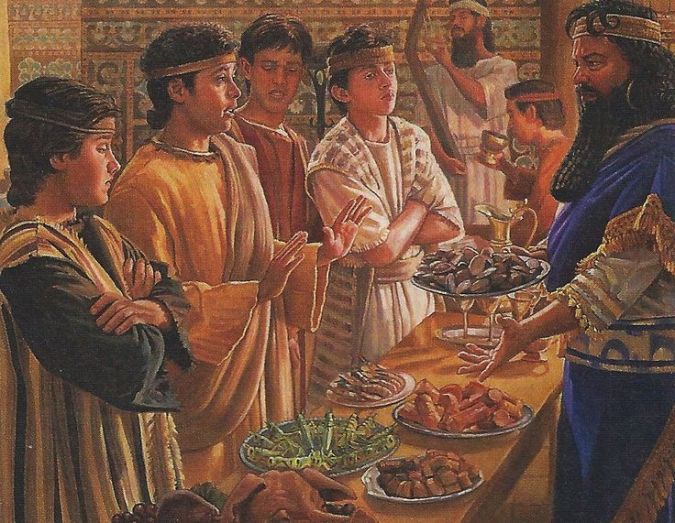
1:8 But Daniel resolved [took a firm stance on what he considered to be moral issue based on God’s Word] not to defile [contaminate] himself with the royal food and wine, and he asked the chief official for permission not to defile [first portion of food and wine had been offered to pagan gods (Marduk, Nebo, Ishtar) in their honor (cf. 1 Cor. 10:28); food most likely unclean according to Jewish dietary rules (cf. Lev. 11; 17:13-14; Deut. 14:3-21)] himself this way.

Note: When have you recently practiced self-control? In what areas of life do you struggle most with self-control and temptation to moral compromise?

On what recent occasion have you felt a tension between your Christian values and our culture’s values? What choice did you make?

How might Daniel’s life have been easier if he had just eaten the food given to him?

Do you think it is easier to demonstrate self-control when faced with temptation if you have thought through your convictions long before the temptation arises? Why or why not?

1:9 Now God [God had not forsaken Daniel in this foreign land] had caused the official to show favor and sympathy to Daniel,

1:10 but the official told Daniel, “I am afraid of my lord the king, who has assigned your food and drink. Why should he see you looking worse than the other young men your age? The king would then have my head because of you.”

1:11 Daniel then said [Daniel went through proper channels and respected those in authority] to the guard [Melzar (KJV) may have been man’s name but more likely described his function] whom the chief official had appointed over Daniel, Hananiah, Mishael and Azariah,

1:12 “Please test your servants for ten days: Give us nothing but vegetables [something grown from seed (could include vegetables, grains, fruits, bread made from grains)] to eat and water to drink.

1:13 Then [at the end of ten days] compare our appearance with that of the young men who eat the royal food, and treat your servants in accordance with what you see [Daniel left the decision with the guard].”

1:14 So he agreed to this [he listened to them] and tested them for ten days.

1:15 At the end of the ten days they looked healthier [literally “fatter of flesh”] and better nourished than any of the young men who ate the royal food.

1:16 So the guard took away their choice food and the wine they were to drink and gave them vegetables instead.

1:17 To these four young men God gave knowledge and understanding of all kinds of literature and learning. And Daniel could understand visions and dreams of all kinds.

1:18 At the end of the time set by the king to bring them in, the chief official presented them to Nebuchadnezzar.

1:19 The king talked with them, and he found none equal to Daniel, Hananiah, Mishael and Azariah; so they entered the king’s service.

1:20 In every matter of wisdom and understanding about which the king questioned them, he found them ten times better than all the magicians and enchanters in his whole kingdom.

1:21 And Daniel remained there until the first year of King Cyrus.

Hosea 6

Hosea 6:1-6


6:1 “Come, let us return [indicates true repentance; involved change of attitudes and a turning away from false gods and sinful ways] to the LORD. He has torn [done by God in love; done redemptively and with the hope that they would recognize and turn from their sinful ways] us to pieces [like a devouring lion (cf. 5:14); describes the damage caused by their sins] but he will heal [restoration to God’s favor and blessings; forgiveness] us; he has injured [see comment on “torn”] us but he will bind up our wounds.

6:2 After two days [figure for a short period of time] he will revive [to bring to life] us; on the third day [figure for a short period of time] he will restore [to raise up; to establish] us, that [result of restoration] we may live in his presence.

6:3 Let us acknowledge [to know Him personally (requires personal fellowship with God)] the LORD; let us press on [determination; overcome obstacles that kept them from God] to acknowledge him. As surely as the sun rises [and chases away the night], he will appear; he will come to us like the winter rains, like the spring rains that water the earth.”

6:4 “What can I do with you, Ephraim [Israel; Northern Kingdom; worshiped image of golden calf]? What can I do with you, Judah [Southern Kingdom]? Your love [word for covenant loyalty; refers to highest and best of which people are capable] is like the morning mist [love for and commitment to God was shallow, temporary, meaningless], like the early dew that disappears [“mist” and “dew” without substance or the ability to last].

6:5 Therefore [because they failed to respond to God’s tender invitation (6:1-3); introduces steps taken by God to turn people back to covenant loyalty] I cut [“cut to fashion” refers to punitive and redemptive judgments] you in pieces with my prophets, I killed you with the words [sharp and painful] of my mouth; my judgments flashed like lightning [brilliant, illuminating, penetrating] upon you.

6:6 For [instead of the insincere and hypocritical worship they offered the Lord] I desire mercy [same word as love in 6:4], not sacrifice [“sacrifice” and “burnt offerings” not ends in themselves], and acknowledgment of God [to know Him personally] rather than burnt offerings.

Practical Consideration: Shallow repentance does not result in deep changes.
Israel’s shallow repentance did not result in deep changes. Israel was only interested in repentance that would remove the inconvenience of judgment in order to return to the sins that had led to judgment. God is not impressed with our words or our sacrifices. He is interested in our hearts and the sincerity of our repentance. True repentance leads to deep changes in the lives of people.

Hosea 5

5:1 “Hear this, you priests [would experience judgment because of their failure to lead the people in the ways of God; their failure was in large measure the reason why the nation was at an all-time spiritual and moral low]! Pay attention, you Israelites [particularly the free, landholding citizens or the elders/representatives of the people; would be held accountable for their failure to heed the Word of God and live according to the terms of the covenant]! Listen, O royal house [politicians and rulers would be held accountable because of their failure to lead the people in a manner consistent with God’s law]! This judgment is against you: [false worship] You have been a snare at Mizpah [city located about seven miles north of Jerusalem; became a place where false gods were worshiped], a net spread out on Tabor [mountain that overlooked the Jezreel Valley; Israelites built a high place there to worship false gods].

Practical Consideration: Leaders without high standards lead people into low places.

Israel’s spiritual leaders did not have high and godly standards. They were only interested in using their positions for personal gain and the pursuit of sensual pleasures. As a result, those who looked to them for guidance were led away from a true knowledge of God and into the depths of sin. Religious leadership carries great responsibility. God will hold leaders accountable for how they use their influence.

5:2 The rebels are deep in slaughter [murder and other vicious crimes]. I will [judgment was inevitable] discipline [indicates coming judgment had a redemptive purpose] all [none would escape the coming judgment] of them.

5:3 I know all about Ephraim [refers to Northern Kingdom]; Israel is not hidden from me. Ephraim, you have now turned to prostitution [judgment would come because Israel had played the harlot; sexual immorality associated with fertility cults]; Israel is corrupt.

5:4 “Their deeds [refers to the cultic/idolatrous activities associated with Baal worship] do not permit them [emphasized addictive power of sin] to return to their God [people were so steeped in sin they had lost the capacity “to return to their God”]. A spirit of prostitution is in their heart; they do not acknowledge the LORD.

5:5 Israel’s arrogance [pride became the cause of Israel’s problems and stumblings] testifies against them; the Israelites, even Ephraim, stumble in their sin; Judah [Southern Kingdom] also stumbles with them.

5:6 When they go [to worship] with their flocks and herds [used for offerings] to seek the LORD, they will not find him [Israel’s worship was superficial and would not lead the people to find God]; he has withdrawn himself from them [a consequence of their sin].

5:7 They are unfaithful to the LORD; they give birth to illegitimate [literally and spiritually] children [evidence of this faithlessness was “illegitimate children” produced by Israel’s adulterous spiritual activities; these “illegitimate children” knew nothing about the true God of Israel’s history because they grew up in a nation whose worship was perverted and an abomination to God]. Now their New Moon festivals [observed at the beginning of every lunar month (cf. Isa. 1:13)] will devour them and their fields.

5:8 “Sound the trumpet in Gibeah, the horn in Ramah. Raise the battle cry in Beth Aven; lead on, O Benjamin.

5:9 Ephraim will be laid waste on the day of reckoning. Among the tribes of Israel I proclaim what is certain.

5:10 Judah’s leaders are like those who move boundary stones. I will pour out my wrath on them like a flood of water.

5:11 Ephraim is oppressed, trampled in judgment, intent on pursuing idols.

5:12 I am like a moth to Ephraim, like rot to the people of Judah.

5:13 “When Ephraim [refers to Northern Kingdom] saw his sickness [God was putting pressure on Israel through the growing military might of the surrounding nations], and Judah [the Southern Kingdom] his sores, then Ephraim [cf. King Menahem (2 Kings 15:19-21); King Ahaz (2 Kings 16:5-9); King Hoshea (2 Kings 17:3)] turned to Assyria [they failed to turn to God; committed apostasy by turning to Assyria], and sent to the great king for help. But he is not able to cure you, not able to heal your sores.

5:14 For I [God Himself] will be like a lion [a lion stalking prey] to Ephraim [fell to the Assyrians in 722 BC], like a great lion to Judah [fell to the Babylonians in 586 BC]. I will tear them to pieces and go away; I will carry them off, with no one to rescue them.

5:15 Then I [like a lion] will go [leaving the people in the hands of their foe] back to my place [lion’s lair] until [after an undetermined period of time] they admit their guilt. And [as a result of their suffering] they will seek my face [God used severe judgment to lead His people to repentance and to see their spiritual need and return to Him]; in their misery they will earnestly seek me.”

Hosea 4

Hosea 4:1-9
4:1 [God summoned the nation to court and outlined His case against the inhabitants of the land] Hear the word of the LORD, you Israelites, because the LORD has a charge to bring against you who live in the land: [sins of omission] “There is no faithfulness [the people had not sustained or remained true to their covenant relationship with God], no love [the people demonstrated no loyalty or love to God or to their fellowman], no acknowledgment of God in the land [God gave the land of Israel to the people as a place where they might live out their covenant obligations and grow in their knowledge of Him; Israel’s rebellion and idolatry made her a squatter deserving of eviction].

Practical Consideration: When God does not govern our lives they are ruined by sin.
The people of Israel neglected the most fundamental aspects of their relationship with God: faithfulness, kindness, and an intimate walk with Him. As a result, they fell into gross sin and violations of God’s commandments. Lives not governed by God are easily ruined by sin. Only an intimate walk with God and a proper understanding of His Word can keep people from becoming ruined and ravaged by sin.

4:2 [sins of commission: these were the result of Israel’s sins of omission or their rebellion against the covenant of God as described in 4:1b] There is only cursing [violation of the third commandment], lying [violation of the ninth commandment] and murder [violation of the sixth commandment], stealing [violation of the eighth commandment] and adultery [violation of the seventh commandment]; they break all bounds [perhaps means that the sins listed were breaking out in the land or that the people were breaking all bounds with their sins], and bloodshed follows bloodshed [the land was so filled with violence and evil that one violent crime followed another].

4:3 Because of this [indicates far-reaching impact of Israel’s sins (4:1-2)] [1] the land mourns [result of drought and famine], [2] and all who live in it waste away; [3] the beasts of the field and the birds of the air and the fish of the sea are dying [even nature itself suffered because of Israel’s sin].

4:4 “But let no man bring a charge, let no man accuse another [God would not allow the people to deny His charges against them], for your people are like those who bring charges against a priest.

4:5 You stumble [means that the Israelites would have a difficult time as they walked through life] day and night, and the prophets [shared responsibility in bringing about this miserable existence] stumble with you. So I will destroy your mother [likely refers to the nation]

4:6 [note three harsh consequences of sin…] my people [term of covenant relationship] are [1] destroyed from lack of knowledge [the people lacked real knowledge of God]. “Because you have rejected knowledge [the people had failed to acknowledge Him as their God], I also [2] reject you [the nation as a whole] as my priests [God’s people were to give witness of the knowledge of God to the world (cf. Ex. 19:6)]; because you have ignored [disobeyed] the law of your God, I also will [3] ignore your children.

4:7 The more the priests increased, the more they sinned against me; they exchanged their Glory [honor] for something disgraceful.

4:8 They [the Levitical priests] feed on the sins of my people [the offerings the people brought when they worshiped at their pagan shrines] and relish [to have an appetite for] their wickedness.

4:9 And it will be: Like people, like priests. I will punish both of them [the unfaithful priests and the unfaithful people] for their ways and repay them for their deeds [no one can sin with impunity].

Hosea 3

Hosea 3:1-2
3:1 The LORD said to me, “Go, show your love to your wife again [means to help and heal the relationship], though she is loved by another and is an adulteress. Love [the basis for restoring broken relationships] her as the LORD loves the Israelites [God likened Hosea’s marriage to His relationship with Israel who had also played the harlot by turning to other gods; Hosea experienced and understood what it was like to love another and not have that love returned], though they turn to other gods and love the sacred raisin cakes [enjoyed during part of the worship of “other gods”].

3:2 So I bought her for fifteen shekels of silver and about a homer and a lethek of barley [price of a slave was generally 30 shekels of silver (cf. Ex. 21:32; Lev. 27:4); Hosea, probably at great personal financial sacrifice, redeemed Gomer; some scholars suggest that the purchase price of fifteen shekels (the barley notwithstanding) was indicative of the fact that Gomer was “damaged goods;” this action on the part of Hosea illustrates the redemptive nature of God’s love].

Practical Consideration:The paths of sin lead to misery and enslavement.
When Gomer left her home and family she eventually ended up enslaved to another “lover.” Hosea had to purchase his own wife at great personal expense. Sin enslaves. Sin is costly for both the sinner and the one who redeems the sinner.

Practical Consideration:Love is redemptive.

Hosea’s love for Gomer was a gracious and forgiving love. He was willing to pay a price to buy back his wayward wife. He could have easily divorced her but instead chose to restore her. God’s judgment had redemption as its ultimate goal. God too, said Hosea, would bring home His faithless wife.

Hosea 3:3-5
3:3 Then I told her, “You are to live with me many days; you must not be a prostitute or be intimate with any man [this action illustrates the disciplining nature of love], and I will live with you [just as Gomer would undergo a period of isolation, Israel would undergo a period of isolation; Gomer’s isolation would help her get her moral bearings back; Israel’s isolation would help her to get religious bearings back].”

Practical Consideration: Love must be tough.

Hosea exercised tough love to help Gomer forget her “lovers.” He isolated her from temptation and even kept himself from having intimate relations with her.

3:4 For the Israelites will live many days without king or prince [without benefit of national leaders; implied domination by another nation], without sacrifice or sacred stones [stone pillars raised in honor of a deity], without ephod [worn by high priest] or idol [without temple and priesthood, implying exile].

Practical Consideration:The Lord disciplines those He loves (Heb. 12:6).
God will hold individuals and nations accountable for their sin. His discipline is redemptive in nature.

3:5 Afterward [after their separation from God (3:4), Hosea looked to the day when…] the Israelites will return [repent and return to God] and seek the LORD their God [once again worship God] and David their king. They will come trembling to the LORD [suggests a new fear of the Lord based upon the hard lessons learned when they forsook the Lord] and to his blessings in the last days.

Hosea 1

1:1 The word of the LORD that came to Hosea son of Beeri during the reigns of Uzziah, Jotham, Ahaz and Hezekiah, kings of Judah, and during the reign of Jeroboam son of Jehoash king of Israel:

1:2 When the LORD began to speak through Hosea [name means “salvation” or “deliverance” and is from the same root as the names Joshua and Jesus], the LORD said to him, “Go, take to yourself an adulterous wife [perhaps a temple prostitute at a Baal temple who had forsaken her sinful career to marry Hosea; perhaps a woman actively involved in prostitution; perhaps a woman who was not a prostitute when Hosea married her but would later become one] and children of unfaithfulness [perhaps suggests that the children would have the faithless tendencies of their mother], because the land is guilty of the vilest adultery in departing from the LORD.”

1:3 So he married Gomer [this marriage would serve as a living object lesson to the people of Israel of their unfaithfulness to God] daughter of Diblaim, and she conceived and bore him [Hosea] a son.

Practical Consideration: Our home life is important.
Hosea must have experienced great personal grief and humiliation as a result of Gomer’s immoral behavior. However, God was able to use the events of Hosea’s life to teach him and the nation about the redemptive nature of His love.

1:4 Then the LORD said to Hosea, “Call him Jezreel [name means “God scatters” or “God sows”], because I will soon [indicated that judgment for sin was imminent] punish the house of Jehu for the massacre at Jezreel [2 Kings 9:1-10:31], and I will put an end to the kingdom of Israel.

1:5 In that day I will break Israel’s bow [Israel’s army] in the Valley of Jezreel [Israel’s military strength would be broken here].”

Note: “In that day” Hosea’s prophecy was fulfilled in 734 BC when the Assyrian monarch named Tiglath-pileser III was victorious against Israel and turned her into a vassal state. Tiglath-pileser III was succeeded by Shalmaneser V (726-722) who besieged the city of Samaria for three years before it fell in 722 BC marking the end of the Northern Kingdom of Israel.

1:6 Gomer conceived again and gave birth to a daughter. Then the LORD said to Hosea, “Call her Lo-Ruhamah [name means “not loved” or “no mercy” or “unpitied” or “she has not obtained compassion” and indicated a further deterioration in the Northern Kingdom’s relationship with God], for I will no longer show love [Israel would no longer experience the loving compassion of God] to the house of Israel, that I should at all forgive them.

Note: Some suggest that Lo-ruhamah and Lo-ammi were not Hosea’s children but children born out of Gomer’s adulterous activities. The reason for this is seen in the language of verses 3, 6, and 8. Notice: “and she conceived and bore him a son” (v. 3). Notice the absence of the pronoun “him” in verse 6: “Gomer conceived again and gave birth to a daughter,” and again in verse 8: “Gomer had another son.”

1:7 Yet I will show love to the house of Judah; and I will save them-not by bow, sword or battle, or by horses and horsemen, but by the LORD their God [Assyria not allowed to destroy Judah; cf. 2 Kings 19:14-36].”

1:8 After she had weaned Lo-Ruhamah, Gomer had another son.

1:9 Then the LORD said, “Call him Lo-Ammi [means “not my people” and indicated further deterioration in Israel’s relationship with God; name suggested God no longer claimed the sinful people of Israel and that God finally rejected those who rejected Him], for you are not my people, and I am not your God [“You are not My people and I am not your I AM”].

1:10 “Yet the Israelites will be like the sand on the seashore [cf. Gen. 22:17; 32:12], which cannot be measured or counted [cf. promise to Abraham (Gen. 12:1-3)]. In the place where it was said to them, ‘You are not my people,’ they will be called ‘sons of the living God [cf. Rom. 9:25-26].’

1:11 The people of Judah [the Southern Kingdom] and the people of Israel [the Northern Kingdom] will be reunited [partially (because they could not choose their own head of government) realized when the people returned from Babylonian exile; in May 1948 Israel became an autonomous, undivided nation], and they will appoint one leader and will come up out of the land, for great will be the day of Jezreel [literally, “God sows”; cf. Hos. 1:4-5].

Hosea 7

Hosea 7:13-16
7:13 Woe [a sorrowful announcement of doom] to them, because [reason for woe and destruction] [1] they have [deliberate transgression] strayed [wandered away and embraced idolatrous practices] from me [God]! Destruction to them [indicates national scope of destruction], because they have rebelled against me! I long to redeem [to obtain release by payment of a price] them [expressed the Lord’s tender heart] but [2] they speak lies [perhaps theological lies that misled people from true worship of God; perhaps by trusting in alliances with other nations and thereby testifying that the Lord could not protect them] against me.

7:14 [3] They do not cry out to me [failure to look to the Lord for help] from their hearts but wail upon their beds [perhaps refers to sexual aspects of Baal worship; trusted false gods]. [4] They gather together [not for solemn assemblies] for [indicates true purpose for their assemblies] grain and new wine but turn away from me.

7:15 [5] I trained them and strengthened them, but they plot evil against me [by making treaties with foreign powers].

7:16 [6] They do not turn to [look in every direction for help but to the Lord] the Most High [proclaimed God’s exalted position]; they are like a faulty [treacherous or slack] bow [they were unreliable and habitually missed the target; their worship looked good but had no power (like a slack bow); cf. Ps. 78:57]. [7] Their leaders will fall by the sword [killed in warfare/coming destruction of the nation] because of their insolent words [against God and His prophets]. For this they will be ridiculed [the subject of jokes] in the land of Egypt [of no help to Israel].

Note: “Like their fathers they were disloyal and faithless, as unreliable as a faulty bow” (Ps. 78:57).
Consider three characteristics of a faulty (treacherous, slack) bow:
• First, a treacherous or slack bow is without power and unresponsive to the archer’s aim.
• Second, a treacherous bow is without purpose. An archer has no use for a treacherous bow because it is unreliable, uncontrollable, and unpredictable.
• Third, a treacherous bow gives no pleasure to the archer because it is a defective and dangerous instrument.

Hosea 8

Hosea 8:1-10
8:1 “Put the trumpet [warned of approaching danger] to your lips! An eagle [better understood as a bird of prey; the symbol of the instrument of judgment (Assyria); Heb. word also can mean “vulture”] is over the house of the LORD because [reason for God’s judgment] the people have broken [by failing to keep terms of covenant] my covenant [agreement made at Sinai] and rebelled against my law.

8:2 Israel cries out to me, ‘O our God, we acknowledge you [in the midst of the crisis the people (who had broken God’s covenant and rebelled against His law) would try to appeal to God on the basis of their status as His chosen people, but to no avail; the lips of the people, which had praised Baal, would be unable to carry their desperate cries to God; God wanted more than lip service]!’

Practical Consideration:You can’t have it both ways!

Israel transgressed against God’s covenant, rebelled against His law, and rejected everything good (Hos. 8:1-2). When they found themselves in the midst of a crisis, however, they cried out to God saying, “O our God, we acknowledge you!” (Hos. 8:2). They did not want to listen to God but they wanted God to listen to them. They had willfully turned a deaf ear to God but wanted God to lend a listening ear to them. They had said “no” to God but wanted God to say “yes” to them. Proverbs 28:9 warns, “If anyone turns a deaf ear to the law, even his prayers are detestable.”

8:3 But Israel has rejected [unwilling to accept; to throw out and discard] what is good [everything for which God stood; terms of the covenant]; an enemy [implied by image of “eagle” or “vulture” in 8:1] will pursue [relentlessly] him.

8:4 [examples of Israel’s sinful folly] They set up kings without my consent [rapid succession of kings; people did not seek God’s will in regard to selection of their kings]; they choose princes without my approval [throne filled without God’s approval; many times throne filled through coups, assassinations, violence, and intrigue]. With their silver and gold they make idols [Jeroboam I set up idols (golden calves) at Bethel and Dan and started the Northern Kingdom down a disastrous course (cf. 1 Kings 12:28-30)] for themselves to their own destruction.

8:5 Throw out your calf-idol [set up in Bethel and Dan to keep the Israelites from returning to worship in Jerusalem where David’s descendants continued to rule (see note on 8:4); this political move had disastrous spiritual results], O Samaria! My anger burns against them [because of their idol worship]. How long will they be incapable of purity [purity possible only through faith in the Lord]?

8:6 They [idols] are from Israel! This calf-a craftsman has made it [the people worshiped a product of their own hands]; it is not God. It will be broken in pieces [in coming judgment], that calf of Samaria.

8:7 “They sow the wind and reap the whirlwind [the law of the harvest]. The stalk has no head [wind cannot produce a head of grain]; it will produce no flour [crop failure]. Were it to yield grain, foreigners would swallow it up [pillaging of any crops by foreigners].

Practical Consideration: You cannot break the law of the harvest.

Israel had sown the wind and would reap the whirlwind (Hos. 8:7). Paul wrote, “Do not be deceived: God cannot be mocked. A man reaps what he sows.” (Gal. 6:7). Paul warned, “Anyone who does wrong will be repaid for his wrong, and there is no favoritism” (Col. 3:25).

8:8 Israel is swallowed up; now she is among the nations like a worthless thing [a vessel].

8:9 For they have gone [for help] up to Assyria [instead of to the Lord] like a wild donkey wandering alone. Ephraim has sold [like a prostitute] herself to lovers.

8:10 Although they have sold themselves [formed alliances with foreign nations like Assyria (8:9)] among the nations, I will now gather them together. They will begin to waste away under the oppression of the mighty king [probably the king of Assyria].

Practical Consideration: God’s people should be distinctive.

Israel lost its identity and distinctiveness as a nation when she formed alliances with foreign/heathen nations. Such alliances introduced practices and beliefs contrary to God’s law. Rather than influencing the world for God, Israel was influenced by the world and lost sight of God. Paul stated in Romans 12:2 that believers should not allow the world to press them into its mold. Our message has no power if our lives are not distinctive.

Hosea 9

Hosea 9:15
9:15 “Because of all their wickedness in Gilgal [Israelites built shrines to other gods in this city], I hated them there. Because of their sinful deeds, I will drive them out of my house. I will no longer love them; all their leaders [failed to guide nation in righteous paths] are rebellious.

Hosea 9:17
9:17 My God will reject [disobedience to God is costly] them because they have not obeyed him; they will be wanderers among the nations.

Hosea 10

Hosea 10:12


10:12 Sow for yourselves righteousness [has to do with works and with obedience to God’s commands], reap [the result of sowing] the fruit of unfailing love [inward commitment to the Lord], and break up your unplowed ground [fallow ground; ground capable of yielding especially abundant fruit (cf. Prov. 13:23)]; for it is time to seek the LORD, until he comes and showers righteousness [salvation; in OT designates fullness of life, abundance, peace, security, room to live] on you.